
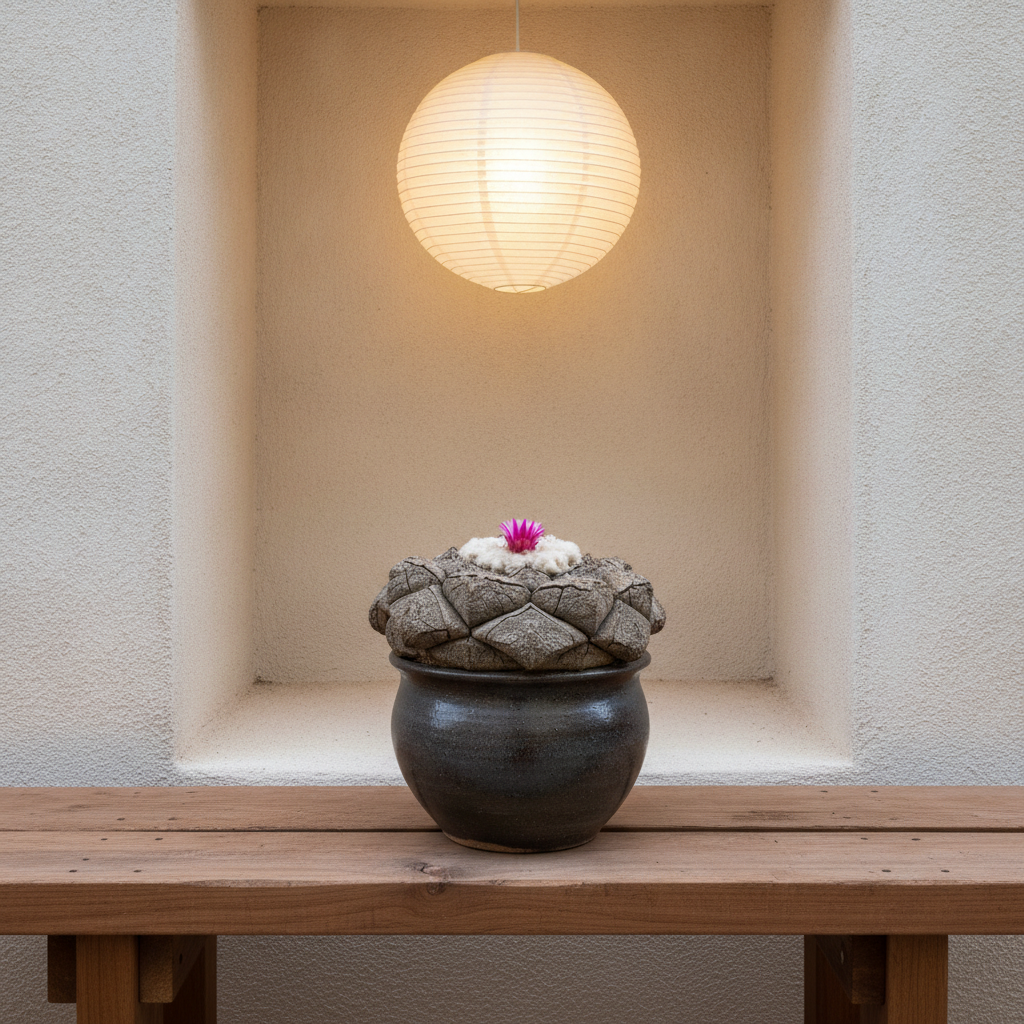
Few houseplants ask you to do so little and reward patience so generously as the living rock cactus, Ariocarpus fissuratus. A native of the limestone flats and gravelled slopes of the Chihuahuan Desert, where it ranges across the Big Bend country of west Texas and into the northern Mexican states of Coahuila, Chihuahua and Durango, this is a plant that has evolved to be overlooked. Its flattened rosette of hard, triangular tubercles sits almost flush with the ground, fissured and grey-green like a piece of cracked stone, so that grazing animals and the fierce desert sun pass it by. The common names it has gathered, living rock, star rock and the slightly misleading “false peyote”, all circle the same idea: a cactus that has perfected the art of looking like the desert floor itself.
That camouflage is more than a curiosity. It tells you almost everything about how to grow the plant well. Ariocarpus fissuratus is spineless, painfully slow, and built around a large water-storing tap root that resents wet feet above all else. As a houseplant it is genuinely undemanding, but the line between surviving and thriving is drawn entirely by restraint. Keep it bright, keep it lean, keep it dry through the cold months, and it will reward you with decades of imperceptible growth punctuated each autumn by a startling silky flower in magenta or rose. Get heavy-handed with the watering can and you can lose a plant that took a nursery a decade to raise in a single soggy fortnight. This guide covers everything from the gritty soil it demands to the once-a-year flowering display, and the conservation responsibilities that come with keeping one.
Contents
- Quick Reference
- Why the Living Rock Cactus Makes a Rewarding Houseplant
- Light Requirements
- Watering & Humidity
- Soil, Potting & Repotting
- Fertilising
- Propagation
- Pests & Diseases
- Popular Varieties
- Frequently Asked Questions
Quick Reference: Living Rock Cactus at a Glance
| Light | Full sun. The brightest, most direct position you can offer, ideally a south-facing window or a grow light supplementing it. |
| Watering | Very infrequent. Soak thoroughly only when in active growth (late summer to autumn), then allow the soil to dry completely. Keep bone dry in winter. |
| Temperature | 21 to 32 degrees Celsius (70 to 90 degrees Fahrenheit) in growth; a cool, dry winter rest at 5 to 10 degrees Celsius (41 to 50 degrees Fahrenheit). |
| Humidity | Low. Thrives in dry household air; high humidity combined with damp soil invites rot. |
| Fertiliser | Minimal. A dilute low-nitrogen cactus feed once or twice during the autumn growth period is ample. |
| Toxicity | Not listed as toxic to cats or dogs and spineless, but it is not an edible plant and contains alkaloids, so keep it out of reach of pets and children. |
Why the Living Rock Cactus Makes a Rewarding Houseplant
The appeal of Ariocarpus fissuratus is not the appeal of a fast, lush, leafy plant. It belongs instead to the world of the connoisseur succulent, prized for its strangeness, its geological beauty and the discipline it teaches. A mature specimen looks less like a living organism than a weathered fragment of rock, its tubercles arranged in a tight geometric rosette, each one grooved with a woolly central furrow and crackled across the surface like sun-baked clay. Collectors describe acquiring their first one as a turning point, the moment a windowsill of ordinary succulents becomes a serious collection.
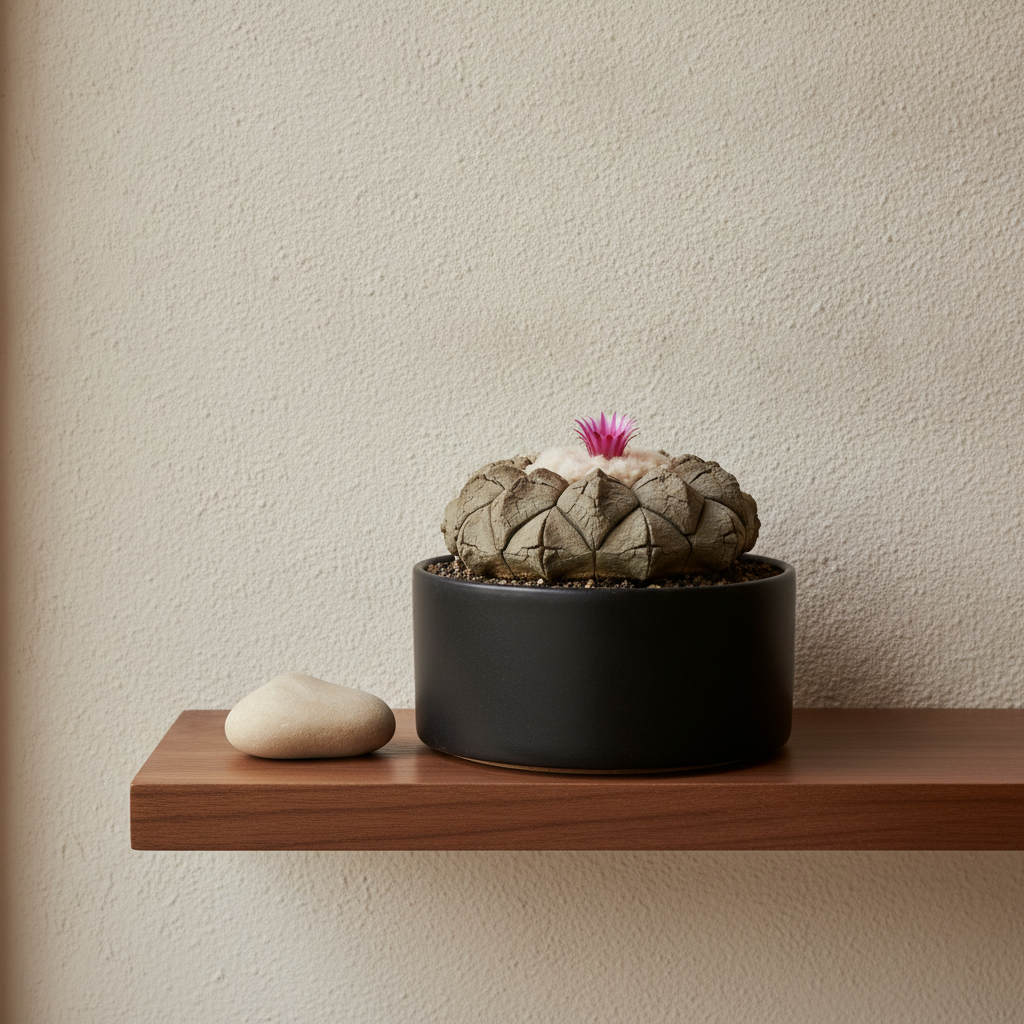
Beyond its looks, this is one of the most forgiving plants you can own in terms of time. It tolerates and indeed prefers neglect, asking for water only a handful of times a year and resenting fuss. For travellers, busy professionals or anyone who has killed more plants through kindness than through neglect, it is close to ideal. The trade-off is patience: a seed-grown plant can take ten to fifteen years to reach flowering size, and even a mature specimen may add only a tubercle or two each season. You are not growing this cactus to watch it change. You are growing it to keep something ancient and beautifully adapted alive on your windowsill, and to be rewarded each autumn when, seemingly overnight, a single luminous flower opens from the wool at its centre.
Important — Conservation: Ariocarpus fissuratus is listed on CITES Appendix I and is protected in the wild, where slow growth and illegal collection have made it vulnerable. Only ever buy nursery-propagated, seed-raised plants from reputable specialist growers, and never remove a plant or seed from the wild.
Important — Toxicity: The living rock cactus is not recorded as toxic to cats or dogs and bears no spines, but it is not a food plant and its tissues contain alkaloids. Despite the nickname “false peyote” it is not the true peyote, Lophophora williamsii. Treat it as a display plant only and keep it away from curious pets and children.
Light Requirements
If there is a single factor that separates a thriving living rock cactus from a slowly declining one, it is light. This is a full-sun desert plant that in habitat endures some of the most intense solar exposure on the continent, sitting unshaded on open limestone flats. Indoors it wants the very brightest position you can provide, and most problems with etiolation, soft growth or refusal to flower trace back to a windowsill that simply is not bright enough.
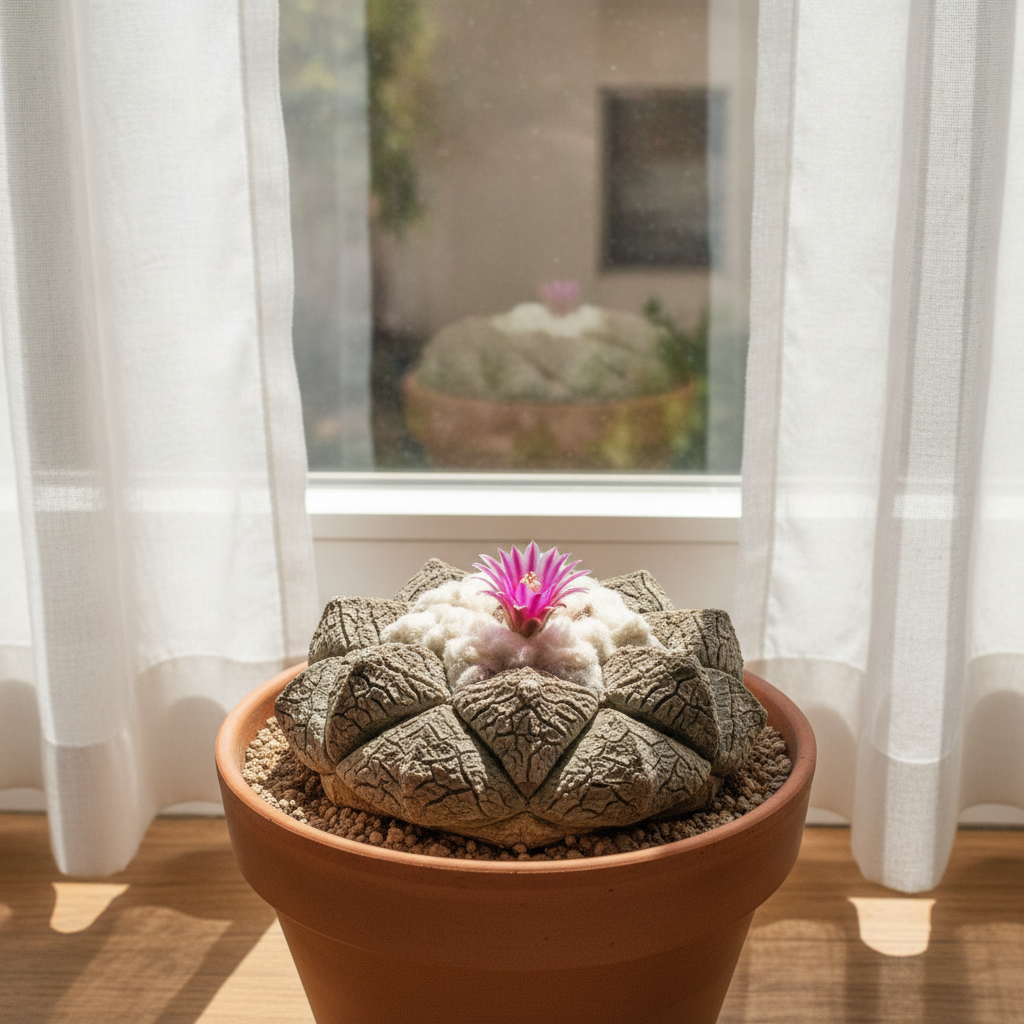
Aim for at least four to six hours of direct sun each day. A south-facing window in the northern hemisphere is the natural home for this plant, and unlike many houseplants it will not scorch behind glass under normal household conditions, having evolved for exactly this kind of punishment. The one caveat is acclimatisation: a plant moved abruptly from a dim shop shelf or a shaded greenhouse into blazing midday sun can suffer surface scorching, so increase exposure gradually over two to three weeks.
Light Levels Explained
Light is easy to misjudge by eye because the human visual system adapts so readily to dim conditions. The table below translates the usual indoor descriptions into rough illuminance figures and the outcome you can expect for this particular cactus, which sits firmly at the demanding end of the scale.
| Light Category | Approx. Level | Typical Location | Outcome |
|---|---|---|---|
| Full direct sun | 50,000 lux and above | On the sill of an unshaded south window | Ideal; compact, well-coloured, likely to flower |
| Bright indirect | 10,000 to 25,000 lux | Just back from a bright window | Survives but may grow soft and is unlikely to flower |
| Medium | 5,000 to 10,000 lux | An east or west window set back | Slow decline, elongation, pale colour |
| Low | 1,000 to 5,000 lux | A north window or interior shelf | Unsuitable; etiolation and eventual loss |
| Very low | Below 1,000 lux | Deep interior, away from windows | Will not survive long term |
Window Orientation and Placement
South-facing window: The best position by a wide margin. The strong, prolonged light keeps the rosette tight and hard-bodied and supplies the energy reserves the plant needs to flower in autumn. Sit it directly on the sill rather than setting it back into the room.
East-facing window: Workable in a very bright room but second-best. The plant receives strong morning sun and softer afternoon light, which is often not quite enough to maintain peak form over a full year. Expect slower, slightly softer growth.
West-facing window: Similar to east, offering strong afternoon sun. Acceptable if the window is large and unobstructed, but watch for heat build-up against the glass in summer, which can be intense in an enclosed sill.
North-facing window: Not suitable for this species. The light is too weak and too diffuse to support a sun-loving desert cactus, and a plant kept here will gradually etiolate and weaken regardless of how carefully you water it.
Pro Tip — Rotate for Even Growth: Because the plant grows so slowly and orients its single flower towards the brightest light, give the pot a quarter turn every couple of weeks so the rosette develops evenly and does not lean towards the glass.
How Light Affects Form and Flowering
Unlike variegated foliage plants, the living rock cactus does not signal poor light through leaf colour so much as through shape. In ample sun the body stays low, broad and densely packed, with firm tubercles and a compact woolly crown. Starved of light it begins to elongate, the centre domes upward, the tubercles soften and space out, and the characteristic rock-like flatness is lost. This stretching is largely irreversible, so prevention through bright placement matters far more than any cure. Strong light is also a precondition for flowering: a plant in marginal light may live for years without ever producing a bloom.
Warning — Sudden Exposure: Although established plants love direct sun, a specimen that has been growing in low light scorches easily if moved straight into intense sun. Patches of bleached or corky tissue are permanent. Always increase light gradually over two to three weeks.
Artificial Lighting
Where natural light is limited, a full-spectrum LED grow light is an excellent supplement and in some collections the primary light source. Position a reasonably powerful unit 20 to 30 centimetres (8 to 12 inches) above the plant and run it for 12 to 14 hours a day during the growing season. Grow lights are particularly valuable for keeping the body compact through the darker months in temperate climates, though if you are giving the plant its proper cool winter rest you can reduce the photoperiod along with the temperature.
Seasonal Adjustments
The plant’s needs shift with the year. Through spring and summer it does little, and in the hottest part of summer it often rests. Its main growth and its flowering come in late summer and autumn, triggered by shortening days and cooler nights, so this is when light matters most. In winter the plant is dormant; light can be reduced in step with cooler temperatures, but never to the point of darkness, as even a resting cactus benefits from a bright position.
Watering & Humidity
Watering is where most living rock cacti are lost, and it is worth stating the principle plainly before any detail: this plant would far rather be too dry than too wet. Its fat tap root is a reservoir built for months of drought, and the same root rots with astonishing speed in cold, sodden soil. The whole art of watering Ariocarpus fissuratus is learning to wait, to water decisively but rarely, and to read the seasons rather than the calendar.
When to Water
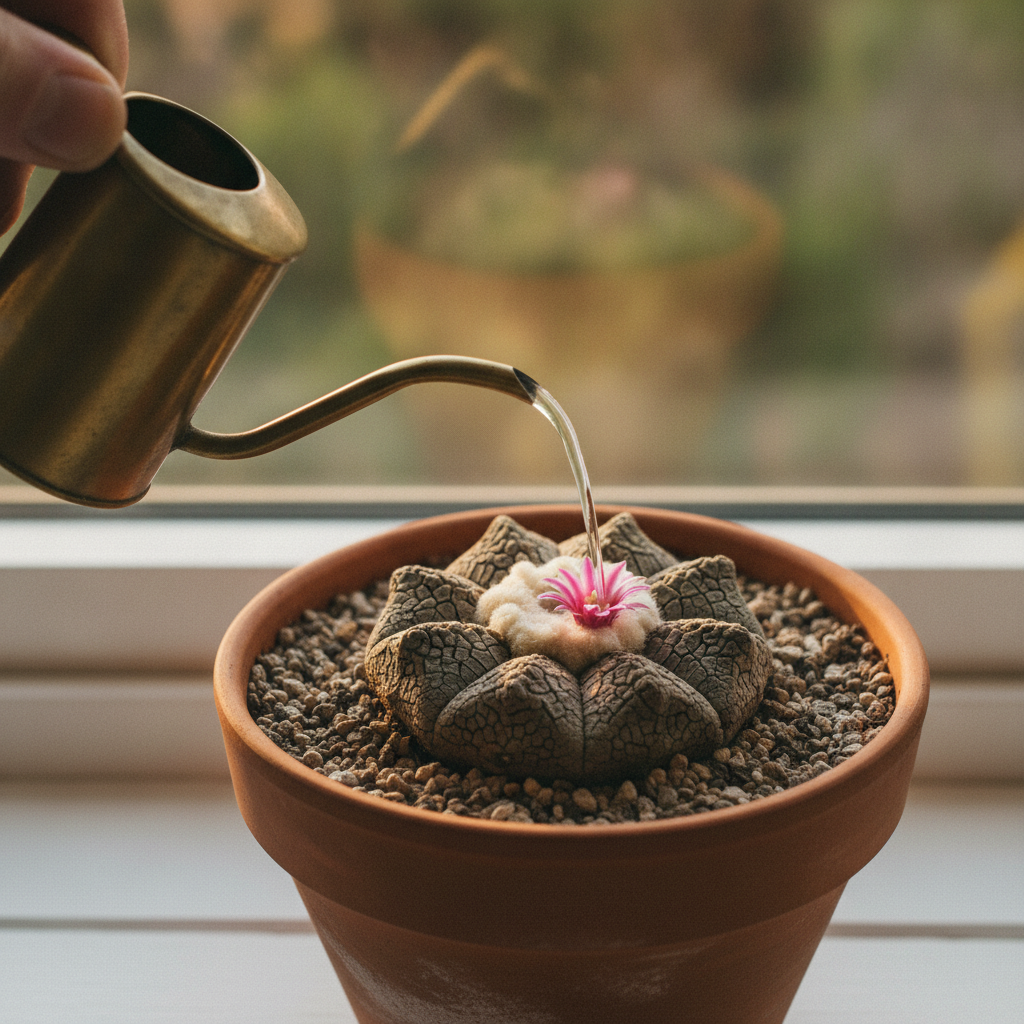
Tie your watering to the plant’s growth cycle rather than to a fixed schedule. From late summer into autumn, when the plant is actively growing and preparing to flower, it appreciates a thorough soak roughly every two to three weeks, always allowing the mix to dry out completely in between. Through the heat of high summer many growers reduce watering further, as the plant often pauses. In winter, when the plant is dormant and temperatures are low, withhold water almost entirely; an established plant can go from autumn to spring on little or nothing.
The most reliable cue is the soil itself. The potting mix should be completely dry all the way through before you even consider watering, and when in doubt you should wait. A lean, gritty mix in a small pot can take a week or more to dry fully, so resist the urge to top it up. Because the plant pulls down into the soil and shrinks in drought, a slightly wrinkled, sunken body in the growing season is a gentle sign that a drink would be welcome; a plump, firm body means it has plenty in reserve.
Pro Tip — When in Doubt, Don’t: The single most useful habit you can develop with this plant is to delay watering whenever you are unsure. A living rock cactus recovers easily from being too dry and very poorly from being too wet, so let hesitation always tip towards the watering can staying on the shelf.
How to Water Correctly
- Confirm the mix is bone dry throughout and that the plant is in active growth, not winter dormancy.
- Water at the soil surface around the base, taking care not to leave water sitting in the woolly crown where it can encourage rot.
- Soak thoroughly until water runs freely from the drainage holes, wetting the entire root zone in one go rather than giving frequent sips.
- Let the pot drain completely and empty any saucer; the roots must never stand in water.
- Return the plant to its bright spot and do not water again until the mix has dried out entirely, which may take two to three weeks or more.
Signs of Overwatering vs. Underwatering
| Symptom | Overwatering | Underwatering |
|---|---|---|
| Body colour | Yellowing, translucent or blackened patches | Dull, faded grey-green |
| Body texture | Soft, mushy, collapsing tubercles | Wrinkled, shrunken, but still firm |
| Soil | Stays damp for long periods, may smell sour | Dry well beyond the normal resting period |
| Roots | Tap root brown, soft and foul-smelling | Roots intact but body drawn down into soil |
| Crown | Rot spreading outward from a wet centre | Crown dry and intact, growth simply paused |
Warning — Root Rot: Soft, blackening tissue or a sour smell from the soil signals rot in the tap root, the most common cause of death in this species. Unpot at once, cut away all decayed tissue with a sterile blade, dust the wound, let it callous for several days and replant in dry, gritty mix, watering only sparingly once it has settled.
Humidity Requirements
Humidity is one area where the living rock cactus asks for nothing. It is perfectly suited to the dry air of a centrally heated home and in fact prefers it, since stagnant, humid air around the body combined with damp soil is a recipe for fungal problems. There is no need for misting, pebble trays or humidifiers, all of which are at best pointless and at worst harmful for a desert plant of this kind.
If anything, the risk runs the other way. In a damp, poorly ventilated room, or in a terrarium or closed cabinet, the plant is far more likely to rot. Good air movement matters more than any particular humidity figure, so an open, airy windowsill is exactly right.
Should you keep your collection somewhere naturally humid, simply lean harder on the other defences: a leaner mix with even more grit, a smaller pot, scrupulous restraint with water, and as much air circulation as you can arrange. A small fan running in a crowded growing space does more good than most growers expect.
Water Quality
Because it is watered so seldom, the living rock cactus is not especially fussy about water quality, but a few points help over the long term. Hard tap water leaves mineral deposits and can raise soil pH over years; if your water is very hard, rainwater or filtered water is a gentle improvement. Allowing tap water to stand overnight lets chlorine dissipate and brings it to room temperature, which is kinder to the roots than a cold blast straight from the tap.
Soil, Potting & Repotting
If light keeps the plant in shape and careful watering keeps it alive, it is the soil that makes both possible. The living rock cactus grows in habitat on free-draining limestone gravels where rain runs through in minutes, and replicating that sharp drainage in a pot is the foundation of good culture. A standard peaty houseplant compost, which holds water like a sponge, will kill this plant; what it needs is a gritty, mineral mix that drains almost instantly and dries quickly.
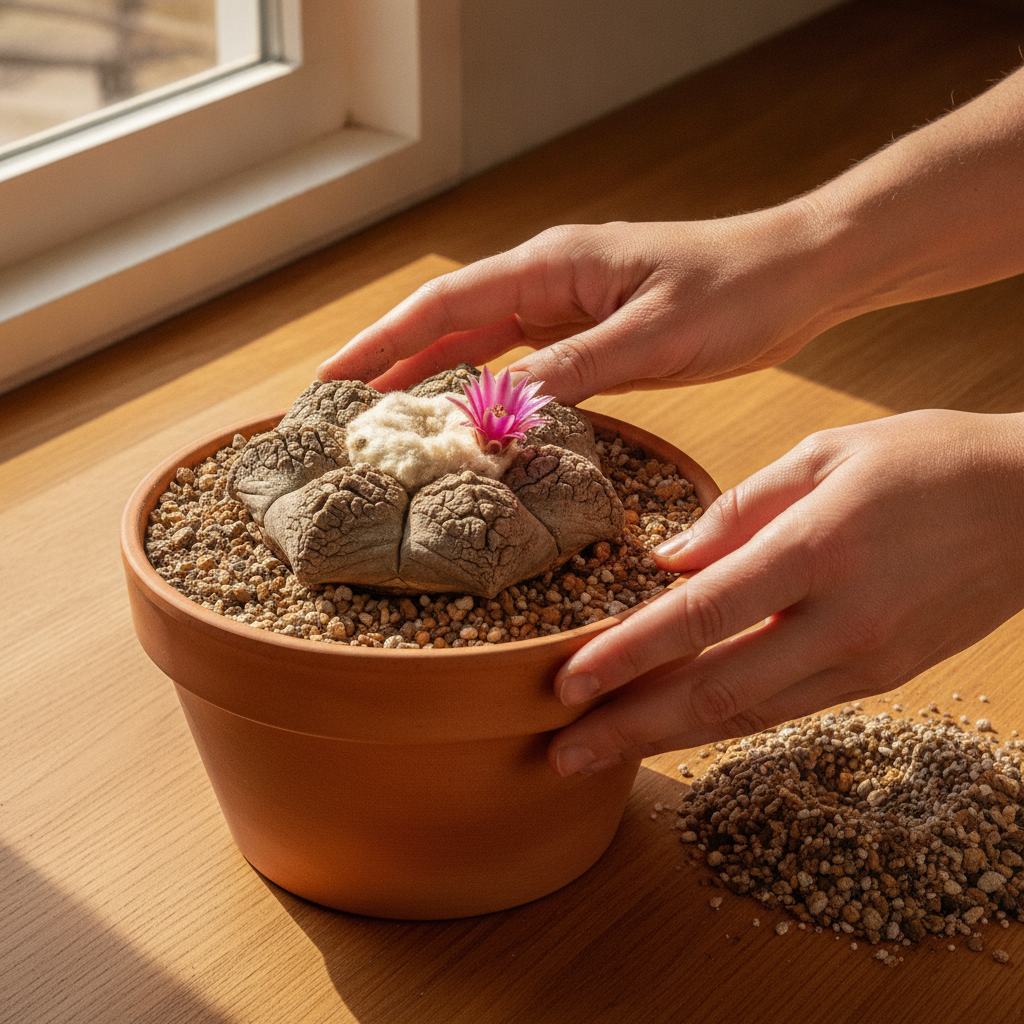
Ideal Soil Composition
Think of the mix as mostly grit with just enough organic matter to hold a trace of moisture and nutrients. A blend that is roughly two-thirds to three-quarters mineral material by volume, with the remainder a coarse organic component, gives the fast drainage and high air content the tap root demands. Many specialist growers go further still and grow their Ariocarpus in an almost purely mineral substrate.
| Component | Proportion | Function |
|---|---|---|
| Pumice or coarse grit | 40 to 50 percent | Provides the primary fast drainage and air pockets around the roots |
| Perlite or lava rock | 20 to 30 percent | Keeps the mix open and lightweight, preventing compaction |
| Coarse sand | 10 percent | Adds further sharpness and mimics the gravelly habitat |
| Loam-based or coir compost | 10 to 20 percent | Holds a little moisture and the small amount of nutrient the plant needs |
| Crushed limestone or dolomite | small handful | Reflects the alkaline, calcareous soils of its native range |
The plant grows naturally over limestone, so a slightly alkaline to neutral mix suits it better than the acidic blends favoured by many tropical houseplants. A small amount of crushed limestone, dolomite grit or even a little garden lime in the mix nudges the pH in the right direction and supplies calcium, though the plant is forgiving enough that a near-neutral mineral mix will serve perfectly well.
Pro Tip — Quick Mix Recipe: For a reliable, no-fuss blend, combine two parts pumice, one part perlite or lava rock, and one part loam-based compost, then stir through a handful of crushed limestone grit. Aim for a mix you could almost pour, with no fine dust to clog the pores.
Choosing the Right Pot
Pot choice is more important for this plant than for most, because the long tap root and the constant risk of rot pull in different directions. The aim is a container that is deep enough to accommodate the root but otherwise snug, and that dries quickly between waterings.
Drainage holes are non-negotiable. Never plant a living rock cactus in a vessel without generous drainage. A decorative cachepot with no hole, however attractive, is a death sentence for a plant this sensitive to standing water. If you love a particular ornamental pot, grow the cactus in a plain plastic or terracotta inner pot and drop that inside.
Pot material: Terracotta and other unglazed clay are excellent because they breathe and wick moisture away, helping the mix dry faster, which suits this rot-prone species. Plastic holds moisture longer, which can be useful in very arid climates or under strong grow lights but demands even more watering discipline elsewhere. Glazed ceramic sits between the two.
Pot size: Choose a deep but narrow pot rather than a wide, shallow one, so the tap root has room to descend while the surface mix is not left perpetually damp. Avoid over-potting; a container only slightly larger than the root system dries more reliably and reduces the chance of rot in the unused, water-holding soil around the edges.
When to Repot
Given how slowly it grows, the living rock cactus needs repotting only rarely, perhaps once every three to five years, and often less. Repot when the plant has clearly outgrown its container, when the mix has broken down and lost its sharp drainage, or when you suspect a root problem and need to inspect the tap root. The best time is at the start of the growing period in late summer, when the plant can re-establish quickly. Always repot into dry mix and wait at least a week before the first watering, giving any disturbed roots time to heal.
How to Repot: Step-by-Step
- Ensure the plant is dry, then gently ease it from its pot, supporting the body rather than pulling on the crown.
- Carefully tease away the old mix from the tap root, taking your time as this root is the plant’s lifeline.
- Inspect the root for any brown, soft or rotten sections and cut them back to firm, healthy tissue with a sterilised blade.
- If you have made any cuts, set the plant aside in a dry, shaded spot for several days so the wounds callous over.
- Position the plant in a deep pot of fresh dry mix so the body sits at the same level it grew before, neither buried nor perched too high.
- Firm the gritty mix gently around the root and add a top dressing of grit or gravel around the base to keep the neck dry.
- Leave the plant unwatered in bright light for at least a week, then resume careful watering only if it is in active growth.
Warning — Transplant Shock: The thick tap root is easily bruised and slow to recover. Repot only when necessary, always into dry mix, and never water immediately afterwards; a damp wound on a freshly disturbed root is the fastest route to rot.
Fertilising
Fertilising a living rock cactus is an exercise in moderation. In the wild it survives on the meagre nutrients of desert gravel, and a heavily fed plant in cultivation tends to grow soft, swollen and untrue to type, losing the tight, rocky character that makes it special. A little feeding during the growth period supports flowering and steady health, but the watchword throughout is “less”.
For most of the year the plant needs nothing at all. Concentrate any feeding into the active autumn growth period, use a dilute low-nitrogen formula, and never feed a dormant or recently repotted plant. If you forget to fertilise altogether in a given year, the cactus will hardly notice; this is a plant on which under-feeding is a far smaller sin than over-feeding.
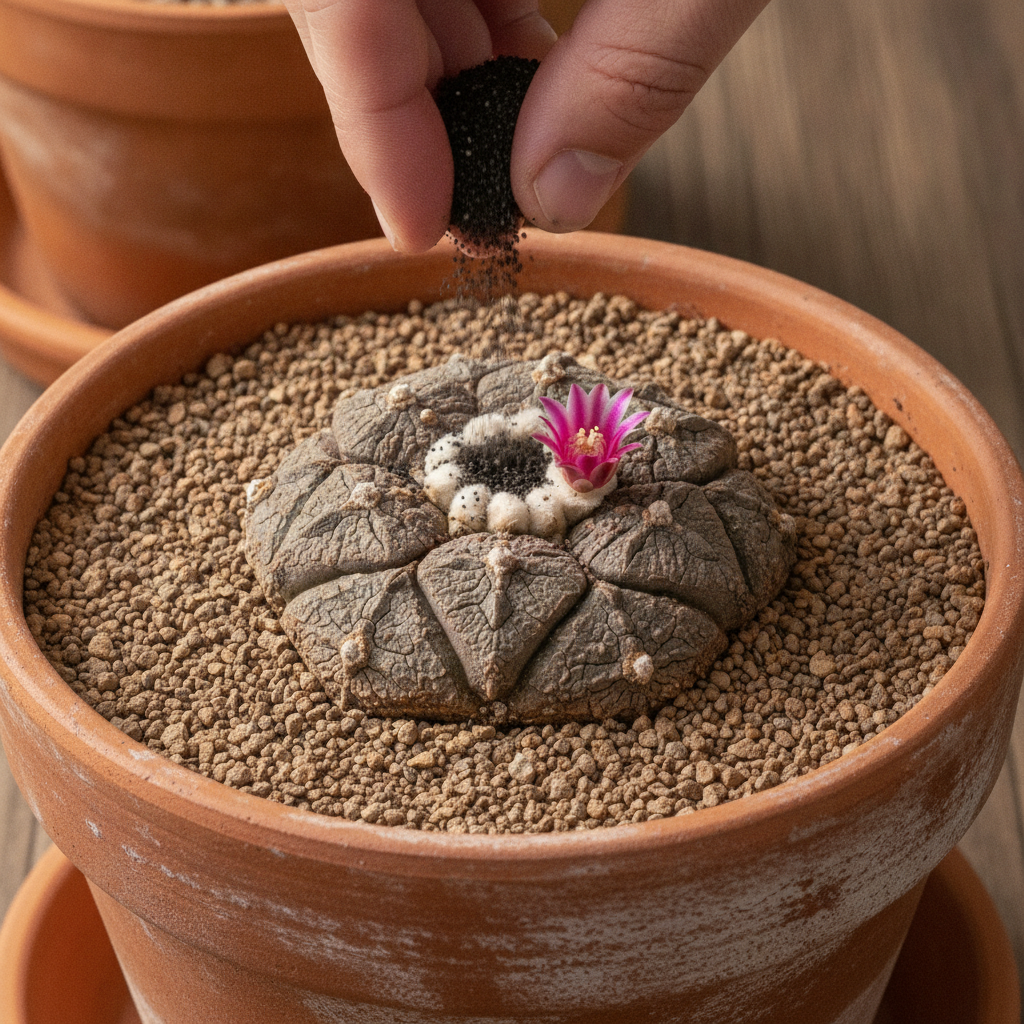
Understanding Plant Nutrients
Fertilisers are described by their balance of three main nutrients, nitrogen, phosphorus and potassium, shown on packaging as the N-P-K ratio. For a slow desert cactus, a feed low in nitrogen and relatively higher in potassium is ideal, supporting firm growth and flowering rather than the soft, sappy expansion that excess nitrogen produces. The table below summarises the roles of the key nutrients.
| Nutrient | Symbol | Primary Function | Deficiency Symptoms |
|---|---|---|---|
| Nitrogen | N | Drives body and tissue growth | Pale colour, very slow growth (rarely an issue here) |
| Phosphorus | P | Supports root health and flowering | Poor flowering, weak root development |
| Potassium | K | Firms tissue, aids flowering and stress tolerance | Soft growth, reduced drought and flower performance |
| Calcium | Ca | Builds cell walls; abundant in limestone soils | Distorted new growth (uncommon in a limey mix) |
| Magnesium | Mg | Central to photosynthesis | General yellowing of older tissue |
| Iron | Fe | Supports chlorophyll production | Pale new growth, more likely in very alkaline conditions |
Types of Fertiliser
Liquid fertilisers: The easiest type to control for a plant that needs so little. A purpose-made cactus and succulent feed, diluted to half the recommended strength or weaker, lets you deliver a precise small dose with a watering and then stop. This is the approach most growers favour.
Slow-release granular: A few prills of a low-strength slow-release feed can work, but the slow, continuous release is harder to switch off when the plant goes dormant, and it risks delivering nutrients during the dry rest. If you use it, use very little.
Organic fertilisers: Mild organic feeds such as a very dilute worm-casting tea can be used, but rich organic matter sits awkwardly with the lean, mineral culture this plant prefers and can hold moisture against the roots. On balance a controlled dilute mineral feed is the safer choice.
Feeding Schedule
Feed only during the active growth period in late summer and autumn, and only once or twice in that whole window. Always apply fertiliser to already-moist soil as part of a normal watering, never to a dry, dormant plant, and never feed in winter. One weak feed at the start of the growth period and perhaps a second a month later is the entire annual programme for a mature plant.
Pro Tip — Dilute and Halve Again: Whatever strength the label recommends for cacti, halve it, and for a living rock cactus consider halving it once more. A barely-tinted feed given twice a year keeps the plant in far better character than a stronger dose.
How to Fertilise
- Confirm the plant is in active autumn growth and that the soil is already moist from a recent watering.
- Mix a cactus fertiliser to no more than half strength, and ideally weaker still.
- Apply the dilute solution to the soil around the base, avoiding the woolly crown.
- Allow the pot to drain fully and resume the normal dry-down before the next watering.
- Do not feed again for at least a month, and not at all once growth slows for winter.
Warning — Salt Build-Up: Because the plant is watered so rarely, fertiliser salts can accumulate in the mix and scorch the roots over time. Flushing the pot thoroughly with plain water once or twice a year, and refreshing the mix when you repot, clears any build-up.
Propagation
Propagation is the one area where the living rock cactus tests a grower’s patience to the limit. Unlike the many succulents that root readily from a leaf or a severed stem, Ariocarpus fissuratus is grown almost exclusively from seed. It does not produce offsets or pups in any reliable way, its tubercles will not strike as cuttings, and there is no shortcut around the years of slow growth that follow germination. The reward for this patience is that a tray of seedlings is also the only ethical source of new plants, since wild collection is both illegal and ecologically damaging.
Seed-raising is therefore the heart of propagation, and it is genuinely rewarding for those willing to play a long game. Fresh seed, a sterile gritty medium, warmth and humidity at the germination stage, and then years of careful growing on are what it takes. Grafting onto a faster rootstock is the other technique serious collectors use, mainly to speed up the painfully slow early years, though it changes the character of the plant and is a specialist pursuit.
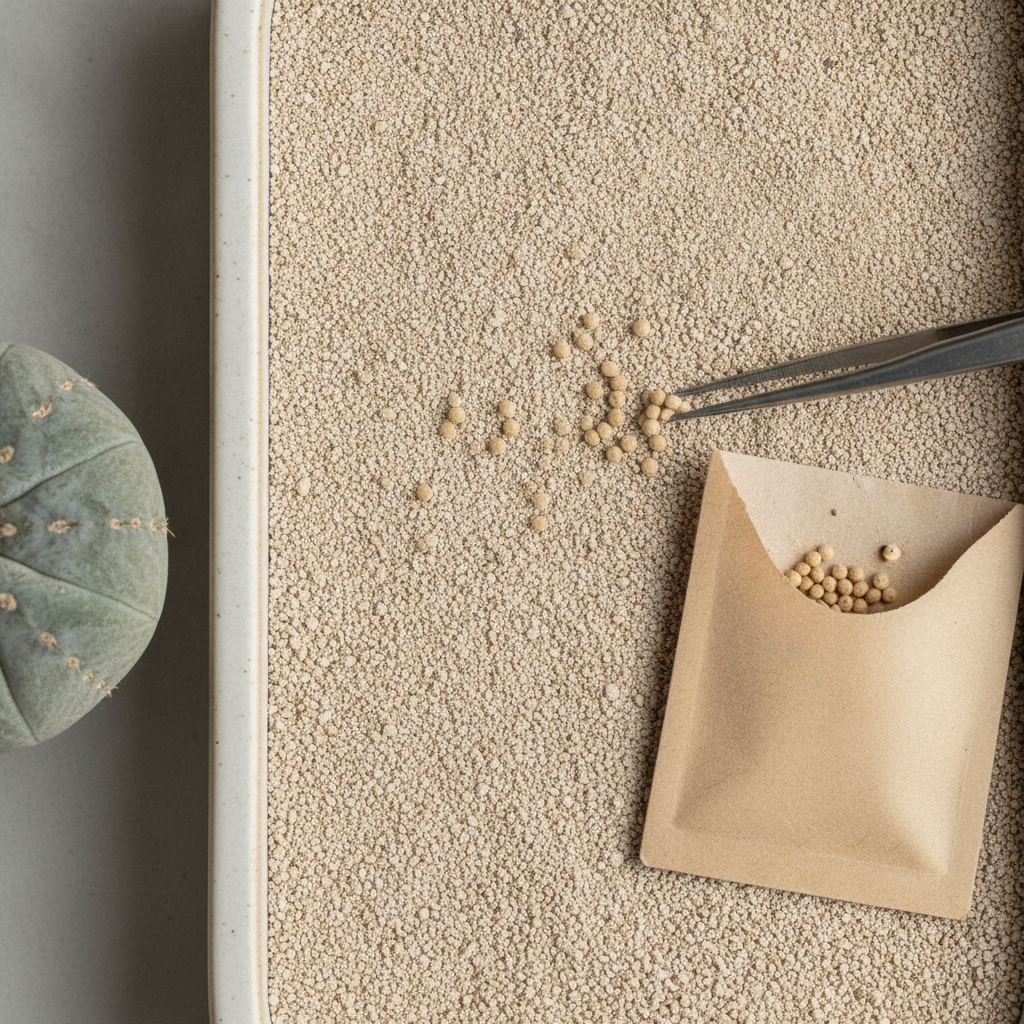
Understanding Seed and the Tap Root
To propagate this plant you need to understand two things about it. First, it sets seed only after flowering, which itself requires a mature, well-grown plant in strong light, and ideally two genetically distinct plants flowering together for cross-pollination, as the species is largely self-incompatible. Second, the seedling’s first priority is to send down a tap root, so the early years are spent building an underground reservoir while the visible body stays tiny. Patience with that hidden investment is what eventually produces a robust adult plant.
Growing From Seed: Step-by-Step
Sowing is best done in spring or early summer when warmth is reliable. Use fresh seed for the best germination, as viability falls with age.
- Fill a small, clean pot or tray with a fine, sterile, gritty seed mix and firm it level.
- Water the medium and let it drain so it is moist but not waterlogged before sowing.
- Scatter the tiny seeds thinly across the surface and press them in gently without burying them, as they need light to germinate.
- Cover the container with a clear lid or place it in a sealed bag to hold humidity, and keep it warm at around 21 to 27 degrees Celsius (70 to 80 degrees Fahrenheit) in bright but indirect light.
- Maintain even moisture and warmth; germination can begin within a week or two but may be staggered over a much longer period.
- Once seedlings appear, ventilate gradually over several weeks to wean them off the high humidity and prevent damping off.
- Grow the seedlings on slowly in their tray for one to two years before pricking them out into individual small pots of gritty mix.
Pro Tip — Wean Slowly: The riskiest moment for seedlings is the transition from the humid, enclosed germination environment to open air. Open the lid a little more each day over two or three weeks rather than all at once, and keep the surface from drying out completely while the seedlings are still tiny.
Grafting for Speed: Step-by-Step
Grafting a young seedling onto a vigorous columnar rootstock can compress years of slow growth into a single season and is used by specialists to bring plants to flowering size quickly. It is an advanced technique and the resulting plant looks and behaves differently from one grown on its own roots.
- Select a healthy, actively growing rootstock such as a Hylocereus or Myrtillocactus and a small seedling scion.
- With a sterile blade make clean, flat cuts across the top of the rootstock and the base of the seedling.
- Press the two cut surfaces together so their inner vascular rings overlap as much as possible.
- Hold the graft union under gentle, even pressure with bands or weights for one to two weeks while it fuses.
- Keep the grafted plant warm, bright and dry at the union, then remove the pressure once growth shows the graft has taken.
Troubleshooting Propagation
| Problem | Likely Cause | Solution |
|---|---|---|
| No germination | Old or non-viable seed, or too cool | Use fresh seed and maintain steady warmth around 21 to 27 degrees Celsius |
| Seedlings collapse and rot | Damping off from too much moisture or stale air | Improve ventilation, use a sterile mix, and avoid waterlogging |
| Seedlings stall and shrivel | Surface dried out completely while still tiny | Keep the medium evenly moist until the seedlings are established |
| Graft fails to take | Misaligned vascular rings or contamination | Re-cut cleanly with a sterile blade and align the rings carefully under pressure |
Pests & Diseases
For all its sensitivity to water, the living rock cactus is relatively untroubled by pests, and a healthy plant in good conditions is rarely bothered. The threats that do exist tend to hide in the woolly crown and around the root, exactly the places that are hardest to inspect, so vigilance and a magnifying glass are your best tools. By a wide margin, however, the most serious disease is one you cause yourself: root rot from overwatering.
Because the plant grows so slowly, any damage it sustains takes a very long time to grow out, which makes prevention far more valuable than cure. A regular close look at the crown and the base, especially before and after the dry winter rest, catches most problems while they are still small.

Common Pests
Mealybugs (Pseudococcidae)
The most likely pest on this species, mealybugs appear as small white cottony tufts tucked into the woolly crown and the grooves between tubercles, where they are easily mistaken for the plant’s own wool. They suck sap and weaken the plant, and root mealybugs may also infest the tap root unseen.
Treatment: Dab visible insects with a cotton bud dipped in diluted isopropyl alcohol, and for a heavier infestation drench with a systemic insecticide or repeated treatments of a suitable contact spray. If root mealybugs are suspected, unpot, wash the root and repot in fresh mix.
Spider mites (Tetranychus urticae)
In hot, dry conditions tiny spider mites can attack the body surface, leaving fine pale stippling and, in severe cases, faint webbing. They are barely visible to the naked eye, so the corky or rusty scarring they leave is often noticed first; on a slow-growing plant this scarring is permanent.
Treatment: Wipe the body gently to remove mites, improve air circulation, and apply a miticide or several rounds of an appropriate horticultural treatment, repeating to catch newly hatched mites.
Scale insects (Diaspididae)
Less common but possible, scale insects appear as small, hard, limpet-like bumps on the body surface. Like mealybugs they feed on sap and can be stubborn once established.
Treatment: Scrape or pick off individual scales, treat with diluted alcohol on a cotton bud, and use a systemic insecticide for persistent infestations.
Common Diseases
Root and basal rot (Fusarium and Phytophthora spp.)
The defining disease of this plant. Cold, wet soil allows fungal pathogens to invade the tap root and the base of the body, which turn brown, soft and foul-smelling, often before any change is visible at the surface. Once advanced it is frequently fatal.
Treatment: Act fast. Unpot, cut away every trace of soft, discoloured tissue back to clean firm flesh, dust the wounds with a fungicide or sulphur, allow them to dry and callous for several days, and replant in dry gritty mix, watering only sparingly thereafter.
Fungal spotting (various pathogens)
Persistent moisture and poor ventilation can cause dark or sunken spots on the body surface, sometimes following water left sitting in the crown. On a slow grower these blemishes linger for years.
Treatment: Improve airflow, water only at the base to keep the crown dry, remove affected tissue if it is spreading, and treat with a fungicide if necessary.
Pest and Disease Summary
| Pest / Disease | Identification | Treatment |
|---|---|---|
| Mealybugs | White cottony tufts in the crown and grooves | Alcohol on a cotton bud; systemic insecticide if widespread |
| Spider mites | Fine pale stippling, faint webbing, corky scarring | Wipe down, raise air movement, apply a miticide |
| Scale insects | Small hard bumps on the body | Remove physically; alcohol and systemic insecticide |
| Root and basal rot | Soft, brown, foul-smelling root or base | Cut out, dry, callous and replant in dry mix |
| Fungal spotting | Dark or sunken spots on the body | Improve airflow, keep crown dry, apply fungicide |
Prevention Strategies
Almost every problem this plant suffers is prevented by the same handful of habits. Water sparingly and only when the mix is bone dry, grow in a sharply draining mineral substrate, give the plant full sun and good air movement, and keep the woolly crown dry by watering at the base. A plant grown hard in these conditions is naturally resilient, and most infestations and rots take hold only when one of these basics has slipped.
Quarantine is the other key habit. Because this is a slow-growing, valuable plant that is hard to nurse back from damage, keep any newly acquired cactus separate from your collection for a few weeks and inspect it closely before letting it join the others. Catching a single mealybug on arrival is far easier than clearing an infestation that has spread across a shelf.
Pro Tip — Inspect at Watering: Make a habit of examining the crown and base each time you water, with a magnifier if you have one. Because you water so rarely, this built-in checkpoint is often enough to catch trouble early without any extra routine.
Popular Varieties
The living rock cactus is a variable species, and botanists and collectors have long recognised distinct forms and varieties across its range, alongside a handful of cultivated selections prized for their texture. Because the plant is so slow and so closely tied to its locality, much of its interest for collectors lies in these regional variations, from the broad rounded tubercles of one form to the deeply crackled surfaces of another.
It is worth noting that the taxonomy of Ariocarpus has shifted over the years, with some plants once treated as separate species now regarded as varieties or synonyms and vice versa. The forms below are those most often encountered in the trade, and all share the same fundamental care.
| Variety | Body Appearance | Light Needs | Growth Rate | Availability |
|---|---|---|---|---|
| var. fissuratus (type) | Flat grey-green rosette, triangular fissured tubercles | Full sun | Very slow | Specialist nurseries |
| var. lloydii | Larger, broader, more rounded tubercles, flatter habit | Full sun | Very slow | Specialist nurseries |
| var. intermedius | Intermediate between the type and lloydii | Full sun | Very slow | Less common |
| var. hintonii | Smaller, more pointed and densely fissured tubercles | Full sun | Very slow | Less common |
| ‘Godzilla’ | Heavily, chaotically fissured, ridged monstrose tubercles | Full sun | Very slow | Sought-after cultivar |
Featured Varieties
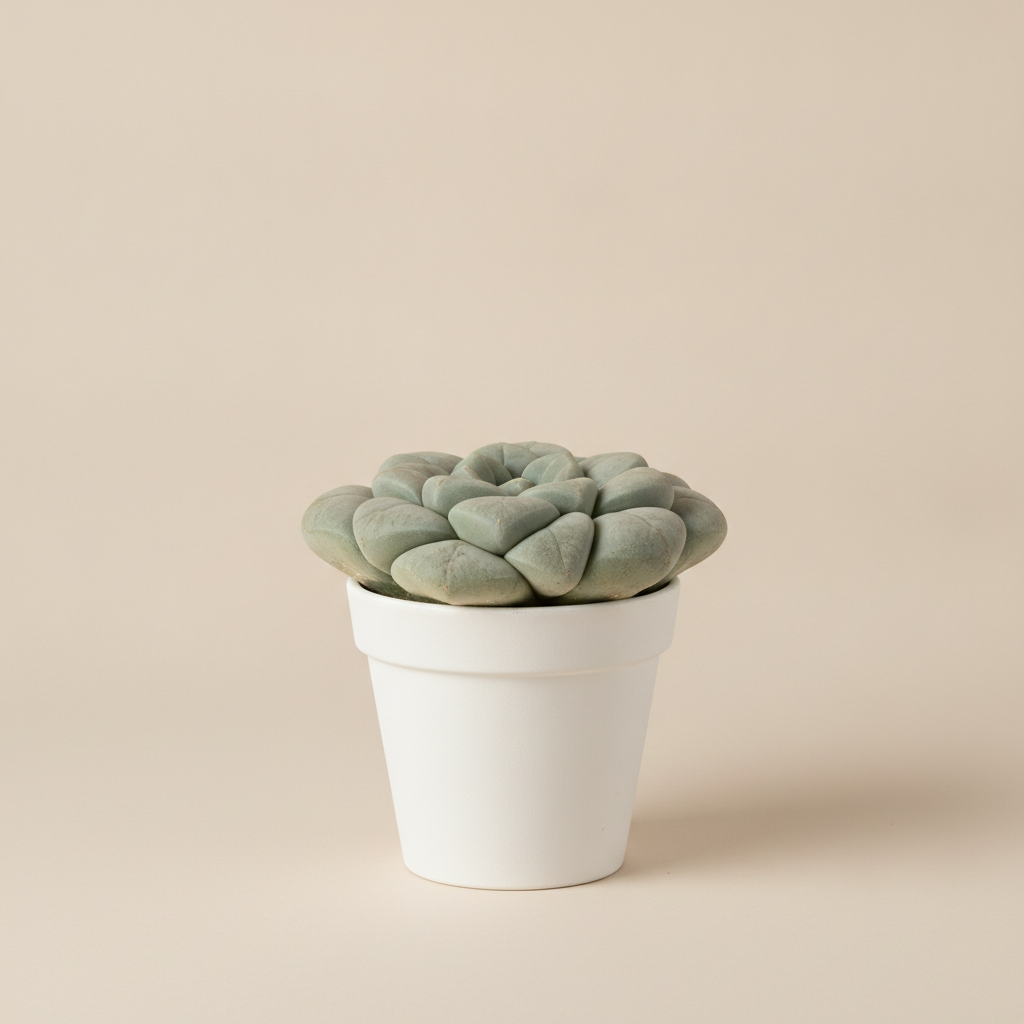
var. lloydii
The most widely grown form, with broader, more rounded and slightly larger grey-green tubercles that build a flatter, wider rosette than the type. Robust and rewarding, it is the form many collectors start with.
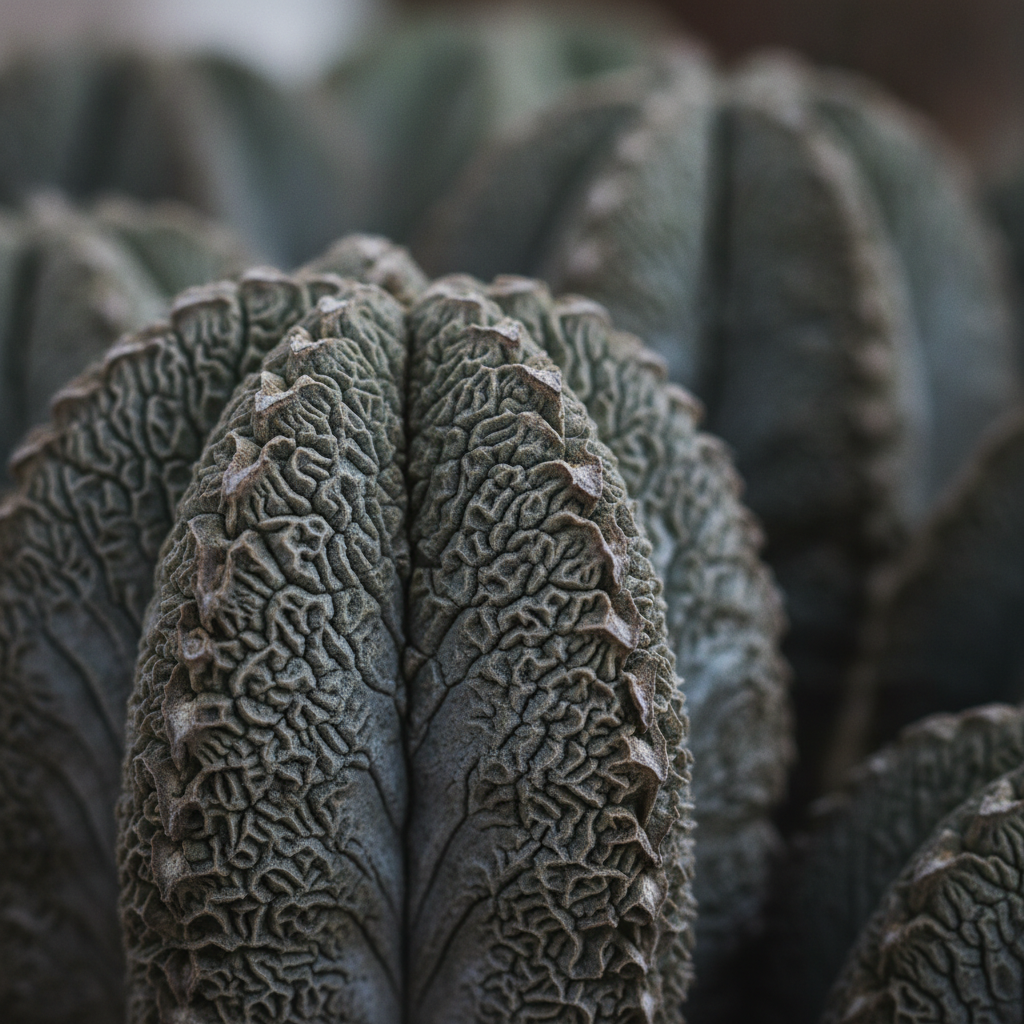
‘Godzilla’
A prized cultivar selected for its heavily and chaotically fissured, ridged tubercles, giving a rugged, deeply textured monstrose look. The exaggerated cracking makes it one of the most collectable selections of the species.
Variety Profiles in Detail
var. lloydii (Ariocarpus fissuratus var. lloydii)
Found in the more southerly part of the range, this variety tends to be larger overall, with thicker, more rounded tubercles and a less sharply fissured surface than the type. It is generally considered one of the easier and more vigorous forms to grow, and its broad, sculptural rosette makes a striking specimen as it matures.
‘Godzilla’ (Ariocarpus fissuratus cv. ‘Godzilla’)
A cultivated selection rather than a wild form, ‘Godzilla’ takes the species’ natural fissuring to an extreme, with deeply grooved, ridged and irregularly crackled tubercles that give it an unmistakably craggy appearance. It is propagated by specialists and commands a premium, but its dramatic texture has made it a favourite display plant among Ariocarpus enthusiasts.
Choosing the Right Variety for Your Space
For a first living rock cactus, the type species or var. lloydii is the sensible choice: both are as widely available as this specialist plant ever is, and both grow reliably under the same bright, dry regime. Whichever form you choose, the requirements are identical, so let availability, your budget and the particular texture that appeals to you guide the decision rather than any difference in care. Above all, buy from a reputable nursery that raises its plants from seed, both for the health of your plant and for the conservation of a species under pressure in the wild.
Frequently Asked Questions
How often should I water a living rock cactus?
Far less often than almost any other houseplant. During active growth in late summer and autumn, water thoroughly only when the mix has dried out completely, which usually means roughly every two to three weeks. In winter, keep the plant essentially dry, watering little or not at all. When unsure, always wait.
Why is my living rock cactus shrinking and pulling down into the soil?
This is usually normal behaviour rather than a problem. In drought and in winter dormancy the plant draws water from its body and retracts towards the soil, becoming wrinkled and sunken. A firm, slightly shrunken body during the dry season is healthy; if it is in active growth and looking very wrinkled, a thorough soak will plump it back up.
How long does a living rock cactus take to grow?
It is one of the slowest-growing cacti in cultivation. A seed-raised plant can take ten to fifteen years to reach flowering size, and even a mature specimen may add only a tubercle or two each year. This is a plant to keep for decades, not one to watch develop week by week.
When and how does it flower?
Mature plants flower in autumn, producing a single silky bloom in magenta, pink or occasionally white from the woolly crown at the centre. Flowering depends on the plant being well grown in strong light and given a proper dry winter rest the previous year. A plant in marginal light may never flower.
Is the living rock cactus toxic to pets?
It is not recorded as toxic to cats or dogs and has no spines, but it is not a food plant and contains alkaloids, so it should not be eaten. Despite the nickname “false peyote” it is not the true peyote. Keep it out of reach of pets and children and treat it strictly as a display plant.
Can I grow it from a cutting or offset?
No. Unlike many succulents, Ariocarpus fissuratus does not root from cuttings and does not reliably produce offsets. It is grown almost entirely from seed, and serious collectors sometimes graft young seedlings onto faster rootstock to speed up the early years. For most growers, seed is the only practical route.
What soil is best for a living rock cactus?
A very sharply draining, mostly mineral mix. Aim for two-thirds or more grit such as pumice, perlite, lava rock and coarse sand, with only a small amount of loam or coir, and a little crushed limestone to reflect its calcareous native soils. Standard peaty potting compost holds far too much water and will rot the roots.
My cactus has gone soft and discoloured at the base. What happened?
Soft, brown or foul-smelling tissue at the base or root almost always means rot from overwatering or cold, wet conditions. Unpot immediately, cut away all affected tissue back to firm clean flesh with a sterile blade, let the wound callous for several days, and replant in dry gritty mix. Then water far more sparingly than before.
Does it need a winter rest?
Yes. A cool, dry winter rest at around 5 to 10 degrees Celsius (41 to 50 degrees Fahrenheit), with little or no water, is important for the plant’s long-term health and encourages flowering. Keep it bright but cool and essentially dry from late autumn until growth resumes the following season.
Why is buying nursery-grown plants so important?
The living rock cactus is protected under CITES Appendix I and is threatened in the wild by slow regeneration and illegal collection. Wild-collected plants rarely survive and their removal damages fragile populations. Buying seed-raised plants from reputable specialist nurseries ensures a healthier plant for you and helps protect the species in its native desert.






