
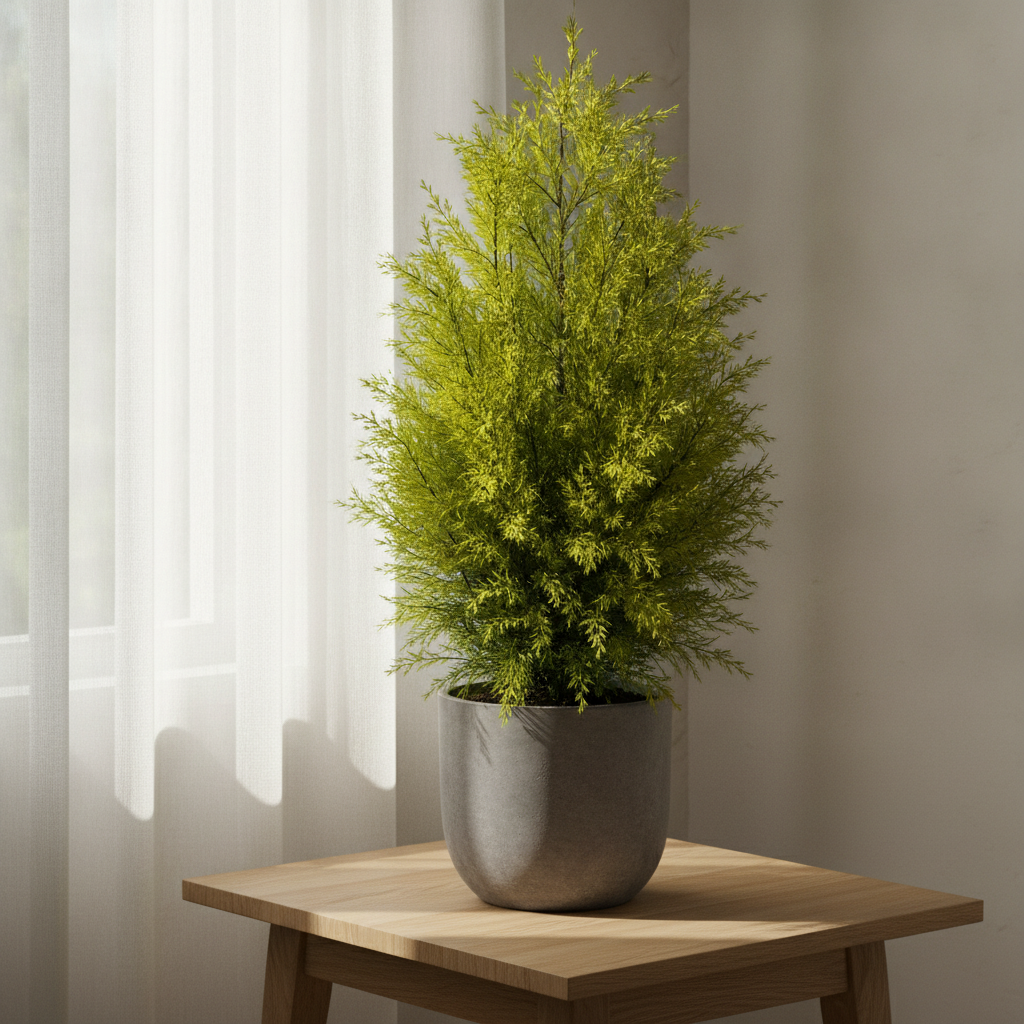
Few houseplants announce themselves to more than one sense, but the lemon cypress is an exception. Brush a hand across its dense, feathery sprays of golden foliage and the room fills with a sharp, fresh citrus scent that gives the plant its common name. Botanically it is Cupressus macrocarpa, the Monterey cypress, and the bright chartreuse-gold form sold as a houseplant is almost always the cultivar ‘Goldcrest’. In the wild the species is a windswept coastal giant clinging to a tiny stretch of the central Californian coast around the Monterey peninsula, but the compact golden selections have become popular indoor and patio plants prized for their colour, fragrance and tidy conical shape.
The lemon cypress has a slightly unfair reputation. It is often sold as an easy festive accent, then turns crisp and brown within weeks, leaving owners convinced they have killed it through neglect. The truth is that this is a sun-loving outdoor conifer being asked to live in a warm, dim, dry living room, which is far from its natural element. Understanding that single fact is the difference between a plant that merely survives for a season and one that thrives for years. This guide covers everything you need: light, watering, soil, feeding, propagation, pests and the most popular varieties, with the practical detail that keeps a lemon cypress green and aromatic rather than browning from the inside out.
Contents
- Quick Reference
- Why Lemon Cypress Makes a Rewarding Houseplant
- Light Requirements
- Watering & Humidity
- Soil, Potting & Repotting
- Fertilising
- Propagation
- Pests & Diseases
- Popular Varieties
- Frequently Asked Questions
Quick Reference: Lemon Cypress at a Glance
| Light | Very bright. At least 6 to 8 hours of direct sun, ideally the brightest spot in the home or a sunny outdoor position |
| Watering | Keep the soil evenly moist. Never allow it to dry out completely, and never leave it waterlogged |
| Temperature | 10 to 21°C (50 to 70°F). Prefers cool, airy conditions and resents hot, dry rooms |
| Humidity | Moderate. Tolerant of average humidity but dislikes dry, heated air and stagnant conditions |
| Fertiliser | Light feeder. Balanced liquid or conifer feed monthly through spring and summer |
| Toxicity | Generally regarded as non-toxic to cats and dogs, though the foliage and sap may cause mild irritation if eaten or handled |
Why Lemon Cypress Makes a Rewarding Houseplant
The appeal of the lemon cypress starts with its colour. Where most indoor plants offer shades of mid to deep green, a healthy ‘Goldcrest’ glows in vivid chartreuse and lemon-gold, a tone that lifts a corner instantly and pairs beautifully with both pale Scandinavian interiors and warmer, more textured rooms. The foliage is soft and feathery rather than spiky, arranged in dense upright sprays that taper into a naturally neat cone, so the plant looks groomed with very little intervention. Add the genuine lemon fragrance released at the lightest touch, and you have a houseplant that engages sight, scent and even sound as its fine foliage rustles.

Beyond looks, the lemon cypress is a versatile plant that bridges indoor and outdoor life. It can spend the brightest months on a balcony, terrace or doorstep, then move indoors as a fragrant living decoration for cooler weather, which is exactly why it appears in shops around the festive season as a miniature living tree. It is genuinely hardy outdoors in milder climates, surviving short spells of frost, so a plant that outgrows the windowsill can graduate to a permanent home in the garden or a large patio pot. Few houseplants offer that kind of second act.
Important — Toxicity: The lemon cypress is not listed among the plants known to be seriously toxic to cats and dogs, and is generally considered safe in a household. That said, the resinous foliage and sap can cause mild stomach upset if eaten in quantity, and the sap may irritate sensitive skin, so it is sensible to keep curious pets and small children from chewing on it and to wash your hands after heavy pruning.
Light Requirements
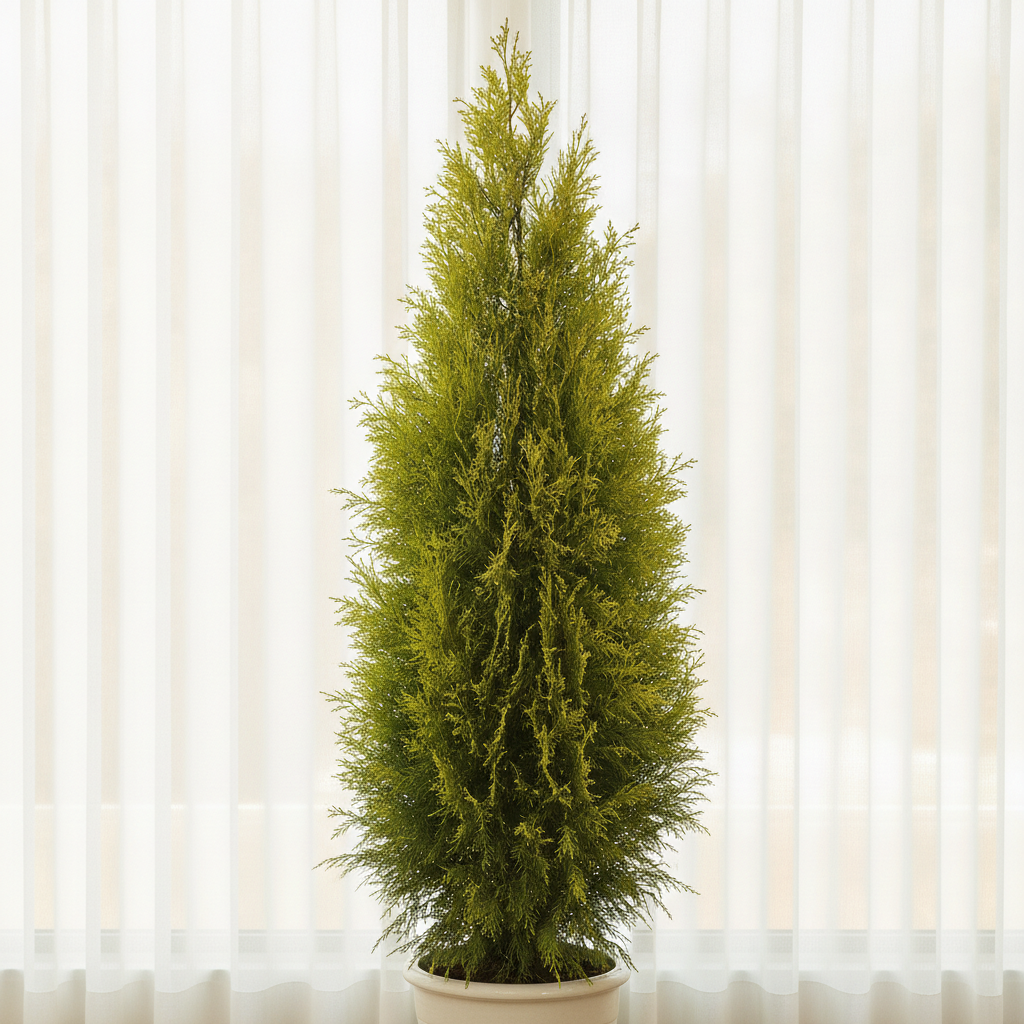
If there is one factor that decides whether a lemon cypress lives or dies indoors, it is light. This is a full-sun coastal conifer, and it carries those expectations into the living room. It wants as much direct light as you can possibly give it, ideally six to eight hours of sun falling directly on the foliage every day. In its native habitat it grows in open, exposed positions, so the dim interior light that suits a pothos or a peace lily is nowhere near enough to keep a cypress green and dense.
The single best indoor position is directly in front of your sunniest window, with nothing shading the plant. Inadequate light is the most common cause of a lemon cypress thinning out, losing its golden colour and turning a dull, lifeless green before browning. Unlike many houseplants, a cypress will not bounce back once branches have gone brown, because conifers do not readily regenerate foliage from bare, woody stems. Getting the light right from the start is therefore not optional, it is the whole game.
Light Levels Explained
Houseplant light is often described in vague terms, so the table below translates those categories into approximate brightness and shows what each means for a lemon cypress specifically. Note how poorly this plant fares in anything less than the top tier, which sets it apart from most foliage houseplants.
| Light Category | Approx. Level | Typical Location | Outcome |
|---|---|---|---|
| Direct sun | 20,000 lux and above | On a south-facing sill or outdoors | Ideal. Dense, golden, fragrant growth |
| Bright indirect | 10,000 to 20,000 lux | Just back from a sunny window | Acceptable but colour fades, growth loosens |
| Medium | 5,000 to 10,000 lux | Near an east or north window | Poor. Thinning, dulling, gradual decline |
| Low | 1,000 to 5,000 lux | Interior of a room | Plant fails, browns and dies back |
| Very low | Below 1,000 lux | Hallways, windowless corners | Unsuitable. Rapid decline |
Window Orientation and Placement
South-facing window: This is the ideal indoor home for a lemon cypress in the northern hemisphere. The long hours of direct light keep the foliage tight, golden and aromatic. Make sure the plant sits right at the glass rather than a metre back, where intensity drops off sharply.
East-facing window: Workable but second best. Morning sun is gentler and shorter, so expect slightly looser growth and a less intense colour. Rotating the plant helps keep it even.
West-facing window: Good, as the strong afternoon and evening sun delivers plenty of energy. Watch that the plant does not dry out too fast in the heat of a west window during summer.
North-facing window: Not recommended. A north aspect simply cannot supply the light a cypress needs, and the plant will thin and brown over a matter of weeks. If north light is all you have, plan to supplement heavily or grow the plant outdoors for much of the year.
Pro Tip — Rotate for Even Growth: Because the lemon cypress grows toward its light source, a plant on a windowsill will lean and become lopsided over time. Give it a quarter turn every week or two so all sides receive equal sun and the cone stays symmetrical.
How Light Affects Colour
The signature lemon-gold colour is itself a light-dependent trait. In strong sun the new growth develops its brightest chartreuse-yellow tones, while in shade the same plant produces duller, greener foliage as it tries to maximise the chlorophyll available to capture scarce light. If your cypress is losing its golden glow and looking more ordinary green, the message is almost always that it wants more sun. Move it brighter and the next flush of growth will return to colour.
Warning — Direct Sunlight: While a lemon cypress craves direct sun, a plant grown in low indoor light should not be moved abruptly into blazing summer sun, especially behind glass that magnifies heat. The sudden change can scorch soft foliage. Acclimatise it over a week or two, increasing exposure gradually, particularly when moving a plant outdoors for the season.
Artificial Lighting
Because the lemon cypress is so demanding, it is one of the few houseplants where a grow light is often genuinely worthwhile rather than a luxury, particularly through dim winters or in homes without a bright window. A full-spectrum LED grow light positioned close above the plant for 10 to 12 hours a day can supply the energy a weak window cannot. Keep the light within roughly 20 to 30 centimetres (8 to 12 inches) of the foliage for meaningful intensity, and combine it with whatever natural light you have rather than relying on it alone unless the plant has no window access at all.
Seasonal Adjustments
Light levels swing dramatically through the year, and the lemon cypress feels every bit of it. In summer the plant is happiest outdoors or in the brightest window, growing actively and colouring up. As autumn light fades, move it to your sunniest position and consider supplementing with a grow light. Winter is the danger season indoors, when short, weak days combine with dry central heating to stress the plant, so prioritise light and airflow above all else until the days lengthen again.
Watering & Humidity
Watering a lemon cypress correctly means walking a narrow line. Unlike the many succulents and drought-tolerant houseplants that prefer to dry out fully between drinks, a cypress wants its soil kept consistently and evenly moist. Conifer foliage does not store water, and once a branch dries out and browns it does not green up again, so allowing the rootball to go bone dry even once can cause permanent damage. At the same time, the plant will rot if left standing in waterlogged soil, so the goal is steady moisture without sogginess.
When to Water
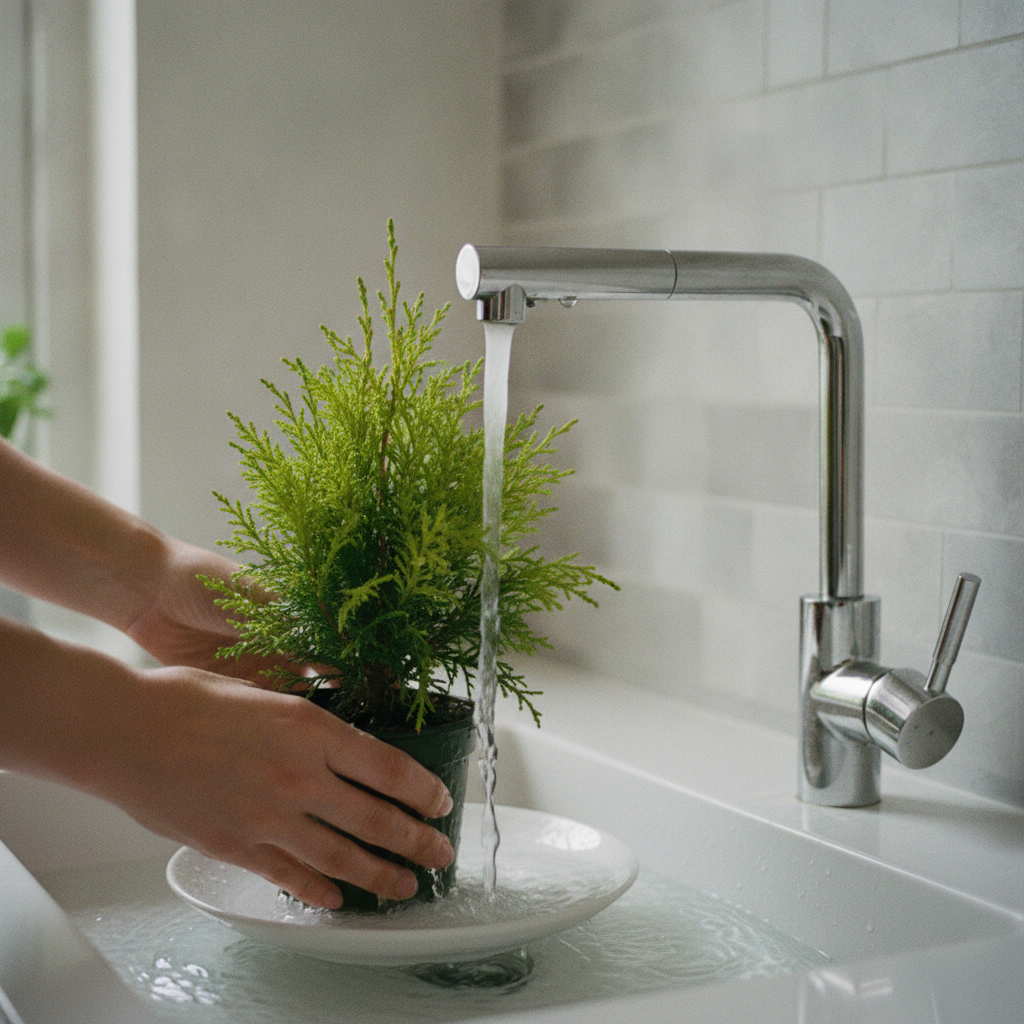
Rather than following a fixed schedule, check the soil with your finger. Water when the top one to two centimetres (about half an inch to an inch) has just begun to dry, but before the deeper soil has dried out. For most plants in a typical home that works out to roughly twice a week in summer and once a week or so in winter, though the only reliable guide is the soil itself, not the calendar.
The rate of drying depends heavily on conditions. A cypress in a sunny window or outdoors in warm weather can dry out alarmingly fast, sometimes within a day or two, while the same plant in cooler winter conditions may go a week between waterings. Pots dry faster than the surrounding soil suggests on hot, windy days, so check more often during summer and during the dry heat of the heating season.
Pro Tip — Lift the Pot: The most reliable way to judge whether a cypress needs water is to lift the pot and feel its weight. A freshly watered pot is heavy, while a dry one feels surprisingly light. After a few weeks you will know by weight alone exactly when a drink is due, long before the foliage shows any stress.
How to Water Correctly
- Check that the top of the soil has begun to dry but the rootball is still slightly moist below.
- Water slowly and thoroughly over the whole soil surface until water runs freely from the drainage holes.
- Let the pot drain completely for several minutes so no water is trapped at the base.
- Empty any water that collects in the saucer or cachepot. Never let the plant stand in it.
- Return the plant to its bright spot and check again in a few days, adjusting frequency to the season.
Signs of Overwatering vs. Underwatering
Browning is the lemon cypress’s universal distress signal, and frustratingly it can mean either too much or too little water. The clues are in the pattern and the soil, so use the table below to tell the two apart before you change anything.
| Symptom | Overwatering | Underwatering |
|---|---|---|
| Foliage colour | Browning that often starts low and inside, with a dull cast | Browning that starts at the tips and outer foliage, crisp and dry |
| Foliage texture | Soft, limp, sometimes darkening before drying | Brittle, crunchy, shattering when touched |
| Soil | Constantly wet, heavy, may smell sour | Bone dry, pulling away from the pot edges |
| Roots | Dark, soft, mushy with a foul smell | Dry and papery but generally intact |
| Recovery | Difficult once rot sets in | Possible if caught before whole branches brown |
Warning — Root Rot: A lemon cypress left in soggy soil or a pot without drainage is highly prone to root rot and to the soil-borne pathogen Phytophthora, both of which can kill the plant quickly and irreversibly. If the soil smells sour and the roots are dark and mushy, unpot immediately, trim away all affected roots with clean tools and repot into fresh, free-draining mix in a clean pot.
Humidity Requirements
The lemon cypress is not a humidity-craving tropical, and it copes with average household humidity perfectly well. Its real enemy is not low ambient moisture so much as the hot, dry, stagnant air created by central heating and radiators in winter. That combination of warmth and dryness dehydrates the fine foliage faster than the roots can replace the water, leading to the familiar winter browning.
The clearest symptom of air that is too hot and dry is interior browning and crisping of the foliage even when the soil is being kept moist, often worst on the side nearest a radiator. This is dehydration of the leaves themselves rather than a root problem, and the cure is cooler, fresher conditions rather than more water at the roots.
Rather than chasing high humidity, focus on keeping the plant cool and well ventilated. Move it away from radiators and heat sources, ensure gentle air movement around it, and if your home is very dry an occasional light misting or a nearby humidifier will do no harm. Good airflow is more valuable to a cypress than a steamy microclimate, because stagnant humid air actually encourages fungal problems on the dense foliage.
Water Quality
The lemon cypress is not especially fussy about water quality and tolerates normal tap water in most areas. In regions with very hard water, mineral build-up in the soil can accumulate over time, so an occasional flush with rainwater or filtered water helps. If you collect rainwater for your plants the cypress will happily take it, as rain is naturally soft and slightly acidic, which suits this plant well.
Soil, Potting & Repotting
The right growing medium for a lemon cypress balances two needs that pull in opposite directions: it must hold enough moisture to keep the rootball from ever drying out, yet drain freely enough that water never pools around the roots. A heavy, water-retentive compost invites rot, while a fast-draining gritty mix designed for cacti dries out too quickly for a moisture-loving conifer. The sweet spot is a fertile, structured mix that stays evenly damp without becoming sodden.
Ideal Soil Composition
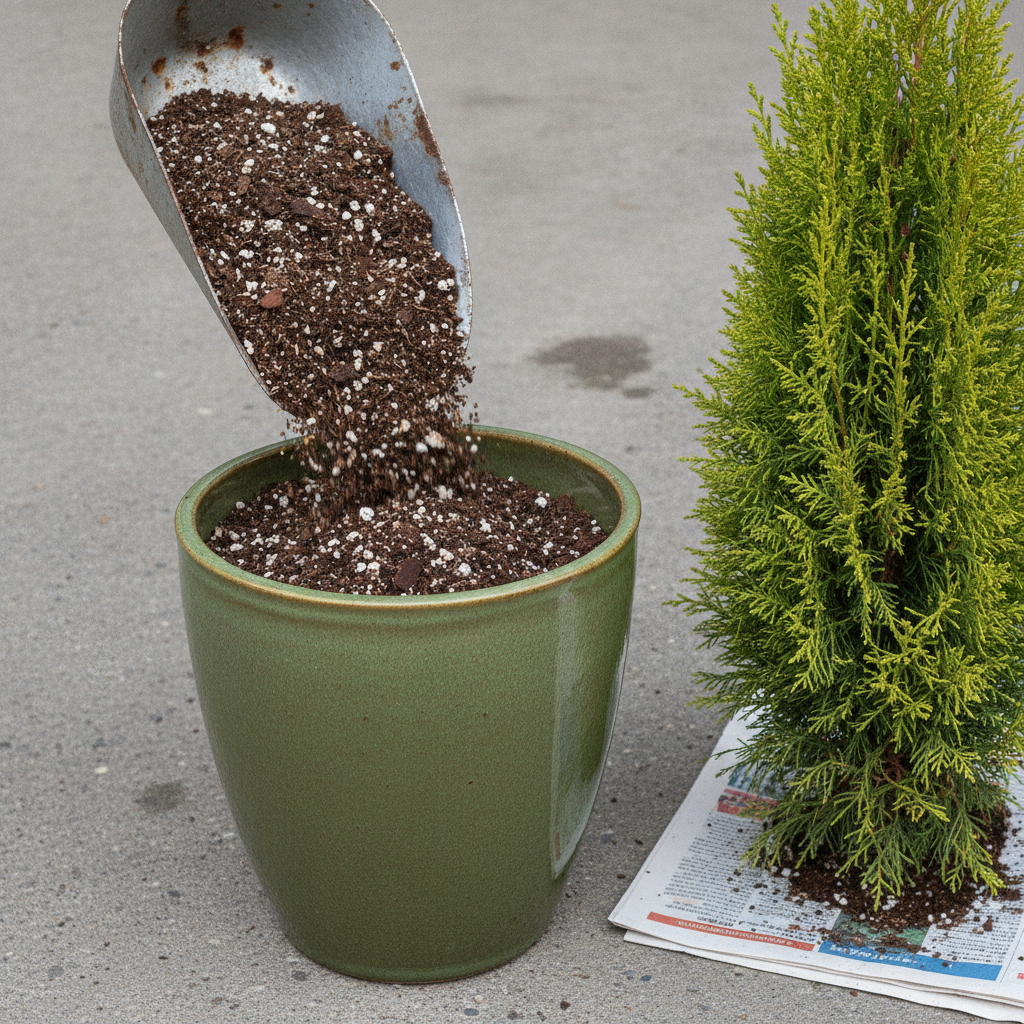
A good starting point is a quality general-purpose or loam-based potting compost opened up with material that improves drainage and aeration. The compost provides moisture retention and nutrients, while added grit, perlite or fine bark creates the air pockets that keep roots healthy. The proportions below give a reliable, free-draining but moisture-retentive blend.
| Component | Proportion | Function |
|---|---|---|
| Loam-based or quality potting compost | 60% | Holds moisture and supplies nutrients |
| Horticultural grit or coarse perlite | 25% | Opens the mix and ensures free drainage |
| Fine composted bark | 15% | Adds structure and gentle acidity |
The lemon cypress prefers a slightly acidic to neutral soil, roughly pH 6.0 to 7.0, which most peat-free and loam-based composts naturally provide. There is no need to obsess over precise pH, but avoid heavily limed or alkaline mixes, and the bark component helps keep the blend on the mildly acidic side that conifers appreciate.
Pro Tip — Quick Mix Recipe: For a no-fuss blend, combine roughly four parts of a good multipurpose compost with two parts horticultural grit or perlite and one part fine bark. This holds moisture for a thirsty cypress while still draining quickly enough to keep the roots safe.
Choosing the Right Pot
The container matters as much as what goes in it. A lemon cypress builds a substantial root system relative to its size and dislikes both cramped, root-bound conditions and the cold, wet soil of an oversized pot.
Drainage holes are non-negotiable. Whatever pot you choose must have generous drainage holes. The single fastest way to kill a lemon cypress is to leave it in a decorative pot with no outlet, where water collects unseen at the base and rots the roots. If you love a particular cachepot, keep the plant in a plain plastic nursery pot inside it and lift it out to water.
Pot material: Terracotta is an excellent choice because its porous walls allow excess moisture to evaporate and reduce the risk of waterlogging, though it does mean watering more often as the soil dries faster. Glazed ceramic and plastic retain moisture longer, which can be useful in hot positions but demands more careful watering. Choose based on your conditions and how often you can realistically check the plant.
Pot size: Move up only one size at a time, choosing a pot two to four centimetres (about one to two inches) wider than the current one. A pot that is far too large holds a reservoir of wet soil the small root system cannot use, which stays cold and soggy and encourages rot.
When to Repot
A lemon cypress typically needs repotting every one to two years, usually in spring as growth resumes. The signs are familiar: roots emerging from the drainage holes, the plant drying out far faster than it used to, water running straight through without soaking in, or growth slowing noticeably. A plant that has been in the same pot for several years will also benefit from fresh soil even if it is not badly root-bound, as old compost becomes compacted and depleted.
How to Repot: Step-by-Step
- Water the plant a day before repotting so the rootball is moist and holds together.
- Prepare the new pot with a layer of fresh, free-draining mix in the base.
- Gently ease the plant out, supporting the base of the stem, and avoid yanking it by the foliage.
- Tease out any tightly circling roots with your fingers and trim away any that are dark or mushy.
- Set the plant in the new pot at the same depth it grew before, never burying the stem deeper.
- Fill around the rootball with fresh mix, firming gently to remove large air gaps.
- Water thoroughly, let it drain, and keep the plant in good light but out of fierce midday sun for a week to settle.
Warning — Transplant Shock: Conifers resent root disturbance more than many houseplants, so handle the rootball as little as possible and never bare-root a lemon cypress. Repot in spring rather than during the stress of summer heat or winter dormancy, and expect a short settling-in period before new growth resumes.
Fertilising
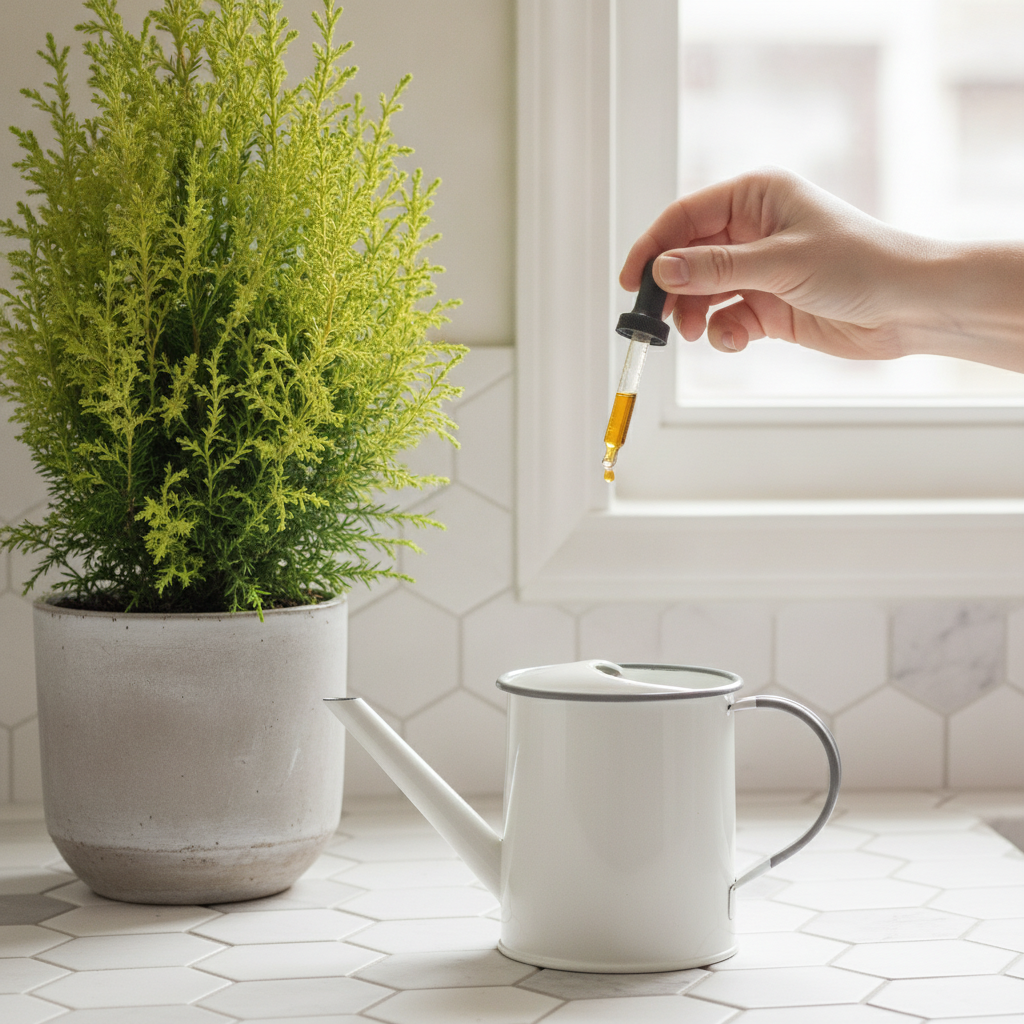
The lemon cypress is a relatively light feeder, but a potted plant has only the nutrients in its limited soil to draw on, and those are used up or washed out over time. Modest, regular feeding through the growing season keeps the foliage dense and richly coloured, while an unfed plant gradually pales, slows and becomes more vulnerable to stress and pests.
The key word is modest. Conifers are adapted to lean soils and are easily damaged by overfeeding, which can scorch the roots and burn the fine foliage. It is always safer to under-feed a lemon cypress than to overdo it, so resist the temptation to push growth with heavy doses of fertiliser.
Understanding Plant Nutrients
Plant fertilisers are described by their N-P-K ratio, the proportions of nitrogen, phosphorus and potassium, the three nutrients plants use in the largest amounts. A handful of secondary nutrients and trace elements round out a plant’s diet. For a foliage conifer like the lemon cypress, nitrogen and the trace elements that keep leaves green are particularly important.
| Nutrient | Symbol | Primary Function | Deficiency Symptoms |
|---|---|---|---|
| Nitrogen | N | Drives lush, dense foliage growth | Pale, yellowing growth and weak development |
| Phosphorus | P | Supports root and overall establishment | Stunted roots and slow, poor growth |
| Potassium | K | Strengthens stress and disease resistance | Browning tips and weak, vulnerable foliage |
| Magnesium | Mg | Central to chlorophyll and green colour | Yellowing between veins on older foliage |
| Iron | Fe | Essential for forming chlorophyll | Yellowing of the newest growth |
Types of Fertiliser
Liquid fertilisers: A balanced liquid houseplant feed diluted in water is the easiest way to feed a lemon cypress and gives you precise control over the dose. It acts quickly and is simple to apply at watering time, which makes it the default choice for most growers.
Slow-release granular: Coated slow-release pellets mixed into the soil or scattered on the surface release nutrients gradually over several months. They are convenient and low-effort, but offer less control, so choose a formulation suited to foliage plants or conifers and apply at the lighter end of the recommended rate.
Organic fertilisers: Gentle organic options such as a diluted seaweed feed or worm-cast top-dressing improve the soil and feed slowly with very little risk of burning. They are an excellent match for a plant that prefers a light, steady supply over an intense dose.
Feeding Schedule
Feed a lemon cypress only during the active growing season, roughly from early spring to late summer. A balanced liquid feed at half the recommended strength once a month is plenty for most plants. Stop feeding entirely through autumn and winter, when growth slows and the plant cannot use the nutrients, leaving unused fertiliser to accumulate as harmful salts in the soil.
Pro Tip — Feed at Half Strength: Conifers are easily overfed, so always dilute liquid fertiliser to half the dose recommended on the label. A weaker feed given regularly is far safer and more effective than an occasional strong dose, which risks scorching both roots and foliage.
How to Fertilise
- Water the plant lightly first so the roots are moist, never feed into bone-dry soil.
- Dilute a balanced liquid fertiliser to half the recommended strength.
- Apply it evenly over the soil at your normal watering, allowing the excess to drain away.
- Wipe up any feed splashed onto the foliage to avoid spotting or burn.
- Repeat roughly once a month through spring and summer, then stop for the cooler months.
Warning — Salt Build-Up: Over time, mineral salts from fertiliser can accumulate in the soil and appear as a white crust on the surface or pot rim, damaging roots and browning the foliage. Flush the pot thoroughly with plenty of plain water every few months to wash these salts out, especially if you feed regularly.
Propagation
Propagating a lemon cypress is rewarding but takes patience, because conifers root more slowly and less reliably than soft-stemmed houseplants. The standard method is taking semi-ripe stem cuttings, since the golden cultivars are selected forms that do not come true from seed and have no offsets or runners to divide. With the right timing and a little persistence, though, you can raise new plants from an established specimen.
The best time to take cuttings is from late summer into early autumn, when the current season’s growth has firmed up but is not yet fully woody. Cuttings taken at this stage, known as semi-ripe or semi-hardwood, root more dependably than soft spring growth or hard winter wood. Expect rooting to take many weeks, sometimes a few months, so set your expectations accordingly.
Understanding Semi-Ripe Cuttings
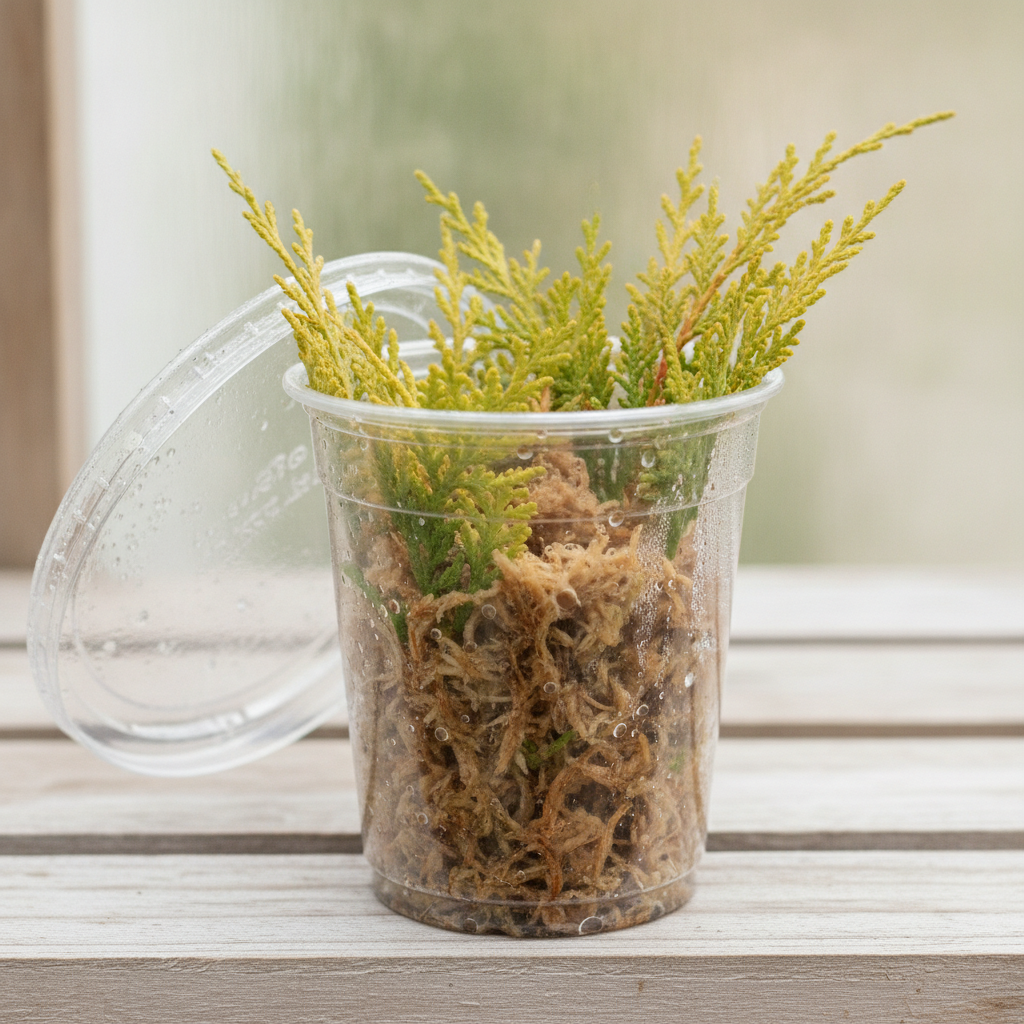
A semi-ripe cutting is a length of this year’s growth that has begun to mature and stiffen at its base while remaining flexible toward the tip. This balance matters because fully soft growth tends to rot before it roots, while hard old wood is reluctant to produce roots at all. Taking a cutting with a small sliver of older wood at its base, known as a heel, can further improve the odds, as the heel contains tissue primed to generate roots.
Stem Cuttings in a Propagator: Step-by-Step
This is the most reliable method for the home grower, using a humid, enclosed environment to keep the cuttings from drying out while they slowly form roots.
- Select healthy, semi-ripe shoots about 8 to 12 centimetres (3 to 5 inches) long from the current season’s growth.
- Take each cutting just below a point where the stem has firmed, ideally pulling it off with a small heel of older wood.
- Strip the foliage from the lower third of each cutting to leave a clean length of stem to insert.
- Dip the cut base in rooting hormone, which noticeably improves success with slow-rooting conifers.
- Insert the cuttings into a moist, free-draining mix of perlite and compost, or into damp sphagnum moss.
- Cover with a propagator lid, clear dome or plastic to hold humidity, and keep in bright, indirect light out of direct sun.
- Keep the medium lightly moist and ventilate occasionally to prevent mould, waiting patiently for roots to form over the following weeks to months.
Pro Tip — Take Plenty of Cuttings: Because conifer cuttings root erratically, success is a numbers game. Take far more cuttings than the number of plants you actually want, perhaps six or more, and accept that only some will take. With a tray of cuttings rather than a single one, the odds of raising at least a few new plants improve dramatically.
Water Rooting: Step-by-Step
Some growers experiment with rooting cypress cuttings in water. It is less reliable than a propagator for woody conifers, but it lets you watch for roots and can work as a low-effort trial alongside a proper batch in soil.
- Take semi-ripe cuttings as above and strip the lower foliage so no leaves sit below the waterline.
- Place the cuttings in a clean glass of fresh water in a bright spot out of direct sun.
- Change the water every few days to keep it fresh and oxygenated and to prevent rot.
- Watch for fine roots to appear, which may take many weeks, and discard any cuttings that go soft or brown.
- Once roots are a few centimetres long, pot the cutting carefully into a free-draining mix and keep it humid while it adjusts to soil.
Troubleshooting Propagation
| Problem | Likely Cause | Solution |
|---|---|---|
| Cuttings brown and dry out | Humidity too low, cuttings drying faster than they root | Cover to hold humidity and keep the medium lightly moist |
| Cuttings rot and go soft | Medium too wet or air too stagnant | Use a free-draining mix and ventilate the cover regularly |
| No roots after months | Wood too soft or too hard, or hormone not used | Take semi-ripe cuttings with a heel and use rooting hormone |
| Mould on cuttings or medium | Excess moisture and poor air movement | Reduce moisture, increase ventilation, remove affected cuttings |
Pests & Diseases
A healthy lemon cypress grown in good light with steady moisture and fresh air is reasonably resistant to trouble, but a stressed plant is a magnet for problems. The dry, warm conditions of a heated home in particular favour the cypress’s most persistent enemy, the spider mite, while soggy soil opens the door to root rot and fungal disease.
Prevention beats cure with every one of these issues. Most pest outbreaks take hold on plants already weakened by poor light, erratic watering or stale air, so the single best defence is keeping your cypress in conditions that suit it. Inspect the plant regularly, parting the dense foliage to check the interior where pests like to hide.
Common Pests
Spider Mites (Tetranychus urticae)
Spider mites are by far the most common and damaging pest of indoor lemon cypress. These tiny sap-sucking arachnids thrive in exactly the warm, dry air a heated home provides, multiplying rapidly and causing a dull, dusty, fading look to the foliage, often with fine webbing visible deep inside the plant. Left unchecked they can brown out a whole plant.
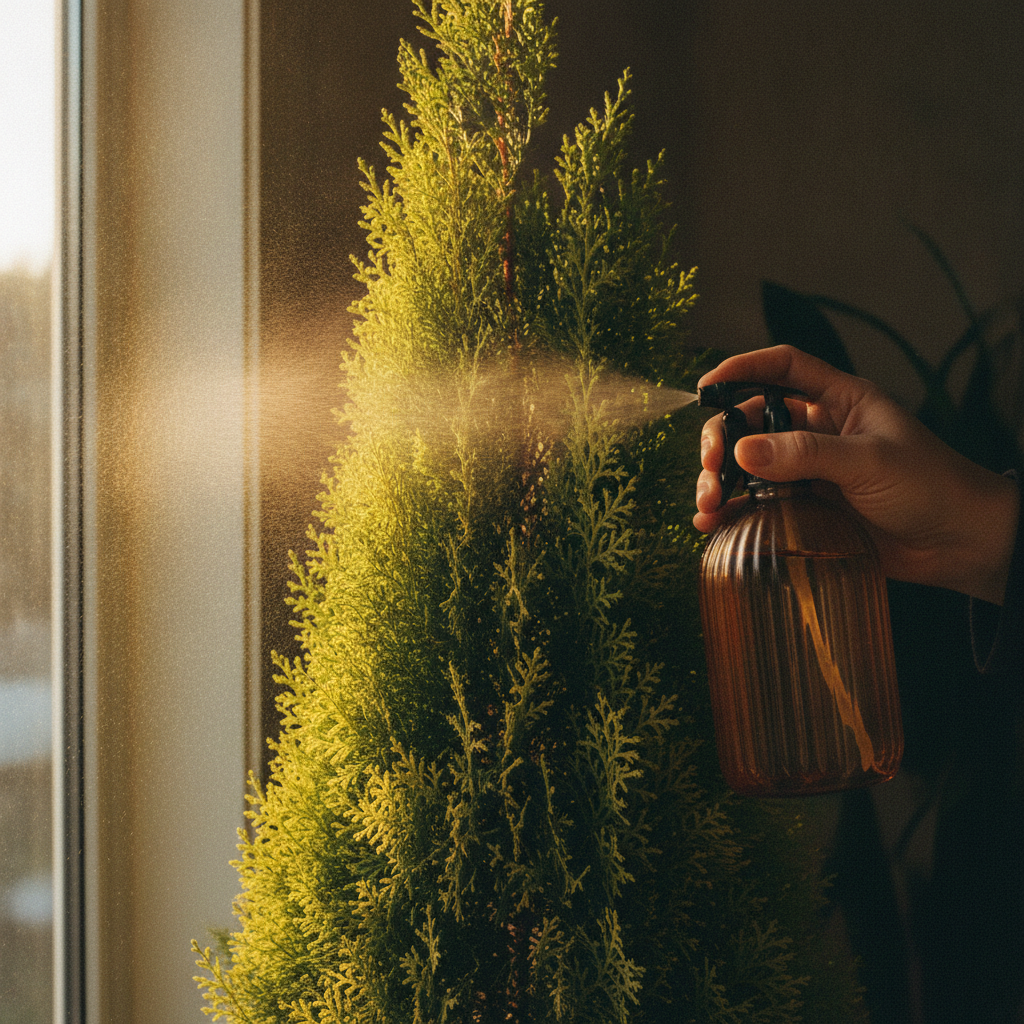
Treatment: Rinse the plant thoroughly with water to dislodge mites, then treat with insecticidal soap or neem oil, paying particular attention to the dense interior foliage. Repeat every few days over several weeks to break the life cycle, and raise humidity and airflow to make conditions less favourable.
Aphids (Aphidoidea)
Aphids are small soft-bodied insects that cluster on tender new growth, sucking sap and excreting sticky honeydew that can lead to sooty mould. They tend to appear on plants pushing fresh growth, especially in spring, and on cypress moved outdoors for the warmer months.
Treatment: Dislodge light infestations with a strong jet of water, then treat with insecticidal soap or neem oil as needed. Repeat applications usually clear them within a couple of weeks.
Scale Insects (Coccoidea)
Scale insects appear as small, immobile brown or tan bumps along the stems and foliage, protected by a waxy shell that makes them easy to overlook and harder to treat. Like aphids they suck sap and produce honeydew, gradually weakening the plant.
Treatment: Remove scale by hand or dab each one with a cotton bud dipped in diluted alcohol, then treat with horticultural oil or neem to catch the mobile young. Persistence over several weeks is needed for full control.
Common Diseases
Root Rot (Phytophthora and Pythium species)
Root rot is the most serious disease of potted lemon cypress and is almost always caused by waterlogged soil or a pot without drainage. The roots suffocate and decay, the foliage browns and wilts despite wet soil, and the soil itself may smell sour. Once advanced it is frequently fatal.
Treatment: Act early. Unpot the plant, cut away all soft, dark roots with clean tools, and repot into fresh, free-draining mix in a clean pot with good drainage. Then correct the watering routine that caused the problem in the first place.
Cypress Canker (Seiridium cardinale)
Cypress canker is a fungal disease that infects branches through wounds, causing sunken lesions, resin bleeding and the dieback of individual branches, which turn brown while the rest of the plant stays green. It is more often a problem on stressed outdoor plants but can affect indoor specimens too.
Treatment: There is no cure once a branch is infected, so prune out affected branches well below the lesion using clean tools sterilised between cuts, and dispose of the material. Keeping the plant vigorous and unstressed is the best protection.
Pest and Disease Summary
| Pest / Disease | Identification | Treatment |
|---|---|---|
| Spider mites | Dull, dusty foliage with fine webbing inside | Rinse, then neem or insecticidal soap, raise humidity |
| Aphids | Clusters on new growth, sticky honeydew | Water jet, then insecticidal soap or neem |
| Scale | Brown waxy bumps on stems and foliage | Remove by hand, treat with horticultural oil |
| Root rot | Browning with wet soil, sour smell, mushy roots | Trim rotten roots, repot, correct watering |
| Cypress canker | Sunken lesions and browning of single branches | Prune out infected branches, keep plant vigorous |
Prevention Strategies
The foundation of prevention is simply good culture. A lemon cypress kept in bright light, watered steadily so it is never soggy or bone dry, fed modestly in season and given fresh moving air is far less likely to suffer any of these problems. Stress is what invites pests and disease, so meeting the plant’s needs is itself the most effective pest control.
Build a habit of inspection. Every week or two, part the foliage and look into the interior of the plant where mites and scale begin, check the colour and feel of the soil, and quarantine any newly bought plant for a couple of weeks before placing it near your cypress. Catching a problem in its first days makes it trivial to solve, while an outbreak left for a month can take over the whole plant.
Pro Tip — Shower It Regularly: Giving your lemon cypress a gentle shower or a spell outdoors in light rain every few weeks washes dust and the earliest spider mites from its dense foliage before they can establish. This simple routine is one of the most effective ways to keep mites at bay on a plant that hides them so well.
Popular Varieties
Almost every lemon cypress sold as a houseplant is a golden cultivar of Cupressus macrocarpa, the Monterey cypress, selected for compact size and bright colour rather than the towering green form of the wild species. The differences between the named varieties come down to the exact shade of gold, the density and habit of growth, and the ultimate size, which lets you choose one to suit a windowsill, a patio pot or a permanent place in the garden.
The two you are most likely to encounter are ‘Goldcrest’ and the more compact ‘Wilma’, often sold as ‘Wilma Goldcrest’. Beyond these, a handful of other selections offer spreading habits or different colour tones for collectors and gardeners. The table below compares the most widely grown forms.
| Variety | Leaf Appearance | Light Needs | Growth Rate | Availability |
|---|---|---|---|---|
| ‘Goldcrest’ | Soft, feathery, bright lemon-gold | Full sun | Moderate | Very common |
| ‘Wilma’ (‘Wilma Goldcrest’) | Dense, fine, bright golden-green, compact | Full sun | Slow to moderate | Common |
| ‘Gold Spread’ | Golden foliage on a low, spreading habit | Full sun | Moderate | Occasional |
| ‘Goldcrest Wilma’ | Very compact, neat conical gold form | Full sun | Slow | Common |
| ‘Greenstead Magnificent’ | Blue-green rather than gold, spreading | Full sun | Slow | Rare |
| ‘Saligna Aurea’ | Golden, thread-like weeping foliage | Full sun | Moderate | Rare |
Featured Varieties
‘Goldcrest’
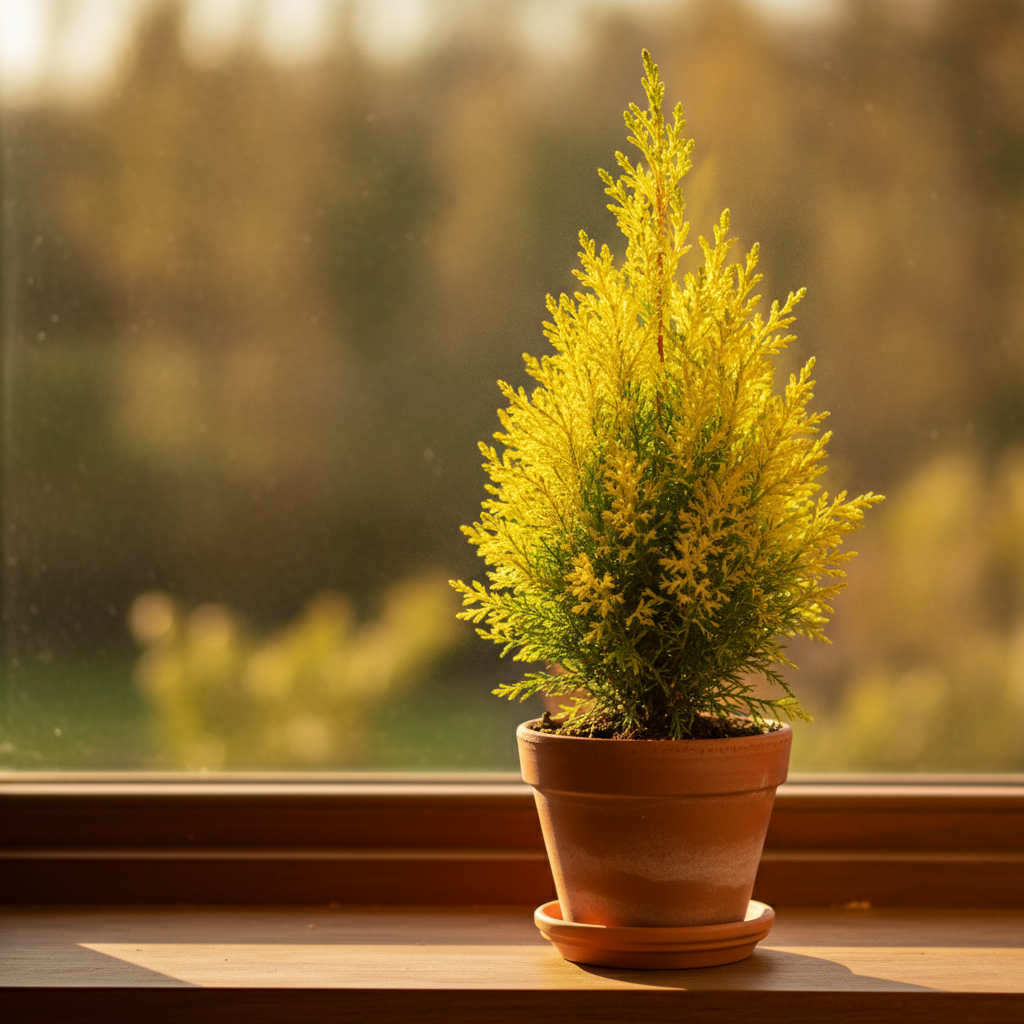
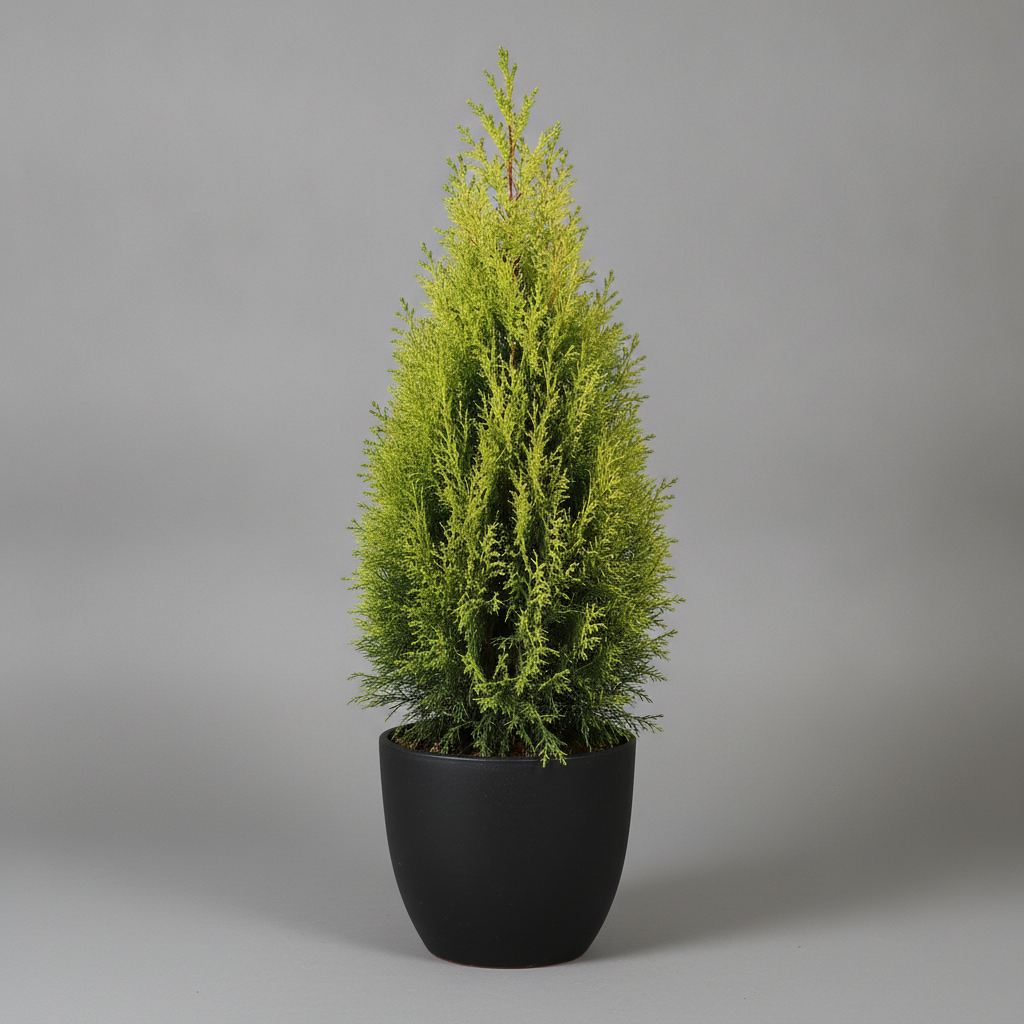
The classic and most widely sold lemon cypress, ‘Goldcrest’ has soft, feathery foliage in a vivid lemon-yellow to chartreuse tone and carries the strongest citrus scent. It forms a neat upright cone and is the variety most people picture when they think of a lemon cypress.
‘Wilma’
A more compact, denser sport of ‘Goldcrest’, ‘Wilma’ has finer, tightly packed golden-green foliage and a slower, neater habit that makes it especially well suited to growing indoors and in smaller pots. Its density gives it a particularly groomed, columnar look.
Variety Profiles in Detail
‘Goldcrest’ (Cupressus macrocarpa ‘Goldcrest’)
Raised in England in the early twentieth century, ‘Goldcrest’ became the definitive golden Monterey cypress and remains the standard against which the others are judged. Grown in full sun it holds a brilliant lemon-gold colour and a strong fragrance, and while compact in a pot it can in time reach several metres if planted out in a mild climate. For indoor growing it needs the brightest possible position to keep its colour and density.
‘Wilma’ (Cupressus macrocarpa ‘Wilma’)
A naturally occurring compact mutation of ‘Goldcrest’, ‘Wilma’ offers the same colour and scent in a denser, slower-growing and more manageable form. This tidy habit and smaller ultimate size make it the variety most often recommended for windowsills, tabletops and small patio containers, where a full-sized ‘Goldcrest’ would quickly outgrow its space.
Choosing the Right Variety for Your Space
For most indoor growers the choice comes down to space and ambition. If you want a compact, slow plant that will sit happily on a sunny sill for a long time, the dense and restrained ‘Wilma’ is the natural pick. If you have a very bright spot, a conservatory or a plan to move the plant outdoors as it grows, classic ‘Goldcrest’ gives you the fullest colour and fragrance and the option of a future life as a garden tree. Whichever you choose, the golden Monterey cypress will only stay bright and dense if you can meet its central demand for abundant direct light, so let the brightness of your space guide the decision as much as the variety name.
Frequently Asked Questions
Why is my lemon cypress turning brown?
Browning is the lemon cypress’s all-purpose stress signal, and the three most common causes are letting the soil dry out completely, insufficient light, and the hot, dry air of a heated room. Crucially, brown foliage on a conifer does not green up again, so the aim is to prevent further browning by correcting the cause: keep the soil evenly moist, move the plant to your brightest window, and keep it cool and away from radiators.
Can a lemon cypress live indoors permanently?
It can, but only in genuinely bright, cool, airy conditions, which most homes struggle to provide year-round. Many people grow lemon cypress as a seasonal indoor plant and move it outdoors for the brighter, cooler months, which keeps it far healthier. If you want to keep one indoors permanently, give it your sunniest window or a grow light, keep it away from heat sources, and accept that it is a more demanding houseplant than most.
How big does a lemon cypress get?
Indoors and in pots, growth is slow and the plant typically stays between about 0.6 and 1.5 metres (2 to 5 feet), and regular trimming keeps it smaller and denser. Planted out in a mild climate, however, ‘Goldcrest’ can eventually become a substantial tree several metres tall, so a plant that outgrows the home can find a permanent place in the garden.
Can I prune my lemon cypress to shape it?
Yes, and light, regular trimming keeps it dense and tidy. The important rule is to cut only into green, foliaged growth and never back into bare, woody stems, because a lemon cypress will not regrow from old wood. Shear lightly in spring and summer to maintain the cone shape, taking a little at a time rather than a hard cut.
Is lemon cypress safe for cats and dogs?
The lemon cypress is generally regarded as non-toxic and does not appear on the main lists of plants seriously dangerous to cats and dogs. Even so, the resinous foliage can cause mild stomach upset if a pet eats a quantity of it, and the sap may irritate skin, so it is wise to discourage pets from chewing on it. If a pet does eat a large amount and seems unwell, consult your vet.
Why has my lemon cypress lost its golden colour?
The golden colour is driven by strong light, so a cypress fading to a duller green is almost always telling you it needs more sun. Move it to the brightest position you have, or supplement with a grow light, and the next flush of growth should return to its bright lemon-gold tone. Underfeeding during the growing season can also dull the colour, so a light monthly feed in spring and summer helps.
How often should I water a lemon cypress?
There is no fixed schedule, because the right frequency depends on light, temperature and season. As a rough guide, expect to water roughly twice a week in warm, bright conditions and about once a week in cooler weather, but always check the soil first. Water when the top centimetre or two has just begun to dry, never letting the rootball dry out fully or sit waterlogged.
Why does my lemon cypress smell like lemons?
The fragrance comes from aromatic oils in the foliage, which are released when the leaves are brushed, crushed or warmed by the sun. This citrus scent is entirely natural and one of the plant’s main attractions. A healthy, well-grown plant in good light produces the strongest fragrance, so a cypress that has lost its scent along with its colour is usually asking for more sun.






