

Few houseplants wear their tropical origins as openly as the laceleaf anthurium. The waxy, heart-shaped spathe that most people mistake for a flower looks almost too perfect to be alive, as though someone had dipped a leaf in lacquer and set a slender tail at its centre. Anthurium andraeanum earns its keep not through a brief seasonal flush but through bracts that hold their colour for weeks at a time, often with several open at once. Understanding the difference between merely keeping this plant alive and coaxing it into that near-continuous display is the whole project, and it is a more achievable one than its exotic looks suggest.

Quick Reference
| Common names | Laceleaf, flamingo flower, tailflower, painter’s palette |
| Botanical name | Anthurium andraeanum |
| Family | Araceae |
| Light | Bright, indirect light; no direct midday sun |
| Watering | When the top 2 to 3 cm (1 inch) of mix dries; never waterlogged |
| Soil | Chunky, free-draining aroid mix rich in bark and perlite |
| Temperature | 18 to 27 C (64 to 81 F) |
| Humidity | High; 60 percent or above preferred |
| Fertiliser | Dilute, phosphorus-inclusive feed every 4 to 6 weeks in growth |
| Mature size | 40 to 60 cm (16 to 24 inches) tall indoors |
| Toxicity | Toxic to pets and people if chewed; sap irritates skin |
| Difficulty | Intermediate |
In this guide
- Why grow a laceleaf anthurium
- Light
- Watering
- Soil and potting
- Fertilising
- Propagation
- Pests and problems
- Varieties
- Frequently asked questions
Why grow a laceleaf anthurium
The laceleaf belongs to the arum family, the same sprawling group that gives us peace lilies, monsteras and philodendrons, and it shares their basic floral architecture. What reads as a single glossy bloom is in fact two structures working together. The broad, coloured, heart-shaped sheet is the spathe, a modified bract whose job in the wild is to attract pollinators and protect the true flowers. Those true flowers are the hundreds of tiny blooms packed along the upright spadix, the slender tail that gives the plant its alternative name of tailflower. Native to the wet forests of Colombia and Ecuador, Anthurium andraeanum grows there as an epiphyte or semi-epiphyte, anchoring itself to tree trunks and rotting wood rather than rooting deep in soil. That single fact about its origins explains almost every care decision that follows.
The appeal indoors is twofold. First, the foliage alone justifies a place on the shelf: thick, leathery, deep green leaves with a faint sheen and clean, cordate outlines that look composed even when the plant is not in bloom. Second, and more famously, a well-kept laceleaf flowers almost continuously, cycling fresh spathes every few weeks so that a mature specimen is rarely without colour. Commercial growers have stretched the palette far beyond the original scarlet into pinks, whites, corals, purples and even near-black, which means the species can suit almost any interior rather than only the boldest. It is this combination of architectural foliage and reliable, long-lasting colour that has made the laceleaf one of the most widely sold flowering houseplants in the world.
Pro Tip — Read the leaves first: A laceleaf tells you how happy it is through its newest growth. Leaves that emerge full-sized, deep green and glossy mean conditions are right. Smaller, paler new leaves and a long gap between spathes are the plant’s way of saying that light, humidity or feeding has slipped below what it needs to thrive.
It is worth being clear-eyed about the difference between survival and performance. A laceleaf will tolerate a surprising amount of neglect, limping along in a dim corner with sporadic watering for a long time without dying. But tolerating and thriving are not the same thing. The plant that produces a constant succession of glossy spathes is the one whose owner has matched the forest conditions it evolved for: warm, humid, brightly but indirectly lit, and rooted in an airy medium that never stays sodden. None of these are difficult to provide, but all of them matter, and the sections that follow take each in turn.
Light
Light is the single biggest lever you have over whether a laceleaf flowers, and it is the variable most people get wrong. Because the plant grows beneath a forest canopy, it is adapted to bright but filtered light rather than the full, unbroken sun of an open field. Indoors this translates to a position that receives plenty of ambient brightness without the direct beam of midday sun falling on the leaves. An east-facing window, where the plant catches gentle morning light before the sun climbs, is close to ideal. A north-facing window can work in a bright room, while a south or west aspect is excellent provided the plant sits a metre or two back from the glass or behind a sheer curtain that diffuses the harshest rays.
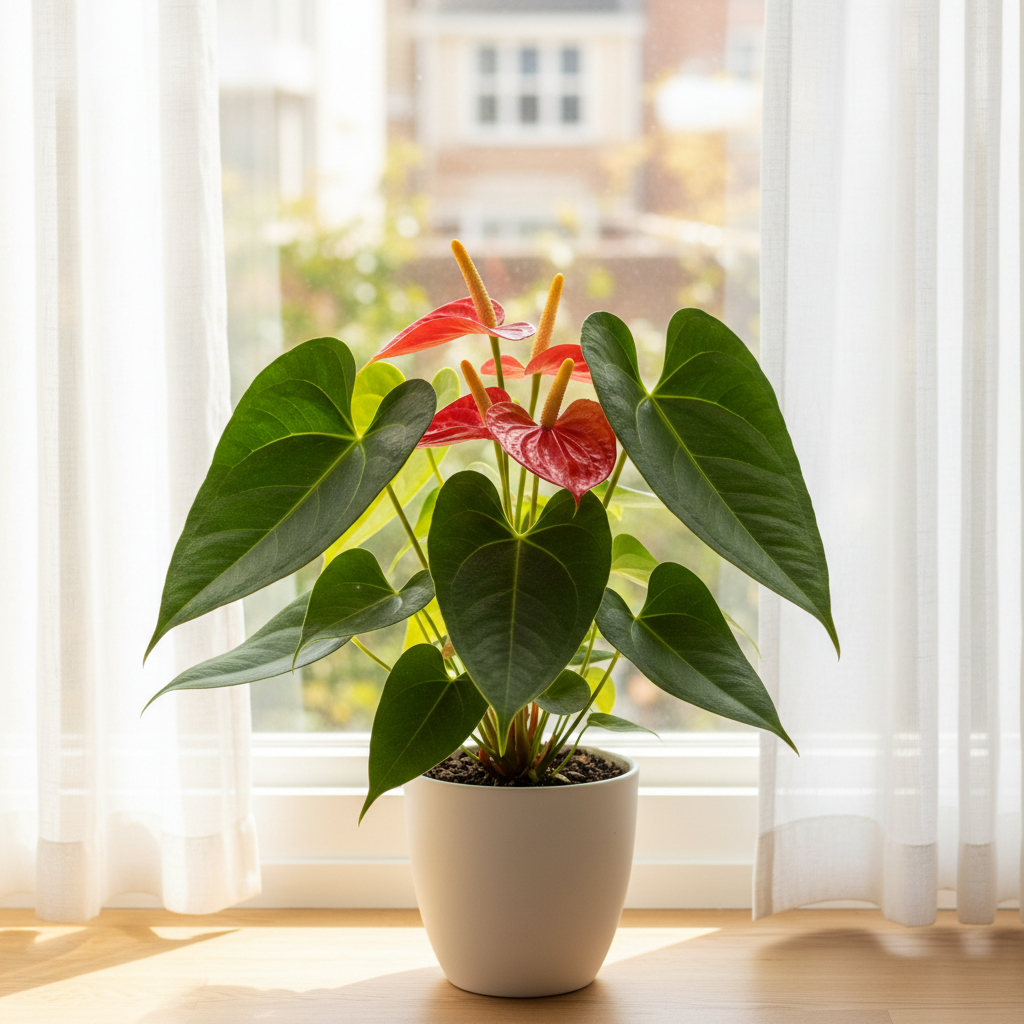
Too little light is the most common reason a healthy-looking laceleaf simply refuses to bloom. In deep shade the plant survives, pushing out leaves at a slow pace, but it lacks the energy budget to fund the metabolically expensive business of flowering. If your plant has gone many months without a spathe and the foliage looks dark but the new growth is sparse and small, the remedy is almost always more light. Move it closer to a window or to a brighter room and watch the next few leaves: when they begin to emerge larger and the internodes stay short, you have found the right exposure.
The opposite error is just as damaging. Direct sun striking the leaves, especially through glass that concentrates the heat, scorches the foliage and bleaches the spathes. The first sign is usually a pale, washed-out patch on the leaf surface that later turns brown and crisp at the centre. Unlike a wilting leaf, scorch does not recover, so it pays to notice the early bleaching and move the plant before the damage sets in. If you are growing in a genuinely dark home, a full-spectrum LED grow-light running for ten to twelve hours a day is a reliable substitute and will keep a laceleaf flowering through the dim months of winter as well as a good window does in summer.
Watering
Watering a laceleaf well means holding two ideas at once: the plant likes consistent moisture, but its epiphytic roots will rot in standing water faster than almost any other quality will harm it. The resolution is to water thoroughly and then allow the top of the mix to dry before watering again. In practice that means letting the top 2 to 3 cm (about 1 inch) of the medium dry to the touch, then watering until liquid runs freely from the drainage holes, and always emptying the saucer afterwards so the pot never sits in a reservoir. A plant kept in this rhythm has roots that are evenly damp but never starved of air, which is exactly what those thick, white epiphytic roots evolved to expect.
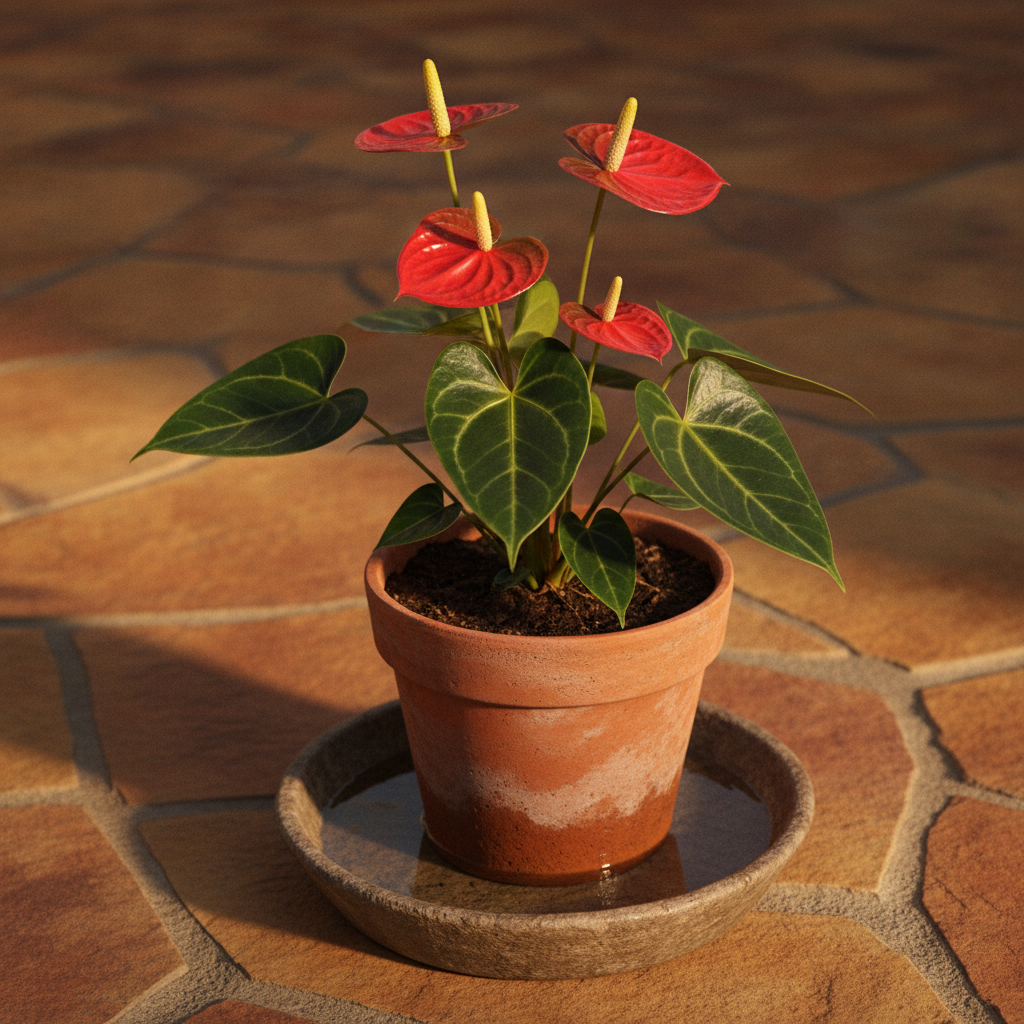
Because the airy mix a laceleaf prefers drains so quickly, some growers find bottom-watering more reliable than watering from above. Standing the pot in a shallow dish of water for fifteen to twenty minutes lets the medium draw moisture up through capillary action until it is evenly damp, after which the pot is lifted out and allowed to drain. This approach avoids the channelling that can happen when water races straight through chunky bark and out the bottom without wetting the root ball at all. Whichever method you use, the frequency will vary with the season: a plant in warm, bright summer conditions may need water twice a week, while the same plant in cool, dim winter might go ten days or more between drinks.
Water quality matters more for anthuriums than for many houseplants. They are mildly sensitive to the chlorine, fluoride and dissolved salts in some tap waters, which can show up as browning leaf tips over time. If your tap water is hard or heavily treated, letting it stand overnight before use helps dissipate chlorine, and rainwater or filtered water is better still. Lukewarm water is kinder than cold straight from the tap, which can shock tropical roots. As for humidity, which is really the other half of the watering question, the laceleaf is unapologetically a high-humidity plant. It is happiest above 60 percent relative humidity, and in the dry air of a centrally heated room it benefits enormously from grouping with other plants, a pebble tray, or a small humidifier nearby.
Warning — Root rot is the usual killer: More laceleaf anthuriums die from overwatering than from any other cause. If the lower leaves yellow and the base of the stem turns soft and brown, suspect rot, unpot the plant immediately, cut away any black mushy roots with sterilised scissors, and repot into fresh, barely damp mix. Caught early, the plant often recovers; left in soggy soil, it rarely does.
Soil and potting
The medium you choose is where the laceleaf’s epiphytic nature must be respected most directly. In the wild its roots cling to bark and decaying wood, surrounded by air and flushed by rain that drains away in moments. Standard houseplant compost, which holds water around the roots and compacts into a dense mass, is the opposite of that and is the fastest route to the root rot described above. What the plant wants instead is a chunky, open mix that holds a little moisture while leaving generous air pockets, and that drains almost as freely as the bark it would otherwise live on.
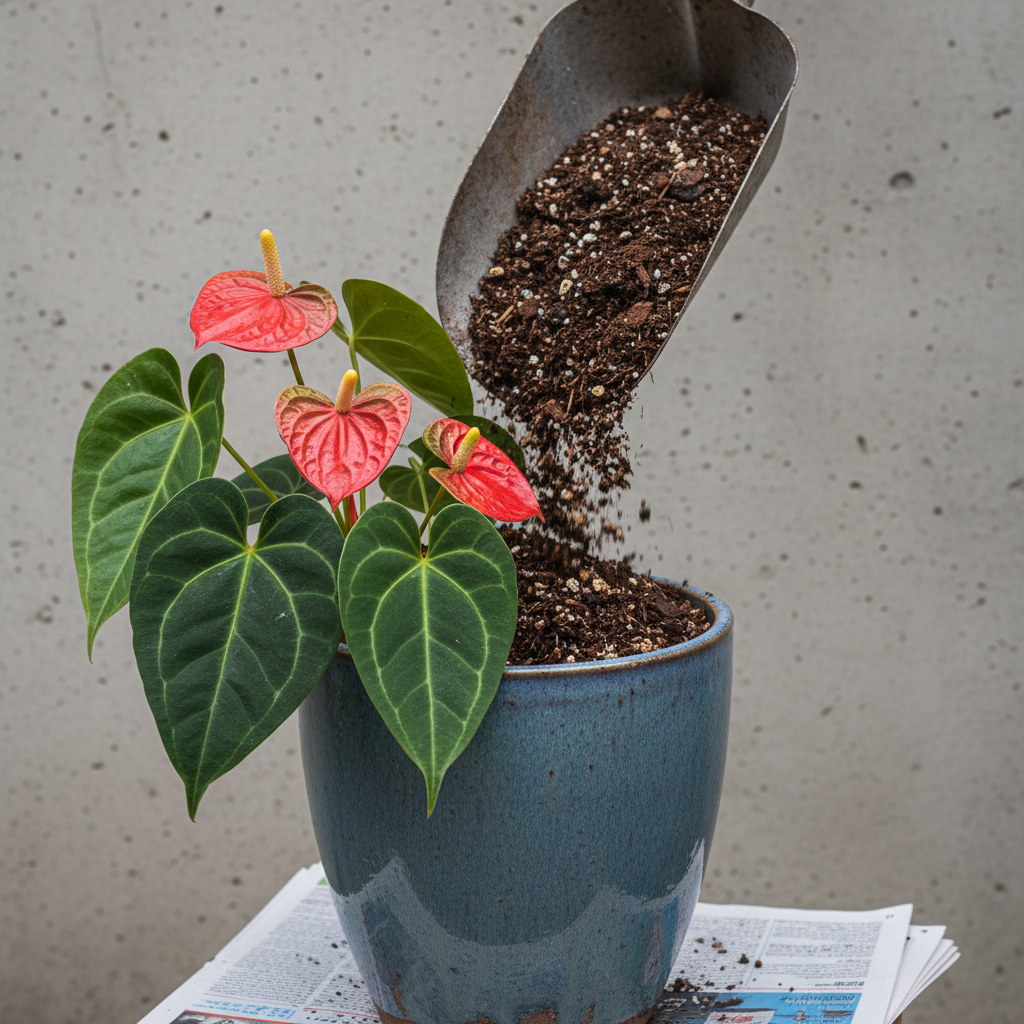
A reliable recipe is roughly equal parts orchid bark, perlite and coco coir or a peat-free houseplant compost, with a handful of horticultural charcoal added to keep the mix sweet. The bark provides the coarse structure and air gaps, the perlite keeps the whole thing from settling, and the coir holds just enough moisture to keep the roots evenly damp between waterings. If you would rather buy than blend, a bagged aroid or orchid mix is a perfectly good starting point and can be opened out further with extra perlite if it feels too dense. The test is simple: when you water, the liquid should pass through and out the drainage holes within seconds, not sit on the surface or take minutes to soak away.
Laceleaf anthuriums actually flower better when slightly underpotted, so resist the urge to move a healthy plant into a much larger container. A pot only a couple of centimetres wider than the root ball, with ample drainage holes, is right. Repot every two to three years, or when roots begin to push out of the drainage holes and the plant dries out almost as soon as you water it, both signs that it has outgrown its home. The best time is spring, as growth accelerates. When you repot, take the chance to inspect the roots, tease away the old depleted mix, and trim anything soft or dead. Setting the plant at the same depth it grew before, with the crown sitting just above the surface, avoids burying the stem and inviting rot.
Fertilising
Because the laceleaf flowers so persistently, it draws steadily on its reserves and benefits from regular but gentle feeding through the growing season. The mistake to avoid is heavy-handedness: the same epiphytic roots that resent wet feet are easily scorched by concentrated fertiliser salts, which build up in the mix and burn the fine root tips. The safe approach is little and often, using a balanced liquid houseplant feed diluted to roughly half the strength recommended on the label, applied every four to six weeks from spring through early autumn. In winter, when light is low and growth slows, stop feeding altogether and let the plant rest.

For a plant grown chiefly for its spathes, a fertiliser with a meaningful proportion of phosphorus, the middle number in the standard nitrogen-phosphorus-potassium ratio, encourages flowering rather than leaf at the expense of bloom. A formula sold for orchids or for flowering houseplants generally suits the laceleaf well. That said, do not chase a high-phosphorus feed at the cost of everything else: the plant still needs nitrogen to build the foliage that powers those flowers, so a broadly balanced feed with a slight lean towards phosphorus is the sensible middle ground rather than a specialist bloom-booster.
Watch the foliage for the signals that your feeding regime is right. Healthy, mid-to-deep green leaves and a steady succession of spathes mean the balance is good. Pale, yellowing leaves across the whole plant during active growth can indicate underfeeding, while a white crust on the soil surface or the pot rim, often paired with brown, scorched leaf tips, points to salt build-up from too much fertiliser. If you see that crust, flush the pot thoroughly with plain water two or three times to leach the excess salts away, then resume feeding at a lighter touch.
Propagation
The laceleaf is straightforward to propagate, and the most dependable method takes advantage of the way a mature plant naturally produces offsets, or pups, around its base. The simplest approach of all is division. When you repot an established clump in spring, look for these side shoots, each with its own cluster of roots and at least one or two leaves. With clean hands or a sterilised blade you can separate a well-rooted offset from the parent, gently working it free so that it keeps its own roots intact, and pot it up immediately in the same airy aroid mix. A divided pup with established roots establishes quickly and often flowers within its first year.
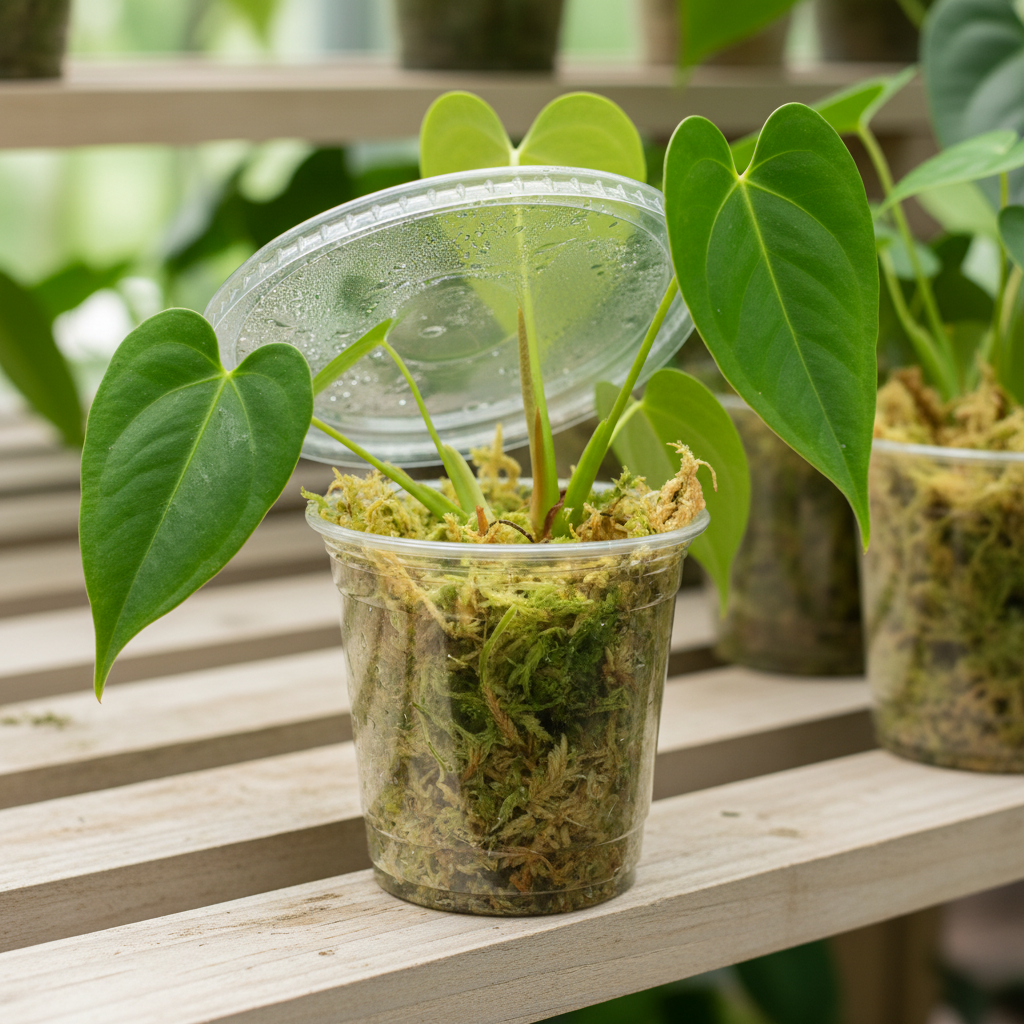
Where a plant has grown tall and leggy, with a length of bare stem showing visible aerial roots and nodes, stem cuttings are the alternative. Each section of stem that carries a node and ideally an aerial root or two can be rooted on its own. Nestling these cuttings into damp sphagnum moss inside a covered, transparent container creates the warm, still, humid microclimate that anthurium roots love, and condensation on the inside of the lid tells you the humidity is right. Kept warm and bright but out of direct sun, the cuttings push fresh white roots within a few weeks, after which they can be potted into the usual mix. The steps below outline the cutting method from start to finish.
- Choose a healthy stem section with at least one node and, if possible, an emerging aerial root.
- Cut cleanly just below the node with a sterilised blade, allowing several centimetres of stem.
- Lay or insert the cutting into pre-moistened sphagnum moss in a clear container, node in contact with the moss.
- Cover loosely to trap humidity, leaving a small gap for air exchange, and keep at 21 to 27 C (70 to 81 F) in bright, indirect light.
- Keep the moss just damp, never soaking, and air it out briefly every few days to prevent mould.
- When roots reach 3 to 5 cm (1 to 2 inches), pot the cutting into a small container of airy aroid mix and resume normal care.
Growing the laceleaf from seed is possible but rarely worth the effort for the home grower, since it requires hand-pollinating the spadix, waiting months for berries to ripen, and a long, slow germination during which seedlings are vulnerable. Division and stem cuttings give you a flowering plant far faster and reproduce the parent exactly, which is especially valuable with the named colour cultivars whose traits would not come true from seed.
Pests and problems
A laceleaf grown in the warm, humid, well-lit conditions it prefers is reasonably resistant to pests, but no houseplant is immune, and the usual indoor culprits will find it if conditions tip in their favour. The most frequent visitors are sap-sucking insects: mealybugs, which appear as small white cottony tufts tucked into leaf axils and along stems; scale, which shows up as flat brown bumps that do not brush off easily; aphids, which cluster on soft new growth and emerging spathes; and spider mites, which thrive in dry air and leave fine webbing and a stippled, dusty look on the leaves. Because spider mites in particular take hold when humidity drops, keeping the air moist is as much a pest-prevention measure as a comfort for the plant.

Catching an infestation early makes all the difference, so inspect the undersides of leaves and the leaf axils regularly, since that is where these pests gather first. For a light outbreak, wiping the leaves and dabbing visible insects with a cotton bud dipped in diluted isopropyl alcohol clears them quickly. For anything more established, a thorough spray of insecticidal soap or neem oil, applied to both leaf surfaces and especially the hidden undersides, breaks the breeding cycle when repeated every seven to ten days for a few weeks. Isolate an affected plant from your other houseplants while you treat it, so the problem does not spread along the shelf.
Most laceleaf troubles, though, are not pests at all but the plant’s response to its conditions, and reading these signs correctly saves a great deal of unnecessary spraying. Yellowing lower leaves usually mean overwatering and the first stage of root stress. Brown, crispy leaf tips point to low humidity, salt build-up from fertiliser, or sensitivity to tap water. A bleached or scorched patch on a leaf comes from direct sun. A plant that grows leaves happily but never flowers is almost always short of light. And green rather than richly coloured spathes can simply mean the bract is ageing, since spathes naturally fade and green as they pass their peak before the plant replaces them. The table below summarises the most common symptoms and their likely causes.
| Symptom | Likely cause | What to do |
| Yellowing lower leaves | Overwatering, poor drainage | Let mix dry more; check roots; improve drainage |
| Brown, crispy leaf tips | Low humidity, salt build-up, hard water | Raise humidity; flush salts; use filtered water |
| Pale, bleached patches | Direct sun scorch | Move out of direct sun behind a sheer curtain |
| No flowers, leaves only | Insufficient light | Move brighter; add a grow-light if needed |
| Cottony white tufts | Mealybugs | Dab with alcohol; treat with neem or soap |
| Fine webbing, stippling | Spider mites (dry air) | Raise humidity; spray both leaf surfaces |
Varieties
Although the wild Anthurium andraeanum is scarlet-spathed, more than a century of breeding has produced a remarkable spread of colours and forms, and the named cultivars sold today are largely selected for spathe colour, size and the productivity of their flowering. The two below are among the most widely grown and show the range available, from the classic fire-engine red that defines the species in most people’s minds to the softer pastels that suit a quieter interior.
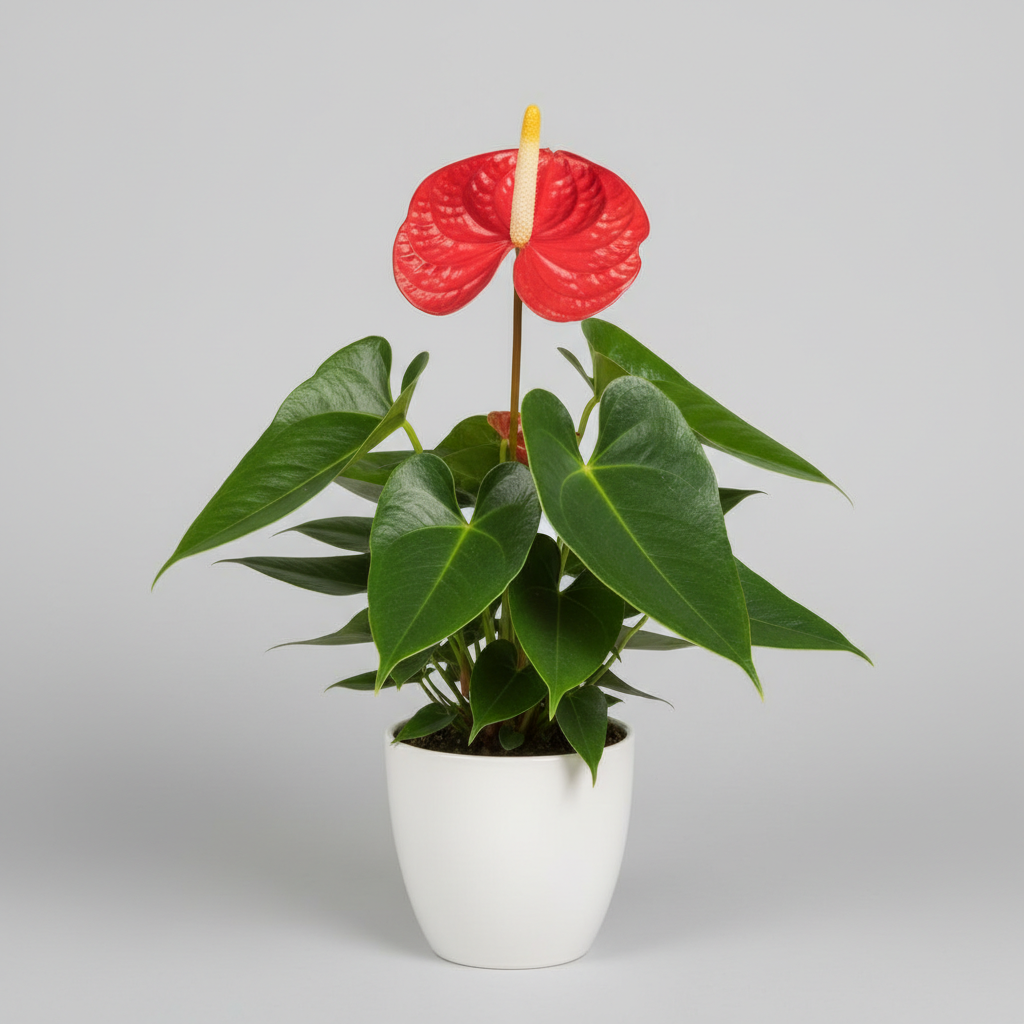
‘Dakota’ is the archetypal red laceleaf, carrying very large, glossy, lacquer-red heart-shaped spathes with a creamy-yellow spadix held proudly above deep green foliage. It is vigorous, free-flowering and forgiving, which makes it the cultivar most often sold as simply “the red anthurium” and a sound first choice.
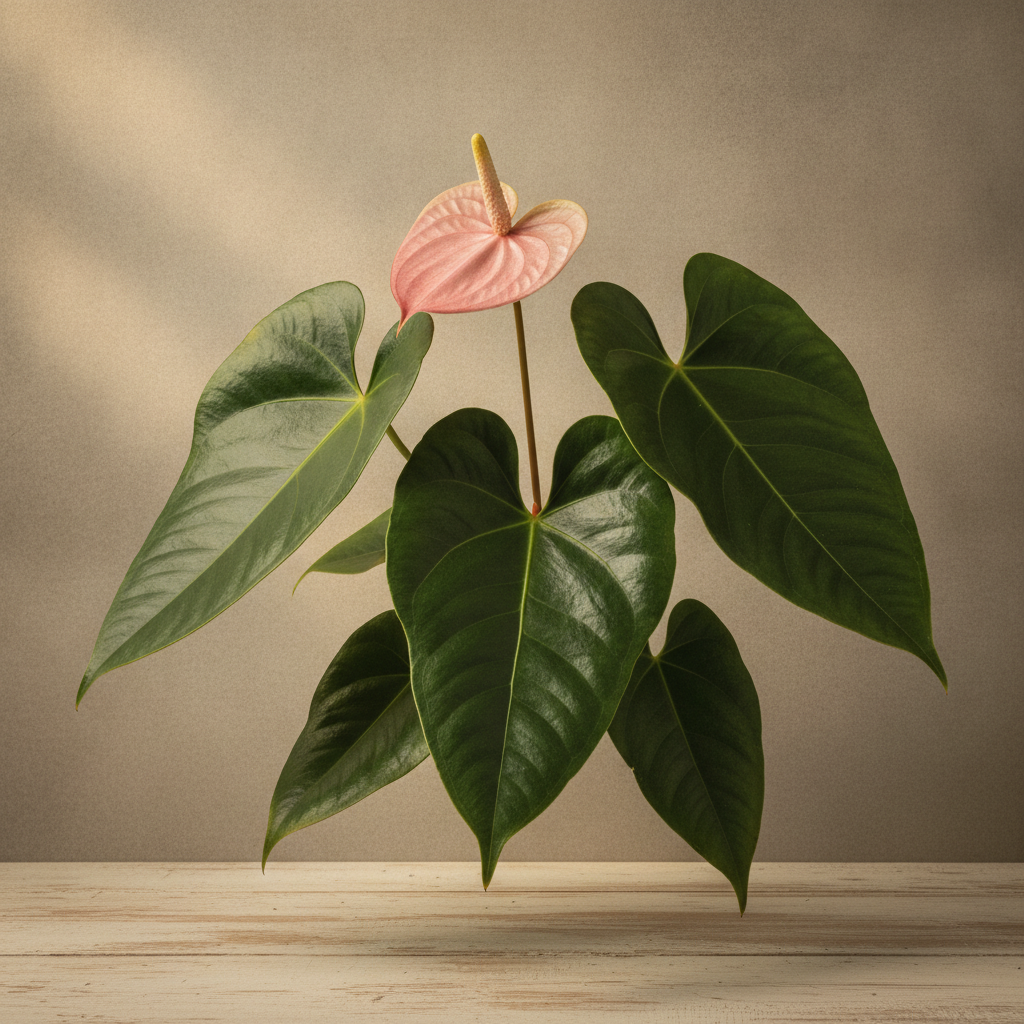
‘Pink Champion’ trades the fire of the classic red for a soft rose-pink waxy spathe set off by a pale creamy spadix above glossy dark leaves. Its gentler colour suits muted, neutral interiors, and like most modern selections it flowers reliably given good light, proving that the pastel cultivars are no harder to keep than their bolder cousins.
Beyond these two, you will find white-spathed forms such as those sold under names like ‘White Heart’, deep burgundy and near-black selections prized by collectors, coral and orange shades, and the so-called obake types whose spathes blend two colours and grow unusually large. Care is essentially identical across the range, so choosing between them is purely a matter of which colour and scale suit your space.
Frequently asked questions
Why won’t my laceleaf anthurium flower?
Insufficient light is by far the most common reason. A laceleaf needs bright, indirect light to fund the energy-hungry process of flowering, and one kept in a dim corner will produce leaves but no spathes. Move it to a brighter spot, just out of direct sun, and feed it a balanced-to-phosphorus-leaning fertiliser through the growing season. Too large a pot can also delay flowering, since the plant blooms better when slightly underpotted.
Is the laceleaf anthurium toxic to cats and dogs?
Yes. Like other members of the arum family, Anthurium andraeanum contains insoluble calcium oxalate crystals throughout its tissues. If a pet or child chews the leaves or stems, the crystals cause intense burning and irritation of the mouth, drooling and difficulty swallowing, and the sap can irritate skin. It is rarely life-threatening but genuinely unpleasant, so keep the plant out of reach of pets and small children, and wash your hands after handling cut stems.
How long do the spathes last?
Each spathe holds its colour for an exceptionally long time, often six to eight weeks and sometimes longer, which is a large part of the plant’s appeal. As an individual spathe ages it gradually fades, often turning greenish, before it is shed and replaced. A healthy plant in good light cycles new spathes continuously, so a mature laceleaf is rarely without at least one in colour.
Should I cut off the spent flowers?
Yes, removing faded spathes tidies the plant and redirects its energy into new growth and fresh blooms. Wait until the spathe has clearly aged and greened or browned, then cut the whole flower stalk down near its base with sterilised scissors. Do not pull it off, as that can tear the crown and open a route for rot.
Why are the leaf tips turning brown?
Brown, crispy tips usually point to air that is too dry, a build-up of fertiliser salts in the mix, or sensitivity to chlorine and fluoride in tap water. Raise the humidity around the plant, flush the pot occasionally with plain water to leach out accumulated salts, and switch to filtered or rainwater if your tap water is hard or heavily treated. Trim the damaged tips with clean scissors if you wish, following the natural leaf shape.
How often should I repot?
Every two to three years is typical, or whenever roots push out of the drainage holes and the plant dries out almost as soon as you water it. Move up only one pot size, since the laceleaf flowers best when slightly underpotted, and always use a fresh, chunky aroid mix. Spring, as growth speeds up, is the best time to do it.






