
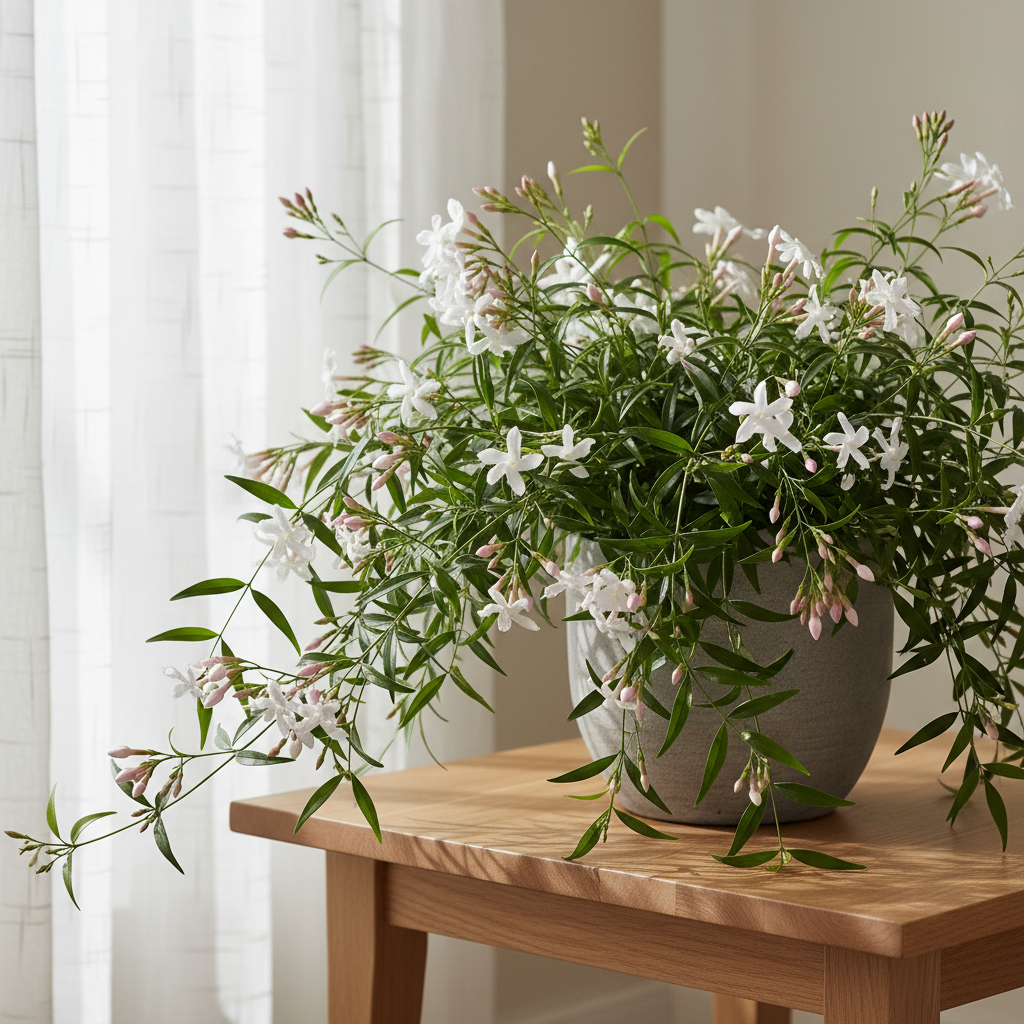
Few houseplants announce themselves quite like jasmine. Step into a room with a mature Jasminum polyanthum in full bloom and the perfume reaches you long before the trailing vines and clouds of pink-budded white stars come into focus. Known almost universally as pink jasmine or winter jasmine, this evergreen climber from the cool, mist-shrouded mountain valleys of southwestern China has spent the better part of a century quietly becoming one of the most popular flowering houseplants in temperate kitchens, conservatories and bright bathrooms. It is sold by the million each January and February under modest little bamboo hoops, and almost every one of those plants is the same species, propagated from cuttings of cuttings that trace back to garden introductions in the 1880s.
The reputation pink jasmine carries is a slightly unfair one. Garden-centre tags promise sweet-scented flowers for life on a kitchen windowsill, and within six weeks the plant has dropped its blossoms, sulked through summer and ended up in the compost. The truth is that Jasminum polyanthum is neither difficult nor short-lived: it is simply a plant that needs to be understood as a cool-climate, long-day vine rather than a warm-loving tropical. Surviving it on a heated windowsill is easy; getting it to rebloom reliably year after year requires you to give it the cold, the brightness and the late-summer rest it actually wants. This guide covers everything from the lux levels its leaves need and the chill it requires to set buds, through soil mixes and watering rhythms, to propagation by cutting and the few pests that bother it indoors.
Contents
- Quick Reference
- Why Jasmine Makes a Rewarding Houseplant
- Light Requirements
- Watering and Humidity
- Soil, Potting and Repotting
- Fertilising
- Propagation
- Pests and Diseases
- Popular Varieties
- Frequently Asked Questions
Quick Reference: Jasmine at a Glance
| Light | Very bright indirect light with at least 2 to 4 hours of direct sun; cooler morning or filtered afternoon sun is ideal. |
| Watering | Keep the top 2 cm (0.75 in) of soil just lightly dry between waterings during growth; reduce slightly in winter but never let it dry out completely. |
| Temperature | Active growth at 15 to 24 °C (59 to 75 °F); needs a cool autumn rest of 4 to 10 °C (39 to 50 °F) for six weeks to set flower buds. |
| Humidity | 40 to 60 percent relative humidity; happy in average indoor air but dislikes very dry, hot rooms. |
| Fertiliser | Balanced liquid feed at half strength every two weeks in spring and summer; switch to a low-nitrogen, high-potassium feed for late summer to boost flowering. |
| Toxicity | True Jasminum species, including pink jasmine, are non-toxic to humans, cats and dogs. Do not confuse with the unrelated and highly toxic Carolina jasmine (Gelsemium sempervirens). |
Why Jasmine Makes a Rewarding Houseplant
Pink jasmine is one of those plants that earns a permanent place in the home almost entirely through its fragrance. The flowers are small, no more than 2 cm (0.8 in) across, but they open in clusters of fifteen to twenty at every leaf axil along the vine, and a mature plant carries hundreds of them at once. The scent is unusual among houseplants: a clean, slightly green sweetness in the morning that intensifies into a heavier, almost honeyed perfume by evening, when the flowers are most strongly pollinator-active in the wild. A single 30 cm pot in flower can perfume an entire living room, and unlike many fragrant flowers it does not have the cloying quality that some find overpowering in confined spaces.
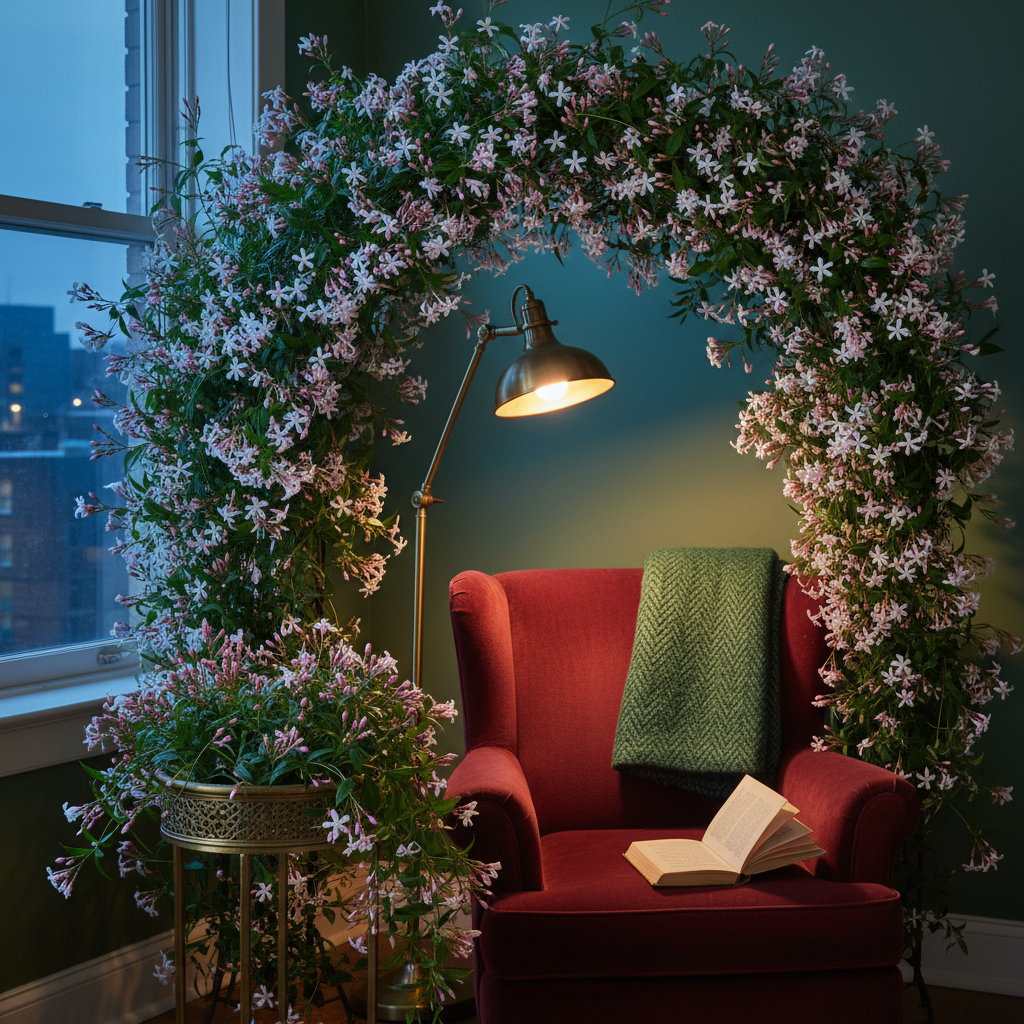
Beyond the perfume, the plant has architectural appeal. The pinnate leaves are arranged in opposing pairs of five to seven narrow, lance-shaped leaflets, dark green and slightly glossy, and they cover the twining stems so densely that even out of flower the plant reads as a curtain of fine foliage. Train it up a bamboo hoop or fan trellis and it forms a tidy domed lantern; let it cascade from a hanging basket and it becomes a 90 cm waterfall of stems within two seasons. Mature plants kept in conservatories or cool sunrooms have been recorded climbing 6 m or more, though most indoor specimens are kept restrained at between 1 and 2 m by annual post-bloom pruning.
Important — Toxicity: All true jasmines in the genus Jasminum are listed as non-toxic by the ASPCA and the RHS, and pink jasmine is safe around cats, dogs and curious toddlers. The risk to watch is mistaken identity: yellow Carolina jasmine (Gelsemium sempervirens), night-blooming jessamine (Cestrum nocturnum) and star jasmine (Trachelospermum jasminoides) are all sold under “jasmine” labels and have varying degrees of toxicity. Verify the botanical name on the tag, not the common name.
Light Requirements
If pink jasmine has one non-negotiable need indoors, it is light. This is a plant that grows in open scrubby valleys at altitudes of 1,800 to 3,000 m in Yunnan and Sichuan, where it spends its life climbing up onto whatever it can find in order to reach the brightest position. Indoors it remembers all of that. A plant placed in a dim corner will not die outright for many months, but it will stop producing flower buds, drop its older leaves and gradually thin into a leggy, sparse vine that resents being touched. The difference between a sulking pink jasmine and a magnificent one comes down almost entirely to whether it receives enough hours of bright light each day.
The ideal indoor position offers very bright indirect light all day, plus at least two to four hours of unfiltered direct sun. An unobstructed east-facing window is close to perfect, because the cooler morning sun provides the brightness without the leaf-scorching intensity that a south-facing summer afternoon can deliver. A south- or west-facing window works well too, provided you draw a sheer curtain across the hottest part of the day in summer. The plant prefers a colour temperature on the cooler end of the spectrum, which is one reason it does so well in tiled bathrooms and sunrooms with multiple glass walls.
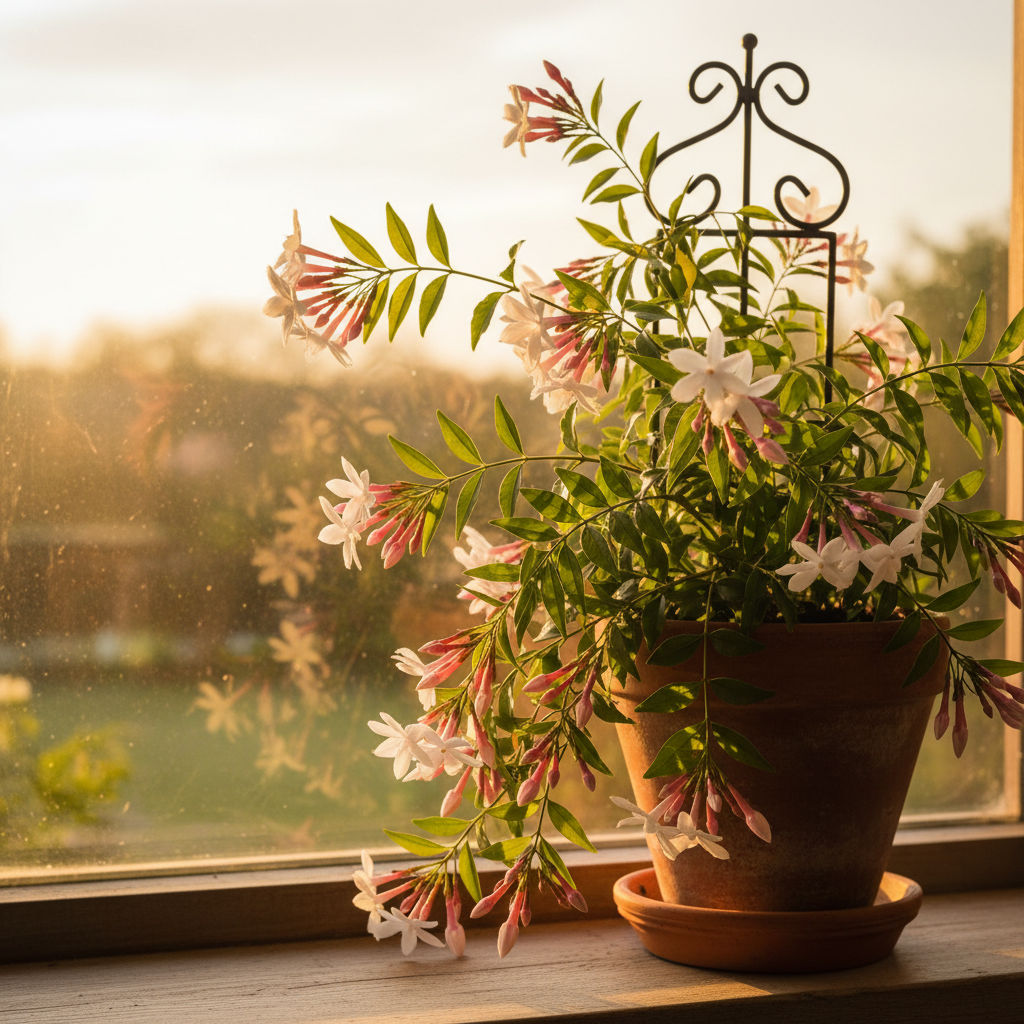
Light Levels Explained
Light intensity indoors is measured in lux, and pink jasmine sits squarely in the high end of what most homes can offer. To put numbers on the categories most plant tags refer to, the following table maps each level to typical indoor placements and the response you can expect from the plant.
| Light Category | Approx. Level | Typical Location | Outcome |
|---|---|---|---|
| Direct sun | 30,000 to 100,000 lux | Within 30 cm of an unshaded south or west window | Excellent for flowering, but use sheer curtain in summer to avoid scorch. |
| Very bright indirect | 10,000 to 25,000 lux | 1 m back from south or west window; on an east windowsill | Ideal for sustained leaf and stem growth; reliable flowering with cool rest. |
| Bright indirect | 2,500 to 10,000 lux | 2 m back from a bright window; on a north-facing windowsill | Plant survives and grows slowly; flowering becomes unreliable. |
| Medium | 800 to 2,500 lux | Across a dim room from a bright window | Survival only; vines etiolate, fewer leaves, no flower buds form. |
| Low | Below 800 lux | Hallway, interior bathroom, deep corner | Not suitable; plant declines over months and eventually fails. |
Window Orientation and Placement
South-facing window: The brightest position in most homes and a strong choice in winter, when low sun angles flood the windowsill. In high summer the same window can deliver 35 to 40 °C of glass-magnified heat by mid-afternoon, which scorches jasmine leaves and dries the rootball within a day. Pull the plant 50 cm back from the glass between June and August, or hang a sheer linen panel.
East-facing window: Probably the best year-round position. The plant gets three to five hours of cool morning sun, which is the brightness it wants without the heat stress of afternoon sun. Even in midsummer, an east window rarely exceeds 28 °C at the glass, and the rest of the day delivers bright indirect light.
West-facing window: Excellent in spring and autumn, when the afternoon sun is warm but not punishing. In summer the same window can be too hot, and in deep winter it provides only two to three hours of useful light because the sun sets early. Acceptable but second-best.
North-facing window: Generally too dim for pink jasmine in the northern half of Europe and most of North America. The plant will hold its shape and live for many months, but it will not flower. In sub-tropical latitudes a north window can deliver enough light for modest growth.
Pro Tip — Quarter Turn Weekly: Pink jasmine is strongly phototropic and will lean noticeably towards the light source within a week. Rotate the pot one quarter turn every time you water and the plant will keep an even shape rather than producing a one-sided cascade of leaves and bare-backed stems.
How Light Affects Flowering and Foliage
Light influences pink jasmine in three distinct ways. First, total daily light integral determines how much new vine the plant can produce each growing season. Second, the spectrum of light in the late summer and early autumn signals the plant to prepare for flowering, in partnership with falling temperatures and shortening days. Third, the contrast between summer day length and the cooler, shorter days of autumn is what synchronises bud initiation across the whole plant, so that a properly grown specimen blooms in a single dramatic flush in January or February rather than dribbling out a few flowers at a time. A plant grown under constant warm indoor light, even bright artificial light, may grow vigorously yet never set buds because it has no seasonal signal to respond to.
Warning — Direct Sunlight: Pink jasmine that has been indoors all winter cannot tolerate a sudden move to full summer sun. Leaves bleached pale yellow or bearing crisp brown patches are classic signs of sunscald. If you intend to move the plant outdoors for summer, acclimate it over ten to fourteen days by increasing direct sun exposure by an hour each day from a starting position in dappled shade.
Artificial Lighting
Full-spectrum LED grow-lights can substitute for window light in dim rooms, but the bar is high. Pink jasmine needs a minimum of 15,000 to 20,000 lux at canopy level for twelve to fourteen hours each day during the growing season to grow vigorously, which usually translates to a 40 to 60 W LED panel suspended 30 cm above the foliage. For bud initiation in autumn, you must then deliberately reduce the photoperiod to ten or eleven hours and drop the ambient temperature, mimicking the natural seasonal trigger. If you are unwilling to manage the lighting schedule that carefully, a bright unshaded window is far easier than trying to flower the plant under lights alone.
Seasonal Adjustments
The light story changes through the year. Move the plant closer to the glass between October and February, when northern hemisphere day length collapses and even a south window may not be bright enough for the leaves to photosynthesise efficiently. From March onward, watch for leaf scorch signs at the same window and pull the plant back gradually as the sun climbs higher. In late August begin reducing artificial light hours if you supplement; this small intervention can be the difference between a heavily budded plant in January and one that produces only leaves.
Watering and Humidity
Pink jasmine has a watering rhythm that sits between a fern and a Mediterranean shrub. The roots are fine and fibrous and do not tolerate waterlogged soil, but the leaves are thin and lose moisture quickly in dry indoor air, so the plant cannot be treated as a drought-tolerant succulent either. The reliable approach is to keep the rootball evenly moist during active growth, allow the surface to dry out lightly between waterings, and never let the pot sit in standing water. Get this balance right and the plant rewards you with shiny, well-spaced leaves and steady stem extension; get it wrong and you will see either soft, browning leaf tips from drought or yellow, dropping leaves from rot.
When to Water
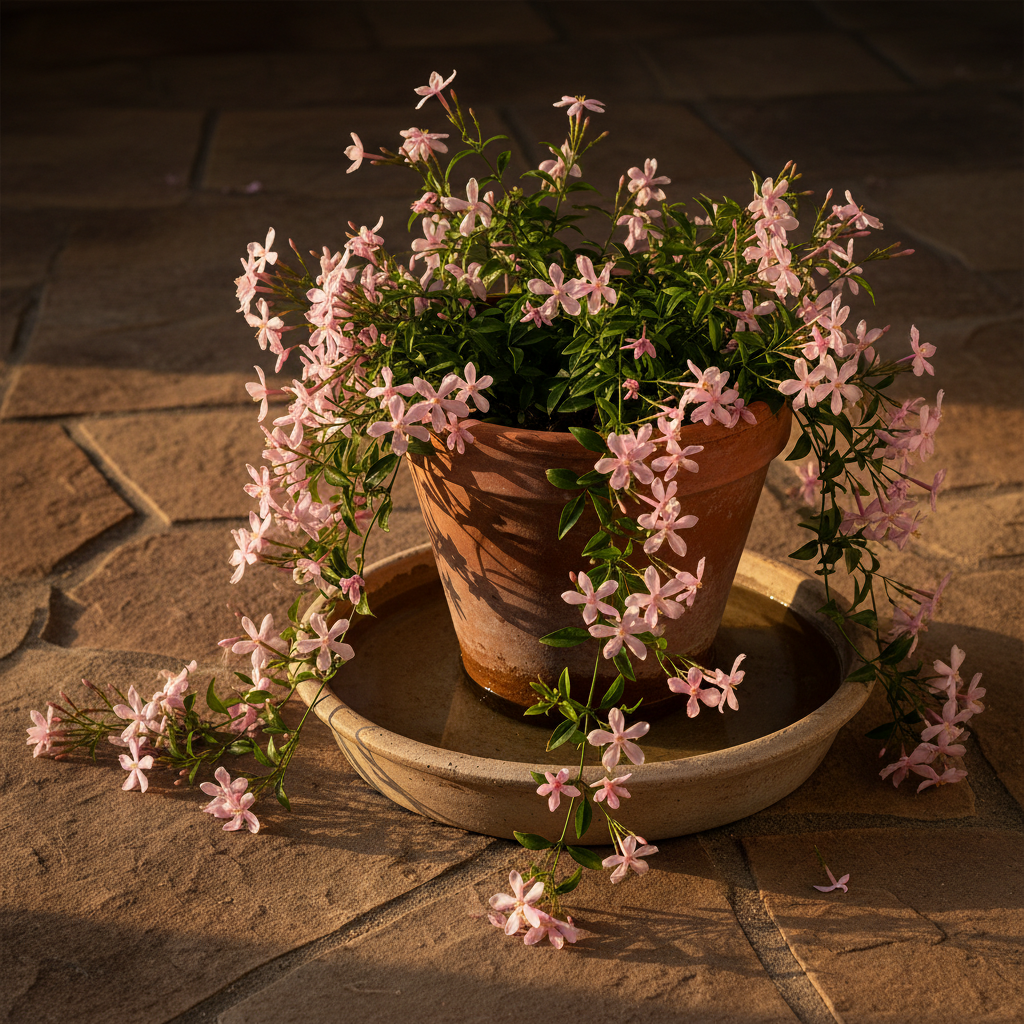
The reliable test is your finger. Push it into the soil to a depth of 2 cm (0.75 in) at the edge of the pot. If the soil at that depth feels dry to the touch but the layer just below still holds a slight coolness, it is time to water. If your finger comes out with damp soil clinging to it, wait another day or two and test again. During the strong growth months between April and September, a 15 cm pot in a bright window typically needs water every five to seven days. In winter, with the plant either in flower or resting, the same pot may only need water every ten to fourteen days.
The lift test is the second confirmation. Pick up the pot before watering and again immediately after watering, and you will quickly learn what a thirsty pot feels like versus a saturated one. With practice the lift test is more reliable than any moisture meter, because it integrates the entire rootball rather than measuring one spot. Cheap moisture probes are notoriously inaccurate in chunky, perlite-rich potting mixes because they only register conductivity at the probe tip.
Pro Tip — The Tepid Water Rule: Pink jasmine roots are sensitive to cold shock. Water straight from the tap can sit at 8 to 12 °C in winter, which slows root function and triggers leaf yellowing within days. Fill the watering can the evening before, or run the tap until the water reaches roughly room temperature before applying.
How to Water Correctly
- Carry the plant to a sink or large saucer where excess water can drain freely without pooling on furniture.
- Pour tepid water slowly and evenly across the soil surface, working around the base of the stems rather than dumping a single torrent in one spot.
- Continue until water runs freely from the drainage holes; this flushes accumulated mineral salts and ensures the entire rootball is wetted, not just the top.
- Let the pot drain for at least ten minutes before returning it to its decorative cachepot or saucer.
- Empty any water that collects in the saucer within an hour; a pot sitting in standing water for twenty-four hours is a reliable recipe for root rot.
- Once a month, take the plant to the shower or kitchen sink and give the foliage a gentle rinse with tepid water to wash dust and any settling pests off the leaves.
Signs of Overwatering vs. Underwatering
| Symptom | Overwatering | Underwatering |
|---|---|---|
| Leaf colour | Yellowing that starts on lower, older leaves and spreads upward, often with a pale, washed-out tone. | Yellowing that begins at leaf tips and edges, with a dry, papery feel before drop. |
| Leaf texture | Soft, limp leaves that do not perk up after watering; sometimes translucent patches. | Crisp, brittle leaves that crumble when touched; tips and margins brown first. |
| Soil surface | Constantly dark and damp, sometimes with a green algal film or a sour smell. | Pale, dusty and cracked; pulls away from the side of the pot. |
| Roots | Soft, mushy, dark brown or black; outer sheath slides off easily when pulled. | Dry, fine and brittle; may snap rather than bend when handled. |
| Stem base | Soft and discoloured at soil line; in advanced cases the stem darkens above the soil. | Stem stays firm; leaves drop progressively from the bottom upward. |
Warning — Root Rot: Once root rot has set in, watering less is not enough; the damaged roots cannot absorb the water already in the soil, and the plant continues to wilt despite a saturated rootball. Unpot the plant, rinse the roots clear of old soil, cut away every soft brown root with sterilised scissors back to firm white tissue, dust the cut surfaces with cinnamon as a mild antifungal, and repot in fresh well-draining mix in a smaller pot than before. Withhold water for two days, then resume on a sparing schedule.
Humidity Requirements
Pink jasmine is relaxed about humidity compared with truly tropical houseplants. The native cloud-forest environment is humid for much of the year, but the plant has adapted to handle the dry winters of Yunnan with no apparent difficulty, and indoor air at 40 to 50 percent relative humidity suits it well. The trouble starts in centrally heated rooms in winter, where radiators can pull humidity below 25 percent. At those levels, leaf tips brown, flower buds may drop before opening and red spider mite becomes a real risk.
The symptoms of low humidity are subtle but cumulative: crisp brown leaf tips that do not green up after watering, slightly cupped leaf margins, an increase in mite activity and, most tellingly, flower buds that yellow and drop without opening. None of these are immediately fatal, but they degrade the plant noticeably and undermine the late-winter floral display you have waited months for.
Raising humidity in winter is straightforward. A pebble tray under the pot, refilled twice a week, lifts local humidity around the foliage by ten to fifteen percent. A small electric humidifier on a timer is more effective and covers an entire room. Grouping the jasmine with other plants creates a microclimate as their combined transpiration raises ambient moisture. Misting the foliage looks satisfying but has only a brief effect; for jasmine in particular, misting is best avoided once the flower buds open because water sitting on the petals encourages botrytis spotting.
Water Quality
Pink jasmine is moderately sensitive to dissolved minerals and chlorine. Hard tap water deposits limescale around the rim of the pot and gradually shifts the soil pH away from the slightly acidic preference of the plant, leading to nutrient lock-out and chlorotic leaves. If your tap water is very hard, use rainwater collected from a clean butt, distilled water, or filtered water for most of the year, reserving tap water for the occasional flushing rinse. Chlorinated water from a municipal supply is acceptable if left to stand uncovered for twenty-four hours so the chlorine evaporates; chloraminated water cannot be off-gassed and requires a carbon filter to remove.
Soil, Potting and Repotting
The single most common reason pink jasmine fails indoors is being left in the dense, peat-heavy compost it arrived in. Nursery-grown plants are pushed for fast growth in glasshouse conditions where the substrate is watered and dried multiple times a day. That same compost sitting in a centrally heated living room stays wet for a week at a time and quickly suffocates the fine root system. Within one growing season, the plant needs to be moved into a mix that drains quickly, holds light moisture and contains enough air for the roots to breathe.
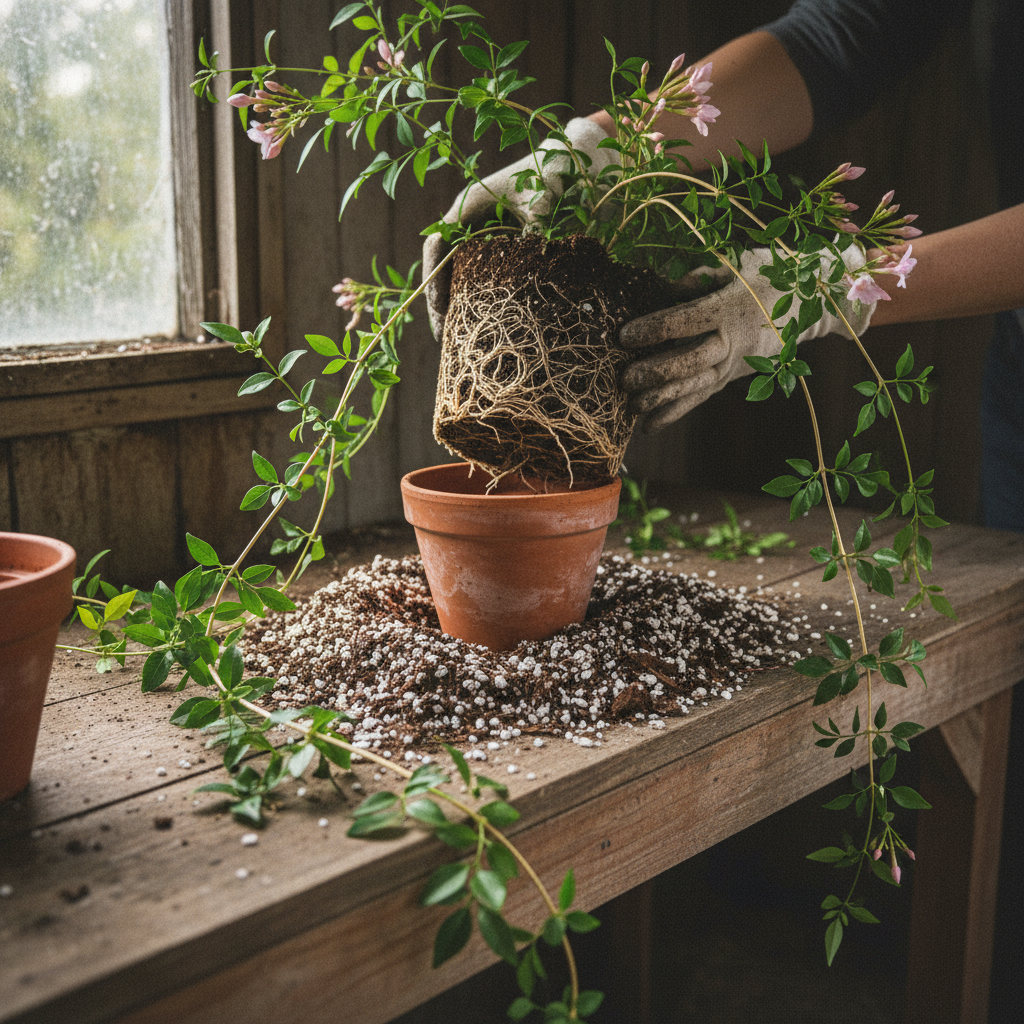
Ideal Soil Composition
Pink jasmine grows best in a fibrous, slightly acidic soil that holds enough moisture to keep the fine roots evenly damp but releases excess water within minutes of watering. The base should be a high-quality houseplant compost, ideally a peat-free coir-based blend, opened up with a generous proportion of perlite or pumice for drainage. A small fraction of composted bark or sphagnum moss helps hold moisture without compaction, and a handful of worm castings provides a gentle slow-release feed. The aim is a mix that crumbles between your fingers rather than forming clods, drains freely yet holds a soft moistness for several days after watering.
| Component | Proportion | Function |
|---|---|---|
| Peat-free houseplant compost (coir-based) | 50 percent | Provides the bulk of the moisture-holding matrix and a gentle nutrient base. |
| Perlite or pumice (3 to 6 mm grade) | 25 percent | Opens the mix for drainage and air exchange around the fine root system. |
| Composted bark or coir chips | 15 percent | Adds long-lasting structure that resists compaction over time. |
| Worm castings | 5 percent | Slow-release nitrogen and micronutrients plus beneficial soil microbes. |
| Horticultural grit or coarse sand | 5 percent | Improves drainage at the base and discourages fungus gnats on the surface. |
Pink jasmine prefers a pH of 6.0 to 6.5, which is mildly acidic and matches what most coir-based composts naturally provide. Avoid heavily limed potting mixes and any soil pre-charged with strong synthetic fertilisers, which can scorch the fine roots. If you want to verify your mix is in range, a simple pH meter or a pack of test strips is inexpensive and worth keeping with your gardening kit.
Pro Tip — Quick Mix Recipe: Two large scoops of peat-free houseplant compost, one scoop of perlite, half a scoop of composted bark, a small handful of worm castings and a sprinkle of horticultural grit produces an excellent jasmine mix in under a minute. Stored dry in a sealed tub it keeps indefinitely and is ready any time you need to repot.
Choosing the Right Pot
Pot choice has more influence on jasmine health than most growers realise. The pot determines how quickly the soil dries, how warm the roots stay in winter and how stable the plant feels when its trained vines lean towards the light. Get the pot wrong and you fight the watering rhythm all year; get it right and the plant manages itself.
Drainage holes are non-negotiable. Without holes in the base, water that drains through the soil simply pools at the bottom of the pot and rots the roots from below. Decorative cachepots without drainage are fine as outer sleeves, but the plant itself must always sit in a pot with at least one generous drainage hole; two or three small ones drain better than a single large one because they are less prone to blockage.
Pot material: Terracotta is the traditional choice and a sound one. The porous walls allow moisture to evaporate through the sides, which prevents the soil staying wet for too long and matches jasmine’s preference for a slightly drying rhythm. The downside is that terracotta also dries the rootball faster, which means more frequent watering in summer. Glazed ceramic and plastic both hold moisture longer, which suits gardeners who travel or forget to water, but raises the risk of overwatering during cooler months.
Pot size: Jasmine is happiest slightly underpotted, with the rootball filling most of the available volume. When you repot, choose a pot only 2 to 3 cm wider in diameter than the current one. Jumping up by 5 cm or more leaves a ring of soggy unrooted soil around the rootball, which holds water the plant cannot use and rots the outer roots. A pot of 15 to 20 cm diameter suits a mature houseplant kept at 1 m tall; a vigorous conservatory specimen may eventually need a 30 cm pot.
When to Repot
Pink jasmine appreciates fresh soil more than it appreciates a larger pot. Aim to refresh the substrate every twelve to eighteen months, ideally in mid to late spring after the main flush of flowers has finished. The signs that a repot is overdue are roots circling visibly at the soil surface, roots growing out of the drainage holes, water that runs straight through the pot without wetting the soil, and a plant that wilts within two days of watering. If the roots have not yet outgrown the pot, you can simply replace the top 3 cm of soil with fresh mix and skip the full repotting that year.
How to Repot: Step-by-Step
- Water the plant thoroughly the day before repotting; a hydrated rootball slides out more cleanly and the roots are less likely to tear.
- Prepare the new pot by placing a piece of mesh or a flat shard over the drainage hole to stop soil washing through, then add a 2 cm layer of fresh mix at the base.
- Tip the plant out by inverting the pot with one hand supporting the soil surface around the stems; tap the rim against the edge of a bench until the rootball releases.
- Gently loosen the outer roots with your fingers, teasing away any tightly circling roots and shaking off about a third of the old soil; cut away any black or mushy roots with sterilised scissors.
- Position the plant in the new pot so the top of the rootball sits 1 to 2 cm below the rim, then backfill around the sides with fresh mix, firming gently with your fingers as you go.
- Water in lightly, just enough to settle the soil; do not soak the rootball, as freshly disturbed roots are vulnerable to rot.
- Place the repotted plant in slightly less light than usual for one week to allow it to recover from the disturbance, then return to its normal position.
Warning — Transplant Shock: Pink jasmine in flower or with buds about to open should not be repotted. The disturbance almost always causes the buds to abort and the open flowers to drop within days. Wait until the flowering flush has finished and the plant has started to push fresh leaf growth before disturbing the roots.
Fertilising
Pink jasmine is a moderate feeder. It is not a tropical aroid that gulps down nitrogen and produces metre-long leaves in a season, but it does need a steady supply of nutrients to support the long, leaf-covered vines it pushes out between April and September, and a deliberate adjustment in the late summer to encourage flower buds rather than yet more foliage. The wrong fertiliser regime is a common reason a perfectly healthy-looking plant produces no flowers: too much nitrogen all season long pushes leaf growth at the expense of the reproductive shift the plant needs to make in autumn.
The rhythm to aim for is generous, balanced feeding from spring through midsummer, a switch to a low-nitrogen, high-potassium feed from late August onwards, then no feeding at all from late October until the flowers finish and active growth resumes. This sequence mirrors what the plant would experience in its native climate, where the rich growing season of warm wet summer gives way to a cooler, drier, lower-nutrient autumn that triggers bud formation.
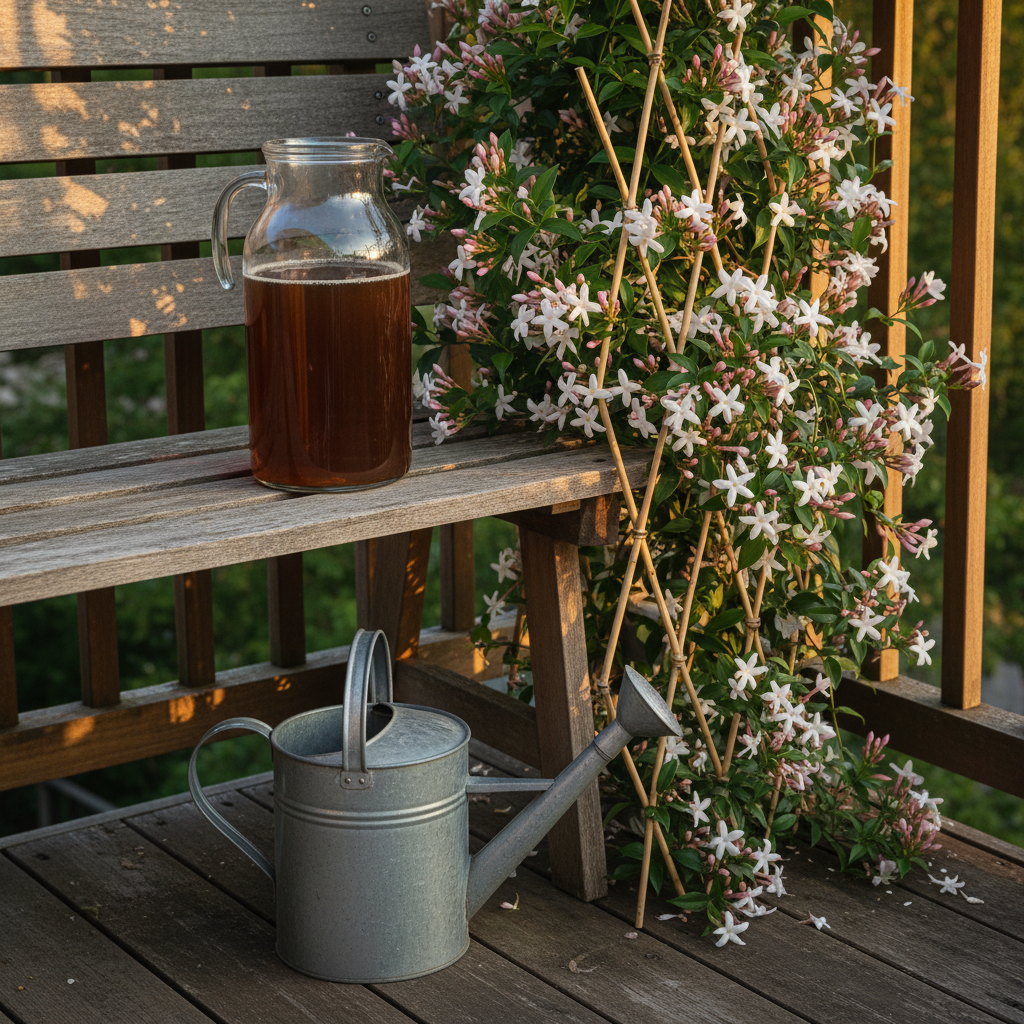
Understanding Plant Nutrients
The numbers on a fertiliser label, the famous NPK ratio, describe the percentage by weight of three major nutrients in the bottle: nitrogen, phosphorus and potassium. Each plays a distinct role, and pink jasmine has a different demand for each at different times of year. Beyond the three majors, several secondary nutrients matter for healthy growth, and deficiencies in any of them produce characteristic leaf symptoms that are well worth learning to recognise.
| Nutrient | Symbol | Primary Function | Deficiency Symptoms |
|---|---|---|---|
| Nitrogen | N | Drives leafy growth and chlorophyll production for photosynthesis. | Pale, yellow-green leaves starting with the oldest; weak, spindly new growth. |
| Phosphorus | P | Supports root development and the formation of flower buds. | Dull, dark green or purplish leaves; poor flowering; stunted root system. |
| Potassium | K | Regulates water balance, flower production and overall plant resilience. | Brown, scorched leaf margins; weak stems; flower buds that fail to open. |
| Calcium | Ca | Builds cell walls and supports robust new growth. | Distorted or hooked new leaves; brown necrotic spots at leaf tips. |
| Magnesium | Mg | Central atom in the chlorophyll molecule; essential for green colour. | Yellowing between leaf veins on older leaves while veins stay dark green. |
| Iron | Fe | Enables chlorophyll synthesis in young leaves. | New leaves emerge pale yellow with green veins; old leaves stay normal. |
Types of Fertiliser
Liquid fertilisers: The default choice for most jasmine growers. Liquid feed dissolves immediately, reaches the roots within a watering, and can be adjusted in strength to match the season. Choose a balanced houseplant feed, typically labelled 10-10-10 or 20-20-20, and apply at half the recommended strength. Switch to a flowering plant feed of around 5-10-15 from late August through October to support bud initiation.
Slow-release granular: Convenient for less attentive growers. A small handful of coated prills scattered across the soil surface in spring delivers a steady trickle of nutrients over three to four months. The downside is that you give up the ability to adjust the feed for the seasonal shift in autumn, and the nutrient release continues regardless of what the plant needs at any given moment.
Organic fertilisers: Worm castings, dilute compost tea, seaweed extract and fish emulsion all suit pink jasmine and have the added benefit of feeding the soil microbiome rather than just dumping nutrients on the plant. A top-dressing of worm castings each spring plus a fortnightly liquid seaweed application throughout summer produces excellent results, and the gentle release rates make overdose almost impossible.
Feeding Schedule
Begin feeding when active growth resumes in March or early April. Apply a balanced liquid feed at half strength every two weeks through May, June and July. From early August, switch to a lower-nitrogen, higher-potassium feed and continue every two weeks until late October. Stop feeding entirely from November through February while the plant is either in flower or resting; feeding during this period risks pushing soft new growth that fails to harden, and disrupts the cool-rest signal that drives flowering. Resume in spring once you see fresh leaf push at the stem tips.
Pro Tip — Half Strength Always: Pink jasmine has fine, surface-spreading roots that scorch easily at the recommended label dose of most houseplant fertilisers. Always dilute liquid feed to half the recommended strength and apply more frequently rather than at full strength less often; the plant takes up the nutrients more efficiently and the risk of root burn drops to near zero.
How to Fertilise
- Always water the plant first with plain water if the soil is dry, then apply the fertiliser solution after; feeding into dry soil concentrates the salts and can burn fine roots.
- Mix the fertiliser at half the recommended strength in a watering can with tepid water, stirring to dissolve fully.
- Pour the solution evenly across the soil surface until a small amount runs from the drainage holes; do not let fertiliser concentrate at one spot near the stem.
- Allow the pot to drain fully and tip away any excess that collects in the saucer within an hour.
- Every six to eight weeks during the growing season, give the pot a deep plain-water flush at the sink to wash accumulated salts out of the soil.
Warning — Salt Build-Up: A white crust on the surface of the soil or around the rim of the pot is the visible sign of mineral salts accumulated from repeated fertilising and hard water. The same salts at root level pull moisture out of the roots by reverse osmosis and produce a plant that wilts in moist soil. Flush the pot thoroughly with plain water three times in succession to dissolve and drain the salts, then resume feeding at a reduced rate.
Propagation
Pink jasmine is one of the most cooperative flowering houseplants when it comes to propagation. A 10 cm cutting taken from a mature vine in late spring will root within three to four weeks in either water or a damp propagation mix, and a successful cutting can be flowering within eighteen months. The plant’s twining habit means it produces long sections of pliable, semi-ripe stem each year, all of which are usable material, so once you have one healthy specimen you can build a small collection or supply friends almost indefinitely.
The two reliable methods for indoor growers are water rooting in a jar, which is the simplest and lets you watch root development daily, and direct sticking into a damp propagation mix, which produces a stronger root system slightly faster. Layering, where you peg a flexible stem down into a pot of soil while still attached to the parent, also works well and is the easiest method for beginners who would rather not detach a cutting until roots are visible. Seed propagation is technically possible but rarely used; named clones are vegetatively propagated for consistency, and seed-raised plants take three to four years to reach flowering size.
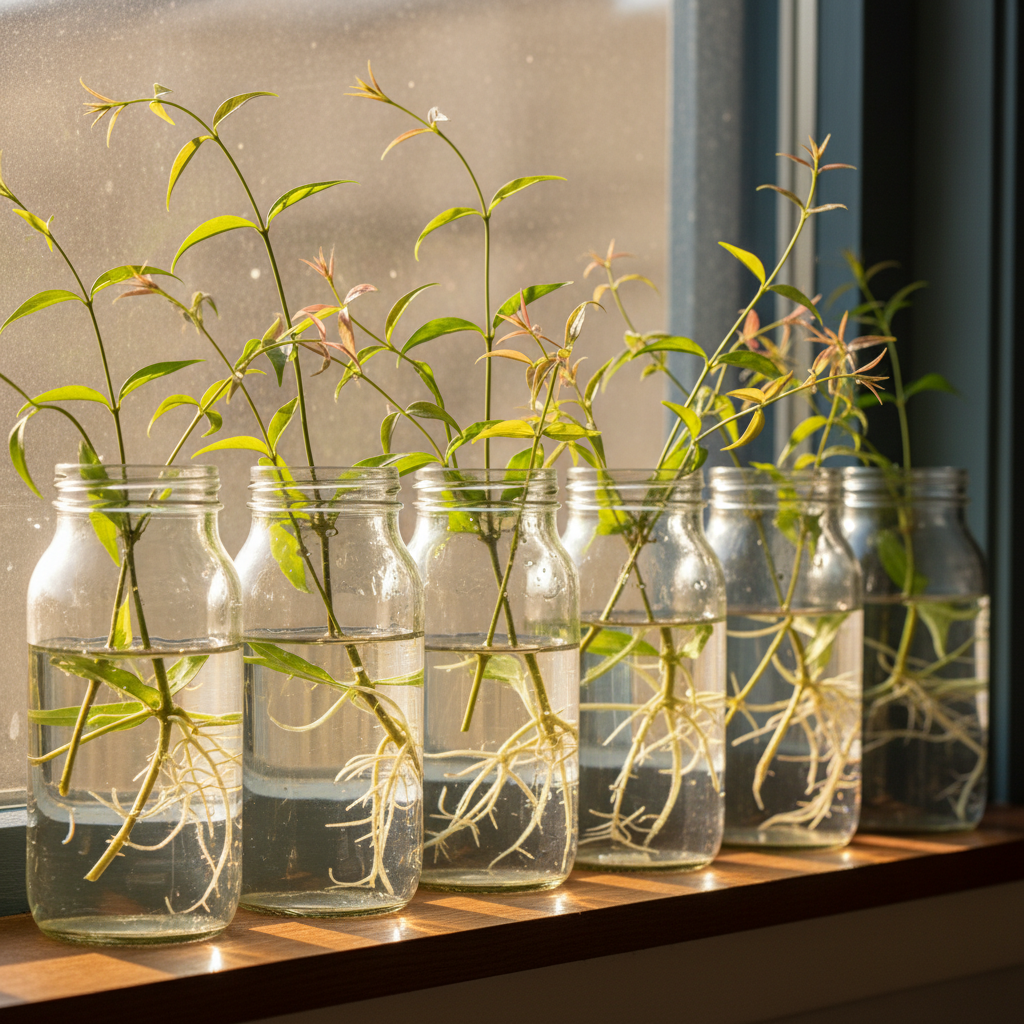
Understanding Nodes and Internodes
Every successful jasmine cutting depends on understanding a single anatomical feature: the node. A node is the slightly thickened point along a stem where a pair of leaves emerges, and just below each node sits the meristematic tissue capable of producing fresh roots when the stem is wounded or submerged. The internode is the smooth, leafless stretch of stem between two nodes. A cutting taken with at least two nodes, the lower one stripped of its leaves and pushed into water or soil, has a near-perfect chance of rooting because each node carries the cellular machinery to generate roots. A cutting taken from an internode alone, with no node present, will almost never root no matter how long you wait. Once you can identify nodes by sight, propagation becomes a routine procedure rather than a gamble.
Water Propagation: Step-by-Step
Water rooting is the most accessible method for indoor growers and produces visible results within ten days. The roots that develop in water are slightly different in structure from those grown in soil, but they transition fine when potted up provided you do so before the water roots exceed about 5 cm in length. Take cuttings in late spring or early summer when the vines are actively growing but the stems have firmed up enough to handle without crushing.
- Select a healthy stem of the current season’s growth that is firm but still flexible, with green bark rather than the woody brown bark of older sections.
- Using clean sharp scissors, cut a 10 to 15 cm section that contains at least three pairs of leaves, making the cut just below the lowest node at a 45 degree angle to maximise rooting surface.
- Strip the lower pair of leaves cleanly from the stem with your fingers, leaving the upper two pairs intact to continue photosynthesising while the cutting roots.
- Place the cutting in a clear glass jar of tepid water deep enough to fully submerge the stripped node but shallow enough that no leaves touch the water.
- Position the jar on a windowsill that receives bright indirect light but no direct sun, which would overheat the water and rot the cutting.
- Refresh the water every four to five days with fresh tepid water, gently rinsing the cutting and the jar to discourage algal and bacterial buildup.
- Roots begin to emerge from the submerged node within seven to ten days; pot the cutting up into damp jasmine mix once the longest root reaches 3 to 5 cm.
- Acclimate the newly potted cutting by keeping the soil consistently damp for two weeks while the water roots adapt, then resume normal watering.
Pro Tip — Multiple Cuttings per Pot: Pot three or four rooted cuttings together in a single 12 cm pot rather than one per pot. The cluster fills out into a full, twining specimen within a season and looks far more substantial than a single thin vine, which is how nursery-grown plants achieve their generous shape from the start.
Soil Propagation: Step-by-Step
Direct soil propagation produces a slightly more robust root system because the roots adapt from the start to drawing moisture from a substrate rather than free water. The trade-off is that you cannot see what is happening underground, and a cutting that fails to root simply collapses without warning. This method is preferred by professional growers for its sturdier outcome, and works equally well for the home grower with a little patience.
- Prepare a small pot of damp propagation mix consisting of equal parts perlite, coir and fine bark, watered through and allowed to drain for an hour.
- Take a 10 to 15 cm cutting from a healthy stem as for water propagation, stripping the lower leaves and trimming the base just below a node at a 45 degree angle.
- Dip the cut end in a powdered or gel rooting hormone, tapping off the excess; this is optional but increases the rooting rate from around 70 percent to over 90 percent.
- Make a hole in the propagation mix with a pencil or chopstick, insert the cutting so the lowest node is buried, and firm the mix gently around the stem.
- Cover the pot with a clear plastic bag or place it under a humidity dome to maintain 80 percent or higher humidity, with one small ventilation gap to prevent fungal buildup.
- Position the covered pot in bright indirect light and check every three days, lifting the cover briefly to release condensation and replace any moisture lost from the mix.
- After three to four weeks, test the cutting with a gentle tug; resistance indicates roots have formed and the cover can be removed gradually over a week to acclimate the cutting to ambient humidity.
Troubleshooting Propagation
| Problem | Likely Cause | Solution |
|---|---|---|
| Cutting wilts within days | Too many leaves left on cutting, losing water faster than absent roots can replace. | Reduce to one or two pairs of leaves; halve each leaf if necessary to reduce surface area. |
| Stem turns black at the base | Bacterial rot from contaminated water or dirty scissors. | Discard cutting; sterilise scissors with isopropyl alcohol before next attempt; refresh water more often. |
| No roots after six weeks | Too cold for cell division (below 18 °C) or cutting taken from old woody stem. | Move to a warmer position (20 to 24 °C) and use newer green-stemmed material. |
| Roots form but cutting fails after potting | Water roots damaged by abrupt transition to dry soil; humidity collapse around new shoots. | Pot up earlier with shorter water roots; keep soil consistently damp and cover with a loose plastic bag for the first week. |
Pests and Diseases
Pink jasmine indoors is not particularly pest-prone, but the same dense, leafy habit that makes it attractive in the home also creates the kind of sheltered, slightly humid microclimate that several common houseplant pests love. The early stages of infestation are easy to miss because the pests hide on the undersides of leaves and in the twining tangle of stems near the trellis. A weekly inspection, particularly under the leaves and at the leaf axils, is the most effective single thing you can do to keep the plant healthy.
The diseases that affect jasmine indoors are almost all the result of cultural mistakes rather than active pathogens introduced from outside. Overwatering produces root rot; cold draughts and condensation produce botrytis on flower buds; lack of air movement produces powdery mildew on leaves. Correcting the underlying culture usually solves the disease without needing fungicides.
Common Pests
Red Spider Mite (Tetranychus urticae)
The most serious pest of indoor jasmine, particularly in winter when central heating dries the air below 30 percent humidity. The mites themselves are less than 0.5 mm long, often barely visible to the naked eye, and the first sign is usually a fine pale stippling on the upper leaf surface. As infestation progresses, the leaves take on a dusty yellow-bronze cast and the undersides become covered in fine silken webbing that traps dust and debris.
Treatment: Raise humidity to above 50 percent immediately as mite reproduction collapses in damp air. Shower the entire plant in tepid water at the sink to dislodge mites mechanically, paying particular attention to the leaf undersides. Spray weekly with neem oil at the recommended dilution for three weeks to break the life cycle, or use a predatory mite such as Phytoseiulus persimilis as a biological control for severe infestations.
Mealybug (Planococcus citri)
Soft, cotton-wool-like white insects that cluster in leaf axils, along stems and around the soil line. Mealybugs feed by piercing plant tissue and sucking sap, which weakens the plant and produces sticky honeydew that drips onto leaves below and attracts sooty mould. They reproduce slowly compared with mites but can establish persistently in a mature jasmine where the dense foliage makes spot treatment difficult.
Treatment: Dab individual mealybugs with a cotton bud soaked in 70 percent isopropyl alcohol; the protective wax coating dissolves on contact and the insect dies within minutes. For larger infestations, spray the entire plant with a 1:10 dilution of insecticidal soap weekly for four weeks, ensuring every leaf axil is reached. Isolate the plant from other houseplants until treatment is complete.
Aphids (Aphis fabae and other species)
Most often encountered on plants moved outdoors for summer, aphids cluster on the soft new growth at stem tips and on flower buds, where their feeding can distort developing leaves and abort buds before they open. They are typically green or black, soft-bodied, around 2 mm long, and reproduce rapidly in warm weather.
Treatment: A sharp jet of water from the hose or kitchen tap removes the majority of an infestation within minutes. Follow up with a weekly spray of insecticidal soap or a 1:10 neem solution for two to three weeks. Ladybirds and lacewings introduced as biological control work well for persistent outdoor infestations.
Common Diseases
Root Rot (Pythium and Phytophthora spp.)
The single most common cause of indoor jasmine failure. Root rot pathogens thrive in waterlogged soil and attack the fine root tips first, gradually working back into the main root system. The above-ground symptoms are misleading because the plant wilts despite damp soil, leaves yellow and drop, and the stem at the soil line becomes soft and discoloured. By the time the symptoms are obvious, much of the root system is already destroyed.
Treatment: Unpot the plant immediately, rinse all old soil from the roots, and cut away every soft brown root back to firm white tissue with sterilised scissors. Dust cuts with cinnamon as a mild antifungal, then repot in fresh well-draining mix in a smaller pot than before. Withhold water for two days to let cut surfaces callous, then resume sparing watering. Recovery takes six to twelve weeks; many plants do not survive.
Botrytis Bud Blight (Botrytis cinerea)
The classic disease of pink jasmine in flower. Botrytis spores germinate on cool, damp surfaces, and the open petals of jasmine flowers in a humid winter sunroom are an ideal landing pad. Infected buds develop pale brown spots that quickly spread to cover the whole petal in fuzzy grey mould, and the surrounding buds often turn black and drop without opening.
Treatment: Remove and bin all affected flowers and buds the moment you spot them; do not compost them, as the spores survive and recolonise. Improve air circulation around the plant with a small fan running on the lowest setting; the moving air dries the petals and prevents spore germination. Avoid misting the plant once flower buds form.
Powdery Mildew (Oidium spp.)
A white, powdery fungal coating that appears first on the upper surface of older leaves, particularly in still, humid air with poor circulation. Unlike most fungi, powdery mildew thrives in moderate rather than wet conditions and is one of the few houseplant diseases that worsens in dry air with high overnight humidity.
Treatment: Wipe affected leaves with a soft cloth dampened in a 1:10 dilution of milk in water; the proteins in milk have a documented antifungal effect on powdery mildew. Improve air circulation with a small fan, and remove the worst-affected leaves entirely. A potassium bicarbonate spray, available as commercial fungicide, works well for persistent cases.
Pest and Disease Summary
| Pest / Disease | Identification | Treatment |
|---|---|---|
| Red spider mite | Stippling on upper leaves; fine webbing on undersides; bronzing. | Raise humidity, shower foliage, spray neem weekly for three weeks. |
| Mealybug | White cotton-wool clusters in leaf axils and along stems. | Dab with isopropyl-alcohol cotton bud, then weekly soap spray. |
| Aphids | Green or black soft insects on new growth and buds. | Rinse off with water, follow with weekly neem or soap. |
| Root rot | Wilting in damp soil; yellowing leaves; soft brown roots. | Trim affected roots, repot in fresh mix, reduce watering. |
| Botrytis bud blight | Brown spots on flowers; grey mould on petals; bud drop. | Remove affected blooms, increase air movement, stop misting. |
| Powdery mildew | White powdery coating on upper leaf surfaces. | Wipe with diluted milk, improve airflow, remove affected leaves. |
Prevention Strategies
Most pest and disease problems on indoor jasmine can be prevented entirely by attention to two underlying conditions: humidity and airflow. Maintaining humidity above 40 percent in winter dramatically reduces the risk of spider mite, which is the most damaging pest. Providing gentle air movement with an oscillating fan or a partially open window suppresses botrytis and powdery mildew at the same time as it strengthens the stems and helps the soil dry between waterings.
A monthly shower under the kitchen tap to rinse dust and incipient pests from the foliage is more effective than weekly inspection alone, because it physically removes pests before they reach detectable populations. Isolate any newly purchased plant for two weeks before placing it near the jasmine, and inspect the underside of every leaf during that quarantine. Most pest outbreaks in established collections start with an infested plant brought in from a garden centre.
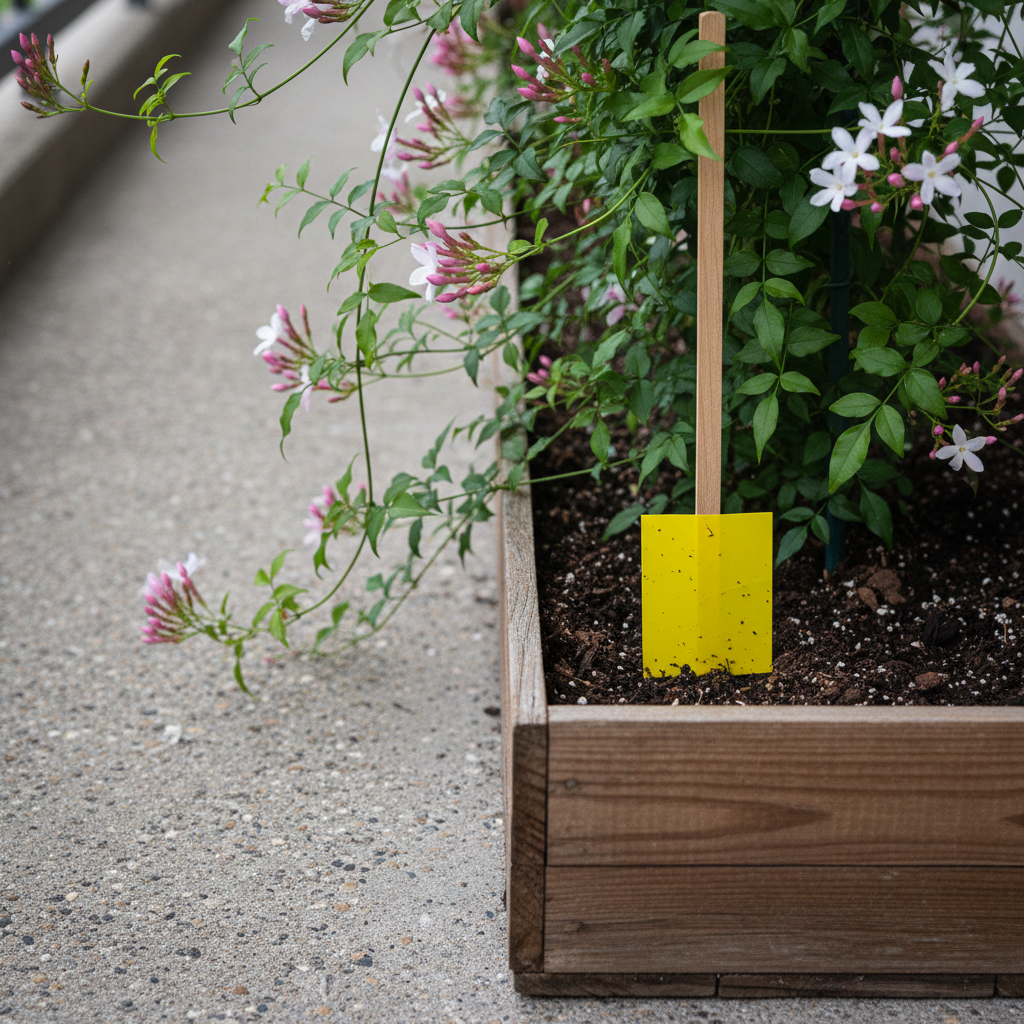
Pro Tip — Yellow Sticky Traps: A single yellow sticky trap on a stake pushed into the soil at the base of the plant gives you an early warning of fungus gnats, whitefly and winged aphids before any visible damage appears. Replace the trap when it fills up, usually every six to eight weeks, and treat it as a monitoring tool rather than a control measure.
Popular Varieties
The word “jasmine” is one of the loosest in horticulture. It is applied to at least three different plant genera and to dozens of unrelated fragrant climbers and shrubs, with the result that buying a jasmine without knowing the botanical name is a slightly random business. True jasmines belong to the genus Jasminum, within the family Oleaceae, and there are around 200 recognised species worldwide. Only a handful are commonly grown as houseplants, and pink jasmine, Jasminum polyanthum, is by far the most widespread.
Beyond J. polyanthum itself, the related species you may encounter under a jasmine label include the heavily perfumed Arabian jasmine, the hardy common white jasmine of European gardens, the showy yellow primrose jasmine, and the popular garden climber known as star jasmine, which despite its name belongs to a completely different genus altogether. The table below sets out the most frequently sold true jasmines and their key characteristics, followed by short profiles of the most useful varieties for indoor growers.
| Variety | Leaf Appearance | Light Needs | Growth Rate | Availability |
|---|---|---|---|---|
| Pink Jasmine (J. polyanthum) | Pinnate, five to seven dark green leaflets | Very bright indirect, some direct sun | Fast, 60 to 90 cm per season | Widely available |
| Arabian Jasmine (J. sambac) | Glossy oval, mid-green | Bright indirect to direct sun | Moderate, more shrubby than vining | Common in Asian nurseries |
| Common Jasmine (J. officinale) | Fine pinnate, seven to nine pointed leaflets | Bright indirect, tolerates cool | Moderate to fast | Widely available outdoors |
| Primrose Jasmine (J. mesnyi) | Trifoliate, glossy dark green | Bright indirect | Moderate, semi-evergreen shrub | Specialist nurseries |
| Royal Jasmine (J. grandiflorum) | Pinnate, five to nine leaflets, lighter green | Bright indirect, some direct sun | Moderate | Specialist nurseries |
| Star Jasmine (Trachelospermum jasminoides) | Glossy oval, leathery dark green | Bright indirect to direct sun | Moderate, evergreen climber | Widely available (not a true jasmine) |
| Winter Jasmine (J. nudiflorum) | Deciduous, three small leaflets per leaf | Full sun, very cold tolerant | Fast outdoors | Widely available as garden shrub |
Featured Varieties
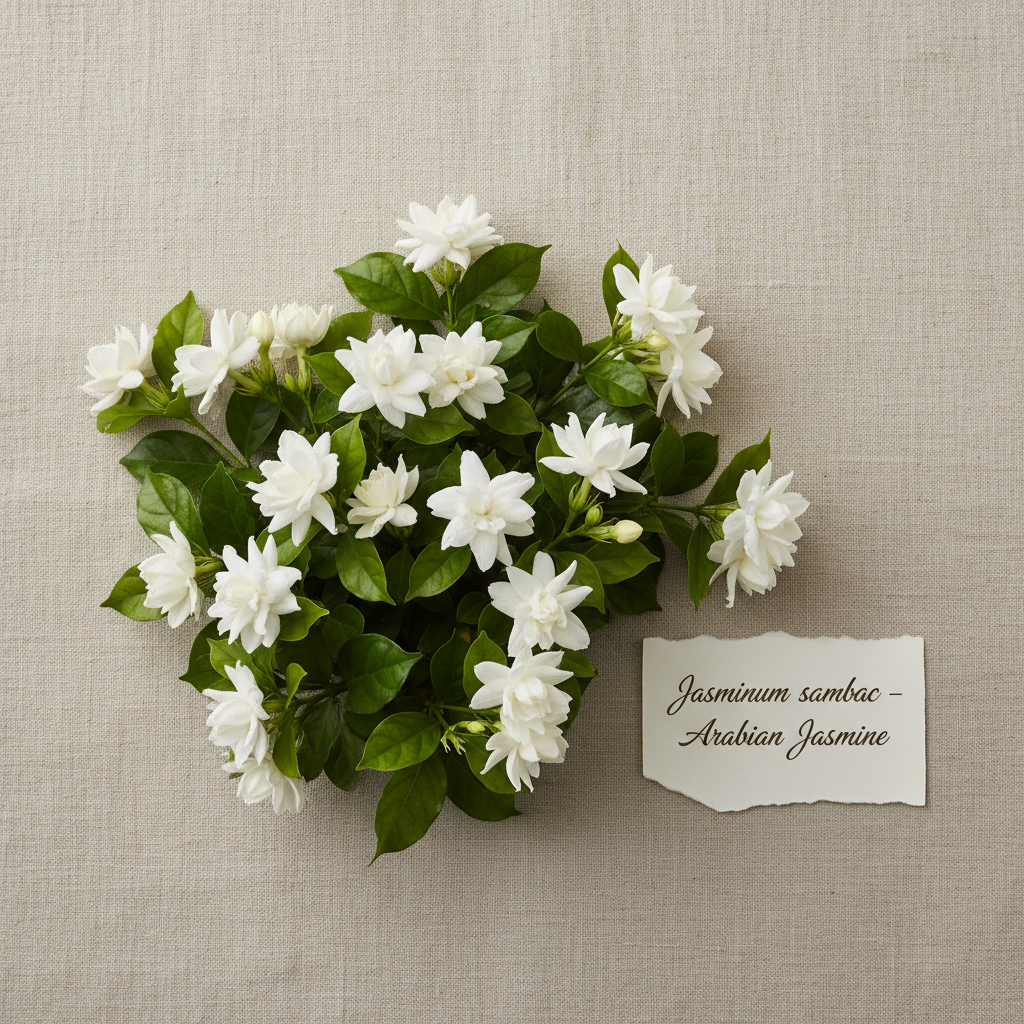
Arabian Jasmine
A bushier, more shrubby cousin of pink jasmine with glossy oval leaves and intensely fragrant pure white flowers that open at dusk. Jasminum sambac is the source of the perfume in many traditional jasmine teas and garlands across South and Southeast Asia. The cultivar ‘Maid of Orleans’ produces single-petalled flowers in continuous flushes throughout the warm months, while ‘Grand Duke of Tuscany’ carries fuller, gardenia-like double flowers on a more compact plant. Arabian jasmine tolerates warmer indoor conditions than pink jasmine and does not require a cold rest to flower, which makes it a better choice for centrally heated apartments without access to a cool windowsill in autumn.
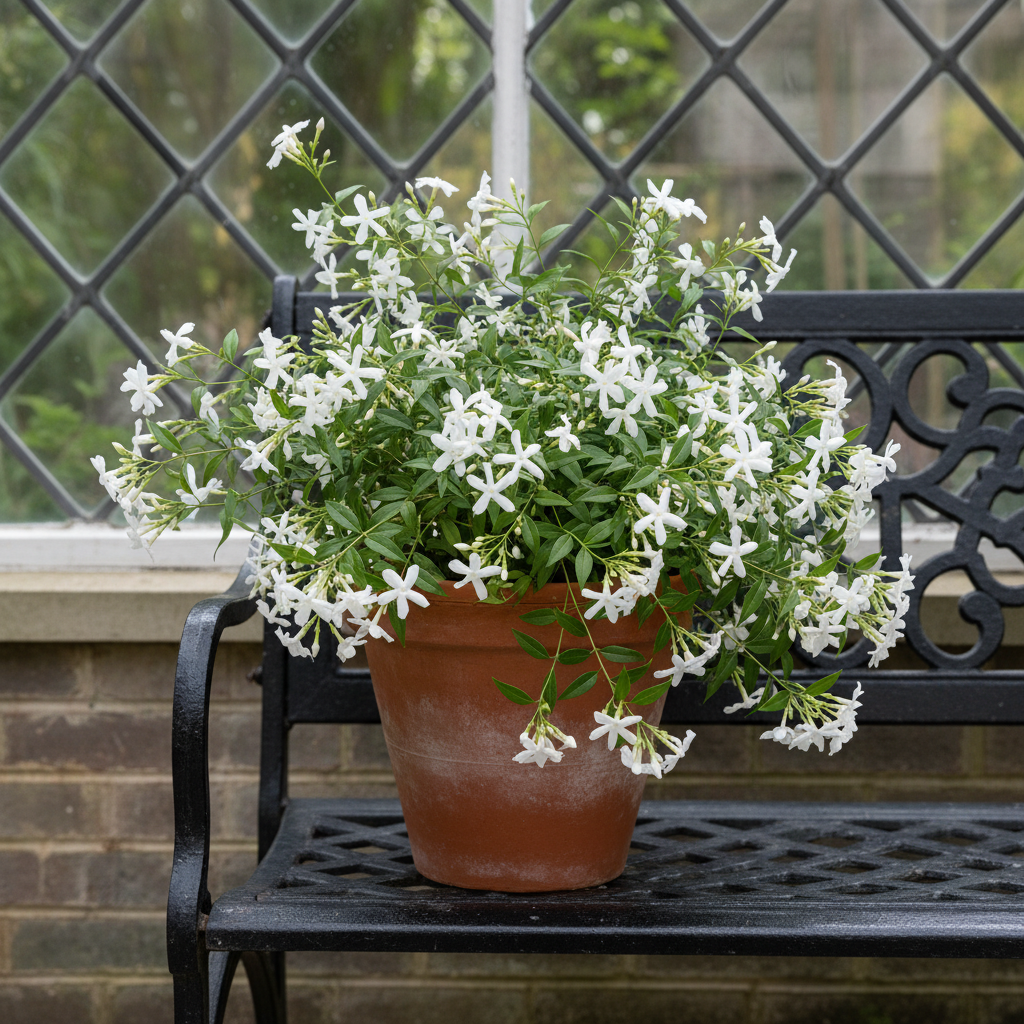
Common White Jasmine
The hardier European cousin of pink jasmine, Jasminum officinale bears delicate pinnate leaves of seven to nine pointed leaflets and produces simple white star-shaped flowers from midsummer through autumn. Unlike pink jasmine, it does not have pink-flushed buds, and it tolerates light frost outdoors in temperate gardens. Grown indoors, common jasmine has a more open vine habit than pink jasmine and reaches similar lengths over time. The cultivar ‘Argenteovariegatum’ carries cream-edged leaves that brighten dim corners even when the plant is not in flower.
Variety Profiles in Detail
Pink Jasmine (Jasminum polyanthum)
The benchmark indoor jasmine and the subject of this guide. Introduced from southwestern China to European cultivation in 1883 by the French missionary-botanist Jean-Marie Delavay, pink jasmine quickly became a glasshouse favourite for its abundant winter flowers and clean perfume. The species name polyanthum means “many-flowered” and is well earned; a mature plant carries more than a thousand individual flowers in a single flush. The buds open from coral pink to pure white over a day or two, and individual flowers persist for around five days before dropping. The whole plant can be in continuous bloom for six to eight weeks if kept cool, or as little as two weeks in a warm room.
Arabian Jasmine (Jasminum sambac)
A more tropical species native to South Asia and probably the most widely cultivated jasmine in the world, thanks to its central role in jasmine tea production in southern China and its use in traditional Hindu and Buddhist ceremonies. The plant is more shrubby than vining, reaching 1 to 2 m as an indoor specimen, with thick glossy leaves arranged in opposite pairs. Flowering is sporadic and continuous through the warm months rather than seasonal, which means a sambac in a sunny living room flowers on and off all year. The flowers are intensely fragrant and release their scent most strongly between dusk and dawn.
Common White Jasmine (Jasminum officinale)
The species traditionally grown over English cottage doorways and on Italian terraces, common jasmine has spent so long in European cultivation that its exact wild origin is uncertain, though it probably came from the Caucasus and northern Iran. It is the hardiest of the popular jasmines, tolerating winter temperatures down to minus 5 °C outdoors and surviving short frosts to minus 10 °C when established. Grown indoors it produces fewer but more refined flowers than pink jasmine and has a longer, more open flowering season from June to October.
Royal Jasmine (Jasminum grandiflorum)
Also known as Spanish or Catalan jasmine, this species is the source of jasmine absolute used in perfumery, with the highest concentration of the indole and benzyl-acetate compounds that give jasmine its characteristic perfume. The plant resembles common white jasmine in habit but produces larger, more deeply scented flowers, and is more tender than its European cousin. As an indoor plant it requires the same conditions as pink jasmine but blooms intermittently throughout summer and autumn rather than in a single winter flush.
Choosing the Right Variety for Your Space
For most indoor growers, pink jasmine is the natural starting point. It is widely available, inexpensive, easy to find in bloom in late winter, and gives a dramatic floral display that justifies its modest price. The single condition it requires above all is a cool autumn rest, which suits an unheated porch, conservatory or guest bedroom but not a centrally heated living room. If you cannot offer a six-week cool period below 10 °C in October and November, Arabian jasmine is the more sensible choice; it does not need a cold rest and flowers continuously in warm conditions. For a plant that can spend summer outdoors and tolerate occasional frost, common white jasmine is the right pick. For pure perfume, royal jasmine is unmatched but harder to find and slightly more demanding than its relatives.
Frequently Asked Questions
Why has my pink jasmine not flowered this year?
Almost always because the plant did not receive a cool autumn rest. Pink jasmine sets its flower buds in response to falling temperatures and shortening days from late September through November. A plant kept above 18 °C all autumn never receives the cold signal that triggers bud initiation, so it produces only leaves the following winter. Move the plant to an unheated room, conservatory or sheltered porch for six weeks in October and November where night temperatures fall to between 4 and 10 °C, water sparingly and stop feeding, and you should see flower buds forming by late December.
Can I keep pink jasmine outdoors all year?
Only in climates that do not experience prolonged frost. Pink jasmine is hardy to about minus 3 °C for brief periods but suffers serious leaf damage below freezing and dies if subjected to sustained frost or temperatures below minus 5 °C. In a Mediterranean or temperate maritime climate, it can grow permanently outdoors against a sheltered south wall. In colder climates, treat it as an indoor plant that summers outside on a balcony or terrace, brought in before the first frost.
When and how should I prune my jasmine?
Prune immediately after flowering, typically in late March or early April. Pink jasmine flowers on the previous season’s growth, which means pruning earlier removes the buds before they open and pruning later cuts off the wood that will carry next year’s flowers. Cut each vine back by roughly one third of its length, removing any weak, dead or crossing stems to the base. The plant responds to hard pruning by producing a flush of vigorous new vines, which will ripen through summer and flower the following winter.
My jasmine flowers smell less strongly than I remember. Why?
Three factors influence perfume strength: temperature, light and time of day. The fragrance compounds in jasmine flowers are volatile oils that evaporate more readily at warmer temperatures, so a plant flowering in a cool unheated room produces a milder scent than the same plant brought into a warmer living room. Bright light strengthens fragrance because the plant produces more of the precursor compounds. Finally, jasmine is most fragrant in the evening, when wild pollinators are most active; the same plant smells noticeably stronger after dusk than at noon.
Why are the leaves yellowing and dropping?
Yellow leaves on pink jasmine usually point to one of four causes: overwatering, which produces general yellowing starting on the oldest leaves; cold draughts, which produce yellowing on the side of the plant facing the cold source; sudden change in location, which produces transient leaf drop as the plant adjusts; or nutrient deficiency, particularly magnesium, which produces yellow patches between green veins. Identify which pattern matches your plant and address the underlying cause; do not simply pick off the yellow leaves, which leaves the problem unsolved.
How long does a pink jasmine live as a houseplant?
Indefinitely, in principle. Pink jasmine is a long-lived perennial vine, and there is no inherent reason a healthy plant should not continue to grow and flower for fifteen or twenty years. In practice, indoor specimens often decline after three to five years because the rootbound stage coincides with cumulative overwatering damage and inadequate light. Repot every eighteen months in fresh mix, prune hard after flowering, and provide the seasonal cool rest, and you can keep the same plant in vigorous health for decades.
Is jasmine safe around my cat or dog?
True jasmines in the genus Jasminum, including pink jasmine, common jasmine and Arabian jasmine, are listed as non-toxic to cats and dogs by the ASPCA. The risk to watch is mistaken identity: yellow Carolina jasmine (Gelsemium sempervirens) and night-blooming jasmine or jessamine (Cestrum nocturnum) are highly toxic to pets and humans, and both are occasionally sold under “jasmine” labels. Always confirm the botanical name before bringing any jasmine into a household with pets or small children.
Can I grow jasmine from the seeds inside a faded flower?
Pink jasmine rarely sets viable seed indoors because flowering occurs outside the normal pollinator season and most cultivated plants are self-incompatible. Even when seed is produced, the plants take three to four years to reach flowering size and may differ from the parent in flower colour and vigour. Stem cuttings root easily and produce a flowering plant in twelve to eighteen months that is genetically identical to the parent, so propagation by cutting is the strongly preferred method for any home grower.
Should I remove the bamboo hoop the plant came with?
Eventually, yes, but not immediately. The hoop or fan-shaped trellis supports the vines while the plant is small and gives it a tidy display shape at the garden centre. Within one or two seasons, however, the plant outgrows the original support, and the vines need a larger framework to climb. Train the plant onto a taller bamboo cane, a wire obelisk or a wall-mounted trellis when you next repot, weaving the new growth gently between the supports as it extends. Cut away the original hoop only when it no longer carries any active stems, to avoid disturbing growing tips.
What is the difference between true jasmine and star jasmine?
They belong to completely different plant families. True jasmines are members of the genus Jasminum in the olive family Oleaceae, while star jasmine (Trachelospermum jasminoides) is a member of the dogbane family Apocynaceae and is more closely related to the periwinkle than to jasmine proper. Star jasmine has leathery oval evergreen leaves and produces small white pinwheel flowers in early summer with a sweet, slightly heavier perfume than true jasmine. As a houseplant it is significantly hardier and slower-growing than pink jasmine, but it does not flower as freely indoors. The two are easily told apart by leaf shape alone: true jasmines have compound pinnate leaves, while star jasmine has simple oval leaves.






