
- Quick Reference: Indoor Light at a Glance
- Window Direction Matters
- How Plants Tell You the Light Is Wrong
- Moving Plants Without Shock
- Grow Lights Are Not Cheating
- Survive Versus Thrive
- Frequently Asked Questions
Light is the invisible ingredient in every successful houseplant routine. Watering, fertilising and repotting all matter, but none of them can compensate for a plant sitting in the wrong light; University of Missouri Extension makes the same point bluntly, noting that the effects of insufficient light cannot be cured by extra fertiliser, water or repotting.[1] The good news is that indoor light becomes far less mysterious once you stop thinking in vague labels like “bright” and “low” and start reading the room the way a plant does.
Most houseplants are not asking for the blazing sun of a greenhouse bench. They are asking for useful, steady light that matches the leaf they have evolved. Thin tropical leaves usually want abundant filtered light. Thick succulent leaves can handle stronger direct sun. Ferns and understory palms may tolerate lower light, but even they grow fuller, denser and healthier when the light is bright enough to fund new growth.
Quick Reference: Indoor Light at a Glance
| Light level | Typical indoor position | What plants usually do there |
|---|---|---|
| Direct sun | Unshaded south or west windowsill in summer | Strong enough for succulents and cacti; can scorch many tropical foliage plants. |
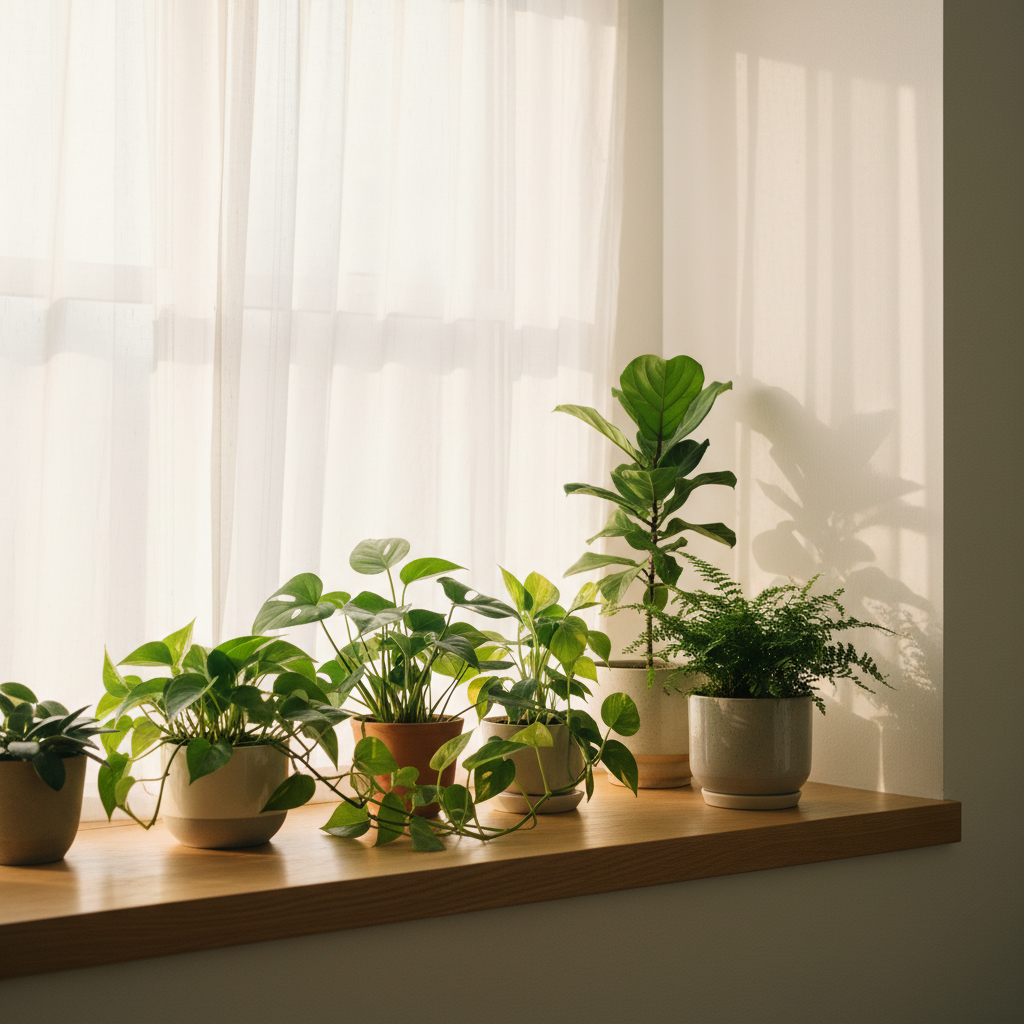
| Bright indirect | East window, sheer-curtained south window, or just back from a west window | Ideal for many aroids, orchids, peperomias, pileas and flowering houseplants. |
| Medium light | Near a north window or a few metres back from a bright window | Suitable for tolerant foliage plants, but growth is slower and looser. |
| Low light | Interior corner away from windows | Survival only for a small group of plants; most will slowly decline. |
| Very low light | Hallway, windowless bathroom, dark shelf | Not enough for long-term growth without a grow light. |
Window Direction Matters
In the northern hemisphere, south-facing windows are usually the brightest and most dangerous. They can be perfect in winter and punishing in summer, particularly behind glass where heat builds quickly. A sheer curtain often turns a harsh south window into excellent bright indirect light. East-facing windows are the most forgiving exposure for many indoor plants because morning sun is gentle and the rest of the day stays bright. West-facing windows work well for tougher plants but can produce fierce afternoon heat. North-facing windows offer cool, even light, useful for ferns and shade-tolerant foliage plants, though often too dim in winter for strong growth.
A plant does not read compass points, of course. It reads intensity. A north window with an open sky view may be better than a south window blocked by a neighbouring building. Curtains, balconies, trees, roof overhangs and dirty glass all reduce the amount of usable light reaching a leaf.
Pro Tip — The Hand Shadow Test: Hold your hand about 30 centimetres above the leaves at midday. A sharp, dark shadow means direct or very strong light. A soft-edged but clearly visible shadow usually means bright indirect light. A faint, barely visible shadow means medium to low light.
How Plants Tell You the Light Is Wrong
Plants are rarely silent; they are just slow. In too little light, stems stretch, leaves become smaller, variegation fades and growth leans dramatically toward the window. A trailing plant may produce long empty vines with leaves clustered only at the ends. A flowering plant may look healthy enough but refuse to bloom, because flowering is expensive and the plant cannot afford it.
In too much light, symptoms are faster and more brutal. Leaves bleach yellow-white, develop crisp brown patches, or redden at the edges before scorching. Damage from sunburn does not heal. The plant can outgrow it, but the affected leaf will remain marked until removed.
Moving Plants Without Shock
Abrupt moves from low light into strong light can burn foliage because leaves produced in shade are physically adapted to shade.[1] If a plant has lived in a dim corner all winter, do not put it straight on a sunny summer windowsill. Move it in stages: first closer to the window, then into morning sun, then into its final position if the leaves remain unmarked.
The same is true in reverse. A plant moved suddenly from bright light to a dim interior may stop using water quickly, so the old watering routine becomes dangerous. Whenever light drops, watering should usually drop too.
Grow Lights Are Not Cheating
A full-spectrum LED grow light can turn an impossible shelf into a usable plant space. For most tropical foliage plants, a white LED panel or bar positioned 30 to 60 centimetres above the canopy and run for 10 to 14 hours a day is enough to maintain compact growth. The plant does not care whether photons came from the sun or a well-placed diode.
Grow lights are particularly useful in winter, when daylight intensity and duration both fall. A plant that was thriving one metre from a window in July may effectively be in low light by December. Supplemental lighting lets you keep the room layout stable while giving the plant a more consistent year.
Warning — The Decor Trap: If a plant looks perfect in a dark corner, it is usually perfect decor but poor horticulture. Use that spot for a realistic faux plant, or add a discreet grow light and make it a real plant position.
Survive Versus Thrive
Many care labels say a plant “tolerates low light.” That does not mean it likes low light. It means it declines slowly enough that the decline may be mistaken for normal behaviour. A snake plant can survive in a dim hallway; it will grow more strongly near a bright window. A kentia palm can tolerate a deeper room; it will hold more fronds in bright indirect light. A pothos can manage almost anywhere; it becomes fuller and more colourful with generous filtered light.
The best placement is not the brightest place in the house. It is the place where the plant’s leaves receive enough energy without overheating or burning. Once you learn to read that balance, almost every other part of plant care becomes easier.
Frequently Asked Questions
| Question | Answer |
|---|---|
| Can ordinary room lights keep plants alive? | Usually not. Ceiling lights are designed for human eyes, not plant growth, and are often too dim or too far away. Dedicated LED grow lights are far more effective. |
| Should I rotate my plants? | Yes, especially plants that lean toward light. A quarter turn every watering keeps growth more even. |
| Is direct sun always bad? | No. Cacti, succulents and some palms relish direct sun. Many thin-leaved tropical plants need it filtered. |
| Why did my plant stop needing water in winter? | Lower light reduces growth and transpiration, so the pot dries more slowly. Adjust watering to the soil, not the calendar. |



