
- Quick Reference: Potting Mix Components
- Why Garden Soil Fails Indoors
- Match the Mix to the Plant
- When to Repot
- How Big Should the New Pot Be?
- Drainage Layers Do Not Fix Bad Drainage
- Step-by-Step Repotting
- Refreshing Without Repotting
- Frequently Asked Questions
A potting mix is not dirt in a bag. It is the root environment of the plant: the place where water, air, nutrients and anchorage all have to coexist. When a plant declines after “doing everything right,” the hidden problem is often below the surface. The mix is compacted, the pot is too large, the roots are circling, or the decorative container has quietly become a swamp.
Most indoor plants need a medium that holds some moisture but still drains and aerates well. Oklahoma State Extension describes good potting medium as one with water-holding capacity while remaining loose enough to promote drainage and aeration.[2] That balance is the whole game.
Quick Reference: Potting Mix Components
| Component | What it contributes | Best used for |
|---|---|---|
| Coir or peat | Moisture retention and light structure | General tropical mixes, ferns, foliage plants. |
| Bark | Air pockets, drainage and chunky texture | Aroids, orchids, epiphytes, long-term structure. |
| Perlite or pumice | Drainage and oxygen around roots | Almost all indoor mixes, especially for overwaterers. |
| Compost or loam | Nutrient buffering and weight | Palms and large floor plants in moderation. |
| Sand or grit | Weight and fast drainage | Cacti and succulents, if coarse enough. |
| Sphagnum moss | Moisture plus air | Propagation, mounts, some orchids and humidity-loving epiphytes. |
Why Garden Soil Fails Indoors
Outdoor soil behaves differently in the ground than it does inside a small pot. In a container, garden soil often compacts, drains slowly and may introduce pests, weed seeds or disease organisms. University of Missouri Extension recommends peat-lite mixes for many houseplants and notes that adding soil to potting media can lead to poor drainage, overwatering and root disease in many cases.[1]
A good indoor mix has structure. When you water it, liquid moves through and air returns behind it. Roots do not want to be sealed in mud. They want a moist but breathable environment.
Match the Mix to the Plant
There is no universal perfect mix because roots are not universal. A Boston fern and a cactus are both houseplants only because they share a house, not because they share a habitat.
| Plant group | Useful mix style | Why |
|---|---|---|
| Aroids such as monstera, philodendron and pothos | Coir or peat, bark, perlite and a little compost | Chunky, airy and moisture-retentive, similar to forest litter. |
| Ferns | Fine-textured but open mix with coir/peat and perlite | Holds steady moisture without becoming stagnant. |
| Succulents and cacti | Mineral-heavy mix with pumice, grit and limited organic matter | Dries quickly and prevents root rot. |
| Orchids | Bark-based orchid mix, not ordinary potting soil | Epiphytic roots need major air flow. |
| Palms | Loam-based or compost-based mix cut with perlite or pumice | Provides weight and steady moisture with drainage. |
| Peperomias and hoyas | Light, airy mix with extra bark or perlite | Semi-succulent roots resent staying wet. |
When to Repot
Repotting is useful when the plant needs it and stressful when it does not. A newly purchased plant rarely needs immediate repotting unless the mix is clearly failing or the pot has no drainage. Let the plant acclimate first.
Signs that repotting is genuinely due include roots circling heavily around the bottom, water running straight through because roots have displaced mix, growth stalling in the growing season, the plant drying far faster than it used to, or the plant becoming physically unstable. A few roots showing through the drainage hole is not an emergency. Some plants bloom better slightly snug.
Pro Tip — Repot in Active Growth: Spring and early summer are the easiest seasons for most houseplants to recover from root disturbance. Repotting in midwinter is possible, but recovery is slower because light and growth are lower.
How Big Should the New Pot Be?
The standard step is one pot size up, usually 2 to 5 centimetres wider in diameter. A huge upgrade is tempting but risky. A small root system in a large volume of wet mix cannot drink fast enough, so the outer soil stays damp and stale. Overpotting is one of the quietest ways to create root rot.
Large floor plants are the exception only in weight, not principle. They may need a heavier pot for stability, but the rootball still should not be surrounded by an excessive moat of wet compost.
Drainage Layers Do Not Fix Bad Drainage
Putting stones, gravel or broken crockery at the bottom of a pot is an old habit that refuses to die. It does not create a magical drainage zone; it often reduces the effective root depth and can make water perch higher in the mix. Oklahoma State Extension explicitly advises against adding aggregates in the bottom and states that pots should be filled with the proper potting medium for optimal growth.[2]
If a pot does not drain well, the answer is not gravel. The answer is a drainage hole, a better mix, or using the pot as a decorative cover for a nursery pot.
Step-by-Step Repotting
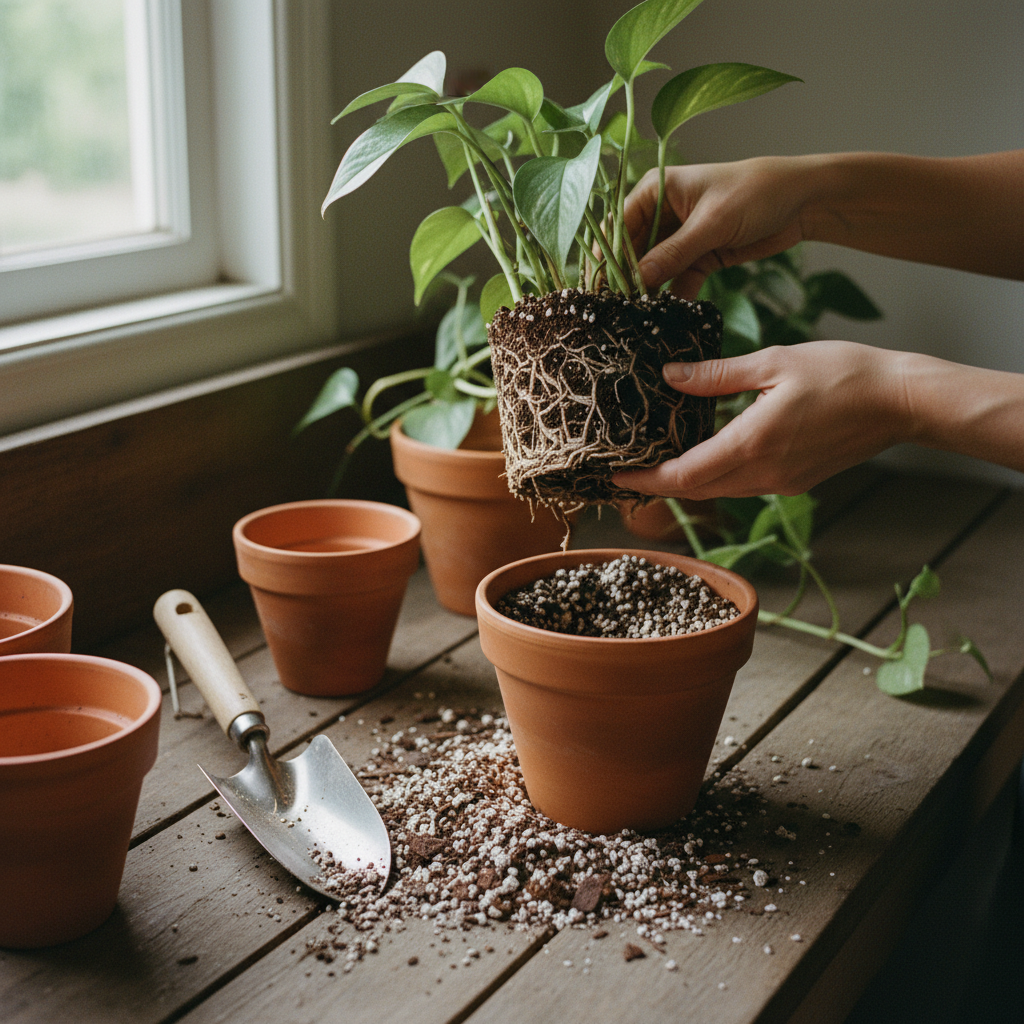
Water the plant a day or two before repotting so the rootball is lightly moist, not dusty dry and not sodden. Slide the plant out gently, supporting the base. Loosen only the outer roots if they are circling tightly; do not tear the rootball apart unless you are dividing a plant that tolerates division. Add fresh mix to the new pot, set the plant at the same depth it was growing before, and fill around the sides, firming lightly rather than compacting.
After repotting, water thoroughly and let the pot drain. Keep the plant in bright indirect light while it settles. Hold fertiliser for a few weeks if the mix already contains nutrients or if many roots were disturbed.
Warning — Same Depth, Always: Burying the stem deeper than before can rot crowns and stems, especially in succulents, peperomias and many aroids. Repot roots, not stems.
Refreshing Without Repotting
Not every tired plant needs a bigger pot. If a large plant is already in the right container, scrape away the top few centimetres of exhausted mix and replace it with fresh medium. This top-dressing improves the surface without disturbing the main rootball. It is especially useful for palms, ficus, dracaenas and other heavy specimens that are difficult to move.
Frequently Asked Questions
| Question | Answer |
|---|---|
| Should I remove all old soil? | Usually no. Remove loose or sour mix, but avoid unnecessary root damage. |
| Can I reuse potting mix? | It is safest not to reuse mix from diseased or pest-infested plants. Old mix also loses structure. |
| Why did my plant droop after repotting? | Temporary transplant stress is common. Keep conditions steady and avoid overwatering while roots recover. |
| Do self-watering pots work? | They can work for moisture-loving plants in good light, but they are risky for succulents and plants that prefer drying cycles. |



