
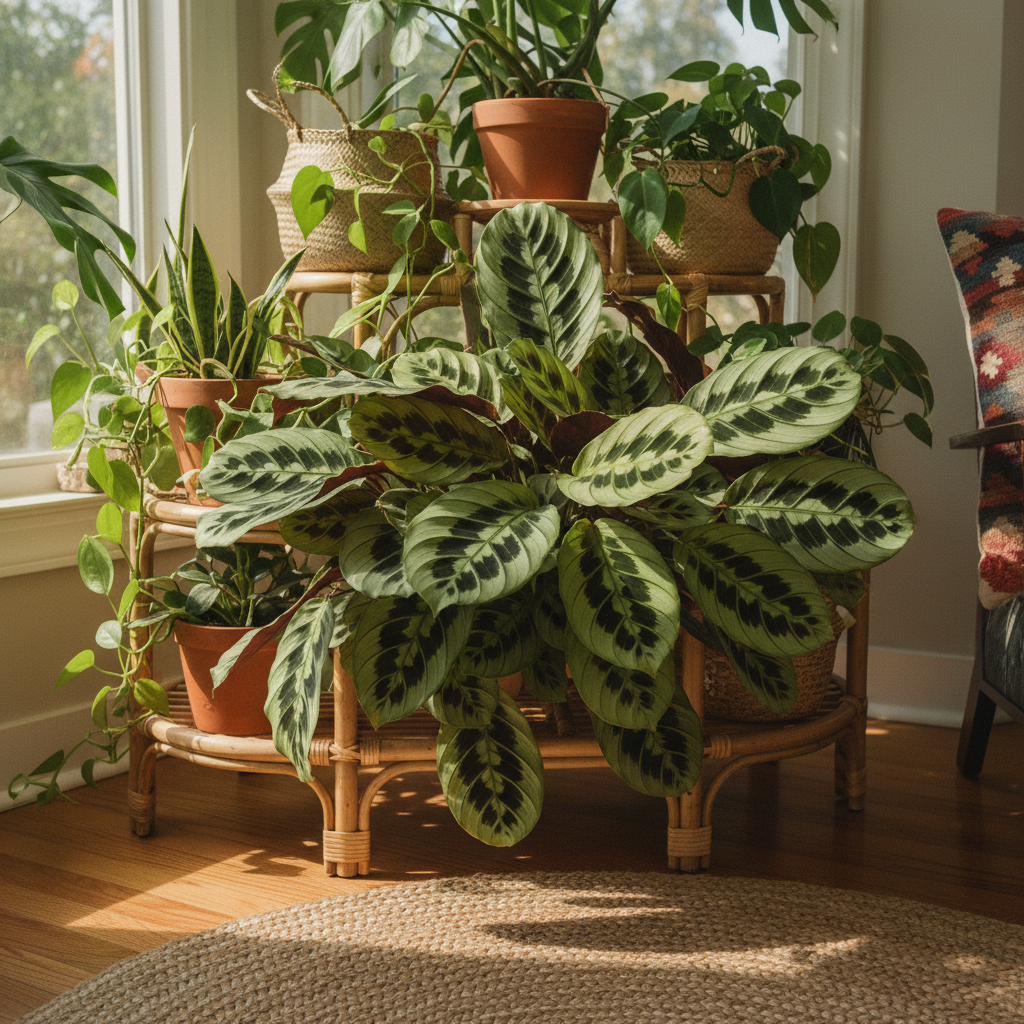
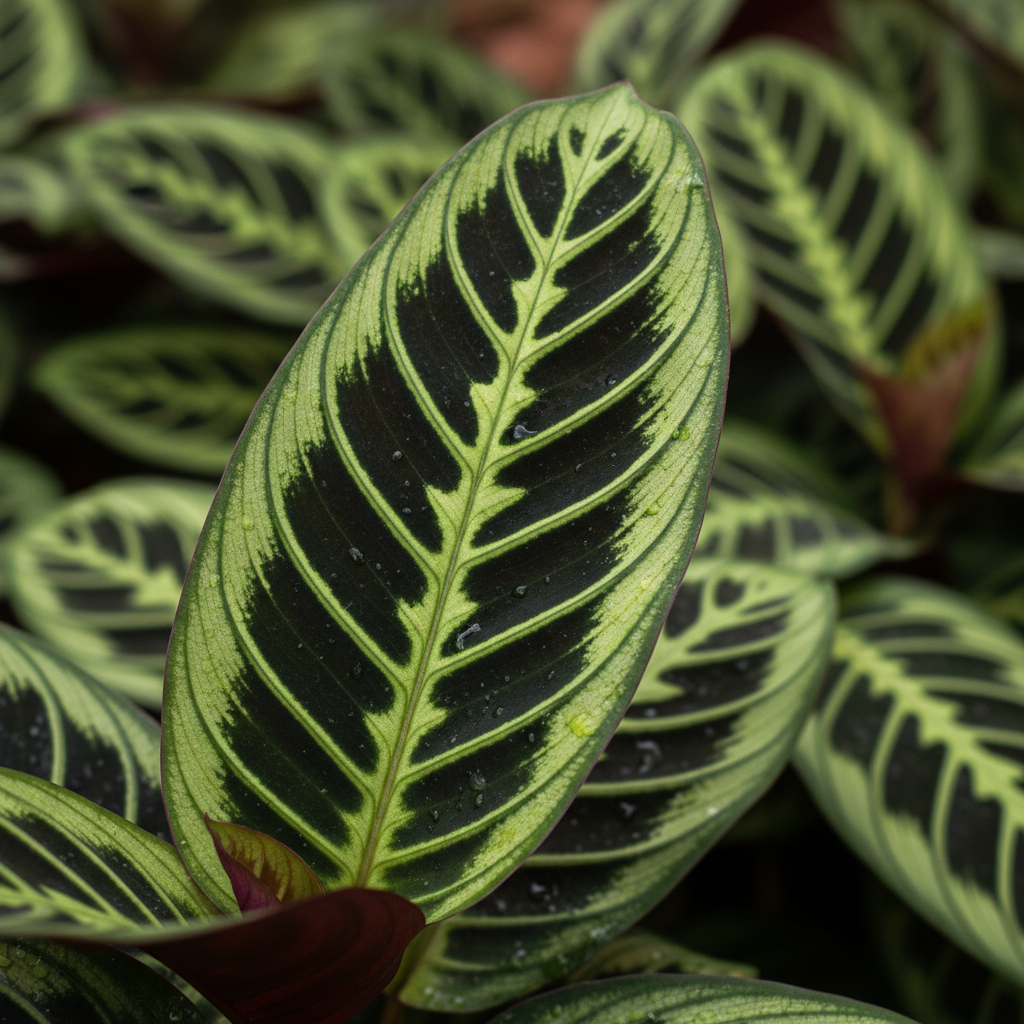
Few foliage houseplants carry their decoration as boldly as the fishbone prayer plant. Each oval leaf is painted with alternating bands of pale silvery-green and deep forest green that radiate from the central rib like the skeleton of a fish, while the undersides glow a rich burgundy-purple that flashes into view whenever the plant moves. Botanically it is Ctenanthe burle-marxii, a low, clumping member of the prayer plant family (Marantaceae) from the shaded understorey of eastern Brazil, and it was named in honour of Roberto Burle Marx, the celebrated Brazilian landscape architect who did so much to popularise the country’s native flora.
Like its Maranta and Calathea cousins, this is a plant with a reputation for being a touch dramatic. It will tell you in no uncertain terms when the air is too dry, the water too harsh, or the light too fierce, usually by curling its margins or crisping its edges. The good news is that none of its demands are mysterious once you understand where it comes from, and a fishbone prayer plant that is given humid air, gentle light and consistent moisture is a remarkably rewarding grower. This guide walks through every aspect of its care, from the science of why its leaves move at night to step-by-step propagation, so you can move beyond keeping it alive and into helping it genuinely flourish.
Contents
- Quick Reference
- Why the Fishbone Prayer Plant Makes a Striking Houseplant
- Light Requirements
- Watering & Humidity
- Soil, Potting & Repotting
- Fertilising
- Propagation
- Pests & Diseases
- Popular Varieties
- Frequently Asked Questions
Quick Reference: Fishbone Prayer Plant at a Glance
| Light | Bright, indirect light; no direct midday sun |
| Watering | Keep evenly moist; water when the top 2 to 3 cm (1 in) of soil feels dry |
| Temperature | 18 to 27°C (65 to 80°F); never below 15°C (59°F) |
| Humidity | High, ideally 60% or more |
| Fertiliser | Balanced feed at half strength, monthly in spring and summer |
| Toxicity | Non-toxic to cats, dogs and humans |
Why the Fishbone Prayer Plant Makes a Striking Houseplant
The most immediate reason to grow Ctenanthe burle-marxii is the foliage. On a mature plant each leaf is a small work of graphic art, the pale ground colour interrupted by precise dark green chevrons that line up into a continuous herringbone running the length of the blade. Held close together on a compact, spreading clump that rarely exceeds 30 to 40 cm (12 to 16 in) in height indoors, the leaves overlap to create a dense, layered cushion of pattern that works beautifully at coffee-table or low-shelf height where you can look down into it.

The second reason is movement. Prayer plants are named for nyctinasty, the daily raising and lowering of their leaves driven by changes in water pressure within a swollen joint at the base of each leaf called the pulvinus. At dusk the fishbone prayer plant folds its blades upward, exposing the wine-coloured undersides and giving the whole plant a softly animated quality, then opens them flat again with the morning light. Watching a healthy specimen settle for the night is one of the quiet pleasures of growing it, and it doubles as a useful health indicator: a plant that has stopped moving is usually telling you something about its water or light. Add to this the fact that it is genuinely non-toxic, and you have a houseplant that earns its place in homes with curious pets and small children alike. The difference between a fishbone prayer plant that survives and one that thrives comes down almost entirely to atmosphere, getting the humidity, water quality and light right, and the sections that follow cover each in turn.
Important — Toxicity: The fishbone prayer plant is listed as non-toxic to cats and dogs by the ASPCA and poses no poisoning risk to humans. As with any plant, nibbled foliage may cause mild stomach upset in a pet that eats a large quantity, so it is still sensible to discourage grazing, but you do not need to worry about the serious toxicity associated with many popular aroids.
Light Requirements
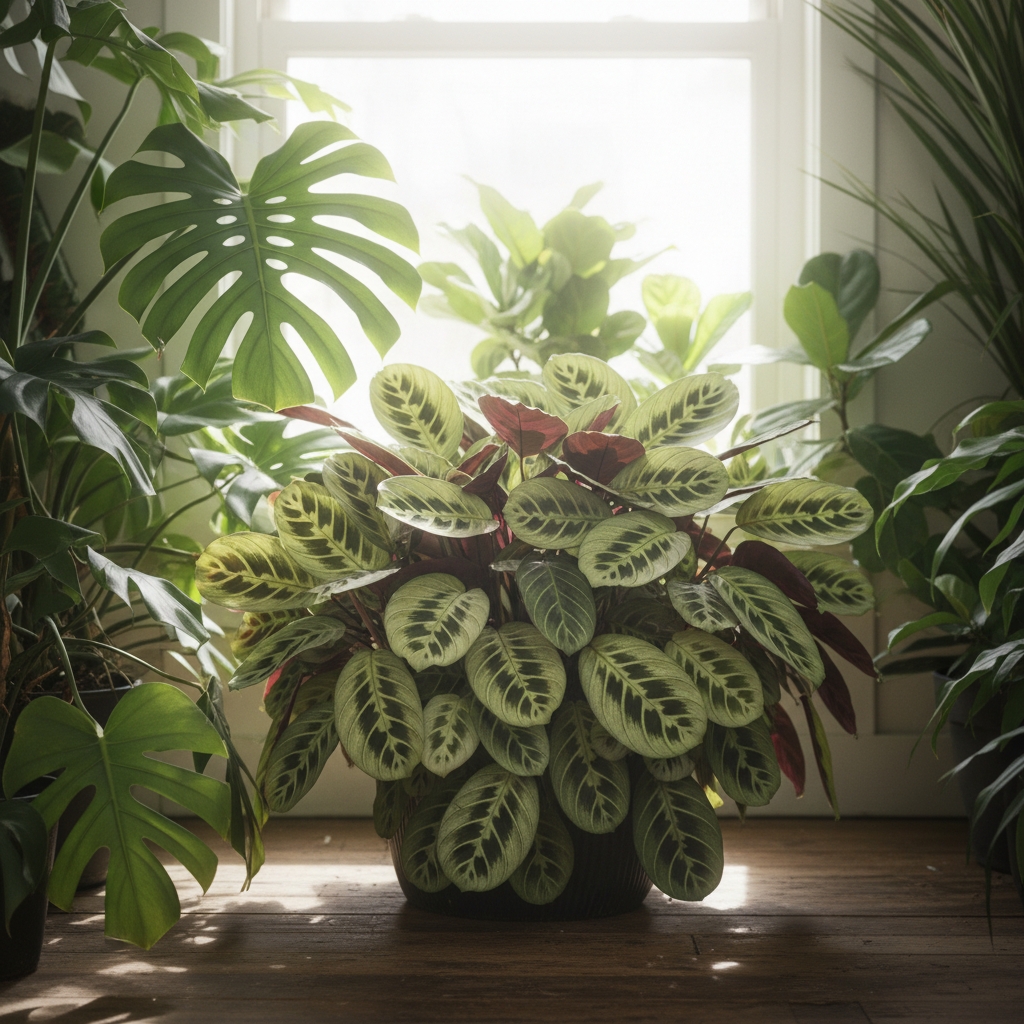
In the wild the fishbone prayer plant grows on the rainforest floor, where the dense canopy overhead filters the tropical sun into a soft, dappled glow long before it reaches ground level. Recreating that quality of light is the single most important thing you can do for its appearance, because it is the patterned leaves themselves that are at stake. Too little light and the plant grows leggy and loses contrast; too much and the markings bleach out and the edges scorch.
The ideal indoor position is one that receives plenty of bright, indirect light for most of the day but where the sun’s rays never fall directly on the foliage. A spot a metre or two back from a bright window, or close to a window screened by a sheer curtain or the leaves of taller plants, mimics the understorey conditions almost perfectly. If the plant is reaching, stretching its stems and spacing its leaves further apart, it wants more light; if the silver bands are turning a flat, washed-out cream, it is getting too much.
Light Levels Explained
Light indoors is easy to misjudge because our eyes adjust so readily, so it helps to think in rough categories. The table below sets out where the fishbone prayer plant fits and what happens at each level.
| Light Category | Approx. Level | Typical Location | Outcome |
|---|---|---|---|
| Direct sun | 20,000 lux and above | On a south windowsill, unscreened | Avoid; bleaching and leaf scorch |
| Bright indirect | 10,000 to 20,000 lux | Near an east window or back from a south one | Ideal; strong colour and tight growth |
| Medium | 5,000 to 10,000 lux | A metre or two into a bright room | Good; slightly slower growth |
| Low | 1,000 to 5,000 lux | A north room or a dim corner | Tolerated briefly; leggy, dull leaves |
| Very low | Under 1,000 lux | Interior hallway, far from any window | Decline; pattern fades and stems flop |
Window Orientation and Placement
South-facing window: The brightest exposure in the northern hemisphere and a risk for this plant if used unscreened. Place it well back from the glass, or diffuse the light with a sheer curtain, so the foliage receives brightness without any direct beam.
East-facing window: Often the best choice. The gentle morning sun is rarely strong enough to harm the leaves, and the bright indirect light that follows for the rest of the day suits the plant well.
West-facing window: Workable, but the afternoon sun here is hot and can scorch the foliage. Set the plant back from the window or filter the light, much as you would at a south window.
North-facing window: The light is safely indirect but may be too weak in winter, when growth can stall and colour dulls. A north sill works best in the brighter half of the year, with a move to better light or a grow lamp through the darkest months.
Pro Tip — Rotate for Even Growth: A fishbone prayer plant will lean steadily toward its light source. Give the pot a quarter turn each time you water so every side receives its share, keeping the clump balanced and symmetrical rather than crowded onto one side.
How Light Affects Leaf Colour and Pattern
The contrast between the pale and dark bands is itself a response to light. In the correct bright indirect range, the plant produces just enough chlorophyll to keep the dark chevrons deep and saturated while leaving the silvery zones luminous, and the pattern reads at its sharpest. Pushed into stronger light, the leaf compensates by fading and the bands blur together into a uniform grey-green. Starved of light, the opposite happens: new leaves emerge larger and thinner with weak markings, and the plant invests in stem length rather than colour. Getting the placement right is therefore not just about preventing damage but about coaxing out the very feature you bought the plant for.
Warning — Direct Sunlight: Even an hour of direct midday sun can leave permanent pale, papery scorch patches on the leaves, and these do not recover. If you notice bleached blotches appearing on the upper surfaces, move the plant out of the beam immediately and trim only the worst-affected foliage once new growth establishes.
Artificial Lighting
The fishbone prayer plant responds well to supplementary lighting, which makes it a good candidate for rooms with little natural light or for getting through a dim northern winter. A full-spectrum LED grow light positioned 30 to 45 cm (12 to 18 in) above the canopy and run for 10 to 12 hours a day will comfortably maintain colour and growth. Because the plant naturally lowers its leaves at night, it is worth putting the light on a timer that gives a clear dark period, allowing the normal day-night rhythm to continue.
Seasonal Adjustments
As the sun drops lower and weakens through autumn and winter, a position that was perfect in summer can become too dim. Many growers move their plant a little closer to the window for the colder months, then back again in spring, and supplement with a grow lamp where needed. Watch the new leaves: if they emerge noticeably paler or more widely spaced than the summer growth, the plant is asking for more light to see it through the season.
Watering & Humidity
Watering is where the fishbone prayer plant tests the patience of new owners, because it asks for a middle path that takes a little practice to find. It wants soil that stays consistently and lightly moist, never drying out completely and never sitting waterlogged. Both extremes show up quickly in the foliage, so reading the plant and the pot is the key skill here.
When to Water
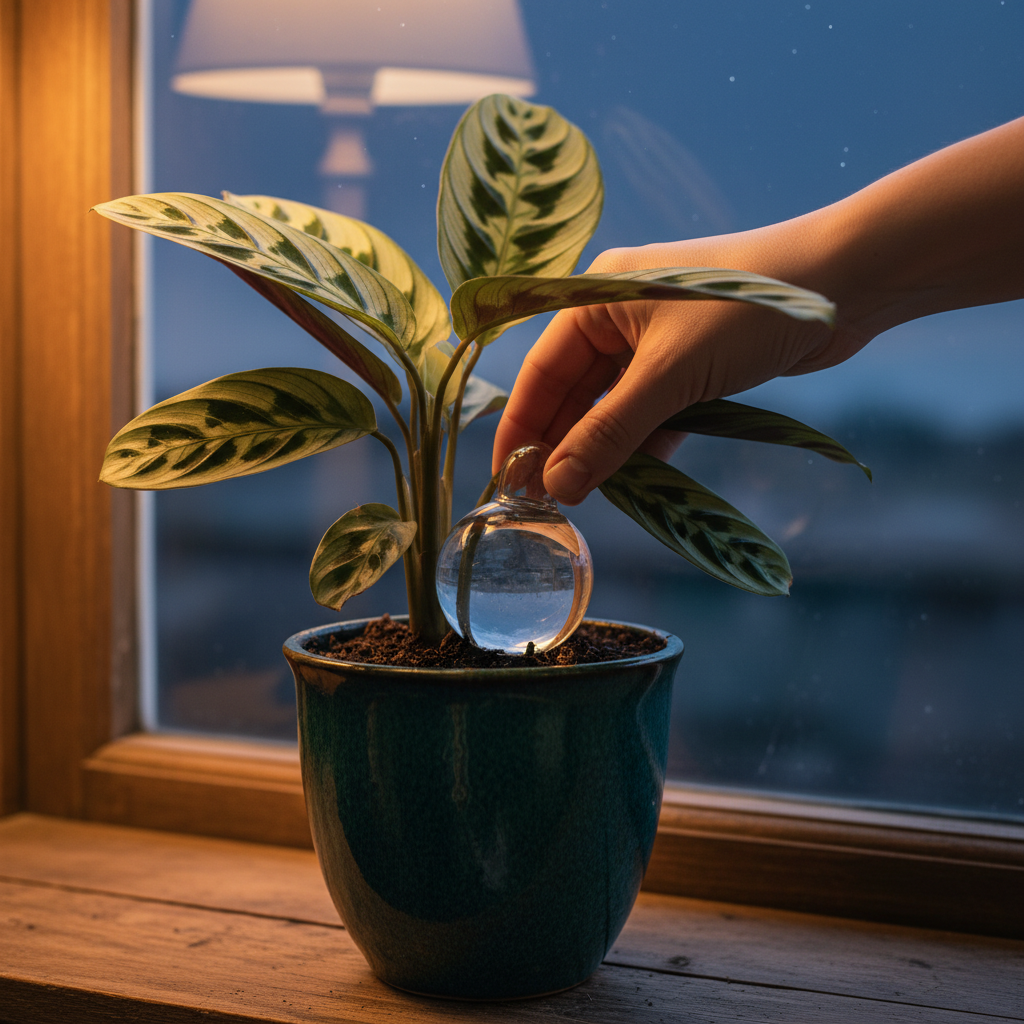
Rather than watering on a fixed schedule, check the soil with your finger. When the top 2 to 3 cm (about 1 in) of the mix feels dry to the touch, it is time to water again. In a bright, warm room during the growing season this typically means watering once or twice a week, but the interval will stretch in winter and in cooler or less bright positions, so let the soil rather than the calendar decide.
Lifting the pot is another reliable guide. A pot that feels light has dried out, while one that is still heavy holds plenty of moisture and can wait. With a little experience you will be able to judge the plant’s needs by weight alone, which is especially useful for spotting when a plant in a decorative cover pot has been quietly sitting wetter than you realised.
Pro Tip — Consistency Beats Volume: This plant prefers small, regular drinks over occasional floods followed by long droughts. Erratic watering, soaking it one week and forgetting it the next, is a common cause of the crispy edges and curling leaves that owners blame on humidity. Steady moisture keeps the foliage smooth and flat.
How to Water Correctly
- Check that the top few centimetres of soil have dried before watering.
- Use room-temperature water, ideally rainwater, distilled water or tap water left to stand overnight (see Water Quality below).
- Pour slowly and evenly over the surface until water runs freely from the drainage holes.
- Let the pot drain fully for several minutes so no water is left standing in the saucer or cover pot.
- Tip away any collected runoff; the roots should never sit in a reservoir of water.
- Return the plant to its spot and wait until the top layer dries again before repeating.
Signs of Overwatering vs. Underwatering
| Symptom | Overwatering | Underwatering |
|---|---|---|
| Leaf colour | Yellowing, often starting with lower leaves | Browning and crisping at the edges and tips |
| Leaf texture | Soft, limp and translucent | Dry, curled and brittle |
| Soil | Constantly wet, may smell sour | Dry, pulling away from the pot sides |
| Roots | Brown, mushy and foul-smelling | Dry and wiry but generally intact |
| Leaf movement | Sluggish or stuck open | Leaves curl tightly and stay folded |
Warning — Root Rot: Persistent waterlogging is the most serious threat to this plant. If you find blackened, mushy roots and a sour smell, remove the plant from its pot, cut away all the rotten tissue with sterilised scissors, and repot into fresh, free-draining mix. Reduce watering afterward and resist the urge to compensate, as a recovering root system needs less water, not more.
Humidity Requirements
If there is one factor that separates a merely living fishbone prayer plant from a thriving one, it is humidity. Coming from a humid rainforest floor, the plant is happiest when the surrounding air sits at 60% relative humidity or above, and it struggles in the dry air of centrally heated or air-conditioned rooms, which can drop below 30%.
The classic symptom of insufficient humidity is browning, papery edges along otherwise healthy leaves, often accompanied by margins that curl inward as the plant tries to reduce moisture loss. These signs are easy to confuse with a watering problem, so check the air as well as the soil when you see them. A small hygrometer takes the guesswork out and is one of the most useful pieces of kit for growing prayer plants well.
To raise humidity, group the plant with other foliage plants so they share the moisture they release, stand the pot on a tray of pebbles topped up with water so evaporation rises around the leaves, or, most effectively, run a room humidifier nearby. A bright bathroom or kitchen, where everyday activities keep the air moist, can also be an excellent home for this species. Misting is often suggested but offers only a brief lift and, if overdone, can encourage fungal leaf spots, so it is no substitute for the steadier methods.
Water Quality
Prayer plants in general, and this one in particular, are sensitive to the chemicals and minerals found in hard tap water. Fluoride, chlorine and a high mineral content can accumulate in the leaf tissue and show up as brown tips and edges even when watering and humidity are otherwise correct. Where your tap water is hard or heavily treated, switch to rainwater, distilled water or filtered water, or at the very least leave tap water to stand uncovered overnight so some of the chlorine can dissipate before use. Many owners who battle persistent leaf-tip browning find it clears up once they change their water source.
Soil, Potting & Repotting
The right growing medium underpins everything else, because it controls how that delicate balance between moist and waterlogged plays out. The fishbone prayer plant needs a mix that holds moisture readily, since it dislikes drying out, while still draining freely enough that excess water escapes rather than lingering around the roots.
Ideal Soil Composition
A peat-free or peat-based potting compost forms a good base, lightened with material that keeps it open and airy. The aim is a fluffy, spongy texture that springs back rather than compacting into a dense block, so that air can reach the roots even when the mix is damp. The table below shows a reliable recipe.
| Component | Proportion | Function |
|---|---|---|
| Coco coir or quality potting compost | 50% | Holds moisture and provides body |
| Perlite or pumice | 25% | Opens the mix and improves drainage |
| Fine orchid bark | 15% | Creates air pockets and structure |
| Worm castings or leaf mould | 10% | Adds gentle, slow nutrition |
The plant prefers a slightly acidic to neutral soil, in the range of roughly pH 6.0 to 6.5, which most standard houseplant composts already provide. There is rarely any need to adjust this deliberately, but it is another reason to avoid hard, alkaline tap water over the long term.
Pro Tip — Quick Mix Recipe: If you want a fast, foolproof blend, combine two parts of a good general houseplant compost with one part perlite and one part fine orchid bark. This gives the moisture retention the plant loves with enough drainage to keep the roots safe, and it works for almost every prayer plant in the Marantaceae family.
Choosing the Right Pot
Because the fishbone prayer plant spreads by rhizomes into a low, wide clump rather than growing tall, a broad, shallow pot often suits it better than a deep one. This matches its naturally spreading root system and avoids large volumes of soil at the bottom that stay wet long after the surface has dried.
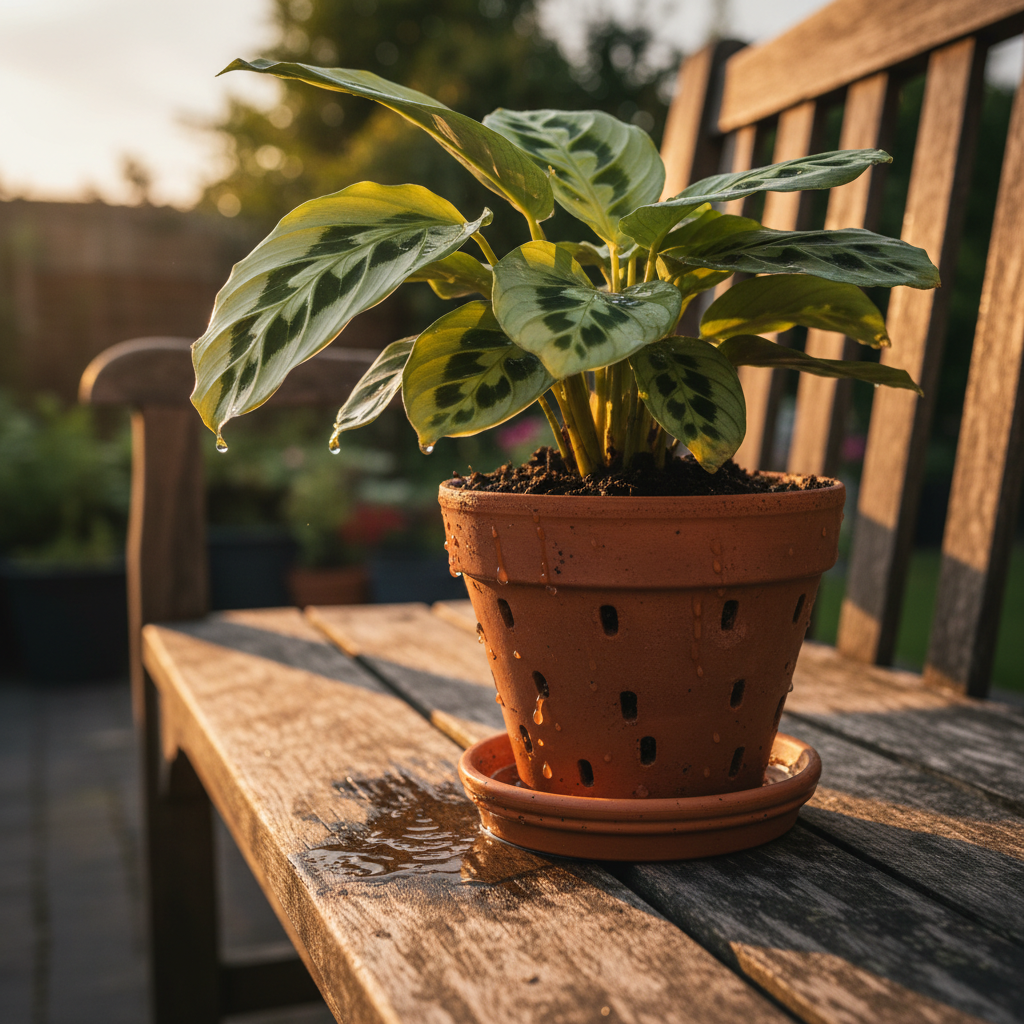
Drainage holes are non-negotiable. Whatever pot you choose, it must have drainage holes. Without them, water collects unseen at the base and root rot becomes almost inevitable. If you love a decorative pot that has no holes, use it as a cover pot with a plain nursery pot inside, and always tip out any water that collects in the bottom.
Pot material: Plastic and glazed ceramic both retain moisture well, which suits a plant that likes to stay damp, and they are the easiest choice for keeping watering consistent. Unglazed terracotta breathes and dries faster, so while it can work, you will need to water more often to stop the mix drying out between drinks.
Pot size: Choose a pot only 2 to 3 cm (1 in) wider than the current root ball. An oversized pot holds more soil than the roots can use, and that excess stays wet, raising the risk of rot. Modest, gradual upsizing is always safer for this plant.
When to Repot
The fishbone prayer plant is not a fast grower and does not need frequent repotting, typically only every two years or so. Tell-tale signs that it is time include roots emerging from the drainage holes or circling the surface, water running straight through without wetting the mix, and growth that has slowed despite good care. The best moment to repot is in spring, at the start of the active growing season, so the plant can recover quickly and put on fresh growth.
How to Repot: Step-by-Step
- Water the plant a day beforehand so the root ball is moist and holds together, reducing stress.
- Ease the plant out by tipping the pot and supporting the base of the clump, rather than pulling on the leaves.
- Gently tease away some of the old, spent soil from around the roots and inspect them, trimming any that are brown or mushy.
- Add a layer of fresh mix to the bottom of the new pot and position the plant at the same depth it grew before.
- Fill around the root ball with fresh mix, pressing lightly to remove large air gaps without compacting it hard.
- Water thoroughly to settle the soil, then let it drain completely.
- Return the plant to a warm, bright spot out of direct sun and hold off on feeding for four to six weeks.
Warning — Transplant Shock: Do not be alarmed if the plant sulks for a week or two after repotting, with some leaf curling or the odd yellow leaf. This is normal transplant shock. Keep conditions warm, humid and stable, avoid fertilising, and the plant will settle and resume growth once its roots have re-established.
Fertilising
The fishbone prayer plant is a light feeder, and it is far easier to harm it with too much fertiliser than too little. In its native understorey it draws modest nutrition from a thin layer of decaying leaf litter, so a gentle, regular feed during the growing season is all it asks for.
The cardinal rule is dilution. The salts in concentrated fertiliser draw moisture out of the fine roots and accumulate in the soil, and this species reacts to that stress with exactly the brown leaf tips that owners so often misread as a humidity problem. Feeding at half the recommended strength, or less, keeps the plant nourished without that risk.
Understanding Plant Nutrients
A balanced houseplant fertiliser supplies the three major nutrients, nitrogen, phosphorus and potassium, shown on the label as the N-P-K ratio, alongside smaller amounts of secondary nutrients and trace elements. For a foliage plant like this one, a balanced or slightly nitrogen-leaning formula keeps the leaves coming. The table below summarises the roles of the main nutrients and the symptoms of deficiency.
| Nutrient | Symbol | Primary Function | Deficiency Symptoms |
|---|---|---|---|
| Nitrogen | N | Leaf and stem growth, green colour | Pale, yellowing older leaves; weak growth |
| Phosphorus | P | Root development and energy transfer | Stunted roots; dull, slow growth |
| Potassium | K | Overall vigour and water regulation | Yellow or brown leaf margins |
| Calcium | Ca | Cell wall strength | Distorted, weak new growth |
| Magnesium | Mg | Core of the chlorophyll molecule | Yellowing between leaf veins |
| Iron | Fe | Chlorophyll production | Pale young leaves with green veins |
Types of Fertiliser
Liquid fertilisers: The most popular and controllable option. Diluted into the watering can, a balanced liquid feed lets you adjust strength and frequency easily and reaches the roots immediately, which makes it the natural choice for this plant.
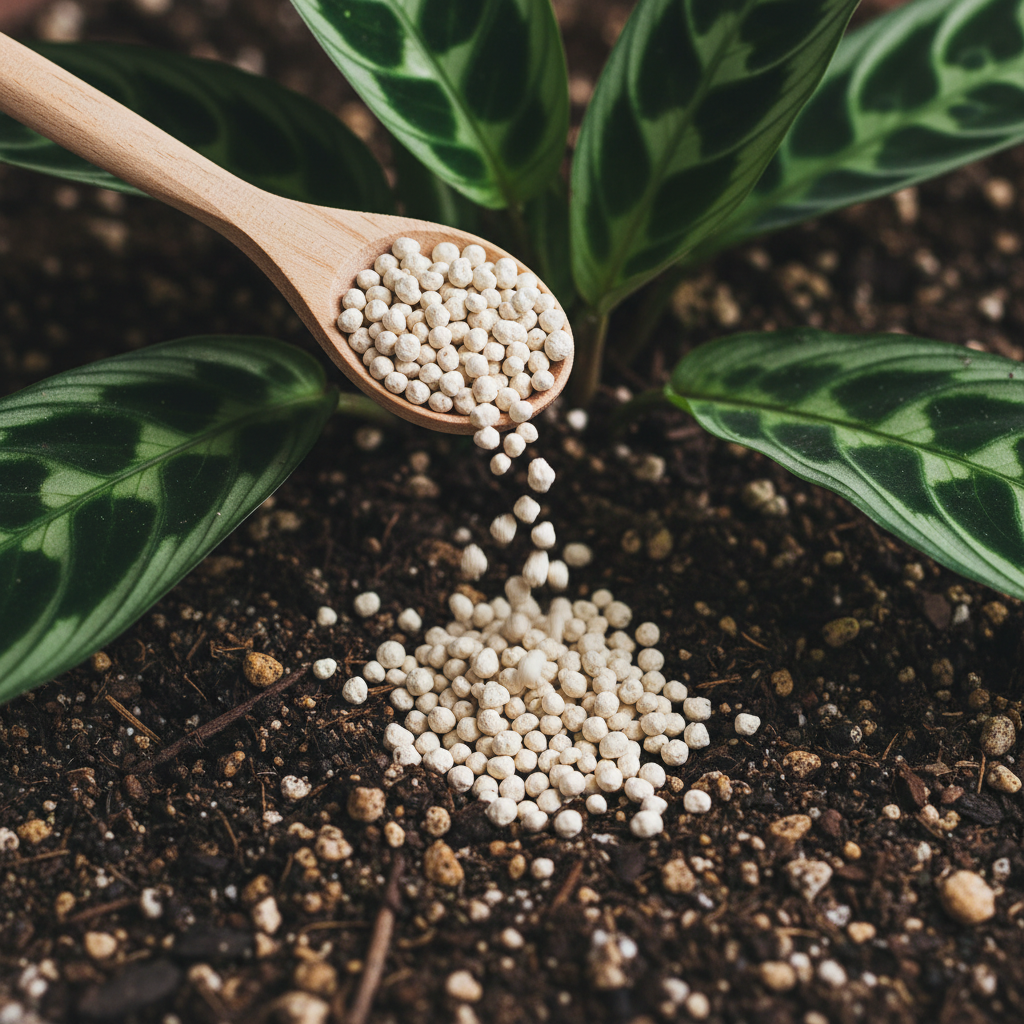
Slow-release granular: Coated prills that release nutrients gradually over several months. They are convenient and reduce the risk of an accidental overdose, though you give up some control over timing. Scatter them sparingly across the soil surface in spring.
Organic fertilisers: Worm castings, diluted seaweed extract and similar gentle organics feed slowly and improve the soil’s life and structure. They are very hard to overdo, which makes them well suited to a sensitive plant, and they pair nicely with the worm castings already in the recommended mix.
Feeding Schedule
Feed once a month with a balanced liquid fertiliser at half strength through the active growing season of spring and summer. As growth slows in autumn, taper off, and stop feeding entirely through winter when the plant is resting and cannot use the extra nutrients. Resuming in spring, when fresh leaves start to appear, keeps the cycle in step with the plant’s own rhythm.
Pro Tip — Always Feed Damp Soil: Never apply fertiliser to dry soil, as the concentrated salts can burn dry roots. Water lightly first, or feed as part of your normal watering, so the diluted fertiliser spreads evenly through already moist mix and reaches the roots gently.
How to Fertilise
- Dilute a balanced liquid fertiliser to half the strength stated on the label.
- Make sure the soil is already damp, watering lightly first if needed.
- Pour the diluted feed evenly over the soil until it begins to drain from the bottom.
- Let the pot drain fully and discard any runoff so salts do not collect in a saucer.
- Flush the soil with plain water every couple of months to wash out any accumulated salts.
Warning — Salt Build-Up: A white crust on the soil surface or around the pot rim signals a build-up of fertiliser salts. Leach the soil by running plenty of plain water through it until it drains freely from the base, and ease back on feeding. Left unchecked, salt build-up scorches the roots and worsens the very leaf-tip browning you are trying to avoid.
Propagation
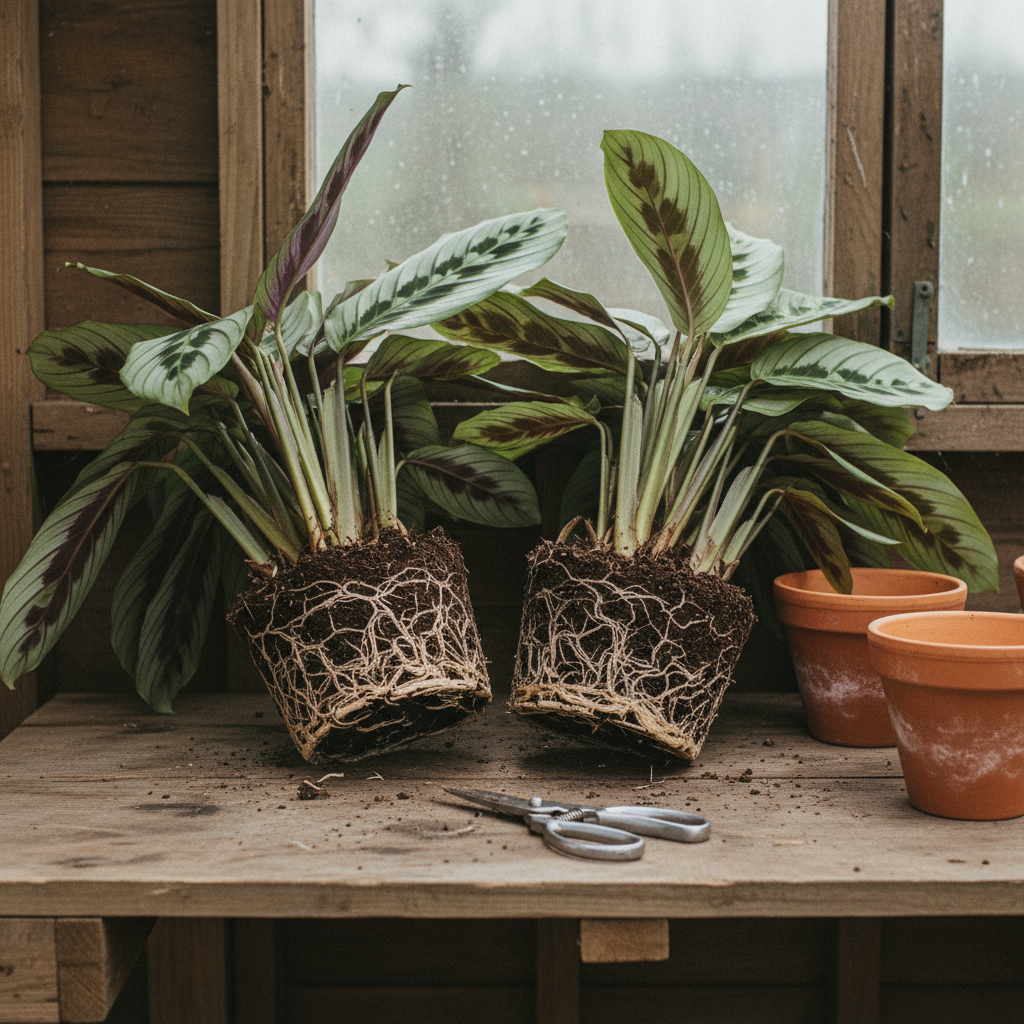
Propagating the fishbone prayer plant is satisfying and free, but it works differently from the leaf and stem cuttings used for vining houseplants. Because this species grows from a creeping underground rhizome that throws up clusters of leaves, the reliable way to multiply it is by division, separating an established clump into smaller, independently rooted plants.
It is worth being clear that single leaf cuttings will not root and grow into new plants the way a pothos or philodendron cutting does. A piece of Ctenanthe needs both roots and a growing point to survive, which is exactly what division provides. The best time to divide is in spring, ideally combined with a scheduled repotting so the plant only suffers one disturbance.
Understanding the Rhizome
The rhizome is a thickened, horizontal stem that runs just below the soil surface, storing energy and sending up new shoots and roots along its length. As the plant matures, the rhizome branches and the clump widens, which is what gives a healthy fishbone prayer plant its spreading, bushy shape. Each section of rhizome that carries its own roots and at least one growing point can become a self-sufficient plant, and that is the structure you work with when dividing.
Division: Step-by-Step
Division is the primary and most dependable method. With a mature, multi-stemmed clump you can usually create two or three new plants in a single session, each of which will establish quickly given warm, humid conditions.
- Water the plant the day before so the roots are hydrated and the soil holds together.
- Slide the whole plant out of its pot and gently brush away enough soil to see the rhizomes and natural clumps.
- Identify sections that each have a healthy bunch of leaves and their own portion of roots attached to the rhizome.
- Separate these sections by teasing the roots apart with your fingers, using a clean, sharp knife only where the rhizome must be cut.
- Pot each division into its own small container of fresh, moist mix at the same depth it grew before.
- Water in well, then place the divisions somewhere warm and bright out of direct sun.
Pro Tip — Raise the Humidity for New Divisions: Freshly divided plants have reduced root systems and lose water faster than they can replace it. Covering each division loosely with a clear plastic bag or placing it in a propagator for the first week or two holds humidity high around the leaves and dramatically improves the success rate while new roots take hold.
Offset Potting: Step-by-Step
Sometimes a vigorous plant pushes up a small clump of leaves a little apart from the main body, effectively an offset on its own short length of rhizome. These can be removed and potted without disturbing the whole parent plant, a gentler alternative to a full division when you only want one or two new plants.
- Scrape away a little surface soil to expose where the offset joins the parent rhizome.
- Check that the offset has formed some roots of its own before separating it.
- Cut it cleanly from the parent with a sterilised blade, keeping as many of its roots as possible.
- Pot the offset into a small container of moist mix and water it in.
- Keep it warm, humid and shaded from direct sun until new growth confirms it has established.
Troubleshooting Propagation
| Problem | Likely Cause | Solution |
|---|---|---|
| Division wilts badly | Too few roots, or air too dry | Raise humidity with a cover; keep warm and shaded |
| Leaves curl and crisp | Water loss outpacing the new roots | Mist lightly, enclose, and keep soil evenly moist |
| Division rots at the base | Soil kept too wet, or cut left dirty | Use free-draining mix and clean tools; water less |
| No new growth for weeks | Cool temperatures or too little root | Move somewhere warmer and brighter; be patient |
Pests & Diseases
A well-cared-for fishbone prayer plant is reasonably resistant to trouble, but the same warm, humid conditions it enjoys can also favour certain pests, and the dry indoor air that stresses it makes others more likely. Catching problems early, while they are confined to a leaf or two, is far easier than tackling an established infestation.
Make a habit of inspecting your plant whenever you water, paying particular attention to the undersides of leaves and the points where leaves meet stems, the hiding places pests favour most. Wiping the foliage gently with a damp cloth not only keeps it clean and able to photosynthesise but also gives you a regular, close look at its health.
Common Pests
Spider Mites (Tetranychus urticae)
The most common and damaging pest of prayer plants, spider mites thrive precisely when the air is dry, which is why this humidity-loving species is so vulnerable in heated rooms. They are tiny, often appearing as moving specks on the leaf undersides, and the first signs are usually a fine pale stippling on the leaves and delicate webbing in the leaf joints.
Treatment: Isolate the plant, rinse the foliage thoroughly under a tepid shower to dislodge the mites, then treat with insecticidal soap or neem oil, repeating every five to seven days until clear. Raising the humidity makes the environment far less hospitable to them and is the best long-term prevention.
Fungus Gnats (Bradysia species)
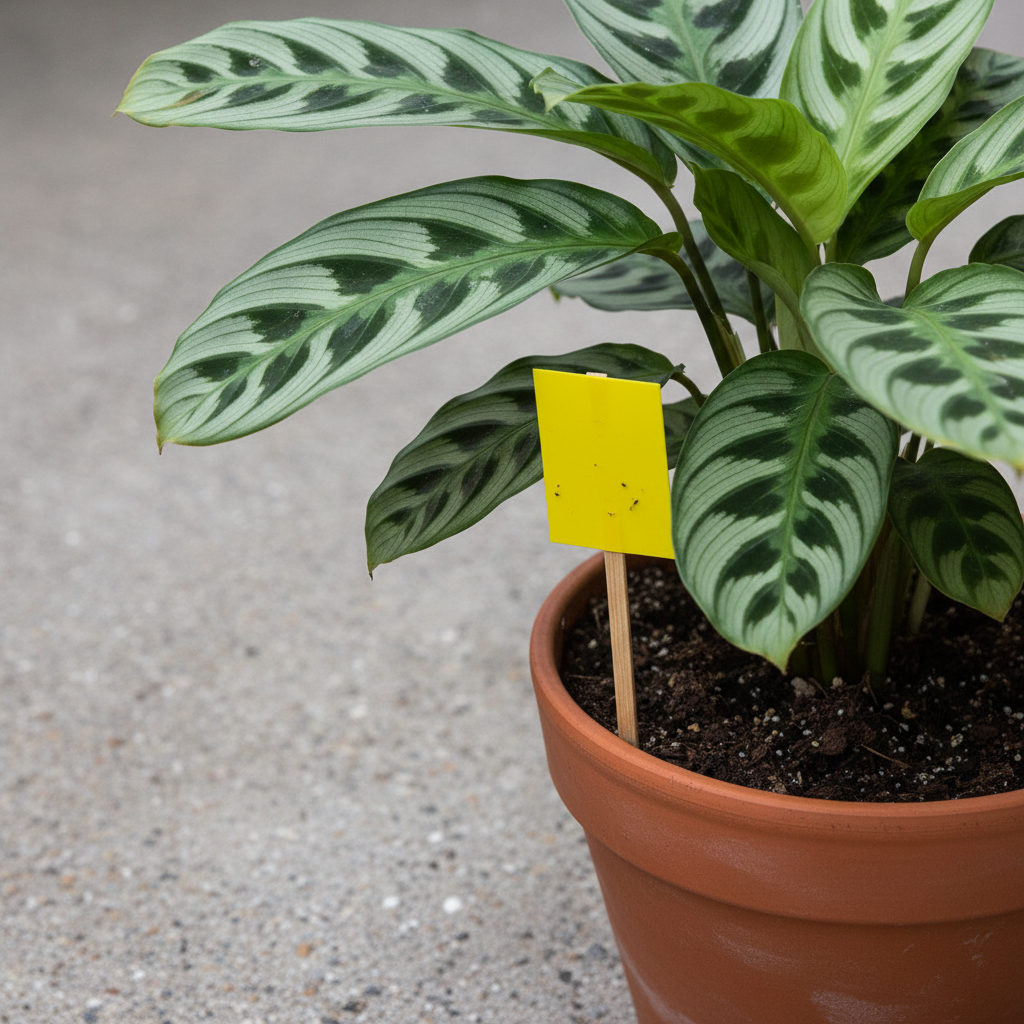
Small black flies that drift up from the soil when you water are fungus gnats, drawn to the consistently moist compost this plant requires. The adults are merely a nuisance, but their larvae feed on organic matter and fine roots in the top layer of soil and can weaken a young plant.
Treatment: Let the top of the soil dry a little more between waterings to break their breeding cycle, set yellow sticky traps to catch the adults, and water with a Bacillus thuringiensis israelensis product or a layer of fine grit on the surface to deter egg-laying.
Mealybugs (Pseudococcus species)
Mealybugs appear as small, white, cottony tufts tucked into leaf axils and along the veins. They suck sap, leaving behind sticky honeydew and causing yellowing and distorted growth where they cluster in numbers.
Treatment: Dab each insect with a cotton bud dipped in isopropyl alcohol to kill it on contact, then follow up with insecticidal soap or neem oil across the whole plant. Check weekly, as mealybugs hide well and often reappear from missed individuals.
Aphids (Aphidoidea)
Aphids are small, soft-bodied insects, often green but sometimes black or pink, that gather on tender new growth and the undersides of young leaves. Like mealybugs they feed on sap and excrete honeydew, which can lead to sooty mould, and heavy feeding distorts emerging foliage.
Treatment: Knock them off with a firm jet of water, then treat with insecticidal soap or neem oil, repeating until no new colonies form. A small outbreak caught early is easily cleared by hand.
Common Diseases
Root Rot (Pythium and Phytophthora)
By far the most common disease of this plant, root rot follows persistent overwatering or poor drainage. The fungi and water moulds responsible thrive in waterlogged soil and destroy the roots, leaving them brown and mushy while the leaves yellow, wilt and collapse from below.
Treatment: Unpot the plant, cut away every soft, blackened root with sterilised scissors, and repot into fresh free-draining mix. Water more sparingly afterward and correct the underlying drainage problem, or the rot will simply return.
Leaf Spot (Helminthosporium and bacterial pathogens)
Fungal and bacterial leaf spots show as small brown or yellow-ringed lesions that can spread and merge if conditions stay wet. They are encouraged by water sitting on the leaves, especially from overhead misting or splashing in still, cool air.
Treatment: Remove affected leaves promptly, improve air circulation, and avoid wetting the foliage when you water. For stubborn fungal cases a copper-based fungicide can help, but cultural changes usually bring it under control.
Pest and Disease Summary
| Pest / Disease | Identification | Treatment |
|---|---|---|
| Spider mites | Fine stippling and webbing; dry air | Rinse, neem or insecticidal soap, raise humidity |
| Fungus gnats | Black flies rising from wet soil | Dry the surface, sticky traps, Bt drench |
| Mealybugs | White cottony tufts in leaf axils | Alcohol swab, then neem or soap |
| Aphids | Clusters on new growth; honeydew | Rinse off, then neem or insecticidal soap |
| Root rot | Yellowing, wilting; mushy brown roots | Trim rot, repot in fresh mix, water less |
| Leaf spot | Brown lesions with yellow halos | Remove leaves, improve airflow, keep foliage dry |
Prevention Strategies
Prevention rests on a few simple habits. Quarantine any new plant for a couple of weeks before it joins your collection, so a hidden pest cannot spread. Keep the humidity up, which both pleases the plant and discourages spider mites, and ensure good air movement to deter fungal problems. Inspect regularly, wipe the leaves clean, and remove dead or fallen foliage that could harbour pests or disease.
Above all, water correctly. A plant kept in the right balance of moisture, with free-draining soil and no standing water, is far more resilient than one swinging between drought and saturation. Most of the diseases that afflict this species trace back to watering mistakes, so getting that right is the most powerful preventive measure of all.
Pro Tip — Treat Early and Thoroughly: When using neem oil or insecticidal soap, apply it in the evening or out of direct sun to avoid leaf burn, and cover every surface including the leaf undersides. Repeat the treatment at weekly intervals for at least three rounds, since a single application rarely catches eggs that hatch later.
Popular Varieties
The genus Ctenanthe contains a handful of closely related species and cultivars that are often sold together under the loose label of fishbone or never-never plants, and telling them apart adds to the fun of collecting them. They share the same understorey care but differ in leaf colour, size and the boldness of their banding.
Ctenanthe burle-marxii itself is the classic fishbone, and the cultivars below either belong to it or sit close beside it in the genus. Whichever you choose, the care described in this guide applies, so you can build a varied collection without learning a new routine for each one.
| Variety | Leaf Appearance | Light Needs | Growth Rate | Availability |
|---|---|---|---|---|
| Burle Marx (type) | Pale green with crisp dark fishbone bands | Bright indirect | Slow to moderate | Common |
| Amagris | Silvery grey-green with faint banding | Bright indirect | Slow | Common |
| Grey Star | Broad silvery leaves, purple undersides | Bright indirect | Moderate | Occasional |
| Compactstar | Smaller, denser clump of banded leaves | Bright indirect | Slow | Occasional |
| Golden Mosaic (C. lubbersiana) | Green splashed with yellow mottling | Bright indirect | Moderate | Occasional |
| Never Never (C. oppenheimiana) | Larger lance leaves, silver and maroon | Bright indirect | Moderate | Common |
Featured Varieties
Amagris
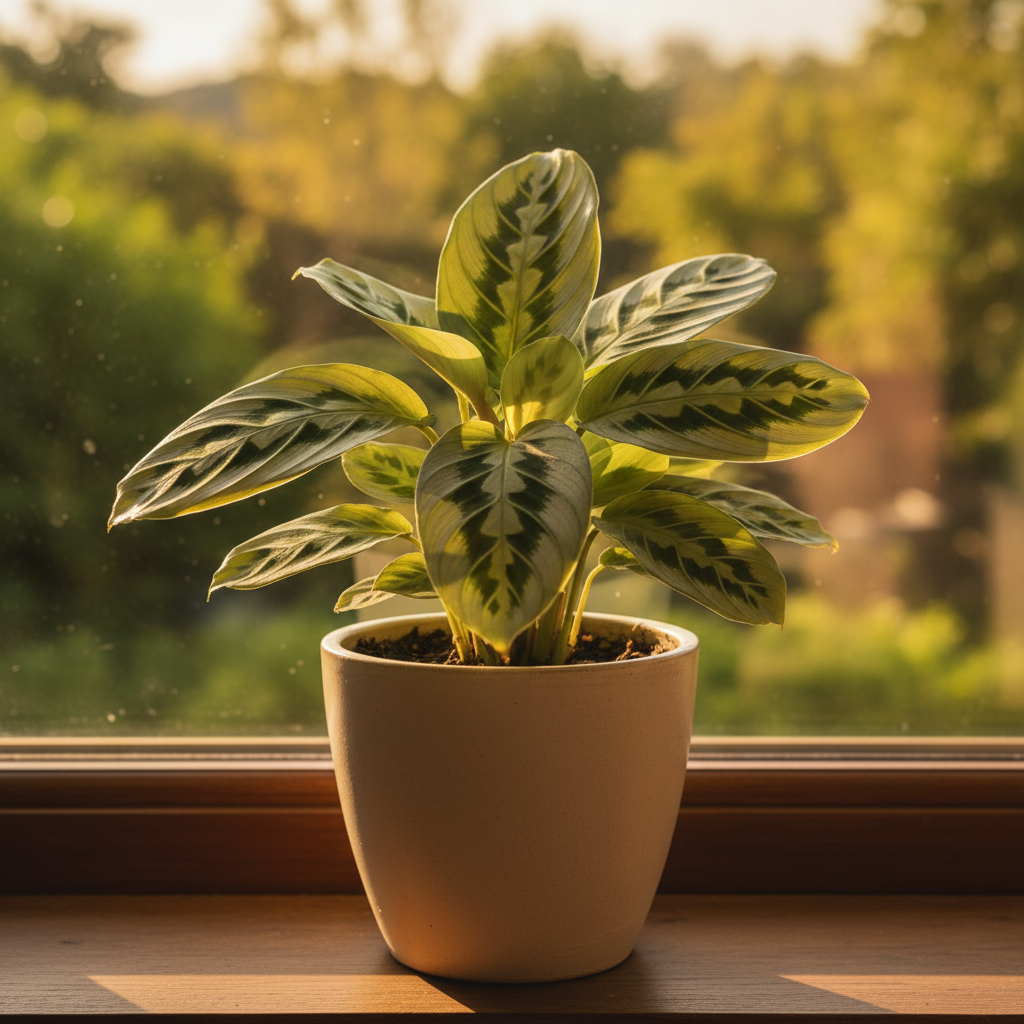
A softly silvered selection whose broad, pale grey-green leaves carry only a whisper of the herringbone pattern, giving the plant a cool, almost frosted look. It is one of the most widely available cultivars and a favourite for brightening shaded corners.
Burle Marx (type)
The classic form, with the sharpest contrast of the group: vivid light-and-dark green chevrons across the upper surface and deep burgundy-purple undersides revealed each evening. This is the plant most people picture when they hear the name fishbone prayer plant.
Variety Profiles in Detail
Amagris (Ctenanthe burle-marxii ‘Amagris’)
Sometimes sold as Grey Star, Amagris is prized for its pale, almost luminous foliage. The reduced contrast makes it read as a soft silvery mound rather than a busy graphic, which suits minimalist interiors. Its care is identical to the species, though the lighter leaves show scorch and water-quality marks especially clearly, so gentle light and clean water pay off visibly.
Compactstar (Ctenanthe burle-marxii ‘Compactstar’)
A tidy, smaller-growing form that keeps the bold banding of the type on a denser, more compact clump. Its restrained size makes it ideal for a shelf or a smaller table where the full species might eventually outgrow its space, and it shares the same liking for humidity and steady moisture.
Never Never Plant (Ctenanthe oppenheimiana)
A close relative rather than a cultivar, the never never plant carries longer, more lance-shaped leaves marbled in silver, cream and green over maroon undersides. It grows taller and more upright than the true fishbone, but its understorey origins mean it asks for exactly the same humid, bright-but-indirect conditions, making it an easy companion in a Marantaceae collection.
Choosing the Right Variety for Your Space
If you want maximum drama, the type Burle Marx form with its crisp banding is the showpiece, while Amagris offers a calmer, silvered look that flatters pale, modern rooms. For tight spaces, the compact selections stay neat, and if you have room to spare and want height, the taller never never relatives extend the same look upward. Because every member of the group shares the same care needs, you can mix and match freely, choosing on appearance and scale alone and trusting that one watering and humidity routine will keep them all content.
Frequently Asked Questions
Why are the leaf edges on my fishbone prayer plant turning brown and crispy?
Crispy brown edges are the plant’s signature complaint and almost always point to dry air, inconsistent watering or harsh water. Start by raising the humidity to 60% or more, keep the soil evenly moist rather than letting it swing between wet and bone dry, and switch to rainwater, distilled or filtered water if your tap water is hard or heavily chlorinated. Improving all three usually stops new browning, though existing damage will not heal and can be trimmed away.
Why do the leaves curl up, and is it a bad sign?
Some curling is completely normal. As a prayer plant it folds its leaves upward at night and opens them by day, so leaves that are curled in the evening and flat in the morning are simply behaving as they should. Curling that persists through the day, however, usually signals underwatering or low humidity, with the plant trying to reduce water loss. Check that the soil has not dried out and that the air is humid enough, and the leaves should relax.
Is the fishbone prayer plant safe for cats and dogs?
Yes. Like other members of the Marantaceae family, Ctenanthe burle-marxii is non-toxic to cats and dogs and is one of the safer choices for a home with pets. While a curious animal that eats a lot of any plant might get a mild stomach upset, there is no risk of the serious poisoning associated with many common houseplants, so you can place it without worry.
Why has my plant stopped moving its leaves at night?
The nightly leaf movement depends on healthy water pressure in the joint at the base of each leaf, so when a plant stops folding it is often thirsty, stressed or sitting in too little light. Check that you are watering consistently and that the plant receives enough bright indirect light during the day. Once its basic needs are met again, the rhythmic movement usually returns.
How often should I repot it?
This is a slow grower, so repotting every two years or so is usually enough. Repot when you see roots escaping the drainage holes, water running straight through, or growth slowing despite good care. Spring is the ideal time, and moving up just one pot size keeps the soil from staying too wet around an under-filled root ball.
Can I propagate it from a single leaf?
No. Unlike vining houseplants, the fishbone prayer plant cannot be grown from a leaf or a stem cutting, because a single leaf has no growing point to form a new plant. The reliable method is division, separating an established clump into sections that each carry their own roots and leaves. Spring, ideally at repotting time, is the best moment to do it.
Why are the silver markings on the new leaves looking faded?
Faded, washed-out markings on new growth usually mean too much light, which bleaches the contrast out of the leaves, while very large and thin pale leaves can indicate the opposite, too little light. Aim for bright but indirect light, away from any direct sun, and you should see the next flush of leaves emerge with the crisp, well-defined banding the plant is known for.
Does it need a humidifier, or will misting do?
For a plant this fond of moisture, a humidifier is the most effective and reliable way to keep the air around 60% humidity. Misting raises humidity only briefly and, if the leaves stay wet in still air, can encourage fungal leaf spots. If you would rather not run a humidifier, grouping plants together and standing the pot on a water-filled pebble tray are steadier options than misting alone.
What is the difference between a Ctenanthe, a Calathea and a Maranta?
All three belong to the prayer plant family, Marantaceae, and share the same nightly leaf movement and love of humidity, which is why their care is so similar. They differ botanically in the structure of their flowers and growth, with Ctenanthe typically forming spreading, bushy clumps of patterned leaves on branching stems. For the home grower, the practical takeaway is that if you can grow one well, you can grow them all.






