
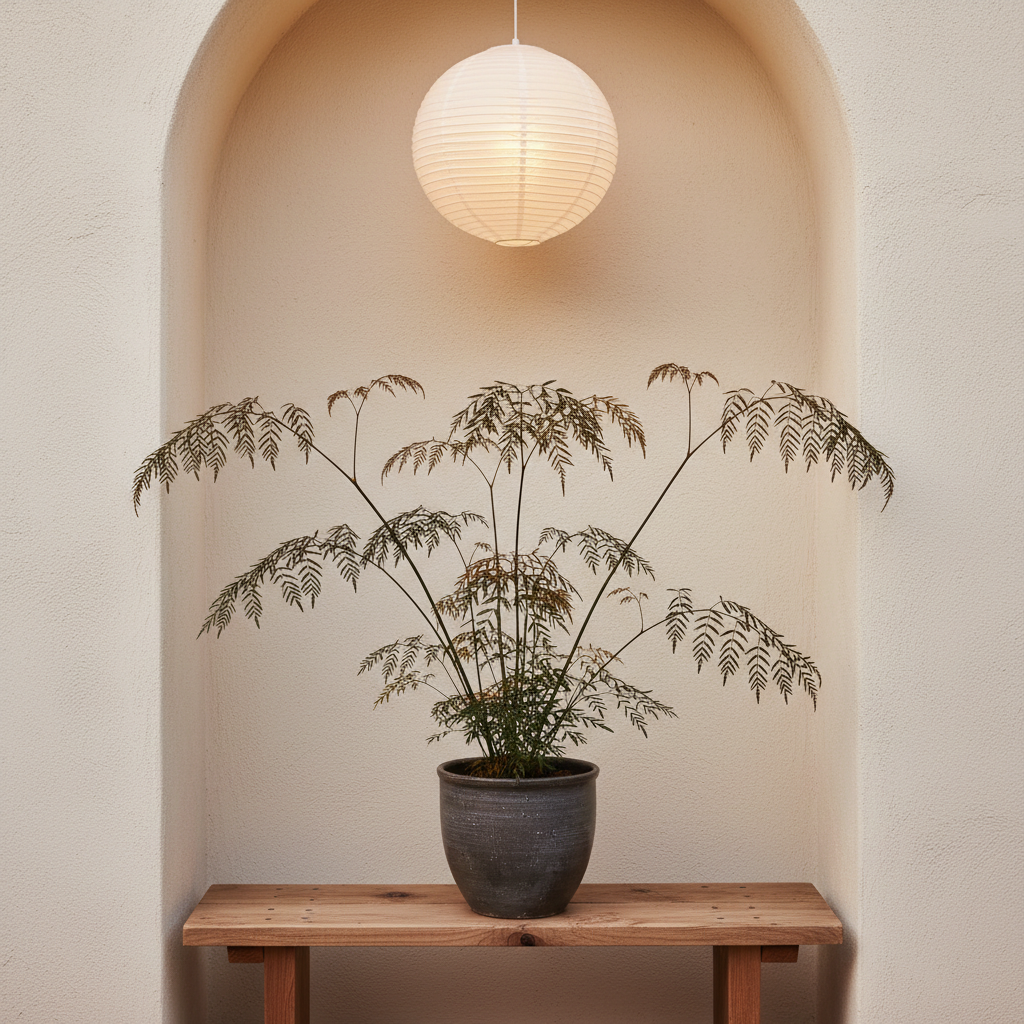
Few houseplants carry an air of quiet sophistication quite like the false aralia. With its slender, arching stems and finely cut, saw-toothed leaflets that hang in dark coppery whorls, Plerandra elegantissima looks less like a typical leafy houseplant and more like an ink drawing come to life. Native to the islands of New Caledonia in the South Pacific, this member of the Araliaceae family has been grown indoors for well over a century, and it has worn several botanical names along the way, including Dizygotheca elegantissima and Schefflera elegantissima. Whatever you call it, the appeal is the same: a airy, lace-like silhouette that softens a room without crowding it.
The false aralia has a reputation for being temperamental, and that reputation is only half deserved. It will indeed drop leaves at the slightest provocation, a sudden draught, a missed watering, a move across the room, but it rarely dies from these sulks. The difference between a false aralia that merely survives, clinging on with a thin scattering of foliage, and one that truly thrives, filling out into a dense, feathery column, comes down to a handful of stable conditions: consistent moisture, warm air, decent humidity and bright but filtered light. This guide covers each of those in detail, along with feeding, propagation, pests and the cultivars worth seeking out.
Contents
- Quick Reference
- Why False Aralia Makes a Striking Houseplant
- Light Requirements
- Watering & Humidity
- Soil, Potting & Repotting
- Fertilising
- Propagation
- Pests & Diseases
- Popular Varieties
- Frequently Asked Questions
Quick Reference: False Aralia at a Glance
| Light | Bright, indirect light; tolerates medium light but growth slows and colour fades |
| Watering | Keep evenly moist; let the top 2 to 3 cm (1 inch) dry before watering again |
| Temperature | 16 to 24°C (61 to 75°F); never below 13°C (55°F) |
| Humidity | Moderate to high, ideally 50 per cent or more |
| Fertiliser | Balanced liquid feed at half strength, monthly in spring and summer |
| Toxicity | Mildly toxic to cats, dogs and humans if eaten; sap may irritate skin |
Why False Aralia Makes a Striking Houseplant
The chief reason to grow a false aralia is its foliage, which is unlike almost anything else in the indoor plant world. Each leaf is palmately compound, meaning several narrow leaflets radiate from a single point at the end of a thin stalk, much like fingers from a hand. In young plants these leaflets are extremely narrow, deeply notched along their edges and coloured a dark, brooding green that reads as bronze or near-black in lower light. The overall effect is delicate and almost feathery, giving the plant a graphic, architectural quality that designers prize for filling a corner with texture rather than bulk.
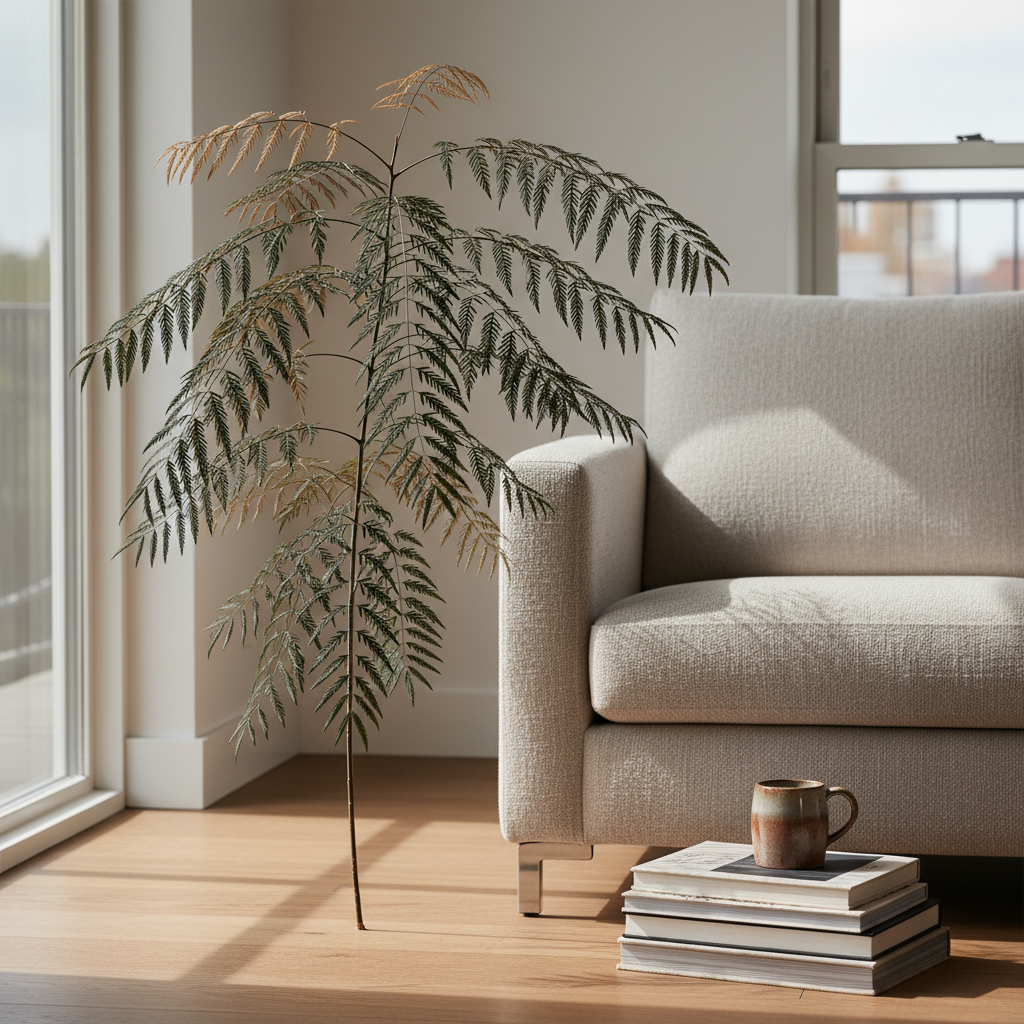
There is a curious twist to the false aralia that catches many growers by surprise. The lacy, thread-like leaves so admired in the shops are the plant’s juvenile form. As a false aralia matures, often after several years and once it passes roughly a metre in height, it begins producing adult foliage with leaflets that are dramatically broader, rounder and a plainer green, losing much of the filigree charm. In its native New Caledonia the plant eventually becomes a small tree several metres tall. Indoors this transition is slow and incomplete, but it explains why an older specimen may look quite different from the wispy thing you brought home. Many growers simply enjoy both phases, while others keep plants compact and youthful through regular pruning.
Important — Toxicity: Like most plants in the Araliaceae family, the false aralia contains compounds that make it mildly toxic if chewed or swallowed. Cats and dogs may experience drooling, mouth irritation and vomiting, and the sap can cause mild skin irritation in sensitive people. It is not among the most dangerous houseplants, but keep it out of reach of pets and small children, and wash your hands after pruning.
Light Requirements
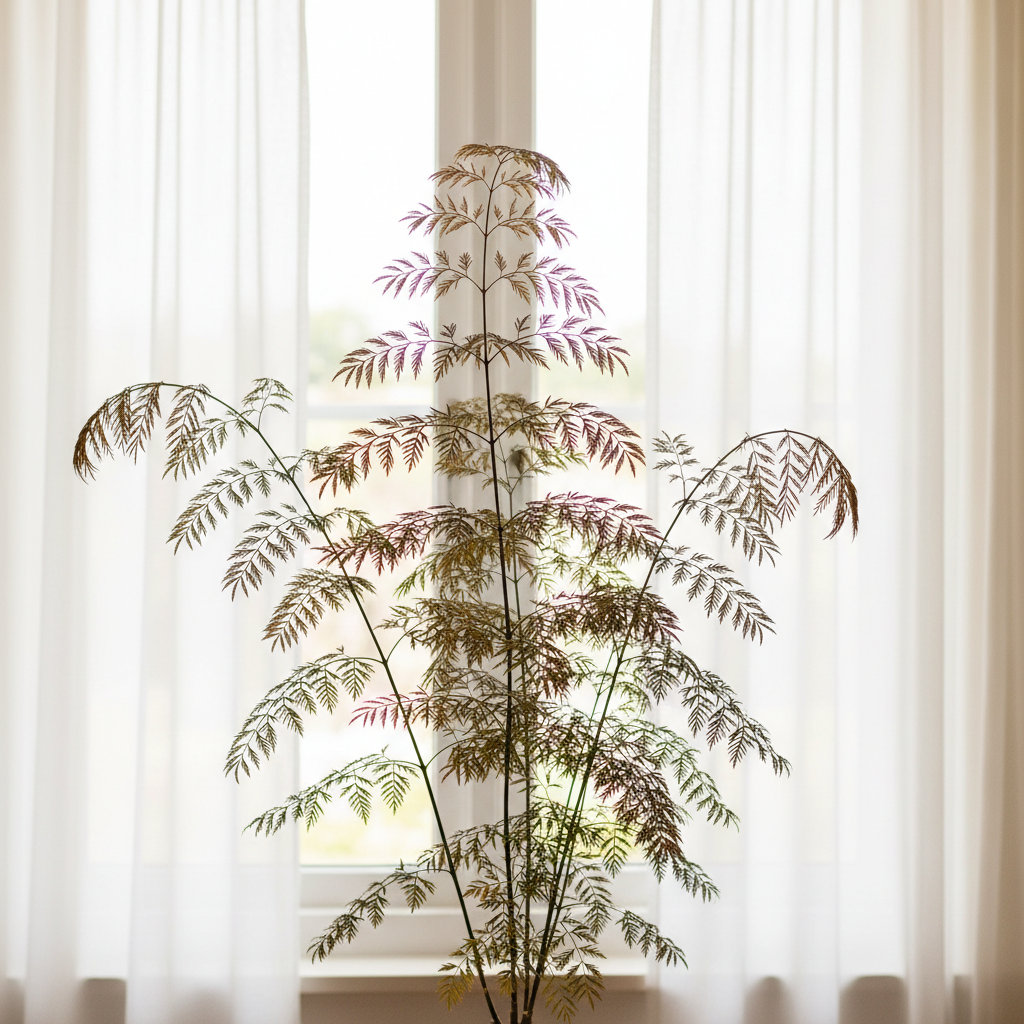
Light is the single most important factor in keeping a false aralia full and healthy, and it is also where many growers go wrong in both directions. The plant evolved as an understorey shrub in bright tropical forests, so it wants plenty of light but resents the harsh, direct rays that would scorch its thin leaflets. The goal is bright, indirect light for most of the day, the kind found a step back from a sunny window or directly beside one filtered by a sheer curtain.
Given enough light, a false aralia holds its lower leaves, keeps a compact and bushy habit and shows the richest, darkest leaf colour. Starved of light it does the opposite, stretching towards the nearest window, shedding interior and lower foliage, and growing leggy and sparse. If your plant is dropping leaves from the bottom up and the new growth looks pale and elongated, insufficient light is almost always the cause.
Light Levels Explained
Indoor light is far dimmer than we perceive, because our eyes adjust automatically. The table below translates the usual descriptions into rough light levels and explains what each means for a false aralia.
| Light Category | Approx. Level | Typical Location | Outcome |
|---|---|---|---|
| Direct sun | 20,000 lux and above | On an unscreened south or west sill | Leaf scorch, bleaching and crisping |
| Bright indirect | 10,000 to 20,000 lux | Beside a sheer-curtained sunny window | Ideal; dense, dark, vigorous growth |
| Medium | 5,000 to 10,000 lux | A metre or two back from a bright window | Acceptable; slower, slightly looser growth |
| Low | 1,000 to 5,000 lux | Interior wall, north-facing room | Leaf drop, legginess, faded colour |
| Very low | Below 1,000 lux | Hallways, windowless corners | Steady decline; not survivable long term |
Window Orientation and Placement
South-facing window: The brightest option in the northern hemisphere, and excellent for a false aralia provided you diffuse the midday sun with a sheer curtain or set the plant a step back. Unfiltered summer sun on a south sill will scorch the foliage.
East-facing window: Often the ideal spot. Gentle morning sun followed by bright indirect light for the rest of the day suits the plant perfectly, and the cooler early rays rarely burn.
West-facing window: Works well, though the strong afternoon sun can be harsh in summer. A light curtain or a half-metre of distance keeps the plant comfortable.
North-facing window: Usually too dim for a thriving false aralia, especially in winter. The plant will hang on for a while but tends to thin out and stretch. If a north window is all you have, plan to supplement with a grow light.
Pro Tip — Rotate for Balance: Because a false aralia leans hard towards its light source, give the pot a quarter turn every week or two. This keeps the slender stems growing upright and evenly clothed in foliage rather than all bending one way.
How Light Affects Leaf Colour and Form
The dark, almost metallic tone of the juvenile leaves deepens in good light and washes out to a flat, weak green in shade. Variegated cultivars such as Bianca are even more demanding, since the cream and white portions of their leaves contain little chlorophyll and the plant needs extra light to compensate. Too little light and a variegated false aralia will throw plainer, greener leaves as it tries to feed itself. Bright, filtered light keeps both the colour and the crisp, finely cut leaf shape at their best.
Warning — Direct Sunlight: The thread-like leaflets of a false aralia have very little surface mass to buffer heat, so they scorch faster than the thicker leaves of many houseplants. Hours of direct summer sun will leave brown, crisp patches that do not recover. Always filter strong light.
Artificial Lighting
False aralias respond well to supplemental lighting, which makes them viable in rooms that would otherwise be too dark. A full-spectrum LED grow light positioned 30 to 45 cm (12 to 18 inches) above the plant for 10 to 12 hours a day will keep growth dense through the darkest months. In a genuinely windowless space the plant can be grown under lights entirely, provided the duration and intensity are sufficient.
Seasonal Adjustments
Light levels indoors can fall by half or more between summer and winter as the sun sits lower and days shorten. A false aralia that was happy a metre from the window in July may need to move right up against the glass in January. Watch for winter leaf drop and stretching, and be ready to relocate the plant or add a grow light as the season turns. Move it gradually rather than all at once, since abrupt changes in light are one of the things that triggers a sulk.
Watering & Humidity
Watering is the part of false aralia care that demands the most consistency. The plant likes its soil kept evenly moist, never waterlogged and never bone dry. Both extremes provoke the same dramatic response: a sudden shower of dropped leaves. Get into a steady rhythm and the plant rewards you with calm, uninterrupted growth.
When to Water
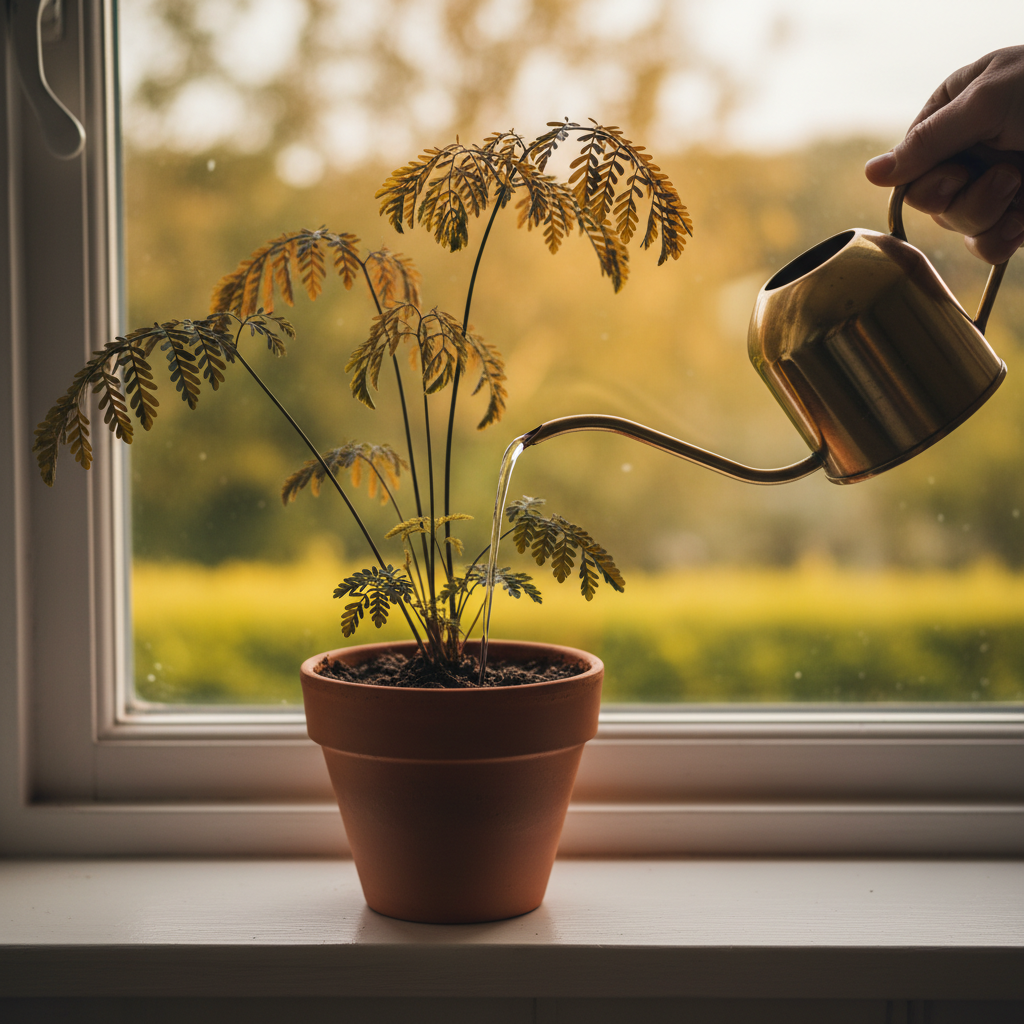
The reliable test is your finger. Push it into the compost to the first knuckle, roughly 2 to 3 cm (1 inch) deep. If that top layer feels dry, it is time to water. If it still feels damp, wait a day or two and check again. In a bright, warm spot during summer this might mean watering once or twice a week, while in cooler, darker winter conditions the interval may stretch to once every week and a half or more.
Resist the urge to water on a fixed calendar schedule, because the plant’s needs change with the seasons, the temperature and the light. A pot that dries quickly in July may stay damp for ten days in December, and watering by habit rather than by checking is the fastest route to root rot. Let the soil guide you.
Pro Tip — Lift the Pot: Once you have watered a few times you will learn the weight of a freshly watered pot versus a dry one. Lifting the plant becomes a quick, reliable moisture check that works even through a decorative cover pot, no finger required.
How to Water Correctly
- Check that the top 2 to 3 cm of compost has dried before reaching for the watering can.
- Water slowly and evenly over the whole surface, using room-temperature water to avoid shocking the roots.
- Continue until water flows freely from the drainage holes, ensuring the entire root ball is moistened.
- Let the pot drain completely for several minutes in a sink or on a tray.
- Tip away any water that collects in the saucer or cover pot so the roots never sit in standing water.
Signs of Overwatering vs. Underwatering
Because a stressed false aralia drops leaves whether it is too wet or too dry, the falling leaves alone will not tell you which mistake you are making. Look instead at the soil, the stems and the pattern of the symptoms.
| Symptom | Overwatering | Underwatering |
|---|---|---|
| Leaf colour | Yellowing, often across many leaves at once | Browning and crisping at the leaflet tips |
| Leaf texture | Soft, limp, sometimes translucent | Dry, brittle and papery |
| Soil | Stays wet for days, may smell sour | Pulls away from the pot edge, dusty dry |
| Roots | Brown, mushy and foul-smelling | Dry, wiry but still firm |
| Stem base | Soft or blackened near the soil line | Firm but shrivelling and thin |
Warning — Root Rot: The most common killer of false aralias is root rot from soggy compost. Once the roots turn brown and mushy the damage spreads fast. If you suspect rot, unpot the plant, cut away all soft roots with sterilised scissors, and repot into fresh, free-draining mix in a clean pot. Reduce watering while it recovers.
Humidity Requirements
As a tropical island native, the false aralia appreciates humidity above the level of most centrally heated homes. It is happiest at around 50 per cent relative humidity or higher. It will cope with average household humidity of 40 per cent, but dry air, especially the parched conditions near a radiator in winter, brings on brown leaf tips, extra leaf drop and a much greater risk of spider mites.
The early warning signs of air that is too dry are crisp brown tips and edges on the fine leaflets, along with a general thinning of the canopy. If you see fine webbing between the stems as well, dry air has already invited spider mites, which thrive in exactly the conditions a false aralia dislikes.
The most effective way to raise humidity around the plant is a small electric humidifier running nearby, which lifts the moisture of the surrounding air steadily. Grouping plants together helps too, as they transpire and create a more humid microclimate. A pebble tray filled with water beneath the pot gives a modest local boost. Misting offers only a brief, fleeting lift and can encourage fungal spotting on the foliage, so it is the least reliable option.
Water Quality
False aralias are not especially fussy about water, but they do better with room-temperature water than with cold water straight from the tap. In hard-water areas the mineral build-up can contribute to leaf-tip browning over time. If your tap water is very hard or heavily chlorinated, letting it stand overnight, or using filtered or collected rainwater, gives the plant a gentler drink and reduces salt accumulation in the compost.
Soil, Potting & Repotting
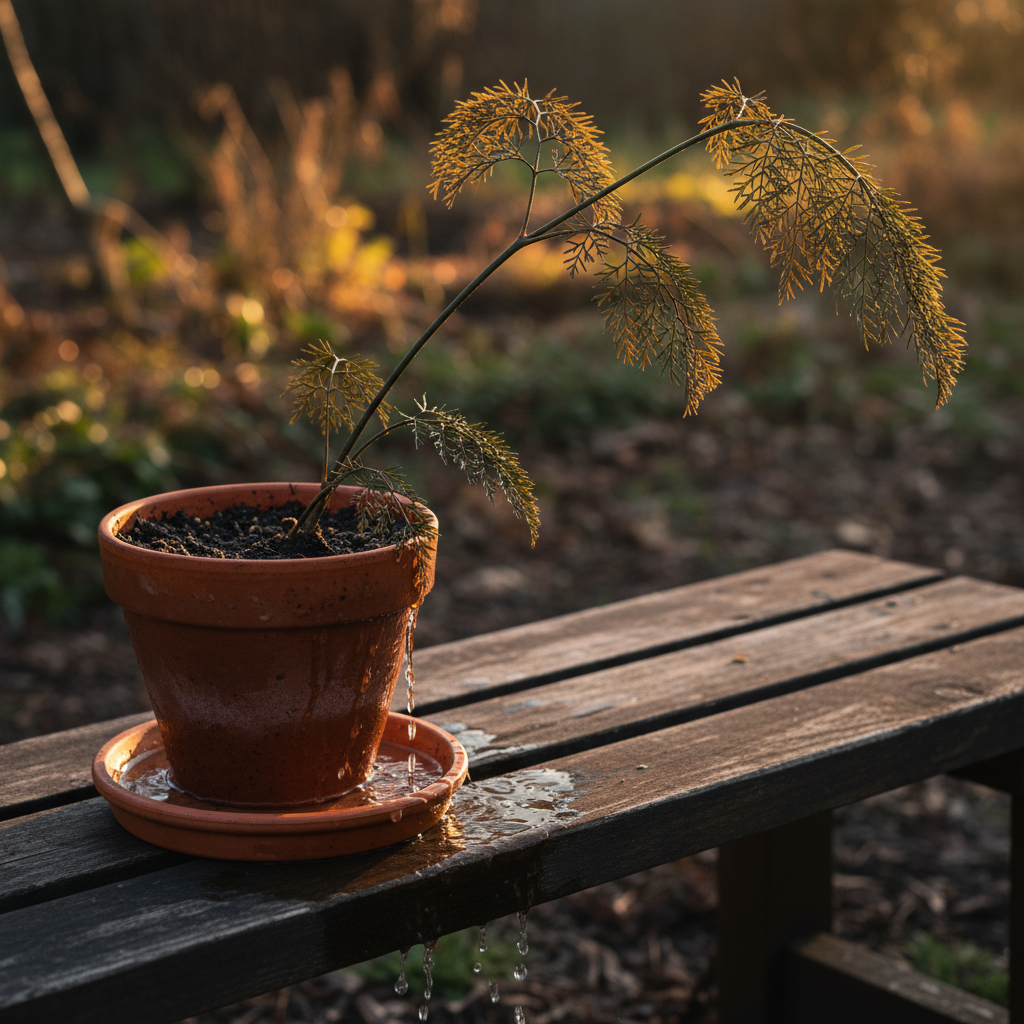
The right compost solves half the watering problem before it starts. A false aralia needs a mix that holds enough moisture to stay evenly damp yet drains freely so the roots are never left sitting in water. A heavy, water-retentive compost used straight from the bag is a recipe for the soggy conditions that cause root rot.
Ideal Soil Composition
Start with a quality peat-free houseplant compost as the base and open it up with materials that improve drainage and aeration. The aim is a loose, chunky texture that water can pass through quickly while leaving the mix pleasantly moist.
| Component | Proportion | Function |
|---|---|---|
| Peat-free houseplant compost | 50 per cent | Base that holds moisture and nutrients |
| Perlite or pumice | 25 per cent | Improves drainage and stops compaction |
| Fine orchid bark | 15 per cent | Adds structure and air pockets at the roots |
| Worm castings or compost | 10 per cent | Gentle, slow-release nutrition |
The false aralia prefers a slightly acidic to neutral soil, around pH 6.0 to 6.5, which is the natural range of most standard houseplant composts, so there is rarely any need to adjust it deliberately.
Pro Tip — Quick Mix Recipe: For a fast, reliable blend, combine two handfuls of houseplant compost with one handful of perlite and a generous pinch of orchid bark. If the mix clumps in your fist and holds a tight ball, add more perlite until it crumbles apart easily.
Choosing the Right Pot
The container matters as much as what goes in it. A well-chosen pot supports the watering routine instead of fighting it, and helps keep the tall, slightly top-heavy plant stable.
Drainage holes are non-negotiable. A false aralia must never sit in a pot without drainage. Excess water has to escape, or the roots will suffocate and rot. If you love a particular decorative cover pot that has no holes, keep the plant in a plain plastic nursery pot inside it and lift the inner pot out to water.
Pot material: Terracotta is porous and wicks moisture from the soil, which suits growers who tend to overwater, while plastic and glazed ceramic hold moisture longer and suit those who water less often. For a plant that likes even dampness, a glazed or plastic pot often makes consistency easier to achieve.
Pot size: Choose a pot only 2 to 4 cm (1 to 2 inches) wider than the current root ball. An oversized pot holds a large volume of damp soil that the roots cannot use quickly, and that excess moisture is exactly what leads to rot. The plant is also tall and narrow, so a slightly heavier or wider-based pot helps prevent it toppling.
When to Repot
False aralias are slow growers and dislike being disturbed, so they need repotting only every two to three years, or when you see roots emerging from the drainage holes and circling the surface. The best time is spring, as the plant moves into active growth and recovers from the disturbance most quickly. Expect a little leaf drop after repotting; it is the plant’s usual reaction to change and not a cause for alarm.
How to Repot: Step-by-Step
- Water the plant a day beforehand so the root ball is moist and holds together, which reduces stress.
- Gently ease the plant out by tipping the pot and supporting the stems, rather than pulling on them.
- Tease a few of the outer roots loose if they are tightly circling, and trim away any that are brown or mushy.
- Add a layer of fresh, free-draining mix to the base of a clean pot only slightly larger than the last.
- Set the plant at the same depth it grew before and fill around the sides with fresh mix, firming gently.
- Water thoroughly to settle the compost, then let the pot drain fully.
- Return the plant to its usual bright, warm spot and hold off on feeding for four to six weeks.
Warning — Transplant Shock: A false aralia will almost always sulk after repotting, dropping a flush of leaves within a week or two. Keep conditions stable, warm, bright and evenly watered, and avoid the temptation to compensate by watering more. The plant typically pushes fresh growth within a month or two once it settles.
Fertilising
False aralias are light feeders, and a modest, regular supply of nutrients keeps them in better condition than occasional heavy doses. During the growing season the plant draws on nitrogen for fresh foliage and a balance of other nutrients to keep its stems strong and its colour deep.
Because the plant grows slowly and resents excess, it is easy to do harm with too much fertiliser. More plants are damaged by overfeeding, which scorches roots and builds up salts, than by underfeeding. When in doubt, feed less.
Understanding Plant Nutrients
Houseplant fertilisers are described by their N-P-K ratio, the proportions of nitrogen, phosphorus and potassium they contain. For a foliage plant like the false aralia, a balanced or slightly nitrogen-led feed is ideal. The table below summarises the nutrients that matter and the signs a plant shows when it runs short of each.
| Nutrient | Symbol | Primary Function | Deficiency Symptoms |
|---|---|---|---|
| Nitrogen | N | Leaf and stem growth, deep green colour | Older leaves yellow, growth stalls |
| Phosphorus | P | Root development and energy transfer | Dull foliage, weak roots, poor growth |
| Potassium | K | Overall vigour and water regulation | Browning leaf edges, weak stems |
| Calcium | Ca | Cell wall strength and new growth | Distorted, stunted young leaves |
| Magnesium | Mg | Core of the chlorophyll molecule | Yellowing between leaf veins |
| Iron | Fe | Chlorophyll formation in new leaves | Young leaves yellow with green veins |
Types of Fertiliser
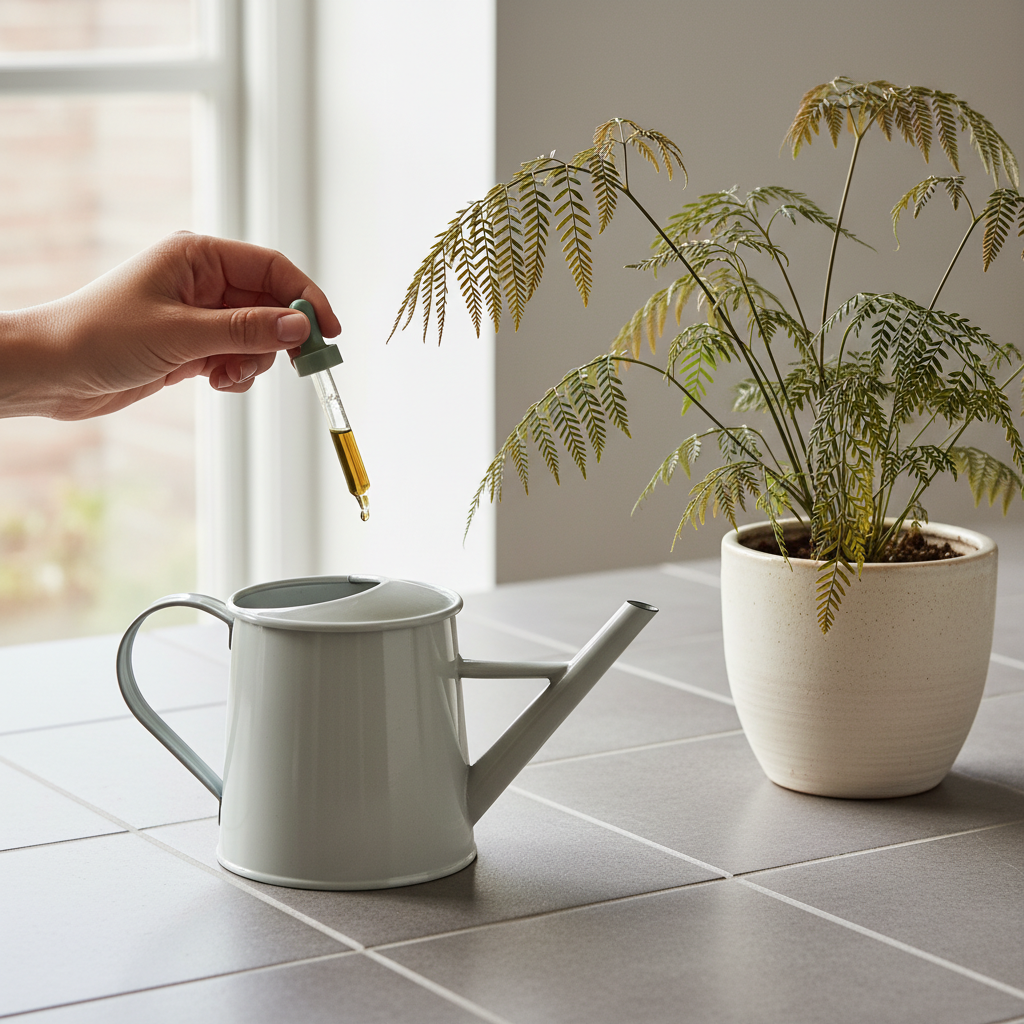
Liquid fertilisers: The easiest choice for a false aralia, because you mix them into the watering can and control the strength precisely. Diluting a balanced feed to half the recommended rate gives gentle, even nutrition and suits the plant’s modest appetite.
Slow-release granular: Coated prills that release nutrients gradually over several months are convenient for those who forget to feed. Use them at the lower end of the recommended rate, since a slow trickle suits this plant better than a strong dose.
Organic fertilisers: Worm castings, diluted seaweed extract and other organic feeds release nutrients slowly and gently, and also improve the soil. They are forgiving and very hard to overdo, which makes them a safe option for a plant easily harmed by excess.
Feeding Schedule
Feed roughly once a month with a half-strength balanced liquid fertiliser through the growing season, from spring to early autumn. As light fades and growth slows in late autumn and winter, stop feeding entirely. A dormant or slow-growing plant cannot use the nutrients, and unused fertiliser simply accumulates in the soil as harmful salts.
Pro Tip — Feed Half, Twice as Often: Rather than a full-strength feed now and then, give a half-strength or even quarter-strength solution more regularly. This mimics the steady, dilute nutrition the plant would receive in nature and avoids the root-scorching peaks of concentrated feeding.
How to Fertilise
- Water the plant lightly first, as feeding dry roots can burn them.
- Mix your chosen liquid fertiliser to half the strength stated on the label.
- Apply the solution evenly across the compost until it just begins to drain.
- Flush the pot with plain water every couple of months to wash out accumulated salts.
Warning — Salt Build-Up: A white crust on the soil surface or around the pot rim, along with brown, scorched leaf tips, signals a build-up of fertiliser salts. Flush the pot thoroughly with plenty of plain water, letting it drain several times, and ease off feeding until the plant recovers.
Propagation
It must be said plainly: the false aralia is one of the trickier houseplants to propagate at home. Unlike a pothos or a tradescantia that roots from a cutting in a jar within days, false aralia cuttings are slow and reluctant, and success rates are modest even for experienced growers. That said, with patience, warmth and the right technique it can be done, and there is real satisfaction in raising a new plant from an old one.
The two methods most likely to work for the home grower are stem cuttings and air layering. Division is not an option, since the plant grows from a single stem rather than a clump, and seed is rarely available and slow to germinate. Whichever route you take, work in spring or early summer when the plant has the most energy for new growth.
Understanding Stem Nodes
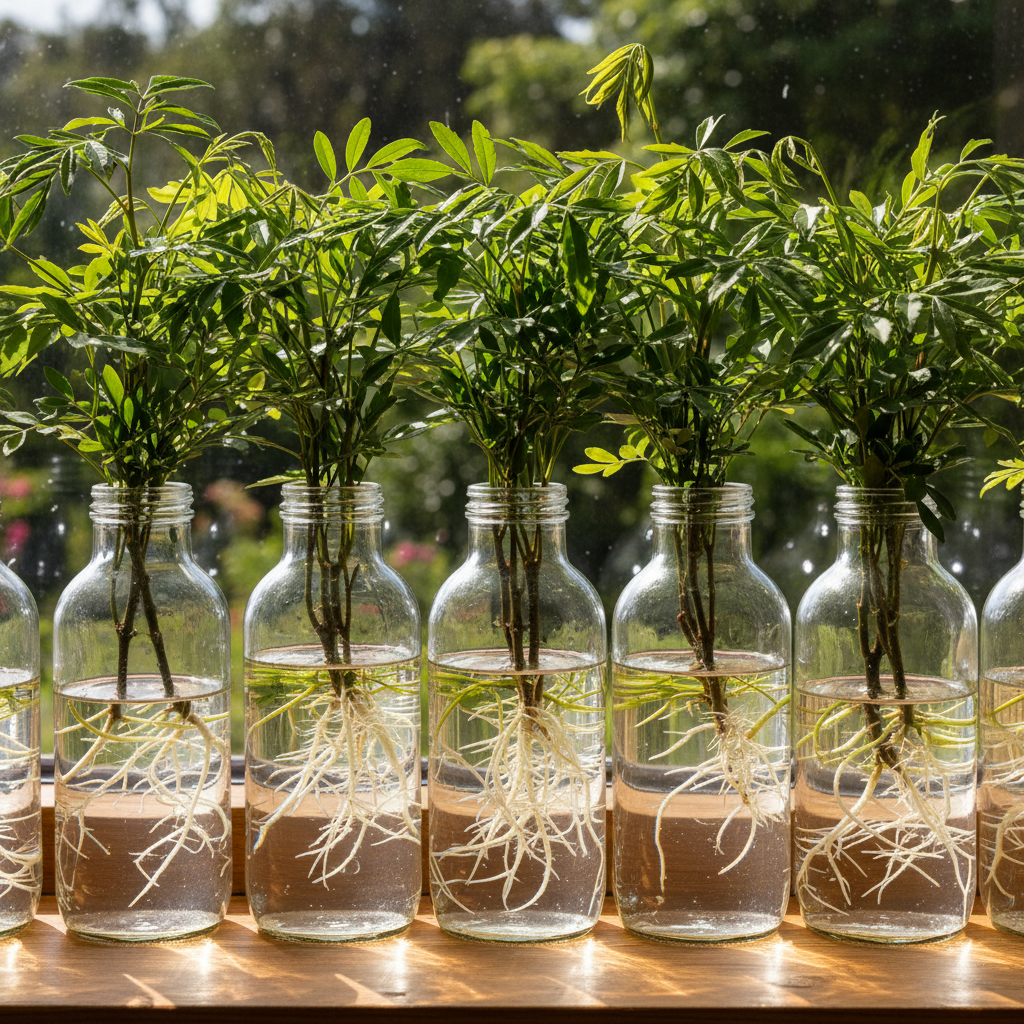
The key to rooting any cutting is the node, the slightly swollen point on a stem where leaves and new shoots emerge. This is where the plant concentrates the cells capable of producing roots. A false aralia cutting must include at least one node, and ideally two, below the surface of the rooting medium. A length of stem with no node will not root no matter how long you wait. Choose a semi-woody section of stem, neither the softest new tip nor an old hardened base, as these middle-aged cuttings root most readily.
Stem Cuttings: Step-by-Step
This is the most common method, though it demands warmth and high humidity to succeed. Rooting hormone and a heated propagator markedly improve your chances.
- Using sterilised secateurs, take a cutting 10 to 15 cm (4 to 6 inches) long that includes at least two nodes.
- Remove the lower leaves, leaving just a few at the top to limit water loss.
- Dip the cut end in rooting hormone powder or gel to encourage root initiation.
- Insert the cutting into a small pot of moist, free-draining propagating mix or damp perlite, burying the lower nodes.
- Cover with a clear plastic bag or place in a propagator to hold humidity high around the cutting.
- Keep warm, ideally 21 to 24°C (70 to 75°F), with bottom heat if possible, in bright indirect light.
- Be patient: roots can take six to ten weeks or longer. Resist disturbing the cutting, and check for resistance to a very gentle tug as a sign of rooting.
Pro Tip — Bottom Heat is the Secret: More than anything else, warm roots make the difference with false aralia cuttings. A heated propagation mat that keeps the medium around 24°C (75°F) can lift your success rate from frustrating to genuinely workable. Cold windowsills, by contrast, almost guarantee failure.
Air Layering: Step-by-Step
Air layering is more reliable than cuttings because the new roots form while the stem is still attached to and fed by the parent plant. It is the method of choice for rejuvenating a tall, leggy specimen that has lost its lower leaves, since you can root the leafy top and start again.
- Choose a healthy section of stem and make a shallow upward cut or remove a thin ring of bark just below a node.
- Dust the wound with rooting hormone to speed root formation.
- Wrap the area in a handful of damp sphagnum moss, enclosing the wounded node completely.
- Cover the moss with clear plastic film and tie it firmly above and below to hold moisture in.
- Keep the moss damp by opening and misting it every week or so, and wait for roots to appear through the moss, usually over one to two months.
- Once a good network of roots has formed, cut the stem below the new roots and pot up the rooted top as a new plant.
Troubleshooting Propagation
| Problem | Likely Cause | Solution |
|---|---|---|
| Cutting rots before rooting | Medium too wet or not sterile | Use fresh perlite, water sparingly, ensure airflow |
| Cutting shrivels and dries | Humidity too low, water loss too high | Cover with a bag or propagator, remove extra leaves |
| No roots after many weeks | Too cold, or cutting lacks a node | Add bottom heat, check the cutting includes nodes |
| Roots form then cutting fails | Potted on too soon or too roughly | Wait for a strong root network, pot gently into damp mix |
Pests & Diseases
A healthy false aralia in stable conditions is reasonably resistant to trouble, but the dry indoor air it dislikes also happens to be the breeding ground for its most persistent enemy, the spider mite. Most problems can be headed off by keeping humidity up, inspecting the plant regularly and acting quickly at the first sign of pests.
Make a habit of checking the undersides of the leaves and the leaf axils each time you water. The fine, crowded foliage of a false aralia gives pests plenty of places to hide, so a small infestation can take hold before it becomes obvious. Early detection is by far the easiest way to keep an outbreak manageable.
Common Pests
Spider Mites (Tetranychus urticae)
The number one pest of false aralias and the reason humidity matters so much. These tiny mites thrive in warm, dry air, sucking sap from the leaves and leaving a fine stippling of pale dots. In bad infestations you will see delicate webbing strung between the stems and leaflets. Because the plant has so many fine leaves, mites can multiply quickly before you notice them.
Treatment: Rinse the whole plant under a tepid shower to dislodge mites and webbing, then treat the foliage thoroughly, including the undersides, with insecticidal soap or diluted neem oil. Repeat every five to seven days for several weeks to break the breeding cycle, and raise the humidity to discourage their return.
Mealybugs (Pseudococcus species)
Small, soft-bodied insects that look like specks of white cotton wool, clustering in the leaf axils and along the stems. They suck sap and excrete a sticky honeydew that can lead to sooty mould. The crowded growth of a false aralia gives them ideal cover.
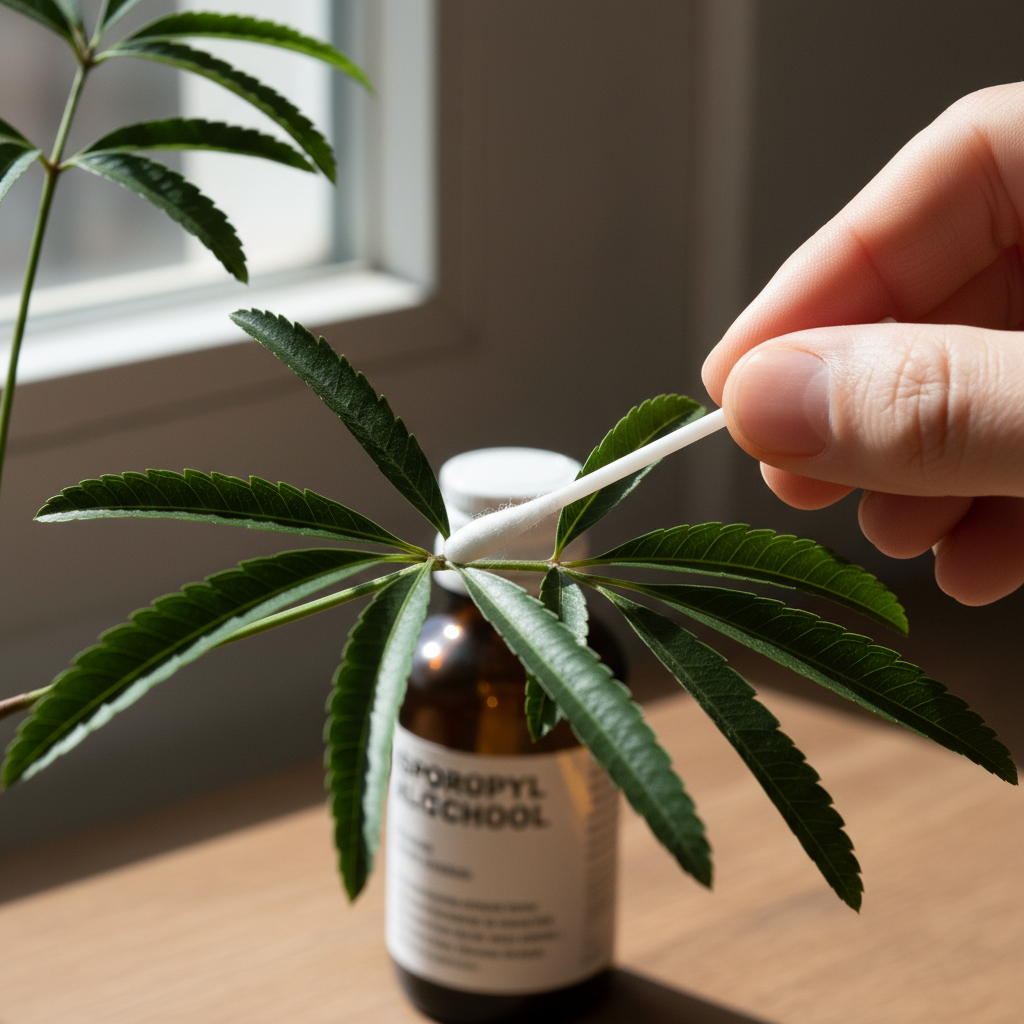
Treatment: Dab each visible mealybug with a cotton bud dipped in diluted isopropyl alcohol, which dissolves their protective coating. For wider infestations, spray with insecticidal soap or neem oil and repeat weekly until they are gone. Isolate the plant from others while you treat it.
Scale (Coccidae family)
Scale insects appear as small, brown, immobile bumps on the stems and the undersides of leaves. Protected by their waxy shells, they are easy to mistake for part of the plant, and like mealybugs they excrete honeydew that attracts mould.
Treatment: Scrape off what you can with a fingernail or an old toothbrush, then treat with neem oil or a systemic insecticide, which the plant absorbs and which poisons the sap the scale feed on. Persistence over several weeks is usually needed for a full clearance.
Common Diseases
Root Rot (Pythium and Phytophthora species)
By far the most serious disease of the false aralia, root rot is caused by fungal-like organisms that flourish in waterlogged compost. The roots turn brown and mushy, the plant wilts despite wet soil, and the stem base may soften and blacken. Left unchecked it is usually fatal.
Treatment: Unpot the plant at once, wash the soil from the roots and cut away every soft, brown root with sterilised scissors. Repot into fresh, free-draining mix in a clean pot, water sparingly until recovery is clear, and correct the overwatering habit that caused it.
Leaf Spot (various fungal and bacterial pathogens)
Brown or black spots, sometimes ringed with yellow, appear on the leaves where fungal or bacterial infection has taken hold. It is encouraged by water sitting on the foliage and by poor air circulation, which is one more reason to avoid heavy misting.
Treatment: Remove the affected leaves, improve airflow around the plant and keep water off the foliage when watering. For stubborn cases a copper-based fungicide can help. Avoiding overhead wetting prevents most outbreaks in the first place.
Pest and Disease Summary
| Pest / Disease | Identification | Treatment |
|---|---|---|
| Spider mites | Fine stippling and webbing, dry-air outbreaks | Rinse, insecticidal soap or neem, raise humidity |
| Mealybugs | White cottony specks in axils and stems | Alcohol on a cotton bud, neem oil, isolate |
| Scale | Brown immobile bumps on stems and leaves | Scrape off, neem or systemic insecticide |
| Root rot | Brown mushy roots, wilting in wet soil | Trim rot, repot in fresh mix, water less |
| Leaf spot | Brown or black spots on the foliage | Remove leaves, improve airflow, keep leaves dry |
Prevention Strategies
The best defence is a healthy, unstressed plant in stable conditions, since pests and diseases most readily attack weakened specimens. Keep the humidity up to deter spider mites, water correctly to prevent root rot, and give the plant good light and gentle feeding so it can shrug off minor problems.
Quarantine any new plant for a couple of weeks before letting it join your collection, as bought-in plants are the commonest source of an infestation. Wipe or rinse the foliage occasionally to remove dust and keep an eye out for the earliest signs of trouble, when intervention is quickest and easiest.
Pro Tip — Neem Oil as Routine Defence: A monthly preventative spray of diluted neem oil, applied in the evening so it does not scorch in sunlight, deters spider mites and other sap-suckers before they establish. It is gentle on the plant and far easier than fighting a full-blown outbreak.
Popular Varieties
Most false aralias sold are simply the species, grown for its classic dark, thread-like juvenile foliage. Over the years, though, growers have selected a handful of named cultivars that differ in leaf width, colour and variegation, giving you a few distinct looks to choose from.
Availability varies by region and season, with the plain species and the variegated Bianca being the easiest to find, while broader-leaved selections like Castor turn up less often in general garden centres and more readily through specialist houseplant sellers.
| Variety | Leaf Appearance | Light Needs | Growth Rate | Availability |
|---|---|---|---|---|
| Species (elegantissima) | Narrow, saw-toothed, near-black green | Bright indirect | Slow | Common |
| Bianca | Shorter, broader, cream-margined leaflets | Bright indirect, slightly more | Slow | Common |
| Castor | Broad, rounded, deep-green leaflets | Bright indirect | Slow to moderate | Occasional |
| Gold Crest | Bronze-green with warm golden tones | Bright indirect | Slow | Uncommon |
| Olympia | Slightly wider, robust dark leaflets | Bright indirect | Slow | Uncommon |
Featured Varieties
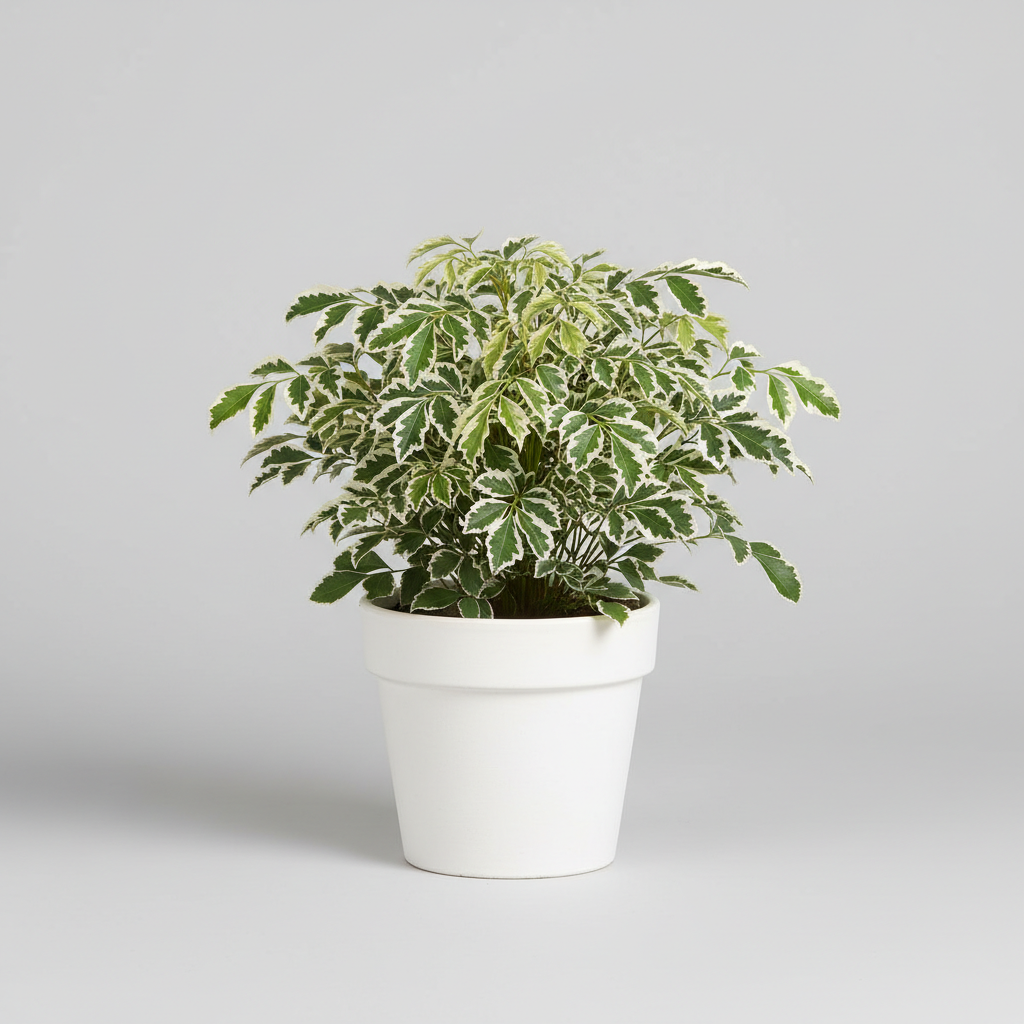
Bianca
A compact, variegated selection with shorter, broader leaflets edged and streaked in creamy white. The pale markings need a touch more light to stay bright, but the effect is softer and more luminous than the brooding species.
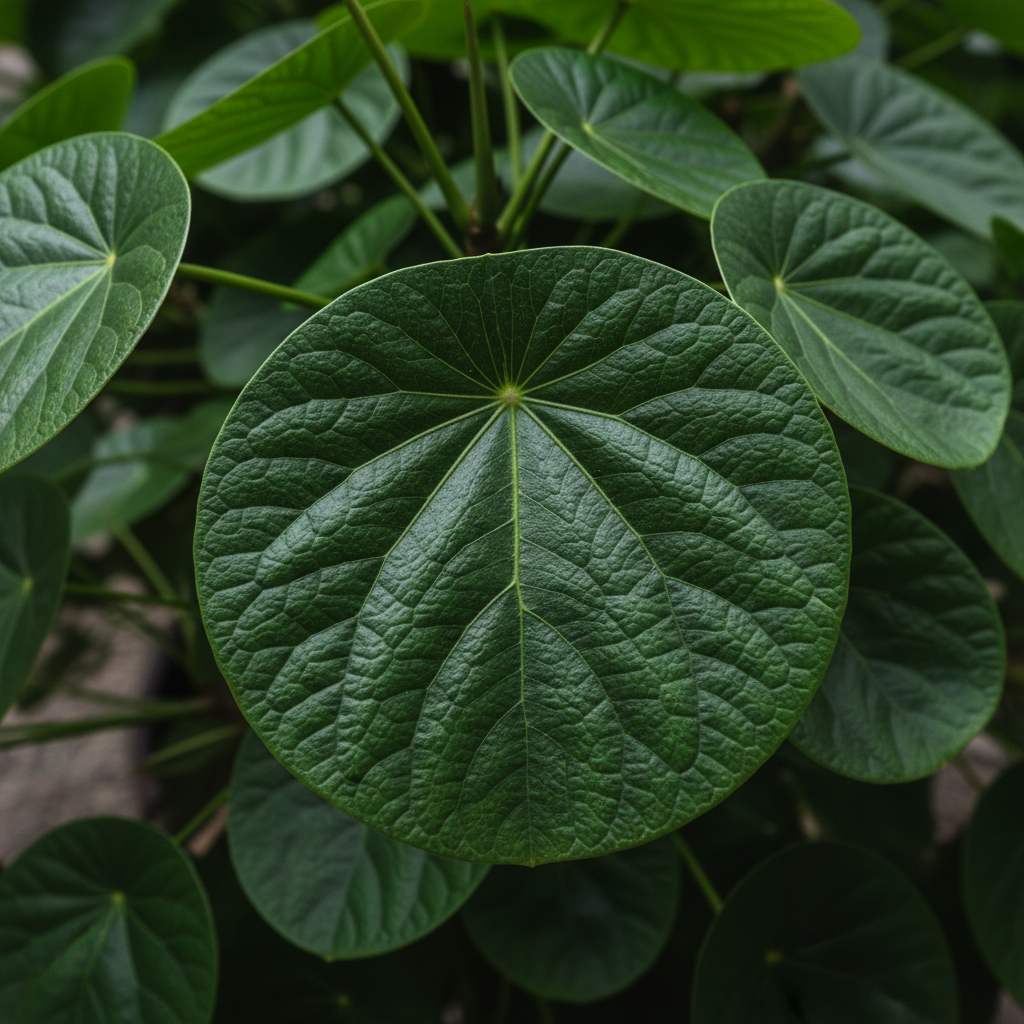
Castor
A robust cultivar with much broader, rounder and less serrated leaflets in a rich deep green, giving a fuller, bushier plant. It reads as a more substantial, less wispy version of the false aralia look.
Variety Profiles in Detail
Bianca (Plerandra elegantissima ‘Bianca’)
Bianca is the variety to choose if the standard plant feels too dark and severe for your space. Its leaflets are noticeably shorter and broader than the species, marked with creamy-white along the midribs and margins, which lightens the whole plant. Because the variegated tissue carries less chlorophyll, give Bianca the brightest indirect light you can manage to keep the markings crisp and to prevent it reverting to plain green.
Castor (Plerandra elegantissima ‘Castor’)
Castor trades the lacy, threadlike delicacy of the species for a broader, bolder leaf. Its rounded, deep-green leaflets give a denser silhouette and a more conventional houseplant presence, and it tends to fill out a little faster than the very fine-leaved forms. It is a good choice where you want the false aralia’s elegance with a touch more substance and a little less fragility of appearance.
Choosing the Right Variety for Your Space
For a dramatic, graphic accent in a bright room, the classic species with its near-black filigree foliage is hard to beat. If you want something softer and lighter, Bianca brings welcome contrast, provided you can give it strong indirect light. And if your heart is set on a fuller, more forgiving plant, the broader-leaved Castor offers the false aralia character with a sturdier look. Whichever you choose, the care is essentially the same; only the light demands of the variegated forms differ meaningfully.
Frequently Asked Questions
Why is my false aralia dropping leaves?
Leaf drop is the false aralia’s stock response to almost any stress, which makes it frustrating to diagnose. The usual triggers are a sudden change in environment, such as being moved or brought home from the shop, inconsistent watering in either direction, cold draughts, and low humidity. If the plant has recently been relocated or repotted, give it stable, warm, bright, evenly watered conditions and a few weeks to settle. Persistent drop from the lower leaves usually points to too little light.
Is the false aralia toxic to cats and dogs?
Yes, mildly. Like other members of the Araliaceae family it is considered toxic if eaten, and chewing the leaves can cause drooling, mouth irritation and vomiting in cats and dogs. It is not among the most dangerous houseplants, but it is wise to keep it out of reach of curious pets and small children, and to wash your hands after handling cut stems.
How big does a false aralia get indoors?
Indoors a false aralia usually reaches 1.2 to 1.8 metres (4 to 6 feet) over many years, growing slowly and upright rather than spreading. In its native New Caledonia it can become a small tree several metres tall, but that scale is rarely seen in the home. You can keep a plant compact and youthful-looking by pruning the top growth, which also encourages the prized fine juvenile foliage to persist.
Why are the leaves on my false aralia getting wider and plainer?
This is a natural part of maturing rather than a problem. As a false aralia ages and grows taller, it shifts from its lacy juvenile foliage to broader, rounder and plainer adult leaves. If you prefer the fine, threadlike look, prune the plant to keep it shorter and bushier, which slows the transition and encourages juvenile growth. Otherwise simply enjoy the change as a sign of a healthy, established plant.
How often should I water a false aralia?
There is no fixed schedule, because the right frequency depends on light, warmth and the season. Water when the top 2 to 3 cm (1 inch) of compost has dried, which in a bright warm spot in summer might be once or twice a week, and in cooler darker winter conditions perhaps once every week and a half. Always check the soil rather than watering by the calendar, and make sure excess water drains away each time.
Why are the leaf tips turning brown and crispy?
Brown, crisp leaf tips on a false aralia almost always point to air that is too dry, often combined with underwatering or a build-up of fertiliser salts. Raise the humidity with a humidifier or by grouping plants, keep the watering consistent, and flush the pot occasionally with plain water to clear excess salts. Browning tips will not turn green again, but improving conditions stops new growth from suffering.
Can I grow a false aralia in low light?
It will tolerate medium light, but genuine low light leads to a slow decline marked by leaf drop, leggy stems and faded colour. If your only available spot is dim, the plant will be much happier with a full-spectrum grow light to make up the difference. For a thriving, full plant, bright indirect light is really the minimum it wants.
Is the false aralia hard to care for?
It has a reputation for being fussy, but that reputation rests almost entirely on its habit of dropping leaves when conditions change. It is not difficult so much as it dislikes inconsistency. Give it a stable home with bright filtered light, steady moisture, warmth above 13°C (55°F) and decent humidity, and it becomes a fairly low-maintenance plant. The trick is settling it somewhere suitable and then leaving its routine alone.






