
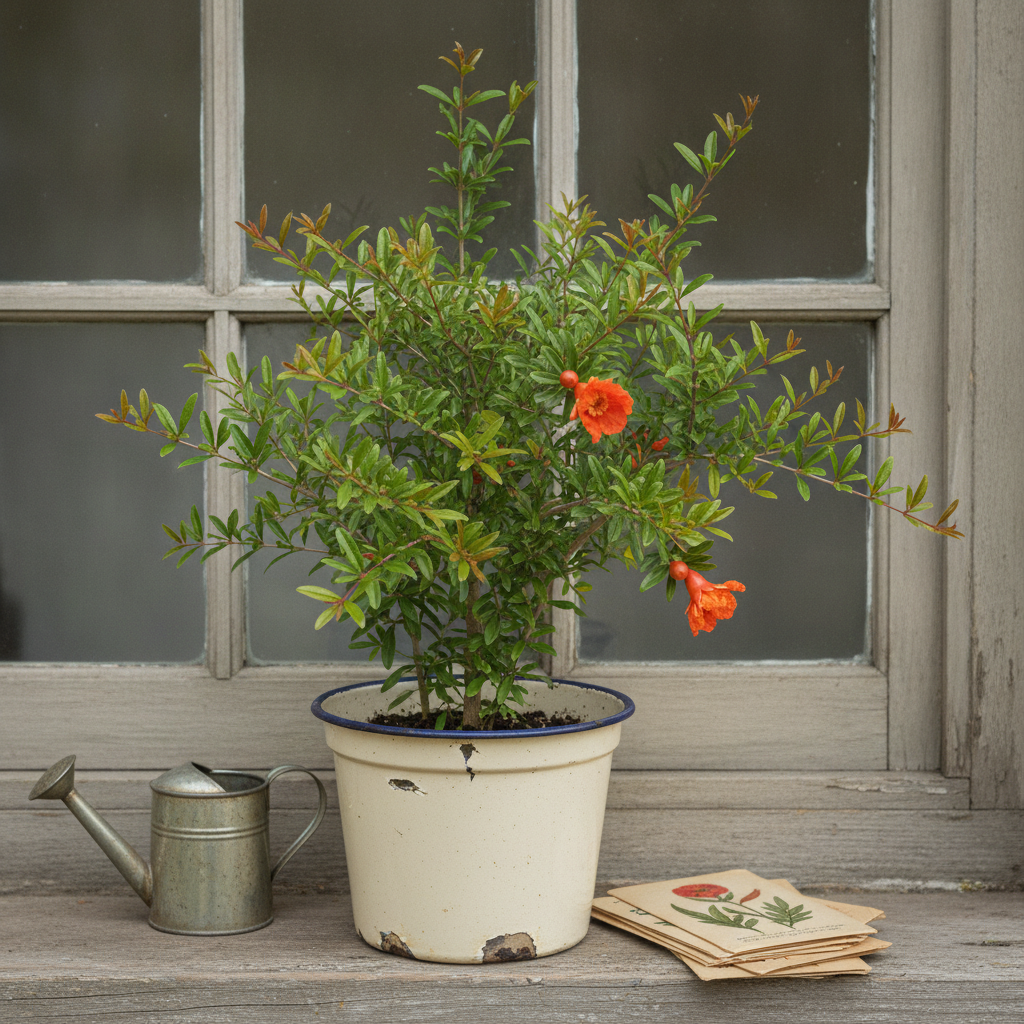
Few houseplants pack as much Mediterranean drama into so small a footprint as the dwarf pomegranate, Punica granatum var. nana. A naturally miniature selection of the same species that produces the familiar orchard fruit, it grows as a dense, twiggy shrub rarely taller than a metre indoors, clothed in small glossy leaves and studded through summer with flared, trumpet-shaped flowers in a near-fluorescent orange-red. Those blooms are often followed by perfectly formed fruit no larger than a golf ball, a botanical sleight of hand that makes the plant feel far more exotic than its easy temperament deserves. Native to the region stretching from the Mediterranean basin through Iran and into the Himalayan foothills, it has been cultivated for ornament for centuries and is a long-standing favourite for bonsai.
The dwarf pomegranate has a reputation as a sun-worshipper that punishes neglect of its light needs, but in truth it is forgiving of almost everything else. It tolerates dry air, shrugs off the occasional missed watering, and actively benefits from a cool, quiet winter rest that many tropical houseplants would resent. The difference between a plant that merely survives and one that truly thrives comes down to a handful of decisions: where you place it, how you manage water through its seasonal rhythm, and whether you give it the winter chill it craves. This guide covers each of those in detail, along with feeding, repotting, propagation, pests, and the named varieties worth seeking out.
Contents
- Quick Reference
- Why the Dwarf Pomegranate Makes a Rewarding Houseplant
- Light Requirements
- Watering & Humidity
- Soil, Potting & Repotting
- Fertilising
- Propagation
- Pests & Diseases
- Popular Varieties
- Frequently Asked Questions
Quick Reference: Dwarf Pomegranate at a Glance
| Light | Full sun. At least 6 hours of direct light daily, ideally a south-facing window or outdoors in summer. |
| Watering | Keep evenly moist in spring and summer; let the top few centimetres dry between waterings. Reduce sharply in winter dormancy. |
| Temperature | 18 to 26 °C (64 to 79 °F) in growth; a cool winter rest of 7 to 13 °C (45 to 55 °F) improves flowering. |
| Humidity | Average household humidity is fine. This is a Mediterranean plant and does not need misting. |
| Fertiliser | Balanced feed in spring; switch to a higher-potassium bloom feed through summer. None in winter. |
| Toxicity | Generally considered non-toxic to cats and dogs, though the bark and roots contain alkaloids best kept out of reach. |
Why the Dwarf Pomegranate Makes a Rewarding Houseplant
The appeal of the dwarf pomegranate begins with its sheer productivity. Where many flowering houseplants demand greenhouse humidity or fussy feeding regimes to bloom indoors, this little shrub will flower freely on a sunny windowsill with nothing more exotic than good light and a sensible watering routine. The flowers themselves are striking: waxy, ruffled and vivid, emerging from a distinctive urn-shaped calyx that persists on the plant and later swells into the ornamental fruit. Even out of bloom, the foliage earns its place, the new growth flushing a coppery bronze before settling to glossy green, all carried on fine branches that respond beautifully to pruning.
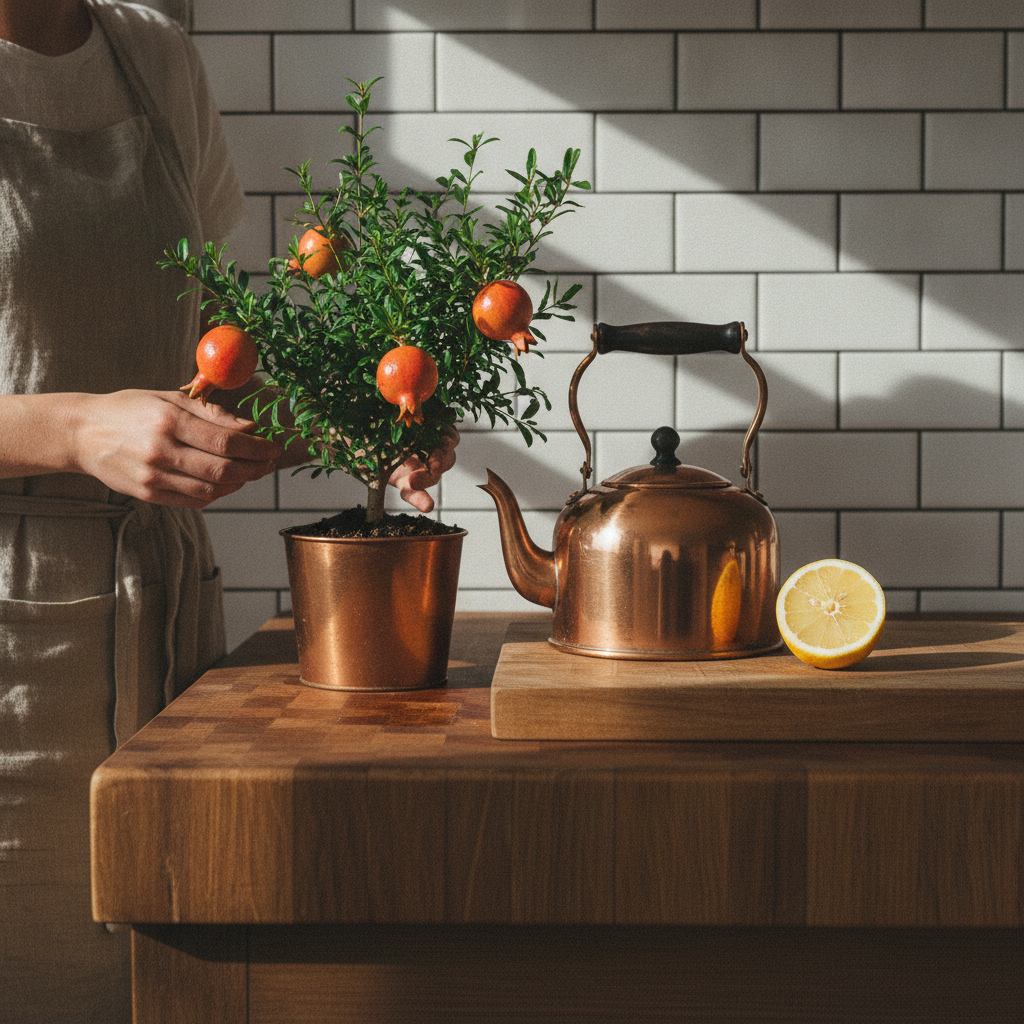
Just as valuable to indoor growers is the plant’s compact, woody structure. Unlike sprawling vines or top-heavy palms, the dwarf pomegranate forms a tidy, self-supporting bush that can be shaped, clipped and trained at will, which is precisely why it has become a staple subject for indoor bonsai. It is deciduous by nature, dropping some or all of its leaves in winter, and far from being a flaw this dormancy is a feature: it allows the plant to rest, simplifies winter care to near-nothing, and sets the stage for a stronger flush of flowers the following season. For anyone who wants a plant with genuine seasonal character rather than static evergreen foliage, that rhythm is part of the charm.
Important — Toxicity: The pomegranate is generally listed as non-toxic to cats and dogs, and the ripe fruit pulp is edible. However, the bark, root and stems contain piperidine alkaloids that can cause digestive upset if chewed in quantity, so keep prunings out of reach of curious pets and children, and supervise any nibbling.
Light Requirements
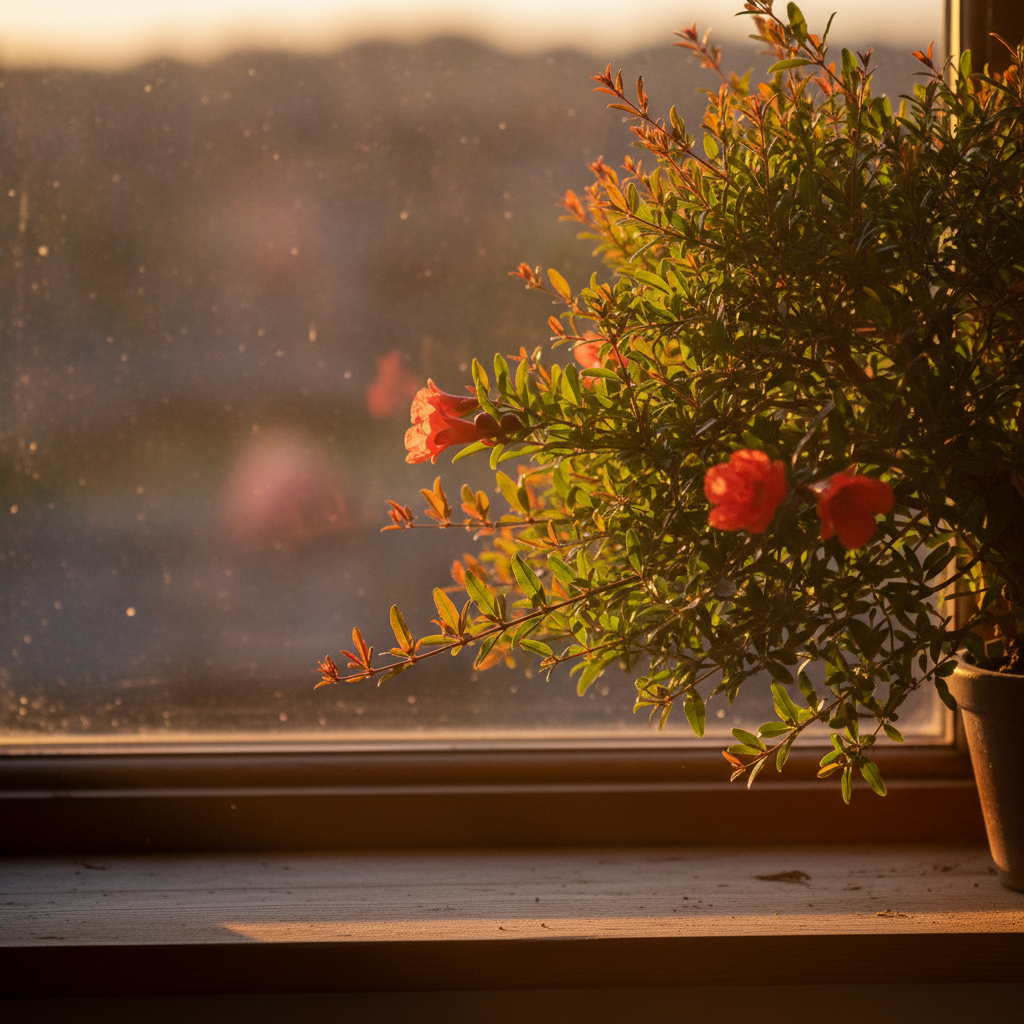
If there is a single non-negotiable in dwarf pomegranate care, it is light. This is a true full-sun plant, evolved under the fierce Mediterranean and West Asian sun, and it cannot flower well, or sometimes at all, without generous direct light. Aim for a minimum of six hours of direct sun each day during the growing season. Anything less and the plant will still grow, producing leaves and lengthening stems, but it will sulk when it comes to blooming, channelling its energy into weak, leggy shoots instead of flower buds.
The ideal indoor position is directly in front of an unobstructed south-facing window, as close to the glass as you can manage without the leaves scorching against it. Better still, move the plant outdoors once the danger of frost has passed and let it bask on a sunny patio or balcony through summer, where the higher light intensity and air movement produce sturdier growth and far more abundant flowering. Acclimatise it gradually to outdoor sun over a week or two to avoid shocking foliage that has grown soft indoors.
Light Levels Explained
Understanding how different light intensities translate to plant behaviour helps you read your own home and place the plant correctly. The figures below are approximate but useful as a guide.
| Light Category | Approx. Level | Typical Location | Outcome |
|---|---|---|---|
| Full direct sun | 20,000 to 100,000 lux | South window, outdoors in summer | Ideal. Compact growth and free flowering. |
| Bright indirect | 10,000 to 20,000 lux | Just off a bright window | Healthy foliage but sparse or no flowers. |
| Medium | 5,000 to 10,000 lux | East or west window, set back | Slow, leggy growth; rarely blooms. |
| Low | 1,000 to 5,000 lux | North window, interior room | Decline over time; leaf drop. |
| Very low | Below 1,000 lux | Dim corner, far from windows | Unsuitable. The plant will not survive long. |
Window Orientation and Placement
South-facing window: The best indoor option by a wide margin. Place the plant right at the glass to capture the most hours of direct sun, and rotate it a quarter-turn weekly so it grows evenly rather than leaning toward the light.
East-facing window: Workable but second-best. The plant will receive strong morning sun that fades to indirect light by afternoon, which supports healthy foliage but often falls short of the intensity needed for heavy flowering.
West-facing window: Similar to east, offering hot afternoon sun. Acceptable for foliage and light flowering, though the plant may need watching for heat stress on summer afternoons behind glass.
North-facing window: Not recommended. North light is far too weak to sustain a sun-loving pomegranate, and a plant kept here will gradually weaken, stretch and drop leaves.
Pro Tip — Summer Holiday Outdoors: The single most effective thing you can do for flowering is to move the plant outside for the warm months. A summer in full sun on a balcony or in the garden will reward you with denser growth and many times more blooms than the same plant kept permanently indoors.
How Light Affects Flowering and Fruit
Light does more than keep the plant alive; it directly governs whether it flowers and fruits. Flower bud formation is triggered by high light combined with the warmth of the growing season, so a pomegranate in marginal light will produce plenty of green growth yet stubbornly refuse to bloom. Fruit set follows the same logic, since the small ornamental pomegranates only develop after successful flowering. If your plant grows happily but never flowers, insufficient light is the most likely culprit before you look at feeding or any other factor.
Warning — Direct Sunlight: While the dwarf pomegranate loves sun, foliage grown in low indoor light can scorch if moved abruptly into intense direct sun. Always harden the plant off gradually over one to two weeks when transitioning it outdoors in spring, increasing exposure a little each day.
Artificial Lighting
In homes that lack a genuinely sunny window, a full-spectrum LED grow light can supplement or replace natural light. Because the plant’s demands are high, position the light close, within 20 to 30 centimetres (8 to 12 inches) of the canopy, and run it for 12 to 14 hours a day during the growing season. Be honest with yourself about whether artificial light can match true sun: it can sustain healthy foliage and may coax modest flowering, but reproducing the intensity of a Mediterranean summer indoors is difficult, and results rarely rival a plant given real sun.
Seasonal Adjustments
As autumn light wanes the plant naturally winds down, and this is normal rather than a problem to fix. Leaves yellow and fall as it enters dormancy, and its light needs drop accordingly. Through the darkest months a cool, bright but undemanding position is all it asks. When light strengthens again in early spring, return the plant to its brightest spot to cue the new flush of growth, and resume the full-sun regime as the season builds.
Watering & Humidity
Watering a dwarf pomegranate well means working with its seasons rather than against them. Through spring and summer, when it is in active growth and flower, it likes a steady supply of moisture and should not be allowed to dry out completely. In winter dormancy its needs collapse to almost nothing. Getting this rhythm right is the second pillar of good care after light, and the most common cause of trouble is treating a dormant winter plant as though it were still growing.
When to Water
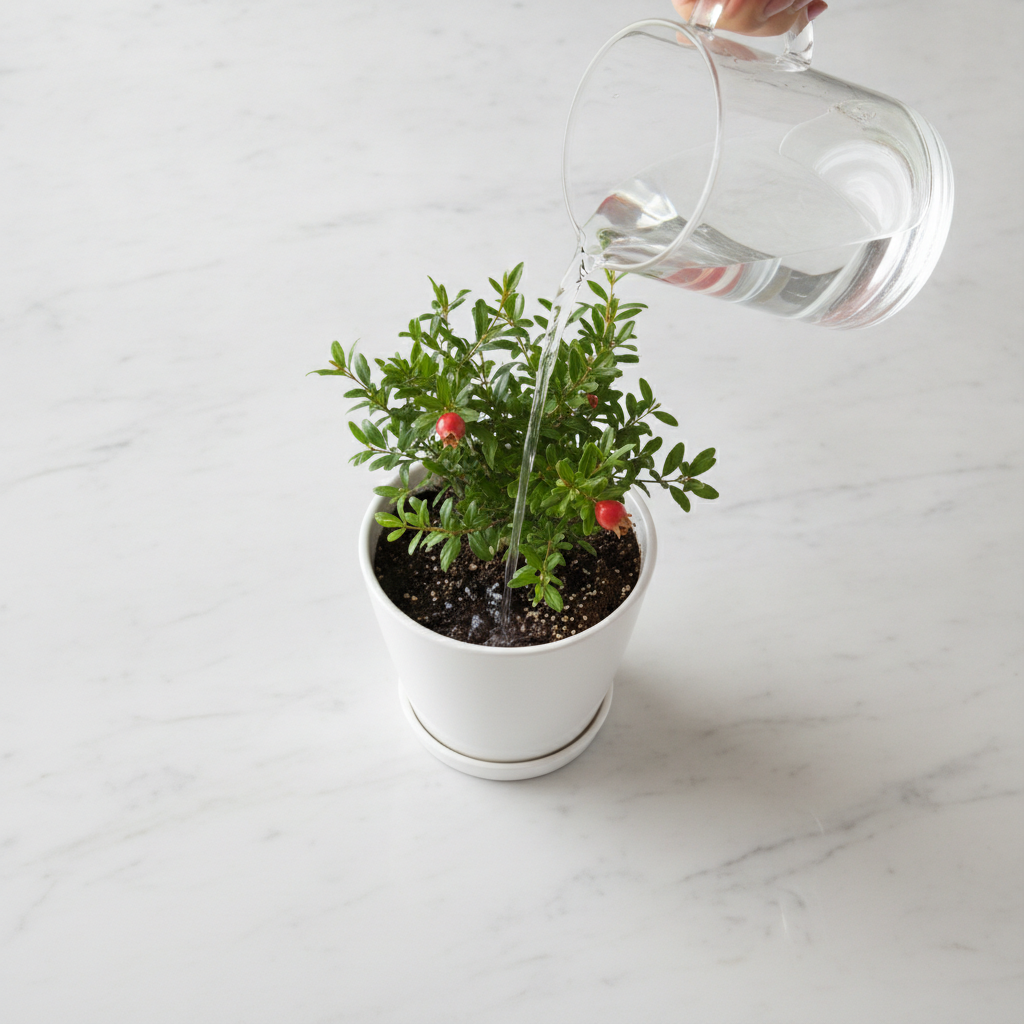
During the growing season, water when the top two to three centimetres (about an inch) of soil have dried but the deeper rootball remains slightly moist. In a sunny summer position this may mean watering every few days, especially for a plant in a small terracotta pot that dries quickly. The goal is consistent moisture without waterlogging, since erratic swings between bone-dry and saturated can cause flower buds and developing fruit to drop.
In winter the picture reverses completely. A dormant, leafless plant uses very little water, and its roots will rot if kept wet in cool conditions. Reduce watering to just enough to stop the soil drying out entirely, perhaps once every two to three weeks depending on temperature, and never leave the pot standing in water. Resume more frequent watering only when new growth appears in spring.
Pro Tip — Finger Test: Skip rigid schedules and check the soil instead. Push a finger two to three centimetres into the mix: if it feels dry at the tip, water; if it is still damp, wait. This single habit prevents the majority of watering mistakes across the year.
How to Water Correctly
- Check the soil first with the finger test to confirm the plant actually needs watering.
- Water at the base of the plant, directing the flow onto the soil rather than over the foliage and flowers.
- Apply water steadily until it flows freely from the drainage holes, ensuring the whole rootball is moistened.
- Let the pot drain completely for several minutes before returning it to its saucer or cover pot.
- Empty any water that collects in the saucer so the roots never sit in standing moisture.
Signs of Overwatering vs. Underwatering
| Symptom | Overwatering | Underwatering |
|---|---|---|
| Leaf colour | Yellowing across many leaves, often lower ones first | Browning, crisping leaf tips and margins |
| Leaf texture | Soft, limp, sometimes translucent | Dry, brittle, curling inward |
| Soil | Stays wet for days, may smell sour | Pulls away from the pot edge, dusty dry |
| Roots | Brown, mushy, foul-smelling | Dry and papery but generally intact |
| Buds and fruit | Drop suddenly while still green | Shrivel and drop during heat or dry spells |
Warning — Root Rot: The fastest way to kill a dwarf pomegranate is to keep it wet and cool, particularly in winter. Soggy soil starves roots of oxygen and invites rot. If you suspect it, unpot the plant, trim away any blackened mushy roots, and repot into fresh, free-draining mix in a clean pot.
Humidity Requirements
Here the dwarf pomegranate is refreshingly undemanding. As a plant of dry, sunny climates it is perfectly content in ordinary household humidity and has no need for the misting, pebble trays or humidifiers that fussier tropical plants require. Average indoor levels of 40 to 50 percent suit it well.
Problems related to humidity are rare, but extremely dry air close to a radiator or heat source in winter can occasionally crisp leaf edges. Since the plant is usually dormant and bare at that time of year, this seldom matters; if it does retain leaves and they brown, simply move it away from the direct draught of the heat source.
There is rarely any need to actively raise humidity for this plant. If your home is unusually dry and a leafy specimen shows stress, grouping it with other plants or setting it on a tray of damp pebbles is more than enough; misting offers little benefit and can encourage fungal spotting on the foliage.
Water Quality
The dwarf pomegranate is not especially sensitive to water quality and tolerates ordinary tap water in most areas. In regions with very hard water, mineral salts can accumulate in the soil over time, so the occasional watering with collected rainwater or a thorough flush of the pot helps keep the rootzone healthy. Room-temperature water is gentler on the roots than cold water straight from the tap.
Soil, Potting & Repotting
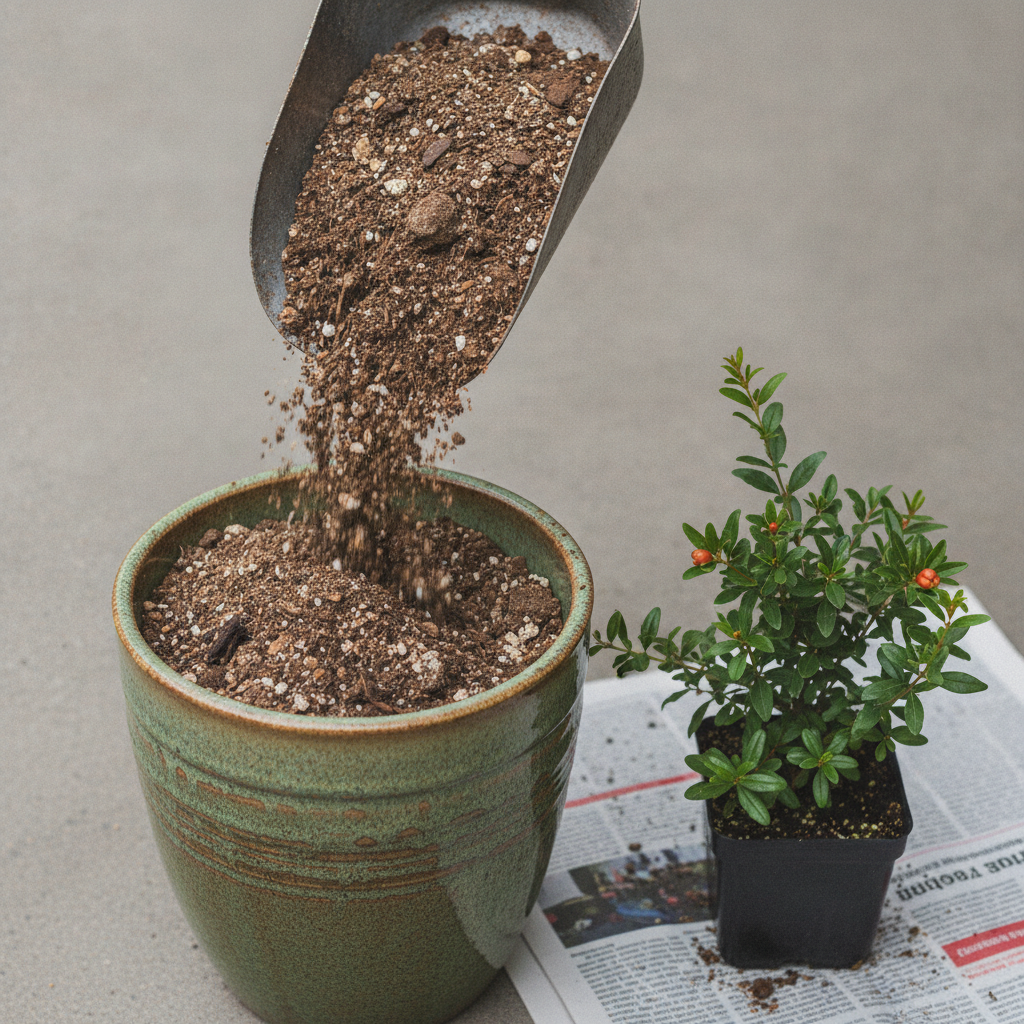
The dwarf pomegranate is not fussy about soil so long as one condition is met: it must drain freely. In the wild it grows in lean, rocky, well-drained ground, and the quickest route to root rot is a heavy, water-retentive mix that stays soggy. A good potting medium for this plant balances enough body to hold moisture and nutrients through the growing season with enough grit to let excess water escape fast.
Ideal Soil Composition
A reliable mix starts with a quality loam-based potting compost, which provides structure and a steady reservoir of nutrients, then opens it up with coarse material for drainage. Aim for roughly two parts compost to one part grit or perlite. Bonsai growers, who keep pomegranates in shallow trays, often lean even further toward an open, granular substrate to guarantee drainage.
| Component | Proportion | Function |
|---|---|---|
| Loam-based potting compost | 50 to 60% | Provides body, moisture retention and nutrients |
| Horticultural grit or coarse sand | 20 to 25% | Improves drainage and adds weight for stability |
| Perlite or pumice | 15 to 20% | Keeps the mix open and aerates the rootzone |
| Composted bark (optional) | 5 to 10% | Adds structure and slow organic matter |
The dwarf pomegranate prefers a soil pH that is slightly acidic to neutral, in the range of about 5.5 to 7.0, which most standard potting composts fall comfortably within. There is no need to chase a precise figure; simply avoid very alkaline conditions, which can lock up iron and lead to yellowing between the leaf veins.
Pro Tip — Quick Mix Recipe: For a no-fuss blend, combine two handfuls of standard loam-based compost with one handful of perlite and a generous pinch of horticultural grit. It drains fast, holds enough moisture for summer growth, and suits both ordinary pots and bonsai trays.
Choosing the Right Pot
Because the dwarf pomegranate is naturally compact and even enjoys a degree of root restriction, you do not need a large pot. Slightly snug roots can actually encourage flowering, so resist the urge to overpot a small plant into a cavernous container where the surplus soil will stay wet and risk rot.
Drainage holes are non-negotiable. Whatever pot you choose must have generous drainage holes. This plant will not tolerate sitting in water, and a decorative pot without drainage is an invitation to root rot no matter how carefully you water.
Pot material: Terracotta is an excellent choice, as its porous walls allow the soil to breathe and dry more evenly, which suits a plant that hates staying wet. Its weight also helps anchor a top-heavy, bushy specimen. Glazed ceramic and plastic both work too, but you will need to water a little more conservatively in them since they hold moisture longer.
Pot size: Choose a pot only one size larger than the current rootball when potting on, typically two to three centimetres (about an inch) wider in diameter. This gives room to grow without drowning the roots in excess soil.
When to Repot
A young, vigorous dwarf pomegranate may need repotting every one to two years, while a mature or bonsai specimen can go several years between moves. The signs that it is time are familiar: roots circling the pot or emerging from the drainage holes, water rushing straight through without wetting the soil, or growth that has visibly slowed. The best time to repot is in early spring, just as the plant breaks dormancy and before the main flush of growth, so it can recover quickly.
How to Repot: Step-by-Step
- Water the plant a day beforehand so the rootball holds together and the roots are not stressed.
- Prepare the new pot with a layer of fresh, free-draining mix in the base.
- Ease the plant out by tipping the pot and supporting the base of the stem, rather than pulling on the trunk.
- Gently tease out any tightly circling roots and trim away any that are dead, dark or mushy with clean secateurs.
- Position the plant at the same depth it grew before, then fill around it with fresh mix, firming lightly to remove air pockets.
- Water thoroughly to settle the soil, then let the pot drain fully.
- Return it to bright light but out of the most intense midday sun for a week or so while it re-establishes.
Warning — Transplant Shock: Avoid feeding for three to four weeks after repotting, as fresh compost already contains nutrients and disturbed roots are easily burned. A little temporary leaf droop is normal; keep the plant out of harsh sun and resist the urge to overwater while it recovers.
Fertilising
A well-fed dwarf pomegranate flowers and fruits far more generously than a starved one, but the type of feed matters as much as the quantity. Too much nitrogen produces a lush, leafy plant that is reluctant to bloom, while a feeding regime weighted toward potassium encourages the flowers and fruit that make this plant worth growing in the first place.
The plant feeds only when it is actively growing, which means spring and summer. Through autumn and winter, as it slows and sheds its leaves, it neither needs nor can use fertiliser, and feeding a dormant plant simply allows salts to build up in the soil.
Understanding Plant Nutrients
Fertiliser labels carry three prominent numbers, the N-P-K ratio, representing nitrogen, phosphorus and potassium. For a flowering and fruiting plant like the pomegranate, understanding what each does helps you choose the right product at the right time of year.
| Nutrient | Symbol | Primary Function | Deficiency Symptoms |
|---|---|---|---|
| Nitrogen | N | Leaf and stem growth, green colour | Pale, yellowing older leaves; weak growth |
| Phosphorus | P | Root development and flower formation | Poor flowering; dull, sometimes purplish leaves |
| Potassium | K | Flowering, fruiting and overall vigour | Few flowers; browning leaf margins |
| Calcium | Ca | Cell wall strength and new growth | Distorted young leaves and shoot tips |
| Magnesium | Mg | Core of chlorophyll, photosynthesis | Yellowing between veins on older leaves |
| Iron | Fe | Chlorophyll production in new growth | Yellowing between veins on the newest leaves |
Types of Fertiliser
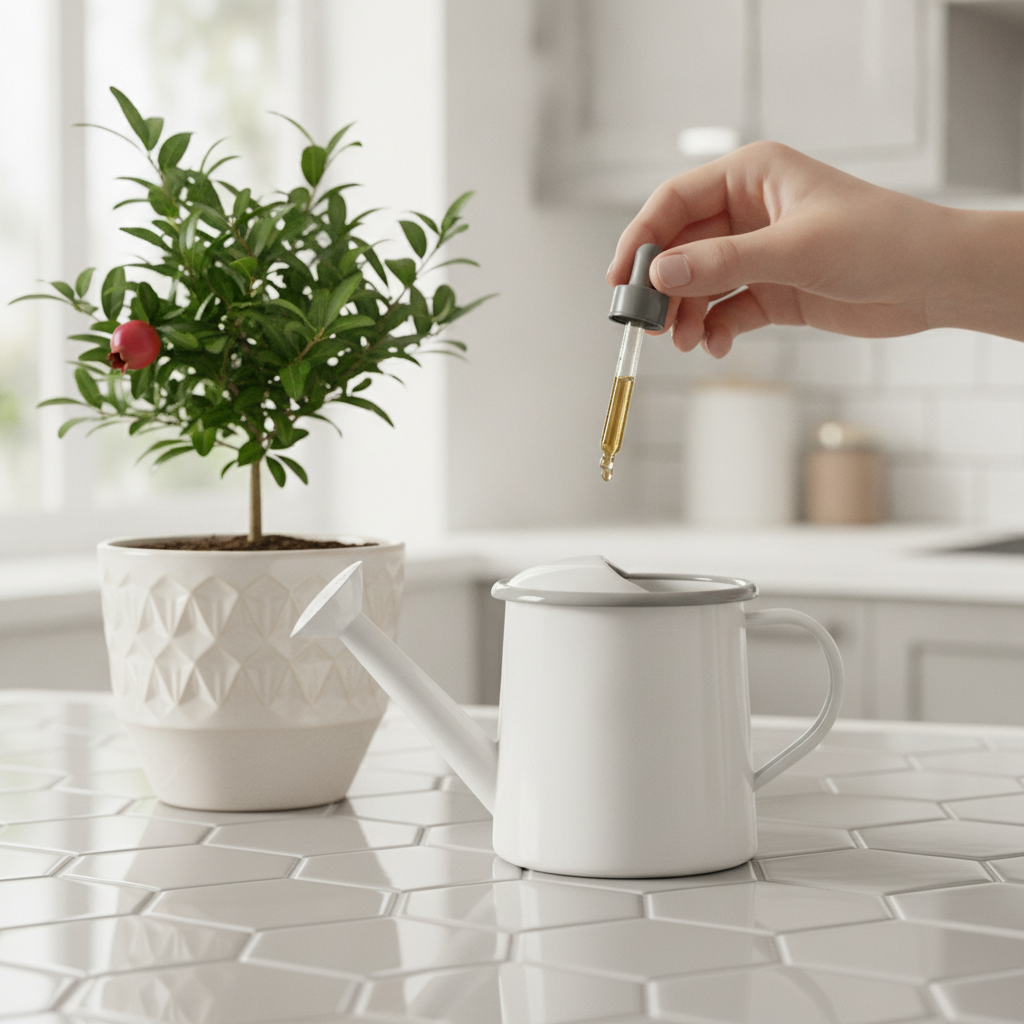
Liquid fertilisers: The most convenient option for indoor pomegranates, mixed into the watering can and applied every couple of weeks in the growing season. A balanced feed in spring followed by a high-potassium tomato or bloom feed through summer suits the plant’s shifting needs nicely.
Slow-release granular: Granules or pellets mixed into the soil release nutrients gradually over months and are a low-effort choice for those who forget regular feeding. Apply at the start of the growing season and let them work through summer.
Organic fertilisers: Worm castings, well-rotted compost top-dressings and seaweed-based feeds gently improve soil health and supply a broad range of nutrients. They act more slowly than synthetic feeds but are forgiving and very hard to overdose.
Feeding Schedule
Begin feeding in early spring as new growth emerges, using a balanced fertiliser at half strength to support the flush of leaves. As flower buds form in late spring and summer, switch to a high-potassium feed every two weeks to fuel blooming and fruit. Taper off in early autumn and stop entirely once the plant begins dropping leaves and enters dormancy.
Pro Tip — Feed for Flowers, Not Leaves: If your pomegranate produces abundant foliage but few flowers, cut back on nitrogen-rich feeds and switch to a high-potassium bloom fertiliser. Combined with strong light, this nudges the plant to invest in flowers and fruit rather than leafy growth.
How to Fertilise
- Water the plant lightly first if the soil is very dry, to protect the roots from concentrated feed.
- Dilute liquid fertiliser to the recommended strength, or half strength for young plants and early in the season.
- Apply the solution evenly over the soil surface until it begins to drain, rather than splashing it onto the foliage.
- Feed in the cooler part of the day and never onto bone-dry soil in strong midday sun.
- Flush the pot thoroughly with plain water every month or two to wash out accumulated salts.
Warning — Salt Build-Up: A white crust on the soil surface or pot rim, or browning leaf tips, signals fertiliser salt accumulation. Flush the pot with several times its volume of plain water until it runs freely from the base, and ease off feeding until the plant recovers.
Propagation
The dwarf pomegranate is satisfying to propagate, and because it is a woody shrub the reliable routes are cuttings and seed rather than the division or offsets used for clumping houseplants. Cuttings are the method of choice for keeping a named variety true to type, since seed-grown plants can vary, while raising from seed is an enjoyable long-term project that often germinates readily.
Whichever route you take, patience is part of the process. Cuttings root over several weeks and seedlings take a few years to reach flowering size, so propagation here is less about instant gratification and more about the quiet pleasure of growing new plants from an existing favourite.
Understanding Nodes and Cutting Wood
Successful cuttings depend on the node, the point on a stem where leaves and buds emerge and where new roots most readily form. Softwood cuttings taken from the current season’s flexible green growth in late spring root quickly under warmth and humidity, while hardwood cuttings of dormant, woody stems taken in winter root more slowly but are very forgiving. In both cases, including two or three nodes per cutting gives the best chance of rooting.
Softwood Cuttings: Step-by-Step
This is the most popular method for the dwarf pomegranate and works well from late spring into summer when the plant is growing strongly.
- Select a healthy, non-flowering shoot from the current season’s growth and cut a 10 to 15 centimetre (4 to 6 inch) length just below a node with clean, sharp secateurs.
- Remove the leaves from the lower half of the cutting, leaving a few at the top.
- Dip the cut end in rooting hormone to improve success rates, tapping off any excess.
- Insert the cutting into a pot of moist, free-draining mix such as equal parts perlite and compost, burying at least one node.
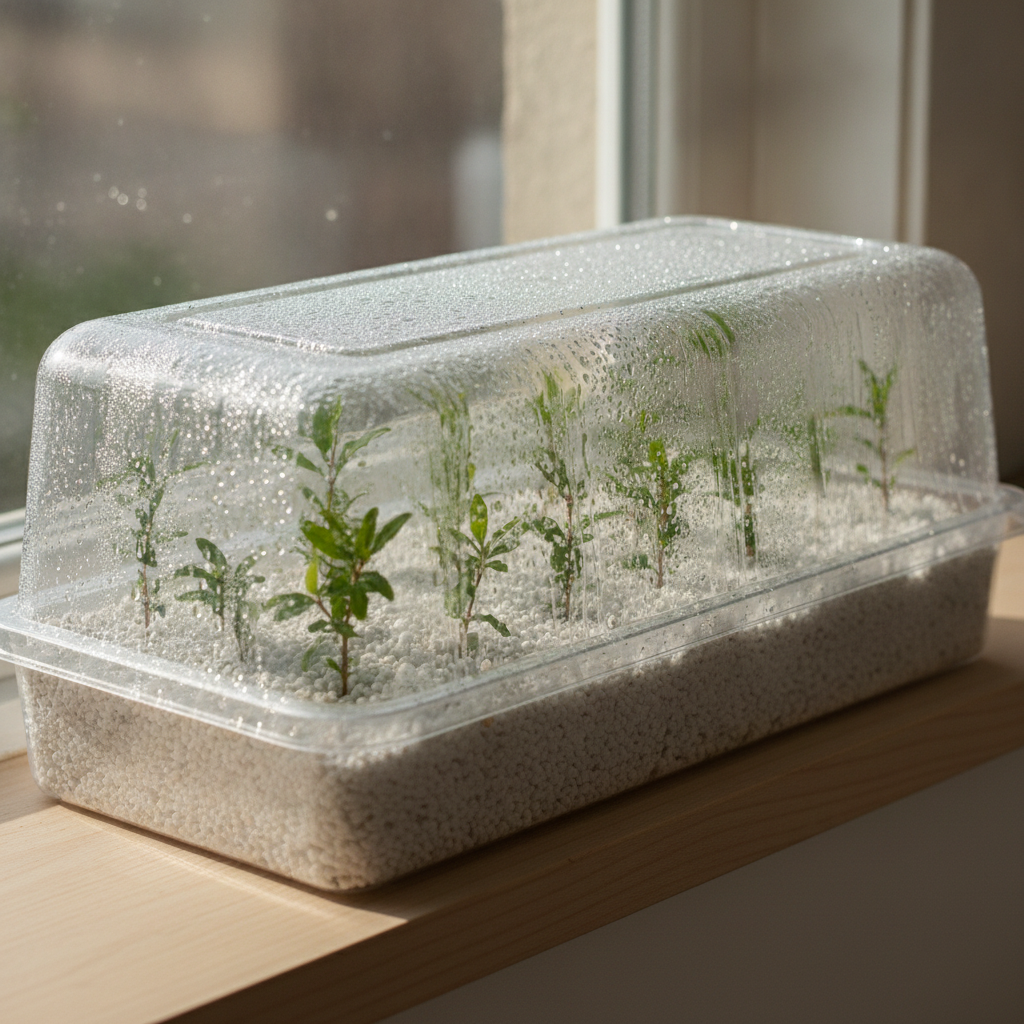
- Cover with a clear plastic bag or humidity dome to maintain moisture, and place in bright, indirect light and warmth.
- Keep the medium lightly moist and ventilate occasionally; roots typically form in four to eight weeks, shown by fresh new growth and resistance to a gentle tug.
Pro Tip — Bottom Heat: Pomegranate cuttings root noticeably faster with gentle warmth at the base. A heated propagation mat set to around 21 °C (70 °F) speeds rooting and improves your success rate, especially for cuttings taken earlier or later in the season.
Growing from Seed: Step-by-Step
Seed is a rewarding way to raise dwarf pomegranates in quantity, and fresh seed from a ripe fruit germinates particularly well.
- Extract seeds from a ripe fruit and clean away the surrounding pulp, then rinse and pat them dry.
- Sow the seeds about half a centimetre deep in a tray of moist, free-draining seed compost.
- Place the tray somewhere warm and bright, ideally around 20 to 25 °C (68 to 77 °F), and keep the surface lightly moist.
- Expect germination over two to six weeks, sometimes erratically.
- Once seedlings have a few sets of true leaves, prick them out into individual small pots.
- Grow them on in strong light, and be patient: seed-raised plants usually take three to four years to begin flowering.
Troubleshooting Propagation
| Problem | Likely Cause | Solution |
|---|---|---|
| Cuttings rot and blacken | Medium too wet or too cold | Use a grittier mix, ventilate the cover, and provide gentle warmth |
| Cuttings shrivel and dry | Too little humidity or moisture loss | Cover to retain humidity and keep out of direct sun |
| No roots after many weeks | Cutting taken at the wrong time or no warmth | Try softwood cuttings in early summer with bottom heat |
| Seeds fail to germinate | Old seed or temperatures too low | Use fresh seed and keep consistently warm at 20 to 25 °C |
Pests & Diseases
A healthy dwarf pomegranate grown in good light is reasonably resistant to trouble, but no plant is immune. The pests it attracts are the usual suspects of indoor growing, and most are easily managed if caught early through regular inspection. The plant’s seasonal leaf drop also helps, since many pest populations are disrupted when the plant goes dormant.
Prevention beats cure every time. Check both sides of the leaves and the leaf axils whenever you water, isolate any new plants before introducing them to your collection, and keep the foliage clean. Early detection turns a potential infestation into a minor inconvenience.
Common Pests
Aphids (Aphidoidea)
Aphids are the pomegranate’s most frequent pest, clustering on soft new shoots and flower buds where they suck sap and excrete sticky honeydew. Heavy infestations distort new growth and can cause buds to abort before opening.
Treatment: Dislodge them with a firm spray of water, then treat with insecticidal soap or a diluted neem oil solution, repeating every few days until they are gone. Check the undersides of new growth closely, as that is where they hide.
Whitefly (Trialeurodes vaporariorum)
Tiny white moth-like insects that rise in a cloud when the plant is disturbed, whitefly feed on the undersides of leaves and, like aphids, leave honeydew that encourages sooty mould. They thrive in the warm conditions a sun-loving pomegranate enjoys.
Treatment: Hang yellow sticky traps to monitor and reduce the flying adults, and spray the leaf undersides with insecticidal soap or neem oil at regular intervals to break the breeding cycle.
Mealybugs (Pseudococcidae)
Mealybugs appear as small, white, cottony tufts tucked into leaf axils and along stems. They feed slowly but persistently, weakening the plant and coating it in honeydew if left unchecked.
Treatment: Dab individual insects with a cotton bud dipped in isopropyl alcohol, then follow up with neem oil for wider coverage. Persistent colonies may need weekly treatment over several weeks.
Spider Mites (Tetranychus urticae)
Encouraged by hot, dry conditions, spider mites are almost invisible but betray themselves with fine webbing and a stippled, speckled look to the leaves. They can build up quickly on a plant in a warm, sunny window.
Treatment: Rinse the foliage thoroughly, including the undersides, and treat with neem oil or a miticide. Raising humidity slightly around the plant makes conditions less favourable for them.
Common Diseases
Root Rot (Phytophthora and others)
By far the most serious threat to an indoor pomegranate, root rot results from waterlogged soil starving the roots of oxygen, especially during the cool dormant season. Symptoms include yellowing leaves, wilting despite wet soil, and a foul smell from the rootzone.
Treatment: Unpot the plant, cut away all blackened, mushy roots with clean tools, and repot into fresh free-draining mix in a clean pot. Then correct the watering habits that caused it, particularly overwatering in winter.
Leaf Spot (Cercospora and others)
Fungal leaf spots show as dark or brown blotches on the foliage, often with a yellow halo, and tend to appear in humid, poorly ventilated conditions or where the leaves are frequently wet.
Treatment: Remove and dispose of affected leaves, improve air circulation around the plant, and water at the base rather than over the foliage. A copper-based or general fungicide can help in stubborn cases.
Pest and Disease Summary
| Pest / Disease | Identification | Treatment |
|---|---|---|
| Aphids | Clusters on new shoots and buds; sticky honeydew | Water spray, insecticidal soap, neem oil |
| Whitefly | Tiny white flies that cloud up when disturbed | Yellow sticky traps, neem oil on leaf undersides |
| Mealybugs | White cottony tufts in axils and on stems | Alcohol on a cotton bud, then neem oil |
| Spider mites | Fine webbing and stippled, speckled leaves | Rinse foliage, neem oil or miticide, raise humidity |
| Root rot | Wilting in wet soil, yellowing, foul smell | Trim rotten roots, repot in fresh mix, correct watering |
| Leaf spot | Dark blotches with yellow halos on leaves | Remove affected leaves, improve airflow, fungicide |
Prevention Strategies
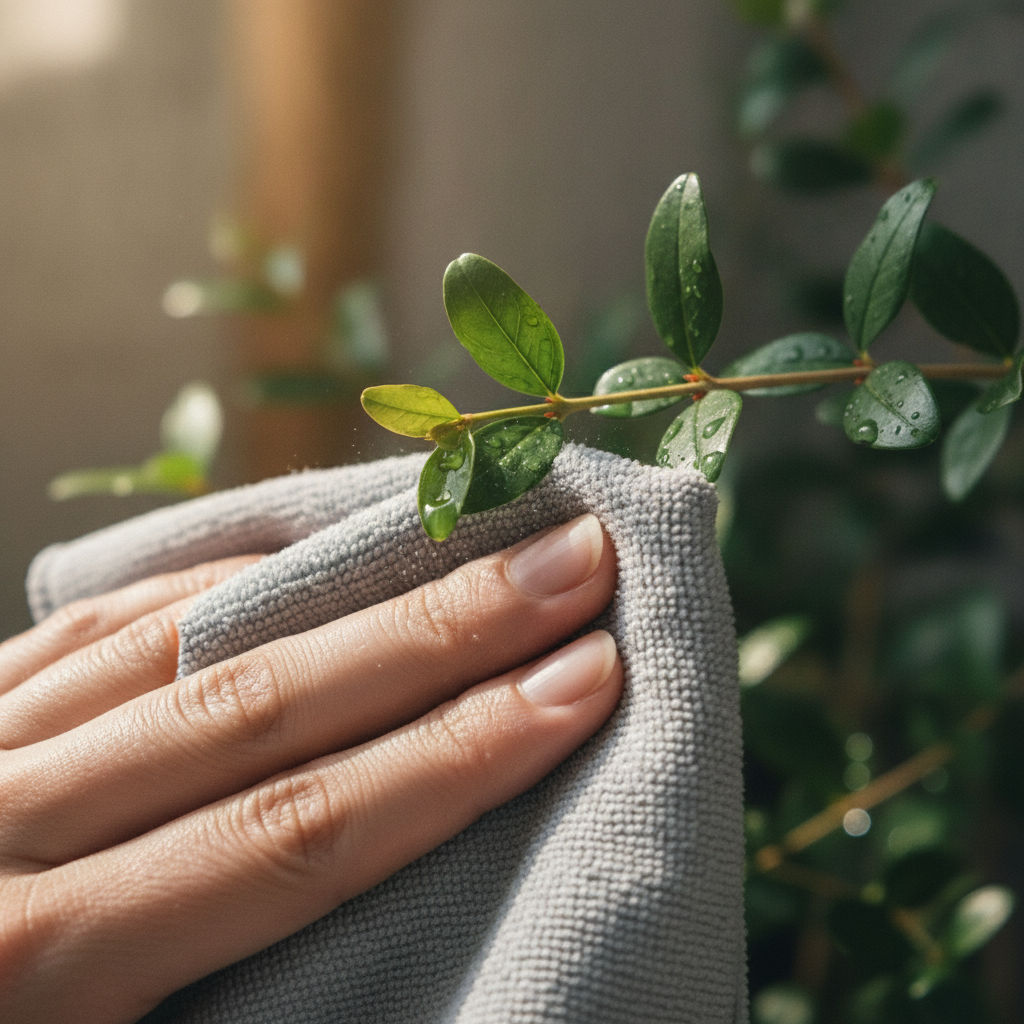
The strongest defence is a vigorous plant. Give the dwarf pomegranate the full sun, free-draining soil and seasonal watering it wants, and it will be far better placed to shrug off the occasional pest than a weakened specimen struggling in poor light. Good airflow around the foliage discourages fungal problems, and a regular wipe of the leaves both keeps them clean and gives you a chance to inspect for early signs of trouble.
Quarantine is the other key habit. Any new plant entering your home can carry pests, so keep newcomers separate for a couple of weeks and check them over before they join the rest of your collection. Likewise, inspect a pomegranate that has summered outdoors before bringing it back inside for winter, treating it if necessary so you do not import hitchhikers.
Pro Tip — Neem Oil Routine: A fortnightly preventive spray of diluted neem oil during the growing season keeps the common sap-suckers at bay before they establish. Apply in the evening or out of direct sun to avoid leaf scorch, and cover the undersides of the leaves where pests congregate.
Popular Varieties
Although the plant most often sold simply as “dwarf pomegranate” is the form Punica granatum var. nana, a number of named selections have been developed for ornamental gardeners and container growers. Some prioritise flower colour and form, others compactness or the quality of their small fruit, and a few are bred specifically with bonsai in mind.
All share the same fundamental care, so choosing between them is a matter of looks and intended use rather than difficulty. The selection below covers the varieties you are most likely to encounter.
| Variety | Flower & Fruit | Light Needs | Growth Rate | Availability |
|---|---|---|---|---|
| ‘Nana’ | Orange-red flowers, small decorative fruit | Full sun | Slow to moderate | Very common |
| ‘State Fair’ | Orange-red flowers, sweet edible mini fruit | Full sun | Moderate | Common |
| ‘Provence’ | Orange flowers, pale ornamental fruit | Full sun | Moderate | Specialist |
| ‘Flore Pleno’ / ‘Double Red’ | Showy double red flowers, little fruit | Full sun | Moderate | Specialist |
| ‘Orange Master’ | Bright orange flowers, decorative fruit | Full sun | Moderate | Specialist |
| ‘Emperor’ / dwarf bonsai forms | Orange-red flowers, very compact habit | Full sun | Slow | Bonsai nurseries |
Featured Varieties
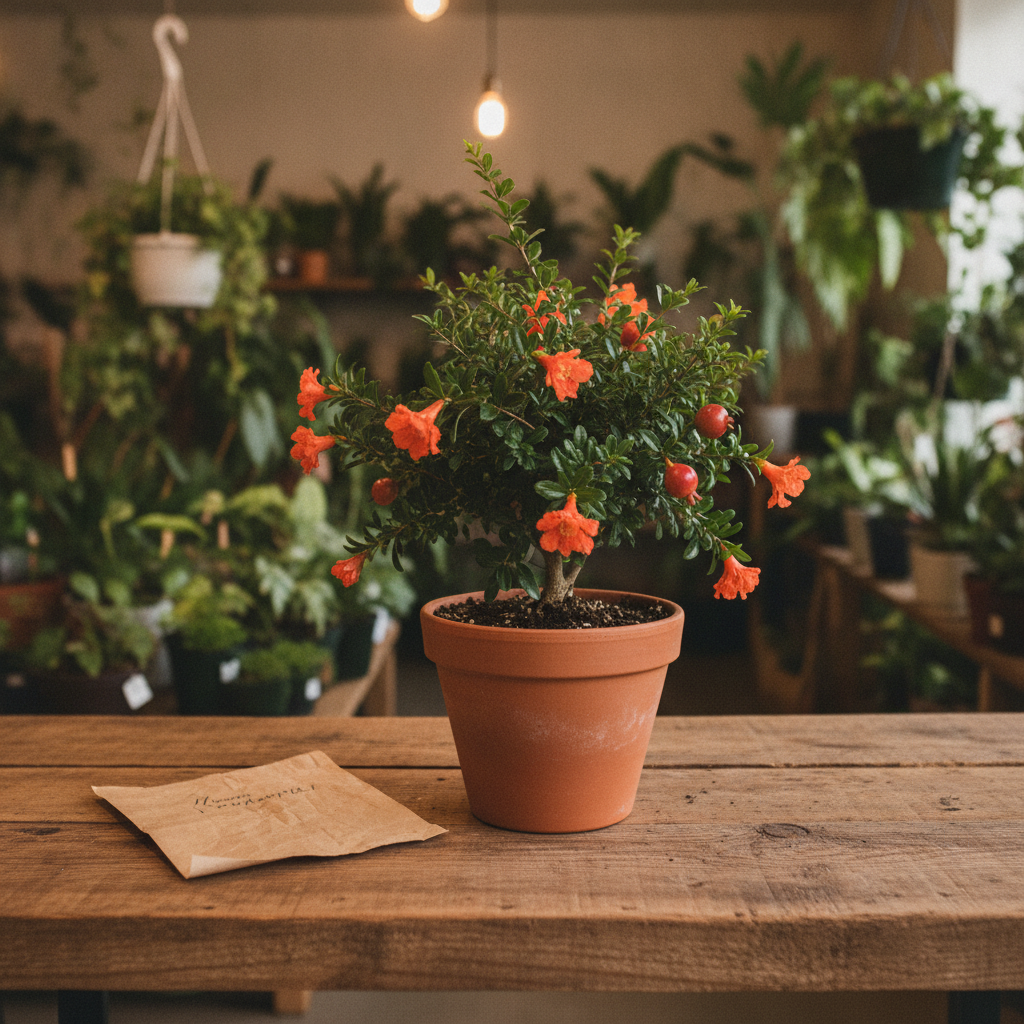
‘Nana’
The classic dwarf form and the one most often sold, ‘Nana’ is prized for its dense, twiggy habit, masses of small glossy leaves and a long succession of vivid orange-red flowers followed by miniature ornamental fruit. It is the natural choice for windowsills and beginner bonsai alike.
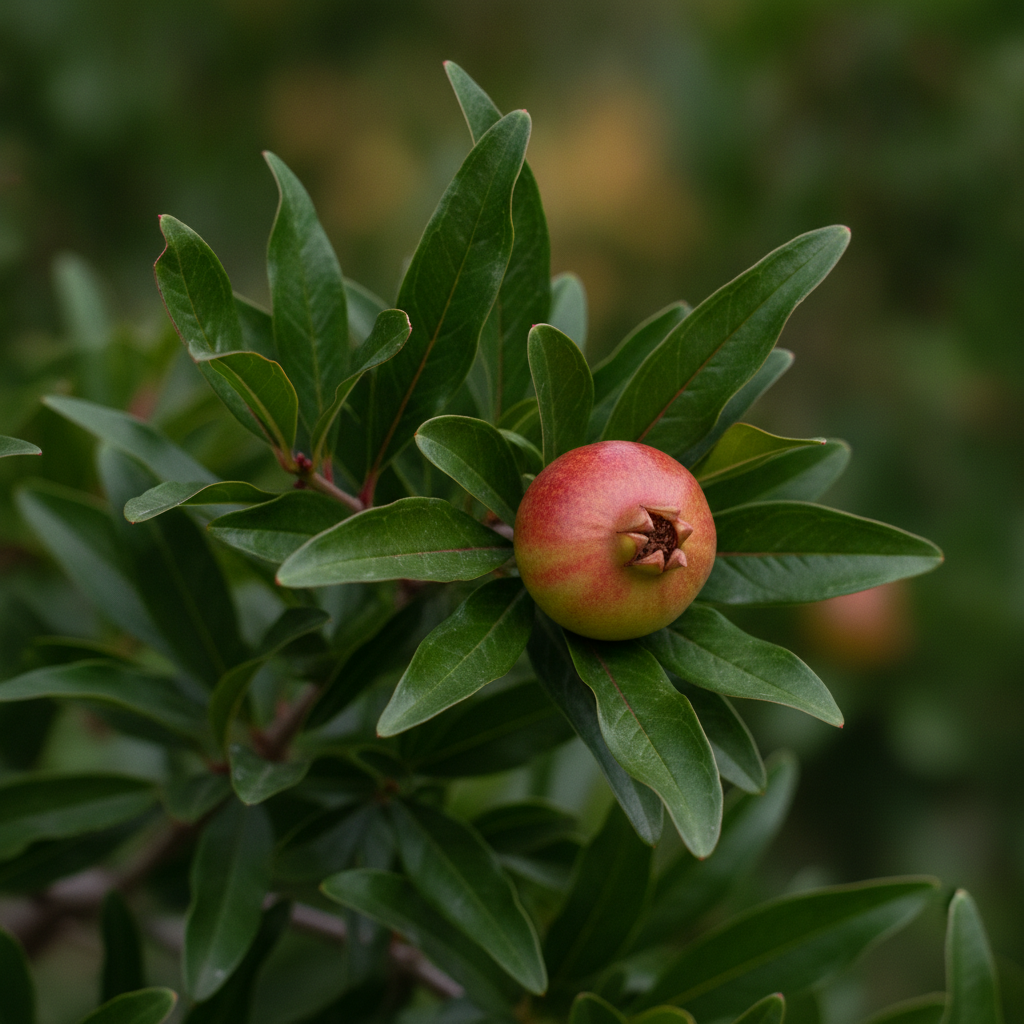
‘State Fair’
A compact, cold-tolerant selection bred for small but genuinely edible fruit, ‘State Fair’ offers the same showy orange-red flowers on a manageable bush. It is a fine choice for growers who want a chance at harvesting their own miniature pomegranates from a container.
Variety Profiles in Detail
‘Nana’ (Punica granatum var. nana)
This is the benchmark dwarf pomegranate, naturally miniature and free-flowering even as a young plant. It tends to flower and fruit earlier in life than full-sized pomegranates, which makes it endlessly rewarding in a pot, and its fine branching takes well to clipping for shape.
‘Flore Pleno’ (Punica granatum ‘Flore Pleno’)
Grown purely for ornament, this double-flowered form produces ruffled, carnation-like red blooms that are far showier than the single species flowers. Because much of its energy goes into the elaborate flowers, it sets little or no fruit, making it a choice for those who value the display above all.
Choosing the Right Variety for Your Space
For most indoor growers, the widely available ‘Nana’ is the obvious starting point: compact, reliable and beautiful. If your real interest is harvesting tiny fruit, look for ‘State Fair’ or another fruiting selection, while anyone chasing maximum floral impact should seek out a double-flowered form like ‘Flore Pleno’. Bonsai enthusiasts will gravitate toward the smallest-leaved, slowest-growing clones. Whatever you choose, remember that the care is identical and that a sunny position matters far more to your success than the particular name on the label.
Frequently Asked Questions
Why is my dwarf pomegranate not flowering?
Insufficient light is the most common reason by far. This plant needs at least six hours of direct sun to bloom, so move it to your brightest south-facing window or, better still, outdoors for the summer. A second factor is feeding: too much nitrogen produces leaves at the expense of flowers, so switch to a high-potassium bloom feed. Finally, a young plant or one that missed its cool winter rest may simply need another season to settle into flowering.
Is the dwarf pomegranate toxic to cats and dogs?
The pomegranate is generally regarded as non-toxic to cats and dogs, and the ripe fruit pulp is edible. That said, the bark, roots and stems contain alkaloids that can cause stomach upset if chewed in quantity, so it is sensible to keep prunings and fallen stems out of reach and to discourage pets from gnawing the woody parts.
Why is my plant dropping its leaves?
If it is autumn or winter, this is completely normal: the dwarf pomegranate is deciduous and naturally sheds its leaves as it enters dormancy. There is nothing to fix, and you should simply reduce watering and stop feeding. Out of season, sudden leaf drop usually points to a stress such as overwatering, severe drought, a cold draught or a big change in light, so review recent conditions to find the cause.
Will the fruit be edible?
The fruit of most ornamental dwarf pomegranates is technically edible but small, often sour, and grown mainly for show rather than the table. Selections bred for fruit, such as ‘State Fair’, produce sweeter, more palatable miniature pomegranates. For a reliable indoor display, treat the fruit as decoration and enjoy any edible bonus it offers.
Does the dwarf pomegranate need a cold winter rest?
It benefits greatly from one. A cool dormant period of around 7 to 13 °C (45 to 55 °F) with little water lets the plant rest properly and encourages stronger flowering the following year. A bright, cool spare room, porch or unheated conservatory is ideal. The plant can manage without a distinct cold rest, but flowering is often less generous as a result.
Can I grow a dwarf pomegranate as a bonsai?
Absolutely, and it is one of the most popular flowering subjects for bonsai. Its naturally small leaves, fine branching, attractive gnarled bark with age and willingness to flower and fruit even when small make it ideal. Grow it in a free-draining bonsai mix, keep it in full sun, and prune and wire it as you would any deciduous bonsai, taking care to shape after flowering.
How big does a dwarf pomegranate get?
Indoors and in containers it typically stays between 60 centimetres and 1 metre (2 to 3 feet) tall, and pruning keeps it smaller still. This compactness is exactly what makes it such a manageable houseplant compared with the full-sized pomegranate, which can reach several metres. Regular trimming after flowering maintains a dense, attractive shape.
Can I keep it outdoors all year?
It depends on your climate. The dwarf pomegranate is hardy in mild, frost-light regions and can live outdoors permanently there, but in cold-winter climates it must be brought inside or into a frost-free space before the first hard frost. A summer outdoors followed by a cool but protected winter indoors gives the best of both worlds for most growers.






