
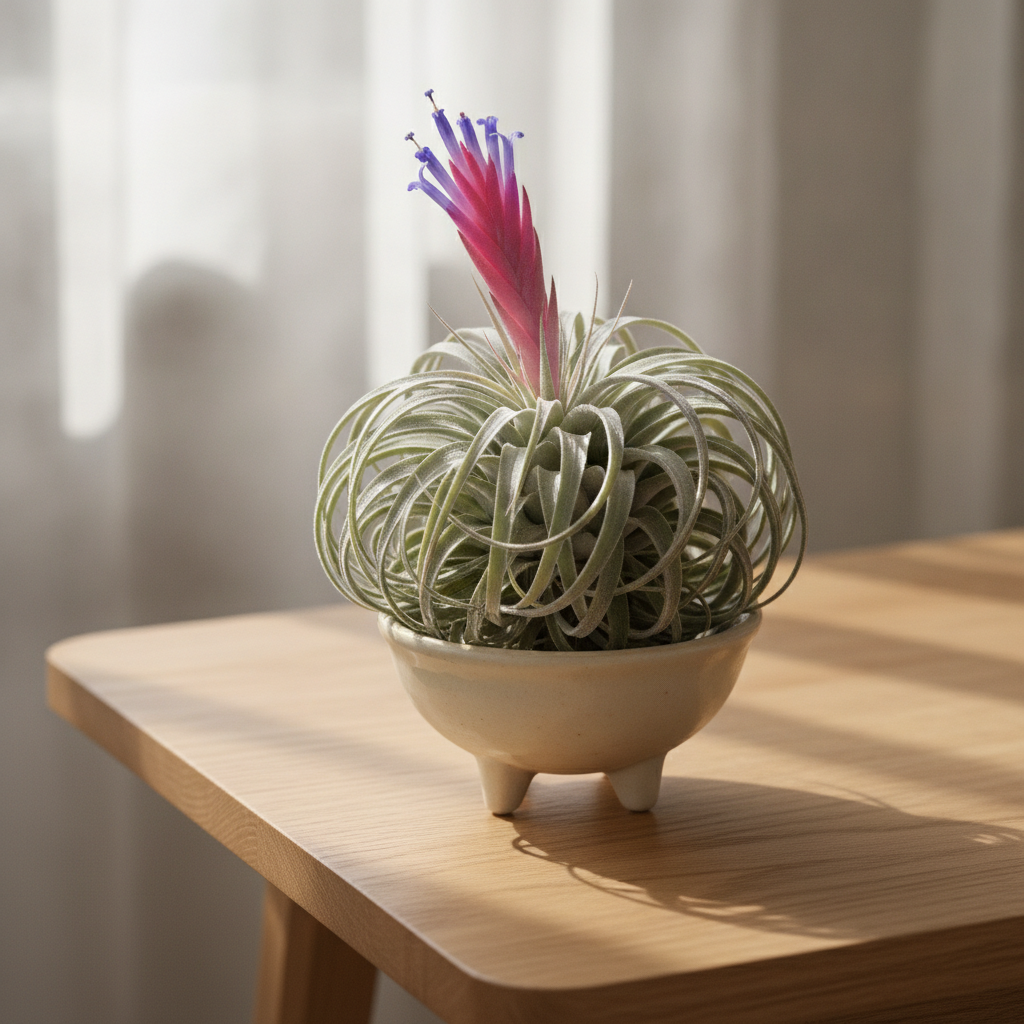
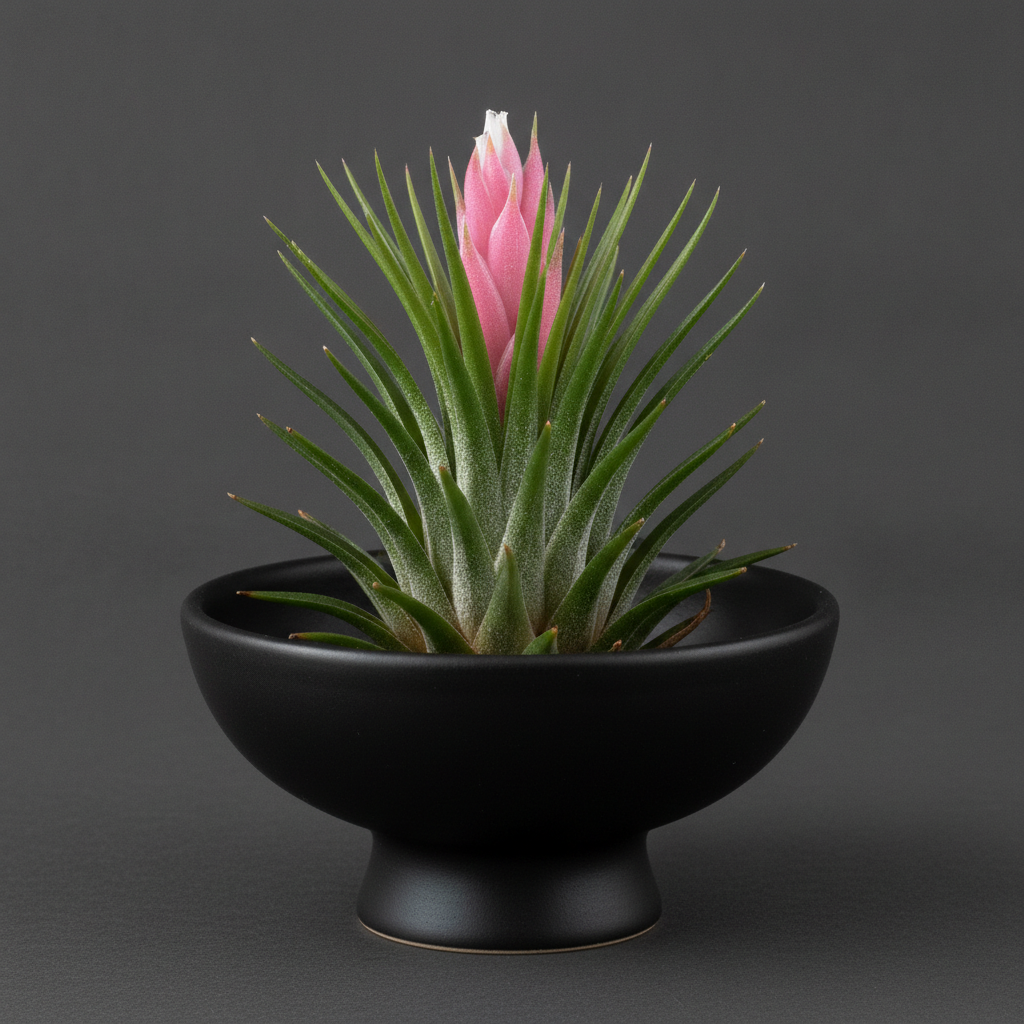
Few houseplants earn their common name as neatly as the cotton candy air plant. Its dense, arching rosette of soft silver-green leaves genuinely resembles a spun sugar treat, and when it flowers the resemblance turns theatrical: a vivid rose-pink teardrop bract pushes up from the centre and unfurls a fan of tubular violet-blue blooms. Botanically it is Tillandsia stricta, an epiphytic bromeliad native to the forests, dunes and rocky outcrops of eastern South America, from Brazil and Venezuela down through Paraguay, Uruguay and northern Argentina. It is also sold simply as the pink air plant, and it is one of the most widely grown and forgiving members of a genus that now numbers more than six hundred species.
What makes an air plant an air plant is that it has abandoned soil altogether. Tillandsia stricta anchors itself to bark, branches or rock with wiry roots that grip but do not feed, and it takes in every drop of water and speck of nutrition through microscopic scales, called trichomes, that coat its leaves and give the plant its frosted silver sheen. That single adaptation rewrites almost every rule of houseplant care, which is why this guide reads a little differently from one about a potted philodendron. Getting a cotton candy air plant to merely survive is easy; getting it to grow into a fat, clustering clump that blooms and throws pups year after year takes an understanding of how it drinks, breathes and rests. This guide covers all of it.
Contents
- Quick Reference
- Why Cotton Candy Air Plant Makes an Ideal Houseplant
- Light Requirements
- Watering & Humidity
- Mounting, Display & Air Circulation
- Fertilising
- Propagation
- Pests & Diseases
- Popular Varieties
- Frequently Asked Questions
Quick Reference: Cotton Candy Air Plant at a Glance
| Light | Bright, indirect light; tolerates an hour or two of gentle morning sun |
| Watering | Soak 20 to 30 minutes once or twice a week, then dry fully within four hours |
| Temperature | 15 to 28 degrees C (59 to 82 degrees F); protect below 10 degrees C (50 degrees F) |
| Humidity | Prefers 50 to 70 percent, but adaptable to average rooms if watered attentively |
| Fertiliser | Bromeliad or orchid feed at quarter strength, roughly once a month in spring and summer |
| Toxicity | Non-toxic and safe around cats, dogs and children |
Why Cotton Candy Air Plant Makes an Ideal Houseplant
The cotton candy air plant sits in the sweet spot between novelty and reliability. Because it needs no pot and no soil, it slots into places nothing else can go: a hanging glass globe, a piece of driftwood on a shelf, a shallow bowl on a desk, or a wire frame on the wall. It stays small, rarely exceeding 15 to 20 centimetres (6 to 8 inches) across, so it never outgrows a windowsill, and a healthy specimen clusters into a colony of interlocking rosettes over time rather than stretching into something leggy and awkward. For anyone who has killed a fern through neglect or drowned a succulent through affection, the low, predictable demands of Tillandsia stricta are a relief.
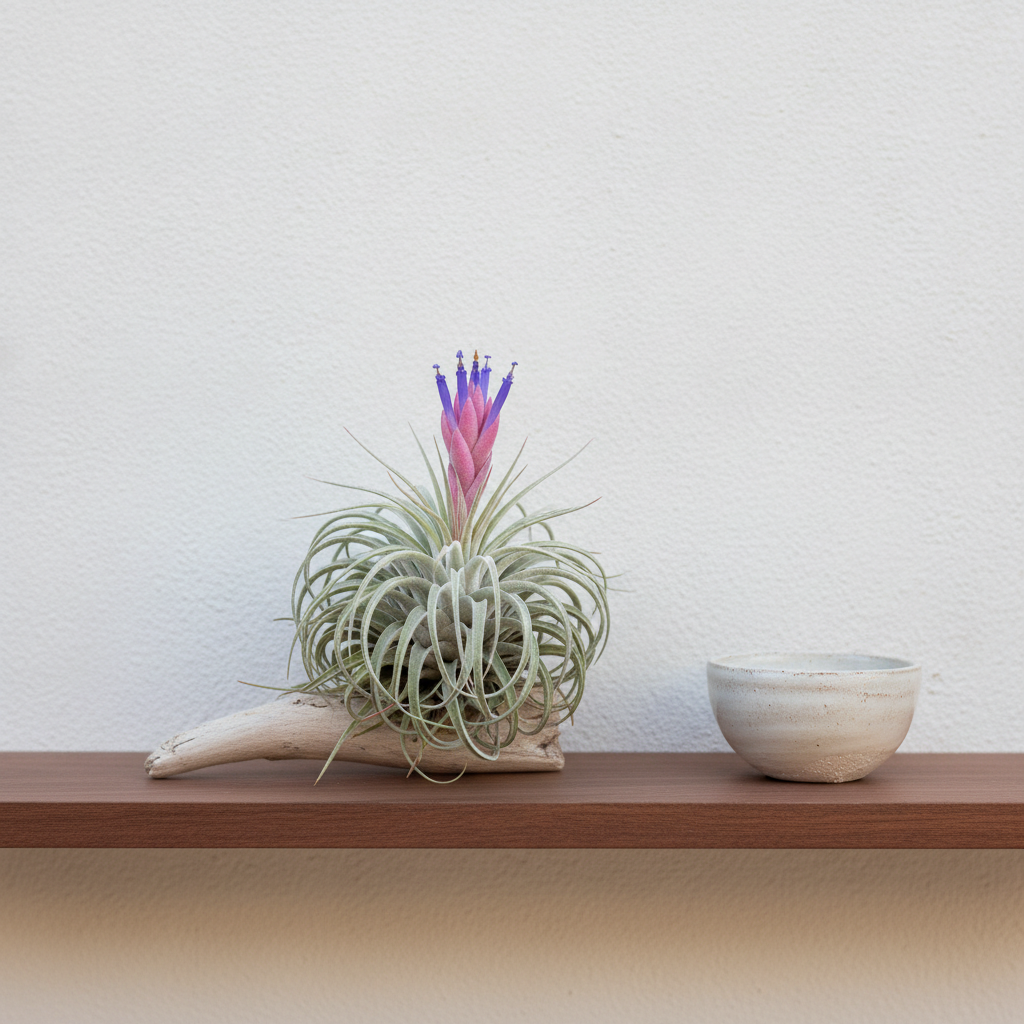
Its second great asset is the bloom. Tillandsia stricta is among the faster air plants to reach flowering size and one of the most dependable to actually perform indoors. As a rosette matures it blushes at the centre, then sends up a bract of intense coral to magenta pink that stays colourful for several weeks, from which short-lived tubular flowers of blue and violet emerge over a few days. Each individual rosette flowers only once in its life, but that finale triggers the plant to produce offsets, so the reward for good care is not a single event but the beginning of a self-renewing cluster.
Important — Toxicity: The cotton candy air plant is not known to be toxic to cats, dogs, horses or humans, which makes it a genuinely pet-safe choice. The main risk to a curious animal is mechanical: a batted or chewed plant can be crushed, and the wiry leaf tips are stiff, so display treasured specimens out of paw’s reach for the plant’s sake rather than the pet’s.
Light Requirements
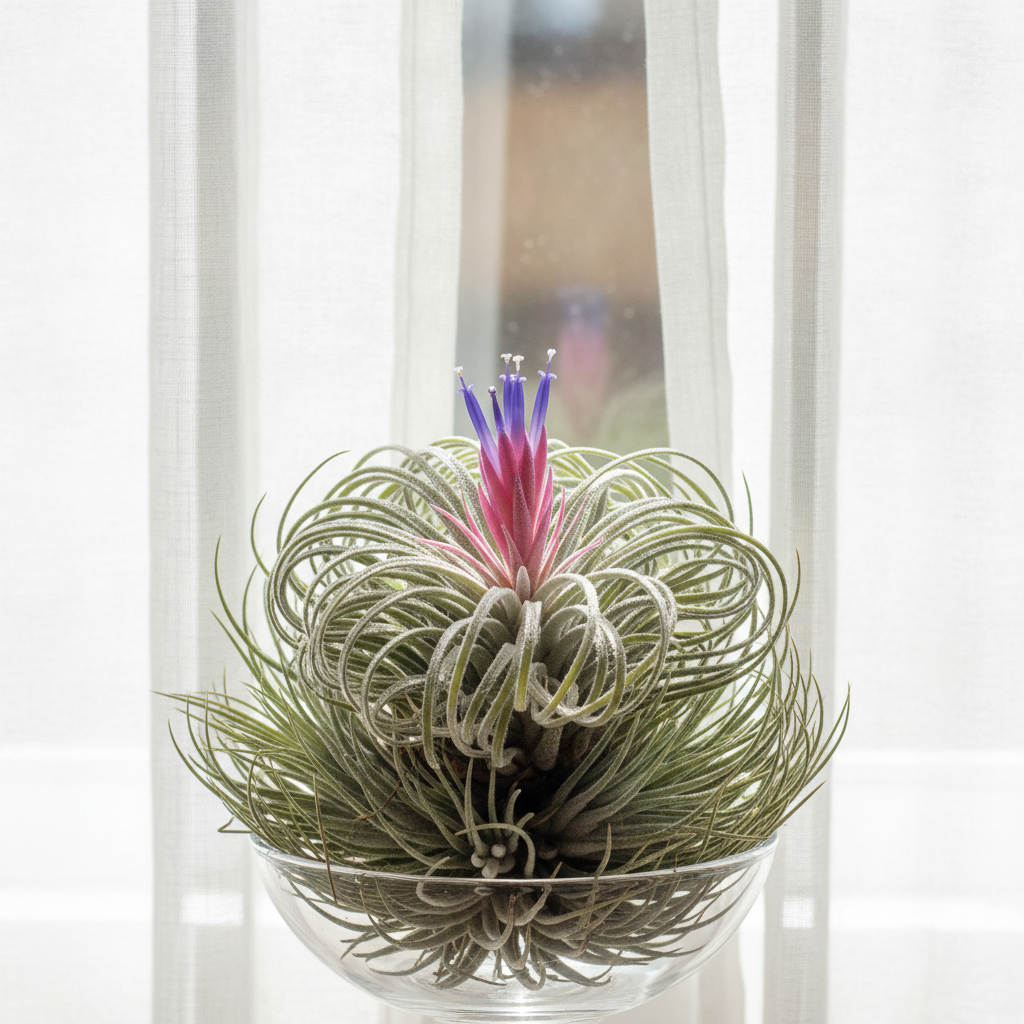
In the wild, Tillandsia stricta grows lashed to branches in the dappled canopy or clinging to exposed rocks and coastal dunes, so the species tolerates a wide band of light. Indoors, the target is bright but indirect light: enough brightness that the silvery trichomes gleam and the plant photosynthesises hard, but not so much scorching midday sun that the leaves bleach and crisp. A position within a metre or two of a bright window, out of the direct beam, is close to ideal for most homes.
Light and water are linked for air plants in a way that catches people out. The more light and warmth a cotton candy air plant receives, the faster it dries after watering and the more often it needs to drink. A plant on a bright sunny sill will want soaking twice a week, while the same plant in a dim corner might rot if watered on the same schedule. Read the two chapters together rather than in isolation.
Light Levels Explained
The table below translates the vague language of plant labels into something you can actually place in a room. The lux figures are approximate and describe the light falling on the plant, not the brightness of the window itself.
| Light Category | Approx. Level | Typical Location | Outcome |
|---|---|---|---|
| Direct sun | Over 50,000 lux | On an unshaded south sill in summer | Bleaching and brown scorch within days |
| Bright indirect | 15,000 to 40,000 lux | Near an east or filtered south window | Ideal growth, strong colour, reliable bloom |
| Medium | 7,000 to 15,000 lux | A metre back from a bright window | Steady but slower growth |
| Low | 2,000 to 7,000 lux | A north room or interior wall | Weak, greening growth and few flowers |
| Very low | Under 2,000 lux | A windowless hall or bathroom | Slow decline and eventual rot risk |
Window Orientation and Placement
South-facing window: The brightest exposure in the northern hemisphere and usable so long as the plant is set back or diffused behind a sheer curtain. Direct summer sun on the glass will scorch the leaves, so avoid placing the plant in the unbroken beam.
East-facing window: Arguably the best position of all. Gentle morning sun is cool enough to be harmless and even beneficial, and the light stays bright but indirect through the afternoon.
West-facing window: A good choice, though the intense late-afternoon sun of high summer can be fierce; pull the plant back a little or filter it during the hottest months.
North-facing window: Workable for maintenance but rarely enough for vigour or bloom. A cotton candy air plant here will hold on but grow slowly, greening as it stretches for light, and will benefit from a supplementary lamp.
Pro Tip — Read the Leaf Colour: The trichome coating is a built-in light meter. A cotton candy air plant in good light looks distinctly silvery and frosted; one that is greening up and losing its bloom is telling you it wants brighter conditions, while a plant turning tan or developing pale scorched patches is getting too much direct sun.
How Light Affects Colour and Blooming
Adequate light is the single biggest lever on whether this plant flowers. In bright indirect conditions the leaves stay heavily silvered, the rosette grows compact and full, and mature plants blush and bloom on schedule. Push a plant into gloom and it does the opposite: leaves lengthen and green, the silver frosting fades as the plant tries to expose more chlorophyll, and flowering stalls indefinitely. The pink bract itself also colours up more intensely when a maturing plant is well lit.
Warning — Direct Sunlight: Air plants have no soil to buffer them and no deep water reserve, so an afternoon in the direct summer beam can dry and scorch the leaves faster than you would expect. Introduce any move to a brighter spot gradually over a week or two, and never place a freshly watered plant in direct sun, where the water can act like a lens on the leaf surface.
Artificial Lighting
The cotton candy air plant responds well to artificial light, which makes it a candidate for offices and rooms with poor natural light. A full-spectrum LED grow light positioned 20 to 30 centimetres (8 to 12 inches) above the plant and run for 12 hours a day will comfortably maintain it and can even trigger bloom. Ordinary warm-white household bulbs contribute little useful energy, so choose a fixture designed for plants if natural light is genuinely lacking.
Seasonal Adjustments
Light indoors falls sharply between autumn and late winter, so a plant that thrived a metre back from the window in July may need moving right up to the glass in December to hold the same brightness. As the days shorten, growth slows and the plant dries more slowly after watering, so the seasonal light drop and the seasonal watering cut-back go hand in hand. Return the plant to its brighter-weather position as light strengthens in spring.
Watering & Humidity
Watering is where air plants live or die, and it is the part of their care least like any other houseplant. Because Tillandsia stricta drinks through its leaves rather than its roots, you do not pour water at a pot; you wet the whole plant and then, crucially, let it dry completely. Master the rhythm of thorough wetting followed by rapid drying and the cotton candy air plant is almost indestructible. Get it wrong in either direction and you get a crisp, thirsty husk or a soft, rotting crown.
When to Water
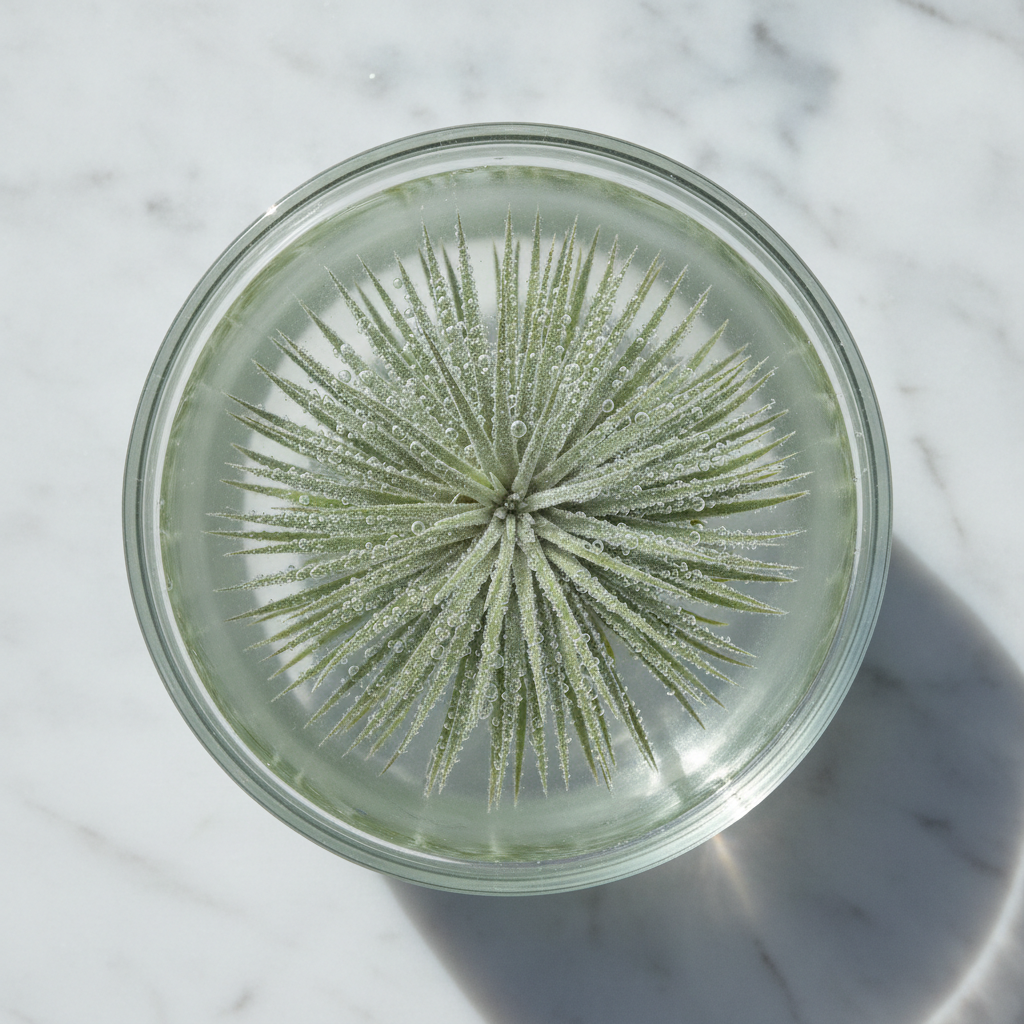
As a starting point, soak a cotton candy air plant once a week, adjusting up or down according to how warm, bright and dry your home is. In a heated winter living room or a hot summer window the plant may want soaking twice a week, while in a cool, humid, shaded spot a single weekly soak or even one every ten days can be plenty. The plant will tell you: healthy leaves are firm and slightly cupped, whereas leaves that are rolling inward, curling more tightly or showing wrinkled, exaggerated channels are signalling thirst.
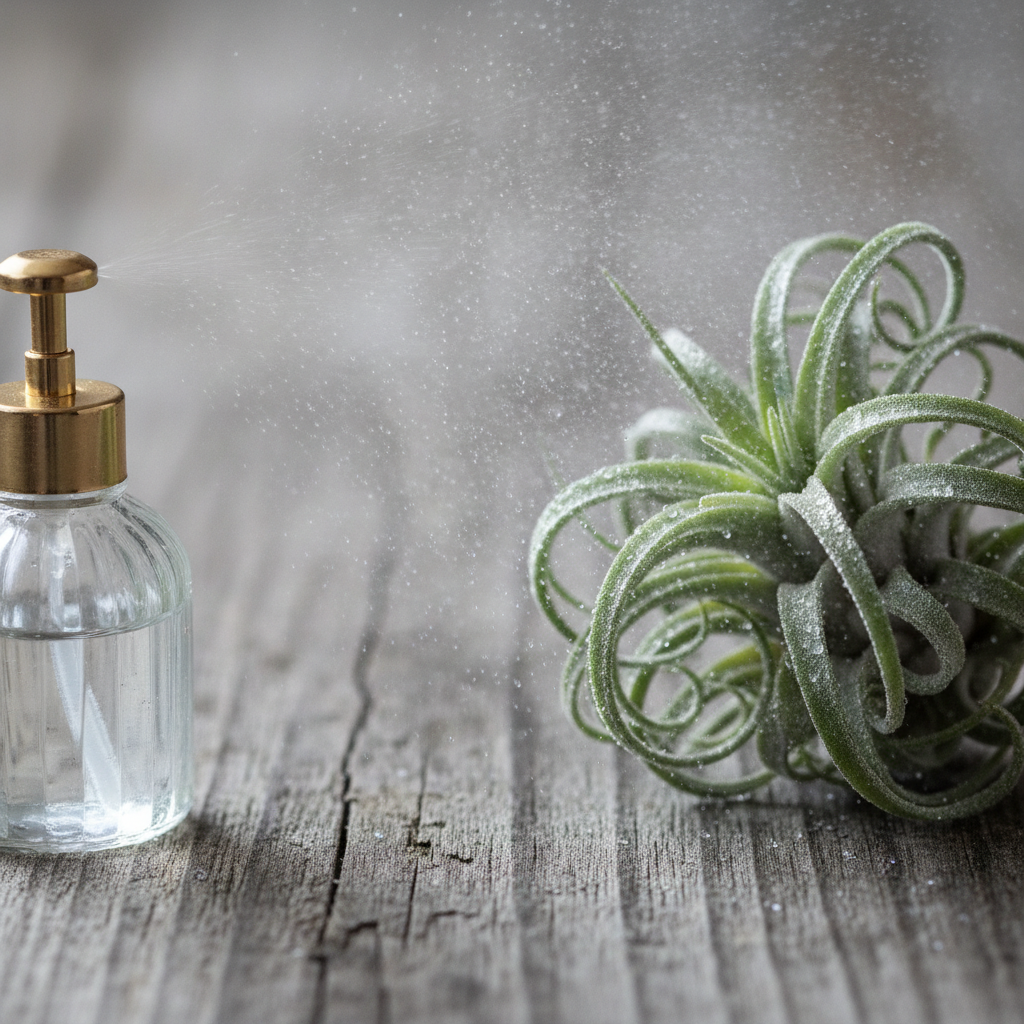
Misting has a place as a supplement between soaks, especially in very dry air, but it is not a substitute for a proper soak. A quick spray wets only the outer leaves and evaporates in minutes, never rehydrating the plant the way full immersion does. Treat misting as a top-up, not the main event.
Pro Tip — Water in the Morning: Soak early in the day so the plant has hours of warmth and air movement to dry out before nightfall. Air plants breathe and lose water mainly at night, and a plant that sits wet and cold in its crown overnight is the classic recipe for rot.
How to Water Correctly
- Fill a bowl or sink with room-temperature water, ideally rainwater, filtered water or dechlorinated tap water.
- Submerge the whole plant, or float it upside down, and leave it to soak for 20 to 30 minutes so the trichomes fully rehydrate.
- Lift the plant out and gently shake off the excess water, paying attention to the dense centre of the rosette where water pools.
- Turn the plant upside down on a towel or in a dish rack so water drains out of the crown rather than sitting in it.
- Leave it to dry in a bright, airy spot until it is completely dry to the touch, which should take no more than three to four hours.
- Only once fully dry, return the plant to its display vessel, terrarium or mount.
Signs of Overwatering vs. Underwatering
| Symptom | Overwatering | Underwatering |
|---|---|---|
| Leaf colour | Browning or blackening at the base and centre | Tips fading to tan or brown and going crisp |
| Leaf texture | Soft, mushy, translucent leaves near the core | Leaves wrinkled, rolled and exaggeratedly channelled |
| Crown / base | Central leaves pull out with a gentle tug, the sign of crown rot | Base stays firm but the whole plant feels light and dry |
| Overall form | Rosette collapses and falls apart | Rosette shrinks and curls in on itself |
| Smell | A sour, musty odour from the centre | No odour, just dryness |
Warning — Crown Rot: Rot is the number one killer of air plants and it is almost always fatal once it reaches the core. If the central leaves pull free easily or the base turns brown and soft, the plant is rotting from trapped moisture. There is no cure once it has set in, so prevention through thorough drying is everything. If only a few outer leaves are affected, salvage healthy pups from around the base.
Humidity Requirements
As a plant that feeds on atmospheric moisture, the cotton candy air plant naturally appreciates humidity and does best between 50 and 70 percent. In a humid bathroom or kitchen it can go longer between soaks because it draws moisture from the air, while in a dry, centrally heated room it depends far more heavily on your watering routine.
Low humidity shows up as accelerated drying, crisping leaf tips and a plant that seems perpetually thirsty no matter how often you soak it. If you see those signs together with dry winter air, raising ambient humidity will ease the strain on the plant and slow its water loss.
Raising humidity is straightforward: group plants together, run a small humidifier nearby, or keep the plant in a room that is naturally moist such as a well-lit bathroom. Pebble trays, so useful for potted plants, do little for a mounted air plant, so favour humidifiers and misting instead. Whatever you do, pair added humidity with good air movement so the plant still dries between soaks.
Water Quality
Water quality matters more for air plants than for most houseplants because everything the plant absorbs passes across its leaves. Rainwater is the gold standard, followed by aquarium water, pond water and filtered water, all of which carry trace minerals the plant can use. Tap water is usually fine if left to stand overnight so chlorine can dissipate, though hard water can leave chalky deposits on the leaves over time. Avoid artificially softened water entirely, as its sodium content is harmful, and steer clear of distilled or reverse-osmosis water, which is so pure it can actually leach minerals back out of the plant.
Mounting, Display & Air Circulation
This is the section where an air plant guide parts ways completely with everything written about potted plants. Tillandsia stricta must never be planted in soil. Its roots exist only to anchor it to a surface, and packing them into damp compost smothers the base and guarantees rot. Instead of potting mix and drainage, the equivalent concerns for an air plant are what you mount it on, how you display it, and above all how freely air moves around it.
Display and Mounting Materials
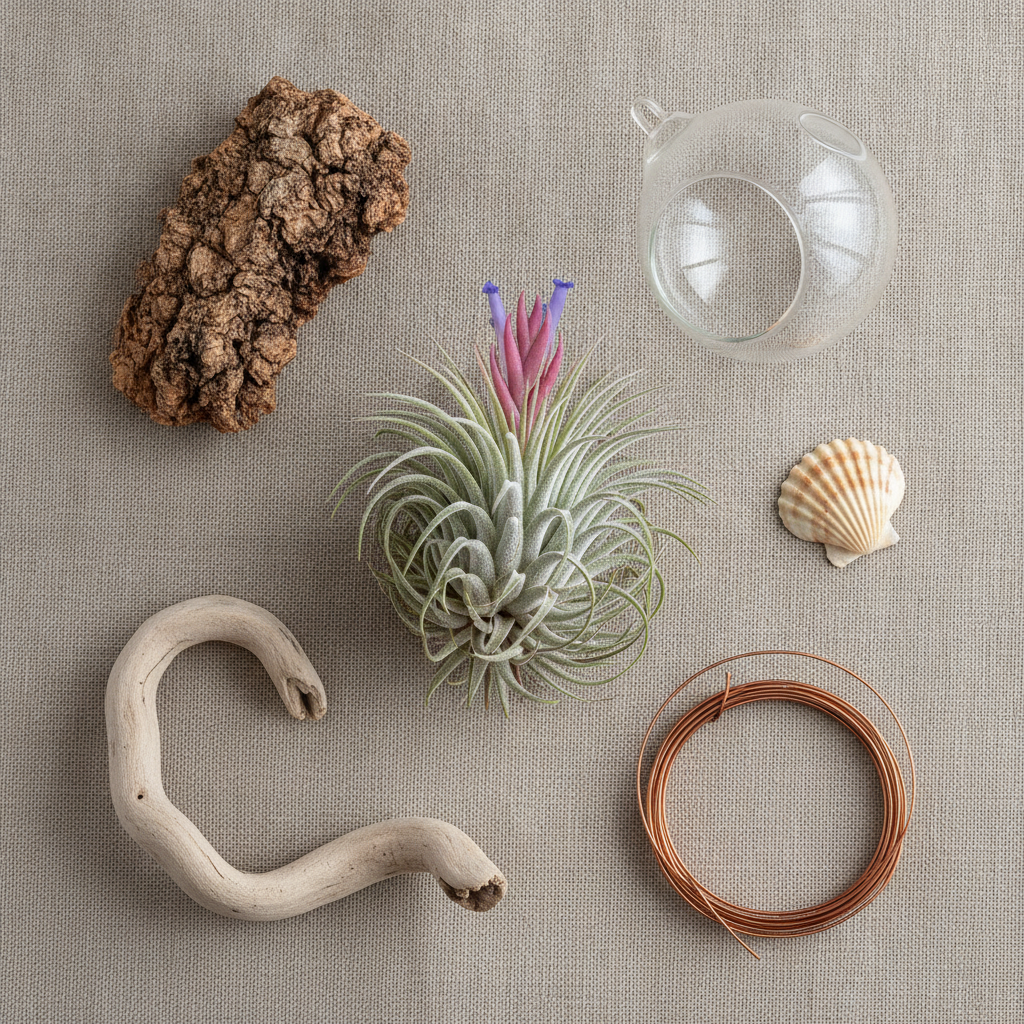
Almost any surface that holds the plant while letting it dry will work. Natural materials such as cork bark, driftwood and grapevine are traditional favourites because they echo the plant’s wild perches and look the part; decorative options such as seashells, ceramic dishes, wire frames and open glass globes are equally fine. The table below outlines the most common choices and how they behave.
| Display Method | Suitability | Notes |
|---|---|---|
| Cork bark or driftwood | Excellent | Natural look, dries fast, attach with wire or waterproof glue |
| Open glass globe or bowl | Good | Attractive, but remove the plant to soak and dry, never leave it wet inside |
| Seashell or ceramic dish | Good | Simple and stable; tip out any pooled water after watering |
| Wire or metal frame | Very good | Maximum airflow; ideal for wall displays |
| Closed terrarium | Poor | Traps moisture and starves the plant of air, inviting rot |
If you want to fix the plant permanently to a mount, secure it by its base with a loop of nylon fishing line, coated florist’s wire or a dab of waterproof adhesive such as E6000, keeping the growing centre and roots free. In time the plant’s own roots will grip the surface and hold it in place.
Pro Tip — Airflow Beats Everything: If you take away one idea from this section, make it airflow. An air plant that dries within a few hours of watering shrugs off almost any other imperfection in its care, while one sealed in a moist, still container will rot no matter how carefully you do everything else. Open displays with moving air are always safest.
Choosing the Right Display
Match the vessel to how you water. A plant glued to a slab of cork can be soaked, mount and all, and hung back up once dry, whereas a plant nestled in a shell or globe should be lifted out for its soak and returned only when bone dry. The most common beginner mistake is treating a glass globe like a tiny vase and adding water to the bottom; standing water is exactly what an air plant cannot abide.
Avoid enclosure and damp. Closed jars, sealed terrariums and moss-lined containers all hold moisture against the plant and choke the airflow it depends on. If you love the terrarium look, choose an open-sided design and still remove the plant to water it.
Think about size and grouping: a single cotton candy air plant looks charming solo, but the species clumps naturally, so leaving room for offsets to develop lets one plant become a living cluster. Displays that let the colony expand outward, rather than confining it, show the plant at its best.
Ongoing Maintenance
Because there is no soil to refresh and no pot to size up, long-term upkeep is mostly grooming. Trim away any leaves that have dried to brown at the tips with clean scissors, cutting at an angle to keep the natural taper, and gently pull off fully dead outer leaves. Once every year or two you may want to re-mount a plant whose base has outgrown its perch, or divide a large clump, but there is no repotting cycle to track.
Warning — Never Pot in Soil: It bears repeating because it is the fastest way to kill this plant. Burying the base of a cotton candy air plant in potting mix, moss or gravel that stays wet will rot the crown within weeks. Keep the base open to the air at all times.
Fertilising
Air plants are famously low feeders, and a cotton candy air plant will live for years on nothing but clean water and light. Fertiliser is therefore optional rather than essential, but a light, regular feed is the single biggest thing you can do to encourage faster growth, stronger colour and, most temptingly, bloom and pup production. The trick is restraint: because the plant absorbs feed directly through its leaves, it is easy to overdose and burn.
Reach for a fertiliser formulated for bromeliads or air plants, or failing that an orchid feed, and dilute it hard. These products are low in nitrogen and, importantly, contain nitrogen in forms an epiphyte can use directly, unlike ordinary houseplant feeds that rely on soil microbes to convert them.
Understanding Plant Nutrients
Every fertiliser label carries three numbers, the N-P-K ratio, describing its proportions of nitrogen, phosphorus and potassium. Nitrogen drives leaf and overall growth, phosphorus supports roots and flowering, and potassium underpins general health and stress resistance. For air plants a balanced or low-nitrogen formula is best; anything too rich in nitrogen forces soft, weak growth that greens up and is slow to flower.
| Nutrient | Symbol | Primary Function | Deficiency Symptoms |
|---|---|---|---|
| Nitrogen | N | Leaf growth and green vigour | Overall paleness and stalled growth |
| Phosphorus | P | Root anchoring and flowering | Poor or absent bloom, weak development |
| Potassium | K | General health and stress tolerance | Weak leaves, browning margins |
| Calcium | Ca | Cell wall structure | Distorted new growth |
| Magnesium | Mg | Chlorophyll production | Yellowing between leaf veins |
| Iron | Fe | Chlorophyll and energy transfer | Pale new leaves with a washed-out look |
Types of Fertiliser
Liquid fertilisers: The obvious choice for air plants. A liquid bromeliad or orchid feed can be diluted into the soak water or a mister and applied straight to the leaves, giving you precise control over the dose.
Slow-release granular: Designed to be worked into soil, granular feeds have no useful place in air plant care because there is no growing medium to hold them. Skip them entirely.
Specialist air plant sprays: A number of ready-mixed foliar sprays are sold specifically for tillandsias, pre-diluted to a safe strength. They are convenient and hard to overdo, which makes them a sensible option for anyone nervous about mixing their own.
Feeding Schedule
Feed roughly once a month through the active growing season of spring and summer, and pause over autumn and winter when growth naturally slows. One monthly soak or mist that includes dilute feed, with plain water the rest of the time, is a comfortable rhythm. There is no benefit to feeding more often, and real risk in doing so.
Pro Tip — Quarter Strength Only: Whatever the label recommends for potted plants, dilute it to no more than a quarter of that strength for an air plant. Absorbing feed directly through the leaves means there is no soil to buffer an overdose, and a weak, frequent approach is always safer than an occasional strong one.
How to Fertilise
- Mix a bromeliad, air plant or orchid fertiliser into room-temperature water at a quarter of the recommended strength.
- Use this solution for one of the month’s regular soaks, immersing the plant for 20 to 30 minutes as usual, or apply it with a mister until the leaves are evenly coated.
- Shake off the excess, invert the plant and let it dry fully exactly as you would after a plain soak.
- Return to plain water for the remaining waterings until the next monthly feed.
Warning — Fertiliser Burn: Too much feed, or feed left concentrated on the leaves as water evaporates, scorches the delicate trichomes and leaves brown, dried patches that do not recover. If you ever apply feed at full strength by mistake, rinse the plant thoroughly with plain water straight away.
Propagation
Propagating a cotton candy air plant is one of the quiet joys of growing it, because the plant does most of the work itself. Unlike a vining houseplant grown from cuttings, Tillandsia stricta multiplies almost entirely through offsets, commonly called pups, that appear at the base of a mature rosette. There are no leaves to root in water and no stems to snip; you simply wait, then separate.
The trigger for pups is maturity, and above all flowering. Each rosette blooms only once and then, having finished its own life cycle, channels its energy into producing two, three or more pups around its base before the parent slowly fades. This is entirely normal and is the plant’s way of renewing itself, so a bloom is not an ending but the start of the next generation.
Understanding Pups and Offsets
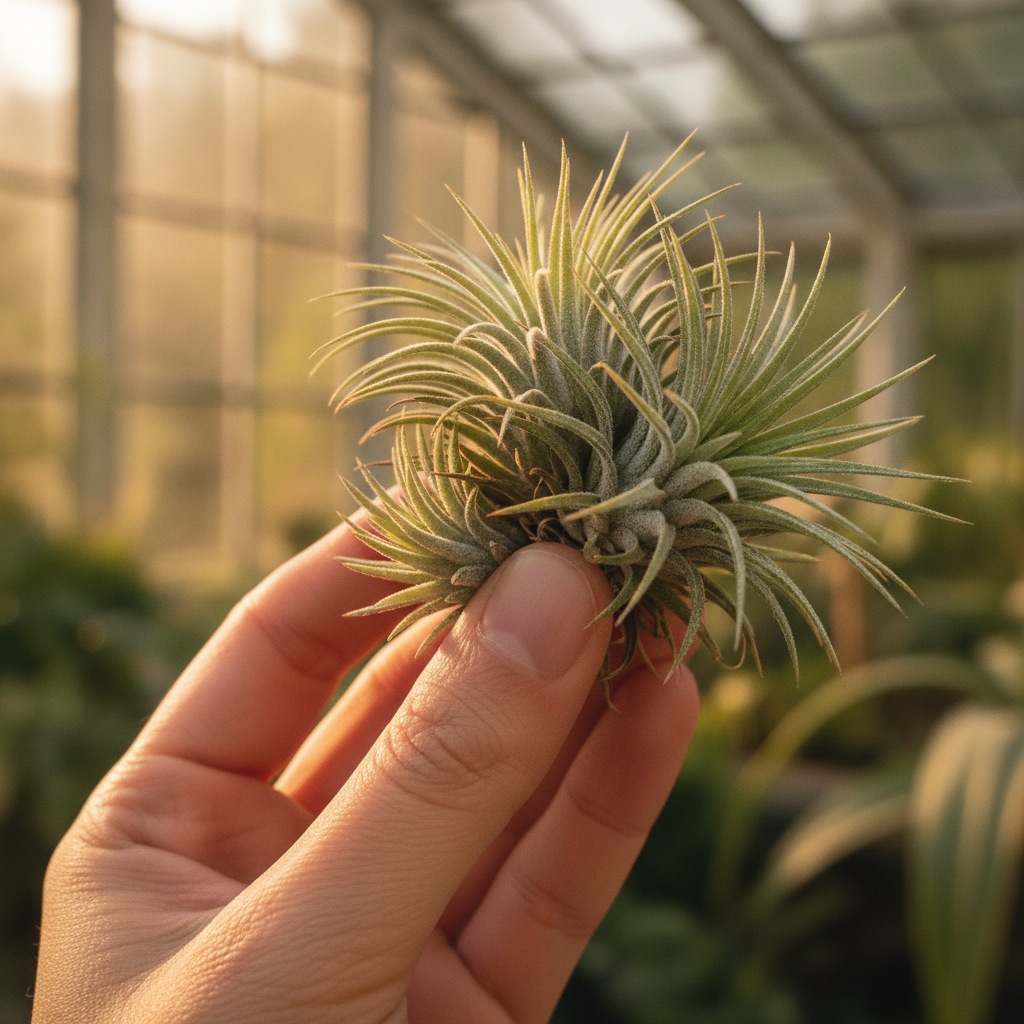
A pup is a genetically identical baby plant that grows from the base of the parent, sharing its structure until it is large enough to live independently. The general rule is to leave a pup attached until it reaches about one third to one half the size of the parent, at which point it has developed enough of its own leaves and roots to fend for itself. Many growers never separate pups at all, letting them grow on into a dense, many-headed clump, which is exactly how Tillandsia stricta grows in the wild and often the most spectacular way to display it.
Dividing Pups: Step-by-Step
When a pup is big enough and you would rather have separate plants than a clump, dividing it is quick and needs no tools beyond your hands.
- Wait until the pup is at least one third the size of the parent and has its own visible base of leaves.
- Hold the parent plant firmly in one hand and the pup in the other, gripping each as low down at the base as you can.
- Gently rock and pull the pup away from the parent with a slow twisting motion, following the natural line where they join.
- If it resists, do not force it; ease it back and off rather than tearing, or leave it a few more weeks to loosen naturally.
- Once separated, treat the pup as a full-sized plant, giving it the same light, soaking and drying routine.
Pro Tip — Patience Pays: The larger you let a pup grow before separating it, the faster it establishes and the sooner it will bloom and pup in turn. There is no rush and no penalty for waiting, so err on the side of leaving pups attached longer rather than detaching them small.
Growing from Seed: Step-by-Step
Air plants can also be grown from seed, though it is a project for the patient rather than a practical way to build a collection. Seedlings take several years to reach a decent size, but the process is genuinely rewarding for the dedicated grower.
- Obtain fresh seed, which follows successful pollination of the flowers and comes wrapped in fluffy, wind-borne fibres.
- Spread the seed across a rough, breathable surface such as a fern fibre mat or a panel of plastic mesh where it can get air and light.
- Mist lightly once or twice a day to keep the seed damp but never sodden, and keep it warm and brightly but indirectly lit.
- Expect germination over several weeks and be prepared to nurture the tiny seedlings for two to three years before they resemble a familiar air plant.
Troubleshooting Propagation
| Problem | Likely Cause | Solution |
|---|---|---|
| No pups appearing | Plant not yet mature or has not flowered | Improve light and feed lightly to encourage bloom, then wait |
| Pup rots after separation | Detached too small or left wet in the crown | Leave pups larger before dividing and dry thoroughly after watering |
| Pup pulls apart and tears | Separated by force before it was ready | Wait until it loosens naturally at one third parent size |
| Parent dies but leaves pups | Normal end of the parent’s life cycle | Nothing to fix; grow the pups on as the next generation |
Pests & Diseases
The cotton candy air plant is refreshingly untroubled by pests, and the great majority of problems growers encounter are cultural rather than biological, tracing back to too much water and too little air. Still, a handful of sap-sucking insects will occasionally find their way onto a tillandsia, and it pays to know what to look for.
Inspect the plant whenever you soak it, paying attention to the crowded centre of the rosette and the leaf bases where pests like to hide. Catching an infestation early, while it is a few insects rather than a colony, makes treatment simple and quick.

Common Pests
Mealybugs (Pseudococcidae)
The most likely pest on an air plant, mealybugs appear as small, soft, white cottony blobs tucked into the leaf bases and crevices of the rosette. They suck sap, weaken the plant and leave a sticky residue behind. Their fluffy coating can be mistaken for the plant’s own trichomes, so look for movement and stickiness.
Treatment: Dab each insect with a cotton bud dipped in diluted isopropyl alcohol, then give the whole plant a thorough soak and rinse. Repeat every few days until no new mealybugs appear, and quarantine the plant away from others in the meantime.
Scale (Diaspididae)
Scale insects show up as small, hard, brown or tan bumps clinging limpet-like to the leaves. They are easy to overlook because they barely move, but a heavy infestation drains the plant and yellows the leaves.
Treatment: Scrape or rub the scales off gently with a fingernail or a cotton bud soaked in alcohol. Follow up with a horticultural soap or a highly diluted neem solution, remembering to rinse and fully dry the plant afterwards.
Aphids (Aphidoidea)
Uncommon on air plants but occasionally drawn to the soft tissue of a developing flower, aphids are tiny green, black or pink insects that cluster on the tenderest growth and secrete sticky honeydew.
Treatment: A firm rinse under the tap dislodges most aphids, and a follow-up with insecticidal soap clears any stragglers. Because they favour the bloom, check flowering plants more closely.
Common Diseases
Crown and Base Rot (fungal and bacterial)
By far the most serious threat to a cotton candy air plant, rot sets in when water lingers in the dense centre of the rosette or the plant is kept in a damp, airless spot. It shows as browning or blackening at the base, softening leaves, and central leaves that pull away with almost no resistance.
Treatment: There is effectively no cure once rot reaches the core. Prevention through thorough drying and good airflow is the only reliable defence. If the parent is lost, rescue any firm, healthy pups from around the base and grow them on separately.
Leaf Tip Browning (physiological)
Not a disease in the strict sense but a common complaint, browning and crisping leaf tips usually indicate underwatering, very dry air, or mineral build-up from hard or softened water. It is cosmetic rather than dangerous.
Treatment: Increase watering frequency or humidity, switch to rainwater or filtered water, and trim the browned tips at an angle with clean scissors to tidy the plant while you address the cause.
Pest and Disease Summary
| Pest / Disease | Identification | Treatment |
|---|---|---|
| Mealybugs | White cottony blobs in leaf bases | Alcohol dab, then soak and rinse; repeat |
| Scale | Hard brown bumps on leaves | Scrape off, treat with soap or dilute neem |
| Aphids | Tiny insects on the flower and new growth | Rinse off and apply insecticidal soap |
| Crown rot | Soft, dark, collapsing centre | No cure; prevent by drying and salvage pups |
| Leaf tip browning | Crisp brown tips | More water or humidity, better water quality, trim |
Prevention Strategies
Prevention with air plants is almost entirely about the drying half of the watering cycle and the air around the plant. A cotton candy air plant that is soaked thoroughly, dried quickly and displayed with good airflow rarely rots and rarely attracts pests, because the conditions that favour both, stagnant damp and stale air, simply never develop.
Beyond that, quarantine any new plant for a couple of weeks before adding it to a group, inspect at every soak, and remove dead leaves promptly so pests have nowhere to shelter. A healthy, well-lit plant also mounts a far better defence against the occasional insect than a stressed one.
Pro Tip — Isolate and Dunk: At the first sign of any pest, move the plant away from your others and give it a good soak-and-rinse; the simple act of immersion drowns and dislodges a surprising number of insects before you reach for any treatment. Follow up with a targeted method only if pests persist.
Popular Varieties
What is sold as the cotton candy air plant is really a single wide-ranging species, Tillandsia stricta, that varies enormously across its natural range and in cultivation. Rather than a list of named cultivars in the way a philodendron collection might have, its variety lies in leaf form, colour and a handful of selected clones that growers prize for particular traits.
The most fundamental split is between soft-leaf and hard-leaf forms, and beyond that a few standout selections such as the near-black flushed forms and the giant-flowering types are worth seeking out. The table gathers the ones you are most likely to meet.
| Variety | Leaf Appearance | Light Needs | Growth Rate | Availability |
|---|---|---|---|---|
| Soft-leaf form | Flexible, heavily silvered, fluffy rosette | Bright indirect | Moderate | Very common |
| Hard-leaf form | Stiff, upright, greener, glossier | Bright indirect to gentle sun | Moderate | Common |
| Tillandsia stricta ‘Midnight’ | Dark, near-black flushed leaves | Bright indirect | Moderate | Specialist |
| Tillandsia stricta ‘Purple Giant’ | Larger rosette, deep purple bloom | Bright indirect | Vigorous | Specialist |
| Silver Star | Very silvery, dense, compact | Bright indirect | Moderate | Occasional |
| Tillandsia stricta var. albifolia | Pale, exceptionally silvered leaves | Bright indirect | Slow to moderate | Specialist |
Featured Varieties
Soft-leaf Form
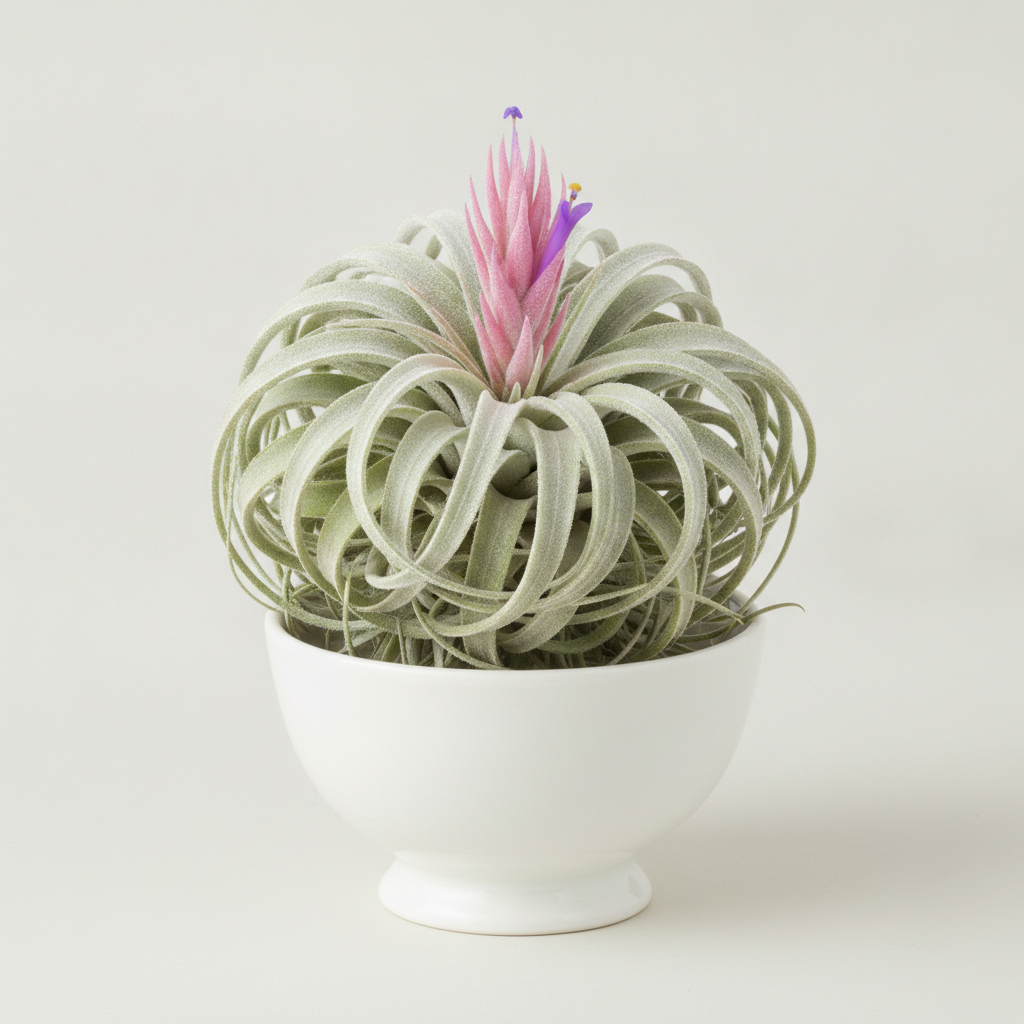
The archetypal cotton candy air plant, with soft, flexible leaves so heavily coated in silvery trichomes that the whole rosette looks frosted. It is the fluffier, more forgiving of the two forms and the one most people picture.
Hard-leaf Form
A stiffer, more architectural take on the species, with greener, glossier leaves that hold themselves upright in a tighter rosette. It tolerates a touch more sun and gives a crisper, more sculptural silhouette.
Variety Profiles in Detail
Soft-leaf Form (Tillandsia stricta)
The soft-leaf form is the classic, and its dense silvering is not just decorative: the heavier trichome cover means it draws more moisture from the air and copes slightly better with dry rooms. Its leaves flex and arch rather than standing rigid, giving the plant its characteristic pom-pom fullness, and it is generally the quicker of the two to bulk up into a clump.
Hard-leaf Form (Tillandsia stricta)
The hard-leaf form has stiffer, greener foliage with less trichome cover, which lets it take a little more direct light but makes it marginally thirstier since it pulls less moisture from the air. Its upright, tidy habit appeals to growers who want a more structured look, and it flowers just as readily as its softer sibling.
‘Midnight’ (Tillandsia stricta)
A dramatic selection whose leaves flush deep, dusky purple to near-black under strong light, throwing the candy-pink bloom bract into vivid contrast. It is grown the same way as the standard species but rewards brighter light with darker colour, and it is a prize for collectors of moody-toned plants.
‘Purple Giant’ (Tillandsia stricta)
As the name suggests, a larger, more vigorous clone that builds a bigger rosette and produces an especially bold, deep-purple flush to its bloom. It makes a real statement as a specimen and clumps generously, though its size means it needs a sturdier mount than the daintier forms.
Choosing the Right Variety for Your Space
For a first air plant or a dry, centrally heated room, the soft-leaf form is the safest and most rewarding choice, thanks to its thirst-buffering trichome cover and easy fullness. If you have a bright spot with a little gentle sun and prefer a crisp, upright shape, the hard-leaf form suits better, while collectors chasing colour will gravitate to ‘Midnight’ or the bold ‘Purple Giant’. Whichever you choose, the care is essentially identical, so pick on looks and let the growing be the constant.
Frequently Asked Questions
How often should I water a cotton candy air plant?
Soak it thoroughly once a week as a baseline, moving to twice a week in hot, bright or dry conditions and back to once every ten days in cool, humid, shaded spots. The firmness and curl of the leaves are your best guide: firm and open means hydrated, tightly rolled and wrinkled means thirsty.
Why is my air plant turning brown in the middle?
Browning or blackening at the centre, especially with soft leaves that pull out easily, is crown rot from water trapped in the rosette. It is usually fatal once it reaches the core, so focus on prevention by always drying the plant upside down within a few hours of watering. Brown, crisp tips at the leaf ends, by contrast, are just underwatering or dry air and are harmless.
Do cotton candy air plants really need no soil?
Correct, and you should never pot one in soil. As an epiphyte it absorbs everything through its leaves and uses its roots only to grip a surface. Burying the base in compost or moss holds moisture against it and causes rot, so display it on wood, in a shell, on a wire frame or in open glass instead.
Will it flower again after blooming?
Each individual rosette flowers only once in its life, then produces pups and gradually fades. So while that particular rosette will not rebloom, the offsets it leaves behind will each grow up and flower in turn, meaning a well-grown plant gives you a continuing succession of blooms across the clump rather than a single show.
What is the pink part of the plant?
The showy pink structure is a bract, a specialised coloured leaf that surrounds the true flowers rather than the flower itself. The actual blooms are the small tubular violet-blue flowers that emerge from the bract over a few days, but the rose-pink bract itself stays colourful for several weeks, which is what gives the plant its long-lasting display and its cotton candy name.
Is the cotton candy air plant safe for pets?
Yes. Tillandsia stricta is not known to be toxic to cats, dogs or other pets, making it one of the safer choices for an animal household. The only real caution is physical, as a chewed or knocked plant can be damaged and its wiry leaf tips are stiff, so keep prized specimens where curious paws cannot reach them.
Can I grow it in a closed terrarium?
It is best avoided. A closed terrarium traps humidity and stops the plant drying out, which is exactly the stagnant, airless dampness that causes rot. If you love the terrarium look, choose an open-sided vessel with plenty of airflow and still remove the plant to soak and dry it properly.
Why is my air plant losing its silvery colour and turning green?
A cotton candy air plant that greens up and looks less frosted is usually short of light. In dim conditions it stretches and exposes more chlorophyll, dulling the silver trichome sheen and stalling bloom. Move it somewhere brighter but still out of harsh direct sun and the silvering, and the flowering, will return.
How big does a cotton candy air plant get?
A single rosette stays small, typically 15 to 20 centimetres (6 to 8 inches) across, which is part of its appeal for compact spaces. Over time, though, the pups it produces build up into a much larger multi-headed clump, so a long-established plant can become a generous cluster many times the size of the original rosette.
What water is best for air plants?
Rainwater is ideal, followed by aquarium or pond water and then filtered water, all of which carry helpful trace minerals. Ordinary tap water works if you let it stand overnight to release chlorine, but avoid softened water because of its sodium, and skip distilled or reverse-osmosis water, which is so pure it can draw minerals back out of the plant.






