
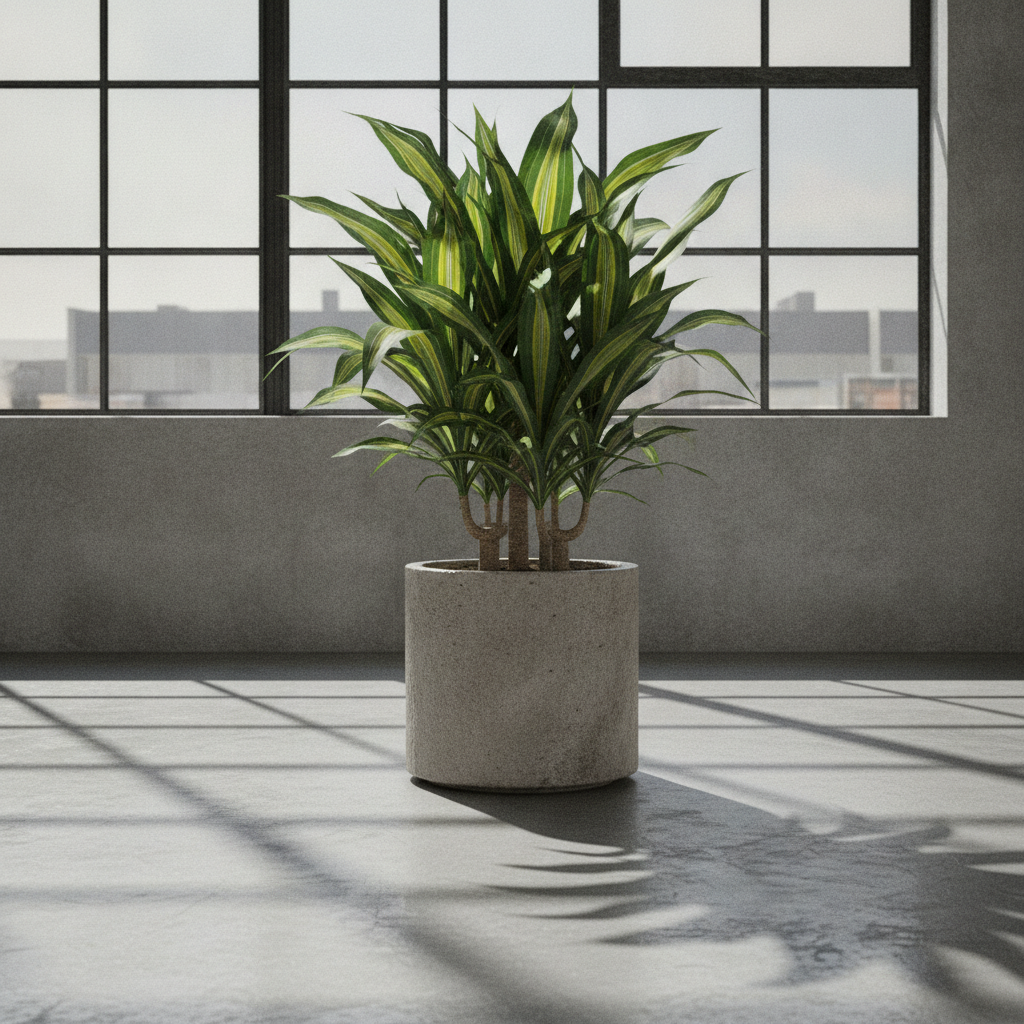
Few houseplants have furnished more offices, hotel lobbies and living-room corners than the cornstalk dracaena. Sold by the thousand as a stout woody cane topped with a fountain of arching, corn-like foliage, Dracaena fragrans ‘Massangeana’ earned its ubiquity honestly: it survives conditions that would flatten a fiddle leaf fig, grows slowly enough to stay in the same pot for years, and asks almost nothing of the person who owns it. The gap between merely surviving and genuinely thriving, however, is wider than most owners realise, and it comes down to a handful of details this guide sets out in full.
Native to tropical Africa and grown as a foliage plant since the Victorian era, the cornstalk dracaena reads the room in the most literal sense. Give it steady warmth, bright indirect light and water that drains freely and it will push out fresh, glossy leaves and hold its lower foliage for longer. Neglect those things and it will not die, but it will slowly thin out, brown at the tips and stall. Understanding what the plant is actually asking for turns a tolerable corner plant into a handsome, architectural specimen.
- Quick Reference
- Why Grow a Cornstalk Dracaena
- Light
- Watering
- Soil
- Fertilising
- Propagation
- Pests and Problems
- Varieties
- FAQ
Quick Reference
The table below is the short version of everything that follows. Treat it as a reminder once you have read the fuller explanations, not as a substitute for them, because the cornstalk dracaena has a couple of quirks (notably its sensitivity to fluoride) that a single row cannot fully convey.
| Botanical name | Dracaena fragrans ‘Massangeana’ |
| Common names | Cornstalk dracaena, mass cane, corn plant |
| Light | Bright indirect; tolerates medium to low light |
| Water | When the top 5 cm (2 in) of soil is dry, roughly every 10 to 14 days |
| Soil | Free-draining, peat-based or coir-based mix with added bark and perlite |
| Temperature | 18 to 27 C (65 to 80 F) |
| Humidity | Average room humidity; happier above 40 per cent |
| Fertiliser | Balanced feed at half strength, monthly in spring and summer |
| Mature size | 1.2 to 1.8 m (4 to 6 ft) indoors, occasionally taller |
| Toxicity | Toxic to cats and dogs if eaten |
| Difficulty | Easy |
Why Grow a Cornstalk Dracaena
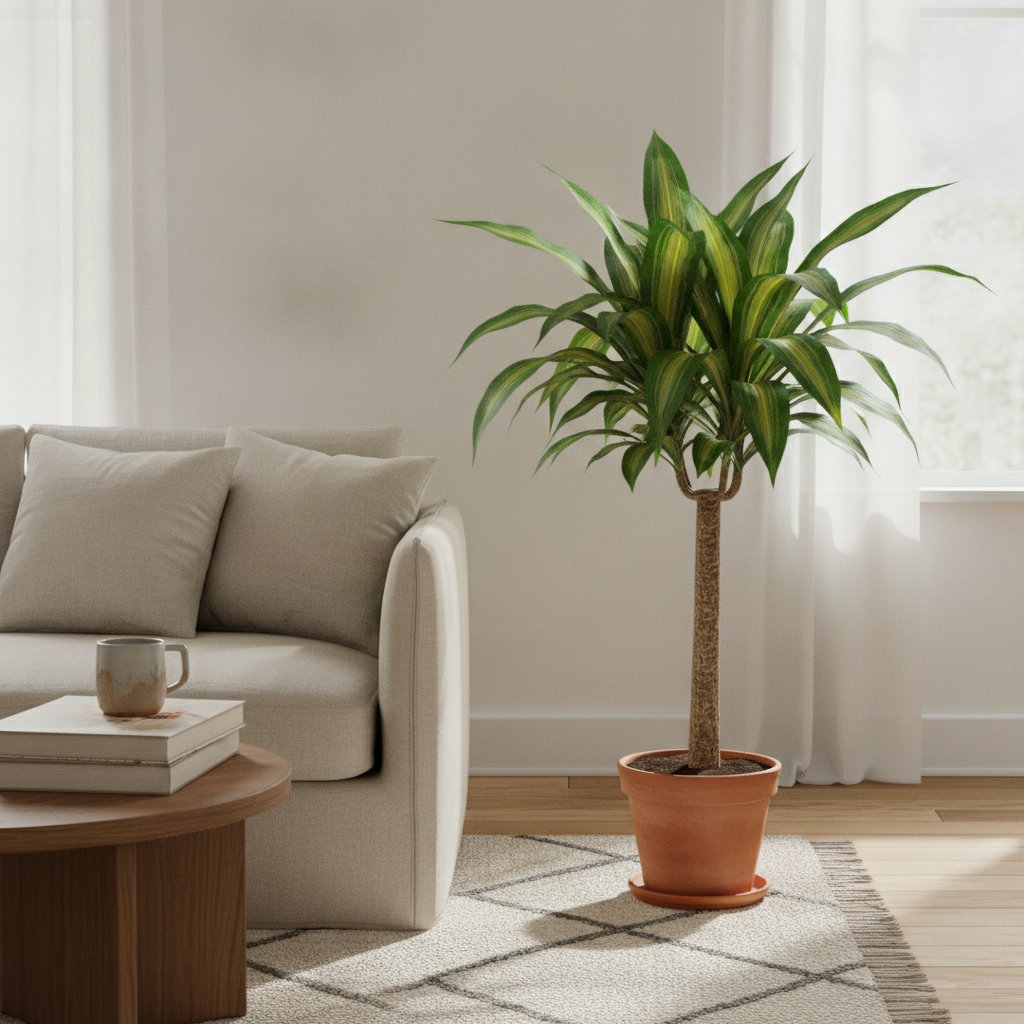
The cornstalk dracaena is the plant people reach for when they want the presence of a small tree without the fuss of one. A single cane, or a cluster of canes at staggered heights, gives a room vertical structure and a soft, tropical outline that fills empty corners and softens hard architectural lines. Because the foliage tops a bare woody stem, the plant occupies floor space efficiently, leaving the area below the crown open rather than sprawling outward like a bushier species.
Its real appeal, though, is temperament. This is one of the most shade-tolerant large foliage plants in cultivation, which is precisely why it colonised so many windowless offices in the late twentieth century. It copes with irregular watering, tolerates the dry air of centrally heated rooms, and rarely drops leaves in protest at being moved. For a first-time owner nervous about killing something expensive, or for anyone furnishing a spot too dim for most plants, it is a reassuringly forgiving choice.
The leaves themselves are the draw. Each is a long, arching strap of glossy deep green, and in the classic ‘Massangeana’ form a broad central band of golden yellow runs the length of the blade, softening to lime toward the margins. Massed at the top of a cane, they arch outward in a loose fountain that catches the light and moves gently in any air current. The plant was once valued as an air-purifying species after mid-century research, and while the practical effect indoors is modest, the foliage certainly earns its keep visually.
Warning — Toxic to pets: Every part of the cornstalk dracaena contains saponins that are toxic to cats and dogs. Chewing the leaves can cause vomiting, drooling, loss of appetite and, in cats, dilated pupils. Site the plant where curious pets cannot reach the foliage, and contact a vet if ingestion is suspected.
Light
Light is where the survive-versus-thrive distinction shows itself most clearly. The cornstalk dracaena will live in surprisingly dim conditions, which is a genuine virtue, but it will only look its best in bright, indirect light. In a well-lit spot the plant holds its lower leaves, keeps its variegation vivid, and puts on steady new growth. In deep shade it hangs on for years but grows slowly, produces smaller and paler leaves, and gradually sheds foliage from the bottom of the crown until the cane looks bare and leggy.
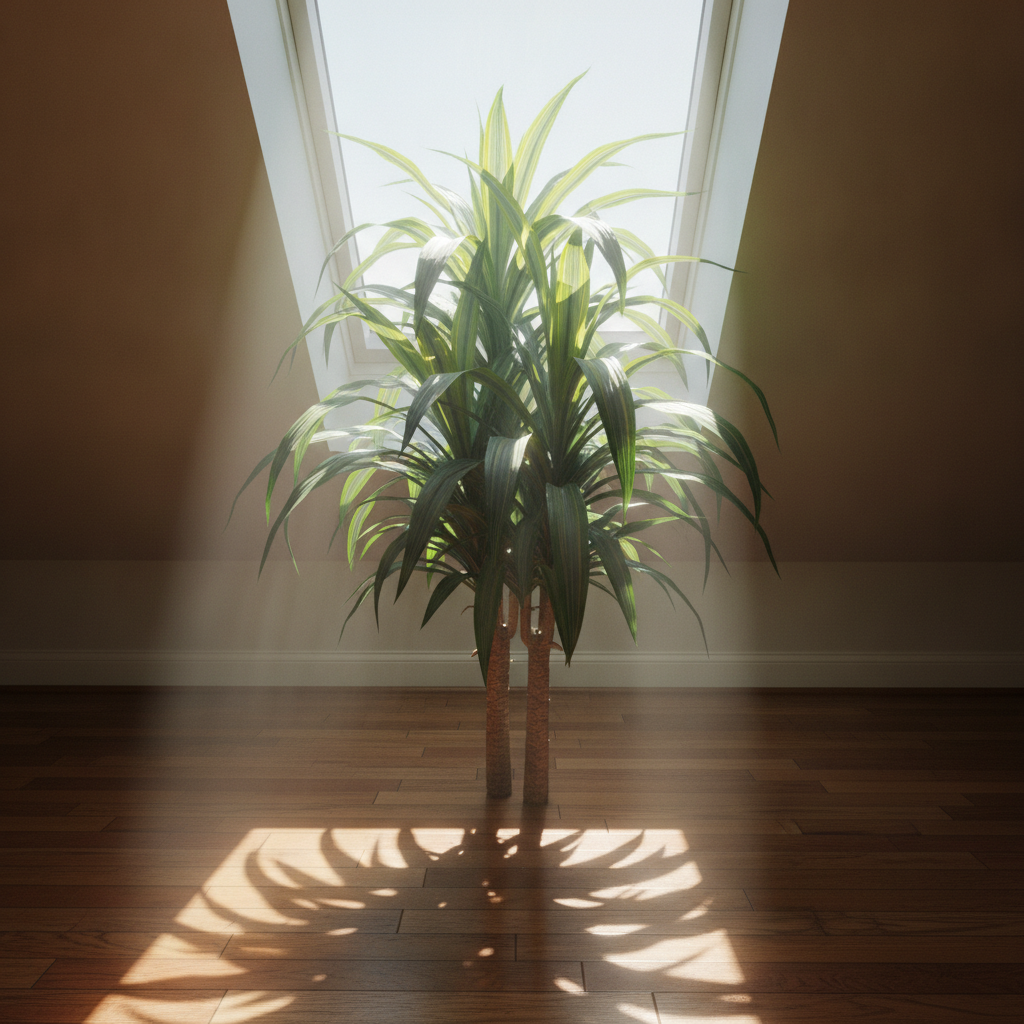
The ideal position is a few metres back from an east-facing or west-facing window, or beside a south-facing one screened by a sheer curtain. What the plant cannot take is prolonged direct sun through glass, which scorches the leaves and bleaches the variegation into washed-out patches. If the yellow central stripe starts to look faded or the leaf surface develops dry, straw-coloured burns, the plant is getting too much direct light rather than too little.
A useful rule of thumb is the shadow test: hold your hand a foot above the foliage in the middle of the day. A soft-edged shadow indicates the bright, indirect light the plant prefers, while a crisp, hard-edged shadow warns of direct sun that may scorch. No shadow at all means the spot is genuinely dim, and although the plant will tolerate it, expect slower growth and thinner foliage over time. Rotating the pot a quarter turn every week or two keeps growth even, since the crown leans noticeably toward the light source.
Pro Tip — Reading a leggy cane: If your plant has a long bare stem with foliage only at the very top, low light is usually the cause. Move it somewhere brighter to slow further leaf loss, and consider air layering or a hard cut-back (covered under propagation) to restore a fuller shape.
Watering
More cornstalk dracaenas are killed by kindness than by neglect. The plant stores water in its thick cane and resents sitting in soggy soil, so the single most important habit to build is letting the mix dry down between waterings. As a starting point, water when the top 5 cm (2 in) of soil feels dry to the touch, which under average indoor conditions usually falls somewhere between every ten days and every two weeks. Rather than watering on a fixed calendar, check the soil and let the plant tell you when it is ready.
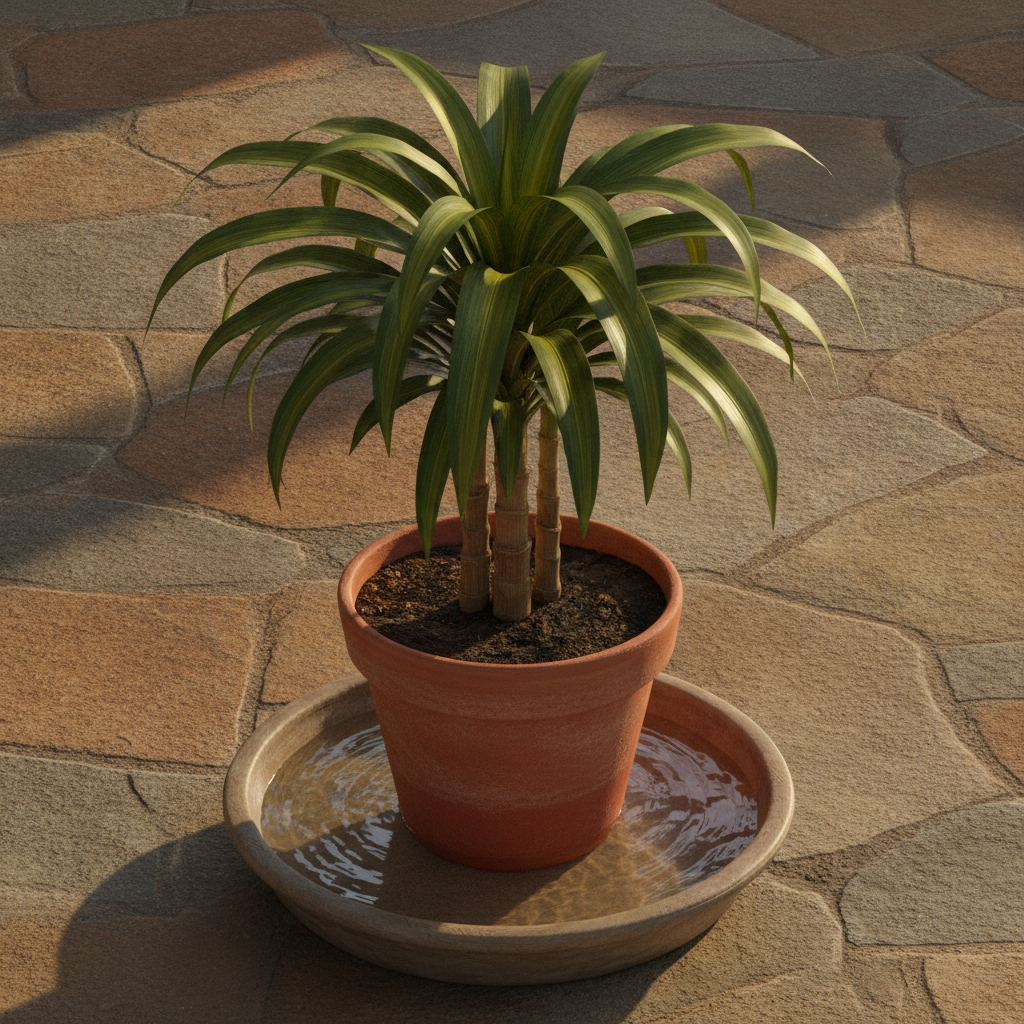
When you do water, water thoroughly. Take the plant to a sink or use a can with a long spout and pour steadily until water runs freely from the drainage holes, then let the pot drain completely before returning it to its saucer. This flushes the root ball evenly and, importantly, washes accumulated salts through the soil. Never leave the pot standing in a dish of water, because waterlogged roots are the fastest route to the soft, blackened stem base that signals fatal rot.
This species has one well-known idiosyncrasy: it is sensitive to fluoride and to a lesser extent chlorine and boron, all of which are common in tap water. The classic symptom is browning that begins at the very tips of the leaves and creeps inward, often edged with a thin yellow halo. If you see this, switch to rainwater, distilled water or tap water that has stood uncovered overnight to let some of the chlorine dissipate. Fluoride does not evaporate this way, so in areas with fluoridated supplies, rainwater or filtered water is the more reliable fix.
Watering needs fall in the cooler, darker months. Through autumn and winter the plant grows slowly and uses far less water, so stretch the interval between waterings and always check the soil first. Overwatering a semi-dormant plant in December is one of the commonest ways owners lose an otherwise healthy specimen. Yellowing lower leaves that feel soft and limp usually point to too much water, whereas crisp brown tips point to underwatering, low humidity or the fluoride problem described above.
Soil
The cornstalk dracaena wants a potting medium that holds enough moisture to keep the root ball from drying out completely, while draining fast enough that water never pools around the roots. A standard peat-free houseplant compost forms a perfectly good base, but on its own it tends to compact over time and stay wet too long, so it benefits from amendment. Aim for an open, springy mix rather than a dense one.
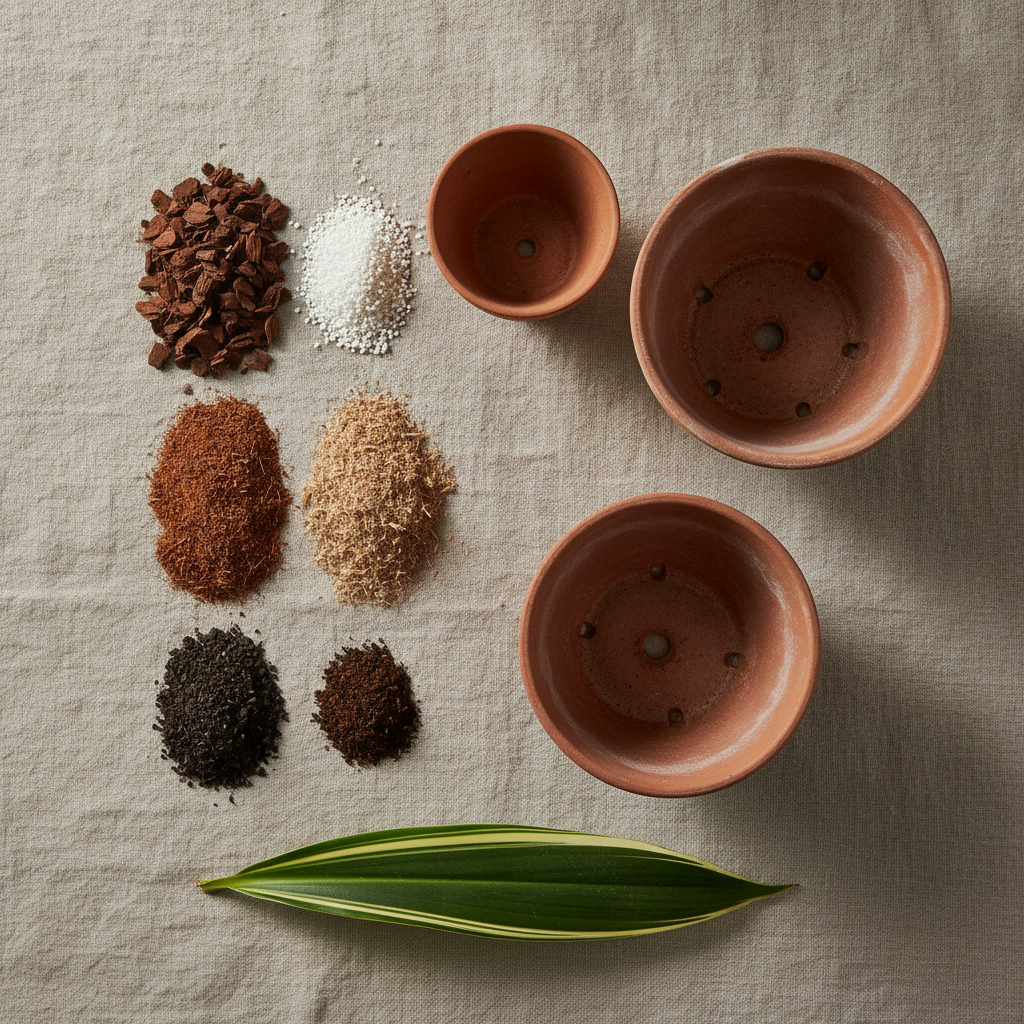
A reliable recipe is roughly three parts general-purpose potting compost or coco coir to one part orchid bark and one part perlite. The bark creates air pockets and stops the mix slumping into a dense mass, while the perlite keeps drainage sharp. A handful of worm castings mixed in adds gentle, slow-release nutrition. The plant is not fussy about pH and sits comfortably in the slightly acidic to neutral range that most bagged composts already provide.
Repotting is an infrequent chore. This is a slow grower that actively prefers to be a little snug in its pot, and disturbing the roots too often does more harm than good. Expect to repot only every two to three years, or when roots are circling the bottom, emerging from the drainage holes, or pushing the plant up out of its container. When you do, move up just one pot size, no more than 5 cm (2 in) wider, since an oversized pot holds a reservoir of wet soil the roots cannot reach and invites rot. Always choose a container with drainage holes.
Pro Tip — Top-dress instead: If your plant is large and awkward to repot, simply scrape off the top few centimetres of old soil each spring and replace it with fresh mix. This refreshes nutrients and structure without the stress of a full root disturbance.
Fertilising
Because it grows slowly, the cornstalk dracaena is a light feeder, and it is far easier to harm it with too much fertiliser than to starve it with too little. A balanced liquid houseplant feed, diluted to half the strength recommended on the label and applied roughly once a month during the active growing season of spring and summer, is all it needs. Stop feeding entirely through autumn and winter, when the plant is barely growing and cannot use the extra nutrients.
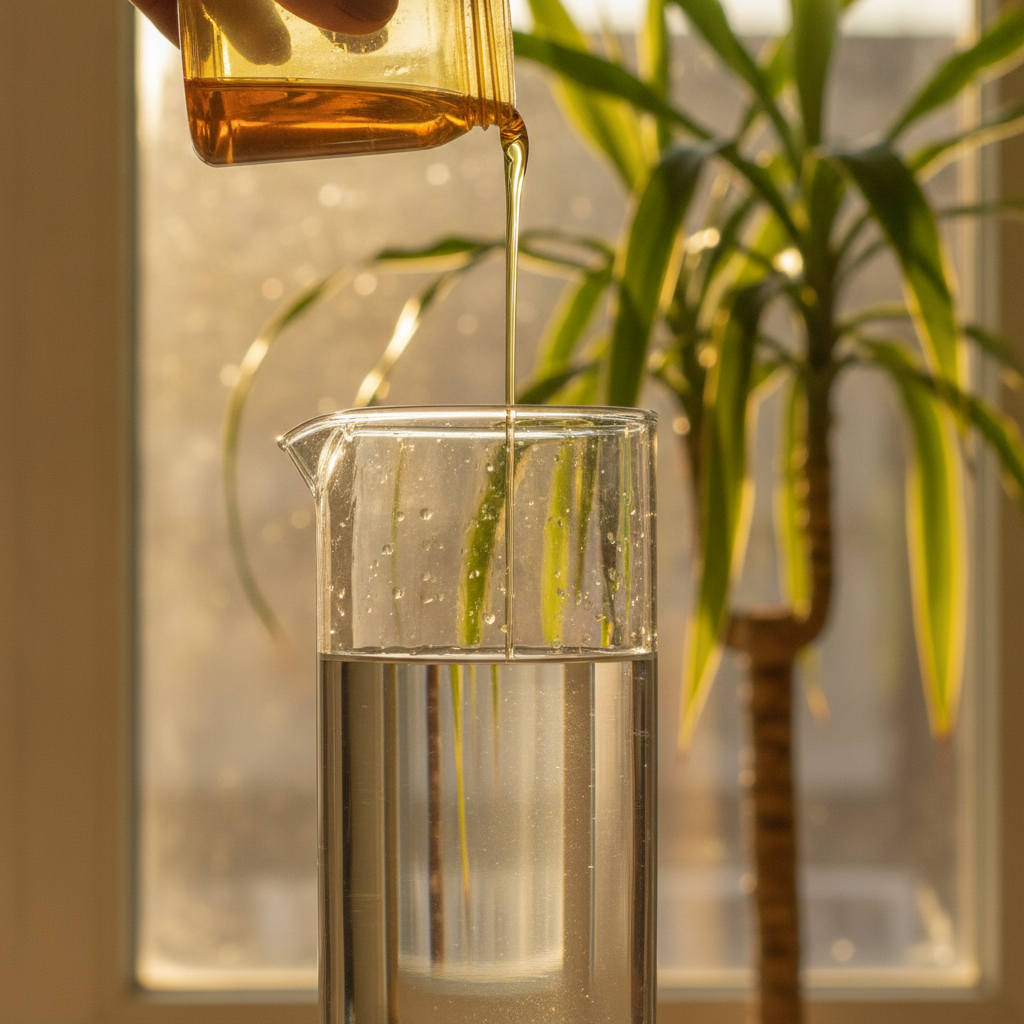
The main risk with feeding is the build-up of mineral salts in the soil, which this fluoride-sensitive species tolerates poorly. Excess fertiliser salts show up as scorched brown leaf tips and margins, the same symptom the plant produces in response to fluoride, and the two problems often compound one another. To keep salts in check, flush the soil thoroughly with plenty of plain water every couple of months, letting it run freely through the pot and out the bottom to carry dissolved salts away.
If you prefer a lower-maintenance approach, a light top-dressing of worm castings in spring supplies gentle nutrition across the season without any risk of salt build-up, and pairs well with the annual soil refresh described above. Whichever route you take, resist the temptation to feed a struggling plant back to health. A dracaena that is browning or dropping leaves almost always has a light, water or root problem, and adding fertiliser to the mix usually makes matters worse rather than better.
Propagation
Propagating a cornstalk dracaena is genuinely satisfying, because the same techniques that create new plants also rescue a tall, bare, leggy specimen and restore its shape. The plant propagates readily from stem sections, and a healthy cane can be cut into several pieces, each capable of rooting into a new plant. The best time to do this is late spring or early summer, when warmth and light give the cuttings the best chance of striking.
The simplest method is the top cutting. Using a clean, sharp knife or secateurs, cut the leafy crown from the top of the cane, leaving roughly 15 to 20 cm (6 to 8 in) of stem below the foliage. Place this cutting in a jar of water or directly into moist, free-draining mix, keep it warm and brightly but indirectly lit, and roots will usually form over several weeks. Meanwhile the bare stump left behind is far from dead: kept warm and lightly watered, it will typically sprout one or more new shoots just below the cut, giving you a bushier plant than before.
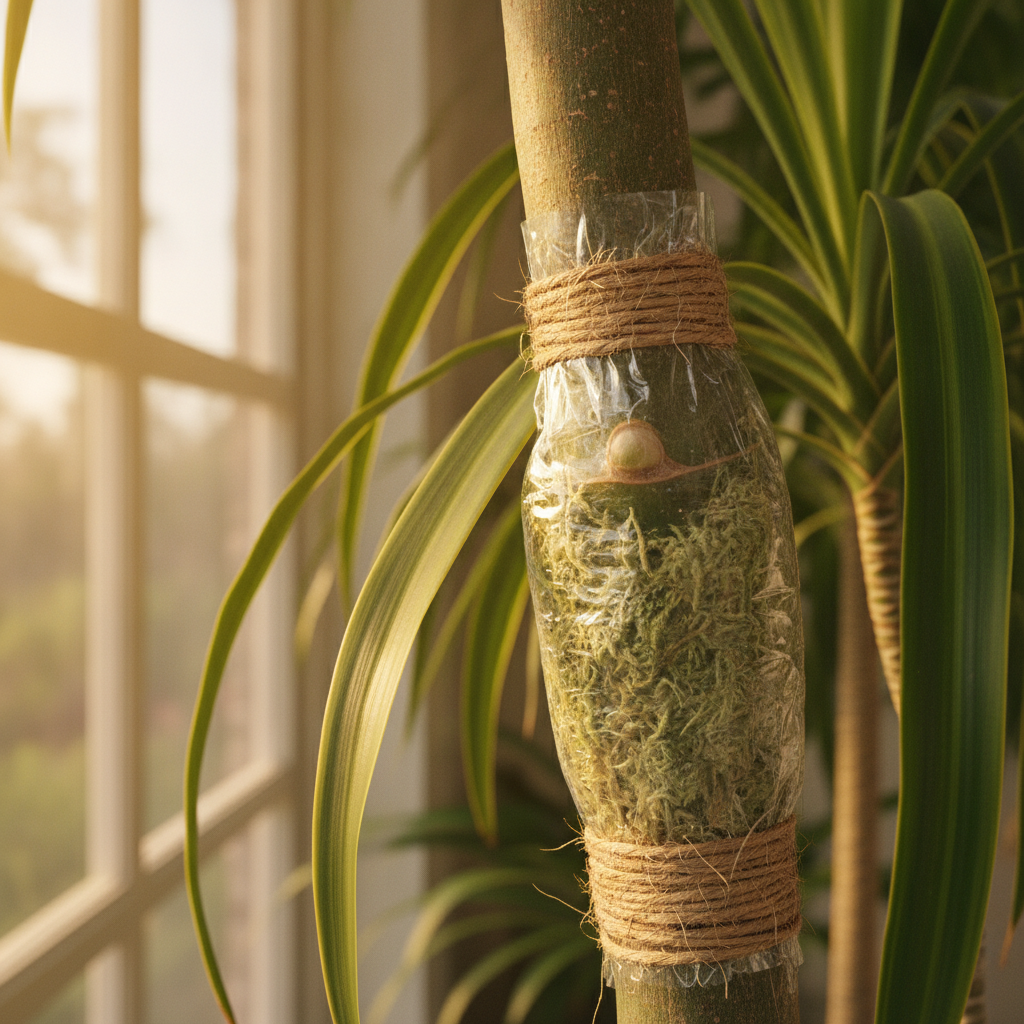
For a more controlled result on a valued plant, air layering is the reliable choice, and it works particularly well on the thick canes of this species. The steps below outline the process.
- Choose a point on the cane below the foliage and, if you wish, nick the bark lightly to encourage rooting.
- Wrap a handful of damp sphagnum moss around that point, enclosing the stem completely.
- Cover the moss with clear plastic film and tie it top and bottom with twine so it holds moisture but lets you see inside.
- Keep the moss damp and wait, usually several weeks to a couple of months, until you can see roots developing through the film.
- Cut the cane just below the new root mass and pot up the rooted section, then care for it as a young plant.
You can also propagate from lower sections of a cut cane, laying or standing 20 cm (8 in) pieces in moist mix. Keep track of which end pointed upward, since the cutting will only sprout correctly if planted the right way up. All methods reward warmth, patience and a light hand with water: cuttings that sit too wet rot rather than root.
Pests and Problems
The cornstalk dracaena is not especially prone to pests, but the dry indoor air it often lives in can invite a few opportunists, and its most conspicuous problems are usually cultural rather than biological. Knowing which is which saves a lot of unnecessary spraying.
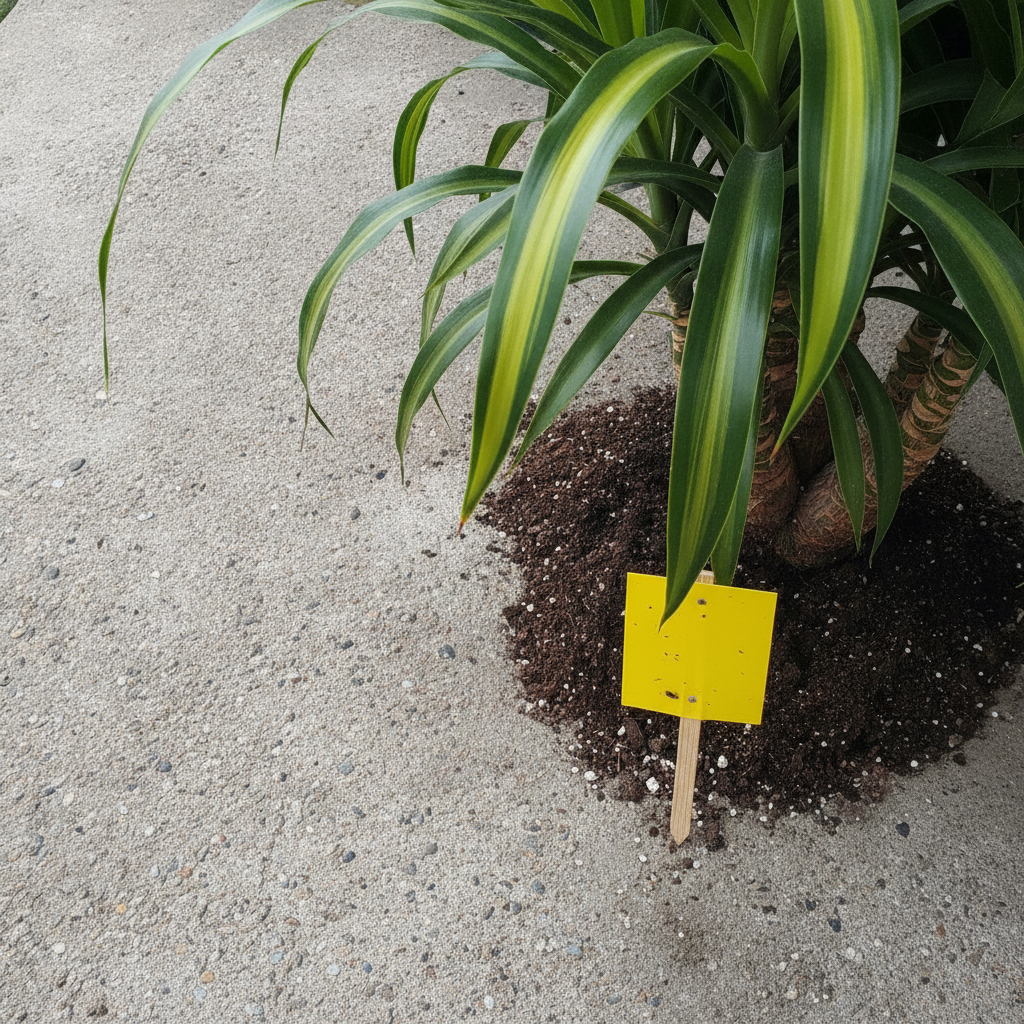
The pests to watch for are spider mites, mealybugs and scale. Spider mites thrive in warm, dry air and betray themselves with fine stippling on the leaves and delicate webbing in the leaf axils; raising humidity and wiping the foliage down discourages them. Mealybugs appear as small white cottony tufts tucked where leaf meets stem, while scale shows up as flat brown discs clinging to stems and leaf undersides. For all three, wiping the affected areas with a cotton bud dipped in diluted isopropyl alcohol, followed by a neem oil spray if the infestation is widespread, brings them under control. Fungus gnats, whose larvae live in perpetually damp soil, are a sign you are watering too often as much as a pest in their own right.
The problems owners worry about most, though, are the leaf symptoms, and these are almost always about care rather than insects. Brown leaf tips are the signature complaint of this species and usually trace back to fluoride or salt in the water, low humidity, or letting the soil dry out too far. Yellowing lower leaves that feel soft point to overwatering, while a soft, dark, foul-smelling stem base signals root rot from waterlogged soil and is the one condition that can genuinely kill the plant. Some steady loss of the oldest, lowest leaves is entirely normal as the plant ages and the cane lengthens, and is nothing to worry about.
Pro Tip — Trim tips, do not remove leaves: Brown tips will not turn green again, but you do not need to sacrifice the whole leaf. Snip just the dead portion away with clean scissors, following the natural taper of the leaf, and the trimmed foliage will look tidy while the plant keeps the healthy green tissue.
Varieties
Dracaena fragrans is a variable species with many named cultivars, distinguished mainly by the colour and arrangement of the stripes on their strap-shaped leaves. The two below are the ones most often sold under the cornstalk or mass cane name, and both share the same easygoing care described throughout this guide.
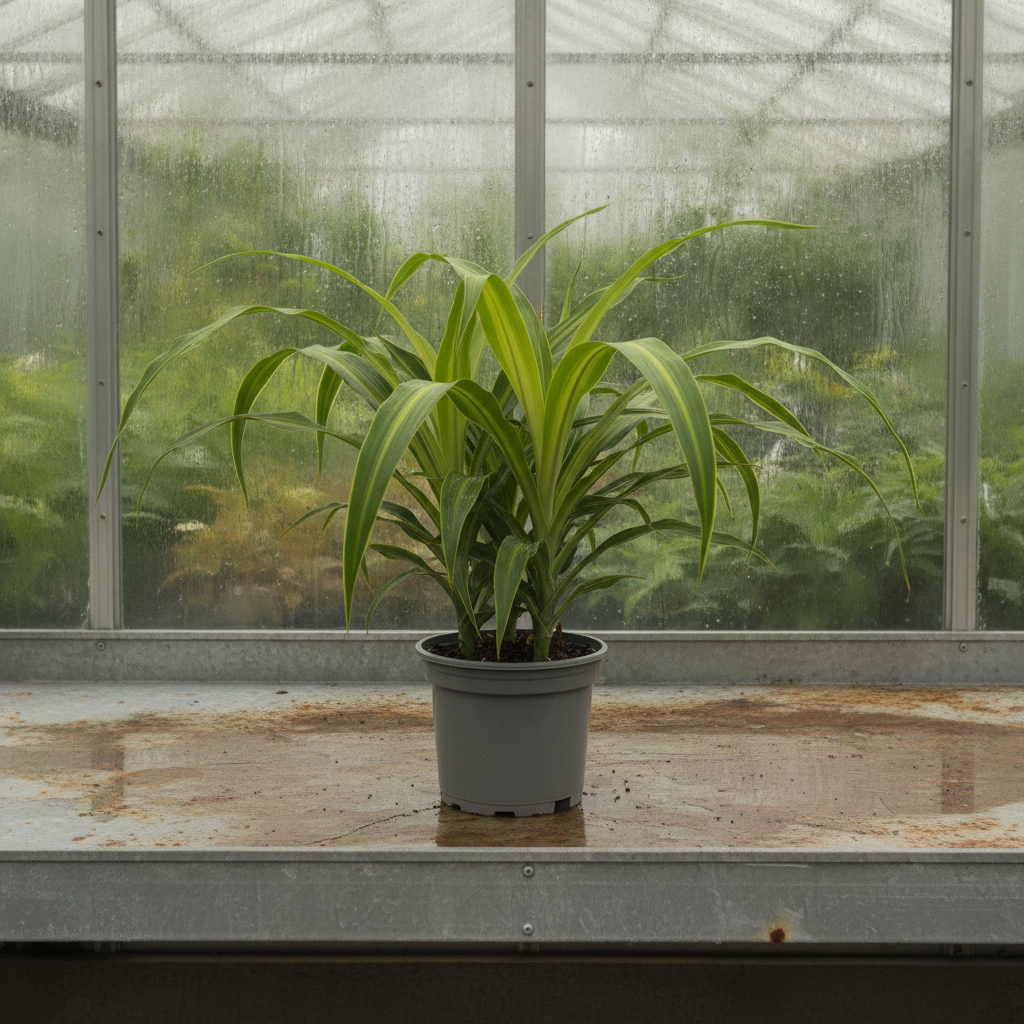
‘Massangeana’
The definitive cornstalk dracaena and by far the most widely sold. Each glossy green strap leaf carries a wide central band of golden yellow that softens to lime toward the edges, and the whole crown arches out in a loose fountain from a stout woody cane. It is the most shade-tolerant of the group and the one most often grown as a multi-cane floor plant.
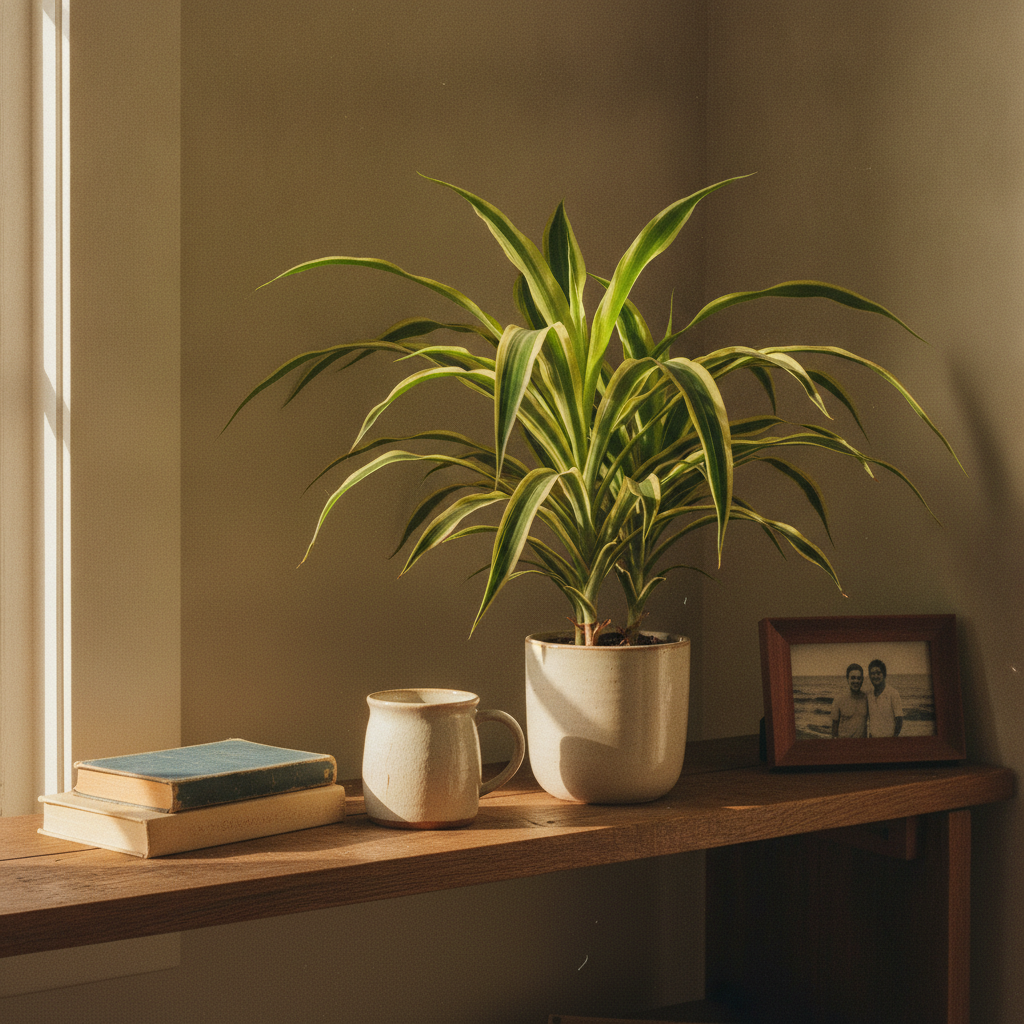
‘Lindenii’
Essentially the mirror image of ‘Massangeana’. Where the classic form carries yellow down the middle, ‘Lindenii’ reverses the pattern, edging each arching strap leaf with creamy-yellow margins that frame a deep green centre. The effect is brighter and more luminous, and it makes a striking contrast when the two cultivars are grown side by side.
Beyond these two, gardeners will encounter related Dracaena fragrans cultivars such as ‘Warneckii’, with fine white stripes, the solid dark green ‘Janet Craig’, and the acid-toned ‘Lemon Lime’. All belong to the same forgiving species and respond to the same conditions, so once you can grow one cornstalk dracaena well, you can grow the whole family.
FAQ
Why are the tips of my cornstalk dracaena turning brown?
Brown tips are this plant’s most common complaint and usually come down to the water. It is sensitive to fluoride and salts, so fluoridated or heavily chlorinated tap water often causes tip browning. Switch to rainwater, distilled or filtered water, keep humidity above about 40 per cent, avoid letting the soil dry out completely, and flush the pot occasionally to clear built-up salts.
How often should I water it?
Water when the top 5 cm (2 in) of soil is dry, which under typical indoor conditions works out at roughly every ten days to two weeks in the growing season and less in winter. Always check the soil rather than watering on a fixed schedule, and let the pot drain fully so the roots never sit in water.
Is the cornstalk dracaena safe for cats and dogs?
No. It contains saponins that are toxic to cats and dogs, and chewing the leaves can cause vomiting, drooling and loss of appetite, with dilated pupils sometimes seen in cats. Keep it out of reach of pets and seek veterinary advice if you suspect your animal has eaten any.
My plant is tall and bare at the bottom. Can I fix it?
Yes. A leggy cane is common in low light and is easily corrected. Cut the leafy top off, leaving a stem of 15 to 20 cm (6 to 8 in) below the foliage, and root it as a new plant. The remaining stump will usually sprout fresh shoots just below the cut, giving you a fuller plant. Move both to brighter light to prevent the problem returning.
How big does it get indoors?
Indoors it typically reaches 1.2 to 1.8 m (4 to 6 ft), though in a bright spot with good care it can grow taller over many years. It is a slow grower, so it stays a manageable size for a long time, and you can control its height by cutting the cane back and rooting the top whenever it outgrows its space.
Does it need a lot of light?
No, and that is a large part of its appeal. It tolerates medium and even low light better than almost any other large foliage plant, which is why it is a fixture in offices and dim corners. That said, it grows faster, holds more leaves and keeps brighter variegation in bright indirect light, so give it the best light you reasonably can while keeping it out of harsh direct sun.






