
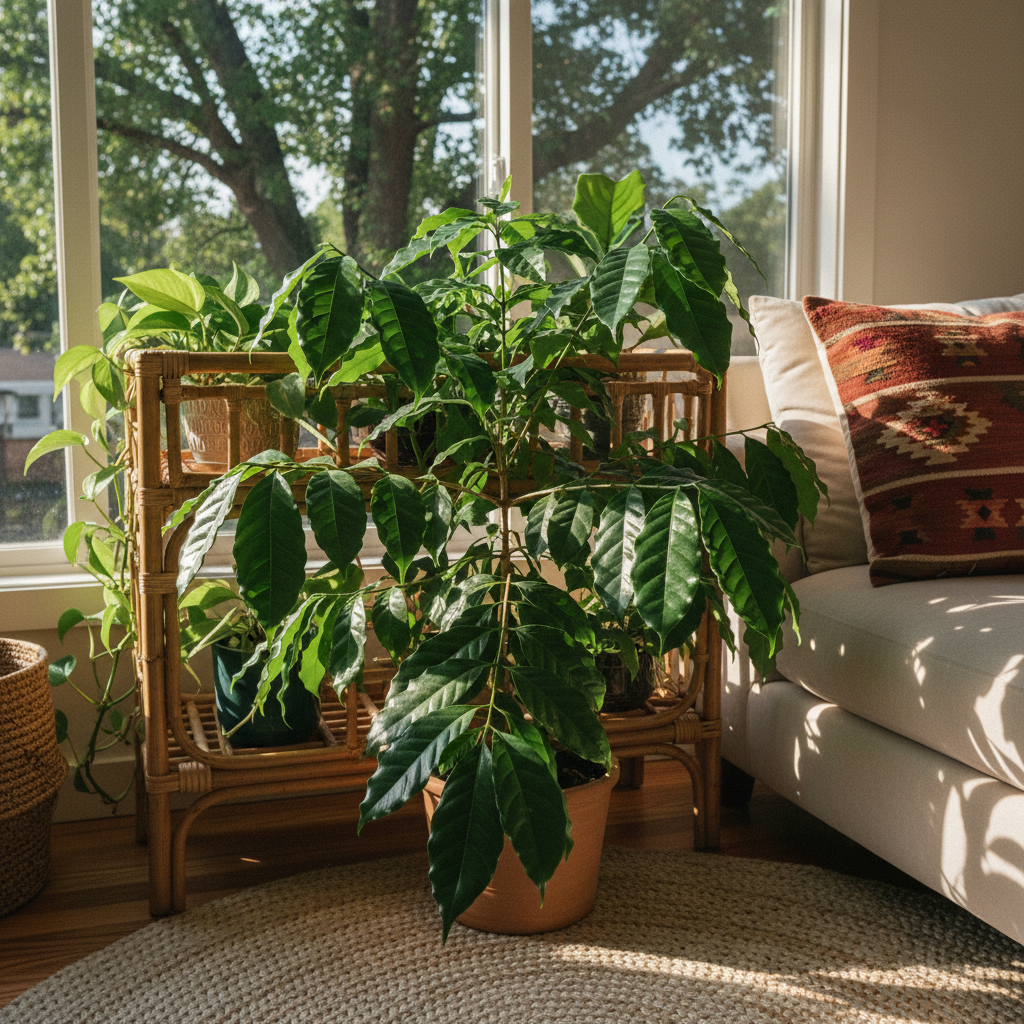
A typical indoor Arabica coffee plant reaches between 1 and 2 metres over the course of five to ten years, depending on cultivar, light and pot size. Dwarf cultivars such as 'Nana' rarely exceed 1 metre. In the wild and on plantations, where they are pruned for harvest, coffee trees can reach 4 to 6 metres, but indoor specimens are restricted by pot size and the lower light levels of a home interior.
Can I drink coffee from beans I grow myself?
Yes, in theory and occasionally in delightful practice. A mature, well-flowering coffee plant might produce somewhere between 50 grams and 200 grams of green beans per year, enough for a small handful of cups. The process from cherry to cup involves harvesting the ripe red berries, removing the soft fruit pulp, fermenting the beans briefly, washing and drying them thoroughly, and finally roasting them at home. It is laborious for so little yield, but the cup brewed from beans grown on your own windowsill is one of the small genuine pleasures of houseplant keeping.
A few yellowing lower leaves over the course of a year are normal as the plant sheds older foliage. A sudden cascade of yellowing leaves at the bottom usually means either overwatering (the most common cause), a nutrient deficiency (particularly nitrogen or magnesium), or a sudden temperature drop. Check the soil moisture first; if it has been wet for several days, the issue is almost certainly watering.
How big will my coffee plant get indoors?
A typical indoor Arabica coffee plant reaches between 1 and 2 metres over the course of five to ten years, depending on cultivar, light and pot size. Dwarf cultivars such as 'Nana' rarely exceed 1 metre. In the wild and on plantations, where they are pruned for harvest, coffee trees can reach 4 to 6 metres, but indoor specimens are restricted by pot size and the lower light levels of a home interior.
Can I drink coffee from beans I grow myself?
Yes, in theory and occasionally in delightful practice. A mature, well-flowering coffee plant might produce somewhere between 50 grams and 200 grams of green beans per year, enough for a small handful of cups. The process from cherry to cup involves harvesting the ripe red berries, removing the soft fruit pulp, fermenting the beans briefly, washing and drying them thoroughly, and finally roasting them at home. It is laborious for so little yield, but the cup brewed from beans grown on your own windowsill is one of the small genuine pleasures of houseplant keeping.
Light pruning is beneficial. In spring, you can pinch out the growing tip of the main stem to encourage branching, and shorten any overly long lateral branches to maintain a tidy shape. Avoid heavy pruning of a young plant; a mature coffee plant can tolerate more aggressive cuts but always recovers more slowly than its summer foliage might suggest. Sterilise your secateurs before each cut to avoid spreading disease.
Why are my coffee plant's lower leaves yellowing and dropping?
A few yellowing lower leaves over the course of a year are normal as the plant sheds older foliage. A sudden cascade of yellowing leaves at the bottom usually means either overwatering (the most common cause), a nutrient deficiency (particularly nitrogen or magnesium), or a sudden temperature drop. Check the soil moisture first; if it has been wet for several days, the issue is almost certainly watering.
How big will my coffee plant get indoors?
A typical indoor Arabica coffee plant reaches between 1 and 2 metres over the course of five to ten years, depending on cultivar, light and pot size. Dwarf cultivars such as 'Nana' rarely exceed 1 metre. In the wild and on plantations, where they are pruned for harvest, coffee trees can reach 4 to 6 metres, but indoor specimens are restricted by pot size and the lower light levels of a home interior.
Can I drink coffee from beans I grow myself?
Yes, in theory and occasionally in delightful practice. A mature, well-flowering coffee plant might produce somewhere between 50 grams and 200 grams of green beans per year, enough for a small handful of cups. The process from cherry to cup involves harvesting the ripe red berries, removing the soft fruit pulp, fermenting the beans briefly, washing and drying them thoroughly, and finally roasting them at home. It is laborious for so little yield, but the cup brewed from beans grown on your own windowsill is one of the small genuine pleasures of houseplant keeping.
Legginess (long internodes, widely spaced leaf pairs, weak stems) is almost always a sign of insufficient light. Move the plant gradually to a brighter spot, ideally near an east or curtained south window. You can also prune the growing tip in spring to encourage bushier lateral growth; coffee plants respond well to a light pinch on the leading shoot and will branch out below the cut.
Should I prune my coffee plant?
Light pruning is beneficial. In spring, you can pinch out the growing tip of the main stem to encourage branching, and shorten any overly long lateral branches to maintain a tidy shape. Avoid heavy pruning of a young plant; a mature coffee plant can tolerate more aggressive cuts but always recovers more slowly than its summer foliage might suggest. Sterilise your secateurs before each cut to avoid spreading disease.
Why are my coffee plant's lower leaves yellowing and dropping?
A few yellowing lower leaves over the course of a year are normal as the plant sheds older foliage. A sudden cascade of yellowing leaves at the bottom usually means either overwatering (the most common cause), a nutrient deficiency (particularly nitrogen or magnesium), or a sudden temperature drop. Check the soil moisture first; if it has been wet for several days, the issue is almost certainly watering.
How big will my coffee plant get indoors?
A typical indoor Arabica coffee plant reaches between 1 and 2 metres over the course of five to ten years, depending on cultivar, light and pot size. Dwarf cultivars such as 'Nana' rarely exceed 1 metre. In the wild and on plantations, where they are pruned for harvest, coffee trees can reach 4 to 6 metres, but indoor specimens are restricted by pot size and the lower light levels of a home interior.
Can I drink coffee from beans I grow myself?
Yes, in theory and occasionally in delightful practice. A mature, well-flowering coffee plant might produce somewhere between 50 grams and 200 grams of green beans per year, enough for a small handful of cups. The process from cherry to cup involves harvesting the ripe red berries, removing the soft fruit pulp, fermenting the beans briefly, washing and drying them thoroughly, and finally roasting them at home. It is laborious for so little yield, but the cup brewed from beans grown on your own windowsill is one of the small genuine pleasures of houseplant keeping.
No. Every part of the coffee plant contains caffeine and related alkaloids that are toxic to dogs, cats and most pets. Ingestion can cause vomiting, restlessness, tremors, rapid heart rate and, in extreme cases, more serious cardiac symptoms. Keep coffee plants out of reach of pets and small children, and contact a veterinarian promptly if you suspect any has been chewed.
My coffee plant is leggy and stretched. What should I do?
Legginess (long internodes, widely spaced leaf pairs, weak stems) is almost always a sign of insufficient light. Move the plant gradually to a brighter spot, ideally near an east or curtained south window. You can also prune the growing tip in spring to encourage bushier lateral growth; coffee plants respond well to a light pinch on the leading shoot and will branch out below the cut.
Should I prune my coffee plant?
Light pruning is beneficial. In spring, you can pinch out the growing tip of the main stem to encourage branching, and shorten any overly long lateral branches to maintain a tidy shape. Avoid heavy pruning of a young plant; a mature coffee plant can tolerate more aggressive cuts but always recovers more slowly than its summer foliage might suggest. Sterilise your secateurs before each cut to avoid spreading disease.
Why are my coffee plant's lower leaves yellowing and dropping?
A few yellowing lower leaves over the course of a year are normal as the plant sheds older foliage. A sudden cascade of yellowing leaves at the bottom usually means either overwatering (the most common cause), a nutrient deficiency (particularly nitrogen or magnesium), or a sudden temperature drop. Check the soil moisture first; if it has been wet for several days, the issue is almost certainly watering.
How big will my coffee plant get indoors?
A typical indoor Arabica coffee plant reaches between 1 and 2 metres over the course of five to ten years, depending on cultivar, light and pot size. Dwarf cultivars such as 'Nana' rarely exceed 1 metre. In the wild and on plantations, where they are pruned for harvest, coffee trees can reach 4 to 6 metres, but indoor specimens are restricted by pot size and the lower light levels of a home interior.
Can I drink coffee from beans I grow myself?
Yes, in theory and occasionally in delightful practice. A mature, well-flowering coffee plant might produce somewhere between 50 grams and 200 grams of green beans per year, enough for a small handful of cups. The process from cherry to cup involves harvesting the ripe red berries, removing the soft fruit pulp, fermenting the beans briefly, washing and drying them thoroughly, and finally roasting them at home. It is laborious for so little yield, but the cup brewed from beans grown on your own windowsill is one of the small genuine pleasures of houseplant keeping.
Yes, with care. A sheltered, partly shaded position on a balcony or patio can be excellent for an indoor coffee plant during the warmest months, giving it brighter light and better airflow than any indoor spot. Acclimatise the plant gradually over two to three weeks, increasing outdoor exposure each day, and bring it back inside well before night temperatures drop below 15 degrees Celsius (59 Fahrenheit) in autumn.
Are coffee plants safe for cats and dogs?
No. Every part of the coffee plant contains caffeine and related alkaloids that are toxic to dogs, cats and most pets. Ingestion can cause vomiting, restlessness, tremors, rapid heart rate and, in extreme cases, more serious cardiac symptoms. Keep coffee plants out of reach of pets and small children, and contact a veterinarian promptly if you suspect any has been chewed.
My coffee plant is leggy and stretched. What should I do?
Legginess (long internodes, widely spaced leaf pairs, weak stems) is almost always a sign of insufficient light. Move the plant gradually to a brighter spot, ideally near an east or curtained south window. You can also prune the growing tip in spring to encourage bushier lateral growth; coffee plants respond well to a light pinch on the leading shoot and will branch out below the cut.
Should I prune my coffee plant?
Light pruning is beneficial. In spring, you can pinch out the growing tip of the main stem to encourage branching, and shorten any overly long lateral branches to maintain a tidy shape. Avoid heavy pruning of a young plant; a mature coffee plant can tolerate more aggressive cuts but always recovers more slowly than its summer foliage might suggest. Sterilise your secateurs before each cut to avoid spreading disease.
Why are my coffee plant's lower leaves yellowing and dropping?
A few yellowing lower leaves over the course of a year are normal as the plant sheds older foliage. A sudden cascade of yellowing leaves at the bottom usually means either overwatering (the most common cause), a nutrient deficiency (particularly nitrogen or magnesium), or a sudden temperature drop. Check the soil moisture first; if it has been wet for several days, the issue is almost certainly watering.
How big will my coffee plant get indoors?
A typical indoor Arabica coffee plant reaches between 1 and 2 metres over the course of five to ten years, depending on cultivar, light and pot size. Dwarf cultivars such as 'Nana' rarely exceed 1 metre. In the wild and on plantations, where they are pruned for harvest, coffee trees can reach 4 to 6 metres, but indoor specimens are restricted by pot size and the lower light levels of a home interior.
Can I drink coffee from beans I grow myself?
Yes, in theory and occasionally in delightful practice. A mature, well-flowering coffee plant might produce somewhere between 50 grams and 200 grams of green beans per year, enough for a small handful of cups. The process from cherry to cup involves harvesting the ripe red berries, removing the soft fruit pulp, fermenting the beans briefly, washing and drying them thoroughly, and finally roasting them at home. It is laborious for so little yield, but the cup brewed from beans grown on your own windowsill is one of the small genuine pleasures of houseplant keeping.
Brown leaf tips on a coffee plant are almost always a sign of dry air or inconsistent watering. The pattern matters: tips that brown gradually from the edges inward usually mean low humidity, while tips that brown abruptly with a yellow halo around the damage often mean fluoride or chlorine sensitivity from tap water. Check humidity first, water quality second, and feeding third.
Can I keep a coffee plant outdoors in summer?
Yes, with care. A sheltered, partly shaded position on a balcony or patio can be excellent for an indoor coffee plant during the warmest months, giving it brighter light and better airflow than any indoor spot. Acclimatise the plant gradually over two to three weeks, increasing outdoor exposure each day, and bring it back inside well before night temperatures drop below 15 degrees Celsius (59 Fahrenheit) in autumn.
Are coffee plants safe for cats and dogs?
No. Every part of the coffee plant contains caffeine and related alkaloids that are toxic to dogs, cats and most pets. Ingestion can cause vomiting, restlessness, tremors, rapid heart rate and, in extreme cases, more serious cardiac symptoms. Keep coffee plants out of reach of pets and small children, and contact a veterinarian promptly if you suspect any has been chewed.
My coffee plant is leggy and stretched. What should I do?
Legginess (long internodes, widely spaced leaf pairs, weak stems) is almost always a sign of insufficient light. Move the plant gradually to a brighter spot, ideally near an east or curtained south window. You can also prune the growing tip in spring to encourage bushier lateral growth; coffee plants respond well to a light pinch on the leading shoot and will branch out below the cut.
Should I prune my coffee plant?
Light pruning is beneficial. In spring, you can pinch out the growing tip of the main stem to encourage branching, and shorten any overly long lateral branches to maintain a tidy shape. Avoid heavy pruning of a young plant; a mature coffee plant can tolerate more aggressive cuts but always recovers more slowly than its summer foliage might suggest. Sterilise your secateurs before each cut to avoid spreading disease.
Why are my coffee plant's lower leaves yellowing and dropping?
A few yellowing lower leaves over the course of a year are normal as the plant sheds older foliage. A sudden cascade of yellowing leaves at the bottom usually means either overwatering (the most common cause), a nutrient deficiency (particularly nitrogen or magnesium), or a sudden temperature drop. Check the soil moisture first; if it has been wet for several days, the issue is almost certainly watering.
How big will my coffee plant get indoors?
A typical indoor Arabica coffee plant reaches between 1 and 2 metres over the course of five to ten years, depending on cultivar, light and pot size. Dwarf cultivars such as 'Nana' rarely exceed 1 metre. In the wild and on plantations, where they are pruned for harvest, coffee trees can reach 4 to 6 metres, but indoor specimens are restricted by pot size and the lower light levels of a home interior.
Can I drink coffee from beans I grow myself?
Yes, in theory and occasionally in delightful practice. A mature, well-flowering coffee plant might produce somewhere between 50 grams and 200 grams of green beans per year, enough for a small handful of cups. The process from cherry to cup involves harvesting the ripe red berries, removing the soft fruit pulp, fermenting the beans briefly, washing and drying them thoroughly, and finally roasting them at home. It is laborious for so little yield, but the cup brewed from beans grown on your own windowsill is one of the small genuine pleasures of houseplant keeping.
Most coffee plants need to reach a height of around 60 cm and an age of at least three years before they will flower for the first time. From flower to ripe red cherry takes another six to nine months. Indoors, flowering is far from guaranteed: it requires bright, near-direct light, a regular feeding schedule, consistent watering and stable humidity. Plants given less than ideal conditions may grow happily for decades as foliage specimens without ever blooming.
Why are the tips of my coffee plant turning brown?
Brown leaf tips on a coffee plant are almost always a sign of dry air or inconsistent watering. The pattern matters: tips that brown gradually from the edges inward usually mean low humidity, while tips that brown abruptly with a yellow halo around the damage often mean fluoride or chlorine sensitivity from tap water. Check humidity first, water quality second, and feeding third.
Can I keep a coffee plant outdoors in summer?
Yes, with care. A sheltered, partly shaded position on a balcony or patio can be excellent for an indoor coffee plant during the warmest months, giving it brighter light and better airflow than any indoor spot. Acclimatise the plant gradually over two to three weeks, increasing outdoor exposure each day, and bring it back inside well before night temperatures drop below 15 degrees Celsius (59 Fahrenheit) in autumn.
Are coffee plants safe for cats and dogs?
No. Every part of the coffee plant contains caffeine and related alkaloids that are toxic to dogs, cats and most pets. Ingestion can cause vomiting, restlessness, tremors, rapid heart rate and, in extreme cases, more serious cardiac symptoms. Keep coffee plants out of reach of pets and small children, and contact a veterinarian promptly if you suspect any has been chewed.
My coffee plant is leggy and stretched. What should I do?
Legginess (long internodes, widely spaced leaf pairs, weak stems) is almost always a sign of insufficient light. Move the plant gradually to a brighter spot, ideally near an east or curtained south window. You can also prune the growing tip in spring to encourage bushier lateral growth; coffee plants respond well to a light pinch on the leading shoot and will branch out below the cut.
Should I prune my coffee plant?
Light pruning is beneficial. In spring, you can pinch out the growing tip of the main stem to encourage branching, and shorten any overly long lateral branches to maintain a tidy shape. Avoid heavy pruning of a young plant; a mature coffee plant can tolerate more aggressive cuts but always recovers more slowly than its summer foliage might suggest. Sterilise your secateurs before each cut to avoid spreading disease.
Why are my coffee plant's lower leaves yellowing and dropping?
A few yellowing lower leaves over the course of a year are normal as the plant sheds older foliage. A sudden cascade of yellowing leaves at the bottom usually means either overwatering (the most common cause), a nutrient deficiency (particularly nitrogen or magnesium), or a sudden temperature drop. Check the soil moisture first; if it has been wet for several days, the issue is almost certainly watering.
How big will my coffee plant get indoors?
A typical indoor Arabica coffee plant reaches between 1 and 2 metres over the course of five to ten years, depending on cultivar, light and pot size. Dwarf cultivars such as 'Nana' rarely exceed 1 metre. In the wild and on plantations, where they are pruned for harvest, coffee trees can reach 4 to 6 metres, but indoor specimens are restricted by pot size and the lower light levels of a home interior.
Can I drink coffee from beans I grow myself?
Yes, in theory and occasionally in delightful practice. A mature, well-flowering coffee plant might produce somewhere between 50 grams and 200 grams of green beans per year, enough for a small handful of cups. The process from cherry to cup involves harvesting the ripe red berries, removing the soft fruit pulp, fermenting the beans briefly, washing and drying them thoroughly, and finally roasting them at home. It is laborious for so little yield, but the cup brewed from beans grown on your own windowsill is one of the small genuine pleasures of houseplant keeping.
No. Roasting destroys the embryo inside the seed, so the dark brown beans on a supermarket shelf are completely incapable of germinating. Only fresh, unroasted (green) coffee beans harvested within the last few weeks have any reasonable chance of sprouting, and even those need warmth, humidity and patience. Specialty roasters and a few online seed suppliers occasionally sell viable green beans labelled specifically for propagation.
How long until my coffee plant flowers and produces beans?
Most coffee plants need to reach a height of around 60 cm and an age of at least three years before they will flower for the first time. From flower to ripe red cherry takes another six to nine months. Indoors, flowering is far from guaranteed: it requires bright, near-direct light, a regular feeding schedule, consistent watering and stable humidity. Plants given less than ideal conditions may grow happily for decades as foliage specimens without ever blooming.
Why are the tips of my coffee plant turning brown?
Brown leaf tips on a coffee plant are almost always a sign of dry air or inconsistent watering. The pattern matters: tips that brown gradually from the edges inward usually mean low humidity, while tips that brown abruptly with a yellow halo around the damage often mean fluoride or chlorine sensitivity from tap water. Check humidity first, water quality second, and feeding third.
Can I keep a coffee plant outdoors in summer?
Yes, with care. A sheltered, partly shaded position on a balcony or patio can be excellent for an indoor coffee plant during the warmest months, giving it brighter light and better airflow than any indoor spot. Acclimatise the plant gradually over two to three weeks, increasing outdoor exposure each day, and bring it back inside well before night temperatures drop below 15 degrees Celsius (59 Fahrenheit) in autumn.
Are coffee plants safe for cats and dogs?
No. Every part of the coffee plant contains caffeine and related alkaloids that are toxic to dogs, cats and most pets. Ingestion can cause vomiting, restlessness, tremors, rapid heart rate and, in extreme cases, more serious cardiac symptoms. Keep coffee plants out of reach of pets and small children, and contact a veterinarian promptly if you suspect any has been chewed.
My coffee plant is leggy and stretched. What should I do?
Legginess (long internodes, widely spaced leaf pairs, weak stems) is almost always a sign of insufficient light. Move the plant gradually to a brighter spot, ideally near an east or curtained south window. You can also prune the growing tip in spring to encourage bushier lateral growth; coffee plants respond well to a light pinch on the leading shoot and will branch out below the cut.
Should I prune my coffee plant?
Light pruning is beneficial. In spring, you can pinch out the growing tip of the main stem to encourage branching, and shorten any overly long lateral branches to maintain a tidy shape. Avoid heavy pruning of a young plant; a mature coffee plant can tolerate more aggressive cuts but always recovers more slowly than its summer foliage might suggest. Sterilise your secateurs before each cut to avoid spreading disease.
Why are my coffee plant's lower leaves yellowing and dropping?
A few yellowing lower leaves over the course of a year are normal as the plant sheds older foliage. A sudden cascade of yellowing leaves at the bottom usually means either overwatering (the most common cause), a nutrient deficiency (particularly nitrogen or magnesium), or a sudden temperature drop. Check the soil moisture first; if it has been wet for several days, the issue is almost certainly watering.
How big will my coffee plant get indoors?
A typical indoor Arabica coffee plant reaches between 1 and 2 metres over the course of five to ten years, depending on cultivar, light and pot size. Dwarf cultivars such as 'Nana' rarely exceed 1 metre. In the wild and on plantations, where they are pruned for harvest, coffee trees can reach 4 to 6 metres, but indoor specimens are restricted by pot size and the lower light levels of a home interior.
Can I drink coffee from beans I grow myself?
Yes, in theory and occasionally in delightful practice. A mature, well-flowering coffee plant might produce somewhere between 50 grams and 200 grams of green beans per year, enough for a small handful of cups. The process from cherry to cup involves harvesting the ripe red berries, removing the soft fruit pulp, fermenting the beans briefly, washing and drying them thoroughly, and finally roasting them at home. It is laborious for so little yield, but the cup brewed from beans grown on your own windowsill is one of the small genuine pleasures of houseplant keeping.
A rarely seen third commercial species with dramatically large, leathery, paddle-shaped leaves and a much more open, tropical-tree feel than Arabica. Liberica makes a magnificent specimen plant given space and good light, but it is uncommon in the houseplant trade and usually only available through specialist nurseries or seed exchanges.
Choosing the Right Variety for Your Space
For most home growers, a dwarf cultivar such as 'Nana' or 'Catura' is the best starting point. They stay manageable on a windowsill, flower at a relatively young age, and tolerate the small inevitable inconsistencies in indoor watering and feeding better than a full-sized landrace. If you have a tall bright corner and the patience to manage a slow-growing tree, 'Bourbon' or 'Typica' can become a striking long-term specimen. Reserve the larger and rarer species, Robusta and Liberica, for when you have a few coffee plants already behind you and want to expand the collection sideways into less familiar territory.
Frequently Asked Questions
Can I grow coffee plants from supermarket coffee beans?
No. Roasting destroys the embryo inside the seed, so the dark brown beans on a supermarket shelf are completely incapable of germinating. Only fresh, unroasted (green) coffee beans harvested within the last few weeks have any reasonable chance of sprouting, and even those need warmth, humidity and patience. Specialty roasters and a few online seed suppliers occasionally sell viable green beans labelled specifically for propagation.
How long until my coffee plant flowers and produces beans?
Most coffee plants need to reach a height of around 60 cm and an age of at least three years before they will flower for the first time. From flower to ripe red cherry takes another six to nine months. Indoors, flowering is far from guaranteed: it requires bright, near-direct light, a regular feeding schedule, consistent watering and stable humidity. Plants given less than ideal conditions may grow happily for decades as foliage specimens without ever blooming.
Why are the tips of my coffee plant turning brown?
Brown leaf tips on a coffee plant are almost always a sign of dry air or inconsistent watering. The pattern matters: tips that brown gradually from the edges inward usually mean low humidity, while tips that brown abruptly with a yellow halo around the damage often mean fluoride or chlorine sensitivity from tap water. Check humidity first, water quality second, and feeding third.
Can I keep a coffee plant outdoors in summer?
Yes, with care. A sheltered, partly shaded position on a balcony or patio can be excellent for an indoor coffee plant during the warmest months, giving it brighter light and better airflow than any indoor spot. Acclimatise the plant gradually over two to three weeks, increasing outdoor exposure each day, and bring it back inside well before night temperatures drop below 15 degrees Celsius (59 Fahrenheit) in autumn.
Are coffee plants safe for cats and dogs?
No. Every part of the coffee plant contains caffeine and related alkaloids that are toxic to dogs, cats and most pets. Ingestion can cause vomiting, restlessness, tremors, rapid heart rate and, in extreme cases, more serious cardiac symptoms. Keep coffee plants out of reach of pets and small children, and contact a veterinarian promptly if you suspect any has been chewed.
My coffee plant is leggy and stretched. What should I do?
Legginess (long internodes, widely spaced leaf pairs, weak stems) is almost always a sign of insufficient light. Move the plant gradually to a brighter spot, ideally near an east or curtained south window. You can also prune the growing tip in spring to encourage bushier lateral growth; coffee plants respond well to a light pinch on the leading shoot and will branch out below the cut.
Should I prune my coffee plant?
Light pruning is beneficial. In spring, you can pinch out the growing tip of the main stem to encourage branching, and shorten any overly long lateral branches to maintain a tidy shape. Avoid heavy pruning of a young plant; a mature coffee plant can tolerate more aggressive cuts but always recovers more slowly than its summer foliage might suggest. Sterilise your secateurs before each cut to avoid spreading disease.
Why are my coffee plant's lower leaves yellowing and dropping?
A few yellowing lower leaves over the course of a year are normal as the plant sheds older foliage. A sudden cascade of yellowing leaves at the bottom usually means either overwatering (the most common cause), a nutrient deficiency (particularly nitrogen or magnesium), or a sudden temperature drop. Check the soil moisture first; if it has been wet for several days, the issue is almost certainly watering.
How big will my coffee plant get indoors?
A typical indoor Arabica coffee plant reaches between 1 and 2 metres over the course of five to ten years, depending on cultivar, light and pot size. Dwarf cultivars such as 'Nana' rarely exceed 1 metre. In the wild and on plantations, where they are pruned for harvest, coffee trees can reach 4 to 6 metres, but indoor specimens are restricted by pot size and the lower light levels of a home interior.
Can I drink coffee from beans I grow myself?
Yes, in theory and occasionally in delightful practice. A mature, well-flowering coffee plant might produce somewhere between 50 grams and 200 grams of green beans per year, enough for a small handful of cups. The process from cherry to cup involves harvesting the ripe red berries, removing the soft fruit pulp, fermenting the beans briefly, washing and drying them thoroughly, and finally roasting them at home. It is laborious for so little yield, but the cup brewed from beans grown on your own windowsill is one of the small genuine pleasures of houseplant keeping.
A distinct species from a lowland habitat, Robusta is hardier than Arabica, more tolerant of warmth and lower humidity, and noticeably more vigorous as a houseplant. The leaves are larger and slightly rougher, and the eventual beans are stronger and more bitter than Arabica. Worth seeking out for collectors curious about the genus, but not the species most growers fall in love with.
Coffea liberica
A rarely seen third commercial species with dramatically large, leathery, paddle-shaped leaves and a much more open, tropical-tree feel than Arabica. Liberica makes a magnificent specimen plant given space and good light, but it is uncommon in the houseplant trade and usually only available through specialist nurseries or seed exchanges.
Choosing the Right Variety for Your Space
For most home growers, a dwarf cultivar such as 'Nana' or 'Catura' is the best starting point. They stay manageable on a windowsill, flower at a relatively young age, and tolerate the small inevitable inconsistencies in indoor watering and feeding better than a full-sized landrace. If you have a tall bright corner and the patience to manage a slow-growing tree, 'Bourbon' or 'Typica' can become a striking long-term specimen. Reserve the larger and rarer species, Robusta and Liberica, for when you have a few coffee plants already behind you and want to expand the collection sideways into less familiar territory.
Frequently Asked Questions
Can I grow coffee plants from supermarket coffee beans?
No. Roasting destroys the embryo inside the seed, so the dark brown beans on a supermarket shelf are completely incapable of germinating. Only fresh, unroasted (green) coffee beans harvested within the last few weeks have any reasonable chance of sprouting, and even those need warmth, humidity and patience. Specialty roasters and a few online seed suppliers occasionally sell viable green beans labelled specifically for propagation.
How long until my coffee plant flowers and produces beans?
Most coffee plants need to reach a height of around 60 cm and an age of at least three years before they will flower for the first time. From flower to ripe red cherry takes another six to nine months. Indoors, flowering is far from guaranteed: it requires bright, near-direct light, a regular feeding schedule, consistent watering and stable humidity. Plants given less than ideal conditions may grow happily for decades as foliage specimens without ever blooming.
Why are the tips of my coffee plant turning brown?
Brown leaf tips on a coffee plant are almost always a sign of dry air or inconsistent watering. The pattern matters: tips that brown gradually from the edges inward usually mean low humidity, while tips that brown abruptly with a yellow halo around the damage often mean fluoride or chlorine sensitivity from tap water. Check humidity first, water quality second, and feeding third.
Can I keep a coffee plant outdoors in summer?
Yes, with care. A sheltered, partly shaded position on a balcony or patio can be excellent for an indoor coffee plant during the warmest months, giving it brighter light and better airflow than any indoor spot. Acclimatise the plant gradually over two to three weeks, increasing outdoor exposure each day, and bring it back inside well before night temperatures drop below 15 degrees Celsius (59 Fahrenheit) in autumn.
Are coffee plants safe for cats and dogs?
No. Every part of the coffee plant contains caffeine and related alkaloids that are toxic to dogs, cats and most pets. Ingestion can cause vomiting, restlessness, tremors, rapid heart rate and, in extreme cases, more serious cardiac symptoms. Keep coffee plants out of reach of pets and small children, and contact a veterinarian promptly if you suspect any has been chewed.
My coffee plant is leggy and stretched. What should I do?
Legginess (long internodes, widely spaced leaf pairs, weak stems) is almost always a sign of insufficient light. Move the plant gradually to a brighter spot, ideally near an east or curtained south window. You can also prune the growing tip in spring to encourage bushier lateral growth; coffee plants respond well to a light pinch on the leading shoot and will branch out below the cut.
Should I prune my coffee plant?
Light pruning is beneficial. In spring, you can pinch out the growing tip of the main stem to encourage branching, and shorten any overly long lateral branches to maintain a tidy shape. Avoid heavy pruning of a young plant; a mature coffee plant can tolerate more aggressive cuts but always recovers more slowly than its summer foliage might suggest. Sterilise your secateurs before each cut to avoid spreading disease.
Why are my coffee plant's lower leaves yellowing and dropping?
A few yellowing lower leaves over the course of a year are normal as the plant sheds older foliage. A sudden cascade of yellowing leaves at the bottom usually means either overwatering (the most common cause), a nutrient deficiency (particularly nitrogen or magnesium), or a sudden temperature drop. Check the soil moisture first; if it has been wet for several days, the issue is almost certainly watering.
How big will my coffee plant get indoors?
A typical indoor Arabica coffee plant reaches between 1 and 2 metres over the course of five to ten years, depending on cultivar, light and pot size. Dwarf cultivars such as 'Nana' rarely exceed 1 metre. In the wild and on plantations, where they are pruned for harvest, coffee trees can reach 4 to 6 metres, but indoor specimens are restricted by pot size and the lower light levels of a home interior.
Can I drink coffee from beans I grow myself?
Yes, in theory and occasionally in delightful practice. A mature, well-flowering coffee plant might produce somewhere between 50 grams and 200 grams of green beans per year, enough for a small handful of cups. The process from cherry to cup involves harvesting the ripe red berries, removing the soft fruit pulp, fermenting the beans briefly, washing and drying them thoroughly, and finally roasting them at home. It is laborious for so little yield, but the cup brewed from beans grown on your own windowsill is one of the small genuine pleasures of houseplant keeping.
The "elephant bean" cultivar, distinguished by leaves and beans that are noticeably larger than those of any other Arabica. Less productive than smaller-leafed cultivars, and slower to flower, but visually striking and a real talking point for anyone who knows their coffee. Best in a generous floor pot rather than on a windowsill.
Coffea canephora (Robusta)
A distinct species from a lowland habitat, Robusta is hardier than Arabica, more tolerant of warmth and lower humidity, and noticeably more vigorous as a houseplant. The leaves are larger and slightly rougher, and the eventual beans are stronger and more bitter than Arabica. Worth seeking out for collectors curious about the genus, but not the species most growers fall in love with.
Coffea liberica
A rarely seen third commercial species with dramatically large, leathery, paddle-shaped leaves and a much more open, tropical-tree feel than Arabica. Liberica makes a magnificent specimen plant given space and good light, but it is uncommon in the houseplant trade and usually only available through specialist nurseries or seed exchanges.
Choosing the Right Variety for Your Space
For most home growers, a dwarf cultivar such as 'Nana' or 'Catura' is the best starting point. They stay manageable on a windowsill, flower at a relatively young age, and tolerate the small inevitable inconsistencies in indoor watering and feeding better than a full-sized landrace. If you have a tall bright corner and the patience to manage a slow-growing tree, 'Bourbon' or 'Typica' can become a striking long-term specimen. Reserve the larger and rarer species, Robusta and Liberica, for when you have a few coffee plants already behind you and want to expand the collection sideways into less familiar territory.
Frequently Asked Questions
Can I grow coffee plants from supermarket coffee beans?
No. Roasting destroys the embryo inside the seed, so the dark brown beans on a supermarket shelf are completely incapable of germinating. Only fresh, unroasted (green) coffee beans harvested within the last few weeks have any reasonable chance of sprouting, and even those need warmth, humidity and patience. Specialty roasters and a few online seed suppliers occasionally sell viable green beans labelled specifically for propagation.
How long until my coffee plant flowers and produces beans?
Most coffee plants need to reach a height of around 60 cm and an age of at least three years before they will flower for the first time. From flower to ripe red cherry takes another six to nine months. Indoors, flowering is far from guaranteed: it requires bright, near-direct light, a regular feeding schedule, consistent watering and stable humidity. Plants given less than ideal conditions may grow happily for decades as foliage specimens without ever blooming.
Why are the tips of my coffee plant turning brown?
Brown leaf tips on a coffee plant are almost always a sign of dry air or inconsistent watering. The pattern matters: tips that brown gradually from the edges inward usually mean low humidity, while tips that brown abruptly with a yellow halo around the damage often mean fluoride or chlorine sensitivity from tap water. Check humidity first, water quality second, and feeding third.
Can I keep a coffee plant outdoors in summer?
Yes, with care. A sheltered, partly shaded position on a balcony or patio can be excellent for an indoor coffee plant during the warmest months, giving it brighter light and better airflow than any indoor spot. Acclimatise the plant gradually over two to three weeks, increasing outdoor exposure each day, and bring it back inside well before night temperatures drop below 15 degrees Celsius (59 Fahrenheit) in autumn.
Are coffee plants safe for cats and dogs?
No. Every part of the coffee plant contains caffeine and related alkaloids that are toxic to dogs, cats and most pets. Ingestion can cause vomiting, restlessness, tremors, rapid heart rate and, in extreme cases, more serious cardiac symptoms. Keep coffee plants out of reach of pets and small children, and contact a veterinarian promptly if you suspect any has been chewed.
My coffee plant is leggy and stretched. What should I do?
Legginess (long internodes, widely spaced leaf pairs, weak stems) is almost always a sign of insufficient light. Move the plant gradually to a brighter spot, ideally near an east or curtained south window. You can also prune the growing tip in spring to encourage bushier lateral growth; coffee plants respond well to a light pinch on the leading shoot and will branch out below the cut.
Should I prune my coffee plant?
Light pruning is beneficial. In spring, you can pinch out the growing tip of the main stem to encourage branching, and shorten any overly long lateral branches to maintain a tidy shape. Avoid heavy pruning of a young plant; a mature coffee plant can tolerate more aggressive cuts but always recovers more slowly than its summer foliage might suggest. Sterilise your secateurs before each cut to avoid spreading disease.
Why are my coffee plant's lower leaves yellowing and dropping?
A few yellowing lower leaves over the course of a year are normal as the plant sheds older foliage. A sudden cascade of yellowing leaves at the bottom usually means either overwatering (the most common cause), a nutrient deficiency (particularly nitrogen or magnesium), or a sudden temperature drop. Check the soil moisture first; if it has been wet for several days, the issue is almost certainly watering.
How big will my coffee plant get indoors?
A typical indoor Arabica coffee plant reaches between 1 and 2 metres over the course of five to ten years, depending on cultivar, light and pot size. Dwarf cultivars such as 'Nana' rarely exceed 1 metre. In the wild and on plantations, where they are pruned for harvest, coffee trees can reach 4 to 6 metres, but indoor specimens are restricted by pot size and the lower light levels of a home interior.
Can I drink coffee from beans I grow myself?
Yes, in theory and occasionally in delightful practice. A mature, well-flowering coffee plant might produce somewhere between 50 grams and 200 grams of green beans per year, enough for a small handful of cups. The process from cherry to cup involves harvesting the ripe red berries, removing the soft fruit pulp, fermenting the beans briefly, washing and drying them thoroughly, and finally roasting them at home. It is laborious for so little yield, but the cup brewed from beans grown on your own windowsill is one of the small genuine pleasures of houseplant keeping.
A natural dwarf mutation of Bourbon discovered in Brazil in the early twentieth century. 'Catura' combines a compact stature with the heavy flowering and fruiting characteristic of its parent, which makes it particularly popular among growers hoping to fruit a plant indoors. Glossy mid-green leaves and a tight, bushy habit.
Arabica 'Maragogype' (Coffea arabica var. maragogype)
The "elephant bean" cultivar, distinguished by leaves and beans that are noticeably larger than those of any other Arabica. Less productive than smaller-leafed cultivars, and slower to flower, but visually striking and a real talking point for anyone who knows their coffee. Best in a generous floor pot rather than on a windowsill.
Coffea canephora (Robusta)
A distinct species from a lowland habitat, Robusta is hardier than Arabica, more tolerant of warmth and lower humidity, and noticeably more vigorous as a houseplant. The leaves are larger and slightly rougher, and the eventual beans are stronger and more bitter than Arabica. Worth seeking out for collectors curious about the genus, but not the species most growers fall in love with.
Coffea liberica
A rarely seen third commercial species with dramatically large, leathery, paddle-shaped leaves and a much more open, tropical-tree feel than Arabica. Liberica makes a magnificent specimen plant given space and good light, but it is uncommon in the houseplant trade and usually only available through specialist nurseries or seed exchanges.
Choosing the Right Variety for Your Space
For most home growers, a dwarf cultivar such as 'Nana' or 'Catura' is the best starting point. They stay manageable on a windowsill, flower at a relatively young age, and tolerate the small inevitable inconsistencies in indoor watering and feeding better than a full-sized landrace. If you have a tall bright corner and the patience to manage a slow-growing tree, 'Bourbon' or 'Typica' can become a striking long-term specimen. Reserve the larger and rarer species, Robusta and Liberica, for when you have a few coffee plants already behind you and want to expand the collection sideways into less familiar territory.
Frequently Asked Questions
Can I grow coffee plants from supermarket coffee beans?
No. Roasting destroys the embryo inside the seed, so the dark brown beans on a supermarket shelf are completely incapable of germinating. Only fresh, unroasted (green) coffee beans harvested within the last few weeks have any reasonable chance of sprouting, and even those need warmth, humidity and patience. Specialty roasters and a few online seed suppliers occasionally sell viable green beans labelled specifically for propagation.
How long until my coffee plant flowers and produces beans?
Most coffee plants need to reach a height of around 60 cm and an age of at least three years before they will flower for the first time. From flower to ripe red cherry takes another six to nine months. Indoors, flowering is far from guaranteed: it requires bright, near-direct light, a regular feeding schedule, consistent watering and stable humidity. Plants given less than ideal conditions may grow happily for decades as foliage specimens without ever blooming.
Why are the tips of my coffee plant turning brown?
Brown leaf tips on a coffee plant are almost always a sign of dry air or inconsistent watering. The pattern matters: tips that brown gradually from the edges inward usually mean low humidity, while tips that brown abruptly with a yellow halo around the damage often mean fluoride or chlorine sensitivity from tap water. Check humidity first, water quality second, and feeding third.
Can I keep a coffee plant outdoors in summer?
Yes, with care. A sheltered, partly shaded position on a balcony or patio can be excellent for an indoor coffee plant during the warmest months, giving it brighter light and better airflow than any indoor spot. Acclimatise the plant gradually over two to three weeks, increasing outdoor exposure each day, and bring it back inside well before night temperatures drop below 15 degrees Celsius (59 Fahrenheit) in autumn.
Are coffee plants safe for cats and dogs?
No. Every part of the coffee plant contains caffeine and related alkaloids that are toxic to dogs, cats and most pets. Ingestion can cause vomiting, restlessness, tremors, rapid heart rate and, in extreme cases, more serious cardiac symptoms. Keep coffee plants out of reach of pets and small children, and contact a veterinarian promptly if you suspect any has been chewed.
My coffee plant is leggy and stretched. What should I do?
Legginess (long internodes, widely spaced leaf pairs, weak stems) is almost always a sign of insufficient light. Move the plant gradually to a brighter spot, ideally near an east or curtained south window. You can also prune the growing tip in spring to encourage bushier lateral growth; coffee plants respond well to a light pinch on the leading shoot and will branch out below the cut.
Should I prune my coffee plant?
Light pruning is beneficial. In spring, you can pinch out the growing tip of the main stem to encourage branching, and shorten any overly long lateral branches to maintain a tidy shape. Avoid heavy pruning of a young plant; a mature coffee plant can tolerate more aggressive cuts but always recovers more slowly than its summer foliage might suggest. Sterilise your secateurs before each cut to avoid spreading disease.
Why are my coffee plant's lower leaves yellowing and dropping?
A few yellowing lower leaves over the course of a year are normal as the plant sheds older foliage. A sudden cascade of yellowing leaves at the bottom usually means either overwatering (the most common cause), a nutrient deficiency (particularly nitrogen or magnesium), or a sudden temperature drop. Check the soil moisture first; if it has been wet for several days, the issue is almost certainly watering.
How big will my coffee plant get indoors?
A typical indoor Arabica coffee plant reaches between 1 and 2 metres over the course of five to ten years, depending on cultivar, light and pot size. Dwarf cultivars such as 'Nana' rarely exceed 1 metre. In the wild and on plantations, where they are pruned for harvest, coffee trees can reach 4 to 6 metres, but indoor specimens are restricted by pot size and the lower light levels of a home interior.
Can I drink coffee from beans I grow myself?
Yes, in theory and occasionally in delightful practice. A mature, well-flowering coffee plant might produce somewhere between 50 grams and 200 grams of green beans per year, enough for a small handful of cups. The process from cherry to cup involves harvesting the ripe red berries, removing the soft fruit pulp, fermenting the beans briefly, washing and drying them thoroughly, and finally roasting them at home. It is laborious for so little yield, but the cup brewed from beans grown on your own windowsill is one of the small genuine pleasures of houseplant keeping.
Often considered the foundational Arabica cultivar from which most others were selected, 'Typica' has an upright, central-leader habit and classic elongated leaves with a slightly bronzed flush on new growth. It is moderate in size and vigour, and produces a refined, mild cup if you ever harvest enough beans to roast.
Arabica 'Catura' (Coffea arabica var. caturra)
A natural dwarf mutation of Bourbon discovered in Brazil in the early twentieth century. 'Catura' combines a compact stature with the heavy flowering and fruiting characteristic of its parent, which makes it particularly popular among growers hoping to fruit a plant indoors. Glossy mid-green leaves and a tight, bushy habit.
Arabica 'Maragogype' (Coffea arabica var. maragogype)
The "elephant bean" cultivar, distinguished by leaves and beans that are noticeably larger than those of any other Arabica. Less productive than smaller-leafed cultivars, and slower to flower, but visually striking and a real talking point for anyone who knows their coffee. Best in a generous floor pot rather than on a windowsill.
Coffea canephora (Robusta)
A distinct species from a lowland habitat, Robusta is hardier than Arabica, more tolerant of warmth and lower humidity, and noticeably more vigorous as a houseplant. The leaves are larger and slightly rougher, and the eventual beans are stronger and more bitter than Arabica. Worth seeking out for collectors curious about the genus, but not the species most growers fall in love with.
Coffea liberica
A rarely seen third commercial species with dramatically large, leathery, paddle-shaped leaves and a much more open, tropical-tree feel than Arabica. Liberica makes a magnificent specimen plant given space and good light, but it is uncommon in the houseplant trade and usually only available through specialist nurseries or seed exchanges.
Choosing the Right Variety for Your Space
For most home growers, a dwarf cultivar such as 'Nana' or 'Catura' is the best starting point. They stay manageable on a windowsill, flower at a relatively young age, and tolerate the small inevitable inconsistencies in indoor watering and feeding better than a full-sized landrace. If you have a tall bright corner and the patience to manage a slow-growing tree, 'Bourbon' or 'Typica' can become a striking long-term specimen. Reserve the larger and rarer species, Robusta and Liberica, for when you have a few coffee plants already behind you and want to expand the collection sideways into less familiar territory.
Frequently Asked Questions
Can I grow coffee plants from supermarket coffee beans?
No. Roasting destroys the embryo inside the seed, so the dark brown beans on a supermarket shelf are completely incapable of germinating. Only fresh, unroasted (green) coffee beans harvested within the last few weeks have any reasonable chance of sprouting, and even those need warmth, humidity and patience. Specialty roasters and a few online seed suppliers occasionally sell viable green beans labelled specifically for propagation.
How long until my coffee plant flowers and produces beans?
Most coffee plants need to reach a height of around 60 cm and an age of at least three years before they will flower for the first time. From flower to ripe red cherry takes another six to nine months. Indoors, flowering is far from guaranteed: it requires bright, near-direct light, a regular feeding schedule, consistent watering and stable humidity. Plants given less than ideal conditions may grow happily for decades as foliage specimens without ever blooming.
Why are the tips of my coffee plant turning brown?
Brown leaf tips on a coffee plant are almost always a sign of dry air or inconsistent watering. The pattern matters: tips that brown gradually from the edges inward usually mean low humidity, while tips that brown abruptly with a yellow halo around the damage often mean fluoride or chlorine sensitivity from tap water. Check humidity first, water quality second, and feeding third.
Can I keep a coffee plant outdoors in summer?
Yes, with care. A sheltered, partly shaded position on a balcony or patio can be excellent for an indoor coffee plant during the warmest months, giving it brighter light and better airflow than any indoor spot. Acclimatise the plant gradually over two to three weeks, increasing outdoor exposure each day, and bring it back inside well before night temperatures drop below 15 degrees Celsius (59 Fahrenheit) in autumn.
Are coffee plants safe for cats and dogs?
No. Every part of the coffee plant contains caffeine and related alkaloids that are toxic to dogs, cats and most pets. Ingestion can cause vomiting, restlessness, tremors, rapid heart rate and, in extreme cases, more serious cardiac symptoms. Keep coffee plants out of reach of pets and small children, and contact a veterinarian promptly if you suspect any has been chewed.
My coffee plant is leggy and stretched. What should I do?
Legginess (long internodes, widely spaced leaf pairs, weak stems) is almost always a sign of insufficient light. Move the plant gradually to a brighter spot, ideally near an east or curtained south window. You can also prune the growing tip in spring to encourage bushier lateral growth; coffee plants respond well to a light pinch on the leading shoot and will branch out below the cut.
Should I prune my coffee plant?
Light pruning is beneficial. In spring, you can pinch out the growing tip of the main stem to encourage branching, and shorten any overly long lateral branches to maintain a tidy shape. Avoid heavy pruning of a young plant; a mature coffee plant can tolerate more aggressive cuts but always recovers more slowly than its summer foliage might suggest. Sterilise your secateurs before each cut to avoid spreading disease.
Why are my coffee plant's lower leaves yellowing and dropping?
A few yellowing lower leaves over the course of a year are normal as the plant sheds older foliage. A sudden cascade of yellowing leaves at the bottom usually means either overwatering (the most common cause), a nutrient deficiency (particularly nitrogen or magnesium), or a sudden temperature drop. Check the soil moisture first; if it has been wet for several days, the issue is almost certainly watering.
How big will my coffee plant get indoors?
A typical indoor Arabica coffee plant reaches between 1 and 2 metres over the course of five to ten years, depending on cultivar, light and pot size. Dwarf cultivars such as 'Nana' rarely exceed 1 metre. In the wild and on plantations, where they are pruned for harvest, coffee trees can reach 4 to 6 metres, but indoor specimens are restricted by pot size and the lower light levels of a home interior.
Can I drink coffee from beans I grow myself?
Yes, in theory and occasionally in delightful practice. A mature, well-flowering coffee plant might produce somewhere between 50 grams and 200 grams of green beans per year, enough for a small handful of cups. The process from cherry to cup involves harvesting the ripe red berries, removing the soft fruit pulp, fermenting the beans briefly, washing and drying them thoroughly, and finally roasting them at home. It is laborious for so little yield, but the cup brewed from beans grown on your own windowsill is one of the small genuine pleasures of houseplant keeping.
Few houseplants carry the romance of the coffee plant. The glossy, deeply veined leaves of Coffea arabica belong to a small evergreen tree that originated in the cool, misty highland forests of south-western Ethiopia, where it still grows wild beneath a canopy of taller trees. As a houseplant it is one of the most quietly elegant aroids-of-the-tropics alternatives you can grow, prized as much for its lush foliage as for the slim chance of nurturing it to the point where it produces fragrant white star-shaped flowers and, eventually, the familiar red cherries that hide the green beans inside.
Coffee plants have a reputation as fussy houseplants, but most of that reputation comes from people treating them as ordinary foliage plants when they are really understorey trees with specific preferences. This guide covers everything you need to keep a coffee plant alive on a windowsill, and then everything extra it takes to push it from merely surviving to thriving, eventually flowering, and possibly even fruiting indoors. The difference between the two is mostly about humidity, consistency, and patience.
Contents
- Quick Reference
- Why Coffee Plant Makes a Rewarding Houseplant
- Light Requirements
- Watering and Humidity
- Soil, Potting and Repotting
- Fertilising
- Propagation
- Pests and Diseases
- Popular Varieties
- Frequently Asked Questions
Quick Reference: Coffee Plant at a Glance
| Botanical name | Coffea arabica (Rubiaceae family) |
| Light | Bright indirect light with some gentle morning sun; tolerates medium light but grows slowly and rarely flowers |
| Watering | Keep the soil consistently and evenly moist; water thoroughly when the top 2 to 3 cm (1 inch) feels dry, never let the root ball dry out completely |
| Temperature | 18 to 24 degrees Celsius (65 to 75 Fahrenheit); avoid anything below 10 degrees Celsius (50 Fahrenheit) |
| Humidity | Prefers 50 to 70 percent; tolerates 40 percent but leaves brown at the tips below that |
| Soil | Rich, loose, slightly acidic, well-draining loam-based mix with added perlite and bark |
| pH | 5.5 to 6.5 |
| Fertiliser | Balanced liquid feed every 2 weeks during the growing season, none in winter |
| Mature size indoors | 1 to 2 metres (3 to 6 feet) over many years; significantly smaller for dwarf cultivars |
| Toxicity | Mildly toxic to dogs, cats and humans; the entire plant contains caffeine and related alkaloids |
| Origin | Highland forests of south-western Ethiopia, between roughly 1,200 and 2,200 metres elevation |
Why Coffee Plant Makes a Rewarding Houseplant
A healthy coffee plant looks like a small, polished tree. The leaves emerge in pairs, opposite one another on slender woody stems, and as they unfurl they pass briefly through a bronzed or pale green stage before settling into the deep glossy green that the species is famous for. The margins of each leaf are gently wavy, almost rippled, and the deeply impressed parallel veins give the foliage a textured, almost quilted appearance under raking light. There are few houseplants that catch a beam of afternoon sun quite so beautifully, and few that look as content in a simple terracotta pot.
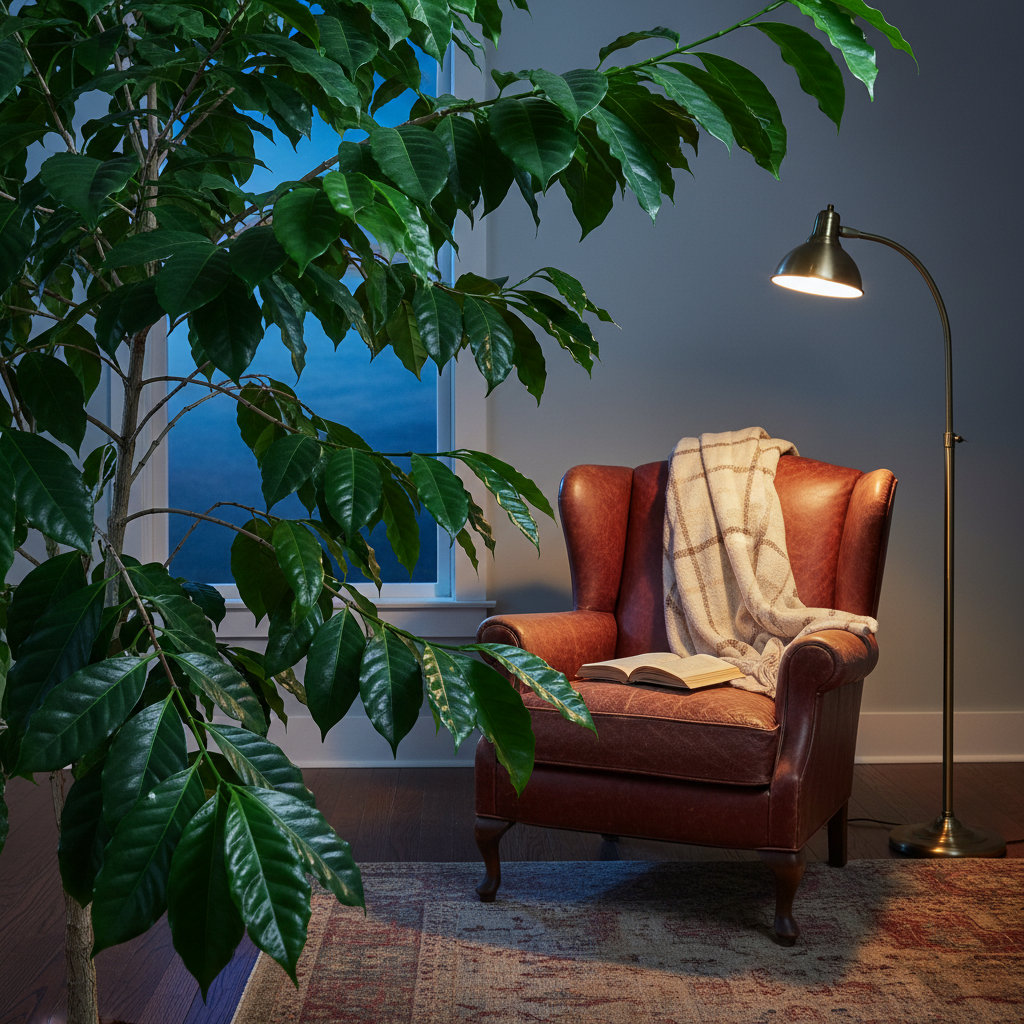
Beyond looks, the coffee plant offers something most houseplants cannot: the possibility of a meaningful harvest. A well-cared-for specimen will, after three to five years, produce clusters of small, sweetly fragrant white flowers along its stems. These are followed by green berries that ripen slowly through yellow to deep red over six to nine months, and inside each cherry are the two paired beans that, once roasted, become the coffee in your cup. The yields from a single houseplant are tiny, but the experience of harvesting, fermenting, drying and roasting your own coffee, even a single cup of it, is the kind of thing that turns a casual plant owner into a serious one.
Important — Toxicity: Every part of the coffee plant contains caffeine and related methylxanthine alkaloids. The unripe green berries are the most concentrated, but the leaves are also mildly toxic if chewed. Keep coffee plants out of reach of dogs, cats and small children, and wash hands after pruning. Symptoms of ingestion in pets include vomiting, restlessness, tremors and an elevated heart rate; contact a veterinarian if you suspect a pet has eaten any part of the plant.
Light Requirements
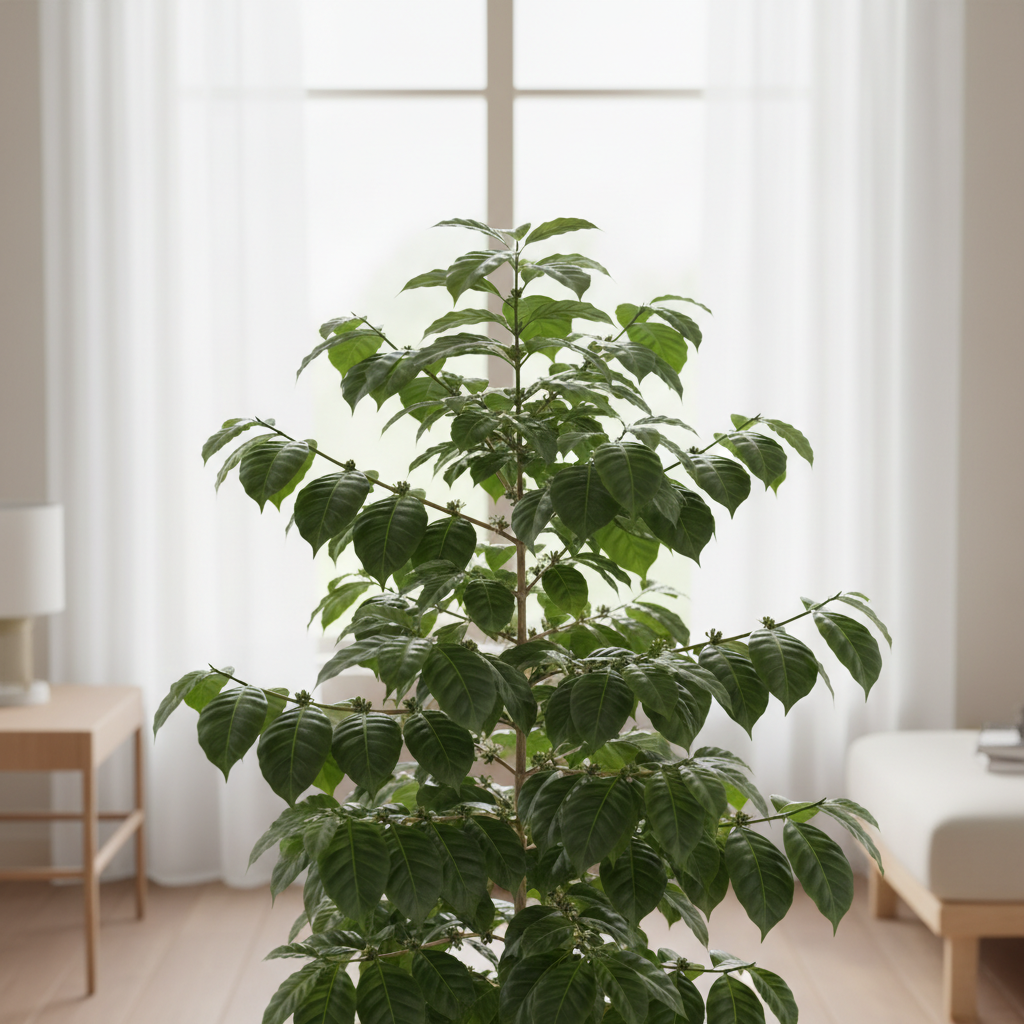
In its native Ethiopian highland forests, the coffee plant grows as an understorey tree, sheltered from the harsh equatorial midday sun by the canopy of taller forest trees. That shaded but bright environment is exactly what you should try to recreate indoors. A coffee plant kept in true low light will hold its leaves but produce no new growth and certainly no flowers; a coffee plant baked in direct summer sun will scorch, drop leaves and look sickly within weeks. The sweet spot is bright, filtered light for most of the day, with perhaps an hour or two of gentle morning sun.
If you can read a paperback comfortably without turning on a lamp at midday, you are probably in the right light zone for a coffee plant. The real test, though, is the leaves themselves. Healthy coffee foliage is a saturated mid to dark green with a perceptible shine; pale, yellow-tinged leaves often mean the plant is in too much sun, while a stretched habit with widely spaced pairs of small leaves usually means it is in too little.
Light Levels Explained
Plant care literature tends to use vague phrases like "bright indirect", but most of us can be more precise. The numbers below describe the foot-candles and lux levels that correspond to common positions in a home, and the way a coffee plant tends to respond to each.
| Light Category | Approx. Level | Typical Location | Outcome |
|---|---|---|---|
| Direct sun | Over 50,000 lux | Unshaded south or west window in summer | Leaf scorch, bleaching, leaf drop within days to weeks |
| Bright indirect | 15,000 to 30,000 lux | Within 1 metre of a curtained south or east window | Ideal: vigorous growth, deep green colour, potential flowering |
| Medium | 5,000 to 15,000 lux | A few metres into a bright room, north-east window | Slow steady growth, fewer new leaves, no flowering |
| Low | 1,000 to 5,000 lux | Deeper interiors, away from windows | Survival only; leaves fade, lower leaves drop, no flowering |
| Very low | Under 1,000 lux | Hallways, windowless bathrooms | Decline within months; not viable long-term |
Window Orientation and Placement
South-facing window: The most productive position for a coffee plant in the Northern Hemisphere, but only when the strongest direct rays are softened by a sheer curtain or by setting the plant back 1 to 2 metres from the glass. Direct, unfiltered south sun in summer will cause sun scald within days. A south window in winter, when the sun is weaker and lower, is usually perfectly safe at any distance.
East-facing window: Often the best all-round position. A coffee plant directly on an east-facing windowsill receives a couple of hours of gentle morning sun, then bright indirect light for the rest of the day, which mimics the dappled forest canopy of its native habitat very well.
West-facing window: Workable, but the afternoon sun in spring and summer can be intense and is often delivered together with peak room temperature. Use a sheer curtain, move the plant a metre back from the glass, or rotate it out of the worst of the afternoon light.
North-facing window: Possible only in summer or in very bright north-facing rooms. A pure north window in winter is usually too dim to keep a coffee plant in active growth, and the plant will simply hold steady until brighter weather returns.
Pro Tip — Rotate Weekly: Coffee plants are phototropic and will lean towards their brightest light source over time, eventually growing visibly lopsided. Give the pot a quarter turn each week so all sides get equal exposure. The plant will reward you with an even, balanced canopy rather than a one-sided tree.
How Light Affects Growth and Flowering
Light intensity is the single biggest factor in whether an indoor coffee plant will ever flower. In commercial plantations, coffee trees receive between 1,500 and 2,500 hours of bright filtered light per year. Few houseplants get anywhere close to that, which is why most indoor coffee plants spend their lives as handsome foliage specimens. If your goal is to coax a plant into bloom, you need the brightest possible position short of direct midday sun, and you need to maintain that intensity year-round, which usually means supplementing with grow-lights in winter.
Warning — Direct Sunlight: A coffee plant accustomed to indoor light cannot suddenly be moved into an unshaded south-facing window or onto a sunny balcony. The leaves will bleach to pale yellow within hours and develop dry, papery scorch patches within a day or two. Any move to a brighter position should be made gradually over two to three weeks, increasing exposure by an hour or so per day.
Artificial Lighting
A full-spectrum LED grow-light is the most reliable way to keep a coffee plant happy through a dark northern winter. Aim for a fixture delivering roughly 200 to 400 micromoles per square metre per second of photosynthetic photon flux density at the top of the canopy, positioned 30 to 50 cm above the plant, on a timer running 10 to 12 hours a day. The cooler-spectrum daylight bulbs (around 5,000 to 6,500 Kelvin) produce the most natural-looking foliage colour, but warm-white bulbs work too and look less obtrusive in a living room.
Seasonal Adjustments
Light intensity inside a home varies more between seasons than most growers realise. A position that is perfectly bright in October can be inadequate by January, and a windowsill that is gentle in March can be punishing in July. Move coffee plants closer to bright windows in autumn and winter, and farther away (or behind a sheer curtain) in late spring and summer. Twice a year, ideally at the equinoxes, take five minutes to reassess every plant in the home and shift them as needed.
Watering and Humidity
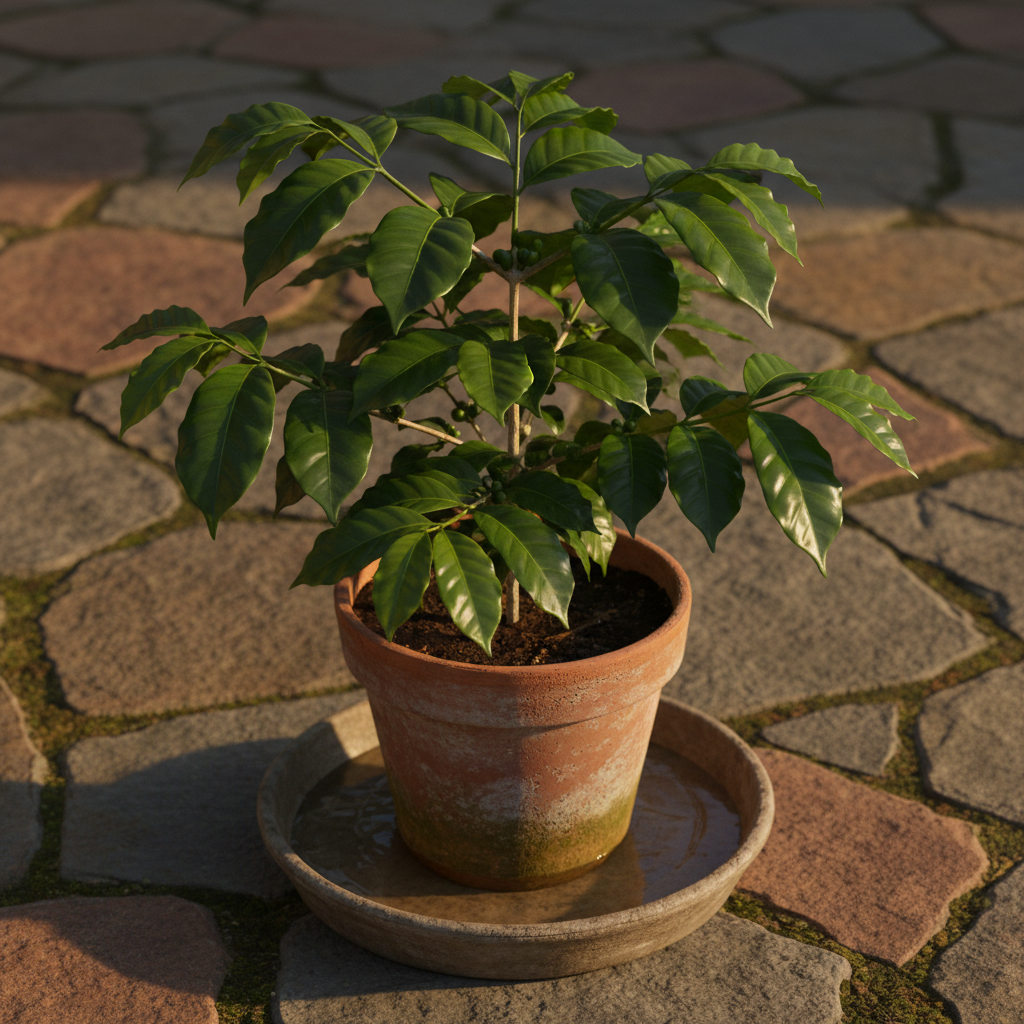
Watering is where most coffee plants are lost, and the failure usually comes from one of two extremes: bone-dry neglect or perpetually soggy soil. Unlike succulents or aroids, coffee plants come from a regularly rainy mountain environment and prefer their root zone to be evenly moist at all times, but they cannot tolerate stagnant water around their roots. The goal is therefore consistent, deep watering whenever the top of the substrate starts to dry, with enough drainage that no water sits in the saucer for more than a few minutes.
When to Water
The most reliable test is the finger test. Push a finger 2 to 3 cm into the soil. If it comes out with damp particles clinging to it, wait a day or two. If it comes out dry and clean, it is time to water. In a warm, bright spot a coffee plant in a 20 cm pot will usually need watering every five to seven days in summer and every ten to fourteen days in winter, but counting days is a poor substitute for actually checking the soil.
A wooden chopstick or a cheap moisture meter pushed deeper into the root ball gives you a more honest reading than a finger in the top layer. Coffee plants are particularly prone to a dry pocket developing in the middle of the root ball even when the top of the soil looks moist, especially in deeper pots, so an occasional deep probe is worth the trouble.
Pro Tip — Lift the Pot: The fastest way to read soil moisture is to lift the pot. A freshly watered coffee plant in a 20 cm container is noticeably heavy; the same pot three or four days later is markedly lighter. After a fortnight of weighing your plants by hand you will have an intuitive sense of when each one is ready for another drink, no moisture meter required.
How to Water Correctly
- Take the plant to a sink or place it on a tray that can catch the runoff.
- Pour room-temperature water slowly around the base of the plant until you see a steady stream emerging from the drainage holes.
- Wait a minute or two, then water again. The first pass rewets the soil; the second pass actually moves moisture through the entire root ball.
- Let the pot drain completely for 10 to 15 minutes before returning it to its decorative cover or saucer.
- Empty any standing water from the saucer; coffee plants will not tolerate sitting in a puddle.
- Wipe up any splashes on the leaves, especially if you live in a hard-water area, to prevent calcium spots forming on the foliage.
Signs of Overwatering vs. Underwatering
| Symptom | Overwatering | Underwatering |
|---|---|---|
| Leaf colour | Lower leaves turn yellow first, sometimes with brown blotches; uniformly dull green canopy | Leaves go pale and crispy at the edges, eventually browning from the tips inward |
| Leaf texture | Soft and limp; the whole leaf may feel slightly clammy | Dry, papery and brittle; leaves curl downward and inward |
| Soil | Wet for many days after watering; sometimes a sour smell or visible algae on the surface | Pulls away from the sides of the pot; rock-hard and difficult to rewet |
| Roots | Dark brown, mushy, slipping out of their outer skin when touched | Pale tan, thin and brittle; the root ball is dry to the centre |
| Stem base | Soft, sometimes blackening at the soil line | Firm but the canopy droops dramatically and recovers within hours of watering |
Warning — Root Rot: Once the lower stem of a coffee plant has gone soft and blackened, the plant is usually beyond saving with watering changes alone. Unpot immediately, cut all mushy roots back to firm white tissue with sterile scissors, dust the cuts with cinnamon or a horticultural fungicide, and repot into fresh, dry, well-draining mix. Withhold water for two or three days, then resume with very modest amounts. Many coffee plants will not recover from a serious root rot episode, so prevention is far easier than treatment.
Humidity Requirements
Coffee plants come from cloud forests where ambient humidity hovers between 60 and 80 percent year-round, with a near-constant drift of mist in the early morning. Indoor air, especially in heated homes in winter, is far drier than that, often dropping below 30 percent in January. A coffee plant in those conditions will hang on, but the leaf tips will brown, the lower leaves will yellow and drop, and new growth will look stunted and chlorotic.
The first symptom of insufficient humidity is almost always crispy brown tips on the youngest leaves. If you see that, do not assume the plant is underwatered; check the air around it first. A simple hygrometer placed beside the plant for a few days will tell you whether the issue is moisture in the soil or moisture in the air.
To raise the local humidity around a coffee plant, group it with other plants, set the pot on a saucer of pebbles topped up with water (making sure the pot itself does not sit in the water), or run a small ultrasonic humidifier in the room. Misting offers a brief lift of perhaps half an hour, which is better than nothing but not a real solution; consistent ambient humidity matters far more than a daily spray.
Water Quality
Coffee plants are mildly sensitive to fluoride, chlorine and very hard water. Tap water works for most growers, but if your municipal supply is heavily chlorinated, leave a watering can open for 24 hours before use so the chlorine can dissipate. In hard-water areas, the calcium and magnesium can gradually push the soil pH up out of the slightly acidic range that coffee prefers, so an occasional flush with rainwater, distilled water or filtered water is a useful habit. If brown tip burn appears even when humidity is good, water quality is the next thing to suspect.
Soil, Potting and Repotting
In the wild, coffee plants grow in deep, friable volcanic soils that are rich in organic matter, free-draining, and slightly acidic. Indoors, the goal is to replicate that profile with materials that are easy to source from any garden centre. A plain bag of general-purpose potting compost is workable but often retains too much moisture and compacts over time; a custom mix delivers visibly better growth and is well worth the small extra effort.
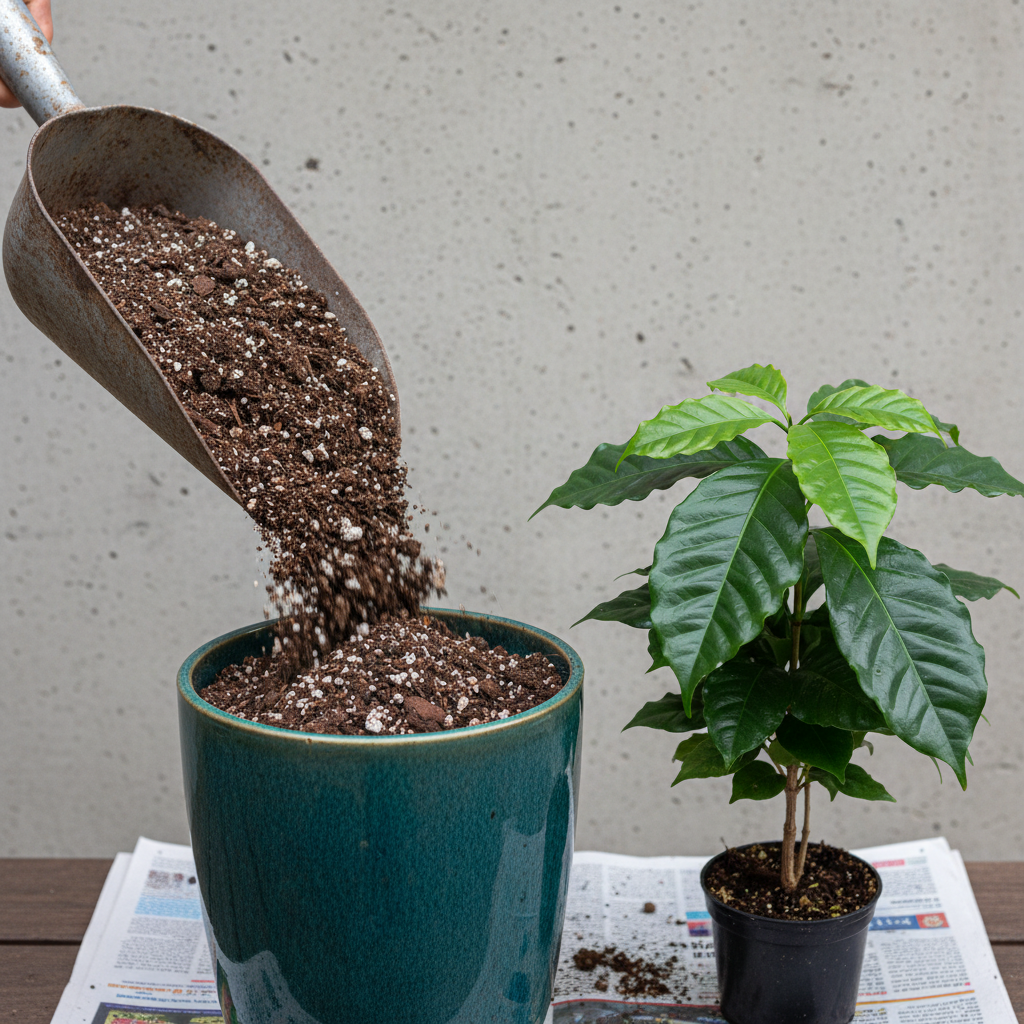
Ideal Soil Composition
A good coffee plant mix is dark, fluffy and crumbly. When you squeeze a handful and release it, the mix should hold together briefly and then fall apart in your palm. If it stays clumped like clay, it will compact in the pot; if it falls apart instantly like sand, it will dry out too fast.
| Component | Proportion | Function |
|---|---|---|
| Quality loam-based compost | 50 percent | Provides structure, nutrients and a buffered pH |
| Coco coir or peat-free compost | 20 percent | Holds moisture without becoming waterlogged |
| Perlite or pumice | 20 percent | Opens up the mix and prevents compaction |
| Fine orchid bark | 10 percent | Creates micro air pockets and slow-releasing organic matter |
| Worm castings (optional) | 1 to 2 handfuls per 5 litres | Adds slow-release nitrogen and beneficial microbes |
Aim for a soil pH between 5.5 and 6.5. Most peat-free or loam-based composts sit naturally within that range, but persistent watering with hard tap water can push the pH higher over time. If older plants begin to show pale, yellowish new growth despite regular feeding, suspect that the pH has drifted alkaline and refresh the top few centimetres of soil, or flush the pot with rainwater and a pinch of soil acidifier.
Pro Tip — Quick Mix Recipe: A foolproof house-blend recipe is one part quality houseplant compost, one part coco coir, half a part perlite and a small handful of fine bark per 5 litres of finished mix. Add a tablespoon of worm castings if you have them, mix everything thoroughly in a large tray or bucket, moisten the blend lightly with a mister before potting, and you have a coffee-friendly substrate that will last 18 to 24 months before it needs refreshing.
Choosing the Right Pot
Coffee plants have a moderately deep, fibrous root system that is happiest in a pot a fraction taller than it is wide. A snug fit encourages a denser root mass and modest top growth, while a pot that is dramatically oversized leaves great volumes of damp soil that the roots cannot occupy and slows the plant down for months.
Drainage holes are non-negotiable. A pot without proper drainage holes will eventually kill a coffee plant, no matter how careful your watering is. The decorative ceramic cover-pots that are popular for houseplants are fine to keep the look of a setup, but the actual growing pot inside should always have generous drainage at the bottom, and you should lift the inner pot out to empty any collected water after each watering.
Pot material: Terracotta wicks moisture and helps prevent overwatering, but it dries out faster in summer and in hot rooms. Glazed ceramic and plastic retain moisture longer and reduce watering frequency, which suits people who tend to forget watering more than people who tend to overdo it. Whichever you choose, do not be tempted by sealed brass or copper containers without an inner pot; the metals leach into the soil and harm the roots.
Pot size: When upsizing, go up by 2 to 3 cm of internal diameter at a time. A jump from a 15 cm pot straight to a 25 cm pot leaves a halo of damp, unused soil around the roots, and that halo is exactly where root rot tends to start. Smaller, more frequent repots into modestly larger containers are far gentler on the plant.
When to Repot
A young, vigorous coffee plant typically needs repotting once a year, ideally in early spring just as growth resumes. An older, slower-growing specimen can stretch that to once every two or three years. The signs that a repot is overdue include roots emerging from the drainage holes, water running straight through the pot without soaking in, the plant becoming dramatically top-heavy, and a noticeable slowdown in new leaf production despite good light and feeding.
How to Repot: Step-by-Step
- Water the plant thoroughly the day before; a hydrated root ball slips out of its pot far more cleanly than a dry one and suffers less damage in transit.
- Prepare the new pot by adding a 3 to 5 cm layer of fresh mix to the bottom, leaving room for the root ball above it.
- Tip the plant on its side and gently work the root ball out, supporting the main stem with one hand. If the plant resists, run a thin knife around the inside edge of the old pot to release it.
- Tease the outer roots free if they are circling the bottom of the root ball, and trim away any obviously dead, mushy or smelly tissue with sterile scissors.
- Centre the plant in the new pot at the same depth it sat in the old one (the soil line should match), and backfill around the sides with fresh mix, firming gently as you go.
- Water in thoroughly until the runoff is clear, allow the pot to drain, and return the plant to a slightly shadier spot for the next week or so to recover.
- Resume normal care after about ten days; hold off on fertiliser for four to six weeks to give the disturbed roots time to settle.
Warning — Transplant Shock: A coffee plant that drops a few leaves in the fortnight after a repot is not dying; it is simply adjusting to its new root environment. Resist the temptation to water more heavily, fertilise, or move the plant to a brighter spot during this period, all of which compound the stress. Keep conditions calm and stable, and new growth usually resumes within six to eight weeks.
Fertilising
Coffee plants are moderately heavy feeders during the growing season. In the wild they draw nutrients from the deep, biologically active forest floor, with a steady drip of nitrogen from decomposing leaf litter and the occasional pulse of phosphorus and potassium from heavier rains. Indoors, your job is to recreate that gentle, sustained nutrient supply without overdoing it.
Underfeeding shows up as pale, washed-out new leaves and slow growth; overfeeding shows up as scorched leaf margins, salt crust on the soil surface and, in severe cases, blackened root tips. The goal is the boring middle: green, glossy new growth that emerges steadily through spring and summer.
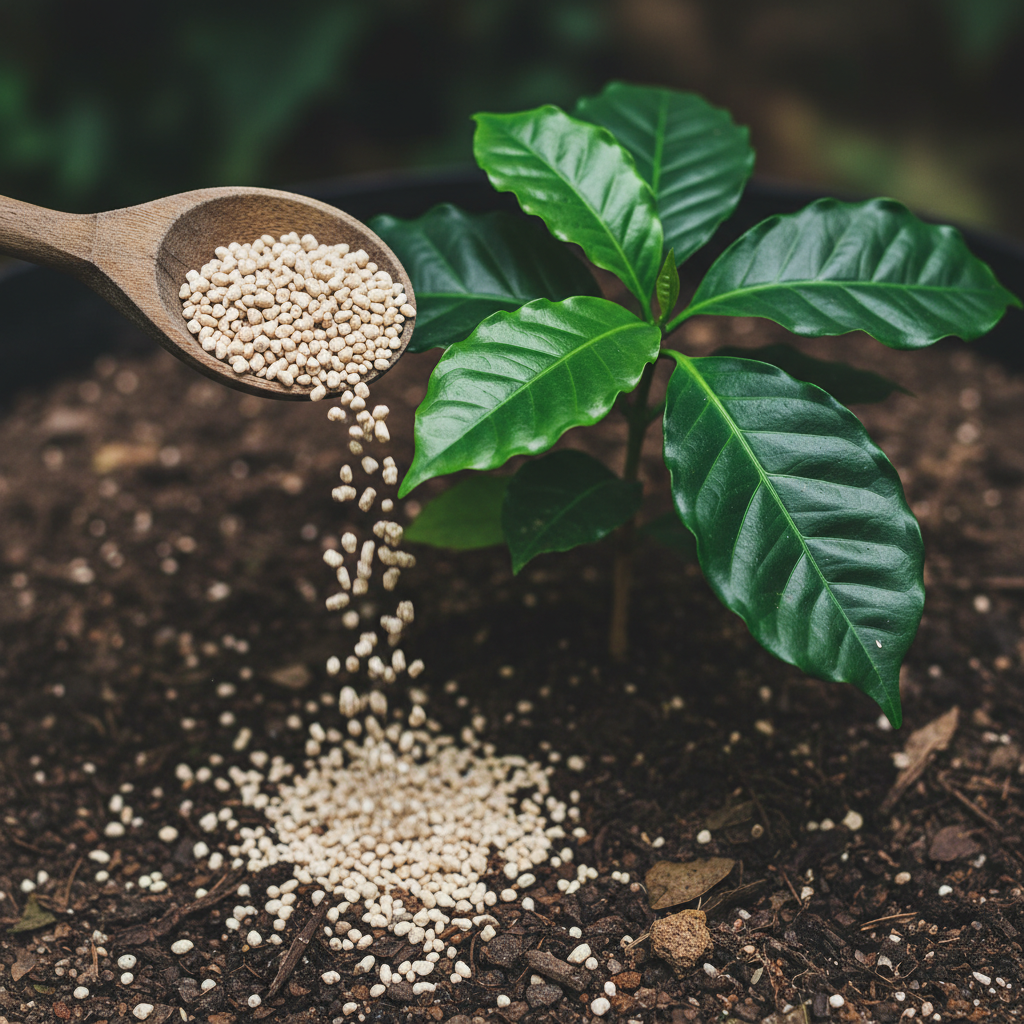
Understanding Plant Nutrients
Like any flowering and fruiting plant, the coffee plant needs a balanced supply of three primary macronutrients (nitrogen, phosphorus and potassium), the secondary macronutrients calcium and magnesium, and a small but essential supply of micronutrients including iron, manganese, zinc and boron. Coffee in particular is notoriously prone to iron and magnesium deficiency in alkaline soils, which is one of the reasons keeping the soil slightly acidic matters.
| Nutrient | Symbol | Primary Function | Deficiency Symptoms |
|---|---|---|---|
| Nitrogen | N | Foliage and stem growth, chlorophyll | Pale, uniformly yellow lower leaves; slow growth |
| Phosphorus | P | Roots, flowers and fruit set | Purplish undersides on older leaves; few flowers |
| Potassium | K | Overall vigour, drought and disease resistance | Yellowing and browning leaf margins, especially on older leaves |
| Calcium | Ca | Cell wall structure, new growth | Distorted or hooked new leaves, brown tips |
| Magnesium | Mg | Chlorophyll synthesis | Interveinal yellowing on older leaves while veins stay green |
| Iron | Fe | Chlorophyll synthesis (new growth) | Interveinal yellowing on the newest leaves, with sharp green veins |
Types of Fertiliser
Liquid fertilisers: The most versatile option for a houseplant coffee. A balanced N-P-K formula in the range of 10-10-10 or 20-20-20, diluted to half the manufacturer's recommended strength and applied every two weeks from early spring to late summer, suits most plants. Specialist citrus or acid-loving plant feeds, which are designed for a similar pH preference, work very well and often include the trace iron and magnesium that coffee plants appreciate.
Slow-release granular: Convenient for growers who travel or forget regular feeding. Scatter a teaspoon of prills onto the soil surface in early spring, top up after three or four months, and let them release nutrients each time you water. Use a formulation labelled for indoor flowering plants rather than a generic lawn fertiliser.
Organic fertilisers: Worm castings, well-rotted compost, fish emulsion and seaweed feeds are all good options and tend to build long-term soil health better than synthetic feeds. They release nutrients more slowly, which is forgiving of overuse, and they encourage the kind of microbial activity that makes a long-lived coffee plant thrive. The trade-off is that some organic feeds, particularly fish-based ones, smell strongly for a day or two after application.
Feeding Schedule
From early spring through late summer (roughly March to September in the Northern Hemisphere), feed at half strength every two weeks. In autumn, taper to once a month at quarter strength, and in winter (November to February), stop feeding altogether. Resume only when you see clear signs of new growth in late winter or early spring.
Pro Tip — Half Strength, Twice as Often: Coffee plants respond far better to a steady drip of weak feed than to occasional strong doses. Mix any liquid fertiliser at half the manufacturer's recommendation and apply it more often. You get the same total monthly nitrogen but a much smoother growth response and almost no risk of fertiliser burn.
How to Fertilise
- Water the plant lightly with plain water first; fertilising into bone-dry soil can burn the fine feeder roots.
- Mix the chosen liquid fertiliser at half the recommended strength in a clean watering can with room-temperature water.
- Pour the diluted solution evenly across the soil surface until you see a small amount of runoff at the bottom.
- Allow the pot to drain completely; empty any standing solution from the saucer.
- Every fourth or fifth feed, replace the diluted fertiliser with a plain-water flush to wash any accumulated mineral salts out of the root zone.
Warning — Salt Build-Up: A white or yellowish crust on the soil surface, or the inside rim of a terracotta pot, is a clear sign that mineral salts from tap water or fertiliser have accumulated to harmful levels. Flush the pot thoroughly with three or four pot-volumes of plain rainwater or filtered water and skip the next two feeds. If the crust persists after flushing, scrape off the top centimetre of soil and replace with fresh mix.
Propagation
Coffee plants can be propagated in two main ways at home: from fresh seed (the unroasted green beans of a ripe cherry) or from semi-hardwood stem cuttings. Each route produces a genetically different result and suits a different timescale. Seed-grown plants are the slowest to fruit but produce the most natural upright tree habit; cuttings inherit the parent's exact genetics and tend to mature into flowering and fruiting more quickly, but often develop a slightly more compact, lateral habit.
Stem cuttings are the easier method for most home growers, mostly because viable fresh seed is hard to source. Roasted supermarket coffee beans will not germinate; only the green, unroasted seed from a recently ripened cherry retains viability, and even those lose germination potential within a few weeks of harvest.
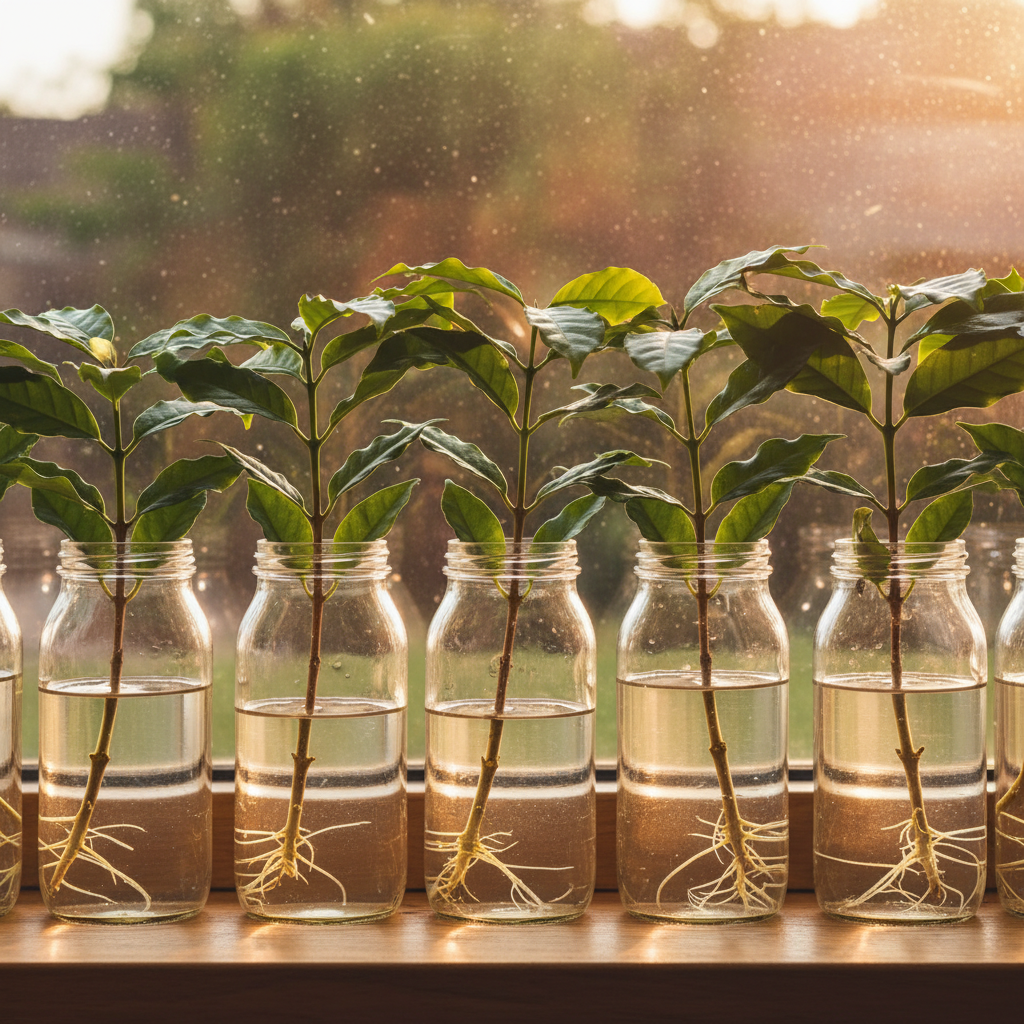
Understanding the Coffee Plant Node
A "node" on a coffee plant is the slight swelling on a stem where a pair of leaves meets. The node carries the dormant buds that, given the right conditions, will produce new roots. A successful cutting always includes at least one node below the water or substrate line, and ideally one or two more above it bearing leaves. A leafless stem section, no matter how long, will not root.
Method 1 — Stem Cuttings: Step-by-Step
This is the most reliable home method. Take cuttings in late spring or early summer, when the plant is in active growth and ambient warmth is at its peak. Avoid taking cuttings in winter; success rates fall dramatically.
- Choose a healthy semi-hardwood stem, one that has matured beyond the soft green of new growth but is not yet fully woody and brittle. The ideal cutting is 10 to 15 cm long and pencil-thick at its base.
- Using sterilised secateurs, cut just below a node at the base and just above a leaf pair at the top.
- Remove the lower pair of leaves entirely; trim the remaining upper leaves in half to reduce moisture loss while the cutting has no roots.
- Dip the cut base in a rooting hormone gel or powder; this is optional but improves success rates noticeably with coffee.
- Insert the cutting into a small pot of moist perlite, or into a glass of clean room-temperature water, deep enough that the lowest node is fully submerged or buried.
- Cover the pot with a clear plastic bag or place it under a humidity dome, keeping it in bright, indirect light at 22 to 26 degrees Celsius (72 to 79 Fahrenheit). Roots should emerge within four to eight weeks; pot up into normal mix once they are 3 to 5 cm long.
Pro Tip — Bottom Heat: Coffee cuttings root noticeably faster when their base is gently warmed. A seedling heat mat set to 24 to 26 degrees Celsius (75 to 79 Fahrenheit) under the propagation tray can cut rooting time roughly in half and is one of the simplest upgrades a home propagator can make.
Method 2 — From Fresh Seed: Step-by-Step
If you can obtain fresh, unroasted green coffee beans (sometimes available from specialty roasters who buy them as raw stock, or from anyone whose own coffee plant has fruited), seed propagation is rewarding but slow. Expect two to three years before the resulting seedlings start to look like proper trees.
- Soak the green beans in clean room-temperature water for 24 hours to soften the papery silver skin and rehydrate the seed.
- Fill a tray or small pot with damp seed-starting mix or pure vermiculite, and press each bean horizontally, flat side down, just below the surface.
- Cover the tray with clear plastic to hold humidity, and keep it warm: 26 to 30 degrees Celsius (79 to 86 Fahrenheit) is ideal. A heated propagator is almost essential.
- Germination is slow and uneven, often taking eight to twelve weeks. Keep the substrate consistently damp but never waterlogged.
- Once each seedling has produced its first true pair of leaves above the cotyledons, pot it on into a small individual pot of standard coffee plant mix.
Troubleshooting Propagation
| Problem | Likely Cause | Solution |
|---|---|---|
| Cutting wilts within days | Too much leaf area, insufficient humidity | Reduce remaining leaves to half size; cover with a humidity dome |
| Cutting base turns black and slimy | Bacterial or fungal rot in stagnant water | Change water every three days; switch to perlite or sphagnum medium |
| Cutting holds steady but never roots | Temperature too low | Move to a warmer position or add a heat mat |
| Seeds fail to germinate | Old or roasted seed | Use only fresh green coffee beans harvested within the last four to six weeks |
Pests and Diseases
Coffee plants kept indoors are relatively pest-resistant compared with thinner-leaved tropicals such as calatheas or fittonias, but they are not immune. The dense canopy and broad, glossy leaves provide hiding places for the same opportunistic pests that affect most houseplants, and a stressed coffee plant (one that is underwatered, underfed or in dry air) attracts trouble far faster than a thriving one.
Inspect the undersides of leaves, the leaf axils where they join the stem, and any new growth on a coffee plant every week or two. Most pest infestations are easy to handle when caught early and miserable to deal with once established.
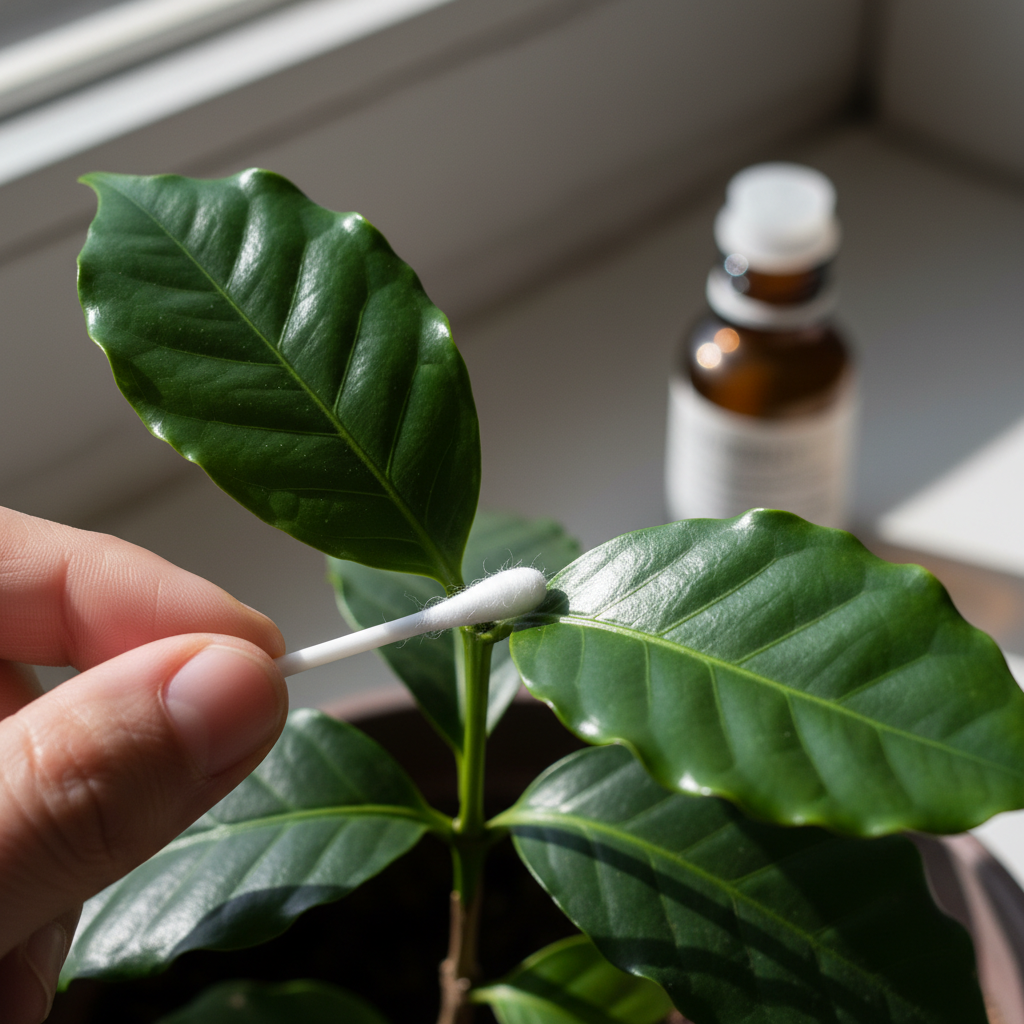
Common Pests
Spider Mites (Tetranychus urticae)
The most common pest of indoor coffee plants, especially in heated winter homes where the air is dry. Spider mites are barely visible to the naked eye but reveal themselves through fine pale stippling on the upper leaf surface, a slightly dusty look on the undersides and, in advanced infestations, fine silken webbing in the leaf axils.
Treatment: Move the plant to a sink or shower and rinse the entire canopy, top and underside, with a forceful jet of room-temperature water. Repeat every five days for three weeks to break the life cycle. For persistent infestations, follow each rinse with a spray of insecticidal soap or 1 percent neem oil solution, focusing on leaf undersides. Raising humidity around the plant makes the environment far less hospitable to mites.
Mealybugs (Planococcus citri)
Small, soft-bodied, sap-sucking insects covered in a distinctive white cottony wax. They hide in leaf axils and along stems, leaving sticky honeydew that can develop into sooty mould. New leaves emerging in an infested plant often look stunted or curled.
Treatment: Dab each visible mealybug with a cotton bud dipped in 70 percent isopropyl alcohol, which kills them on contact and dissolves their waxy coating. Follow up with a weekly neem oil or insecticidal soap drench for three weeks. Mealybugs are slow to reappear but very persistent if not fully eradicated.
Scale Insects (Coccus viridis and others)
Coffee plants are vulnerable to several scale species, particularly the green coffee scale that has plagued coffee plantations for centuries. They appear as small, oval, slightly domed brown or green bumps on stems and the undersides of leaves, often along the midrib. Sticky honeydew on the leaves below an infestation is usually the first clue.
Treatment: Scrape visible scale off with a fingernail or soft toothbrush, then treat with a horticultural oil spray to suffocate any survivors and crawlers. Repeat every ten days for at least three rounds. Heavy infestations may justify a systemic insecticide drench applied to the soil, but use these sparingly and only on plants you do not plan to harvest beans from.
Thrips (Frankliniella occidentalis)
Slender, fast-moving, almost translucent insects that rasp at leaf tissue and feed on the resulting sap. The damage looks like silvery streaks and small black specks (their droppings) on the upper leaf surface. Thrips are most often introduced on newly purchased plants or cut flowers.
Treatment: Hang bright yellow or blue sticky traps near the plant to monitor and reduce adult numbers. Treat the foliage with spinosad spray or insecticidal soap every five to seven days for three weeks; thrips have a fast life cycle and one-off treatments rarely succeed.
Common Diseases
Coffee Leaf Rust (Hemileia vastatrix)
The most economically damaging disease of coffee worldwide and an occasional, if unwelcome, problem on indoor plants. It appears first as small pale yellow spots on the upper leaf surface, with corresponding bright orange powdery patches of fungal spores on the underside. Affected leaves yellow and drop, and severely infected plants can defoliate within weeks.
Treatment: Remove and bag every visibly affected leaf, do not compost them. Improve air circulation around the plant, reduce overhead watering, and treat with a copper-based or systemic fungicide labelled for ornamental use. Severely affected plants are usually better discarded than treated, as the disease is highly contagious to other coffee plants.
Root Rot (Pythium and Phytophthora spp.)
The most common fatal disease of indoor coffee plants, caused by water moulds that thrive in saturated, oxygen-poor soil. The symptoms above ground (yellowing lower leaves, soft drooping new growth, a sour smell from the pot) often appear only after the underground damage is well advanced.
Treatment: See the watering section above for full instructions. Prevention through proper drainage and watering discipline is far more effective than treatment.
Sooty Mould (various Capnodium spp.)
Not a disease of the plant itself but a black, soot-like fungus that grows on the sticky honeydew secreted by sap-sucking pests such as scale, mealybugs and aphids. It coats the leaf surface, blocks light and weakens the plant indirectly.
Treatment: Wipe affected leaves with a soft damp cloth or a weak solution of insecticidal soap to remove the mould, and treat the underlying pest infestation. Sooty mould always disappears once its food source (the honeydew) is gone.
Pest and Disease Summary
| Pest / Disease | Identification | Treatment |
|---|---|---|
| Spider mites | Fine stippling, dusty undersides, fine webbing | Forceful water rinse plus weekly insecticidal soap or neem |
| Mealybugs | White cottony clusters in leaf axils | Cotton bud with 70 percent alcohol plus neem follow-up |
| Scale | Small brown or green bumps on stems and leaf undersides | Scrape off, then weekly horticultural oil for three weeks |
| Thrips | Silvery streaks and tiny black specks on leaves | Sticky traps plus spinosad or insecticidal soap |
| Leaf rust | Yellow spots on top, orange powdery patches below | Remove affected leaves, treat with copper fungicide |
| Root rot | Soft black stem base, sour-smelling wet soil | Unpot, trim rotten roots, repot in fresh dry mix |
| Sooty mould | Black soot-like coating over leaves | Wipe clean, treat the underlying pest |
Prevention Strategies
The single best preventive measure is to inspect new plants thoroughly before bringing them home, and to quarantine them away from your existing collection for two weeks regardless. Most pest outbreaks in indoor coffee plants trace back to a hitchhiker on a recently acquired plant, not to spontaneous infestations.
Beyond quarantine, healthy growing conditions matter more than any pesticide. A coffee plant that is well fed, evenly watered and kept in adequate humidity is much less attractive to spider mites and scale than one that is stressed. Wiping the leaves with a damp cloth every few weeks removes dust, exposes any early infestation and gives you a chance to spot problems before they take hold.
Pro Tip — The Weekly Inspection: Set a recurring weekly reminder to spend two minutes looking at each coffee plant: tops and undersides of three random leaves, the stems near the soil line, and the leaf axils where pests like to hide. A pest you catch in week one takes an evening to deal with; the same pest in week six can mean months of repeated treatments.
Popular Varieties
Almost every coffee plant sold as a houseplant is Coffea arabica, the species responsible for around 60 percent of the world's commercial coffee. Within that species there are dozens of named cultivars, most of which were selected by coffee farmers for traits such as bean size, disease resistance or yield rather than ornamental appeal. A handful, however, have made the leap into the houseplant trade thanks to their compact habit or their interesting foliage and growth.
Beyond Coffea arabica, growers occasionally see Coffea canephora (Robusta) and Coffea liberica offered as novelties. Both are larger, hardier and less refined than Arabica in cup quality, but they can be entertaining curiosities for a serious houseplant collector.
| Variety | Leaf Appearance | Light Needs | Growth Rate | Availability |
|---|---|---|---|---|
| Arabica 'Nana' | Small, dense, glossy dark green | Bright indirect | Slow, compact | Common in houseplant trade |
| Arabica 'Bourbon' | Broad oval, deep green, slightly bronzed new growth | Bright indirect | Moderate | Specialist nurseries and seed exchanges |
| Arabica 'Typica' | Classic elongated leaves, bronzed tips | Bright indirect | Moderate | Specialist nurseries |
| Arabica 'Catura' | Compact, glossy mid-green | Bright indirect | Slow to moderate | Coffee-trade and specialist sources |
| Arabica 'Maragogype' | Strikingly large, broad leaves and beans | Bright indirect | Moderate to fast | Rare, specialist only |
| Coffea canephora (Robusta) | Larger, slightly rougher leaves | Bright indirect, tolerates lower humidity | Fast | Uncommon in retail |
| Coffea liberica | Very large, leathery, paddle-shaped leaves | Bright indirect | Fast | Rare collector species |
Featured Varieties
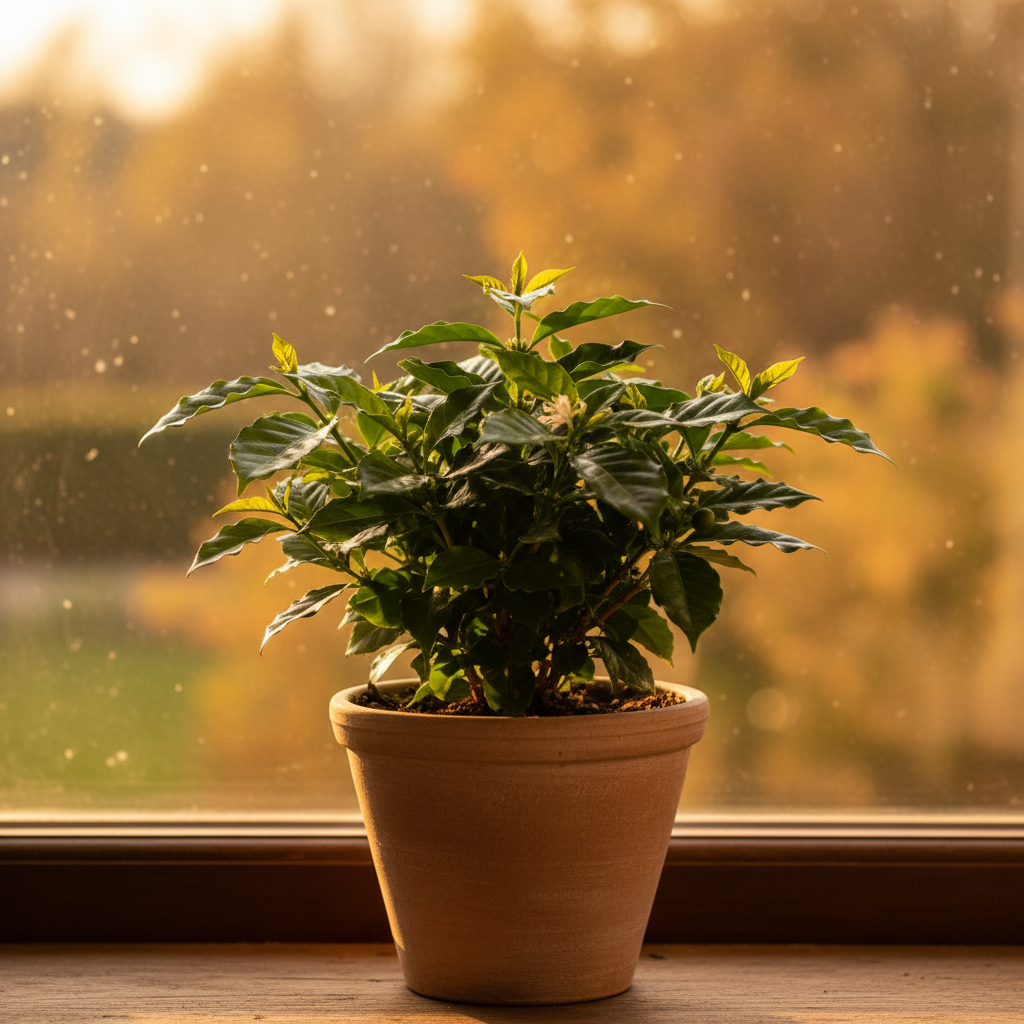
Arabica 'Nana'
The dwarf cultivar most often sold as an indoor coffee plant. 'Nana' tops out around 80 cm to 1 metre in a typical living-room pot, producing densely arranged glossy lance-shaped leaves on a compact, well-branched frame. Its smaller scale and slower growth make it ideal for windowsills and small flats, and it tends to flower at a younger age than full-sized cultivars.
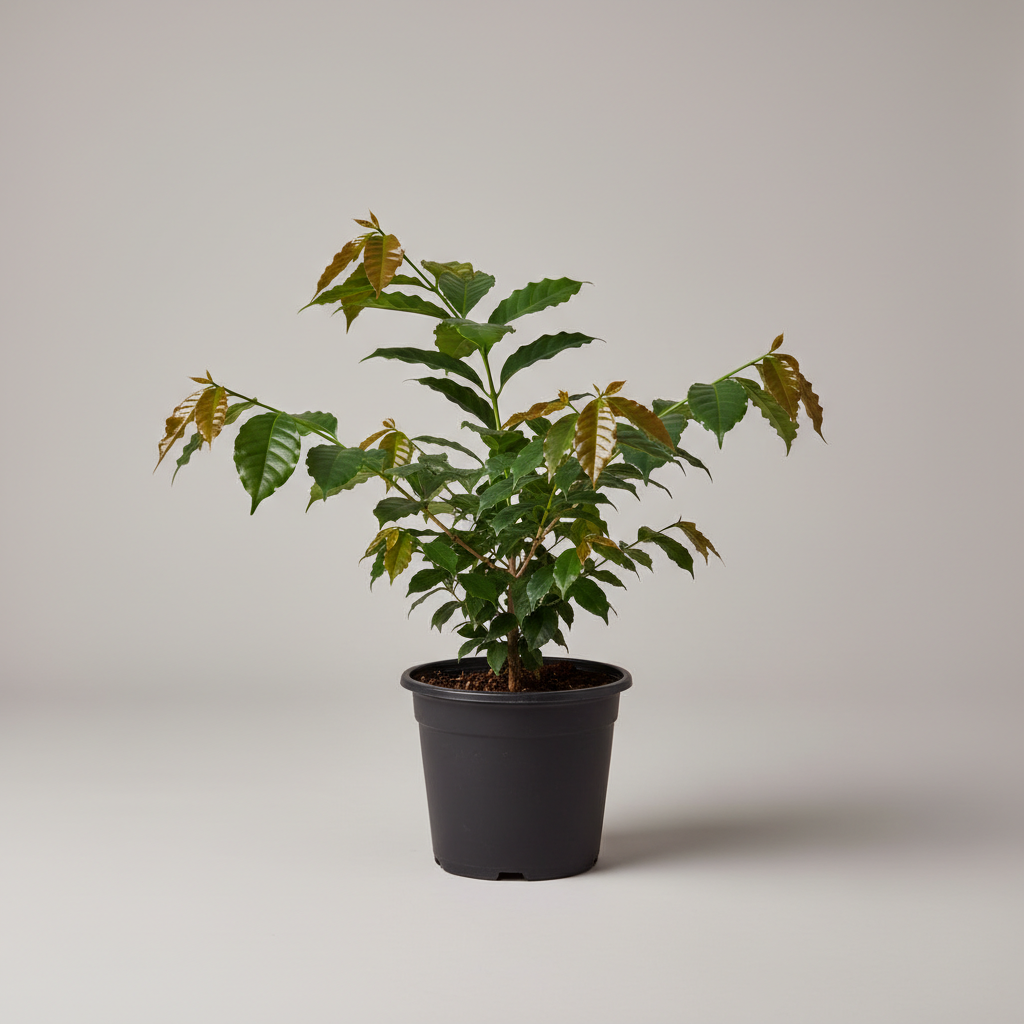
Arabica 'Bourbon'
One of the original landrace cultivars, with a more open, elegant branching habit and broader oval leaves that flush bronzed before settling into deep green. 'Bourbon' will eventually reach 1.5 to 2 metres indoors and is the cultivar of choice for growers who hope to coax a houseplant into producing the famously fragrant flowers and red cherries.
Variety Profiles in Detail
Arabica 'Typica' (Coffea arabica var. typica)
Often considered the foundational Arabica cultivar from which most others were selected, 'Typica' has an upright, central-leader habit and classic elongated leaves with a slightly bronzed flush on new growth. It is moderate in size and vigour, and produces a refined, mild cup if you ever harvest enough beans to roast.
Arabica 'Catura' (Coffea arabica var. caturra)
A natural dwarf mutation of Bourbon discovered in Brazil in the early twentieth century. 'Catura' combines a compact stature with the heavy flowering and fruiting characteristic of its parent, which makes it particularly popular among growers hoping to fruit a plant indoors. Glossy mid-green leaves and a tight, bushy habit.
Arabica 'Maragogype' (Coffea arabica var. maragogype)
The "elephant bean" cultivar, distinguished by leaves and beans that are noticeably larger than those of any other Arabica. Less productive than smaller-leafed cultivars, and slower to flower, but visually striking and a real talking point for anyone who knows their coffee. Best in a generous floor pot rather than on a windowsill.
Coffea canephora (Robusta)
A distinct species from a lowland habitat, Robusta is hardier than Arabica, more tolerant of warmth and lower humidity, and noticeably more vigorous as a houseplant. The leaves are larger and slightly rougher, and the eventual beans are stronger and more bitter than Arabica. Worth seeking out for collectors curious about the genus, but not the species most growers fall in love with.
Coffea liberica
A rarely seen third commercial species with dramatically large, leathery, paddle-shaped leaves and a much more open, tropical-tree feel than Arabica. Liberica makes a magnificent specimen plant given space and good light, but it is uncommon in the houseplant trade and usually only available through specialist nurseries or seed exchanges.
Choosing the Right Variety for Your Space
For most home growers, a dwarf cultivar such as 'Nana' or 'Catura' is the best starting point. They stay manageable on a windowsill, flower at a relatively young age, and tolerate the small inevitable inconsistencies in indoor watering and feeding better than a full-sized landrace. If you have a tall bright corner and the patience to manage a slow-growing tree, 'Bourbon' or 'Typica' can become a striking long-term specimen. Reserve the larger and rarer species, Robusta and Liberica, for when you have a few coffee plants already behind you and want to expand the collection sideways into less familiar territory.
Frequently Asked Questions
Can I grow coffee plants from supermarket coffee beans?
No. Roasting destroys the embryo inside the seed, so the dark brown beans on a supermarket shelf are completely incapable of germinating. Only fresh, unroasted (green) coffee beans harvested within the last few weeks have any reasonable chance of sprouting, and even those need warmth, humidity and patience. Specialty roasters and a few online seed suppliers occasionally sell viable green beans labelled specifically for propagation.
How long until my coffee plant flowers and produces beans?
Most coffee plants need to reach a height of around 60 cm and an age of at least three years before they will flower for the first time. From flower to ripe red cherry takes another six to nine months. Indoors, flowering is far from guaranteed: it requires bright, near-direct light, a regular feeding schedule, consistent watering and stable humidity. Plants given less than ideal conditions may grow happily for decades as foliage specimens without ever blooming.
Why are the tips of my coffee plant turning brown?
Brown leaf tips on a coffee plant are almost always a sign of dry air or inconsistent watering. The pattern matters: tips that brown gradually from the edges inward usually mean low humidity, while tips that brown abruptly with a yellow halo around the damage often mean fluoride or chlorine sensitivity from tap water. Check humidity first, water quality second, and feeding third.
Can I keep a coffee plant outdoors in summer?
Yes, with care. A sheltered, partly shaded position on a balcony or patio can be excellent for an indoor coffee plant during the warmest months, giving it brighter light and better airflow than any indoor spot. Acclimatise the plant gradually over two to three weeks, increasing outdoor exposure each day, and bring it back inside well before night temperatures drop below 15 degrees Celsius (59 Fahrenheit) in autumn.
Are coffee plants safe for cats and dogs?
No. Every part of the coffee plant contains caffeine and related alkaloids that are toxic to dogs, cats and most pets. Ingestion can cause vomiting, restlessness, tremors, rapid heart rate and, in extreme cases, more serious cardiac symptoms. Keep coffee plants out of reach of pets and small children, and contact a veterinarian promptly if you suspect any has been chewed.
My coffee plant is leggy and stretched. What should I do?
Legginess (long internodes, widely spaced leaf pairs, weak stems) is almost always a sign of insufficient light. Move the plant gradually to a brighter spot, ideally near an east or curtained south window. You can also prune the growing tip in spring to encourage bushier lateral growth; coffee plants respond well to a light pinch on the leading shoot and will branch out below the cut.
Should I prune my coffee plant?
Light pruning is beneficial. In spring, you can pinch out the growing tip of the main stem to encourage branching, and shorten any overly long lateral branches to maintain a tidy shape. Avoid heavy pruning of a young plant; a mature coffee plant can tolerate more aggressive cuts but always recovers more slowly than its summer foliage might suggest. Sterilise your secateurs before each cut to avoid spreading disease.
Why are my coffee plant's lower leaves yellowing and dropping?
A few yellowing lower leaves over the course of a year are normal as the plant sheds older foliage. A sudden cascade of yellowing leaves at the bottom usually means either overwatering (the most common cause), a nutrient deficiency (particularly nitrogen or magnesium), or a sudden temperature drop. Check the soil moisture first; if it has been wet for several days, the issue is almost certainly watering.
How big will my coffee plant get indoors?
A typical indoor Arabica coffee plant reaches between 1 and 2 metres over the course of five to ten years, depending on cultivar, light and pot size. Dwarf cultivars such as 'Nana' rarely exceed 1 metre. In the wild and on plantations, where they are pruned for harvest, coffee trees can reach 4 to 6 metres, but indoor specimens are restricted by pot size and the lower light levels of a home interior.
Can I drink coffee from beans I grow myself?
Yes, in theory and occasionally in delightful practice. A mature, well-flowering coffee plant might produce somewhere between 50 grams and 200 grams of green beans per year, enough for a small handful of cups. The process from cherry to cup involves harvesting the ripe red berries, removing the soft fruit pulp, fermenting the beans briefly, washing and drying them thoroughly, and finally roasting them at home. It is laborious for so little yield, but the cup brewed from beans grown on your own windowsill is one of the small genuine pleasures of houseplant keeping.






