
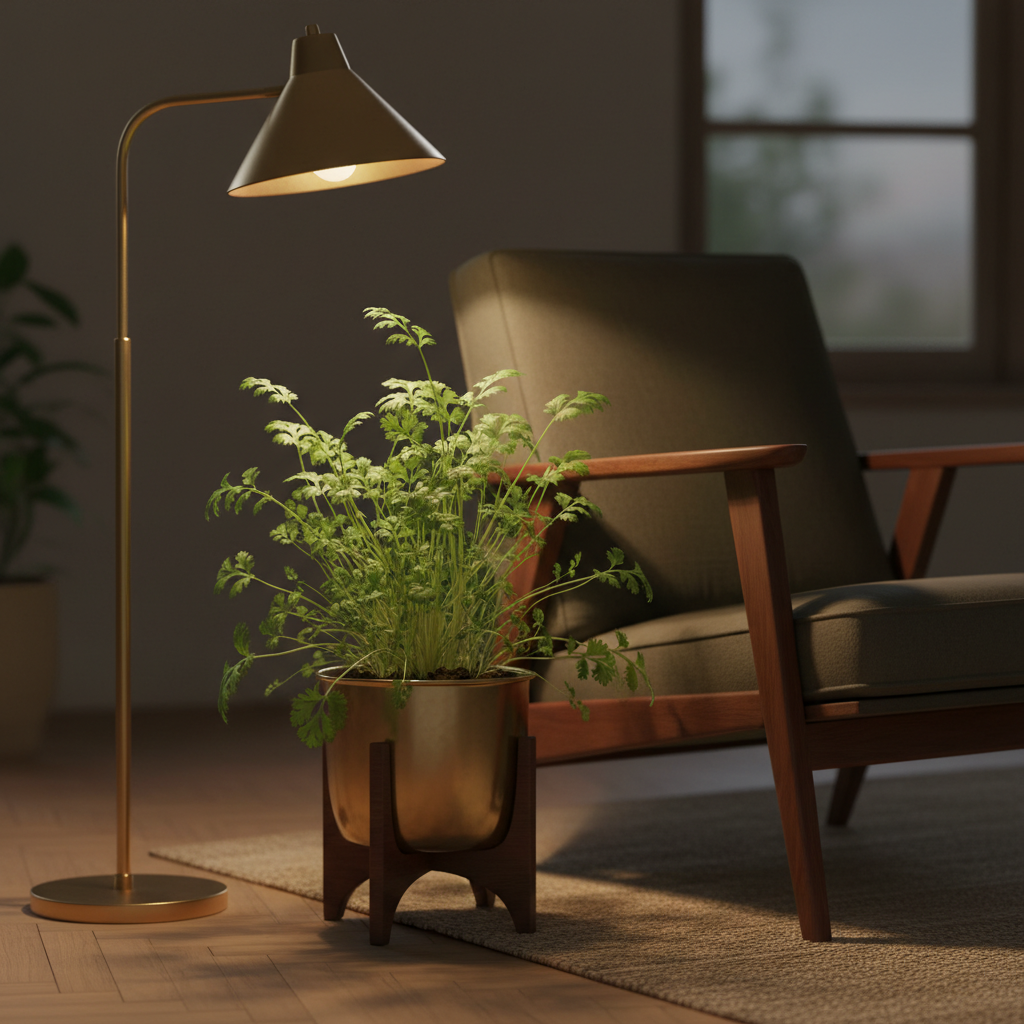
Cilantro (Coriandrum sativum) is one of the most widely used culinary herbs in the world, and one of the most temperamental plants ever invited onto a kitchen windowsill. The same plant that perfumes a Vietnamese pho or a Mexican salsa with its unmistakable bright herbal sharpness will, if mishandled, sprint to seed in three weeks and leave the cook with nothing but a thicket of pale flower stalks. Understanding cilantro indoors is less about keeping it alive, which is easy, than about keeping it leafy, which is genuinely difficult. This guide treats the plant as the cool-season annual herb it actually is, rather than the year-round houseplant the supermarket pot would have you believe.
Quick Reference
This table summarises the essentials. Each row is unpacked in detail in the sections that follow.
| Botanical name | Coriandrum sativum |
| Family | Apiaceae (carrot family) |
| Also known as | Coriander, Chinese parsley, dhania |
| Plant type | Cool-season annual culinary herb |
| Mature size | 30 to 60 cm (12 to 24 in) tall before flowering |
| Light | Bright direct sun in cool months, bright filtered light when temperatures climb |
| Water | Keep evenly moist, never bone dry, never waterlogged |
| Soil | Light, free-draining, slightly rich potting mix, pH 6.2 to 6.8 |
| Temperature | 15 to 21 C (60 to 70 F) ideal, bolts rapidly above 24 C (75 F) |
| Humidity | 40 to 60 percent, tolerates average indoor air |
| Feeding | Light feeding every three to four weeks during active leaf production |
| Propagation | Seed only, sown directly into the final pot in succession every two to three weeks |
| Toxicity | Non-toxic to humans, cats, dogs and most pets |
| Difficulty | Beginner-friendly to grow, intermediate to keep productive long-term |
- Why grow cilantro as a houseplant
- Light requirements
- Watering
- Soil and potting
- Fertilising
- Propagation from seed
- Common pests and problems
- Cilantro varieties
- Frequently asked questions
Why Grow Cilantro as a Houseplant
The case for growing cilantro indoors is almost entirely culinary. Supermarket cilantro is invariably picked too young, shipped too far, and sits in the chilled cabinet long enough that its volatile aldehydes oxidise into something flat and slightly soapy. Cilantro snipped from a thriving plant ten minutes before it hits the pan tastes brighter, sharper and more complex than anything sold in a plastic sleeve. For households that cook regularly with South and Southeast Asian, Mexican, Middle Eastern or North African cuisines, a working cilantro plant on the kitchen counter is one of the most useful herbs to keep in rotation.
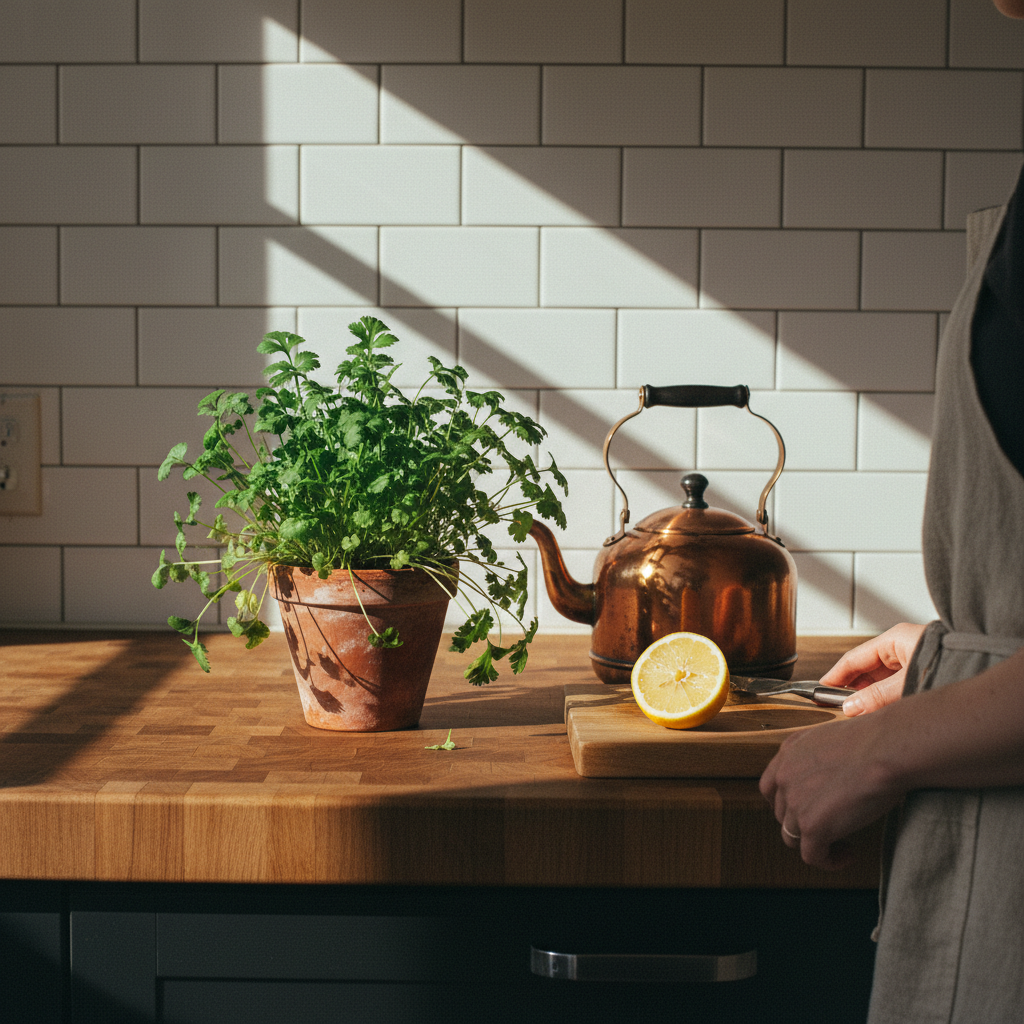
The case against growing it is that cilantro is not, in any meaningful sense, a houseplant. It is a fast-cycling annual that evolved to germinate in cool damp soil, throw up a flush of edible leaves, then flower, set seed and die within a single season. Indoor conditions, with their warm dry air and limited light, push the plant through that cycle even faster than a garden bed would. A single supermarket pot rarely lasts more than four to six weeks of regular harvesting before it bolts and the leaf production collapses. The honest framing is that cilantro on a windowsill is a productive crop on a rolling four-to-six-week cycle, not a single ornamental specimen you can keep alive for years. Once a grower accepts that and starts a fresh pot every two to three weeks, the supply becomes continuous and reliable.
It is also worth noting that the plant produces two genuinely different harvests. The fresh young leaves are the herb known in English-speaking kitchens as cilantro and almost everywhere else as coriander or dhania. The dried ripe seeds, which appear if the plant is allowed to complete its life cycle, are the warm citrusy spice known universally as coriander. A single cilantro plant, raised through to flowering, gives the indoor cook both ingredients from the same stem. Many growers deliberately let one pot in three bolt for exactly this reason.
Pro Tip — The Soap Gene: Roughly one in seven people carry a variant of the OR6A2 olfactory receptor gene that makes the aldehydes in fresh cilantro taste distinctly soapy. If a member of the household tastes soap rather than herb, it is not the plant’s fault and not a sign of poor flavour. Cooking the leaves briefly or substituting culantro (Eryngium foetidum) often helps.
Light Requirements
Cilantro is a sun-loving plant with a strict practical ceiling on how much light it actually wants. In the wild, the plant germinates in late winter or early spring in the eastern Mediterranean and west Asia, grows quickly through the cool months under full unfiltered sun, and dies back as summer heat arrives. Indoors, this translates into a clear seasonal preference: as much direct sun as a windowsill can provide while temperatures stay below about 21 C (70 F), and a deliberate retreat to brighter filtered light once a room begins to warm up.
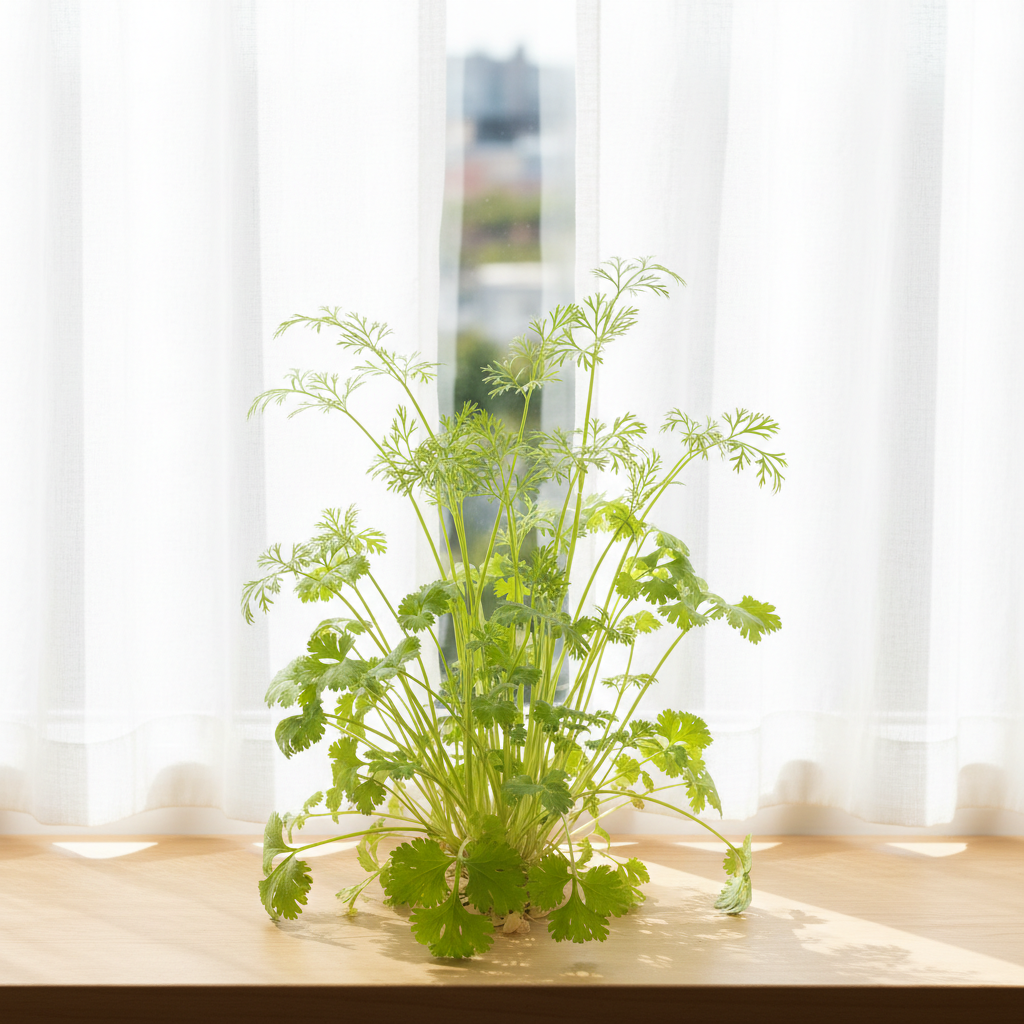
In practical terms, a south-facing or west-facing window in autumn, winter and early spring is ideal. Four to six hours of direct sun a day keeps the plants stocky, leafy and slow to flower. From late spring onwards, that same window will push midday temperatures around the pot above the bolting threshold, and the plant will respond by throwing up a flower stalk almost overnight. At that point, shifting the pot back from the glass by half a metre, or moving it to an east-facing or north-facing window that still receives bright indirect light, will buy several extra weeks of leaf harvest.
Cilantro can survive in less than three hours of direct sun a day, but the plants stretch, the leaves grow paler and thinner, and the harvest window contracts. In a permanently dim apartment, a small full-spectrum LED grow light run for ten to twelve hours a day, positioned 25 to 30 cm (10 to 12 in) above the foliage, will keep the plants compact and productive. Cilantro is not particularly fussy about light spectrum and responds well to standard horticultural LED fixtures sold for leafy greens and herbs.
One subtle point that catches many indoor growers off guard is that cilantro reads day length as well as light intensity. Long days, above roughly fourteen hours, are a flowering trigger almost on their own, independent of temperature. This is why a perfectly cool windowsill plant can suddenly bolt in midsummer even when the room feels comfortable. Growers in northern latitudes who use grow lights to extend the photoperiod beyond fourteen hours will inadvertently push the plants towards seed. Twelve hours of light a day is a reasonable indoor maximum for keeping plants in vegetative leaf production.
Watering
Cilantro wants steady, even moisture. The plant has a relatively shallow fibrous root system topped by leaves that transpire quickly, and it punishes both extremes of the watering scale within hours rather than days. A pot that dries to bone in a warm room will trigger immediate bolting, because drought is one of the strongest flowering signals cilantro responds to. A pot that sits in a saucer of water for more than an hour or two will rot at the crown, particularly in cool conditions where the soil is slow to dry.
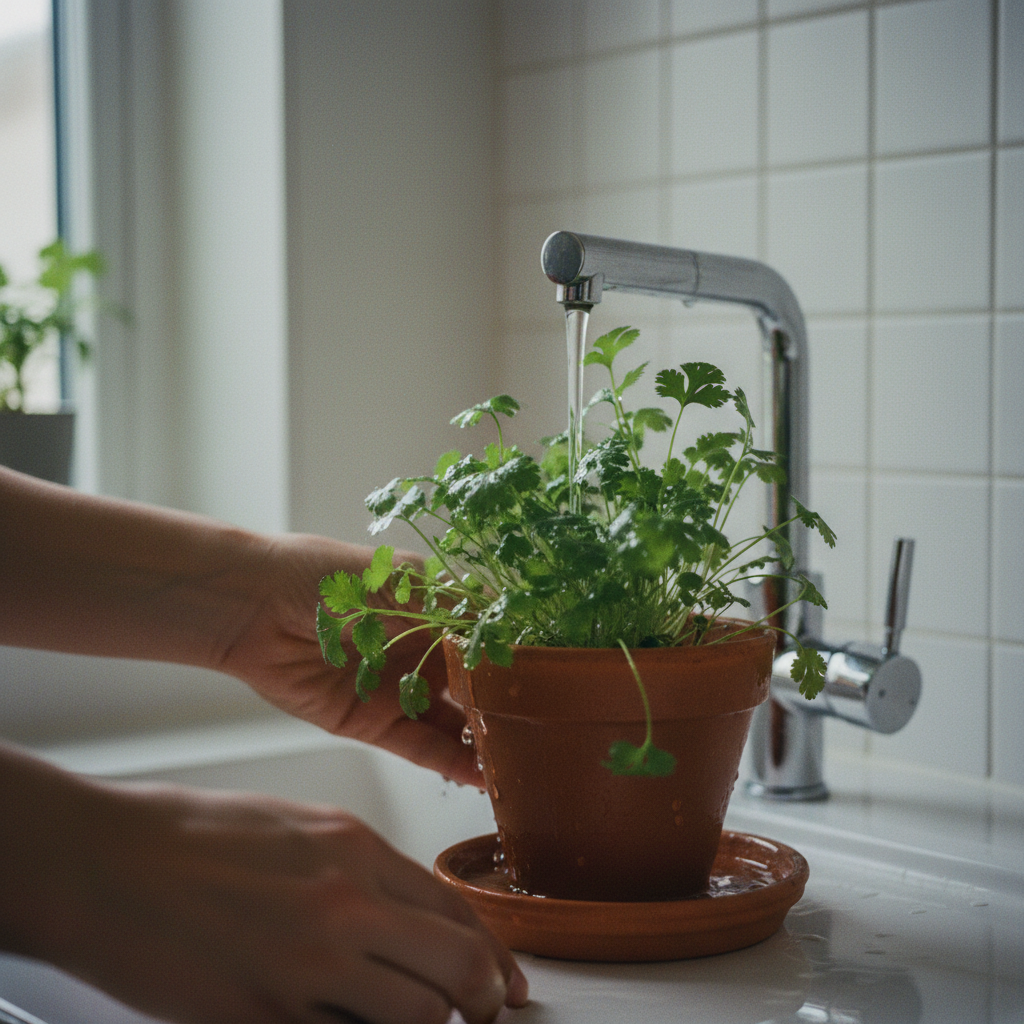
The reliable indoor rhythm is to water thoroughly when the top centimetre of soil feels dry to the touch, and never to let the pot dry further than that. In a 13 cm (5 in) pot on a sunny windowsill in spring, this typically works out at every two to three days. In a smaller terracotta pot in summer, it can be daily. In a deeper pot in cool winter conditions, it may be once a week. The frequency matters less than the diagnostic: a quick finger test at the soil surface every morning is more reliable than any fixed schedule.
When watering, the technique is to drench the pot until water runs freely from the drainage holes, then to discard whatever collects in the saucer within half an hour. This flushes out built-up mineral salts and ensures the entire root ball is rewetted rather than only the top layer. Light, frequent sprinklings encourage the roots to stay shallow and make the plant even more drought-sensitive than it already is. Cilantro is not a plant that benefits from bottom watering as a routine, because the very fine surface roots dry out before deep watering reaches them, but a fortnightly bottom-soak as a complement to surface watering is a useful way to ensure the lower root zone stays hydrated.
Water temperature matters more than the literature usually suggests. Cilantro roots are sensitive to cold shocks, and ice-cold tap water in a winter kitchen can briefly stall growth. Room-temperature water is preferable. Hard water with high lime content is tolerated reasonably well, but if leaf tips begin to brown despite even moisture, a switch to filtered or rainwater for a fortnight usually settles the symptom.
Warning — Wilting Is a Crisis: Unlike many houseplants, cilantro that has wilted to the point of collapse rarely recovers fully. The first severe wilt usually triggers the plant to flower as a survival response, even if it is watered immediately afterwards. Treat the first sign of slightly drooping outer leaves as the latest acceptable watering point, not the first.
Soil and Potting
Cilantro wants a soil that drains freely yet holds enough moisture to avoid the bone-dry spikes that trigger bolting. The ideal indoor mix is a good-quality peat-free or peat-reduced general-purpose potting compost lightened with around twenty percent by volume of perlite or coarse horticultural grit. A pure seedling or peat-based mix tends to compact within a few weeks of repeated watering and turns into a sodden brick at the bottom of the pot. A pure cactus or succulent mix drains too fast and leaves the plant chronically thirsty. The mid-range, herb-friendly blend is what works.
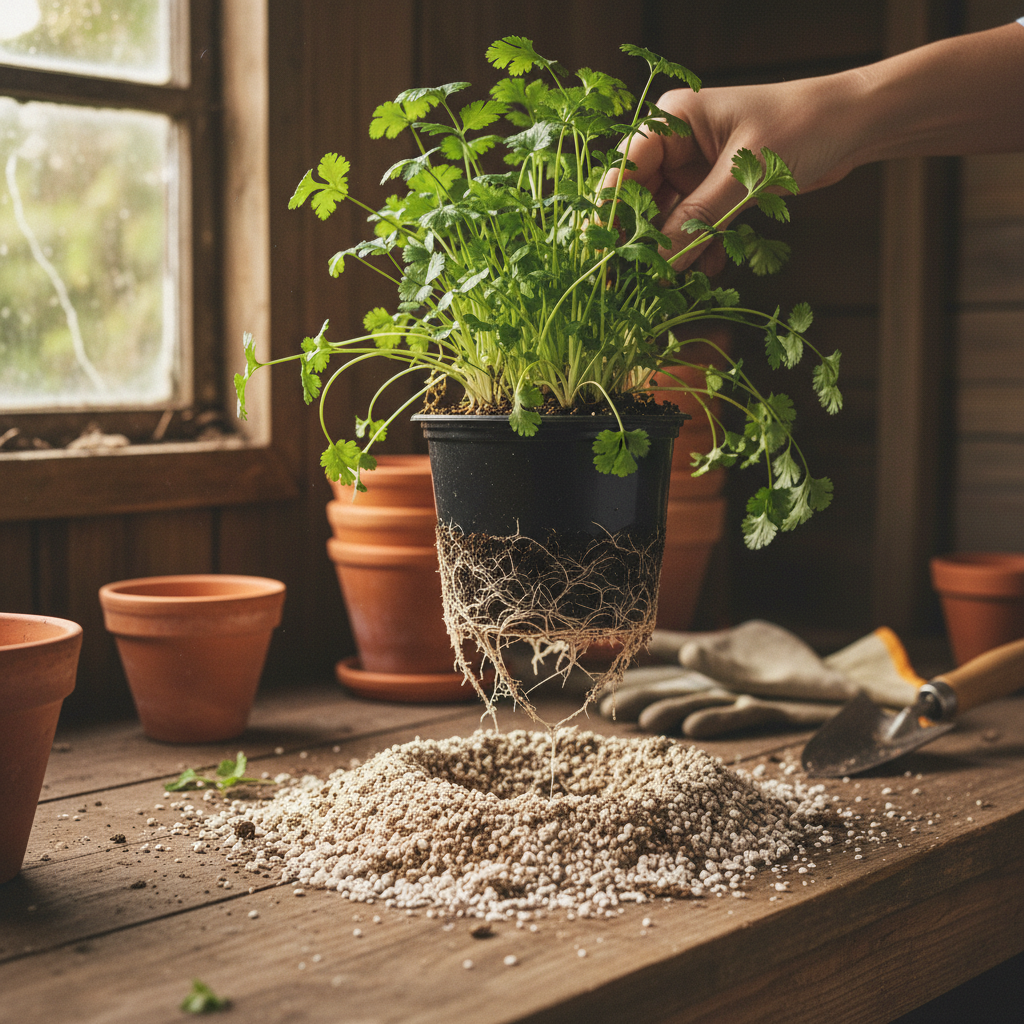
The pot itself deserves more thought than it usually gets. Cilantro forms a small but deep taproot in addition to its fibrous side roots, and it strongly resents having that taproot disturbed once it has formed. The practical consequence is that cilantro should be sown directly into the pot it will live in, rather than raised in a seed tray and transplanted, and that pot should be at least 15 cm (6 in) deep. Shallow herb bowls and divided rectangular planters that crowd cilantro alongside basil or parsley produce stunted, fast-bolting plants. A single dedicated pot, 13 to 15 cm (5 to 6 in) wide and 15 to 20 cm (6 to 8 in) deep, with at least one good drainage hole, is the right size for a productive clump of four to six plants.
Terracotta is an excellent pot material for cilantro on a sunny windowsill, because its porous walls allow excess moisture to wick away and keep the root zone slightly cooler than a plastic or glazed ceramic pot would. In cool, dim conditions the reverse is true: terracotta can dry the soil out too quickly and plastic is the safer choice. Whichever material is used, the cardinal rule is drainage. A pot without holes will kill a cilantro plant within a fortnight regardless of how careful the watering is.
Soil pH is rarely worth measuring for an indoor herb, but cilantro performs best in slightly acidic to neutral conditions, somewhere between pH 6.2 and 6.8. Most commercial potting composts sit comfortably in that range out of the bag. The plant tolerates a wider band than that, but extreme acidity below pH 5.5 or alkalinity above pH 7.5 locks out key nutrients and shows up as pale, weak growth.
Fertilising
Cilantro is a light feeder by houseplant standards. Its short life cycle and modest size mean it never has time to deplete a well-made potting mix the way a long-lived foliage plant would, and over-feeding actively works against the cook. High nitrogen levels produce lush, dark green leaves with a noticeably weaker, more vegetal flavour and a thinner cell structure that wilts more quickly after cutting. The aim with cilantro is steady, modest nutrition rather than the rich diet a fast-growing aroid would appreciate.
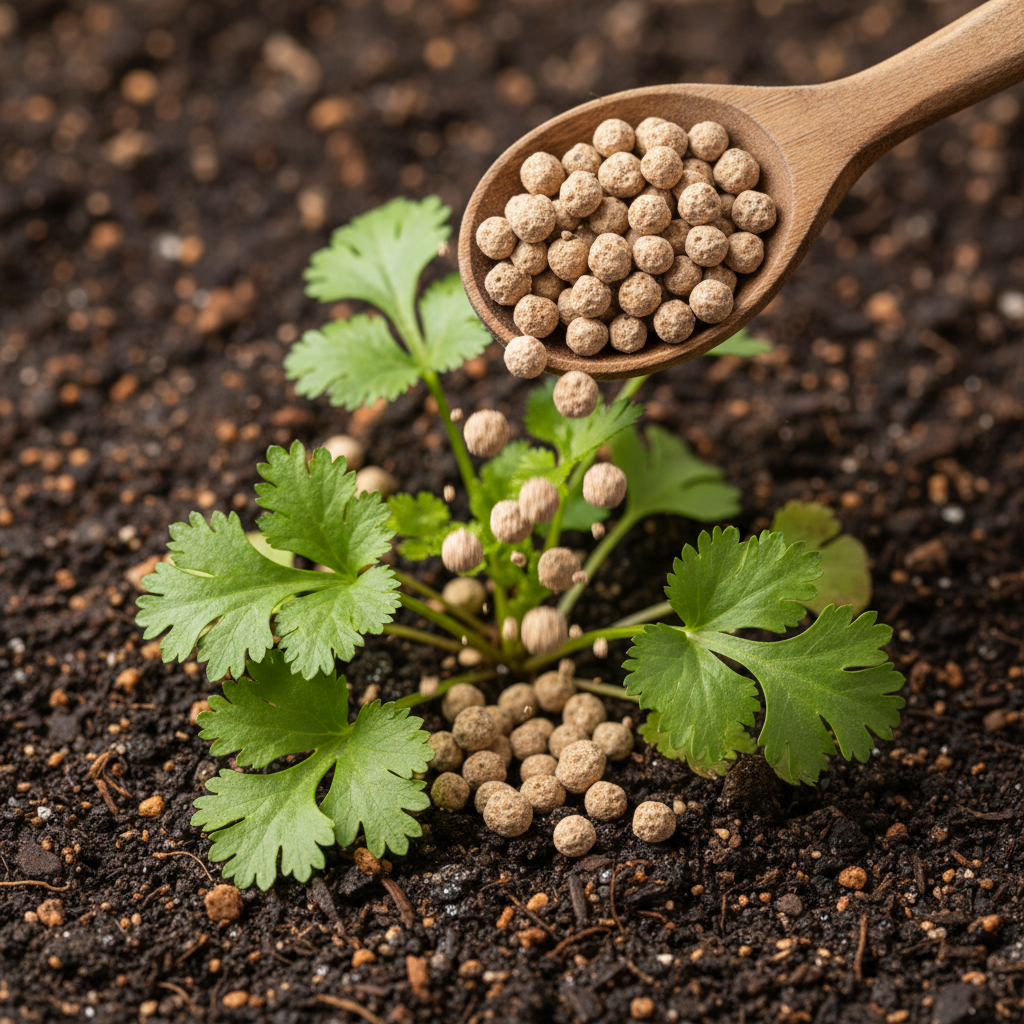
A reasonable indoor regime is a half-strength dose of a balanced liquid herb or vegetable fertiliser every three to four weeks during active leaf production, beginning roughly three weeks after seedlings emerge. A balanced NPK ratio in the region of 5-5-5 or 4-4-4 is well suited. Alternatively, a single light scatter of slow-release organic prills on top of the soil at the time of sowing, at roughly half the rate suggested for ornamental houseplants, will carry the plant through its productive life without further feeding. Worm castings worked lightly into the top centimetre of soil are another mild, long-acting option and have the advantage of releasing nutrients slowly enough that they never push the plant into the lush over-fed state.
What cilantro emphatically does not want is a high-nitrogen lawn or leafy-green feed used at full strength. Nitrogen-heavy feeding shortens shelf life on the cut stem, weakens flavour, and makes the plant noticeably more attractive to aphids. If a pot is showing pale, yellowing lower leaves despite even watering, the deficiency is most likely nitrogen, but the response should be a gentle half-strength feed, not a heavy dose.
Feeding should stop entirely once the plant begins to flower, both because the flowering stem will no longer produce useful culinary leaves and because the nutrients are better channelled into the developing seed heads if coriander seed is the eventual goal.
Propagation from Seed
Cilantro is propagated exclusively from seed. The plant cannot be grown from cuttings, divided like a clump-forming perennial, or rooted in water like a soft-stemmed tradescantia. Each seed contains two embryos and typically produces two seedlings, which is why germinating cilantro often appears denser than the sowing rate would suggest. The practical workflow for a productive indoor supply is to sow directly into the final pot, in succession every two to three weeks, and to harvest each pot intensively for around four to six weeks before composting it and starting again.
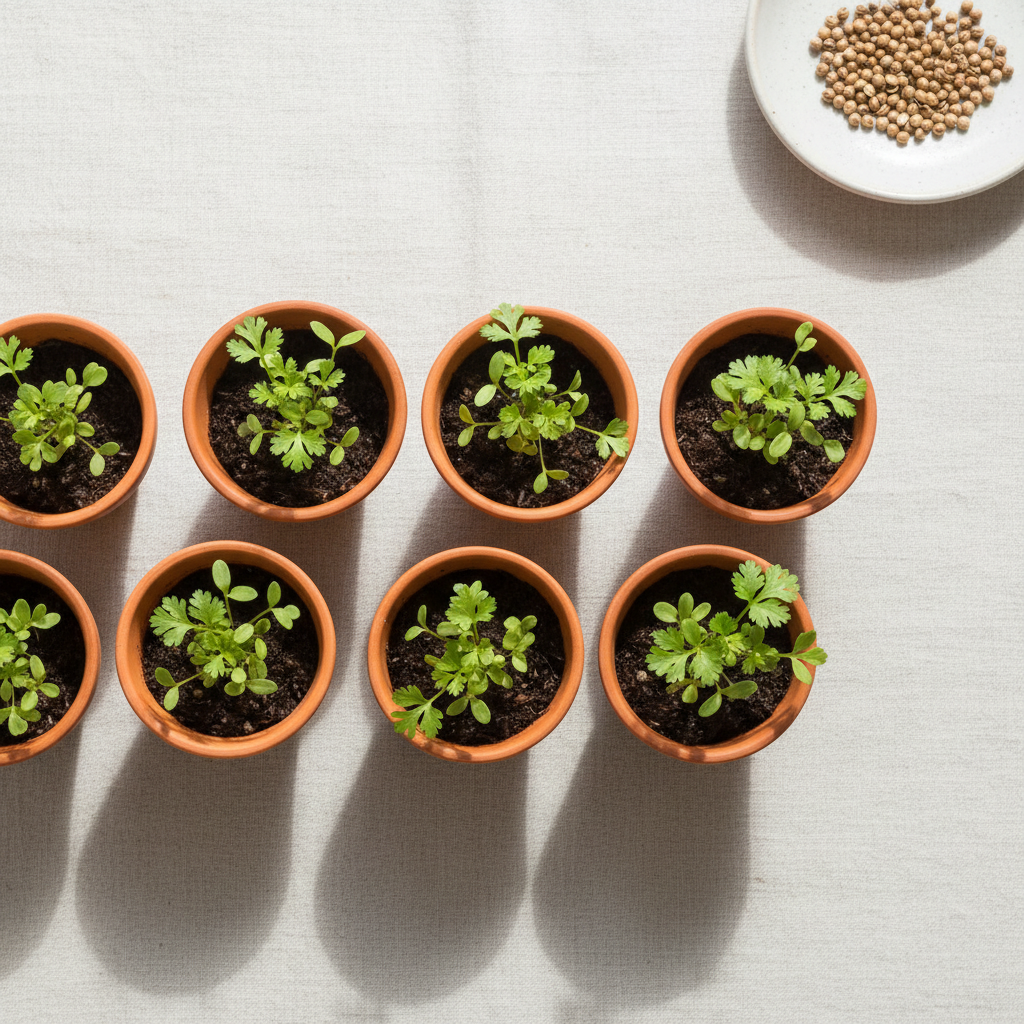
The basic method is simple. Fill a 15 cm (6 in) deep pot with the herb mix described above, water it thoroughly, and let it drain for half an hour. Lightly press the surface flat. Scatter ten to fifteen cilantro seeds evenly across the surface, then cover them with about half a centimetre (a quarter inch) of dry potting mix and press gently to ensure soil-to-seed contact. Mist the surface lightly to settle the covering soil and place the pot in bright indirect light at room temperature.
The step-by-step routine that produces the highest germination rate indoors is:
- Optionally crack the seeds. Coriander seeds are actually two fused fruits enclosing the embryos. Gently rolling them under the flat of a knife to split the husk speeds germination by two or three days. This step is helpful but not essential.
- Soak the seeds for twelve to twenty-four hours in room-temperature water. This softens the hard outer husk and dramatically improves germination uniformity.
- Sow the soaked seeds onto pre-watered soil at the rate above, cover, and mist.
- Keep the pot at 18 to 22 C (65 to 72 F) and the soil consistently moist but not wet. A loose covering of cling film or a clear plastic dome speeds germination but should be removed as soon as the first seedlings appear.
- Expect germination in seven to fourteen days. Move the pot into its final bright position as soon as the first true feathery leaves appear above the rounded cotyledons.
- Thin only if the seedlings are obviously overcrowded. Cilantro is a herb that grows happily as a clump, and over-thinning produces fewer leaves overall.
For a continuous indoor supply, the single most useful habit is to sow a fresh pot on a fixed schedule, regardless of how well the existing pots are doing. Every two weeks works for a single-person household; every three weeks for a household using cilantro a couple of times a week. By the time pot number one is being composted at week six, pot number three is just coming into harvest and pot number four is germinating. The cilantro never runs out, and no single plant is ever pushed past its productive prime.
Seeds remain viable for three to four years if stored in a cool, dry, dark place in an airtight container. A single packet bought once a year is more than enough for an indoor succession program.
Common Pests and Problems
Indoor cilantro is not a pest magnet, but its soft, juicy, fast-growing stems offer easy targets for a handful of common houseplant insects, and its short life cycle means even a minor infestation can ruin the harvest before any spray has time to work. Prevention through good airflow, restrained feeding and a clean growing area is far more effective than any reactive treatment.
Aphids
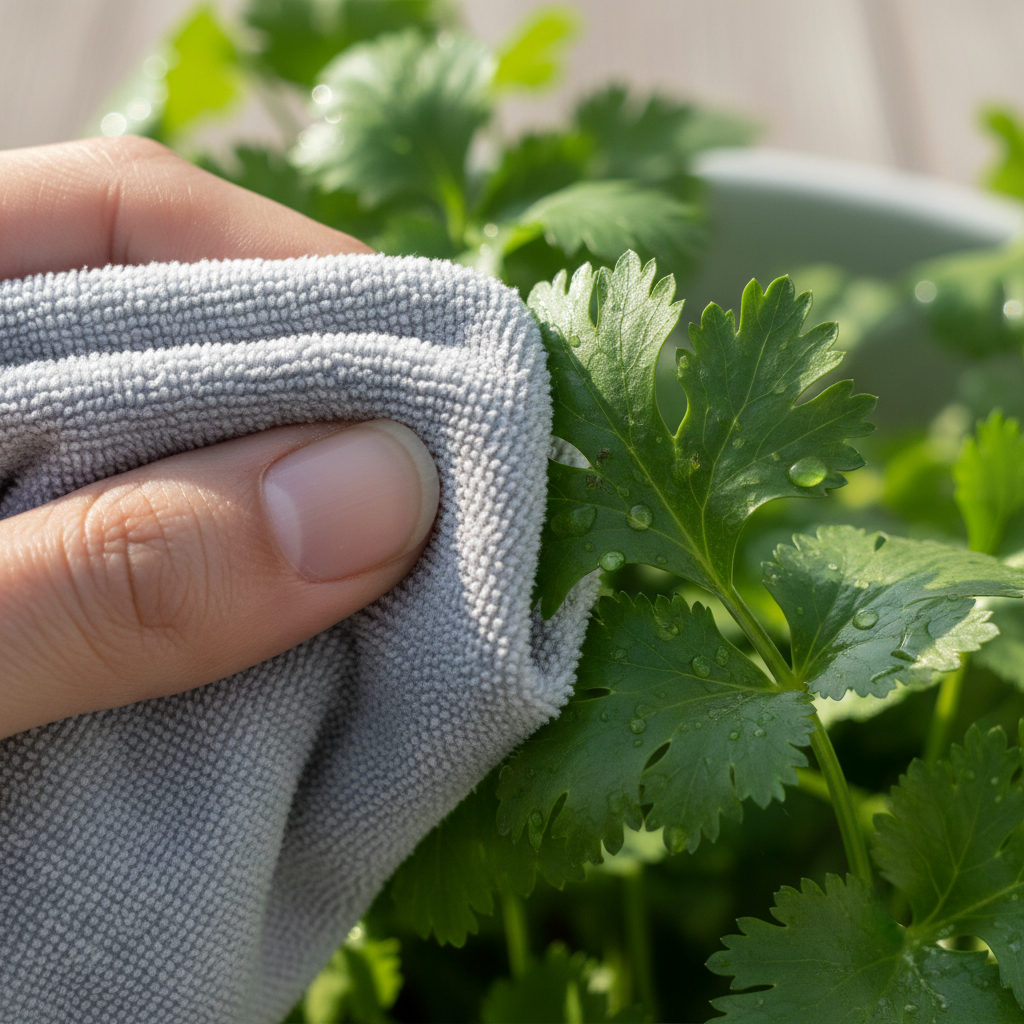
Aphids are by far the most common indoor pest of cilantro, particularly the green peach aphid (Myzus persicae). They cluster on the soft new growth at the tips of the stems and on the undersides of young leaves, sucking sap and leaving sticky honeydew. A heavy infestation can collapse a young plant in under a week. Because cilantro is a food crop and is harvested constantly, chemical insecticides are inappropriate. The reliable controls are a firm rinse under the kitchen tap to dislodge the colonies, a wipe-down of the foliage with a damp soft cloth, and where necessary a light spray of dilute insecticidal soap or a 1:1 mix of water and rubbing alcohol on the affected stems only. Repeat every three to five days until clear.
Fungus gnats
Fungus gnats appear in pots kept too consistently wet, particularly in peat-rich seedling composts. The adults are harmless but irritating; the small white larvae in the top centimetre of soil can damage the fine roots of seedlings. The most effective control is to let the top centimetre of soil dry out properly between waterings, to top-dress with a centimetre of horticultural grit or fine sand to break the breeding surface, and to hang a yellow sticky trap above the pot to catch adults. Biological controls based on Bacillus thuringiensis israelensis (Bti), sold as mosquito or gnat bits, can be used as a soil drench and are safe on edible herbs.
Spider mites
Spider mites are less common indoors but can colonise cilantro in hot, dry rooms with stagnant air. Early signs are a faint stippling on the upper leaf surface and very fine webbing in the leaf axils. The standard response is to increase humidity around the pot, shower the plant under a lukewarm tap to physically remove the mites, and repeat at intervals of five days. Insecticidal soap can be used carefully on edible herbs provided leaves are rinsed before harvest.
Powdery mildew
Powdery mildew shows up as a fine white dusting on the upper leaf surface, usually triggered by overcrowded pots, poor airflow and persistently humid still air. The cure is mostly preventative: do not crowd pots together on a windowsill, do not mist cilantro routinely, and ensure the room has at least some air movement. Affected leaves should be removed and discarded rather than composted.
Premature bolting
Strictly speaking not a pest, but the single most common reason an indoor cilantro pot disappoints. Bolting is the abrupt elongation of the central stem into a flower stalk and is triggered by some combination of heat above 24 C (75 F), long days above fourteen hours, drought stress and root disturbance. Once a plant has bolted, the leaves become small, sparse and bitter, and no amount of corrective care will reverse the process. The strategies that delay bolting are using a slow-bolt cultivar, sowing in cooler months where possible, keeping the soil evenly moist, avoiding transplanting, and choosing a slightly cooler position once spring temperatures climb. Many indoor growers also pinch out the very first central flower stalk as soon as they spot it, which can extend the leafy phase by a week or two before the plant insists on flowering anyway.
Cilantro Varieties
Most supermarket cilantro is grown from generic, unnamed seed bred for fast germination rather than indoor longevity. For a productive indoor herb supply, choosing a named cultivar bred specifically for leaf production and bolt resistance makes a meaningful difference. Two cultivars in particular dominate the indoor herb world.
‘Slow Bolt’
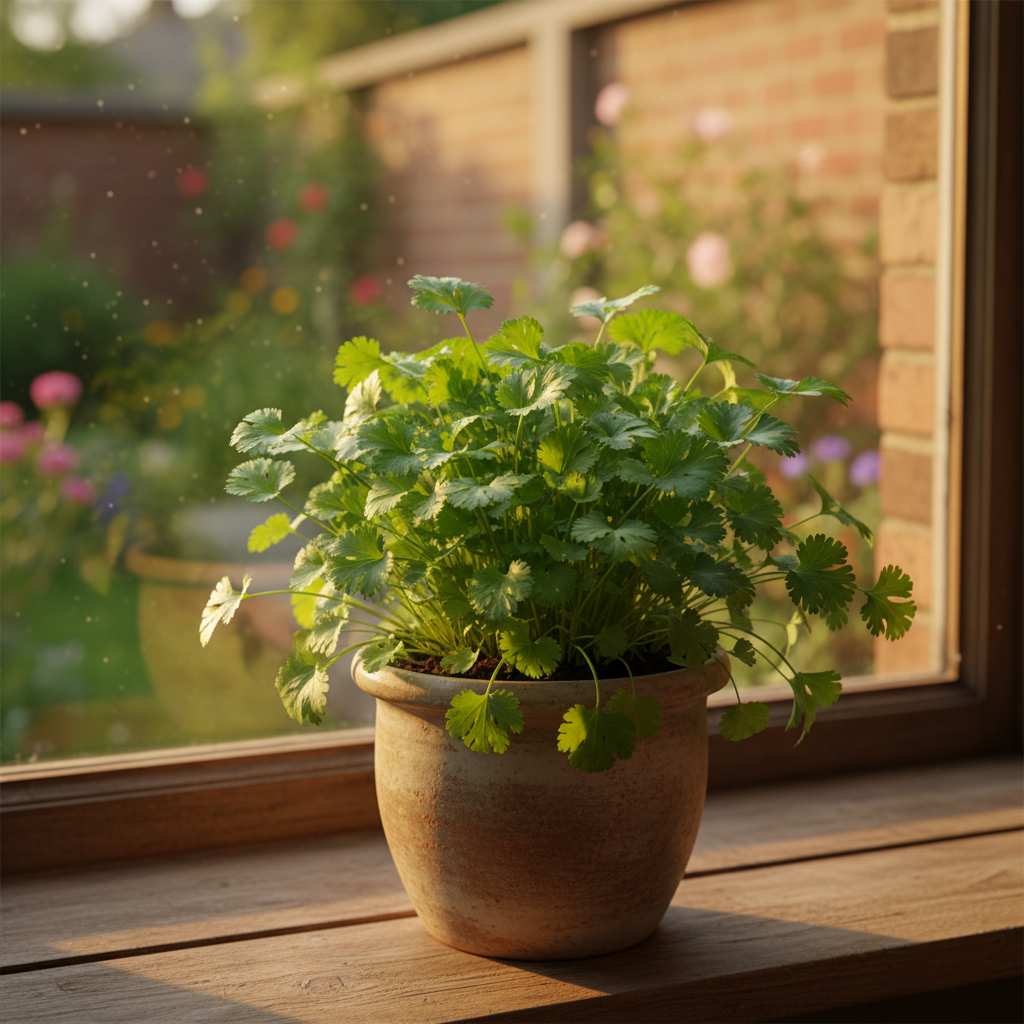
‘Slow Bolt’, sometimes sold as ‘Slow-Bolting’ or under the brand-specific names ‘Calypso’ and ‘Cruiser’, is the cultivar of choice for indoor and warm-climate growers. It has been selected over generations for a delayed flowering response to heat and long days, typically yielding around two to three weeks of additional leaf harvest compared with standard seed. The leaves are slightly broader and more rounded than the classic culinary cultivar, with a softer, marginally less pungent flavour that some cooks prefer for finishing dishes. Habit is compact and bushy. This is the right choice for anyone serious about a continuous indoor supply.
‘Santo’
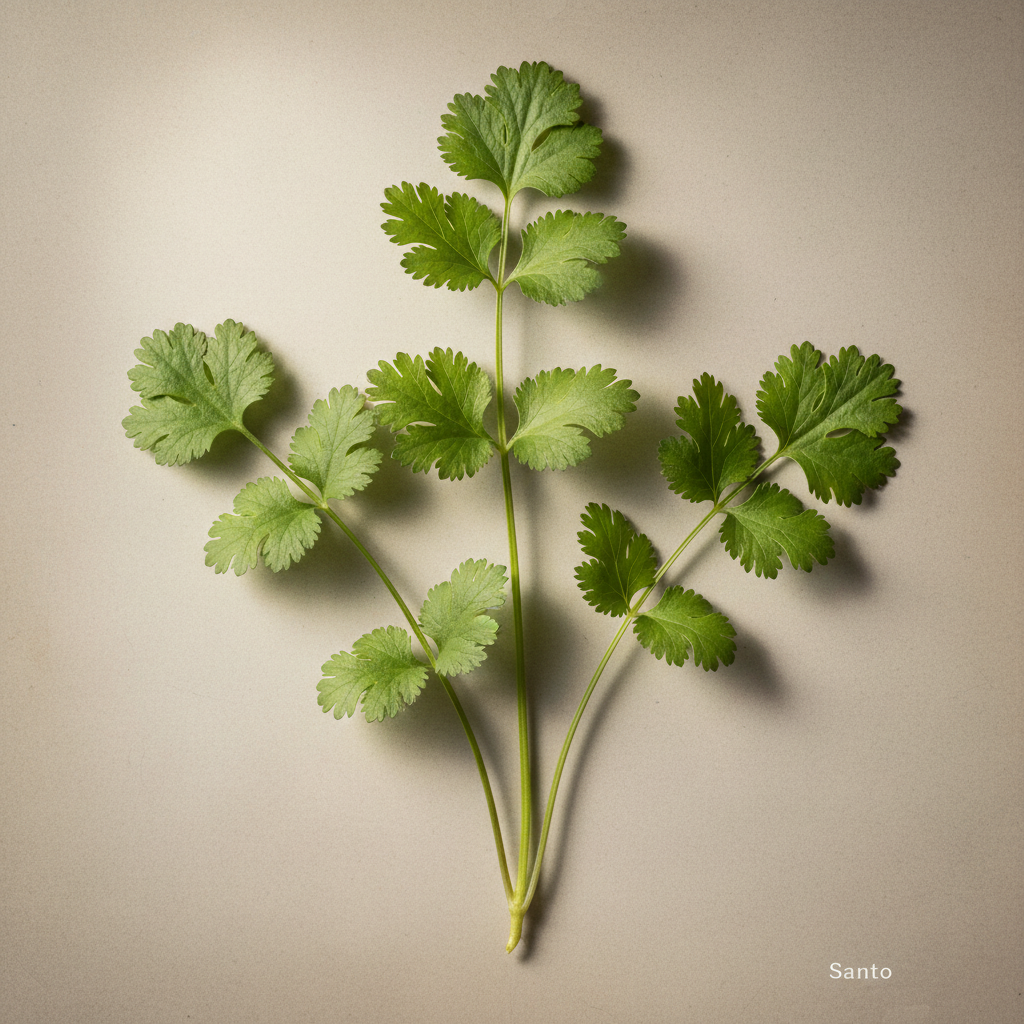
‘Santo’ is the workhorse culinary cilantro and the variety most commonly sold in seed packets worldwide. The leaves are bright apple-green, flat, deeply lobed and carry the punchy, unmistakable cilantro flavour at its strongest. Habit is slightly more upright than ‘Slow Bolt’, and the plants bolt on a more typical four-to-six-week cycle indoors. ‘Santo’ is the right choice when flavour intensity matters more than indoor longevity, and is the cultivar most often grown by gardeners who deliberately allow some plants to flower for coriander seed production.
Other named cultivars worth knowing include ‘Leisure’, another slow-bolting selection particularly suited to warm rooms; ‘Confetti’, an ornamental cultivar with extremely fine feathery leaves and a milder flavour, useful for salads and garnishing; and ‘Marino’, a compact European cultivar that performs reliably in small windowsill pots. Vietnamese coriander (Persicaria odorata) and culantro (Eryngium foetidum) are sometimes sold as cilantro substitutes and share much of the flavour profile, but they are entirely different plants with their own quite different cultural requirements and are not covered in this guide.
Frequently Asked Questions
Why does my cilantro keep flowering after only a few weeks?
Bolting is the plant’s normal life-cycle endpoint, not a fault. It is triggered by heat, long days, drought stress and root disturbance, and indoor conditions tend to combine all four. Use a slow-bolt cultivar, keep room temperatures below 24 C (75 F), water before the soil ever fully dries, and sow directly into the final pot to avoid transplanting. Even with perfect care, indoor cilantro rarely lasts more than six to eight weeks of leaf harvest. Succession sowing is the only durable solution.
Can I regrow cilantro from supermarket stems in water?
No. Cilantro cannot be rooted from cut stems. The stems may stay green and even develop tiny white nubs in water, but these are not functional roots and the plant will never establish in soil. Always start cilantro from seed.
Is cilantro safe for cats and dogs?
Yes. Cilantro is non-toxic to cats, dogs and most household pets and is in fact occasionally used in small amounts as a digestive aid for both. Pets that nibble the plant will come to no harm, although large quantities of any unusual herb can cause mild gastric upset.
Can I grow cilantro and coriander from the same plant?
Yes, and many growers do exactly this. Cilantro is the fresh leafy herb harvested before flowering; coriander is the dry seed harvested after the plant has flowered and set seed. A single plant produces both, in that order. Allow one pot in every three or four to bolt deliberately, let the flowers set seed, and harvest the brown ripe seed heads when they begin to drop.
How much cilantro can I harvest from one pot?
A well-grown 15 cm (6 in) pot containing six healthy plants typically yields the equivalent of three to four supermarket bunches over its productive lifespan, harvested as small repeated cuttings every few days. Harvest the outer stems first by cutting them at the base, leaving the central growing point untouched. This encourages the plant to keep producing new leaves from the centre for as long as possible.
Does cilantro need a special grow light to thrive indoors?
Not in a bright windowsill position with several hours of direct sun a day. In a dim apartment, a basic full-spectrum LED herb light run for ten to twelve hours daily will keep plants compact and productive. Avoid running grow lights for more than twelve hours a day, as long photoperiods themselves push cilantro into flower.






