
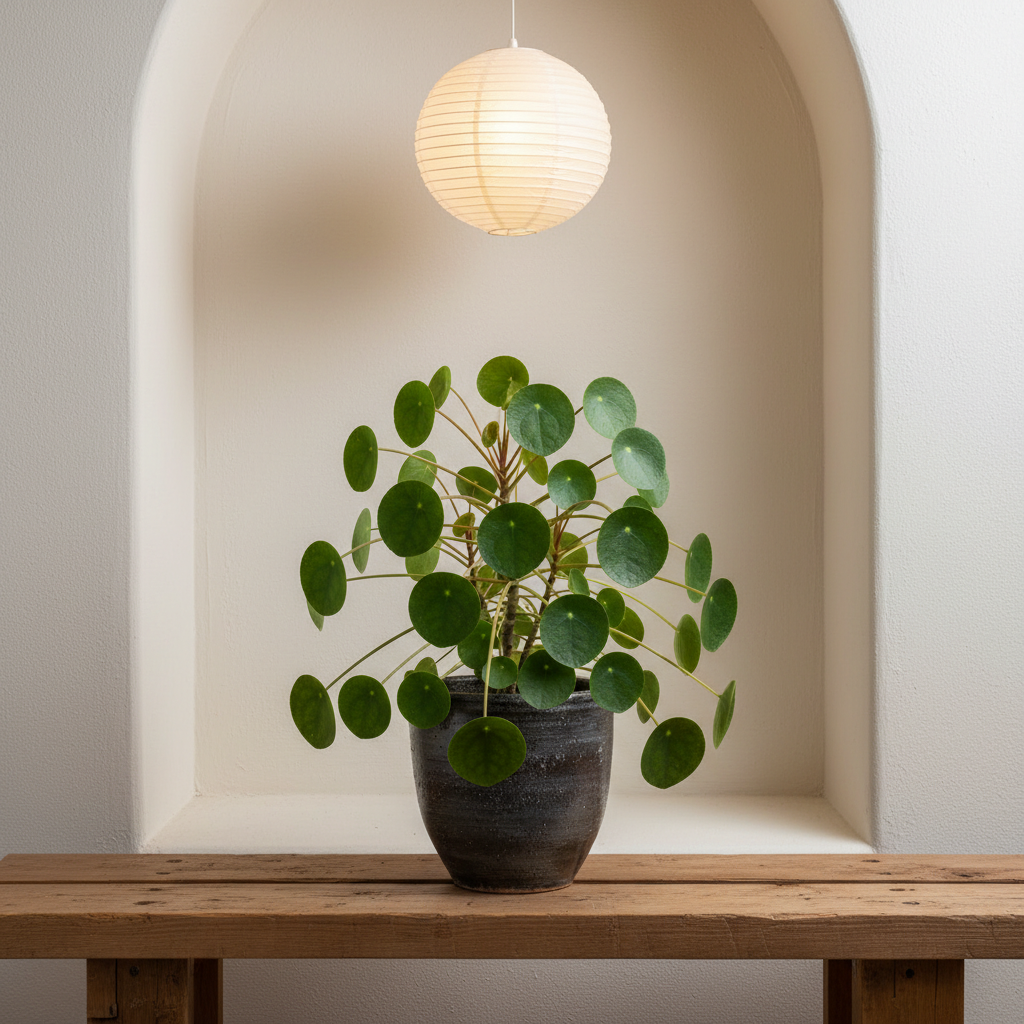
Few houseplants have a backstory quite like the Chinese Money Plant. Botanically Pilea peperomioides, and known variously as the Pancake Plant, UFO Plant, Missionary Plant, Friendship Plant or simply Pilea, this small upright stem-builder with its perfectly round, coin-shaped leaves drifted around northern European living rooms for decades as a pass-along plant before commercial nurseries figured out how to mass-produce it. Native to the cool, shaded forests of the Cang Mountains and parts of Yunnan in south-western China, it spent most of the twentieth century outside conventional plant trade entirely, passed crown-to-pup from one window to the next. Today it sits on more shelves than almost any other small foliage plant in the world.
The reputation that comes with the plant is mostly accurate. The Chinese Money Plant is genuinely undemanding once a few simple conditions are met, and it pays back the smallest attention with a steady production of baby plants you can pot up, give away or use to refresh the parent. But surviving and thriving are still two different outcomes here. A neglected Pilea will live for years as a leggy, lopsided stem with a thin crown of leaves leaning desperately toward the brightest window; a well-cared-for one becomes a tidy, near-symmetrical lollipop of crisp green coins, dense with pups crowding the soil. This guide covers exactly what separates the two, in detail, from light placement to the cultivars worth seeking out.
Contents
- Quick Reference
- Why Chinese Money Plant Makes a Brilliant Houseplant
- Light Requirements
- Watering and Humidity
- Soil, Potting and Repotting
- Fertilising
- Propagation
- Pests and Diseases
- Popular Varieties
- Frequently Asked Questions
Quick Reference: Chinese Money Plant at a Glance
| Light | Bright indirect light, with an hour or two of gentle direct sun |
| Watering | Water thoroughly when the top 2 to 3 cm (1 inch) of soil is dry, roughly every 7 to 10 days in summer |
| Temperature | 15 to 24 C (59 to 75 F); tolerates a brief dip to 10 C (50 F) but no frost |
| Humidity | 40 to 60 percent; happy in average household humidity |
| Fertiliser | Balanced liquid feed at half strength every 3 to 4 weeks in spring and summer |
| Toxicity | Considered non-toxic to cats, dogs and humans by the ASPCA and major veterinary references |
Why Chinese Money Plant Makes a Brilliant Houseplant
The first thing most people notice about a Chinese Money Plant is the geometry. The leaves are almost perfect discs, each held aloft on a long, slender pinkish-green petiole that joins the leaf blade not at the edge but right in the centre, an arrangement botanists call peltate. From the side, every leaf looks like a tiny green lily pad floating on an invisible pond. From above, a healthy specimen reads as a constellation of glossy circles in three rough layers, with the youngest and smallest leaves clustered around the growing tip and the largest, oldest leaves arching out below. This is one of the few houseplants that genuinely earns the label “sculptural” without any pruning or training on your part.
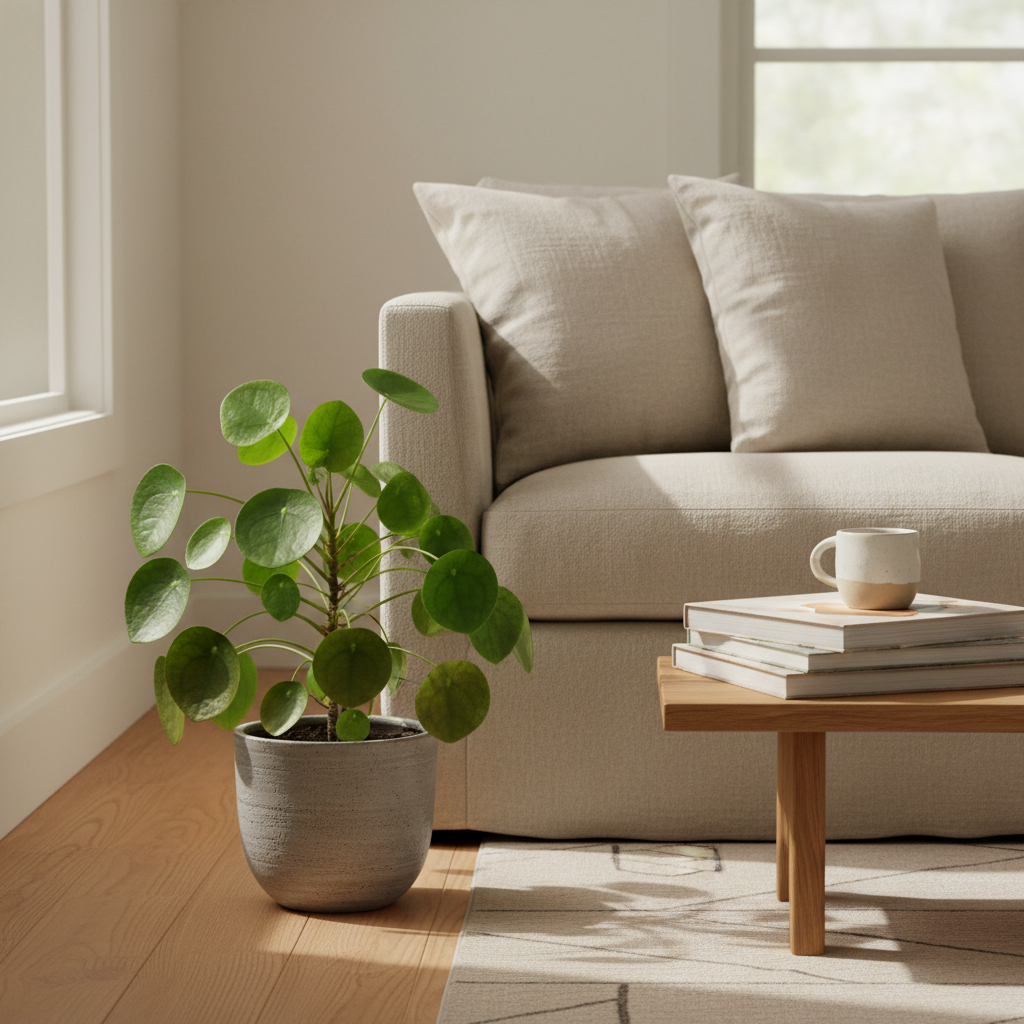
Beyond looks, there are practical reasons this plant is found on so many shelves. It stays small. A mature, well-grown Pilea reaches roughly 25 to 40 cm (10 to 16 inches) tall and roughly the same across, which means it fits a windowsill, a desk corner, a bathroom shelf or the gap on a side table where nothing else quite belongs. It is reasonably forgiving of irregular watering thanks to its semi-succulent stem and fleshy roots, which store a small reserve of water and let it shrug off the occasional missed soak. It propagates itself constantly and obviously, sending up baby plants both from the soil at the base of the parent and directly from buds along the main stem, and these pups separate cleanly and root easily, which is why this plant has spread the way it has. And it has no thorns, no irritating sap, no airborne spores and no documented serious toxicity, so it sits comfortably in homes with curious cats, dogs and small children.
Important — Toxicity: The Chinese Money Plant is listed as non-toxic by the ASPCA, and is not associated with poisoning cases in pets or humans. That said, no plant is a substitute for food. A dog or cat chewing large quantities of any houseplant can experience mild stomach upset, so it remains sensible to discourage nibbling and to clear up shed leaves promptly.
Light Requirements
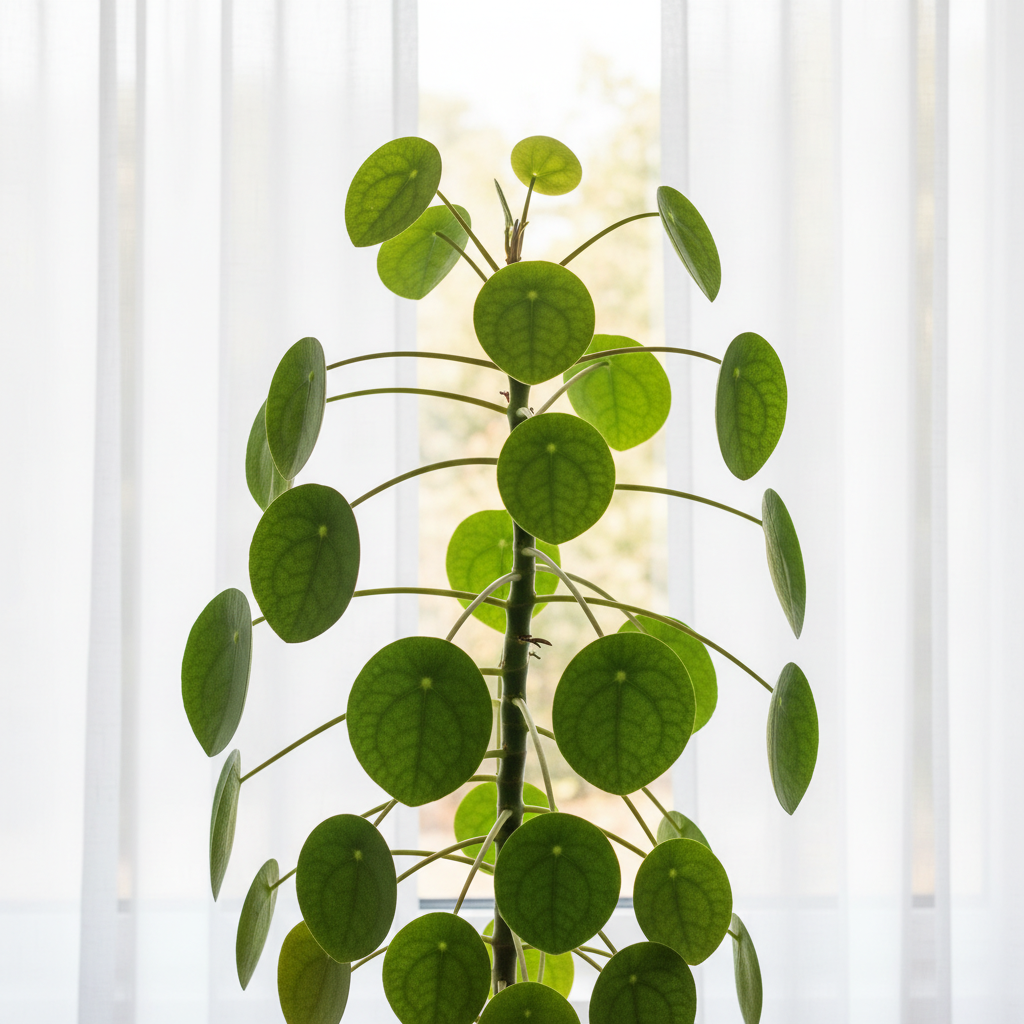
Light is the single biggest variable separating a beautiful Pilea from a sad one. In its native habitat the plant grows on cool, shaded rocky slopes and under the broken canopy of broadleaf forest, which translates indoors to bright, mostly indirect light with a small allowance for very gentle direct sun. Get the light right and almost every other element of care becomes easier, because growth is steady, water demand is predictable and pup production is generous. Get it wrong, and you will spend years fighting symptoms.
The single best position for a Chinese Money Plant in most homes is within half a metre (about a foot and a half) of an east-facing or lightly curtained south-facing window. East windows give a brief stretch of soft direct morning sun followed by bright indirect light for the rest of the day, which is almost ideal. South-facing windows are too intense if the plant sits right against the glass during the warmer months, but a fine sheer curtain or being set back a step solves that immediately.
Light Levels Explained
Houseplant guides throw around terms like “bright indirect” without ever defining them. For this plant in particular, knowing roughly what each band means is useful, because the difference between “bright indirect” and “medium” is the difference between a compact, generous specimen and a sparse, stretching one. The table below puts approximate lux values, real-world placements and likely outcomes together for quick reference.
| Light Category | Approx. Level | Typical Location | Outcome |
|---|---|---|---|
| Direct sun | over 30,000 lux | Right at an unshaded south or west window in summer | Leaves bleach, redden or scorch within hours; not recommended |
| Bright indirect | 10,000 to 20,000 lux | Within 50 cm (20 in) of an east window or sheer-curtained south window | Compact growth, deep green colour, steady pup production |
| Medium | 2,500 to 10,000 lux | One to two metres back from a bright window, or right at a north window | Slower growth, longer petioles, plant slowly tilts toward the light |
| Low | 500 to 2,500 lux | Deep in a room, or far from any window | Stretching, leaf drop, no new pups; will decline over months |
| Very low | under 500 lux | Hallways, windowless bathrooms, north corners | Plant will not survive long-term; supplement with a grow light |
Window Orientation and Placement
South-facing window: Excellent in autumn, winter and very early spring, when the sun is low and weak. From late spring through early autumn, move the plant back by 30 to 60 cm (1 to 2 ft) or hang a sheer curtain to filter the midday sun. Otherwise the leaves nearest the glass will pale, redden and eventually develop crisp brown patches.
East-facing window: The single best year-round position for Pilea peperomioides in most homes. The plant gets one to three hours of gentle morning sun followed by bright indirect light through the afternoon, with no risk of scorching even in midsummer.
West-facing window: Workable but watch the late afternoon. The summer afternoon sun streaming through a west window is the hottest, harshest light most houseplants ever see indoors. Pull the plant back, or hang a curtain, from May through September.
North-facing window: Possible, with caveats. North light is gentle and unchanging but on the dim side for Pilea, especially in winter. The plant will survive, but expect slower growth and longer petioles that make the rosette look stretched. Rotating the pot weekly becomes especially important here, because the plant will tilt strongly toward the only light source.
Pro Tip — Quarter Turns: Every time you water, turn the pot a quarter turn. Pilea is one of the most strongly phototropic houseplants you can grow, which is what gives older neglected specimens that exaggerated lopsided lean. A quick turn each week keeps the rosette symmetrical without you ever having to think about it.
How Light Affects Leaf Shape and Colour
Light intensity controls two things you can read off the plant directly: the length of the petioles and the size of the leaf blades. In bright, generous light, petioles stay short (around 6 to 10 cm or 2.5 to 4 in) and the leaves grow large, almost overlapping, giving the iconic dense, pancake-stacked appearance. In dimmer light, the plant stretches each petiole longer to push the leaf out toward whatever light is available, while the blades themselves often grow smaller and thinner. A Pilea with leaves more than 12 cm (5 in) apart on petioles longer than 15 cm (6 in) is telling you, clearly, that it would prefer to be closer to a window.
Colour also shifts with light. Strong bright light without scorching brings the deepest, glossiest greens, sometimes with a faint reddish flush along the petiole stems where they meet the leaf. In very low light, leaves slowly pale to a flatter mid-green and lose some of their gloss. In genuinely too-strong direct sun, leaves bleach to a yellowish white, often starting at the edges, and any reddening on the petioles turns rust-brown rather than pink. The plant uses colour to communicate, and Pilea is unusually expressive about it.
Warning — Direct Sunlight: Pilea leaves will scorch in less than half a day of unfiltered summer sun, especially through south or west glass. Scorched patches look pale and papery first, then crisp brown, and they do not recover. Move the plant gradually if you are increasing its light exposure, giving it a week or two between each step closer to the window.
Artificial Lighting
Chinese Money Plant grows readily under full-spectrum LED grow lights, which makes it a strong candidate for plant shelves and rooms without good window access. A modest LED panel rated around 20 to 30 watts, positioned 30 to 40 cm (12 to 16 in) above the plant and run for 10 to 12 hours a day, keeps a Pilea compact and well coloured even in the depths of winter. If the plant is sharing a shelf with succulents or other higher-light plants, place it slightly toward the edge of the brightest pool of light rather than dead centre, since Pilea will burn more easily than a Haworthia or Echeveria under the same fixture.
Seasonal Adjustments
The intensity and duration of natural light changes dramatically through the year, especially at higher latitudes. A Pilea that was perfectly placed in autumn often needs to be moved 30 to 60 cm (1 to 2 ft) closer to the window in winter, and then pulled back or curtained in summer. Watch the plant for the signs: stretching petioles and smaller new leaves mean move closer to the window; pale or reddened leaves on the side facing the glass mean pull back or filter. Many growers find that a Pilea wants a south-facing window from October to March and an east-facing position from April to September.
Watering and Humidity
Watering is where most Chinese Money Plants are lost, and almost always to the same mistake: too much, too often, in soil that holds water too long. The plant has fleshy roots and a slightly succulent stem, which means it stores its own water reserve and prefers to dry out between thorough drinks rather than sit in damp soil indefinitely. Get that rhythm right and you will rarely have a problem. Get it wrong and root rot can take the plant down in a fortnight.
When to Water
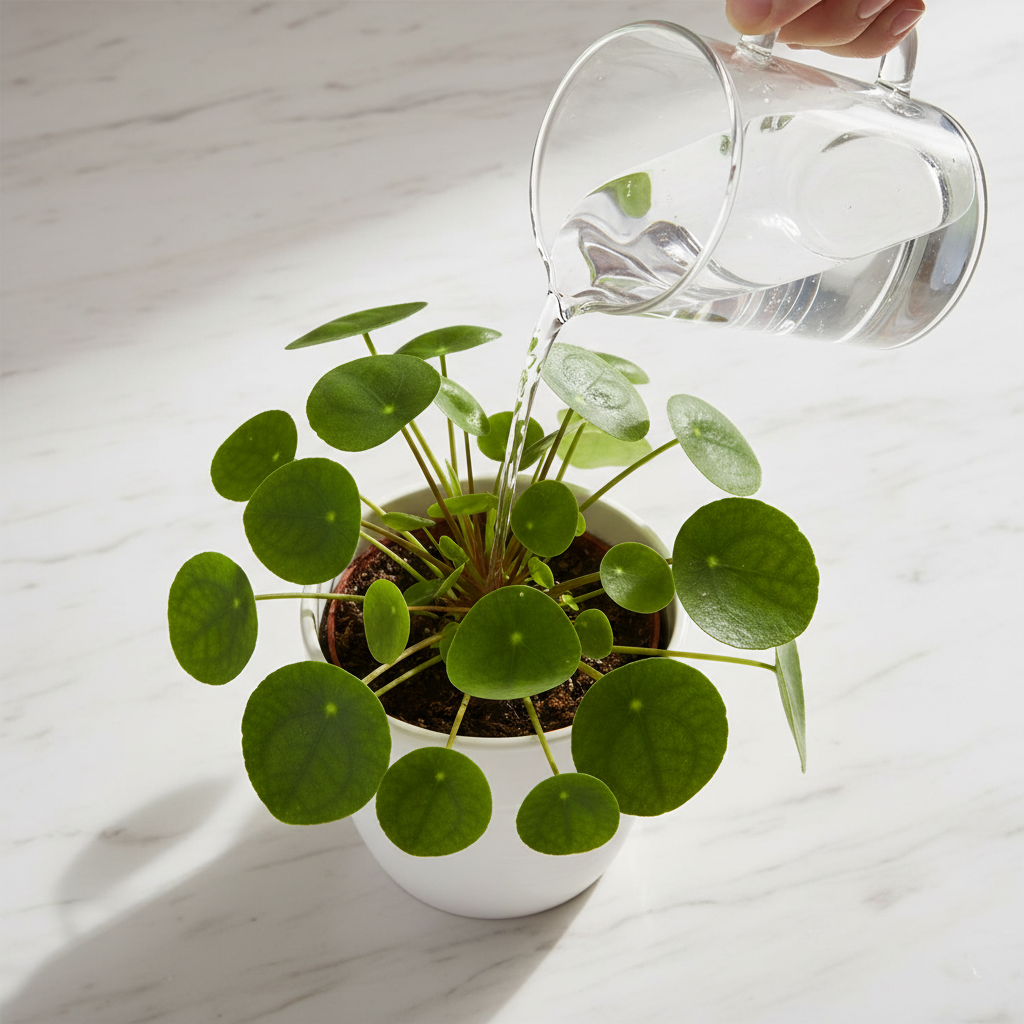
The reliable rule is to water when the top 2 to 3 cm (about 1 in) of the potting mix has dried out. Push a finger in up to the second knuckle, or lift the pot and judge by weight once you know what a dry pot feels like compared with a freshly watered one. In a warm, bright spring or summer position, this typically falls every 7 to 10 days. In autumn and winter, when the plant is barely growing, the interval often stretches to 14 days or longer. Resist the urge to follow a fixed weekly schedule. The plant does not care what day of the week it is, only how dry its substrate has become.
One characteristic Pilea quirk that helps with timing: the leaves themselves droop noticeably when the plant is genuinely thirsty. The normally horizontal coin-leaves angle downward, and the central stem stiffness softens. Within an hour or two of a good watering, the leaves lift back to their proper plane. Once you have seen this happen once, you have a very reliable physical signal you can use as confirmation that a thorough soak was due.
Pro Tip — The Weight Test: Lift the pot the moment you finish watering, and again when the soil feels dry to the touch. The contrast in weight is unmistakable, and after two or three cycles you will be able to tell whether the pot needs water just by picking it up, without ever sticking a finger into the soil.
How to Water Correctly
- Take the plant to a sink, bathtub or large saucer, since the goal is to flush water all the way through the root zone.
- Pour room-temperature water steadily over the soil surface, working around the base of the plant rather than from a single point. Avoid splashing the central crown if possible.
- Keep pouring until water runs freely from the drainage holes, which usually means using a volume of water roughly equal to one quarter to one third of the pot’s volume.
- Let the pot drain completely for 5 to 10 minutes. Pilea must never be left standing in water; the moment drainage stops, tip out anything pooled in the saucer.
- Return the plant to its usual spot and do not water again until the top 2 to 3 cm (1 in) of mix has dried out, regardless of how many days that takes.
Signs of Overwatering vs. Underwatering
| Symptom | Overwatering | Underwatering |
|---|---|---|
| Leaf colour | Yellowing, often starting with the oldest lower leaves; sometimes blackening at the edges | Pale, slightly faded green; older leaves may go crisp at the margin |
| Leaf texture | Soft, limp, sometimes translucent; leaves can fall off at a light touch | Thin and slightly curled, but still firm; leaves droop but spring back after watering |
| Soil | Consistently wet, sometimes with a sour or musty smell | Pulled back from the sides of the pot, very light to lift, dusty on top |
| Roots | Brown, mushy, easily broken when the rootball is inspected | White or cream, firm and brittle but otherwise healthy |
| Stem base | Soft, possibly blackening; the whole plant may topple at a touch | Firm and intact; the central stem stays sturdy |
Warning — Root Rot: Once the stem base softens, the plant is in serious trouble and rapid action is needed. Unpot it, wash the roots clean, cut away every brown or mushy section back to firm white tissue, and repot into fresh dry mix in a smaller pot with extra perlite. Do not water for 4 to 5 days afterwards. If the entire base has rotted away, take the healthiest top section, let the cut callus for 24 hours, and root it in water as a cutting; the parent stem will rarely recover but the crown almost always does.
Humidity Requirements
Chinese Money Plant is comfortable in normal household humidity, which usually sits between 40 and 60 percent for occupied rooms. This is one of the rare cases where the plant truly is happy on a bookshelf or kitchen counter with no humidifier, no pebble tray and no misting routine. The leaves are smooth, slightly waxy and able to hold their own moisture without needing supplementary atmospheric humidity to look their best.
That said, you do not want to keep it in genuinely dry conditions for long stretches. Humidity below about 25 percent, which is common in centrally heated homes during winter, can cause leaf edges to crisp brown and pup production to slow. The combination of dry winter air and a pot near a hot radiator is particularly stressful, since the warm air pulls water out of the leaves faster than cool roots in cold soil can replace it. If your home dries out in winter and other plants are showing brown leaf tips at the same time, grouping Pilea among them buffers the whole micro-climate without any special equipment.
If you do want to nudge humidity upward, the most effective option is a small ultrasonic humidifier set to 50 percent and placed within a metre or so of the plant. Pebble trays make almost no measurable difference in open rooms and are not worth the effort. Misting feels productive but barely affects ambient humidity for more than a few minutes, and on Pilea it can leave faint mineral marks on the glossy leaf surface, so it is best avoided as a regular practice.
Water Quality
Chinese Money Plant is moderately sensitive to mineral build-up but not as fussy as a Calathea or a Maranta. Hard tap water used over months can deposit a faint white crust on the soil surface and gradually contribute to leaf-tip browning. If your water is very hard or heavily chlorinated, use filtered water, rain water or tap water that has been left out uncovered for 24 hours so the volatile chlorine evaporates. Room-temperature water is preferable to cold straight from the tap, which can briefly chill the roots and slow them down for a day or two.
Soil, Potting and Repotting
The right soil mix is the single most important decision you will make for a Pilea, more important even than how often you water, because the substrate dictates how long the roots stay wet after each drink. Pilea peperomioides comes from cool, rocky, mossy slopes where rainfall drains away almost instantly. That habitat tells you everything you need to know about its preferred container medium: light, chunky, well-aerated and quick to drain, never dense or peaty.
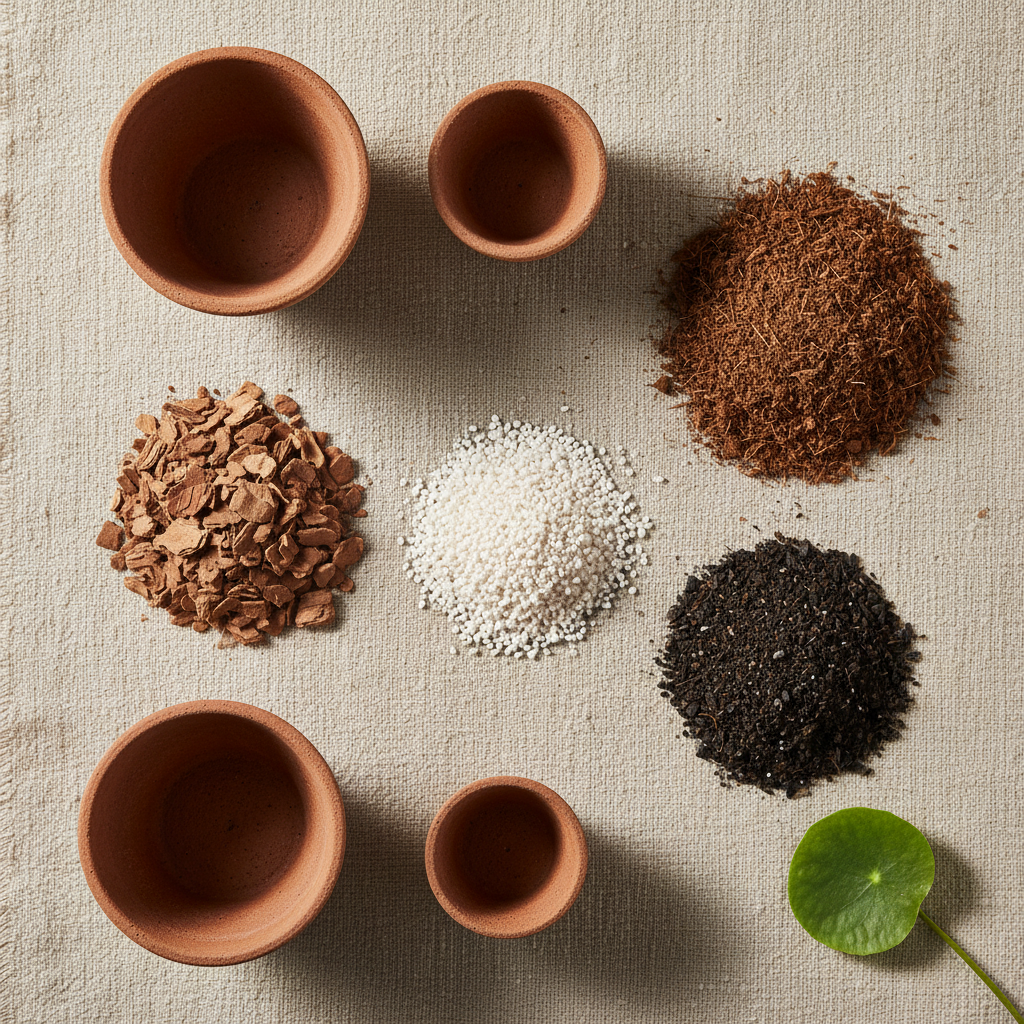
Ideal Soil Composition
A generic supermarket houseplant compost is too dense for Pilea straight from the bag. It holds moisture too long, compacts within a few months and starves the roots of oxygen, which is exactly the recipe for root rot in this species. Aim instead for a mix that visibly contains chunky drainage material, so that when you press it between your fingers it crumbles apart rather than packing into a ball. The table below shows a reliable home-mixed recipe.
| Component | Proportion | Function |
|---|---|---|
| Quality houseplant compost or coir-based mix | 50 percent | Provides body, baseline moisture retention and a small nutrient buffer |
| Perlite | 30 percent | Opens up the structure and creates air pockets for oxygen exchange |
| Fine orchid bark or pumice | 15 percent | Adds chunky drainage channels and resists compaction over time |
| Worm castings | 5 percent | Slow-release nutrients and beneficial microbial activity |
The ideal pH sits between 6.0 and 7.0, which is slightly acidic to neutral and is what most commercial peat-free composts already provide. There is no need to test or adjust pH for normal household care; only if you are using rainwater with unusual mineral content or a very alkaline tap supply do you need to think about it.
Pro Tip — Quick Mix Recipe: If you do not want to source four ingredients separately, mix two parts of a quality peat-free houseplant compost with one part perlite. That ratio alone solves more Pilea problems than any other single change, because it cuts watering anxiety in half by making it physically harder to overwater.
Choosing the Right Pot
Pot choice matters more for Pilea than for almost any other small houseplant, because its compact root system can be easily overwhelmed by too much wet substrate. A pot one or two centimetres (half an inch to an inch) larger than the rootball in diameter, and roughly the same again in depth, is correct. A pot much larger than that holds a reservoir of damp soil the roots cannot access, and that reservoir is exactly where rot starts.
Drainage holes are non-negotiable. Use a pot with at least one generous drainage hole, ideally several. Decorative cachepots without drainage are fine as outer covers, but the plant itself must sit in something that lets water exit. The single most common cause of Pilea death in well-meaning homes is a pretty ceramic cover pot full of water hidden underneath a happy-looking plant.
Pot material: Terracotta is the safest first-time choice. It breathes, wicks moisture out of the soil through its porous walls, and dries the rootball slightly faster than glazed ceramic or plastic. This is forgiving for new owners. Glazed ceramic and plastic are perfectly workable for experienced growers who can read soil moisture confidently, and they have the advantage of holding moisture longer, which is convenient if you tend to forget watering. The trade-off is that they amplify any overwatering tendency.
Pot size: Pilea actively prefers being slightly snug in its pot. A pot that feels almost too small will produce a tighter, more compact rosette and more pups around the base, while an oversized pot delays both. As a rough guide, the pot diameter should equal the spread of the foliage minus 4 to 6 cm (1.5 to 2.5 in). For a mature 30 cm wide plant, that means a pot around 14 cm (5.5 in) across.
When to Repot
Chinese Money Plants do not need frequent repotting. Once every 18 to 24 months is plenty for most specimens, and even then only if at least one of the standard signs is showing: roots circling the inside of the pot or coming out of the drainage holes, the pot drying out within two or three days of every watering, the plant pushing visibly upward and exposing roots above the soil line, or a noticeable slowdown in pup production. The best time to repot is spring or very early summer, when the plant is moving back into active growth and recovers from disturbance most quickly.
How to Repot: Step-by-Step
- Water the plant lightly a day before, so the rootball holds together but the soil is not soggy. Bone-dry rootballs shatter; sodden ones smear.
- Prepare the new pot: only 2 to 3 cm (about 1 in) wider than the current one, with fresh well-draining mix added to about a third of its depth.
- Slide the plant out by inverting the pot and supporting the crown gently with your fingers. Tap the rim if it sticks; never pull on the stem.
- Inspect the rootball. Tease out any tightly circling roots with your fingers and trim away any brown, mushy or hollow sections back to firm white tissue with clean scissors.
- Position the plant in the new pot so the soil line sits exactly where it was before, never deeper. Burying the stem encourages stem rot in this species more than in most.
- Backfill around the rootball with fresh mix, pressing gently with your fingertips to remove the largest air pockets but not packing it tight. Top the soil up to about 1.5 cm (0.5 in) below the rim.
- Water lightly to settle the mix and return the plant to bright indirect light. Hold off from full watering and any fertiliser for two weeks while the roots establish.
Warning — Transplant Shock: A repotted Pilea often droops dramatically for the first 48 to 72 hours, sometimes alarmingly so. Resist the temptation to water heavily or move it into stronger light to “perk it up”. Both make things worse. Leave it in a slightly shadier spot than usual, with the soil only just damp, and it will recover on its own within four or five days.
Fertilising
Chinese Money Plant is a modest feeder. It does not need the heavy, regular nutrient programme that a fast-growing Monstera or Philodendron benefits from, but it absolutely benefits from steady, dilute feeding during its active growing months. A well-fed Pilea produces deeper green leaves, larger blades, more pups and a sturdier stem; an unfed Pilea will survive almost indefinitely in clean compost but will look pale, small and slightly tired by its second summer in the same pot.
The single biggest mistake with feeding this plant is overdoing it. Pilea roots are small and sensitive to mineral build-up, and a strong dose of synthetic fertiliser can burn the root tips within a single watering, after which leaves brown along the margins and pup production stalls for weeks. Fortunately the fix is simple: feed often but very dilute, never strong.
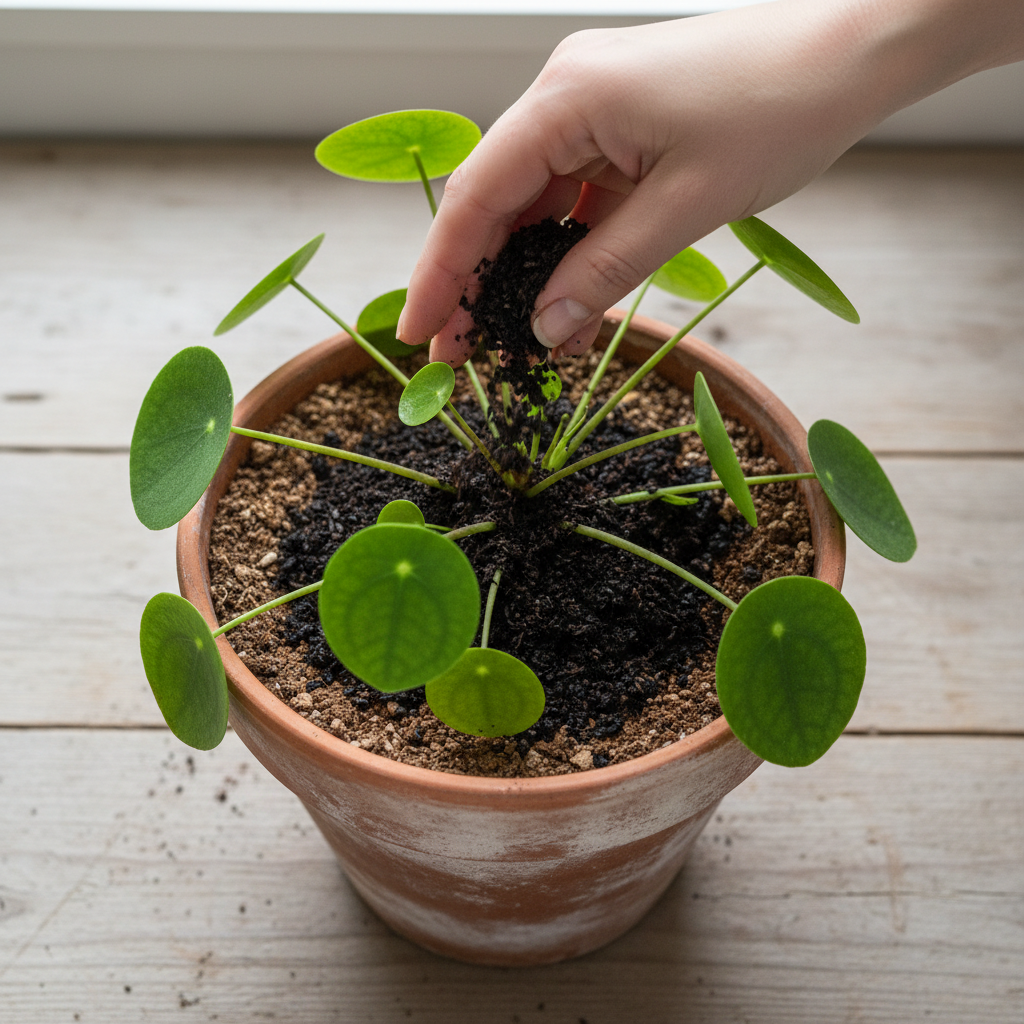
Understanding Plant Nutrients
All houseplant fertilisers are built around the same handful of nutrients, expressed on the bottle as the familiar N-P-K ratio plus a list of micronutrients. Knowing what each one does helps you interpret deficiency symptoms when they appear, rather than reaching for a generic “feed more” response. Pilea responds particularly well to balanced formulations rather than tilted ones, since it does not have the heavy flowering or fruiting demand that would justify a high-phosphorus product.
| Nutrient | Symbol | Primary Function | Deficiency Symptoms |
|---|---|---|---|
| Nitrogen | N | Leaf and stem growth, chlorophyll production | Older leaves yellow uniformly; plant stops producing pups |
| Phosphorus | P | Root development, energy transfer, flower formation | Stunted growth, dull dark leaves, small new pups |
| Potassium | K | Cell wall strength, water regulation, disease resistance | Brown crisp leaf margins, weak floppy petioles |
| Calcium | Ca | Cell wall structure, new leaf formation | Distorted new growth, small puckered emerging leaves |
| Magnesium | Mg | Centre of every chlorophyll molecule | Yellowing between green veins on older leaves |
| Iron | Fe | Chlorophyll synthesis | Yellowing between veins on the newest leaves, while veins stay green |
Types of Fertiliser
Liquid fertilisers: The most controllable option for Pilea, because dilution rate is in your hands. A balanced general houseplant feed, typically marketed as 5-5-5, 6-6-6, 10-10-10 or thereabouts, mixed to half the strength recommended on the bottle, is ideal. Apply when watering, never to dry soil, because dry roots absorb concentrated fertiliser too quickly and burn easily.
Slow-release granular: Convenient but tricky to calibrate for a small pot. Slow-release prills like the resin-coated 14-14-14 or 18-6-12 formulations release nutrients over three to six months depending on temperature, which can mean a long, gentle feed in cool conditions or an unintended overdose in a warm summer windowsill. If you use them, halve the recommended dose for the pot size and refresh in spring only.
Organic fertilisers: The gentlest and most forgiving option. A thin top-dressing of worm castings in early spring, replenished mid-summer, provides slow nutrition without any risk of burning, and adds beneficial microbial activity to the substrate at the same time. Compost teas, well diluted, are also good for occasional use. Organic feeds make it almost impossible to over-fertilise a Pilea, which is why many experienced growers default to them entirely for this species.
Feeding Schedule
Feed actively from early spring through early autumn, roughly March to September in the northern hemisphere, when daylight is long enough to drive sustained growth. A balanced liquid feed at half strength every three to four weeks is the workhorse schedule. Stop feeding entirely in late autumn and winter; the plant is barely growing, cannot use the nutrients, and they will simply build up as salts in the soil and damage the roots over months. Resume only when you see fresh new pups appearing in spring.
Pro Tip — Half Strength Always: The instructions on a bottle of houseplant fertiliser are written for fast-growing plants in optimal conditions. For a domestic Pilea in average indoor light, half strength is the right strength, and quarter strength is fine if the plant is in a particularly dim spot or recovering from stress. Going stronger than label dose helps no one and risks salt damage.
How to Fertilise
- Wait until the plant is due for watering, with the top of the soil dry but the deeper rootball still slightly moist, not bone dry.
- Mix the chosen fertiliser to half the label dose in a clean container of room-temperature water.
- Water the plant normally with the diluted feed, pouring across the surface until water runs from the drainage holes.
- Empty the saucer once drainage stops. Salts left in standing water can be drawn back into the soil as it dries.
- Every third or fourth feed, flush the pot with plain water only, slowly and thoroughly, to wash accumulated salts out of the root zone.
Warning — Salt Build-Up: White or yellowish crust on the soil surface, on the rim of the pot, or around drainage holes is the visible sign of accumulated fertiliser salts. Continued exposure causes brown crisp leaf tips, leaf drop and stunted new growth. Flush the pot with three times its volume of plain water and skip the next two feeds; in severe cases, repot into fresh mix.
Propagation
Chinese Money Plant is one of the easiest houseplants on earth to propagate, and the way it does it is part of the reason it spread through European homes for decades before commercial nurseries caught up. Mature plants produce baby plants, called pups or offsets, in two slightly different locations: from horizontal underground runners that surface around the base of the main stem, and directly from latent buds along the parent stem above the soil. Both kinds separate from the parent cleanly and root readily, which is what gave this plant its old nickname of “Friendship Plant”.
Stem cuttings of the bare main stem also root, less reliably than pups but well enough to rescue a damaged plant. Seed propagation is technically possible but vanishingly rare in cultivation, because mature flowering specimens are uncommon indoors and the seeds are tiny, short-lived and slow. For practical purposes, propagation of this species means working with its abundant pups.
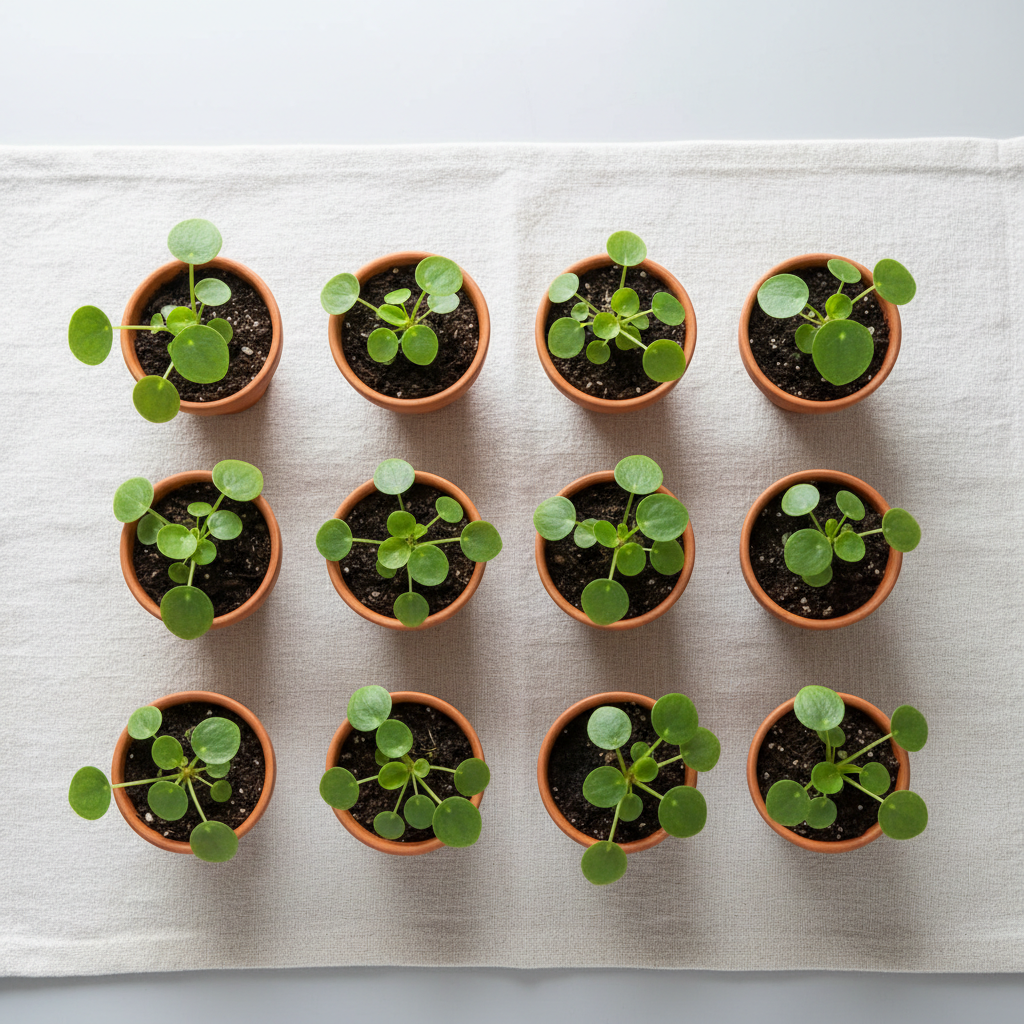
Understanding Pups and Runners
The first time you notice a tiny new Pilea poking up next to the main stem you have a choice to make: leave it where it is and let the parent pot become a small clump, or separate it and grow it on as a standalone plant. Both are perfectly reasonable. Soil pups are the easiest by far, because they emerge from a horizontal runner already carrying their own root system. By the time the new rosette has three or four leaves about the size of a five-pence coin or a US dime, the pup is ready to be lifted away and potted on its own.
Stem pups, which appear higher up on the trunk of the parent, do not start with their own roots. They need to be cut off, rooted in water or moist substrate for two to four weeks, and only then potted into soil. They are slightly more work but produce identical plants and are useful when the parent does not seem to be producing soil pups, which can happen if the plant is potted in a way that smothers the runners.
Method 1: Soil Pup Division, Step-by-Step
This is the method to use whenever a parent plant is producing baby pups that emerge from the soil surface near the base of the main stem. It is fast, reliable and produces a young plant that is already established with its own root system.
- Wait until the pup is at least 5 to 7 cm (2 to 3 in) tall and has at least three or four of its own leaves. Smaller than this and survival rates drop sharply.
- Water the parent plant lightly the day before, so the soil is workable but not saturated.
- Gently scrape away soil around the base of the pup with your fingers until you can see the white runner connecting it to the parent stem.
- Use a clean, sharp blade to cut the runner between the pup and the parent, leaving as much of the pup’s own root system intact as possible.
- Lift the pup carefully out of the surrounding soil and pot it into a small container, no larger than 7 to 8 cm (3 in) across, filled with the same chunky mix you use for the parent.
- Water lightly to settle the mix and place in bright indirect light, slightly shadier than the parent’s usual spot for the first week.
- Hold off from feeding for at least four weeks; the new pup should be focused on establishing roots, not pushing leaves.
Pro Tip — Pot Up Several at Once: If the parent has produced multiple pups in the same season, lift and pot them up in a single session into matching small pots. A row of identical baby pileas is one of the most charming results in indoor growing, and it gives you an instant supply of gifts.
Method 2: Stem Pup or Cutting in Water, Step-by-Step
Stem pups emerge from buds along the main trunk, often in the upper third of the plant, and they look like small rosettes growing directly out of the bark. They do not have their own roots when you find them. The same method works for the bare top of a parent plant if it has grown leggy or lost its lower leaves and you want to restart with a fresh crown.
- Choose a stem pup that is at least 5 cm (2 in) tall with several established leaves, or a length of healthy stem 6 to 10 cm (2.5 to 4 in) long with at least one node.
- Cut cleanly with a sterilised blade, just below where you want the new root system to form.
- Place the cutting in a small glass or jar of room-temperature water with at least one node submerged. Leaves must stay above the water line; submerged leaves rot quickly.
- Position the glass in bright indirect light, never in direct sun, and refresh the water every three to five days to keep it oxygenated.
- Wait two to four weeks for fresh white roots to emerge from the submerged node. When the longest root is 3 to 5 cm (1 to 2 in), the cutting is ready to pot up.
- Pot into a small container of chunky houseplant mix, keep the substrate just lightly moist for the first two weeks, then water on the normal “dry top inch” schedule from then on.
Troubleshooting Propagation
| Problem | Likely Cause | Solution |
|---|---|---|
| Cutting rots in water before roots appear | Water not changed often enough, or leaves submerged | Refresh water every 3 days and trim off any submerged leaves; start a fresh cutting if rot has spread |
| Pup wilts dramatically after potting | Roots disturbed during separation, or too much light too soon | Move to slightly shadier spot, light watering, leave for 5 days without further disturbance |
| Parent plant produces no pups at all | Insufficient light, root-bound or excessively loose soil burying runners | Move to brighter spot, repot into chunky mix at the original soil line, fresh balanced feed in spring |
| Stem cutting roots but never leafs out | Cutting too short, no node submerged, or rooted too cold | Use a longer cutting with two nodes, keep at 20 C (68 F) or warmer; some patience required, can take 6 weeks |
Pests and Diseases
Chinese Money Plant is not a pest magnet. Its smooth, slightly waxy leaves and tidy growth habit make it less attractive to most common houseplant insects than, say, a hairy Pelargonium or a fleshy Begonia. That said, no houseplant is genuinely immune, and Pilea collected from greenhouse nurseries or kept among other plants will eventually encounter the standard suspects. The most reliable defence is steady inspection. Once a week, when you water, glance under a couple of leaves and check the soil surface. Catching a problem at five insects rather than five hundred is the entire game.
Diseases on Pilea are almost always cultural rather than infectious, and almost always trace back to the same root cause: soil that stays wet too long. Fungal and bacterial rots, leaf-edge browning and a general sad limpness are usually the substrate complaining, not a pathogen striking. Get the watering and the potting mix right and most of this disappears.
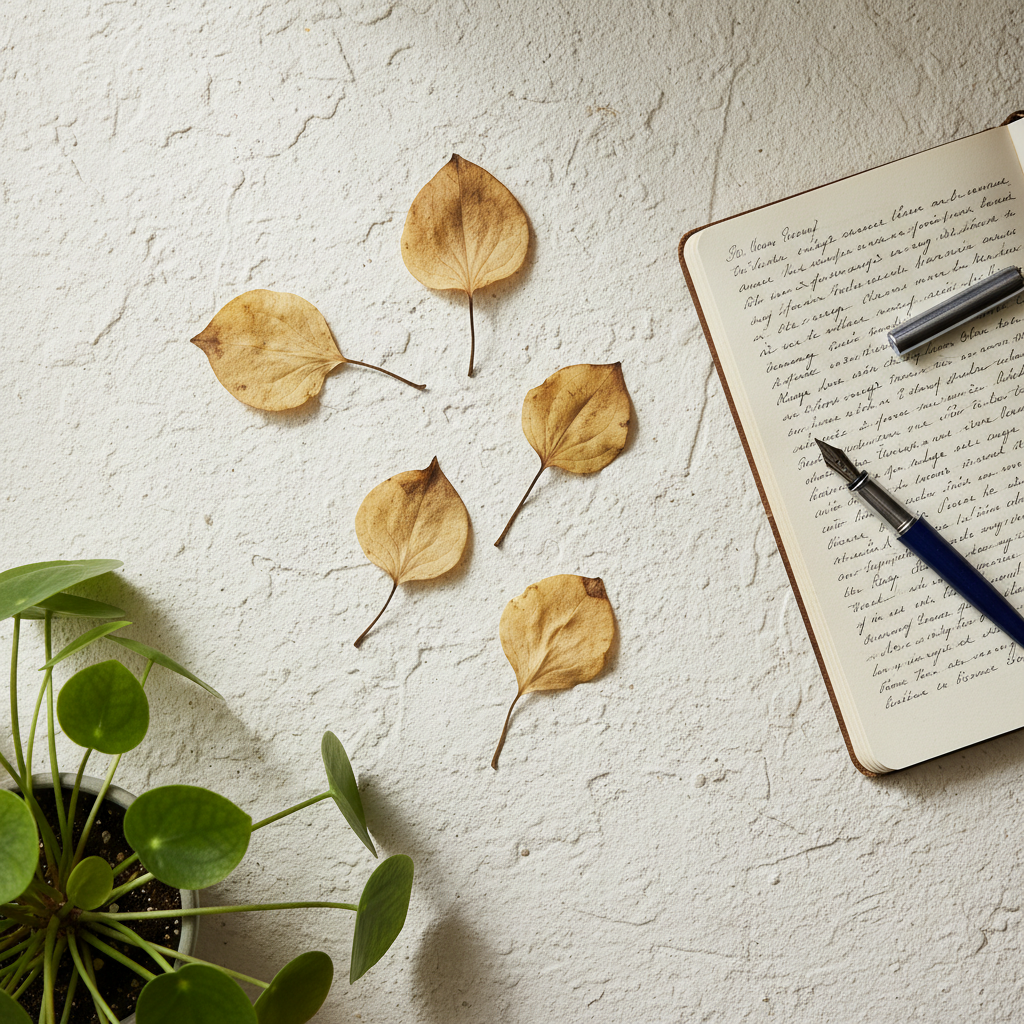
Common Pests
Spider Mites (Tetranychus urticae)
Spider mites are tiny, dust-sized arachnids that live on the undersides of leaves and pierce cells to suck out their contents. They thrive in warm, dry conditions, which makes centrally heated winter rooms their favourite environment. On Pilea, the first sign is a faint stippling of pale dots across the leaf surface, which closer inspection reveals as the empty cells the mites have drained. Heavy infestations produce visible fine webbing in leaf axils and along petiole bases.
Treatment: Rinse the plant thoroughly in a tepid shower, then spray with a horticultural soap or a 1 percent neem oil solution, paying particular attention to leaf undersides. Repeat at five-day intervals for three applications to break the mite life cycle. Increase ambient humidity, since mites struggle above 50 percent, and isolate the plant from other houseplants until two clean inspections in a row.
Mealybugs (Pseudococcus longispinus)
Mealybugs appear as small, white, cottony tufts wedged into the angles where petioles meet the stem and in the centre of the rosette. They feed on plant sap and excrete sticky honeydew, which often shows up as a glossy film on lower leaves and the surrounding shelf. Pilea is moderately susceptible because its tight rosette geometry creates exactly the kind of sheltered nooks mealybugs prefer.
Treatment: For small infestations, dab each cluster directly with a cotton bud soaked in 70 percent isopropyl alcohol, which dissolves the protective wax coating and kills the insect underneath. For larger infestations, spray the whole plant with horticultural soap weekly for three weeks, and check the undersides of leaves and the soil surface for crawlers between treatments. Quarantine the plant until clear.
Fungus Gnats (Bradysia spp.)
Fungus gnats are small, dark, mosquito-like flies that swarm out of the pot when disturbed. The adults are harmless, but their larvae live in the top centimetre of damp soil and feed on fungi, organic matter and, occasionally, tender young roots. They are a near-certain symptom of soil that has been kept too wet, and they appear within weeks of overwatering becoming a habit.
Treatment: Let the soil dry out more thoroughly between waterings; the larvae cannot survive in dry substrate. Top-dress the pot with 1 cm (0.5 in) of horticultural sand or fine grit, which discourages adults from laying eggs. Yellow sticky traps catch the adults and break the breeding cycle. Persistent populations respond to a soil drench of Bacillus thuringiensis israelensis (Bti), available in mosquito-control dunks dissolved in watering water.
Aphids (Aphis gossypii and similar)
Aphids are uncommon on Pilea indoors but do occasionally arrive on a new plant or hitch a ride in from open windows in summer. They cluster on soft new growth, particularly young pups, and on the inflorescence stalks if the plant is flowering. They feed on sap and excrete the same sticky honeydew as mealybugs.
Treatment: Strong water sprays dislodge most colonies on this species, because the leaves are robust and the aphids are exposed. Follow up with horticultural soap if any persist. Check daily for a week after the first sighting, since reproduction is rapid.
Common Diseases
Root Rot (Pythium and Phytophthora spp.)
By far the most common disease on this species, and the one most likely to kill a Pilea outright. It begins as a soft, browning rot in the smallest roots and works upward into the main stem base. Above ground, the first signs are persistent slight wilting that does not improve after watering, lower leaves yellowing and dropping, and eventually a stem that goes soft at the soil line. By the time the stem is collapsing, the rootball is already largely gone.
Treatment: Unpot immediately, wash the rootball clean and inspect. Cut away every brown or hollow root back to firm white tissue. Repot into fresh dry mix in a smaller, clean pot. Hold off from watering for four to five days. If the central stem has rotted at the base, the plant cannot be saved as a whole; take the healthiest top section as a cutting, let it callus 24 hours, and root in water (see Propagation).
Leaf Spot (Cercospora and bacterial pathogens)
Occasional brown or black spots on individual leaves, sometimes with a yellowish halo. Almost always associated with water sitting on the foliage for extended periods, in combination with poor airflow. On Pilea, this is most often the result of misting routines or splashing during overhead watering, especially in cool rooms.
Treatment: Remove affected leaves at the petiole. Reduce or stop misting. Water at the soil surface, not over the leaves, and ensure adequate air movement around the plant by improving general room ventilation. Stubborn cases respond to a copper-based fungicide labelled for indoor ornamentals, applied per the product instructions.
Powdery Mildew (Erysiphales)
Rare on Pilea indoors but can appear if the plant is grown in stagnant, very humid conditions, such as a closed terrarium or a poorly ventilated bathroom. Shows as a fine dusty white coating on the upper leaf surface, often starting at the leaf centre and spreading outward.
Treatment: Move the plant to a better ventilated spot immediately. Wipe affected leaves with a soft cloth dipped in dilute milk solution (one part full-fat milk to nine parts water), a folk remedy that has proven effective in research trials. Severe cases respond to potassium-bicarbonate-based fungicides.
Pest and Disease Summary
| Pest / Disease | Identification | Treatment |
|---|---|---|
| Spider mites | Fine stippling on leaves, faint webbing in axils | Rinse, horticultural soap or neem, weekly for 3 weeks |
| Mealybugs | White cottony tufts in petiole joints and rosette centre | Cotton bud with 70 percent alcohol; soap spray weekly |
| Fungus gnats | Small dark flies above pot; larvae in top of soil | Dry soil more, sand top-dress, sticky traps, Bti drench |
| Aphids | Clusters of small green or black insects on new growth | Strong water rinse, horticultural soap if needed |
| Root rot | Soft stem base, persistent wilt, brown mushy roots | Unpot, trim rotten roots, fresh dry mix, hold water 5 days |
| Leaf spot | Brown or black spots with yellow halos | Remove affected leaves, stop misting, improve airflow |
| Powdery mildew | White dusty coating on upper leaf surface | Move to ventilated spot, milk solution wipe, bicarbonate spray if persistent |
Prevention Strategies
Most pest problems on Pilea trace back to one of three failures: a new plant brought in without quarantine, declining health from cultural stress that weakens its defences, or stagnant air around a closely packed plant collection. Address those three and you will rarely see anything more serious than a stray fungus gnat. Quarantine every incoming plant for at least two weeks in a separate room, inspecting weekly. Keep the plant in conditions it actually wants, since a stressed Pilea attracts insects in a way a thriving one does not. And rotate the plant slightly every couple of weeks so air moves around the rosette rather than stagnating between the leaves.
For disease prevention, the controllable variables are watering technique and pot choice. Water from below the leaves, never from above, and let the soil dry properly between drinks. Use a pot with generous drainage and a mix with at least 30 percent perlite. Empty saucers and cachepots within ten minutes of every watering. Keep the plant out of cold draughts in winter, which depress its immune response and make any latent pathogen more likely to take hold.
Pro Tip — The Soap Sentinel: Keep a small spray bottle of pre-mixed insecticidal soap on the shelf next to your Pilea. The moment you see anything suspicious, give the plant a thorough spray, especially the leaf undersides and axils. A 30-second response on day one beats a 30-day treatment programme on day fourteen, every single time.
Popular Varieties
For most of the last century, Chinese Money Plant existed in cultivation as a single, unselected, all-green form. Mass-market availability arrived only around 2015 and 2016, and with it came the first deliberately propagated cultivars. The number of named varieties is still small compared with old houseplant lineages like Philodendron or Begonia, but the few that exist are striking, sought after, and well worth tracking down if you want more than the standard green form.
Almost every named cultivar is propagated vegetatively from pups, which means rare varieties stay scarce and prices stay high for years after their initial release. Variegated Pileas in particular were collector items selling for hundreds of pounds in the late 2010s, though prices have eased substantially since.
| Variety | Leaf Appearance | Light Needs | Growth Rate | Availability |
|---|---|---|---|---|
| Standard P. peperomioides | Plain glossy mid-green, round and flat | Bright indirect | Moderate | Widely available |
| ‘Mojito’ | Round leaves with cream and pale-green variegation | Bright indirect, slightly more is helpful | Slow to moderate | Specialist, increasing |
| ‘Sugar’ | Round leaves dusted with tiny silver-white sparkles | Bright indirect | Moderate | Specialist |
| ‘White Splash’ / ‘Variegata’ | Round leaves with bold white-cream sectors and splashes | Bright indirect, needs more light than green form | Slow | Rare, collector |
| ‘Frosted Jade’ | Cream-edged leaves with green centres | Bright indirect | Slow | Rare, collector |
| P. depressa (Baby Tears Pilea) | Tiny round bright-green leaves, trailing habit, related species | Bright indirect | Fast trailing | Specialist |
Featured Varieties
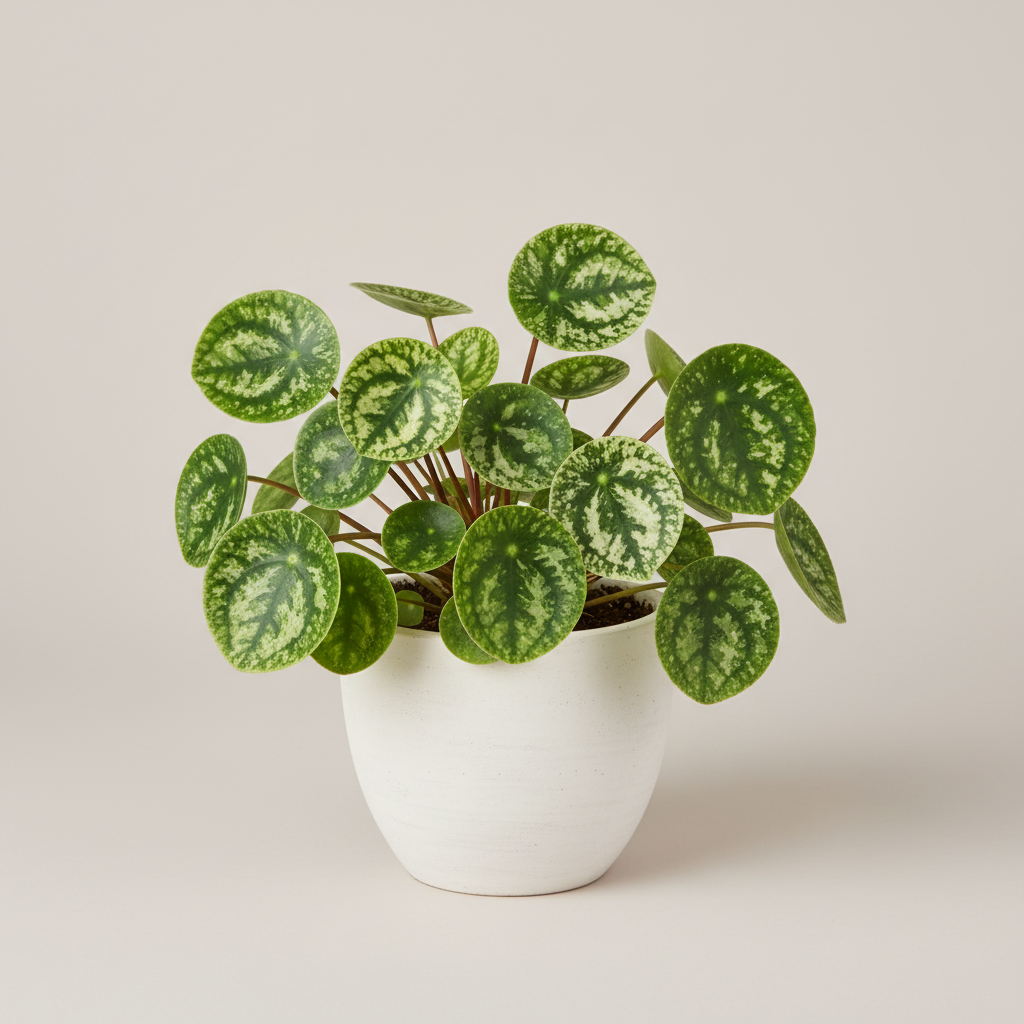
‘Mojito’
The most distinctive of the variegated cultivars, with irregular cream and pale-green splashes scattered across each round leaf. No two leaves are marked the same way, which gives a mature specimen a beautifully restless, painterly look. Grows slightly slower than the green form and benefits from a slightly brighter spot to keep variegation crisp.
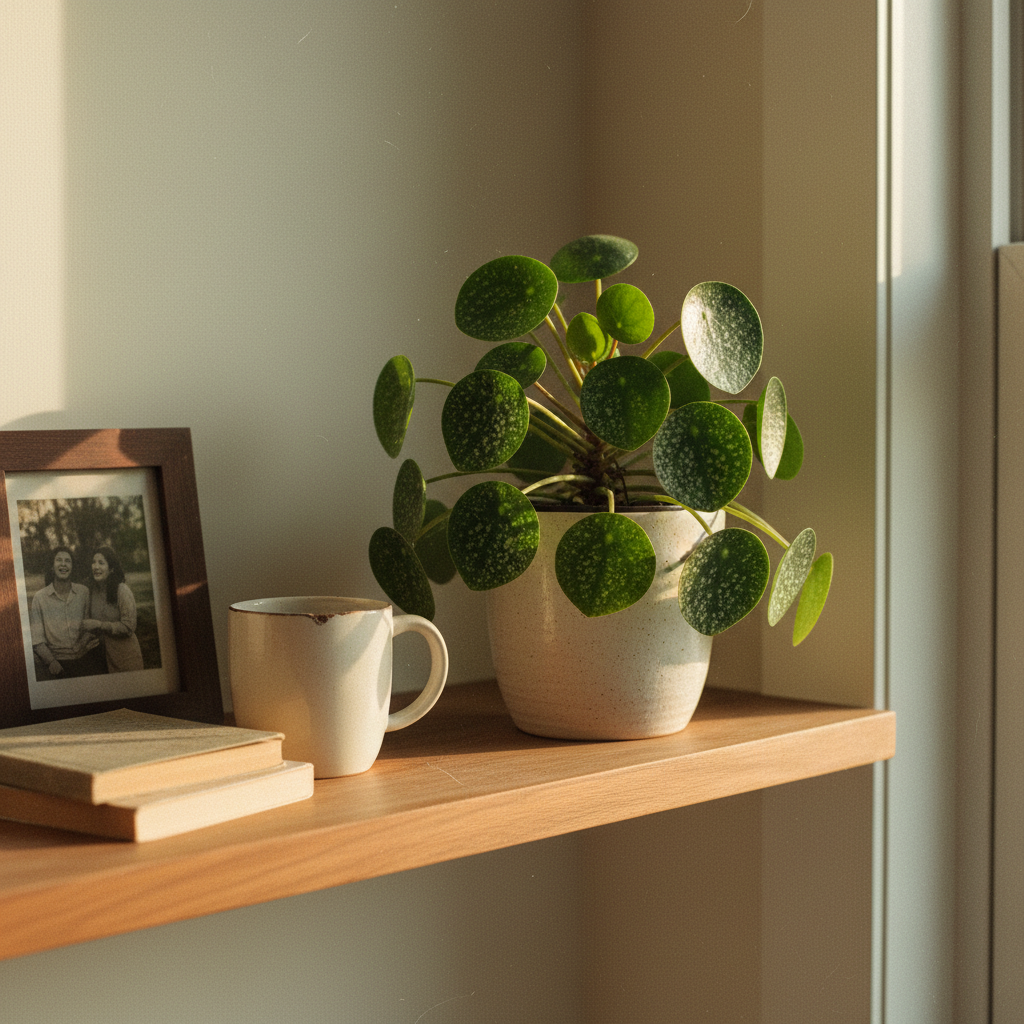
‘Sugar’
A more recent introduction, with leaves dusted across the upper surface with countless tiny silver-white flecks that catch the light like sugar crystals. The effect is subtle in shade and dramatic in raking morning light. Care needs are essentially identical to the standard green form, though leaves often show slightly more pinkish flush at the petiole base.
Variety Profiles in Detail
Standard Chinese Money Plant (Pilea peperomioides)
The original form is still arguably the most architecturally satisfying of all. Plain mid-green, glossy, flat, perfectly round leaves on slender petioles arising from a single fleshy stem. A mature, well-grown standard Pilea is a sculpture in three dimensions and remains a strong design choice in almost any room. Care is straightforward and entirely as described in this guide.
‘Mojito’ (Pilea peperomioides ‘Mojito’)
The cultivar that brought variegation to the species commercially. Selected for stable speckled variegation, ‘Mojito’ has been propagated widely enough in the last few years that prices have come down from the eye-watering heights of 2018 and 2019. Each leaf carries a unique pattern of cream and pale-green splashes, which means that no two specimens look quite the same. Place in slightly brighter light than the standard form to maintain colour saturation.
‘Sugar’ (Pilea peperomioides ‘Sugar’)
One of the most sought-after recent introductions, ‘Sugar’ shows tiny, almost crystalline silver-white flecks scattered across the upper surface of otherwise green leaves. The effect is most pronounced on mature leaves and in moderate-to-bright light. Some growers report that the flecking varies leaf to leaf depending on growing conditions, and that warm growing temperatures intensify the silvering.
‘White Splash’ / Variegata (Pilea peperomioides ‘Variegata’)
The boldest of the variegated cultivars, with large white-cream sectors and full half-leaf variegation. Beautiful but slow, fragile and demanding. Variegated sectors lack chlorophyll, which means the plant grows more slowly overall and needs more light to compensate. Reverted all-green pups should be removed promptly to maintain the variegation across the whole specimen.
‘Frosted Jade’ (Pilea peperomioides ‘Frosted Jade’)
A marginated cultivar with cream edges and green centres. Less common than ‘Mojito’ and tends to be slow, but very neat in habit. Treat like ‘White Splash’ in terms of slightly higher light needs and slower growth.
Baby Tears Pilea (Pilea depressa)
A related species rather than a true variety of Pilea peperomioides, but often sold alongside it because of the family connection. Tiny round bright-green leaves, trailing habit, ideal for hanging pots and terraria. Care is broadly similar to its more famous cousin, with the same preference for bright indirect light and well-drained mix, though it tolerates higher humidity well and benefits from regular trimming to encourage bushy growth.
Choosing the Right Variety for Your Space
If you are growing a Pilea for the first time, start with the standard green form. It is widely available, inexpensive, fast to produce pups, and forgiving of beginner mistakes; you will learn the rhythm of the species without simultaneously fighting the slower growth and higher light needs of a variegated cultivar. If you have grown the species before and want something more unusual, ‘Mojito’ is the natural next step: distinctive enough to look different, similar enough in care that nothing about your routine needs to change. The rarer cultivars like ‘White Splash’ and ‘Frosted Jade’ are rewarding but better reserved for growers who can guarantee the brighter light and gentler watering they need.
Frequently Asked Questions
Why are my Chinese Money Plant’s leaves curling?
Slight downward curling of mature leaves usually points to light stress, often too much direct sun. Edges curling under and slightly cupped leaves point to underwatering. Distorted curling on new growth, with puckered leaves, is more likely a calcium issue or, occasionally, very early signs of pest damage on the developing rosette. Check the obvious things first: light position, soil moisture and any visible insects in the centre of the plant.
Why is my Pilea leaning to one side?
Pilea peperomioides is intensely phototropic and will tilt toward its strongest light source within days. The fix is straightforward: rotate the pot a quarter turn every time you water. Over a few weeks, the rosette will reorient and stand straight again. Severe leans that have set in over months may need staking briefly with a slim bamboo cane and a soft tie, while you correct the underlying light problem.
My plant has dropped all its lower leaves; can I save it?
Almost certainly yes. The standard Pilea recovery move is to behead the leggy parent: cut the upper crown off, just below the lowest healthy leaf, let the cut callus for 24 hours, and root the top section in water as a fresh cutting. The bare parent stem usually sprouts multiple new pups within a few weeks, especially if you keep it warm and bright. You end up with two plants from one.
How fast does a Chinese Money Plant grow?
Moderate. In good conditions, expect roughly one new leaf every one to two weeks during spring and summer, with the central stem gaining 10 to 15 cm (4 to 6 in) of height per year. Pup production picks up sharply once the parent reaches about 15 cm (6 in) tall, and a well-established plant can produce 6 to 10 pups in a single growing season.
Should I cut off old or damaged leaves?
Yes, but cleanly. Snip the petiole off close to the main stem with sharp, clean scissors. Leaves that have yellowed, browned at the margin or been damaged beyond repair are not going to recover, and they redirect the plant’s energy when removed. Healthy older leaves should be left in place; the plant relies on them for photosynthesis and will shed them naturally when it is ready.
Why are the leaves on my Pilea so small?
Small new leaves usually mean one of three things: insufficient light, insufficient nutrients, or being severely root-bound. Check light placement first, since it is the most common cause. If light is good, try a half-strength balanced feed every three weeks for two months. If the plant is also rocking in its pot or showing roots emerging from drainage holes, it is time to repot a single size up.
Are Chinese Money Plants safe for cats and dogs?
Yes. Pilea peperomioides is listed as non-toxic to cats, dogs and horses by the ASPCA, and no significant poisoning cases are recorded in veterinary literature. As with any plant, large quantities chewed could still cause mild stomach upset, so it is sensible to discourage repeated browsing.
Why do the leaves have white spots on them?
Small white deposits are usually mineral residue from hard tap water or from fertiliser splashes, and wipe off with a damp soft cloth. Fine white powder that does not wipe away is more likely powdery mildew, which is rare but treatable. Tiny, cottony white tufts hidden in the leaf axils are mealybugs and need direct treatment, not a wipe.
Can a Chinese Money Plant flower indoors?
Occasionally, yes. A mature, well-grown specimen sometimes produces tall, slender pinkish-white flower stalks bearing dozens of tiny insignificant flowers, usually in late winter or early spring. The flowers are not ornamental and many growers cut the stalks off to keep the plant focused on leaf and pup production. Some report that a brief cool spell, around 12 to 15 C (54 to 59 F), in autumn encourages flowering the following spring.
How long does a Chinese Money Plant live?
Indefinitely, in practical terms. The original parent stem will eventually grow leggy and tired after five to ten years, but by then it has produced dozens of pups, any one of which carries the same plant forward. The Chinese Money Plant is one of the easiest houseplants to keep going across decades, and any specimen in a home today is often only a generation or two removed from a plant grown in a Norwegian kitchen window in the 1950s.






