
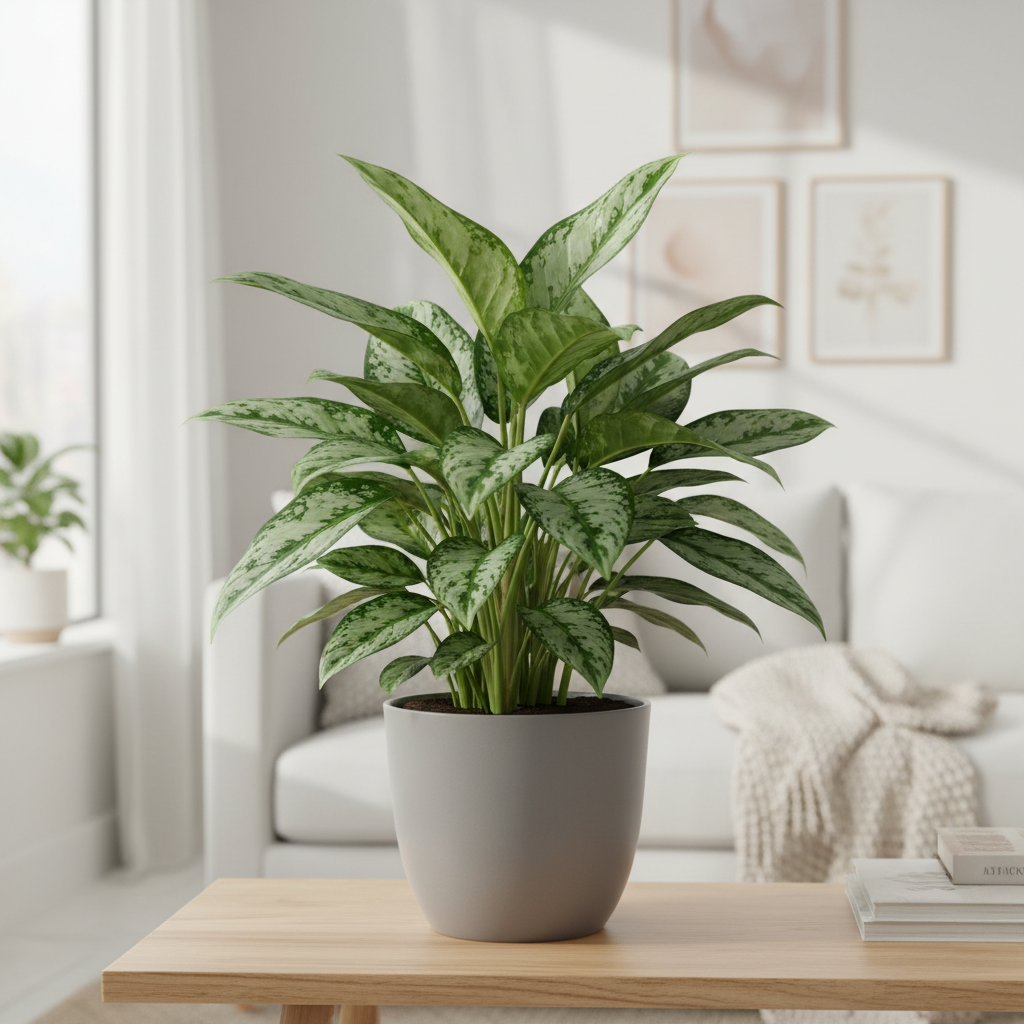
The Chinese Evergreen, known botanically as Aglaonema commutatum, is a tropical foliage plant whose generous, marbled leaves have made it one of the most enduring houseplants in cultivation. The genus Aglaonema comprises around two dozen species native to the humid lowland forests of Southeast Asia, with A. commutatum ranging across the Philippines and parts of Sulawesi, where it grows as a slow, clumping understorey perennial beneath the rainforest canopy. Cultivated in Asia for centuries as a symbol of fortune and long life, it reached Western greenhouses in the late nineteenth century and has since been hybridised into a remarkable spectrum of cultivars displaying silver, cream, chartreuse, pink and crimson variegation.
Few houseplants offer such a generous balance of beauty and forgiveness. The Chinese Evergreen tolerates low light, irregular watering and the dry air of centrally heated rooms with quiet patience, yet rewards a more attentive owner with rich colour, dense growth and the occasional ivory spathe. This guide separates merely surviving from genuinely thriving, walking you through every facet of its culture — the light it prefers but does not demand, the watering rhythm that prevents the only serious mistake you can make, the soil that keeps its fleshy roots happy for years, and the cultivars that turn a humble corner plant into the focal point of a room.
Contents
- Quick Reference
- Why Chinese Evergreen Makes an Excellent Houseplant
- Light Requirements
- Watering and Humidity
- Soil, Potting and Repotting
- Fertilising
- Propagation
- Pests and Diseases
- Popular Varieties
- Frequently Asked Questions
Quick Reference: Chinese Evergreen at a Glance
| Light | Medium to bright indirect; tolerates low light, dislikes direct sun. Variegated and pink cultivars need brighter conditions than plain green forms. |
| Watering | Allow the top 3 to 5 cm (1 to 2 in) of soil to dry between waterings. Typically every 7 to 14 days in summer, every 14 to 21 days in winter. |
| Temperature | 18 to 27 degC (65 to 80 degF). Must stay above 13 degC (55 degF); cold damage is rapid and often fatal. |
| Humidity | Prefers 50 to 70 percent, but adapts comfortably to typical indoor humidity of 30 to 50 percent. |
| Fertiliser | Balanced liquid feed at half strength every 4 to 6 weeks during spring and summer; none in winter. |
| Toxicity | Toxic to cats, dogs and humans if ingested. Contains insoluble calcium oxalate crystals that cause oral irritation and swelling. |
Why Chinese Evergreen Makes an Excellent Houseplant
Of all the foliage plants in mainstream cultivation, few combine ease of care with visual interest as effectively as the Chinese Evergreen. Its slow growth, patient temperament and tolerance of forgotten waterings have earned it a permanent place in offices, hotel lobbies and difficult dim corners where almost nothing else will survive. Yet to dismiss it as a workhorse plant misses its real charm: the spectrum of leaf patterning produced by modern breeding ranges from delicate silver brushstrokes to almost neon pink, giving the genus a graphic quality that few houseplants can match. A single specimen of Aglaonema ‘Pictum Tricolor’ or ‘Red Anjamani’ can transform a quiet shelf into a statement.
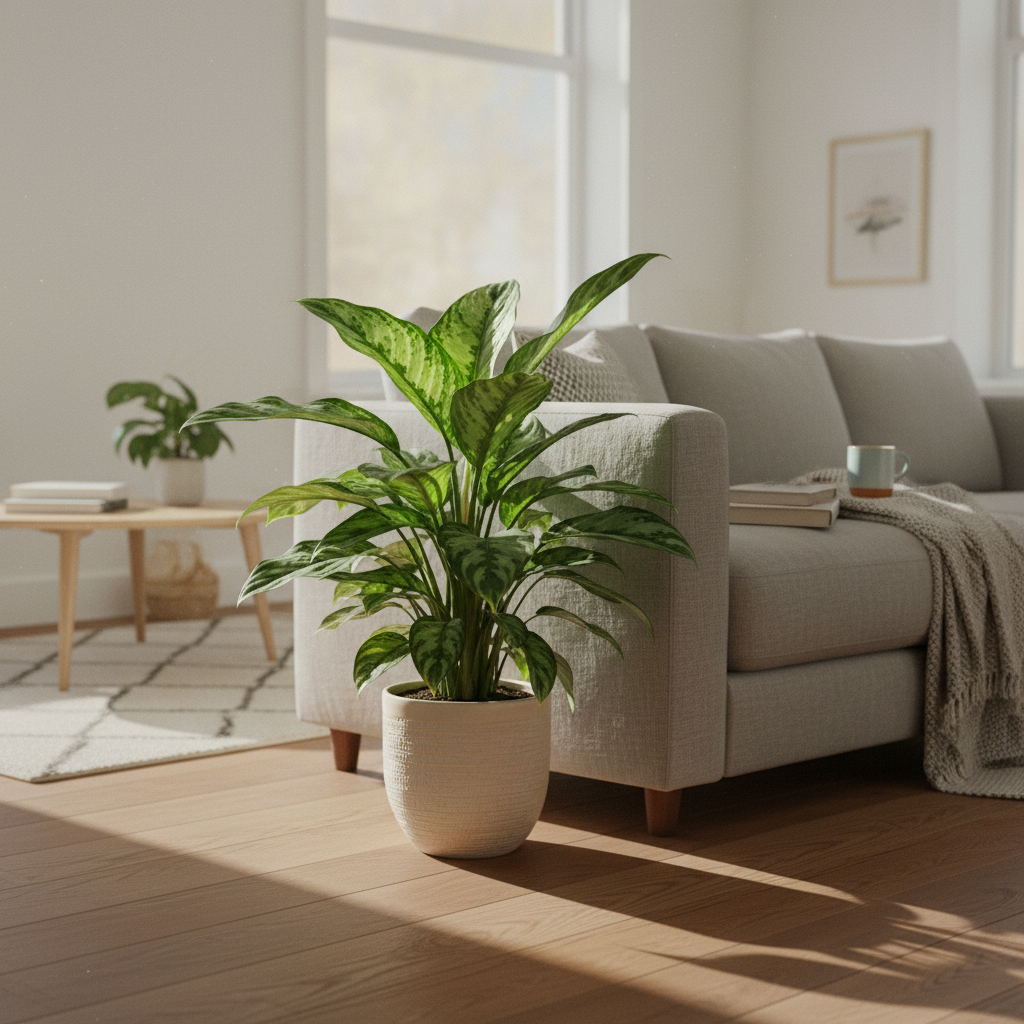
The plant’s resilience is rooted in its evolutionary origin. As a forest-floor species, Aglaonema commutatum developed to exploit the dim, stable light reaching the lowest layer of the rainforest, where canopy gaps shift constantly and direct sun rarely falls. Its broad leaves are efficient at capturing diffuse light, and its fleshy rhizomatous roots store enough moisture to weather brief dry spells. The same biology that lets it persist beneath dense canopy is what allows it to survive a forgotten Friday in a north-facing office. NASA’s Clean Air Study placed several Aglaonemas among the more effective houseplants at filtering common indoor volatile compounds, and although the practical magnitude of that effect in a normal room is small, it adds to the plant’s quietly useful reputation.
Important — Toxicity: All parts of the Chinese Evergreen contain insoluble calcium oxalate crystals. Chewed or bitten leaves can cause intense oral pain, drooling, swelling and vomiting in cats, dogs and small children. Place plants out of reach of curious pets and wash hands after handling cut stems, as the sap can also irritate sensitive skin.
Light Requirements
Light is the dial that most strongly governs how a Chinese Evergreen looks. The species and its many cultivars are famously tolerant of low conditions, which is the trait that built the plant’s reputation, but tolerance is not the same as preference. Plants given bright, filtered light will grow noticeably faster, hold their variegation more vividly and produce a denser, more upright clump. Plants kept in genuinely dim corners will live, sometimes for many years, but they grow slowly, lose internal contrast and may develop overly long, stretching stems.
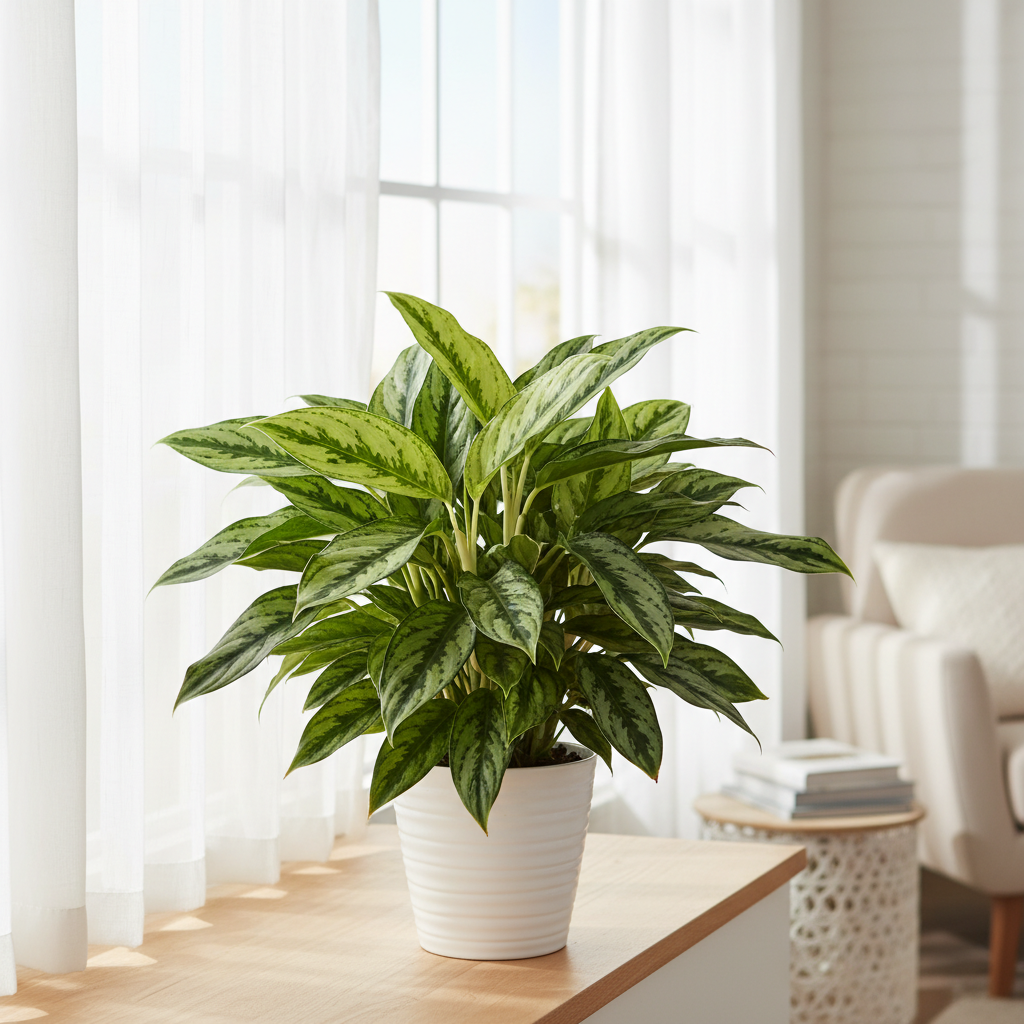
The ideal placement is a position with bright indirect light: a spot a metre or two back from a south- or east-facing window, behind a sheer curtain, or close to a north-facing window in summer. Light readings of around 10,000 to 25,000 lux suit most cultivars. Direct midday sun, by contrast, scorches the foliage within hours, leaving translucent pale patches that never recover.
Light Levels Explained
Indoor lighting is notoriously difficult to assess by eye, partly because human vision adapts so well to low levels that we routinely overestimate how bright a room is. A simple lux meter app on a smartphone gives a rough but useful guide. The table below maps the common descriptive categories onto approximate readings and onto how Chinese Evergreens respond at each level.
| Light Category | Approx. Level | Typical Location | Outcome |
|---|---|---|---|
| Direct sun | 30,000 lux and above | On a sunny windowsill, no curtain | Avoid — leaves bleach and scorch within days. |
| Bright indirect | 10,000 to 25,000 lux | Close to an east window or 1 to 2 m back from a south window with sheer curtain | Excellent: vivid variegation, compact growth, occasional flowering. |
| Medium indirect | 2,500 to 10,000 lux | Several metres into a bright room | Reliable: steady growth, slightly less colour intensity. |
| Low | 500 to 2,500 lux | North-facing room corner, office desk away from a window | Survives well; growth is slow, variegation fades on coloured forms. |
| Very low | Below 500 lux | Internal hallways, basements, windowless bathrooms | Tolerated only temporarily; stems stretch and leaves drop with time. |
Window Orientation and Placement
South-facing window: A south aspect is too intense for an unfiltered placement, but it provides excellent conditions when the plant is set back from the glass or shielded by a voile curtain. In winter, when sun angles are low and intensity falls, a Chinese Evergreen can be moved closer to the window without harm.
East-facing window: Probably the single best position. Soft morning sun for a couple of hours followed by bright indirect light for the rest of the day suits all cultivars, from the most strongly variegated to the deepest green forms.
West-facing window: Works well, but the strong afternoon sun in summer should be diffused with a curtain or by setting the plant a metre back from the glass. The brighter, more colourful cultivars enjoy the higher light.
North-facing window: Suitable for plain green and silver-variegated cultivars such as ‘Maria’ or ‘Silver Bay’, which are notably shade tolerant. Pink and red cultivars usually need brighter conditions to keep their colour.
Pro Tip — Rotate Monthly: Aglaonemas reach steadily toward their light source, and a clump can tilt visibly within a few weeks. Give the pot a quarter turn every two to four weeks to keep the rosette growing symmetrically.
How Light Affects Variegation and Colour
The patterns of silver, cream and pink that make modern Aglaonemas so striking are not pigments in the ordinary sense but a combination of low-chlorophyll tissue and reflective intercellular air spaces. Because these regions photosynthesise less efficiently than the green parts, the plant relies on higher light to compensate. In dim conditions, new leaves often emerge greener and less patterned, the plant effectively prioritising survival over decoration. Move the same plant into brighter indirect light, and within a few months newly produced leaves will return to their characteristic brightness. Pink and red cultivars such as ‘Red Siam’, ‘Red Anjamani’ and ‘Pink Dalmatian’ are especially light-hungry; in low light they wash to muddy bronze rather than the vivid coral they should display.
Warning — Direct Sunlight: Even a couple of hours of unfiltered summer sun through glass can permanently damage Aglaonema leaves. The first sign is a faint paling of the upper surface, followed by crispy translucent patches. Damaged tissue cannot regenerate. Move the plant immediately and trim the worst-affected leaves at the base.
Artificial Lighting
Chinese Evergreens respond well to fluorescent and LED grow lights, which is why they are a fixture in window-less offices. A full-spectrum LED panel running 10 to 12 hours a day at around 30 cm (12 in) above the canopy provides more than enough energy for healthy growth. Cool-white office tubes alone are usually sufficient to keep a plant alive but will not bring out the best colour in variegated cultivars. If you are growing in a windowless space, choose plain green or silver cultivars rather than the pink or red types.
Seasonal Adjustments
Daylight in temperate latitudes can fall by 75 percent or more between midsummer and the depths of winter. Chinese Evergreens slow their growth in response to shorter days, and a position that was perfect in July may be too dim in December. As light begins to wane in early autumn, consider moving plants 30 to 50 cm closer to the window or supplementing with a small grow light during the darkest months. Reverse the move in spring as days lengthen and intensity rises.
Watering and Humidity
Watering is the single most important practice in Chinese Evergreen care, and it is also the most commonly mismanaged. The plant’s fleshy roots store moisture between waterings, which means it tolerates short dry periods comfortably but rots quickly when soil stays continuously wet. The aim is a steady cycle of thorough watering followed by partial drying, with the rhythm dictated by how fast the pot loses moisture rather than by a fixed weekly schedule.
When to Water
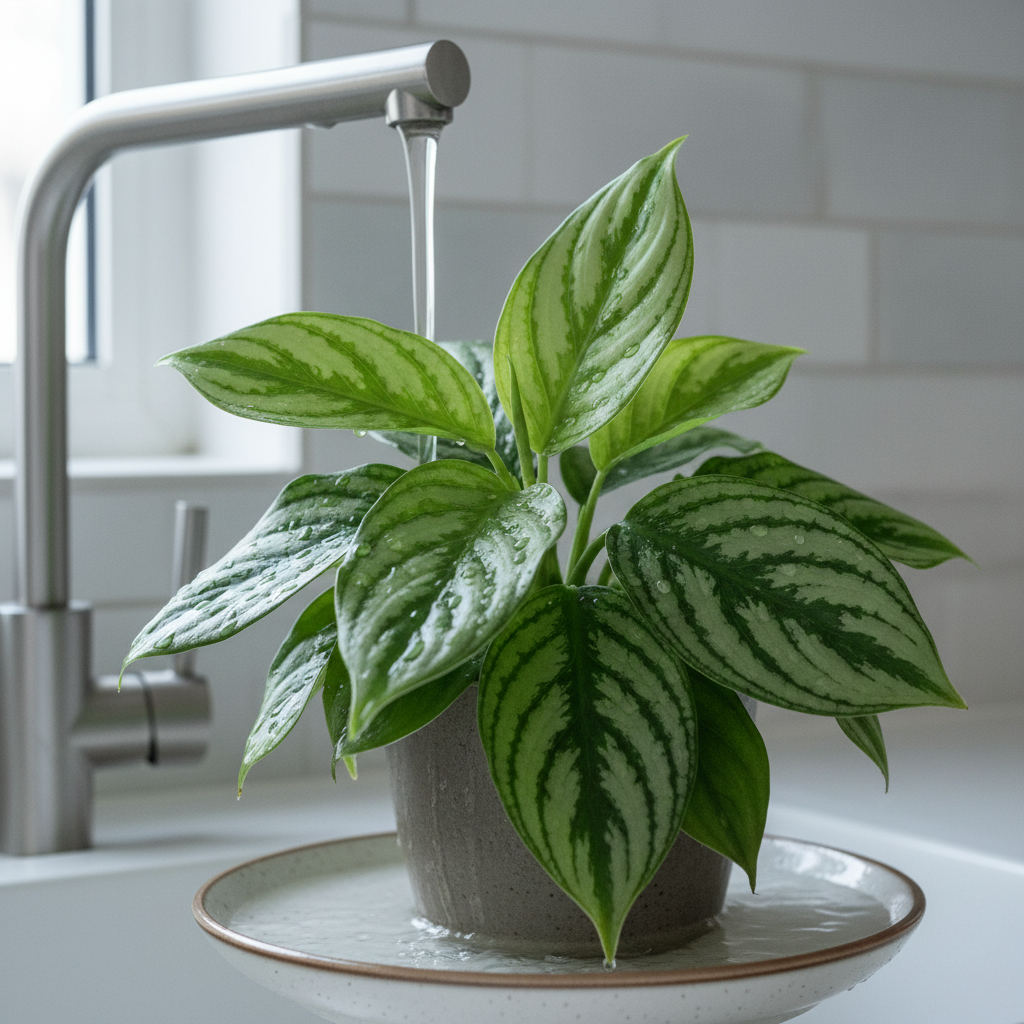
The reliable test is the finger or skewer method: push a finger into the soil to a depth of 3 to 5 cm (1 to 2 in), or insert a thin bamboo skewer to the base of the pot. If the soil feels dry at that depth, or the skewer comes out clean, it is time to water. If the soil is still damp, wait two or three days and test again. In a typical centrally heated home, this works out to roughly every 7 to 10 days in summer and every 14 to 21 days in winter, but pot size, soil composition, light level and temperature can all stretch or compress that interval.
The most common error is watering on a calendar rather than by feel. A plant tucked into a warm sunny corner in midsummer may need water twice a week; the same plant in a cool corner in February may go a month without complaint. Trust the soil, not the date. A second useful cue is weight: a freshly watered pot is noticeably heavy, and an empty one is light. With practice you can judge moisture by lifting the pot, which is faster than reaching for a skewer and avoids disturbing the soil surface.
Pro Tip — Tepid, Not Cold: Aglaonemas dislike cold water on warm roots. Water straight from the tap can be 10 degC or colder in winter and causes brief root shock that may show up as drooping or pale leaves a day later. Let water stand at room temperature for an hour or use tepid water from the hot tap mixed to a lukewarm blend.
How to Water Correctly
- Check the soil with a finger or skewer to confirm the top 3 to 5 cm is dry.
- Move the plant to a sink or basin if possible, or place it on a deep saucer that can catch runoff.
- Pour tepid water slowly and evenly over the entire soil surface, working in concentric circles, until water runs freely from the drainage holes.
- Let the pot drain for 10 to 15 minutes, then tip out any water that has collected in the saucer or cachepot.
- Return the plant to its usual position only after it has finished dripping, and never let the base sit in standing water.
Signs of Overwatering vs. Underwatering
| Symptom | Overwatering | Underwatering |
|---|---|---|
| Leaf colour | Lower leaves yellow uniformly and become limp. | Leaves dull and pale, edges may brown. |
| Leaf texture | Soft, water-soaked, sometimes translucent at the base. | Crisp, papery, curling inward at the margins. |
| Soil | Persistently wet, may smell sour, surface algae or fungus gnats present. | Pulls away from the side of the pot; dust-dry to fingertip. |
| Roots | Brown, mushy, easily detached from the crown. | Tan, brittle, intact but dry. |
| Stem base | Soft, dark, sometimes weeping clear liquid. | Firm but thin; whole plant looks deflated. |
Warning — Root Rot: Root rot is the leading cause of premature death in Chinese Evergreens. Once the rot reaches the central crown, the plant rarely recovers. If you notice a sour smell from the soil, mushy stem bases or sudden collapse, unpot immediately, cut away every soft brown root with sterilised scissors, dust the cut surfaces with cinnamon or sulphur, and repot in fresh, dry mix. Water sparingly until new growth resumes.
Humidity Requirements
Chinese Evergreens prefer the moderate-to-high humidity of their rainforest origins, typically 50 to 70 percent, but they adapt well to typical indoor humidity of 30 to 50 percent. In genuinely dry conditions, such as the 20 to 25 percent humidity common in centrally heated rooms in winter, leaf tips may brown and new leaves can emerge slightly puckered. None of this is fatal, but it does reduce the polished look of a healthy plant.
The most reliable humidity signal is the leaf tip. Soft, papery brown tips that progress slowly down the margin indicate chronically dry air, especially when accompanied by crisp edges on the newest leaves. A second clue is unusually fast soil drying despite mild temperatures, which means the air is pulling moisture out of both the foliage and the substrate.
Raising humidity does not require sophisticated equipment. Grouping plants together creates a small humid microclimate as they transpire. A pebble tray — a shallow dish of pebbles topped up with water, with the pot resting on top but not in the water — adds a few percent locally. The most effective and least fiddly approach is a small ultrasonic humidifier on a timer, running for a few hours in the morning and afternoon. Misting is gentle and short-lived, useful as a cosmetic refresh but not as a humidity strategy on its own.
Water Quality
Aglaonemas are mildly sensitive to fluoride and chloramine commonly added to municipal water. Brown leaf tips with a sharp boundary and no other obvious cause often indicate fluoride toxicity. If your tap water is heavily treated, switch to rainwater, filtered water, or tap water that has stood uncovered for 24 hours, which allows free chlorine to dissipate (though not chloramine). Water hardness is rarely a serious problem for this genus, but flushing the pot thoroughly every few months with plenty of plain water helps to leach any accumulated salts.
Soil, Potting and Repotting
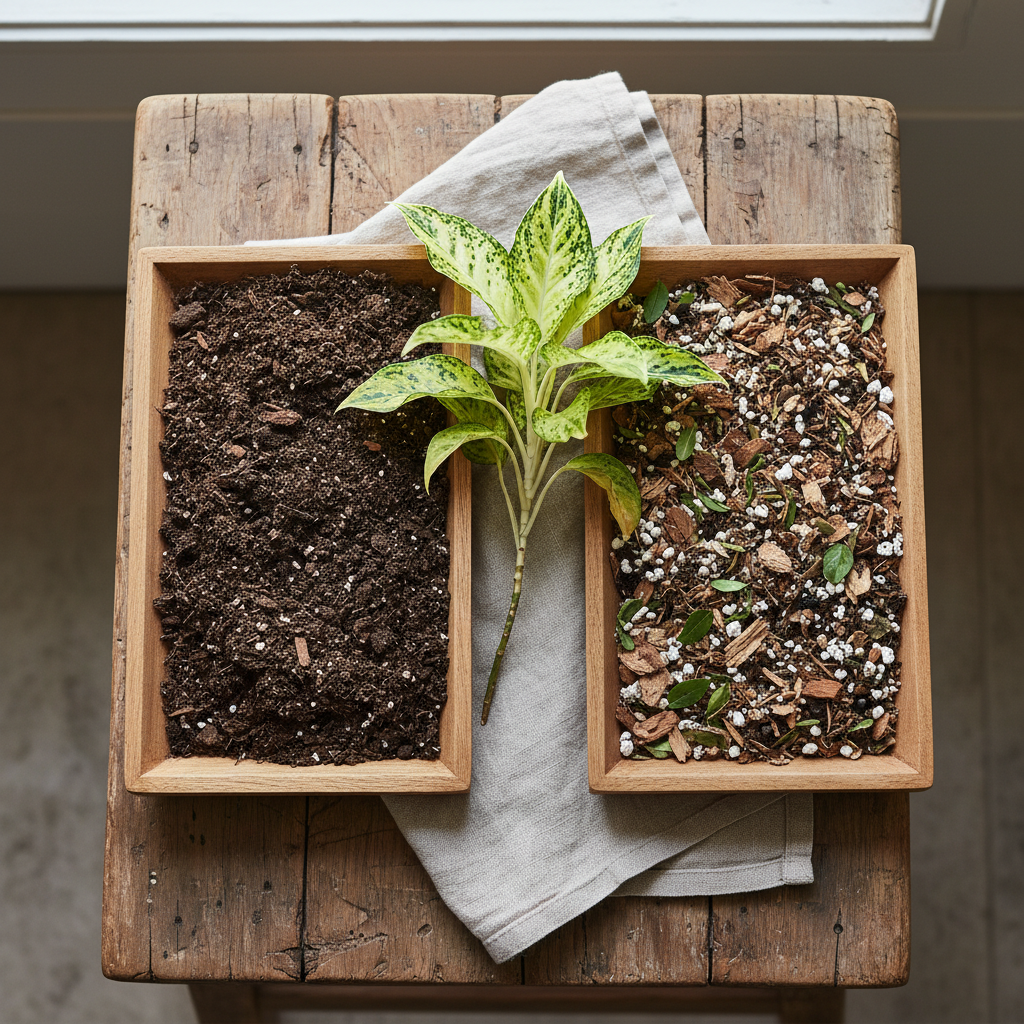
The right substrate is the second pillar of Aglaonema care, alongside watering. Because the species is prone to root rot in waterlogged conditions, soil must be moisture-retentive enough to support the plant between waterings but porous enough to drain freely and admit air to the root zone. Heavy, peaty bagged compost on its own holds far too much water for too long; pure cactus mix swings the other way and dries too rapidly. The ideal lies between the two, closer to a chunky aroid blend than to a conventional houseplant compost.
Ideal Soil Composition
A good Aglaonema mix balances three properties: moisture retention, drainage and structural openness. Moisture retention comes from coir or sphagnum-based compost; drainage from perlite, pumice or coarse sand; structure from orchid bark or charcoal, which keep the mix from collapsing into a dense slab as it ages. The proportions below are a reliable starting point, but they can be adjusted toward more bark and perlite for terracotta pots, which dry faster, and toward more compost for plastic or glazed pots, which retain water longer.
| Component | Proportion | Function |
|---|---|---|
| Quality houseplant compost or coir | 50 percent | Holds moisture and supplies basic organic matter for nutrient retention. |
| Perlite or pumice | 25 percent | Creates lasting air spaces, prevents compaction, accelerates drainage. |
| Orchid bark (fine grade) | 20 percent | Keeps the mix structurally open and mimics the chunky texture of forest-floor litter. |
| Horticultural charcoal | 5 percent | Absorbs impurities and helps suppress root pathogens. |
Aglaonemas prefer a slightly acidic to neutral pH, in the range of 5.5 to 6.5. Most peat- or coir-based composts naturally fall in this range, so no adjustment is usually needed. If you use tap water with high mineral content, the soil pH can creep upward over time, which is another reason to flush the pot occasionally and to refresh the substrate every two to three years.
Pro Tip — Quick Mix Recipe: If you do not want to assemble a custom blend, take any quality bagged houseplant compost and stir in one part perlite to every two parts compost, plus a generous handful of orchid bark. The mix will not be perfect, but it will be far better than straight compost from the bag.
Choosing the Right Pot
The pot is part of the watering system. A pot that is too large will hold more wet soil than the plant can use, prolonging the dry-down cycle and inviting rot. A pot that is too small will dry out too fast and cramp the rhizomes. Aim for a pot that gives 2 to 3 cm (around 1 in) of fresh soil around the existing root ball — no more — and that has at least one generous drainage hole.
Drainage holes are non-negotiable. A decorative cachepot without holes can be used as an outer sleeve, with the plant in a plain plastic nursery pot inside, but never plant directly into a sealed container. Even with a layer of gravel at the bottom, water will accumulate against the roots and rot will follow within weeks.
Pot material: Terracotta is breathable and helps wet soil dry faster, which suits heavy waterers and cool rooms. Plastic and glazed ceramic retain moisture longer and suit drier, warmer environments. Whichever you choose, ensure the surface is wide enough at the rim to allow water to soak in evenly rather than running straight down the sides.
Pot size: Chinese Evergreens have modest root systems and prefer being slightly underpotted to overpotted. A 15 to 20 cm (6 to 8 in) pot suits a medium plant; a mature specimen typically tops out around 25 to 30 cm (10 to 12 in). Tall narrow pots tend to retain water at the bottom; squat broad pots dry more evenly.
When to Repot
Aglaonemas are slow growers and dislike unnecessary disturbance, so repotting every two to three years is typical, not annual. Signs that a repot is overdue include roots circling the inside of the pot, roots emerging through the drainage holes, soil that dries out within a day or two of watering, or visibly poor growth despite good light and feeding. Spring, just as growth resumes, is the best moment; avoid repotting in autumn or winter, when slowed metabolism makes recovery less reliable.
How to Repot: Step-by-Step
- Water the plant the day before repotting so the root ball is moist but not waterlogged, which makes removal cleaner and reduces shock.
- Prepare the new pot by ensuring drainage holes are clear and adding a 2 to 3 cm layer of fresh aroid mix at the bottom.
- Ease the plant out by tipping the pot sideways and pressing gently around the sides; never pull on the stems.
- Inspect the roots, gently teasing out any tightly circling growth and trimming away any soft brown or black sections with sterilised scissors.
- Position the plant in the new pot so the crown sits at the same depth it did before, then backfill with fresh mix and firm it gently around the roots.
- Water thoroughly until liquid runs freely from the drainage holes, let the pot drain, then return it to bright indirect light.
- Hold off on fertilising for at least four weeks while new roots establish in the fresh substrate.
Warning — Transplant Shock: Even gentle repotting can trigger a brief sulk, with one or two older leaves yellowing and dropping in the weeks after. This is normal and not a sign of failure. Keep the plant out of direct sun, water more cautiously than usual until new growth appears, and resist the urge to fertilise to compensate.
Fertilising
Chinese Evergreens are not heavy feeders, which is part of why they tolerate neglect so gracefully. Their slow growth and modest root system mean that even minimal feeding sustains decent foliage, and overfeeding is a more common problem than underfeeding. A simple monthly half-strength liquid feed through spring and summer is usually all that is needed to keep an Aglaonema looking its best.
The signs of an undernourished plant — pale new growth, slow leaf production, smaller leaves than the cultivar’s norm — appear gradually and are easy to reverse. The signs of overfeeding are sharper and less forgiving: brown crispy leaf tips, a white crust on the soil surface, and in serious cases, scorched root edges. When in doubt, feed less, not more.
Understanding Plant Nutrients
Most general houseplant fertilisers carry three numbers on the label, the N-P-K ratio, indicating the percentage of nitrogen, phosphorus and potassium they contain. Nitrogen drives leaf growth and intensity of green colour; phosphorus supports root development and flowering; potassium contributes to overall vigour and stress tolerance. Beyond these three, plants also need smaller amounts of calcium, magnesium, iron and a suite of micronutrients. A balanced 20-20-20 or near-balanced 10-10-10 fertiliser meets the Chinese Evergreen’s needs comfortably; specialised aroid or foliage blends with slightly higher nitrogen also work well.
| Nutrient | Symbol | Primary Function | Deficiency Symptoms |
|---|---|---|---|
| Nitrogen | N | Drives leaf and stem growth, contributes to chlorophyll production. | Pale, smaller new leaves; older leaves yellow first. |
| Phosphorus | P | Supports root development, energy transfer, flowering. | Stunted growth, dull foliage, occasional purple tinge on undersides. |
| Potassium | K | Regulates water balance and overall vigour. | Brown leaf edges and weak stems. |
| Calcium | Ca | Strengthens cell walls and new tissue. | Distorted or hooked new leaves. |
| Magnesium | Mg | Central atom of chlorophyll; essential for green colour. | Interveinal yellowing on older leaves. |
| Iron | Fe | Required for chlorophyll synthesis. | Interveinal yellowing on the newest leaves. |
Types of Fertiliser
Liquid fertilisers: The most controllable option. Diluted into the watering can at half the recommended strength, they deliver a mild, even feed that the plant can use immediately. Best applied to already moist soil to avoid burning dry roots.
Slow-release granular: Convenient prills that release nutrients gradually over three to six months in response to soil moisture and temperature. Useful for forgetful owners but harder to dose precisely, so use the lower end of the recommended rate.
Organic fertilisers: Worm castings, fish emulsion and seaweed extracts provide a gentler nutrient profile along with beneficial microbes. They are forgiving and rarely cause burn, though fish products can smell strongly indoors for a day or two.
Feeding Schedule
From early spring through to late summer, feed once every four to six weeks with a balanced liquid fertiliser diluted to half the manufacturer’s recommended strength. Stop feeding entirely from late autumn through winter, when growth slows or pauses and unused fertiliser salts accumulate in the soil. Newly repotted plants should not be fed for at least a month, as fresh compost already contains enough nutrients to sustain initial growth.
Pro Tip — Dilute and Half-Dose: Manufacturer-recommended doses are written for fast-growing greenhouse plants in active production. For a slow grower like Aglaonema in indoor light, halve the dose and double the interval. The plant will be just as well fed and far less at risk of salt build-up.
How to Fertilise
- Choose a balanced liquid fertiliser, ideally one labelled for foliage houseplants.
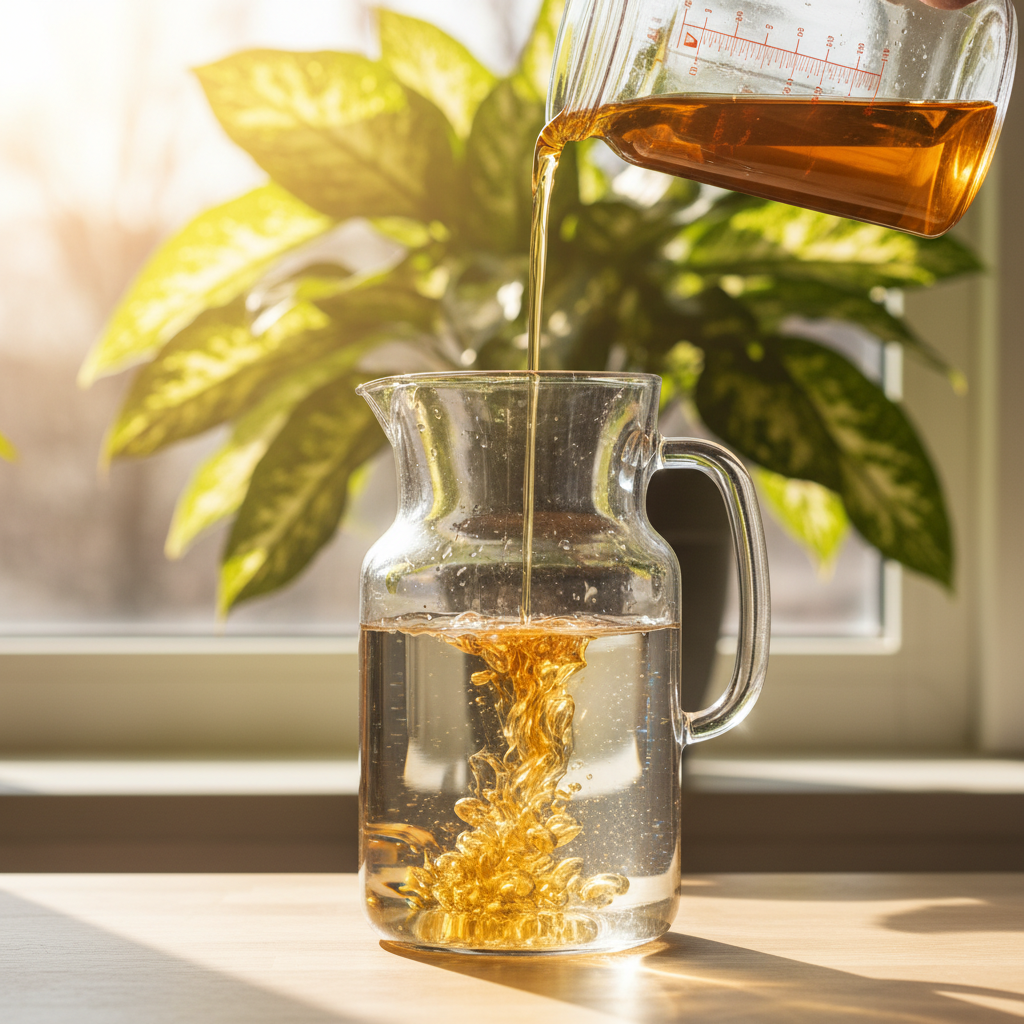
- Mix to half the recommended strength in a clean jug of tepid water.
- Water the plant lightly with plain water first if the soil is bone dry, to protect the fine root hairs from contact burn.
- Apply the diluted fertiliser slowly across the soil surface until it begins to drain from the bottom, then tip out any excess from the saucer.
- Every third or fourth feed, skip the fertiliser entirely and instead flush the pot with a large volume of plain water, which leaches accumulated salts.
Warning — Salt Build-Up: A white or yellowish crust on the soil surface or around the rim of the pot indicates accumulating mineral salts, almost always from fertiliser combined with hard tap water. Untreated, the salts damage fine roots and cause brown leaf tips. Scrape off the visible crust, flush the pot thoroughly with plain water two or three times in succession, and reduce the feeding rate going forward.
Propagation
Chinese Evergreens can be propagated by two reliable methods at home: division of mature clumps and rooting of stem cuttings. Both succeed at a high rate when carried out in the warm half of the year, when active growth supplies the hormones and energy needed for new roots. Seed propagation is technically possible but slow and impractical for the home grower, partly because indoor specimens rarely flower and partly because most modern Aglaonemas are hybrids that do not come true from seed.
Division is the simpler method and is the natural by-product of repotting a mature clump that has produced multiple crowns. Stem cuttings are useful for refreshing a tall or leggy specimen that has lost its lower leaves, and for sharing a favourite cultivar with friends without sacrificing the parent plant.
Understanding the Plant’s Structure
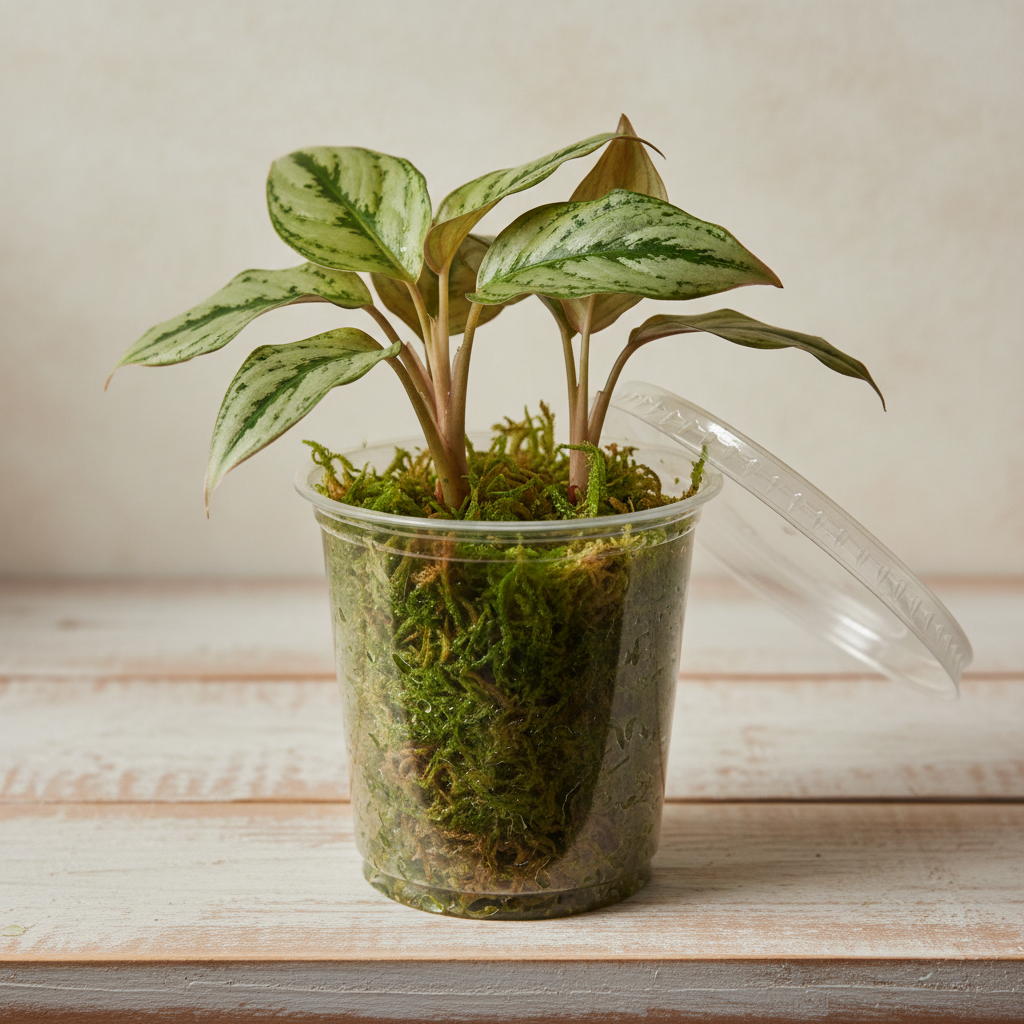
An Aglaonema is built from short, fleshy stems that grow upright from a basal rhizome. Over time, each stem may push out side shoots that develop their own root systems, gradually turning a single plant into a multi-crowned clump. The plant roots readily from any node along a stem, which is the structural feature that makes propagation so straightforward: a stem cutting with two or three nodes will produce a complete new plant given moisture and warmth.
Division: Step-by-Step
Division is the easiest and least risky propagation method, best carried out when you are already repotting a mature plant in spring. A clump that has produced three or more visible crowns can usually be separated into two or three independent plants.
- Water the parent plant a day before division so the rhizomes are turgid and the soil eases away cleanly.
- Remove the plant from its pot and gently shake or wash the loose soil from the root ball to reveal the structure of the crowns.
- Identify natural separation points where individual crowns or stem clusters have their own roots, and ease them apart by hand wherever possible.
- Where divisions resist hand separation, use a sterilised sharp knife to cut cleanly through the rhizome, leaving each section with at least one healthy stem and a fair share of roots.
- Pot each division immediately into its own appropriately sized pot of fresh aroid mix and water thoroughly.
- Keep the divisions in warm, bright indirect light and water sparingly until new growth appears, usually within four to six weeks.
Pro Tip — Spring is Best: Both division and cuttings root fastest when temperatures sit above 22 degC (72 degF), which is why spring and early summer give such reliable results. Attempts in midwinter, when soil temperatures are low and daylight short, can take three times as long and have a noticeably higher failure rate.
Stem Cuttings: Step-by-Step
Stem cuttings are useful when a plant has grown tall and leggy or when you want to multiply a favourite cultivar without dividing the parent. Each cutting needs at least one node, ideally two or three, and a few healthy leaves.
- Choose a healthy stem with several visible nodes, and identify a cutting length of around 10 to 15 cm (4 to 6 in) bearing two or three leaves.
- Make a clean cut just below a node using sterilised secateurs, and remove the lowest leaf to expose the node that will go into the rooting medium.
- Let the cut surface callus over for an hour or two in shade, which reduces the risk of stem rot.
- Insert the cutting into damp sphagnum moss, a glass of water, or a 50/50 mix of perlite and coir, with at least one node buried or submerged.
- Keep the setup in warm, bright indirect light at 22 to 27 degC (72 to 80 degF), and check moisture every few days.
- Roots typically emerge in three to six weeks; once they reach 3 to 5 cm long, pot the cutting up into standard aroid mix and treat as a young plant.
Troubleshooting Propagation
| Problem | Likely Cause | Solution |
|---|---|---|
| Cut stem turns mushy at the base | Bacterial rot from cutting an unclean blade or keeping the medium too wet. | Re-cut above the rot with sterilised scissors, dust with cinnamon, restart in fresh medium. |
| No roots after eight weeks | Temperatures too low or insufficient light. | Move to a warmer location, ideally on a heated propagation mat at 24 degC (75 degF). |
| Roots form but leaves yellow and drop | Cutting was too weak or had too many leaves transpiring beyond what the new roots could support. | Reduce leaf surface by trimming larger leaves in half horizontally, and raise humidity around the cutting. |
| Divisions wilt badly after potting | Too much root was lost during separation. | Place in a clear bag for a few days to maintain humidity while roots re-establish, then gradually open the bag. |
Pests and Diseases
Chinese Evergreens are not especially troubled by pests, but no houseplant is fully immune, and the broad leaves of an Aglaonema offer an inviting landing platform for the usual suspects. Most infestations begin small and progress slowly, which gives a watchful owner ample time to intervene before damage becomes severe. A monthly leaf inspection — both upper and lower surfaces, plus the leaf axils — is the single most useful pest-management habit you can adopt.
Cultural practice is the other half of prevention. Plants kept in appropriate light, watered correctly and given good airflow are far less hospitable to pests than stressed, weak specimens. Most serious outbreaks trace back to a plant that was already declining for cultural reasons before the pests arrived.
Common Pests
Mealybugs (Pseudococcus longispinus)
Small, soft-bodied insects covered in a white waxy fluff. They cluster in leaf axils, along stems and under leaves, where they suck sap and excrete sticky honeydew. A heavy infestation causes yellowing, distorted new growth and a general dulling of the plant.
Treatment: Dab visible mealybugs with a cotton bud soaked in 70 percent isopropyl alcohol; the wax breaks down on contact and the insects die quickly. Follow up with a thorough rinse of the foliage in the sink, then a weekly neem-oil spray for three weeks to catch newly hatched crawlers.
Spider mites (Tetranychus urticae)
Microscopic arachnids that thrive in hot, dry conditions, particularly during winter in centrally heated rooms. The earliest sign is a fine stippling of yellow or silver dots on the upper leaf surface; severe infestations produce visible webbing in the leaf axils and along the underside of leaves.
Treatment: Shower the plant under a tepid stream of water to dislodge mites and reduce population pressure. Raise humidity around the plant, then spray every five to seven days for three weeks with insecticidal soap or neem oil, paying particular attention to leaf undersides.
Scale insects (Coccus hesperidum)
Brown, dome-shaped insects that attach themselves to stems and the undersides of leaves, where they look like small bumps and can be mistaken for plant tissue. Like mealybugs, they secrete honeydew that often grows sooty mould.
Treatment: Scrape off visible scales with a soft toothbrush or fingernail, then treat the plant weekly with neem oil or horticultural oil for at least four weeks to control the mobile crawler stage.
Fungus gnats (Bradysia species)
Tiny black flies that hover around the soil surface; the adults are harmless but their larvae feed on roots and fungal threads in consistently moist soil. Their presence is usually a sign that the soil is being kept too wet for too long.
Treatment: Let the top 5 cm of soil dry thoroughly between waterings, which breaks the larval life cycle. Yellow sticky traps catch adults, and a soil drench with Bacillus thuringiensis israelensis (Bti) or mosquito-dunk solution kills larvae without harming the plant.
Common Diseases
Root rot (Pythium and Phytophthora species)
By far the most serious threat to Aglaonemas, caused by oomycete pathogens that proliferate in waterlogged, low-oxygen soil. Symptoms begin with limp, yellowing lower leaves and progress to a foul-smelling soft rot at the stem base.
Treatment: Unpot the plant immediately, wash the roots clean, and cut away every soft brown root and any rotted stem tissue with sterilised scissors. Dust the cuts with cinnamon or sulphur, repot into fresh dry mix in a clean pot, and water sparingly until new growth confirms recovery.
Leaf spot (Erwinia or Fusarium species)
Bacterial or fungal pathogens that cause discrete brown or black spots, often with a yellow halo, on the leaf surface. Spread is usually facilitated by water sitting on the leaves overnight or by poor airflow.
Treatment: Remove affected leaves at the base and discard them. Water the soil only, never the foliage, and improve airflow with a small fan on low speed during humid months. Severe cases may need a copper-based fungicide.
Pest and Disease Summary
| Pest / Disease | Identification | Treatment |
|---|---|---|
| Mealybugs | White cottony tufts in leaf axils and along stems. | Alcohol swab, foliage rinse, weekly neem oil. |
| Spider mites | Fine stippling on leaves, webbing on undersides. | Tepid shower, raise humidity, insecticidal soap. |
| Scale insects | Brown dome-shaped bumps on stems and leaf undersides. | Scrape off, follow with neem or horticultural oil. |
| Fungus gnats | Small black flies around soil surface. | Let soil dry between waterings, yellow sticky traps, Bti drench. |
| Root rot | Yellowing lower leaves, soft black roots, sour smell. | Unpot, trim rotted roots, repot in fresh dry mix. |
| Leaf spot | Brown or black spots with yellow halos. | Remove affected leaves, water at soil only, improve airflow. |
Prevention Strategies
Prevention rests on a small set of consistent habits. Inspect plants at least monthly, paying attention to leaf undersides and the tight spaces between stems and leaves where pests prefer to hide. Quarantine any newly acquired plant for two to three weeks before placing it near established specimens, as nursery and shop plants are by far the most common source of household pest introductions.
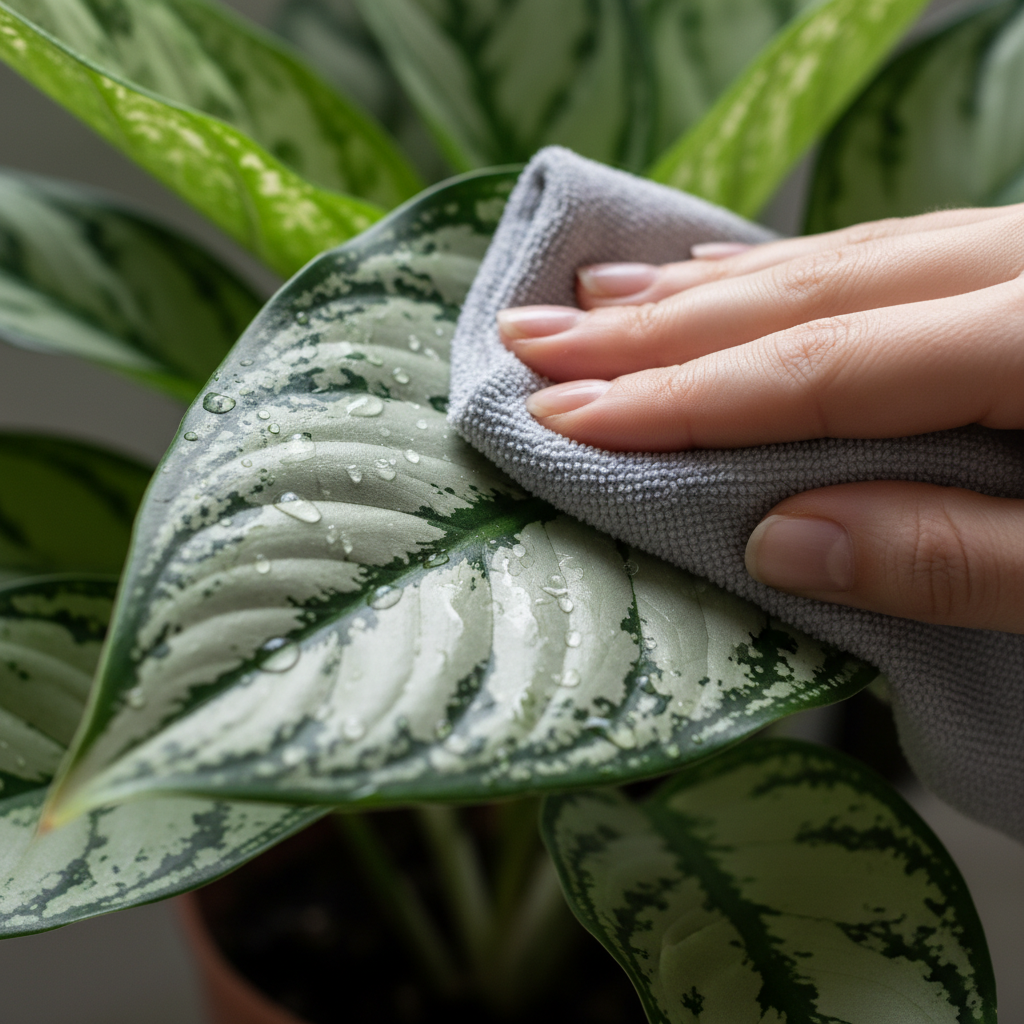
Maintain reasonable airflow, especially in winter when windows stay closed for months on end. Wipe leaves with a damp microfibre cloth every few weeks, which dislodges dust, removes the earliest pests before they establish, and keeps the stomata clear for efficient gas exchange. Sterilise scissors and secateurs with isopropyl alcohol before and after any pruning or division to avoid spreading disease between plants.
Pro Tip — Neem Oil Rhythm: A monthly foliar spray of diluted neem oil during the growing season acts as a gentle prophylactic against most soft-bodied insect pests. Apply in the evening to avoid leaf scorch and keep the plant out of direct sun for the next 12 hours while the oil film evaporates.
Popular Varieties
The genus Aglaonema has been one of the most actively bred foliage groups of the past three decades, particularly through Thai and Indonesian programmes that crossed traditional silvery A. commutatum selections with the more brightly coloured A. rotundum from Sumatra. The result is a remarkable spectrum of cultivars: classic silvery whites, restrained creams, bold pinks, electric reds and deep blackish greens. Most are sold under cultivar names rather than under their full botanical lineage, which means a plant labelled simply “Aglaonema ‘Silver Bay'” or “‘Red Anjamani'” may have several species in its background.
For practical purposes, varieties divide into three light-tolerance groups. The plain green and silver-variegated cultivars tolerate the lowest light and are the safest choice for darker rooms. The cream-and-white-variegated cultivars need bright indirect light to maintain their pale tissue. The pink and red cultivars are the most light-hungry, and in dim corners they sulk and turn muddy.
| Variety | Leaf Appearance | Light Needs | Growth Rate | Availability |
|---|---|---|---|---|
| ‘Silver Bay’ | Large oval leaves with bright silver marbling on dark green. | Medium to bright indirect. | Moderate. | Widespread. |
| ‘Maria’ | Glossy dark green with subtle silver-grey banding. | Tolerates low light very well. | Slow. | Widespread. |
| ‘Silver Queen’ | Long lanceolate leaves with extensive silver-grey across most of the surface. | Medium to bright indirect. | Moderate. | Common. |
| ‘Red Siam’ (Siam Aurora) | Pink and red midribs and margins on green centres. | Bright indirect required. | Slow to moderate. | Common. |
| ‘Red Anjamani’ | Almost entirely deep red leaves with green margins. | Bright indirect required. | Slow. | Common. |
| ‘Pink Dalmatian’ | Green base flecked and spotted with bubblegum pink. | Bright indirect required. | Slow. | Increasing. |
| ‘Pictum Tricolor’ | Velvety leaves marbled in three shades of green camouflage-style. | Bright indirect; benefits from higher humidity. | Slow. | Specialist nurseries. |
| ‘Cutlass’ | Long narrow leaves with grey-green centres and dark green margins. | Medium to bright indirect. | Moderate. | Common. |
Featured Varieties
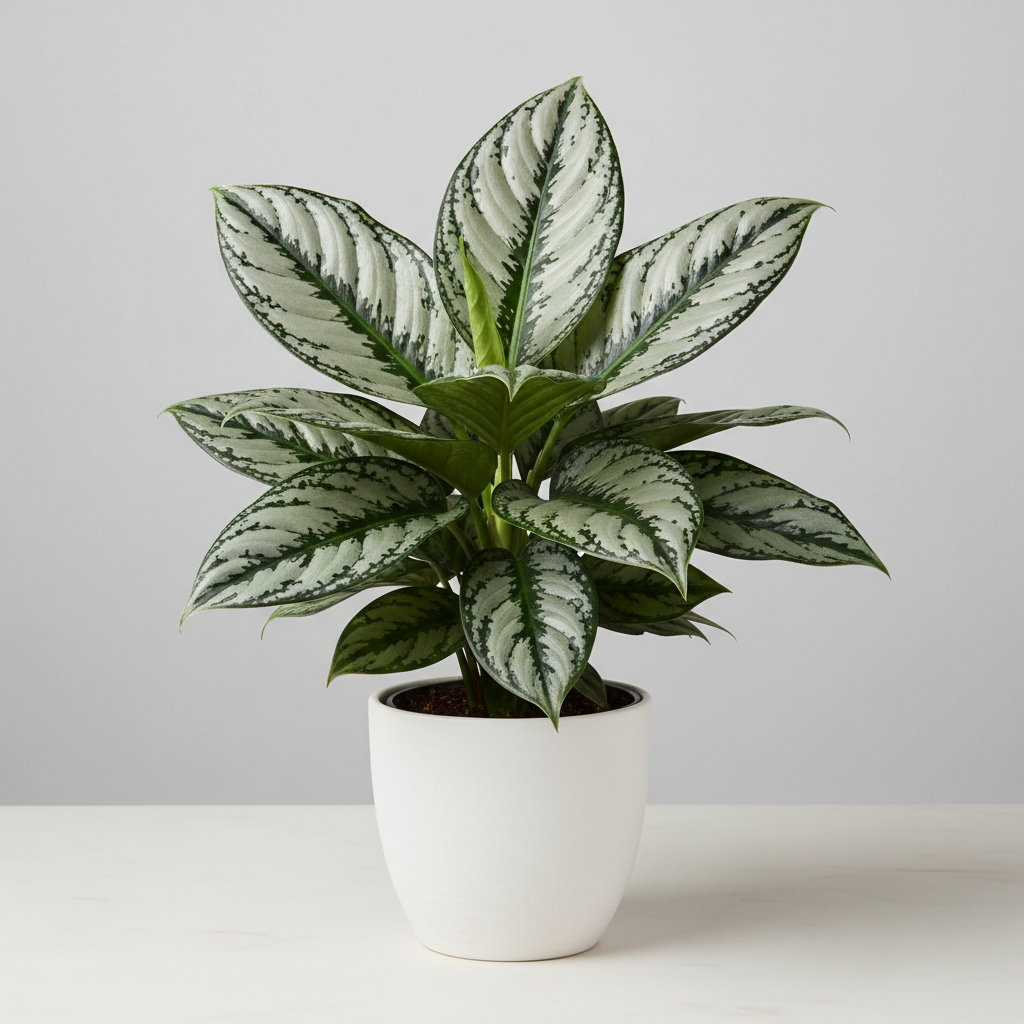
‘Silver Bay’
One of the most popular and widely available cultivars, ‘Silver Bay’ produces large, almost oval leaves with bright silver-grey marbling spread generously across a dark green base. It tolerates a wide range of light conditions, makes a substantial floor plant when mature, and remains attractive even in years when growth slows.
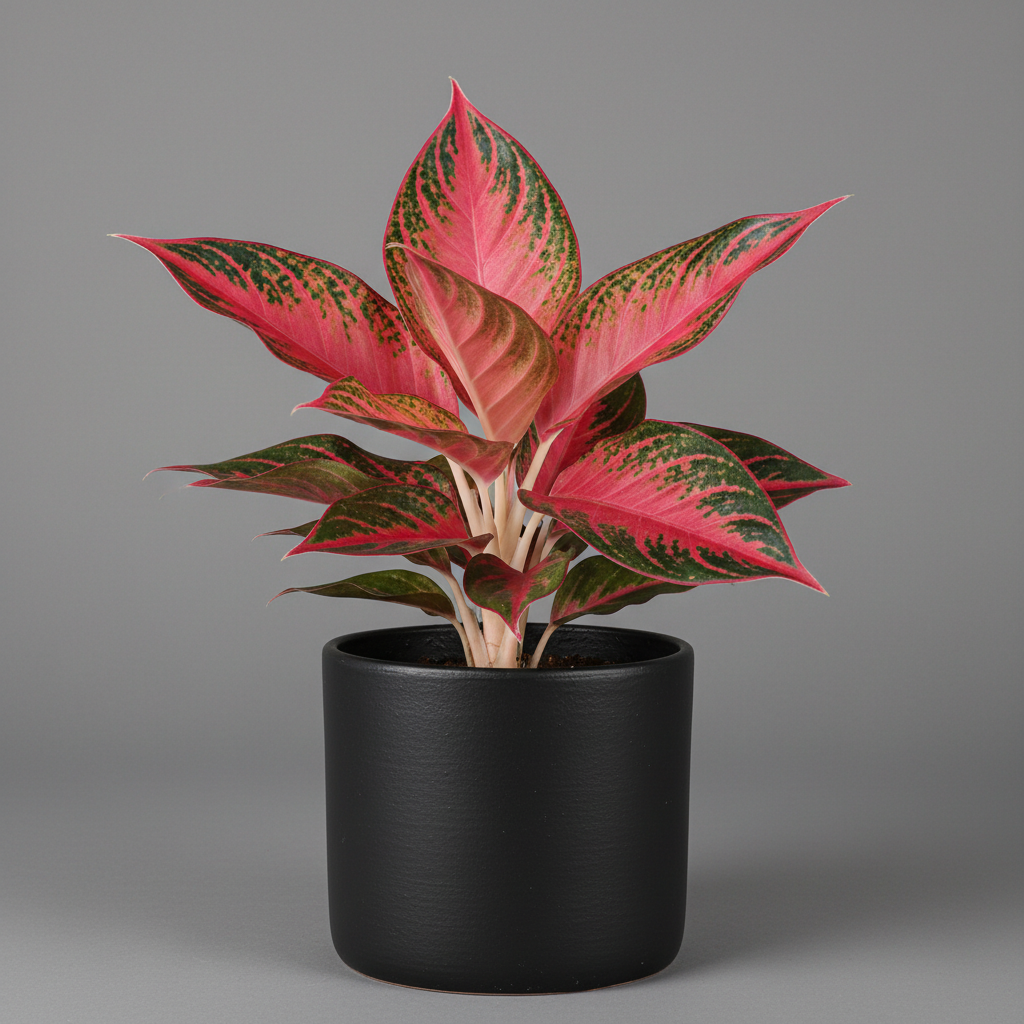
‘Red Siam’ (Siam Aurora)
One of the breakthrough coloured cultivars from Thai breeding programmes, ‘Red Siam’ carries strong pink-to-red margins and midribs that frame deep green leaf centres. New growth often flushes rosy red before maturing. It needs noticeably brighter light than the silver cultivars to keep its colour saturated.
Variety Profiles in Detail
‘Maria’ (Aglaonema commutatum ‘Maria’)
Perhaps the toughest cultivar in the genus and a fixture in offices, banks and hotel lobbies, ‘Maria’ offers glossy dark green leaves with restrained silver-grey banding. Its low-light tolerance is exceptional, and it will grow steadily in conditions that would slowly kill a more strongly variegated cultivar. Slow growth makes it a long-term investment plant that needs little upkeep.
‘Silver Queen’ (Aglaonema ‘Silver Queen’)
A long-established hybrid with elongated leaves dominated by silver tones, with green confined to the midrib and a thin margin. ‘Silver Queen’ is one of the more cold-tender cultivars and prefers temperatures consistently above 16 degC (60 degF). In the right conditions it forms a generous, fountain-shaped clump.
‘Red Anjamani’ (Aglaonema ‘Red Anjamani’)
Among the most heavily pigmented Aglaonemas, ‘Red Anjamani’ produces leaves that are almost entirely deep crimson with only a narrow green margin. It is more demanding than the silver cultivars: bright indirect light is essential, humidity should be moderate to high, and watering should err slightly on the careful side. The reward is a plant of striking, almost luminous colour.
‘Pictum Tricolor’ (Aglaonema pictum ‘Tricolor’)
A connoisseur’s plant rather than a commercial staple, ‘Pictum Tricolor’ carries small velvety leaves marbled in three distinct shades of green in a pattern reminiscent of military camouflage. It is botanically distinct from A. commutatum, deriving from A. pictum of Sumatra, and prefers slightly higher humidity than the mainstream cultivars. It rewards patient growing with a unique and quietly arresting appearance.
Choosing the Right Variety for Your Space
The single most important factor in choosing an Aglaonema cultivar is the light available in the spot you plan to put it. For a dim corner away from any window, a ‘Maria’ or plain ‘Silver Bay’ will outlive its setting with quiet dignity. For a bright spot a metre or two back from an east window, almost any cultivar will thrive, and this is the moment to pick something more colourful: a ‘Red Siam’ for an obvious statement, a ‘Pink Dalmatian’ for something subtler. For a very bright spot with filtered direct light, the deeper red cultivars such as ‘Red Anjamani’ will hold their saturation best. Pair the plant to the room, and an Aglaonema will reward you with years of low-maintenance beauty.
Frequently Asked Questions
Why are my Chinese Evergreen’s leaves turning yellow?
Uniform yellowing of older lower leaves, especially when soil is consistently wet, is almost always a sign of overwatering and the early stages of root rot. Yellowing concentrated on new growth, by contrast, may indicate iron or magnesium deficiency, which is rare in fed plants. A single occasional yellow leaf at the base is normal as old foliage is shed in favour of new.
Why does my Chinese Evergreen have brown leaf tips?
Brown tips usually point to one of three causes: dry indoor air during winter heating, accumulated mineral salts from fertiliser or hard tap water, or fluoride sensitivity from heavily treated municipal water. Increase humidity, flush the pot thoroughly with plain water every few months, and consider switching to rainwater or filtered water if the problem persists.
Is Chinese Evergreen safe around pets?
No. Like most aroids, Aglaonemas contain insoluble calcium oxalate crystals in all parts of the plant. Chewing causes intense oral pain, drooling, swelling and sometimes vomiting in cats, dogs, rabbits and small children. The plant should be placed well out of reach of curious pets, and any accidental ingestion warrants a veterinary call.
Will my Chinese Evergreen flower?
Yes, given enough light and a mature plant, Aglaonemas produce small white or pale green spathe-and-spadix flowers typical of the aroid family. Indoor flowering is most likely in spring or summer on plants kept in bright indirect light. The flowers are botanically interesting but not particularly showy, and many growers cut them off to redirect the plant’s energy back into foliage.
How fast does Chinese Evergreen grow?
Slow to moderate, depending on the cultivar and conditions. In good light and warmth, a healthy plant may add four to six new leaves per stem during the growing season. In low light or cool conditions, growth can slow to almost nothing for months at a time. Mature specimens reach about 60 to 90 cm (24 to 36 in) tall and equally wide.
Can I keep a Chinese Evergreen in a bathroom?
Yes, provided the bathroom has reasonable natural light, ideally from a window. The warmth and elevated humidity of a typical bathroom suit Aglaonemas well, and the leaves often look noticeably better than the same cultivar grown in a dry living room. Windowless bathrooms are not suitable, as light is the limiting factor.
Why is my Chinese Evergreen drooping?
Drooping can indicate either extreme of the moisture spectrum: severely dry soil leaves the plant unable to maintain leaf turgor, while waterlogged soil damages roots and produces the same wilted appearance. Check the soil first. If it is bone dry, water thoroughly. If it is wet, hold off and investigate for root rot. Sudden drooping after a cold draught usually recovers once warmth returns.
Can I grow Chinese Evergreen in water alone?
Aglaonemas root readily in water and can live in water culture for many months, which is why water propagation works so well. Long-term hydroculture is feasible with regular water changes and a dilute liquid fertiliser, but most growers find the plant performs better when potted into a proper aroid mix once roots are established.
What temperature is too cold for Chinese Evergreen?
Temperatures below 13 degC (55 degF) cause visible chill damage within a day or two, typically appearing as greasy dark patches on the leaves that later turn brown. Brief exposure to 10 degC (50 degF) may be tolerated but is risky. Never place a Chinese Evergreen near a cold draught, a single-glazed window in winter, or an unheated porch.
How long can a Chinese Evergreen live?
With reasonable care, a Chinese Evergreen can live for ten to twenty years, and there are well-documented specimens of considerably greater age. Its slow growth and longevity make it a genuinely long-term plant, often outlasting the furniture it sits beside. Periodic division and repotting refresh its vigour and can effectively renew the plant indefinitely.






