
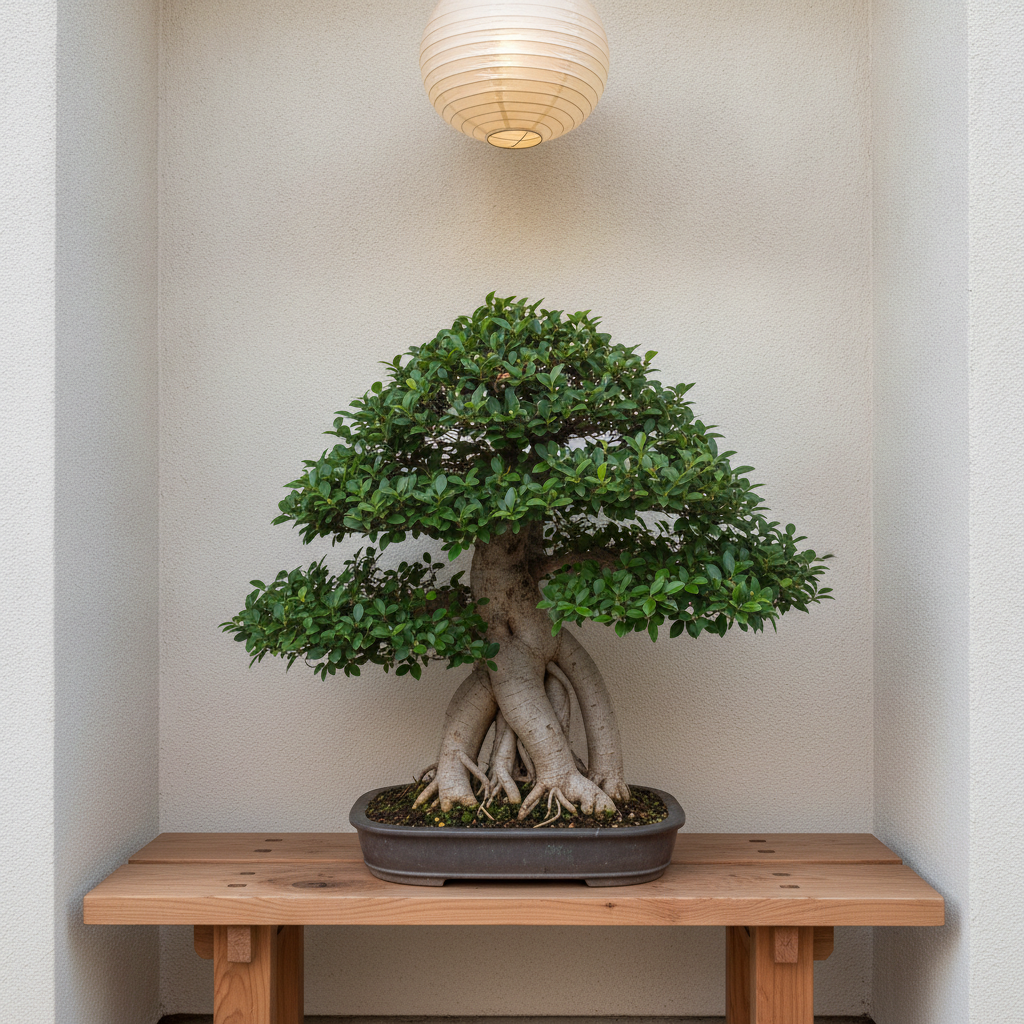
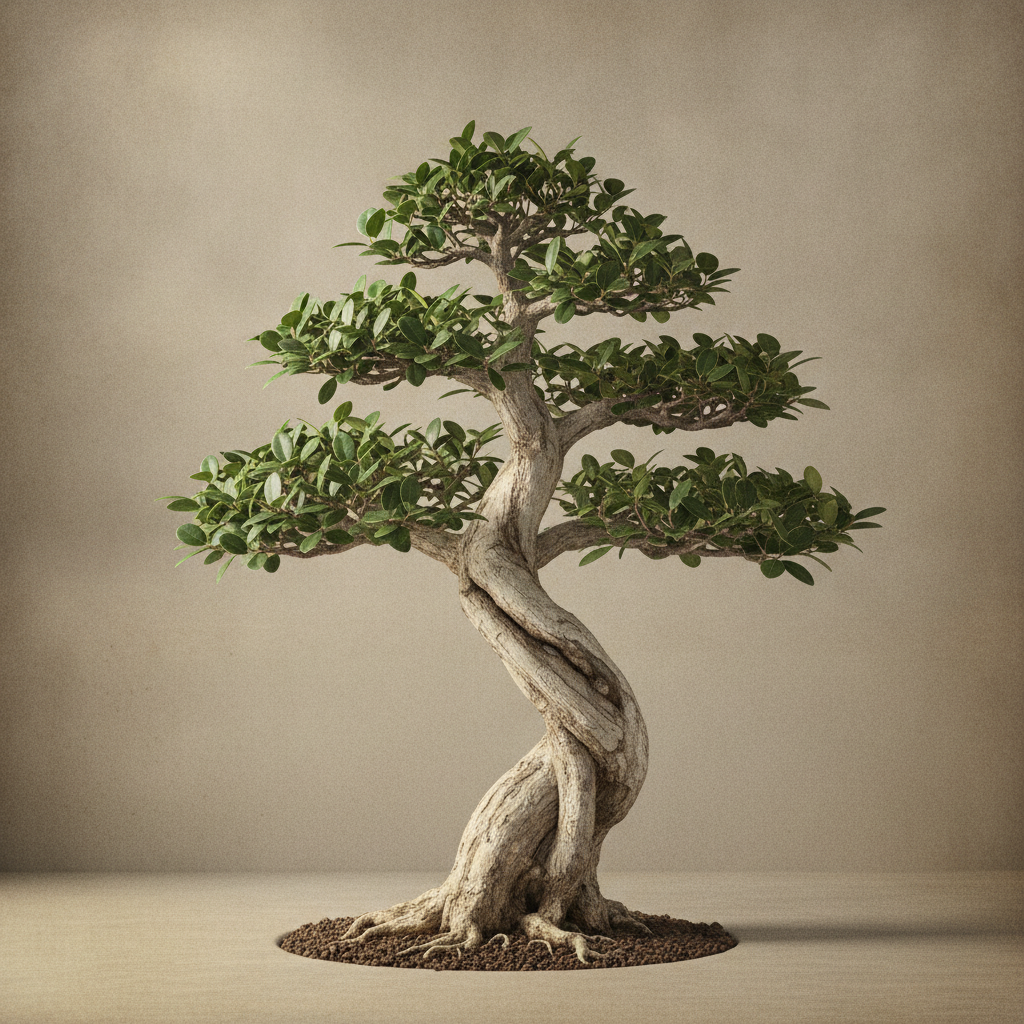
Few plants manage to look ancient and cartoonish at the same time, but the Chinese banyan bonsai (Ficus microcarpa) does exactly that. Sold in almost every garden centre and supermarket as the “ginseng ficus”, it is instantly recognisable by its swollen, pot-bellied root base topped with a neat cloud of small, glossy leaves. Behind the novelty sits one of the toughest, most beginner-friendly trees in the entire bonsai world, a plant that will forgive missed waterings, low light and the general chaos of ordinary indoor life while still looking the part on a shelf or desk.
This guide covers everything needed to keep a Chinese banyan bonsai not merely alive but genuinely thriving: how much light it really wants, how to read its watering needs, what to pot it into, and how to steer it from a survivable houseplant into a healthy, characterful little tree. The distinction between surviving and thriving matters more with bonsai than with almost any other houseplant, because the whole point is a plant kept deliberately small yet vigorous, and vigour is where good care shows.
In This Guide
- Quick Reference
- Why Grow a Chinese Banyan Bonsai
- Light
- Watering
- Soil and Potting
- Fertilising
- Propagation
- Pests and Problems
- Varieties
- Frequently Asked Questions
Quick Reference
| Botanical name | Ficus microcarpa (often sold as Ficus ginseng or Ficus retusa) |
| Common names | Chinese banyan, ginseng ficus, Indian laurel fig, curtain fig |
| Plant type | Evergreen broadleaf tree, grown as indoor bonsai |
| Mature size (as bonsai) | 15 to 90 cm (6 to 36 in) tall, depending on training |
| Light | Bright, indirect light; tolerates some direct sun |
| Water | When the top 1 to 2 cm (0.5 to 1 in) of soil feels dry |
| Soil | Free-draining bonsai or aroid-style mix |
| Humidity | Average to high; happier above 40 per cent |
| Temperature | 16 to 24 degrees C (61 to 75 degrees F) |
| Fertiliser | Balanced feed, fortnightly in the growing season |
| Toxicity | Mildly toxic to pets and people; sap can irritate skin |
| Difficulty | Easy, one of the best beginner bonsai |
Why Grow a Chinese Banyan Bonsai

The Chinese banyan is a subtropical fig native to a wide sweep of Asia and Australasia, where in the wild it grows into a vast, buttressed tree that drops curtains of aerial roots and can eventually smother buildings and other trees. That vigour is exactly what makes it such a rewarding bonsai. A plant genetically built to grow enormous responds to pruning and root confinement by backbudding freely, thickening its trunk and producing the dense, twiggy structure that reads as a miniature old tree. The grower is essentially borrowing a fraction of an unstoppable natural force and keeping it in a dish.
The familiar “ginseng” form found in shops is not a natural growth habit at all. It is produced in nurseries, usually in China and other parts of Southeast Asia, by growing seedlings for their fat storage roots and then grafting small-leaved Ficus microcarpa foliage onto the top. The result is the bulbous, aerial-root trunk that looks like a set of swollen fingers or, indeed, a ginseng root. Whether that mass-produced look appeals is a matter of taste, but it does mean the plant arrives cheap, robust and almost impossible to kill through neglect, which is a fine place to begin.
For anyone nervous about the reputation bonsai has for being fussy and high-maintenance, this species is a gentle introduction. It tolerates the dry air of centrally heated rooms, bounces back from occasional drought, and grows fast enough that pruning mistakes are quickly outgrown rather than permanently disfiguring. Master the Chinese banyan and the core skills of watering judgement, pruning and repotting transfer directly to more demanding species later on.
Pro Tip — Let it settle first: A newly bought ginseng ficus will often drop a flush of leaves within a fortnight of coming home. This is almost always a reaction to the change in light and humidity, not a sign of failure. Resist the urge to repot, feed heavily or move it repeatedly. Give it one bright spot, water it correctly, and let it acclimatise for a month before making any changes.
Light
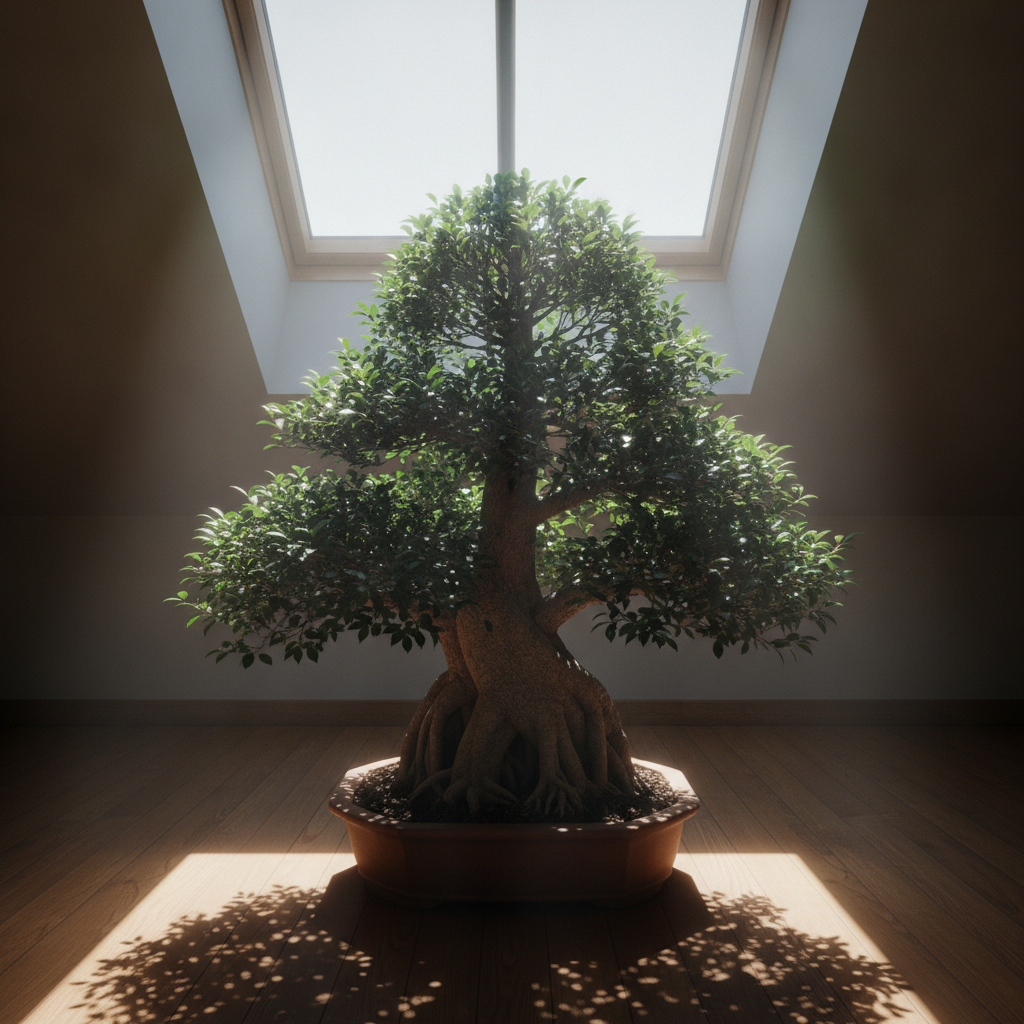
Light is the single biggest lever a grower has over how good a Chinese banyan bonsai looks. The plant will survive in a surprisingly dim corner, holding onto its leaves and ticking over for months, but survival and good form are different things. In low light the internodes, the gaps between leaves along a stem, stretch out, the new leaves grow larger and thinner, and the neat, twiggy silhouette gives way to a leggy, sparse look. To thrive, this tree wants the brightest position a home can offer.
The ideal is bright, indirect light for most of the day, such as a spot right beside an east or west-facing window, or a metre or so back from a south-facing one. The Chinese banyan also tolerates a few hours of direct sun better than most indoor plants, and a little morning sun actively improves leaf colour and density. The main caution is fierce, unfiltered midday summer sun through glass, which can scorch leaves, particularly on a plant that has been living somewhere dim and is not hardened to it. Introduce stronger light gradually over a week or two.
Rotate the pot a quarter turn every week or two so that all sides receive similar light, otherwise the canopy grows lopsided toward the window. In the darker months from late autumn to early spring, when daylight in northern latitudes is weak and short, move the tree to the brightest available window or supplement with a full-spectrum LED grow light for ten to twelve hours a day. Good winter light is the difference between a plant that merely idles until spring and one that keeps its dense, healthy canopy year-round.
Watering
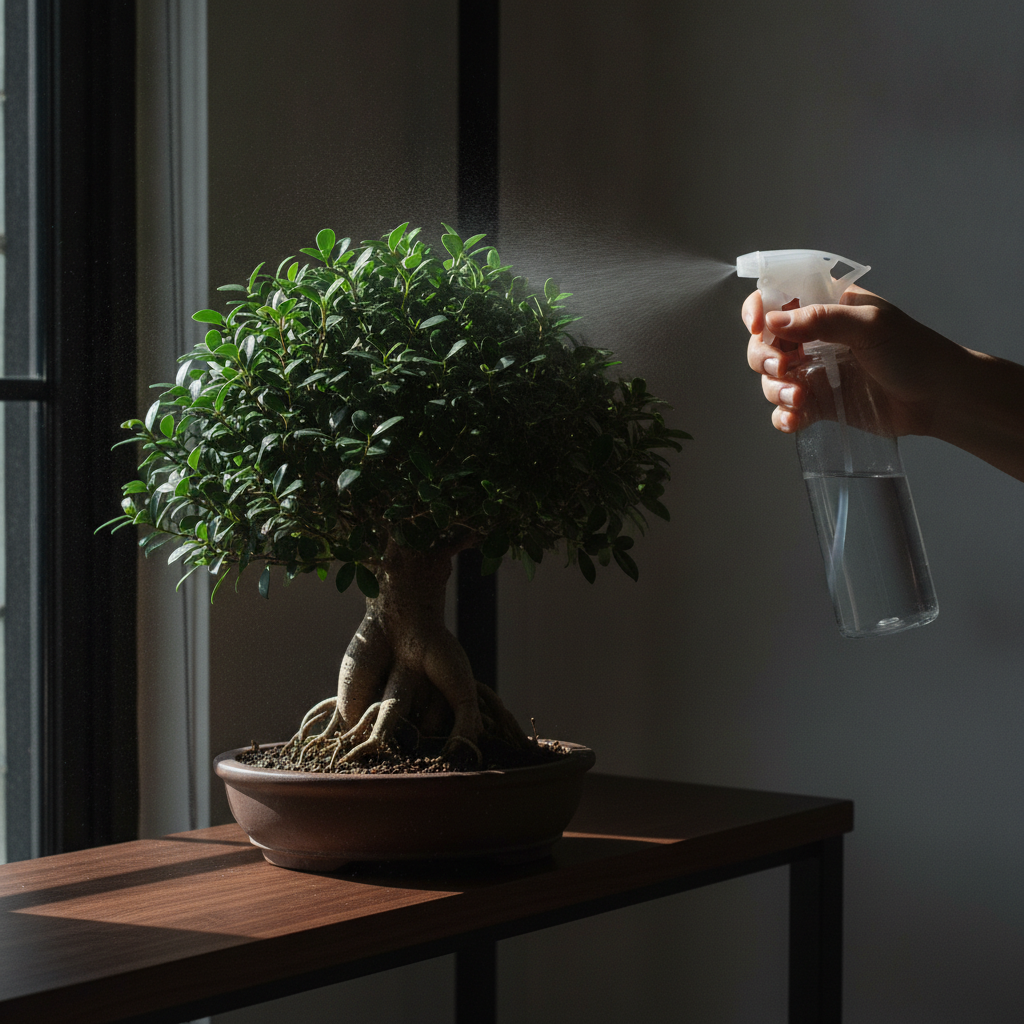
Watering is where most Chinese banyan bonsai are lost, and almost always through kindness rather than neglect. Because the plant lives in a shallow container with a limited volume of soil, its watering rhythm is quicker and less forgiving than a houseplant in a deep pot, yet the roots still rot readily if left standing in water. The reliable method is to check rather than to schedule. Feel the surface of the soil with a finger, and water thoroughly only once the top 1 to 2 cm (0.5 to 1 in) has dried out.
When it is time to water, water generously. Take the tree to a sink and let water run through until it flows freely from the drainage holes, which wets the entire root mass and flushes out accumulated salts. Allow it to drain completely before returning it to its saucer, and never leave the pot sitting in a dish of collected water. A bonsai in free-draining mix in a bright, warm spot may need this every two to three days in high summer, and only once every week to ten days in the depths of winter. The soil, not the calendar, sets the pace.
The Chinese banyan is genuinely tolerant of the occasional missed watering, drawing on the moisture stored in its fat roots and trunk, so erring slightly on the dry side is far safer than keeping it constantly wet. Chronic overwatering shows as yellowing leaves that drop while still soft, a sour smell from the soil, and blackened roots. Underwatering, by contrast, produces crisp, browning leaf edges and wilting that recovers quickly once watered. Because the two look different, learning to tell them apart takes the guesswork out of care.
Warning — Tap water and leaf drop: Sudden, dramatic leaf drop is the Chinese banyan’s stress signal, triggered by cold water, cold draughts, or a big swing in conditions. Use room-temperature water rather than cold straight from the tap, keep the tree away from draughty doorways and cold windowpanes in winter, and change one thing at a time so the plant is never shocked on several fronts at once.
Soil and Potting
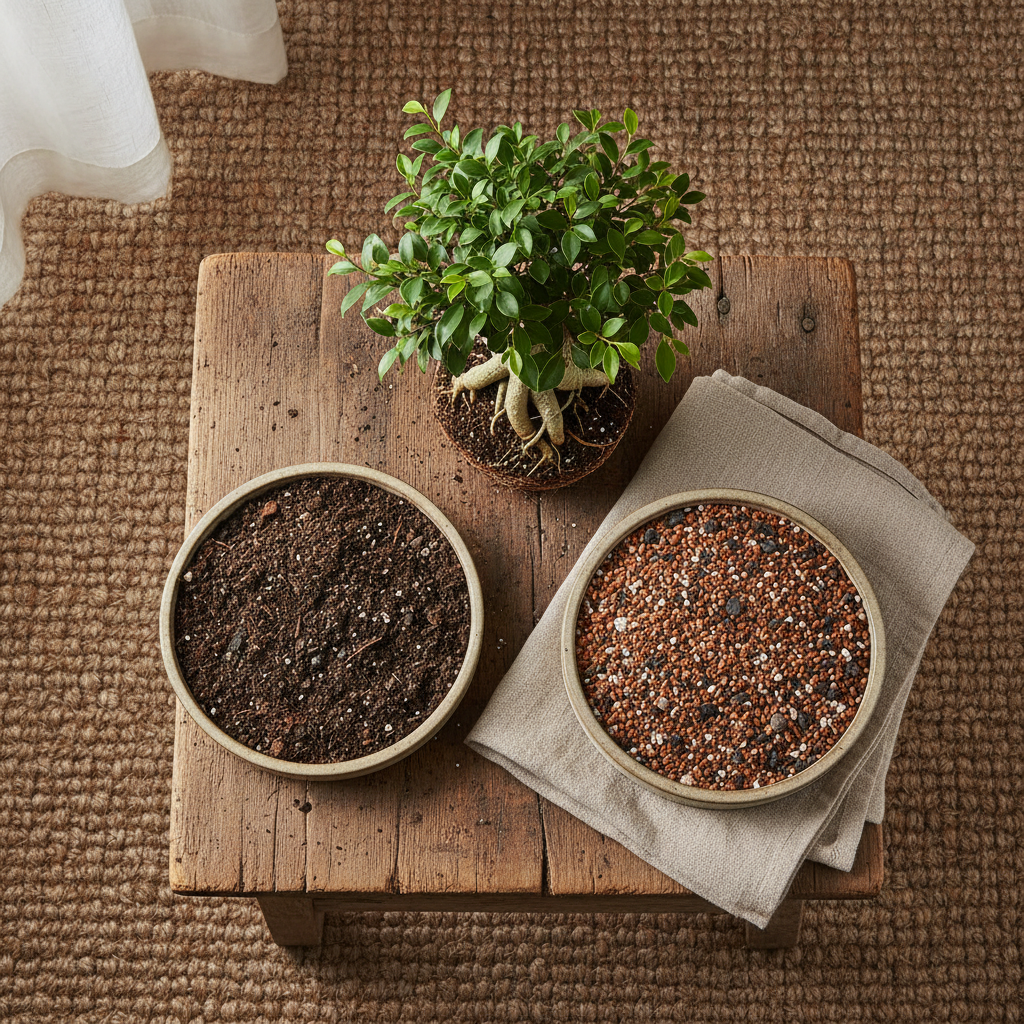
The soil a Chinese banyan bonsai lives in has to do two contradictory things at once: hold enough moisture to keep a small root mass from drying out too fast, yet drain quickly enough that the roots never sit in stagnant water. The dense, water-retentive potting compost that many shop-bought specimens arrive in fails the second test, which is why repotting into a proper free-draining mix is one of the most valuable things a new owner can do once the plant has settled in.
A classic bonsai substrate for a ficus is a blend of akadama, a fired Japanese clay granule, with pumice and fine bark or lava rock in roughly equal parts. Where those are hard to source, a good approximation is a chunky aroid-style mix of orchid bark, perlite or pumice, and a small amount of quality potting compost, aiming for a texture that feels open and gritty rather than smooth and dense. The goal is a substrate that water rushes through, leaving the particles damp but the air spaces clear.
Repot a young, vigorous Chinese banyan every two years, and an older, more established tree every three to five years, always in spring as growth resumes. Ease the tree out of its pot, tease away the outer third of the root ball, and trim back the longest roots with clean, sharp scissors before settling it into fresh mix in the same or a slightly larger container. This root pruning is not cruelty; it is what keeps a confined tree young, encourages fine feeder roots close to the trunk, and refreshes the soil that inevitably breaks down and compacts over time.
Always use a pot with drainage holes. A traditional shallow bonsai pot suits the aesthetic and helps keep the tree compact, but any well-draining container works while a tree is being developed. Mesh over the drainage holes stops soil washing out, and a layer of coarser grit at the base does no harm on a deeper pot, though in a shallow bonsai tray the whole mix should already be coarse enough not to need it.
Fertilising
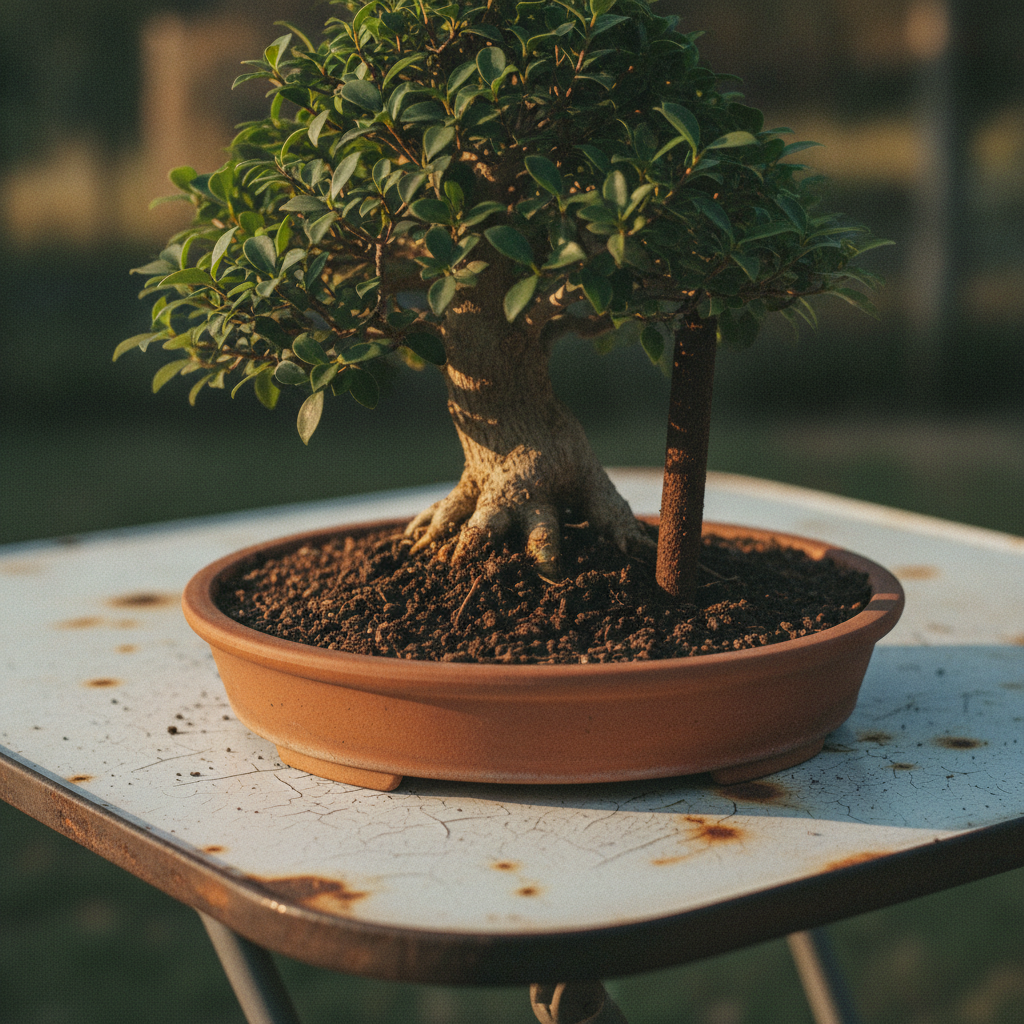
Because a bonsai grows in such a small volume of soil, its roots quickly exhaust the available nutrients, so regular feeding matters more here than for a plant in a large pot that can coast on reserves. During the active growing season from spring through early autumn, feed a Chinese banyan every two weeks with a balanced liquid fertiliser diluted to half the strength recommended on the bottle. Frequent, dilute feeding suits the fast, steady growth this species puts on and avoids the risk of scorching a confined root system with a heavy dose.
A balanced formula with roughly equal nitrogen, phosphorus and potassium keeps foliage, roots and overall vigour in step. Growers who prefer to feed less often can use slow-release fertiliser pellets or organic fertiliser cakes pressed onto the soil surface, which release nutrients gradually with each watering. Whichever route is chosen, always feed onto damp soil rather than bone-dry mix, as fertiliser applied to a parched root ball is far more likely to cause root burn.
Ease off in winter. Where the tree is kept warm and well lit and continues to grow, a monthly feed at quarter strength is enough. Where it slows down in cooler, darker conditions, stop feeding altogether until spring, because fertiliser fed to a plant that is not actively growing simply accumulates in the soil as salts and can damage the roots. A short annual rest from feeding does no harm and often precedes a stronger flush of growth when the light returns.
Propagation
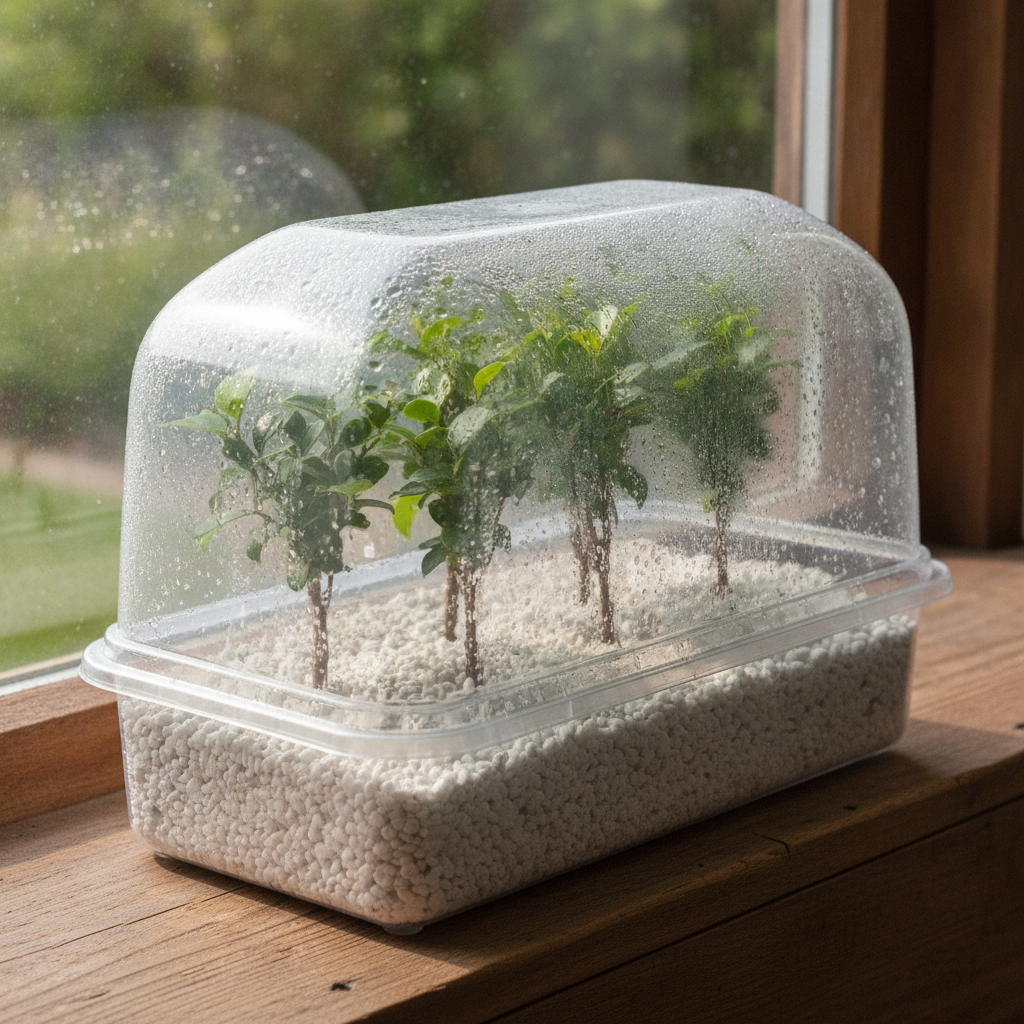
The Chinese banyan roots so easily from cuttings that propagation is less a challenge than an inevitability once pruning season arrives. Cuttings taken from ordinary Ficus microcarpa will grow on their own roots into upright, conventionally trunked trees rather than reproducing the grafted ginseng belly, which some growers actually prefer as it yields a more natural little tree. Late spring and early summer, when the plant is growing strongly and warmth is reliable, give the highest success rates.
To take stem cuttings, follow these steps:
- Select a healthy semi-woody shoot 8 to 15 cm (3 to 6 in) long and cut it just below a leaf node with clean, sharp scissors.
- Remove the leaves from the lower half of the cutting, leaving two or three at the top, and blot the cut end to stop the milky sap flowing.
- Optionally dip the cut end in rooting hormone, then insert it into a small pot of damp, gritty cutting mix or moist perlite.
- Cover with a clear plastic bag or humidity dome to hold moisture around the leaves, and keep it warm at around 22 to 27 degrees C (72 to 81 degrees F) in bright, indirect light.
- Keep the medium lightly moist but never waterlogged, and expect roots to form within four to eight weeks, shown by fresh new growth at the tip.
Once a cutting is well rooted and pushing new leaves, harden it off gradually by opening the cover for longer each day over a week before removing it entirely. Air layering is the other reliable method and is worth knowing for thickening or reshaping a trunk: a ring of bark is removed from a branch, wrapped in damp sphagnum moss and plastic, and left until roots form in the moss, at which point the rooted section is cut off and potted as a new plant with a ready-made trunk.
Pests and Problems
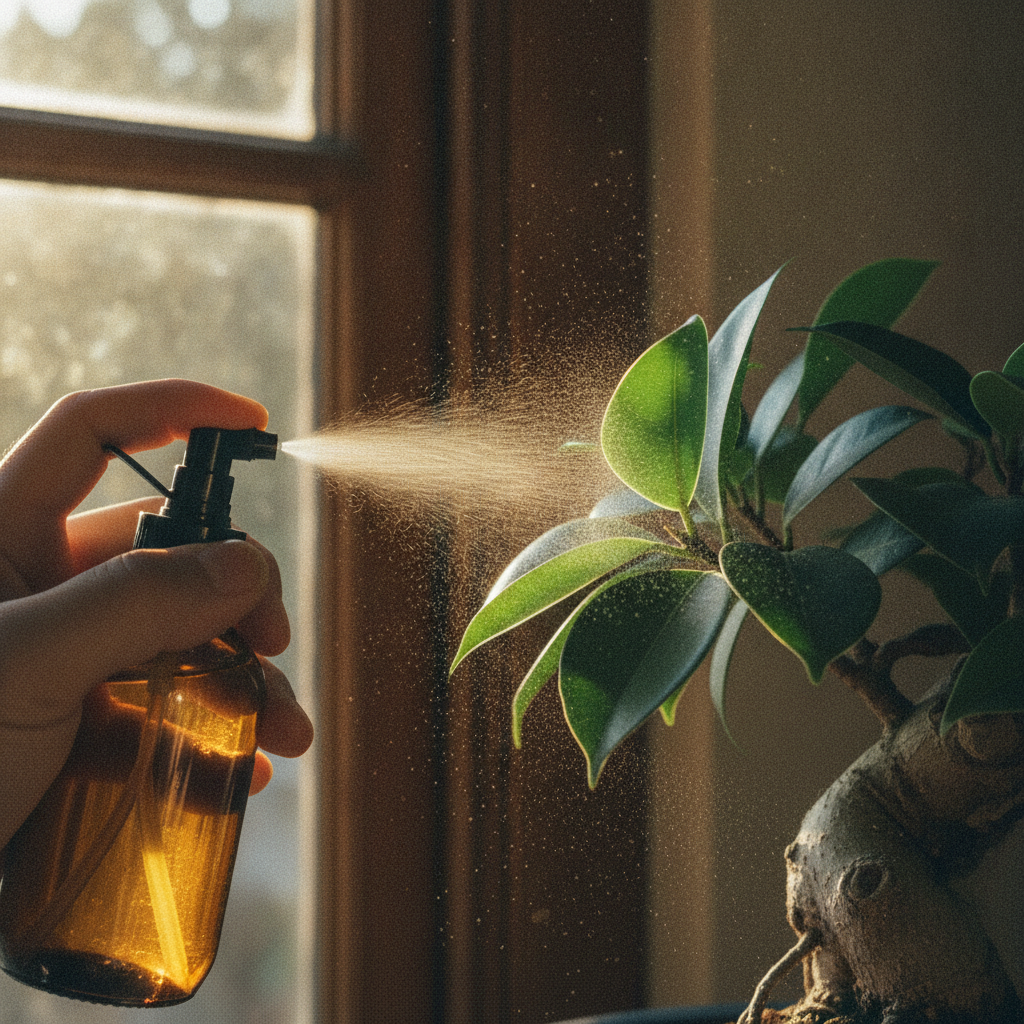
A healthy, well-lit Chinese banyan is not especially prone to pests, but the dry air of heated indoor rooms in winter can invite a few familiar troublemakers. Scale insects are the most common, appearing as small brown or tan bumps clinging to stems and the undersides of leaves, often accompanied by sticky honeydew and sooty mould. Mealybugs show as white cottony tufts in leaf axils, and spider mites, which thrive in dry air, leave fine stippling and delicate webbing between the leaves. Inspect the tree regularly, since early detection makes any infestation far easier to clear.
For light infestations, wipe scale and mealybugs off with a cotton bud dipped in diluted isopropyl alcohol, and rinse spider mites away with a firm spray of water. For anything more established, treat the whole canopy, paying particular attention to the leaf undersides, with a horticultural oil such as neem or an insecticidal soap, repeating every seven to fourteen days until the pests are gone. Raising the humidity around the tree and improving airflow both discourage spider mites, which dislike moist air.
The most alarming problem, sudden leaf drop, is usually environmental rather than a pest or disease. The Chinese banyan sheds leaves in response to stress, and the usual triggers are a change of location, a drop in light levels, cold draughts, or letting the soil swing between extremes of soggy and bone dry. The remedy is stability: settle the tree in one good spot, water consistently, keep it out of cold draughts, and be patient, because a healthy trunk almost always reflushes with new leaves within a few weeks once conditions steady.
Warning — Irritant sap: Like all figs, Ficus microcarpa exudes a milky white latex when cut. It can irritate skin and eyes and is mildly toxic if eaten, so keep the tree out of reach of curious pets and children, wash your hands after pruning, and avoid rubbing your eyes while working on it.
Varieties
Most Chinese banyan bonsai sold are simply the species Ficus microcarpa, but a couple of distinct forms turn up often enough to be worth recognising, and each brings its own character to a collection.
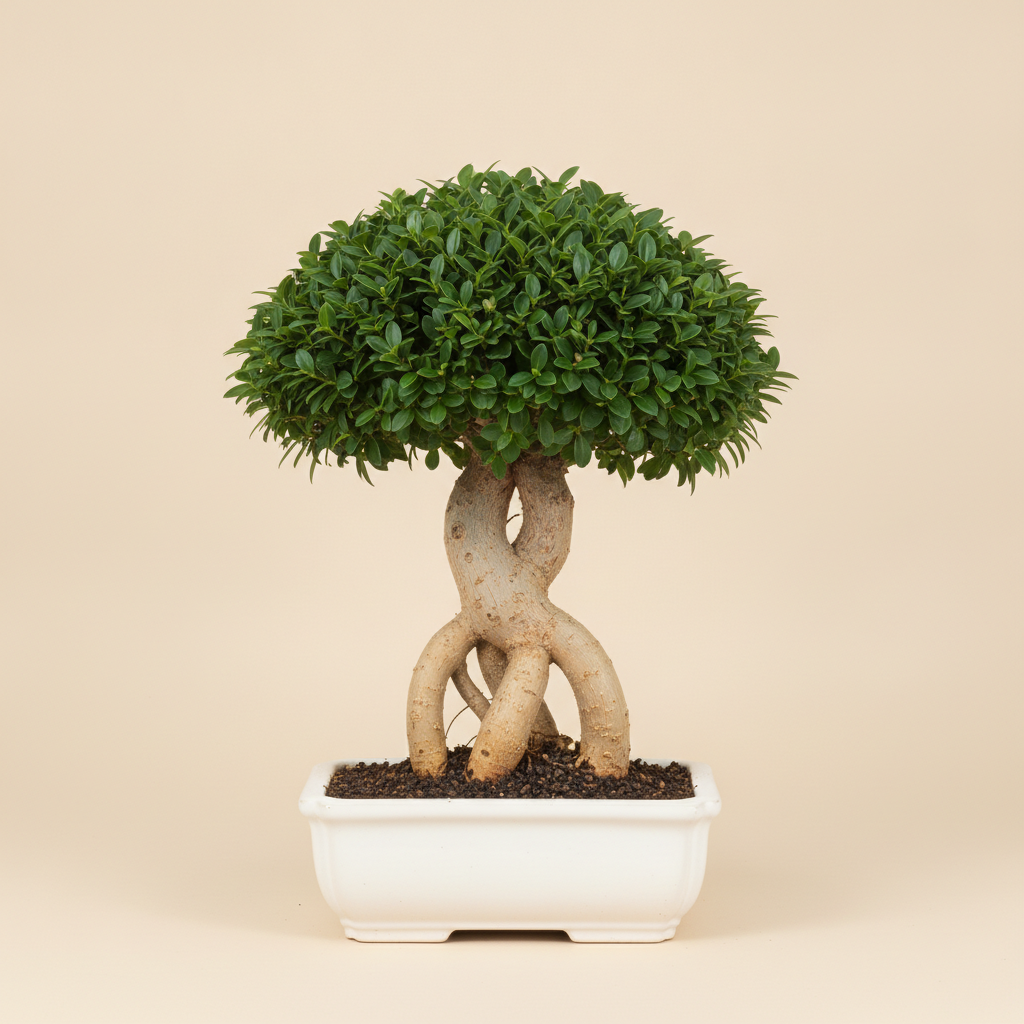
Ginseng Ficus
The form found in almost every shop, grown for its fat, bulbous storage roots and then grafted with small-leaved foliage. The swollen, pot-bellied trunk that gives it the ginseng name is its signature. It is inexpensive, extremely robust and the ideal starting point for a first bonsai.
Tiger Bark
A cultivar prized for its distinctive mottled bark, patterned with pale grey and cream striping that resembles a tiger’s markings and gives even a young tree an aged appearance. It grows on a more natural upright trunk with the same small, glossy leaves, and is a favourite among more serious bonsai growers.
Frequently Asked Questions
Why is my Chinese banyan bonsai dropping leaves?
Leaf drop is this tree’s standard reaction to stress, most often a change in location or light, a cold draught, or inconsistent watering. It is rarely fatal. Settle the plant in one bright, stable spot, water it only when the top of the soil dries, keep it away from cold windows and doorways, and give it a few weeks. A healthy trunk almost always produces a fresh flush of leaves once conditions steady.
How often should I water a ginseng ficus?
There is no fixed schedule. Check the soil and water thoroughly only when the top 1 to 2 cm (0.5 to 1 in) has dried out. In a bright, warm spot in summer this may be every two to three days, while in winter it can stretch to once a week or longer. Always water until it runs from the drainage holes, then let it drain fully and never leave the pot standing in water.
Is a Chinese banyan bonsai a good plant for beginners?
It is one of the best. The species is vigorous, forgiving of missed waterings and low light, and fast enough to recover from pruning mistakes, which makes it an ideal first bonsai for learning the core skills of watering, feeding and shaping before moving on to fussier trees.
Can a ginseng ficus live indoors permanently?
Yes. As a subtropical species it is not frost hardy and is well suited to life as an indoor tree, provided it gets the brightest position available. It can spend the warm summer months outdoors in a sheltered, partly sunny spot, which often improves its vigour, but it must be brought back inside well before temperatures fall below about 12 to 15 degrees C (54 to 59 degrees F).
Is Ficus microcarpa toxic to cats and dogs?
Yes, mildly. The leaves and the milky sap contain compounds that can cause mouth irritation, drooling and digestive upset if chewed, and the sap can irritate skin. It is sensible to keep the tree out of reach of pets and children and to wash your hands after pruning.
How do I keep the leaves small?
Small leaves come from bright light, restrained feeding and regular pruning. Give the tree as much light as possible, pinch or trim new shoots back to one or two leaves once they have extended several nodes, and avoid overfeeding, which pushes lush, oversized foliage. Over time this regime builds the dense ramification and fine leaves that make a convincing miniature tree.
The Chinese banyan bonsai proves that a plant can be both an easy houseplant and a genuine entry into the craft of bonsai. Give it good light, water it by feel rather than by rota, pot it into a free-draining mix, and prune it with a little confidence, and this tough, characterful little fig will reward the effort for years, thickening and improving in a way few indoor plants ever do.






