
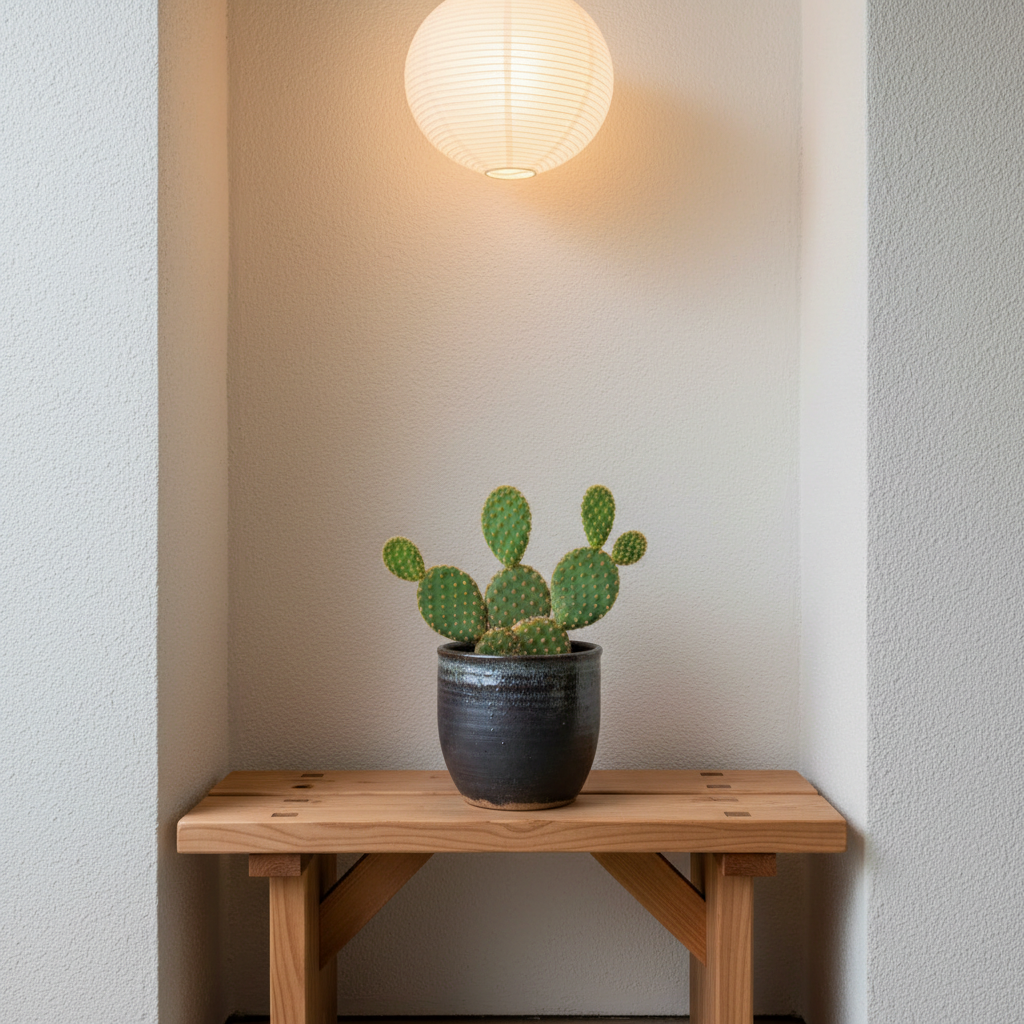
Few houseplants invite a smile quite as quickly as the bunny ear cactus, a small, branching desert native whose flattened pads bud sideways in pairs so neatly that they look almost cartoonish. The plant is botanically known as Opuntia microdasys, and depending on where you shop for it you will also see the names polka dot cactus, angel’s wings cactus, or simply bunny cactus on the label. It hails from the high, arid plateaux of central and northern Mexico, where it grows in mineral-rich soils that drain in seconds and bakes for months under a relentless sun. Indoors it is one of the most architectural and easygoing cacti you can grow, valued as much for the regular, polka-dot pattern of its glochids as for the way mature plants throw out tidy clumps of new pads that look like a family of rabbits caught mid-stretch.
A bunny ear cactus has a forgiving reputation, and that reputation is largely deserved. It will tolerate skipped waterings, the dry air of a centrally heated flat and most domestic temperature swings without complaint. What it does not tolerate well is the same gentle, attentive treatment most leafy houseplants reward you for: soggy soil, low light, frequent feeding and warm winter conditions are the four most reliable ways to kill it. This guide covers the practical difference between merely keeping a bunny ear cactus alive and growing one that produces new pads each spring, flushes red in good light and survives for decades. Along the way it deals with the plant’s most distinctive quirk, the glochids — those soft-looking, irritating little bristles that demand a particular handling discipline from anyone who keeps the species.
Contents
- Quick Reference
- Why Bunny Ear Cactus Makes a Cheerful Houseplant
- Light Requirements
- Watering and Humidity
- Soil, Potting and Repotting
- Fertilising
- Propagation
- Pests and Diseases
- Popular Varieties
- Frequently Asked Questions
Quick Reference: Bunny Ear Cactus at a Glance
| Botanical name | Opuntia microdasys |
| Family | Cactaceae |
| Common names | Bunny ear cactus, polka dot cactus, angel’s wings cactus |
| Light | Bright direct sun, ideally 6 hours per day; tolerates very bright indirect light at the cost of compact form |
| Watering | Soak thoroughly, then let the soil dry out completely; roughly every 2 to 3 weeks in summer, every 4 to 6 weeks in winter |
| Temperature | 21 to 32 degrees C (70 to 90 F) growing season; 7 to 13 degrees C (45 to 55 F) winter rest for best flowering |
| Humidity | Low to moderate, 30 to 50 per cent; dislikes consistently humid air |
| Soil | Gritty cactus and succulent mix with at least 50 per cent mineral content (pumice, perlite, coarse sand or grit) |
| Fertiliser | Low-nitrogen cactus feed at quarter strength, once a month from late spring to early autumn only |
| Mature size | 40 to 60 cm (16 to 24 in) tall indoors, occasionally to 90 cm (35 in); spreading habit |
| Growth rate | Slow to moderate; one or two flushes of new pads per year |
| Lifespan | Decades when basic care is met; old specimens become woody at the base |
| Toxicity | Non-toxic if eaten according to ASPCA, but the glochids cause significant physical irritation to skin, eyes and mouths of people and pets |
Why Bunny Ear Cactus Makes a Cheerful Houseplant
The bunny ear cactus has been a fixture of windowsill collections in Europe and North America since the late nineteenth century, when Victorian glasshouse enthusiasts began importing Mexican cacti in volume. Its appeal is partly visual and partly practical. Visually, Opuntia microdasys is one of the most graphic plants in cultivation: each pad is an almost perfect rounded paddle, and the small areoles on its surface are arranged in a tight diagonal grid rather than scattered randomly. From those areoles burst tufts of glochids that on the most popular form, var. albispina, are a clean creamy white, giving the plant its other common name, polka dot cactus. Mature specimens branch repeatedly, with new pads emerging in pairs from the upper edge of an older pad in the unmistakable bunny-ear silhouette that the species is named for.
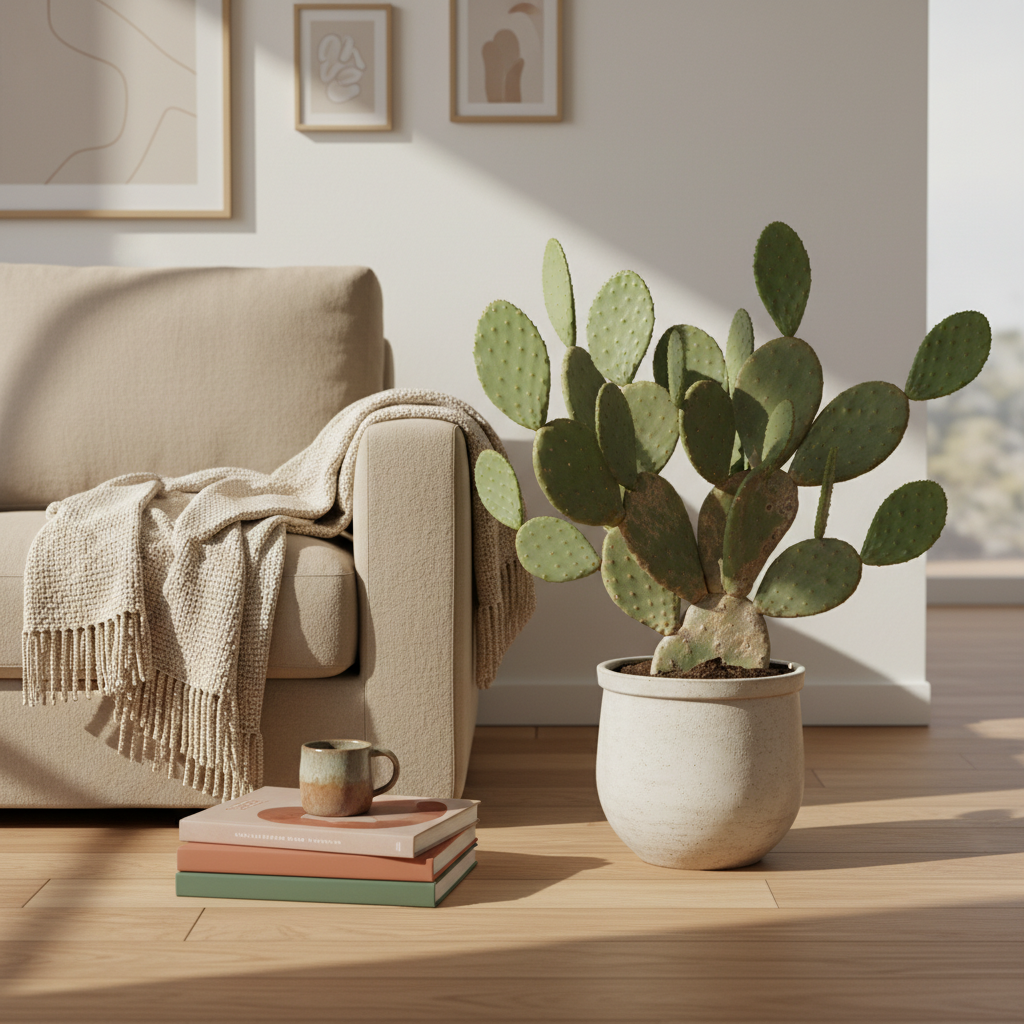
Practically, the bunny ear cactus belongs to a small group of cacti that are genuinely well-suited to ordinary domestic conditions. Many cacti from the central Mexican highlands require a strong difference between day and night temperatures to thrive long-term, and most cacti will eventually rot in an unventilated apartment if their watering is timed badly. Opuntia microdasys is unusually flexible on both counts: it accepts a fairly stable indoor temperature, recovers gracefully from short droughts and is one of the more reliable cacti to flower indoors, producing pale yellow cups in late spring or early summer in a sunny window. The plant is also slow and modest in habit. A specimen bought as a small 10 cm rooted pad will typically stay in scale with a windowsill for several years before it needs a larger pot, which makes it easy to integrate into a small flat.
The most important thing to understand about Opuntia microdasys before buying one is the glochids. Unlike the long, rigid spines of most cacti, glochids are tiny, hair-fine, barbed bristles that detach at the lightest touch. They lodge in skin instantly, are almost invisible once embedded, and cause a low-grade itch that can last for several days. They are not dangerous, but they are genuinely unpleasant, and any household with curious toddlers, cats inclined to bat at plants or anyone who handles plants barehanded should think carefully about where the cactus will live. With sensible placement, however, the glochids cease to be a daily concern and simply become part of the plant’s character.
Warning — Handling glochids: Never touch a bunny ear cactus with bare fingers, even briefly. Use folded newspaper, leather gloves, kitchen tongs or tightly rolled cardboard whenever the plant must be moved or repotted, and assume any embedded glochid is the price of forgetting.
Light Requirements
Light is the single most important factor for keeping Opuntia microdasys healthy indoors, and it is also the factor most often misjudged. In its native range, the bunny ear cactus grows in open scrubland and rocky slopes at altitudes between 1,500 and 2,500 metres (4,900 to 8,200 ft), where it receives roughly ten to twelve hours of direct sun for most of the year. No domestic window can replicate that intensity, which is why the plant should be given the brightest spot in the home without apology. A south-facing windowsill in the northern hemisphere, or a north-facing one in the southern hemisphere, is ideal. East and west windows can work for established plants but will slow growth and may produce slightly etiolated pads over time.
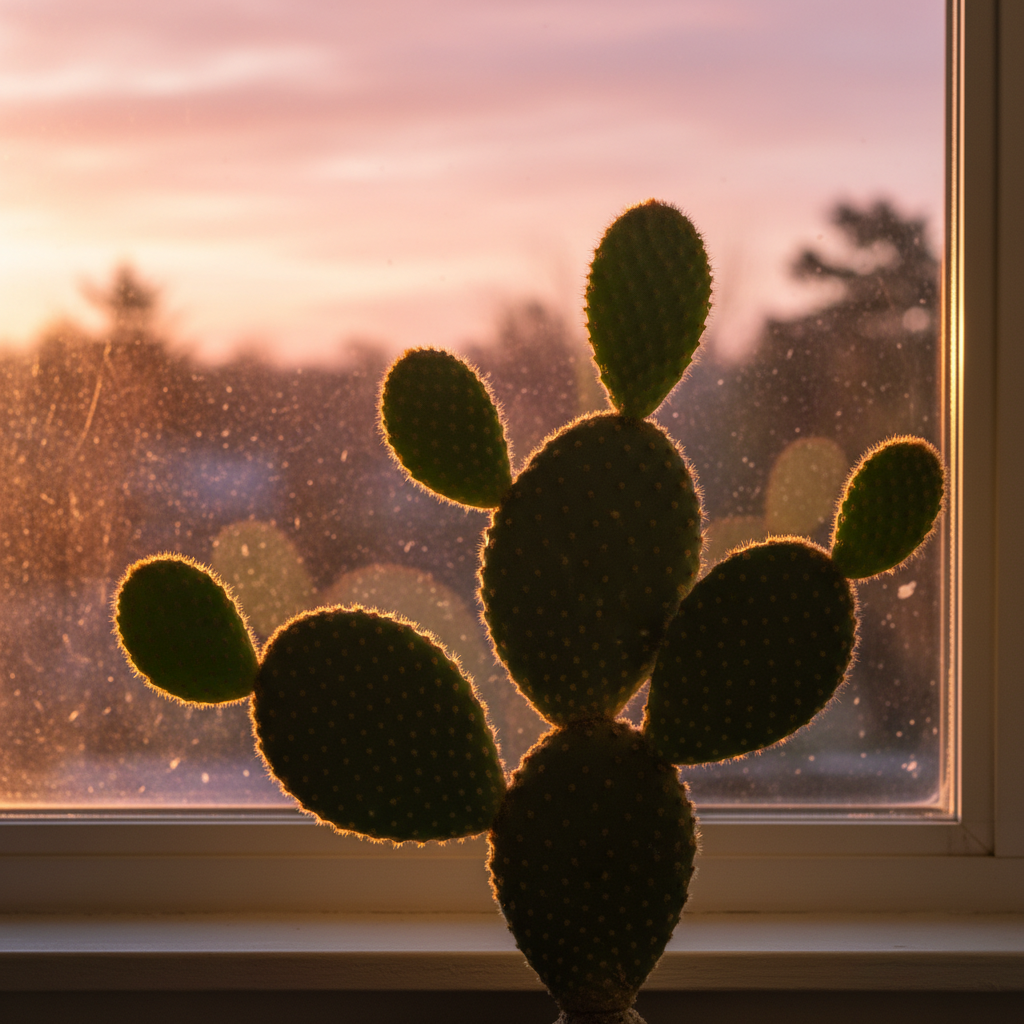
The visible signs of insufficient light are straightforward to read once you know them. A bunny ear cactus that is not receiving enough sun produces new pads that are noticeably narrower, longer and paler than the rest of the plant, often with a slight bend toward the brightest available light source. The polka-dot pattern of glochids tends to spread more sparsely on undersized pads, and the overall green of the plant becomes a flat, dull tone rather than the warm, slightly yellow-green it should have in good light. In severe cases new pads emerge thin and almost flat-faced, more like leaves than the chunky paddles you expect, and the plant becomes top-heavy and prone to tipping in its pot. If you spot any of these symptoms, the response is gradual relocation to a brighter window, not an immediate move into harsh midday sun.
Sunburn, though less commonly discussed, is a real risk when a bunny ear cactus is moved abruptly from shade into full sun. The pad surface develops irregular pale yellow or whitish patches within a few hours, and within a day or two those patches turn corky and brown. The damage is permanent on that pad but does not spread to new growth. To avoid it, acclimatise any new plant or any plant that has spent the winter in lower light by exposing it to direct sun for an extra hour each day over the course of about two weeks. The same applies in spring when moving the plant outdoors for the summer: assume the cactus has forgotten what real sun feels like, and ease it back into the routine. Outdoor placement, where conditions allow, is genuinely beneficial: a summer spent on a sheltered balcony or in a bright courtyard usually produces the most colourful, compact growth of the year.
Artificial lighting is a workable supplement, particularly through the dim months of a northern winter when even a south window provides only a few hours of weak sun. A full-spectrum LED grow light positioned 15 to 30 cm above the plant for twelve hours per day will keep growth tight and prevent etiolation, though it will not replace the colour-deepening effect of real sunlight. Bunny ear cacti grown entirely under artificial light tend to remain a uniform mid-green rather than developing the reddish or purplish blush that hours of true sun can produce on pad edges of stressed plants. That blush is a sign of mild, healthy stress rather than damage, and many growers consider it one of the most attractive features of well-grown specimens.
Pro Tip — Rotate weekly: Bunny ear cactus pads grow asymmetrically toward the brightest light source. A quarter turn every week or two keeps growth balanced and prevents the plant from leaning permanently in one direction.
Watering and Humidity
Watering is where most bunny ear cacti meet their end. The plant stores a generous reserve of water in its thick pads, has a shallow but extensive root system designed to catch infrequent rainfall and is genetically equipped to wait. A healthy Opuntia microdasys in dry soil can survive weeks of complete drought without showing any visible distress; the same plant in soil that stays moist for even a few days will rot at the soil line so quickly that you may not notice until pads start tipping over. The right approach is sometimes called the soak-and-dry method, and it is the only watering schedule that suits this species reliably over years.
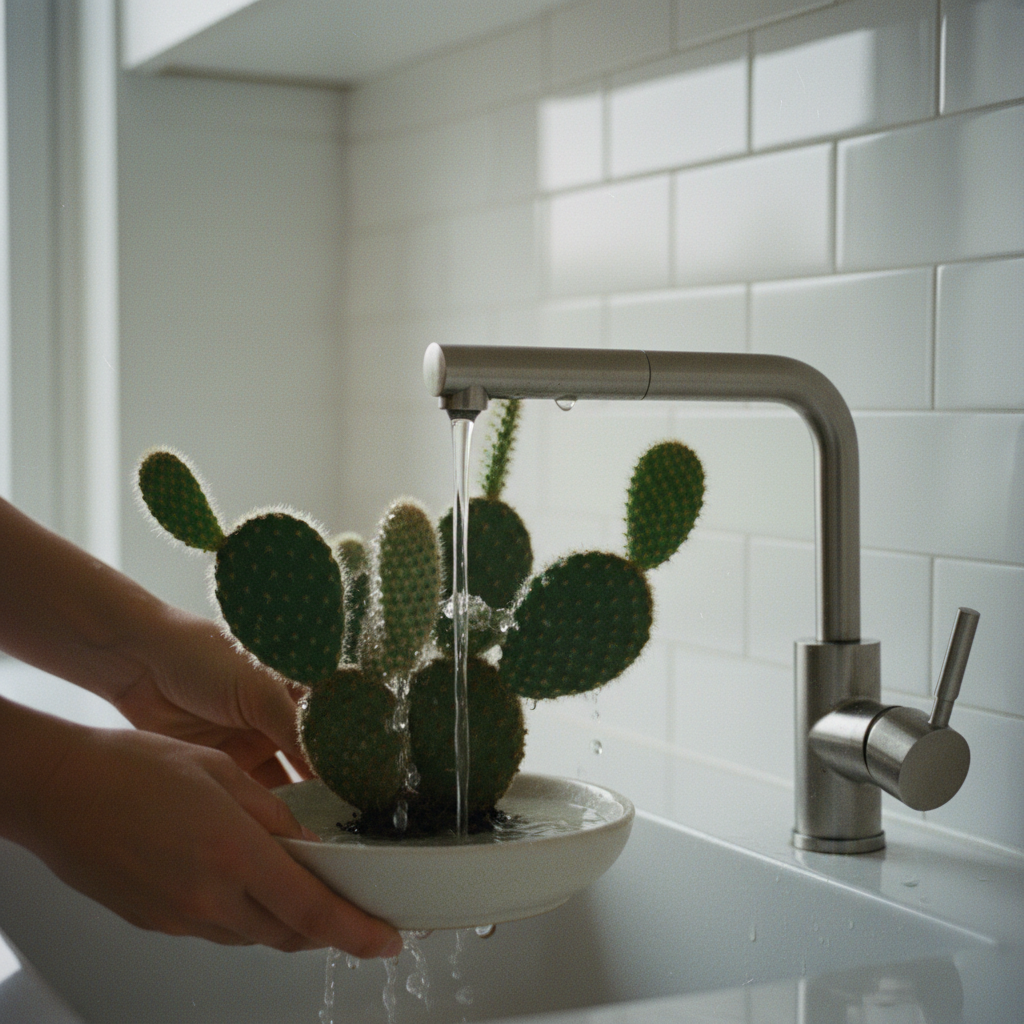
In practice, the routine looks like this. During the active growing season, broadly from late April to early September in the northern hemisphere, you water deeply when the soil is bone dry from top to bottom. A wooden chopstick or moisture meter pushed to the base of the pot is the most reliable way to confirm this; the surface of cactus mix dries within a day or two and is no guide to what is happening at root level. When the substrate is fully dry, take the plant to the sink, water until it streams freely from the drainage holes for several seconds, let it drain fully and return it to its spot. Depending on pot size, room temperature and how sunny the position is, this will translate to one watering every two to three weeks at the height of summer.
From October onwards, watering should drop sharply. A bunny ear cactus held cool through winter, ideally between 7 and 13 degrees C (45 to 55 F), needs almost nothing: a single small drink every six to eight weeks is usually enough to prevent the pads from shrivelling. A plant kept in a warm room over winter, around 20 degrees C (68 F) or above, will continue to use a little water and may need a modest soak every three to four weeks, but it will also fail to set flower buds the following spring because it never enters dormancy. The cool, dry winter rest is not a fad; it is the metabolic signal that triggers flowering and resets the plant’s growth cycle. If you have a frost-free conservatory, garage or unheated porch, the cactus will reward you for storing it there from late autumn until early spring.
The signs of overwatering and underwatering are mirror images and worth distinguishing carefully. An underwatered bunny ear cactus develops pads that look slightly deflated and softly wrinkled, almost like a folded leather purse. The pads remain firm to a careful poke and the plant recovers fully within a day or two of a thorough soaking. An overwatered plant, by contrast, develops pads that go from firm to soft and squishy without wrinkling first, often paired with yellowing or blackening at the base where the lowest pad meets the soil. Once that soft, wet rot starts, no amount of drying will save the affected pad; you must surgically remove every soft section back to clearly healthy tissue and accept the loss.
Humidity, by contrast, is mostly a non-issue for this species. Opuntia microdasys is from a climate where summer afternoon humidity often drops below 25 per cent, and it positively dislikes the warm, damp air that suits ferns and tropical aroids. Average indoor humidity of 30 to 50 per cent suits it perfectly, and it tolerates the very dry conditions of a centrally heated home in winter without flinching. The only humidity-related precaution is to avoid grouping the cactus closely with humidity-loving plants whose evaporating moisture might keep the air around the pads damp for long periods, and to avoid misting it. Mist droplets that pool in the small dimples of an areole can encourage fungal spots, especially in cooler conditions.
Pro Tip — Use the lift test: A clay-potted bunny ear cactus is dramatically lighter when its soil is bone dry. Lifting the pot before and just after watering teaches your hand the difference within a few cycles, and from then on you can judge readiness for the next soak by weight alone.
Soil, Potting and Repotting
A bunny ear cactus has roots adapted for sharp drainage and brief surges of rainwater rather than for steady moisture. The substrate it lives in matters more for this species than for almost any other common houseplant, because a mix that holds water for too long will undo every other piece of correct care you give it. The aim is a gritty, low-organic medium that drains within a few seconds of watering and dries from top to bottom within a few days, even in a closed pot indoors.
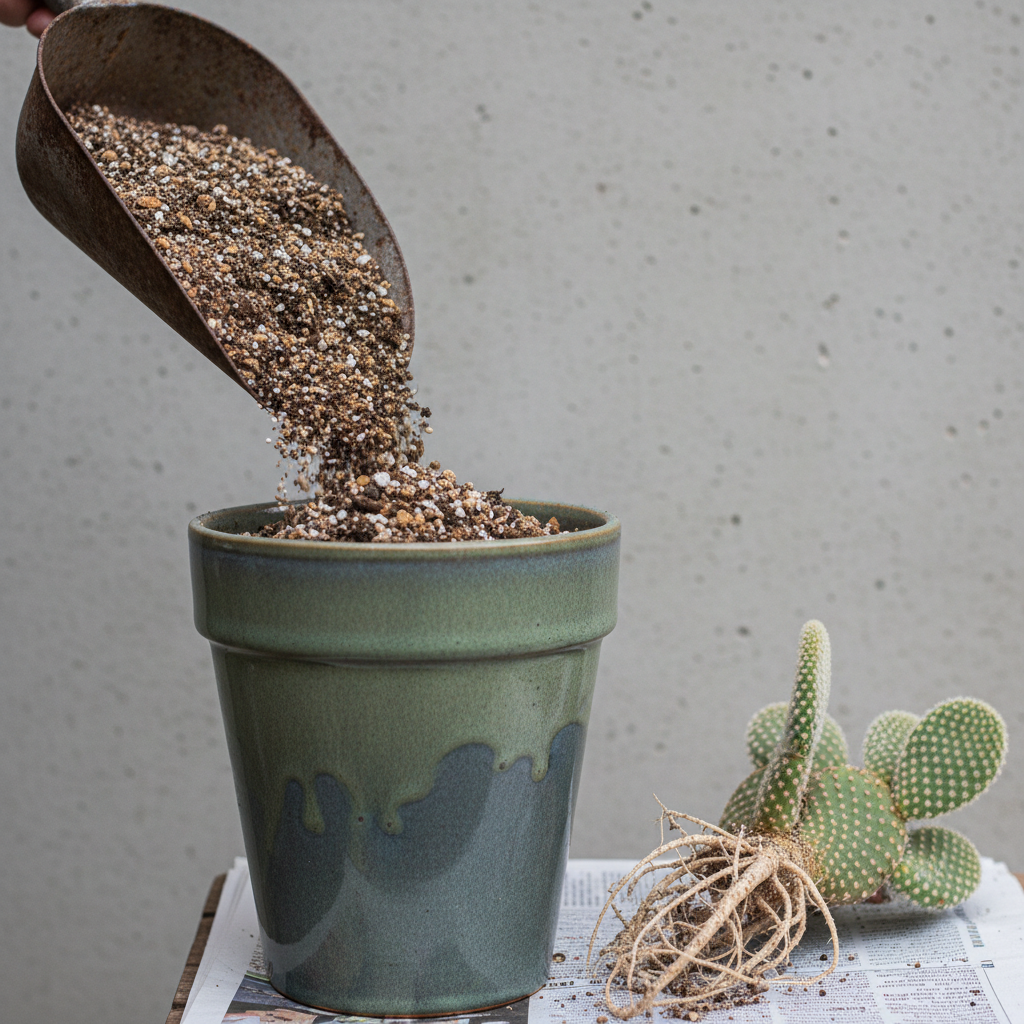
Most bagged cactus and succulent mixes sold at garden centres are a workable starting point but rarely gritty enough on their own. As a rule, you want a substrate that is at least 50 per cent mineral content by volume. A reliable home blend uses one part standard cactus mix, one part pumice or perlite (5 to 10 mm grade) and one part coarse horticultural grit or coarse sand. Lava rock, expanded clay pebbles broken to size, or akadama work equally well as the mineral fraction; what matters is that the particles are angular and three to ten millimetres across, so that the substrate retains a structural open texture rather than packing down over time. A pH between 6.0 and 7.5 is appropriate, which is the natural range of most cactus mixes once the grit is added.
Pot choice contributes to drainage as much as the mix does. Unglazed terracotta is the traditional choice for cacti and remains the right one for this species. The porous clay walls allow moisture to wick out through the sides of the pot, which speeds the dry-down cycle by several days compared with a plastic or glazed ceramic vessel of the same size. The pot must have drainage holes; no decorative cover-pot trick can substitute for a hole through which excess water can escape. Choose a pot that is only slightly larger than the root ball: an oversized pot holds a reservoir of moist soil around the roots that the plant cannot use quickly enough, and that excess moisture is the most common cause of base rot.
Repotting is required every two to three years for young plants and every three to five years for established ones. Spring, just as new growth is starting, is the right moment. The mechanics are simple but demand extra care with this species. Wear thick leather gloves or use a folded strip of newspaper as a sling to support the plant; even brushing the pads in passing can transfer glochids to your forearms or face. Tip the pot sideways, work the root ball free, gently tease away as much of the old substrate as you can without breaking healthy roots, and inspect the base. Cut away any dark, soft or hollow patches with a sharp, sterilised blade and let those wounds air-dry for a few hours to a day before replanting.
When repotting is complete, do not water for at least a week. This pause is critical: cactus roots that have been disturbed or trimmed need time for their cut surfaces to callous over, and water introduced to a freshly damaged root system is a fast route to rot. After a week of dry rest in a bright but not blazing position, give the plant a normal first watering and resume the usual soak-and-dry routine. A mineral top-dressing of small pebbles, pumice or aquarium grit looks attractive, keeps the surface of the soil dry around the base of the plant and reduces the risk of fungal damping-off at the soil line.
Fertilising
Bunny ear cacti are slow growers and modest feeders. In nature they survive on minerals leached from rocky substrates by occasional rains and small amounts of organic matter that wash in from above. Indoors, they need very little supplementary feeding and respond better to a frugal, restrained approach than to the regular high-nitrogen feeding that suits leafy tropicals. Overfeeding produces soft, pale growth, weak pads that struggle to support their own weight, and a marked increase in susceptibility to mealybugs and other sap-feeding insects.
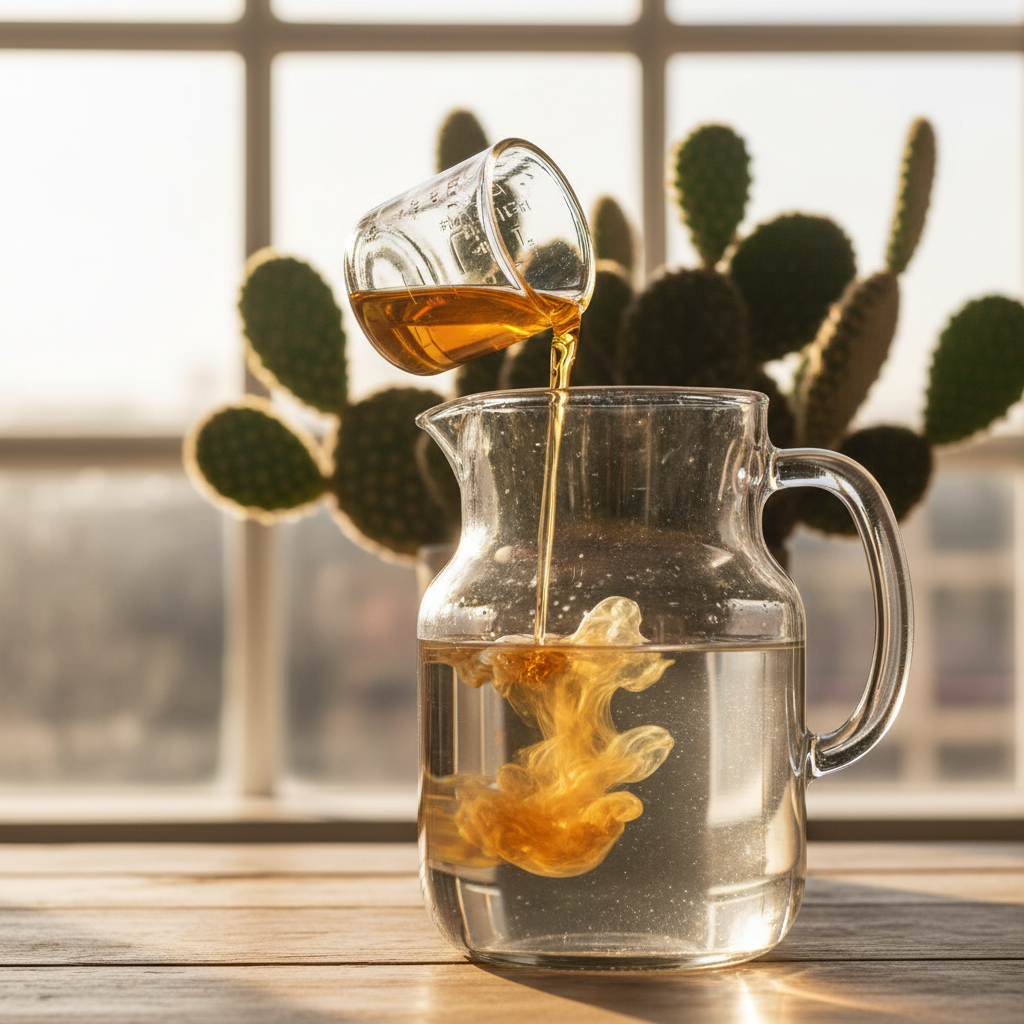
The right product is a low-nitrogen cactus or succulent fertiliser, typically labelled with an NPK ratio in the range of 2-7-7, 1-7-6 or similar. Higher first-number formulas promote leaf growth in tropicals but produce mushy, flop-prone pads on Opuntias. Liquid feeds are easier to dose precisely than granular ones. Mix the chosen feed at a quarter to half the manufacturer’s recommended strength, never full strength, and apply it as part of a normal watering once a month from late April through early September. Avoid the temptation to feed more often; even monthly is on the generous end for this species, and many experienced growers feed only once or twice per season with no ill effects.
Do not fertilise during the winter rest. A plant kept cool from October to March is metabolically idle and cannot use the nutrients you supply; the unused salts simply accumulate in the substrate, raising its salinity and damaging the fine feeder roots over time. If you notice a white crust forming on the top of the soil or on the outside of a terracotta pot, that is fertiliser salt buildup, and the remedy is a thorough flush: water heavily several times with plain water at the next normal watering to wash the salts through and out of the drainage holes.
Top-dressing with a thin layer of well-rotted compost or worm castings in early spring is a gentle alternative to liquid feeding and works well for growers who prefer organic methods. A teaspoon or two scratched lightly into the surface of the substrate releases nutrients slowly as the cactus is watered, mimicking the way nutrients become available in the wild. This is particularly useful for newly repotted plants in fresh, mineral-heavy mix that contains very little inherent fertility.
Propagation
Propagating Opuntia microdasys is one of the most rewarding small projects in the cactus world: success rates are very high, the timeline is short and the only real demand on the grower is patience between steps. The method that works best, and the one practised by almost every commercial nursery selling this species, is pad cuttings. Seed propagation is possible but slow, with seedlings taking several years to reach a recognisable shape, and it is rarely worth the trouble when pads root so readily.
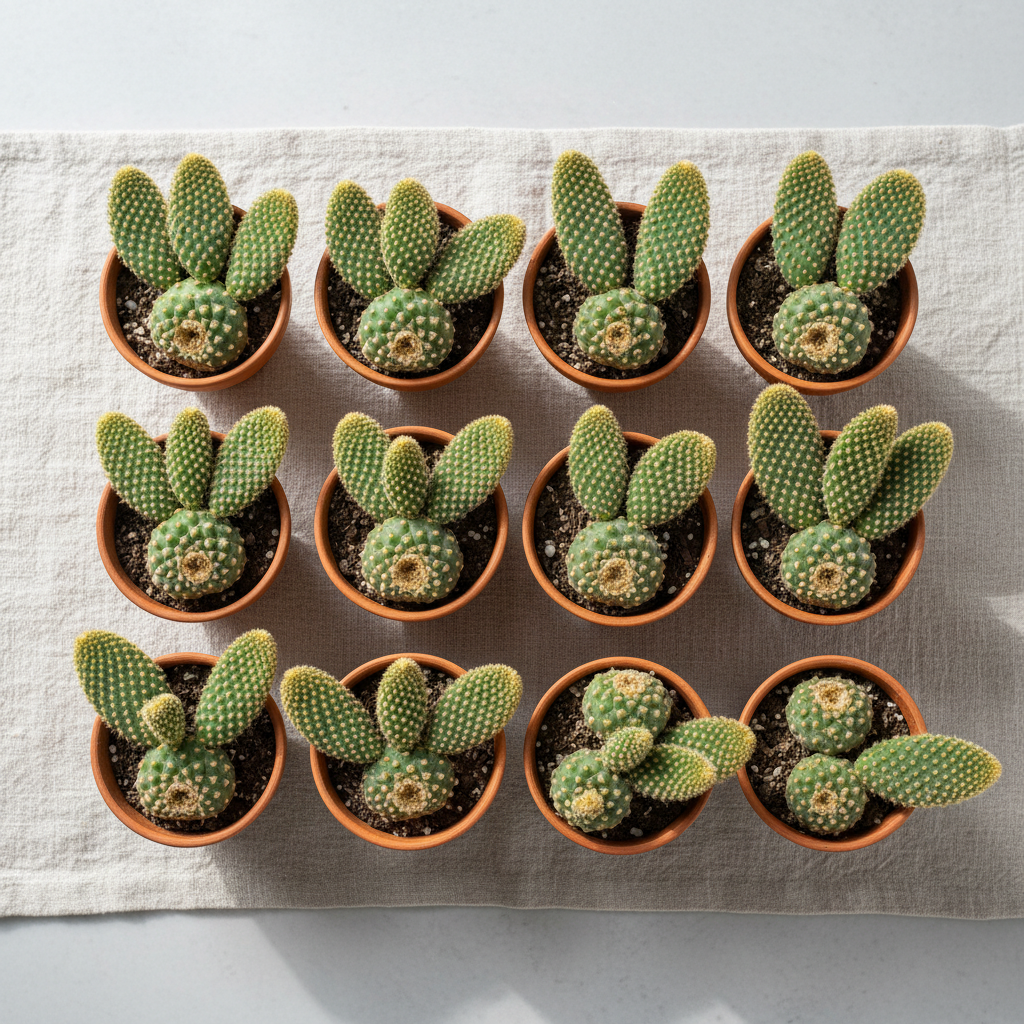
The best season for propagation is late spring or early summer, when the parent plant is actively growing and ambient temperatures are warm enough to drive new root development. Choose a healthy pad that has reached its mature size — usually 6 to 12 cm long — and that shows no soft spots, discolouration or damage. Younger pads near the growing tip root faster but offer a smaller reservoir of stored energy; older pads further down the plant take longer to root but generate a more vigorous, multi-pad new plant. Either works; a mix of both is a sensible insurance policy.
- Put on thick leather gloves and gather a sharp, sterilised knife or a pair of pruning snips. Cleanliness matters: cut surfaces are entry points for the same fungi that cause root rot.
- Cut the chosen pad cleanly at its narrow join with the parent pad. Aim for a straight cut, not a torn or twisted separation, because a clean wound calluses faster and more reliably.
- Place the cutting on a sheet of newspaper or in a shallow tray in a warm, bright but indirect spot. Leave it untouched for one to two weeks. During this period the cut surface dries and forms a hard, pale tan callous that seals the wound against bacteria and fungi.
- Once the callous is firm and dry to the touch, prepare a small pot with the same gritty cactus mix used for adult plants, and a top-dressing of grit or pumice over the surface.
- Insert the calloused end of the pad into the substrate just deeply enough to hold it upright, no more than 1 to 2 cm. Burying it deeper invites rot. Use a small support such as a wedge of pumice or a folded card if the pad will not stand on its own.
- Place the pot in bright indirect light at a steady room temperature of 21 to 27 degrees C (70 to 80 F). Do not water for one to two weeks. After that initial dry period, mist the soil surface very lightly, or water with a tablespoon or two of room-temperature water once a week.
- Roots typically develop within two to four weeks. The first sign that rooting has succeeded is the pad becoming firmly anchored when nudged gently. New pad growth, when it appears at the top of the cutting, is the definitive signal that propagation has been successful.
Once a cutting has established and shown new growth, transition it to the normal soak-and-dry watering schedule and treat it as a mature plant. A single rooted pad can flush several new pads within its first year in good conditions, producing a recognisable bunny-eared cluster within two to three years. Cuttings make the bunny ear cactus an unusually generous gift plant, since each repotting of a mature specimen can yield half a dozen viable cuttings without diminishing the parent in any visible way.
Pro Tip — Don’t skip the callous: The single most common reason pad cuttings fail is impatience. A pad set into damp substrate before its cut surface has calloused will rot from the cut end inward, almost without exception. Wait until the wound is dry, pale and hard before potting up.
Pests and Diseases
Bunny ear cacti are not especially pest-prone, but their tightly clustered glochids offer cover and shelter to small sap-feeding insects, which means the few problems they do attract can be difficult to detect early and stubborn to clear. Routine inspection every couple of weeks, under a strong light, is the single best preventative measure.
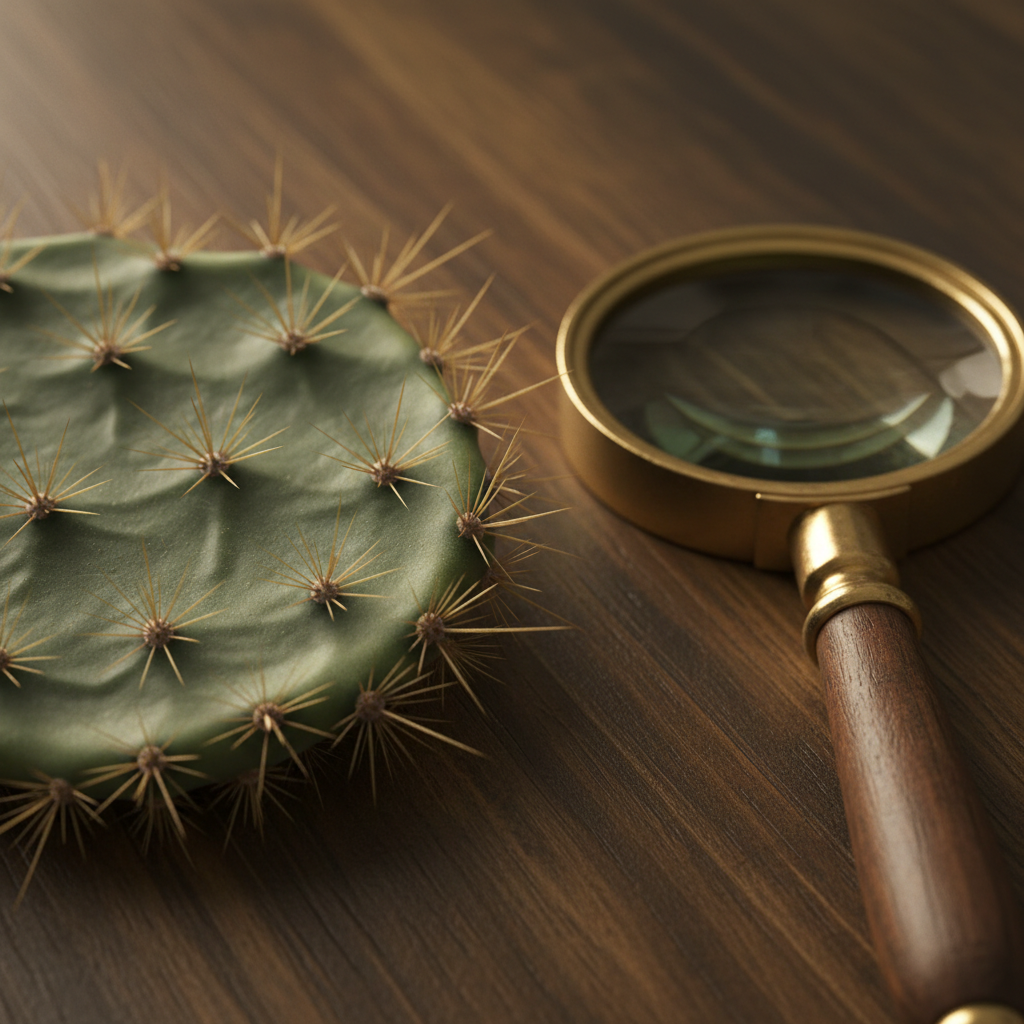
Mealybugs are by far the most common pest of Opuntia microdasys. They appear as small, soft-bodied, cottony insects nestled in the angles between pads and at the base of glochid clusters, and they leave behind a sticky honeydew that attracts sooty mould. A light infestation can be addressed by dabbing each insect with a cotton bud dipped in 70 per cent isopropyl alcohol; the alcohol dissolves the waxy coating that protects the bug and kills it on contact. For larger infestations, a systemic insecticide containing imidacloprid or acetamiprid, applied as a soil drench according to the label, will work through the plant’s tissue and reach mealybugs hidden in inaccessible crevices. Repeat treatments at seven- to ten-day intervals for three cycles, since eggs and crawlers shelter where contact sprays cannot reach.
Scale insects appear less frequently than mealybugs but cause similar damage. They are small, immobile, brown or tan bumps on the pad surface, often along the central ridge or near the base of glochid clusters. Treatment follows the same principles as for mealybugs: physical removal with a cotton bud and alcohol for light infestations, systemic insecticide for established ones. Both pests are far more likely to take hold on plants that are stressed by overfeeding, low light or warm, stagnant winter conditions, so improving the cultural setup is part of any pest control strategy.
Spider mites occasionally attack bunny ear cacti in very dry, dusty environments, producing a fine speckling on the pad surface and, in heavy infestations, gossamer webbing between glochids. They prefer warmer, drier conditions than mealybugs and tend to appear in midsummer or in centrally heated rooms in winter. A thorough rinse under a soft stream of water, applied as a sink shower from below to avoid forcing droplets into areoles, knocks most of the population off the plant. If they return, a miticidal spray formulated for ornamental plants will clear them up in one or two applications.
The most serious problem in this species is not an insect but root and base rot caused by fungi such as Fusarium and Phytophthora. Rot almost always follows overwatering, poor drainage, cold wet conditions or a combination of all three. The symptoms move quickly: a pad goes from firm to soft, then yellow or brown, then collapses, often within a few days. By the time soft tissue reaches a pad you can see, the rot has usually already spread through the basal pad and into the roots. The only realistic response is surgical: unpot the plant, cut every soft section back to clean white tissue, dust the cut surfaces with sulphur or cinnamon powder as a mild fungicide, let everything air-dry for several days, and replant in fresh, dry, gritty mix. Hold off watering for a fortnight afterwards. Recovery is possible if at least some pads above the rot remain firm and healthy.
Corky scarring on older pads is occasionally mistaken for disease and is in fact normal. As pads age they develop tan, suberised patches where damage, scratches or old areoles have healed over. Provided the surrounding tissue is firm and green, corking is cosmetic and not a sign of trouble.
Warning — Quarantine new arrivals: Any new cactus brought into the home should be kept apart from the rest of the collection for two to three weeks. Mealybugs and scale frequently arrive on shop-bought plants and only become visible after a few weeks of warmer conditions; isolating new plants prevents a single hitchhiker from establishing across a whole shelf.
Popular Varieties
Although Opuntia microdasys is a single species, several named forms and closely related cultivars are grown in cultivation, distinguished mostly by the colour of their glochids. All of them share the same care requirements; the visual differences are produced by pigmentation in the glochid clusters and, in some cases, by the size and proportion of the pads.
Albata / Polka Dot Cactus
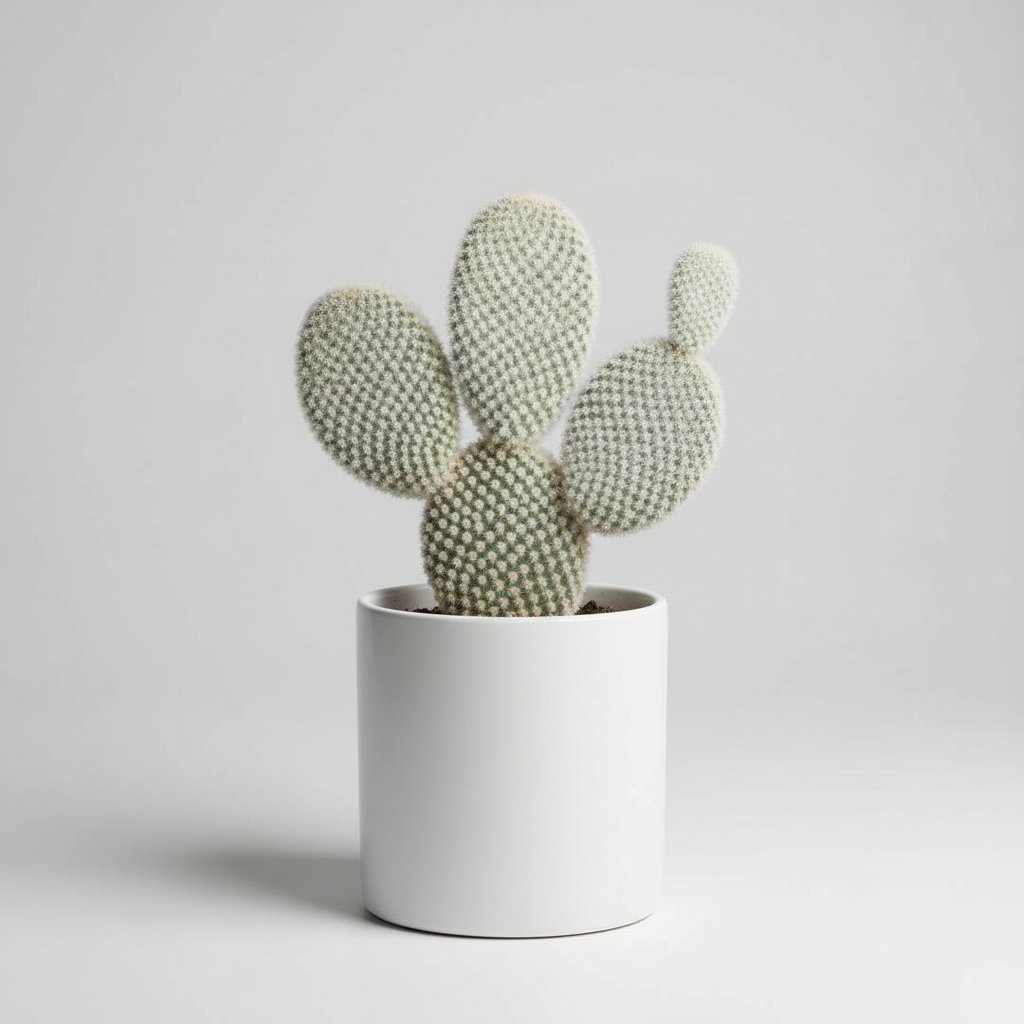
The most widely grown form of the species, sometimes sold simply as polka dot cactus or angel’s wings. Pads are bright fresh green and densely studded with snow-white glochid clusters arranged in regular diagonal rows. The white glochids are softer-looking than those of the species type and create the unmistakable polka-dot effect from which the plant takes most of its common names. Habit is compact, with rounded pads that grow in tidy bunny-ear pairs.
Rufida / Cinnamon Cactus
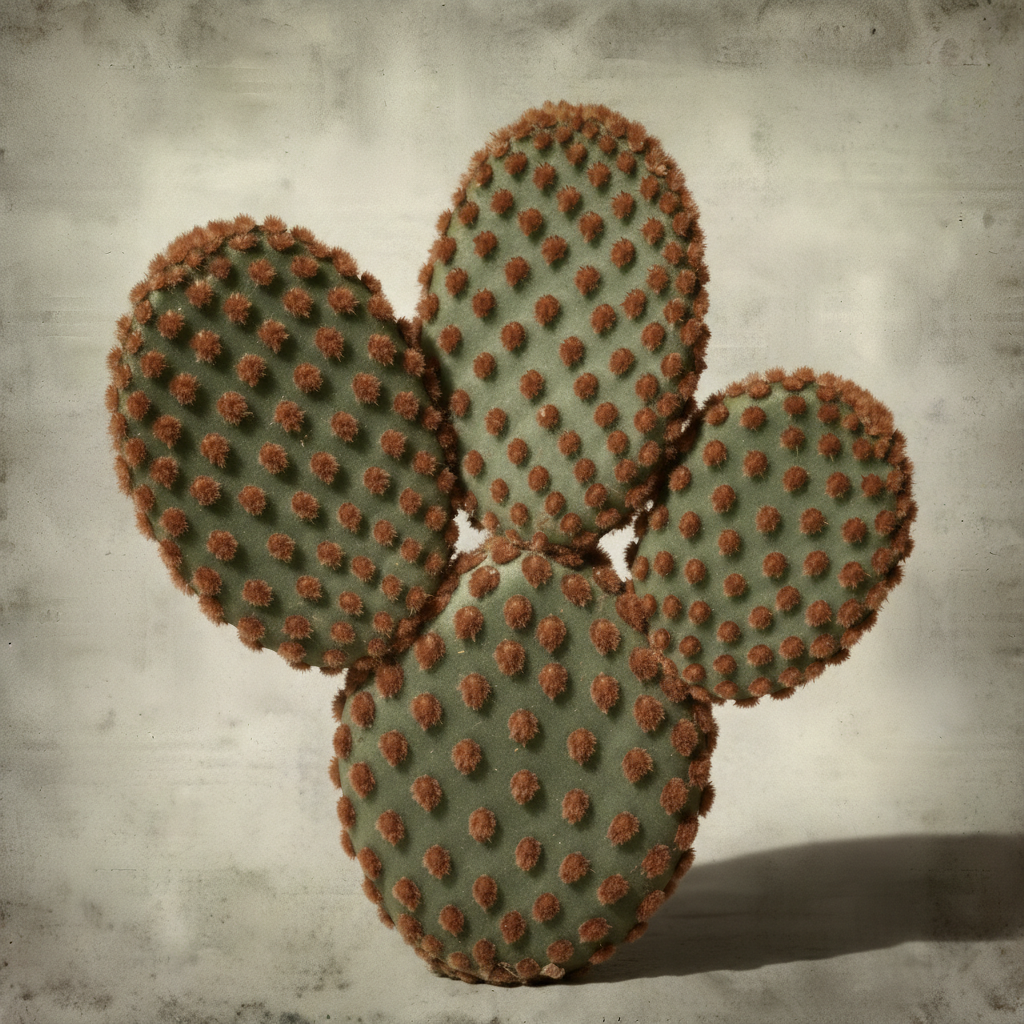
Treated by some botanists as a distinct species, Opuntia rufida, and by others as a variety of Opuntia microdasys. The glochids are a warm cinnamon to rust-red brown, set in regular polka-dot rows against pads that are often slightly broader and flatter than those of the white form. The reddish glochids deepen in colour in strong light, giving mature plants a warm, almost coppery cast that contrasts beautifully against terracotta or pale stone pots. Care is identical to the standard form.
Pallida
A less commonly seen form with very pale, almost yellow-white glochids that fade to near-cream as they age. The overall effect is softer and more muted than the bright white of albispina, and pads tend to be slightly smaller. Often sold without explicit naming under the generic polka dot cactus label.
Caress
A dwarf selection with very small pads, sometimes no larger than a thumbnail, growing in tight clusters. Sold occasionally as a novelty miniature; care is identical, but its slow growth and small scale make it well suited to small terracotta pots and shallow trays.
Undulata
A rare cultivated form distinguished by pads with a wavy, slightly undulating margin rather than the usual smooth oval. Rarely available outside specialist nurseries and prized by collectors of unusual cactus forms.
Frequently Asked Questions
Are bunny ear cactus glochids dangerous?
Not dangerous in any medical sense, but genuinely unpleasant. Glochids are tiny, barbed bristles that detach at the lightest touch and lodge in skin, where they cause a low-grade itch and mild inflammation that can last several days. They are most easily removed with sticky tape or a thin layer of white school glue allowed to dry and then peeled off. Tweezers tend to break off the tips. The risk is greatest for very small children and pets that might mouth the plant; in those households the cactus is best placed where contact is physically impossible.
Is the bunny ear cactus toxic to cats and dogs?
The plant is listed as non-toxic by the ASPCA, meaning ingestion will not poison a cat or dog. However, the glochids cause severe oral and gastrointestinal irritation if a pet chews on the pads, and embedded glochids in the mouth, paws or eyes can require veterinary attention to remove. Treat the cactus as physically hazardous to inquisitive pets even though it is not chemically toxic.
Why won’t my bunny ear cactus flower?
Indoor flowering of Opuntia microdasys requires three conditions in sequence: a long period of strong direct sun during the summer, a cool, dry winter rest between 7 and 13 degrees C (45 and 55 F), and a mature plant of at least three to five years old. A plant kept warm and watered year-round will grow steadily but rarely flowers, because it never receives the seasonal signal that triggers bud formation. Move the cactus to an unheated but frost-free room from late autumn until early spring, water sparingly during this rest, and you should see pale yellow cups in late spring or early summer in subsequent years.
My bunny ear cactus pads have gone wrinkly and soft — what’s wrong?
The two most likely causes are very different and demand opposite responses. Pads that look slightly wrinkled or shrivelled but remain firm to a careful poke usually indicate underwatering: a thorough soak restores them within a day or two. Pads that are soft, squishy and yellowing at the base point to overwatering and probable root or base rot. In the second case, unpot the plant, cut away every soft section back to clean tissue, allow the wounds to dry for several days and replant in fresh, dry, gritty mix.
How big does a bunny ear cactus get?
Indoors, expect a mature plant to reach 40 to 60 cm (16 to 24 in) tall after several years, with a similar or slightly wider spread as it branches. In ideal conditions or kept outdoors year-round in mild climates, specimens can reach 90 cm (35 in) and form sprawling, multi-stemmed shrubs. Growth is slow: most owners see one or two flushes of new pads per year, with each flush adding two to five new pads at the tips of existing growth.
Can I put my bunny ear cactus outside in summer?
Yes, and it usually benefits the plant. A bunny ear cactus moved outdoors for the warm months produces tighter, more colourful growth and is more likely to flower the following year. Acclimatise it gradually over a week or two by starting in partial shade and increasing direct sun exposure each day to prevent sunburn. Bring it back indoors before night temperatures drop below 10 degrees C (50 F) in autumn. Rain is not a problem provided the pot drains freely, but check that prolonged wet spells do not waterlog the soil; move the plant under cover if necessary.
What’s the best way to remove glochids from skin?
The most effective method is to apply a thin layer of white school glue or rubber-based depilatory wax over the affected area, let it dry completely and peel it off in one piece. Sticky packing tape works almost as well for surface bristles. Tweezers and washing with soap and water remove only the most loosely embedded glochids and tend to break the rest off below skin level, where they continue to irritate. If glochids enter the eye, rinse with copious cool water and seek medical attention rather than trying to remove them at home.
How do I tell when to water my bunny ear cactus?
Push a wooden chopstick or moisture meter to the bottom of the pot. If it comes out completely dry and the substrate at depth is bone dry, it is time to water. If any moisture is detected at the lowest level, wait. A second reliable check is pot weight: a terracotta pot of dry cactus mix is dramatically lighter than the same pot after a soak, and after a few cycles your hand learns the difference. In winter, even when the soil reads dry, wait an extra week or two before watering if the plant is in a cool resting position.
Can I grow a bunny ear cactus from seed?
Yes, but it is rarely worth the trouble. Seed germinates readily on a moist, sterile cactus mix kept warm and bright, but seedlings are extremely slow: it can take two to three years before they reach the size of a small commercial nursery plant, and another two to three before they take on the recognisable bunny-eared form. Pad cuttings produce a finished-looking plant in a fraction of the time, root almost without effort and preserve the exact characteristics of the parent variety.
Why are the new pads on my plant smaller than the older ones?
Slightly smaller new pads are normal late in the growing season as the plant slows down ahead of dormancy. Dramatically smaller, narrower or paler new pads point to insufficient light: the cactus is producing tissue from stored reserves but cannot photosynthesise enough to build pads at full size. Move the plant gradually to a brighter window, acclimatising over two weeks if the change is significant, and growth should return to normal by the following season.






