
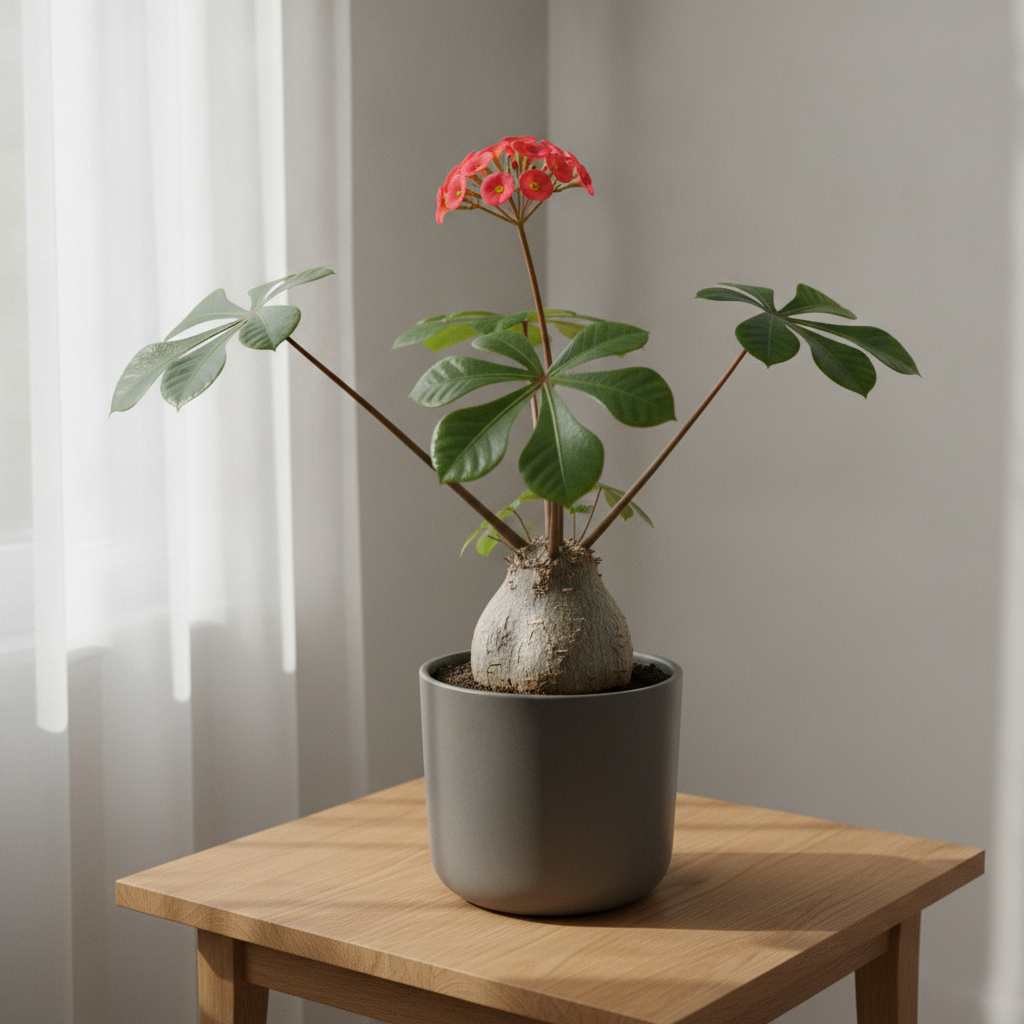
Few houseplants announce themselves as boldly as the buddha belly plant, a caudiciform curiosity whose swollen, grey, bottle-shaped trunk looks less like a stem and more like a piece of living sculpture. Known botanically as Jatropha podagrica, it belongs to the spurge family (Euphorbiaceae) and goes by an entertaining roster of common names, including gout plant, gout stalk, bottleplant shrub, Guatemalan rhubarb and coral plant. The “gout” references nod to the gouty, distended caudex that stores water and gives the plant its comic, pot-bellied silhouette. Native to the seasonally dry tropics of Central America and the Caribbean, from Guatemala and Honduras through Nicaragua and Panama, it has since travelled the warm regions of the world as an ornamental.
What keeps the buddha belly plant in steady demand is the unusual combination of a fat, succulent trunk, glossy umbrella-like leaves and clusters of long-lasting coral-red flowers that can appear in almost any month of the year. It is genuinely undemanding once you understand its rhythm, yet there is a real gap between merely keeping one alive and coaxing it to flower freely and fatten its caudex. This guide walks through every aspect of its care, from light and watering through soil, feeding, propagation and pests, so you can move your plant from simply surviving to genuinely thriving.
Contents
- Quick Reference
- Why the Buddha Belly Plant Makes a Rewarding Houseplant
- Light Requirements
- Watering & Humidity
- Soil, Potting & Repotting
- Fertilising
- Propagation
- Pests & Diseases
- Popular Varieties
- Frequently Asked Questions
Quick Reference: Buddha Belly Plant at a Glance
| Light | Bright light, including several hours of direct sun; the brightest spot you can offer indoors |
| Watering | Water thoroughly, then allow the top half of the mix to dry; sharply reduced in winter dormancy |
| Temperature | 18 to 28 degrees Celsius (64 to 82 Fahrenheit); keep above 10 degrees Celsius (50 Fahrenheit) |
| Humidity | Tolerant of average household humidity; no misting required |
| Fertiliser | Dilute balanced or low-nitrogen feed monthly during active growth; none in winter |
| Toxicity | Highly toxic to people and pets; sap is a skin and eye irritant and seeds are dangerously poisonous |
Why the Buddha Belly Plant Makes a Rewarding Houseplant
The appeal of Jatropha podagrica rests almost entirely on its architecture. Most houseplants are valued for foliage or flowers; this one is grown first for its trunk. The caudex, that swollen grey-silver base, is a water-storage organ adapted to the long dry seasons of its native habitat, and as the plant matures it thickens into a gnarled, characterful column that can reach 20 to 30 centimetres (8 to 12 inches) tall and a comparable girth in a pot. Above it sits a sparse crown of large, peltate, three- to five-lobed leaves on long petioles, glossy green on top with a faintly bluish, paler underside. The whole effect is part bonsai, part succulent, part tropical oddity.
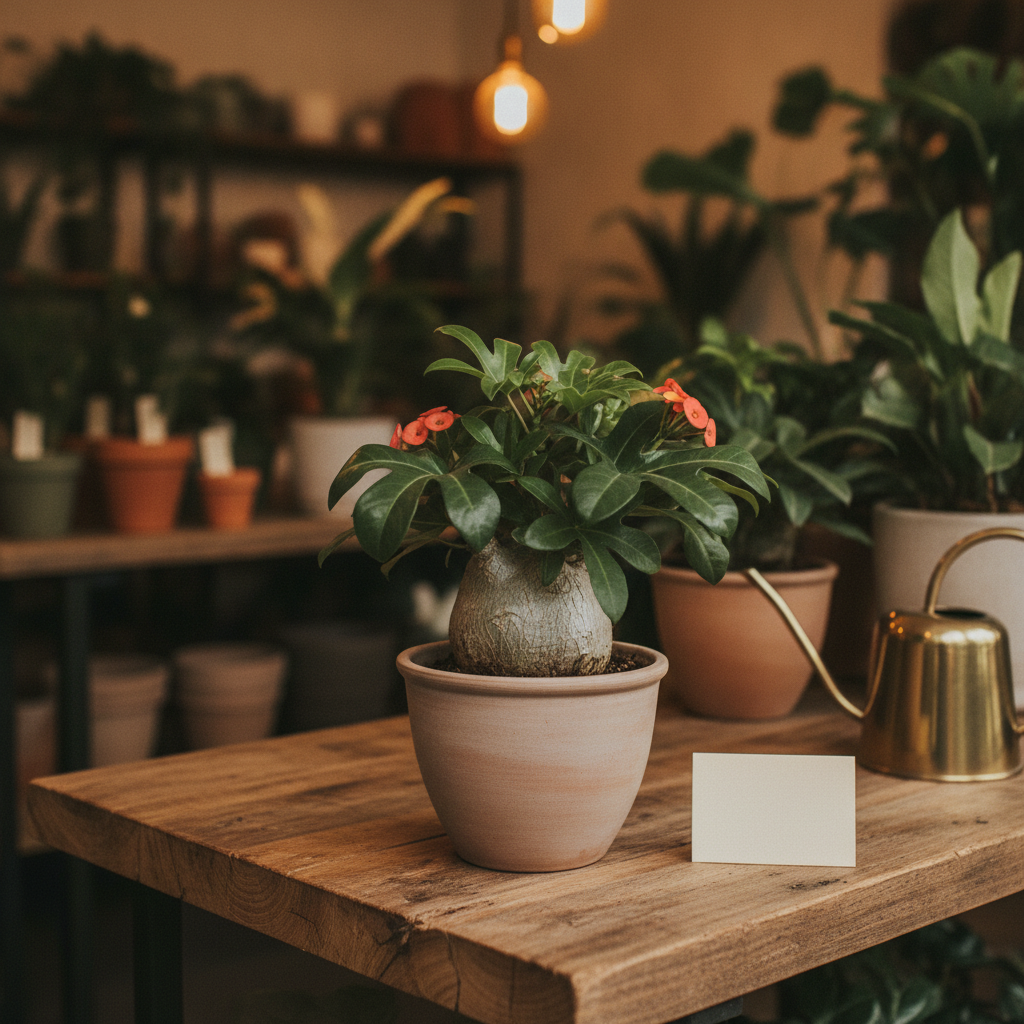
Then there are the flowers. Held on tall, branched stalks that rise well clear of the foliage, the small five-petalled blooms are a vivid coral-red to scarlet and open in succession over weeks, so a well-grown plant can be in flower for much of the year. They are followed by three-lobed green capsules that ripen, dry and split explosively, flinging seed a surprising distance, which is one reason the plant naturalises so readily in warm climates. For an indoor grower this combination of a near-indestructible water-storing trunk, modest foliage and reliable colour is unusually generous, and because the plant stays compact it suits a sunny windowsill far better than most flowering tropicals.
Important — Toxicity: Every part of the buddha belly plant is toxic. The milky latex contains irritant compounds that can inflame skin and eyes, and the seeds contain curcin, a toxic protein, along with purgative oils that make even one or two seeds dangerous if eaten. Keep the plant well out of reach of children and pets, wear gloves when pruning or repotting, wash your hands afterwards, and never let anyone handle or taste the seeds.
Light Requirements
Light is the single biggest factor in whether a buddha belly plant merely persists or genuinely flourishes. As a plant of open, sun-baked scrub and rocky slopes, it is built for strong illumination, and indoors it wants the brightest position you can give it. Skimp on light and the plant will not die quickly, but it will stretch, produce thin, widely spaced leaves, fail to flower and never build the fat trunk that is the whole point of growing it.
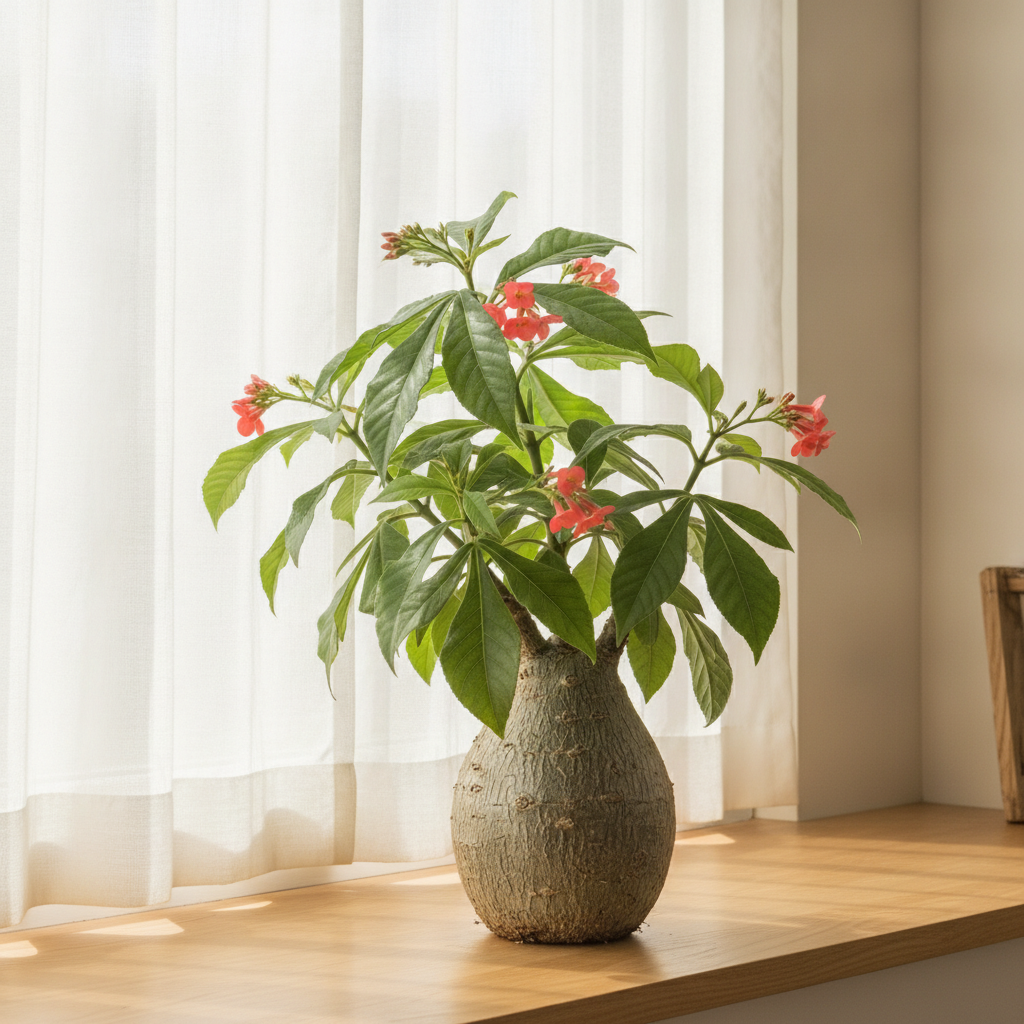
The ideal indoor spot is directly in front of, or very close to, a window that receives several hours of direct sun each day. A few hours of morning or gentle direct sun on the leaves is beneficial rather than harmful, and the plant will reward bright conditions with compact growth and far more flowers. In its native range it grows in full tropical sun, so there is little risk of giving it too much light indoors through glass, provided any move to stronger light is made gradually.
Light Levels Explained
It helps to translate vague terms like “bright light” into something more concrete. The table below sets out the main indoor light categories and how the buddha belly plant responds in each, measured loosely in lux as a guide rather than a precise prescription.
| Light Category | Approx. Level | Typical Location | Outcome |
|---|---|---|---|
| Direct sun | Over 50,000 lux | On a south or west windowsill | Excellent: compact, free-flowering, thick caudex |
| Bright indirect | 20,000 to 50,000 lux | Just back from a sunny window | Good: healthy growth, moderate flowering |
| Medium | 10,000 to 20,000 lux | A few metres from a bright window | Marginal: leggy, sparse flowering |
| Low | 2,000 to 10,000 lux | North aspect or interior wall | Poor: stretched, pale, unlikely to flower |
| Very low | Under 2,000 lux | Hallways, far from windows | Decline: gradual loss of vigour |
Window Orientation and Placement
South-facing window: In the northern hemisphere this is the prime position. It delivers the long hours of strong light the plant craves, and a buddha belly plant set right on or beside a south windowsill will be the most compact and floriferous.
East-facing window: A good second choice. Morning sun is gentle and well tolerated, and the plant will grow well here, though flowering may be a little less profuse than in a south aspect.
West-facing window: Also very suitable, offering strong afternoon sun. Watch that the trunk and leaves are not pressed against hot glass on the warmest summer days, but otherwise this is an excellent spot.
North-facing window: The weakest option and best avoided. Light here is too low to sustain good growth, and a plant kept at a north window will stretch, lose its compact form and almost certainly refuse to flower.
Pro Tip — Rotate for Symmetry: Because the buddha belly plant has such a sparse, sculptural crown, any lean towards the light is very visible. Give the pot a quarter turn every week or two so the trunk grows upright and the leaves spread evenly rather than all reaching in one direction.
How Light Affects Flowering
Flowering is the clearest signal of whether your plant is getting enough light. In strong conditions the coral-red flower stalks appear repeatedly through the warmer months and often beyond, while in dim light the plant diverts its energy into simply holding on and produces little or no bloom. If your buddha belly plant has good colour and a fat trunk but has never flowered, low light is the most likely culprit, and moving it closer to a sunny window is usually the single most effective change you can make.
Warning — Direct Sunlight: Although the plant loves sun, a specimen that has spent months in a dim room can scorch if it is moved abruptly into intense direct light. Acclimatise it over two to three weeks, increasing exposure gradually, to avoid pale, bleached or brown patches on the leaves.
Artificial Lighting
Where natural light is limited, the buddha belly plant responds well to a full-spectrum LED grow light. Because its needs are high, position the light fairly close, around 20 to 30 centimetres (8 to 12 inches) above the crown, and run it for 12 to 14 hours a day to mimic a long tropical day. Grow lights are particularly useful through dim northern winters, helping the plant hold its leaves and resume growth promptly in spring.
Seasonal Adjustments
Light intensity falls sharply in winter, and many buddha belly plants respond by dropping some or all of their leaves and entering a natural rest. This is normal and nothing to fear: the caudex carries the plant through. During this period move the plant to your very brightest window, or supplement with a grow light, so that when day length increases it leafs out again quickly and strongly.
Watering & Humidity
Watering is where most buddha belly plants are lost, and almost always to too much rather than too little. The swollen caudex is a reservoir, so the plant is built to endure drought and deeply resents sitting in wet soil. Treat it as you would a cactus or other succulent, water generously but infrequently, and you will rarely go wrong.
When to Water
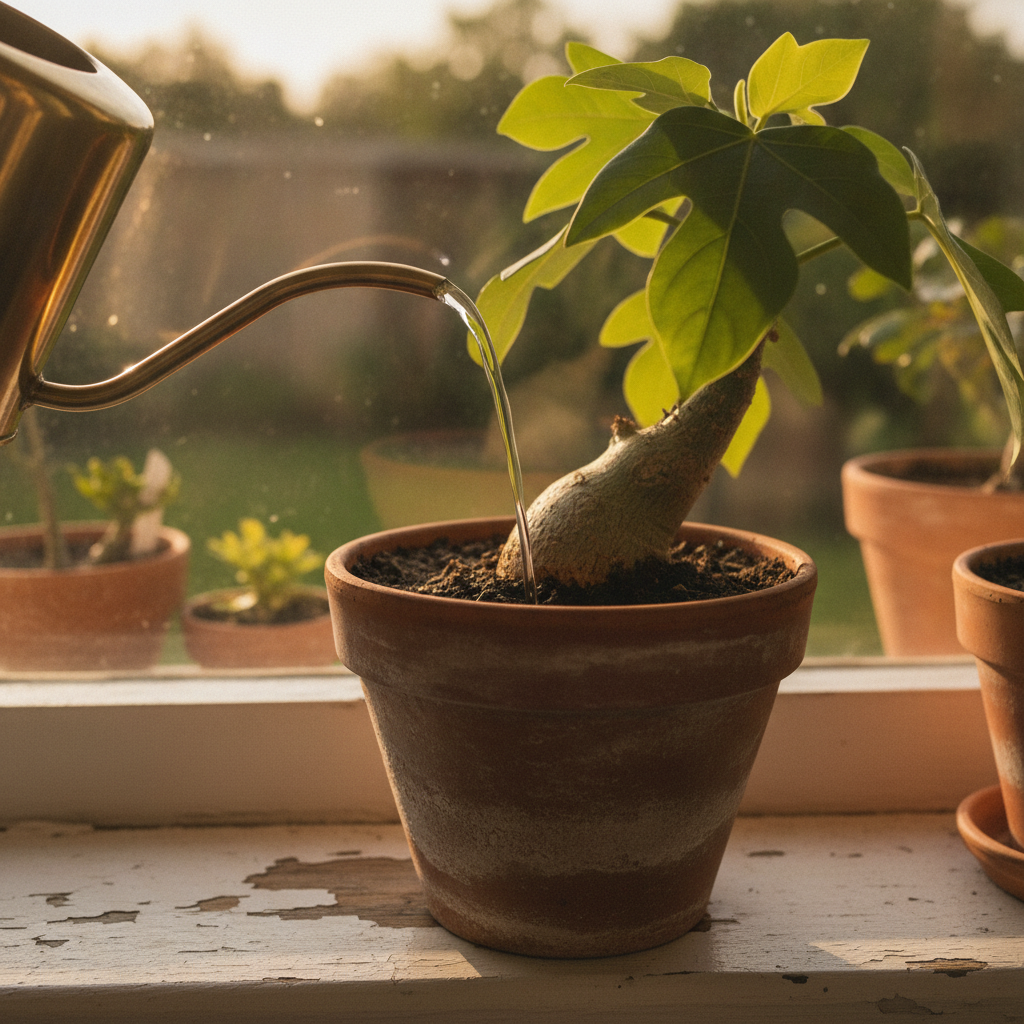
During the active growing season, from spring through early autumn, water thoroughly and then wait until at least the top half of the potting mix has dried before watering again. The simplest test is to push a finger several centimetres into the soil; if it feels dry at that depth, it is time to water, and if it is still damp, wait. A wooden skewer or moisture meter works just as well for anyone who prefers not to dig.
In winter, when light is weak and the plant is resting or has shed its leaves, cut back hard. A leafless, dormant buddha belly plant needs only the occasional small drink, perhaps once every three to four weeks, just enough to stop the caudex from shrivelling. Watering a dormant plant on its summer schedule is the fastest route to root rot, so let the season set the pace rather than the calendar.
Pro Tip — Read the Trunk: The caudex itself is a built-in water gauge. When it feels firm and full, the plant has ample reserves and can wait. If it starts to look slightly wrinkled or feels soft and yielding, the reserves are running low and a thorough watering is due.
How to Water Correctly
- Check that the top half of the mix is dry before you begin, and choose tepid rather than cold water.
- Water at the soil surface, around the base of the caudex, keeping the trunk crown itself relatively dry.
- Apply water steadily until it runs freely from the drainage holes, wetting the entire root ball.
- Let the pot drain completely for several minutes so no water is held against the roots.
- Empty the saucer or cache-pot; never leave the plant standing in collected water.
- Wait until the mix has dried to the correct depth again before repeating, adjusting the interval to the season.
Signs of Overwatering vs. Underwatering
| Symptom | Overwatering | Underwatering |
|---|---|---|
| Leaf colour | Yellowing, often across the whole leaf | Dull, with browning edges and tips |
| Leaf texture | Soft, limp and translucent | Thin, crisp and papery |
| Soil | Stays wet for days, may smell sour | Bone dry, pulling away from the pot |
| Caudex | Soft, spongy, possibly discoloured | Noticeably wrinkled and shrunken |
| Stem base | Blackened, mushy, rotting at the soil line | Firm but slowly losing plumpness |
Warning — Root Rot: A soft, darkening, foul-smelling base is the hallmark of root or caudex rot, and it advances quickly. At the first sign, unpot the plant, cut away all soft and blackened tissue with a sterile blade, dust the cuts, allow them to dry and callus for a day or two, and repot into fresh, very gritty, barely moist mix. A wrinkled trunk recovers easily; a rotten one rarely does.
Humidity Requirements
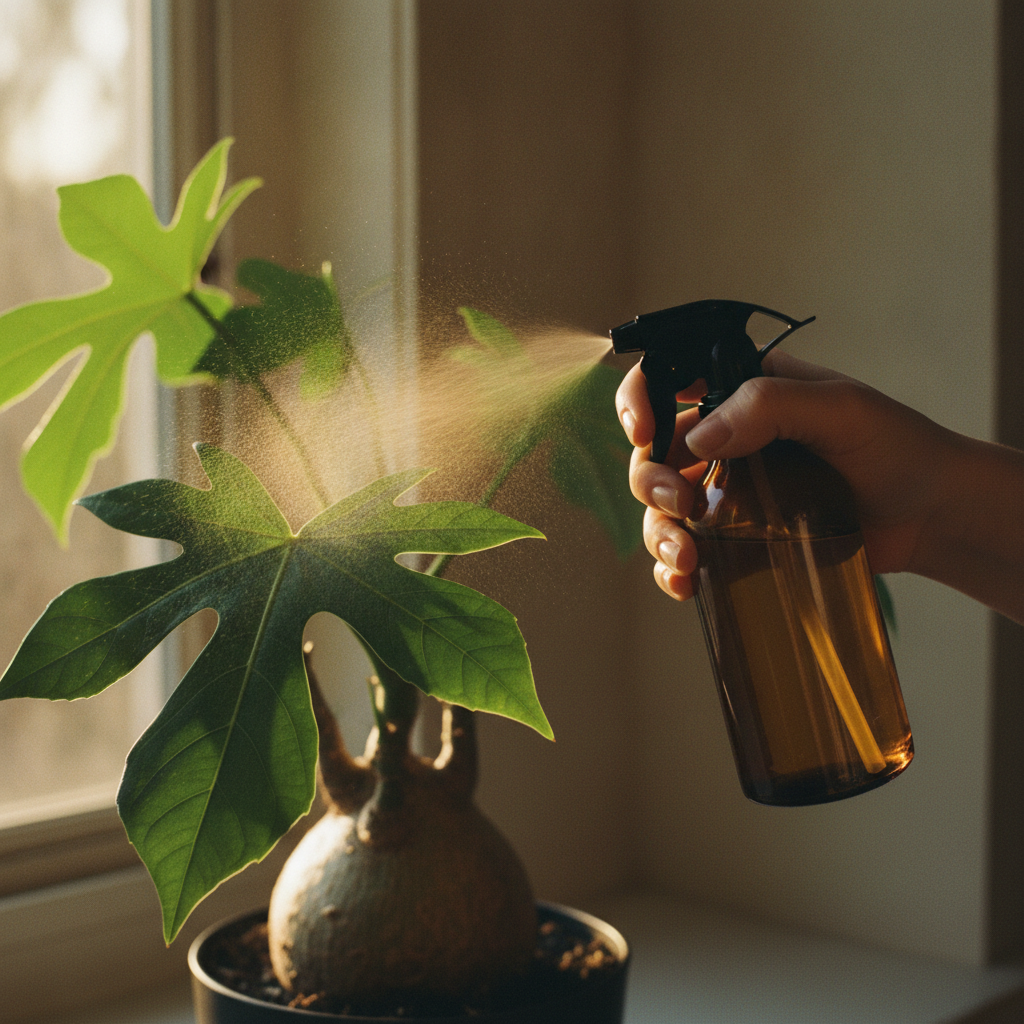
One of the great conveniences of this plant is its indifference to humidity. Coming from seasonally dry country, it is perfectly content in the average dry air of a centrally heated or air-conditioned home, and it does not need the humidity trays, pebble dishes or daily misting that tropical aroids demand.
In fact, fussing over humidity can do harm. Misting wets the foliage and the crown of the caudex unnecessarily, and in still indoor air that lingering moisture invites fungal spotting rather than improving the plant’s health.
If your home is unusually humid, simply make sure the plant has good air movement and very free-draining soil so that the extra moisture in the air does not translate into a permanently damp root zone. Beyond that, there is nothing to adjust; ordinary room humidity suits it well.
Water Quality
The buddha belly plant is not fussy about water quality and tolerates ordinary tap water in most areas. In regions with very hard water, mineral salts can gradually build up in the mix, so an occasional flush with rainwater or filtered water, or simply repotting into fresh soil every couple of years, keeps the root zone sweet. Always use water at or near room temperature, as a shock of cold water on a warm-climate succulent is best avoided.
Soil, Potting & Repotting
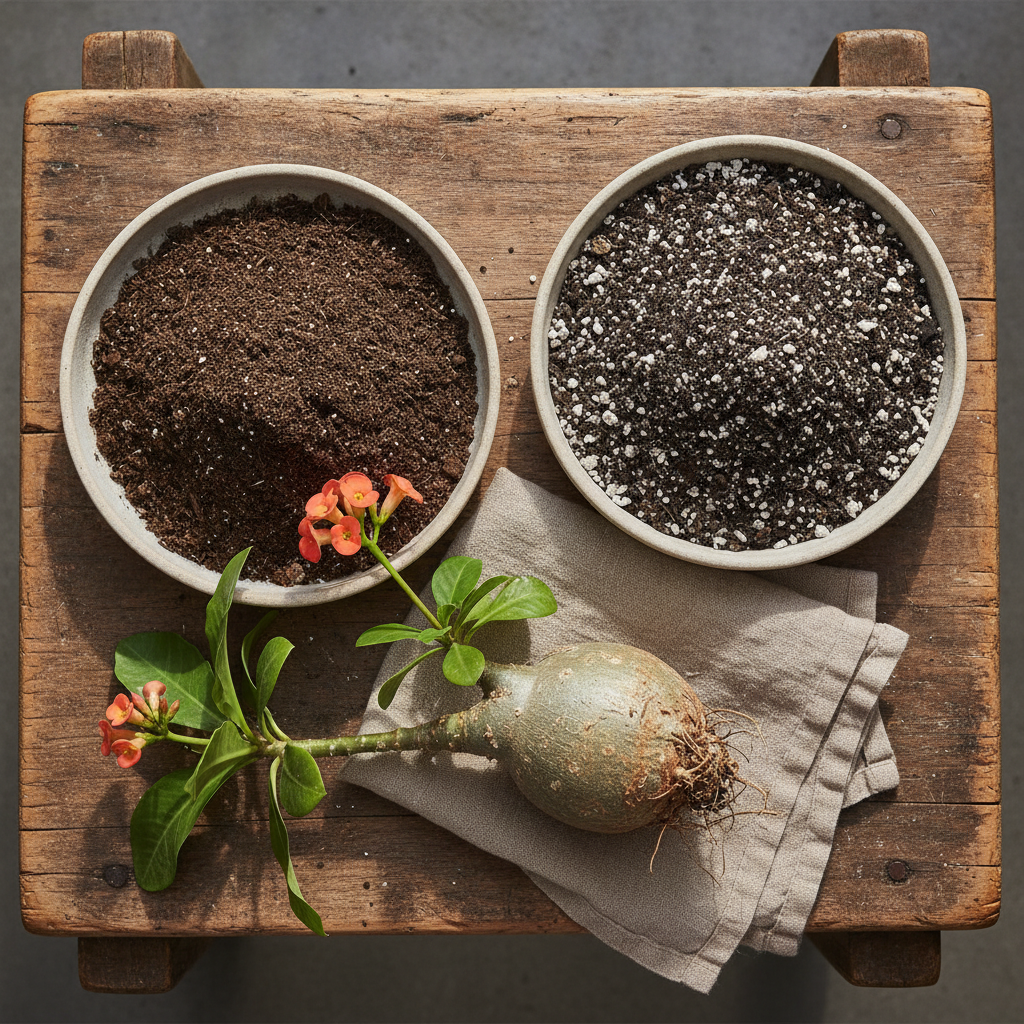
If watering is where buddha belly plants are most often killed, soil is where those mistakes are made forgivable or fatal. A fast-draining, gritty mix gives you a wide margin for error, because excess water drains away before it can rot the roots. A heavy, water-retentive compost does the opposite, holding moisture against the caudex long after the plant has had its fill.
Ideal Soil Composition
Aim for a mix that drains within seconds of watering and never stays soggy. A proprietary cactus and succulent compost is a sound starting point, but most benefit from extra grit to open them up further. The goal is a substrate that holds just enough moisture to sustain the plant between waterings while letting the rest run straight through.
| Component | Proportion | Function |
|---|---|---|
| Cactus or general potting compost | 50 percent | Provides body, structure and a base level of nutrients |
| Coarse grit or pumice | 30 percent | Creates drainage channels and weighs down a top-heavy plant |
| Perlite | 20 percent | Lightens the mix and improves aeration around the roots |
The plant is relaxed about pH, thriving anywhere from slightly acidic to slightly alkaline, roughly 6.0 to 7.5, so there is no need to chase a precise figure. Far more important than pH is sheer drainage, and a mix that is too rich or too dense will undo all your careful watering.
Pro Tip — Quick Mix Recipe: For a reliable blend, combine two parts cactus compost, one part coarse horticultural grit or pumice and one part perlite. Mix in a handful of fine bark for extra structure, and you have an open, free-draining medium ideal for a water-storing caudex plant.
Choosing the Right Pot
Pot choice has a real influence on how easy the plant is to keep, affecting both drainage and how quickly the soil dries between waterings.
Drainage holes are non-negotiable. The buddha belly plant must never sit in standing water, so any pot you use needs at least one generous drainage hole. Decorative cache-pots without holes are fine as outer covers, but only if you lift the plant out to water and let it drain fully before returning it.
Pot material: Terracotta is the natural partner for this plant. Its porous walls draw moisture out of the mix and let the whole root ball dry more evenly, which suits a drought-adapted succulent perfectly. Glazed ceramic and plastic both work, but they hold moisture longer, so you must water more cautiously in them.
Pot size: Choose a pot only slightly larger than the root ball. These plants flower and fatten best when a touch pot-bound, and an oversized pot holds a reservoir of damp soil the small root system cannot use, raising the risk of rot. A snug, heavy terracotta pot also helps anchor a top-heavy specimen.
When to Repot
The buddha belly plant grows slowly and dislikes disturbance, so it needs repotting only every two to three years, or when roots are clearly filling the pot and emerging from the drainage holes. The best time is early spring, just as growth resumes, giving the plant a full season to settle in. Repotting chiefly refreshes exhausted soil and gives the caudex room to expand rather than encouraging rapid size gains.
How to Repot: Step-by-Step
- Put on gloves before you start, as the cut or bruised plant releases an irritant latex.
- Water lightly a day ahead so the root ball holds together but is not saturated.
- Ease the plant out by tipping the pot and supporting the caudex; never pull on the trunk.
- Gently tease away old, spent soil from the roots and inspect them, trimming any that are soft, black or rotten.
- Set the plant at the same depth in fresh gritty mix, keeping the caudex proud of the soil rather than buried.
- Firm the mix lightly around the roots to remove air pockets without compacting it.
- Wait several days before watering, then resume normal care, allowing cut roots to seal first.
Warning — Transplant Shock: Keeping the caudex partly above the soil line is important. Burying the swollen base in damp mix traps moisture against it and is a common cause of rot after repotting. Plant high, water sparingly at first, and let the plant re-establish before treating it as normal.
Fertilising
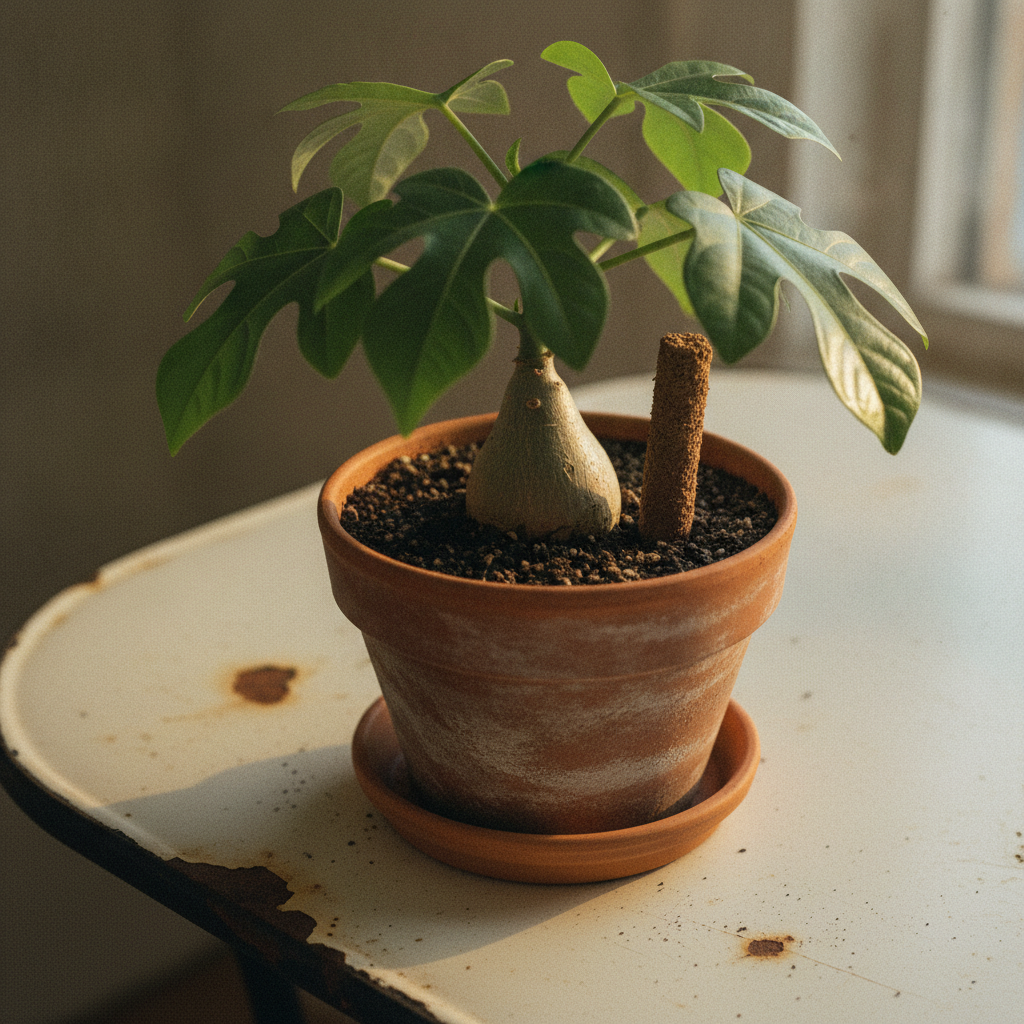
The buddha belly plant is a light feeder, and a little fertiliser goes a long way. In its native scrub it grows in lean, stony ground, so it neither needs nor wants heavy feeding, but a modest, well-timed boost during the growing season supports steady growth and encourages those prized coral flowers.
The key is restraint and timing. Feed only when the plant is in active growth, dilute well below the strength you would use for a leafy houseplant, and stop completely once growth slows in autumn. Overfeeding produces soft, sappy growth at the expense of flowers and can scorch the roots.
Understanding Plant Nutrients
Fertilisers are described by their N-P-K ratio, the proportion of nitrogen, phosphorus and potassium they contain. For a flowering caudex plant a balanced feed, or one slightly lower in nitrogen and higher in potassium, is ideal, as too much nitrogen drives leafy growth at the cost of blooms. The table below summarises the main nutrients and the signs of deficiency.
| Nutrient | Symbol | Primary Function | Deficiency Symptoms |
|---|---|---|---|
| Nitrogen | N | Leaf and stem growth, green colour | Pale, yellowing older leaves and stalled growth |
| Phosphorus | P | Root development and flowering | Poor flowering, dull or purplish foliage |
| Potassium | K | Overall vigour and flower quality | Browning leaf margins and weak blooms |
| Calcium | Ca | Cell wall strength | Distorted new growth and dieback at tips |
| Magnesium | Mg | Core of the chlorophyll molecule | Yellowing between the veins of older leaves |
| Iron | Fe | Chlorophyll production in new growth | Yellowing between the veins of young leaves |
Types of Fertiliser
Liquid fertilisers: The easiest choice for this plant. A balanced houseplant feed or a cactus and succulent fertiliser, diluted to half strength or less and applied with watering, gives you complete control over timing and quantity.
Slow-release granular: A few granules of a controlled-release feed worked into the surface in spring will gently nourish the plant across the season. Use sparingly, as these products are easy to overdose in a small pot of lean mix.
Organic fertilisers: Diluted worm-castings tea or a gentle organic liquid feed work well and are very forgiving. They release nutrients slowly and are far less likely to scorch the roots than strong synthetic feeds.
Feeding Schedule
Feed roughly once a month from mid-spring to early autumn while the plant is in leaf and growing actively. Always apply fertiliser to already-moist soil rather than a bone-dry root ball, and withhold all feeding from late autumn through winter, when the plant is resting and unable to use the nutrients.
Pro Tip — Less Is More: When in doubt, underfeed. A buddha belly plant grown slightly hungry stays compact, flowers more freely and builds a denser, more characterful caudex than one pushed hard with fertiliser, which tends to produce lush leaves and few flowers.
How to Fertilise
- Confirm the plant is in active growth, with leaves and ideally flower stalks present.
- Dilute a balanced or low-nitrogen feed to half the recommended strength or less.
- Water lightly first if the mix is very dry, so the feed does not contact bare roots.
- Apply the diluted solution evenly over the soil until it just begins to drain.
- Resume the normal watering rhythm and repeat about once a month through the season.
Warning — Salt Build-Up: Repeated feeding can leave a crust of mineral salts on the soil and pot, seen as white deposits and sometimes browning leaf tips. Flush the pot thoroughly with plain water two or three times a year to wash these salts out, and ease off the feed if they keep accumulating.
Propagation
The buddha belly plant can be propagated in two main ways, from its own freely produced seed and from stem cuttings. Seed is the more rewarding route because it produces plants with the characteristic swollen caudex, while cuttings root readily but tend to grow as thinner-stemmed plants that take longer to develop a fat base.
Because the plant is self-fertile, a single specimen in good light will often set seed without any help, and the explosive capsules can leave seedlings popping up in nearby pots. Both methods are straightforward, and the choice mostly comes down to whether you want that signature bottle trunk from the outset.
Understanding the Caudex and Seed
The swollen caudex that defines this plant develops most strongly in seed-grown specimens, which thicken their base from an early age. Stem cuttings, by contrast, root from a side shoot and inherit its slimmer form, so although they make perfectly good plants they may never match the pot-bellied character of a seedling. Knowing this helps you pick the method that matches your goal, and it explains why nursery plants with a fine fat trunk are almost always raised from seed.
Growing from Seed: Step-by-Step
Seed is the best way to obtain that classic swollen base. Fresh seed germinates quickly and reliably in warmth, so collect the capsules just before they split, or buy fresh seed, and sow without delay.
- Wearing gloves, collect ripe capsules before they burst, or sow fresh purchased seed promptly.
- Optionally soak the hard seed in tepid water for 24 hours to soften the coat and speed germination.
- Sow seed about one centimetre deep in moist, gritty, free-draining seed mix, one or two per small pot.
- Keep the mix warm, around 25 to 30 degrees Celsius (77 to 86 Fahrenheit), and lightly moist but never soggy.
- Expect germination in one to three weeks; move seedlings into bright light as soon as they emerge.
- Grow on undisturbed, watering sparingly, and pot up only when the seedlings are well rooted.
Pro Tip — Handle Seed With Care: The seeds are the most poisonous part of the plant. Keep them away from children and pets at every stage, label seed pots clearly, and wash your hands after sowing or collecting capsules.
Stem Cuttings: Step-by-Step
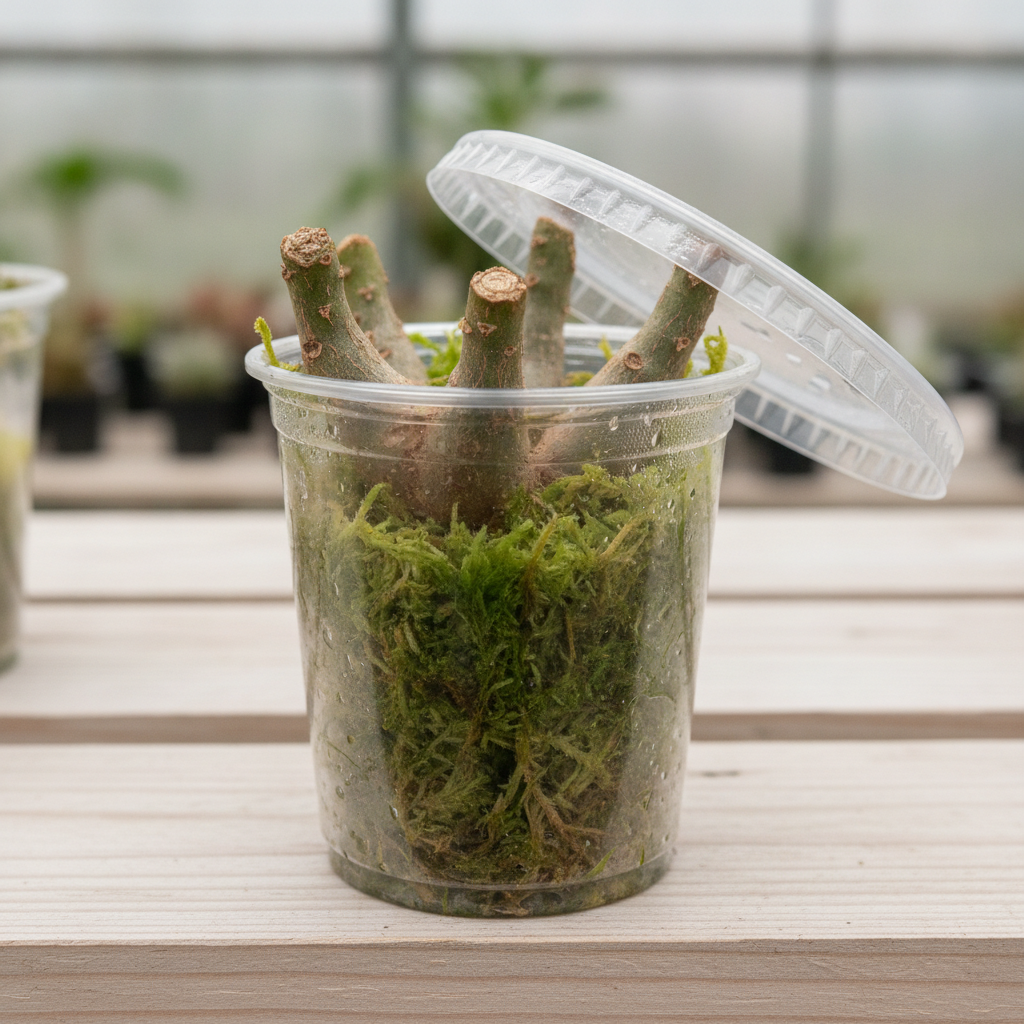
If you want a quick clone of a favourite plant, stem cuttings are simple and have a high success rate. Take them in late spring or summer when the plant is growing strongly, and let the cut latex dry before planting.
- Wearing gloves, cut a healthy stem section 10 to 15 centimetres (4 to 6 inches) long with a sterile blade.
- Rinse or blot away the milky sap, then leave the cutting in a warm, airy spot for a few days to callus.
- Insert the calloused end into barely moist gritty mix or damp sphagnum moss in a small, draining pot.
- Keep warm and bright in indirect light, with gentle humidity but plenty of air movement.
- Water very sparingly until roots form, which usually takes three to six weeks.
- Once new growth appears, the cutting has rooted; grow it on as a normal plant.
Troubleshooting Propagation
| Problem | Likely Cause | Solution |
|---|---|---|
| Seed fails to germinate | Old or stale seed, or too cool | Use fresh seed and provide steady bottom heat |
| Cutting rots before rooting | Not calloused, or kept too wet | Dry the cut for several days and water very sparingly |
| Cutting shrivels | Excessive drying before roots form | Raise humidity slightly and keep the medium barely moist |
| Seedlings stretch and flop | Insufficient light | Move to a bright window or under a grow light at once |
Pests & Diseases
The buddha belly plant is robust and relatively trouble-free, and its toxic, latex-filled tissues deter many would-be pests. The problems it does encounter are mostly the familiar sap-sucking insects of the indoor garden, and these are easily managed if caught early.
By far the most serious threat, however, is not an insect at all but root and caudex rot brought on by overwatering. Get the watering right and keep an eye out for the occasional pest, and this plant will give you very little trouble.
Common Pests
Spider Mites (Tetranychus urticae)
These tiny mites thrive in warm, dry conditions and cluster on leaf undersides, leaving fine pale stippling and, in bad cases, delicate webbing between the leaves and petioles. Affected foliage looks dusty and loses its gloss.
Treatment: Rinse the foliage, then treat with neem oil or an insecticidal soap, repeating every five to seven days until the mites are gone. Improving air movement and wiping the leaves regularly helps prevent their return.
Mealybugs (Pseudococcus species)
Mealybugs appear as small, white, cottony tufts tucked into leaf axils, along petioles and around the crown of the caudex. They suck sap, weaken the plant and excrete sticky honeydew that can turn into sooty mould.
Treatment: Dab each insect with a cotton bud dipped in isopropyl alcohol, then follow up with neem oil or insecticidal soap across the whole plant. Check the hidden folds around the trunk carefully, as that is where they like to hide.
Scale Insects (Coccoidea)
Scale shows up as small, fixed brown or tan bumps on stems and the undersides of leaves. Firmly attached and easy to overlook, they drain sap steadily and produce honeydew much like mealybugs.
Treatment: Scrape off the scales gently with a fingernail or soft brush, or remove them with an alcohol-dipped cotton bud, then treat with neem or horticultural oil to catch the mobile young. Several rounds may be needed for a heavy infestation.
Common Diseases
Root and Caudex Rot (Pythium and Phytophthora species)
The most dangerous problem this plant faces, rot is driven by waterlogged soil and poor drainage. It starts unseen at the roots and works up into the caudex, which turns soft, dark and foul-smelling, while the leaves yellow and collapse.
Treatment: Act fast. Unpot the plant, cut away every soft and discoloured part with a sterile blade, let the wounds dry and callus, and repot into fresh, very gritty mix. Then water far more sparingly. Prevention, through open soil and restrained watering, is far more reliable than cure.
Fungal Leaf Spot (various fungi)
Brown or black spots, sometimes ringed with yellow, can develop on the leaves when foliage stays wet in still, humid air. It is rarely serious but mars the plant’s appearance and can spread if ignored.
Treatment: Remove affected leaves, improve air circulation and keep water off the foliage. Watering at the soil rather than over the crown usually stops the problem from recurring.
Pest and Disease Summary
| Pest / Disease | Identification | Treatment |
|---|---|---|
| Spider mites | Fine stippling and webbing on leaf undersides | Rinse, then neem oil or insecticidal soap weekly |
| Mealybugs | White cottony tufts in axils and around the trunk | Alcohol swab, then neem oil or soap |
| Scale | Brown fixed bumps on stems and leaves | Scrape off, then treat with horticultural oil |
| Root and caudex rot | Soft, dark, smelly base and collapsing leaves | Cut out rot, dry, repot in gritty mix, water less |
| Fungal leaf spot | Brown or black spots on damp foliage | Remove leaves, improve airflow, keep foliage dry |
Prevention Strategies
The best defence is a healthy, well-grown plant in the right conditions. Bright light, gritty soil and disciplined watering keep the buddha belly plant vigorous and far less inviting to pests and disease alike. Inspect it whenever you water, paying particular attention to leaf undersides and the crevices around the caudex, so that anything amiss is spotted before it takes hold.
Isolate any new plant for a couple of weeks before letting it join your collection, and quarantine an affected plant at the first sign of trouble. Good airflow, clean tools and the prompt removal of dead leaves all reduce the chances of problems spreading.
Pro Tip — Neem as Routine: A light monthly spray of diluted neem oil over the foliage acts as a gentle preventative, deterring mites and mealybugs before they establish. Apply it in the evening or out of direct sun so the treated leaves do not scorch.
Popular Varieties
Unlike many fashionable houseplants, the buddha belly plant has not been bred into a long line of named cultivars; it is grown overwhelmingly as the wild species, whose natural form is striking enough to need no improvement. What variation exists comes mainly from related Jatropha species, which offer different leaf shapes and growth habits while sharing the same coral flowers and easy care.
For anyone drawn to the genus, the closely allied coral plant, Jatropha multifida, makes a fascinating companion, trading the swollen trunk for spectacular, deeply cut foliage. The table and profiles below set out the species and its most notable relatives.
| Variety | Leaf Appearance | Light Needs | Growth Rate | Availability |
|---|---|---|---|---|
| Jatropha podagrica (species) | Glossy three- to five-lobed peltate leaves | Bright, some direct sun | Slow | Common |
| Jatropha multifida | Deeply divided, finely cut palm-like leaves | Bright, some direct sun | Moderate | Occasional |
| Jatropha berlandieri | Small lobed leaves over a partly buried caudex | Bright, full sun | Very slow | Specialist |
| Jatropha integerrima | Pointed, sometimes lobed evergreen leaves | Bright, full sun | Moderate to fast | Occasional |
| Variegated Jatropha podagrica | Lobed leaves marbled with cream | Bright, some direct sun | Slow | Rare |
Featured Varieties
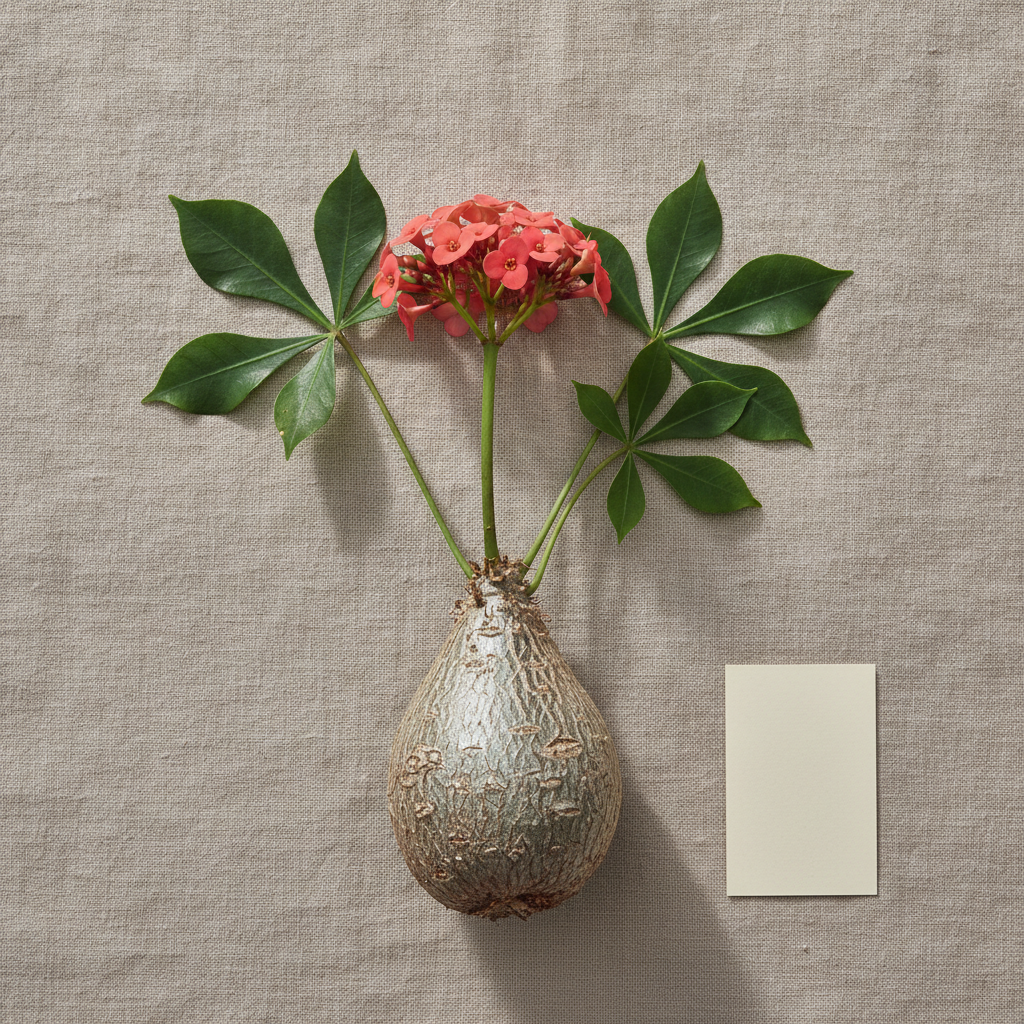
Jatropha podagrica (Species)
The classic buddha belly plant, with its fat grey caudex, glossy lobed leaves and tall sprays of coral-red flowers. This is the form almost everyone grows, prized for its sculptural trunk and long flowering season.
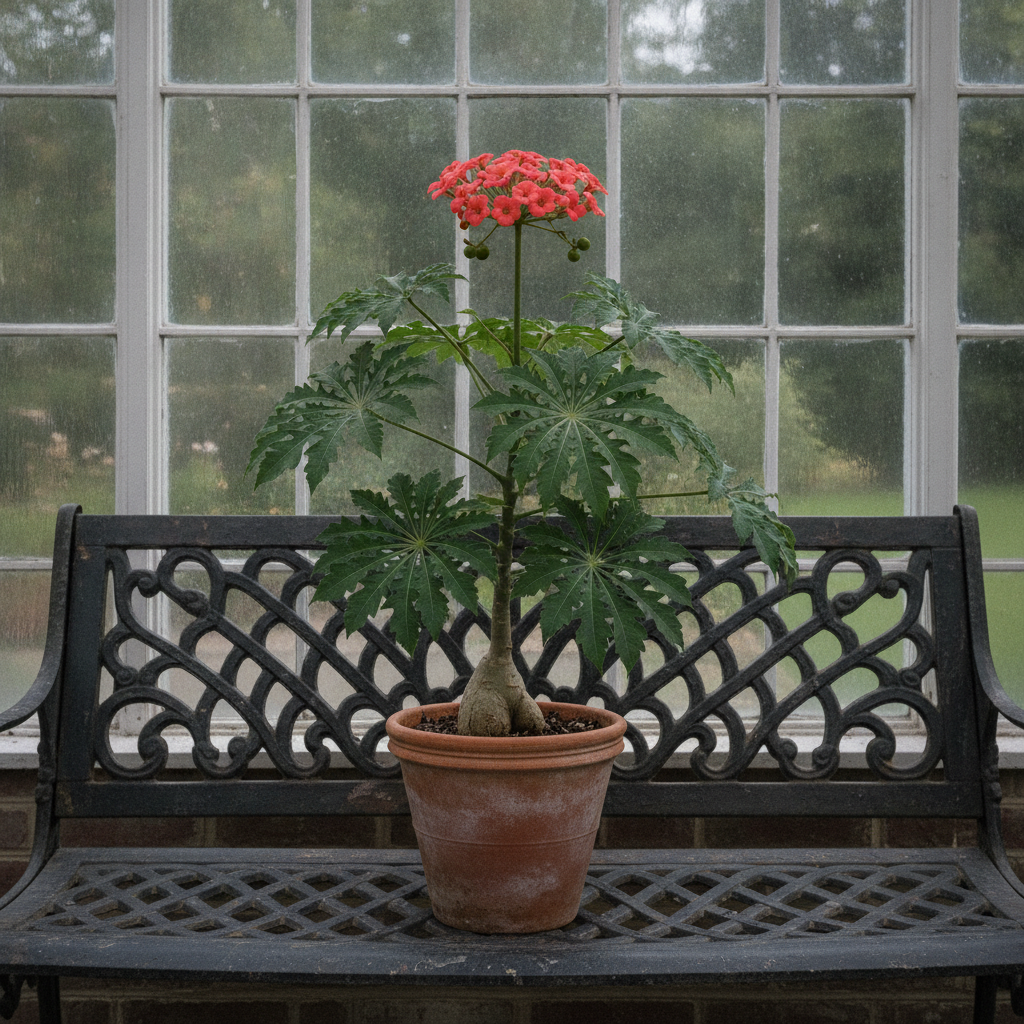
Jatropha multifida (Coral Plant)
A close relative grown for its spectacular, deeply divided, palm-like foliage rather than a swollen trunk. It carries similar flat clusters of coral-red flowers and enjoys the same warm, bright, free-draining conditions.
Variety Profiles in Detail
Jatropha podagrica (Jatropha podagrica)
The species itself is the star of the genus indoors. Everything that makes the buddha belly plant desirable, the bottle-shaped caudex, the umbrella of glossy peltate leaves and the near-perpetual coral flowers, is on full display in the unimproved wild form. It stays small, suits a sunny windowsill and asks for very little, which is exactly why it has never needed cultivars to earn its place.
Coral Plant (Jatropha multifida)
Also called the coral bush or Guatemala rhubarb, this relative swaps the swollen trunk for some of the most ornamental foliage in the family: large, rounded leaves cut into many fine, deeply divided segments, like green lace. It grows taller and more shrub-like than the buddha belly plant but shares its coral flowers, its toxicity and its preference for warmth, sun and sharp drainage.
Berlandier’s Nettlespurge (Jatropha berlandieri)
A true caudiciform for collectors, this species forms a large, often partly buried, rounded tuber from which slender stems and small lobed leaves emerge seasonally. Very slow growing and at its best when the caudex is gradually raised above the soil, it is a connoisseur’s plant rather than a beginner’s, but it rewards patience with a remarkable, characterful base.
Choosing the Right Variety for Your Space
For most people the species buddha belly plant is the obvious choice: compact, forgiving and endlessly characterful on a bright sill. If it is dramatic foliage you are after, the coral plant delivers far showier leaves at the cost of a little more height, while dedicated succulent growers may relish the slow, sculptural challenge of Jatropha berlandieri. Whichever you choose, the care is essentially the same, so you can collect across the genus without learning a new routine for each.
Frequently Asked Questions
Why is my buddha belly plant dropping its leaves?
Leaf drop in autumn and winter is usually natural dormancy as light and temperature fall, and the bare caudex will simply rest until spring. Out of season, sudden leaf loss more often points to overwatering, cold draughts or a sharp drop in temperature, so check those conditions before worrying.
Is the buddha belly plant poisonous to cats and dogs?
Yes, very much so. All parts are toxic, the sap is an irritant and the seeds are dangerously poisonous if eaten, so keep the plant well out of reach of pets and children. If ingestion is suspected, contact a vet or doctor promptly.
How often does it flower?
Given enough light and warmth, a buddha belly plant can flower almost continuously, sending up fresh coral-red stalks repeatedly through the warmer months and sometimes year-round. If yours never blooms, insufficient light is nearly always the reason.
Why is the trunk wrinkled or soft?
A slightly wrinkled caudex means the plant has drawn down its water reserves and simply needs a thorough watering; it will plump up again within a day or two. A soft, spongy or discoloured trunk is far more serious and usually signals rot from overwatering, which needs immediate action.
How big does it get?
Indoors the buddha belly plant typically reaches 30 to 60 centimetres (12 to 24 inches) tall over many years, with a caudex up to around 20 centimetres (8 inches) across. It grows slowly and stays naturally compact, which is part of its appeal for windowsill growers.
Does it need a winter rest?
It benefits from one. Through winter, keep the plant cooler but frost-free, give it your brightest light and water only enough to keep the caudex from shrivelling. This natural rest mirrors the dry season of its homeland and sets it up to grow and flower strongly in spring.
Can I grow it outdoors?
In frost-free, tropical or subtropical climates it makes an excellent garden or patio plant in full sun and sharp-draining soil. In cooler regions it is best kept as a container plant that summers outdoors in a sheltered, sunny spot and comes inside well before the first cold nights.
Why are the leaves turning yellow?
Occasional yellowing of older leaves is normal, especially heading into the rest period. Widespread yellowing in the growing season usually means overwatering, though a long-unfed plant may also be short of nutrients, so review your watering first and then consider a dilute feed.






