
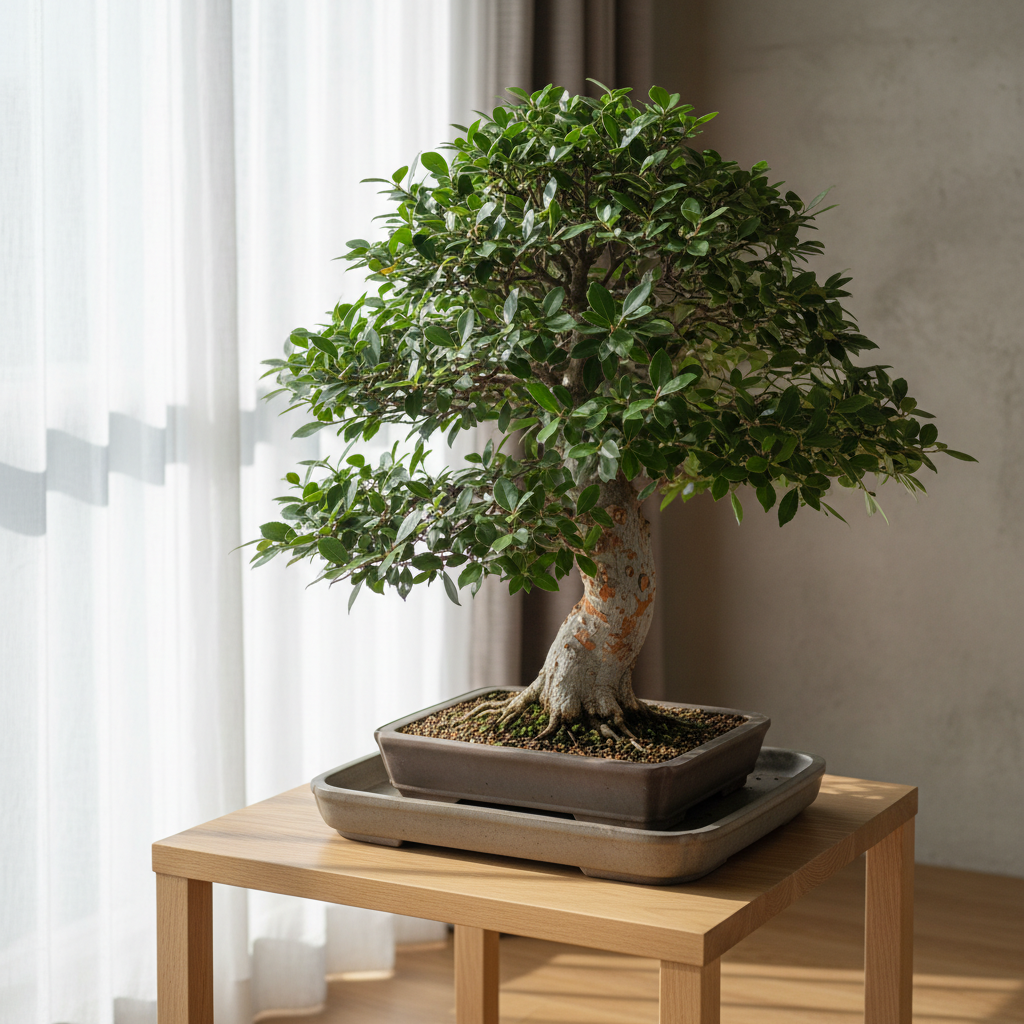
The bonsai elm, almost always the Chinese elm (Ulmus parvifolia), is the tree most often handed to a first-time bonsai grower, and for good reason. Native to China, Japan, Korea and parts of Vietnam, this deciduous to semi-evergreen tree has been cultivated as bonsai for centuries because it tolerates beginner mistakes that would kill more temperamental species. Its small, alternately arranged, finely toothed leaves rarely exceed 3 centimetres (1.2 inches), it back-buds prolifically on old wood, and its mottled bark flakes to reveal patches of grey, orange and cream that give even a young specimen the look of a venerable old tree.
What makes the Chinese elm unusual among indoor trees is how it blurs the line between houseplant and garden tree. It can be kept on a bright windowsill year round in mild climates, moved outdoors for the growing season, or grown permanently outside where winters are gentle. Keeping one alive is genuinely easy. Coaxing it into a dense, well-ramified canopy with a tapering trunk and convincing age is where the craft lies. This guide covers both: the day-to-day care that keeps the tree healthy, and the techniques that move it from merely surviving to truly thriving as a piece of living sculpture.
Contents
- Quick Reference
- Why the Bonsai Elm Makes a Beginner-Friendly Houseplant
- Light Requirements
- Watering & Humidity
- Soil, Potting & Repotting
- Fertilising
- Propagation
- Pests & Diseases
- Popular Varieties
- Frequently Asked Questions
Quick Reference: The Bonsai Elm at a Glance
| Light | Very bright light, including several hours of direct sun; the brightest spot you can offer indoors |
| Watering | Keep the soil evenly moist; water thoroughly when the surface begins to dry, never letting the shallow pot dry out completely |
| Temperature | 15 to 24°C (59 to 75°F) when in active growth; tolerates cooler conditions and light frost if grown outdoors and acclimatised |
| Humidity | Average household humidity of 40 to 50% is adequate; higher levels improve leaf quality |
| Fertiliser | Balanced feed every two weeks through spring and summer, reduced in autumn, paused in winter dormancy |
| Toxicity | Generally regarded as non-toxic to cats, dogs and humans, though it is an ornamental tree and not intended for consumption |
Why the Bonsai Elm Makes a Beginner-Friendly Houseplant
Few trees forgive a learning curve as gracefully as the Chinese elm. It recovers quickly from hard pruning, sprouts new buds readily from bare branches and even the trunk, and signals trouble early enough that an attentive owner can usually correct course before damage becomes terminal. This resilience is precisely why bonsai nurseries and gift shops stock it by the thousand, and why so many bonsai journeys begin with an elm bought on impulse.
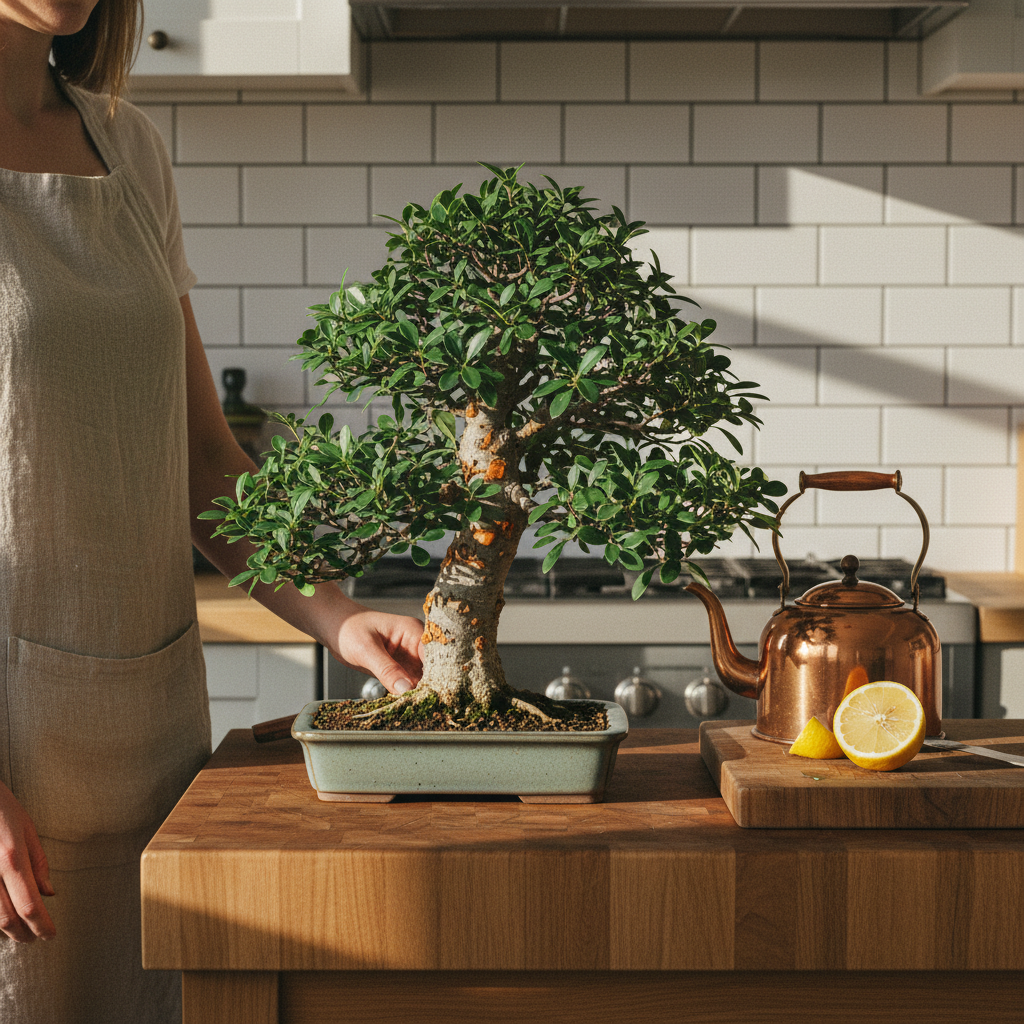
Beyond its forgiving nature, the bonsai elm is genuinely beautiful to develop. It produces fine twigging faster than almost any other broadleaf species, which means a grower can build a believable, cloud-like canopy within a few seasons rather than a few decades. The bark matures attractively, fissuring and flaking on older trunks, and the species responds well to almost every styling approach, from formal upright to informal, cascade, broom and group plantings. A tree that is both easy to keep and rewarding to refine is a rare combination, and the elm offers it.
Important — Toxicity: The Chinese elm is not listed among common toxic plants and is generally considered safe around cats and dogs. That said, any tree treated with pesticides, wired with metal, or grown in a shallow ceramic pot poses incidental hazards to curious pets, so place the tree out of reach and keep wire offcuts and chemical sprays well away from animals.
Light Requirements
Light is the single biggest factor separating a thriving bonsai elm from a leggy, sparse one. As a tree adapted to open woodland and full sun in its native range, the Chinese elm wants far more light than the typical foliage houseplant. Indoors, this is usually the limiting factor: a tree that merely survives in a dim corner will produce long internodes, oversized leaves and weak twigging, undoing the very qualities that make it attractive as bonsai.
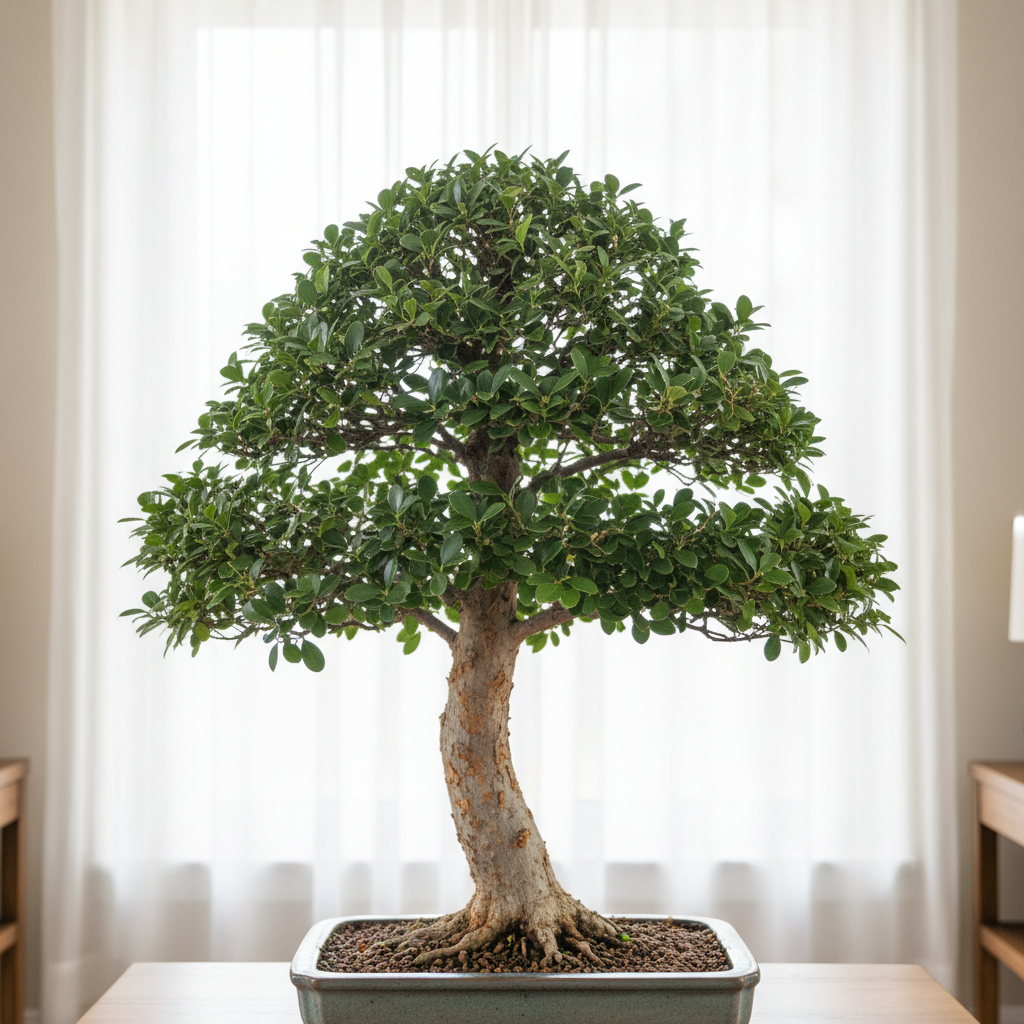
The ideal is the brightest position you can offer, with at least three to four hours of direct sun each day supplemented by bright indirect light for the rest. A south or west-facing windowsill is excellent, and many growers find the tree performs best when moved outdoors from late spring to early autumn, where natural light dwarfs anything available inside. An elm that receives strong light keeps its leaves small, its internodes short and its canopy dense.
Light Levels Explained
Understanding how different light intensities translate into growth helps you place the tree correctly. The table below outlines the practical outcome of each light tier for a Chinese elm grown indoors or under cover.
| Light Category | Approx. Level | Typical Location | Outcome |
|---|---|---|---|
| Direct sun | 20,000 lux and above | Outdoors, or right at a south-facing window | Compact growth, small leaves, dense ramification, strongest health |
| Bright indirect | 10,000 to 20,000 lux | Close to a bright east or west window | Good growth and acceptable leaf size; reliable indoor option |
| Medium | 5,000 to 10,000 lux | A metre or two back from a bright window | Slower growth, longer internodes, gradual loss of vigour |
| Low | 1,000 to 5,000 lux | North window or interior room | Leggy growth, oversized pale leaves, decline over time |
| Very low | Below 1,000 lux | Dim corner, far from any window | Leaf drop and progressive dieback; unsustainable |
Window Orientation and Placement
South-facing window: The best indoor position in the northern hemisphere. The tree receives the longest and most intense light, which keeps growth compact. In high summer, a sheer curtain can soften the harshest midday rays if leaf tips begin to scorch, though most elms handle full sun without complaint once acclimatised.
East-facing window: A reliable choice offering bright morning sun followed by gentler afternoon light. Growth stays reasonably tight and leaf size remains small. This orientation rarely causes scorch and suits growers who want strong light without the intensity of a south aspect.
West-facing window: Similar in value to an east window but delivering stronger, warmer afternoon light. Watch soil moisture closely here, as the heat of late-day sun can dry a shallow bonsai pot quickly. An excellent position overall.
North-facing window: The weakest option and generally inadequate on its own. A Chinese elm placed at a north window will stretch, pale and thin out over time. If this is the only window available, supplement heavily with a grow light or move the tree outdoors for the growing season.
Pro Tip — Rotate for Even Growth: Turn the tree a quarter turn every week or two so all sides receive equal light. Elms grow noticeably towards the light source, and a tree left unrotated will develop a lopsided, front-heavy canopy that is difficult to correct later.
How Light Affects Leaf Size and Ramification
One of the central goals in elm bonsai is small leaves and fine twigging, and light is the primary lever for both. Under strong light the tree shortens the distance between buds, producing more branch divisions in a given space and keeping each leaf small to limit water loss. Under weak light the opposite happens: internodes lengthen as the tree reaches for brightness, and leaves enlarge to capture what little light there is. A grower chasing refinement should treat maximum light as the foundation on which every other technique rests.
Warning — Direct Sunlight: A tree moved abruptly from indoors into full outdoor sun can suffer leaf scorch, appearing as bleached or browned patches. Acclimatise gradually over a week or two, starting with morning sun or dappled shade and increasing exposure as the foliage hardens.
Artificial Lighting
Where natural light falls short, a full-spectrum LED grow light is a practical solution and is often essential for indoor elms in winter. Position the light 20 to 40 centimetres (8 to 16 inches) above the canopy and run it for 10 to 12 hours a day to mimic a long growing-season photoperiod. A grow light can be the difference between a tree that merely holds on through the dark months and one that continues to build structure year round.
Seasonal Adjustments
The Chinese elm responds to the seasons even indoors. As daylight shortens in autumn, growth slows and an outdoor-grown tree may drop some or all of its leaves to enter dormancy, which is entirely normal and healthy. Indoors, where warmth and light persist, the tree often stays semi-evergreen. Move outdoor trees to a sheltered, frost-protected spot for winter, and indoors, push the tree as close to the brightest window as possible to compensate for the weaker, shorter days.
Watering & Humidity
Watering a bonsai elm is less about a fixed schedule and more about reading the tree and its shallow container. Because bonsai pots hold so little soil, they dry out far faster than a conventional plant pot, and the elm prefers its roots kept consistently moist rather than swinging between bone dry and saturated. Getting this balance right is the most important daily habit in keeping the tree healthy.
When to Water
Check the soil daily by touching the surface and, if in doubt, pressing a finger a centimetre or so into the mix. Water when the top layer has begun to dry but before the deeper soil has dried out completely. In warm, bright conditions a vigorous elm in a small pot may need watering once or even twice a day, while in cool, dim winter weather it may go several days between waterings.
Resist the temptation to water on a rigid calendar. The tree’s needs change with temperature, light, season and how root-bound it has become, so a pot that needed daily water in July may need it only twice a week in November. Observing the tree and the weight of the pot, which feels noticeably lighter when dry, will serve you far better than any fixed routine.
Pro Tip — The Lift Test: Learn the weight of the pot immediately after watering and again when it is approaching dry. With a little practice you can judge watering needs simply by lifting the tree, a more reliable cue than surface appearance alone, especially with a fast-draining bonsai mix.
How to Water Correctly
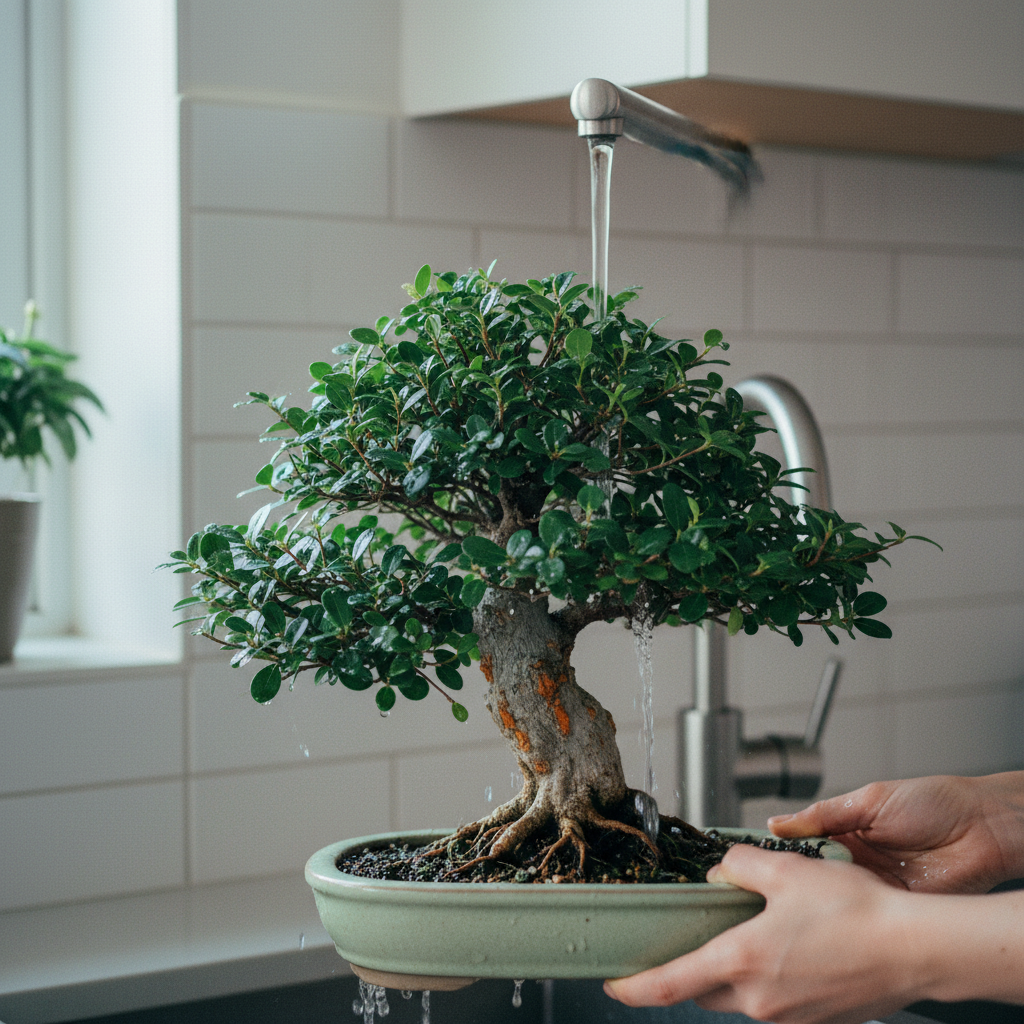
- Use a watering can with a fine rose or a gentle tap stream so the force of the water does not wash soil out of the shallow pot.
- Water the entire soil surface evenly, moving across the whole pot rather than pouring in one spot.
- Continue until water runs freely from the drainage holes, confirming the full depth of soil is wet.
- Pause, then water a second time a minute later; the first pass wets the mix and the second ensures thorough saturation.
- Allow the pot to drain fully and never leave it standing in a saucer of water, which suffocates the roots.
- Tip away any water that collects in the drip tray once the pot has finished draining.
Signs of Overwatering vs. Underwatering
| Symptom | Overwatering | Underwatering |
|---|---|---|
| Leaf colour | Yellowing leaves, often dropping while still soft | Browning, crisping leaves, particularly at the margins |
| Leaf texture | Soft, limp, sometimes translucent | Dry, brittle and curling |
| Soil | Constantly wet, sour-smelling, slow to dry | Pulls away from the pot edges, dusty and hard |
| Roots | Dark, mushy and foul-smelling | Dry and shrivelled but not rotten |
| Branches | Whole twigs dying back from waterlogging | Fine twigs becoming dry and snapping cleanly |
Warning — Root Rot: A pot left standing in water or watered before the previous soak has begun to dry is the fastest route to root rot, which is far harder to reverse than drought stress. If the soil smells sour and leaves yellow and drop, ease off watering immediately and, in severe cases, repot into fresh free-draining mix and trim away any blackened roots.
Humidity Requirements
The Chinese elm is undemanding about humidity and copes well with the 40 to 50% typical of a heated home. It does not need the elevated moisture that tropical foliage plants crave, which is one more reason it suits indoor life so readily. That said, very dry air from radiators or air conditioning can stress the tree and encourage spider mites.
Signs that air is too dry include crisping leaf edges, a general dullness to the foliage and, over time, the fine speckling and webbing that betray a mite infestation. These symptoms often appear in mid-winter when central heating runs constantly and the air becomes parched.
Raising humidity is straightforward where needed. Stand the pot on a humidity tray filled with pebbles and a little water, keeping the pot base above the waterline, group it with other plants to create a moister microclimate, or mist the foliage occasionally on the driest days. None of these are essential for survival, but they help the tree look its best through a dry winter.
Water Quality
The Chinese elm is not fussy about water quality and tolerates ordinary tap water in most regions. In areas with very hard water, mineral salts can accumulate on the soil surface and pot rim over time, so an occasional flush with rainwater or filtered water helps clear them. Room-temperature water is gentler on the roots than very cold water straight from the tap.
Soil, Potting & Repotting
Soil for a bonsai elm has a different job from soil for an ordinary pot plant. It must anchor the tree in a very shallow container, hold enough moisture between waterings, yet drain freely enough that roots never sit in stagnant water. The classic answer is an open, granular bonsai mix rather than bagged general-purpose compost, which holds too much water and compacts in a shallow pot.
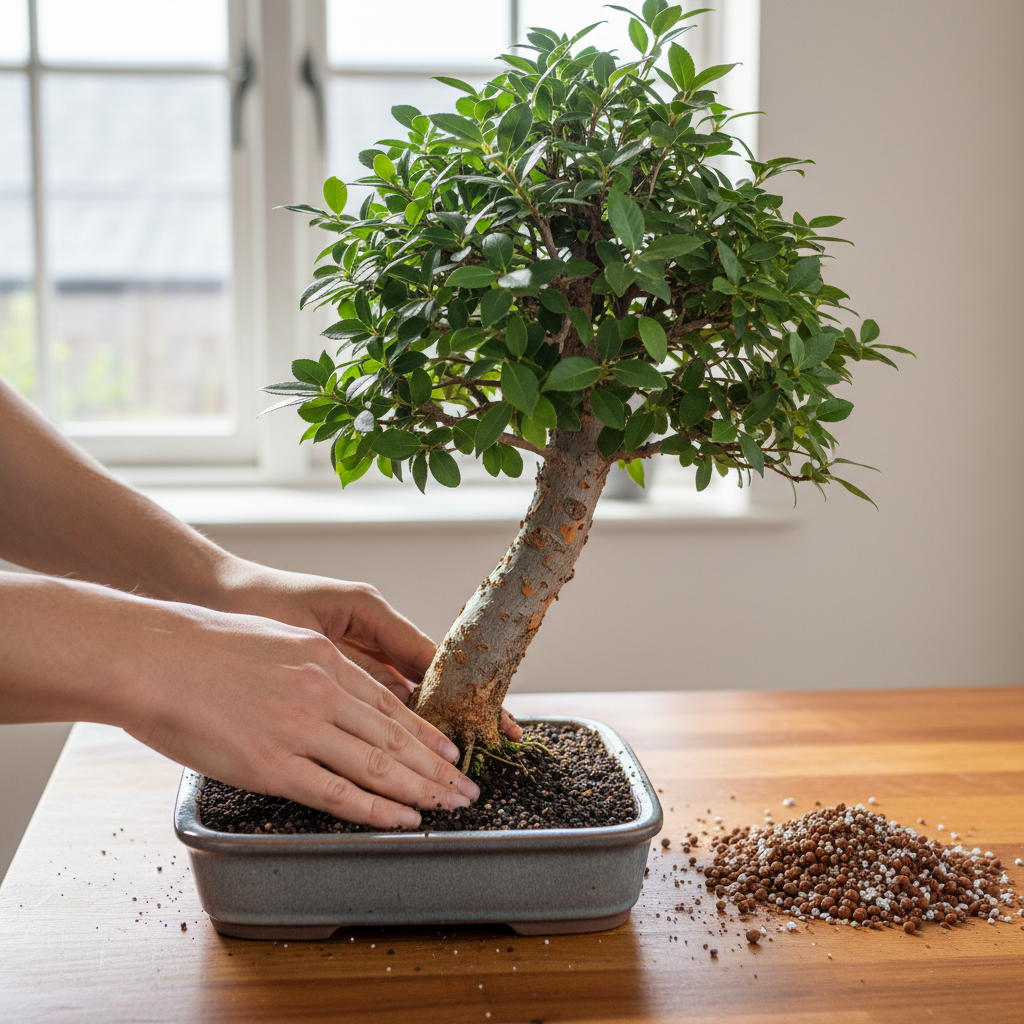
Ideal Soil Composition
A good elm mix combines a moisture-retentive granular component with sharp, free-draining elements and a little organic matter for fertility. The proportions below give a balanced, beginner-friendly blend that suits the Chinese elm in most climates, leaning slightly towards moisture retention because the species likes to stay evenly damp.
| Component | Proportion | Function |
|---|---|---|
| Akadama (or fired clay granules) | 50% | Retains moisture and nutrients while holding structure; the backbone of the mix |
| Pumice | 25% | Improves aeration and drainage, encourages fine root growth |
| Lava rock or grit | 15% | Adds sharp drainage and keeps the mix open |
| Fine composted bark | 10% | Introduces a small amount of organic matter and fertility |
The Chinese elm is comfortable across a broad pH range and grows well in slightly acidic to neutral conditions, roughly pH 6.0 to 7.0. A standard bonsai mix naturally falls within this band, so most growers never need to test or adjust pH unless their water is extremely alkaline.
Pro Tip — Quick Mix Recipe: If you cannot source individual components, a ready-made bonsai soil blend works well, or mix two parts commercial bonsai mix with one part extra pumice or perlite to sharpen the drainage. Avoid using ordinary houseplant compost alone, as it compacts and stays wet in a shallow pot.
Choosing the Right Pot
The pot is part of the composition in bonsai, not merely a container, but it must serve the tree’s health first. For a Chinese elm the pot should be shallow yet large enough to hold sufficient soil to buffer against drying, and it must allow water to escape freely.
Drainage holes are non-negotiable. Every bonsai pot should have one or more generous drainage holes, usually fitted with mesh to retain soil while letting water pass. Many pots also have small wiring holes used to anchor the tree firmly in place, which prevents it rocking and helps new roots establish.
Pot material: Frost-proof glazed or unglazed ceramic is the traditional and best choice, being stable, attractive and durable. Plastic training pots are perfectly acceptable while developing a young tree, as they are cheap and retain moisture well, with the more refined ceramic pot reserved for the finished design.
Pot size: Match the pot to the trunk for visual balance, with the pot length roughly two-thirds the height of the tree as a starting guideline. A pot that is too deep or too large holds excess wet soil and slows the development of the compact root pad that bonsai aims for.
When to Repot
A vigorous young Chinese elm typically needs repotting every two years, while older, more established trees can go three to five years between repottings. The signs that a tree is ready include water sitting on the surface and draining slowly, roots circling the pot or emerging from the drainage holes, and a general loss of vigour. The best time is early spring as the buds begin to swell but before they open fully, when the tree has the most energy to recover and push new roots.
How to Repot: Step-by-Step
- Water the tree a day before so the root mass is moist but not soggy, then carefully ease it out of its pot.
- Use a root hook or chopstick to gently comb out the outer and lower roots, removing about a third of the old soil.
- Trim back the longest and thickest roots with clean, sharp scissors, keeping the fine feeder roots that do the work of water uptake.
- Prepare the pot with mesh over the drainage holes, a thin layer of coarse mix at the base, and an anchoring wire threaded through if used.
- Position the tree, work fresh bonsai mix around and between the roots with a chopstick so no air pockets remain, and secure it with the anchor wire.
- Water thoroughly until it runs clear from the drainage holes, settling the soil around the roots.
- Place the freshly repotted tree in bright shade out of strong sun and wind for two to three weeks while it recovers.
Warning — Transplant Shock: Do not fertilise for three to four weeks after repotting, as fresh roots are easily burned and the tree is not yet drawing nutrients strongly. Hold off on hard pruning at the same time too; combining heavy root work and heavy top pruning in one session can overwhelm even a tough elm.
Fertilising
Because a bonsai grows in a tiny volume of soil with limited natural fertility, feeding is essential rather than optional. The open, granular mixes that keep elm roots healthy hold few nutrients of their own, so regular fertilising replaces what the tree would otherwise draw from open ground. Without it, growth slows, leaves pale and the fine ramification you are working to build stalls.
The good news is that the Chinese elm is a hungry, responsive feeder that rewards consistent fertilising with vigorous growth. The aim is steady, moderate nutrition through the growing season rather than occasional heavy doses, which can scorch roots and force coarse, oversized growth that works against good bonsai proportions.
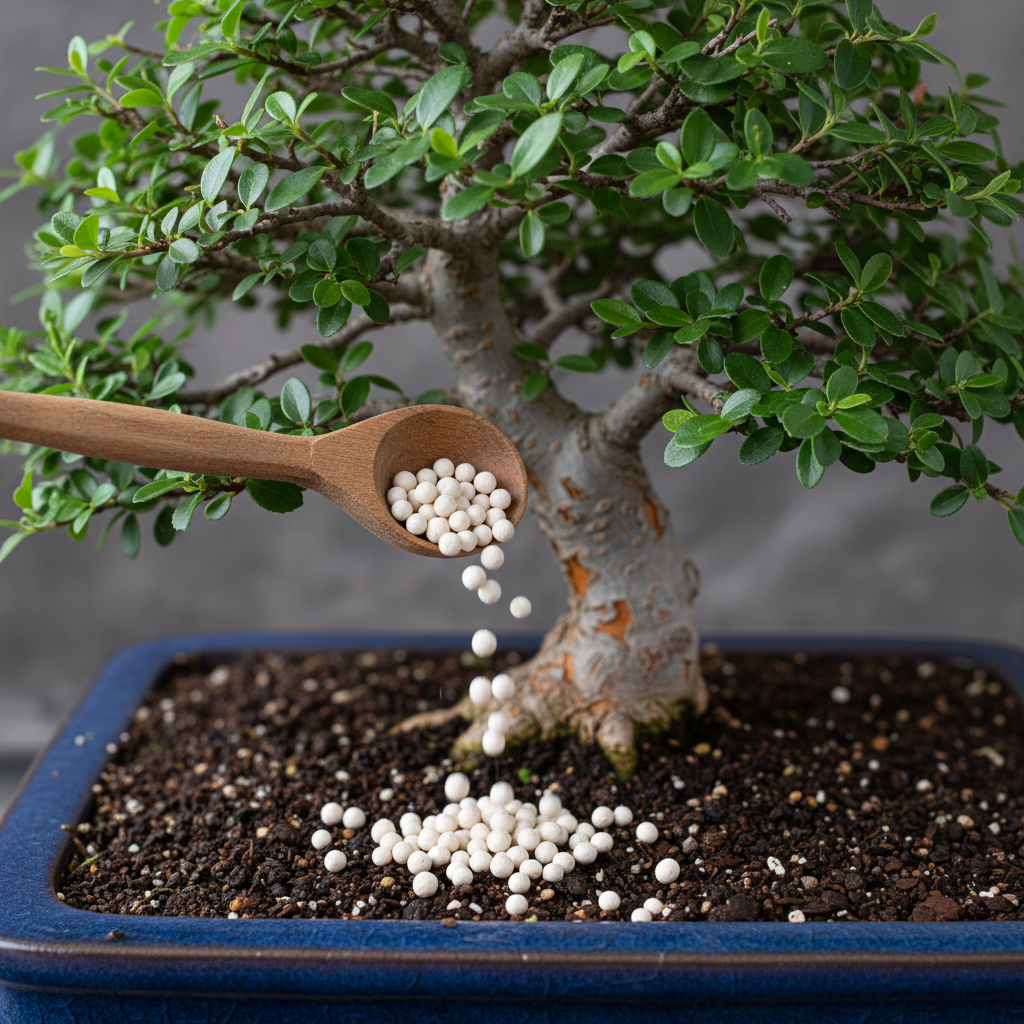
Understanding Plant Nutrients
Fertiliser labels carry three numbers, the N-P-K ratio, representing the percentages of nitrogen, phosphorus and potassium, the three nutrients plants need in the largest quantities. A range of secondary nutrients and trace elements matter too, and recognising deficiency symptoms helps you diagnose a struggling tree.
| Nutrient | Symbol | Primary Function | Deficiency Symptoms |
|---|---|---|---|
| Nitrogen | N | Drives leaf and shoot growth and rich green colour | Pale, yellowing older leaves and weak, slow growth |
| Phosphorus | P | Supports root development and energy transfer | Stunted growth, dull or purplish foliage |
| Potassium | K | Regulates water use and strengthens disease resistance | Scorched, browning leaf margins |
| Calcium | Ca | Builds strong cell walls and new growth | Distorted, hooked new shoots and tip dieback |
| Magnesium | Mg | Central atom of chlorophyll, enabling photosynthesis | Yellowing between the veins of older leaves |
| Iron | Fe | Essential for chlorophyll production | Yellowing between the veins of young leaves |
Types of Fertiliser
Liquid fertilisers: Diluted and applied with watering, these give fast, controllable feeding and are ideal during the active growing season. They are easy to adjust and flush, but they wash through quickly and must be reapplied often, typically every one to two weeks.
Slow-release granular: Sprinkled onto or worked lightly into the soil surface, these release nutrients gradually over weeks or months and are convenient for busy growers. They provide a steady baseline of nutrition with minimal effort, though they offer less precise control than liquids.
Organic fertilisers: Solid organic feeds such as rapeseed cake or pelleted formulas break down slowly and feed soil life as well as the tree. Many bonsai growers favour them for the gentle, sustained nutrition they give, accepting that they can smell earthy and sometimes attract attention from pests if left exposed.
Feeding Schedule
Feed a Chinese elm every two weeks with a balanced liquid fertiliser at half to full strength through the main growing season of spring and summer. As growth slows in autumn, reduce feeding to monthly and switch to a formula lower in nitrogen to help the wood harden before winter. For trees that go dormant outdoors in winter, stop feeding entirely until growth resumes. Indoor trees that keep growing through winter can be fed lightly at roughly half the summer frequency.
Pro Tip — Feed for Refinement: When working to reduce leaf size and build fine twigging on a developed tree, use a slightly lower-nitrogen balanced feed and keep doses modest. Heavy nitrogen forces long, coarse shoots with big leaves, exactly the opposite of the compact growth refinement demands.
How to Fertilise
- Always fertilise onto already-moist soil, never a bone-dry root ball, to avoid burning the roots.
- Dilute liquid feeds to the recommended strength or weaker; with bonsai it is safer to underfeed than overfeed.
- Apply evenly across the whole soil surface so all roots benefit rather than one concentrated patch.
- For granular or solid organic feeds, place them on the surface and let watering carry the nutrients down.
- Flush the pot with plain water every month or so to clear any accumulated mineral salts.
Warning — Salt Build-Up: A white crust on the soil surface or pot rim signals a build-up of fertiliser salts, which can damage fine roots. Flush the pot thoroughly with plain water several times to leach the salts away, and reduce your feeding strength going forward.
Propagation
The Chinese elm is one of the easier trees to propagate, which is part of why it is so widely available and affordable. A grower can raise new trees from cuttings, from seed, or by air layering, the last of which is especially useful for producing a sizeable tree with mature bark in a single season.
Whichever method you choose, propagation is best attempted in spring and early summer when the tree is in vigorous growth and most willing to form roots. Patience and clean tools are the two constants across every technique, along with the willingness to accept that not every cutting or layer will take.
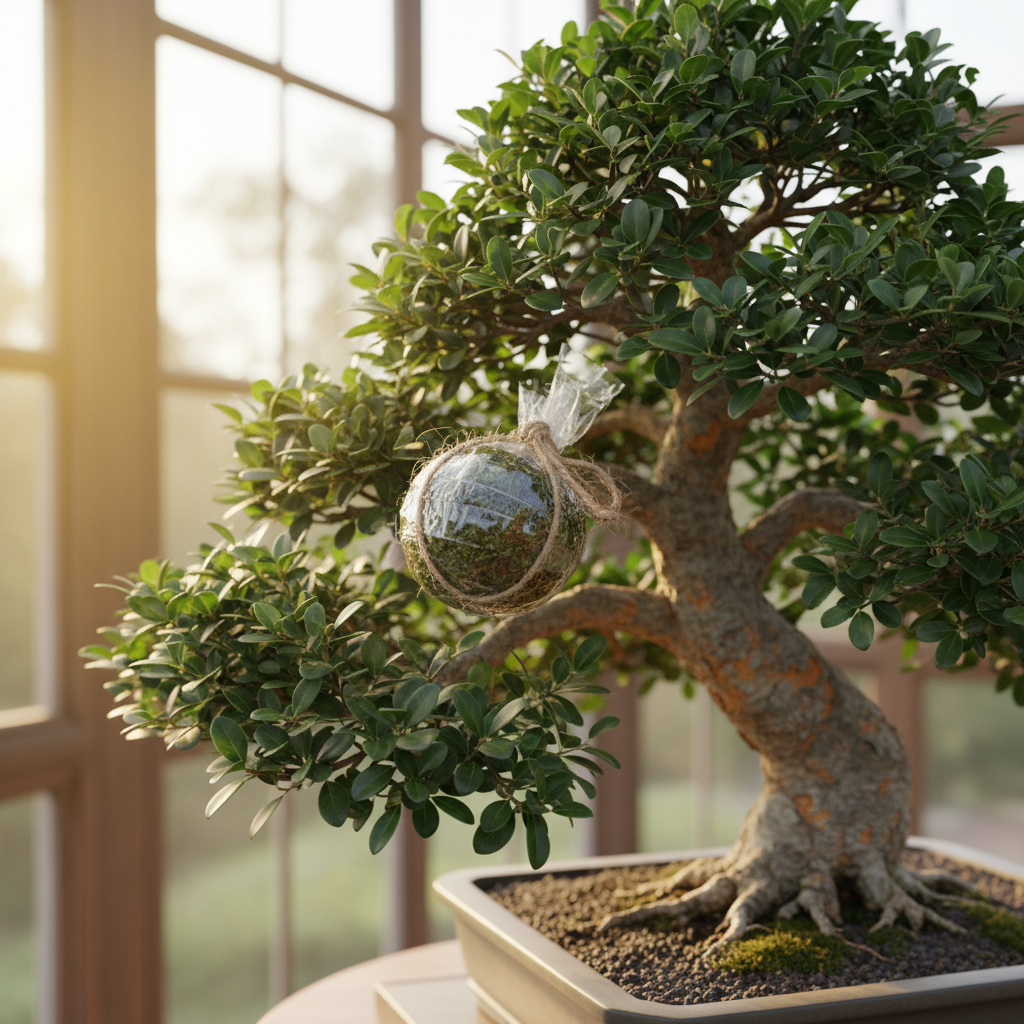
Understanding Nodes and Cambium
Successful propagation depends on two parts of the tree. Nodes are the points along a stem where leaves and buds emerge, and they hold the dormant cells most able to form new roots, which is why cuttings root most readily just below a node. The cambium is the thin green layer of living tissue just beneath the bark; in air layering, exposing and interrupting this layer triggers the stem to grow roots above the cut. Knowing where each lies turns propagation from guesswork into a reliable technique.
Air Layering: Step-by-Step
Air layering lets you root a branch while it is still attached to the parent tree, so the new plant arrives fully formed with bark, taper and branching already in place. It is the method of choice when you want a substantial elm quickly or want to remove an awkward upper section and turn it into a tree in its own right.
- Choose a healthy branch of the thickness you want for your future trunk and pick a point where you would like new roots to form.
- Remove a ring of bark roughly one and a half times the branch diameter in width, cutting cleanly down to the hard wood to interrupt the cambium completely.
- Optionally dust the upper cut edge with rooting hormone to encourage faster root formation.
- Wrap the wound in a generous ball of moist sphagnum moss, enclosing it fully.
- Cover the moss with clear plastic film and tie it firmly above and below so the moss stays in place and moisture is retained.
- Keep the moss damp through the season, and once a healthy mass of roots is visible through the film, cut the branch off below the new roots and pot it up as a young tree.
Pro Tip — Keep the Moss Moist: The single most common cause of air-layer failure is the moss drying out. Check it regularly and inject water with a syringe through a small hole in the film if needed, resealing afterwards so the humid environment around the wound is never lost.
Stem Cuttings: Step-by-Step
Cuttings are the simplest way to produce several new elms at once and a good use for the trimmings generated by routine pruning. They take a little longer than air layers to become presentable trees but cost nothing and have a high success rate with this species.
- Take cuttings 8 to 15 centimetres (3 to 6 inches) long from healthy current or last season’s growth, cutting just below a node.
- Remove the lower leaves, leaving a few at the top, and dip the cut end in rooting hormone.
- Insert the cuttings into a moist, free-draining mix of equal parts perlite and bonsai soil or fine bark.
- Place them in bright, indirect light, keep the mix consistently moist, and cover with a clear dome or bag to hold humidity.
- After four to eight weeks, test for resistance with a gentle tug; firm anchorage means roots have formed and the cutting can be gradually acclimatised and potted on.
Troubleshooting Propagation
| Problem | Likely Cause | Solution |
|---|---|---|
| Cuttings wilt then die | Too much moisture loss before roots form | Increase humidity with a dome and reduce leaf area on each cutting |
| Cuttings rot at the base | Mix too wet or not free-draining enough | Use a more open, gritty medium and water less frequently |
| Air layer shows no roots | Cambium not fully removed, so the branch healed over | Make a clean, complete ring cut down to hard wood and try again |
| Roots form but cutting fails after potting | Moved to harsh conditions too quickly | Acclimatise gradually over one to two weeks before full light and normal watering |
Pests & Diseases
A healthy, well-lit Chinese elm shrugs off most problems, and the species has no serious pest weakness indoors. The troubles that do arise are usually the common houseplant pests that appear when air is dry or the tree is stressed, along with a couple of fungal issues linked to overwatering or poor air circulation.
Prevention beats cure with every one of them. Regular inspection, good airflow, correct watering and the strong light the tree craves keep most problems from gaining a foothold in the first place. When trouble does appear, early action while populations are small makes treatment far easier.
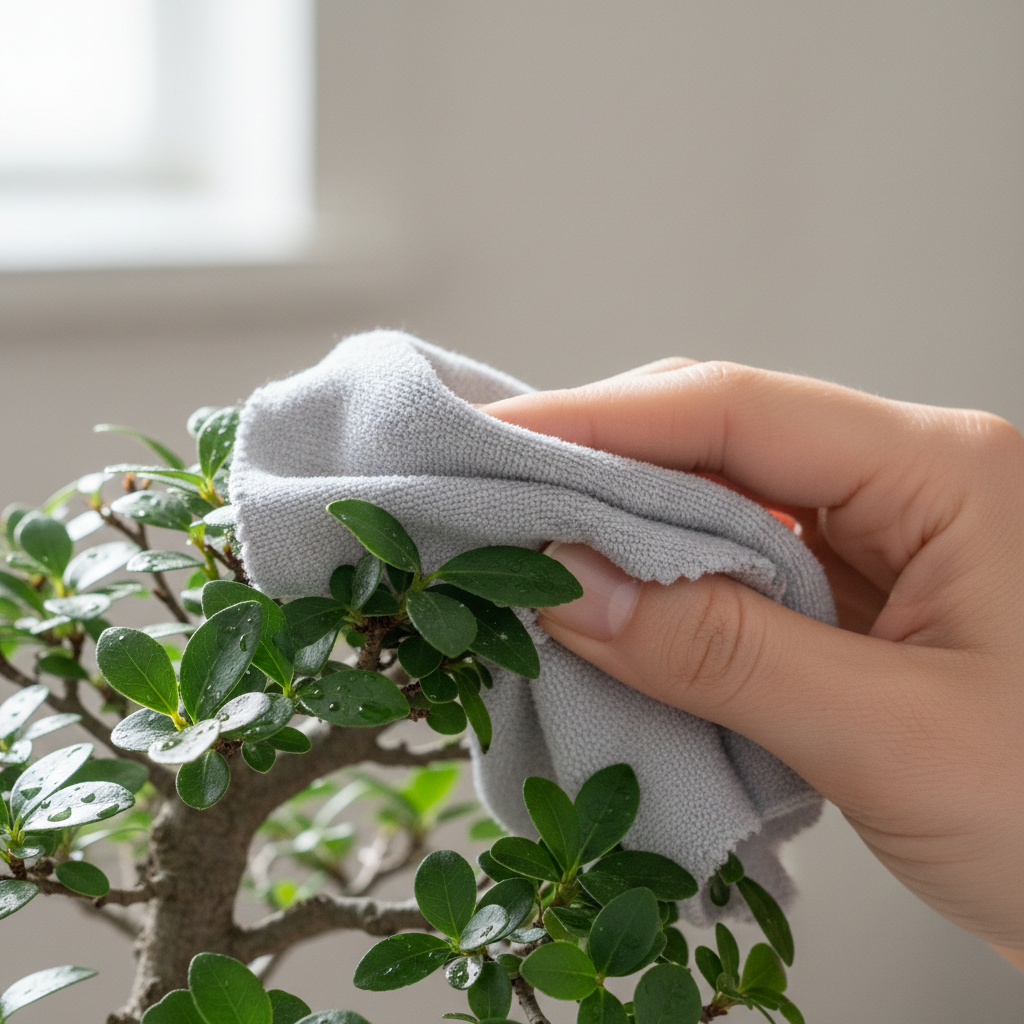
Common Pests
Spider Mites (Tetranychus urticae)
The most likely pest on an indoor elm, especially in the dry warmth of winter. Spider mites are tiny and hard to see, betraying themselves through fine pale speckling on the leaves and delicate webbing in the branch junctions. Heavy infestations cause leaves to yellow, dry and drop.
Treatment: Rinse the foliage thoroughly, raise humidity, and treat with insecticidal soap or a miticide, repeating every few days to catch newly hatched mites. Improving air moisture is the best long-term deterrent.
Scale Insects (Coccoidea)
Scale appear as small, immobile brown or tan bumps clinging to stems and the undersides of leaves, often along the veins. They suck sap and excrete sticky honeydew, which can lead to sooty mould. Their waxy shells make them stubborn.
Treatment: Scrape off what you can and dab each insect with a cotton bud soaked in diluted alcohol, then follow up with horticultural oil to smother any survivors and newly hatched crawlers.
Aphids (Aphidoidea)
Soft-bodied green, black or brown insects that cluster on tender new shoots and the undersides of fresh leaves, distorting growth as they feed. They reproduce rapidly but are among the easiest pests to clear.
Treatment: Dislodge them with a strong jet of water, then treat with insecticidal soap or neem oil if numbers persist. A few applications usually settle the problem.
Common Diseases
Root Rot (Phytophthora and Pythium species)
The most serious threat to a bonsai elm and almost always a consequence of overwatering or a waterlogged, compacted soil. Affected roots turn dark and mushy, leaves yellow and drop, and the tree declines from the base up.
Treatment: Remove the tree from its pot, cut away all blackened, soft roots with sterile scissors, and repot into fresh free-draining mix. Water sparingly until clear signs of recovery appear, and correct the watering habits that caused it.
Black Spot and Leaf Fungus (various fungi)
Dark blotches or spots on the leaves, sometimes with yellowing around them, typically caused by persistent moisture on the foliage combined with poor air movement. More cosmetic than fatal but worth addressing.
Treatment: Remove affected leaves, improve airflow around the tree, avoid wetting the foliage when watering, and apply a fungicide if the problem spreads.
Pest and Disease Summary
| Pest / Disease | Identification | Treatment |
|---|---|---|
| Spider mites | Fine speckling and webbing, dry yellowing leaves | Rinse, raise humidity, insecticidal soap or miticide |
| Scale insects | Brown waxy bumps on stems and leaf undersides | Alcohol swab plus horticultural oil |
| Aphids | Clusters on new shoots, distorted growth | Water jet, then insecticidal soap or neem oil |
| Root rot | Dark mushy roots, yellowing, sour soil | Trim roots, repot in fresh mix, reduce watering |
| Leaf fungus | Dark spots or blotches on the foliage | Remove leaves, improve airflow, fungicide if spreading |
Prevention Strategies
The strongest defence is a vigorous tree, and vigour comes from the basics done well: ample light, correct watering, an open free-draining soil and regular but moderate feeding. A tree under these conditions resists pests and diseases that quickly overwhelm a stressed, struggling specimen.
Inspect the tree closely at every watering, paying particular attention to the undersides of leaves and the junctions of branches where pests hide. Quarantine any newly acquired plant for a couple of weeks before placing it near your elm, and keep the soil surface clear of fallen leaves and debris that can harbour fungus and pests.
Pro Tip — Neem as a Routine: A monthly preventative spray of dilute neem oil, applied in the evening to avoid leaf scorch, discourages most sap-sucking pests before they establish. Cover the leaf undersides as well as the tops, where many pests prefer to feed and lay eggs.
Popular Varieties
While the standard Chinese elm is by far the most common bonsai elm, several cultivars and related species are prized for particular traits, from exceptionally small leaves to rugged corky bark. Choosing among them depends on the scale of tree you want and the character you find most appealing.
It is worth noting that many trees sold simply as “Chinese elm bonsai” are unnamed seedlings of Ulmus parvifolia, which vary naturally in leaf size and bark character. The named cultivars below have been selected and propagated for consistent, desirable features.
| Variety | Leaf Appearance | Light Needs | Growth Rate | Availability |
|---|---|---|---|---|
| Standard Chinese elm | Small glossy oval, finely toothed | Very bright to full sun | Fast | Very common |
| ‘Catlin’ | Very small, dense and glossy | Very bright to full sun | Moderate to fast | Common |
| ‘Seiju’ | Tiny crinkled leaves, corky bark | Very bright to full sun | Slow, dwarf | Specialist |
| ‘Hokkaido’ | Minute leaves, very fine twigs | Very bright to full sun | Very slow, dwarf | Specialist, prized |
| ‘Yatsubusa’ | Compact dwarf habit, small leaves | Very bright to full sun | Slow | Specialist |
| ‘Frosty’ | Small leaves with creamy white margins | Bright, slightly less direct sun | Moderate | Less common |
Featured Varieties
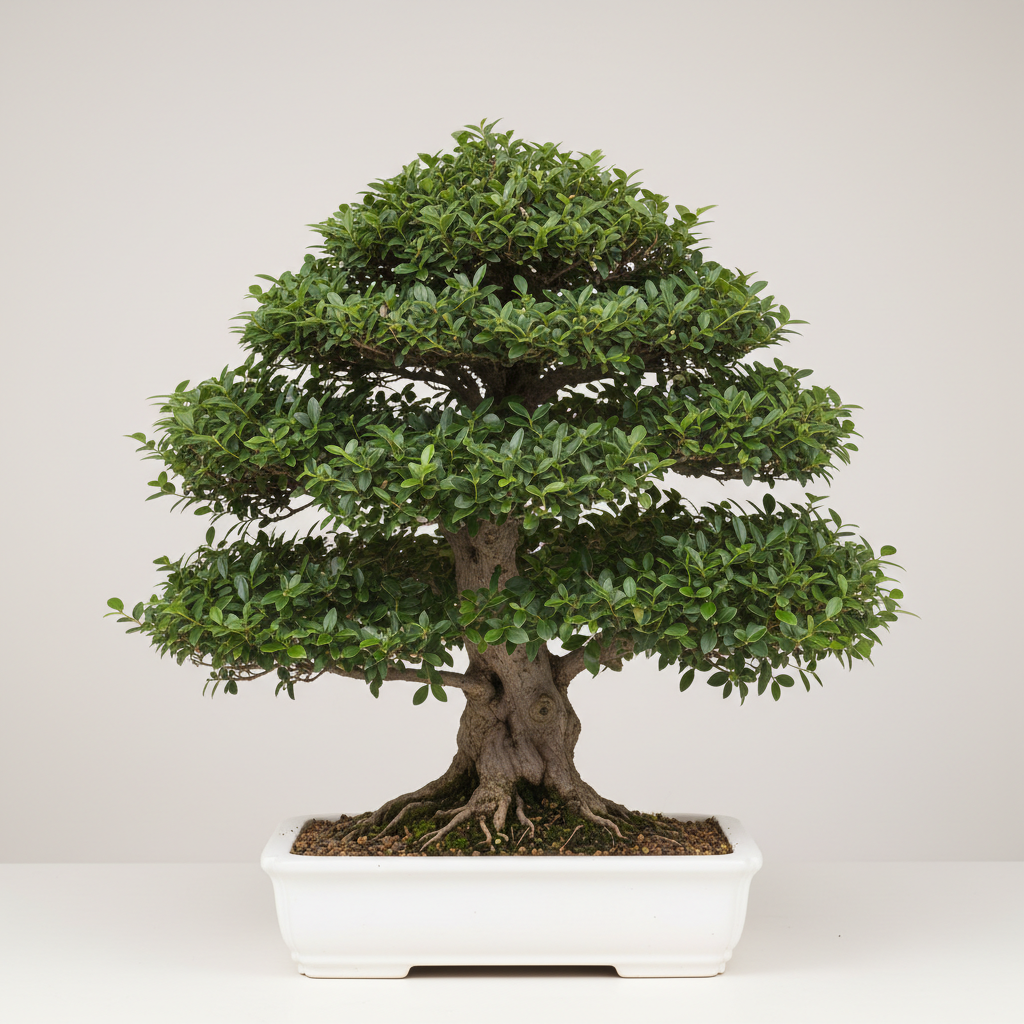
‘Catlin’
A widely grown cultivar with notably small, glossy dark-green leaves on dense, finely ramified growth. Its tight habit makes it a favourite for smaller bonsai and for building convincing fine twigging quickly.
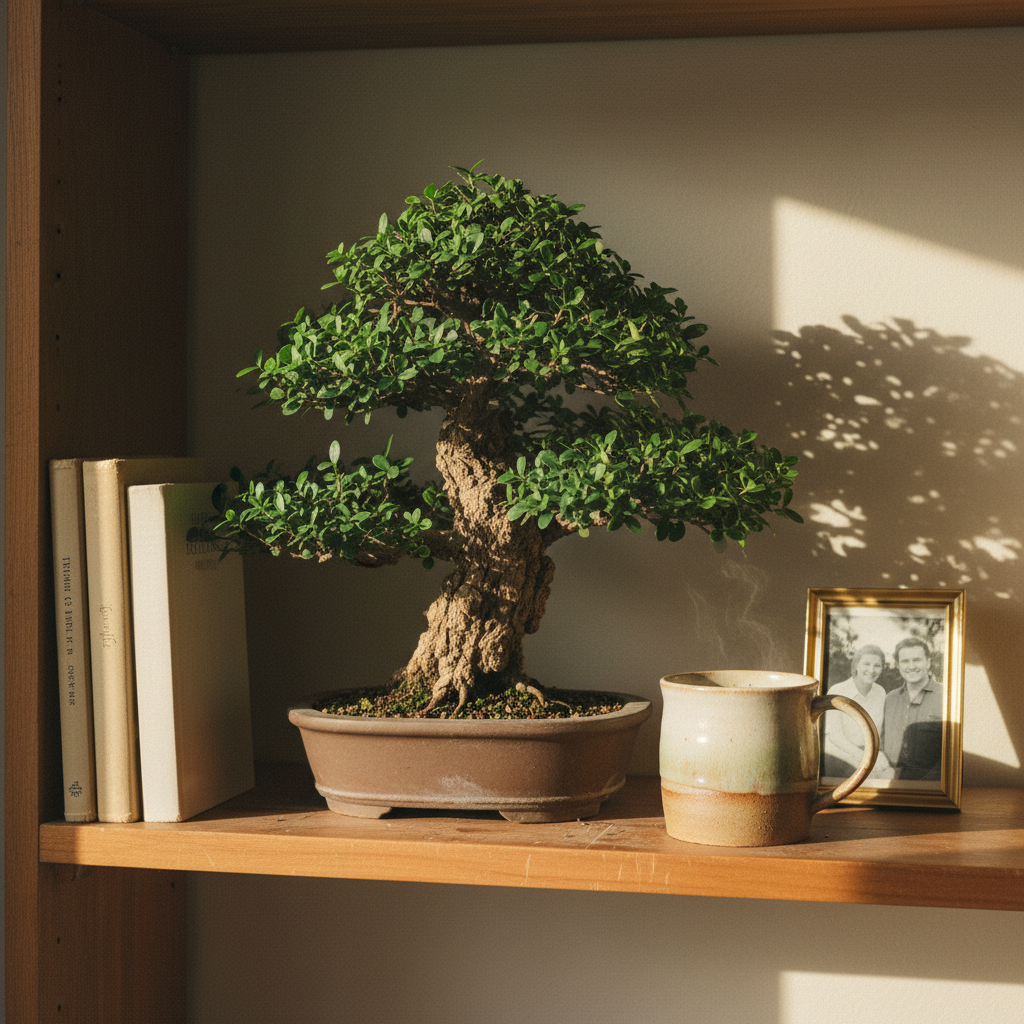
‘Seiju’
A slow-growing dwarf cultivar treasured for its rugged, deeply fissured corky bark and tiny crinkled leaves. The mature-looking bark develops early, giving even small specimens a striking sense of age.
Variety Profiles in Detail
Standard Chinese Elm (Ulmus parvifolia)
The workhorse of the bonsai world, vigorous, forgiving and quick to ramify. Its naturally small leaves and rapid twigging make it suitable for almost any style and any scale, and its low cost means beginners can experiment freely. This is the tree most readers will own, and it remains the benchmark against which the cultivars are judged.
‘Hokkaido’ (Ulmus parvifolia ‘Hokkaido’)
A true miniature with some of the smallest leaves of any elm and exceptionally fine, dense twigging. It grows slowly and demands patience, but it is prized for mame and shohin bonsai, the smallest size classes, where its delicate proportions are unmatched. Its slow pace and specialist availability make it a tree for the more experienced grower.
‘Frosty’ (Ulmus parvifolia ‘Frosty’)
A variegated selection whose small leaves carry creamy white margins, lending a lighter, more delicate look to the canopy. Variegated foliage holds slightly less chlorophyll, so it appreciates strong light to stay healthy while avoiding the most scorching midday sun. A distinctive choice for growers who want something beyond plain green.
Choosing the Right Variety for Your Space
For a first tree, the standard Chinese elm is hard to beat, combining low cost, vigour and forgiveness in one package. If you are drawn to very small bonsai, ‘Hokkaido’ or ‘Seiju’ reward the extra patience with miniature leaves and characterful bark. Gardeners who want a touch of colour might seek out ‘Frosty’, while anyone aiming to develop refined twigging at a workable pace will find ‘Catlin’ an excellent middle ground. Whatever you choose, the underlying care described in this guide applies to them all.
Frequently Asked Questions
Is the Chinese elm an indoor or outdoor bonsai?
It can be both, which is part of its appeal. In mild climates it thrives outdoors year round, where it gets the strong light it loves and a natural winter dormancy. It also adapts well to life indoors at a very bright window, often staying semi-evergreen rather than dropping its leaves. Many growers compromise by keeping it outdoors through the growing season and bringing it to a bright, cool indoor spot for the coldest months.
Why is my Chinese elm dropping its leaves?
Leaf drop has several possible causes. A modest, gradual drop in autumn is natural dormancy and nothing to worry about. Sudden heavy drop usually signals a stress, most often a change in environment such as moving the tree, a swing in watering between too dry and too wet, or insufficient light. Review the basics, keep conditions stable, and a healthy tree generally recovers and re-leafs.
How often should I water a bonsai elm?
There is no fixed answer, because the right frequency depends on temperature, light, season and pot size. Instead of a schedule, check the soil daily and water thoroughly when the surface begins to dry. In warm, bright conditions this may mean watering once or twice a day, while in cool winter weather it might be only every few days.
When and how do I prune a Chinese elm?
The elm tolerates pruning extremely well. During the growing season, pinch or trim new shoots back to one or two leaves once they have extended to four or five, which encourages the fine branching that gives bonsai its character. Heavier structural pruning of thicker branches is best done in late winter or early spring before the flush of new growth, when the tree can heal and respond strongly.
Can I wire a Chinese elm to shape it?
Yes, wiring is an effective way to position branches, but the elm thickens quickly, so watch the wire closely. Young shoots are flexible and easy to bend, while older branches are more brittle and may need guy wires instead. Remove the wire before it bites into the swelling bark, which can happen within a few months on a vigorous tree and leaves unsightly scarring.
How do I reduce the leaf size on my elm?
Strong light, restrained nitrogen and regular pruning all encourage smaller leaves. On a healthy, established tree some growers also defoliate in early summer, removing most leaves to force a second flush of smaller foliage with shorter internodes. Defoliation is a refinement technique best reserved for vigorous trees, not stressed or recently repotted ones.
Is the Chinese elm safe around pets?
The Chinese elm is generally regarded as non-toxic and is not listed among plants known to poison cats or dogs. Even so, it is an ornamental tree rather than a snack, and the wire, fertiliser pellets and pesticide sprays sometimes used in its care can harm a curious animal. Keep the tree out of reach and store care products safely away from pets.
How long does a bonsai elm live?
With good care a Chinese elm bonsai can live for many decades and is often passed between generations. Bonsai are effectively kept in a state of managed maturity, so a well-tended tree does not age out the way a houseplant might; instead it slowly gains the gnarled trunk, flaking bark and dense canopy that make an old specimen so valued. Consistent care is the key to that long, slow refinement.






