
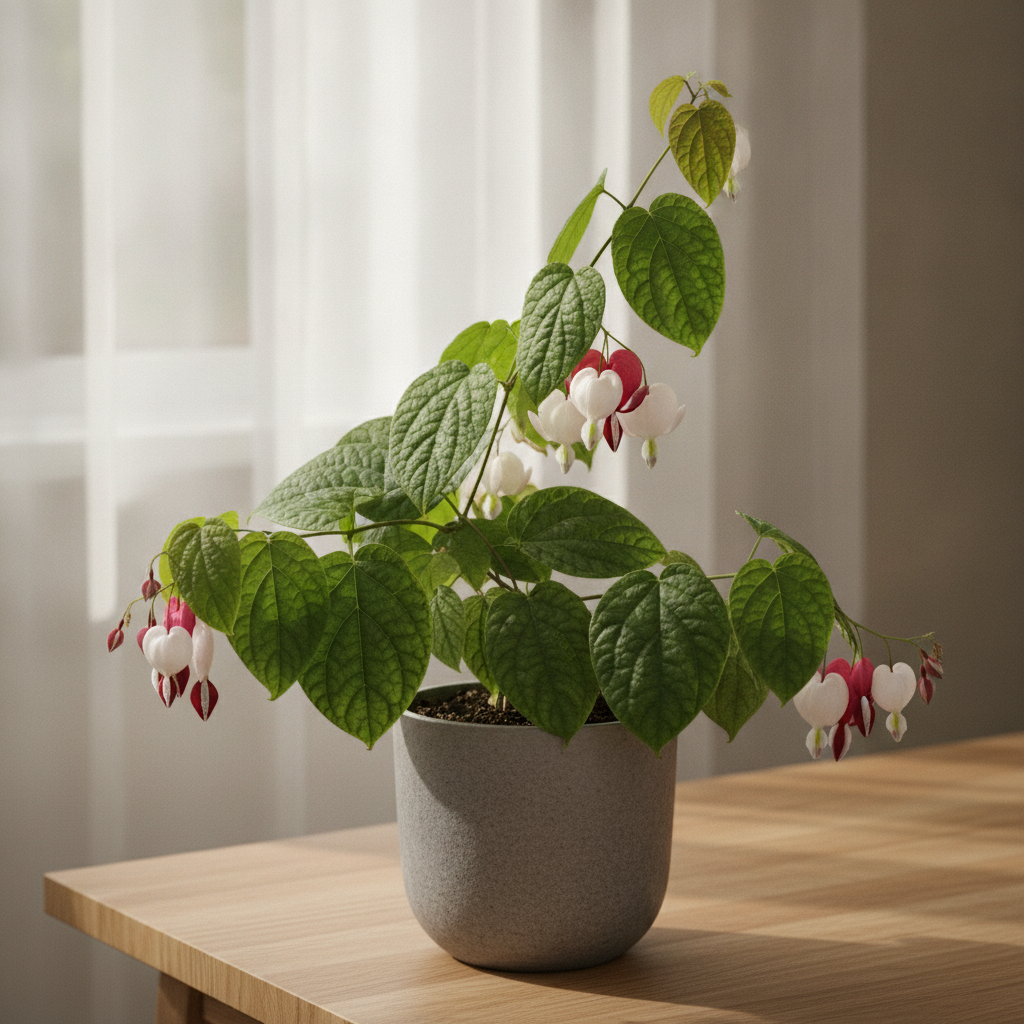
Few houseplants stop a room the way a flowering bleeding heart vine does. Each bloom is a small piece of theatre: a pure-white, inflated lantern of a calyx from which a vivid crimson flower bursts, stamens curling outward like a held breath. The common name comes from exactly this contrast of white and blood-red, and once you have seen a mature plant draped in dozens of them at once, the ordinary pothos on the next shelf starts to look a little sleepy. The good news is that Clerodendrum thomsoniae is far more forgiving than its exotic looks suggest. The slightly harder news is that keeping it alive and getting it to flower are two different skills, and this guide is built to give you both.
In This Guide
- Quick reference
- Why the bleeding heart vine makes a rewarding houseplant
- Light
- Watering
- Soil and potting
- Fertilising
- Propagation
- Pests and problems
- Varieties
- Frequently asked questions
Quick Reference
If you only read one section before bringing a plant home, make it this one. The table below summarises what Clerodendrum thomsoniae needs to thrive, not merely to cling to life. Everything here is expanded in detail further down the page.
| Common names | Bleeding heart vine, glory bower, glorybower, bag flower, tropical bleeding heart |
| Botanical name | Clerodendrum thomsoniae |
| Family | Lamiaceae (the mint and sage family) |
| Native range | Tropical West Africa, from Senegal to Cameroon |
| Plant type | Evergreen twining climber, grown as a vine or trained shrub |
| Mature size indoors | 1 to 2.5 metres (3 to 8 feet) trained, much larger if left to climb |
| Light | Bright indirect light with two to three hours of gentle direct sun |
| Water | Keep evenly moist in growth, ease off markedly in winter |
| Humidity | Moderate to high, 50 per cent or above preferred |
| Temperature | 18 to 24 degrees Celsius (64 to 75 Fahrenheit) in growth |
| Soil | Rich, free-draining, slightly acidic loam with plenty of organic matter |
| Feeding | Fortnightly high-potassium feed through spring and summer |
| Flowering season | Late spring through autumn, with a cool winter rest to set buds |
| Toxicity | Low, but the sap can irritate skin and is best kept from pets and children |
| Difficulty | Easy to keep alive, moderate to flower well |
Why the Bleeding Heart Vine Makes a Rewarding Houseplant
The bleeding heart vine belongs to Clerodendrum, a sprawling genus of more than three hundred species of trees, shrubs and climbers scattered across the tropics. Clerodendrum thomsoniae hails from the humid lowland forests of tropical West Africa, where it scrambles up through other vegetation toward the light, throwing out long flexible stems that twine wherever they find support. It was introduced to European glasshouses in the nineteenth century and named after the wife of the Reverend William Cooper Thomson, a missionary and naturalist in Nigeria. For most of its history it has been a conservatory and greenhouse plant, prized precisely because it would flower lavishly under glass when little else would.
What makes it worth a place on your windowsill is the flower, and the flower repays a close look. Each bloom is built in two parts. The showy white structure is not a petal at all but the calyx, a balloon of fused sepals that inflates into a five-sided lantern. From the mouth of that lantern emerges the true corolla, a star of deep crimson to scarlet petals with long arching stamens that reach well beyond the flower. As the bloom ages the white calyx slowly flushes pink and then dusky mauve, so a healthy plant carries flowers in several shades at once. The contrast of porcelain white and arterial red is what earns the plant its slightly gothic common name, and it is genuinely unusual among easy-to-grow houseplants.
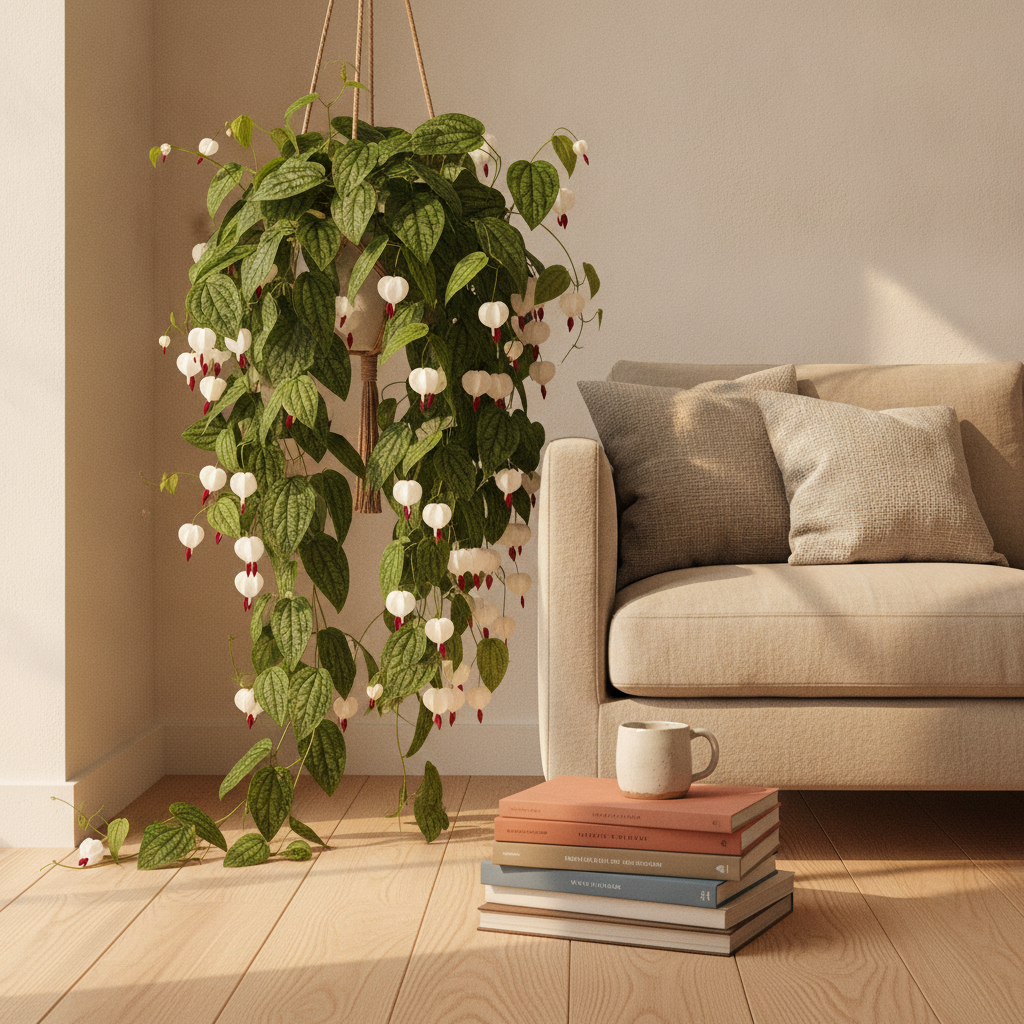
Away from the flowers, the plant earns its keep too. The foliage is handsome in its own right: glossy, dark green, oval leaves up to fifteen centimetres (six inches) long, with deeply impressed veins that give each leaf a quilted, almost corrugated texture. The stems are pliable and quick to grow, which is exactly what you want in a plant you intend to train. Left to its own devices it will reach two to three metres, but it responds beautifully to being wound around a hoop, a trellis or a moss pole, and it can equally be pruned hard into a bushy mounded shrub. That flexibility is part of the appeal. The same plant can be a compact flowering ball on a side table or a curtain of green-and-white cascading from a high shelf, depending entirely on how you direct it.
This is also where the survive-versus-thrive distinction becomes important. A bleeding heart vine kept in a dim corner with erratic watering will live for years as a tangle of green leaves and never produce a single bloom. There is nothing wrong with such a plant, but it is not what anyone buys a bleeding heart vine for. Getting it to flower is a matter of giving it enough light, feeding it the right way, and crucially allowing it a genuine cool, dry rest over winter. Master those three things and the plant flips from a pleasant foliage climber into the showstopper it is meant to be. The rest of this guide is really about that transition.
Pro Tip — Buy in bloom: When choosing a plant, look for one already carrying buds or flowers rather than the bushiest foliage specimen. A plant that is flowering in the shop is proving it is mature enough and has been grown in enough light to bloom, which tells you far more than leaf count alone.
Light
Light is the single biggest lever you have over whether this plant flowers, so it is worth getting right from the start. In its native forests the bleeding heart vine climbs toward bright, broken light at the canopy edge rather than sitting in deep shade, and that is the quality of light to recreate indoors. Aim for a position that is bright all day with a few hours of gentle direct sun, ideally the softer light of morning rather than the fierce heat of a south-facing window at midday.
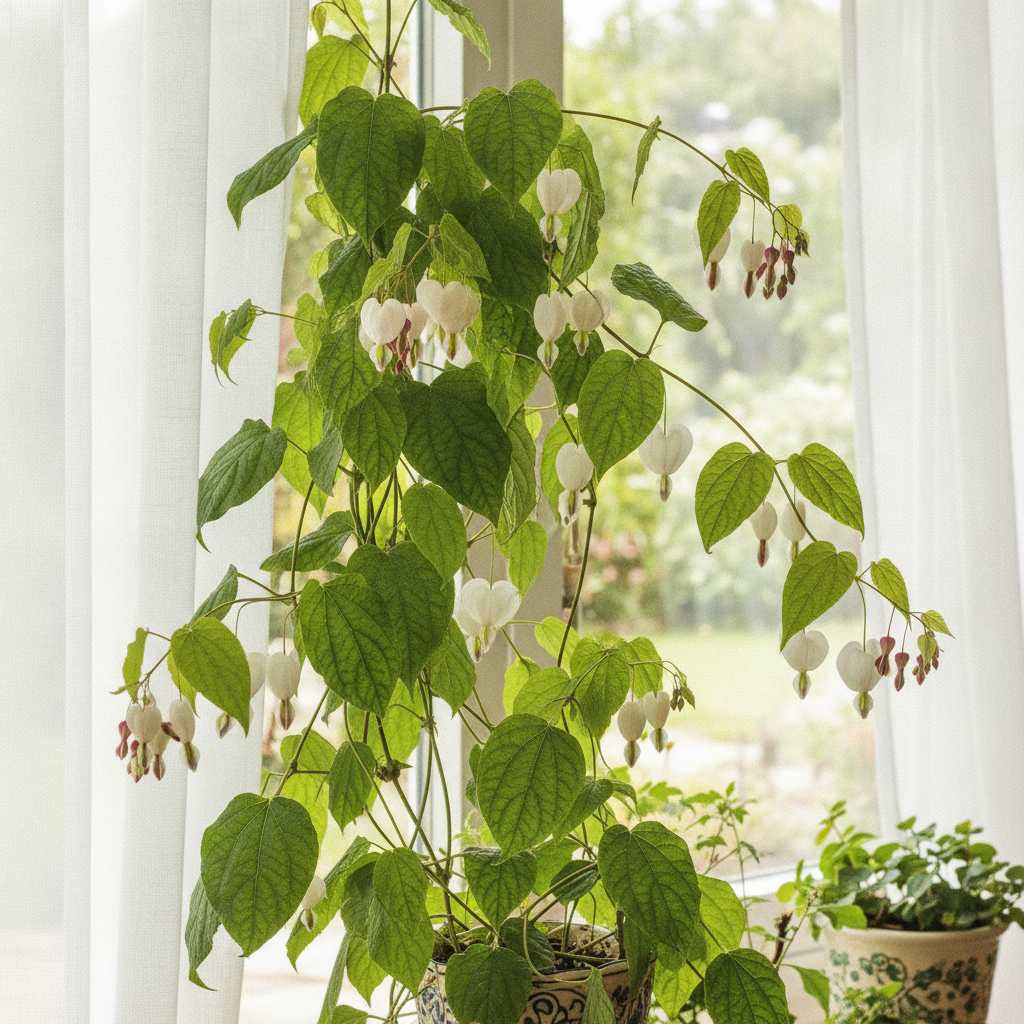
In practical terms, an east-facing window is close to perfect, giving cool morning sun followed by bright light for the rest of the day. A west-facing window works well too, though you may need a sheer curtain to take the edge off hot afternoon sun in summer. A south-facing window is excellent in winter and during dull weather, but in high summer the plant should sit a little back from the glass or behind a light curtain to avoid leaf scorch. A north-facing window, by contrast, rarely supplies enough light to set buds. The plant will survive there and may even look reasonably lush, but you should not expect much flowering.
The leaves themselves will tell you whether the light is right. In good light the foliage stays a deep, even green and the spaces between leaves on each stem, the internodes, stay short and compact. When light is too low the plant stretches, producing long bare lengths of stem with widely spaced, pale leaves as it reaches for a brighter spot. That etiolated, leggy growth is the clearest sign you need to move it closer to a window. At the other extreme, leaves that develop bleached, crisp patches are catching too much direct midday sun and want a touch more shade or a curtain between them and the glass.
If your home simply lacks a bright window, a full-spectrum LED grow light is a thoroughly effective substitute and is often what tips a stubborn plant into flowering. Run it for roughly twelve hours a day, positioned thirty to forty-five centimetres (12 to 18 inches) above the foliage. One detail worth remembering: the bleeding heart vine flowers on new growth produced in spring and summer, so the long, bright days of the growing season are when ample light matters most. Through the winter rest, which we will come to, lower light is not only acceptable but part of the plan.
Pro Tip — Rotate for even growth: Because the vine grows so eagerly toward the light, give the pot a quarter turn each week. Without it, the plant piles all its growth and flowers on the window side and goes bare at the back, which spoils the shape of a trained specimen.
Watering
Watering a bleeding heart vine is a tale of two seasons, and the most common mistakes come from treating the plant the same all year round. During the active growing months of spring and summer it is a thirsty, fast-growing plant that wants its soil kept consistently and evenly moist. Through the cooler months it wants something close to the opposite: a markedly drier regime that, together with cooler temperatures, triggers the rest period it needs to flower well the following year.
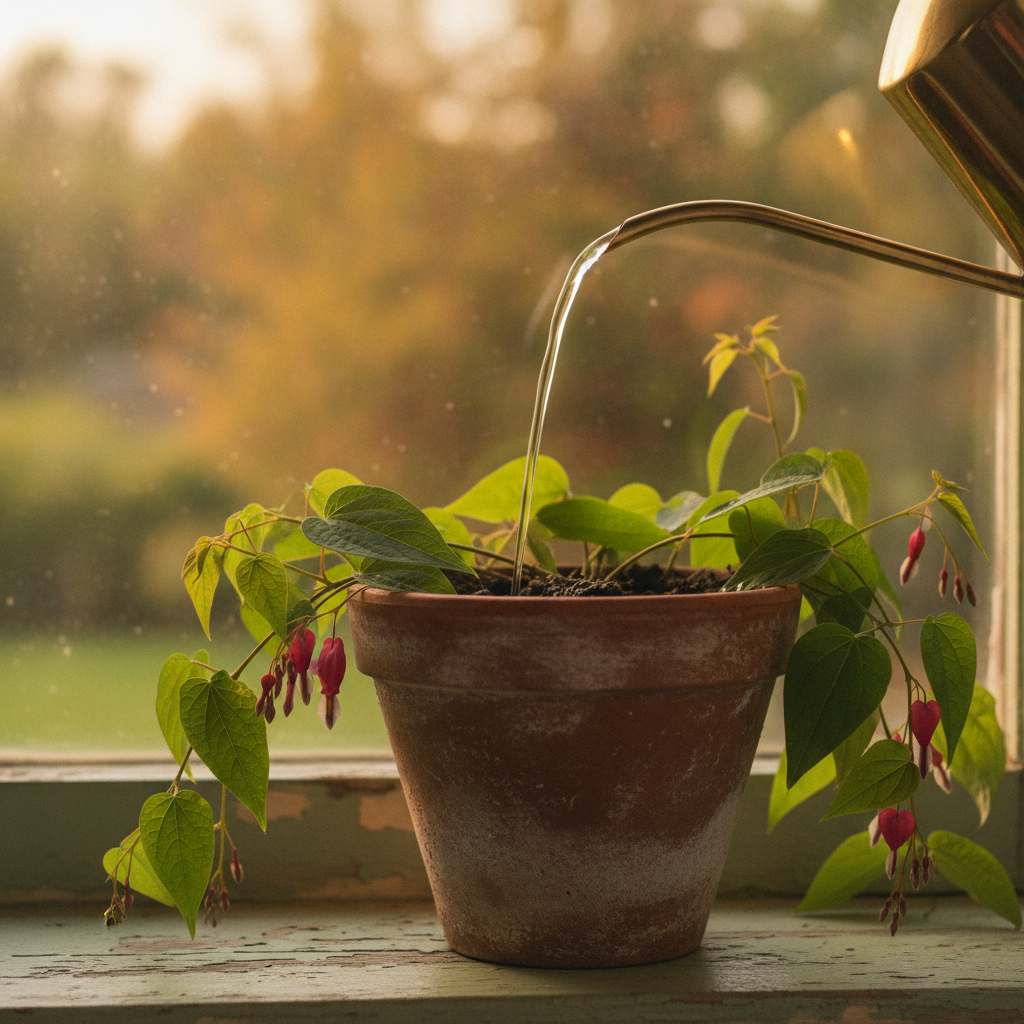
In spring and summer, water when the top two to three centimetres (about an inch) of compost have dried out. Water thoroughly, letting it run freely from the drainage holes so the whole root ball is wetted, then empty the saucer so the pot never stands in water. In the heat of summer, a vigorous plant in active growth and good light may need watering two or three times a week. The goal is steady moisture, not a swamp: the compost should feel like a wrung-out cloth, damp but never sodden. Bleeding heart vines wilt fairly dramatically when they dry out too far, the soft new growth flagging first, but they usually recover well once watered, so an occasional lapse is not a disaster.
From mid-autumn the picture changes. As light levels and temperatures fall, reduce watering substantially and let the top half of the pot dry before watering again. The plant may drop some or even most of its leaves over winter, and this is entirely normal behaviour rather than a sign of trouble. A deciduous or semi-deciduous winter rest is part of how this plant works, and a cool, dry, leafless plant in January is doing exactly what it should. Keep the compost barely moist, just enough that the roots do not shrivel completely, and resume generous watering in spring as new growth appears.
Water quality is worth a thought because this is a slightly acid-loving plant. Hard tap water, over time, nudges the soil toward alkalinity and can cause yellowing between the leaf veins. If your tap water is very hard and you notice this kind of chlorosis, switch to rainwater, filtered water or cooled boiled water. Whatever you use, let it come to room temperature first, as cold water on the roots of a warmth-loving tropical can cause a check to growth and bud drop.
Warning — Overwatering in winter: The fastest way to kill a bleeding heart vine is to keep watering it heavily through a cold, dark winter. Cold, wet compost with little active root uptake is a recipe for root rot. When in doubt during the dormant months, wait another few days before watering.
Humidity matters alongside watering. As a lowland tropical plant, the bleeding heart vine appreciates moisture in the air and is happiest at around 50 per cent relative humidity or higher. In a centrally heated room in winter the air can become very dry, which encourages leaf-edge browning and, more importantly, spider mites. Grouping it with other plants, standing the pot on a tray of damp pebbles, or running a small humidifier nearby all help. Misting gives a brief lift but does little for sustained humidity, so do not rely on it alone.
Soil and Potting
The bleeding heart vine wants a soil that manages a slightly awkward balancing act: rich and moisture-retentive enough to feed a hungry, fast-growing climber, yet free-draining enough that the roots never sit in stagnant water. Get the balance right and the plant rewards you with vigorous growth; get it wrong in either direction and you see either drought stress or root rot.
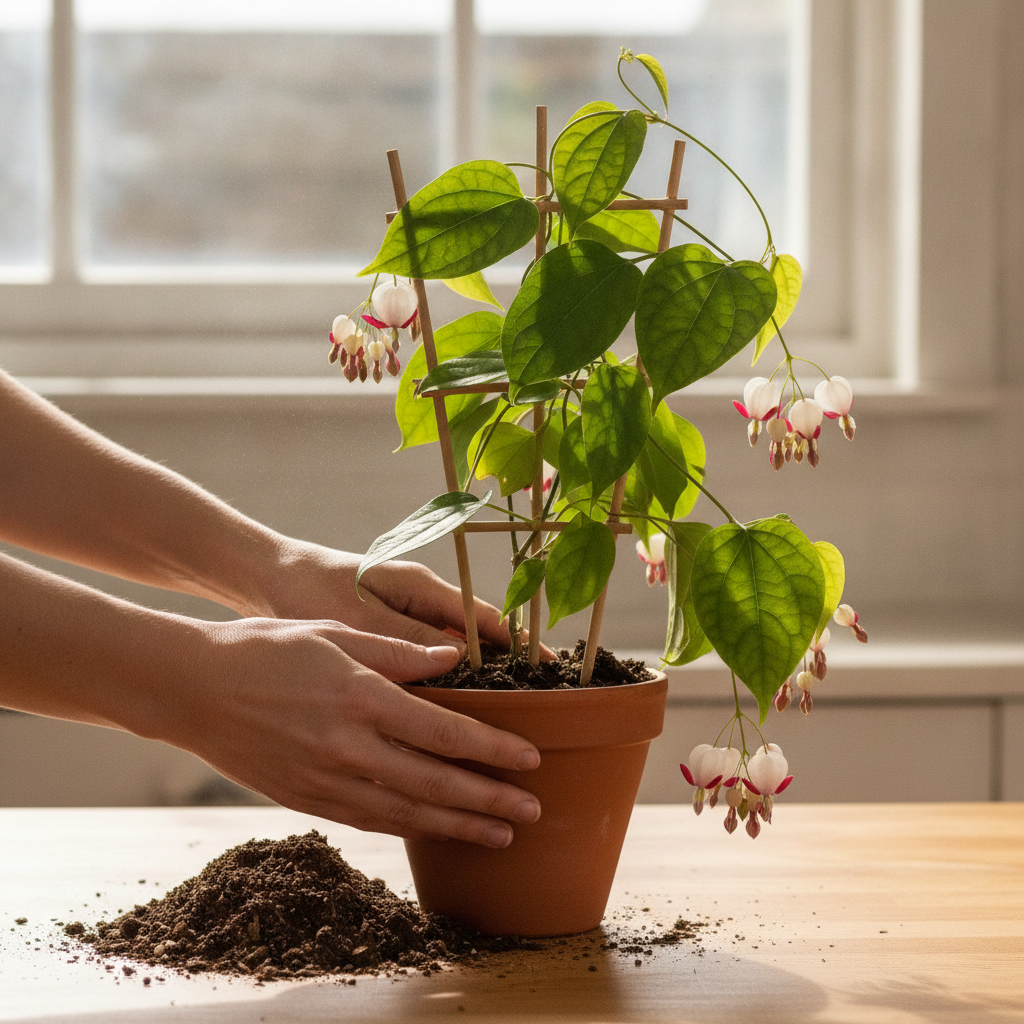
A good starting point is a quality peat-free houseplant compost or loam-based potting mix, opened up with extra drainage material. A reliable recipe is roughly two parts general potting compost to one part perlite or fine bark, with a generous handful of worm castings or well-rotted leaf mould stirred through to provide slow, steady nutrition and a slightly acidic character. The slight acidity suits the plant, which prefers a pH in the region of 6.0 to 6.5. Avoid heavy, dense composts that stay wet for days, and equally avoid pure cactus mixes, which drain so freely that this thirsty plant would need watering constantly.
Whatever container you choose must have drainage holes. This is not negotiable for a plant that hates wet feet. Terracotta is an excellent choice because its porous walls let excess moisture evaporate and make overwatering harder, though it does mean you will water more often in summer. Plastic and glazed ceramic hold moisture longer, which can be an advantage in a hot, bright spot but demands a little more care not to overwater. Choose a pot only one size larger than the current one when potting on. An oversized pot holds a large volume of wet soil around a small root system, which is exactly the condition that invites rot.
Repot in spring, just as new growth begins, every one to two years or whenever roots start circling the bottom of the pot or poking through the drainage holes. A pot-bound plant actually tends to flower more freely, because slight root restriction encourages blooming over leafy growth, so there is no need to rush a young plant into a much bigger container. When you do repot, tease apart any tightly circling roots, settle the plant at the same depth it sat before, firm the fresh mix gently around the root ball, and water it in. If you are happy with the plant’s size, you can instead top-dress, scraping off the top few centimetres of old compost and replacing it with fresh, rather than moving up a pot size.
Fertilising
A flowering climber growing as fast as this one is a hungry plant, and feeding is one of the levers that separates a leafy survivor from a flowering specimen. The key is not just to feed, but to feed the right kind of nutrients at the right time of year.
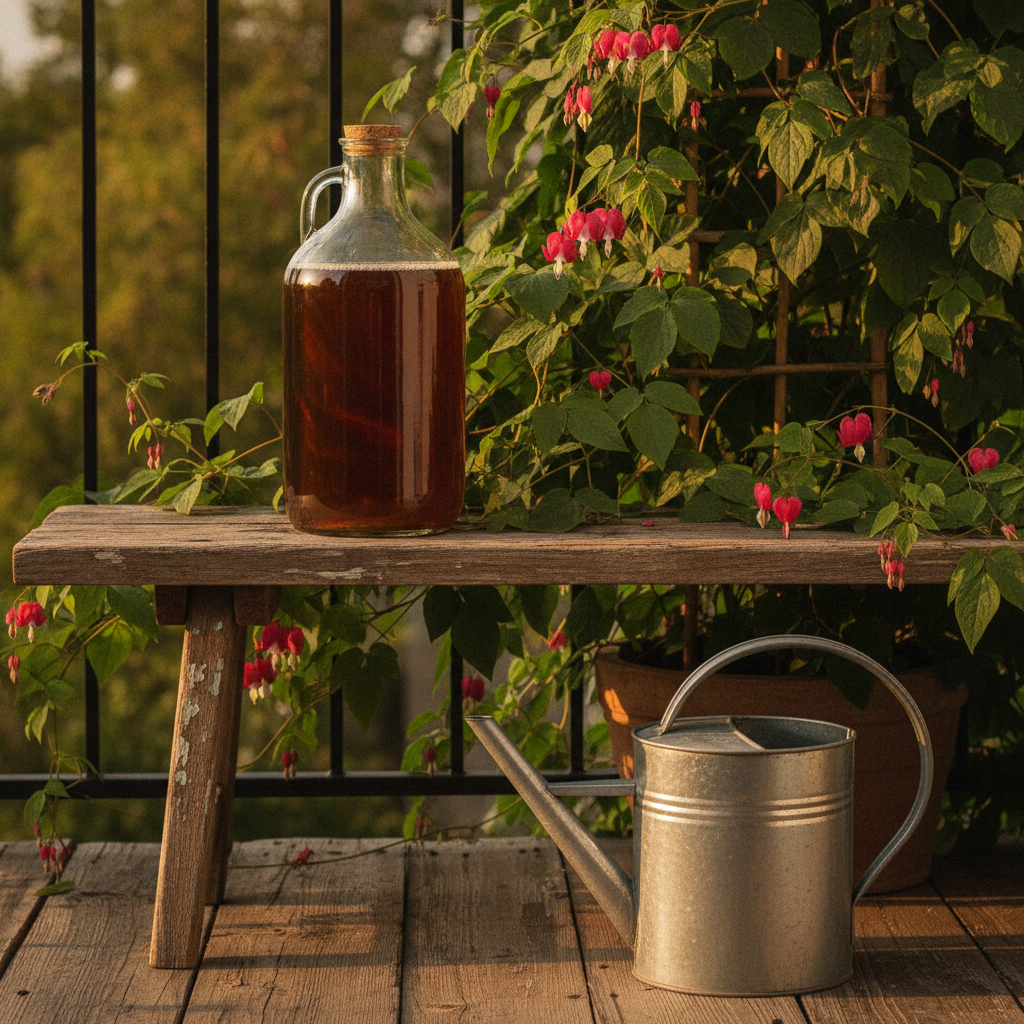
Through the growing season, from spring until early autumn, feed every two weeks with a balanced liquid houseplant fertiliser diluted to the strength recommended on the bottle. As flower buds begin to form, switch to a high-potassium feed, the kind sold for tomatoes or for flowering plants, because potassium directly supports flower and fruit production. Alternating between a balanced feed and a high-potassium one through the summer keeps both foliage and flowers well supplied. A nitrogen-heavy feed, by contrast, drives lush green growth at the expense of blooms, so resist the urge to use a leafy-houseplant fertiliser if flowering is your aim.
The cardinal rule of feeding is to stop in autumn and not resume until spring. The plant is moving into its rest period, growth slows or halts, and fertiliser applied to dormant roots simply builds up as unused salts in the soil, which can scorch the roots. Feeding through winter also works against the very dormancy you are trying to encourage. Hold off entirely from roughly mid-autumn until you see fresh growth pushing in spring, then begin again gradually.
Always feed onto already-moist soil rather than bone-dry compost, as concentrated fertiliser drawn into dry roots can burn them. If you ever see a white crust forming on the soil surface or around the pot rim, that is accumulated mineral salts, and it is worth flushing the pot through with plenty of plain water to leach them out. Organic options such as a dilute seaweed feed or a well-strained compost tea work perfectly well and tend to be gentler and more forgiving than synthetic feeds, which makes them a good choice if you are inclined to be heavy-handed.
Pro Tip — Potassium for blooms: If your plant grows lush and green but refuses to flower, and the light is genuinely good, the cause is often too much nitrogen. Switching to a tomato fertiliser for the summer is frequently all it takes to coax out the first flush of flowers.
Propagation
The bleeding heart vine is satisfyingly easy to propagate, which is good news given how readily it produces long, pliable stems that practically beg to be turned into new plants. The most reliable method is stem cuttings taken in late spring or early summer, when the plant is in strong active growth. Cuttings will root in either water or moist compost, and both routes are dependable.
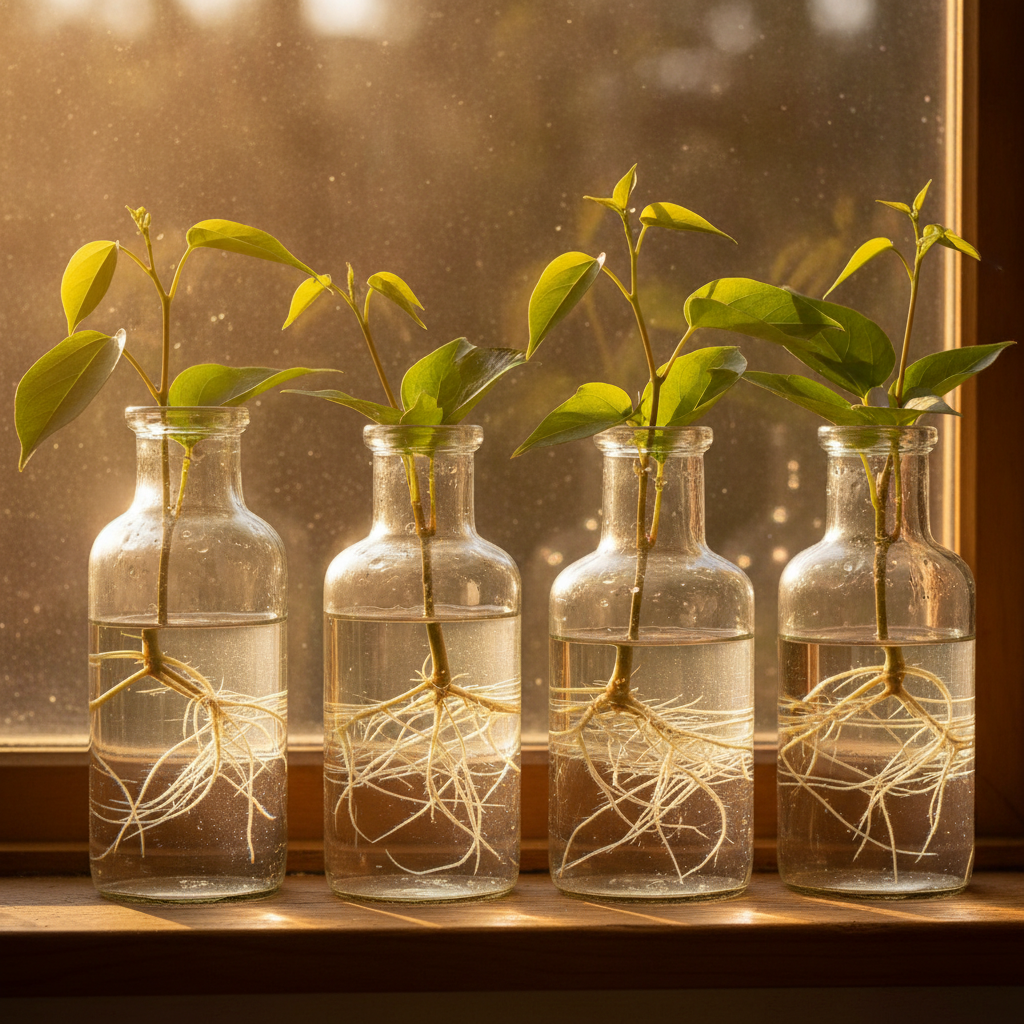
To take cuttings, follow these steps:
- Choose a healthy, non-flowering stem and cut a length of about ten to fifteen centimetres (4 to 6 inches) just below a leaf node, using clean, sharp secateurs. The node is the point where leaves emerge, and it is where roots will form.
- Strip the leaves from the lower half of the cutting, leaving two or three leaves at the top. If those upper leaves are large, you can halve them to reduce moisture loss.
- For water rooting, stand the cutting in a glass of clean, room-temperature water on a bright windowsill out of direct sun, making sure at least one bare node is submerged. Change the water every few days to keep it fresh and oxygenated.
- For soil rooting, dip the cut end in rooting hormone, then insert it into a small pot of moist, free-draining cutting compost. Firm it in gently and water lightly.
- Keep cuttings warm, ideally around 21 to 24 degrees Celsius (70 to 75 Fahrenheit), and humid. A clear plastic bag or propagator over a soil cutting traps moisture and speeds rooting, but lift it daily for a few minutes to let fresh air in and prevent mould.
- Roots usually appear within three to six weeks. Once water-rooted cuttings have roots a few centimetres long, pot them up into standard mix, keeping them well watered for the first few weeks while they adjust to soil.
Warmth and humidity are the two factors that make the biggest difference to success. Cuttings taken in the warmth of early summer root far more readily than those taken in the cooler, darker months, when they tend to stall or rot. A heated propagation mat beneath the pot can noticeably improve and speed up rooting if your home runs cool.
Beyond cuttings, more patient growers can try air layering on a longer, semi-woody stem, which produces a larger plant more quickly, or sow fresh seed if your plant sets any, though seed-raised plants are slower to reach flowering size. For most people, however, a handful of summer stem cuttings is by far the simplest way to turn one bleeding heart vine into several, whether to bush out the parent in a single pot or to share with friends.
Pests and Problems
A bleeding heart vine grown in good conditions is reasonably robust, but its soft, lush foliage and love of warmth make it attractive to the usual cast of indoor pests, especially when the air turns dry over winter. Catching trouble early is far easier than fighting an established infestation, so make a habit of turning over a few leaves whenever you water.
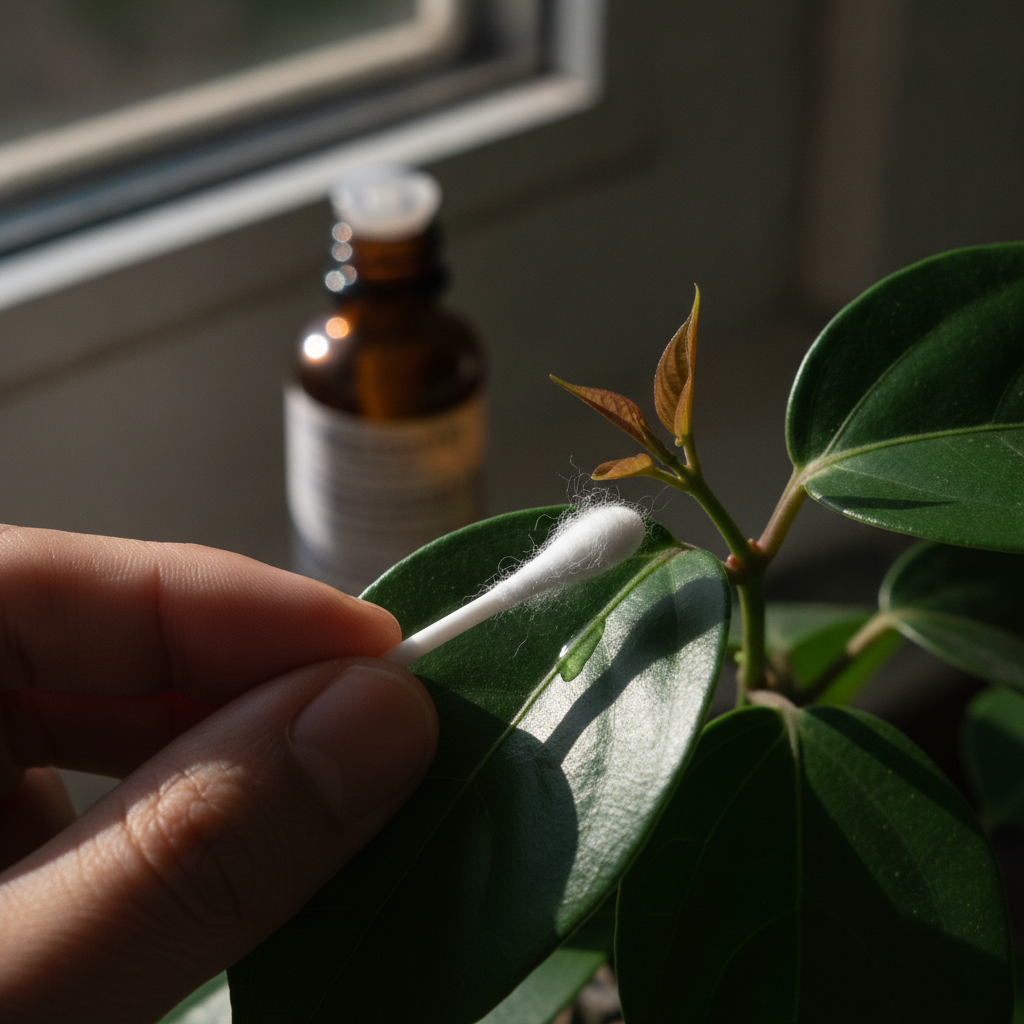
The most persistent enemy is the spider mite, which thrives in the warm, dry conditions of a centrally heated room. These tiny pests are easy to miss until you spot fine speckling or stippling on the upper leaf surface and, in bad cases, delicate webbing in the leaf axils and along the stems. Because dry air encourages them, raising humidity is both prevention and part of the cure. Mealybugs are the other common visitor, showing up as small white cottony tufts tucked into leaf joints and the undersides of leaves, while whitefly, aphids and scale insects all appear from time to time, particularly on new growth and around the flowers.
The table below summarises the most likely problems and how to respond to each.
| Problem | Likely cause | What to do |
| Fine speckling and webbing on leaves | Spider mites, encouraged by dry air | Rinse foliage, raise humidity, treat with insecticidal soap or neem oil weekly until clear |
| White cottony tufts in leaf joints | Mealybugs | Dab each one with a cotton bud dipped in dilute isopropyl alcohol, then treat with neem |
| Tiny white flies rising when disturbed | Whitefly | Use yellow sticky traps and repeated insecticidal soap sprays |
| Sudden yellowing and leaf drop | Cold draught, overwatering or sharp temperature change | Move to a stable, warm spot and check the soil is not waterlogged |
| Lush green growth but no flowers | Too little light, too much nitrogen, or no winter rest | Increase light, switch to high-potassium feed, and give a cool dry winter |
| Yellowing between leaf veins | Hard water or alkaline soil | Water with rainwater and feed a sequestered iron or ericaceous tonic |
For any insect pest, the first response should be physical: wipe or rinse off as many as you can, isolate the plant from its neighbours so the problem does not spread, and only then move to treatment. Insecticidal soap and neem oil are both effective and relatively gentle, but they work by contact and need repeating every five to seven days over several weeks to break the breeding cycle, since they rarely catch every egg in one pass. Patience and repetition matter more than a stronger chemical.
Among the non-pest problems, the most frequent disappointment is a healthy-looking plant that simply will not flower. Nine times out of ten the cause is one of three things: not enough light, too much nitrogen, or the absence of a proper winter rest. Address all three together, a bright spot, a potassium-rich summer feed, and a cool, dry, low-light spell from late autumn into late winter, and a stubborn plant usually comes good. Leaf drop in winter, on the other hand, is rarely a problem at all but the plant’s natural response to its rest period, and new leaves return in spring.
Warning — Mind the sap: The bleeding heart vine is regarded as only mildly toxic, but its sap can irritate sensitive skin and may cause stomach upset if chewed. Keep it out of reach of pets and small children, and consider wearing gloves if you are pruning a large plant.
Varieties
The classic white-and-crimson species is the form most often sold, and for many growers it is the only one they ever want. There are, however, a couple of well-loved variations worth seeking out, along with some closely related Clerodendrum climbers that are easy to confuse with it. The two cultivars below are the ones you are most likely to find offered for sale.
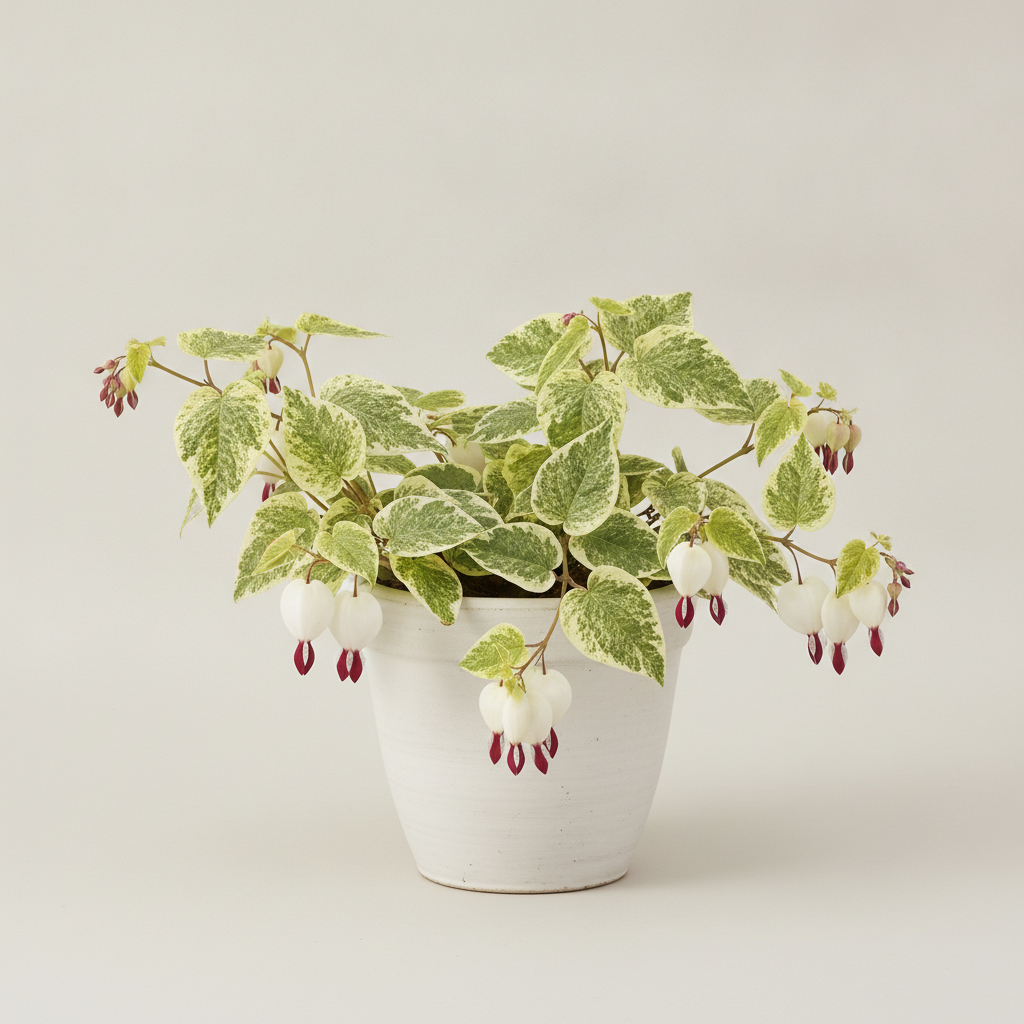
‘Variegatum’ carries the same white-and-crimson flowers as the species, but its foliage is marbled and edged in creamy yellow and pale green rather than plain dark green. The variegation gives the plant interest even out of flower, which is a real bonus for a plant that takes a leafless winter rest. It tends to grow a little more slowly than the plain green form and appreciates slightly brighter light to keep its variegation crisp, but its care is otherwise identical.
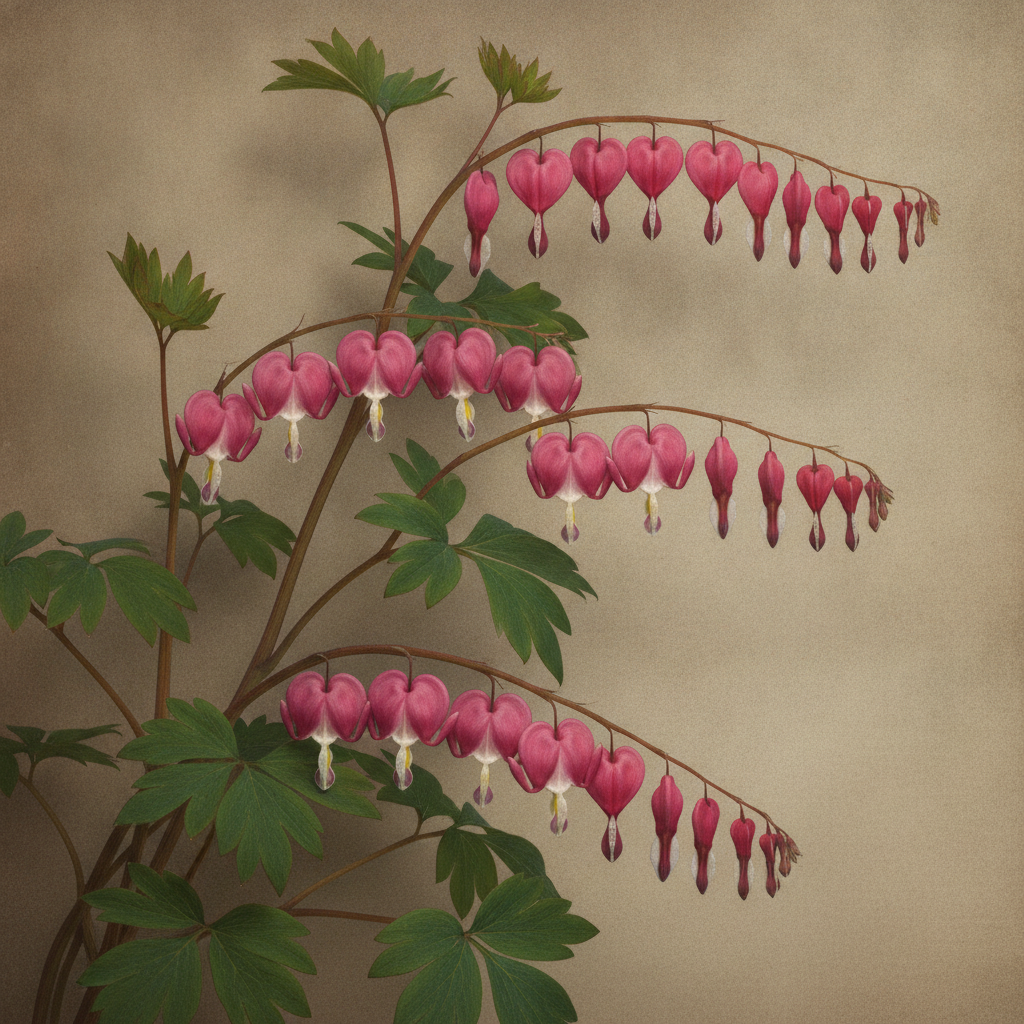
‘Delectum’, sometimes sold under the name Clerodendrum x speciosum, swaps the white calyx for a rich rosy-magenta to deep pink one, while keeping the red corolla at its centre. It is a vigorous hybrid that flowers in even larger trusses than the species, making a spectacular show on a mature plant. It is a touch more tender and more vigorous, so it benefits from firm pruning to keep it in bounds, but it is otherwise grown in exactly the same way.
Beyond these, the wider Clerodendrum genus offers relatives that the keen grower may encounter. Clerodendrum splendens, the flaming glorybower, is an all-scarlet climber, while Clerodendrum ugandense, the blue butterfly bush, bears delicate pale-blue flowers shaped like butterflies and is grown more as a shrub. None of these is quite the bleeding heart vine, but all share its general love of warmth, light and a summer feeding regime, so the care principles in this guide carry across reasonably well.
Frequently Asked Questions
Why won’t my bleeding heart vine flower?
This is the most common question by far, and the answer is almost always one of three things. The plant needs bright light to set buds, so a dim corner will give you leaves but no flowers. It needs the right food, meaning a high-potassium feed in summer rather than a nitrogen-rich one that drives leafy growth. And, crucially, it needs a cool, dry, lower-light rest over winter to trigger flowering the following season. Provide all three and a healthy plant will usually bloom. Maturity also plays a part, as very young plants sometimes simply need another year to reach flowering size.
Is the bleeding heart vine toxic to cats and dogs?
It is generally regarded as only mildly toxic rather than dangerously poisonous, but the sap can irritate skin and ingesting the leaves may cause mild stomach upset in pets or children. It is sensible to site the plant out of reach of curious cats, dogs and toddlers, and to wash your hands or wear gloves after pruning. If you suspect a pet has eaten a significant amount, contact your vet for advice.
My plant dropped all its leaves in winter. Is it dead?
Almost certainly not. The bleeding heart vine is naturally semi-deciduous and often drops some or all of its leaves during its winter rest, particularly when kept cool and on the dry side, which is exactly what you should be doing. Scratch the stem lightly with a fingernail; if it is green underneath it is alive and resting. Keep the compost barely moist, hold off feeding, and fresh growth should push from the bare stems as the days lengthen in spring.
How big does a bleeding heart vine get indoors?
Left to climb, it can easily reach two to three metres (6 to 10 feet) or more, scrambling up any support it can find. In practice most indoor growers keep it to between one and two metres by training it onto a hoop, trellis or moss pole and pruning after flowering. It also takes well to being cut back hard into a compact, bushy shrub, so you have a good deal of control over its eventual size.
When and how should I prune it?
Prune in late winter or early spring, before the new flush of growth begins. Because the plant flowers on new growth, pruning at this point encourages plenty of fresh flowering stems for the season ahead. Cut back leggy or tangled growth to shape the plant, remove any dead or weak stems entirely, and do not be afraid to be fairly bold, as the vine responds to hard pruning with vigorous regrowth. The pieces you remove can be turned into cuttings if they are healthy.
Can I grow it outdoors?
Only in genuinely frost-free, warm climates, roughly equivalent to United States hardiness zones 10 and 11, can it live outdoors year round. Everywhere cooler it is best treated as a houseplant or conservatory plant, though it enjoys being moved outside to a sheltered, partly shaded spot over the warmest summer months. Bring it back indoors well before the first cold nights of autumn, as it has no tolerance for frost and will be damaged by temperatures below about ten degrees Celsius (50 Fahrenheit).
Grown well, the bleeding heart vine is one of the most rewarding flowering climbers you can keep indoors. Give it bright light, steady moisture and feeding through the warm months, then the discipline of a genuine cool, dry winter rest, and it repays you with months of those unmistakable white lanterns and their crimson hearts. It asks a little more thought than a foliage plant, but the payoff, a curtain of living jewellery in your window, more than justifies the effort.






