
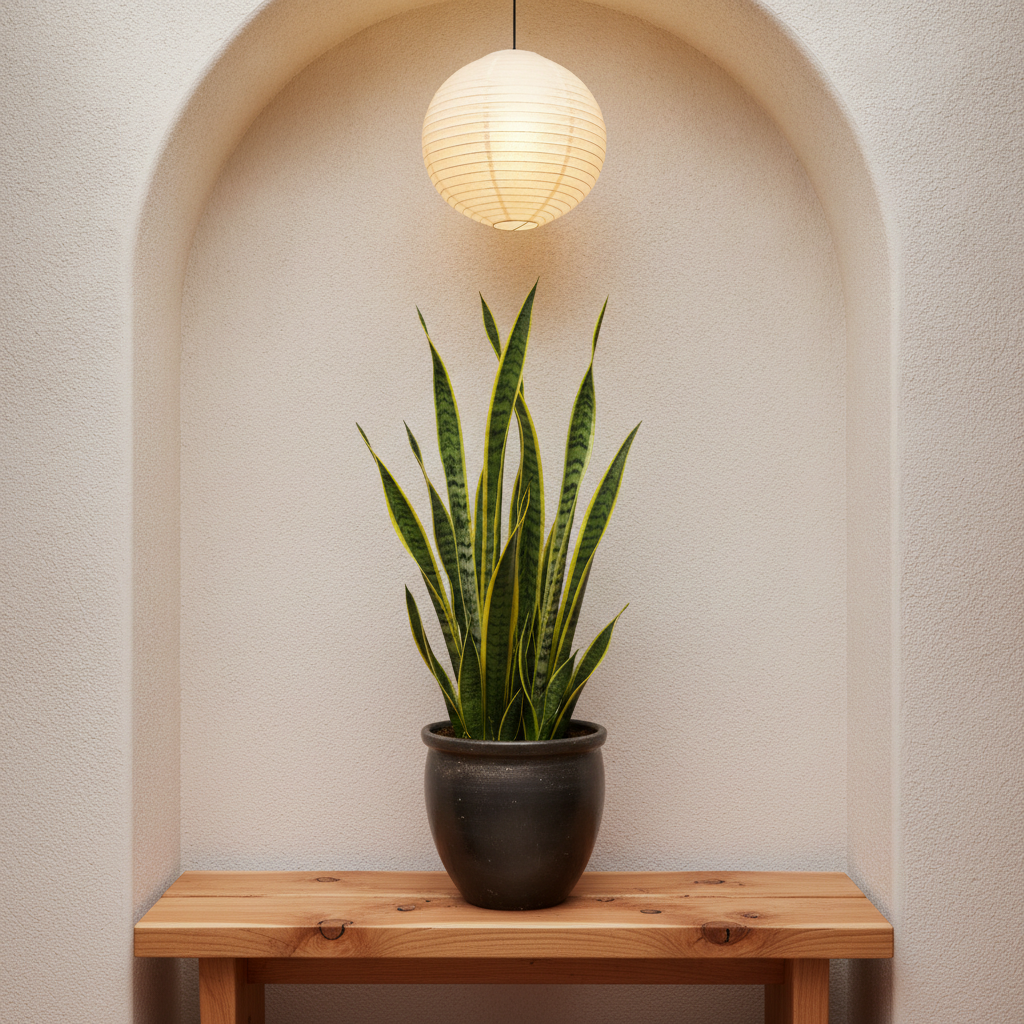
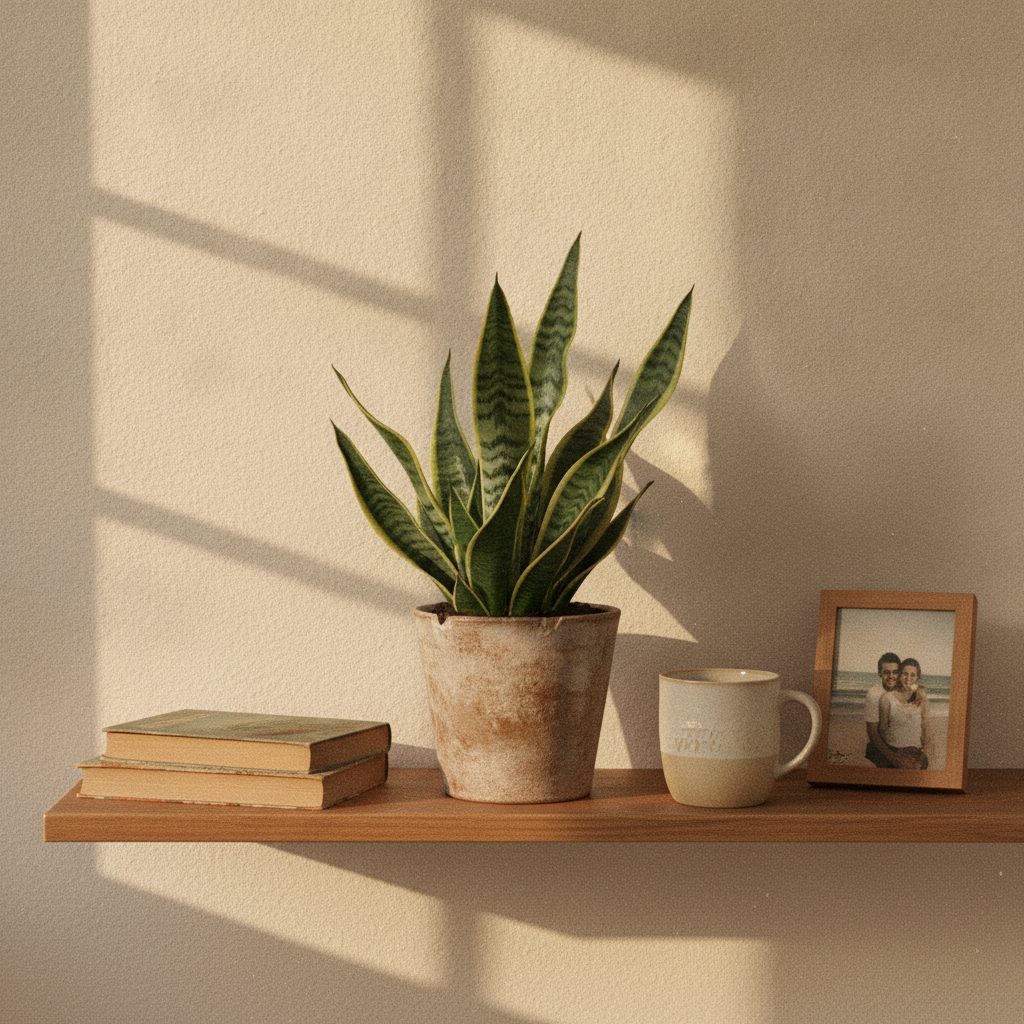
Few houseplants wear their name as plainly as the Black Gold snake plant, a striking selection of Dracaena trifasciata whose deep, almost blackish-green leaf blades are edged with a clean band of golden yellow. Known to older gardeners as Sansevieria trifasciata, and still sold under a tangle of common names including Gold Flame Sansevieria and mother-in-law’s tongue, it belongs to a group of rhizomatous evergreens native to the rocky, seasonally dry lowlands of tropical West Africa. There, it survives long rainless stretches by storing water in its thick, waxy foliage, a survival strategy that translates almost perfectly to the neglect of a centrally heated living room.
This reputation as an unkillable plant is well earned, but there is a meaningful gap between a snake plant that merely survives and one that genuinely thrives, pushing up tall new spears of well-coloured foliage each season. This guide covers everything needed to close that gap: how much light the gold margins really want, why watering is the single most common way owners lose the plant, what compost keeps the roots healthy, and how to multiply your collection without accidentally breeding out the very colour that makes this cultivar special.
Contents
- Quick Reference
- Why the Black Gold Snake Plant Makes an Ideal Houseplant
- Light Requirements
- Watering & Humidity
- Soil, Potting & Repotting
- Fertilising
- Propagation
- Pests & Diseases
- Popular Varieties
- Frequently Asked Questions
Quick Reference: Black Gold Snake Plant at a Glance
| Light | Tolerates low light, but bright indirect light keeps the gold margins vivid. A little gentle direct sun is welcome. |
| Watering | Only when the compost is fully dry, roughly every 2 to 3 weeks in summer and every 4 to 6 weeks in winter. |
| Temperature | 18 to 27 degrees Celsius (64 to 81 degrees Fahrenheit). Keep above 10 degrees Celsius (50 degrees Fahrenheit). |
| Humidity | Undemanding. Ordinary household humidity of 30 to 50 per cent is ideal. |
| Fertiliser | A dilute balanced feed once a month through spring and summer only. |
| Toxicity | Toxic to cats and dogs if chewed, and a mild irritant to people. Keep out of reach of pets. |
Why the Black Gold Snake Plant Makes an Ideal Houseplant
The appeal of the Black Gold snake plant begins with its sheer resilience. This is a plant that photosynthesises using a water-thrifty pathway known as crassulacean acid metabolism, opening its leaf pores at night rather than during the heat of the day to limit moisture loss. In practical terms, it can go weeks without water, shrug off dry indoor air, and hold its form in the dim corners where most foliage plants sulk. For a first-time plant owner, an office with erratic care, or a frequent traveller, it is one of the most forgiving choices available.

Beyond toughness, the plant earns its place on aesthetic grounds. Its strictly vertical, sword-shaped leaves form a tidy architectural fountain that reads as sculptural rather than fussy, and the golden margins catch the light in a way that lifts a dark corner. It was among the species highlighted in NASA’s Clean Air Study for its ability to take up certain airborne compounds, and while the real-world purifying effect in an ordinary room is modest, the plant does quietly release oxygen overnight, an unusual trait that makes it a popular choice for bedrooms. Add slow, undemanding growth that rarely outgrows its spot, and it is easy to see why the snake plant has stayed in continuous cultivation for well over a century.
Important — Toxicity: All parts of the snake plant contain saponins, which are toxic to cats and dogs and can cause drooling, vomiting and diarrhoea if the leaves are chewed. The sap can also irritate sensitive skin. Site the plant where curious pets and small children cannot reach it, and wash your hands after cutting the foliage.
Light Requirements
The snake plant’s famous tolerance of low light is genuine, but it is a survival trait rather than a preference. A Black Gold left in a dark hallway will persist for a long time, yet it will grow slowly, produce narrow, weakly coloured leaves, and gradually lose the crisp definition of its golden edges. To bring out the best of this cultivar, think of low light as the floor of what it will accept and bright indirect light as where it actually flourishes.
The ideal position is a spot that receives plenty of ambient brightness with a few hours of gentle, filtered sun. Unlike many delicate foliage plants, an established snake plant appreciates and can handle some direct morning light, which intensifies the contrast between the dark centre and the yellow margin. The one thing to avoid is a sudden move from deep shade into harsh, unfiltered afternoon sun, which can scorch leaves that have not had time to acclimatise.
Light Levels Explained
Because light is measured in different ways, the table below translates the common descriptive categories into approximate lux values and everyday locations, along with the outcome you can expect from the Black Gold at each level.
| Light Category | Approx. Level | Typical Location | Outcome |
|---|---|---|---|
| Direct sun | Over 50,000 lux | On a south-facing sill against the glass | Fine once acclimatised; risk of scorch if abrupt |
| Bright indirect | 10,000 to 20,000 lux | Near an east or west window | Best growth and strongest gold colour |
| Medium | 5,000 to 10,000 lux | A metre or two back from a bright window | Steady, healthy, slightly slower growth |
| Low | 1,000 to 5,000 lux | An interior wall or dim corner | Survives well; muted colour, sparse new leaves |
| Very low | Under 1,000 lux | A windowless room or deep hallway | Slow decline over months; not sustainable long term |
Window Orientation and Placement
South-facing window: The brightest option in the northern hemisphere. Excellent for a snake plant provided it sits a little back from the glass or behind a sheer curtain during the fiercest summer hours, so the leaves colour up without scorching.
East-facing window: An ideal home. The plant receives soft, cool morning sun that deepens the gold margins, followed by bright but undemanding light for the rest of the day.
West-facing window: Also very suitable, offering bright afternoon light. Watch for heat build-up close to the glass on hot days and pull the pot back slightly if the leaf tips look stressed.
North-facing window: Workable and reliable, though this is the dimmest aspect. Growth will be slow and the colour softer. Place the plant right at the window rather than back in the room to make the most of the available light.
Pro Tip — Even Growth: Snake plant leaves grow towards the brightest source, so a plant lit from one side will gradually lean. Give the pot a quarter turn every couple of weeks to keep the fan of leaves upright and symmetrical.
How Light Affects Leaf Colour
The golden margin of the Black Gold is a form of variegation, meaning those yellow zones carry less chlorophyll and rely on the green centre to feed the whole leaf. In good light the plant can afford to maintain a wide, bright band of gold. In poor light it prioritises survival, and new leaves emerge with thinner, greener margins as the plant tries to maximise its photosynthetic area. If you notice fresh growth looking plainer than the older foliage, the plant is asking for a brighter position rather than more water or feed.
Warning — Direct Sunlight: A snake plant moved suddenly from a shady spot into strong, direct summer sun can develop pale, bleached or brown scorch patches within a day or two. These marks are permanent. Always acclimatise the plant over a week or two by increasing its sun exposure gradually.
Artificial Lighting
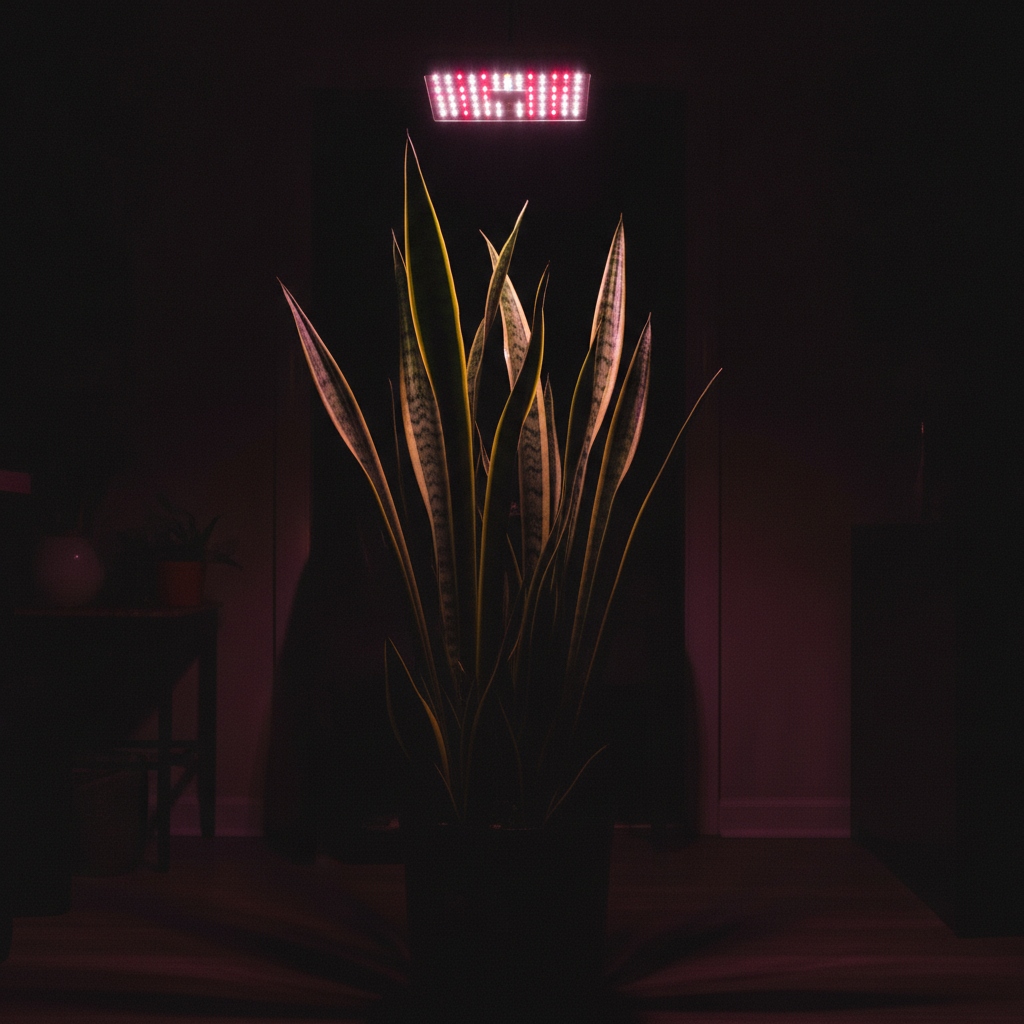
Snake plants respond well to artificial light, which makes them useful in offices and windowless rooms. A standard full-spectrum LED grow-light positioned 30 to 45 centimetres (12 to 18 inches) above the plant and run for 10 to 12 hours a day will comfortably replace a bright window. Because the plant grows slowly, even ordinary bright ceiling lighting in a busy room contributes more than you might expect.
Seasonal Adjustments
Light indoors falls sharply in winter as the sun sits lower and days shorten. A snake plant that was thriving in a medium spot through summer may need moving closer to the window from late autumn to keep it ticking over. As growth slows in the cold months, the plant needs far less water, so a brighter winter position should always be paired with a longer gap between waterings rather than the same routine as summer.
Watering & Humidity
If there is one thing that separates a healthy snake plant from a failing one, it is watering. This is a plant built for drought, and the overwhelming majority of snake plants that die are killed not by neglect but by kindness, drowned in compost that never gets the chance to dry out. The guiding principle is simple: when in doubt, do not water.
When to Water
Water only when the compost has dried out completely, from the surface right down to the base of the pot. The most reliable test is to push a finger several centimetres into the soil, or to lift the pot and judge by weight, since a dry pot is noticeably lighter. In a warm, bright room during spring and summer this typically means watering every two to three weeks, but treat that only as a starting point and let the compost, not the calendar, make the decision.
In autumn and winter, growth all but stops and the plant’s water use drops dramatically. During this period many snake plants need watering only once every four to six weeks, and some in cool rooms even less. Erring on the side of dryness through the cold months is one of the surest ways to keep the plant alive from one year to the next.
Pro Tip — The Weight Test: Get to know the weight of your pot straight after a thorough watering and again when the compost is bone dry. Once you can feel the difference by hand, you will never need a moisture meter, and you will almost never overwater again.
How to Water Correctly
- Confirm the compost is dry all the way through before you begin.
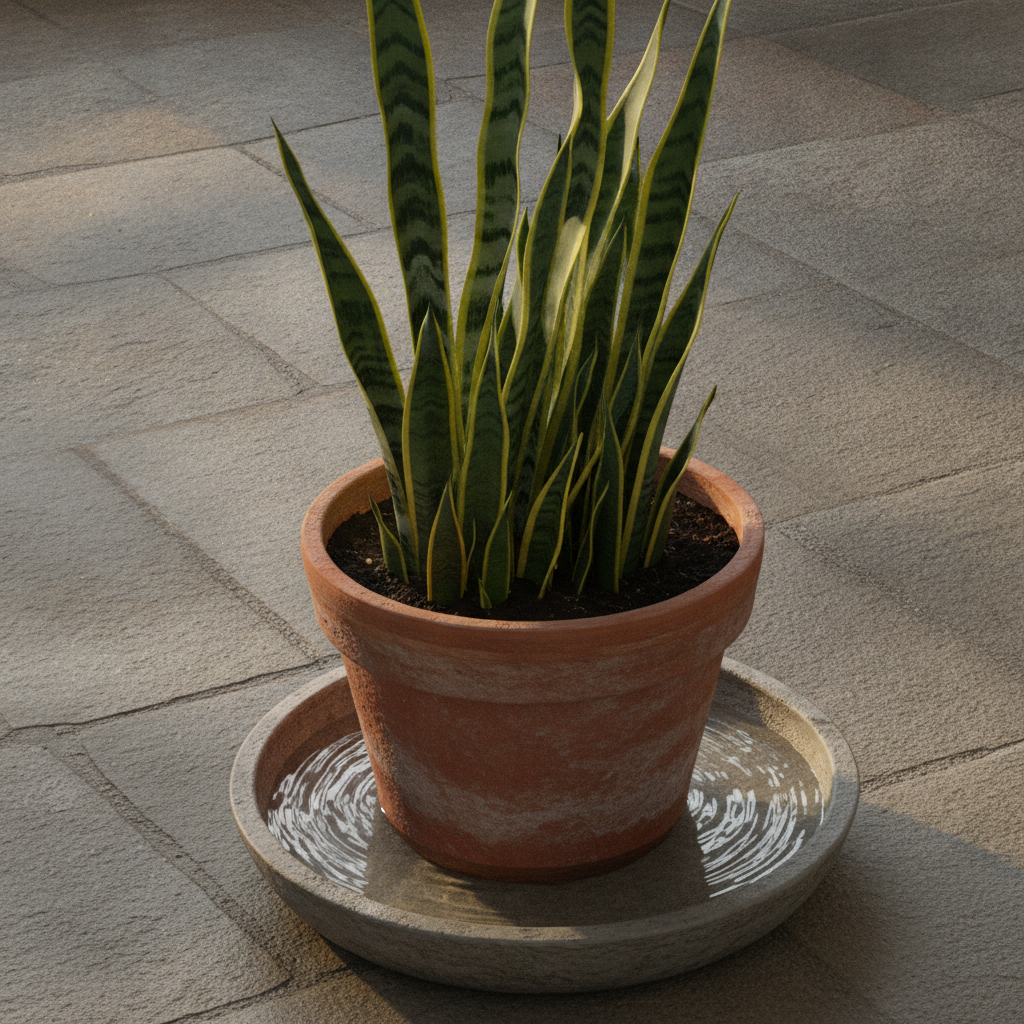
- Water the soil surface directly, avoiding the central crown where the leaves emerge, or stand the pot in a shallow dish of water to soak up from below.
- Add water until it runs freely from the drainage holes, which ensures the whole root ball is wetted.
- Let the pot drain fully for several minutes so no water is left sitting at the base.
- Empty the saucer or cache-pot completely. A snake plant must never stand in water.
- Return the plant to its spot and do not water again until the compost has dried out entirely.
Signs of Overwatering vs. Underwatering
| Symptom | Overwatering | Underwatering |
|---|---|---|
| Leaf colour | Yellowing, often at the base first | Fading to a dull, greyish green |
| Leaf texture | Soft, mushy, translucent at the base | Wrinkled, puckered or curling inwards |
| Leaf posture | Leaves topple over and flop outward | Leaves stay upright but thin and crease |
| Soil | Stays wet for weeks, may smell sour | Bone dry, pulling away from the pot sides |
| Roots and base | Brown, soft, foul-smelling rhizome rot | Firm but dry; recovers quickly once watered |
Warning — Root Rot: A snake plant whose leaves have gone soft, yellow and mushy at the base is almost certainly suffering rhizome rot from overwatering. Tip it out, cut away every soft, brown section back to firm white tissue with a clean blade, let the wounds callous for a day, and repot the healthy parts into fresh, dry, gritty compost. Caught early, the plant usually recovers.
Humidity Requirements
Humidity is refreshingly simple with this plant. Coming from a climate with long dry seasons, the Black Gold is perfectly content in the 30 to 50 per cent humidity found in most homes, and it has no need of misting, pebble trays or a humidifier. This tolerance of dry air is a large part of why it copes so well next to radiators and in air-conditioned offices where more tropical plants struggle.
Problems attributed to low humidity, such as brown leaf tips, are far more often caused by inconsistent watering, a build-up of mineral salts, or fluoride and chlorine in tap water. It is worth checking those factors before assuming the air is at fault, because raising humidity for a snake plant is almost never the solution and can in fact encourage fungal issues.
If anything, the plant prefers good air circulation to high humidity. A gently ventilated room helps the compost dry at a healthy pace and keeps the crown free of the stagnant, damp conditions that invite rot, so there is rarely any reason to increase the moisture in the air around it.
Water Quality
Snake plants are moderately sensitive to the fluoride and chlorine in some tap water, which can accumulate and contribute to brown leaf tips over time. If your area has heavily treated or very hard water and you notice tip browning, switch to rainwater, distilled water or tap water that has been left to stand overnight. For most households, ordinary tap water applied on a strict dry-out cycle causes no trouble at all.
Soil, Potting & Repotting
The right compost does more of the work of keeping a snake plant alive than any watering schedule, because a freely draining mix forgives the occasional heavy hand while a dense, water-retentive one punishes it. The aim is a gritty, open medium that holds just enough moisture to sustain the plant between waterings and then dries out quickly and completely.
Ideal Soil Composition
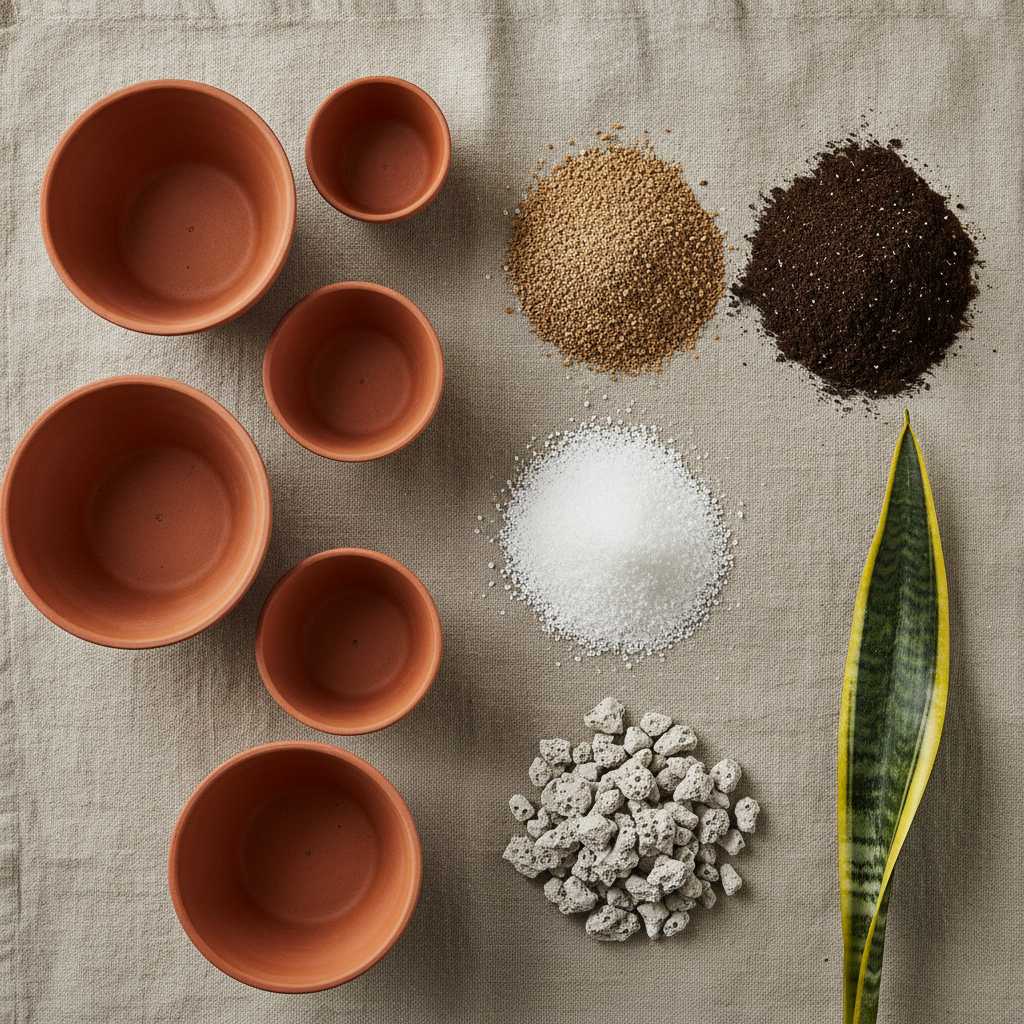
The simplest reliable approach is to start with a proprietary cactus and succulent compost and open it up further with additional grit and perlite. Ordinary multipurpose potting compost used on its own holds far too much water for this plant and is the leading cause of rot. The table below shows a proven blend that suits the Black Gold in an average indoor setting.
| Component | Proportion | Function |
|---|---|---|
| Cactus and succulent compost | Half | Base structure and modest moisture retention |
| Coarse grit or coarse sand | One quarter | Weight, drainage and air spaces around roots |
| Perlite or pumice | One quarter | Keeps the mix open and fast-draining |
Snake plants prefer a slightly acidic to neutral compost, roughly in the pH range of 5.5 to 7.5, which most peat-free and cactus mixes fall within naturally. There is no need to test or adjust pH for a plant this adaptable; getting the drainage right matters far more than fine-tuning the chemistry.
Pro Tip — Quick Mix Recipe: No cactus compost to hand? Mix two parts ordinary peat-free potting compost with one part perlite and one part coarse grit or horticultural sand. This rough-and-ready blend drains well enough to keep a snake plant happy for years.
Choosing the Right Pot
The container matters as much as its contents. Snake plants have vigorous, spreading rhizomes that are surprisingly powerful, and a well-chosen pot supports both healthy roots and the plant’s top-heavy, upright habit.
Drainage holes are non-negotiable. Whatever pot you choose, it must have holes in the base. Without them, water collects at the bottom and the rhizome sits in a reservoir it cannot escape, which is the fastest route to rot. Decorative pots without drainage should only ever be used as an outer cover for a plain pot that can be lifted out to water.
Pot material: Terracotta is an excellent match for snake plants because its porous walls wick moisture out of the compost and let it breathe, buffering against overwatering. Glazed ceramic and plastic hold moisture longer, so if you use them, be even stricter about letting the compost dry. Heavy materials such as terracotta or stoneware also add welcome ballast to a tall, leaf-heavy plant.
Pot size: Choose a pot only slightly larger than the root ball. Snake plants actually flower and grow best when a touch pot-bound, and an oversized container holds a large volume of slow-drying compost that raises the risk of rot. When you do move up, increase the pot diameter by just 2 to 4 centimetres (1 to 2 inches).
When to Repot
Because it enjoys tight quarters and grows slowly, the Black Gold needs repotting only every two to three years, or when clear signs appear: roots creeping out of the drainage holes, the rhizomes visibly pushing the plant up and out of the pot, or in extreme cases the strong roots cracking a plastic or even terracotta container. Spring, at the start of the growing season, is the best time to repot so the plant can settle in while actively growing.
How to Repot: Step-by-Step
- Water lightly a day or two beforehand only if the plant is completely dry, which makes it easier to remove; otherwise repot dry.
- Ease the plant out by tipping the pot and supporting the base of the leaves, rather than pulling on the foliage.
- Gently tease away the old compost from the rhizomes and inspect the roots, trimming any that are soft, brown or rotten.
- Add a layer of fresh gritty mix to the new pot and position the plant at the same depth it sat before, with the rhizome tops at or just below the surface.
- Fill around the root ball with fresh compost, firming lightly to remove large air pockets without compacting the mix.
- Resist watering for at least a week to let any disturbed or cut roots callous over, then resume the normal dry-out cycle.
Warning — Transplant Shock: Watering a freshly repotted snake plant straight away is a common mistake. Damaged roots exposed to moist compost rot easily, so keeping the plant dry for the first week after repotting is essential, not optional.
Fertilising
Snake plants are light feeders, adapted to poor, rocky soils, and they need only a modest amount of supplementary nutrition to grow well. Overfeeding does far more harm than underfeeding, encouraging weak, floppy growth and allowing mineral salts to build up in the compost. A restrained approach produces the strongest, best-coloured foliage.
Feeding should be confined to the active growing season of spring and summer. Through autumn and winter the plant is effectively dormant and cannot use the nutrients, so any fertiliser applied then simply accumulates as salt around the roots and can scorch them.
Understanding Plant Nutrients
Fertilisers are labelled with an NPK ratio showing the percentages of nitrogen, phosphorus and potassium, the three nutrients plants use in the largest quantities. A balanced houseplant feed with roughly equal proportions, or one slightly lower in nitrogen, suits the snake plant well. The table below summarises the key nutrients and the symptoms that appear when each runs short.
| Nutrient | Symbol | Primary Function | Deficiency Symptoms |
|---|---|---|---|
| Nitrogen | N | Leaf growth and green pigment | Pale, slow, stunted new leaves |
| Phosphorus | P | Root development and flowering | Weak roots, poor establishment |
| Potassium | K | Overall vigour and water regulation | Yellowing or browning leaf edges |
| Calcium | Ca | Cell wall structure | Distorted or weak new growth |
| Magnesium | Mg | Core of the chlorophyll molecule | Yellowing between leaf veins |
| Iron | Fe | Chlorophyll production | Pale new leaves with green veins |
Types of Fertiliser
Liquid fertilisers: The easiest option to control. Diluted into the watering can, they deliver nutrients immediately and are simple to stop over winter. For a snake plant, always dilute to half the strength stated on the label.
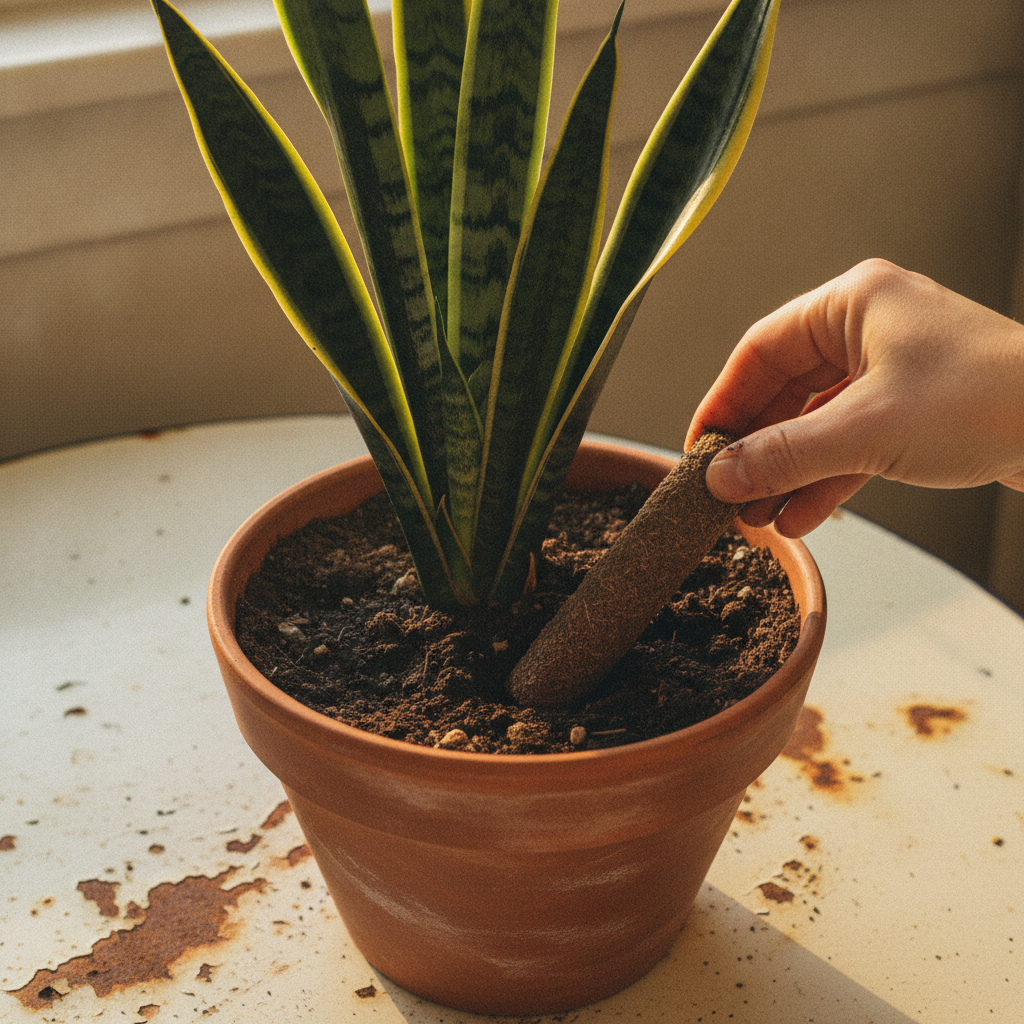
Slow-release granular: Coated prills or pushed-in sticks that release nutrients gradually over several months. Convenient, but harder to fine-tune, so use them at the lower end of the recommended rate and only in spring.
Organic fertilisers: Gentle options such as worm castings or diluted seaweed feed release nutrients slowly and are very hard to overdo, which suits a plant this sensitive to excess. They also help sustain healthy soil life.
Feeding Schedule
A single dilute feed once a month from spring through late summer is plenty for a Black Gold snake plant. That amounts to only three or four feeds across the whole year. Never fertilise a dry plant, as concentrated nutrients against dry roots can burn them; always feed onto compost that is already lightly moist, or feed straight after watering.
Pro Tip — Less Is More: When it comes to snake plants, half-strength feed given half as often as you think is the safe rule. If you ever have to choose between skipping a feed and giving an extra one, always skip it. This plant tolerates hunger far better than excess.
How to Fertilise
- Check that the season is spring or summer and that the plant is in active growth.
- Dilute a balanced liquid houseplant feed to half the recommended strength.
- Ensure the compost is already lightly moist, or water first and feed afterwards.
- Apply the diluted feed evenly to the soil, keeping it off the leaves and away from the central crown.
- Flush the pot thoroughly with plain water every few months to wash out any accumulated salts.
Warning — Salt Build-Up: A white or yellowish crust on the soil surface or around the pot rim signals a build-up of fertiliser salts. Left unchecked this scorches roots and browns leaf tips. Leach the compost by running plenty of plain water through it until it drains freely, and ease off the feeding.
Propagation
Propagating a snake plant is straightforward and satisfying, but with a variegated cultivar like the Black Gold there is one crucial catch that catches many people out. The golden margin is what botanists call a chimeric variegation, held in specific cell layers of the plant. It is passed on faithfully by division, which keeps whole growing points intact, but it is lost when the plant is grown from a leaf cutting.
In practice this means that if you slice a leaf into sections and root them, the new plants will almost always come up plain green, having grown from the inner tissue that does not carry the gold. To keep the striking colour of the Black Gold, division is the method to use. Leaf cuttings are still worth knowing for the sheer novelty and for plain-green types, so both methods are covered below.
Understanding Rhizomes and Pups
Snake plants spread by underground rhizomes, thick horizontal stems that store energy and send up new fans of leaves, known as pups, at intervals. A mature plant is really a colony of these connected growing points sharing one root system. Because each pup already carries the full leaf structure, including the variegated layers, separating them is what preserves the gold and lets you multiply the plant true to type.
Division: Step-by-Step
Division is the reliable way to make more Black Gold snake plants while keeping their colour, and it is best done in spring when repotting anyway.
- Slide the whole plant out of its pot and brush the compost away from the rhizomes so you can see the growing points clearly.
- Identify natural divisions where a pup or cluster of leaves has its own section of rhizome and roots.
- Cut cleanly through the rhizome with a sterilised sharp knife, ensuring each division keeps at least one healthy leaf fan and a portion of roots.
- Leave the cut divisions somewhere dry and shaded for a day so the wounds callous over.
- Pot each division into fresh gritty compost at its original depth, in a pot only slightly larger than its roots.
- Wait a week before the first watering, then care for each division exactly as you would an established plant.
Pro Tip — Keep the Gold: Always propagate a Black Gold by division rather than leaf cuttings. Division carries the variegated cell layers intact, so the new plants keep their golden margins, whereas leaf cuttings will almost always revert to plain green.
Leaf Cuttings: Step-by-Step
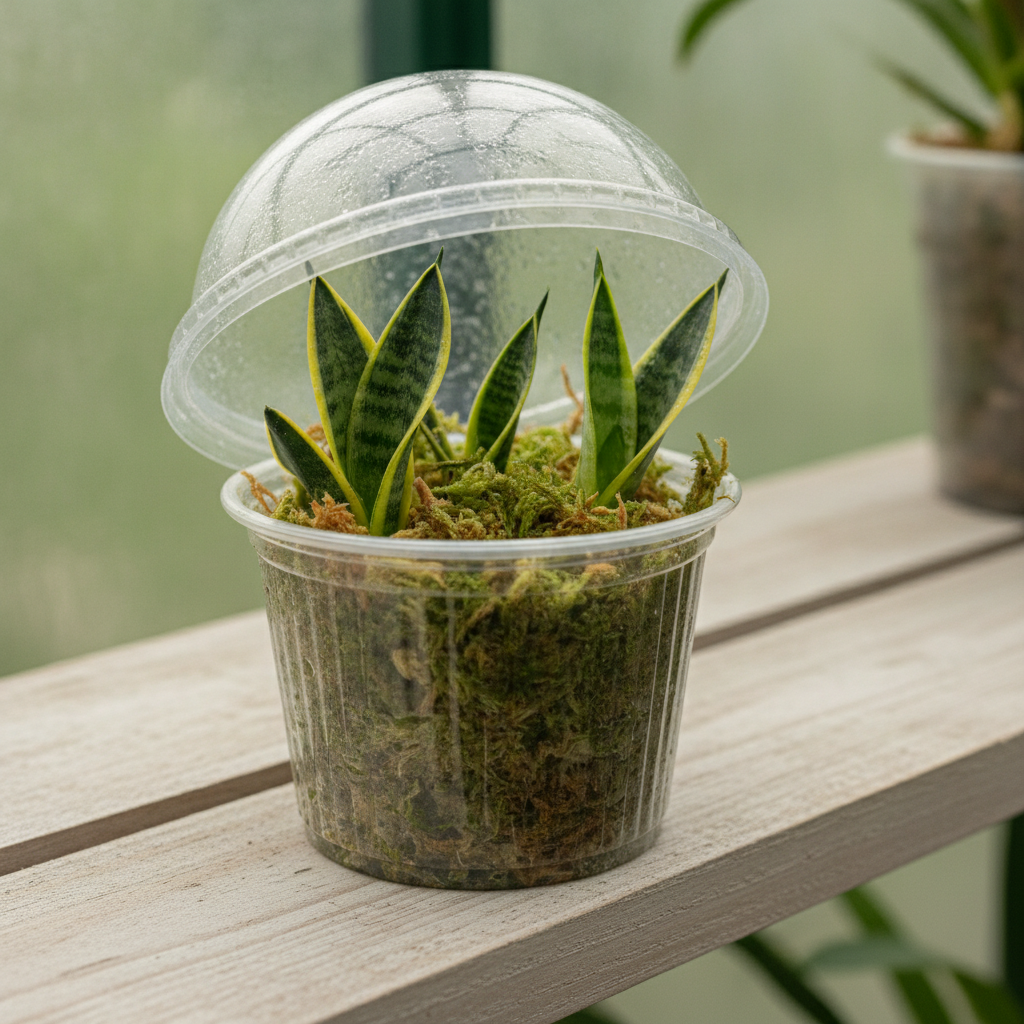
Leaf cuttings are the classic snake plant party trick and work well for solid-green plants, though remember the new plants will lose the gold. They can be rooted in either water or moist medium.
- Choose a healthy, mature leaf and cut it away at the base with a clean, sharp blade.
- Slice the leaf crossways into sections roughly 5 to 8 centimetres (2 to 3 inches) long, and note which end of each section was the lower end, as it must be planted that way up.
- Leave the sections to callous in a dry spot for one to two days to seal the cut surfaces.
- Insert the lower edge of each section about 2 centimetres (1 inch) into moist gritty compost or damp sphagnum moss, keeping the correct orientation.
- Place in warm, bright indirect light and keep the medium barely moist, never wet.
- Be patient; roots take several weeks and new pups can take a couple of months or more to appear.
Troubleshooting Propagation
| Problem | Likely Cause | Solution |
|---|---|---|
| Cuttings rot before rooting | Medium kept too wet, or cut end not calloused | Let cuttings dry longer and keep medium barely moist |
| New plants come up plain green | Grown from leaf cuttings, which lose variegation | Use division instead to preserve the gold margin |
| Nothing happens for months | Cool temperatures or very low light | Move somewhere warm and bright, and simply wait |
| Section planted upside down | Orientation reversed after cutting | Always mark the lower end before slicing the leaf |
Pests & Diseases
The Black Gold snake plant is one of the least troubled houseplants you can grow. Its tough, waxy leaves deter most insects, and the vast majority of problems owners encounter are not pests or disease at all but the consequences of overwatering. Still, a few pests do occasionally appear, usually on plants that are stressed or growing alongside more vulnerable neighbours.
The single most important disease to understand is root and rhizome rot, which is why it appears first below. Almost everything that goes seriously wrong with a snake plant traces back to compost that stayed too wet for too long, so prevention rests far more on your watering habits than on any spray.
Common Pests
Mealybugs (Pseudococcidae)
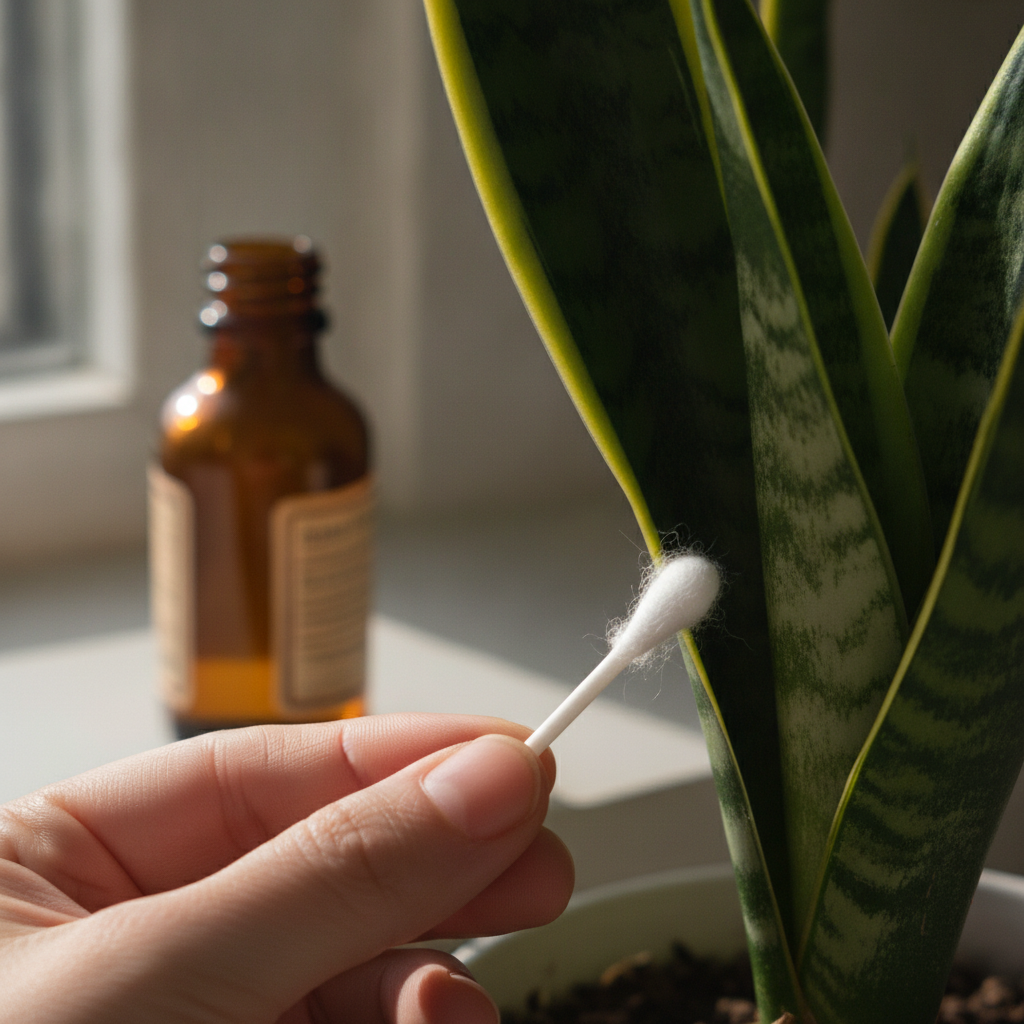
The most likely pest on a snake plant, mealybugs appear as small, white, cottony blobs tucked into the leaf axils and along the bases of the leaves. They suck sap, weakening the plant and leaving sticky honeydew behind.
Treatment: Dab each insect directly with a cotton bud dipped in isopropyl alcohol, which kills them on contact. For larger outbreaks, wipe the leaves with diluted neem oil or an insecticidal soap and repeat weekly until no new bugs appear.
Spider Mites (Tetranychus urticae)
Rare on snake plants but possible in hot, dry conditions, spider mites are tiny and hard to see, betrayed mainly by fine webbing and faint pale stippling on the leaves. They thrive when a plant is dusty and neglected.
Treatment: Wipe the foliage with a damp cloth to remove mites and webbing, then treat with neem oil or insecticidal soap. Improving air circulation and keeping the leaves clean discourages their return.
Scale Insects (Coccoidea)
Scale shows up as small, flat or domed brown bumps clinging to the leaves, often mistaken at first for natural markings. Like mealybugs they feed on sap and can slowly sap a plant’s vigour if left to multiply.
Treatment: Scrape or rub the scales off gently with a fingernail or an alcohol-dipped cotton bud, then follow up with neem oil to catch the mobile juveniles. Persistent checking over several weeks is key.
Common Diseases
Root and Rhizome Rot (Fusarium and Pythium species)
By far the most serious and most common problem, rot sets in when the rhizome sits in wet compost. The base of the leaves turns soft, yellow and mushy, often with a foul smell, and affected leaves topple away from the centre.
Treatment: Unpot the plant, cut away all soft, discoloured tissue back to firm white flesh with a sterilised blade, and discard the ruined compost. Let the healthy sections callous for a day, then repot into fresh, dry, gritty mix and hold off watering for a week or more.
Southern Blight (Sclerotium rolfsii)
A less common fungal disease favoured by warm, humid, stagnant conditions, southern blight appears as a white, thread-like fungal growth around the base of the plant, sometimes with small tan spore bodies. It causes the lower leaves to collapse.
Treatment: Remove and destroy affected tissue and the surrounding compost promptly, improve air circulation, and let the plant dry out thoroughly. Severely affected plants are best salvaged by taking clean divisions from unaffected growth.
Pest and Disease Summary
| Pest / Disease | Identification | Treatment |
|---|---|---|
| Mealybugs | White cottony clumps in leaf axils | Alcohol on a cotton bud, then neem oil |
| Spider mites | Fine webbing and pale stippling | Wipe leaves, treat with neem or soap |
| Scale | Small brown bumps on leaves | Scrape off and follow up with neem oil |
| Root and rhizome rot | Soft, yellow, smelly leaf bases | Cut out rot, repot dry, withhold water |
| Southern blight | White threads and tan bodies at the base | Remove tissue, dry out, divide clean growth |
Prevention Strategies
Prevention comes down to a handful of good habits. Water only when the compost is fully dry, use a gritty free-draining mix in a pot with drainage, and keep the leaves clean and the air moving. Inspect new plants before bringing them home and, ideally, keep them apart from your collection for a couple of weeks so any hidden pests reveal themselves before they can spread.
A healthy, well-lit, correctly watered snake plant has strong natural defences, so the best pest control of all is simply keeping the plant unstressed. Wiping the leaves every few weeks not only keeps them glossy and photosynthesising well but also gives you a regular chance to spot trouble while it is still easy to deal with.
Pro Tip — Isolate and Inspect: Whenever you notice a pest, move the affected plant away from its neighbours straight away. Snake plants are rarely the source of an infestation, so an outbreak usually means a nearby plant is harbouring the pest and needs treating too.
Popular Varieties
The Black Gold sits within an unusually varied family of snake plants, and part of the fun of growing one is discovering how many distinct forms the species offers. From tall gold-edged classics to compact rosettes and cylindrical spears, they all share the same easy-going care, which makes building a collection almost effortless.
The varieties below are among the most widely available and most often confused with the Black Gold, since several share its dark leaves and yellow margins. The table gives a quick comparison before two of the closest relatives are looked at in more detail.
| Variety | Leaf Appearance | Light Needs | Growth Rate | Availability |
|---|---|---|---|---|
| Black Gold | Dark green centre, broad gold margin | Low to bright indirect | Slow | Common |
| Laurentii | Green banding, wide bright yellow edge | Low to bright indirect | Slow to moderate | Very common |
| Futura Superba | Short, wide, silvery-green with yellow edge | Low to bright indirect | Slow | Common |
| Black Coral | Dark green with pale grey cross-banding | Low to bright indirect | Slow | Common |
| Moonshine | Broad, pale silvery-green, no yellow | Bright indirect preferred | Slow | Common |
| Hahnii (Bird’s Nest) | Compact low rosette of short leaves | Low to bright indirect | Slow | Very common |
| Cylindrica | Round, spear-like cylindrical leaves | Bright indirect preferred | Slow | Common |
Featured Varieties
Laurentii
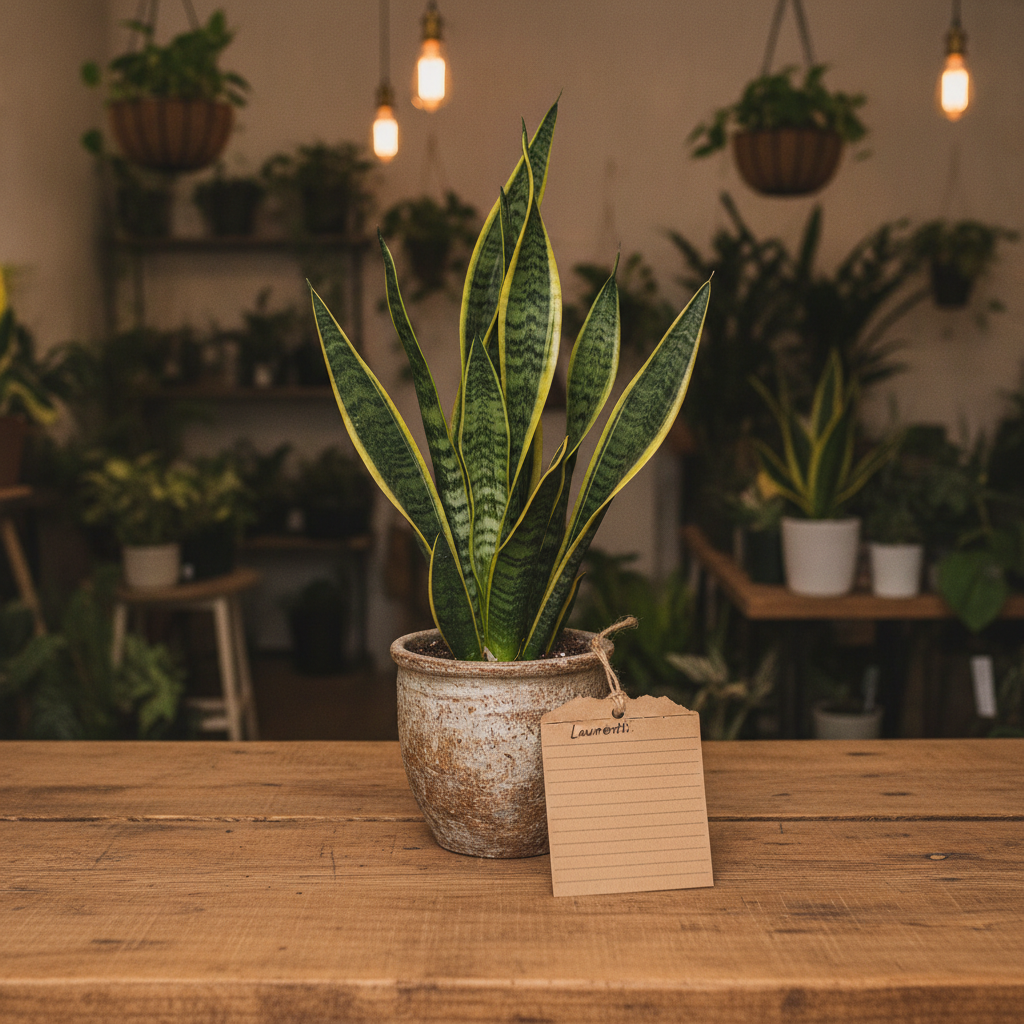
The definitive gold-edged snake plant and the Black Gold’s closest cousin, Laurentii carries broad, bright yellow margins around a green centre patterned with pale cross-banding. It is the variety most people picture when they hear the name.
Futura Superba
A more compact selection with shorter, wider leaves in silvery grey-green, edged with a thin creamy-yellow margin. Its stockier proportions make it a good choice for shelves and smaller spaces where a tall Laurentii would be unwieldy.
Variety Profiles in Detail
Laurentii (Dracaena trifasciata ‘Laurentii’)
Introduced to European horticulture in the early twentieth century, Laurentii was the first widely grown variegated snake plant and remains the benchmark. Its tall, upright leaves reach 60 to 90 centimetres (24 to 36 inches) and, like the Black Gold, it must be propagated by division to keep its yellow margins. The two are so alike that the names are sometimes used interchangeably in the trade, though Black Gold selections tend to show darker centres and a slightly cleaner gold band.
Futura Superba (Dracaena trifasciata ‘Futura Superba’)
Futura Superba is a modern, compact answer to the classic tall varieties. Its leaves are noticeably shorter and broader, forming a denser, more rounded plant that stays neat on a windowsill or shelf. The silvery mottling across the leaf, combined with a fine yellow edge, gives it a softer look than the bold Black Gold, while its care is identical in every respect.
Choosing the Right Variety for Your Space
Choosing between snake plant varieties is mostly a question of scale and light. For a bold floor-standing statement in a bright corner, the tall Black Gold or Laurentii are hard to beat. For a shelf, desk or grouped display, compact forms such as Futura Superba or the low Hahnii rosette fit better. If your space is genuinely dim, any of the green-and-gold types will cope, while the silvery Moonshine and cylindrical forms reward a brighter position with better colour and firmer growth.
Frequently Asked Questions
Why are the new leaves on my Black Gold coming up plain green?
This usually points to insufficient light. In dim conditions the plant produces greener, less variegated leaves to maximise photosynthesis. Move it somewhere brighter and subsequent growth should show a stronger gold margin. If the plain leaves came from a leaf cutting, however, the loss of colour is permanent, because leaf cuttings do not carry the variegation.
How often should I water a snake plant?
Only when the compost has dried out completely, which typically means every two to three weeks in summer and every four to six weeks in winter. Rather than following a fixed schedule, check the soil each time and water only once it is dry all the way through. When unsure, wait a few more days.
Why are my snake plant’s leaves falling over?
Leaves that flop outward from the centre are the classic sign of overwatering and the beginnings of rhizome rot. Check the base of the leaves and the compost; if they are soft or the soil is wet and sour, act quickly to cut out any rot and repot into dry, gritty mix. Very low light causing weak, etiolated growth can also make leaves lean.
Is the Black Gold snake plant safe for cats and dogs?
No. Like all snake plants it contains saponins that are toxic to cats and dogs, causing drooling, vomiting and diarrhoea if chewed. It is generally considered mildly toxic rather than life-threatening, but it is best kept well out of reach of pets, and any suspected ingestion warrants a call to your vet.
Can a snake plant really survive in low light?
Yes, it is one of the very few genuinely low-light-tolerant houseplants, which is a large part of its popularity. That said, tolerating low light is not the same as preferring it. In dim conditions the plant grows slowly and its colour fades, so for the best appearance give it bright, indirect light even though it will endure far less.
Why does my snake plant have brown leaf tips?
Brown tips are usually caused by inconsistent watering, whether periods of complete drought or occasional overwatering, and sometimes by a build-up of mineral salts or fluoride from tap water. Settle into a steady dry-out watering routine, flush the compost with plain water now and then, and consider using rainwater or filtered water if your tap water is heavily treated.
Does the Black Gold snake plant flower?
It can, though flowering indoors is uncommon and unpredictable. A mature, slightly pot-bound plant in good light may occasionally send up a tall spike of small, fragrant, greenish-white flowers. Flowering does not harm the plant, and while you cannot force it reliably, providing bright light and leaving the plant undisturbed in its pot gives the best chance.
How fast does a snake plant grow?
Slowly. In good conditions expect only a few new leaves each year, and growth is concentrated in the warm months of spring and summer. Brighter light and the warmer end of the temperature range speed things up a little, but this is fundamentally an unhurried plant, and its slow pace is one reason it stays looking tidy for so long.
Do I need to mist my snake plant?
No, and you should not. Snake plants are adapted to dry air and are perfectly happy at normal household humidity. Misting does nothing useful and, by leaving water sitting in the crown and on the leaves, can actually encourage rot and fungal spots. Keep the foliage dust-free with an occasional wipe instead.
Should I cut off a damaged snake plant leaf?
Yes, if a leaf is badly damaged, rotting or unsightly, cut it off cleanly at the base with a sterilised blade. Snake plant leaves do not heal or regrow from a cut point, so trimming a tip only leaves a blunt end; removing the whole leaf at the base keeps the plant tidy and lets its energy go into healthy new growth.






