
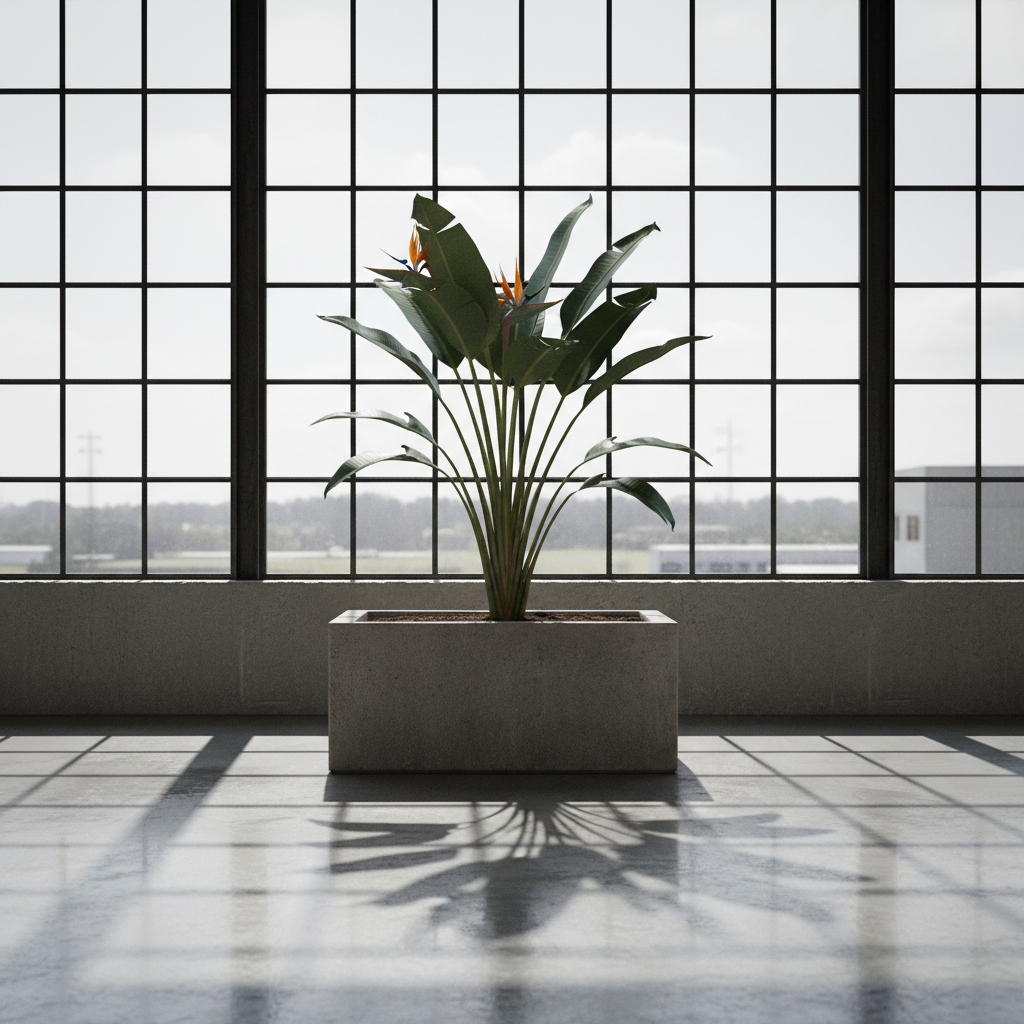
Few houseplants command a room the way the bird of paradise (Strelitzia reginae) does. Born on the rocky coastal scrub of South Africa’s Eastern Cape, it grew up in full sun, brisk wind and lean soil, and it carries that bearing indoors: tall paddle leaves held aloft on long petioles, fanning open into a sculpted clump that throws hard shadows across whatever it stands on. Where most foliage plants whisper, this one declares.
That same toughness is also why so many indoor specimens look sullen rather than splendid. The bird of paradise will survive an astonishing amount of neglect, but to thrive it asks for the same things it had at home: brilliant light, generous root run, deep soakings between dry spells, and time. This guide walks through every lever you can pull to coax a healthy clump out of an undersized pot, and, with patience, into producing the famous crested orange-and-blue inflorescence that gave the plant its name.
Quick Reference
Use the table below as a one-glance summary, then read the relevant section for the detail behind each setting. Anchor links jump straight to the topic.
- Why grow a bird of paradise indoors
- Light
- Watering
- Soil and potting
- Fertilising
- Propagation
- Pests, problems and troubleshooting
- Notable varieties and relatives
- Frequently asked questions
| Botanical name | Strelitzia reginae |
| Family | Strelitziaceae |
| Common names | Bird of paradise, crane flower |
| Native range | Coastal Eastern Cape and KwaZulu-Natal, South Africa |
| Mature size indoors | 1.2 to 2 metres tall (4 to 6.5 ft), forming a fan 1 metre (3.3 ft) wide |
| Growth habit | Clumping evergreen perennial, no true trunk, leaves emerge from a stout rhizome |
| Light | Bright direct sun for at least 4 to 6 hours a day; tolerates very bright indirect but will not bloom |
| Watering | Soak thoroughly, then let the top 5 to 7 cm (2 to 3 in) of soil dry before watering again |
| Humidity | Average household, 40 to 60 percent; tolerant of dry air |
| Temperature | 18 to 27 degrees Celsius (65 to 80 Fahrenheit); avoid sustained exposure below 10 degrees Celsius (50 Fahrenheit) |
| Soil | Rich, loam-based, free-draining; aim for a peat-free mix with grit, bark and perlite |
| Feeding | Balanced liquid feed every 2 to 4 weeks in spring and summer; stop in winter |
| Propagation | Division of rhizome clumps in spring; rarely from seed (slow) |
| Toxicity | Mildly toxic to cats, dogs and humans if eaten; seeds especially so |
| Time to first bloom | 4 to 7 years from seed, 3 to 5 from a sizeable division |
Why Grow a Bird of Paradise Indoors
The bird of paradise occupies a rare niche among houseplants: it is one of very few large indoor specimens that combines sculptural drama, genuine flowering potential and a forgiving constitution. Its long oblong leaves, each held on its own erect petiole, rise from the base in a flat fan rather than spreading horizontally like a fiddle leaf fig or weeping fig, so the plant fills vertical space without devouring floor area. In a corner with good light, a five-year-old clump reads as part-sculpture, part-architecture.
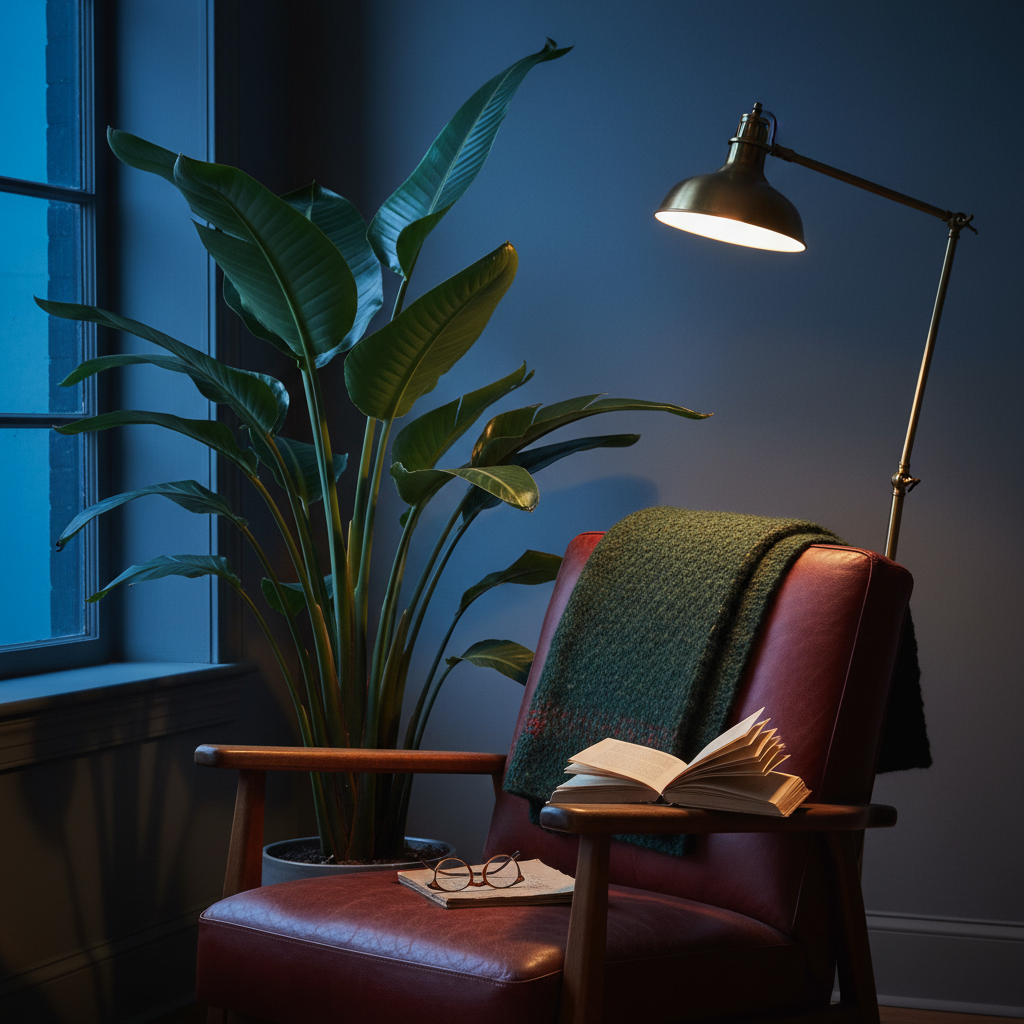
The reward most owners are chasing is the flower itself, a crested inflorescence shaped like a long-beaked bird in profile, the green and pink boat-shaped spathe cradling a sequence of brilliant orange sepals and arching cobalt blue petals. Each spathe produces several flowers in succession, and a mature plant in bright light can throw multiple inflorescences a year. The species is South Africa’s national flower for good reason, and even outside its bloom cycle the foliage alone earns its keep.
What makes it suitable for indoor growing is its underlying toughness. Originating in a Mediterranean-like climate of bright sun, mild winters and seasonal rainfall, it tolerates the dry air of centrally heated rooms, the long stretches between waterings that holidays impose, and the moderate temperature swings of a typical home. It is not, however, a low-light plant or a “stick it in the corner and forget about it” plant in the manner of a ZZ plant or pothos. Without strong, sustained light it will neither bloom nor produce vigorous new leaves, and it can decline slowly enough that the owner does not notice until the clump has lost half its presence.
Pro Tip — Buy with bloom potential in mind: A bird of paradise needs a substantial rhizome and at least 6 to 10 mature leaves before it can flower. If your goal is blooming, choose the largest specimen you can house and place rather than starting with a juvenile, which may need 3 to 5 more years of growth before producing its first inflorescence.
Light
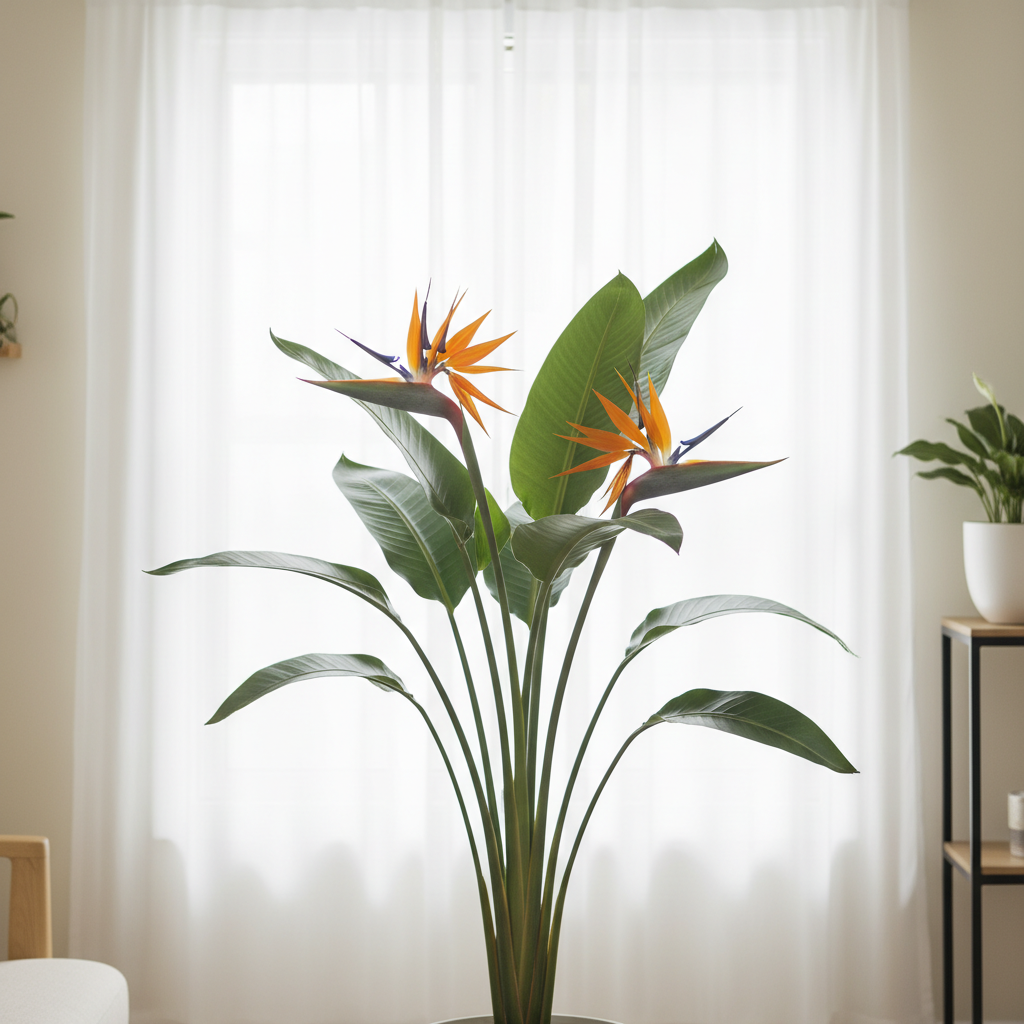
Light is the single largest factor separating a bird of paradise that thrives from one that merely persists. In its native habitat the plant grows in open coastal scrub with full unobstructed sun for most of the day. Indoors, you should aim to come as close to that as your space allows. A south or south-west facing window with the plant standing within 1 metre (3.3 ft) of the glass is ideal in the northern hemisphere; in the southern hemisphere, choose a northerly aspect. East-facing positions work for keeping the plant alive but rarely deliver enough cumulative light for flowering.
For a working rule of thumb, the leaves should cast a sharp, clearly defined shadow during the brightest part of the day. A soft, fuzzy shadow indicates the plant is in indirect light and will grow only slowly. A pale, lavender shadow on the floor at noon suggests the plant is in dim conditions that will lead to slow decline of older leaves over months. In a measured space the foliage prefers around 20,000 to 50,000 lux for sustained periods, levels which usually require unobstructed window glass and minimal shading from neighbouring buildings or trees.
Acclimatisation matters. A bird of paradise that has lived in a shaded plant nursery or a dimmer interior position will scorch if moved abruptly to full midday sun behind glass, which acts as a magnifying lens. Move the plant a metre at a time, every week or two, towards its eventual bright spot, and during the first two weeks in a new position shield it during the harshest two hours around solar noon with a sheer curtain. After about a month the older leaves will have adjusted their internal chlorophyll arrangement and you can remove the shading.
If you cannot offer good natural light, supplemental lighting is a genuine option for this species. A single 30 to 50 watt full-spectrum LED panel positioned 30 to 60 cm (12 to 24 in) above the canopy and running on a timer for 12 to 14 hours a day can carry the plant through dark Scandinavian or British winters and, in a windowless room, can supply the entirety of its lighting needs. Position lights to the side as well as overhead to avoid skewed growth; the bird of paradise will tilt towards its strongest light source within weeks.
Rotate the pot a quarter turn every fortnight to keep the fan symmetrical. The leaves emerge in a single plane, so a plant that is not rotated quickly develops a one-sided silhouette as the new growth chases the window.
Warning — Splitting leaves are a feature, not a problem: Mature bird of paradise leaves naturally develop slits and tears along the leaf margins as they age. This is an evolutionary adaptation that lets coastal winds pass through rather than rip the leaf off its petiole, and it is not a sign of disease, pests or care faults. Indoor leaves split less, but a few tears on older leaves are nothing to worry about.
Watering
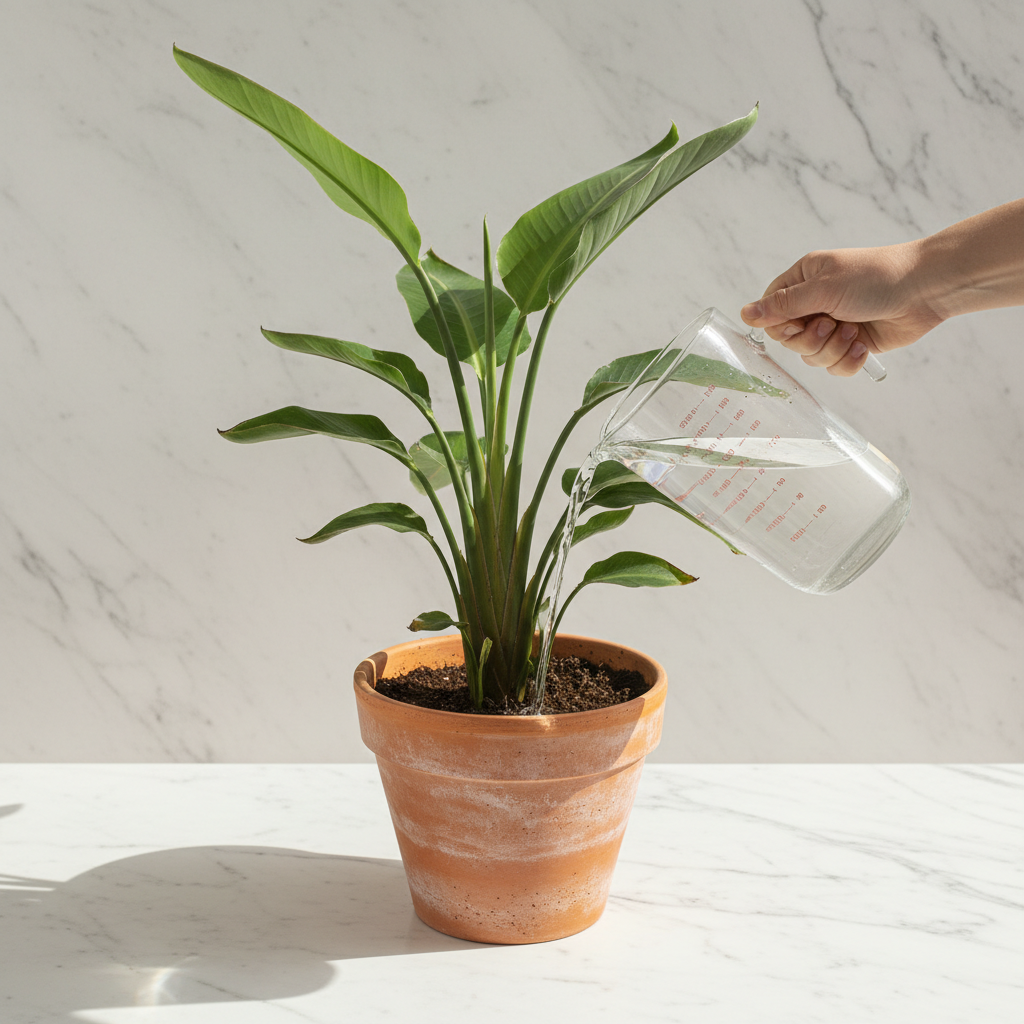
The bird of paradise stores water in its thick rhizome and fleshy roots, which means it behaves more like a perennial of seasonally dry climates than a true tropical. The correct approach is therefore “soak, then dry”: water generously so that the entire root mass is wetted and excess runs from the drainage holes, then wait until the top 5 to 7 centimetres (2 to 3 inches) of substrate are dry before watering again. Pushing a finger into the soil to that depth is the most reliable test; a moisture meter calibrated for houseplants gives a useful cross-check but should not be trusted alone on a dense aroid-style mix where the probe can read damp pockets next to dry ones.
Frequency depends entirely on light, temperature, pot size and substrate, not on a calendar. A 1.5 metre (5 ft) specimen in a 30 centimetre (12 in) terracotta pot in a sunny window in summer may need a thorough soaking every 5 to 7 days. The same plant in a glazed plastic pot in a cooler corner during a damp Danish November may go three weeks between waterings. Get into the habit of checking moisture rather than scheduling watering.
When you water, do so in the sink, shower, or out on a balcony if conditions allow, and pour water steadily across the entire soil surface until it runs freely from the bottom for at least 30 seconds. This flushes accumulated mineral salts from the substrate, which is particularly important for plants fed regularly with synthetic fertilisers. Tip away any water collected in saucers within 30 minutes; a bird of paradise tolerates short bottom-wetting but not standing in a tray of stagnant water.
Water quality matters less for this species than for fussy aroids or calatheas. Hard tap water is fine in the medium term, though over years of heavy mineral feeding a chalky residue can build up at the soil surface and at the pot rim. If your tap water is exceptionally hard or chlorinated, leave a jug to stand for 24 hours before use, or use collected rainwater when convenient. Use water at room temperature; the rhizome resents a winter dousing with very cold tap water, which can shock the roots into temporary dormancy.
Common watering mistakes are easy to recognise and fix. Persistent overwatering produces yellowing across multiple leaves at once and soft, mushy bases to the petioles where they meet the rhizome; if you suspect rot, unpot the plant, cut away any dark, slimy tissue with a clean knife, dust the cut with cinnamon or sulphur, and repot into fresh dry mix. Persistent underwatering produces dry brown leaf edges that progress inwards, and curled, drooping petioles that fail to bounce back even after a soaking; rescue by submerging the pot in tepid water for 20 minutes, then drain thoroughly.
Pro Tip — The petiole is a moisture gauge: Healthy bird of paradise petioles are firm, slightly rigid and hold the leaf blade aloft at a sharp angle to the vertical stem. When the plant is thirsty, the petioles soften and the leaves begin to droop towards the horizontal. Use this as a built-in indicator that a thorough soak is overdue.
Soil and Potting
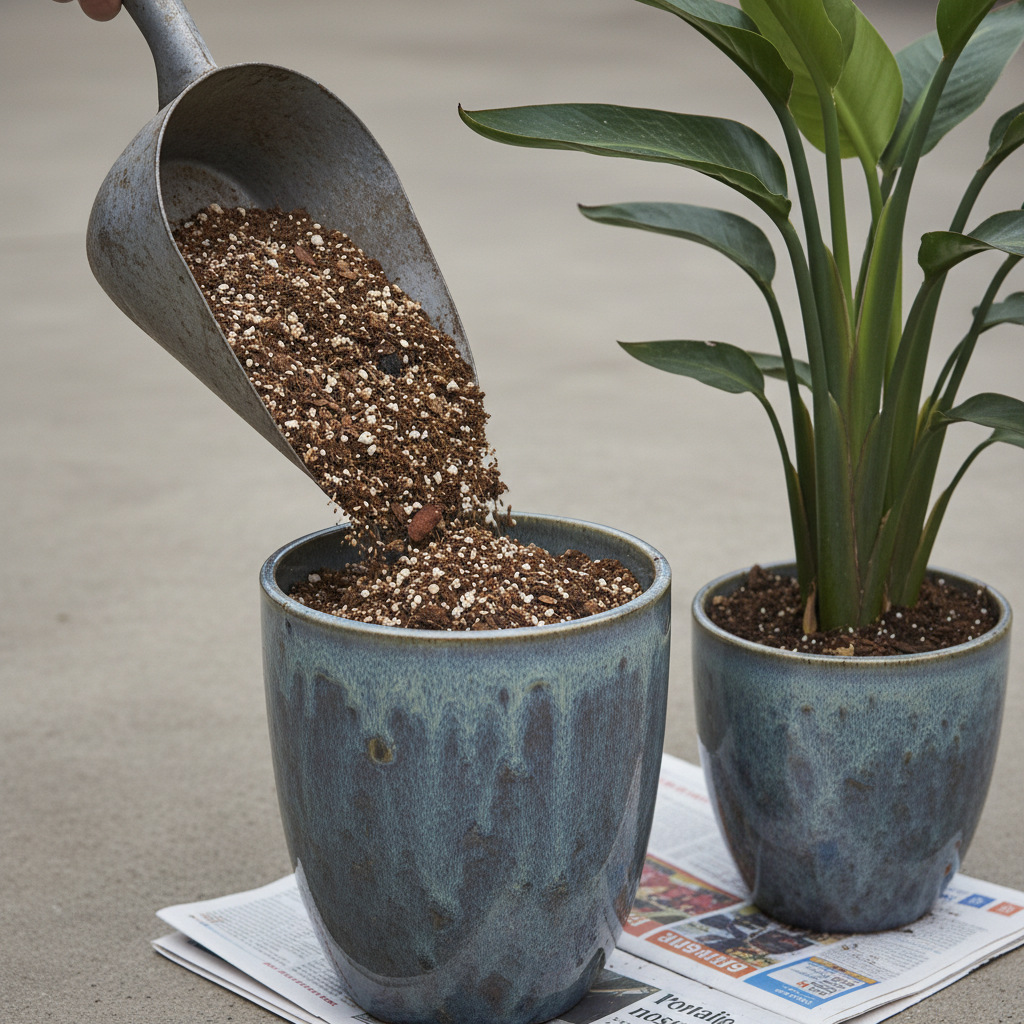
The bird of paradise wants a rich substrate that holds onto nutrients and moisture but drains freely. Off-the-shelf “houseplant compost” is usually too fine and too retentive; a peat-free multipurpose compost on its own packs down within a season and starts holding water against the rhizome. A better approach is to blend your own. A reliable recipe for this species is roughly half by volume good loam-based compost (for example a John Innes No. 2 or peat-free equivalent), a quarter coarse horticultural grit or pumice, and a quarter orchid bark or coco husk chip, with a small handful of perlite per pot for extra air. A long-release fertiliser pellet at the rate the manufacturer recommends rounds out the mix.
The aim is a substrate that feels chunky in the hand, that water passes through within seconds when you pour it on, and that holds enough moisture to keep the roots happy for several days between waterings. If the mix forms a dense ball when you squeeze a damp handful, it is too fine; add more bark and grit. If water rushes through and the mix never seems to hold moisture, increase the loam proportion.
Pot choice is unusually important for this plant. The bird of paradise has thick, fleshy roots that pack a pot rapidly and exert real outward pressure on the walls; cheap thin plastic pots have been known to deform or even crack under a vigorous root system, and a tightly rooted clump can lift itself partly out of an undersized container. Choose a sturdy terracotta, glazed ceramic or thick rotomoulded plastic pot, at least as wide as it is tall, with multiple generous drainage holes. As a guide, the pot diameter should be roughly equal to the spread of the leaf fan at its widest.
Here is where the bird of paradise diverges from most houseplants: it actively benefits from being slightly underpotted. A clump that fills its container is the one most likely to bloom, because rhizome congestion appears to be one of the cues that prompt flowering. Repot only every two to three years, and even then move up only one pot size (about 5 centimetres or 2 inches in diameter). A mature plant in a 40 to 45 centimetre (16 to 18 in) pot is generally at its happiest; many large specimens are kept in the same container for five or more years with nothing but annual top-dressing and consistent feeding.
Repot in early spring as new growth is just beginning, never in winter dormancy. Slide the plant from its pot, tease away the outer layer of old compost and any circling roots with your fingers, and place the rhizome at the same depth it sat before — burying the crown invites rot. Top up around the sides with fresh mix, water thoroughly, then leave the plant unfed for four to six weeks while it settles. Some leaf yellowing or drooping is normal after repotting and should resolve within a month.
If you cannot or do not want to fully repot, top-dressing is an effective annual alternative. Each spring, scrape away the top 3 to 5 centimetres (1 to 2 inches) of old substrate from the pot surface, avoiding the rhizome itself, and replace with fresh mix lightly enriched with worm castings or controlled-release fertiliser. This refreshes nutrients and improves the upper layer’s drainage without disturbing the roots.
Fertilising
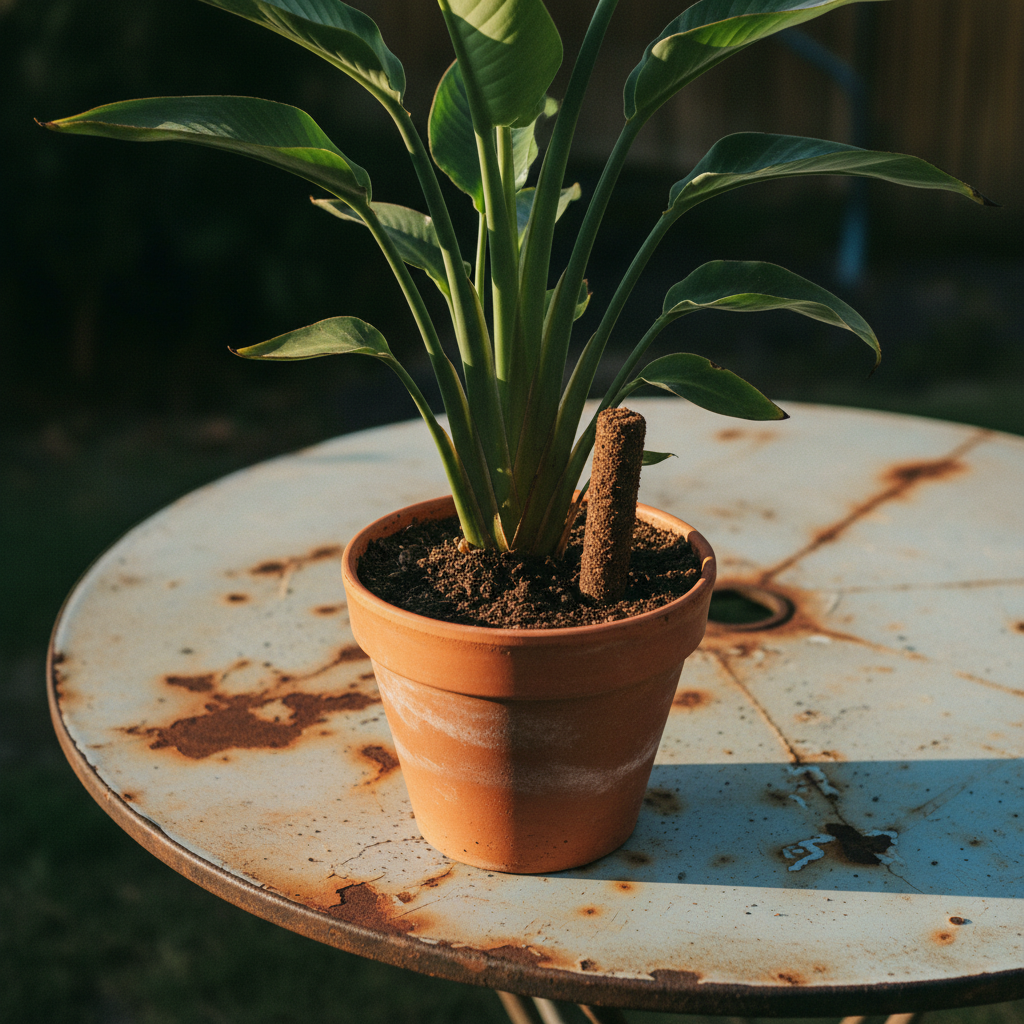
A mature bird of paradise is a hungry plant. Putting on a new leaf every six to eight weeks during the growing season, plus producing the energy reserves needed for flowering, demands a steady supply of nutrients well beyond what a soil refresh can deliver. Feed regularly from early spring (when daylength is clearly increasing and you can see new growth emerging from the rhizome) through to early autumn, then stop until the following spring.
A balanced liquid houseplant fertiliser, applied at half the manufacturer’s recommended strength every two weeks, suits most situations. Half-strength reduces the risk of leaf-tip burn from accumulated salts, and the more frequent application better mimics the trickle of nutrients the plant would receive in nature. If you prefer a simpler schedule, full-strength feed once a month works almost as well, particularly if you flush the pot thoroughly with plain water every third or fourth watering to prevent salt build-up.
For flowering-aged plants — those with at least 6 to 10 mature leaves and a rhizome the diameter of a fist or larger — switch from a balanced 20-20-20 type feed to a higher-potassium formulation in late spring, such as a tomato fertiliser, applied at the same half-strength rate. Potassium supports flower bud formation, and many growers report a marked uptick in inflorescences after a season or two of this switch. Continue the potassium-rich feed through midsummer, then taper through autumn.
Slow-release pellets or compressed fertiliser sticks are a convenient alternative for travellers and busy households. Push the sticks into the soil at the pot edge in early spring and again in midsummer, following the dosage on the packet for the pot size. They deliver nutrients steadily across two to three months and remove the need to remember a watering-can schedule. The trade-off is less control over the nutrient mix, and the salts they leave behind eventually require flushing.
Organic feeders such as worm castings, compost tea, fish emulsion or seaweed extract suit this plant well and have the advantage of supporting soil biology as much as plant nutrition. A thin top-dressing of worm castings in spring, refreshed midsummer, together with a fortnightly application of dilute seaweed feed during the growing season, will keep a bird of paradise in robust condition without the salt accumulation risk of synthetic feeds.
Withhold feeding entirely from late autumn to late winter. Day length and temperature both drop, photosynthesis slows, and the rhizome enters a period of reduced uptake. Fertilising during this dormancy will accumulate in the soil, scorch root tips and leave white crusts on the substrate surface and around the pot rim by the time growth resumes in spring.
Warning — Don’t feed a stressed plant: If your bird of paradise is recently repotted, suffering from root rot, recovering from pest damage, or visibly drought-stressed, stop feeding until the plant has stabilised. Fertilising stressed roots concentrates salts at exactly the points least able to cope, often making the underlying problem worse.
Propagation
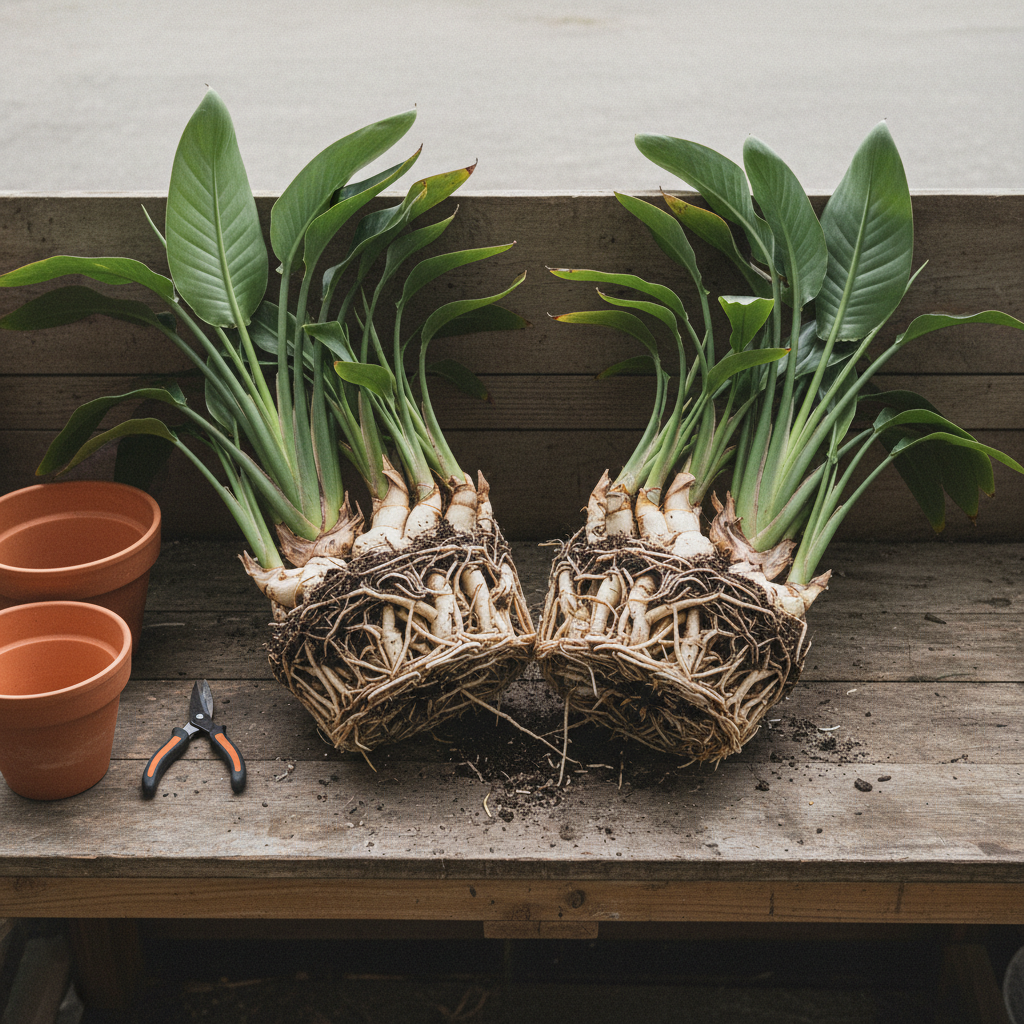
The bird of paradise is one of the few popular houseplants that cannot be propagated from stem or leaf cuttings. There is no vining stem to layer, no leaf node that will form roots in a glass of water, and no detachable pup that drops cleanly away the way an aloe or a haworthia produces. Multiplication at home effectively means one method: division of the rhizome of an established, congested clump.
Division is straightforward in principle, more daunting in practice, simply because the rhizome of a mature plant is thick, woody and tightly interlaced. The right time is early spring, just as new growth is beginning, which gives the divisions a full growing season to recover before winter. You will need a sharp clean knife or pruning saw, secateurs, two or more clean pots one size smaller than the original, fresh substrate, and ideally a second pair of hands to steady a large clump.
The step-by-step process is as follows.
- Water the plant lightly a day in advance so the substrate releases cleanly but the roots are not saturated.
- Tip the plant out of its pot onto a tarpaulin, large tray or the floor of a potting shed.
- Tease away as much loose substrate as you can with your fingers to expose the rhizome and the points where individual fans meet it.
- Identify natural division lines. A mature clump typically consists of several fans, each with its own crown of leaves rising from a connected segment of rhizome. Aim to leave each division with at least one strong fan of leaves and a substantial section of rhizome with its own root system.
- Slice through the rhizome with a sharp knife or saw, cutting cleanly and decisively rather than worrying at the cut. Smaller fans may pull apart with hand pressure; larger ones need real force.
- Trim any badly damaged roots, but leave the bulk of the root system intact.
- Dust the cut surfaces with cinnamon powder, ground sulphur or simply allow them to air-dry for a couple of hours in a shaded spot to callus before potting.
- Pot each division into fresh free-draining mix, placing the rhizome at the same depth it was previously, and firming the substrate gently around the roots.
- Water in well, then place the divisions in a bright but not blazing position for 4 to 6 weeks while they re-establish.
- Withhold fertiliser for at least a month, and reduce watering frequency until the divisions show signs of new growth.
Expect some sulking after division. Older leaves may yellow or droop as the plant rebalances root mass to leaf mass, and new growth may not appear for two to three months. Provided the rhizome itself remains firm and the crown stays dry, recovery is reliable.
The alternative method is propagation from seed. Bird of paradise seeds, with their distinctive tuft of bright orange arils, can be sown after soaking in warm water for 24 hours and scarifying lightly with sandpaper, then germinated in warm humid conditions of around 25 degrees Celsius (77 Fahrenheit). The challenge is patience: germination can take 6 to 12 weeks, growth is slow, and seedlings need 4 to 7 years to reach flowering size. Most home growers stick with division.
Pests, Problems and Troubleshooting
The bird of paradise has fewer pest issues than most popular houseplants, thanks to its tough waxy leaves and resilient constitution, but it is not pest-proof. The pests most likely to colonise an indoor specimen are scale insects, mealybugs, spider mites and, particularly in plants kept too wet, fungus gnats. Less commonly, thrips and whitefly appear, usually after the plant has spent time outdoors in summer.
Scale insects show up as small flat or domed brown bumps along the petioles and the undersides of leaves. They suck sap, leaving sticky honeydew on lower leaves and the floor below, which in turn supports sooty mould. Treat by wiping each bump off with a cotton bud dipped in isopropyl alcohol, then following up with a horticultural soap or oil spray every 10 days for three to four cycles to catch newly hatched crawlers. Heavy infestations on hidden leaf bases may require physically opening the leaf fan to inspect and treat each axil.
Mealybugs look like tiny tufts of cotton wool, typically in the leaf axils where the petiole meets the rhizome, or along the undersides of leaves. Treat the same way as scale: alcohol-dipped cotton buds for visible insects, followed by repeated soap or neem oil sprays. Mealybugs can also colonise the root zone of badly affected plants; if leaf treatment is not enough, drench the soil with a systemic insecticide such as imidacloprid, or unpot and rinse the roots thoroughly before repotting in fresh substrate.
Spider mites prefer hot dry conditions, so a bird of paradise next to a radiator in winter is at heightened risk. The first sign is fine pale stippling on the upper leaf surface, progressing to faintly visible webbing in the leaf axils and along the petioles. Increase humidity around the plant, hose the foliage down in the shower fortnightly during outbreaks, and apply a miticide or a strong soap or neem solution to the leaf undersides every 5 to 7 days for three rounds. Predatory mites are an effective biological alternative for indoor growers willing to source them.
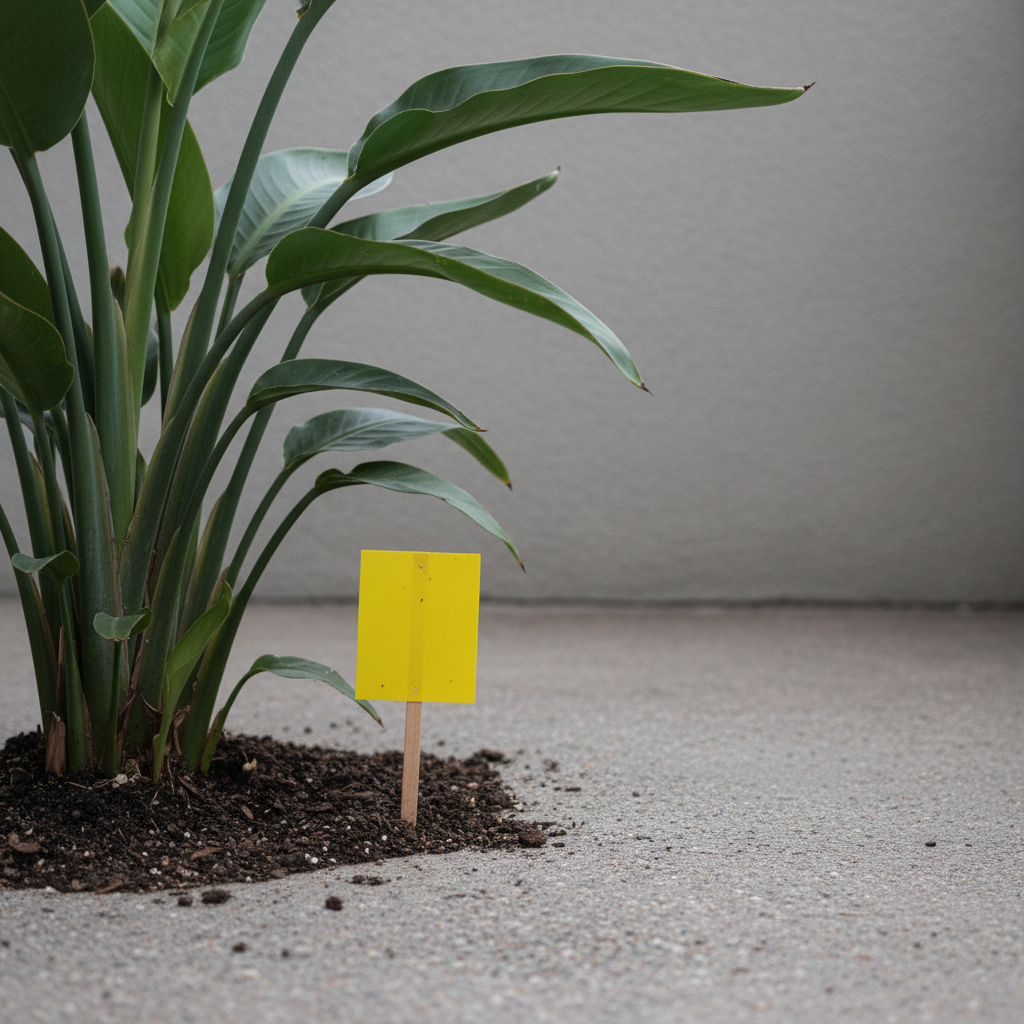
Fungus gnats — small black flies hovering around the soil surface — almost always indicate consistently wet substrate. Let the top 5 centimetres (2 in) of soil dry out completely between waterings, apply a Bacillus thuringiensis subspecies israelensis (BTI) drench to kill larvae, and place yellow sticky traps at the pot rim to catch flying adults. The infestation usually resolves within two to three weeks of drier conditions.
Beyond pests, the most common problems with bird of paradise are leaf browning, leaf yellowing and refusal to bloom. Brown crispy leaf tips and margins usually indicate underwatering, low humidity in combination with very hot dry air, or accumulated salt damage from over-fertilisation; flush the substrate thoroughly with plain water, then re-establish a more consistent watering routine. Brown soft patches in the middle of leaves point to physical damage or, more rarely, fungal infection from prolonged water sitting on the foliage. Whole-leaf yellowing on multiple leaves at once almost always means overwatering or root rot, particularly in winter; check root health and adjust accordingly.
Refusal to bloom is the most common complaint about this plant, and the diagnosis is almost always one of four things: insufficient light, plant too young (less than 4 years old or fewer than 6 to 10 mature leaves), pot too large (the rhizome needs to feel constrained), or insufficient feeding through the growing season. Address whichever of these applies and patience usually pays off within a year or two.
Warning — Mildly toxic to pets and children: The leaves and especially the seeds of bird of paradise contain compounds that cause mouth irritation, nausea and vomiting if ingested. Keep the plant out of reach of curious pets and small children, and wash your hands after handling cut tissue.
Notable Varieties and Relatives
Strictly speaking, named cultivars within Strelitzia reginae itself are few; the species has been remarkably consistent in cultivation. Most of the visual variation a buyer encounters comes from other species within the genus that are sold under the same “bird of paradise” umbrella. The two most important to recognise are the Giant White Bird of Paradise and the cultivar Mandela’s Gold.
Giant White Bird of Paradise
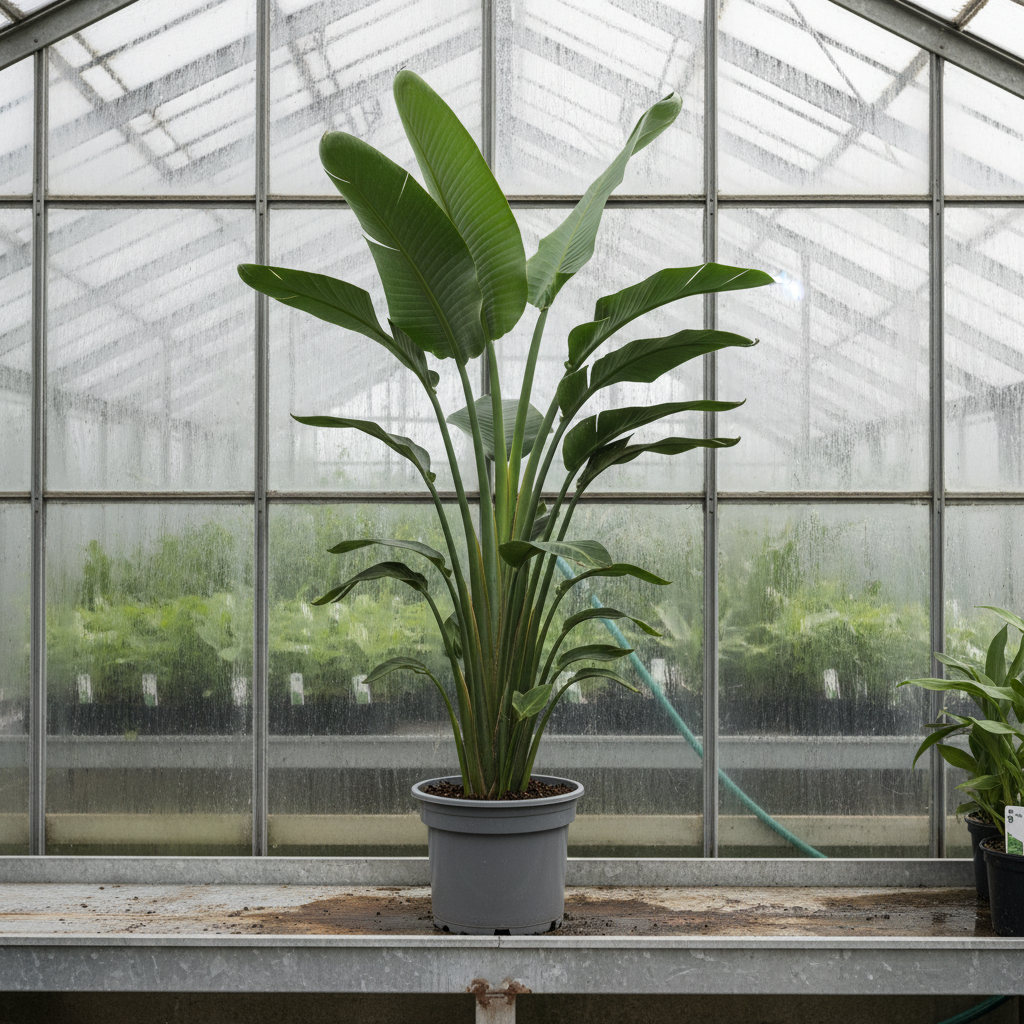
Strelitzia nicolai is the species most often confused with S. reginae in the houseplant trade, particularly when sold young. It has the same paddle-shaped leaves but reaches 5 to 6 metres (16 to 20 ft) outdoors and easily 2 metres (6.5 ft) indoors, forming a clumping pseudo-trunk reminiscent of a banana. The flower is dramatically different: large boat-shaped purple-black bracts cradle white sepals and a pale blue tongue, blooming high in the canopy on mature specimens. Care is essentially identical to the orange-flowered species, but the larger ultimate size makes it suitable only for spacious rooms with high ceilings.
Mandela’s Gold
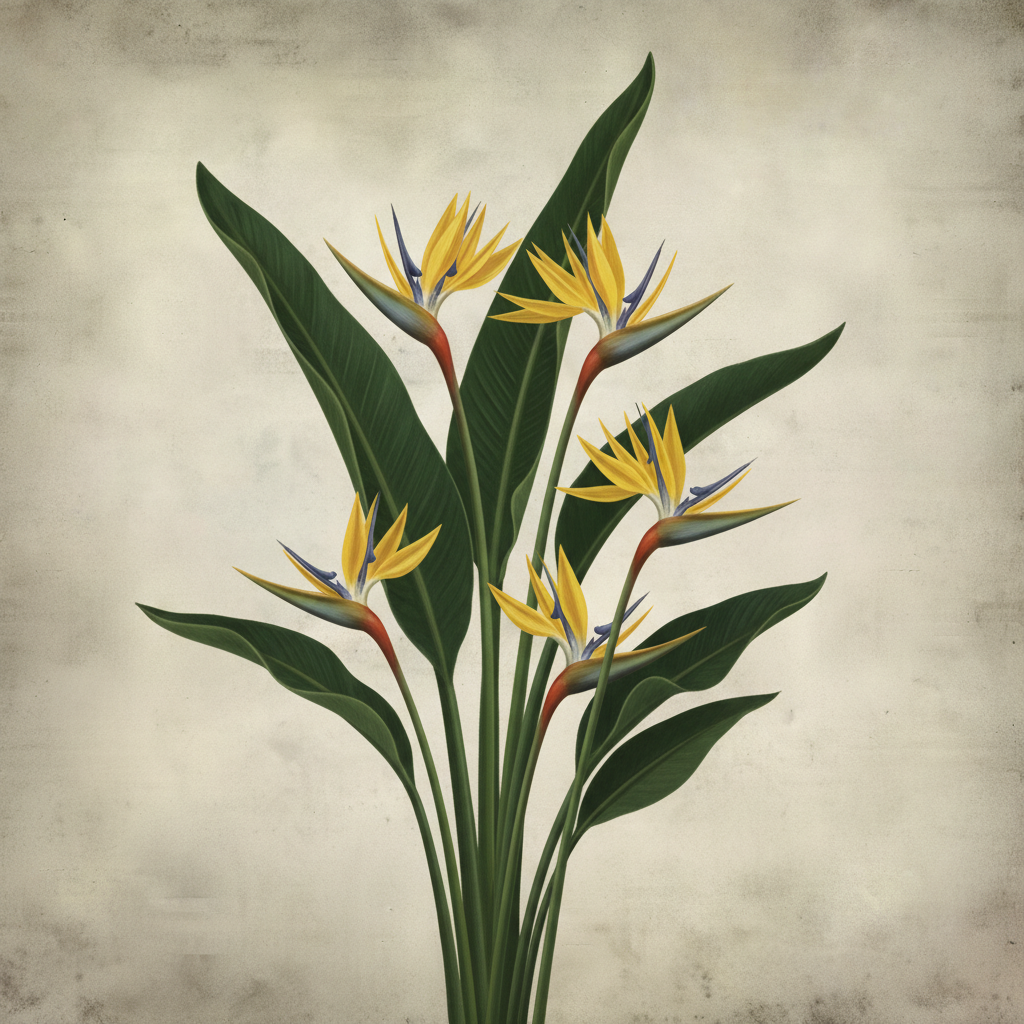
Strelitzia reginae ‘Mandela’s Gold’, sometimes still sold under its earlier name ‘Kirstenbosch Gold’, is a true cultivar of the orange-flowered species, developed at South Africa’s Kirstenbosch National Botanical Garden over two decades of selective breeding from a single yellow-sepalled seedling. The leaves are indistinguishable from the standard species; the difference is in the flowers, which carry clear lemon-yellow sepals in place of the usual flame orange, contrasting against the same cobalt blue tongue. It is rare in cultivation, slow to produce true seed, and grown almost exclusively from division of mother plants, which makes it command a premium.
Two further relatives are worth knowing. Strelitzia juncea, the narrow-leaved bird of paradise, has dispensed with leaf blades almost entirely and presents a sheaf of rush-like cylindrical leaves rising from a small clump, with orange-and-blue flowers identical to the species perched on top. It is extremely drought-tolerant and an interesting architectural alternative for those who like the flower but find the broad leaves visually overwhelming. Strelitzia alba, the white-flowered tree strelitzia, is similar in scale to S. nicolai but with pure white flowers and a more pronounced trunk, almost never sold as a houseplant due to its eventual size.
A frequent point of confusion is the so-called “Mexican Bird of Paradise” (Caesalpinia pulcherrima), which is an entirely unrelated leguminous shrub with fern-like foliage and flame-coloured flowers. It is sometimes labelled “bird of paradise” in nursery centres but shares neither a family nor care requirements with the true Strelitzia. If in doubt, look at the leaves: anything other than large paddle blades on long petioles is not a Strelitzia.
Frequently Asked Questions
How long does it take for an indoor bird of paradise to bloom?
A plant grown from a sizeable division typically needs 3 to 5 years to produce its first inflorescence, provided light is genuinely bright. A seed-grown plant can take 4 to 7 years. The single biggest accelerant is light intensity; the single biggest delay is keeping the plant in a pot too large for the rhizome, which puts all the plant’s energy into root growth at the expense of bloom production.
Why are my bird of paradise leaves splitting?
Splits along the leaf margins are an evolutionary adaptation to coastal wind, not a sign of stress. Mature leaves naturally develop tears along the edges as they age, which lets airflow pass through rather than ripping the entire blade off its petiole. Indoor plants split less than outdoor ones because the air is calmer, but a few splits on older leaves are nothing to worry about. Splits at the base of the leaf or holes mid-blade, on the other hand, usually indicate physical damage during repotting or handling.
Can a bird of paradise live outdoors?
Yes, in USDA hardiness zones 10 to 12, or in any climate that does not see sustained temperatures below 0 degrees Celsius (32 Fahrenheit). In milder Mediterranean and subtropical climates it is a popular landscape plant. In cold-winter regions like northern Europe, the plant can spend summer outdoors in a sheltered sunny spot from late spring until first autumn frost, then come back indoors. Acclimatise it gradually in each direction to avoid leaf scorch or cold shock.
Is the bird of paradise toxic to cats and dogs?
Mildly. The leaves and especially the bright orange-tufted seeds contain compounds that cause mouth irritation, drooling, nausea and vomiting if ingested. Symptoms are uncomfortable but rarely life-threatening. Keep the plant out of reach of pets and children who might be tempted to chew the leaves or the seed pods, and contact your vet or poison control line if ingestion does occur.
Should I cut off old yellow leaves?
Yes, once a leaf has fully yellowed and become limp it has finished contributing energy to the plant, and removing it improves the plant’s appearance and reduces pest hiding spots. Cut the entire petiole back to within 2 to 3 centimetres (about an inch) of the rhizome with clean sharp secateurs. Do not pull or tear, which can damage the rhizome surface and open it to rot.
How do I encourage flowering?
Three levers, in this order. First, light: place the plant in the brightest position you have, ideally with several hours of direct sun a day. Second, root constraint: keep the rhizome in a pot it almost fills, repotting only every 2 to 3 years and only one size up. Third, feeding: from late spring through midsummer, switch to a higher-potassium fertiliser such as a tomato feed at half strength every fortnight. Address all three, give the plant time, and a mature specimen will reward you.
Why is my bird of paradise leaning to one side?
The leaves emerge in a single plane, so when the plant always faces the same direction towards its light source, the new fan grows out and forwards, while the side away from the light stops producing. Rotate the pot a quarter turn every two weeks to keep the silhouette symmetrical. If the plant is already lopsided, accelerate rotation to a full turn over four to six weeks; the next round of leaves will fill in the bare side.






