
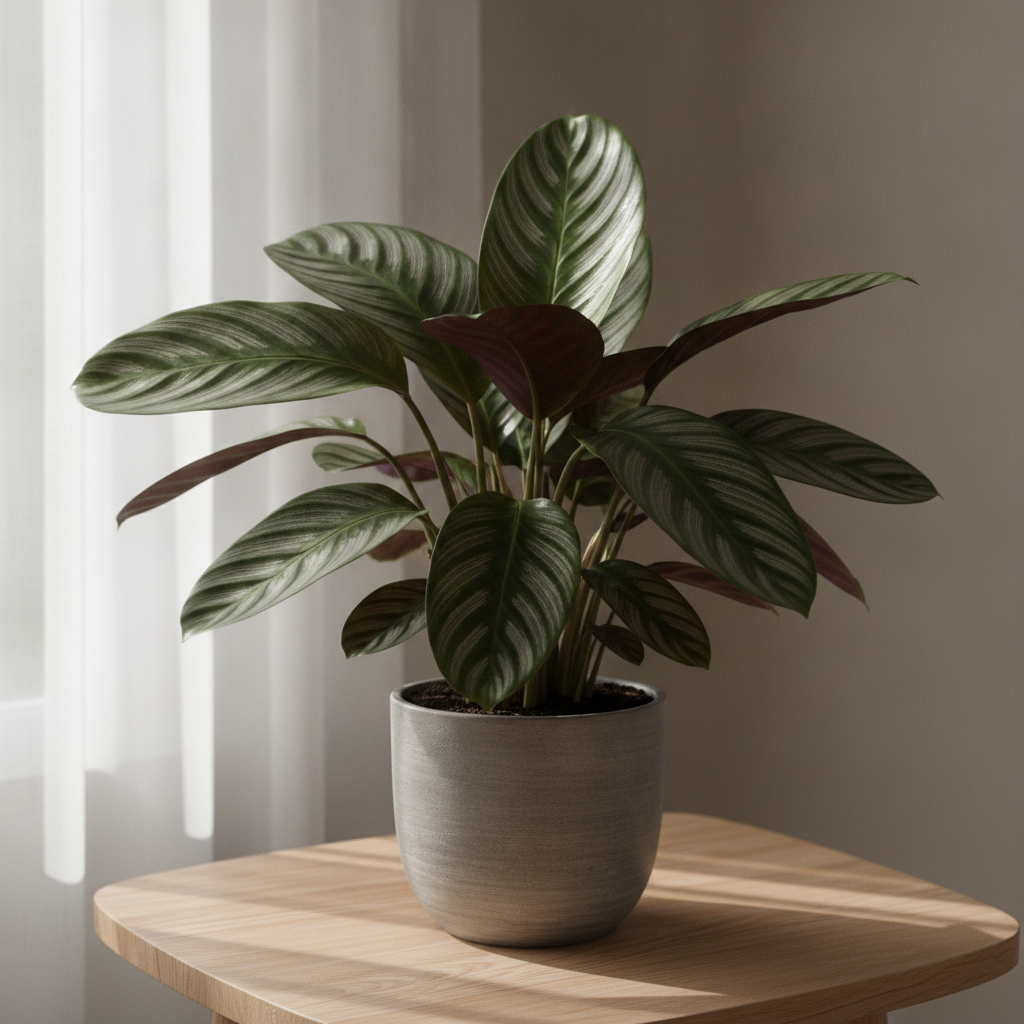
Few houseplants announce themselves as boldly as the Beauty Star calathea, whose dark green leaves are ruled with fine pink-and-silver pinstripes so precise they look hand-drawn. A cultivar of Goeppertia ornata (still widely sold under its former name, Calathea ornata), it belongs to the prayer plant family, Marantaceae, and hails from the humid rainforest understorey of Colombia and Ecuador. Its common name is a nod to the celestial neatness of that striping, and among the many pinstripe calatheas it is one of the most sought after for the vividness of its rose-coloured lines against a deep, almost blackish-green backdrop.
The Beauty Star has a reputation, and it is only partly deserved. It is often described as fussy, and it is true that this is not a plant that forgives neglect the way a pothos or snake plant will. But the demands it makes are consistent and knowable: steady moisture, warmth, high humidity and clean water. Meet those four conditions and the plant is not difficult at all. This guide covers everything from the biology behind its famous nightly leaf movement to the exact water quality that keeps its edges from crisping, and it draws a clear line throughout between what merely keeps the plant alive and what makes it genuinely thrive.
Contents
- Quick Reference
- Why Beauty Star Calathea Makes a Rewarding Houseplant
- Light Requirements
- Watering & Humidity
- Soil, Potting & Repotting
- Fertilising
- Propagation
- Pests & Diseases
- Popular Varieties
- Frequently Asked Questions
Quick Reference: Beauty Star Calathea at a Glance
| Light | Bright, indirect light; no direct midday sun |
| Watering | Keep evenly moist; water when the top 2 to 3 cm (1 in) feels barely dry |
| Temperature | 18 to 27 degrees C (65 to 81 degrees F); avoid below 15 degrees C (59 degrees F) |
| Humidity | High, ideally 60 percent or above; 50 percent is the practical minimum |
| Fertiliser | Balanced feed at half strength, monthly in spring and summer |
| Toxicity | Non-toxic to cats, dogs and humans |
Why Beauty Star Calathea Makes a Rewarding Houseplant
The single best reason to grow a Beauty Star is the foliage, which offers a kind of detail few other houseplants can match. Each elongated oval leaf is a dark, glossy green overlaid with alternating thin and thick stripes that run in pairs from the central midrib to the leaf margin, coloured a soft rose-pink when the plant is young and often maturing to creamy silver-white on older growth. Turn a leaf over and the reverse is a rich burgundy-purple, so that a well-grown plant reads differently depending on whether you are looking down at it or up through it. In a mixed collection it provides pattern where most plants provide only shape.
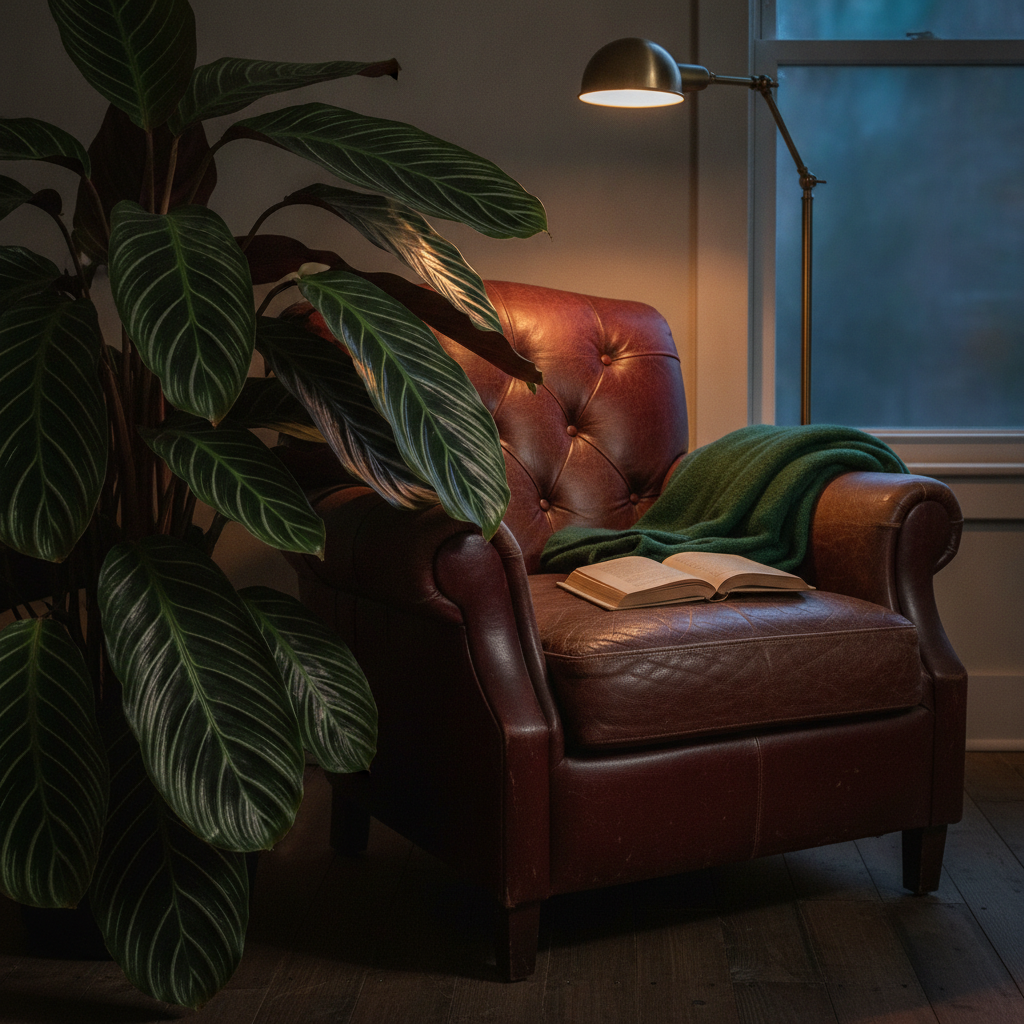
Beyond looks, the Beauty Star has two qualities that make it genuinely liveable. First, it is entirely non-toxic, which puts it on a very short list of statement foliage plants that are safe around cats, dogs and curious children. Second, it performs the nightly ritual that gives the whole prayer plant family its name: as evening falls, the leaves fold upward from the base as though closing in prayer, then relax open again by morning. This movement, called nyctinasty, is driven by a swollen hinge of tissue at the base of each leaf stalk and turns the plant into a slow, living clock. It is also a useful diagnostic, because a healthy Beauty Star that suddenly stops moving is usually telling you something about its water or light before any browning appears.
Important — Toxicity: The Beauty Star calathea is non-toxic to cats, dogs and humans, so no special precautions are needed for pets or children. As with any plant, nibbling foliage can still cause mild stomach upset, so it is sensible to discourage grazing even though the leaves carry no harmful compounds.
Light Requirements
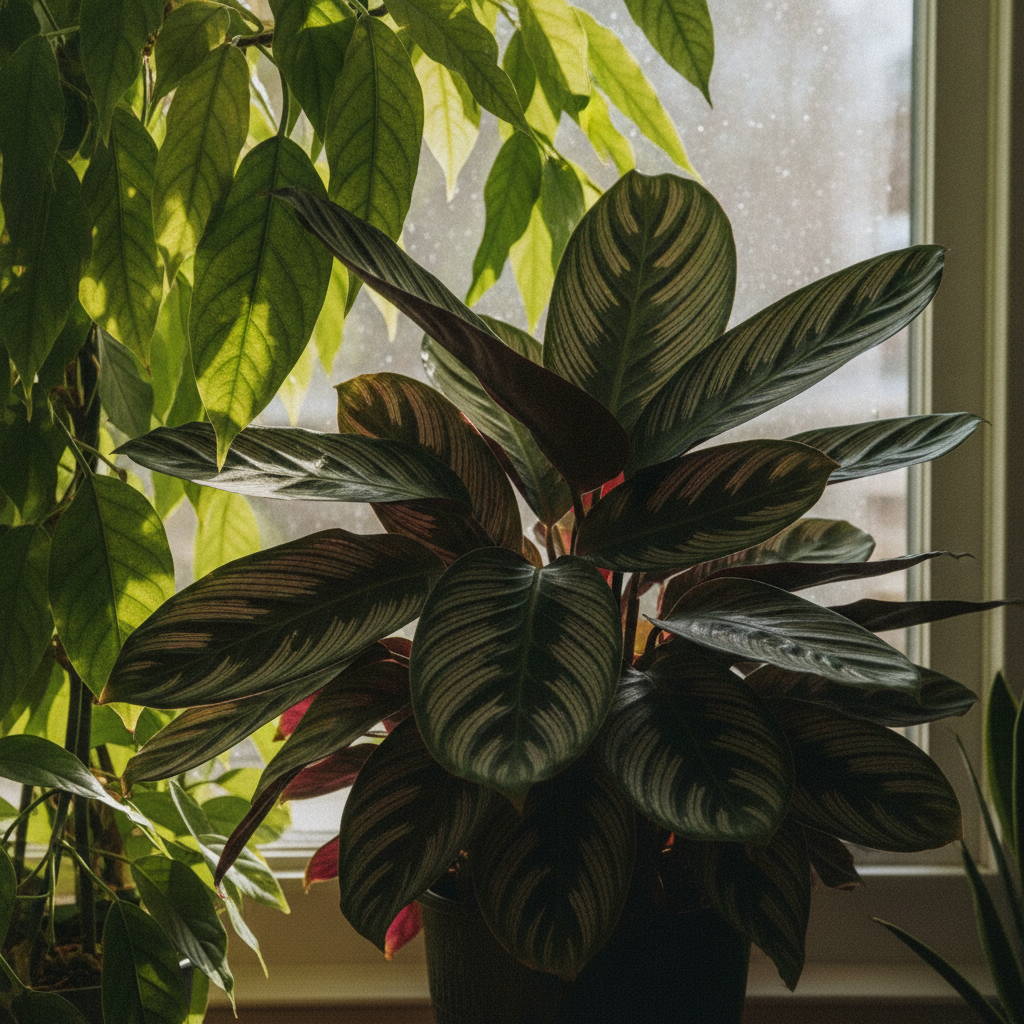
In the wild the Beauty Star grows on the forest floor beneath a dense canopy, receiving only the dappled, filtered light that survives the journey down through many layers of leaves. That origin dictates everything about how it should be lit indoors: it wants brightness without directness, the ambient glow of a well-lit room rather than a beam of sun falling across its foliage. Bright, indirect light keeps the striping crisp, the colour saturated and the growth compact.
The ideal position is a metre or two back from a bright window, or immediately beside a window that faces away from the sun’s strongest arc. A spot that feels comfortably bright for reading, without any hard-edged patch of sunlight landing on the leaves, is almost always right. If you can see a sharp shadow of the plant cast on the wall behind it, the light is too direct and should be softened with a sheer curtain or a little more distance.
Light Levels Explained
Understanding the practical light bands helps you place the plant with confidence. The Beauty Star sits comfortably in the medium to bright-indirect range and is one of the few striking foliage plants that tolerates lower light reasonably well, at the cost of slower growth.
| Light Category | Approx. Level | Typical Location | Outcome |
|---|---|---|---|
| Direct sun | Over 50,000 lux | On a south or west sill in summer | Harmful; scorches leaves and fades stripes |
| Bright indirect | 10,000 to 20,000 lux | Near an east window or set back from a bright one | Ideal; strong colour and steady growth |
| Medium | 5,000 to 10,000 lux | Centre of a well-lit room | Good; slightly slower but healthy |
| Low | 1,000 to 2,500 lux | Interior corner or north room | Tolerated; sparse growth, muted pattern |
| Very low | Under 1,000 lux | Windowless space | Decline; leggy, weak, eventually fails |
Window Orientation and Placement
South-facing window: The brightest exposure and the one that demands the most care. Keep the plant well back from the glass, or diffuse the light with a sheer curtain, so that it receives the room’s reflected brightness rather than the direct beam that would bleach and scorch the leaves.
East-facing window: Often the sweet spot. The gentle morning sun is weak enough to be harmless, and for the rest of the day the plant sits in bright, even indirect light. A Beauty Star placed right on an east sill usually colours beautifully.
West-facing window: Workable, but the fierce late-afternoon sun is the risk. Set the plant back a little or filter the glass so the strongest hours do not fall directly on the foliage.
North-facing window: A safe, sunless exposure that suits the plant’s tolerance for softer light. Growth will be a touch slower and you may want the plant closer to the glass, but there is no risk of scorch and the pattern stays true.
Pro Tip — Rotate for Even Growth: Calatheas lean noticeably toward their light source and their leaves reorient over days, not hours. Give the pot a quarter turn each week so the plant develops evenly rather than crowding all its foliage toward the window.
How Light Affects Leaf Colour
Light does more than fuel growth in this plant; it shapes the very feature you bought it for. In good bright-indirect light the pink stripes stay vivid and the contrast between line and leaf is at its sharpest. In light that is too low, new leaves emerge smaller, the spacing between leaves stretches, and the striping can come through paler and less defined. In light that is too strong, the opposite happens: the deep green washes out toward a tired yellow-green and the fine markings fade as the leaf surface is stressed. The colour, in other words, is a fairly reliable readout of whether you have the balance right.
Warning — Direct Sunlight: Even an hour of direct midday sun can leave permanent pale, papery patches on Beauty Star leaves, and the damage does not heal. If you notice bleached areas developing on the sun-facing side, move the plant out of the beam immediately rather than waiting to see whether it recovers.
Artificial Lighting
The Beauty Star responds well to supplementary lighting, which makes it a good candidate for darker rooms and for the short days of winter. A full-spectrum LED grow light positioned 30 to 45 cm (12 to 18 in) above the plant and run for 10 to 12 hours a day will comfortably replace or top up natural light. Because the plant’s needs are moderate rather than intense, you do not need a powerful horticultural fixture; a modest LED is plenty, and the even, unchanging quality of artificial light actually suits a plant that dislikes harsh direct sun.
Seasonal Adjustments
As the sun weakens and drops lower through autumn and winter, a position that was perfect in summer may become too dim, so it pays to move the plant a little closer to the window for the darker months and then back again in spring. Winter light through glass is far gentler, so the scorch risk of a south or west window largely disappears from roughly November to February in temperate regions. Keep an eye on the leaves through the transitions and adjust placement before growth stalls rather than after.
Watering & Humidity
Watering is where most Beauty Star calatheas are won or lost. This is a plant that wants its soil kept evenly and lightly moist at all times, never sodden and never bone dry, which is a narrower target than the soak-and-dry rhythm that suits so many houseplants. The roots are fine and thirsty but also quick to rot if they sit in standing water, so the aim is consistent dampness rather than either extreme.
When to Water
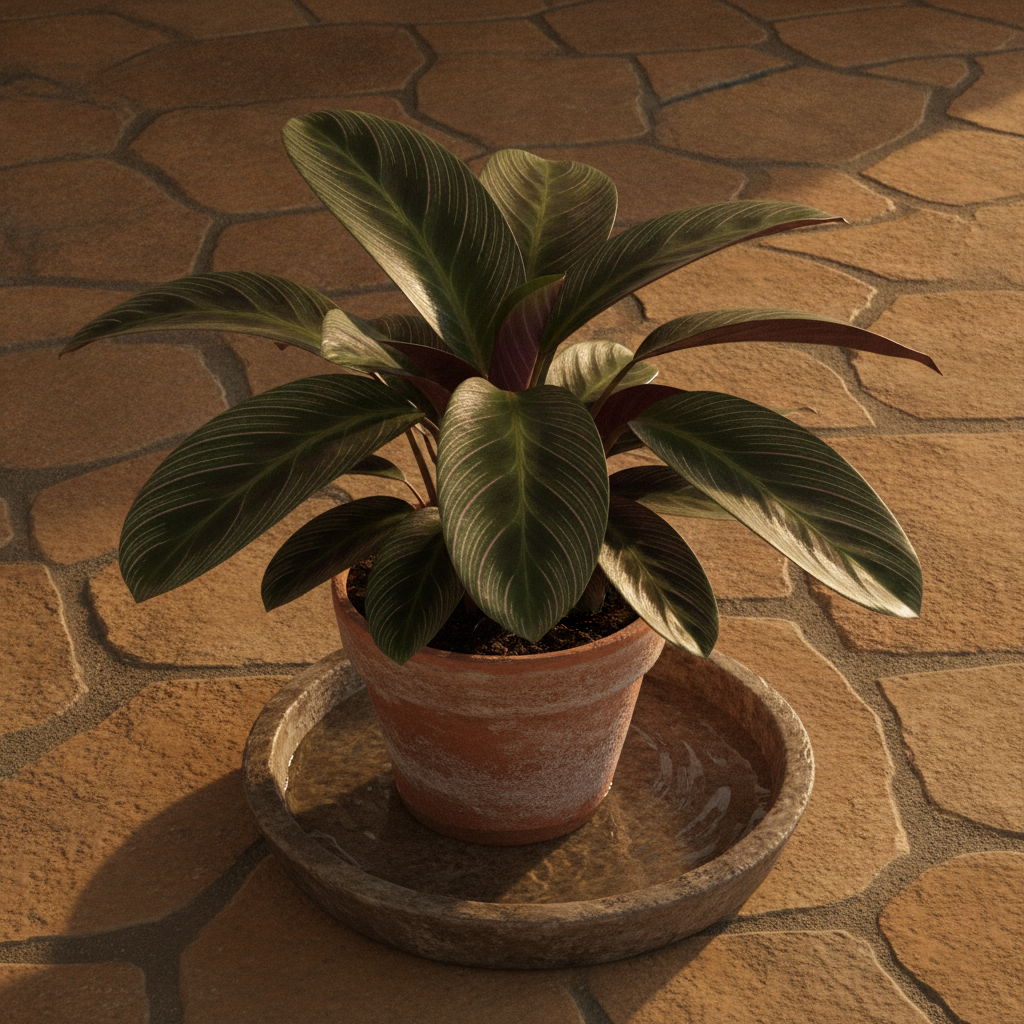
Check the plant every few days by pressing a finger into the top of the soil. When the top 2 to 3 cm (about 1 in) has just begun to feel dry, it is time to water; you should not wait for the deeper soil to dry out as you would with a succulent or a snake plant. In a warm, bright spot during the growing season this often works out to roughly once or twice a week, but the plant’s feel, not the calendar, should govern the decision, because pot size, temperature and season all change the pace.
Through autumn and winter, when growth slows and evaporation drops, the interval lengthens and you should let the surface dry a little more between waterings to avoid the soil staying cold and wet. The plant still wants moisture in winter, just less frequently, so keep checking rather than switching to a fixed reduced schedule.
Pro Tip — Bottom Watering: Standing the pot in a tray of water for 20 to 30 minutes lets the mix wick up moisture evenly and keeps the dense crown of leaf bases dry, which reduces the risk of rot. Tip away whatever has not been absorbed afterward so the plant never sits in a reservoir.
How to Water Correctly
- Check that the top 2 to 3 cm (1 in) of soil has just started to dry before watering.
- Use room-temperature water that is low in minerals, such as rainwater, distilled or filtered water (see Water Quality below).
- Water slowly and evenly across the surface, or stand the pot in a shallow tray to draw water up from below.
- Let the pot drain fully; every drop of excess should run out through the drainage holes.
- Empty the saucer or cache pot so the plant is never left standing in water.
- Return the plant to its spot and feel the soil again in three or four days to recalibrate your timing.
Signs of Overwatering vs. Underwatering
| Symptom | Overwatering | Underwatering |
|---|---|---|
| Leaf colour | Yellowing, often on lower leaves first | Fading, with browning and curling at the edges |
| Leaf texture | Soft, limp, translucent patches | Dry, crisp, papery margins |
| Soil | Constantly wet, sour smell | Pulling away from the pot sides, dusty |
| Roots | Brown, mushy, foul-smelling | Dry and brittle but pale |
| Stem base | Blackened, soft at the crown | Firm but wilting from lack of turgor |
Warning — Root Rot: Because the Beauty Star is kept continuously moist, it sits closer to the edge of root rot than most houseplants. If the soil ever smells sour or the crown turns soft and black, unpot the plant at once, cut away every mushy root, and repot into fresh, airy mix. Caught early this is survivable; left alone it is usually fatal.
Humidity Requirements
If watering is the first pillar of Beauty Star care, humidity is the second, and the two are closely linked. This is a rainforest-floor plant accustomed to air that rarely drops below 60 percent relative humidity, and in the dry air of a centrally heated or air-conditioned home it will protest quickly. Aim for 60 percent or higher for the plant to thrive; around 50 percent is the practical minimum below which the characteristic brown, crispy leaf edges tend to appear.
The clearest symptom of air that is too dry is browning along the very margins of otherwise healthy leaves, sometimes with the fine outer edge curling inward. Because this browning is caused by moisture stress rather than disease, it cannot be reversed on a leaf once it appears, though raising the humidity stops it spreading and keeps new growth clean. Persistent low humidity also encourages spider mites, which thrive precisely in the warm, dry conditions the plant dislikes.
The most reliable way to raise humidity is a small room humidifier running near the plant, which lifts the ambient level in a way nothing else quite matches. Grouping plants together helps, as does standing the pot on a wide tray of pebbles topped up with water so that evaporation rises around the foliage without the roots ever touching the water. A steamy bathroom with enough light can be an excellent home. Misting is often suggested but does little for ambient humidity and, by leaving water sitting on the leaves, can invite fungal spotting, so it is not the answer here.
Water Quality
The Beauty Star is unusually sensitive to what is in its water. Calatheas react to the fluoride, chlorine and dissolved salts present in much tap water, which accumulate at the leaf margins and cause the same brown, crisped edges that low humidity produces. If your plant browns despite good humidity and careful watering, hard tap water is the most likely culprit. Switching to rainwater, distilled water or filtered water usually solves the problem within a few new leaves. If you must use tap water, leaving it to stand uncovered overnight allows some chlorine to dissipate, though it does nothing for fluoride or mineral salts.
Soil, Potting & Repotting
The right soil for a Beauty Star has to reconcile two demands that seem to pull in opposite directions: it must hold enough moisture to keep the plant evenly damp, yet drain and breathe freely enough that the fine roots never suffocate in stagnant water. The answer is an open, organic-rich mix that stays moist without turning to mud, and getting this balance right removes much of the difficulty people have with the plant.
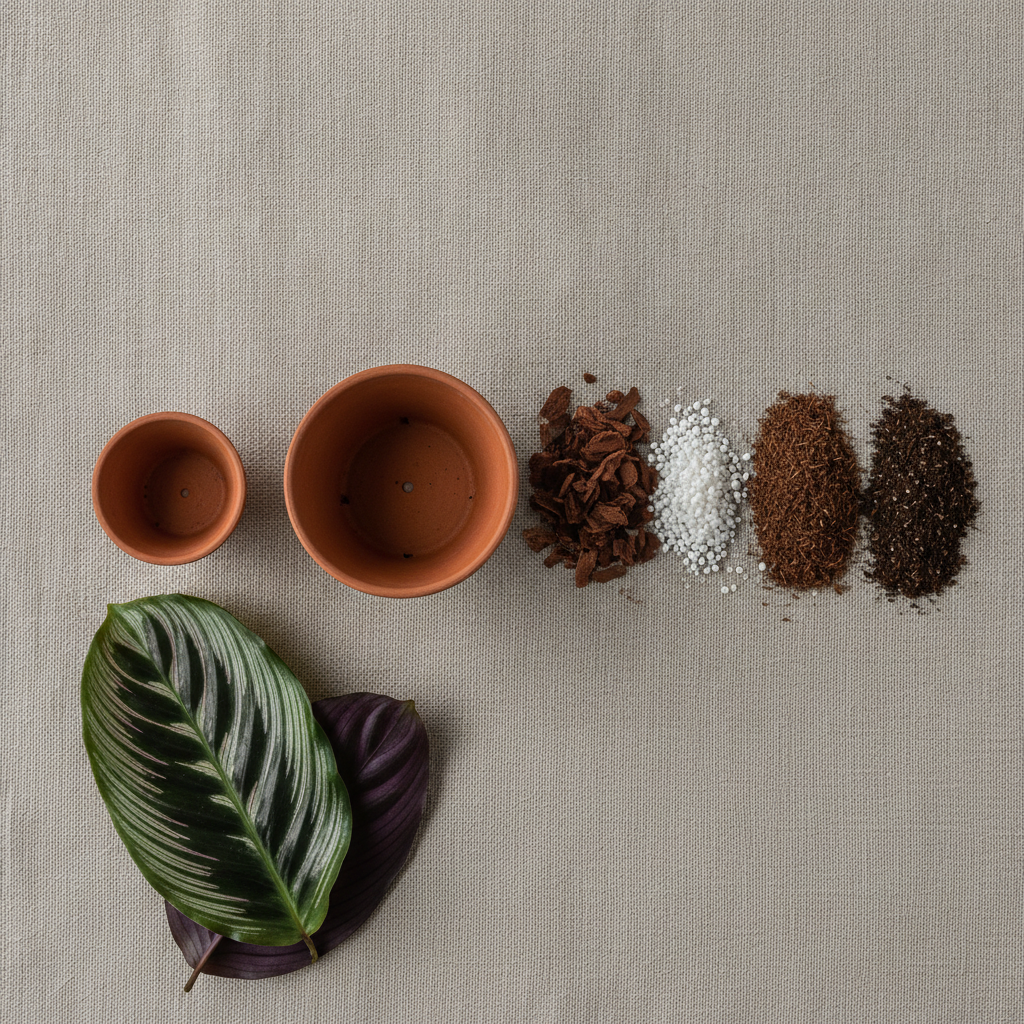
Ideal Soil Composition
A good starting point is a peat-free base of coco coir or a quality houseplant compost, lightened with roughly a third perlite for aeration and a handful of fine orchid bark to keep the structure open. The coir holds the steady moisture the plant wants, the perlite creates the air pockets that protect the roots, and the bark stops the whole mix compacting over time. A little worm castings or compost folded in adds gentle, slow nutrition.
| Component | Proportion | Function |
|---|---|---|
| Coco coir or houseplant compost | 50 percent | Holds even moisture without going sour |
| Perlite | 30 percent | Aerates and improves drainage |
| Fine orchid bark | 15 percent | Keeps structure open, prevents compaction |
| Worm castings or compost | 5 percent | Provides gentle background nutrition |
The Beauty Star prefers a slightly acidic soil, in the region of pH 6.0 to 6.5, which the coir-and-bark base naturally tends toward. There is rarely any need to adjust pH deliberately, but it is another reason to avoid hard, alkaline tap water, which nudges the root zone in the wrong direction over time.
Pro Tip — Quick Mix Recipe: If you would rather not measure, combine two handfuls of peat-free houseplant compost, one handful of perlite and half a handful of fine orchid bark. It gives almost exactly the moisture-retentive yet airy texture the Beauty Star wants.
Choosing the Right Pot
The container matters more than it might seem, because it governs how quickly the soil dries and therefore how easy the plant is to keep in its narrow moisture band. The goal is a pot that supports even dampness without letting water pool at the bottom.
Drainage holes are non-negotiable. Whatever pot you choose must have holes in the base. The Beauty Star is kept moist, which leaves no margin for water collecting unseen at the bottom of a sealed container, where it would rot the roots within days.
Pot material: Plastic and glazed ceramic both hold moisture longer and are generally the easier choice for a plant that must not dry out. Unglazed terracotta breathes and dries quickly, which can be useful if you tend to overwater but means you will need to water more often to keep pace with the plant’s needs.
Pot size: Choose a pot only 2 to 3 cm (1 in) wider than the current root ball. An oversized pot holds a large volume of soil that stays wet long after the roots have taken what they need, and that reservoir of cold, sodden mix is one of the commonest causes of rot in this plant.
When to Repot
The Beauty Star grows at a modest pace and does not need frequent repotting; every one to two years is usually right, best done in spring as growth resumes. Tell-tale signs that it is time include roots emerging from the drainage holes, water running straight through without wetting the mix, or the plant drying out noticeably faster than it used to. Repotting is also the natural moment to refresh tired soil and to divide an overgrown clump if you want more plants.
How to Repot: Step-by-Step
- Water the plant a day beforehand so the root ball is hydrated and holds together as you work.
- Ease the plant out by tipping the pot and supporting the base of the foliage, rather than pulling on the leaves.
- Gently tease away the old soil from the outer roots and inspect them, trimming any that are brown or mushy.
- Add a layer of fresh mix to a clean pot only slightly larger than the last, and settle the plant at the same depth it grew before.
- Fill around the sides with fresh mix, firming lightly so there are no large air gaps but without compacting it.
- Water thoroughly with low-mineral water and let it drain completely.
- Return the plant to a warm, humid, brightly indirect spot and hold off on feeding for a few weeks while it settles.
Warning — Transplant Shock: Calatheas dislike root disturbance and often sulk for a week or two after repotting, drooping or pausing their leaf movement. Keep humidity high and conditions stable, resist the urge to overwater the sulking plant, and it will usually recover once new roots establish.
Fertilising
The Beauty Star is a light feeder, and its nutritional needs are easily met without heavy fertilising. In its native understorey it draws modest nutrition from a thin, leaf-litter soil, and indoors it grows steadily rather than fast, so it neither needs nor tolerates the rich feeding that a fast-growing vine might appreciate.
The danger with this plant is not underfeeding but overfeeding, because its sensitivity to mineral salts extends to fertiliser as readily as to hard water. Too much feed leaves a build-up of salts in the soil that burns the fine roots and worsens the very leaf-edge browning that owners work so hard to prevent, so a restrained hand is essential.
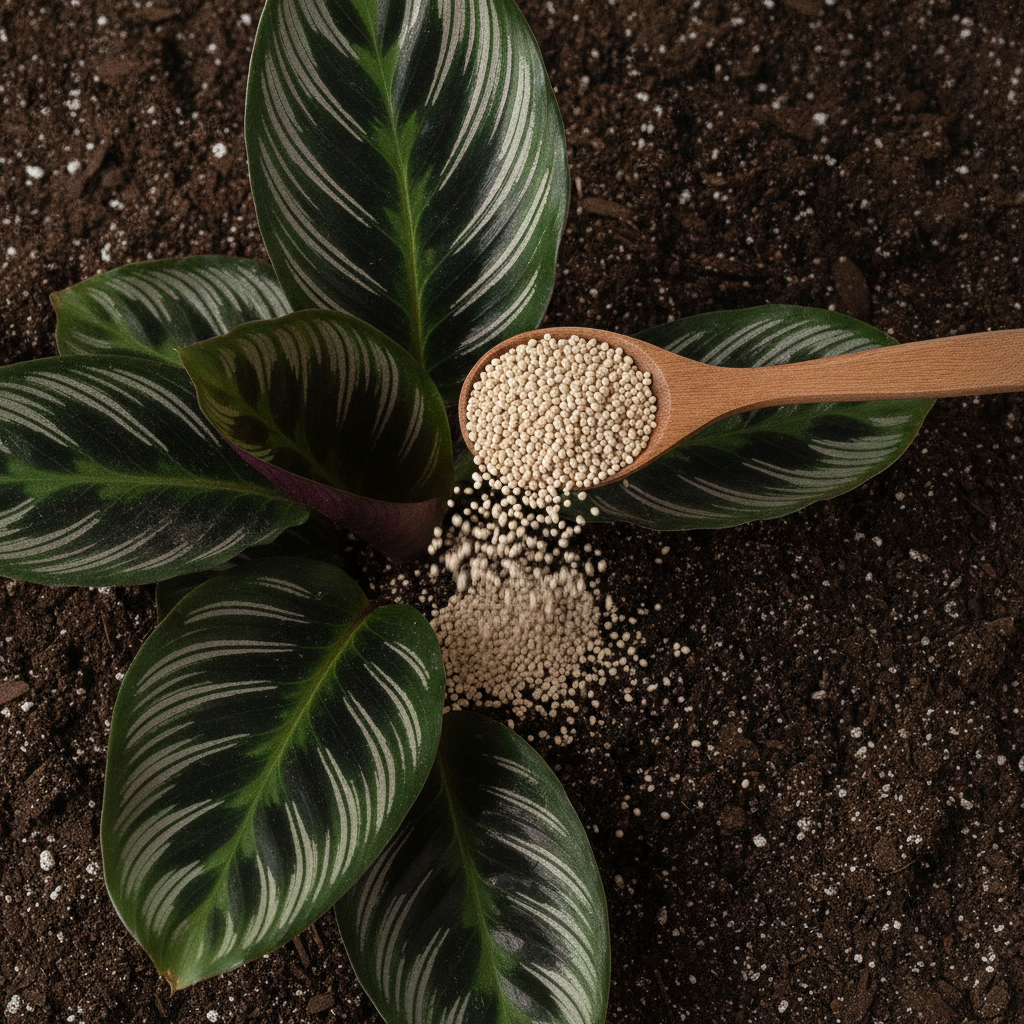
Understanding Plant Nutrients
A balanced houseplant fertiliser supplies the three macronutrients that drive most growth, nitrogen, phosphorus and potassium, along with the secondary and trace elements that keep foliage healthy. For a foliage plant such as the Beauty Star, nitrogen for leaf growth matters most, but a balanced formula that also carries magnesium and iron helps keep the deep green rich and the striping strong.
| Nutrient | Symbol | Primary Function | Deficiency Symptoms |
|---|---|---|---|
| Nitrogen | N | Leaf and stem growth, green colour | Pale, yellowing older leaves; slow growth |
| Phosphorus | P | Root development and energy transfer | Stunted growth, dull foliage |
| Potassium | K | Overall vigour and water regulation | Brown leaf edges, weak stems |
| Magnesium | Mg | Core of the chlorophyll molecule | Yellowing between the veins of older leaves |
| Iron | Fe | Chlorophyll production in new growth | Yellowing between the veins of new leaves |
Types of Fertiliser
Liquid fertilisers: The easiest choice for this plant, because diluting a balanced liquid feed to half strength lets you control the dose precisely and flush it away if needed. Applied to already-moist soil during the growing season, it is gentle and effective.
Slow-release granular: Convenient but harder to control, since the prills release nutrients whenever the soil is warm and wet, which for this constantly moist plant is nearly always. If you use them, use them lightly and watch for any sign of salt build-up.
Organic fertilisers: Worm castings, diluted seaweed feed and similar gentle organics suit the Beauty Star well, releasing nutrients slowly and carrying far less risk of the salt burn that synthetic feeds can cause. They are a forgiving option for anyone nervous about overfeeding.
Feeding Schedule
Feed roughly once a month through spring and summer, using a balanced fertiliser at half the recommended strength. Stop feeding altogether in autumn and winter, when growth naturally pauses and any added nutrients would simply accumulate as unused salts in the soil. This modest schedule is more than enough to keep a Beauty Star in full colour and steady growth.
Pro Tip — Half Strength, Always: Whatever the label recommends, dilute it to half for this plant. A Beauty Star fed lightly and regularly will always look better than one given full-strength feed, which risks scorching the roots and browning the leaf edges you are trying to protect.
How to Fertilise
- Water the plant first, or feed when the soil is already moist, so the fertiliser never hits dry roots.
- Dilute a balanced liquid feed to half the recommended strength with low-mineral water.
- Apply evenly to the soil, avoiding the leaves and the crown.
- Once every couple of months, flush the pot with plain water to wash out any accumulated salts.
Warning — Salt Build-Up: A white crust on the soil surface or around the drainage holes signals accumulated fertiliser salts, which scorch roots and brown leaf tips. Flush the pot thoroughly with plain low-mineral water until it runs freely from the base, and cut back on feeding.
Propagation
Unlike the many houseplants that root readily from a cutting in a jar of water, the Beauty Star can only be propagated by division. It grows from a spreading underground rhizome that produces new clumps of leaves, and the way to make more plants is to separate those clumps, each with its own roots and shoots, into independent plants. A stem or leaf cutting will not root, so division is the one method worth learning.
The best time to divide is in spring, ideally combined with a scheduled repotting so the plant is disturbed only once. A healthy, established clump that has filled its pot divides most successfully, because each section can be given enough roots to support itself from the start.
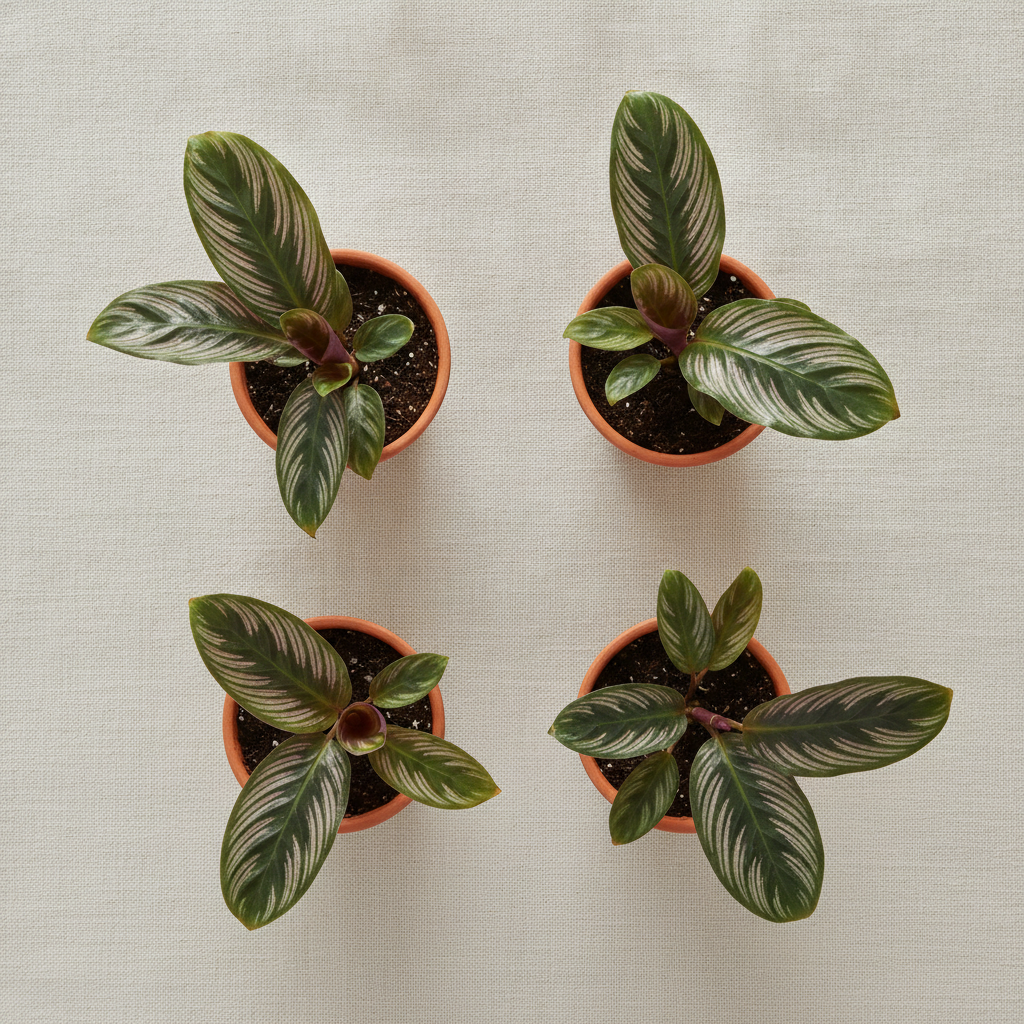
Understanding the Rhizome
The rhizome is a horizontal underground stem from which both roots and leaf clusters arise. As the plant matures it produces several such clusters, each effectively a plantlet joined to its neighbours below the soil. Because every cluster already has its own roots, the clump can be separated into pieces that are immediately viable, which is what makes division so reliable when a plant is otherwise notoriously hard to propagate.
Division: Step-by-Step
Division is straightforward provided you are gentle and make sure each new section is properly self-supporting before you separate it.
- Water the plant a day ahead, then slide the whole root ball out of its pot.
- Gently shake and tease away the loose soil until you can see the natural clumps and the roots that belong to each.
- Identify sections that carry both several leaves and a good portion of roots.
- Ease the sections apart by hand where possible, using a clean, sharp knife only if the rhizome must be cut.
- Pot each division into its own small container of fresh, moist mix at the same depth it grew before.
- Water in with low-mineral water and place the new plants somewhere warm, humid and brightly shaded.
Pro Tip — Humidity Boost for New Divisions: Fresh divisions establish fastest in extra humidity. Covering each new pot loosely with a clear bag or placing it in a propagator for the first week or two keeps the air moist while the disturbed roots recover, then open it gradually to acclimatise the plant.
Aftercare: Establishing Divisions
For the first few weeks a division will focus on rooting rather than new leaves, and may look static or even sulk a little, which is normal. Keep the mix evenly moist but not wet, hold off on any feeding until you see fresh growth, and maintain warmth and humidity. Once a new leaf unfurls you can be confident the division has taken and can begin to treat it as an ordinary plant.
Troubleshooting Propagation
| Problem | Likely Cause | Solution |
|---|---|---|
| Division wilts badly | Too few roots on the section, or dry air | Raise humidity, keep evenly moist, be patient |
| Rot at the base | Soil kept too wet after division | Reduce watering; ensure airy mix and drainage |
| No new growth for weeks | Normal establishment phase | Maintain warmth and humidity; wait for roots |
| Section fails entirely | Divided too small, with insufficient roots | Take larger sections next time, each with ample roots |
Pests & Diseases
A well-cared-for Beauty Star is reasonably resilient, but its love of warm, humid conditions and its thin, tender leaves make it a target for a handful of common houseplant pests, and its constant moisture leaves it open to a couple of diseases. Most trouble can be caught early by turning a few leaves over each time you water and looking closely at the undersides where problems usually begin.
Prevention is far easier than cure with this plant, and most of it comes down to the same conditions that keep the foliage handsome: appropriate humidity, clean water, good airflow and a quick response to anything unusual. A stressed plant, especially one kept too dry, is markedly more vulnerable than a well-tended one.
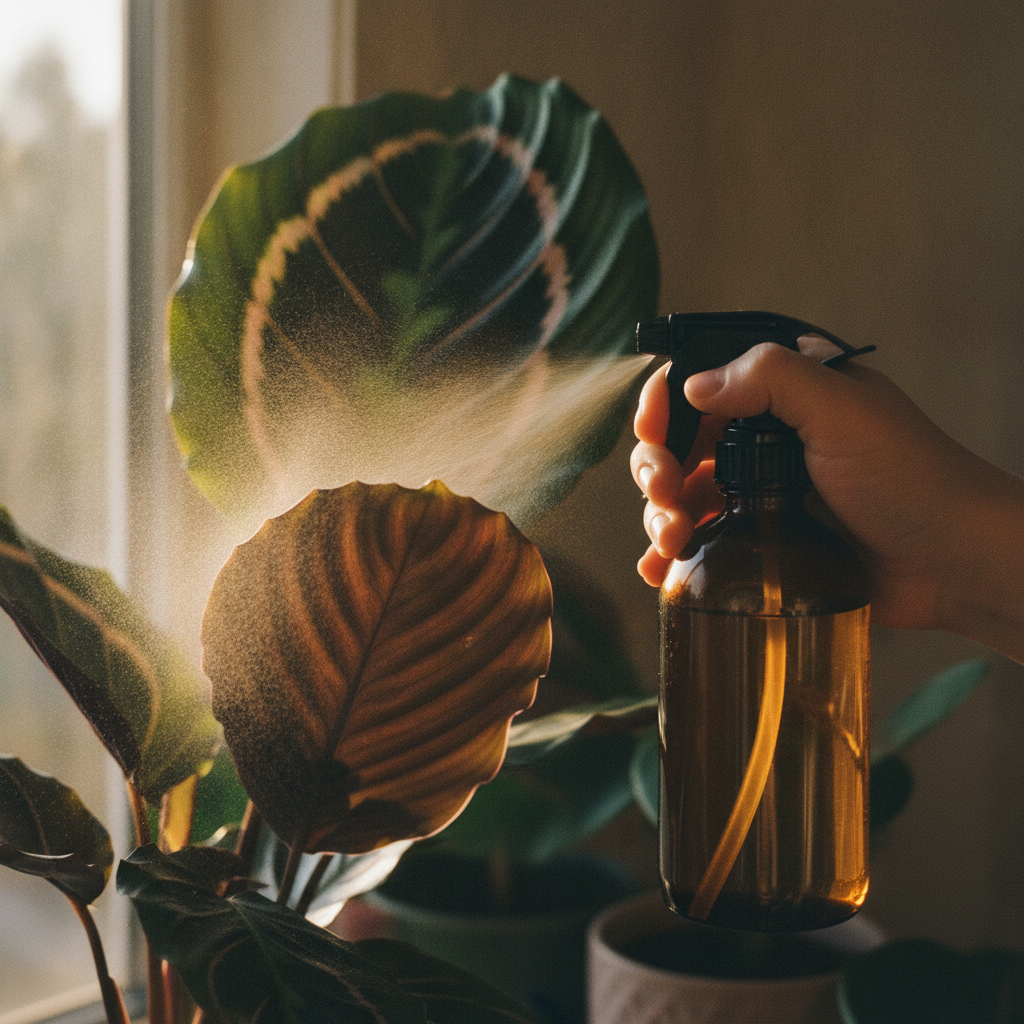
Common Pests
Spider Mites (Tetranychus urticae)
By far the most frequent and most serious pest of the Beauty Star, spider mites thrive in exactly the warm, dry air the plant hates. They are tiny, often invisible until fine webbing appears in the leaf axils and the foliage takes on a dull, stippled, speckled look. Because the plant is already stressed by low humidity when mites take hold, an infestation can escalate quickly.
Treatment: Rinse the plant thoroughly, including the leaf undersides, then treat with insecticidal soap or neem oil and repeat every five to seven days until clear. Raising the humidity is both treatment and prevention, since mites cannot establish in the moist air the plant prefers.
Fungus Gnats (Bradysia species)
The constantly moist soil that suits the Beauty Star is also ideal for fungus gnats, small dark flies whose larvae live in the top layer of damp compost. The adults are more nuisance than threat, but heavy larval populations can nibble fine roots and weaken a young plant.
Treatment: Let the very top of the soil dry slightly between waterings, cover it with a thin layer of grit to break the breeding cycle, and use yellow sticky traps to catch the adults. A biological control such as beneficial nematodes tackles the larvae if the problem persists.
Mealybugs (Pseudococcus species)
Mealybugs appear as small, white, cottony tufts tucked into leaf joints and along the stems, where they feed on sap and secrete a sticky honeydew. They spread slowly but are persistent, and a colony left alone will gradually sap the plant’s vigour.
Treatment: Dab each insect with a cotton bud dipped in diluted isopropyl alcohol, then follow up with neem oil or insecticidal soap across the whole plant. Check weekly for a month, as eggs hidden in crevices can hatch after the first treatment.
Common Diseases
Root Rot (Pythium and Phytophthora)
The chief disease risk for a plant kept continuously moist, root rot sets in when the soil stays waterlogged and airless long enough for fungal pathogens to attack the roots. The first signs are usually above ground, with yellowing, wilting foliage and a crown that softens and blackens even though the plant is being watered.
Treatment: Unpot the plant, cut away all brown, mushy roots back to firm white tissue, and repot into fresh, airy mix in a clean pot. Water more carefully thereafter and make sure the container drains freely; prevention through good soil and drainage is far more reliable than any cure.
Leaf Spot (various fungi and bacteria)
Leaf spot shows as small brown or black patches, sometimes ringed with yellow, that appear when leaves stay wet for too long in still, humid air. It is most common where water sits on the foliage after misting or splashing, giving spores the moisture they need to germinate.
Treatment: Remove affected leaves, improve airflow around the plant, and keep water off the foliage by watering at the soil. In stubborn cases a copper-based fungicide can help, but better ventilation and dry leaves usually resolve it.
Pest and Disease Summary
| Pest / Disease | Identification | Treatment |
|---|---|---|
| Spider mites | Fine webbing, dull stippled leaves | Rinse, neem or soap, raise humidity |
| Fungus gnats | Small flies over damp soil | Dry the surface, sticky traps, nematodes |
| Mealybugs | White cottony tufts in leaf joints | Alcohol dab, then neem or soap |
| Root rot | Yellowing, soft blackened crown | Trim rotten roots, repot, water carefully |
| Leaf spot | Brown or black spots on leaves | Remove leaves, improve airflow, keep foliage dry |
Prevention Strategies
The most effective defence is a plant kept in the conditions it wants, because vigorous growth resists pests and disease in a way that stressed growth cannot. Maintaining humidity above 50 percent keeps spider mites at bay, watering with clean water at the soil rather than the leaves prevents leaf spot, and using an airy, free-draining mix guards against root rot. Good airflow around the plant ties all of this together.
It also helps to inspect new arrivals before they join your collection and to keep them apart for a couple of weeks, since most infestations enter the home on a newly bought plant. A quick look at the leaf undersides each time you water turns pest control into routine observation rather than crisis response.
Pro Tip — Neem as Routine, Not Rescue: A light monthly wipe or spray of diluted neem oil across the leaf undersides, done before any pest appears, keeps spider mites and mealybugs from ever gaining a foothold. Prevention on a healthy plant is far less work than treating an outbreak on a stressed one.
Popular Varieties
The Beauty Star is one cultivar within the wider world of pinstripe calatheas, all forms of Goeppertia ornata, and once you know its markings you begin to notice the family resemblances and differences across the group. They share the same care needs, so choosing between them is almost entirely a question of which leaf pattern and scale appeals to you.
Beyond the ornata group, the name calathea is often used loosely for the many related prayer plants in the genera Goeppertia and Maranta, so a plant shop’s calathea bench may hold half a dozen very different looking species alongside the pinstripes. The table and profiles below focus on the ornata relatives most likely to be sold next to a Beauty Star.
| Variety | Leaf Appearance | Light Needs | Growth Rate | Availability |
|---|---|---|---|---|
| Beauty Star | Dark green with fine pink-to-silver pinstripes | Bright indirect | Moderate | Common |
| Sanderiana | Broad olive-green with wide rose-to-white stripes | Bright indirect | Moderate | Fairly common |
| Roseolineata | Deep green with vivid bright pink hairline stripes | Bright indirect | Moderate | Occasional |
| Calathea ornata (species) | Green with paired pink pinstripes, larger overall | Bright indirect | Moderate | Common |
| Calathea majestica | Larger leaves with fine, densely packed lines | Bright indirect | Moderate | Occasional |
Featured Varieties
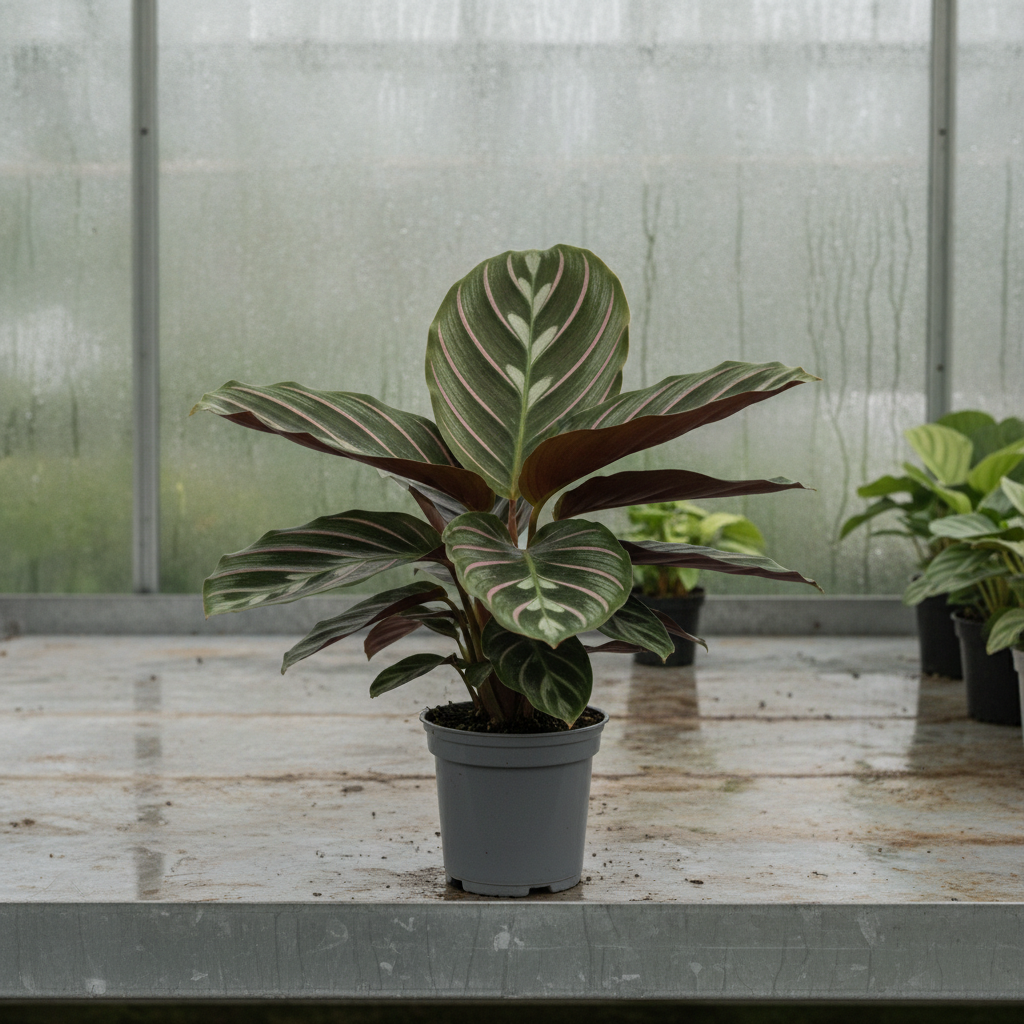
Sanderiana
A larger, bolder relative with broad olive-green leaves crossed by wide stripes that begin rose-pink and mature to a soft silvery white, above a deep maroon reverse. It reads as a more dramatic, heavier-textured version of the Beauty Star.
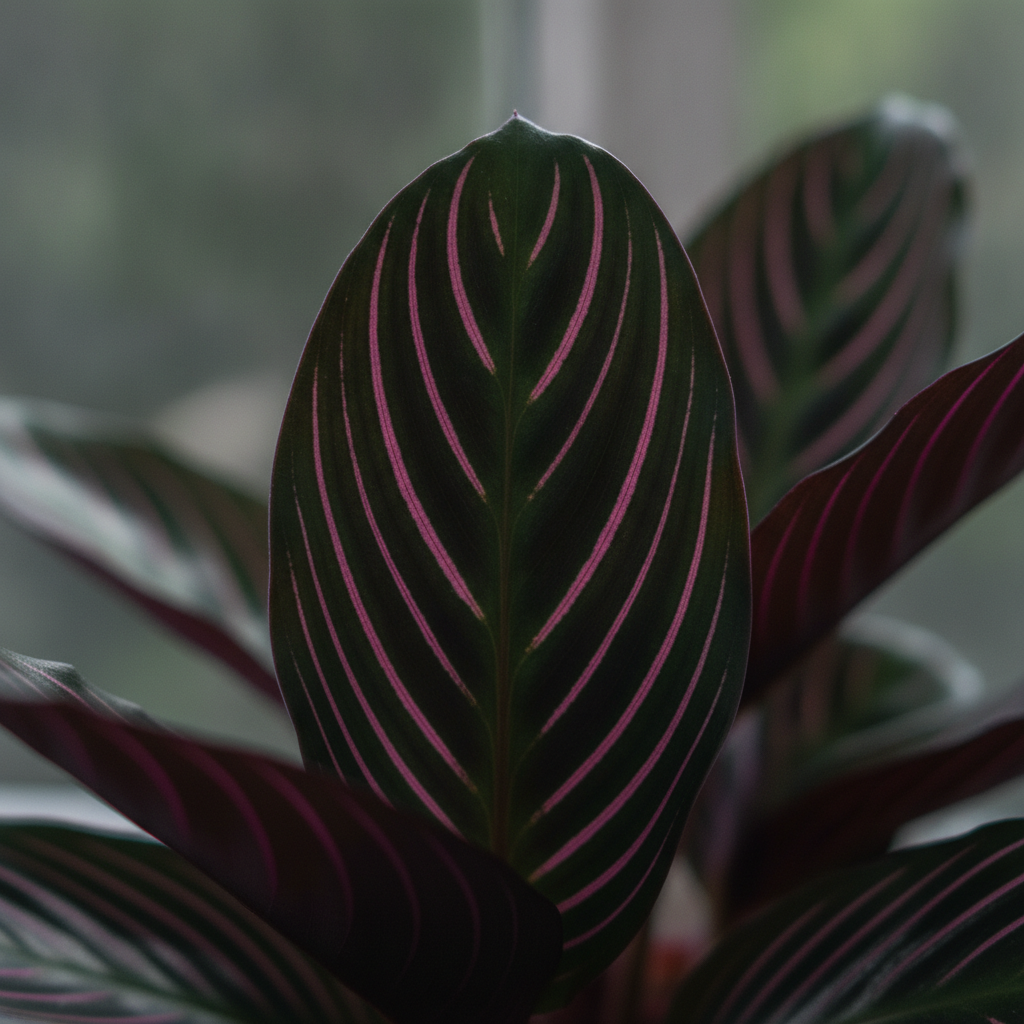
Roseolineata
Prized for the intensity of its colour, Roseolineata carries vivid, bright rose-pink hairline stripes on narrower, very dark green leaves, keeping their pink far longer than most before any fade to white. It is the most saturated of the pinstripe forms.
Variety Profiles in Detail
Sanderiana (Goeppertia ornata ‘Sanderiana’)
Sanderiana is essentially the Beauty Star scaled up and softened. Its leaves are larger and broader, and the stripes are wider and fewer, so the effect is of confident brushstrokes rather than fine pen lines. Young leaves flush a warm pink that ages to creamy silver, and the plant makes an imposing tabletop specimen where the Beauty Star is more delicate. Care is identical, though the greater leaf area makes it slightly thirstier and even keener on humidity.
Roseolineata (Goeppertia ornata ‘Roseolineata’)
Where other pinstripe calatheas mellow toward white with age, Roseolineata holds its vivid rose-pink lines, making it the choice for anyone who wants the colour at its most electric. The leaves are narrower and a very deep green, so the contrast is exceptional. It can be a little harder to find and, like all the ornata forms, rewards steady humidity and clean water with the most saturated colour.
Choosing the Right Variety for Your Space
Because every pinstripe calathea shares the same needs, the practical choice comes down to scale and colour rather than difficulty. For a compact, finely detailed plant on a shelf or side table the Beauty Star itself is ideal; for a bolder statement with room to spread, Sanderiana’s larger leaves earn their space; and for the most saturated pink, Roseolineata is worth seeking out. Whichever you choose, the same warm, humid, brightly shaded position with clean water will keep it at its best.
Frequently Asked Questions
Why are the edges of my Beauty Star’s leaves turning brown and crispy?
Crispy brown edges are the plant’s signature complaint and almost always point to one of three things: air that is too dry, water that is too high in minerals, or inconsistent watering. Raise the humidity above 50 percent, switch to rainwater, distilled or filtered water, and keep the soil evenly moist. Existing brown edges will not turn green again, but new leaves should emerge clean once the cause is fixed.
Why does my calathea move its leaves up and down?
This nightly raising and lowering is called nyctinasty and is a natural feature of the whole prayer plant family. A small hinge of tissue at the base of each leaf stalk swells and relaxes in response to the day-night cycle, folding the leaves upward at night and opening them by morning. It is a sign of a healthy, well-hydrated plant, and a Beauty Star that stops moving is often signalling a problem with water or light.
Is the Beauty Star calathea safe for cats and dogs?
Yes. Like all calatheas, the Beauty Star is non-toxic to cats, dogs and humans, which makes it one of the safest striking foliage plants for a home with pets or children. Eating any plant can cause mild stomach upset simply through the bulk of foliage, so it is still worth discouraging grazing, but the leaves contain no harmful compounds.
How often should I water my Beauty Star?
Rather than following a fixed schedule, water whenever the top 2 to 3 cm (about 1 in) of soil has just begun to feel dry, keeping the mix evenly moist but never soggy. In a warm, bright spot this often means once or twice a week in the growing season and less in winter, but the feel of the soil should always guide you over the calendar.
Why is my Beauty Star’s colour fading?
Fading, washed-out foliage usually means the light is wrong. Too much direct sun bleaches the deep green and dulls the pink stripes, while too little light leaves new growth pale and sparse. Move the plant to bright but indirect light, well back from any window that receives direct sun, and the colour of new leaves should return to normal.
Can I propagate a Beauty Star from a leaf or stem cutting?
No. Unlike pothos or philodendrons, calatheas will not root from a leaf or stem cutting placed in water or soil. The only reliable method is division, separating an established clump into sections that each have their own roots and shoots, ideally in spring when you repot. A cutting simply has no way to form a new growing point.
Why are the lower leaves on my Beauty Star turning yellow?
An occasional yellowing lower leaf is simply old age and nothing to worry about. Widespread yellowing, especially with soft, limp leaves and constantly wet soil, points to overwatering and the early stages of root problems. Check that the pot drains freely, let the top of the soil dry slightly more between waterings, and make sure the plant is never left standing in water.
Does a Beauty Star calathea need a terrarium or cabinet to do well?
It does not require one, but it certainly appreciates the stable, high humidity that an enclosed cabinet or terrarium provides, and many growers find it much easier to keep flawless in such a setting. In an ordinary room a humidifier, a pebble tray and grouping with other plants will keep it healthy; the cabinet simply makes perfect, unblemished leaves more attainable.
Why has my Beauty Star stopped moving its leaves at night?
A pause in the usual leaf movement is one of the earliest signs of stress, often appearing before any visible browning. The common causes are underwatering, a sudden drop in humidity, or a change in light or position. Check the soil moisture and the ambient humidity first, restore stable conditions, and the rhythmic folding usually resumes within a few days.
What temperature does the Beauty Star prefer?
It is happiest between 18 and 27 degrees C (65 to 81 degrees F), comfortably within normal room temperature. Keep it away from cold draughts, unheated porches and the cold glass of a winter window, and never let it sit below about 15 degrees C (59 degrees F), as chilling damages the foliage and stalls growth. Sudden temperature swings are as unwelcome as the cold itself.






