
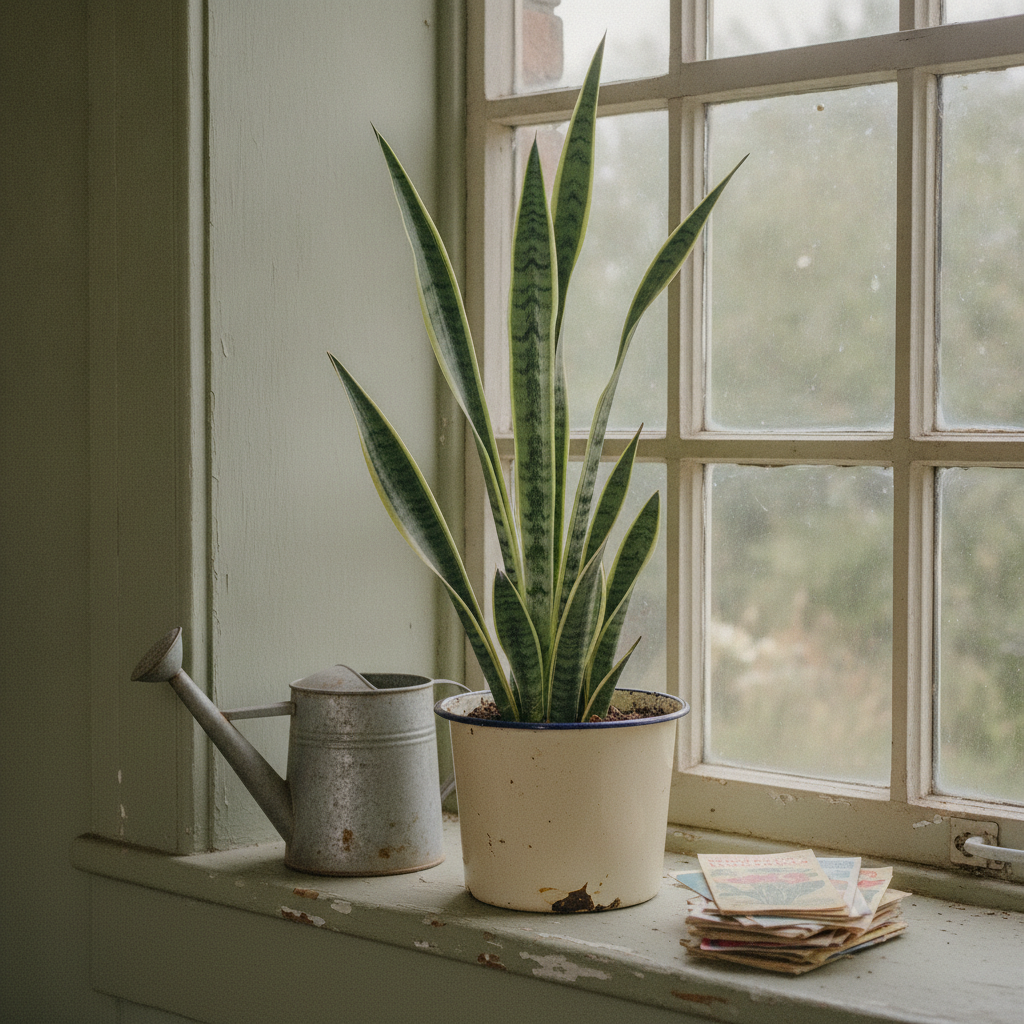
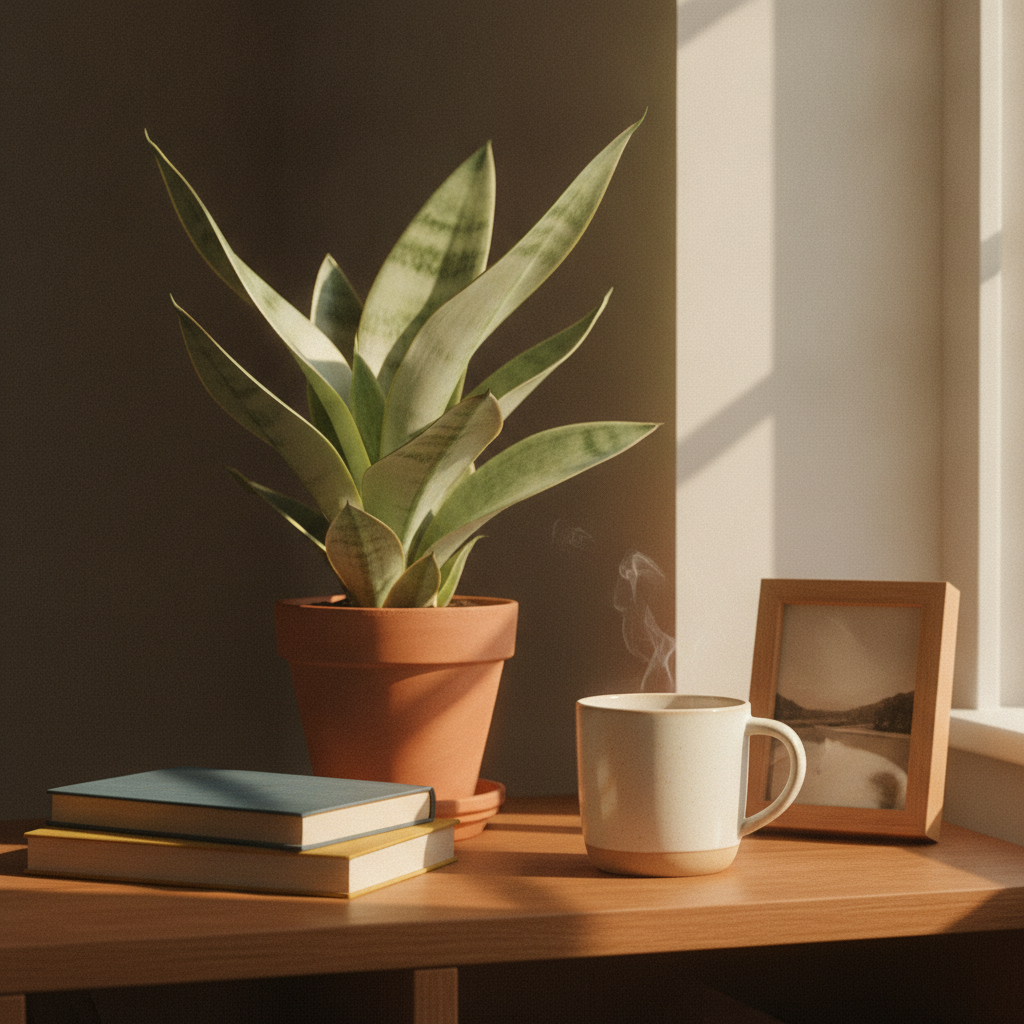
Among the many snake plants that populate windowsills and office corners, Dracaena trifasciata ‘Bantel’s Sensation’ stands slightly apart. Where most snake plants carry their variegation as horizontal banding or golden margins, this cultivar draws its pale markings the other way, in thin vertical streaks of creamy white that run the full length of each narrow, upright leaf. Often sold under its older name Sansevieria trifasciata ‘Bantel’s Sensation’ and occasionally as the White Striped Snake Plant, it was selected by the nurseryman Gustav Bantel in Baltimore during the 1940s and has been quietly prized by collectors ever since. The parent species is native to the rocky, seasonally dry woodlands of tropical West Africa, and much of what makes the plant so forgiving indoors traces directly back to that arid heritage.
Bantel’s Sensation has earned the same reputation for toughness as the rest of its clan, tolerating low light, irregular watering and long stretches of neglect without much complaint. Yet there is a meaningful gap between a snake plant that merely survives and one that genuinely thrives, pushing out crisp new leaves with bright, well-defined striping. This guide covers everything needed to close that gap, from reading the plant’s light and water needs to repotting, feeding, propagating and heading off the handful of problems that trouble it. Learn the small number of things this plant truly cares about, and it will reward you with years of sculptural, almost architectural growth.
Contents
- Quick Reference
- Why Bantel’s Sensation Makes a Standout Houseplant
- Light Requirements
- Watering & Humidity
- Soil, Potting & Repotting
- Fertilising
- Propagation
- Pests & Diseases
- Popular Varieties
- Frequently Asked Questions
Quick Reference: Bantel’s Sensation at a Glance
| Light | Bright, indirect light preferred to keep the white striping crisp; tolerates medium and low light, though variegation fades |
| Watering | Sparingly. Let the mix dry out completely, roughly every two to three weeks in summer and monthly or less in winter |
| Temperature | 18 to 27 degrees Celsius (64 to 81 degrees Fahrenheit); keep above 10 degrees Celsius (50 degrees Fahrenheit) |
| Humidity | Undemanding; ordinary room humidity of 30 to 50 per cent is ample |
| Fertiliser | Light feeder; a dilute balanced feed two or three times across spring and summer is plenty |
| Toxicity | Mildly toxic to cats and dogs if chewed or swallowed, owing to saponins |
Why Bantel’s Sensation Makes a Standout Houseplant
The first argument in this plant’s favour is simply how it looks. A mature specimen forms a tight fan of slim, blade-like leaves that reach upward with very little sideways sprawl, making it one of the most space-efficient statement plants available. The vertical white striping catches light along the length of each leaf and gives the whole plant a fine, brushed-silver quality that broader-leaved snake plants cannot match. Because it grows narrow rather than wide, it slots into corners, hallways and the gaps between furniture where fuller plants would feel crowded.

The second argument is resilience. Like all snake plants, Bantel’s Sensation uses crassulacean acid metabolism, a water-thrifty form of photosynthesis in which the leaf pores open at night rather than during the heat of the day. This lets the plant store water and carbon efficiently and shrug off the dry indoor air, missed waterings and fluctuating light that defeat fussier species. It is genuinely one of the easiest houseplants to keep alive, which makes it a fine choice for beginners, frequent travellers and anyone furnishing a low-light room. The only real trade-off is pace, as this is a slow-growing cultivar that adds leaves gradually rather than racing to fill its pot.
Important – Toxicity: Bantel’s Sensation contains saponins that are mildly toxic to cats and dogs, and can cause drooling, nausea, vomiting and diarrhoea if the leaves are chewed. It is also mildly irritating to people if ingested. Keep it out of reach of pets and small children who might be tempted to bite the striking leaves.
Light Requirements
Light is the single factor that separates a merely alive Bantel’s Sensation from a spectacular one. Because roughly half of each leaf is white tissue that carries little or no chlorophyll, the plant has less green surface with which to feed itself than a plain snake plant does. That makes good light more important here than for its all-green relatives, even though the species as a whole is famous for coping in gloom.
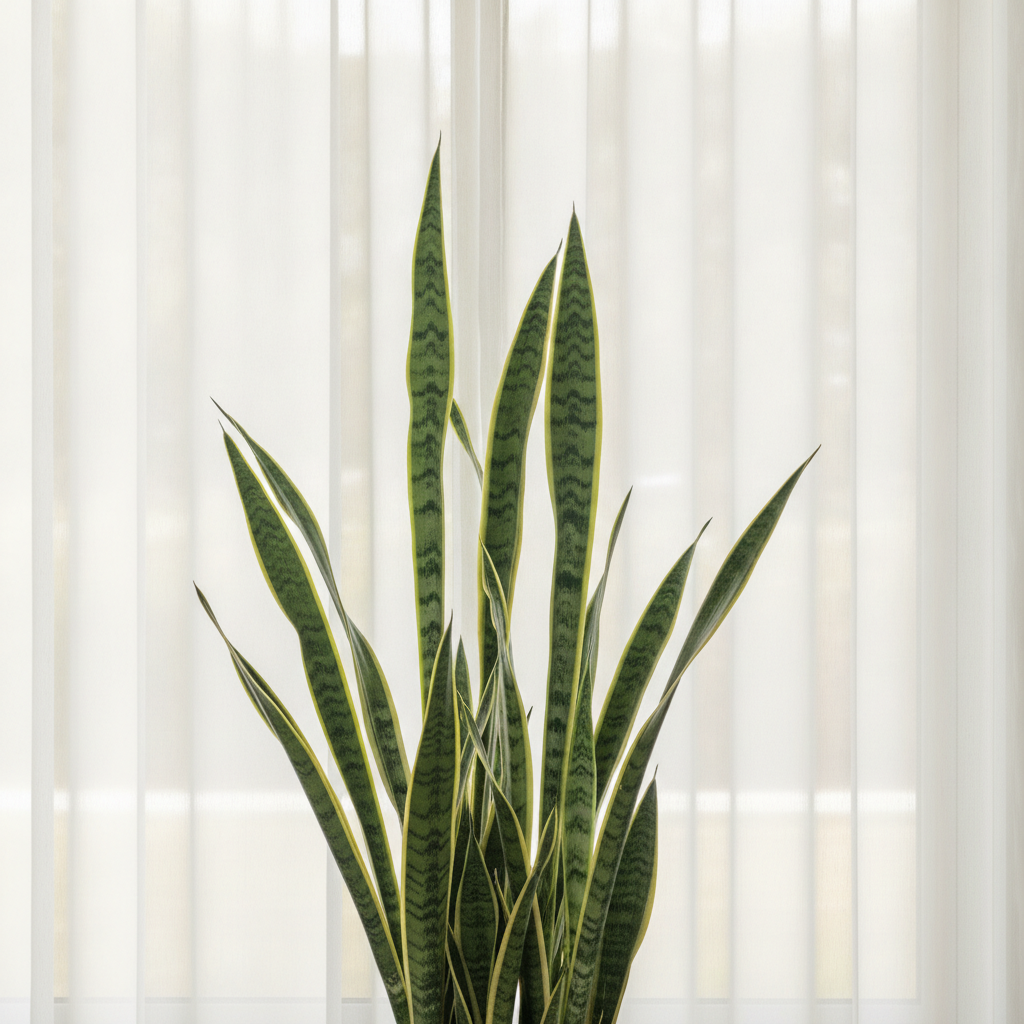
The ideal position is a spot with bright, indirect light for most of the day, such as a metre or so back from an east or west window, or beside a south window screened by a sheer curtain. In this kind of light the plant grows steadily and the white stripes stay bright and sharply defined. It will survive in medium and even low light, but growth slows almost to a standstill and the variegation dulls, with new leaves emerging greener and less striped than those grown in brighter conditions.
Light Levels Explained
Houseplant light is easier to judge once you attach rough numbers to the vague labels growers use. The table below maps the common categories to approximate light levels and the outcome you can expect from this particular cultivar.
| Light Category | Approx. Level | Typical Location | Outcome |
|---|---|---|---|
| Direct sun | Over 30,000 lux | On an unscreened south sill | Risk of bleaching and scorch after a few hours; acclimatise slowly |
| Bright indirect | 10,000 to 20,000 lux | Near a bright window, out of the sun’s direct beam | Best growth and sharpest, brightest striping |
| Medium | 5,000 to 10,000 lux | A few metres into a well-lit room | Slow, steady growth; variegation slightly softer |
| Low | 1,000 to 5,000 lux | A north room or an interior corner | Survives; growth stalls and stripes fade toward green |
| Very low | Under 1,000 lux | A windowless hallway or bathroom | Long-term decline; supplement with a lamp |
Window Orientation and Placement
South-facing window: The brightest option and a good one, provided the harsh midday beam is diffused with a sheer curtain or the plant is set back a little. Unscreened, prolonged direct sun can bleach the white tissue and leave dry, tan patches.
East-facing window: An excellent choice. Gentle, cool morning sun followed by bright indirect light for the rest of the day suits this plant almost perfectly.
West-facing window: Also very good. Afternoon light is stronger and warmer, so pull the plant back slightly or filter the last of the day’s sun if leaves start to look pale.
North-facing window: Workable but the weakest position. The plant will hold on, yet expect little new growth and gradually greener, less striped leaves over time.
Pro Tip – Rotate for Even Growth: Snake plant leaves lean gently toward their light source. Give the pot a quarter turn every couple of weeks so the fan stays upright and symmetrical rather than tilting toward the window.
How Light Affects Variegation
The white striping that makes Bantel’s Sensation special is not a fixed feature so much as a response to conditions. In good light the plant produces new leaves with plenty of pale tissue and strong contrast. In poor light it hedges its bets, producing leaves with more green so it can gather enough energy to survive. Over months in a dim corner, an entire plant can drift back toward plain green. If your specimen is losing its stripes, the remedy is almost always more light rather than more water or feed.
Warning – Direct Sunlight: Variegated leaves scorch more readily than green ones because the white areas have no pigment to protect them. Never move a plant straight from a shaded spot into full sun. Increase its exposure over a week or two so it can adjust and avoid sunburn.
Artificial Lighting
Bantel’s Sensation responds well to supplementary lighting, which makes it a candidate for offices and rooms with no usable window. A modest full-spectrum LED grow light positioned 30 to 45 centimetres (12 to 18 inches) above the plant and run for ten to twelve hours a day is enough to maintain healthy growth and preserve the striping. Ordinary bright room lighting alone will not sustain it long term, but it is a useful supplement to weak natural light.
Seasonal Adjustments
Indoor light falls markedly in winter as the sun sits lower and days shorten. Many owners move the plant closer to the window through the darker months, then ease it back in spring as the light strengthens. Watch for signs of too little light, such as stalled growth and fading stripes, and be ready to shift the plant or add a lamp until the days lengthen again.
Watering & Humidity
If light is the factor most owners underestimate, water is the one they overdo. More snake plants die from too much water than from any other cause combined. The thick, fleshy leaves are water-storage organs, and the plant is built to ride out drought, so the guiding principle is to water thoroughly but infrequently and to err firmly on the side of dry.
When to Water
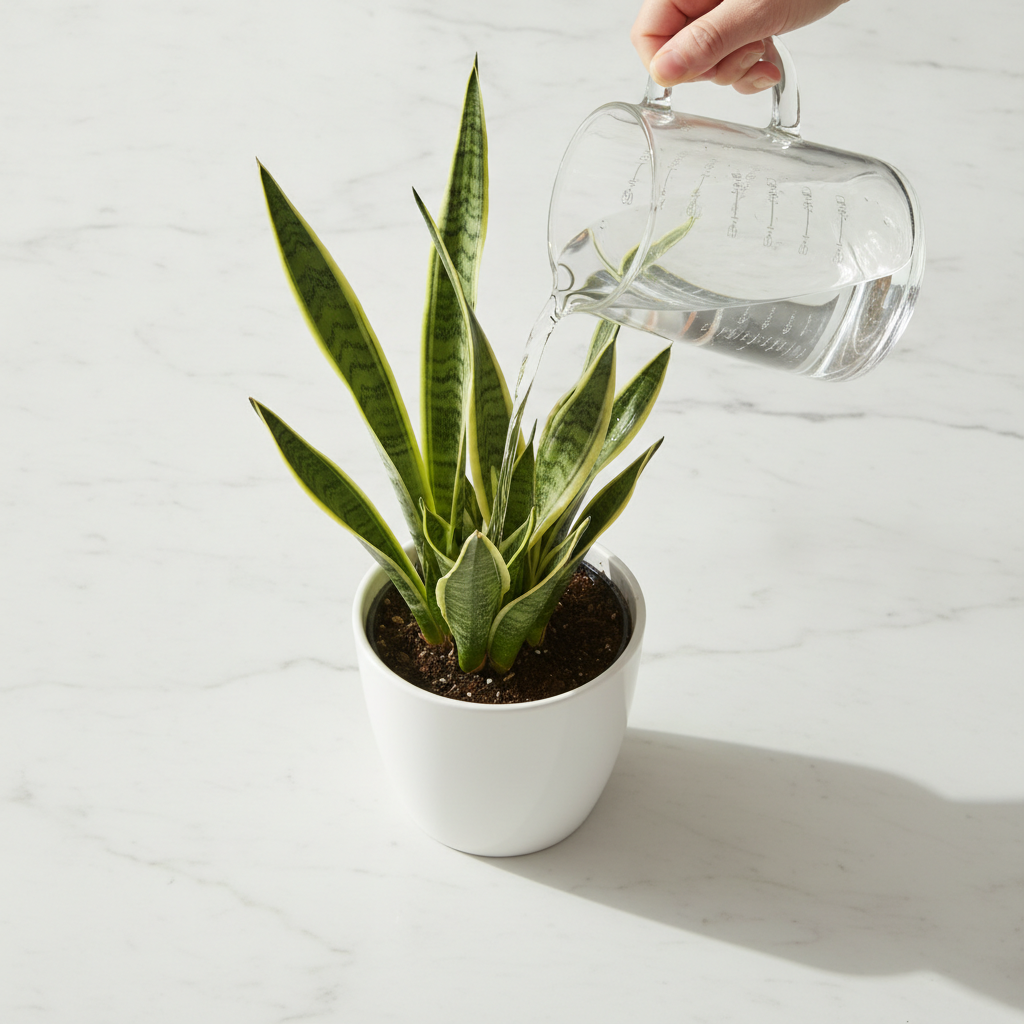
Forget any fixed schedule and let the soil decide. Push a finger into the mix to the second knuckle, or use a wooden skewer or moisture meter, and only water when it is dry all the way down. In a bright, warm spot during spring and summer this usually falls every two to three weeks, while in the low light and cool of winter it can stretch to once a month or even less.
The exact interval matters far less than the test. Pot size, light, temperature and the time of year all shift how quickly the mix dries, so a plant that needs water fortnightly in July may go six weeks between drinks in January. Checking before you pour, every single time, is the habit that keeps this plant alive.
Pro Tip – When in Doubt, Wait: A thirsty snake plant recovers within hours of a good soak, but a waterlogged one may already be rotting from the roots up. If you are unsure whether it needs water, give it another few days and check again.
How to Water Correctly
- Confirm the mix is dry throughout before you begin.
- Water at the soil surface, keeping the water off the central rosette where the leaves meet, since standing water there can cause rot.
- Pour slowly and evenly until water runs freely from the drainage holes.
- Let the pot drain completely for several minutes.
- Empty the saucer or cachepot so the roots never sit in standing water.
- Wait until the mix is bone dry again before the next watering.
Signs of Overwatering vs. Underwatering
| Symptom | Overwatering | Underwatering |
|---|---|---|
| Leaf colour | Yellowing, often from the base upward | Fading to a dull, greyish green |
| Leaf texture | Soft, mushy, translucent near the base | Wrinkled, puckered and thin, sometimes creased |
| Leaf posture | Leaves flop outward and topple from a soft base | Leaves curl inward and lose rigidity |
| Soil | Stays wet for weeks, may smell sour | Bone dry, pulling away from the pot sides |
| Roots and base | Brown, slimy roots and a squashy rhizome | Firm but dry roots; recovers fast once watered |
Warning – Root Rot: A soft, foul-smelling base and toppling leaves point to root rot, the commonest killer of snake plants. Unpot the plant at once, cut away every brown and mushy root and rhizome section with sterile blades, let the cuts callus for a day, and repot into fresh, dry, free-draining mix. Withhold water for a week afterward.
Humidity Requirements
Humidity is one thing you can stop worrying about with this plant. Coming from a seasonally dry climate, Bantel’s Sensation is entirely at home in the average 30 to 50 per cent humidity of a centrally heated or air-conditioned room and never needs misting.
In fact, damp, stagnant air does more harm than good, encouraging fungal spotting on the leaves. Good air circulation matters more than moisture in the air, so the plant is happiest in an open, well-ventilated spot rather than a crowded, humid one.
There is no need to raise humidity for this species. If you keep it alongside tropical plants that demand a moister atmosphere, simply ensure air moves freely around the snake plant and that its leaves dry quickly after any splashing.
Water Quality
Bantel’s Sensation is not fussy about water quality, and ordinary tap water is fine in most areas. If your supply is heavily chlorinated or very hard, occasional watering with rainwater or filtered water can prevent mineral crusting on the soil surface, but this is a refinement rather than a requirement. Room-temperature water is gentler on the roots than very cold water straight from the tap.
Soil, Potting & Repotting
The right growing medium is your best insurance against the overwatering that threatens every snake plant. Because the plant tolerates dryness so well but rots so readily in wet conditions, the mix should drain fast and hold very little water. Get the substrate right and small errors in watering frequency matter far less.
Ideal Soil Composition
A purpose-made cactus and succulent compost is the simplest starting point, and for many growers it is all that is needed. To make an ordinary houseplant compost suitable, cut it heavily with grit and drainage material so that water flows straight through. The aim is an open, airy structure that never stays soggy.
| Component | Proportion | Function |
|---|---|---|
| Cactus or standard potting compost | Half | Base structure and a modest reserve of nutrients |
| Coarse perlite or pumice | One quarter | Creates air pockets and speeds drainage |
| Coarse sand or fine grit | One quarter | Adds weight and further improves drainage |
Snake plants prefer a slightly acidic to neutral mix, roughly pH 6.0 to 7.0, which most peat-free and cactus composts fall within by default, so this rarely needs adjusting. What matters far more than the exact pH is that the medium is loose and free-draining rather than dense and moisture-retentive.
Pro Tip – Quick Mix Recipe: For a reliable blend, combine two parts cactus compost, one part coarse perlite and one part horticultural grit. It drains freely, holds the plant upright and suits every snake plant in the collection.
Choosing the Right Pot
Pot choice has a real bearing on how easy the plant is to water correctly, since the container governs how fast the mix dries and how much room the vigorous rhizomes have to spread.
Drainage holes are non-negotiable. Never plant a snake plant directly into a pot without drainage. If you love a particular decorative cachepot, keep the plant in a plain nursery pot with holes and drop that inside, lifting it out to water and drain.
Pot material: Terracotta is ideal because its porous walls wick moisture from the mix and dry it out faster, which suits a plant that hates staying wet. Glazed ceramic and plastic hold moisture longer, so if you use them, be even more careful to let the soil dry fully between waterings.
Pot size: Choose a snug pot only slightly larger than the root mass. Snake plants flower and grow best when a little pot-bound, and an oversized pot holds a large volume of slow-drying soil that invites rot. A heavy terracotta pot also counterbalances the tall leaves and stops the plant toppling.
When to Repot
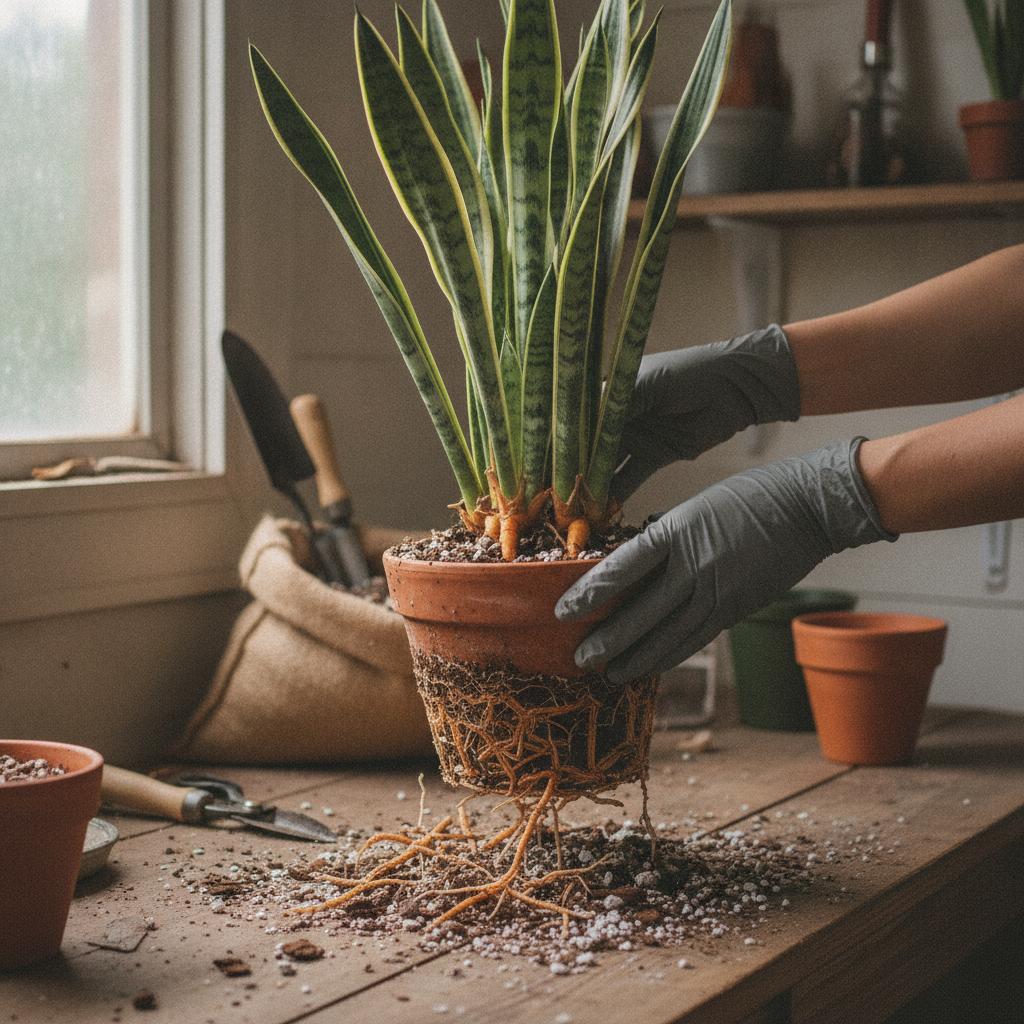
Bantel’s Sensation is slow-growing and content to be crowded, so it needs repotting only every three to five years. The usual prompts are roots creeping out of the drainage holes, a pot that bulges or cracks as the strong rhizomes expand, or the plant becoming so top-heavy it tips over. Spring and early summer, when the plant is in active growth, is the best time to do it.
How to Repot: Step-by-Step
- Water lightly a day or two beforehand so the root ball holds together, or repot dry to reduce the risk of rot.
- Ease the plant out by tipping the pot and supporting the base of the leaves; squeeze a flexible pot or run a knife around a rigid one.
- Shake off the old, spent mix and inspect the rhizomes and roots, trimming any that are brown, soft or rotten with sterile blades.
- Choose a pot just one size larger with good drainage, and add a layer of fresh, free-draining mix to the base.
- Set the plant at the same depth it grew before and fill around it with mix, firming gently to remove large air pockets.
- Hold off watering for several days to let any disturbed or cut roots callus over, then resume the normal dry-out routine.
Warning – Transplant Shock: Snake plants dislike disturbance and may sulk for a few weeks after repotting. This is normal. Resist the urge to compensate with extra water or feed, which only stresses the recovering roots further. Keep it warm, in good light and dry, and it will settle.
Fertilising
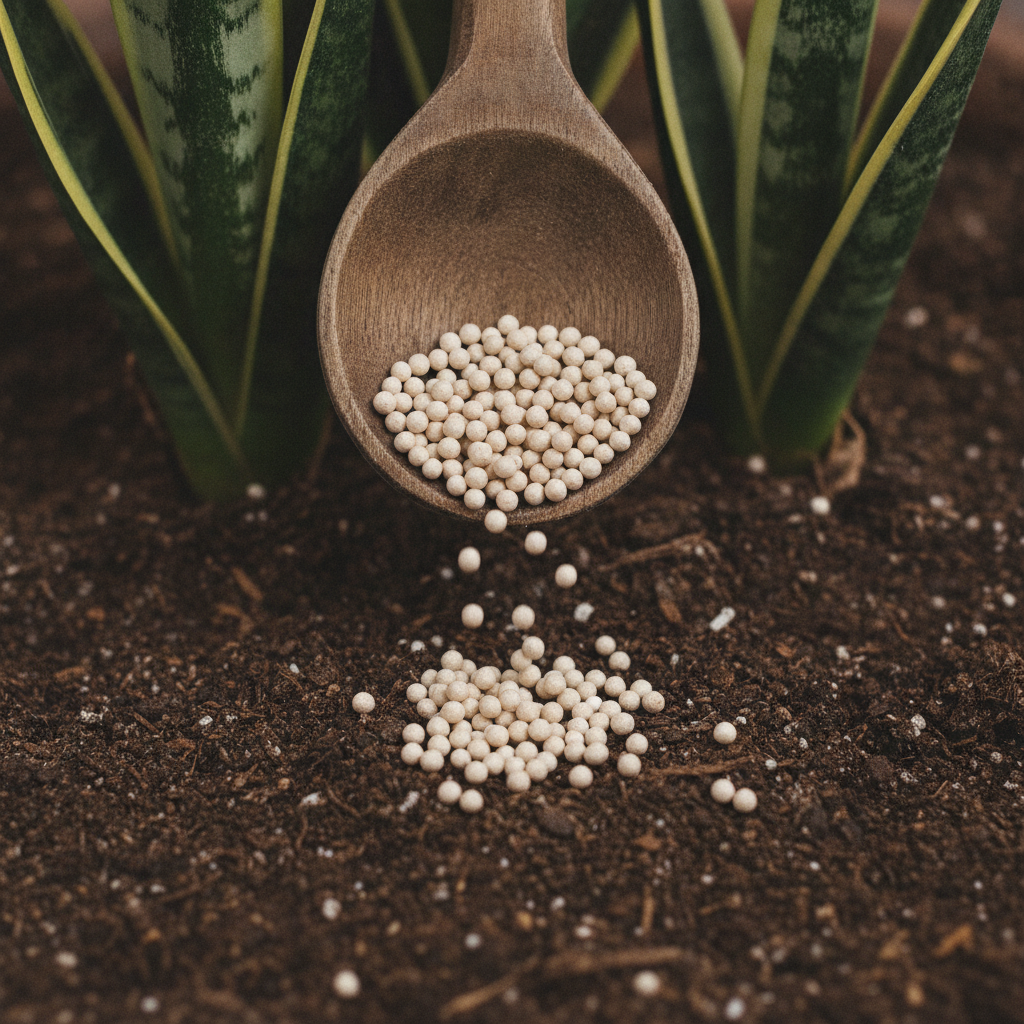
Snake plants are famously light feeders, having evolved in poor, thin soils, and Bantel’s Sensation is no exception. It is one of the few houseplants where doing less is genuinely better, and far more specimens are harmed by overfeeding than by going hungry.
A little feed during the growing season does support steady growth and bright variegation, but the quantities involved are small. Think of fertiliser as an occasional supplement rather than a regular part of the routine.
Understanding Plant Nutrients
Most fertilisers list three headline numbers, the N-P-K ratio, giving the percentages of nitrogen, phosphorus and potassium. A balanced feed such as 10-10-10, diluted well, is perfectly suited to a foliage plant like this. The table below outlines the main nutrients and what their shortage looks like.
| Nutrient | Symbol | Primary Function | Deficiency Symptoms |
|---|---|---|---|
| Nitrogen | N | Leaf and stem growth, green pigment | Overall paling and stunted new leaves |
| Phosphorus | P | Root development and energy transfer | Weak roots, sluggish growth, dull tone |
| Potassium | K | Overall vigour and stress tolerance | Yellowing or browning at leaf edges |
| Magnesium | Mg | Core of the chlorophyll molecule | Yellowing between the veins of older leaves |
| Iron | Fe | Chlorophyll production in new growth | Pale yellow young leaves with green veins |
Types of Fertiliser
Liquid fertilisers: The easiest to control, since you dilute them in water and can dial the strength right down. A general houseplant or cactus feed at half strength or weaker is ideal for this plant.
Slow-release granular: Coated prills that release nutrients gradually over months. Convenient and low-effort, though they offer less control, so use them at the lower end of the recommended rate for a light feeder like this.
Organic fertilisers: Worm castings, dilute seaweed and similar gentle options feed slowly and are very hard to overdo, making them a safe, forgiving choice for anyone nervous about scorching the roots.
Feeding Schedule
Feed only during the active growing months of spring and summer, offering a dilute balanced feed just two or three times across the whole season. Stop entirely in autumn and winter, when the plant is barely growing and cannot use the nutrients, so any surplus simply accumulates in the soil as harmful salts.
Pro Tip – Halve the Dose: Whatever a fertiliser label recommends for houseplants, halve it, or halve it again, for a snake plant. These plants thrive on lean conditions, and a weak feed given occasionally is always safer than a strong one.
How to Fertilise
- Dilute a balanced liquid feed to half the label strength or less.
- Water the plant with plain water first if the mix is very dry, to protect the roots from a concentrated dose.
- Apply the diluted feed to the soil, never onto the leaves or into the central rosette.
- Let any excess drain away and empty the saucer.
- Feed no more than every four to six weeks, and only in spring and summer.
Warning – Salt Build-Up: A white crust on the soil or pot rim and brown, scorched leaf tips signal a build-up of fertiliser salts. Flush the pot by running plenty of plain water through it until it drains freely from the base, and cut back on feeding.
Propagation
Propagating Bantel’s Sensation is straightforward, but there is one crucial catch that sets it apart from ordinary snake plants. The white striping is a chimeric trait, meaning it depends on a specific layered arrangement of tissue in the growing point rather than being carried uniformly through the plant. That single fact determines which propagation method you should choose.
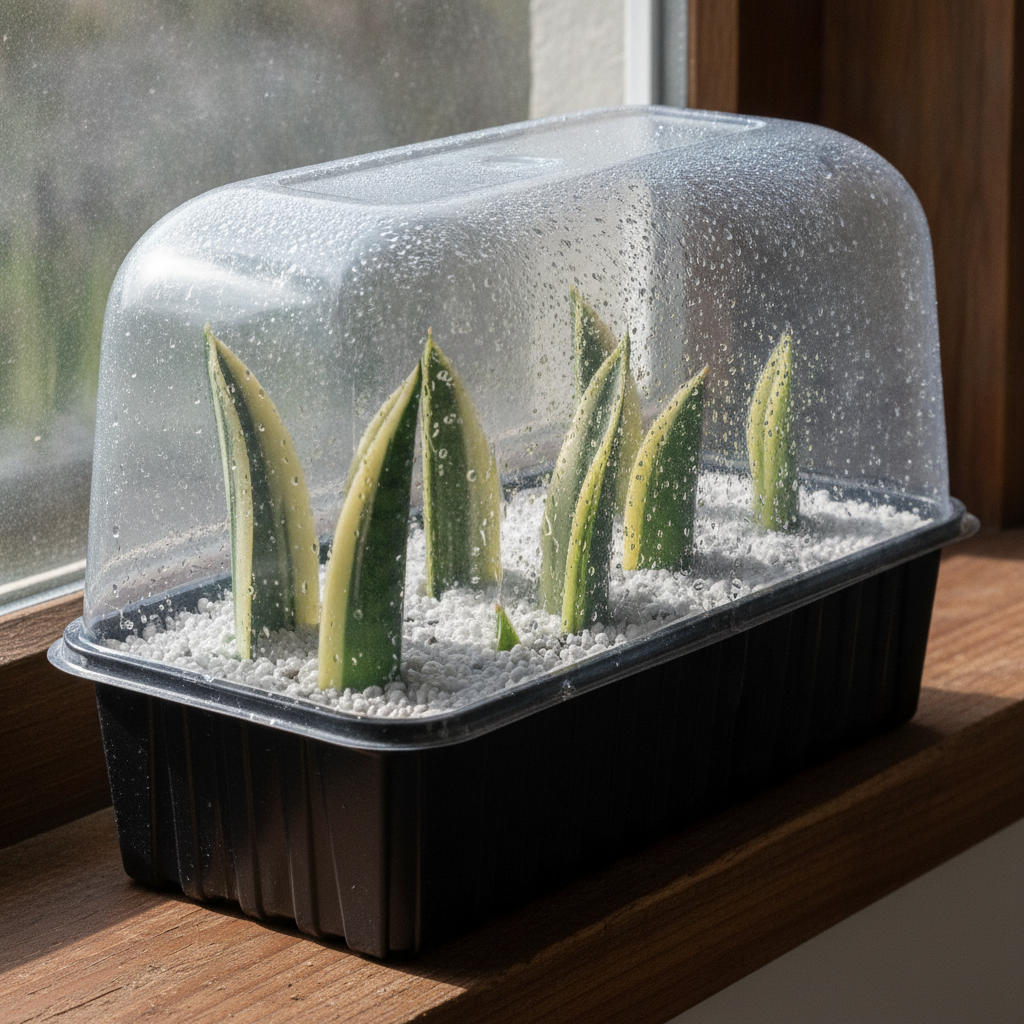
The short version is that division preserves the variegation while leaf cuttings usually lose it. Both methods are covered below so you understand the trade-off, but for keeping the prized white stripes, division is the method to reach for.
Understanding Rhizomes and Chimeric Variegation
Snake plants spread underground by rhizomes, thick horizontal stems that push out new leaf fans, or pups, around the parent. When you divide a clump, each pup keeps a section of the original rhizome and the layered growing tissue that produces the stripes, so it comes away true to type. A leaf cutting, by contrast, regenerates a whole new plant from unspecialised cells that reorganise without the chimeric layering, and the result is almost always a reverted, plain green snake plant. This is why professional growers multiply Bantel’s Sensation by division rather than cuttings.
Division: Step-by-Step
Division is the reliable, variegation-preserving method and is best done in spring or early summer, ideally when you are repotting anyway.
- Slide the whole plant out of its pot and brush the loose soil away from the roots and rhizomes.
- Identify natural clumps of leaves, each with its own roots and a connecting length of rhizome.
- Separate the clumps by teasing them apart, or cut through the rhizome between them with a clean, sharp knife, making sure each division keeps roots and at least one healthy leaf fan.
- Let the cut surfaces dry and callus for a day or two in a shaded, airy spot to guard against rot.
- Pot each division into its own small container of fresh, free-draining mix at its original depth.
- Wait a week before the first light watering, then return to the normal dry-out routine.
Pro Tip – Divide While Repotting: Since both jobs mean lifting the plant and disturbing the roots, combine them. Every three to five years when the plant needs a bigger pot, take the chance to split off a division or two at the same time.
Leaf Cuttings: Step-by-Step
Leaf cuttings are the classic snake plant party trick and worth knowing, as long as you accept that the offspring will revert to plain green. It remains a fun way to make more easy-care plants where the striping is not the point.
- Cut a healthy leaf off at the base with clean, sharp blades.
- Slice it into sections roughly 5 to 8 centimetres (2 to 3 inches) long, noting which end pointed downward, since it must be planted the same way up.
- Let the cut pieces dry and callus for a day or two.
- Insert the lower edge of each section about a third of its depth into damp perlite or free-draining mix, keeping the correct orientation.
- Place in bright, indirect light and keep the medium barely moist, watering sparingly to avoid rot.
- Be patient, as roots take several weeks and new pups can take a couple of months or more to appear.
Troubleshooting Propagation
| Problem | Likely Cause | Solution |
|---|---|---|
| Cuttings rot before rooting | Medium too wet or cuts not callused | Let cuts dry longer, use gritty mix and water sparingly |
| New pups come out plain green | Leaf cuttings cannot pass on chimeric striping | Expected; use division to keep the variegation |
| No roots after many weeks | Too cold, too dark or too dry | Move somewhere warm and bright and keep the medium barely moist |
| Divisions wilt after potting | Watered too soon or roots damaged | Hold off water while cuts callus, then water lightly |
Pests & Diseases
Bantel’s Sensation is among the most trouble-free houseplants you can keep, and its tough, leathery leaves deter most pests. The problems that do arise are nearly always linked to overwatering rather than to any infestation, which makes prevention largely a matter of restraint with the watering can.
Even so, it pays to inspect the plant now and then, particularly the leaf axils and undersides where sap-sucking insects like to hide. Catching a small problem early keeps it small.
Common Pests
Mealybugs (Pseudococcus species)
Small, soft-bodied insects that look like tufts of white cotton wool tucked into leaf axils and along the leaf bases. They suck sap, weaken the plant and leave a sticky residue that can attract sooty mould.
Treatment: Dab each insect with a cotton bud dipped in isopropyl alcohol, then wipe the leaves clean. For a wider infestation, treat with insecticidal soap or a diluted neem oil solution and repeat weekly until they are gone.
Spider Mites (Tetranychus urticae)
Tiny arachnids that thrive in hot, dry air and show up as fine speckling on the leaves and, in bad cases, delicate webbing between them. They are hard to see without a hand lens.
Treatment: Wipe the leaves down with a damp cloth to remove mites and webbing, improve air circulation, and apply neem oil or insecticidal soap to both leaf surfaces every few days until the population collapses.
Thrips (Thrips species)
Slender, dark, fast-moving insects that rasp at the leaf surface, leaving silvery streaks and tiny black specks of excrement. They can spread quickly between plants.
Treatment: Isolate the plant, prune the worst-affected leaves, and treat with neem oil or insecticidal soap. Yellow sticky traps help catch the adults and monitor whether the problem is easing.
Common Diseases
Root Rot (Fusarium and Pythium species)
By far the most serious threat to this plant, caused by soil-borne fungi that flourish in waterlogged conditions. The base of the plant turns soft and brown, leaves yellow and topple, and there is often a sour smell.
Treatment: Unpot immediately, cut away all soft, brown roots and rhizome with sterile blades, let the healthy tissue callus for a day, and repot into fresh dry mix. Salvage any firm leaves as cuttings if the crown is lost.
Southern Blight and Leaf Spot (Sclerotium and fungal pathogens)
Fungal problems that appear as reddish-brown, sunken or water-soaked spots on the leaves, usually where moisture has been allowed to sit on the foliage in warm, stagnant air.
Treatment: Remove affected leaves with clean blades, keep water off the foliage, improve ventilation, and reduce watering. A copper-based or general fungicide can help in persistent cases.
Pest and Disease Summary
| Pest / Disease | Identification | Treatment |
|---|---|---|
| Mealybugs | White cottony tufts in leaf axils | Alcohol on a cotton bud, then insecticidal soap or neem |
| Spider mites | Fine speckling and faint webbing | Wipe leaves, raise airflow, apply neem or soap |
| Thrips | Silvery streaks and black specks | Isolate, prune, neem or soap, sticky traps |
| Root rot | Soft brown base, toppling leaves, odour | Cut out rot, repot into dry mix, water less |
| Leaf spot | Brown sunken or water-soaked spots | Remove leaves, keep foliage dry, improve airflow |
Prevention Strategies
Prevention with this plant comes down to a few simple habits. Water only when the mix is dry, use a free-draining medium in a pot with drainage holes, and keep the leaves dry and the air moving. Most snake plants that fail do so because these basics were neglected rather than because of any pest.
Inspect any new plant carefully and keep it apart from your collection for a couple of weeks before introducing it, since quarantine is the single most effective way to stop an infestation spreading. A quick monthly check of the leaf axils and undersides will catch almost any problem while it is still easy to deal with.
Pro Tip – Wipe the Leaves: Every few weeks, wipe the broad leaf faces with a soft, damp cloth. It removes dust so the plant can photosynthesise efficiently, keeps the white striping looking its best, and gives you a regular moment to spot pests before they take hold.
Popular Varieties
Bantel’s Sensation is itself a named cultivar of Dracaena trifasciata, prized for its unusual vertical white striping, but it belongs to a large and varied family of snake plants. Understanding its relatives helps place it in context and points toward companions that share its easy care while offering a different look.
The cultivars below span the range from tall and upright to compact and rosette-forming, and from bold yellow margins to soft silvery tones. All ask for the same lean, dry, bright treatment, so a collection of them is no harder to keep than a single plant.
| Variety | Leaf Appearance | Light Needs | Growth Rate | Availability |
|---|---|---|---|---|
| Bantel’s Sensation | Narrow, upright, vertical white stripes | Bright indirect | Slow | Uncommon |
| Laurentii | Broad, upright, bold yellow margins | Bright indirect | Moderate | Very common |
| Moonshine | Wide, silvery pale green | Bright indirect | Slow | Common |
| Hahnii (Bird’s Nest) | Short rosette of banded leaves | Low to bright indirect | Slow | Common |
| Futura Superba | Shorter, wide leaves, yellow edges | Bright indirect | Moderate | Common |
| Cylindrica | Round, spear-like cylindrical leaves | Bright indirect | Slow | Common |
| Black Coral | Dark green with subtle grey banding | Low to bright indirect | Moderate | Common |
Featured Varieties
Laurentii
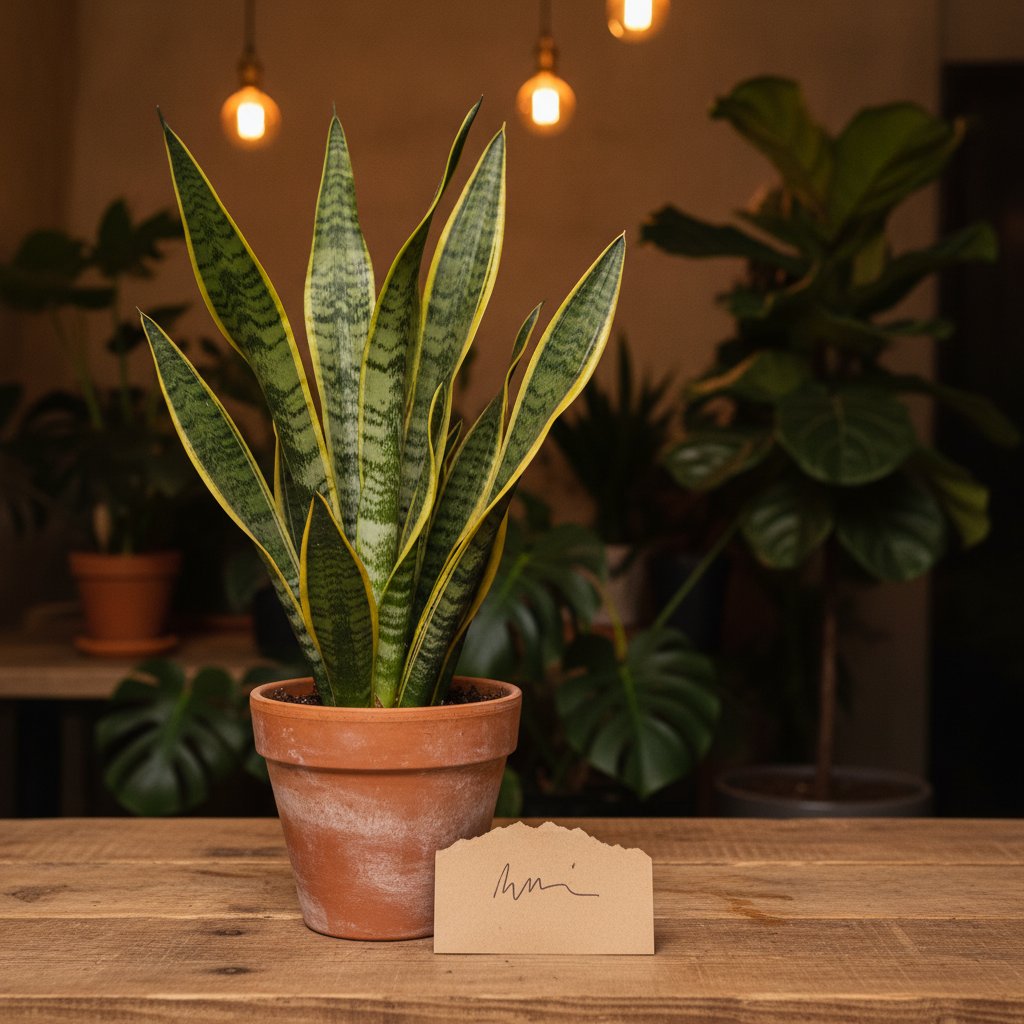
The classic snake plant and the one most people picture, with broad, upright leaves edged in bold golden-yellow and cross-banded in grey-green. Vigorous and widely sold, it makes an excellent, more affordable companion to the rarer Bantel’s Sensation.
Moonshine
A striking cultivar with wide, smooth leaves of pale, silvery green and faint darker margins. Its cool, ghostly colouring pairs beautifully with the crisp white striping of Bantel’s Sensation and holds best in bright, indirect light.
Variety Profiles in Detail
Bantel’s Sensation (Dracaena trifasciata ‘Bantel’s Sensation’)
The subject of this guide, distinguished from every other snake plant by its slim, dark green leaves streaked lengthwise with fine creamy-white lines. It is slow-growing and slightly more light-hungry than plain forms, and because the variegation is chimeric it must be propagated by division to stay true. Its narrow, sculptural silhouette makes it a favourite for modern, minimal interiors.
Hahnii (Dracaena trifasciata ‘Hahnii’)
Known as the bird’s nest snake plant, this dwarf cultivar forms a low, tight rosette rarely more than 15 centimetres (6 inches) tall, with the same banded leaves in miniature. Its compact habit suits desks, shelves and small spaces where the taller forms would not fit.
Cylindrica (Dracaena angolensis)
The African spear or cylindrical snake plant grows stiff, round, spear-like leaves instead of flat blades, sometimes braided or fanned by growers. It shares the same undemanding care and makes a bold architectural contrast to the striped, flat-leaved cultivars.
Choosing the Right Variety for Your Space
Let your light and your space guide the choice. For a bright spot where you want the striping to shine, Bantel’s Sensation and Moonshine both reward you, while Laurentii is the dependable, easy-to-find all-rounder. For dim corners, the plain green and darker cultivars such as Black Coral cope best, and for small surfaces the compact Hahnii is ideal. Because every one of them asks for the same lean, dry, bright treatment, you can mix and match freely and build a varied collection with a single, simple care routine.
Frequently Asked Questions
Why is my Bantel’s Sensation losing its white stripes?
Almost always because of too little light. In dim conditions the plant produces greener leaves to gather more energy, and over time it can drift back toward plain green. Move it to a brighter, indirect spot and new growth should return with better striping.
How often should I water it?
Only when the soil is completely dry, which typically means every two to three weeks in summer and monthly or less in winter. Always test the soil rather than following a calendar, as the right interval shifts with light, warmth and season.
Why are the leaves turning yellow and soft?
Soft, yellowing leaves are the classic sign of overwatering and possible root rot. Let the soil dry out, check the roots for brown mushy sections, and cut back your watering. Firm, wrinkled leaves, by contrast, point to underwatering and are easily fixed with a good soak.
Can I propagate it from a leaf cutting and keep the stripes?
No. Leaf cuttings of Bantel’s Sensation almost always revert to plain green because the variegation is chimeric. To keep the white striping you must propagate by dividing the rhizome, which passes on the pattern intact.
Is Bantel’s Sensation safe around pets?
No. Like all snake plants it contains saponins that are mildly toxic to cats and dogs, causing drooling, vomiting and diarrhoea if chewed. It is best kept out of reach of curious pets and small children.
Why is my snake plant not growing?
Bantel’s Sensation is naturally slow-growing, and growth all but stops in low light and over winter, so a little patience is normal. If you want to encourage it, give it brighter indirect light and a light feed during spring and summer, but do not resort to extra water, which does more harm than good.
Does it really improve air quality?
Snake plants featured in NASA’s well-known clean-air research and can remove trace pollutants under laboratory conditions, and because they release oxygen at night they are often suggested for bedrooms. In an ordinary room the effect is modest, so enjoy it as a pleasant bonus rather than a substitute for ventilation.
How big will it get?
Indoors, Bantel’s Sensation typically reaches 60 to 90 centimetres (24 to 36 inches) tall over many years, occasionally more in ideal conditions. It stays pleasingly narrow throughout, spreading only slowly as the rhizome produces new fans around the base.






