
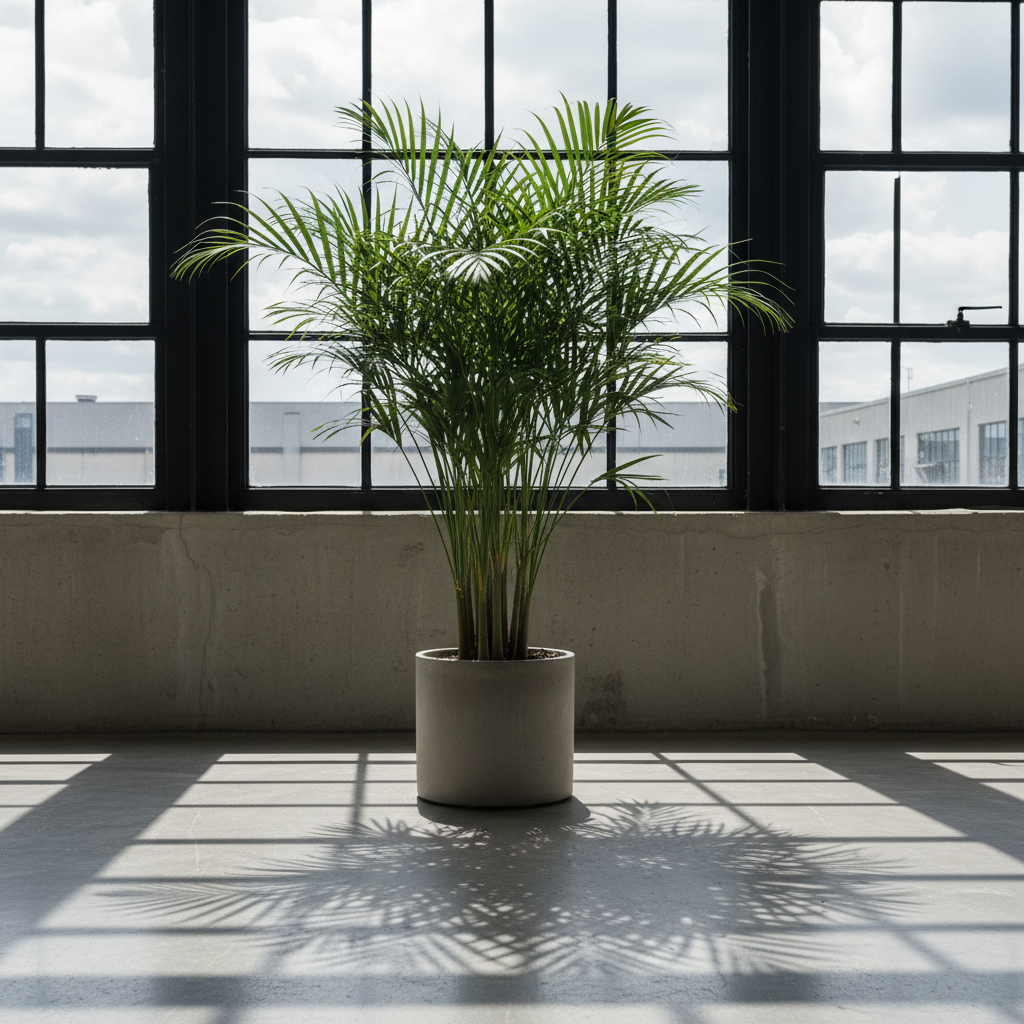
Few palms earn their place in a living room as gracefully as the bamboo palm. Known botanically as Chamaedorea seifrizii, it grows as a clustering thicket of slender, ringed canes that genuinely resemble bamboo, each one crowned with arching, feathery fronds of narrow dark-green leaflets. It is native to the limestone understorey of the Yucatán Peninsula and across Mexico, Belize and Guatemala, where it grows in the dim, humid shade beneath taller rainforest trees. That heritage explains almost everything about how it behaves indoors: it is built for filtered light, steady moisture and warmth, and it asks for very little drama in return.
It is also one of the most forgiving large houseplants you can grow, which is why it turns up in offices, hotel lobbies and shaded corners that defeat most other palms. The bamboo palm has a reputation as nearly indestructible, and that reputation is mostly deserved, but there is a meaningful gap between a plant that survives and one that thrives. A surviving bamboo palm sits in a dim corner with browning frond tips and a few tired canes. A thriving one forms a lush, multi-stemmed screen of fresh green that softens a whole room. This guide covers everything that separates the two, from light and watering through soil, feeding, propagation by division and the pests that occasionally test your patience.
Contents
- Quick Reference
- Why the Bamboo Palm Makes a Great Houseplant
- Light Requirements
- Watering & Humidity
- Soil, Potting & Repotting
- Fertilising
- Propagation
- Pests & Diseases
- Popular Varieties
- Frequently Asked Questions
Quick Reference: Bamboo Palm at a Glance
| Light | Bright, indirect light is ideal; tolerates medium and even low light, but never harsh direct sun |
| Watering | Keep the mix lightly and evenly moist; water when the top 2 to 3 cm (1 inch) feels dry, and never let it sit in water |
| Temperature | 18 to 27 degrees C (65 to 80 degrees F); avoid anything below 10 degrees C (50 degrees F) and cold draughts |
| Humidity | Prefers 50 percent or higher; tolerates average indoor humidity but resents very dry air |
| Fertiliser | Balanced or palm-specific feed at half strength, monthly through spring and summer only |
| Toxicity | Non-toxic and considered safe for cats, dogs and children |
Why the Bamboo Palm Makes a Great Houseplant
The bamboo palm’s greatest asset is its tolerance of the conditions found in real homes rather than greenhouses. Many palms sold as houseplants demand strong light and crisp humidity, then sulk the moment they are moved into an ordinary room. Chamaedorea seifrizii evolved in deep forest shade, so the medium light of a north-facing room or the dappled light a few metres back from a bright window suits it perfectly. It grows slowly and steadily, holding its shape for years, and its clustering habit means a single pot reads as a small grove rather than a lone stem, giving you a generous, screen-like presence without needing several plants.
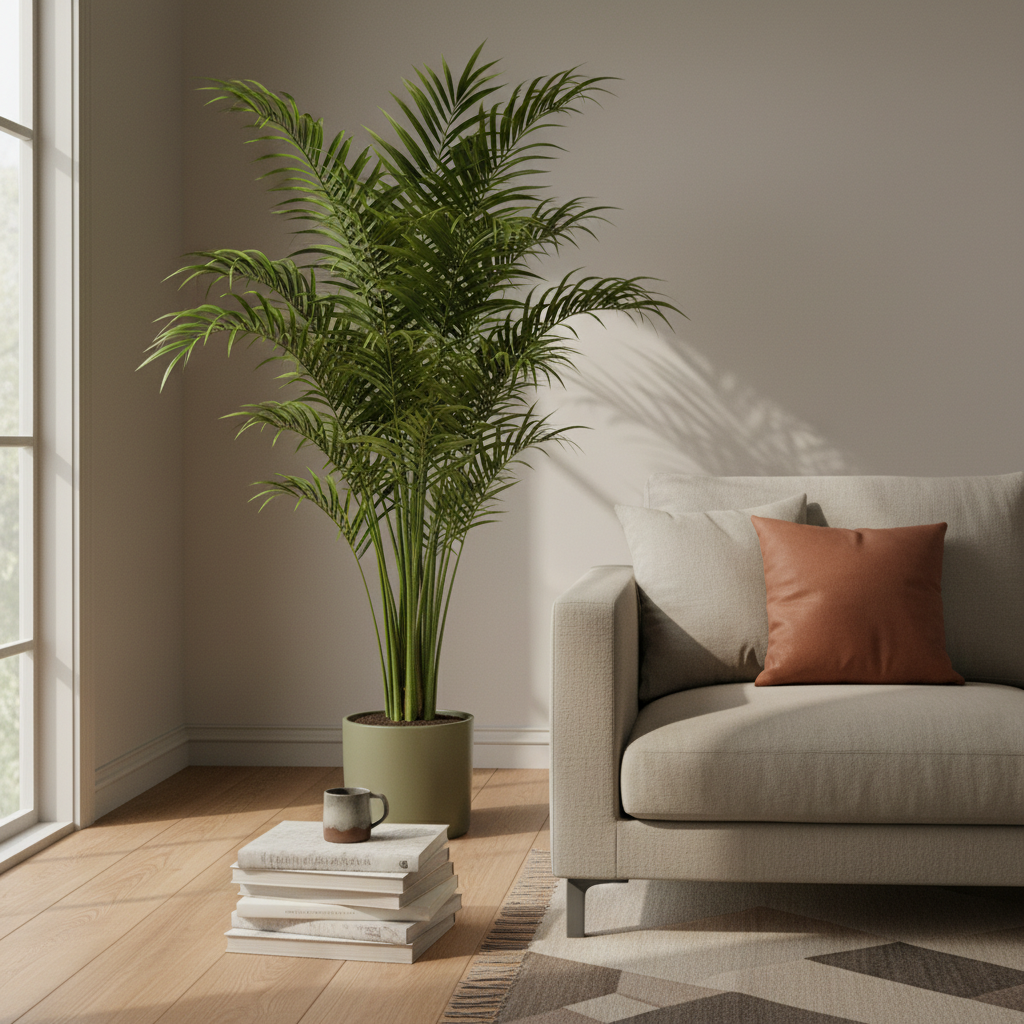
There is also a practical health angle. The bamboo palm featured in NASA’s Clean Air Study, where it was noted for filtering airborne compounds such as benzene, formaldehyde and trichloroethylene from enclosed spaces. The real-world purifying effect of any single houseplant is modest compared with simply opening a window, but the species is at least an efficient transpirer, releasing moisture that can take the edge off dry indoor air. Most importantly for households with animals, the bamboo palm is listed as non-toxic to cats and dogs, so it is one of the few statement-sized plants you can grow without worrying about a curious pet. Combine that safety, the air-friendly reputation and the relaxed care, and it is easy to see why this palm has been a fixture of indoor planting schemes for decades.
Important — Toxicity: The bamboo palm is considered non-toxic to cats, dogs and people, which makes it a rare safe choice among large indoor plants. Take care not to confuse it with the unrelated heavenly or sacred bamboo (Nandina domestica), a true shrub that is toxic; genuine Chamaedorea palms are safe.
Light Requirements
Light is the single factor people most often get wrong with the bamboo palm, usually by giving it too much rather than too little. As a forest-floor species it is adapted to broken, filtered light, so its sweet spot indoors is bright but indirect illumination of the kind found near, but not directly in, a sunny window. In these conditions the canes stay full and the fronds keep their deep, even green. The good news is that it also copes with genuinely medium and low light far better than most palms, which is exactly why it survives in offices and interior corners where little else will.
The trade-off is growth rate. In bright indirect light the plant produces new fronds at a respectable pace and fills out densely. Move it into a dim corner and it will hold on, but it will grow slowly, push out fewer new canes and may gradually thin. Think of low light as a holding pattern the plant tolerates rather than a place it flourishes. If your only available spot is genuinely dim, the plant will still look presentable for a long time, but plan to rotate it somewhere brighter for a few weeks now and then, or supplement with a grow light, to keep it vigorous.
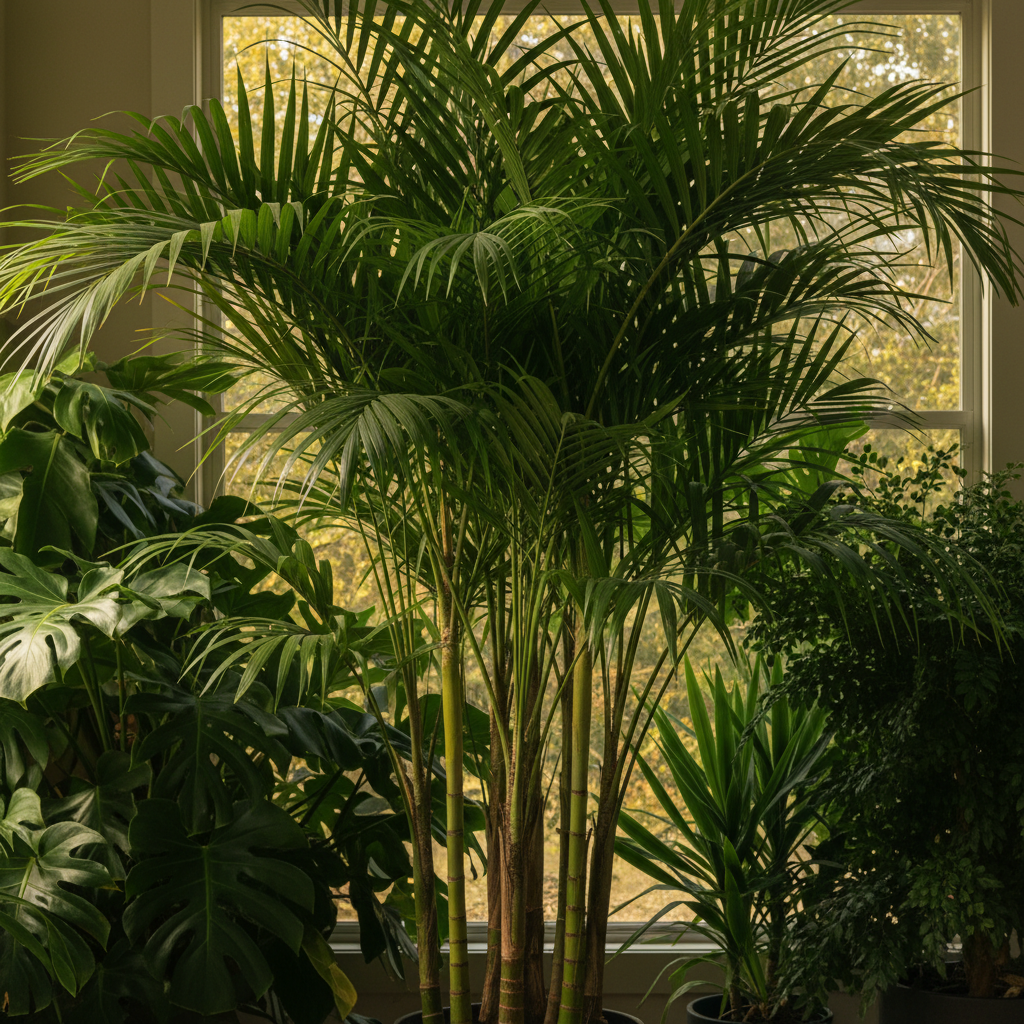
Light Levels Explained
Indoor light is far dimmer than we perceive, because our eyes adjust automatically. The table below translates the usual descriptive categories into approximate light levels and typical positions, along with what each means for a bamboo palm over time.
| Light Category | Approx. Level | Typical Location | Outcome |
|---|---|---|---|
| Direct sun | Over 50,000 lux | On a south-facing sill, full sun on the leaves | Too strong; scorched, bleached fronds and crisp tips |
| Bright indirect | 10,000 to 25,000 lux | A metre or two from a bright window, or beside an east window | Ideal; full, deep-green growth at a steady pace |
| Medium | 5,000 to 10,000 lux | Centre of a well-lit room, near a north window | Good; healthy but slower growth |
| Low | 1,000 to 5,000 lux | Interior corner, several metres from any window | Tolerated; survives but grows little and may thin |
| Very low | Under 1,000 lux | Windowless room, lit only by lamps | Decline over time; needs supplemental light |
Window Orientation and Placement
South-facing window: The brightest exposure and potentially the most hazardous, because direct midday sun will scorch the fronds. Place the palm well back from the glass, or filter the light with a sheer curtain, so it receives the brightness without the direct rays.
East-facing window: Often the best choice. Gentle morning sun is rarely strong enough to burn, and the plant enjoys the bright light through the rest of the day. A position directly beside an east window usually keeps a bamboo palm looking its best.
West-facing window: Workable, but the strong afternoon sun can be harsh in summer. Set the plant back from the glass or off to one side so it avoids the most intense hours of direct light.
North-facing window: A reliable spot for this shade-loving palm. The soft, even light of a north aspect rarely burns and is usually bright enough to maintain steady, if unhurried, growth.
Pro Tip — Rotate for Even Growth: A bamboo palm grows toward its light source, so a plant left in one position will gradually lean and thin on the shaded side. Give the pot a quarter turn every week or two so all the canes receive even light and the clump stays balanced and full.
How Light Affects Frond Colour and Density
Light controls both the colour and the fullness of the foliage. In good bright indirect light the leaflets are a rich, saturated green and the canes pack closely together, giving the dense, screening look the species is prized for. In too little light the new growth comes through paler and more widely spaced, and the overall clump can look leggy and sparse. In too much direct sun the opposite happens: the green fades to a sickly yellow-green and the leaflet tips crisp and brown. Aim for the middle ground and you will be rewarded with the deep, even colour that makes the plant so handsome.
Warning — Direct Sunlight: Sudden exposure to direct sun is the fastest way to ruin a bamboo palm’s appearance. A plant moved straight from a shaded shop into a sunny window can show bleached, scorched patches within days. If you must increase its light, do so gradually over two to three weeks to let it acclimatise.
Artificial Lighting
Because it accepts low light, the bamboo palm responds well to artificial supplementation, which makes it a strong candidate for offices and interior rooms. A full-spectrum LED grow light positioned above the canopy, running for ten to twelve hours a day, easily provides enough energy to keep the plant healthy where natural light is marginal. Even ordinary bright office lighting, on for long working hours, contributes meaningfully. Keep any dedicated grow light far enough above the fronds that it never radiates noticeable heat onto the foliage.
Seasonal Adjustments
Indoor light falls sharply from autumn into winter as the days shorten and the sun sits lower. A bamboo palm that thrived a metre back from a window in summer may need to move closer to the glass in the darker months to maintain the same effective brightness. As winter light weakens, growth naturally slows almost to a stop, so reduce watering to match and hold off on feeding until the light returns in spring. When daylight strengthens again, shift the plant back to its summer position to spare it from the stronger seasonal sun.
Watering & Humidity
Watering is where the bamboo palm rewards a little attention. It likes its soil kept lightly and evenly moist, never bone dry but never waterlogged either. This is a slightly narrower target than the dry-then-soak routine that suits succulents and many tropical foliage plants, and most problems with this palm trace back to getting it wrong in one direction or the other. The roots are fine and sensitive, and they will not tolerate standing in water, so good drainage is as important as the watering itself.
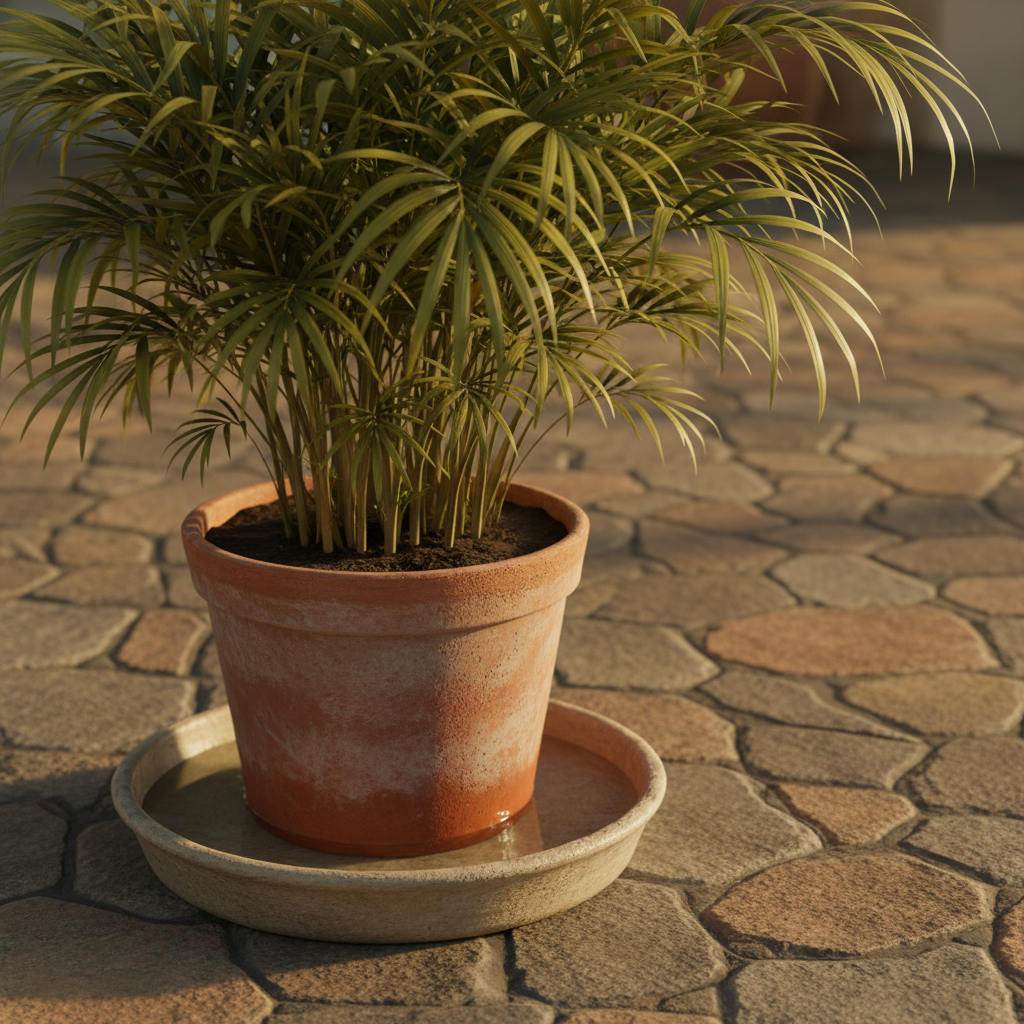
When to Water
The most reliable cue is the top of the soil. Push a finger into the mix and water when the top 2 to 3 cm (about 1 inch) has dried out, while the soil deeper down still feels slightly cool and damp. In a bright, warm room in summer this might mean watering once or twice a week; in a cooler, dimmer position in winter it could stretch to every ten days or more. Rather than watering on a fixed schedule, let the soil tell you when, because the same plant needs very different amounts across the seasons.
When you do water, water thoroughly. Add water until it runs freely from the drainage holes, which moistens the entire root ball evenly and flushes out accumulated salts. Then let the pot drain completely and never leave it standing in the runoff. A thorough soak followed by free drainage suits this palm far better than frequent shallow sips, which tend to wet only the surface and leave the deeper roots either parched or, if overdone, perpetually soggy.
Pro Tip — Weigh the Pot: Lift the pot just after watering to learn how heavy a fully watered plant feels, then again a few days later. With a little practice the change in weight tells you when the root ball has dried enough to water again, which is more reliable than the calendar and quicker than testing the soil each time.
How to Water Correctly
- Check the soil first by pushing a finger 2 to 3 cm into the mix; water only if the top has dried.
- Use room-temperature water, ideally rainwater, distilled or tap water left to stand overnight to release some of the chlorine.
- Pour slowly and evenly over the whole surface until water flows freely from the drainage holes.
- Let the pot drain completely for several minutes so no excess remains in the base.
- Empty the saucer, cache pot or drip tray so the palm never sits in standing water.
- Wait until the top of the mix dries again before repeating, adjusting frequency with the season.
Signs of Overwatering vs. Underwatering
| Symptom | Overwatering | Underwatering |
|---|---|---|
| Leaf colour | Whole fronds yellowing, often from the lower canes upward | Fronds dull and greyish, browning at the very tips first |
| Leaf texture | Soft, limp, sometimes translucent | Dry, brittle and papery, crisping at the edges |
| Soil | Stays wet for days, may smell sour or musty | Dry and pulling away from the sides of the pot |
| Roots | Brown, mushy and foul-smelling | Dry but firm; pale and intact |
| Cane base | Soft or darkened where it meets the soil | Firm but growth stalls and no new canes appear |
Warning — Root Rot: Persistently soggy soil is the bamboo palm’s most serious threat. Once the fine roots rot they can no longer take up water, so the plant wilts even though the soil is wet, which tempts owners to water more and accelerate the collapse. If you suspect rot, ease the plant from its pot, trim away any brown mushy roots with clean scissors and repot into fresh, free-draining mix.
Humidity Requirements
As a rainforest species the bamboo palm prefers humidity of around 50 percent or higher, though it is more tolerant of ordinary household air than fussier tropicals. In a normally humid home it usually does fine, but in very dry conditions, especially in winter when central heating strips moisture from the air, it can struggle.
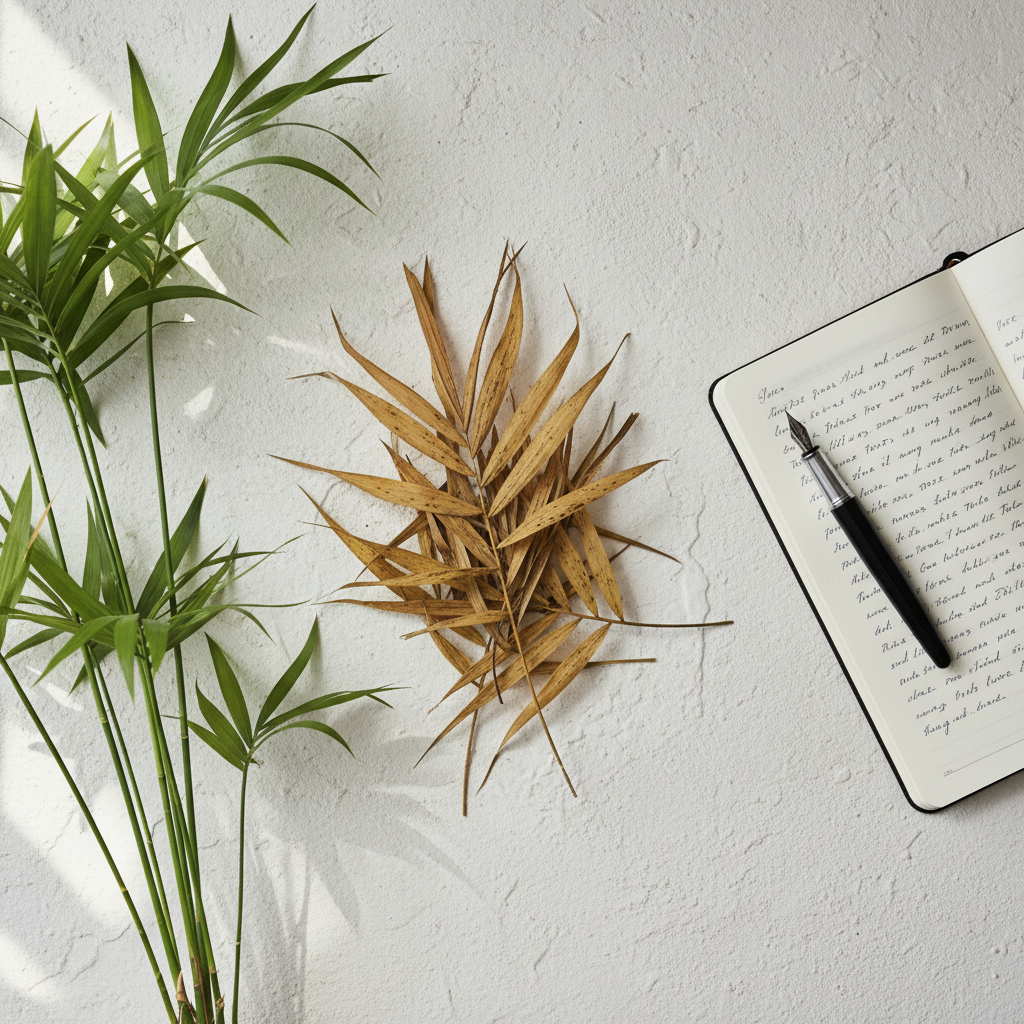
The classic symptom of air that is too dry is browning at the very tips of the leaflets, sometimes spreading into thin brown margins along the leaf edges. Low humidity also makes the plant far more attractive to spider mites, which thrive in warm, dry air and are the bamboo palm’s most common pest. If you see fine tip browning together with faint stippling on the fronds, suspect a combination of dry air and mites.
Raising humidity is straightforward. Grouping plants together creates a more humid microclimate as they transpire, and a pebble tray filled with water beneath the pot adds local moisture as it evaporates, provided the pot base sits above the waterline. In very dry rooms a small humidifier is the most effective and consistent solution. Misting offers only a brief lift and, on a dense palm, can encourage fungal spotting if the fronds stay wet, so it is the least useful of the options.
Water Quality
Like many palms, Chamaedorea seifrizii can be sensitive to the fluoride, chlorine and dissolved salts in hard tap water, which accumulate in the foliage and contribute to that tell-tale tip browning. If your tap water is heavily treated and you notice persistent brown tips despite correct watering and humidity, switch to rainwater, filtered or distilled water. At the very least, let tap water stand uncovered overnight before using it so some of the chlorine can dissipate. Flushing the soil thoroughly each time you water also helps prevent salts from building up around the roots.
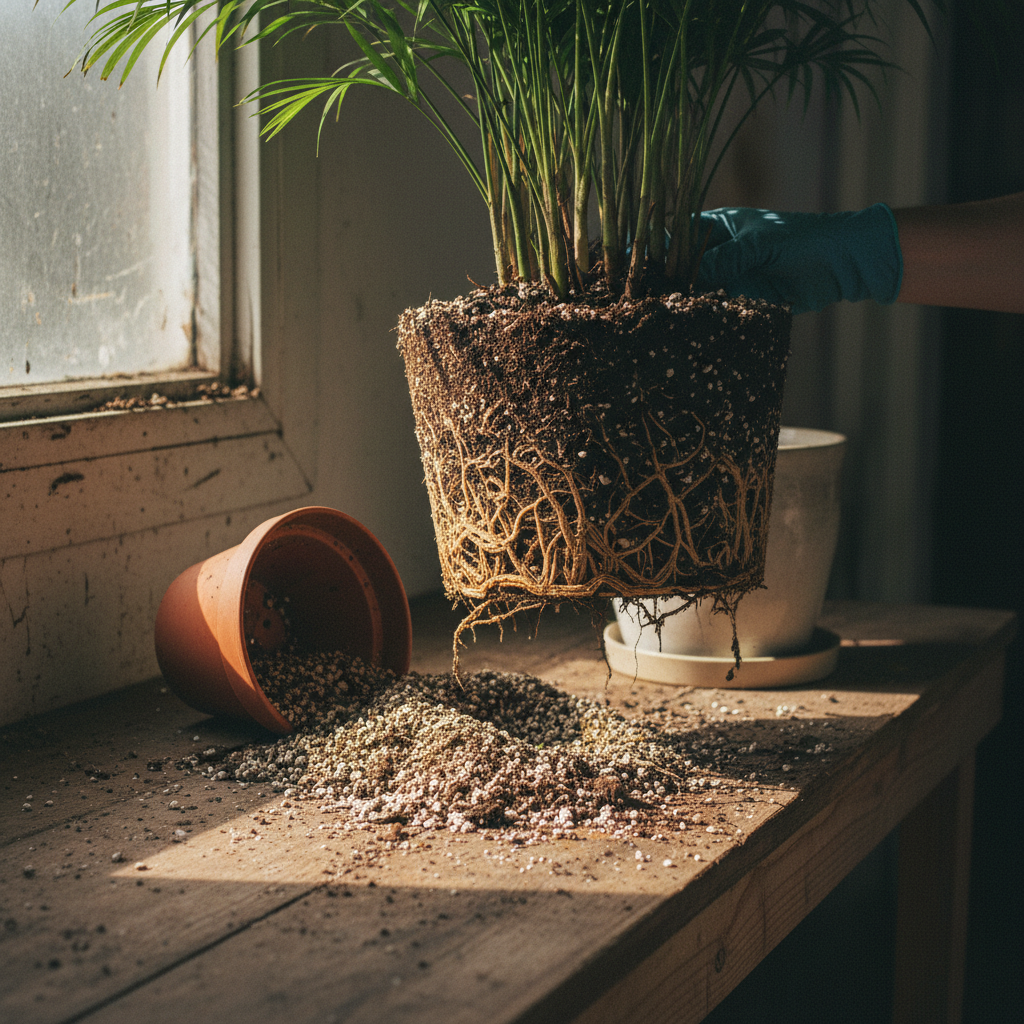
Soil, Potting & Repotting
The bamboo palm needs a growing medium that does two slightly contradictory things at once: hold enough moisture to stay evenly damp, yet drain freely so the roots are never waterlogged. The right mix delivers both, and getting it correct removes the single biggest cause of trouble with this plant. A heavy, dense compost that stays sodden is the enemy; an open, airy mix that holds moisture without becoming a swamp is the goal.
Ideal Soil Composition
A good base is a quality peat-free houseplant compost, opened up with generous amounts of drainage material. Many growers start from a general indoor potting mix and amend it heavily, or build their own blend from the components below. The aim is a structure that crumbles and holds air rather than compacting into a solid, waterlogged mass.
| Component | Proportion | Function |
|---|---|---|
| Quality potting compost | 2 parts | Holds moisture and nutrients; forms the body of the mix |
| Perlite or pumice | 1 part | Opens the structure for drainage and aeration |
| Coco coir or fine bark | 1 part | Retains even moisture without compacting |
| Coarse sand or grit | Half part | Adds weight and improves drainage for a top-heavy palm |
The bamboo palm prefers a slightly acidic to neutral soil, roughly pH 5.5 to 7.0, which most standard potting composts fall within naturally, so there is rarely any need to adjust it. Far more important than fine-tuning the pH is keeping the structure open and free-draining, because a well-aerated root zone does more for this palm than any chemical tweak.
Pro Tip — Quick Mix Recipe: For a fast, reliable blend, combine two handfuls of standard houseplant compost with one handful of perlite and one of coco coir, plus a small scoop of coarse sand. It holds moisture evenly yet drains within seconds of watering, which is exactly what the bamboo palm wants.
Choosing the Right Pot
Because a mature bamboo palm becomes tall and top-heavy, the pot has a structural job as well as a horticultural one. A slightly heavier or wider-based container helps keep the plant stable, while the right material and size keep the roots healthy.
Drainage holes are non-negotiable. This palm will not tolerate sitting in water, so the pot must have generous drainage holes. If you love a decorative cache pot without holes, keep the plant in a plain plastic nursery pot that drains freely and simply lift it out to water, returning it once it has finished draining.
Pot material: Terracotta is forgiving because it breathes and wicks away excess moisture, which suits owners prone to overwatering. Glazed ceramic and plastic retain moisture longer, which can be an advantage in dry rooms but demands a more careful hand with the watering can. A heavier ceramic or terracotta pot also adds welcome stability to a tall clump.
Pot size: Choose a pot only 2 to 5 cm (1 to 2 inches) wider in diameter than the current root ball. An oversized pot holds a large volume of damp soil the roots cannot use quickly, and that lingering moisture invites rot. This palm actually grows contentedly when slightly snug in its container, so resist the urge to over-pot.
When to Repot
The bamboo palm is a slow grower with roots it would rather not have disturbed, so it needs repotting only every two to three years. Tell-tale signs that it is ready include roots emerging from the drainage holes or circling the surface, water that runs straight through without wetting the mix, or a plant that has become so root-bound it dries out almost immediately after watering. The best time to repot is spring or early summer, when the plant is in active growth and recovers fastest. Between repottings, simply refresh the top few centimetres of soil each year to replenish nutrients without disturbing the roots.
How to Repot: Step-by-Step
- Water the plant a day beforehand so the root ball is moist and holds together, easing it out of the old pot.
- Tip the pot and gently slide the clump out, supporting the canes near the base rather than pulling on the fronds.
- Tease a little of the old soil from the outer roots and inspect them, trimming away any that are brown, soft or rotten.
- Add a layer of fresh, free-draining mix to the base of a pot one size larger and position the plant at the same depth it sat before.
- Backfill around the root ball with fresh mix, firming gently to remove large air pockets without compacting the soil.
- Water thoroughly to settle the mix and let the pot drain completely.
- Return the plant to its usual spot and hold off feeding for six to eight weeks while it re-establishes.
Warning — Transplant Shock: Bamboo palms dislike root disturbance and may sulk for a few weeks after repotting, occasionally browning a frond or two. Avoid the temptation to fertilise straight away or to overwater in an effort to help; keep conditions stable and steady, and the plant will settle on its own.
Fertilising
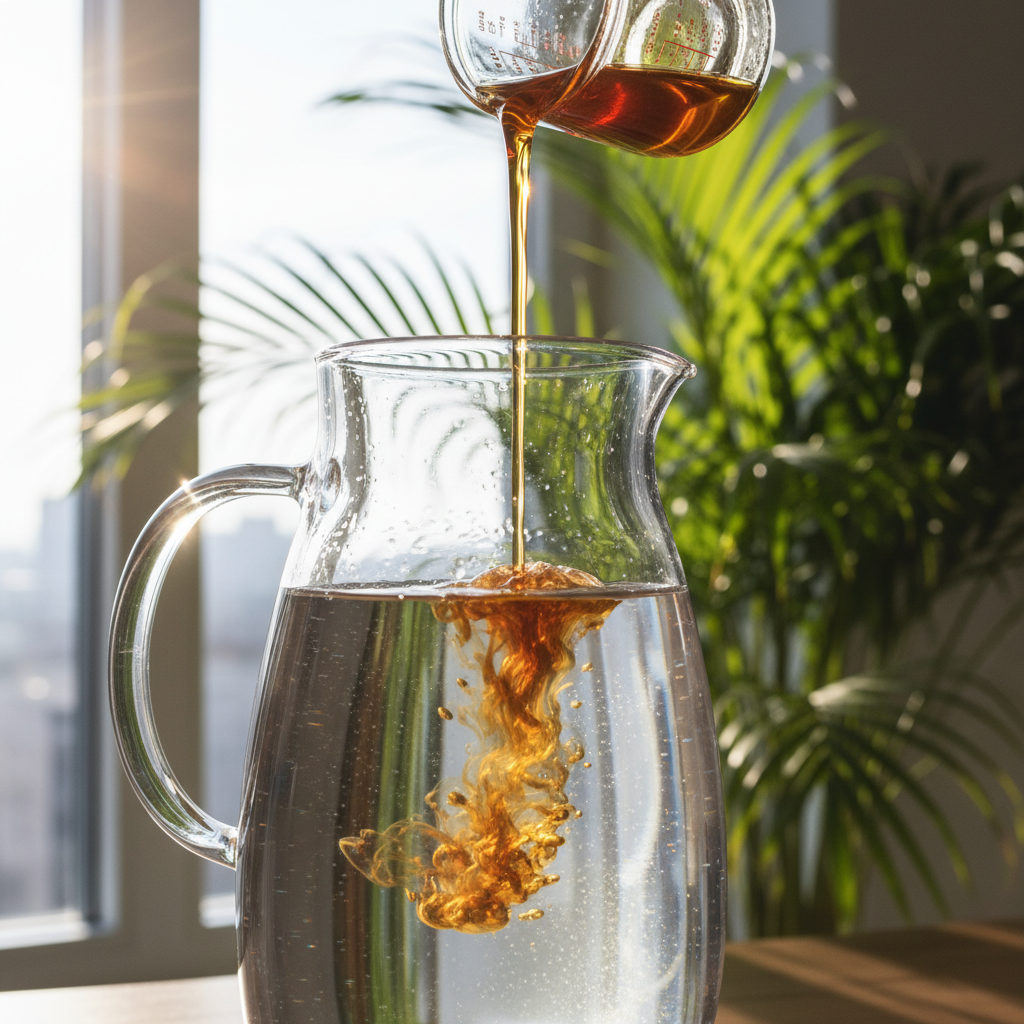
The bamboo palm is a light feeder, and a modest, careful approach to fertilising serves it far better than enthusiasm. In the wild it grows in lean forest soils, so it has no need for heavy feeding, and applying too much does real harm by burning the sensitive roots and scorching the leaf tips. A little, given at the right time of year, keeps the foliage green and the new canes coming.
Timing matters as much as quantity. Feed only during the active growing season of spring and summer, when the plant can actually use the nutrients, and stop entirely in autumn and winter when growth slows. Fertilising a dormant plant simply leaves unused salts to accumulate in the soil, exactly the conditions that cause tip burn.
Understanding Plant Nutrients
Fertilisers are labelled with an NPK ratio showing the percentages of nitrogen, phosphorus and potassium, the three nutrients plants use in the largest amounts. For a foliage palm a balanced ratio, or one slightly higher in nitrogen, is ideal because it supports lush green growth. Palms are also notably prone to deficiencies in magnesium and the micronutrients manganese and iron, which is why dedicated palm fertilisers include them. The table below summarises the key nutrients and how a shortage shows itself.
| Nutrient | Symbol | Primary Function | Deficiency Symptoms |
|---|---|---|---|
| Nitrogen | N | Drives leafy green growth and overall vigour | Uniformly pale, yellowing older fronds and slow growth |
| Phosphorus | P | Supports root development and energy transfer | Stunted growth and dull, darkened foliage |
| Potassium | K | Regulates water balance and overall health | Yellow or orange flecking and translucent spotting on older fronds |
| Magnesium | Mg | Central to chlorophyll and photosynthesis | Broad yellow bands along the leaflet edges, green centre retained |
| Manganese | Mn | Enzyme function in new growth | Weak, frizzled new fronds, sometimes called frizzle top |
| Iron | Fe | Chlorophyll formation in the newest leaves | Yellowing of the youngest fronds while the veins stay green |
Types of Fertiliser
Liquid fertilisers: The easiest to control, which is exactly why they suit this salt-sensitive palm. Diluted in water and applied during normal watering, they give you precise command over dose and timing, and they are simple to dilute to the half strength the bamboo palm prefers.
Slow-release granular: Convenient pellets that release nutrients gradually over several months. They are low effort, but you give up fine control, and in a small pot it is easy to apply more than this light feeder needs, so use them sparingly if at all.
Organic fertilisers: Gentle options such as diluted seaweed extract, worm-casting tea or a light top-dressing of worm castings feed slowly and improve soil life, with little risk of burning. They are a forgiving choice for anyone nervous about overfeeding.
Feeding Schedule
A simple, safe routine is to feed once a month with a balanced or palm-specific liquid fertiliser diluted to half the recommended strength, throughout spring and summer. That gives roughly four to six feeds across the growing season, which is ample for this undemanding plant. Stop feeding entirely from autumn through winter while growth is at rest, and always apply fertiliser to already-moist soil rather than dry, so the diluted feed never concentrates against dry roots.
Pro Tip — Less Is More: When in doubt, underfeed. A bamboo palm will happily coast on very little fertiliser, but it recovers slowly from the root and tip burn caused by too much. Half strength, once a month, in the growing season only, is genuinely all this plant asks for.
How to Fertilise
- Confirm the plant is in active growth, during spring or summer, before feeding at all.
- Dilute a balanced or palm fertiliser to half the strength stated on the label.
- Water the plant lightly first if the soil is dry, so the feed never hits dry roots.
- Apply the diluted solution evenly across the soil surface in place of a normal watering.
- Every couple of months, flush the pot with plain water to wash out any salts that have built up.
Warning — Salt Build-Up: A white or yellowish crust on the soil surface or around the pot rim signals accumulated fertiliser salts, which scorch the roots and brown the frond tips. If you see it, flush the pot thoroughly with plain water several times to leach the salts away, and ease back on the feeding.
Propagation
Propagating a bamboo palm works differently from the cutting-and-rooting routine that suits so many trailing houseplants. Because each cane is a single, unbranched stem that grows from the base, you cannot take a stem or leaf cutting and root it; a severed cane simply will not regrow. Instead, the plant multiplies in the two ways nature uses, by dividing an established clump into smaller clumps, or by sowing seed.
For the home grower, division is by far the more practical method, and it is the route this guide focuses on. Growing from seed is possible but slow and unpredictable, since fresh viable seed is hard to come by and germination can take many weeks to months. Division gives you an instant second plant from one you already own, with a high success rate when done carefully.
Understanding the Clumping Habit
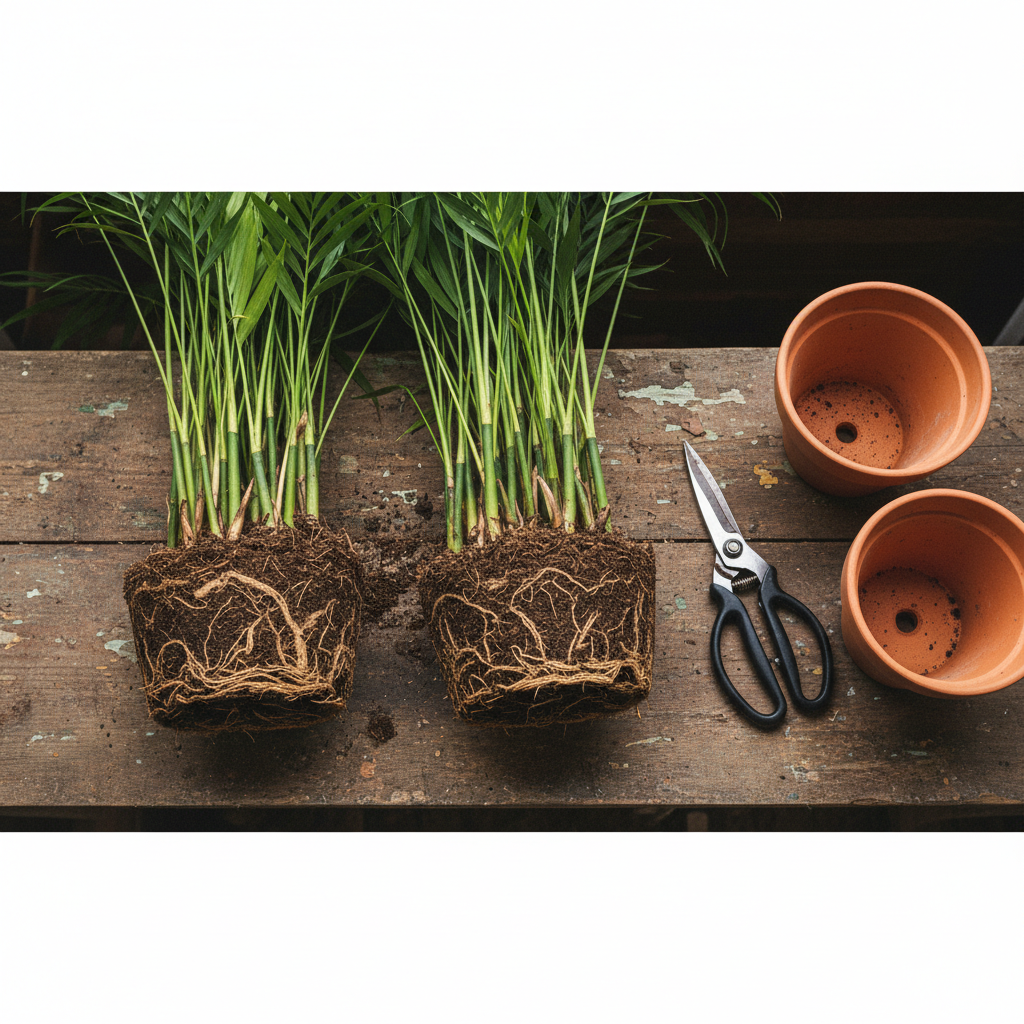
The bamboo palm naturally produces new canes from its base, gradually building up the dense, multi-stemmed clump that gives it its character. Each cane has its own portion of the shared root system, which is precisely what makes division possible: a mature clump is effectively several plants growing together. The key to success is making sure every piece you separate keeps a healthy share of both canes and roots, so it can support itself immediately. A division with plenty of roots establishes quickly, while one with too few will struggle.
Division: Step-by-Step
The best time to divide is spring or early summer, ideally when you are repotting anyway, so the plant only endures one disturbance. Choose a mature, well-established clump with several canes, and water it a day or two beforehand to reduce stress.
- Ease the whole plant out of its pot and gently shake or wash away enough soil to see how the canes and roots are arranged.
- Identify a natural division point where a group of canes has its own cluster of roots, separate from the rest.
- Tease the sections apart by hand where you can, using a clean, sharp knife only to cut through tightly knit roots.
- Aim for divisions of at least three or four canes, each with a generous, intact portion of roots.
- Pot each division into its own container of fresh, free-draining mix at the same depth it grew before.
- Water thoroughly, then place the new plants somewhere warm with bright indirect light and out of direct sun.
- Keep the soil lightly moist and be patient; expect a settling-in period before new growth appears.
Pro Tip — Keep Divisions Generous: Resist the urge to split a clump into too many small pieces. A few well-rooted divisions of several canes each will establish quickly and look full straight away, whereas single canes with minimal roots often fail or take a very long time to recover.
Growing from Seed: Step-by-Step
Seed is the only other route, and while it demands patience it can be rewarding if you have access to fresh, viable seed, which loses its ability to germinate quickly once dry.
- Soak fresh seed in room-temperature water for one to two days to soften the seed coat.
- Sow shallowly in a moist, free-draining seed mix, barely covering each seed.
- Keep the mix consistently warm, ideally 24 to 29 degrees C (75 to 85 degrees F), and humid, covering the tray to retain moisture.
- Place in bright indirect light and maintain even moisture without letting the surface dry out.
- Be patient, as germination is erratic and can take anywhere from six weeks to several months.
- Once seedlings have a few fronds and a working root system, pot them on individually.
Troubleshooting Propagation
| Problem | Likely Cause | Solution |
|---|---|---|
| Division wilts and declines | Too few roots left on the section, or too much top growth to support | Keep divisions large and well-rooted; shade and maintain humidity while they settle |
| Fronds brown after dividing | Normal transplant shock from root disturbance | Hold conditions steady, do not feed, and wait for new growth |
| Rot at the cut or cane base | Soil kept too wet, or dirty cutting tools | Use a free-draining mix, clean sterile tools, and water more sparingly |
| Seed never germinates | Old or dried-out seed, or too low a temperature | Use fresh seed and provide consistent bottom heat and humidity |
Pests & Diseases
A healthy, well-positioned bamboo palm is reasonably resistant to trouble, but it is not immune, and a stressed plant in dry air is far more vulnerable. The great majority of problems are preventable with good basic care, prompt inspection and a quick response when something does appear. Most pest infestations begin small and are easily dealt with if caught early, so the habit of looking your plant over regularly is worth more than any spray.
The single most common pest on this palm is the spider mite, encouraged by the warm, dry indoor air that the plant otherwise dislikes. Scale and mealybugs appear less often, and fungal issues are usually a symptom of overwatering rather than a primary disease. Knowing what to look for makes all of them manageable.
Common Pests
Spider Mites (Tetranychus urticae)
By far the most frequent pest of the bamboo palm, spider mites are tiny sap-sucking arachnids that thrive in warm, dry conditions. They cause fine pale stippling or speckling across the fronds, and in heavy infestations spin delicate webbing between the leaflets. The foliage takes on a dull, dusty, slightly bronzed look as the damage spreads.
Treatment: Rinse the plant thoroughly, including the undersides of the fronds, to knock back the population, then treat with insecticidal soap or neem oil, repeating every five to seven days for several cycles to catch newly hatched mites. Raising humidity makes the environment far less hospitable and helps prevent their return.
Mealybugs (Pseudococcus species)
Mealybugs appear as small, soft, white cottony masses tucked into the leaf axils and along the canes. They suck sap and excrete sticky honeydew, which can lead to sooty mould, and a heavy infestation weakens the plant and yellows the foliage.
Treatment: Dab individual bugs with a cotton bud dipped in isopropyl alcohol, then treat the whole plant with insecticidal soap or neem oil. Inspect regularly afterwards, as mealybugs are persistent and hide in tight crevices where they are easily missed.
Scale (Coccidae family)
Scale insects show up as small, brown, immobile bumps clinging to the canes and the undersides of the fronds. They too feed on sap and produce honeydew, and their hard protective shells make them stubborn to remove and easy to overlook until numbers build.
Treatment: Scrape off what you can by hand or with a soft brush, dab them with alcohol on a cotton bud, and follow up with horticultural oil or neem to smother the rest. Several treatments spaced a week apart are usually needed to clear a population fully.
Common Diseases
Root Rot (Pythium and Phytophthora species)
The most serious disease of the bamboo palm is root rot, caused by fungal pathogens that flourish in waterlogged soil. Symptoms include yellowing, wilting fronds despite wet soil, a soft or darkened cane base, and mushy, foul-smelling roots when the plant is unpotted.
Treatment: Unpot the plant, cut away all rotten roots with clean scissors, and repot into fresh, free-draining mix in a clean pot. The only lasting fix is to correct the underlying watering and drainage so the roots are never left sitting in water.
Leaf Spot (various fungal pathogens)
Fungal leaf spot shows as brown or black spots, sometimes ringed with a yellow halo, usually where the foliage stays wet for too long or air circulation is poor. It is rarely fatal but disfigures the fronds and can spread if ignored.
Treatment: Remove the affected fronds, avoid wetting the foliage when watering, and improve airflow around the plant. A copper-based or general fungicide can help in persistent cases, but cultural changes usually solve the problem.
Pest and Disease Summary
| Pest / Disease | Identification | Treatment |
|---|---|---|
| Spider mites | Fine stippling and webbing; dull, bronzed fronds | Rinse, then insecticidal soap or neem weekly; raise humidity |
| Mealybugs | White cottony masses in axils and along canes | Alcohol on a cotton bud, then neem or insecticidal soap |
| Scale | Brown immobile bumps on canes and frond undersides | Scrape off, dab with alcohol, follow with horticultural oil |
| Root rot | Wilting in wet soil; mushy, smelly roots | Trim rotten roots, repot in fresh mix, correct watering |
| Leaf spot | Brown or black spots, often with yellow halos | Remove affected fronds, improve airflow, keep foliage dry |
Prevention Strategies
Prevention rests on the same good habits that keep the plant looking its best. Inspect the fronds, especially their undersides and the leaf axils, every week or two so you catch problems while they are small. Keep humidity up to deter spider mites, water correctly to prevent root rot, and wipe the foliage occasionally to remove dust and reveal early pest activity. Whenever you bring home a new plant, keep it apart from your others for a couple of weeks so any hitchhiking pests do not spread.
Healthy plants resist pests and disease far better than stressed ones, so consistent care is itself the best defence. A bamboo palm in the right light, watered and fed correctly and kept in adequate humidity, is a tough, resilient plant that rarely suffers serious trouble. Most of the issues owners encounter trace back to a single avoidable stress, usually overwatering or very dry air, which is reassuring because both are easy to put right.
Pro Tip — Shower Off Dust: Every few weeks, stand your bamboo palm in a lukewarm shower or rinse it gently with the kitchen tap. It washes away dust that dulls the foliage and reduces photosynthesis, dislodges any early spider mites before they take hold, and gives the dense canopy a thorough clean that hand-wiping cannot match.
Popular Varieties
The bamboo palm has relatively few named cultivars compared with showier houseplants, but there is meaningful variation in form, and the name itself is applied loosely in the trade. The species you buy as a true bamboo palm is Chamaedorea seifrizii, yet several closely related Chamaedorea palms are sold under the same or similar names, and a handful of unrelated palms are sometimes muddled in too. Knowing the difference helps you buy the plant you actually want.
Within the species, the most distinct selection is the compact, bushy cultivar grown widely for the interior trade, while the wild type is taller and more open. Beyond it, the table sets out the bamboo palm alongside its frequent look-alikes so you can tell them apart at a glance.
| Variety | Leaf Appearance | Light Needs | Growth Rate | Availability |
|---|---|---|---|---|
| Bamboo Palm (species) | Slender ringed canes, narrow dark-green leaflets | Bright indirect to low | Slow | Common |
| ‘Florida Hospitality’ | Denser, bushier clump, full dark-green fronds | Bright indirect to low | Slow to moderate | Common |
| Reed Palm (wild type) | Taller, more open canes with airy fronds | Bright indirect to low | Slow | Occasional |
| Parlour Palm (C. elegans) | Smaller, single-stemmed, soft fronds | Low to medium | Slow | Very common |
| Cat Palm (C. cataractarum) | Clumping, no visible canes, glossy fronds | Bright indirect | Moderate | Common |
| Areca Palm (Dypsis lutescens) | Yellow-green canes, feathery upright fronds | Bright indirect | Moderate to fast | Very common |
Featured Varieties
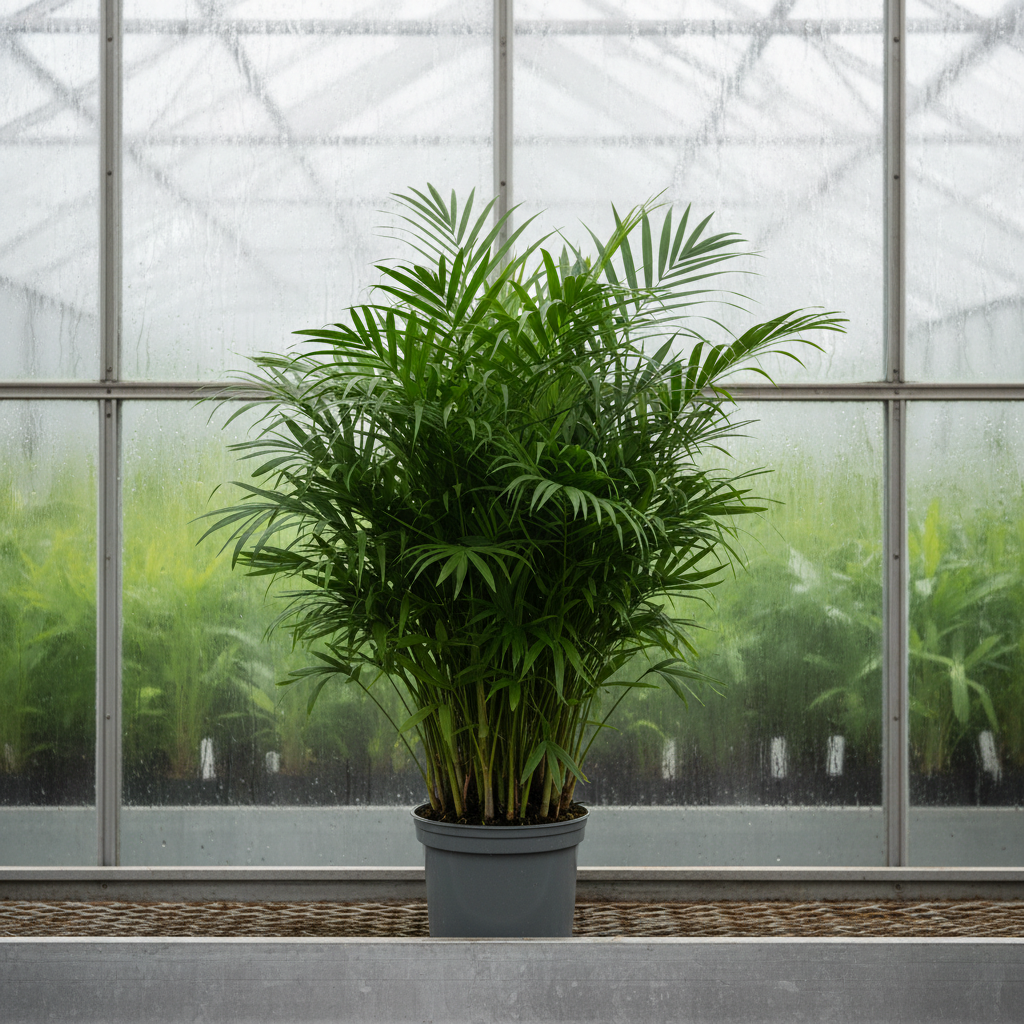
‘Florida Hospitality’
The dominant cultivar in the interior-plant trade, selected for a denser, bushier habit than the wild type. It packs more canes into a fuller clump with rich, dark-green fronds, making it the most lush and screen-like form for indoor use.
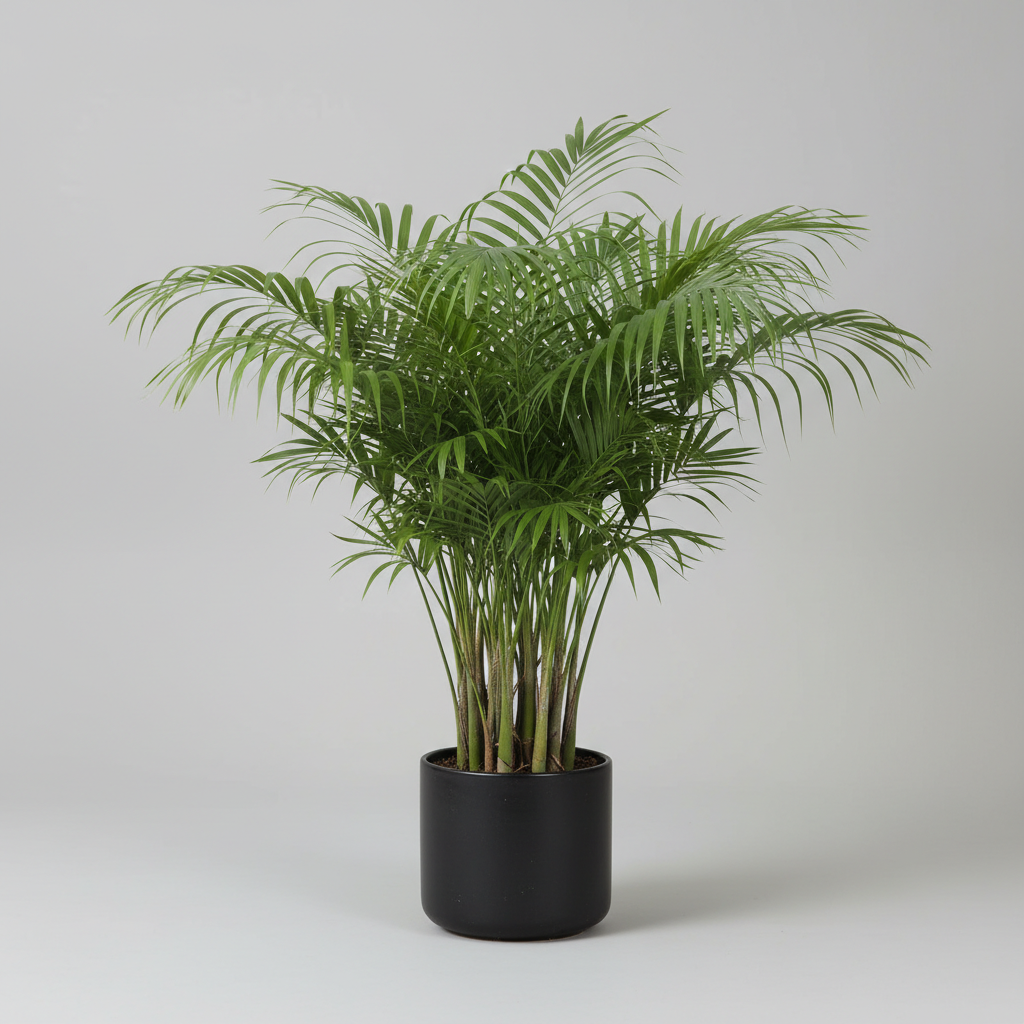
Reed Palm (wild type)
The natural form of the species, often sold simply as reed palm. It grows taller with more widely spaced, distinctly bamboo-ringed canes and airier, gracefully arching fronds, giving a lighter, more architectural look than the compact cultivar.
Variety Profiles in Detail
‘Florida Hospitality’ (Chamaedorea seifrizii ‘Florida Hospitality’)
Bred for the commercial interior market, this is the bamboo palm most people actually buy. Its tighter, fuller clumping and abundant dark foliage make it ideal where you want a dense green screen, and it shares all the easy-care, shade-tolerant, pet-safe qualities of the species. If you simply ask for a bamboo palm at a garden centre, this is very often what you will be handed.
Cat Palm (Chamaedorea cataractarum)
A close relative often confused with the bamboo palm, the cat palm also forms a dense clump but lacks the visible bamboo-like canes, with fronds emerging more directly from the base. It is a little thirstier than the bamboo palm and likes consistently moist soil, but its care is otherwise very similar, making it a fine alternative if you prefer the cane-less look.
Parlour Palm (Chamaedorea elegans)
The bamboo palm’s smaller cousin, the parlour palm is one of the most popular indoor palms of all and is even more tolerant of low light. It stays compact and single-stemmed rather than forming tall canes, so it suits tabletops and shelves where a full-sized bamboo palm would be too large. The two are often grown side by side for different roles in the same room.
Choosing the Right Variety for Your Space
For most homes, the compact ‘Florida Hospitality’ form is the easiest to find and the most rewarding, giving a generous, lush screen in a manageable footprint. If you have the room and prefer a taller, airier, more sculptural plant, seek out the wild-type reed palm. Where space is tight or light is very low, the smaller parlour palm is a better fit, and if you like the clumping look without visible canes, the cat palm is worth considering. Whichever you choose, the core care described in this guide applies, because all of these are closely related shade-loving Chamaedorea palms with very similar needs.
Frequently Asked Questions
Is the bamboo palm safe for cats and dogs?
Yes. The bamboo palm (Chamaedorea seifrizii) is listed as non-toxic to both cats and dogs, which makes it one of the safest large houseplants for homes with pets. Take care not to confuse it with heavenly bamboo (Nandina domestica), which is an unrelated and toxic shrub; genuine Chamaedorea palms are not a concern.
Why are the tips of my bamboo palm turning brown?
Brown leaf tips are the most common complaint and usually point to low humidity, inconsistent watering or a build-up of salts and minerals from tap water or over-fertilising. Raise the humidity, keep the soil evenly moist rather than swinging between wet and bone dry, flush the pot occasionally with clean water, and consider switching to rainwater or filtered water if your tap supply is hard.
How big does a bamboo palm get indoors?
Indoors a bamboo palm typically reaches 1.2 to 2 metres (4 to 7 feet) tall over several years, occasionally more in ideal conditions, with a spread of around a metre. It is a slow grower, so it stays a manageable size for a long time, and you can keep it more compact by leaving it slightly root-bound and dividing it when the clump becomes too large.
Can a bamboo palm grow in low light?
It can, which is one of its great strengths and the reason it is so widely used in offices and shaded rooms. It tolerates low light far better than most palms, but it will grow more slowly and stay less full than it would in bright indirect light. Think of low light as something the plant endures rather than enjoys; for the lushest growth, give it the brightest spot that does not include direct sun.
How often should I water my bamboo palm?
Rather than following a fixed schedule, water when the top 2 to 3 cm (about 1 inch) of soil has dried out. In a warm, bright room in summer this often works out to once or twice a week, dropping to every ten days or more in cooler, dimmer winter conditions. The aim is soil that stays lightly and evenly moist, never waterlogged and never completely dry.
Why are the lower fronds of my bamboo palm turning yellow?
The occasional yellowing of an old lower frond is natural as the plant sheds its eldest growth, and you can simply trim it away. If several fronds yellow at once, however, suspect overwatering, which is the usual culprit, or possibly a nutrient deficiency. Check that the soil is draining freely and not staying sodden, and review your watering before assuming the plant needs feeding.
Can I grow a bamboo palm from a cutting?
No. Unlike trailing houseplants, palms cannot be propagated from stem or leaf cuttings, because each cane is a single growing point that will not regrow if cut. The only practical way to propagate a bamboo palm at home is by dividing an established clump into smaller, well-rooted sections; the alternative is growing from fresh seed, which is slow and far less reliable.
Does the bamboo palm really purify the air?
The bamboo palm featured in NASA’s Clean Air Study and was noted for removing compounds such as benzene, formaldehyde and trichloroethylene under laboratory conditions. In a real home the effect of any single plant is modest, so it is no substitute for ventilation, but the palm is an efficient transpirer that adds humidity to the air and is certainly a healthy, attractive presence in a room.
What is the difference between a bamboo palm and an areca palm?
They are different species often sold for similar uses. The bamboo palm (Chamaedorea seifrizii) has slender, distinctly ringed green canes and tolerates lower light, while the areca palm (Dypsis lutescens) has yellower canes, a more feathery upright look, grows faster and demands brighter light. For a shaded room the bamboo palm is the better and more forgiving choice.
Should I cut off brown or damaged fronds?
Yes. Removing fully brown or badly damaged fronds tidies the plant and lets it direct energy into healthy growth. Use clean, sharp scissors and cut at the base of the affected cane or frond. If only the very tips are brown, you can trim just the dead portion, ideally following the natural leaf shape, and leave the rest of the green frond in place to keep working.






