
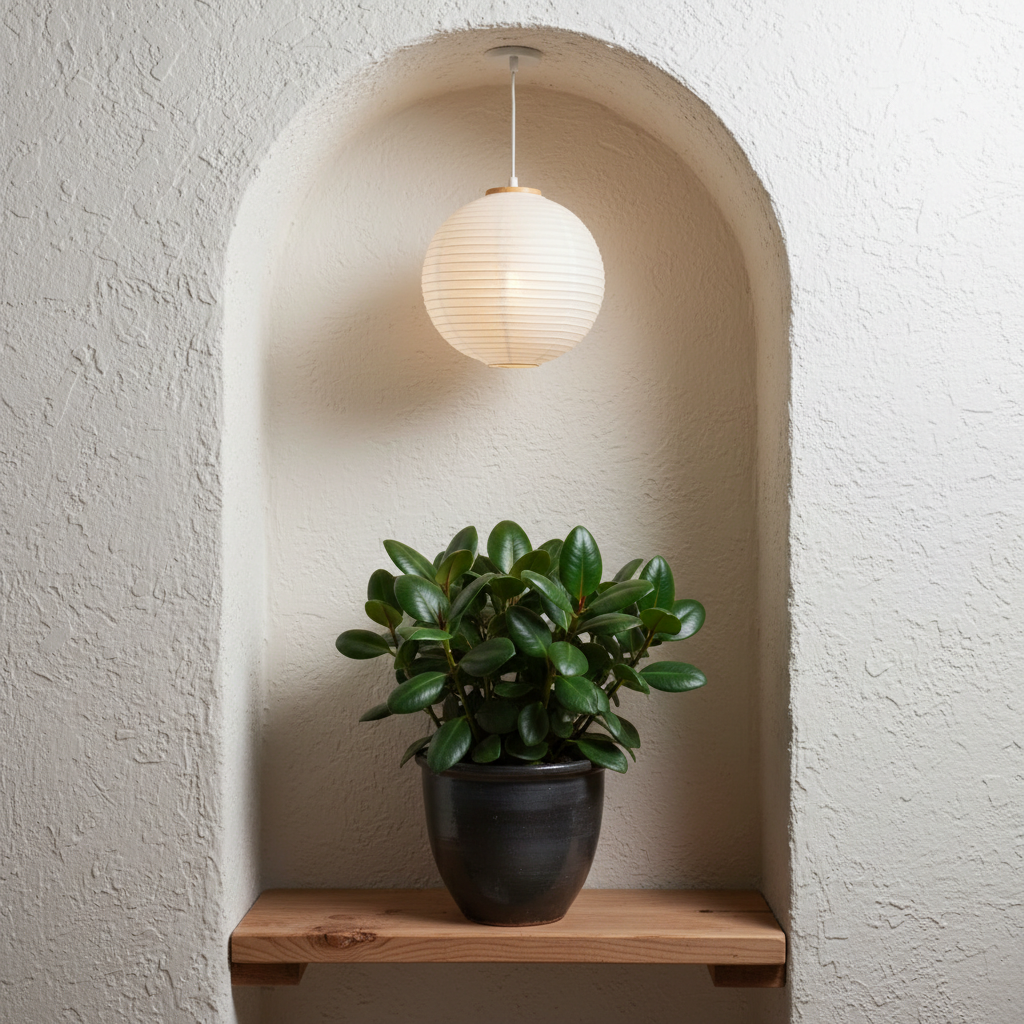
The baby rubber plant, known botanically as Peperomia obtusifolia, is one of the most agreeable tabletop houseplants in cultivation. Native to the warm, shaded understorey of Florida, Mexico, the Caribbean and the northern fringes of South America, it carries a set of thick, glossy, paddle-shaped leaves on short, semi-succulent stems that lend it a quietly architectural presence. Despite its common name it has no botanical relationship to the true rubber plant, Ficus elastica, and the resemblance is only skin-deep: a similar leathery sheen and a comparable depth of green, but on a far smaller, far gentler scale. Other names you will encounter on plant-shop labels include American rubber plant, pepper face and simply Peperomia.
Its reputation as a beginner-friendly plant is well earned. The thick leaves and fleshy petioles store water, the root system is modest and the plant resents almost nothing more than fuss. Yet between merely keeping a Peperomia obtusifolia alive and watching it flourish into a dense, jewel-bright mound there is a real gap, and that gap is the subject of this guide. We will work through every element of its care, from the precise quality of light it prefers to the rhythm of watering that suits its succulent nature, and we will look at what the plant is asking for when something goes wrong.
Contents
- Quick Reference
- Why the Baby Rubber Plant Makes an Excellent Houseplant
- Light Requirements
- Watering and Humidity
- Soil, Potting and Repotting
- Fertilising
- Propagation
- Pests and Diseases
- Popular Varieties
- Frequently Asked Questions
Quick Reference: Baby Rubber Plant at a Glance
| Botanical name | Peperomia obtusifolia |
| Family | Piperaceae (the pepper family) |
| Mature size | 20 to 30 cm tall (8 to 12 in), spreading slightly wider |
| Light | Bright indirect light; tolerates medium light, struggles in deep shade or direct midday sun |
| Watering | Allow the top 3 to 4 cm (1 to 1.5 in) of soil to dry between waterings; water thoroughly, then drain |
| Temperature | 18 to 24 °C (65 to 75 °F); minimum 13 °C (55 °F) |
| Humidity | 40 to 50 percent is plenty; no misting needed |
| Soil | Light, fast-draining mix with added perlite or pumice |
| Fertiliser | Balanced liquid feed at quarter strength every 4 to 6 weeks in spring and summer |
| Propagation | Leaf cuttings, stem cuttings; roots in water or substrate |
| Toxicity | Non-toxic to cats and dogs (ASPCA listing); pet-safe |
| Origin | Florida, Mexico, Caribbean, northern South America |
Why the Baby Rubber Plant Makes an Excellent Houseplant
Among the many small foliage plants vying for a place on the bookshelf or kitchen windowsill, Peperomia obtusifolia earns its keep with an unusual combination of forgiving temperament and high visual interest. The leaves are the headline feature: rounded, blunt-tipped and so thick that they feel almost rubbery when pressed, with a deep, lacquered green that catches the light in any room. Held on short, succulent stems no longer than ten or twelve centimetres, they form a tight, almost cushion-like rosette that rarely looks unkempt and never demands staking.
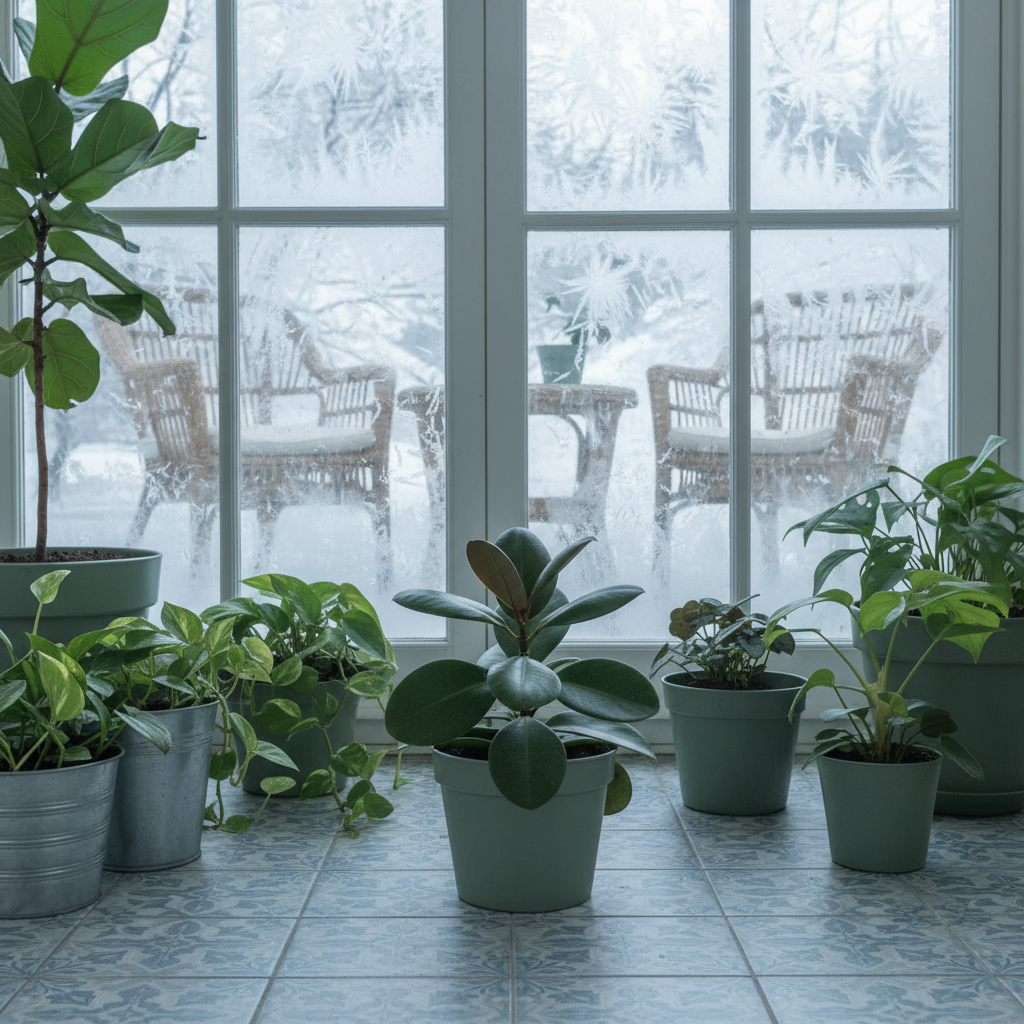
The plant’s tolerance for ordinary indoor conditions is what most often surprises new owners. It does not insist on a humidifier, it does not collapse if you go away for a fortnight, and it does not need the rich, root-bound pot life of larger aroids. The succulent leaves and stems mean that Peperomia obtusifolia behaves, in many practical ways, more like a small succulent than a tropical foliage plant, and this is the single most important fact to absorb before you make any care decision.
There is also a quiet practical advantage that anyone living with cats, dogs or curious toddlers will appreciate: the baby rubber plant is listed by the American Society for the Prevention of Cruelty to Animals as non-toxic to both cats and dogs, and it contains none of the calcium oxalate crystals that make so many popular tropical houseplants a hazard. A nibble will not poison a pet, although it may earn a stern glance from the gardener. Few plants combine pet safety, sculptural foliage and outright resilience to this degree.
The species also flowers occasionally indoors, producing slender, upright white-green spikes that rise above the foliage like miniature mouse tails. They are not showy and have no scent, but in a mature, healthy specimen they are a welcome signal that the plant is happy. Many growers snip them off to redirect energy into leaves; others leave them as a curiosity. Either approach is correct.
Light Requirements
Light is where the gap between surviving and thriving opens widest with this species. Peperomia obtusifolia evolved in the dappled understorey of warm forests, where bright, indirect light filters through a higher canopy. Bring that picture indoors and you have your aim: a position where the plant sits in plenty of ambient brightness but never receives the harsh, direct rays of midday sun. An east-facing window with a couple of hours of gentle morning light is close to perfect, as is a position one or two metres back from a south or west-facing window that is filtered by a sheer curtain.
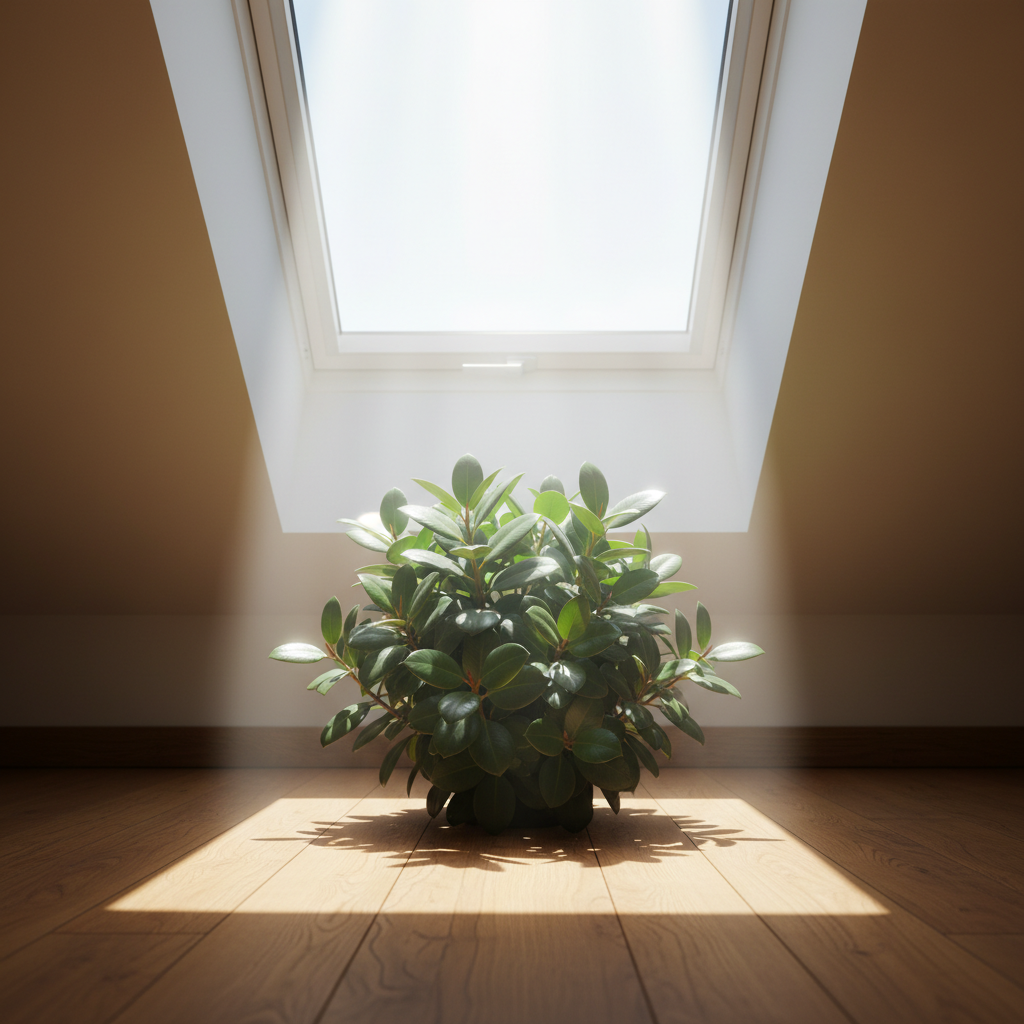
The plant will, in fairness, survive in considerably lower light than it prefers. Place it on a low shelf in a corridor with only borrowed daylight and it will continue to push out leaves for many months, perhaps years, before giving up. But the difference between surviving and thriving will be plain to see: a low-light specimen produces stems that stretch unnaturally between leaf nodes, leaves that emerge smaller, paler and held more loosely, and a general looseness of habit that the species in good light never shows. Variegated cultivars in particular suffer here; in dim conditions they revert toward solid green as the plant chases every available photon.
Equally damaging, in the other direction, is direct hot sun. The leaves are thick but they are not sun-adapted in the way that, say, an Aloe or Crassula is. A few hours of unfiltered midday light in summer can bleach the deep green to a sickly yellowish hue, scorch pale brown patches into the leaf surface, and in extreme cases cause the affected leaves to drop entirely. If you have only a bright south-facing window, set the plant a metre or so back from the glass, or fit a sheer curtain to soften the light. Morning and late-afternoon direct sun is much gentler and is generally tolerated well, particularly through the cooler months.
Pro Tip — Rotate the pot regularly: Peperomia obtusifolia grows toward the light noticeably more than its compact appearance might suggest. Give the pot a quarter turn every time you water, and the rosette will stay even and symmetrical instead of leaning steadily toward the brightest side of the room.
Artificial light is a perfectly viable option for this species, which is a useful piece of information if you want to grow it in a windowless office or a basement workshop. A standard full-spectrum LED grow light positioned 30 to 45 centimetres above the foliage and run for 10 to 12 hours per day will keep the plant compact and richly coloured. The leaves’ modest size and the plant’s overall small footprint make it one of the simplest candidates for a small grow-light setup.
Watering and Humidity
If light is where thriving begins, watering is where most baby rubber plants meet an untimely end. The single most common reason a Peperomia is lost from a private collection is not pests, not draughts, not low humidity, but a generous gardener with a watering can. The thick leaves store water, the stems store water and the modest root system is easily overwhelmed by a saturated medium. The species would always rather be slightly too dry than slightly too wet, and the watering regime should be designed around that preference.
The reliable test is the finger test, performed weekly rather than on a fixed schedule. Push a finger two or three centimetres down into the soil. If it comes out with any cool dampness clinging to the skin, leave the plant alone for several more days. If the top three or four centimetres feel completely dry and the pot itself feels noticeably lighter than it did when freshly watered, it is time to water. In the average centrally heated home this works out to roughly once every 10 to 14 days in spring and summer, and once every three to four weeks in winter, though the pot’s drainage, the substrate and the position will all shift those figures.
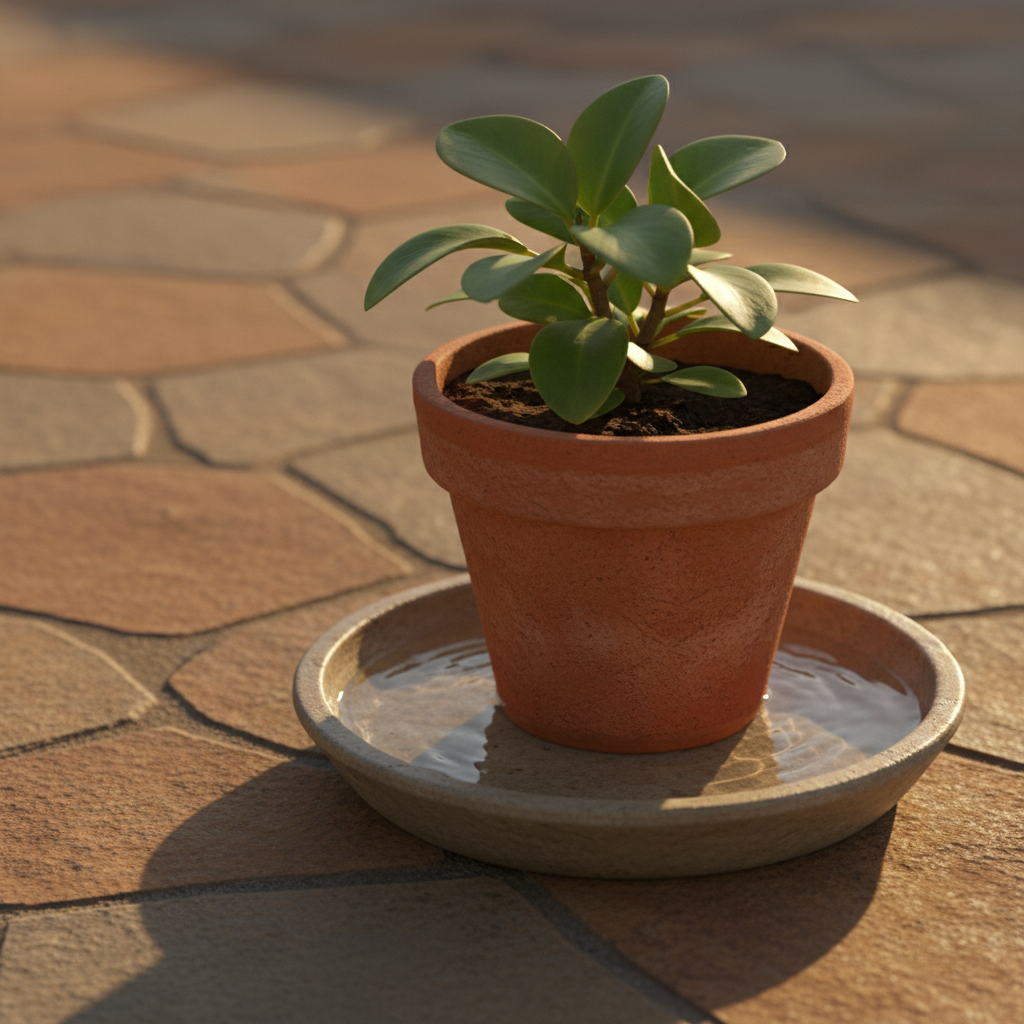
When you do water, water thoroughly. A shy, half-hearted splash that wets only the top of the substrate trains the roots to stay shallow and concentrates mineral salts at the surface over time. A full watering, in which the substrate is fully wetted and surplus runs out through the drainage holes, both rehydrates the entire root ball and flushes any accumulated fertiliser residue. Tip away any water that collects in the saucer after 15 or 20 minutes; the plant should never sit with its roots in standing water.
Bottom-watering is a popular technique with this species and is well suited to it. Stand the pot in a shallow dish containing three or four centimetres of room-temperature water for about a quarter of an hour, then lift it out and let it drain. This approach delivers moisture evenly without dampening the crown of the plant, which is useful given the slight risk of stem rot at the soil line on older specimens.
Warning — Listen to the leaves: a Peperomia that has been overwatered develops soft, droopy, slightly translucent leaves that may drop at the merest touch. A Peperomia that has been underwatered develops slightly wrinkled, less plump leaves that recover their firmness within a day of a proper watering. The first is a structural problem you need to act on; the second is the plant simply telling you the calendar has slipped.
Humidity, despite the species’ tropical origin, is not a concern. The thick, waxy leaves are well-adapted to dryish indoor air, and the plant is perfectly content in the 40 to 50 percent relative humidity that prevails in most homes for most of the year. There is no need to mist it, set it on a pebble tray, or huddle it under a glass cloche. If your home is exceptionally dry in winter, say below 30 percent, grouping the Peperomia with other plants will lift the local humidity enough to keep it comfortable, but heroic measures are unnecessary.
Water quality is worth a brief note. Peperomia obtusifolia is not especially sensitive to tap water and most municipal supplies are perfectly acceptable. If your tap water is exceptionally hard, you may eventually see a faint pale crust on the soil surface or the rim of the pot, which is harmless mineral residue. Letting tap water stand uncovered for 24 hours allows chlorine to dissipate and brings it to room temperature, which the plant prefers over a cold shock straight from the cold tap.
Soil, Potting and Repotting
A successful Peperomia begins with a substrate that drains quickly. The root system is fine and shallow, the leaves and stems store a great deal of moisture themselves, and a heavy, peaty soil that stays sodden for days is precisely the conditions that lead to root rot. The ideal mix is light, well-aerated and slightly chunky, behaving more like a mild succulent mix than a traditional houseplant compost.
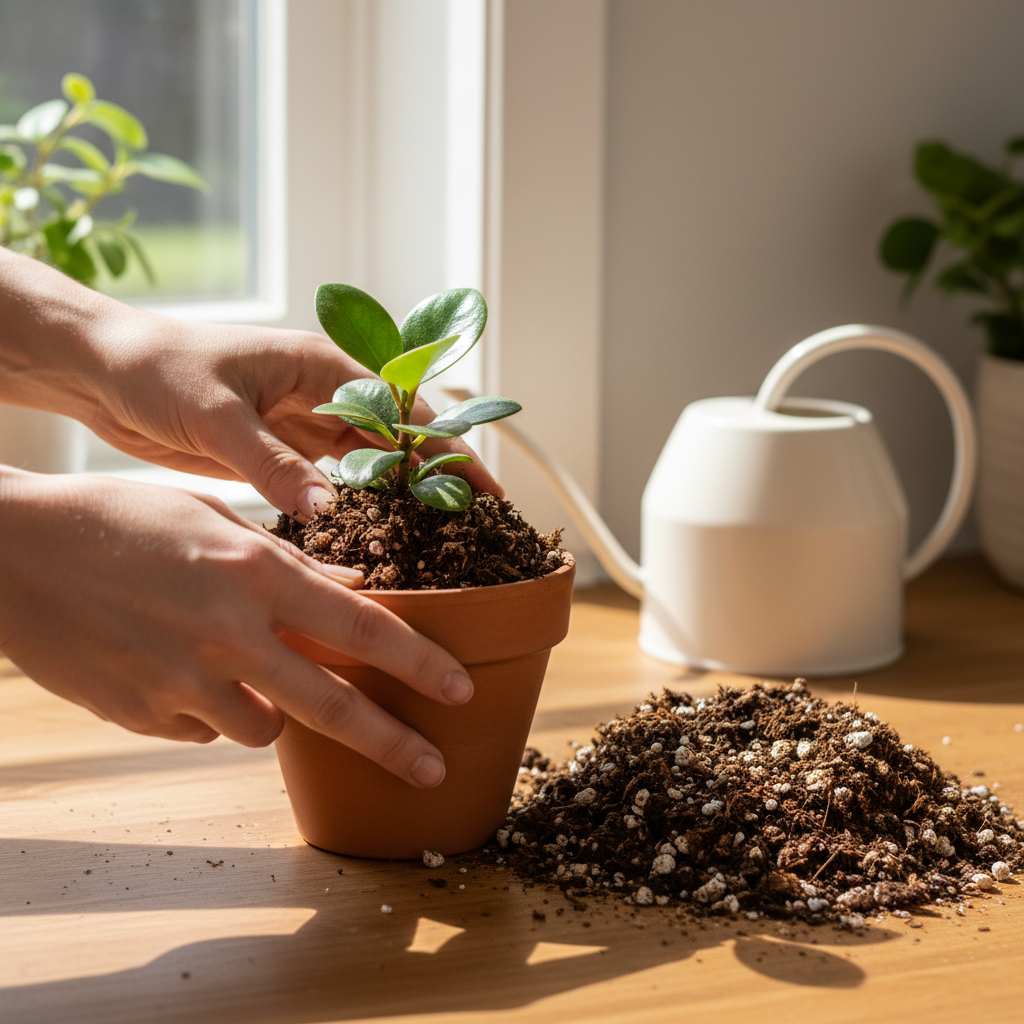
A simple, reliable recipe is two parts standard indoor plant compost, one part perlite or pumice, and one part orchid bark or coarse coco husk. The compost provides body and a modest store of nutrients, the perlite or pumice opens up the air spaces and prevents compaction, and the bark or husk lengthens the mix’s lifespan by resisting decomposition into fines. If you would prefer a single bagged product, a commercial succulent and cactus mix lightened with an extra handful of perlite will serve the plant well.
Pot choice matters more for this species than for many tropicals. Terracotta is an excellent fit: the porous walls let moisture move out through the sides of the pot, accelerating the drying cycle that Peperomia obtusifolia appreciates. Glazed ceramic and plastic pots both work too, but if you use them, be especially careful not to overwater and consider going a size smaller than you would with a more thirsty plant. Whichever material you choose, drainage holes are non-negotiable. A decorative cachepot with no drainage is fine as a sleeve so long as you remove the inner growing pot for watering and only return it once the surplus has drained away.
Repotting needs are modest. The baby rubber plant is a slow grower with a small root system, and a healthy specimen needs a new pot only every two or three years. The clearest signal that it is time to move up a size is when roots begin to circle the bottom of the existing pot or emerge from the drainage holes. Choose a new pot only one or, at most, two centimetres wider in diameter than the current one. An oversized pot holds far more moisture than the small root system can use, and the resulting permanently damp soil is exactly the recipe for trouble.
The best time to repot is early spring, just as the plant begins its active growth period, or in early summer. Avoid disturbing the roots during winter, when the plant is slow and any setback will linger. Water the plant well a day or two before repotting, so it is fully hydrated, then ease it out of its old pot, gently tease loose any tightly circling roots, settle it into the fresh mix at the same depth as before, and water lightly to settle the soil. Hold off on fertilising for at least four to six weeks while the disturbed roots recover.
Fertilising
The baby rubber plant is a light feeder and is far more readily damaged by too much fertiliser than by too little. Its slow growth rate, small root system and adaptation to lean tropical-understorey soils mean that the heavy feeding schedules suitable for fast-growing aroids would burn it. Restraint is the watchword: feed sparingly, dilute generously, and skip the feed entirely whenever you are in doubt.
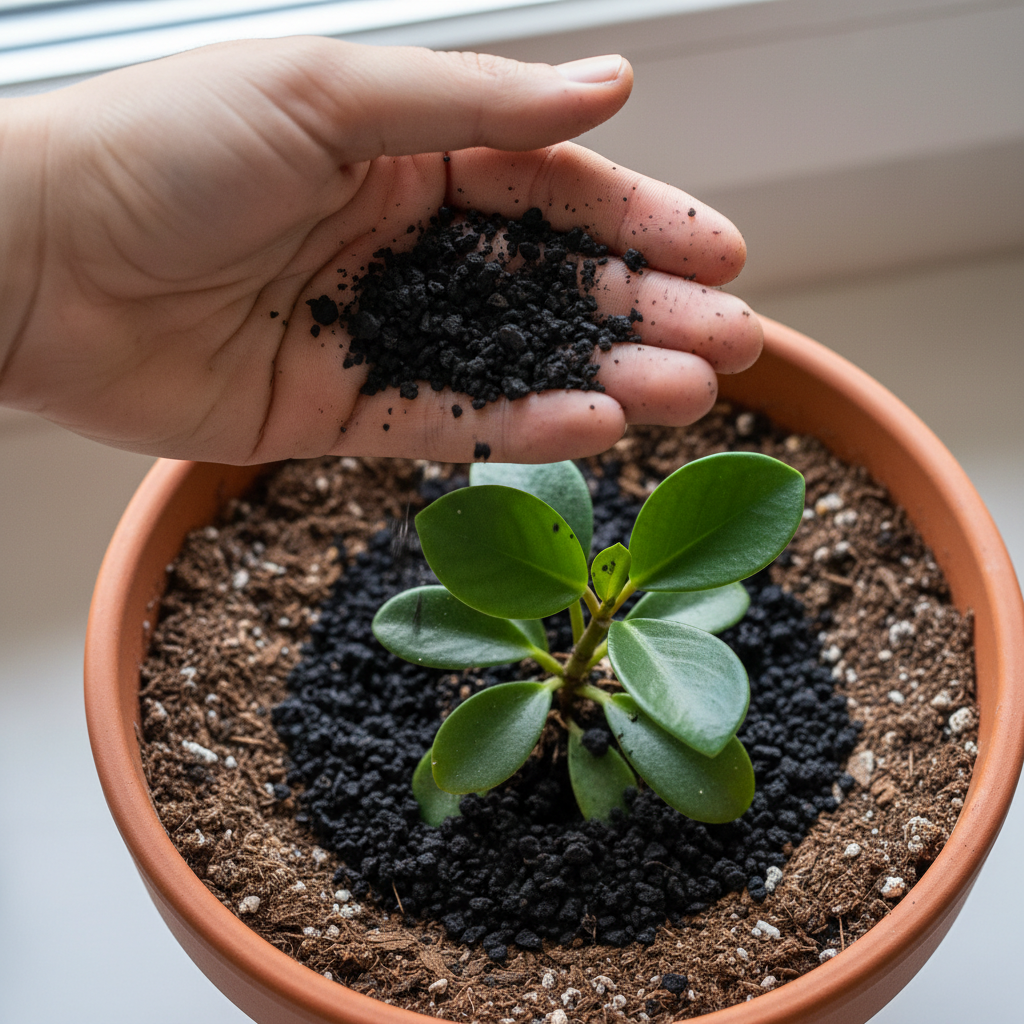
A balanced liquid houseplant fertiliser, with an NPK ratio in the region of 10-10-10 or 20-20-20, diluted to a quarter of the strength recommended on the label, applied every four to six weeks during spring and summer, is more than enough. Through autumn and winter, when growth slows almost to a halt, stop feeding entirely. Resume in early spring once you see fresh leaves beginning to unfurl from the growing tips.
If you prefer organic options, a thin top-dressing of worm castings applied in early spring and again at mid-summer provides a gentle, slow-release source of nitrogen and trace minerals. A diluted compost tea, watered into the soil in place of a feed every six to eight weeks, is another low-risk approach. Whichever route you take, always apply fertiliser to soil that is already moist, never to bone-dry substrate, as concentrated nutrients on dry roots can cause chemical burn.
Warning — Salt build-up: a tell-tale crust of white or yellowish mineral residue on the soil surface or around the rim of the pot indicates accumulating fertiliser salts. Flush the pot through with plain, tepid water until plenty runs out the bottom, then withhold further feeding for two months. Repeat annually as a preventative if you fertilise regularly.
Propagation
One of the chief pleasures of Peperomia obtusifolia is how readily it propagates. Almost every part of the plant is willing to put down roots given the right encouragement, and a single mature specimen can be the source of half a dozen new plants in the space of a season. Two methods are particularly reliable: stem cuttings and leaf cuttings. Both succeed in water and in substrate, so you can choose whichever fits your style.
Stem cuttings
This is the faster of the two routes, because the cutting already carries several leaves and a length of established stem. The new plant matures noticeably more quickly than a leaf cutting.
- Choose a healthy stem with at least three leaves, and using a sharp, clean blade, cut just below a leaf node about 7 to 10 cm down from the growing tip.
- Remove the lowest pair of leaves to expose one or two nodes.
- Let the cut surface callus over for a few hours on a clean surface; this reduces the risk of rot once the cutting is in moisture.
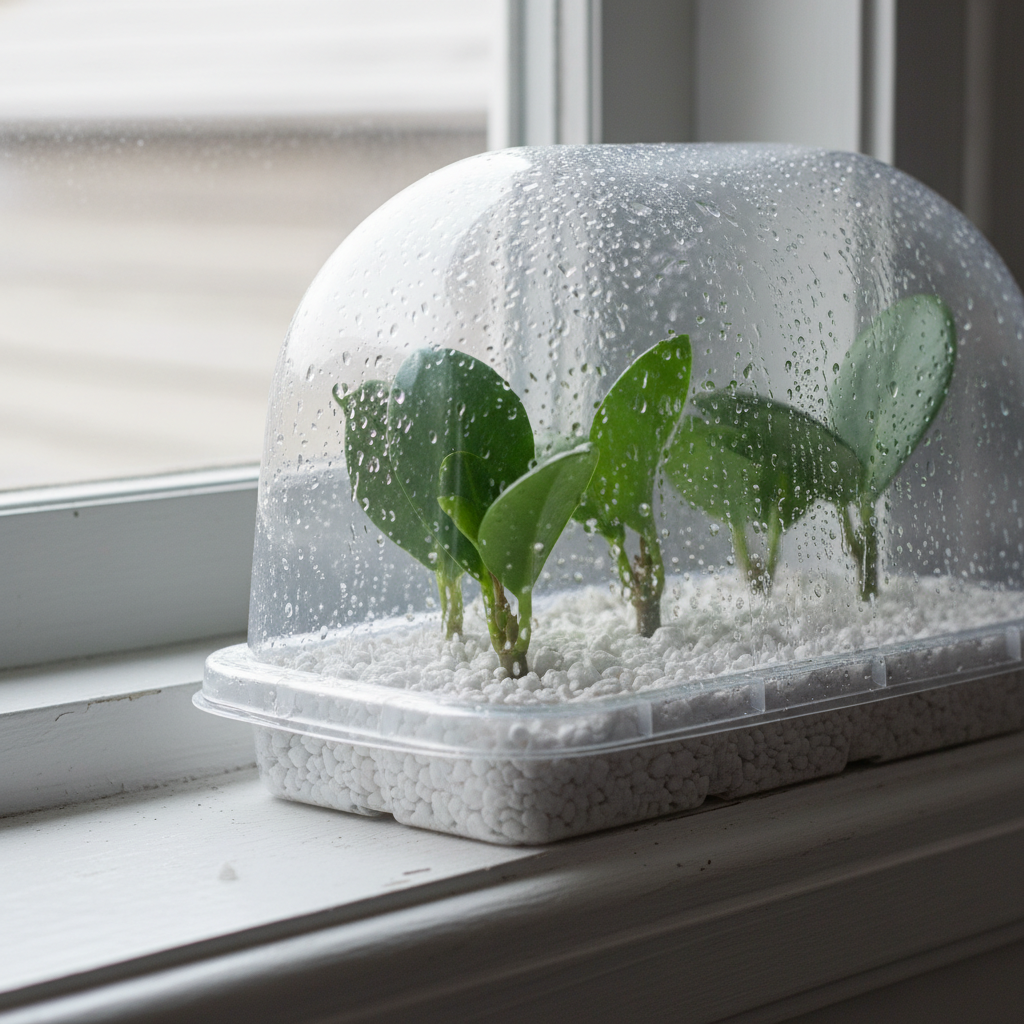
- For water rooting, set the cutting in a small glass of room-temperature water with the exposed nodes submerged but the remaining leaves above the surface. Refresh the water weekly.
- For substrate rooting, insert the cutting into a small pot of damp, light propagation mix or pure perlite, firming gently around the stem.
- Place in bright, indirect light at normal room temperature. Roots typically appear within two to four weeks. Once water-rooted cuttings have roots two to three centimetres long, pot them into substrate.
Leaf cuttings
Leaf cuttings are slower but offer the chance to multiply a beloved plant from material you would otherwise discard.
- Snip a healthy leaf cleanly at the base of its petiole.
- You can root the whole leaf with its short petiole pushed into damp substrate, or, in the classic Peperomia method, slice the leaf in half across its width and stand the cut edge upright in damp propagation mix.
- Provide steady warmth around 21 to 24 °C and high humidity. A clear plastic bag, an upturned glass jar or a propagation dome over the cutting works perfectly.
- Keep the substrate just barely damp; soggy substrate at this stage almost always leads to failure.
- Tiny new plantlets emerge from the base of the leaf or along the cut edge within four to eight weeks. Once the new plantlets have three or four leaves of their own, pot them up individually into a small pot of standard mix.
Spring and early summer are the most productive seasons for propagation; cuttings taken in winter root much more slowly and the failure rate climbs. A pinch of cinnamon dusted on cut surfaces acts as a mild natural fungicide and improves the strike rate when you propagate several cuttings together under a dome.
Pests and Diseases
The baby rubber plant is not a magnet for pests, and a healthy specimen in good light with a sensible watering regime is unlikely to attract serious trouble. When problems do arise, however, they tend to be the same handful of culprits that plague most indoor collections, and the early signs are easy to miss in dense, glossy foliage. A weekly inspection of the leaf undersides and the leaf axils is worth the small effort.
Mealybugs
Of all the pests that show interest in Peperomia, mealybugs are the most common. They appear as small, white, cotton-wool tufts wedged into the leaf axils and along the undersides of stems, and a serious infestation slowly drains the plant’s vigour. Spot-treat individual insects by dabbing them with a cotton bud dipped in 70 percent isopropyl alcohol; the alcohol dissolves the waxy coating and kills them on contact. For a heavier infestation, follow up with a thorough drench of insecticidal soap or a diluted neem oil solution applied across the entire plant, paying particular attention to leaf axils and the soil surface where eggs can hide. Repeat every seven to ten days for three cycles to catch newly hatched generations.
Spider mites
Spider mites are less common on Peperomia than on thinner-leaved tropicals, but they do appear when the air is unusually dry and warm. The early signs are a faint stippling of yellow dots on the leaf surface; in later stages, fine webbing forms in the leaf axils. Raise local humidity, wipe the leaves with a damp microfibre cloth to dislodge adults, and treat with neem oil or insecticidal soap on a weekly cycle.
Fungus gnats
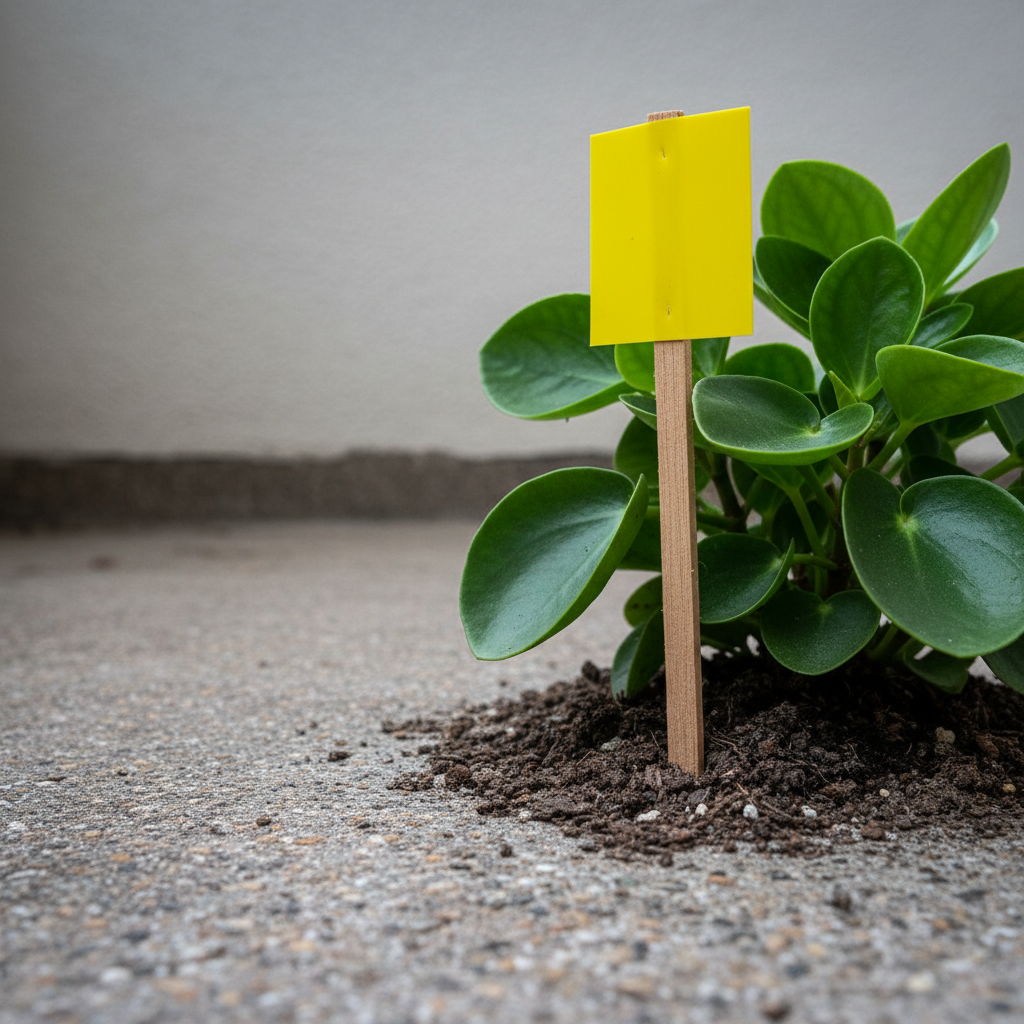
Fungus gnats are less a threat to the plant than a nuisance to the owner, but a sustained population indicates a soil that is staying too wet for too long, which is the underlying issue you need to fix. Let the substrate dry more thoroughly between waterings, top-dress with a one-centimetre layer of horticultural grit or sand to deny the adults a moist surface to lay eggs, and set out a yellow sticky trap to monitor and reduce the adult population. In stubborn cases, a soil drench with Bacillus thuringiensis subspecies israelensis (Bti) targets the larvae specifically without affecting the plant.
Root rot
Root rot is by far the most serious risk to Peperomia obtusifolia, and it is invariably the consequence of chronic overwatering or a poorly drained substrate. Soft, blackening stems at the soil line, leaves that drop at the slightest touch, and a sour, swampy smell when you sniff the pot are all late warnings. If you catch it early, unpot the plant, slice away any black, mushy roots with a sterilised blade, allow the remaining root mass to dry on a paper towel for a few hours, and repot into fresh, dry, fast-draining mix. Withhold water for a week to encourage callusing, then resume only modest watering until new growth confirms recovery.
Pro Tip — Quarantine new arrivals: any plant bought from a shop or swap may carry pest eggs invisible to the eye. Keep new acquisitions isolated from the rest of your collection for three to four weeks, inspect them weekly under bright light, and only move them into your main display once you are confident they are clean. This single habit prevents most household outbreaks before they begin.
Popular Varieties
Although the species Peperomia obtusifolia in its plain solid-green form is itself a handsome plant, the cultivars expand the visual range considerably. Variegation in this species is unusually stable, with the cream and yellow patterns persisting reliably from one leaf to the next, and the most established varieties have been in commercial production for decades. Three or four cultivars dominate the houseplant trade.
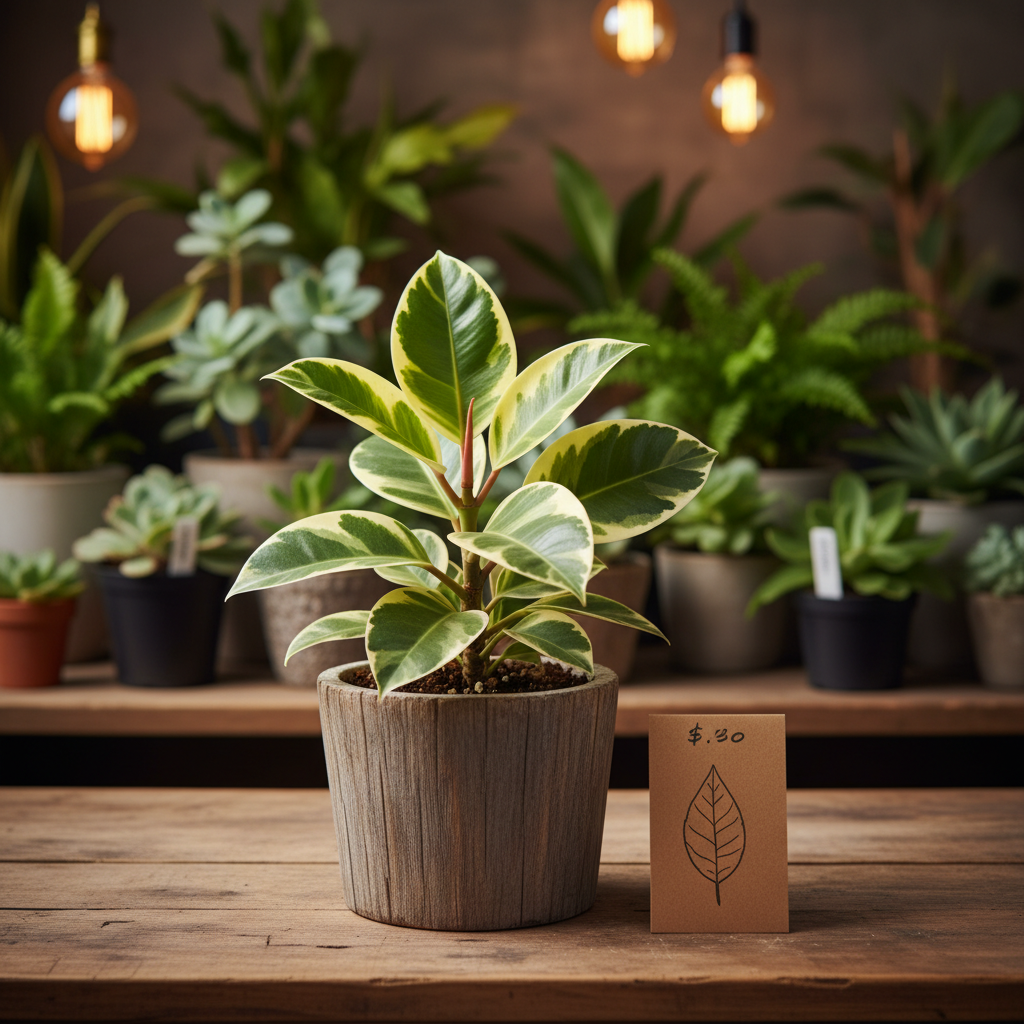
‘Variegata’ is the most familiar of the variegated forms, and the one most often labelled simply Variegated Baby Rubber Plant in shops. Each thick, paddle-shaped leaf carries a soft, irregular marbling of creamy yellow and pale green around its margins, with the deep green of the species concentrated in the centre. No two leaves are identical, which gives a mature specimen a quietly lively appearance. It grows at a similar rate to the green form, perhaps a touch slower, and shares the same care requirements; only its light demand is slightly higher, since the cream sections of the leaf carry less chlorophyll and need more ambient brightness to keep the plant in balance.
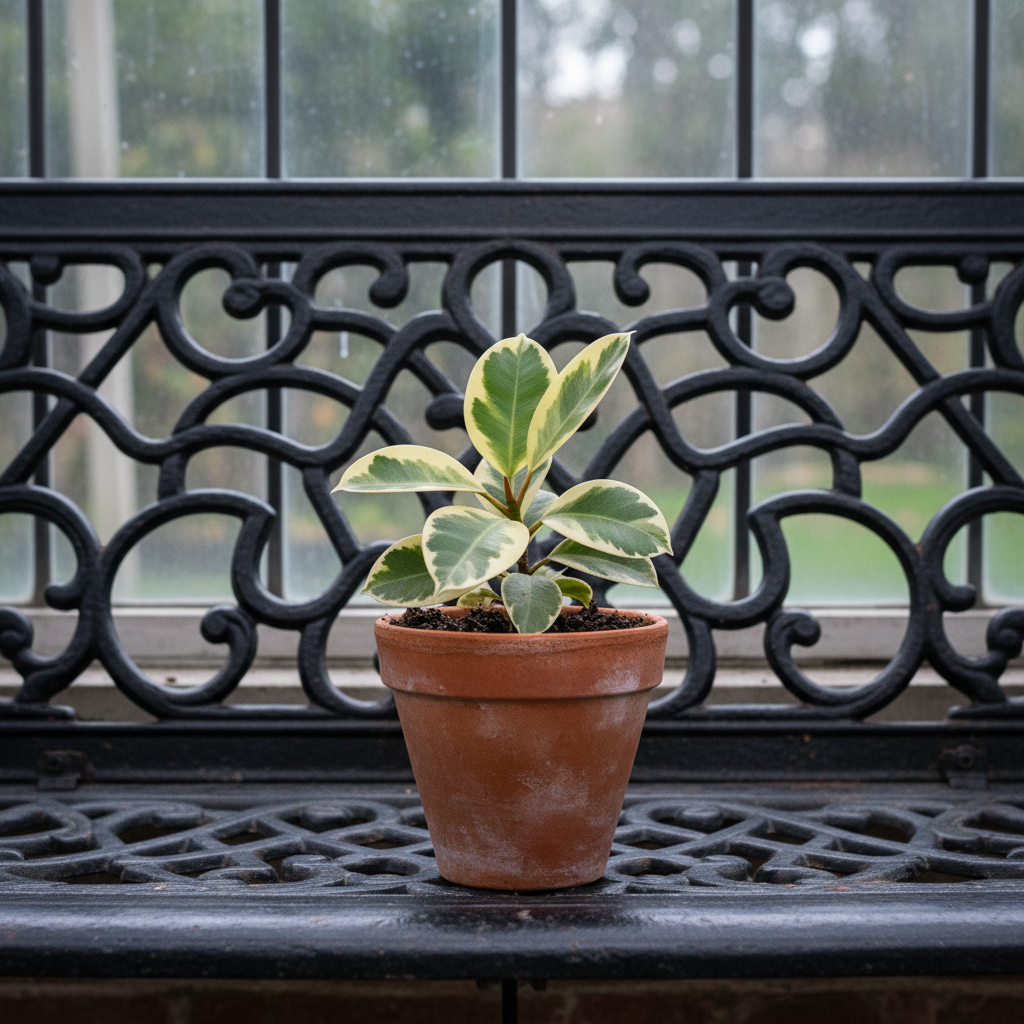
‘Golden Gate’ takes the variegation a step further. The leaves are framed with broad, creamy-white margins that sometimes cover the majority of the leaf surface, leaving only a small jade-green central splash. The contrast is striking and gives the plant a brighter, lighter overall presence than ‘Variegata’. Because so much of the leaf area is non-photosynthetic, ‘Golden Gate’ is the most light-demanding of the common cultivars and is the first to lose its variegation in low light. Site it in the brightest indirect position you have, and watch new growth carefully: a sudden run of nearly all-cream leaves can over time deplete the plant of energy.
Beyond these two, several other names appear regularly in specialist collections. ‘Albo-Marginata’ resembles ‘Variegata’ but with cleaner, sharper white edges and a colder overall tone. ‘Lemon Lime’ swaps the creamy variegation for chartreuse-yellow stripes against vivid mid-green, giving a much more acidic colour palette. ‘Marble’, occasionally sold as ‘USA’ or ‘Vibrant Marble’, shows a more chaotic, swirled pattern of green and cream that varies leaf by leaf. All four share the same care needs as the species itself, with the standard caveat that the brighter the variegation, the brighter the position should be.
Frequently Asked Questions
Is the baby rubber plant the same as the rubber plant (Ficus elastica)?
No, despite the shared common name they are unrelated. The rubber plant, Ficus elastica, is a large tree in the fig family that can grow to several metres indoors and produces milky latex when cut. The baby rubber plant, Peperomia obtusifolia, is a small, semi-succulent member of the pepper family that rarely exceeds 30 centimetres in height and produces no latex. The name comes from the slightly similar rubbery feel of the leaves, nothing more.
Is Peperomia obtusifolia safe for cats and dogs?
Yes. The ASPCA lists Peperomia obtusifolia as non-toxic to both cats and dogs. It contains no calcium oxalate crystals, no irritant sap and no known toxic alkaloids. Pets that nibble a leaf may experience mild digestive upset simply from eating plant material, but the plant itself is not a hazard.
Why are my baby rubber plant’s leaves wrinkly?
Wrinkled leaves nearly always indicate underwatering. The leaves are essentially small water reservoirs, and when the soil dries out completely for an extended period, the plant draws on those reserves and the leaves begin to lose their plumpness. Water thoroughly and the firmness should return within a day or two. If the leaves remain limp and soft after watering, suspect overwatering and root damage instead.
Why are my baby rubber plant’s leaves falling off?
Sudden leaf drop, especially when accompanied by softening at the leaf base, is usually a sign of overwatering and the onset of root rot. Check the soil; if it is wet and the lower stems feel mushy, unpot the plant, trim away any blackened roots, and repot into fresh, dry, fast-draining mix. Less commonly, leaf drop can follow a cold draught, a sudden move to a much darker location, or transplant shock from a recent repotting.
How fast does the baby rubber plant grow?
It is a notably slow grower compared with most popular houseplants. A young plant might add two or three new leaves per month in spring and summer at its peak, and almost nothing through autumn and winter. A mature specimen reaches its full 25 to 30 centimetre height in three to four years and then spreads laterally rather than upward. This deliberate pace is one of the reasons it stays attractive for so long: it rarely outgrows the spot you have chosen for it.
Should I mist my baby rubber plant?
No. The thick, waxy leaves do not benefit from misting and the practice can encourage fungal problems if water settles in the leaf axils. Average household humidity is perfectly adequate for this species. If you enjoy the ritual of misting, direct it at neighbouring tropicals that actually appreciate it; your Peperomia would rather you left it alone.
My baby rubber plant has tall white spikes growing from it. What are they?
Those are the flower spikes, sometimes called rat-tail flowers. They consist of hundreds of tiny, scentless cream-green florets along an upright stem and are produced occasionally by happy, mature plants. They are not showy and do not affect the plant’s health. Some growers leave them as a curiosity; others snip them off to direct the plant’s modest energy back into foliage. Either is fine.
Can the baby rubber plant live in a bathroom?
It can, provided the bathroom has a window that supplies bright, indirect light through most of the day. A windowless bathroom relying on artificial light only will not sustain a healthy specimen long-term. The higher humidity in bathrooms is neither necessary nor especially helpful, but neither does it cause harm if drainage is adequate.
Why is my variegated Peperomia obtusifolia turning all green?
This is a classic sign of insufficient light. Variegated leaves carry less chlorophyll than fully green ones, so when the plant is starved of light it preferentially produces new growth with more green tissue to compensate. Move the plant to a noticeably brighter position, prune away any all-green stems as they appear, and over time the new growth should regain its variegated pattern.
How long does a baby rubber plant live?
With reasonable care, a baby rubber plant can live for ten years or more as a single specimen, and effectively indefinitely if you propagate replacement plants from cuttings every few years. Older plants sometimes begin to look leggy and bare at the base as the lowest leaves naturally age and drop; at that point a hard prune in spring will trigger fresh bushy growth, or you can simply take cuttings from the top and start again.
For all its modest scale, Peperomia obtusifolia is a quietly rewarding plant to live with. It asks for the right light, a sparing hand with the watering can and a substrate that drains briskly, and in return it offers years of dense, lacquered foliage that holds its shape through the dark months when many of its tropical neighbours sulk. Begin with those three pillars in place and the rest of its care looks after itself.






