
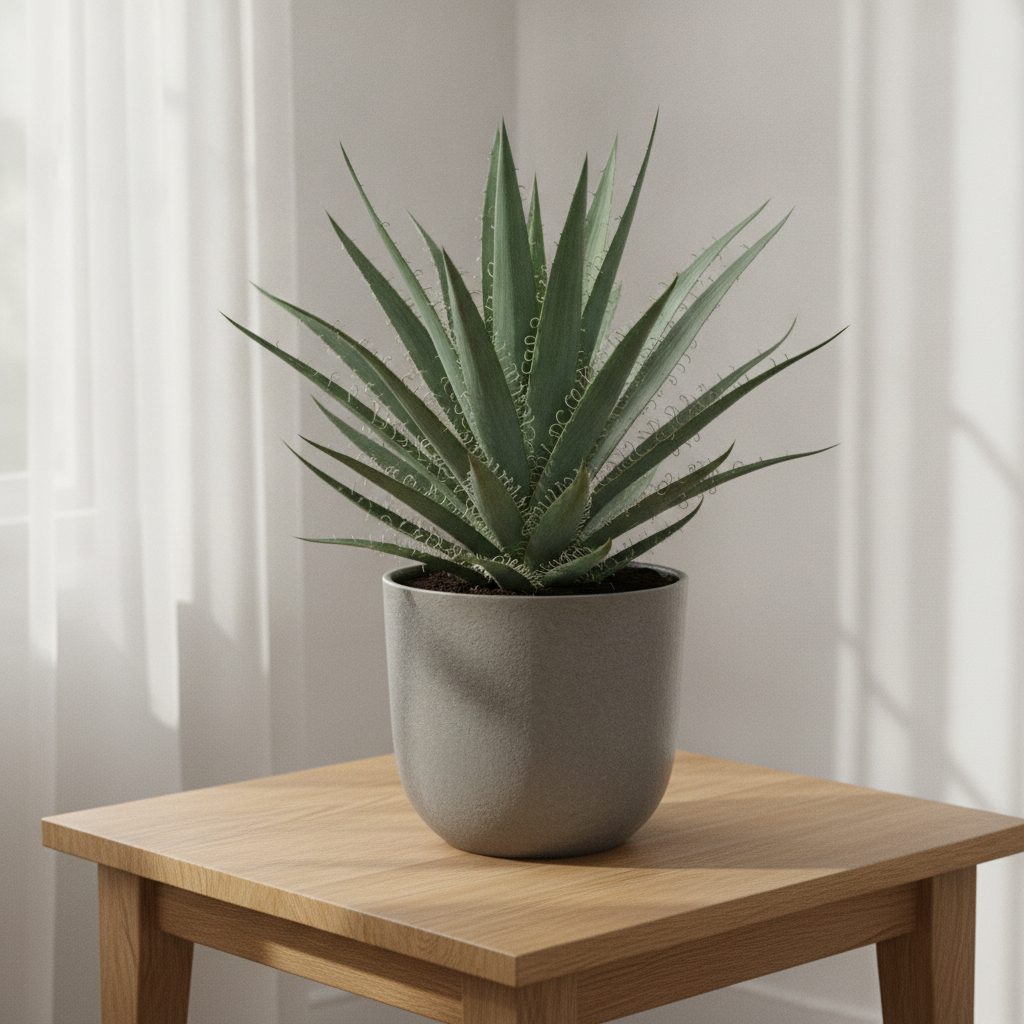
Few houseplants wear their identity as plainly as Adam’s Needle. Run a finger along the edge of a mature leaf and you meet the two features that name it: a spine-sharp tip that inspired the “needle”, and dozens of curling white threads peeling away from the margins, the botanical signature preserved in its species epithet. Known to botanists as Yucca filamentosa, this stemless evergreen forms a tight rosette of stiff, sword-shaped blue-green blades and belongs to the asparagus family (Asparagaceae). It is native to the sandy soils, pine barrens and coastal dunes of the south-eastern United States, where it endures blazing sun, drought, salt spray and hard frost with equal indifference.
That toughness is exactly what makes it such a forgiving container plant, and also what trips up new growers. Adam’s Needle is almost impossible to kill through neglect, but very easy to disappoint through kindness. Overwater it, crowd it into a dim corner, or plant it in rich moisture-retentive compost and it will merely survive, its rosette loosening and its lower leaves yellowing. Give it the brightest window in the house, a gritty free-draining mix and a genuinely dry rest between waterings, and it thrives, tightening into a crisp architectural sculpture that can anchor a room for decades. This guide covers everything from light and watering to potting, feeding, division and pests, with the recurring theme that thriving here means doing less, not more.
Contents
- Quick Reference
- Why Adam’s Needle Makes a Rewarding Houseplant
- Light Requirements
- Watering & Humidity
- Soil, Potting & Repotting
- Fertilising
- Propagation
- Pests & Diseases
- Popular Varieties
- Frequently Asked Questions
Quick Reference: Adam’s Needle at a Glance
| Light | As much direct sun as possible; a south-facing window indoors, or full sun outdoors. Tolerates less but stretches and weakens. |
| Watering | Sparingly. Let the soil dry out completely, then water thoroughly. Roughly every 2 to 3 weeks in summer, monthly or less in winter. |
| Temperature | Happy at 15 to 27 °C (59 to 81 °F) indoors; tolerates brief dips near 0 °C (32 °F) and, as a garden plant, far colder. |
| Humidity | Low to average. Dry indoor air is no problem; high humidity with poor airflow invites rot. |
| Fertiliser | Light feeder. A dilute balanced feed once or twice across the growing season is plenty. |
| Toxicity | Mildly toxic to cats, dogs and horses if eaten (saponins). The rigid, needle-tipped leaves are also a physical hazard. |
Why Adam’s Needle Makes a Rewarding Houseplant
Adam’s Needle earns its place indoors on the strength of its silhouette. Where most houseplants offer soft, rounded foliage, Yucca filamentosa delivers a burst of stiff radiating blades, a living starburst that reads as sculpture rather than greenery. The blue-green colour is cool and matte, the curling white marginal threads catch the light, and the whole rosette holds its shape year-round without the flopping or leaf drop that plagues fussier plants. For anyone building a room around clean lines and a slightly arid, sun-baked mood, it is one of the most architectural plants you can grow in a pot.
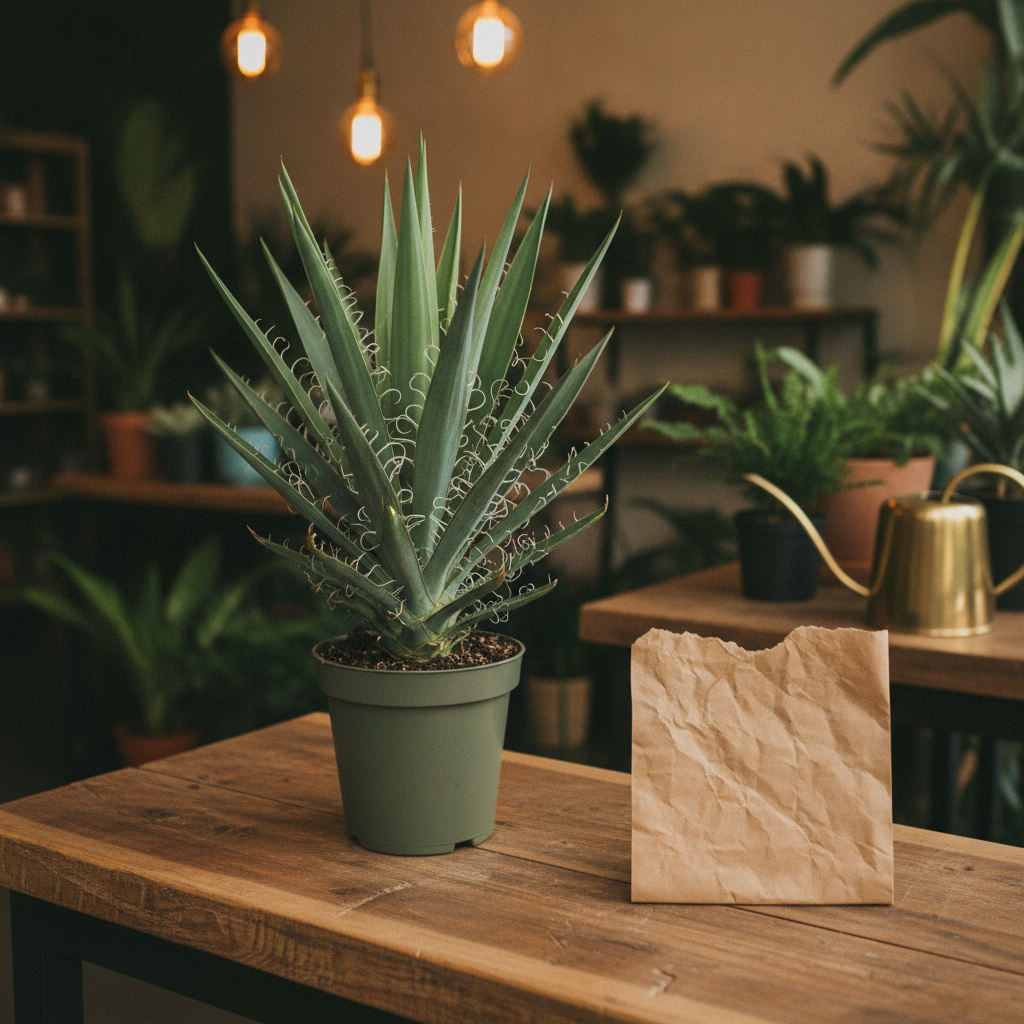
Beyond looks, it is genuinely low-maintenance in the way that suits busy or forgetful growers. It stores water in its thick roots and fleshy leaf bases, so it shrugs off a missed watering that would wilt a fern within hours. It has no meaningful humidity requirement, which makes it one of the few dramatic plants that stays happy in a centrally heated flat. It grows slowly, so it rarely outgrows its spot or its pot in a hurry. And in the ground it is one of the toughest ornamentals in cultivation, hardy through hard winters, tolerant of coastal salt and content in poor sandy soil, which tells you exactly how little pampering the potted version needs. The trade-off is that it demands light and drainage in return, and it will punish overwatering faster than almost any other failing.
Important — Toxicity: All parts of Adam’s Needle contain saponins that are mildly toxic to cats, dogs and horses, causing drooling, vomiting or diarrhoea if chewed. Just as importantly, the leaf tips are genuinely sharp and can cause puncture injuries to eyes and skin. Site the plant away from walkways, play areas and inquisitive pets, and consider trimming the very tips if it lives at child height.
Light Requirements
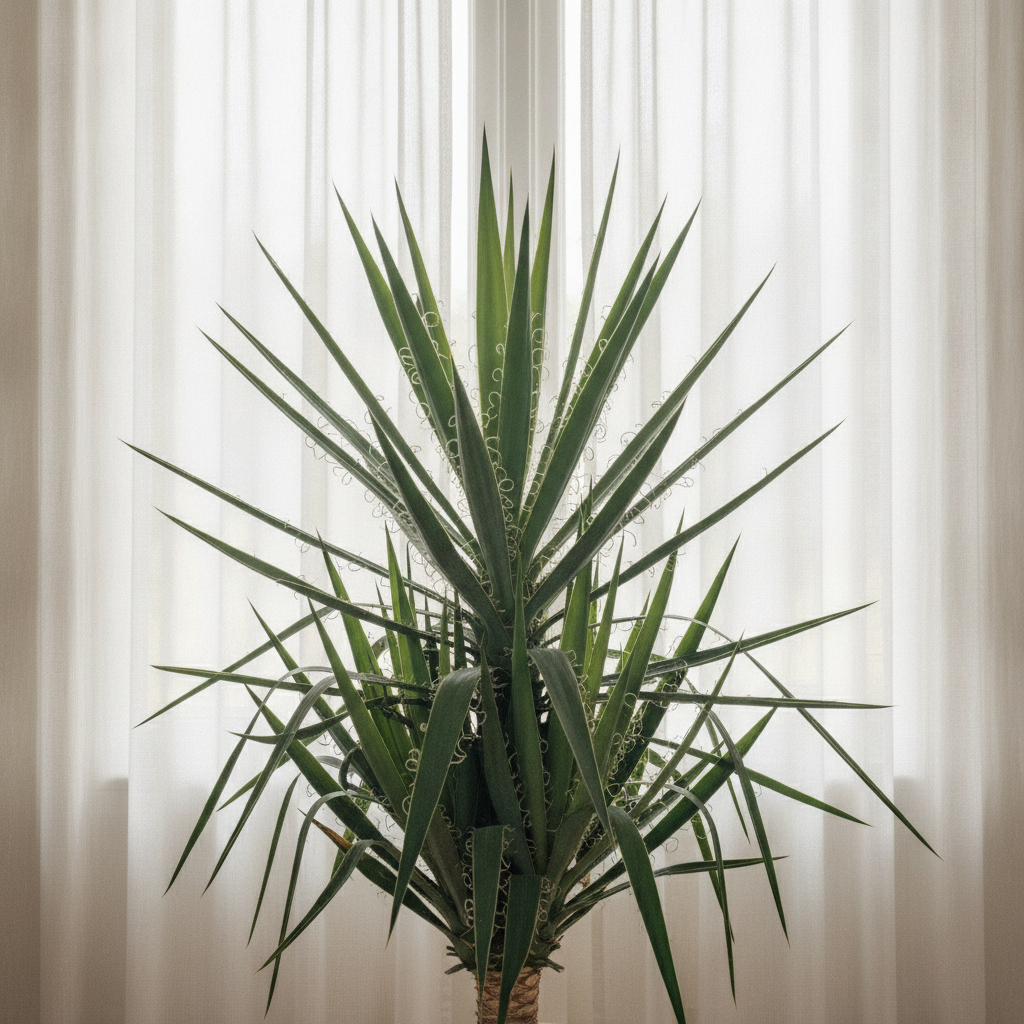
If you remember only one thing about growing Adam’s Needle indoors, make it this: give it the most light you possibly can. This is a full-sun plant from open, exposed habitats, and nothing about a domestic interior comes close to the intensity it evolved under. Insufficient light is by far the most common reason a potted yucca looks disappointing, producing pale, floppy, over-long leaves and a loose, collapsing rosette instead of the tight starburst you are after.
The ideal indoor position is directly in front of an unobstructed south-facing window (north-facing in the Southern Hemisphere), where the plant can bask in several hours of genuine direct sun each day. A bright conservatory, sunroom or a spot pressed right against the glass is perfect. Outdoors in summer it will happily take a fully sunny patio or balcony, and this seasonal holiday outside is one of the best things you can do to keep a container specimen vigorous and compact.
Light Levels Explained
Light is easy to underestimate because our eyes adjust so readily; a corner that looks bright to us may deliver a small fraction of the energy a plant needs. The table below translates rough light categories into the practical outcome you can expect from Adam’s Needle in each.
| Light Category | Approx. Level | Typical Location | Outcome |
|---|---|---|---|
| Direct sun | 20,000 to 100,000 lux | On the sill of a south-facing window, or outdoors | Ideal. Tight rosette, strong colour, sturdy leaves. |
| Bright indirect | 10,000 to 20,000 lux | Just back from a sunny window, or beside an east or west window | Acceptable. Growth slower, rosette slightly looser. |
| Medium | 2,000 to 10,000 lux | A few metres from a bright window | Survives but etiolates; leaves lengthen and weaken. |
| Low | 500 to 2,000 lux | Interior wall, north-facing room | Slow decline. Pale, stretched, prone to rot. |
| Very low | Below 500 lux | Hallway, windowless spot | Not viable long term. |
Window Orientation and Placement
South-facing window: The best choice by a wide margin. Place the plant on or immediately beside the sill so it receives the maximum hours of direct sun. This is the one orientation that reliably keeps the rosette tight and the leaves rigid.
East-facing window: Workable, offering a few hours of gentler morning sun. Expect slightly slower, looser growth than in a south window, and rotate the pot regularly to keep the rosette even.
West-facing window: Also workable, delivering strong afternoon sun. Watch for heat build-up behind glass on the hottest days, but in general a west window suits a yucca well.
North-facing window: Not enough light on its own. A yucca here will steadily stretch and soften. If a north window is your only option, plan to supplement with a grow light or move the plant outdoors for the summer.
Pro Tip — Read the Rosette: The plant tells you whether it has enough light through its shape. A tight, compact rosette with short, stiff, upright-to-arching blades means it is content. Long, floppy leaves and widening gaps between them mean it is reaching for light and needs a brighter home.
How Light Affects Colour and Form
Light governs not just growth rate but the plant’s entire character. In strong sun the blades stay short, thick and rigid, the blue-green colour deepens and the marginal filaments are dense and pronounced. In variegated cultivars such as ‘Color Guard’ and ‘Bright Edge’, high light also intensifies the yellow tones and, in cool weather, brings out the pink and coral flushes that make those varieties so prized. Move the same plant into shade and the variegation fades toward plain green, the leaves elongate and thin, and the whole plant loses the crisp definition that is the point of growing it.
Warning — Direct Sunlight: Although Adam’s Needle loves full sun, a plant that has spent months indoors has soft, sun-unaccustomed tissue. Moving it straight into blazing outdoor sun can scorch the leaves, leaving bleached or brown patches. Acclimatise it over 10 to 14 days, starting in bright shade and increasing exposure gradually.
Artificial Lighting
Because its light demand is so high, Adam’s Needle is a strong candidate for supplementary lighting in darker homes or through northern winters. A full-spectrum LED grow light positioned 20 to 30 cm (8 to 12 in) above the rosette, run for 10 to 12 hours a day, can keep a plant compact where natural light falls short. Ordinary room lighting is far too weak to register, so treat a grow light as a genuine sun substitute rather than a token gesture, and pair it with good drainage since a well-lit plant will use water faster.
Seasonal Adjustments
Follow the sun through the year. In spring and summer, when light is abundant, the plant is in active growth and can take the brightest spot you have, indoors or out. As autumn light weakens, move it as close to the window as possible and, crucially, cut back sharply on water to match the slower pace of growth. Many growers give Adam’s Needle a cool, bright, nearly dry winter rest, which mimics its natural dormancy and helps mature plants build up to flowering. The pairing to remember is simple: high light and moderate water in summer, still-high light but minimal water in winter.
Watering & Humidity
Watering is where most Adam’s Needle plants live or die, and the guiding principle is restraint. This is a drought-adapted plant that stores moisture in swollen roots and fleshy leaf bases, and its roots need air as much as water. In its native ground it goes weeks between rains and grows in sand that drains in seconds. The single most damaging thing you can do to a potted yucca is keep its soil consistently moist. When in doubt, wait; a thirsty yucca recovers within hours of a drink, but a waterlogged one rots from the roots up and may be beyond saving before the leaves even show it.
When to Water
Water only when the potting mix has dried out completely, top to bottom. Do not follow a calendar; check the soil instead. Push a finger deep into the mix, or lift the pot to feel its weight, and water only when it is bone dry and light. In a warm, sunny position through summer this typically works out to roughly once every two to three weeks, but the interval depends entirely on your light, pot size and home, so let the soil be your guide.
In winter, when growth slows to a crawl and light is weak, stretch the intervals dramatically. Once a month is often plenty, and a cool, resting plant may want water even less than that. The colder and darker the plant’s position, the longer it can and should stay dry. Erring on the side of drought in winter is one of the surest ways to keep a yucca alive for the long term.
Pro Tip — The Lift Test: Get to know the weight of the pot right after a thorough watering and again when the mix is fully dry. That difference is more reliable than any finger test or moisture meter, and within a couple of cycles you will be able to judge the plant’s thirst by lifting it for a second.
How to Water Correctly
- Confirm the mix is fully dry by weight or by probing deep into the pot.
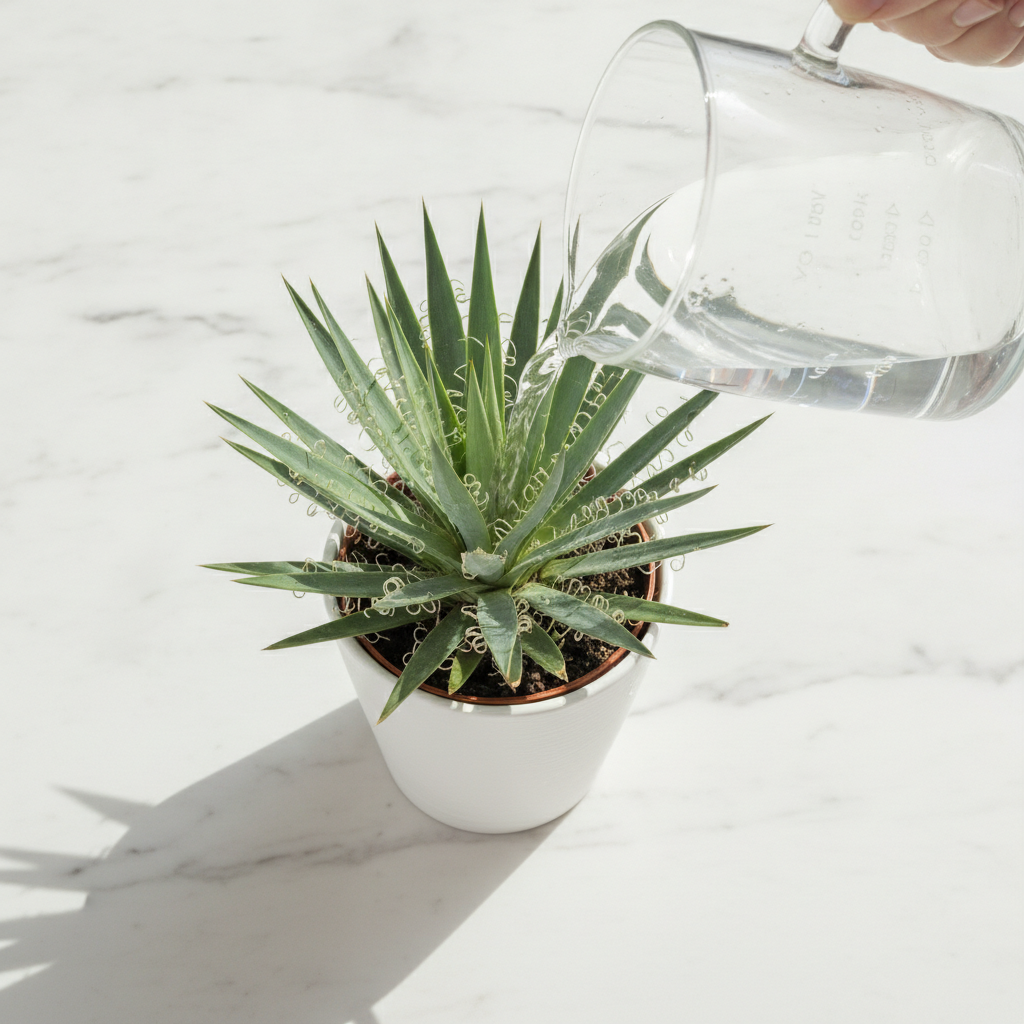
- Water at the soil surface, keeping the crown and the leaf rosette dry to avoid trapping moisture where the blades meet.
- Add water slowly and steadily until it runs freely from the drainage holes, which fully wets the root zone and flushes out old salts.
- Let the pot drain completely, then tip away any water left standing in the saucer or cachepot.
- Return the plant to its bright spot and do not water again until the mix has dried out entirely.
Signs of Overwatering vs. Underwatering
| Symptom | Overwatering | Underwatering |
|---|---|---|
| Leaf colour | Yellowing that spreads from the base upward, often across many leaves at once | Older, lowest leaves slowly browning and drying at the tips |
| Leaf texture | Soft, mushy, translucent leaf bases | Leaves thinner, slightly wrinkled or curling inward |
| Soil | Stays wet for many days; may smell sour or musty | Bone dry, pulling away from the sides of the pot |
| Roots | Brown, soft, black or foul-smelling | Firm and pale but sparse; plant loose in its pot |
| Stem base / crown | Soft, darkened, collapsing at soil level | Firm, though growth stalls until watered |
Warning — Root Rot: A soft, darkening base and a sour smell from the soil mean rot has set in. Act immediately: unpot the plant, cut away all mushy roots and tissue with a sterilised blade, let the cut surfaces dry and callus for a day or two, and repot into fresh, gritty, barely moist mix. Then keep it dry and bright while it recovers. Caught early, a yucca often pulls through; left in wet soil, it rarely does.
Humidity Requirements
Humidity is refreshingly simple with Adam’s Needle: it does not need any special provision. Coming from dry, exposed habitats, it is entirely comfortable in the low humidity of a centrally heated or air-conditioned home, and average indoor levels of 30 to 50 percent suit it perfectly. This makes it one of the few statement plants you can grow well without misters, pebble trays or a humidifier.
If anything, the risk runs the other way. Persistently high humidity combined with poor airflow encourages fungal leaf spots and crown rot, especially if water sits in the rosette. There is no need to raise humidity for this plant, and doing so can do more harm than good.
Because you never need to increase humidity, focus your attention instead on airflow. A position with gentle air movement keeps the leaves dry between waterings and dramatically reduces the chance of fungal problems. Avoid cramming the plant into a stagnant corner, and never mist it.
Water Quality
Adam’s Needle is unfussy about water quality and tolerates ordinary tap water without complaint, another mark of its easy-going nature. Over years, mineral salts from hard water and fertiliser can accumulate in the mix, so an occasional thorough flush, letting water run freely through the pot, keeps the root zone sweet. If you notice a crust of white deposits on the soil surface or pot rim, flush more often or switch to filtered or rainwater. Room-temperature water is gentler on the roots than cold water straight from the tap.
Soil, Potting & Repotting
Drainage is everything for Adam’s Needle. In the wild it grows in pure sand and gritty, fast-draining ground, and the potting mix that keeps it healthy indoors mimics that: open, coarse and quick to dry. Ordinary bagged houseplant compost, which is designed to hold moisture, is the wrong starting point on its own and is the hidden cause of many a rotted yucca. Get the mix right and half the battle of growing this plant is already won.
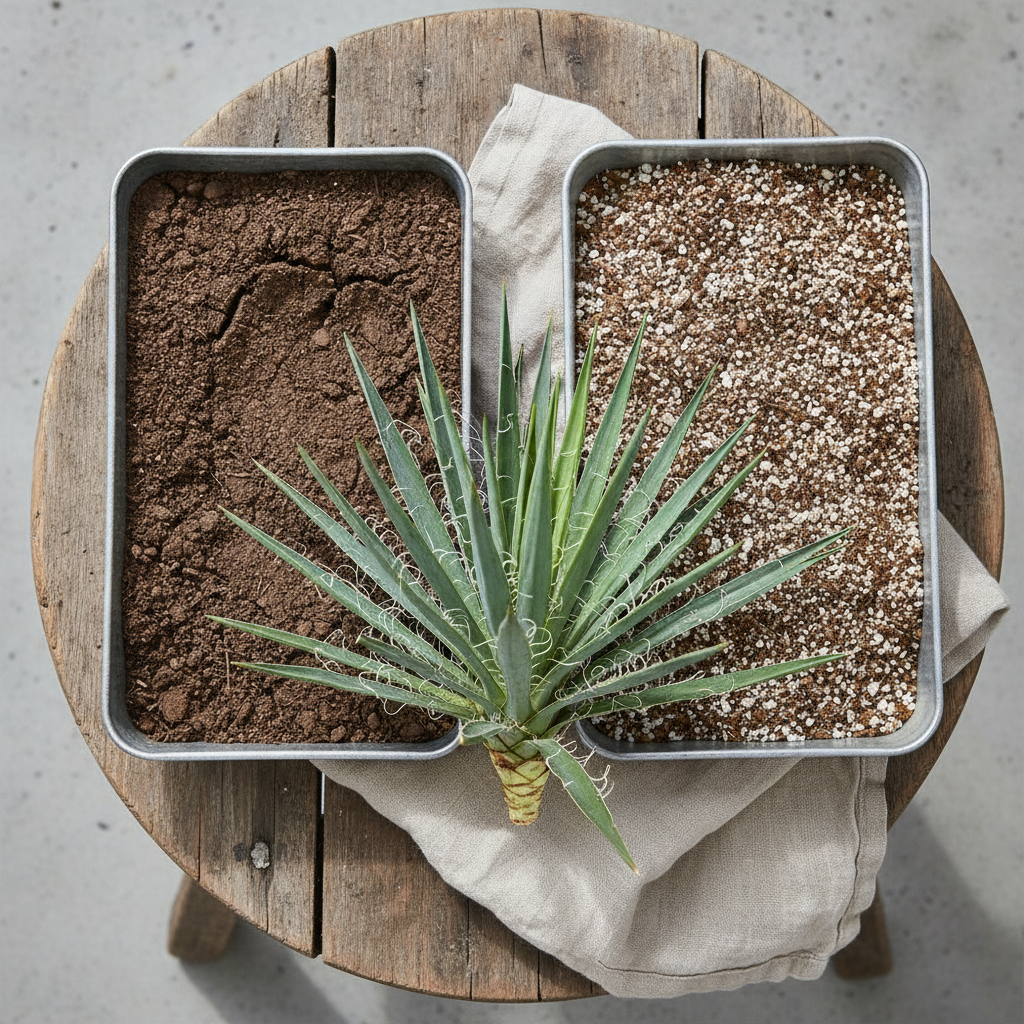
Ideal Soil Composition
The aim is a gritty, mineral-rich mix that holds just enough moisture to keep the roots ticking over while draining almost instantly. The simplest reliable approach is to take a quality cactus and succulent compost and open it up further with extra grit and perlite, so that water pours straight through and the mix dries within a few days. The table below shows a dependable recipe.
| Component | Proportion | Function |
|---|---|---|
| Cactus / succulent compost | Half | Base structure and modest moisture retention |
| Horticultural grit or coarse sand | One quarter | Adds weight and rapid drainage; mimics native soil |
| Perlite or pumice | One quarter | Creates air pockets and keeps the mix open |
Adam’s Needle is not fussy about pH and does well in anything from slightly acidic to slightly alkaline, roughly pH 6.0 to 7.5. The texture and drainage of the mix matter far more than its acidity, so concentrate your effort there and treat pH as a non-issue for this plant.
Pro Tip — Quick Mix Recipe: No cactus compost to hand? Combine two parts ordinary peat-free houseplant compost with one part perlite and one part coarse horticultural grit or sharp sand. The goal is a mix so open that water runs straight through and never stays soggy.
Choosing the Right Pot
The right container reinforces everything the soil is doing. Because a mature Adam’s Needle can become tall and top-heavy, stability matters too, so a heavy pot is a practical advantage as well as an aesthetic one.
Drainage holes are non-negotiable. Never pot Adam’s Needle into a container without drainage. No matter how careful your watering, a pot that cannot shed excess water will eventually drown the roots. If you love a decorative cachepot without holes, keep the plant in a plain draining nursery pot that sits inside it, and empty any water that collects.
Pot material: Terracotta is close to ideal. Its porous walls wick moisture out of the mix and let it breathe, working with the plant’s need to dry quickly, and its weight helps counterbalance a tall rosette. Glazed ceramic and plastic hold moisture longer, so if you use them, lean even harder on a gritty mix and disciplined watering.
Pot size: Choose a container only slightly larger than the root ball. A pot that is too big holds a reservoir of damp soil the roots cannot use, which invites rot. Adam’s Needle is quite happy growing a little snug, and a modest pot also helps restrain its size if you want to keep it manageable.
When to Repot
Adam’s Needle grows slowly and positively enjoys being somewhat pot-bound, so it needs repotting only every two to three years, or when clear signs appear: roots emerging from the drainage holes, the plant becoming unstable and top-heavy, the mix breaking down and staying wet too long, or growth stalling despite good care. Spring, at the start of the active season, is the best time to repot, giving the plant a full summer to settle in. Often you can simply refresh the top few centimetres of mix each spring and delay a full repot for years.
How to Repot: Step-by-Step
- Wear thick gloves and, if the plant is large, wrap the rosette loosely in cardboard or a folded towel to shield your arms from the sharp leaf tips.
- Water lightly a day before if the mix is dust-dry, which helps the root ball slide out, then gently ease the plant from its pot.
- Tease away loose old soil from the roots and inspect them, trimming any that are soft, brown or rotten with a sterilised blade.
- Add a layer of fresh gritty mix to the base of a clean pot only slightly larger than the last, and position the plant at the same depth it grew before.
- Backfill around the roots with more mix, firming gently to remove air gaps but not compacting it hard.
- Wait about a week before watering, giving any damaged roots time to callus, then resume normal sparing watering.
Warning — Transplant Shock: Do not water a freshly repotted yucca straight away. Roots disturbed during repotting are vulnerable, and moist soil around fresh wounds is an open invitation to rot. Waiting roughly a week to water is one of the most important and most often ignored steps in repotting this plant.
Fertilising
Adam’s Needle is a light feeder that evolved in poor, sandy soils, and it needs far less fertiliser than fast-growing tropical houseplants. Overfeeding does real harm here, pushing weak, sappy growth and building up damaging salts in a mix that already drains fast. The safe rule is to feed little and rarely, and to treat any feed as a supplement to good light rather than a substitute for it.
Because its needs are so modest, many growers keep a container yucca perfectly healthy on a single feed or two across the whole growing season, or on the slow trickle of nutrients released by an annual top-up of fresh mix. There is no need to reach for fertiliser at the first sign of slow growth, which is far more often a light or watering issue than a nutrient one.
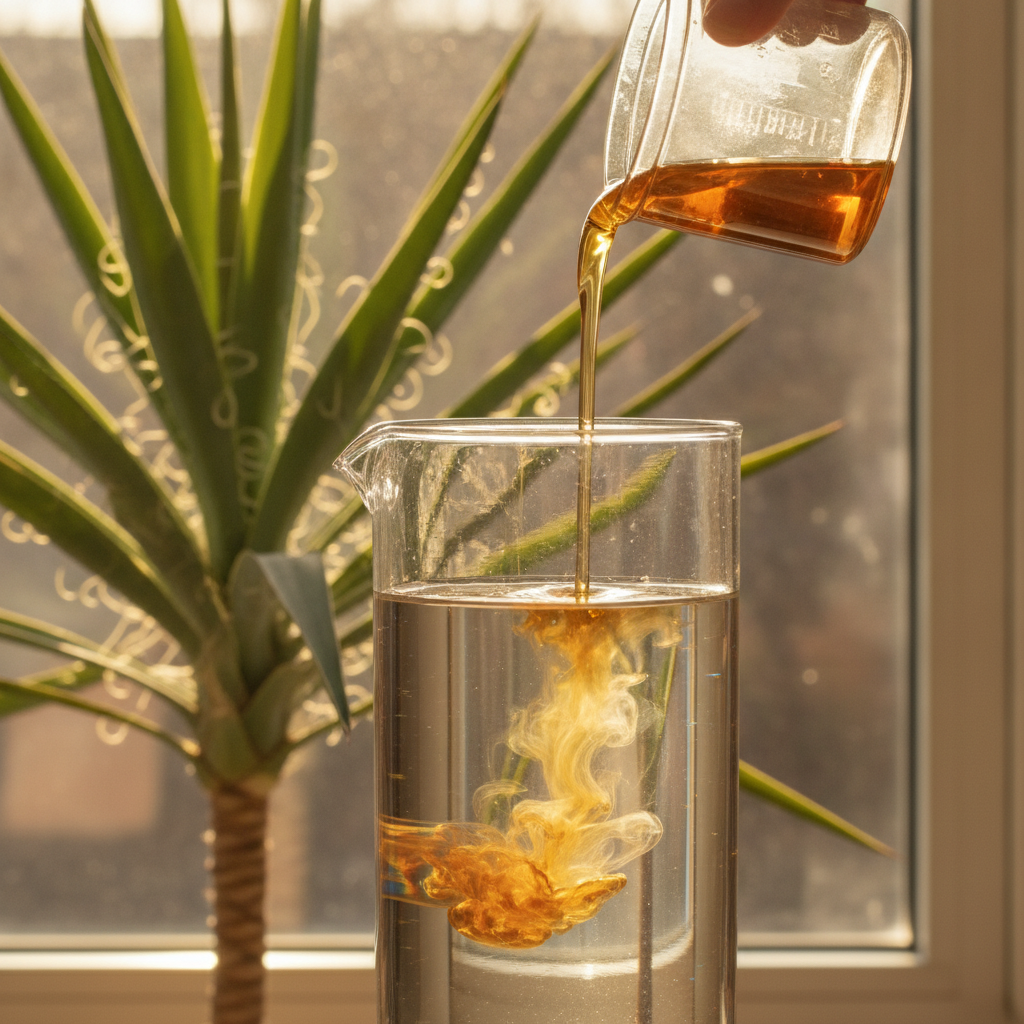
Understanding Plant Nutrients
Fertilisers are labelled with an N-P-K ratio, the percentages of nitrogen, phosphorus and potassium, the three nutrients plants use in the greatest quantity. Alongside these, several secondary nutrients and trace elements keep foliage healthy. For a slow, undemanding plant like Adam’s Needle, a balanced formula at low strength covers everything it needs; the table below explains what each element does and how a shortage shows up.
| Nutrient | Symbol | Primary Function | Deficiency Symptoms |
|---|---|---|---|
| Nitrogen | N | Leaf and stem growth, green colour | Overall pale, yellowing older leaves, slow growth |
| Phosphorus | P | Root development and flowering | Weak roots, poor vigour, dull foliage |
| Potassium | K | Overall health and stress tolerance | Yellow or scorched leaf edges, weak growth |
| Calcium | Ca | Cell wall strength | Distorted or weak new growth |
| Magnesium | Mg | Core of the chlorophyll molecule | Yellowing between the veins of older leaves |
| Iron | Fe | Chlorophyll production | Yellowing between veins on the newest leaves |
Types of Fertiliser
Liquid fertilisers: The easiest to control, which is exactly why they suit a light feeder. Diluted well below the label rate and added to your watering can once or twice a summer, a balanced liquid feed gives you complete command over how much the plant receives.
Slow-release granular: A small dose of coated granules stirred into the mix in spring releases a gentle, steady supply of nutrients across the season. Use a light hand and the low end of any recommended rate, since it is easy to over-apply for such an undemanding plant.
Organic fertilisers: Gentle options such as dilute worm-casting tea or a light top-dressing of worm castings feed slowly and are almost impossible to overdo. They also help sustain soil life, though in a fast-draining mineral mix their effect is mild.
Feeding Schedule
Feed only during the active growing season, from late spring through summer. One or two dilute feeds across those months is genuinely enough, and stopping entirely still leaves you with a healthy plant. Never feed in autumn or winter, when the plant is resting; nutrients it cannot use simply accumulate as salts in the soil. When growth naturally slows as the days shorten, put the fertiliser away until spring.
Pro Tip — Less Is More: With Adam’s Needle it is always safer to underfeed than to overfeed. If you are unsure whether to feed, don’t. A slightly hungry yucca stays compact and healthy, whereas an overfed one grows soft, leggy and far more vulnerable to pests and rot.
How to Fertilise
- Feed only in spring and summer, and never on completely dry soil.
- Water lightly first if the mix is bone dry, so the feed does not scorch the roots.
- Dilute a balanced liquid fertiliser to half the label strength or less.
- Apply to the soil, keeping the solution off the leaves and out of the crown.
- Return to your normal sparing watering routine and do not feed again for several weeks.
Warning — Salt Build-Up: A white crust on the soil or pot rim, or brown, scorched leaf tips, often signals a build-up of fertiliser salts. Flush the pot thoroughly with plenty of plain water, letting it run freely from the drainage holes several times, and ease off feeding until the plant recovers.
Propagation
Adam’s Needle propagates readily, but not in the way many houseplants do. There is no rooting a leaf in a jar of water here; the plant multiplies instead through the offsets, or pups, that sprout around the base of an established rosette, and through sections of its thick roots. Both methods are straightforward and have a high success rate, rewarding a little patience with sturdy new plants that are true copies of the parent.
The best time to propagate is spring or early summer, when the plant is in active growth and cut surfaces heal quickly. Division of offsets is the most reliable route for most growers and doubles as a way to tidy a clump that has become congested, while root cuttings are a useful bonus method when you are already repotting.
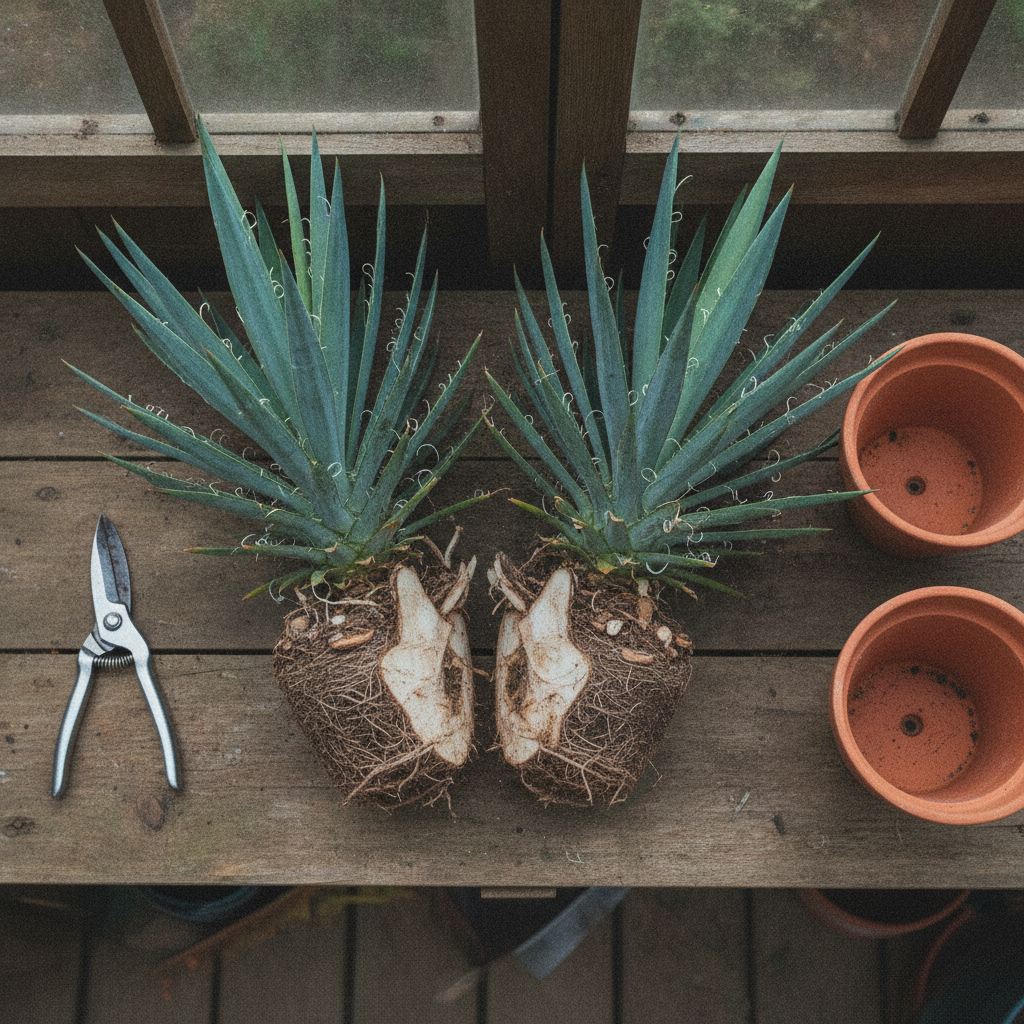
Understanding Offsets and Roots
A mature Adam’s Needle naturally produces offsets, small rosettes that emerge from the base and from spreading underground stems, gradually forming a clump. Each pup develops its own roots while still attached to the parent, which is what makes division so dependable: you are simply separating an already-rooted young plant. The plant’s fleshy roots also carry dormant buds, so a severed root section can generate an entirely new rosette, a quirk that also explains why yuccas can resprout persistently in the garden.
Division of Offsets: Step-by-Step
Division is best done in spring, ideally combined with a routine repot so the parent is disturbed only once. Wear thick gloves throughout to protect against the needle-sharp tips.
- Slide the whole plant out of its pot and gently brush away soil to expose where the offsets join the parent and how each is rooted.
- Choose a well-developed pup that already has its own roots; larger, better-rooted offsets establish far more readily than tiny ones.
- Separate it from the parent with a clean, sharp, sterilised knife, cutting through the connecting stem or root and keeping as many of the pup’s own roots intact as possible.
- Let the cut surfaces on both pup and parent dry and callus for a day or two in a shaded, airy spot to guard against rot.
- Pot the offset into its own small container of gritty, free-draining mix, at the same depth it sat before.
- Keep it in bright light, wait about a week, then begin watering sparingly as the new roots take hold.
Pro Tip — Let It Callus: The single biggest cause of failed yucca divisions is potting a fresh cut straight into moist soil, where it rots before it can root. Always allow the wound to dry and callus for a day or two first, and start the newly potted division on the dry side. Patience at this stage makes all the difference.
Root Cuttings: Step-by-Step
Root cuttings are a handy way to make extra plants from the thick roots you expose during repotting, taking advantage of the dormant buds those roots carry.
- While repotting, select a healthy, firm section of thick root and cut a piece roughly 5 to 10 cm (2 to 4 in) long with a sterilised blade.
- Note which end was nearest the crown; this end sits uppermost when planted.
- Let the cut piece dry and callus for a day or two in a shaded spot.
- Lay or set it just below the surface of a tray of barely moist gritty mix, crown-end up.
- Keep it warm and in bright indirect light, misting the surface only if it dries out completely, and wait; a new rosette can take several weeks to emerge.
- Once a young rosette is growing strongly with its own roots, pot it on into a small container and treat it as a mature plant.
Troubleshooting Propagation
| Problem | Likely Cause | Solution |
|---|---|---|
| Offset rots after separation | Potted while the cut was fresh, or kept too wet | Let cuts callus first and keep the mix on the dry side |
| Division fails to establish | Too few roots taken, or a pup that was too small | Divide only well-rooted, sizeable offsets |
| Root cutting never sprouts | Planted upside down, or the mix stayed too wet or too cold | Keep the crown end up, warm and barely moist |
| New plant sits still for weeks | Normal; yuccas are slow to root and shoot | Be patient, maintain warmth and bright light, avoid overwatering |
Pests & Diseases
Adam’s Needle is one of the more pest-resistant plants you can grow, its tough, fibrous leaves offering little for soft-bodied insects to exploit. Most problems it does encounter are self-inflicted, traceable back to overwatering or poor drainage rather than to any pest. Still, indoor plants in warm, dry, still air can pick up a few familiar culprits, and knowing what to look for lets you deal with them early.
The habit worth cultivating is regular inspection. Every week or two, look over the leaves, particularly the shaded inner rosette and the leaf bases, and check the base of the plant for softness. Caught early, every pest and disease below is manageable; left unnoticed, small problems become entrenched ones.
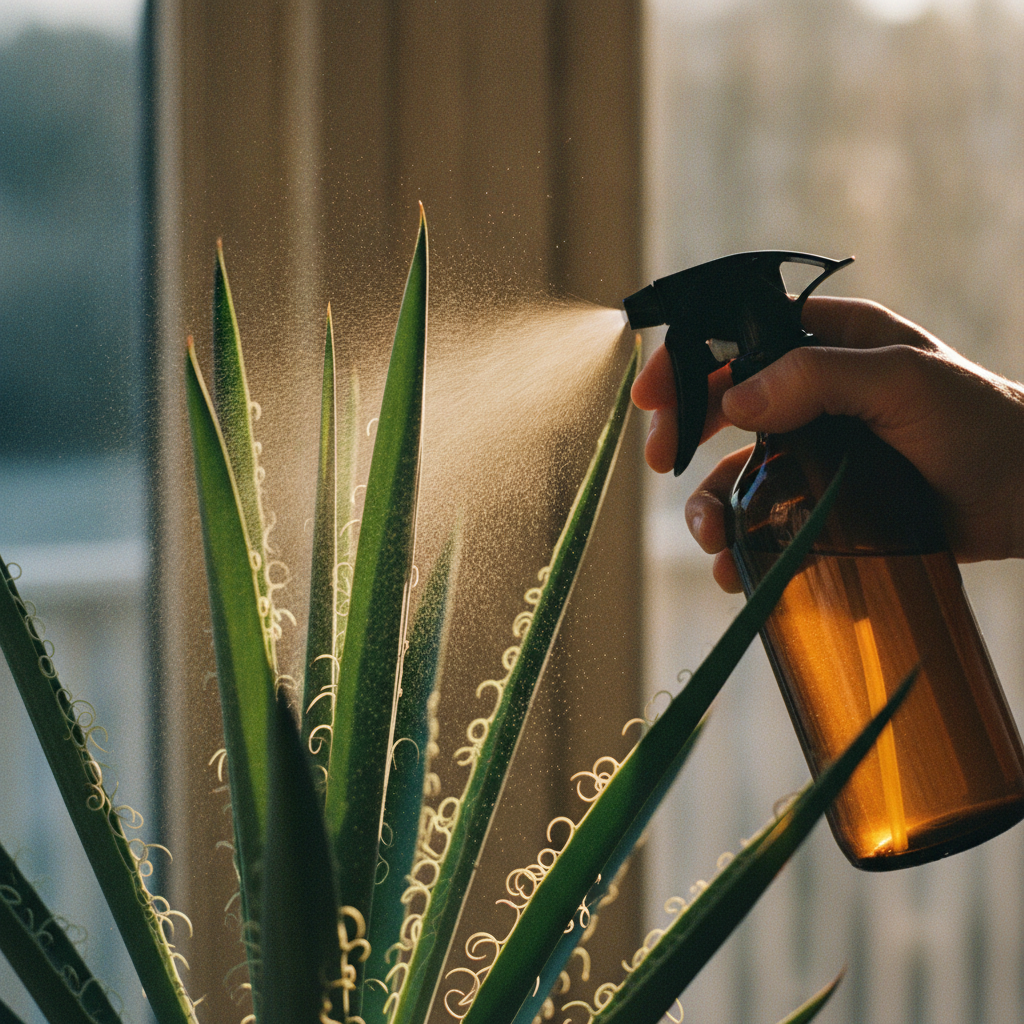
Common Pests
Scale (Coccoidea)
Scale insects are the most likely pest on an indoor yucca, appearing as small, hard, brown or tan bumps clinging to the leaves and leaf bases. They suck sap and excrete sticky honeydew, and their armoured coating makes them stubborn to shift.
Treatment: Scrape off the bumps or dab each one with a cotton bud dipped in surgical spirit, then treat the plant with horticultural or neem oil to catch the mobile juveniles. Repeat every week or two until no new scale appears.
Mealybugs (Pseudococcidae)
Mealybugs show up as small, white, cottony tufts tucked into the crevices where leaves meet the stem. Like scale, they feed on sap, weakening the plant and leaving sticky residue that can turn sooty and black.
Treatment: Touch each insect with a spirit-soaked cotton bud to kill it on contact, then follow up with neem or insecticidal soap sprays. Check the hidden inner rosette carefully, as mealybugs love those sheltered spots.
Spider Mites (Tetranychus urticae)
Spider mites thrive in the warm, dry conditions a yucca otherwise enjoys, so they are an occasional visitor indoors. They are tiny, but their fine webbing between leaves and a faint stippling or dullness on the foliage give them away.
Treatment: Wipe the leaves with a damp cloth to remove mites and webbing, then apply neem oil or insecticidal soap. Improving airflow helps, though avoid raising humidity as a control since that trades one problem for the risk of fungal disease.
Common Diseases
Root and Crown Rot (Pythium and Phytophthora)
By far the most serious threat to Adam’s Needle, rot is caused by soil-borne fungi and water moulds that take hold in waterlogged mix. It shows as a soft, darkening, collapsing base, yellowing leaves and, often, a sour smell, and it can kill a plant before the damage is visible above soil.
Treatment: Act fast. Unpot the plant, cut away all soft and discoloured roots and crown tissue with a sterilised blade, let the wounds dry, and repot into fresh gritty mix. Then keep it dry and bright. Prevention through sparing watering and sharp drainage is far more effective than any cure.
Fungal Leaf Spot (Cercospora and others)
Leaf spot appears as brown or grey blotches, sometimes with yellow haloes, usually where humidity is high, airflow is poor or water has been allowed to sit on the foliage. It is rarely fatal but disfigures the leaves permanently.
Treatment: Remove badly affected leaves, improve air circulation and keep water off the foliage when watering. In stubborn cases a copper-based or general fungicide helps, but cultural fixes usually resolve it.
Pest and Disease Summary
| Pest / Disease | Identification | Treatment |
|---|---|---|
| Scale | Hard brown bumps on leaves and bases, sticky honeydew | Scrape or dab with spirit, then neem oil; repeat |
| Mealybugs | White cottony tufts in leaf crevices | Spirit-soaked cotton bud, then neem or insecticidal soap |
| Spider mites | Fine webbing, stippled dull leaves | Wipe leaves, apply neem or soap, improve airflow |
| Root and crown rot | Soft dark collapsing base, yellowing, sour smell | Cut away rot, repot in dry gritty mix, keep dry |
| Fungal leaf spot | Brown or grey blotches, sometimes yellow-haloed | Remove leaves, improve airflow, keep foliage dry |
Prevention Strategies
Prevention with Adam’s Needle comes down to giving it the sunny, dry, airy conditions it wants. Strong light and a fast-draining mix keep the plant vigorous and its tissues firm, which makes it far less appealing to sap-sucking pests. Sparing watering and good drainage remove the waterlogging that causes almost every serious disease. Between them, these two habits prevent the overwhelming majority of problems before they start.
Add a few simple routines and you cover the rest. Inspect new leaves and leaf bases regularly, wipe dust from the foliage occasionally so pests have nowhere to hide, isolate any newly bought plant for a couple of weeks before it joins your collection, and ensure gentle air movement around the rosette. None of this is demanding, and it keeps an already tough plant essentially trouble-free.
Pro Tip — Neem as Routine: A light neem oil spray every few weeks through the growing season works as a gentle preventative, deterring scale, mealybugs and mites before they establish. Apply it in the evening or out of direct sun so the treated leaves do not scorch, and keep it out of the crown.
Popular Varieties
While the plain green species is handsome in its own right, most of the Adam’s Needle you meet in shops and gardens are selected cultivars, chosen for bold variegation that turns an already architectural plant into a genuine focal point. These variegated forms share the identical easy care of the species, so choosing between them is purely a matter of colour and taste.
Because Yucca filamentosa is such a widely grown hardy plant, its cultivars are readily available and reliably true to type. The table below gathers the best-known selections; the profiles that follow look at the two most popular in more detail.
| Variety | Leaf Appearance | Light Needs | Growth Rate | Availability |
|---|---|---|---|---|
| ‘Color Guard’ | Broad creamy-yellow central stripe, pink flush in cold | Full sun | Slow | Common |
| ‘Bright Edge’ | Green blades with narrow golden-yellow margins | Full sun | Slow | Common |
| ‘Golden Sword’ | Yellow central band bordered with green, reverse of ‘Bright Edge’ | Full sun | Slow | Common |
| ‘Variegata’ | Blue-green leaves edged creamy white | Full sun | Slow | Occasional |
| ‘Ivory Tower’ | Green foliage, selected for upward-facing flowers | Full sun | Slow | Occasional |
| Species (plain green) | Uniform blue-green with white marginal threads | Full sun | Slow | Common |
Featured Varieties
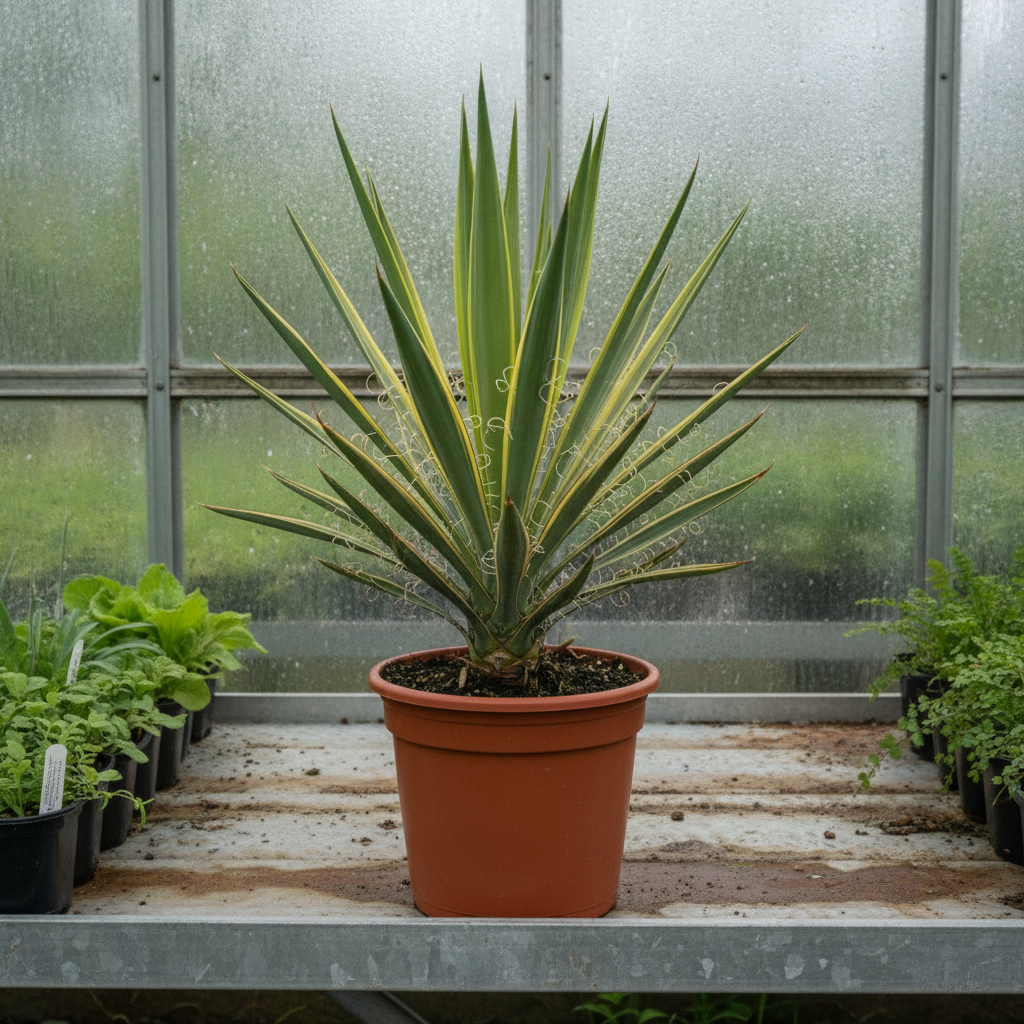
‘Color Guard’
The most popular selection, with each leaf carrying a broad creamy-yellow central stripe framed by deep green. In cold weather the margins flush rose-pink and coral, giving the plant a second season of interest.
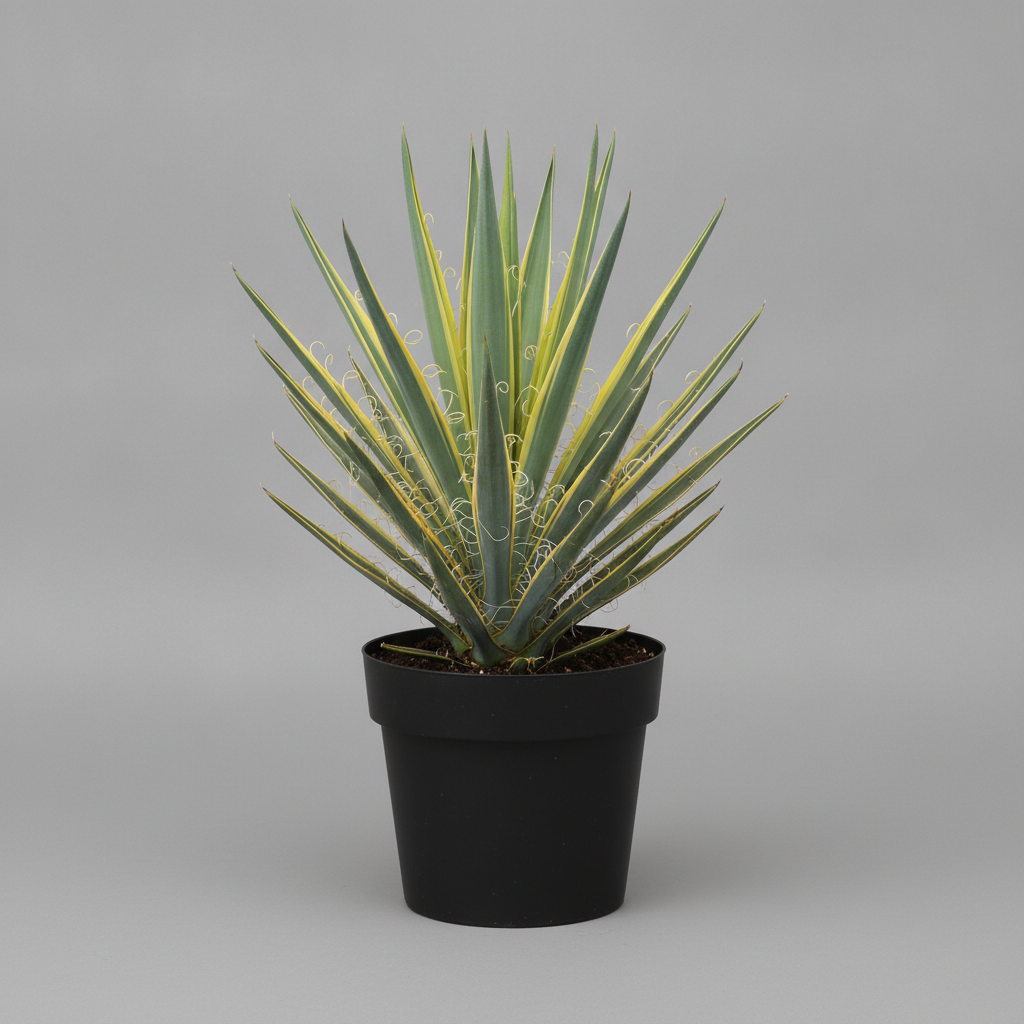
‘Bright Edge’
A mirror image of the central-striped forms, with blue-green blades neatly edged in narrow bright golden-yellow margins. The clean banding and the usual curling white filaments make it a crisp, tidy choice.
Variety Profiles in Detail
‘Color Guard’ (Yucca filamentosa ‘Color Guard’)
‘Color Guard’ is the benchmark variegated Adam’s Needle and the one most likely to be on a garden centre bench. Its wide, buttery central stripe glows in strong light, and the cold-season pink and coral tinting of the outer leaves gives it a changing palette few evergreens can match. Like all these forms it wants full sun to hold its colour; in shade the yellow fades toward green and the effect is lost. It makes an outstanding container specimen where its bright rosette can be shown off.
‘Bright Edge’ (Yucca filamentosa ‘Bright Edge’)
‘Bright Edge’ reverses the pattern, placing the gold at the leaf margins rather than the centre, which gives the rosette a fine, precise outline. It tends to stay slightly more compact and is prized for its neat, uniform look. Its care is identical to ‘Color Guard’ and the species: full sun, sharp drainage and minimal water. Grown side by side, the two make a satisfying pair, one glowing from the centre out, the other framed at the edges.
Choosing the Right Variety for Your Space
Since every variety shares the same care and slow, tidy habit, choose on looks and light. All of them need full sun to look their best, so match your brightest spot to whichever colour scheme appeals: the warm glow of a central gold stripe in ‘Color Guard’ or ‘Golden Sword’, the crisp outline of ‘Bright Edge’, the cool contrast of white-edged ‘Variegata’, or the understated architecture of the plain green species. Whichever you pick, you are getting the same tough, sculptural, sun-loving plant, and the same reassuringly short list of care instructions.
Frequently Asked Questions
Why are the lower leaves of my Adam’s Needle turning yellow and dying?
A few of the oldest, lowest leaves slowly yellowing and drying is completely normal, the plant shedding spent foliage as it grows. If yellowing is widespread, spreads upward and comes with soft leaf bases or a sour-smelling, permanently wet mix, suspect overwatering and root rot instead. Check the roots and let the soil dry out fully before watering again.
Can Adam’s Needle grow indoors as a permanent houseplant?
Yes, provided you can give it very bright light. A south-facing window is close to essential; in anything dimmer the plant slowly stretches and weakens. Many growers keep it indoors year-round successfully, and it benefits enormously from a summer spent outdoors in full sun, which keeps the rosette tight and vigorous.
How often should I water my Adam’s Needle?
Only when the mix has dried out completely, which in a bright summer position is roughly every two to three weeks, and in winter perhaps monthly or less. Rather than following a schedule, check the soil by weight or by probing deep into the pot, and always err on the side of leaving it dry.
Is Adam’s Needle poisonous to cats and dogs?
It is mildly toxic. The leaves and roots contain saponins that can cause drooling, vomiting or diarrhoea if a pet chews them. On top of the chemical risk, the sharp, rigid leaf tips can cause physical injury. Keep the plant out of reach of pets and children, and site it away from busy walkways.
Will my indoor Adam’s Needle flower?
Indoors it is uncommon. In the ground a mature plant sends up a tall spike of creamy-white bell-shaped flowers in summer, but flowering usually needs the strong light, cool winter rest and root room that pots and interiors rarely provide. Grown as a houseplant, treat Adam’s Needle as a foliage plant and regard any bloom as a bonus.
Why are the tips of my Adam’s Needle turning brown?
Brown tips usually point to a build-up of fertiliser salts, prolonged underwatering, or occasionally sun scorch on a plant not yet acclimatised to strong light. Flush the pot thoroughly with plain water to clear excess salts, review your watering, and acclimatise the plant gradually if you have just moved it into brighter conditions.
Can I cut off the sharp leaf tips?
Yes. Trimming the needle-sharp tips with clean scissors is a common and harmless way to make the plant safer around children and in high-traffic spots. Snip only the very point of each leaf; the plant is unbothered, and the change is barely noticeable from a short distance.
How big does Adam’s Needle get in a pot?
In a container the foliage rosette typically reaches around 60 to 90 cm (2 to 3 ft) across and tall, growing slowly and staying manageable for years. A restrained pot size and its naturally leisurely pace keep it in scale with most rooms, and any summer flower spike, though much taller, appears only on mature plants and is short-lived.






