
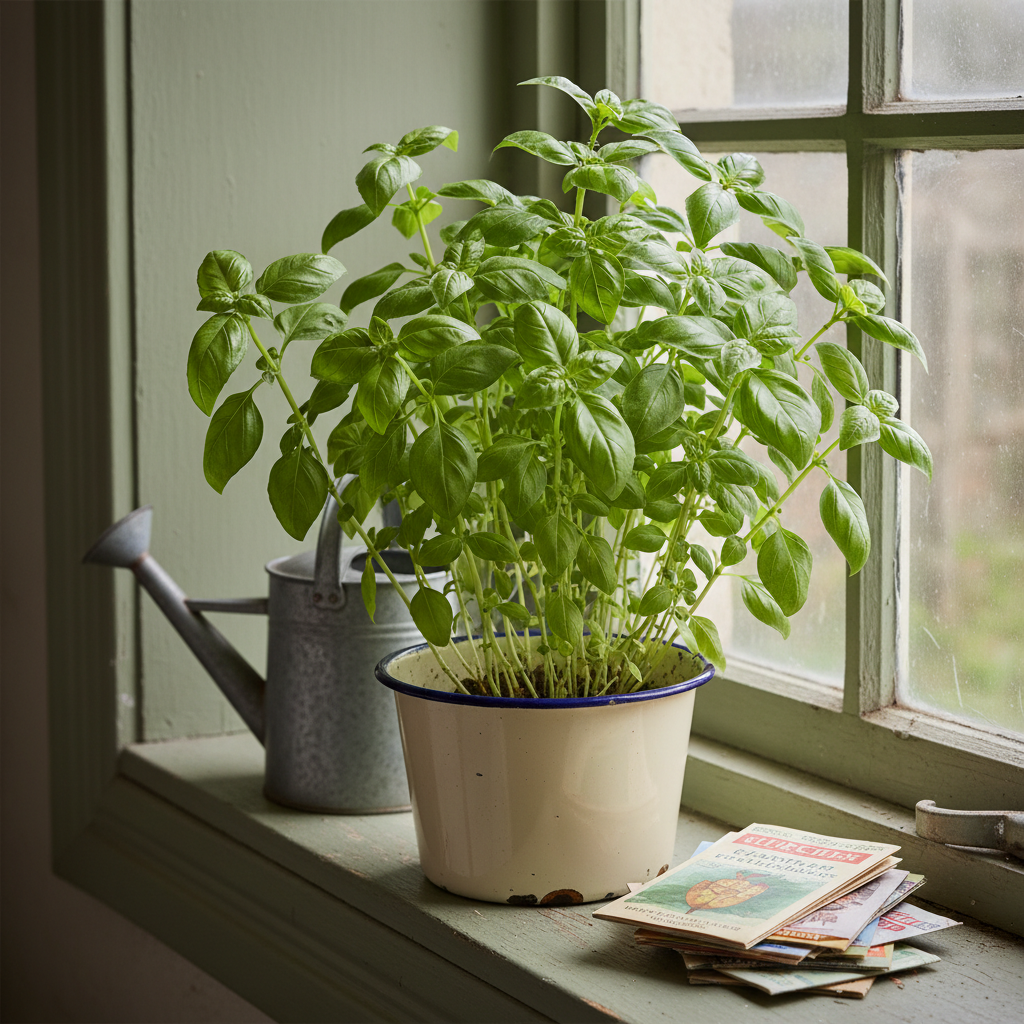
Few culinary herbs are as universally loved, or as universally murdered on the kitchen windowsill, as basil. Ocimum basilicum is a tender annual in the mint family (Lamiaceae), native to a broad sweep of tropical Asia and Africa where it has been cultivated for at least three thousand years. Sometimes called sweet basil, common basil or, in older British seed catalogues, simply garden basil, the plant carries one of the most distinctive aromas in the herb world — a warm, sweet, clove-pepper scent that rises from the leaves at the lightest touch. It is the foundation of Italian pesto, Thai krapao, Vietnamese pho garnishes and a long list of Mediterranean tomato dishes, and unlike many culinary herbs it is grown almost entirely for its leaves rather than its flowers or seeds.
Supermarkets sell basil as a houseplant, but the pots that arrive home in cellophane sleeves are typically not one plant at all. They are a dense cluster of seedlings raised on hydroponic rafts and pushed into commerce before any one of them has built a serious root system. That is why so many gardeners conclude that basil is fussy, when in fact the issue is almost always cultural. Given enough light, a decent root run and water timed to soil moisture rather than the calendar, basil is one of the most generous plants you can grow. This guide separates the bare survival approach (a plant that limps along for a few weeks) from a thriving approach (a bushy, repeatedly harvested plant that lasts an entire growing season indoors). It covers the underlying biology, the practical care decisions, propagation from cuttings and seed, the pests and diseases that actually matter, and a survey of the varieties worth seeking out.
Contents
- Quick Reference
- Why Basil Makes a Rewarding Houseplant
- Light Requirements
- Watering and Humidity
- Soil, Potting and Repotting
- Fertilising
- Propagation
- Pests and Diseases
- Popular Varieties
- Frequently Asked Questions
Quick Reference: Basil at a Glance
| Botanical name | Ocimum basilicum |
| Common names | Basil, sweet basil, common basil, Genovese basil |
| Family | Lamiaceae (mint family) |
| Light | Bright direct light, minimum 6 hours per day. South or west-facing window indoors. |
| Watering | Keep evenly moist but never waterlogged. Water when the top centimetre of soil has just begun to dry. |
| Temperature | 18 to 27 degrees Celsius (65 to 80 Fahrenheit). Avoid anything below 10 degrees Celsius (50 Fahrenheit). |
| Humidity | 40 to 60 per cent. Tolerates average household humidity well. |
| Fertiliser | Balanced liquid feed at half strength every 2 to 3 weeks during active growth. |
| Soil | Loose, fertile, free-draining loam-based mix. Slightly acidic to neutral, pH 6.0 to 7.0. |
| Pot size | Minimum 15 to 20 cm (6 to 8 inches) wide and deep for a single mature plant. |
| Mature size indoors | 30 to 60 cm (12 to 24 inches) tall, depending on variety and pruning. |
| Lifespan | Annual. Lives one growing season outdoors, can be kept productive 6 to 9 months indoors. |
| Toxicity | Non-toxic to humans, dogs and cats in culinary quantities. Essential oils may irritate sensitive pets in very large amounts. |
Why Basil Makes a Rewarding Houseplant
The case for growing basil indoors comes down to four things: the sheer usefulness of fresh leaves in cooking, the speed of growth, the responsiveness of the plant to good care, and the disproportionate sensory reward for a small footprint on the windowsill. A single healthy plant in a 20 cm pot can provide a steady supply of leaves for pasta, salads, sandwiches and infusions through an entire summer and well into autumn. Supermarket bunches wilt within a day or two, while a living plant gives you fragrance, freshness and the option to harvest a single leaf or a handful as you need it.
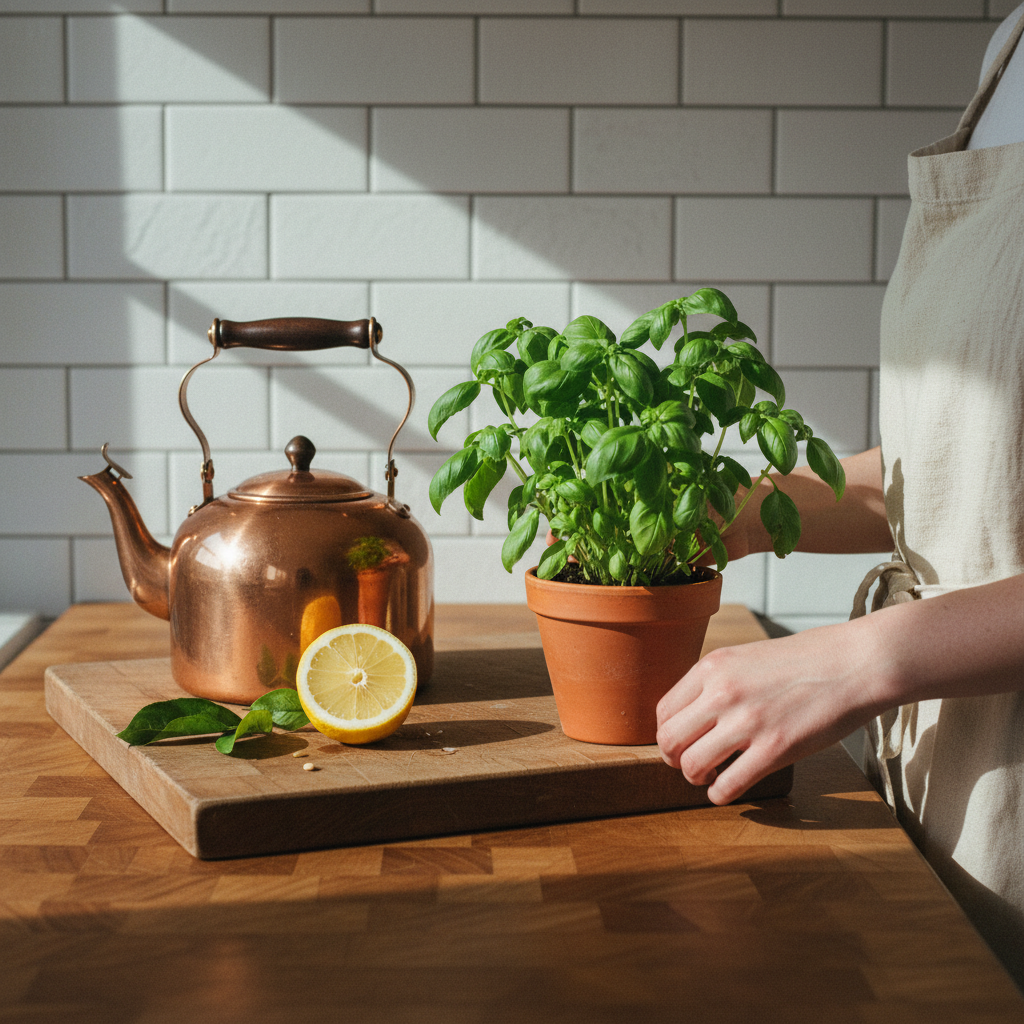
Basil also rewards beginners more honestly than many ornamental houseplants. A pothos or a snake plant can coast on stored reserves for weeks, masking poor light or sporadic watering until it suddenly collapses. Basil tells you quickly. Leaves cup, droop or yellow within a day or two when something is off, which makes it an excellent teaching plant: the feedback loop between mistake and visible consequence is short enough that you actually learn from it. Get the basics right and the plant pushes new growth almost continuously, branching at every pinch and producing a rounded bushy shape that is as attractive as any flowering houseplant.
The aromatic compounds in the leaves, principally linalool, eugenol and methyl chavicol, are released even by passing brush against the foliage. This means basil contributes to the air in a way most houseplants do not. A pot on the kitchen counter quietly perfumes the room every time a cupboard is opened or a tea towel brushes past, which on a dull winter afternoon is an unreasonably effective mood improver for the space a small terracotta pot occupies.
Important — Toxicity: Basil is safe for humans and is widely listed as non-toxic to dogs and cats by veterinary references including the ASPCA. The essential oils in the leaves are concentrated, however, and very large quantities or pure oil extracts can irritate a small animal’s digestive tract. As a culinary herb on the windowsill, no special precautions are needed.
Light Requirements
Light is the single biggest reason indoor basil fails. The plant evolved in the open sun of tropical Asia and Africa, and although it tolerates a few hours of shade, it expects strong direct light for the majority of the day. In a windowsill setting that translates to roughly six hours of unfiltered sun, or a long stretch of very bright indirect light supplemented by an hour or two of direct sun. Anything dimmer produces the familiar sad supermarket basil look: thin pale stems stretched towards the glass, large floppy leaves, internodes lengthening and the plant unable to recover from harvest.
Indoors, the ideal position from autumn through early spring is the sunniest window in the house, usually south or south-west facing in the Northern Hemisphere. From late spring through early autumn the same window may be too hot at midday, and east or west exposures with several hours of direct morning or afternoon sun work better. Outdoors during the warm months, the plant happily takes full sun in temperate climates so long as soil moisture is maintained. In hot Mediterranean or continental summers, light afternoon shade prevents leaf scorch.
Light Levels Explained
Houseplant guides toss around terms like “bright indirect” and “medium light” as if they were universally understood. They are not. The table below converts those categories into approximate illuminance in lux, a typical placement in the home, and what each level actually means for a basil plant.
| Light Category | Approx. Level | Typical Location | Outcome for Basil |
|---|---|---|---|
| Direct sun | 30,000 to 80,000 lux | Right against an unobstructed south or west window | Excellent in cool months. May scorch leaves in peak summer behind glass. |
| Bright direct | 10,000 to 30,000 lux | Within 30 cm of a south or west window | Ideal. Compact growth, dense foliage, strong flavour. |
| Bright indirect | 5,000 to 10,000 lux | 1 to 2 metres back from a sunny window, or against a north window | Plant survives but stretches. Harvests become slow. |
| Medium | 1,000 to 5,000 lux | Deeper in a room with one window | Slow decline. Leaves thin, internodes long, eventual collapse. |
| Low | Below 1,000 lux | Hallways, interior rooms, far from any window | Not viable. Move to a brighter spot or add artificial light. |
Window Orientation and Placement
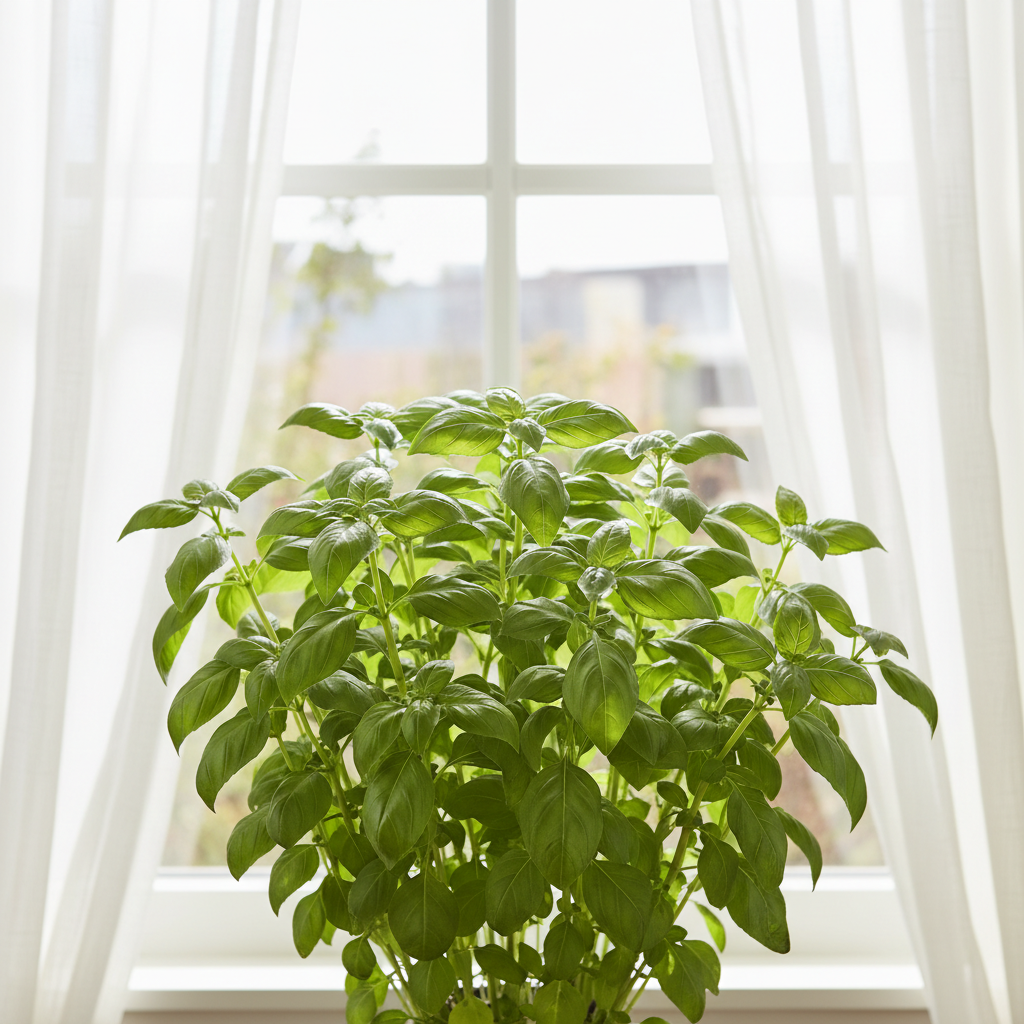
South-facing window: the best choice for most of the year in northern latitudes. From October to March the sun is low enough that even midday rays are gentle, and basil placed within 30 cm of the glass behaves exactly as it would in a sunny garden bed. In summer, when the sun rises high, the same window can deliver more heat than the plant wants. Move the pot back 50 to 80 cm, or use a sheer curtain to diffuse midday rays.
East-facing window: a strong second choice, especially in summer. Bright cool morning light up to about 11 a.m. encourages compact growth without the heat stress of west-facing sun. Production may slow in midwinter when the morning sun arrives weak and brief.
West-facing window: good in spring, autumn and cooler summers, often too intense in heatwaves because afternoon light carries the accumulated heat of the day. Watch for wilting in the hours either side of sundown and step the pot back if the leaves feel hot to the touch.
North-facing window: rarely sufficient on its own. Basil can be kept alive on a north windowsill in midsummer at higher latitudes but will rarely thrive. If north exposure is all that is available, plan to supplement with a grow light.
Pro Tip — Read the Plant, Not the Calendar: the practical test is leaf size relative to internode length. If the spaces between leaf pairs are roughly equal to the leaf length, the plant is getting enough light. If the gaps are noticeably longer than the leaves, the plant is reaching for more light and the position is too dim.
How Light Affects Flavour and Form
Light affects basil more profoundly than most kitchen herbs because the volatile oils that give it flavour are produced in glandular trichomes on the leaf surface, and those trichomes form most densely on plants grown in strong sun. A plant raised under generous light tastes sharper, sweeter and more recognisably of itself. The same variety raised under marginal light tastes flat and grassy, even when the leaves are technically green and healthy. This is why supermarket basil, pulled out of a high-light greenhouse and rushed onto a shaded shelf for a week of dim transit, often tastes less interesting than a leaf from a homegrown plant of the same cultivar.
Form responds in parallel. Strong light keeps the plant compact, with short internodes and dense lateral branching. Weak light produces tall, leggy growth with widely spaced leaves and a tendency to flop. Variegated and purple cultivars are especially light-hungry: the pigment patterns that make varieties such as Dark Opal or Wild Magic visually striking depend on sun-driven anthocyanin production, and those plants fade to a muddy green-purple in poor light.
Warning — Direct Sunlight: basil under glass in midsummer can experience leaf temperatures noticeably higher than air temperature, especially at south or west exposures. Symptoms include cupped, leathery upper leaves and pale tan scorch patches on the surfaces most directly facing the window. The fix is not less light overall, but a sheer curtain or a step back from the glass during the hottest hours.
Artificial Lighting
Where natural light is inadequate, basil responds remarkably well to artificial lighting. A modern full-spectrum LED grow light, hung 25 to 40 cm above the canopy and run for 12 to 14 hours per day, can produce growth essentially indistinguishable from a sunny windowsill. The plant cares little about the specific colour temperature: cool white, warm white and “blurple” grow lights all work as long as the photosynthetic photon flux density at the canopy is high enough — roughly 200 to 400 micromoles per square metre per second is the sensible target. Cheap clip-on LEDs from general retailers are often underpowered for fruiting vegetables, but for a single basil plant they are usually sufficient.
Seasonal Adjustments
Basil is a true annual that responds strongly to day length. In the Northern Hemisphere, growth slows from late September as the photoperiod drops below 12 hours, and the plant will begin to set flower buds aggressively as a survival reflex. Pinching out those buds redirects energy back into leaves and extends the productive window into late autumn. Beyond mid-November, even a healthy plant under a sunny window may simply stop pushing new leaves until early February, when lengthening days resume growth. Indoor growers who want continuous harvest through the dark months will benefit from supplementary light from October to March.
Watering and Humidity
Basil is widely described as thirsty, and in active growth that is broadly accurate, but the more useful framing is that basil hates extremes. The plant evolved in monsoon climates where rain alternates with brief dry spells, and the roots are adapted to soil that is consistently damp without ever being saturated. A pot that swings between bone-dry and waterlogged is a near-certain death sentence, and so is a pot that sits in a saucer of stagnant water for days. The right rhythm is small, frequent waterings that keep the rootball evenly moist, with brief surface drying between drinks.
When to Water
The most reliable signal is the top centimetre of soil. Press a finger into the surface: if it comes away with a faint cool dampness clinging to the skin, the plant is fine and another day of drying will not hurt. If it comes away dry and slightly dusty, water now. A plant in a 15 cm terracotta pot on a sunny windowsill in midsummer may need water every morning. The same plant in a 20 cm plastic pot in a cooler kitchen in October might go four or five days between waterings. Calendar-based rules fail because the variables move faster than the calendar does.
Leaf cues are the secondary signal. A mildly thirsty basil plant will hold its leaves slightly downward and lose some of the perky horizontal stance of well-watered foliage. By the time the leaves are noticeably drooping, the plant is already stressed, although a thorough soak usually restores it within an hour. The aim is to water just before the plant reaches that visible droop, not after. Repeated drooping events accumulate damage even when the plant recovers cosmetically, and persistent under-watering ultimately triggers early flowering.
Pro Tip — Weigh the Pot: after a thorough watering, lift the pot and remember the weight. A few days later, lift it again. The difference between sodden and ready-to-water is unmistakable once you have felt it half a dozen times, and pot weight is far more reliable than surface appearance because it integrates the moisture state of the entire rootball.
How to Water Correctly
- Water at the base of the plant, not from overhead. Wet foliage that does not dry by evening is the single biggest invitation to fungal disease in basil.
- Use room-temperature water. Cold water from the tap can shock the roots and slow growth, particularly in winter.
- Water until you see flow from the drainage holes, then stop. This wets the entire rootball without leaving the lower roots starved.
- Empty the saucer after about 15 minutes. Roots left standing in pooled water suffocate within 24 to 48 hours, and basil is one of the quicker plants to develop root rot under those conditions.
- Water in the morning whenever possible. The plant can use the moisture through the day, and any incidental splashes on leaves dry before nightfall.
- Avoid the habit of giving small “top-ups” every day, where the surface looks damp but the lower rootball stays dry. This creates a starved bottom layer of roots that fails the first time you go away for the weekend.
Signs of Overwatering vs. Underwatering
| Symptom | Overwatering | Underwatering |
|---|---|---|
| Leaf colour | Lower leaves yellowing uniformly | Lower leaves dry and crisp at the edges, still green centrally |
| Leaf texture | Soft, limp, sometimes translucent | Stiff, papery, cupped or curled |
| Soil surface | Persistently dark, sometimes mossy or sour-smelling | Pale, cracked, pulling away from the pot wall |
| Stem base | Blackened or soft at the soil line | Firm and dry but may show splitting at the base |
| Root condition | Brown, mushy, foul-smelling roots | Pale, brittle, sparse roots |
| Recovery after watering | None or worsens | Visible perking-up within an hour |
Warning — Root Rot: basil moves from healthy to terminal root rot faster than most houseplants — sometimes within 48 hours of being left in a saucer of water. The first sign is usually a sudden wilt that does not recover after watering, paired with a sour smell from the soil. If you spot it early, unpot the plant, cut away any blackened roots, repot in fresh dry mix and withhold water for two days. After that, the plant is more often gone than saved, which is why prevention through drainage and emptied saucers matters so much.
Humidity Requirements
Basil is comfortable across a wide humidity band, from roughly 40 to 70 per cent relative humidity, which covers the conditions in most kitchens and living rooms year-round. Unlike the truly humidity-dependent tropicals (calatheas, ferns, alocasias), it does not need a humidifier or pebble tray to thrive. The leaves are robust enough to tolerate the dry air of a heated home in winter, provided watering is kept consistent.
The exceptions are kitchens with persistently high humidity (steam from cooking that lingers for hours) and bathrooms with poor ventilation. In those environments, the still moist air encourages fungal pathogens on basil foliage, particularly downy mildew. A plant grown above a frequently used hob with no overhead extraction will often show grey fuzzy patches on the leaf undersides within weeks, even when watering is correct. Position basil near the window of a humid room rather than directly above the source of moisture.
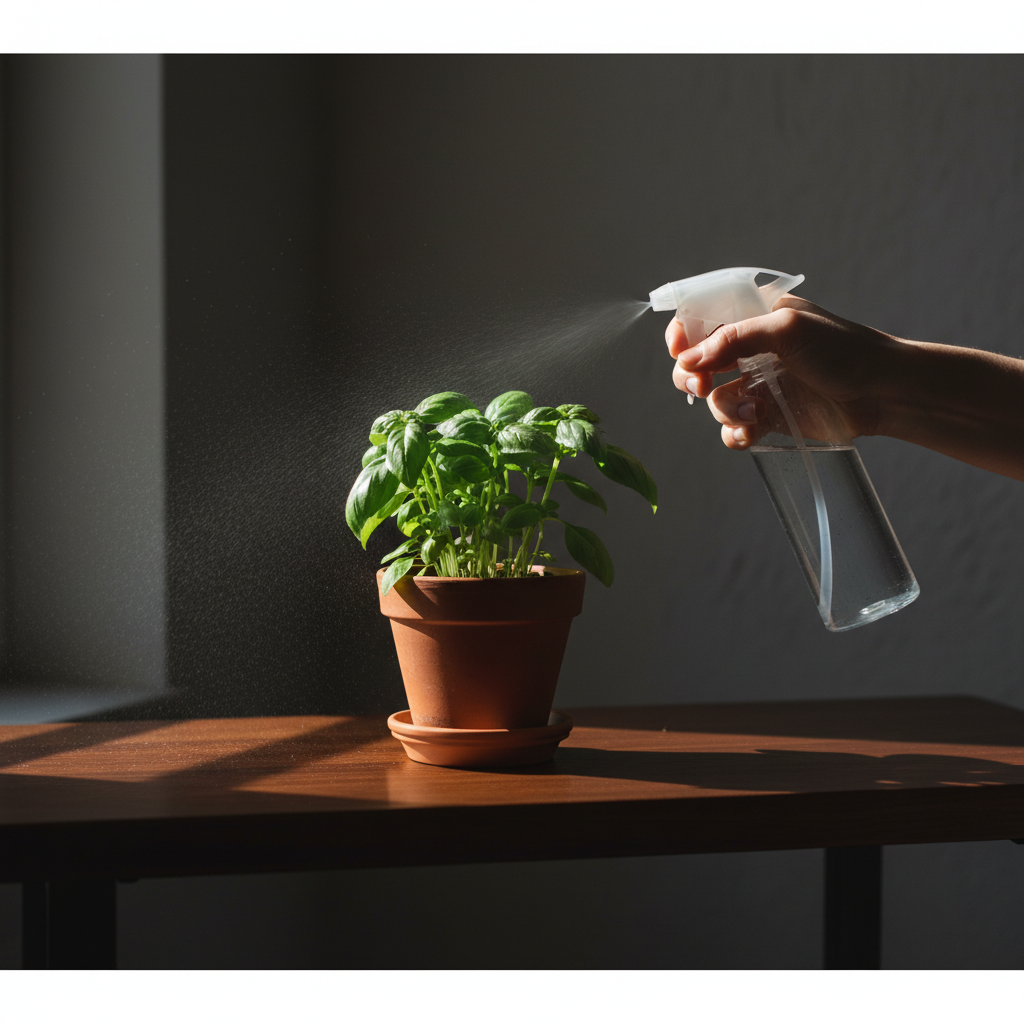
If you suspect humidity is too low, the symptoms are subtle: leaves slightly cupped upward, fine browning along the leaf margin, and a faster watering schedule than the light level alone would predict. Grouping plants together raises local humidity by 5 to 10 per cent through transpiration, which is usually enough. Misting is largely cosmetic in the basil context, with one exception: a quick morning mist before sunrise can help a plant that has visibly shrivelled overnight in a very dry winter room, but it should never be a routine substitute for sensible watering.
Water Quality
Basil is undemanding about water chemistry. Ordinary tap water is fine in almost every region; the plant tolerates moderately hard water, chlorinated mains water and the modest mineral content of most municipal supplies without complaint. Two situations call for an alternative. The first is heavily softened water, which carries elevated sodium and can build up to phytotoxic levels in repeated waterings; if your house is on a salt-cycle softener, draw water from an outside tap or use rainwater. The second is areas with very chloraminated water; chloramines do not dissipate by sitting open as chlorine does, and while basil tolerates them, sensitive growers may prefer filtered water for prized cultivars. Rainwater is excellent and gentle.
Soil, Potting and Repotting
The soil under a basil plant is doing three things at once: holding enough water that the roots are never thirsty between drinks, draining quickly enough that they never sit in saturated mud, and providing the steady mineral nutrition that aromatic herbs need to keep producing new leaves. Cheap supermarket multipurpose composts can struggle on the first two of those points, going from bone-dry to peat-bog and back without ever holding the middle ground. A well-chosen mix makes the difference between a plant that needs daily attention and one that forgives the occasional missed morning.
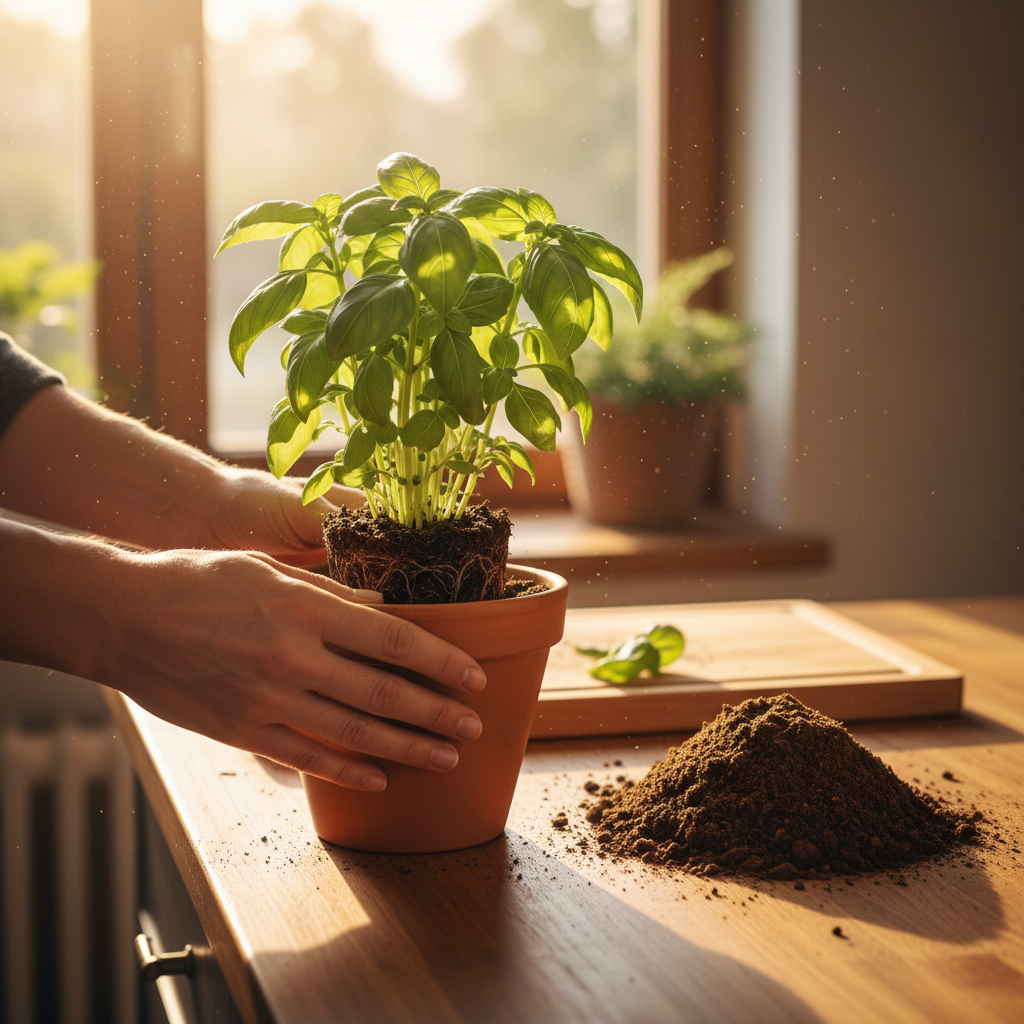
Ideal Soil Composition
The target for basil is a loose, fertile, free-draining mix on a loam-based foundation. Pure peat-based composts dry unevenly and rewet poorly once they have crusted over, both of which favour the wet-dry swings basil dislikes. A loam component, even a relatively small one, adds mineral weight, holds nutrients between waterings and buffers temperature swings at the root. Coir-based composts perform similarly well when amended with grit and a slow-release fertiliser. Whatever the base, plenty of perlite or coarse sand keeps the structure open and the drainage rate high.
| Component | Proportion | Function |
|---|---|---|
| Quality multipurpose or loam-based compost (e.g. John Innes No. 2) | 60 per cent | Bulk nutrition, moisture retention, root anchorage |
| Coir or peat-free fines | 15 per cent | Holds moisture without packing down |
| Perlite or sharp horticultural sand | 20 per cent | Maintains air spaces and rapid drainage |
| Worm castings or fine compost | 5 per cent | Slow-release nutrition and beneficial microbiology |
The chemistry matters too. Basil is happiest in soil that runs mildly acidic to neutral, pH 6.0 to 7.0. Below pH 5.5 the plant struggles to take up calcium and magnesium efficiently and may show interveinal chlorosis on the upper leaves. Above pH 7.5 phosphorus and iron become less available, and growth slows. Most commercial composts arrive in the right band straight out of the bag, so testing is rarely necessary unless you are reusing soil from another project or seeing unexplained nutrient symptoms.
Pro Tip — Quick Mix Recipe: for a single 20 cm pot, blend roughly four large handfuls of good peat-free multipurpose compost with one large handful of perlite and a generous pinch of worm castings. Mix in a bucket until uniform. The result is rough, gritty, fragrant, and well within the range basil grows happily in.
Choosing the Right Pot
Pot choice for basil is a balance between root volume, evaporation rate and weight on the windowsill. The plant produces a surprisingly extensive root system for its modest above-ground size, and a cramped pot is one of the most common reasons indoor basil tops out at half its potential. The minimum sensible pot for a single plant is 15 cm across; 20 cm produces a noticeably larger, more productive plant and buys you longer between waterings.
Drainage holes are non-negotiable. A pot without holes turns a routine watering into a slow flood, and basil dies in waterlogged soil faster than almost any other windowsill herb. If you love a particular cachepot that has no drainage, use it as a sleeve around an inner plastic pot and remove the inner pot to water in the sink.
Pot material: terracotta breathes, dries quickly and is forgiving of the over-attentive waterer; the porous walls let excess moisture escape laterally as well as through the holes. Glazed ceramic and plastic hold moisture longer and suit infrequent waterers, but they punish the heavy-handed. In a south-facing window in midsummer, a terracotta pot can dry out in a single day; in the same window in winter, a plastic pot may stay too damp. Switching pot material seasonally is overkill, but worth knowing when you choose.
Pot size: a too-large pot is almost as bad as a too-small one, because the unoccupied volume of damp soil takes longer to dry than the roots can use it. The right size is one in which the rootball plus 3 to 5 cm of fresh mix all the way around comfortably fits. Step up gradually as the plant grows rather than potting a small seedling into a 25 cm pot from the start.
When to Repot
A purchased supermarket basil should be repotted within a few days of coming home, both because the original pot is too crowded and because the rootball is usually a sodden mass of peat that drains poorly. Subsequent repotting depends on growth rate; a plant in a 15 cm pot in active growth may benefit from a step up to 20 cm midway through the season. Signs that repotting is overdue include water running straight through the pot without wetting the soil, roots circling visibly at the surface, and a slowing of new leaf production despite good light and feeding. Late spring or early summer is the ideal timing in temperate climates, as the plant has the energy to recover quickly.
How to Repot: Step-by-Step
- Water the plant lightly the day before. Damp roots are easier to manage than dry ones and less likely to break.
- Prepare the new pot with a 2 to 3 cm layer of fresh mix at the bottom, enough to lift the root ball so the top sits about 1 cm below the rim.
- Tip the plant out by inverting the existing pot and supporting the base of the stem between two fingers. Tap the rim gently if it sticks.
- If the supermarket pot contained multiple seedlings, gently tease the rootball apart and select the strongest two or three; pot them as a small clump rather than a dozen weak competitors.
- Loosen any tightly wound roots around the outside of the ball with your fingertips. Cut away any black or mushy roots with clean scissors.
- Centre the plant in the new pot and backfill with fresh mix, firming gently around the sides with your fingers. Avoid burying the stem deeper than it grew originally.
- Water thoroughly until drainage runs from the holes, then place the plant back in its usual position. Hold off on fertiliser for two weeks while the roots settle in.
Warning — Transplant Shock: basil tolerates repotting better than many herbs, but it dislikes deep root disturbance. Expect a brief pause of three to five days during which the plant looks slightly limp and may drop a few lower leaves. Resist the urge to water again on day two if the soil is still damp; the plant is regrowing fine root hairs and over-watering at this stage accelerates rot rather than recovery.
Fertilising
Basil is a fast-growing leafy herb that needs steady but moderate nutrition. Overfeeding produces large, soft, watery leaves with diminished aromatic compounds, the horticultural equivalent of overfed lettuce: lots of volume, less flavour. Underfeeding produces small pale leaves, slow regrowth after harvest and premature flowering. The balance point is closer to underfeeding than most beginners assume.
A useful mental model is that container-grown basil exhausts its starting soil nutrition in roughly six to eight weeks of active growth. After that, anything the plant takes up has to come from the watering can or from incorporated slow-release fertiliser. A new pot of fresh compost in late spring usually does not need supplementary feeding until midsummer; from midsummer onwards, light feeding becomes the difference between a stalling plant and a continuously productive one.
Understanding Plant Nutrients
Plant fertilisers are described by their NPK ratio: the relative percentages of nitrogen (N), phosphorus (P) and potassium (K). For a leaf-producing herb like basil, nitrogen is the dominant requirement, with potassium a clear second for overall plant health and phosphorus a quieter third. A balanced general-purpose liquid feed such as 7-7-7 or 10-10-10 works well; a tomato food with a high potassium bias is unnecessarily skewed for basil and may push the plant towards flowering faster.
| Nutrient | Symbol | Primary Function | Deficiency Symptoms |
|---|---|---|---|
| Nitrogen | N | Leaf growth, chlorophyll, protein synthesis | Uniform pale yellowing of older leaves, slow growth |
| Phosphorus | P | Root development, energy transfer, flowering | Stunted growth, purple tint on undersides of older leaves |
| Potassium | K | Overall vigour, water regulation, disease resistance | Brown leaf margins, weak stems, susceptibility to wilt |
| Calcium | Ca | Cell wall structure, new growth integrity | Distorted or stunted young leaves, leaf-tip browning |
| Magnesium | Mg | Central atom in chlorophyll | Interveinal yellowing on older leaves while veins stay green |
| Iron | Fe | Chlorophyll synthesis | Interveinal yellowing on the newest, youngest leaves |
Types of Fertiliser
Liquid fertilisers: the simplest and most precise option. A balanced liquid feed at half the manufacturer’s recommended strength, applied every two to three weeks during active growth, is enough for almost any indoor basil. The half-strength rule reflects the small soil volume of a pot compared with garden soil and matters more than the specific brand.
Slow-release granular: mixed into the potting mix at planting or scattered on the surface as a top dressing, slow-release pellets feed gradually over three to six months. This suits gardeners who would rather not remember a feeding schedule, although the dosing is less responsive to season and growth rate than a liquid programme.
Organic fertilisers: seaweed extract, fish emulsion, worm-casting tea and proprietary organic liquids all work well with basil, often producing fuller flavour than synthetic alternatives. Fish emulsion has a strong smell for 24 hours after application, which can be a consideration for kitchen windowsills. Seaweed extract is the friendliest option for indoor use, offering a balanced micronutrient profile without lingering odour.
Feeding Schedule
The default schedule for healthy indoor basil is a half-strength balanced liquid feed every two to three weeks from late spring through early autumn, dropping to monthly or stopping altogether through the dark months when growth has slowed. Newly repotted plants need no fertiliser for two to four weeks, as fresh compost already supplies what the roots are looking for. Plants under grow lights running 14-hour days through winter should be fed at the active-season schedule, since their growth rate matches summer.
Pro Tip — Half Strength, Twice as Often: if you tend to forget feeding for long stretches and then over-correct with a strong dose, switch to a quarter-strength solution every time you water. The cumulative nutrition is roughly the same, the risk of fertiliser burn is much lower, and the plant gets the steady drip-feed it actually evolved to use.
How to Fertilise
- Water the plant lightly with plain water first if the soil is dry. Fertiliser on bone-dry roots can scorch the fine root hairs.
- Mix the liquid feed at half the recommended strength in a clean watering can or jug, using room-temperature water.
- Pour the solution evenly over the soil surface, working around the base of the plant rather than splashing the foliage.
- Allow excess to drain through the pot. Empty the saucer after 15 minutes so dissolved salts do not concentrate in standing water.
- Note the date. A small calendar mark prevents both the “I’m sure I just fed it” and the “when did I last feed it?” failure modes.
Warning — Salt Build-Up: repeated feeding without occasional flushing concentrates mineral salts in the rootzone, eventually showing as a white crust on the soil surface, scorched leaf margins and stalled growth. Every two to three months, water the plant heavily with plain room-temperature water until at least the pot’s volume in water has drained through. This leaches accumulated salts out of the rootball and resets the chemistry.
Propagation
Basil is one of the easiest houseplants to propagate and one of the most rewarding, because the timeline from cutting to a usable harvestable plant is measured in weeks rather than months. There are two routes: stem cuttings, which produce a clone of the parent and reach pickable size fastest, and seed, which is cheap, gives access to the widest range of varieties, and produces vigorous plants but takes a few weeks longer to reach the same usable size.
For continuous supply through the summer, the trick is to start a new round of cuttings or seeds every four to six weeks. A single plant in a pot will eventually slow as it pushes toward flowering; a rolling succession of three or four plants at staggered ages keeps fresh leaves on the kitchen counter from May to October without interruption.
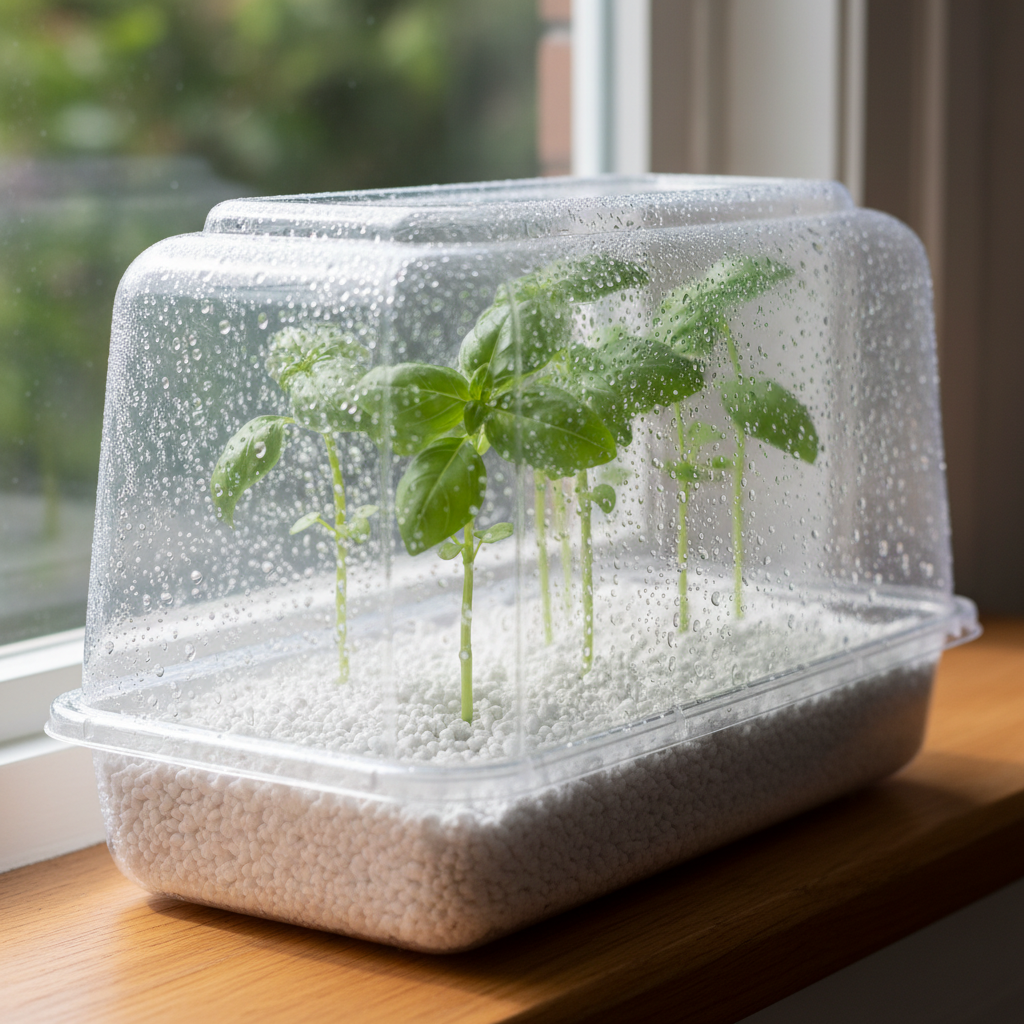
Understanding the Node
Every propagation method for basil revolves around a single botanical feature: the node, the swollen point on the stem where a pair of leaves emerges. Each node carries dormant meristematic tissue capable of producing both roots (if buried) and lateral shoots (if exposed). Cuttings root reliably because the stem section below a node is rich in this versatile tissue. Pinching above a node triggers two lateral shoots to break from the buds at that same point, which is the mechanism behind shaping a single seedling into a dense bushy plant.
Stem Cuttings: Step-by-Step
Stem cuttings root in water or in a sterile medium such as damp perlite or vermiculite. Water rooting is dramatic and easy to monitor, but the resulting roots are adapted to liquid life and sometimes sulk when moved to soil. Perlite under a humidity dome produces sturdier roots ready for direct potting, at the cost of being less visible. Either method works; the medium is less important than choosing a healthy non-flowering shoot and keeping conditions clean.
- Choose a healthy, non-flowering tip from a vigorous plant. The cutting should be 10 to 15 cm long with at least three leaf pairs.
- Make a clean cut with sharp scissors or a sterilised blade, about 5 mm below a node. Avoid crushing the stem.
- Strip the lower one or two leaf pairs from the stem, leaving 2 to 3 cm of bare stem at the base. The exposed nodes are where roots will emerge.
- Place the cutting in a clean glass of room-temperature water or push it 2 to 3 cm into a small pot of damp perlite. Multiple cuttings can share a single container.
- Set the cuttings in bright indirect light, out of direct sun, at room temperature. Change water every two days; mist the perlite lightly if it begins to dry.
- Roots typically appear within 7 to 14 days. Once roots are 2 to 3 cm long, pot the cutting up into a small container of fresh mix.
- Water lightly after potting and keep the new plant out of strong sun for a week to harden off. Resume normal care once new growth begins at the tip.
Pro Tip — Cut Just Before You Need a Sprig: the easiest time to take cuttings is when you are pinching the plant to keep it bushy anyway. A 10 cm tip removed to delay flowering becomes a free new plant if it is dropped into a glass of water on the way to the kitchen rather than straight into the chopping board.
Seed Sowing: Step-by-Step
Basil seed is cheap, germinates reliably and gives access to far more cultivars than a garden centre will ever sell as plants. Indoor sowing can happen any time of year provided the sown tray sits in adequate warmth and light; outdoor or unheated greenhouse sowing waits until soil temperatures are reliably above 15 degrees Celsius (59 Fahrenheit), which in most of Northern Europe is mid-May.
- Fill a clean small pot or seed tray with fine, moist seed-sowing compost. Firm gently and level the surface.
- Scatter seeds thinly across the surface, aiming for roughly 1 cm between seeds. Cover with a 2 to 3 mm dusting of fine compost or vermiculite. Basil germinates better with a touch of light, so do not bury the seed deeply.
- Water from below by standing the tray in a shallow dish of water for 10 to 15 minutes, then drain. Overhead watering displaces small seeds.
- Cover with a clear lid or a plastic bag and place in a warm spot, ideally 20 to 25 degrees Celsius (68 to 77 Fahrenheit). A heat mat speeds germination but is not essential.
- Seedlings emerge within 5 to 10 days. Remove the cover as soon as the first green leaves show and move to a bright window.
- When seedlings have their first true leaves (the second pair, after the initial round seed leaves), thin or prick out to one strong plant per small pot.
- Pot on into a 15 to 20 cm container once the young plant has six or eight true leaves and a sturdy stem.
Troubleshooting Propagation
| Problem | Likely Cause | Solution |
|---|---|---|
| Cutting stem turns black at the base in water | Bacterial rot, often from leaves submerged in the water | Strip all leaves from the lower stem and change the water every two days |
| Cutting wilts persistently in perlite | Stem too soft, taken from a stressed parent, or humidity too low | Choose firm non-flowering shoots and cover with a clear dome for the first week |
| Seedlings stretch tall with tiny leaves | Insufficient light after germination | Move to the brightest window or add a desk-style grow light 25 cm above the tray |
| Seedlings collapse at soil level (damping off) | Fungal pathogens in damp, poorly ventilated compost | Use fresh sterile seed compost, water from below, and provide gentle air movement once seedlings emerge |
Pests and Diseases
Indoor basil is bothered by a smaller cast of pests and diseases than its outdoor counterpart, but the ones that find it tend to settle in quickly because the environment is sheltered and largely free of predators. Most problems can be prevented with three habits: inspect new arrivals before they join an established collection, water in the morning so foliage dries by night, and keep air gently moving around the plant.
Because basil is grown for eating, treatments should always lean toward the gentlest option that solves the problem. Systemic synthetic insecticides have no place on a culinary herb. Wiping leaves, dilute soap sprays and isolating affected plants are usually enough, with neem oil reserved for stubborn infestations and applied at least seven days before any leaves will be harvested.
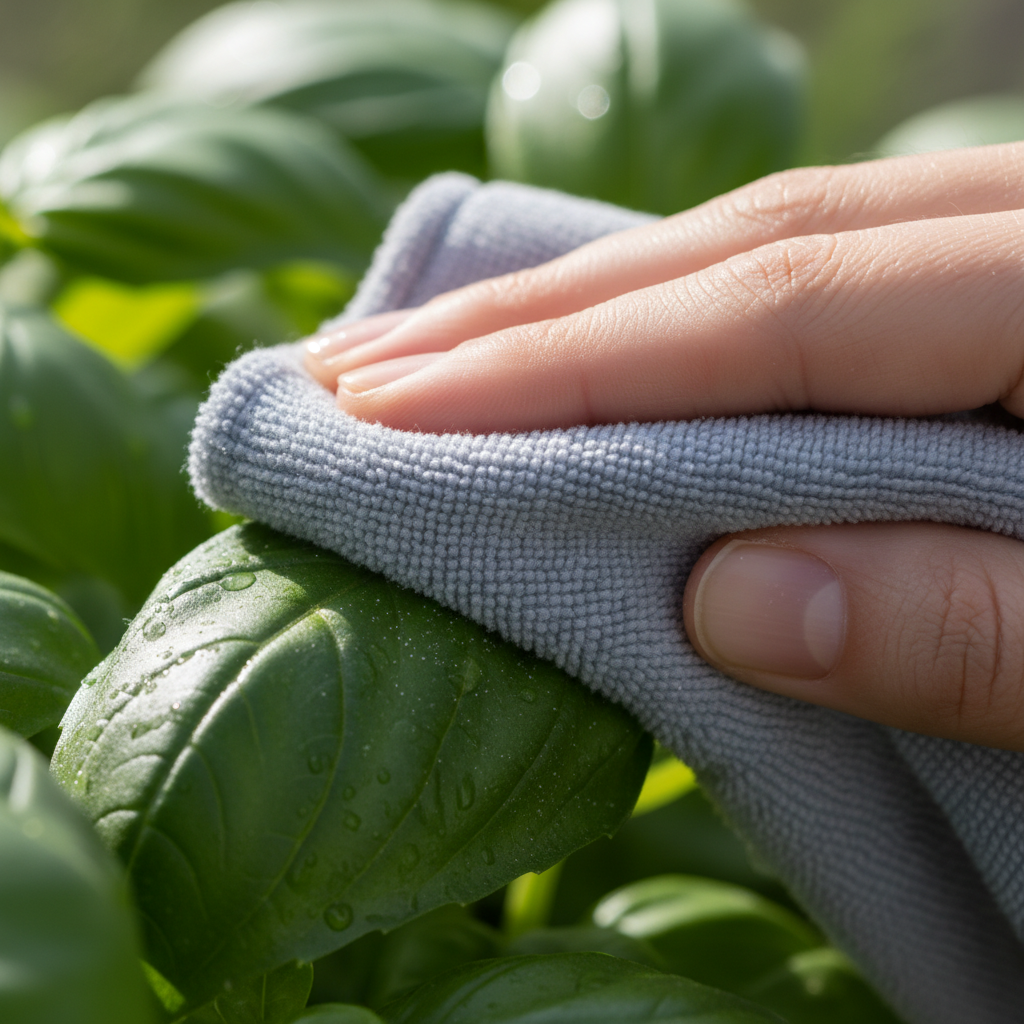
Common Pests
Aphids (Aphidoidea)
Soft-bodied green, yellow or black insects 1 to 3 mm long, clustered on the youngest leaves and growing tips. They suck sap, distort new growth and excrete sticky honeydew that supports sooty mould. Infestations spread quickly indoors because reproduction is parthenogenetic and continuous in warm conditions.
Treatment: rinse off with a firm spray of water in the sink, then wipe remaining individuals with a damp cloth. Repeat every three to four days for two weeks. For heavier infestations, a 1 per cent solution of mild liquid soap (not detergent) sprayed onto the affected areas in the evening, then rinsed off the following morning, breaks the cycle without lasting residue.
Spider mites (Tetranychus urticae)
Tiny eight-legged arachnids, often invisible until their fine webbing appears on the underside of leaves and across stems. Damage shows as pale stippling on upper surfaces and a generally dusty, off-colour appearance. They thrive in dry, still air, which makes heated rooms in winter their preferred environment.
Treatment: raise local humidity (group plants, add a humidifier in winter) and shower the foliage in the sink with room-temperature water. For persistent populations, neem oil applied to the leaf undersides every five days for three applications interrupts the breeding cycle. Always rinse leaves and wait at least a week before harvesting.
Whiteflies (Trialeurodes vaporariorum)
Small white moth-like insects that explode in a cloud when the plant is disturbed. Nymphs feed on the leaf undersides, weakening the plant and producing honeydew. Whiteflies often arrive with supermarket plants and are particularly fond of basil and tomato relatives.
Treatment: yellow sticky traps catch adults effectively and let you monitor whether the population is rising or falling. Vacuum the cloud gently with a low-suction handheld vacuum in the morning when whiteflies are sluggish, then wipe leaf undersides with a damp cloth. Severe cases respond to insecticidal soap spray, applied after sundown to avoid leaf burn.
Fungus gnats (Bradysia spp.)
Slender black flies 2 to 3 mm long, weak fliers, hovering around the pot rather than the plant itself. The adults are mostly a nuisance; the larvae, however, feed on root hairs and decaying organic matter in damp soil, which slows the plant and predisposes it to other root problems.
Treatment: let the top 2 cm of soil dry between waterings to interrupt the larval life cycle. A thin layer of horticultural sand or fine grit on the soil surface deters egg-laying. A biological control (Bacillus thuringiensis israelensis) applied as a soil drench is highly effective and entirely safe on culinary herbs.
Common Diseases
Downy mildew (Peronospora belbahrii)
The single most consequential disease of cultivated basil worldwide, first reported in Europe in the early 2000s and now widespread. Symptoms begin as a slight yellowing of upper leaf surfaces, followed within days by greyish-purple fuzzy sporulation on the undersides. Affected leaves blacken and drop; in humid conditions, an entire plant can be lost in a fortnight.
Treatment: remove and bin affected leaves immediately (do not compost). Improve airflow with a small fan, reduce overhead watering and increase the spacing between plants. There is no reliable home cure once the disease is established. Choose resistant cultivars such as Prospera, Rutgers Devotion DMR or Rutgers Obsession DMR for the next sowing, as these were specifically bred to resist this pathogen.
Fusarium wilt (Fusarium oxysporum f. sp. basilici)
A soil-borne fungus that infects basil through the roots and blocks the vascular system. Symptoms include sudden one-sided wilting that does not recover with watering, brown streaks visible in the stem when cut, and stunted growth even with otherwise correct care. The disease persists in soil for years.
Treatment: there is no cure for an infected plant. Remove and destroy the plant and its soil, sterilise the pot with a 10 per cent bleach solution, and use fresh sterile compost for future basil in that location. Resistant varieties are available; rotating the kind of plant grown in any given pot also reduces buildup.
Grey mould (Botrytis cinerea)
A common opportunistic fungus that colonises damaged or dying tissue, especially leaves left on the soil surface and stem wounds from rough harvesting. Symptoms are a fuzzy grey-brown growth on dead or dying parts that can spread to healthy tissue if conditions stay humid.
Treatment: remove all dead and yellowing material promptly, improve airflow with a small fan, and keep the area around the plant free of fallen leaf debris. Once visible mould is present, snip away affected sections with clean scissors and bin them. Avoid overhead watering until the plant is back to clean healthy growth.
Pest and Disease Summary
| Pest / Disease | Identification | Treatment |
|---|---|---|
| Aphids | Clustered soft-bodied insects on tips | Water rinse, soap spray, repeat weekly |
| Spider mites | Fine webbing, stippled leaves, dry air conditions | Raise humidity, shower foliage, neem if persistent |
| Whiteflies | White cloud rises when plant is disturbed | Yellow sticky traps, vacuum adults, insecticidal soap |
| Fungus gnats | Small flies around pot, larvae in damp soil | Dry the top 2 cm, sand topdressing, Bt drench |
| Downy mildew | Yellow tops, grey-purple fuzz on undersides | Remove infected leaves, improve airflow, switch to resistant variety |
| Fusarium wilt | Sudden one-sided wilt, brown stem streaks | Destroy plant, sterilise pot, resistant cultivars next time |
| Grey mould | Fuzzy grey-brown growth on dying tissue | Remove debris, improve airflow, avoid overhead watering |
Prevention Strategies
Most basil problems are prevented at the door rather than cured. New plants from a supermarket, garden centre or another gardener should spend a week quarantined on a separate windowsill while you inspect leaf undersides and watch the soil for fungus gnats. A quick rinse of the foliage under a soft tap removes most opportunistic eggs and spores before they establish.
Ongoing prevention is mostly environmental. A gentle fan running on its lowest setting for a few hours a day strengthens stems, reduces fungal disease and discourages mites and whiteflies. Water in the morning, not the evening. Wipe the leaves weekly, both upper and lower surfaces, with a damp cloth or a soft brush; this single habit dispatches more pest eggs than any spray will ever need to.
Pro Tip — A Weekly Five-Minute Inspection: set a phone reminder for the same time every week to lift each basil plant, turn it upside down, examine the leaf undersides under good light and slide a finger into the soil to check moisture and look for gnat larvae. A pest caught on its first weekend is trivial to remove. The same pest noticed three weeks later is an infestation that may cost you the plant.
Popular Varieties
Although a single species name covers most culinary basils, Ocimum basilicum is staggeringly variable. Centuries of selection across Europe, the Mediterranean, the Middle East and Asia have produced cultivars that differ in leaf size, leaf colour, growth habit, essential oil profile, heat tolerance and disease resistance. A few additional species sit comfortably alongside the main group: holy basil (Ocimum tenuiflorum) and African blue basil (Ocimum kilimandscharicum hybrids) bring different aromas and growth habits but the same broad cultural requirements.
For most gardeners the choice comes down to three questions. What will it taste of? How big does it get? And does it carry resistance to downy mildew, the disease most likely to end a season prematurely? The table below summarises the most popular cultivars on those criteria, followed by detailed profiles of the varieties worth seeking out.
| Variety | Leaf Appearance | Light Needs | Growth Rate | Availability |
|---|---|---|---|---|
| Genovese | Large broad emerald, classic sweet basil | Full sun | Fast | Very common |
| Sweet Italian Large Leaf | Very large, broad, slightly cupped leaves | Full sun | Fast | Common |
| Dark Opal | Deep burgundy-purple, glossy | Full sun | Moderate | Common |
| Thai (Horapha) | Narrow pointed green leaves, purple stems | Full sun | Fast | Common in Asian seed sources |
| Lemon basil | Pale green, narrow, citrus-scented | Full sun | Fast | Specialist |
| Holy basil (Tulsi) | Slightly hairy green or purple leaves | Full sun | Moderate | Specialist |
| Greek bush basil | Very small leaves, dense compact mound | Full sun | Moderate | Common |
| Prospera DMR | Genovese type, downy-mildew resistant | Full sun | Fast | Increasingly common |
Featured Varieties
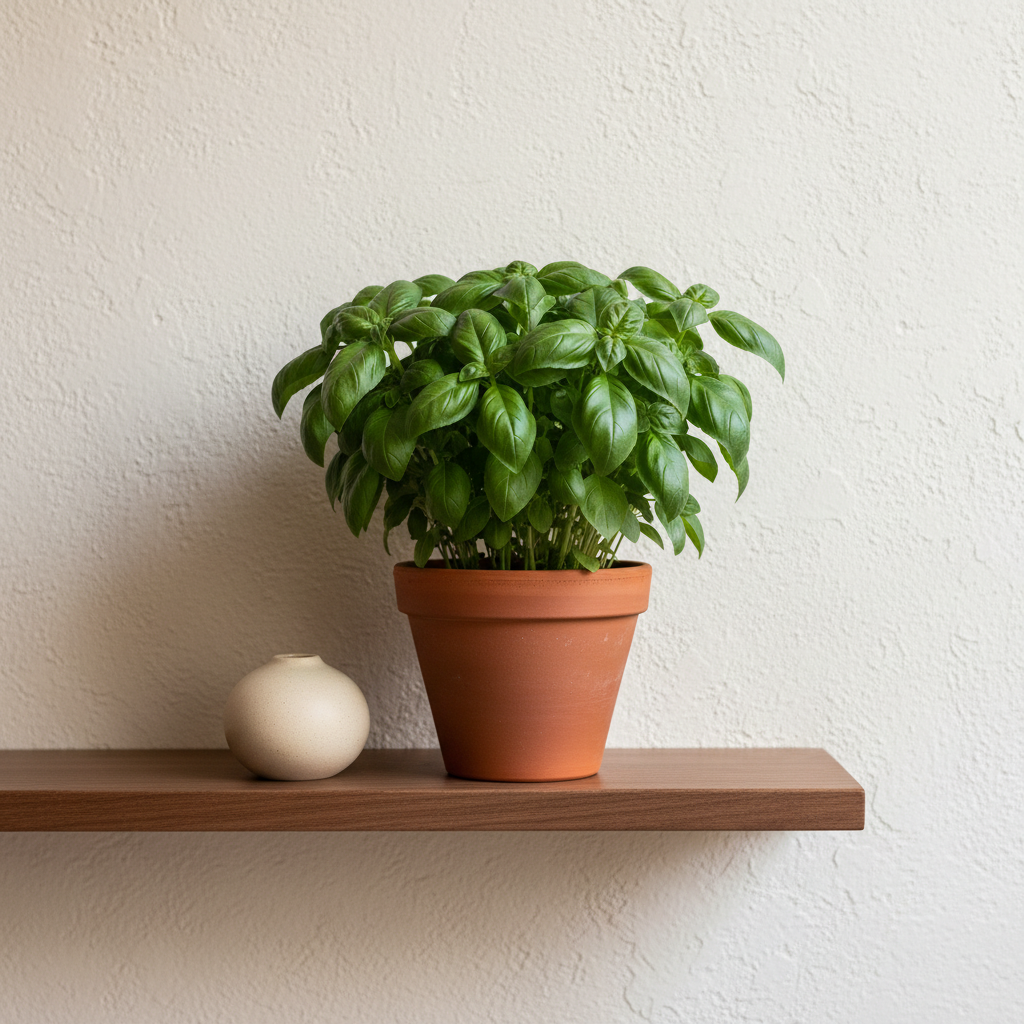
Genovese Basil
The reference cultivar for Italian cooking and the standard against which all sweet basils are measured. Large, broad, slightly cupped emerald leaves with a sweet, clove-pepper aroma and a clean lingering finish, the result of centuries of selection in and around Liguria. Ideal for pesto, where its concentration of linalool and methyl chavicol drives the classic flavour.
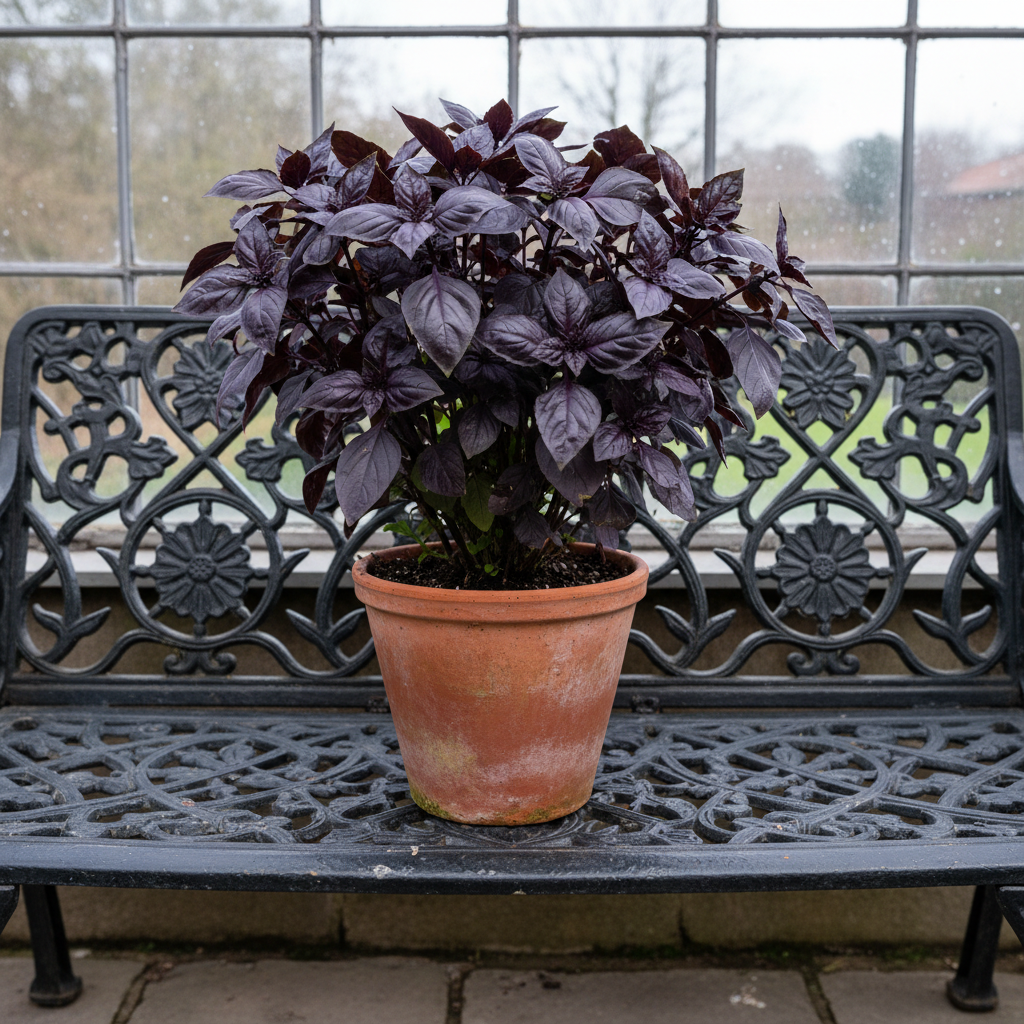
Dark Opal Basil
Bred at the University of Connecticut in the 1950s and the first basil to win an All-America Selections award. Deep burgundy-purple, almost black leaves with a smooth glossy surface and a spicier anise-clove aroma than green sweet basils. Prized as much for its dramatic foliage in containers and infused vinegars as for its flavour in the pan.
Variety Profiles in Detail
Thai Basil (Ocimum basilicum var. thyrsiflora)
Sometimes labelled horapha or sweet Thai, this is the basil that defines Southeast Asian cuisines from Vietnamese pho garnishes to Thai stir-fried beef. Narrow, pointed dark green leaves on striking purple stems, with a clean anise-liquorice aroma that holds up better to high-heat cooking than sweet Italian types. Hardier and more heat-tolerant than Genovese, and a good choice for warm sunny windowsills in summer.
Lemon Basil (Ocimum basilicum × americanum)
A hybrid carrying a strong citrus note from a high concentration of citral in the leaves, alongside the underlying basil aroma. Smaller, narrower paler-green leaves and a more upright open growth habit than Genovese. Outstanding in fish dishes, summer drinks, light salads and infused syrups; less suitable for pesto because the citrus dominates.
Holy Basil / Tulsi (Ocimum tenuiflorum)
A different species, native to the Indian subcontinent and revered in Hindu traditions where it is grown beside doorways and home shrines. Slightly hairy leaves in green or purple forms, with a complex aroma carrying notes of clove, mint and a faint medicinal sweetness. Used in Thai cooking (as krapao, the genuine basil of pad krapao) and in herbal teas for its calming reputation. Slightly slower-growing than sweet basil and more cold-sensitive.
Greek Bush Basil (Ocimum basilicum var. minimum)
A naturally compact ball-shaped plant covered in tiny leaves, rarely exceeding 30 cm tall. The flavour is milder and more delicate than Genovese, well suited to garnishing rather than carrying a sauce. Its tight habit makes it the most ornamental of the culinary basils, ideal for small pots, mixed herb containers and the windowsills of cooks who would rather not stake or train a leggy plant.
Prospera DMR (Downy-Mildew Resistant)
A relatively recent introduction from breeding programmes responding to the worldwide downy mildew crisis. Visually and aromatically a near-perfect Genovese substitute, with strong resistance to Peronospora belbahrii. Worth choosing for any grower who has lost a basil crop to downy mildew in the past or grows basil in a humid greenhouse environment. Several similar resistant cultivars now exist (Rutgers Devotion, Rutgers Obsession, Amazel), each with slightly different growth habits and flavour notes.
Choosing the Right Variety for Your Space
A small sunny kitchen with one good window is best served by Greek bush basil or a single Genovese in a 20 cm pot. A grower with multiple windows and an interest in Asian cooking will benefit from one Genovese for pesto and one Thai basil for stir-fries, kept in separate pots because Thai basil grows more vigorously and would crowd out a sweet basil sharing the same soil. A grower in a humid environment or one who has had downy mildew problems should plan around a resistant cultivar such as Prospera. And a windowsill primarily decorative as well as culinary almost always benefits from Dark Opal, whose colour reads dramatically against a pale wall and whose flavour is interesting enough to use.
Frequently Asked Questions
Why does my supermarket basil die within a week of coming home?
Supermarket pots are typically a dozen or more seedlings forced together at hydroponic speed and pushed into a small peat-heavy pot that drains badly. The plants survive that environment only because the shop’s lighting and cool temperature slow growth to nearly nothing. Brought home, they stretch in lower light, exhaust their root run within days and collapse. Repotting into a larger container with a better mix, separating the strongest two or three seedlings, and placing the plant in the sunniest available window almost always rescues it.
Should I let my basil flower?
Not if you want to keep eating it. As soon as basil sets flower buds, the plant shifts energy from leaf production to seed production. Leaves become smaller, flavour becomes flatter and the plant ages rapidly. Pinch out flower spikes as soon as you see them; consistent pinching keeps a basil productive for several extra months. If you want to save seed or attract pollinators, allow one or two plants in a sequence to flower while keeping others pinched for the kitchen.
How do I harvest basil so the plant keeps producing?
Always pinch just above a leaf pair, never strip individual leaves from the stem. Cutting above a node triggers two new lateral shoots to develop from the buds at that node, which doubles the plant’s growing tips. Repeating this every two to three weeks turns a single upright seedling into a dense bush within six to eight weeks. Avoid removing more than a third of the foliage at any one harvest.
Can I keep basil going through winter indoors?
Yes, with two adjustments. The first is light: shorter winter days mean the plant needs the sunniest window in the house, or a supplementary grow light running 12 to 14 hours per day. The second is restraint with water and food: lower light slows the plant’s metabolism, and the watering and feeding schedule from June will drown a plant in January. Check soil moisture before each watering, reduce feeding to monthly, and accept that growth will slow even at its best.
Why are the lower leaves on my basil turning yellow?
The most common causes, in order: overwatering (soft, uniformly yellow lower leaves, persistently damp soil), nutrient depletion (gradual fading of older leaves while new growth stays green and small), and natural aging at the base of a long-grown plant (single leaves turning yellow and dropping while the rest of the plant looks fine). Diagnose by checking soil moisture first; if the soil is damp and the leaves are limp, the answer is almost always too much water.
Is basil safe for my cat or dog?
Yes, in any culinary quantity. The ASPCA lists basil as non-toxic to dogs, cats and horses. The essential oils are concentrated, however, so a pet that habitually chews and swallows entire plants may experience mild digestive upset. Pure basil essential oil is a different matter and should be kept away from pets. As a windowsill herb that the occasional cat brushes past, basil is among the safest options you can grow.
Why is my basil bitter?
Bitterness in basil is almost always a sign that the plant has begun to flower, even if the flower spikes are still small and easy to miss. The chemistry of the leaves changes as the plant transitions into seed production, with the sweet front notes giving way to harder, more astringent compounds. Pinch out every flower bud aggressively and you will usually find sweetness returns to new growth within a week or two. Heat stress and persistent under-watering can produce a similar effect.
Can I grow basil from a cutting taken from a supermarket bunch?
Often, yes. Pick the freshest-looking bunch you can find. Choose stems that are firm, not flowering, and at least 10 cm long. Strip the lower leaves, place the cut ends in a glass of water on a bright windowsill, change the water every two days, and you will usually see roots within ten to fourteen days. From there, pot up into a small container of fresh mix and treat as any rooted cutting. The flavour will be the same as the parent bunch, and you have effectively turned a one-time grocery purchase into a long-term kitchen plant.
How long does an indoor basil plant live?
Basil is biologically an annual. Outdoors it lives one growing season and dies at the first hard frost. Indoors with good care and aggressive flower-pinching, a single plant can stay productive for six to nine months before its vigour fades. Rather than fight that biology, most experienced growers run a rolling succession of cuttings or seedlings every four to six weeks so that a young plant is always coming into its prime as an older one declines.
Why are tiny holes appearing in my basil leaves overnight?
Indoors this is almost always either caterpillar or slug damage if the plant has spent time on a balcony or by an open window, or, much less commonly, leaf-cutting weevils. Inspect leaf undersides and the soil surface after dark with a torch; you will usually catch the culprit in the act. A simple hand-pick is enough to clear most caterpillar problems. If the damage continues without a visible cause, examine the soil and the pot rim for slug trails or small slug-like droppings, and place a damp cardboard trap nearby to confirm.






