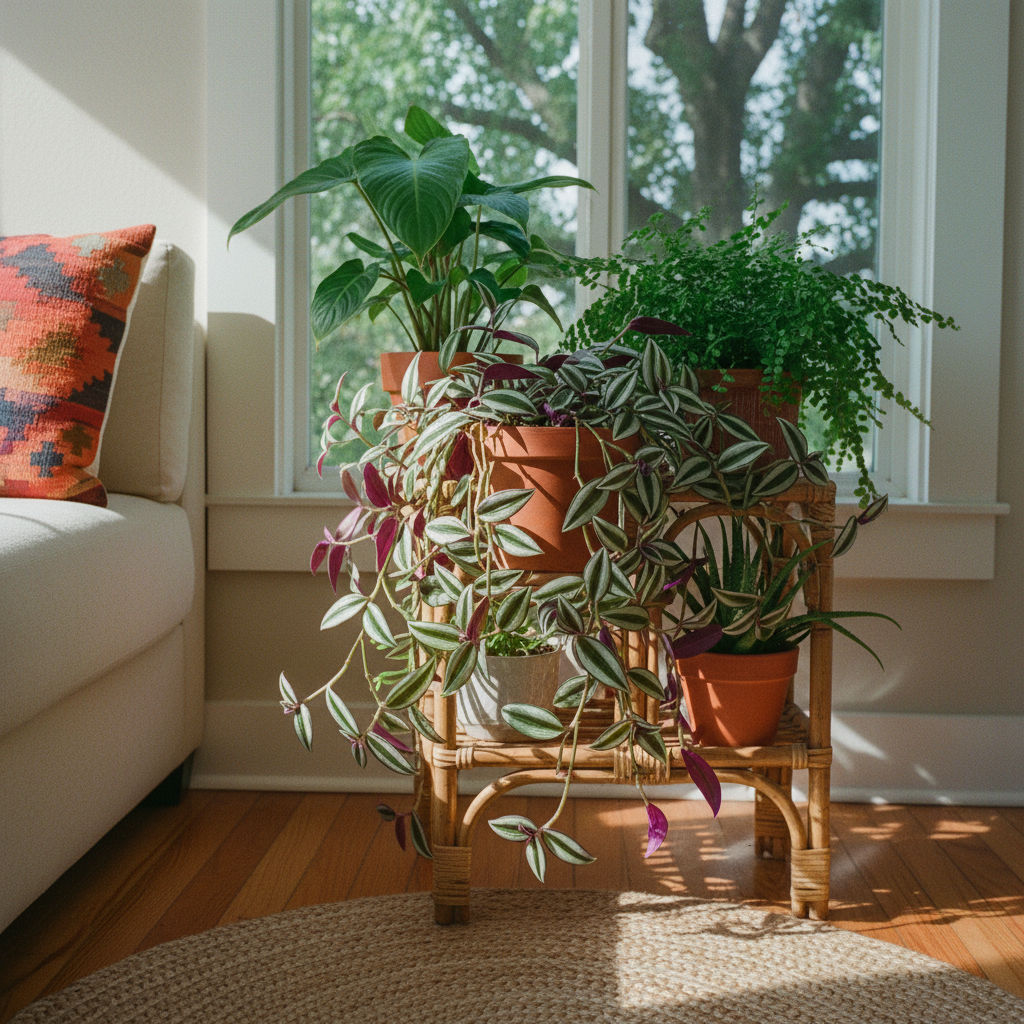
A complete care guide to Tradescantia zebrina, the silver-and-purple striped trailing houseplant also known as the Wandering Dude — covering light, watering, soil, propagation and the most coveted varieties.
Few houseplants reward a sunny windowsill quite as readily as the Tradescantia zebrina, a softly trailing perennial from the steamy understorey of southern Mexico, Guatemala and the wider Mesoamerican lowlands. Long marketed under the dated label “wandering Jew” and now more sensibly called wandering dude, inch plant or silver inch plant, this is the species in the genus most likely to stop a visitor mid-sentence: its narrow, lance-shaped leaves are pinstriped with metallic silver and deep emerald on top, and washed in vivid magenta-purple underneath. Catch the light through a trailing strand and the effect is unmistakable.
Tradescantias have a reputation as the houseplant you cannot kill, and T. zebrina earns it. Cuttings root in a glass of water within days, growth is almost embarrassingly quick in a warm spot, and a sad-looking pot can be reset to dense and lush in a single season. The catch, and the reason this guide exists, is that surviving and thriving are very different outcomes. A neglected zebrina will live; it will also stretch, fade, drop its lower leaves and turn into a leggy curtain with bald stems. This guide covers the difference, with detail on light, watering, the soil mix that prevents most failures, fertilising for colour, the laughably easy propagation methods, and the cultivars worth tracking down.
Bright indirect light; tolerates 1 to 2 hours of direct sun for best colour
Watering
Water when the top 2 to 3 cm (1 inch) of soil is dry, roughly weekly in summer, every 10 to 14 days in winter
Temperature
16 to 24 degrees Celsius (60 to 75 Fahrenheit); avoid anything under 10 degrees Celsius (50 Fahrenheit)
Humidity
Tolerates average household humidity (40 to 50 percent); thrives at 60 percent or higher
Soil
Standard well-draining peat-based or coir-based mix with extra perlite
Fertiliser
Balanced liquid feed (NPK around 10-10-10 or 20-20-20) at half strength every 2 to 4 weeks in spring and summer
Propagation
Stem cuttings root in water or directly in soil within 7 to 14 days
Mature size
Stems trailing 30 to 90 cm (1 to 3 feet); leaves 4 to 7 cm long
Toxicity
Mildly toxic to cats, dogs and humans; sap can cause skin irritation
Difficulty
Beginner-friendly; one of the easiest houseplants in cultivation
Why Tradescantia Zebrina Makes a Standout Houseplant
The first thing to know about Tradescantia zebrina is that it is built to grow, and grow fast. In the wild it functions as a creeping ground cover under broken canopy, rooting wherever a node touches damp soil and forming dense mats that knit a clearing together in weeks. Indoors that same vigour means a small four-inch nursery pot can produce a full trailing curtain within a single summer, given decent light and steady moisture. Few other houseplants give that kind of instant gratification.
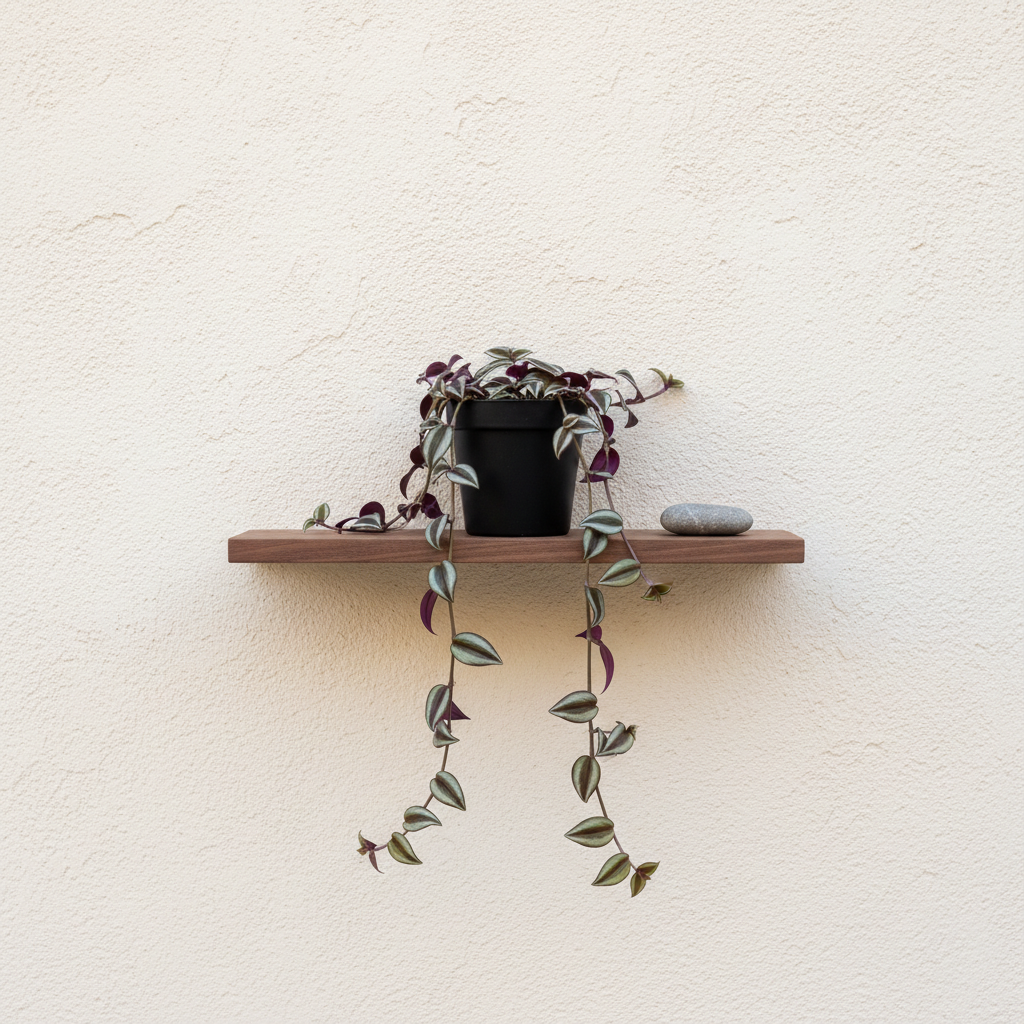
A mature Tradescantia zebrina on a floating shelf — the trailing habit and silver-on-purple foliage at full effect.
The second thing to know is that the colour is doing real work. Each leaf carries two longitudinal silver stripes flanking a central band of green or violet on the upper surface, while the entire underside is flushed magenta to deep purple. The silver bands are actually air-filled cavities in the leaf surface that scatter light — a feature shared with several rainforest understorey plants and one of the reasons the leaves look almost iridescent in raking light. That magenta underside is anthocyanin pigment, the same compound that turns autumn maples red, and it acts as a sunscreen for the chloroplasts beneath. In strong light it deepens; in low light it fades, which is the single best diagnostic for whether your plant is getting enough light.
For the houseplant grower, the practical appeal is breadth: this is a plant that suits a hanging basket, a tall shelf, a windowsill, a wall-mounted planter or a tabletop. It mixes well in dish gardens with succulents and other low-water plants, and it is happy to be cut back hard whenever it gets unruly. It is also one of the genuinely cheap-to-acquire houseplants — a single cutting from a friend produces an entire shelf within a season. The combination of beginner-friendly care, dramatic colouring and rapid growth keeps T. zebrina in the top tier of recommended starter houseplants, even after decades in cultivation.
Important — Toxicity: All parts of Tradescantia zebrina contain calcium oxalate crystals and other irritant compounds. Ingestion can cause vomiting, drooling and oral irritation in cats and dogs, and the milky sap is a known contact dermatitis trigger in humans — particularly when taking cuttings or pinching back leggy stems. Wear gloves if you have sensitive skin, keep the plant out of reach of pets known to chew foliage, and wash your hands after handling.
Light Requirements
Light is the single biggest variable in keeping a Tradescantia zebrina looking the way you want it to. In its native habitat the plant grows along the edges of clearings and at the margins of forest paths, where it receives short bursts of direct morning or late-afternoon sun and bright dappled light for the rest of the day. Replicating that indoors means aiming for bright indirect light as the baseline, with the option of one to two hours of direct sun to keep the colours saturated.
An adequately lit zebrina has tight internodes (the gaps between leaves on a stem stay short), full magenta colouration on the leaf undersides, and crisp silver striping that catches the light from across the room. A light-starved plant tells you immediately: internodes stretch to two or three times their normal length, the leaves shrink, the silver striping dulls to muted grey, and the magenta underside pales to washed-out pink. Lower leaves drop off, leaving bare stem.
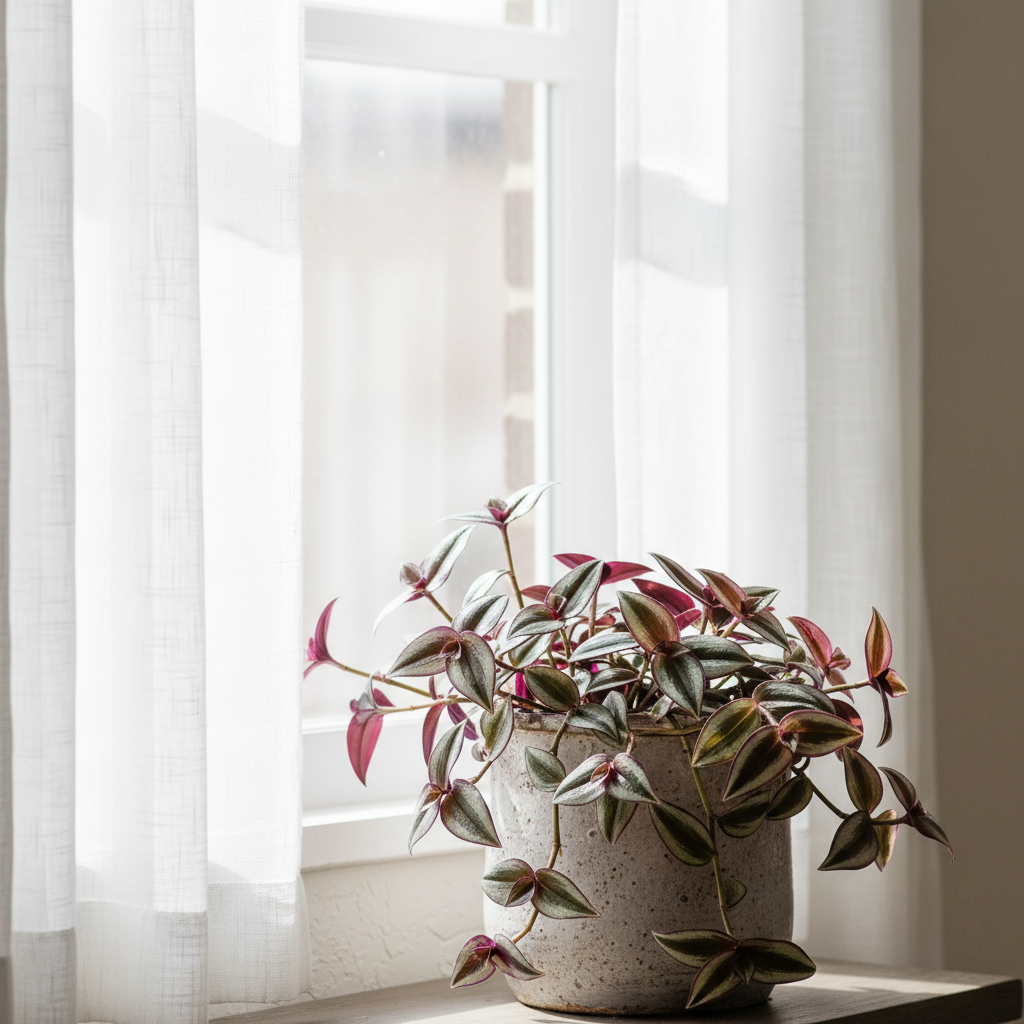
A south-facing window softened by sheer curtains is close to the ideal placement.
Light Levels Explained
Most houseplant guides hand-wave “bright indirect light” as if it were a single, well-defined condition. In reality there are several distinct intensity tiers, and a zebrina behaves quite differently in each.
Light Category
Approx. Level
Typical Location
Outcome
Direct sun
20,000 to 100,000 lux
Unobstructed south or west window
Tolerated for 1 to 2 hours morning or late afternoon; risk of scorch midday
Bright indirect
10,000 to 20,000 lux
Within 1 metre of a sunny window, with sheer curtain
Ideal: compact growth, deep silver and magenta colouration
Medium
2,500 to 10,000 lux
2 to 3 metres from a bright window, or close to a north window
Acceptable: growth slows, colour slightly muted
Low
500 to 2,500 lux
Interior room or hallway with limited natural light
Poor: leggy growth, fading colour, lower leaf drop
Very low
Under 500 lux
Windowless bathroom or closet
Plant will decline within weeks
Window Orientation and Placement
South-facing window: The best window for a T. zebrina, with one caveat. Place the plant within a metre of the glass for full effect, but filter midday sun in summer with a sheer curtain or move the plant a step back during the hottest hours. A sun-grown zebrina is the deepest-coloured zebrina you will ever see.
East-facing window: Excellent. Gentle morning sun lasts a couple of hours and is enough to maintain colour without scorching. Direct contact with the glass is usually safe even in summer.
West-facing window: Also excellent, with similar treatment to a south window. Hot late-afternoon sun in summer can crisp leaves pressed against the glass; pull the plant back 30 cm or filter the light.
North-facing window: Workable but suboptimal. Place the plant directly on the windowsill (not back in the room) and expect slower growth with somewhat muted colour. Consider supplementing with a small grow-light during the darker months at high latitudes.
Pro Tip — The Silver-Stripe Test: Look at the silver bands on the upper leaf surface. If they are wide, bright and almost metallic, your plant is happy. If they have shrunk to thin grey lines and the green between them dominates, the plant is reverting toward its lower-light, lower-pigment baseline and you should move it brighter immediately.
How Light Affects Colour and Variegation
The silver striping and magenta undersides are both light-driven traits, but they respond differently. The silver bands are structural — caused by air pockets in the leaf surface that exist regardless of light level — but they appear brighter when the surrounding green or violet tissue is more saturated, which only happens under good light. The magenta undersides, by contrast, are produced by anthocyanin synthesis, which is actively triggered by ultraviolet exposure and bright light. In other words, more light makes the leaves more purple, and a faded plant moved to a brighter spot will visibly re-pigment over four to six weeks.
This is why the same cultivar can look dramatically different in two different homes. A ‘Burgundy’ zebrina on a south-facing windowsill will produce leaves so dark they read almost black, while the same cultivar in a dim hallway will look like an ordinary green plant with a pinkish wash on the back. The cultivar sets the ceiling; light determines how close you get to it.
Warning — Direct Sunlight: While T. zebrina tolerates more direct sun than many tropical houseplants, prolonged unfiltered midday sun in summer (especially through south or west windows with no curtain) will scorch the leaves. Watch for pale tan papery patches on upper leaf surfaces, which are usually irreversible. Acclimatise gradually whenever moving to a brighter spot, increasing exposure by an hour or two per week over a fortnight.
Artificial Lighting
Tradescantia zebrina responds well to supplemental grow-lights, particularly in winter at higher latitudes where ambient light drops to inadequate levels for months. A modest full-spectrum LED bar, around 20 to 30 watts, hung 30 to 45 cm above the plant and run on a timer for 10 to 12 hours per day, will keep growth compact and colour saturated through the darkest months. Cheap LED panels designed for seedling propagation work fine — there is no need for high-output horticultural fixtures. Plants under grow-lights often show colour intensity that rivals or exceeds windowsill specimens, because the light is consistent every day rather than weather-dependent.
Seasonal Adjustments
In temperate climates, light intensity through windows drops by half or more between summer and winter, and the angle of the sun shifts the plant’s effective exposure. A zebrina that was thriving 30 cm back from a south window in July may be light-starved in the same spot in December. Move it closer to the glass in winter, rotate the pot a quarter turn each week to keep growth even on all sides, and consider adding a supplemental light if leggy growth starts to appear before spring returns.
Watering and Humidity
Watering a Tradescantia zebrina is more forgiving than most tropical houseplants, but it is also the area where most accidental killings happen. The fleshy stems and semi-succulent leaves store enough water to make the plant resilient to brief drought, but those same stems rot quickly when waterlogged. The rule of thumb is simple: water thoroughly, then let the top 2 to 3 cm of the substrate dry out before the next watering.
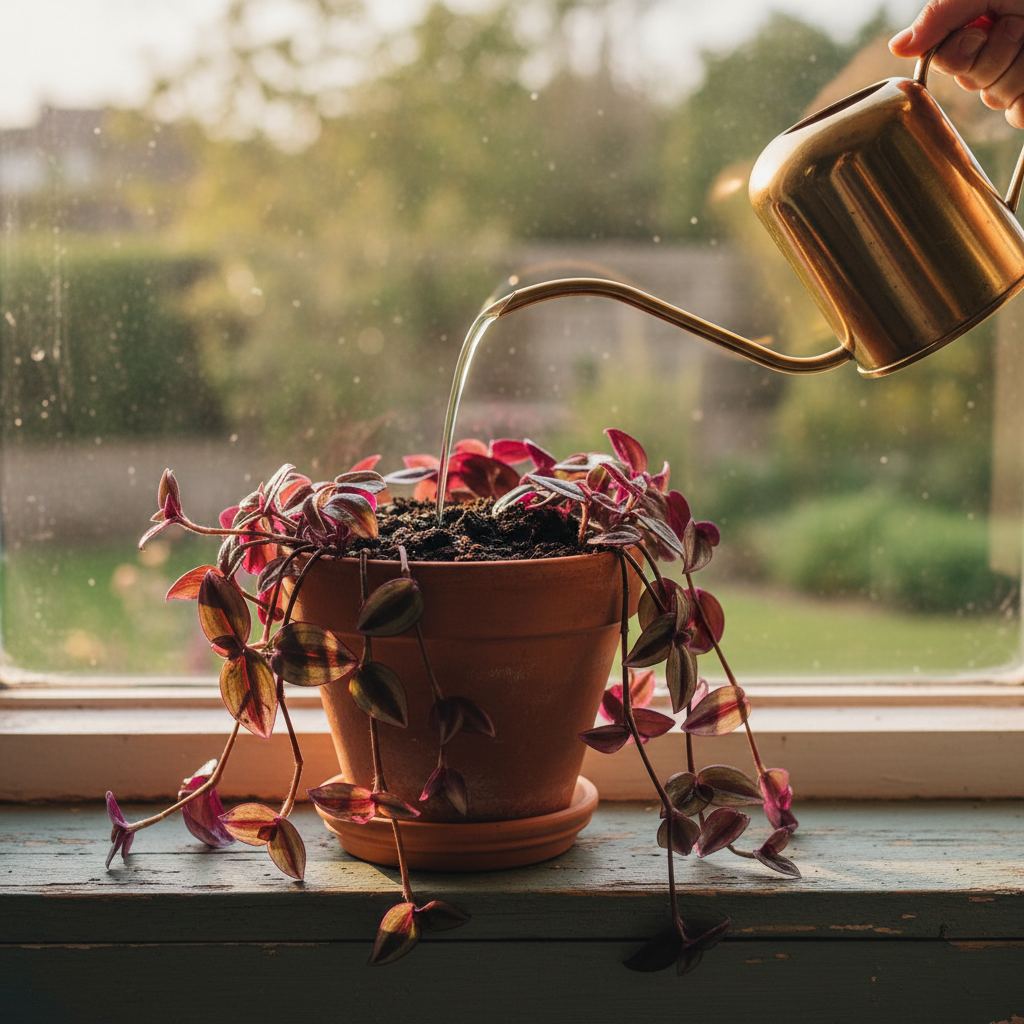
Water thoroughly, aiming the stream at the soil rather than the foliage, then let the top centimetres dry before the next round.
How Often to Water
Frequency depends on pot size, substrate, light level, season and ambient humidity, so any calendar-based recommendation is at best a starting point. As a guideline, a healthy zebrina in a 12 cm pot of standard houseplant mix, in bright indirect light at room temperature, typically needs water every 5 to 7 days in spring and summer and every 10 to 14 days in autumn and winter. In a small clay pot in direct sun it can be every 3 to 4 days; in a large plastic pot in a cool, dim room it might be every two to three weeks.
Rather than counting days, learn to read the plant and the substrate. Lift the pot when freshly watered, then again when the top centimetres are dry, and feel the weight difference. Within a week or two you will know by hand whether the pot needs water without checking the soil at all. The fingertip test still works: push a finger 2 to 3 cm into the soil, and if it comes out dry, water.
How to Water
Water until it runs freely from the drainage holes, then let the pot drain completely. Do not leave the plant sitting in standing water for more than 15 to 30 minutes. Aim the stream at the soil rather than the foliage where possible — wet leaves can encourage fungal issues in cool, still air, although T. zebrina is less prone to this than some thinner-leaved tropicals.
Bottom watering, where the pot is set in a shallow dish of water for 15 to 20 minutes until the surface darkens with moisture, works well for zebrinas and avoids splashing foliage entirely. It also encourages roots to grow downward toward the moisture, producing a stronger root mass over time.
Water Quality
Tap water is fine in most parts of the world. Unlike calatheas and other sensitive species, T. zebrina shrugs off moderate chlorine, chloramine and mineral hardness. In very hard-water areas, occasional limescale build-up on the soil surface can be flushed with a thorough watering using collected rainwater every couple of months. Avoid persistently softened water from a domestic ion-exchange softener — the high sodium content damages root tissue over time.
Signs of Overwatering and Underwatering
Symptom
Likely Cause
Action
Yellowing lower leaves, soft mushy stems near the base
Overwatering, root rot
Unpot, trim rotted roots, repot in fresh dry mix, water sparingly
Wilted, curled, crispy edges, leaves feel papery
Underwatering
Water thoroughly, soak from below for 20 minutes
Brown crispy leaf tips with otherwise healthy foliage
Low humidity or fluoride in tap water
Mist occasionally, switch to rainwater
Sudden leaf drop after watering
Cold water shock or sudden temperature change
Use room-temperature water, avoid cold drafts
Mushy black stem bases, foul smell
Advanced root and stem rot
Discard rotted material, take tip cuttings from any healthy growth to restart
Pro Tip — When in Doubt, Wait: A T. zebrina will recover from a missed watering far faster than from a soggy week. If you are uncertain whether the soil is dry enough, give it another day or two. The plant tells you when it is thirsty by drooping slightly, and bounces back within hours of a good drink.
Humidity
Average household humidity, typically 40 to 50 percent, suits this plant well. It is one of the easier tropical houseplants to grow in dry winter homes because the semi-succulent leaves and stems hold moisture. That said, humidity above 60 percent encourages lusher growth, larger leaves and richer colour. A pebble tray, a nearby humidifier or grouping with other plants will all nudge the local microclimate upward. Misting is rarely necessary and offers limited benefit on its own — the water evaporates within minutes and ambient humidity changes barely move.
Temperature
Ideal temperatures sit between 16 and 24 degrees Celsius (60 to 75 Fahrenheit), with night temperatures dropping by a few degrees but staying above 13 degrees Celsius (55 Fahrenheit). Brief dips to 10 degrees Celsius (50 Fahrenheit) are tolerated. Anything below 5 degrees Celsius (41 Fahrenheit) causes cold damage: stems blacken at the base, leaves go translucent and the plant frequently collapses within days. Keep zebrinas well clear of cold draughts, single-glazed windows in deep winter, and unheated conservatories.
Soil, Potting and Repotting
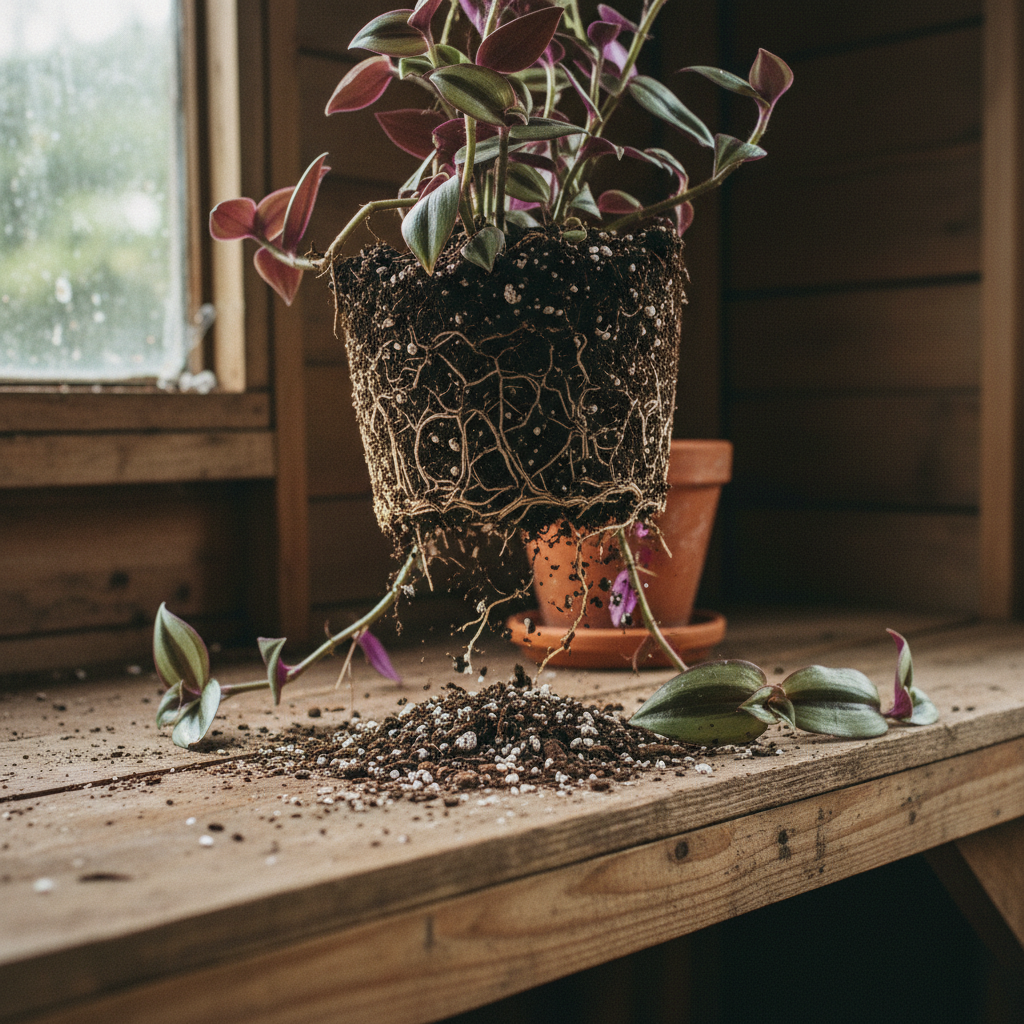
For all its rainforest-floor origins, Tradescantia zebrina wants a soil mix that drains aggressively. The shallow, branching root system suffocates in heavy, water-retentive substrate, and the soft fleshy stems are quick to rot at the soil line if conditions stay wet. The good news is that you can use any decent commercial houseplant mix as your starting point and amend it with cheap, widely available ingredients.
A repot every year or two refreshes the substrate and gives the shallow root system room to spread.
Recommended Soil Mix
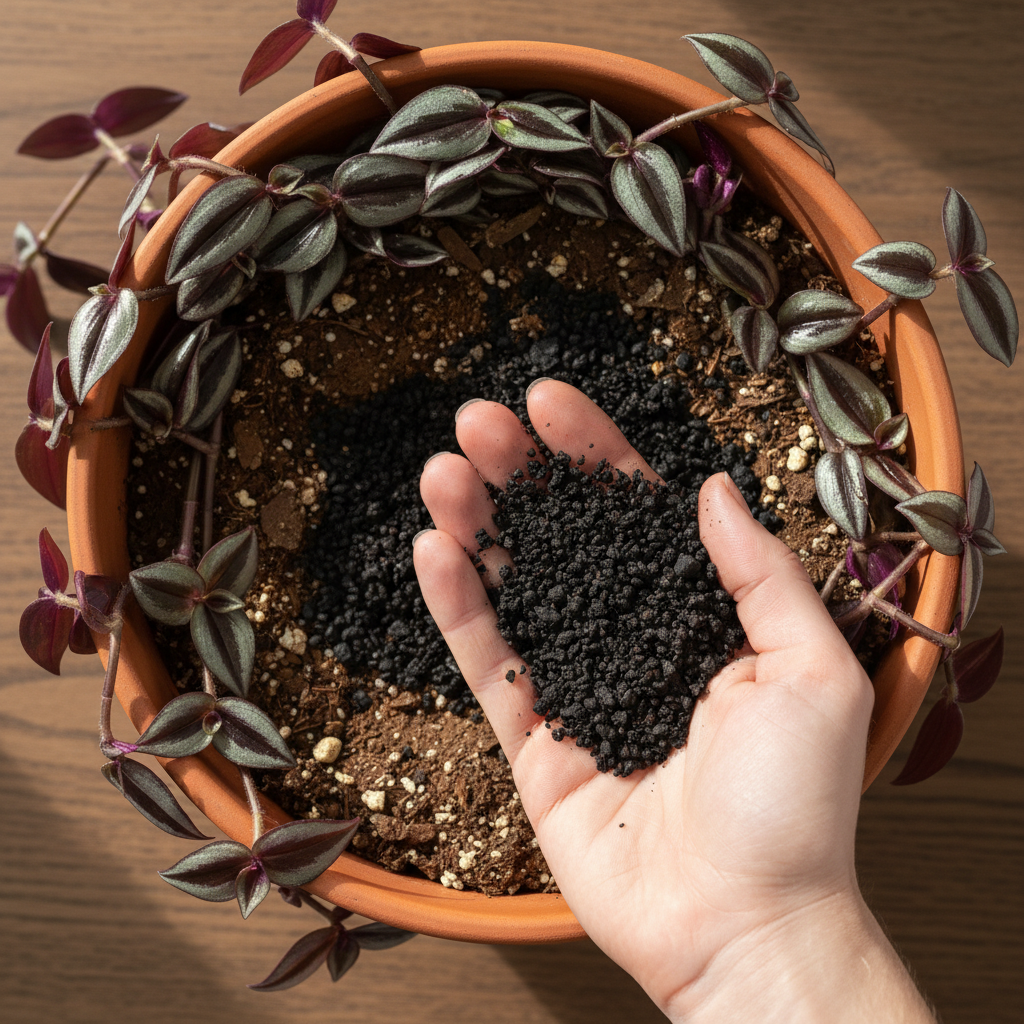
A simple, reliable blend is three parts standard peat-based or coir-based houseplant mix to one part perlite, with an optional one part fine orchid bark for extra structure. The perlite opens up the mix, prevents compaction and ensures water moves through quickly. The bark, where used, adds chunky air pockets and slows breakdown of the mix over time. A small handful of horticultural charcoal is a useful addition to keep the substrate sweet between repottings.
If you prefer a no-mix-required option, a cactus and succulent compost works well straight from the bag, particularly in cooler homes where extra drainage is welcome. A pure houseplant compost with no amendment is too dense and stays wet too long, especially in plastic pots — if that is what you have, add at least a quarter perlite by volume before potting.
Choosing a Pot
Drainage is non-negotiable. A pot without drainage holes is the single most reliable way to kill a T. zebrina, no matter how careful the watering. Terracotta pots are excellent because they wick moisture out through the walls and dry faster than plastic, which suits the plant’s preference for between-watering dryness. Plastic and glazed ceramic pots are also fine, but pay closer attention to the drying cycle and reduce watering frequency accordingly.
Size matters less than people assume. Zebrinas have shallow, somewhat fibrous root systems and tolerate being slightly snug in their containers; overpotting into a too-large vessel just creates pockets of perpetually damp soil that the roots cannot reach. Go up one pot size (typically 2 to 3 cm wider in diameter) at each repotting and no more. A 12 to 15 cm pot is the typical mature container; very mature, established plants in 20 cm hanging baskets are stunning, but anything beyond that tends to look unbalanced because the foliage trails away from the rim.
Repotting Schedule
Repot every 12 to 18 months in spring as growth resumes. Signs that a plant needs repotting include roots emerging from the drainage holes, water running straight through the pot without absorbing, and a noticeably faster dry-out cycle than a year ago. Many growers prefer to refresh the substrate in the existing pot rather than upsizing — tip the plant out, shake off most of the spent mix, trim any dead roots and repot into fresh substrate. This keeps the plant manageable and the soil ecosystem healthy without ever-larger containers.
Pruning and Reshaping
Pruning is where many zebrina growers underperform their plant’s potential. The species naturally goes leggy as it ages, with stems extending and lower leaves dropping to leave bare lengths of pink-purple stem topped with a tuft of foliage at the end. This is normal, but it also looks scruffy. The remedy is regular, aggressive pruning: cut every stem back to within 8 to 12 cm of the soil at least once a year, ideally in late winter or early spring. Within four to six weeks the plant pushes new growth from the cut nodes and rebuilds as a dense, full pot.
Use the prunings as cuttings. Every healthy tip with two or three leaves will root within a fortnight, so a single hard prune yields enough material to fill another pot, refresh the parent or pass plants around to friends. This is the trick to keeping zebrinas looking show-quality long-term: continuous renewal rather than letting the original stems stretch out indefinitely.
Fertilising
Tradescantia zebrina is a light to moderate feeder. In its native habitat it grows in leaf-litter-rich understorey soils that are continuously replenished by falling organic matter — not in heavily fertilised conditions. Indoors, the goal is to provide enough nutrients to sustain the species’ naturally rapid growth without pushing it into the soft, weak, oversized foliage that comes from overfeeding.
Top-dressing with worm castings is a gentle, slow-release way to feed a zebrina without risk of burn.
What to Feed
A balanced liquid houseplant fertiliser with an NPK ratio in the region of 10-10-10 or 20-20-20 is the simplest choice. Dilute to half the strength printed on the label — most commercial feeds are calibrated for plants that are hungrier than tradescantias, and full strength tends to produce salt build-up in the soil and crispy leaf margins over time. Apply every two to four weeks during the active growing season from early spring to early autumn, and stop feeding altogether through the winter months when growth slows.
Organic alternatives work equally well. A monthly top-dressing of worm castings (a thin layer scattered over the soil surface and gently scratched in) provides slow-release nitrogen and a useful boost of beneficial microbes. Compost teas, fish emulsion at half strength, or a thin layer of well-rotted leaf mould are all sensible options for growers who prefer to avoid synthetic feeds.
Signs of Over- and Under-Feeding
Overfed plants produce unusually large, soft, pale leaves with weak stems that flop easily. The colour intensity drops noticeably because the chlorophyll is diluted across more leaf tissue, and the silver striping becomes less defined. Salt build-up shows up as a white crust on the pot rim or soil surface, and as brown crispy leaf margins. Flush the pot with three times the pot volume of plain water to leach out accumulated salts, and skip the next two feeds.
Underfed plants slow their growth dramatically, produce smaller leaves and may show generalised pale-green or yellowish foliage. Lower leaves yellow and drop more frequently than usual. If the plant has been in the same pot for over a year without feeding, a single dose at half strength followed by a regular every-three-weeks schedule will usually green it back up within a month.
Pro Tip — Less is More: If you are going to err in one direction with a zebrina, err toward underfeeding. The plant grows fast even at modest nutrient levels, and a slightly hungry plant produces tighter, better-coloured foliage than a well-fed one. Hold back on the bottle.
Propagation
If there is one houseplant that converts new growers into propagation enthusiasts, it is Tradescantia zebrina. The propagation success rate hovers near 100 percent with even minimal care, the timeline from cutting to rooted plant is days rather than weeks, and the parent plant benefits from the inevitable pruning. There are essentially three methods — water rooting, direct soil rooting and division of an established clump — and all three work reliably.
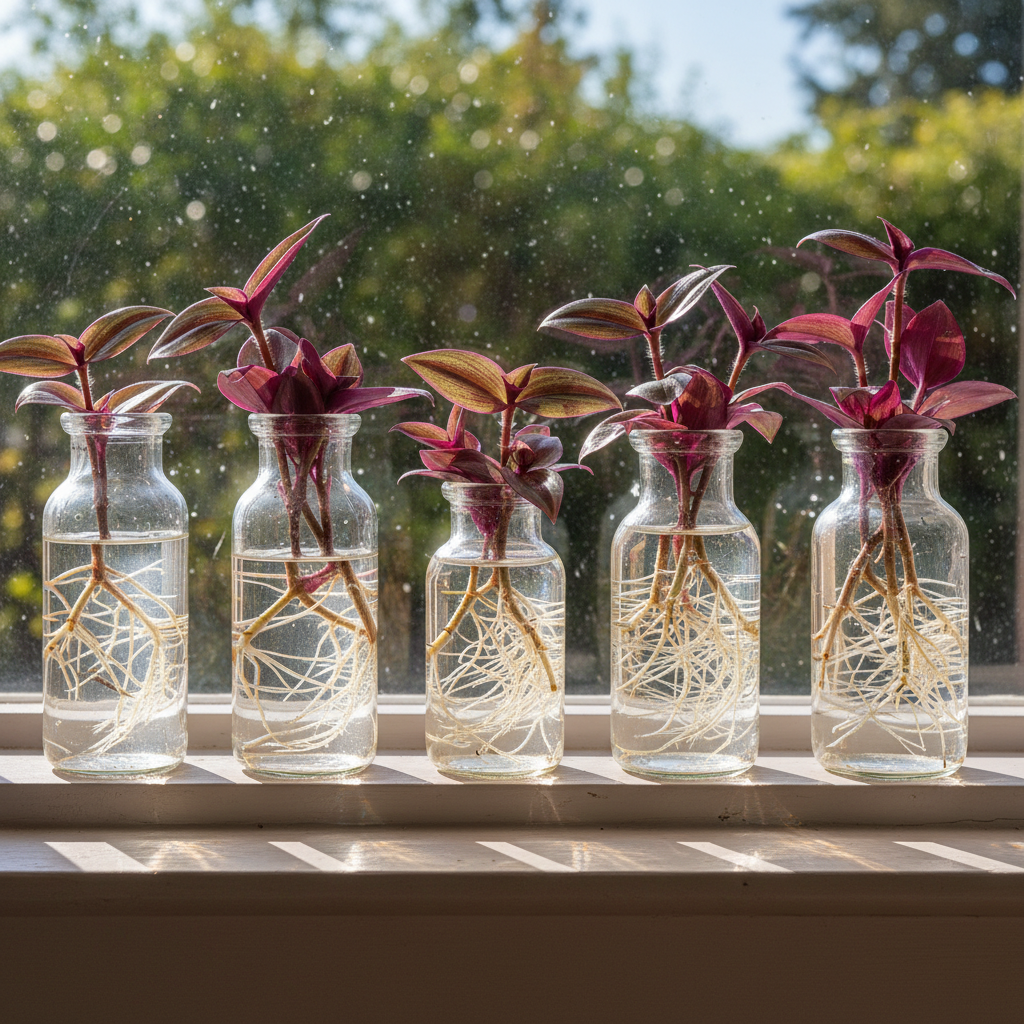
Water rooting in a sunny window is the classic zebrina propagation method — and the most reliable.
Method 1: Water Rooting
The classic and most visually satisfying method. Roots emerge from the leaf nodes within a few days and the whole process is visible through the glass.
Using clean sharp scissors or snips, take tip cuttings 8 to 15 cm long. Each cutting should have at least three leaf nodes (the slightly swollen joints where leaves emerge).
Strip the leaves from the lower one or two nodes, leaving the upper two or three intact. This exposes the nodes that will produce roots and prevents submerged leaves from rotting in the water.
Place the cuttings in a clean glass jar or small vase filled with room-temperature water. The lower nodes must be submerged; the remaining leaves must stay above water.
Set the jar in bright indirect light. A windowsill out of direct midday sun is ideal.
Change the water every 5 to 7 days, or whenever it starts to look cloudy. Top up between changes if evaporation lowers the level.
Roots typically appear within 5 to 10 days and reach 2 to 3 cm within two to three weeks. At that point pot up into a small pot of standard houseplant mix, water in and keep the soil consistently moist for the first two weeks while the water-formed roots transition to soil.
Method 2: Direct Soil Rooting
Skipping the water stage entirely produces sturdier plants in the long run because the roots that form are already adapted to soil, rather than water-roots that must remodel themselves when transplanted.
Take cuttings as above, with at least three nodes per piece and the lower leaves stripped.
Fill a small pot (8 to 10 cm) with damp, well-draining houseplant mix. Make several holes around the perimeter with a chopstick or pencil.
Insert one cutting into each hole, deep enough to bury at least one leafless node, and gently firm the soil around the stem.
Six to eight cuttings spaced around a single pot produces a full, attractive plant in a few months — faster than waiting for a single cutting to branch out.
Water in lightly and place in bright indirect light. Keep the soil consistently lightly moist (not wet) for the first three weeks. After that, water as for an established plant.
You will know rooting has happened when the cuttings start producing fresh growth from the upper nodes, typically two to three weeks after sticking.
Method 3: Division
For an established multi-stem plant that has been growing in a single pot for a year or more, division at repotting time is a quick way to create two or three smaller plants without taking cuttings at all. Tip the plant out, gently tease the root ball apart along natural divisions between stems, and pot each section into its own container with fresh mix. Water in and keep slightly shaded for a week while the disturbed roots recover.
Best Time of Year
Spring and early summer are the most reliable times to propagate, when the parent plant is in active growth and ambient temperatures encourage fast rooting. Autumn and winter cuttings work but take longer to root — sometimes three weeks or more — and benefit from a warm spot (above 20 degrees Celsius) and supplemental light.
Pro Tip — Refill the Parent: When you take cuttings, push two or three of them straight back into the parent pot alongside the original stems. The mother plant gets denser and fuller immediately, while the bulk of your cuttings start new plants elsewhere. This single habit transforms an aging, leggy zebrina back into a show-stopper within a month.
Pests and Diseases
Tradescantia zebrina is moderately pest-resistant but not immune. The dense foliage and damp soil conditions that suit the plant also create microclimates that attract a handful of common houseplant pests. Catching infestations early is the difference between a five-minute wipe-down and a multi-week recovery.
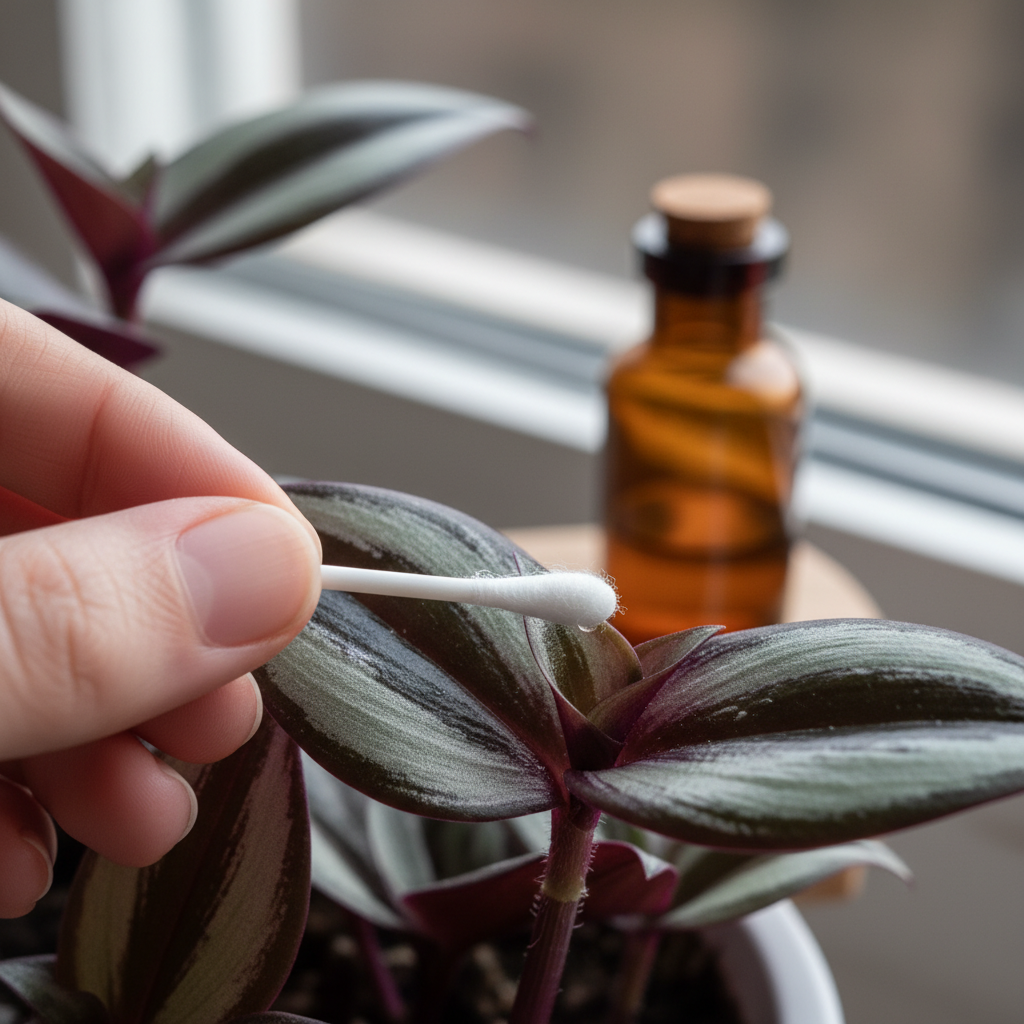
A cotton bud dipped in isopropyl alcohol handles early pest outbreaks one leaf axil at a time.
Spider Mites
The most common pest on indoor tradescantias, especially in dry winter air. Look for fine speckling on the upper leaf surfaces, tiny moving dots on the undersides under a hand lens, and (in advanced cases) thin webbing between leaves and stems. Affected leaves yellow and drop. Treat by rinsing the entire plant thoroughly under a tepid shower to dislodge mites, then spray weekly with insecticidal soap or a diluted neem oil solution for three to four weeks to break the life cycle. Raising humidity around the plant discourages reinfestation.
Aphids
Small soft-bodied insects, typically green or black, that cluster on new growth and flower stems. They suck sap, distort young leaves and leave a sticky residue (honeydew) that can attract sooty mould. Small populations come off easily with a strong jet of water; larger outbreaks respond well to insecticidal soap sprayed every 5 to 7 days for two to three weeks.
Mealybugs
White, cottony, slow-moving insects that hide in leaf axils and along stems, particularly in shaded interior parts of the plant. Dab individuals directly with a cotton bud dipped in isopropyl alcohol, then follow up with a thorough insecticidal soap or neem oil treatment to catch any crawlers you missed. Mealybugs are stubborn — expect to repeat the treatment every week for at least a month before declaring victory.
Fungus Gnats
Tiny dark flies that hover over the soil surface and breed in consistently damp substrate. They are largely harmless to the plant itself, but the larvae feed on roots and tender stems in heavy infestations. The cure is to let the top of the soil dry between waterings (which a zebrina prefers anyway), top-dress with a thin layer of dry horticultural sand or fine gravel to disrupt egg-laying, and use yellow sticky traps to catch adults.
Root Rot
The most serious problem affecting zebrinas, and almost always a watering issue rather than a pathogen issue. Symptoms include yellowing and dropping lower leaves, mushy soft stems at the soil line, a foul sour smell from the pot, and overall wilting despite damp soil. Recovery is possible if caught early: tip the plant out, wash all old soil from the roots, cut away any black or mushy tissue with sterile scissors, dust the cuts with cinnamon or sulphur powder, and repot into completely fresh, dry, well-draining mix. Withhold water for 5 to 7 days and then resume cautious watering. If the rot has reached the main stem base, salvage the situation by taking tip cuttings from any healthy growth and starting fresh.
Warning — Sap Sensitivity: When pruning or removing diseased material, wear gloves. The cell sap of Tradescantia zebrina contains compounds that cause contact dermatitis in a meaningful minority of people, with rashes appearing 24 to 48 hours after exposure. Wash any tools and any skin that contacted the sap promptly with soap and water.
Popular Varieties
The species Tradescantia zebrina has been in cultivation long enough to produce a handful of distinctive cultivars, several of which look so different from the standard form that they are sometimes mistaken for separate species. The two most widely available and most striking are featured below, with notes on several others worth keeping an eye out for.
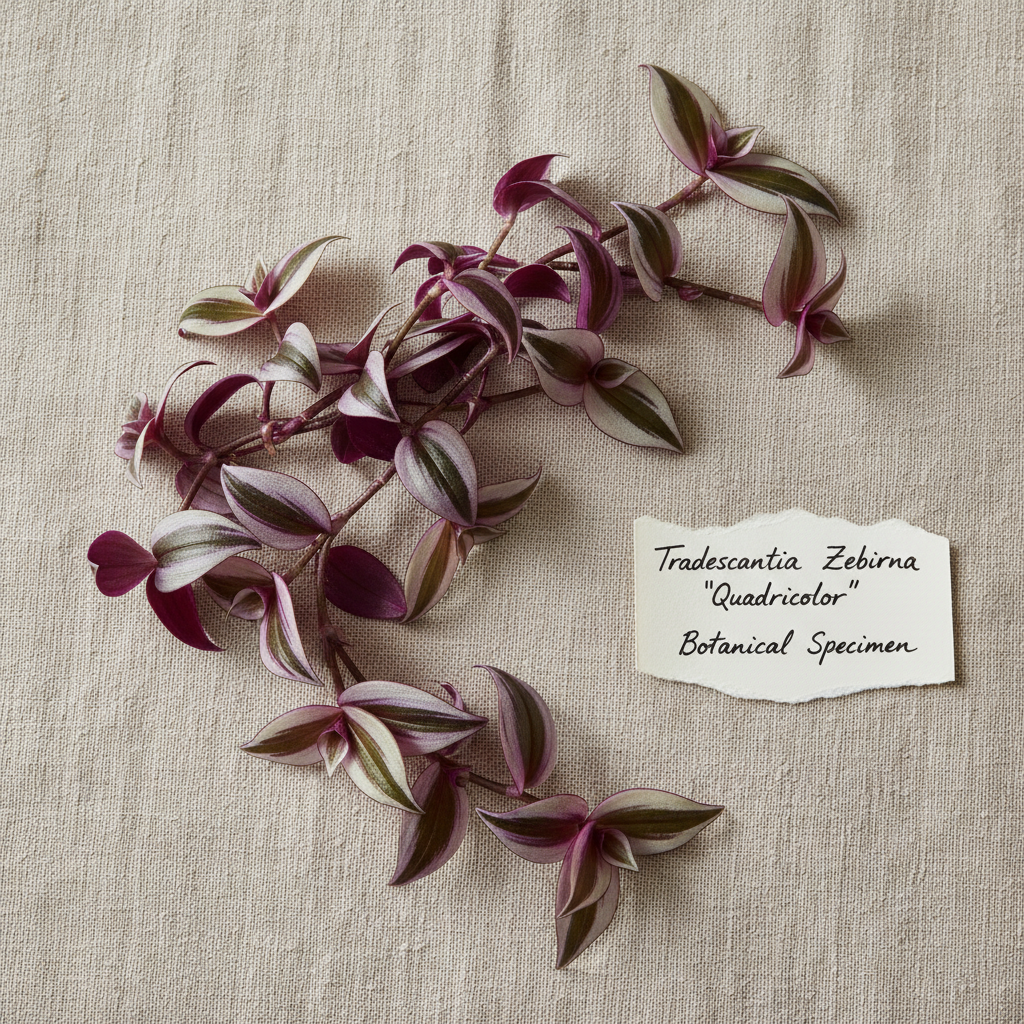
T. zebrina ‘Quadricolor’ — four-tone striping at its best.
‘Quadricolor’ (also sold as ‘Discolor Multicolor’)
The most coveted cultivar in the species. The leaf upper surface carries longitudinal stripes in four distinct tones — bright silver, soft pink, creamy white and deep green — over the standard magenta-purple underside. Each leaf is almost a watercolour painting, and no two are identical. Care is identical to the species but the cultivar holds its colouration only in bright light; in low light the pink and cream stripes fade toward green and the visual signature disappears. Slightly slower-growing and slightly more demanding than the plain species.
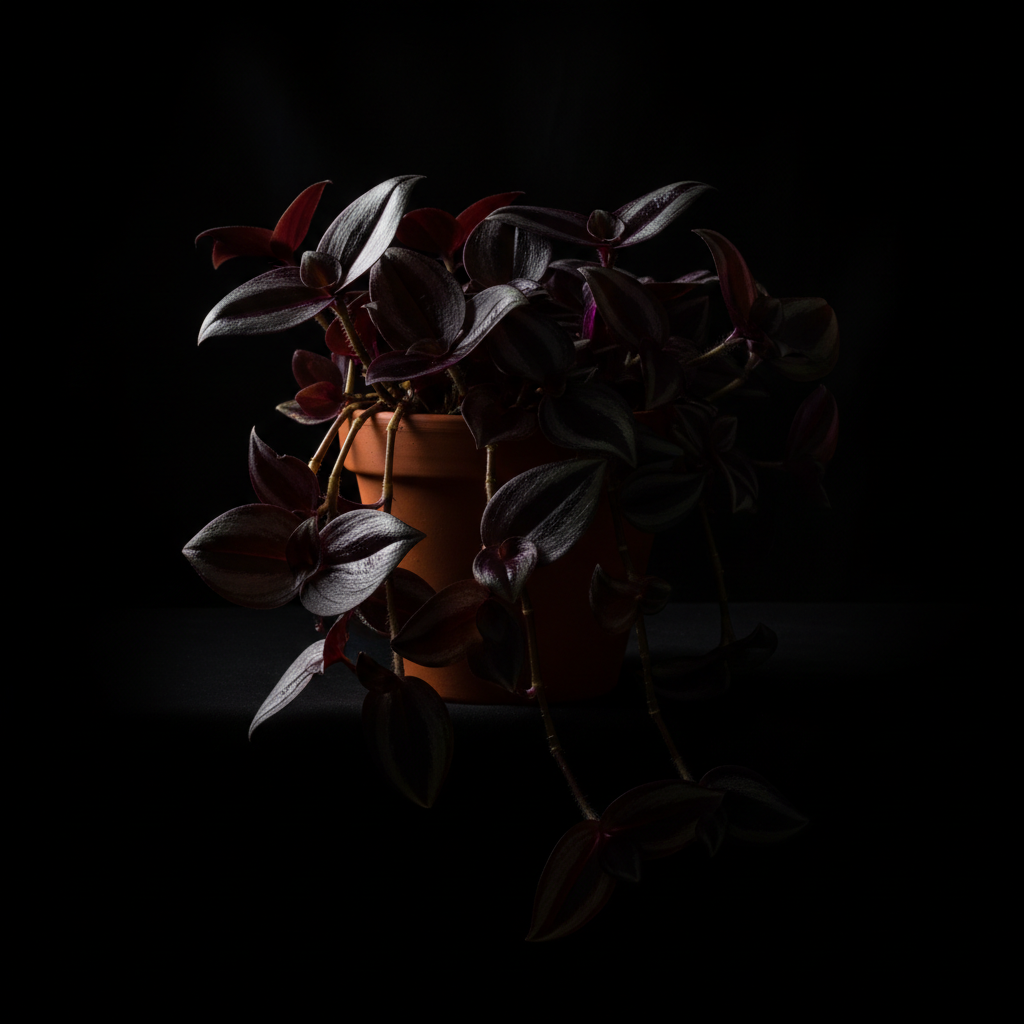
T. zebrina ‘Burgundy’ — colour pushed almost to black under strong light.
‘Burgundy’ (sometimes sold as ‘Deep Purple’ or ‘Purpusii’)
A dramatic cultivar selected for the depth of its purple pigmentation. The leaf upper surface carries the standard silver striping but on a much darker, often nearly black-purple base, and the undersides go a deeper violet than the species. The overall effect is brooding and dramatic, particularly when paired with paler companion plants. Grows as easily as the species and tolerates the same conditions, but the colour is most intense under direct morning sun or under good supplemental lighting.
Other Cultivars Worth Knowing
‘Silver Plus’: A cultivar in which the silver striping is exaggerated to cover most of the upper leaf surface, with only thin green margins remaining. Looks almost metallic in good light. Slightly less vigorous than the species and benefits from extra care in winter.
‘Tikal’: Compact, slightly more upright in habit than the trailing standard, with smaller leaves and tighter internodes. Useful where the long trailing form would not fit.
‘Red Gem’: Another deep-purple selection, slightly different from ‘Burgundy’ in that the silver striping is suppressed and the entire upper leaf surface is uniformly burgundy-red. Striking when grown well; muddy and dull when underlit.
Several other closely related species in the same genus are sometimes confused with T. zebrina — notably Tradescantia fluminensis (inch plant, with plain green leaves and small white flowers), Tradescantia pallida (purple heart, with longer pointed all-purple leaves and pink flowers) and Tradescantia spathacea (Moses-in-the-cradle, much larger upright rosettes). All share the easy-care reputation but each has its own distinct look.
Frequently Asked Questions
Why is my Tradescantia Zebrina losing its purple colour?
Almost always insufficient light. The anthocyanin pigments that produce the magenta-purple underside are triggered by bright light and ultraviolet exposure; in a dim spot the plant cannot afford to invest in pigment production and the colour fades to pale pink or grey-green. Move the plant within a metre of a south, east or west window and the colour will deepen visibly within four to six weeks.
Why does my zebrina look bare and leggy at the base?
This is the natural growth pattern of the species — older lower leaves drop as the stems extend, leaving bare stem topped with fresh foliage. The remedy is regular hard pruning. Cut every stem back to within 8 to 12 cm of the soil at least once a year, and push a few of the cuttings back into the same pot to fill the gap. Within six weeks the plant looks fresh and dense again.
Is Tradescantia Zebrina safe around cats and dogs?
It is mildly toxic. Ingestion typically causes drooling, vomiting and oral irritation in cats and dogs, and the sap is a known skin irritant in some people. Effects are unpleasant but rarely serious. If you have pets that habitually chew foliage, hang the plant out of reach or choose a more pet-safe alternative such as a Boston fern or a parlor palm.
How often should I prune?
At a minimum, one hard cut-back in early spring and a lighter shaping in midsummer. More aggressive growers prune every two to three months year-round, which keeps the plant in continuous show-quality condition and produces a constant supply of cuttings.
Can Tradescantia Zebrina grow outside?
In USDA zones 9 to 11 it grows happily outdoors as a perennial ground cover, where it can become invasive in mild climates — Hawaii, parts of Florida, southern Australia and South Africa all list it as an environmental weed. Elsewhere it makes an excellent summer container plant on a sheltered balcony or patio. Bring it indoors before temperatures drop below 10 degrees Celsius and acclimatise it gradually when moving in either direction to avoid sun shock.
Why are the leaf tips turning brown?
Three common causes. Low humidity is the most frequent, particularly in heated winter rooms — raise ambient moisture with a humidifier or pebble tray. Fluoride or chloramine in tap water can accumulate over time; switch to rainwater or filtered water if your local supply is heavily treated. Excess fertiliser salts in the soil also produce crispy margins; flush the pot thoroughly every few months to leach build-up out.
Does Tradescantia Zebrina flower?
Yes, occasionally. Small three-petalled pink or violet flowers appear in clusters at the stem tips, usually in late spring or summer on a happy, well-lit plant. The flowers are pretty but short-lived (each lasting only a day) and are nowhere near the visual draw of the foliage. Many growers never see them, which says nothing negative about their plants.
My cuttings rooted in water but died after potting up. What went wrong?
Water-formed roots are structurally different from soil roots and need time to adapt after transplanting. Pot up while the water roots are still short (1 to 2 cm), keep the soil consistently moist (not wet) for the first two to three weeks, and place in bright indirect light rather than direct sun. To avoid the transition step altogether, root your cuttings directly in soil from the start.
Why is my zebrina growing slowly even in bright light?
Check temperature first — sustained cool conditions below 15 degrees Celsius slow growth dramatically even in good light. Then check for root issues by tipping the plant out and inspecting the root ball; rotted or congested roots cannot support active growth. Finally, consider whether feeding has been adequate over the past growing season. A combination of warmer placement, fresh soil and resumed fertilising usually restores normal vigour within a month.
Can I grow Tradescantia Zebrina permanently in water?
Yes, and it can look striking — a glass vessel of long trailing stems with visible roots makes a stunning long-term display. Change the water every week or two, add a single drop of liquid fertiliser at quarter strength monthly during the growing season, and provide bright indirect light. Plants grown permanently in water tend to be slightly less vigorous than soil-grown specimens but live indefinitely with this care.