
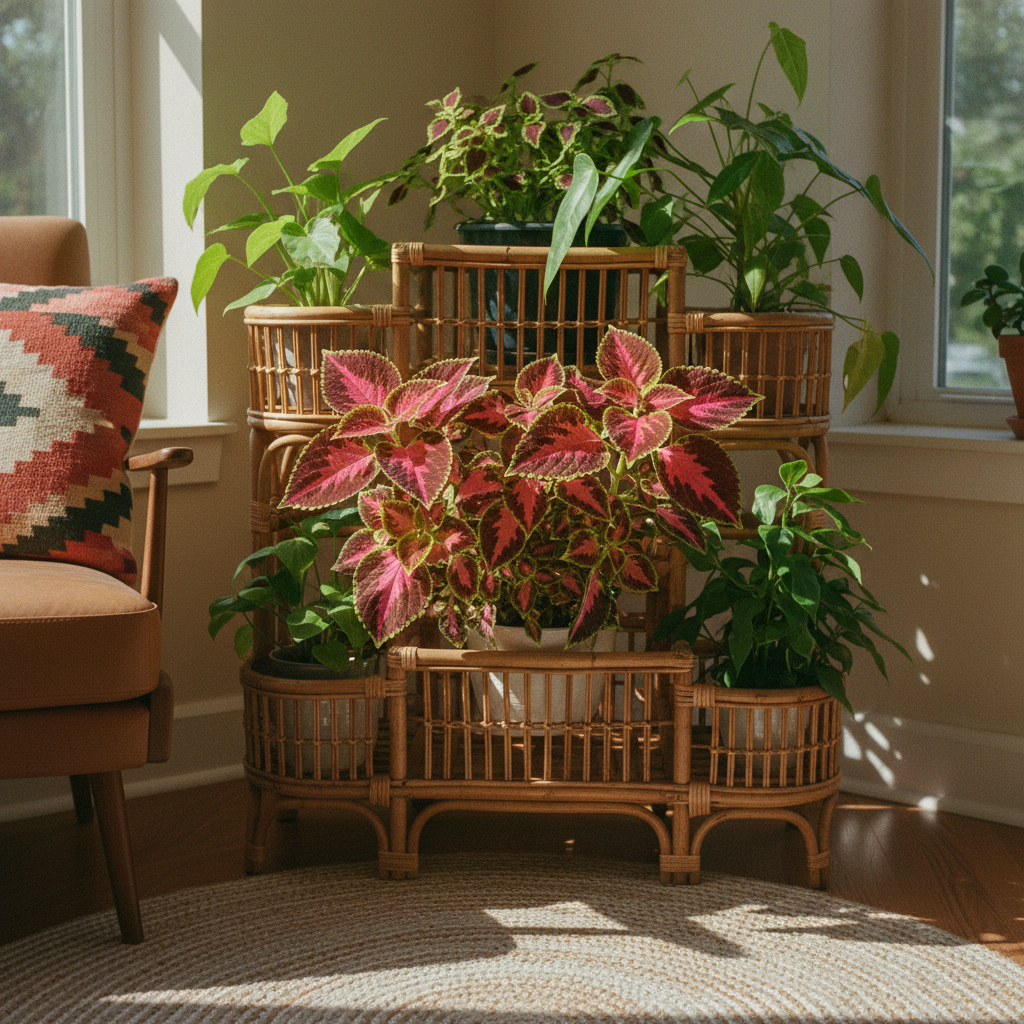
Few houseplants pack as much pigment into a single leaf as coleus. Known botanically as Plectranthus scutellarioides (and for decades wandering through the genera Coleus and Solenostemon before taxonomists settled the matter), this tropical member of the mint family produces foliage in combinations of crimson, magenta, chartreuse, chocolate, copper and near-black that have no real rivals in the indoor world. The common name “painted nettle” hints at both the leaf shape and the squared, mint-like stems, while older British gardeners may still call it “flame nettle” for the obvious reason. Native to Southeast Asia and tropical Africa, coleus has been a fixture of Victorian conservatories since the mid-nineteenth century and a staple of summer bedding schemes ever since, but its real renaissance has come indoors, where modern compact cultivars and the rise of grow-light culture have made year-round container life entirely practical.
The reputation that follows coleus around — easy, fast, cheerful, slightly disposable — is only half deserved. A coleus will indeed survive a stunning range of mistreatment for several months, which is why it is so often grown as an annual and tossed at the end of the season. Getting it to actually thrive indoors year after year, however, requires understanding a few unfussy but non-negotiable preferences: it wants more light than most “easy” houseplants, more water than the average succulent-trained plant parent will offer, and a steady programme of pinching that converts a leggy weed into a dense, sculpted shrub. This guide covers everything from light angles and pinching schedules to overwintering, propagation and the cultivars worth hunting down, with the goal of moving you from keeping coleus alive to growing it well.
Contents
- Quick Reference
- Why Coleus Makes a Rewarding Houseplant
- Light Requirements
- Watering & Humidity
- Soil, Potting & Repotting
- Fertilising
- Propagation
- Pests & Diseases
- Popular Varieties
- Frequently Asked Questions
Quick Reference: Coleus at a Glance
| Botanical name | Plectranthus scutellarioides (syn. Coleus scutellarioides, Solenostemon scutellarioides) |
| Family | Lamiaceae (mint family) |
| Native range | Southeast Asia, Malesia, tropical Africa, Australia and Pacific islands |
| Light | Bright indirect to several hours of gentle direct sun; modern cultivars tolerate full sun outdoors but indoors prefer bright filtered light |
| Watering | Keep soil consistently moist but never waterlogged; water when the top 1 to 2 cm (half an inch) feels dry, often twice a week indoors in summer |
| Temperature | Ideal 18 to 27 degrees Celsius (65 to 80 Fahrenheit); will sulk below 15 degrees Celsius (60 Fahrenheit) and die at the first hint of frost |
| Humidity | Prefers 50 to 70 per cent; tolerates average indoor air but leaves crisp at the edges in very dry rooms |
| Soil | Rich, loose, well-drained potting mix; a peat- or coir-based houseplant blend amended with perlite suits it perfectly |
| Fertiliser | Balanced liquid feed at half strength every two weeks during active growth from spring through early autumn |
| Mature size indoors | 30 to 90 centimetres tall (1 to 3 feet), depending on cultivar and pinching regime |
| Growth rate | Fast; a rooted cutting can become a full plant in eight to twelve weeks |
| Toxicity | Mildly toxic to cats, dogs and horses; the volatile oils can cause vomiting, drooling and skin irritation. Generally considered non-toxic to humans, but the sap may irritate sensitive skin |
| Lifespan | Tender perennial; commonly grown as an annual but lives for several years indoors with proper care |
Why Coleus Makes a Rewarding Houseplant
The single most compelling argument for coleus indoors is the foliage. While most houseplants offer one variation on green, coleus produces a leaf surface that reads more like printed velvet than living tissue, with sharp boundaries between contrasting pigments and a finish that ranges from matte to satin depending on the cultivar. Breeders have pushed the colour range so far that catalogues now list cultivars in true black-purple, neon chartreuse, pumpkin orange, salmon pink, raspberry and combinations of all five in a single leaf. Because the colour lives in the leaves rather than in short-lived flowers, the display is uninterrupted from the moment the plant takes off in spring until you decide to pinch back the flower spikes in late autumn.

Beyond the visual case, coleus rewards intervention in a way that more meditative houseplants do not. A neglected pothos will keep trailing politely; a neglected coleus will become a tall, weak-stemmed mess in a matter of weeks. But a coleus that is pinched, fed and turned with a little attention will roughly double in volume every couple of months during the growing season and reward you with the satisfaction of a plant that visibly responds to care. This makes it a particularly good choice for people who want to feel they are gardening, even when the garden is a 30-centimetre pot on a kitchen table. The plant is also generous to a fault with propagation, rooting from cuttings in a glass of water with such reliability that one healthy specimen can become a dozen within a season, making it an unusually low-stakes plant for beginners learning how to read leaves and adjust care.
There are real trade-offs, of course. Coleus is short-lived by tropical-perennial standards, with most home-grown specimens declining after two or three years even with good care. It cannot tolerate cold and will collapse if left near a freezing draught. It blooms readily, and once flowering begins the plant diverts energy from leaf production and starts to thin out, so most growers pinch the flower spikes off as soon as they form. None of these is a deal-breaker, but together they mean coleus is a plant you garden with rather than a plant you live alongside passively.
Important — Toxicity: Coleus contains essential oils, including diterpenoids, that can cause vomiting, diarrhoea and excessive drooling in cats, dogs and horses if eaten. The fresh sap may also irritate sensitive skin in humans. If you keep coleus in a home with curious pets or small children, place it on a shelf out of reach and wear gloves when taking and trimming cuttings.
Light Requirements
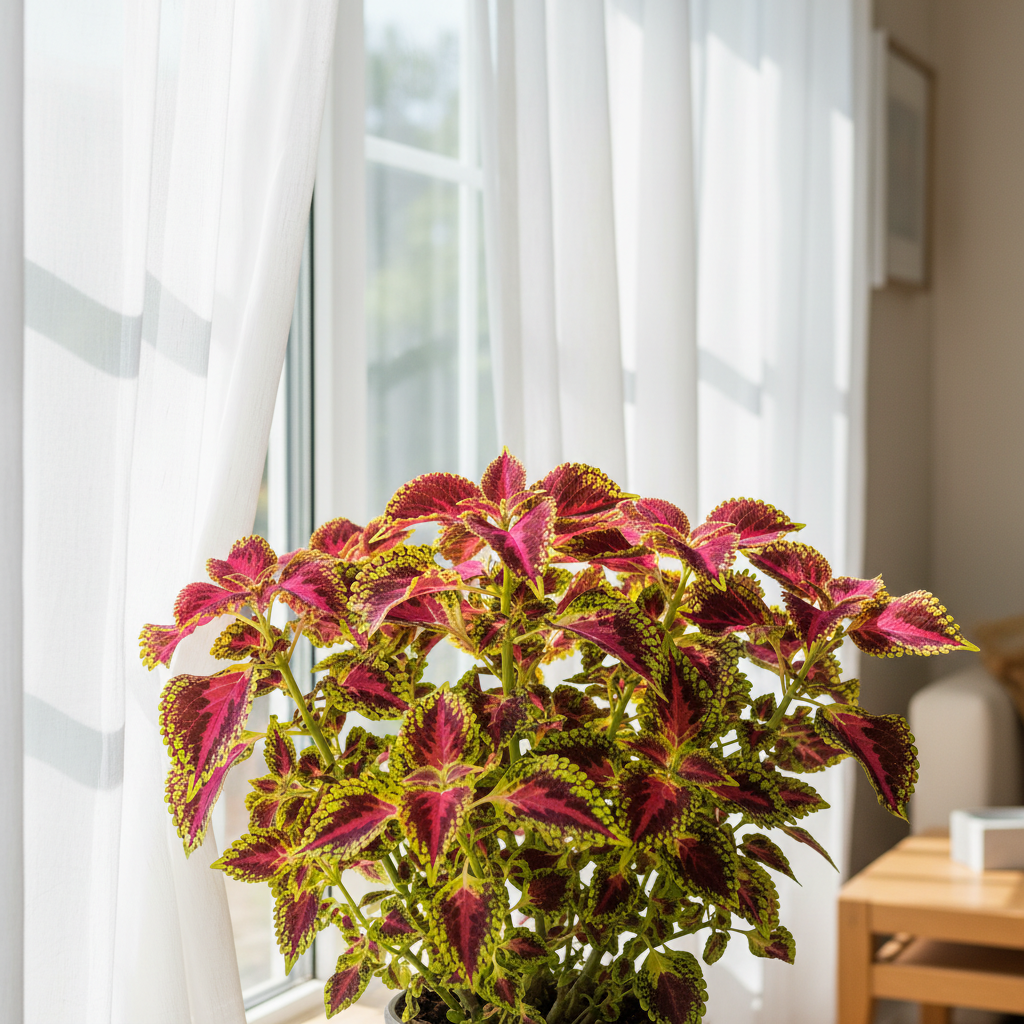
Light is the variable that most often decides whether a coleus thrives or stretches. Indoor coleus wants what gardeners call high light: very bright indirect illumination for most of the day, ideally with a couple of hours of gentle direct sun at the beginning or end of the day. The exact threshold depends on the cultivar, because modern breeding has produced two camps. Older “shade coleus” types, with thin leaves and lurid colour combinations, scorch in midday sun and were bred for the partly shaded borders of the Victorian garden. Newer sun-tolerant series such as ‘Wizard’, ‘ColorBlaze’, ‘Main Street’ and the ‘Premium Sun’ line have thicker leaves and richer pigment under direct light, and many will grow outdoors in full sun all summer. Indoors, both groups behave more similarly, because even a south-facing window delivers far less light than the open sky.
The ideal indoor placement for almost any coleus is within a metre of a large window that gets bright light for most of the day. East- and west-facing windows tend to deliver the right balance of intensity and gentleness; south-facing windows are excellent in autumn and winter but may need a sheer curtain in summer; north-facing windows are usable for shade-bred cultivars but will produce leggier, paler plants. If a coleus produces large, well-spaced internodes and leaves that look bleached or oddly pale, it is reaching for light. If it stays compact, with short gaps between leaf pairs and richly saturated colour, the light level is correct.
Light Levels Explained
Indoor light is usually classified into five informal tiers. The table below sets out what each tier means in practice and how coleus typically responds.
| Light Category | Approx. Level (lux) | Typical Location | Outcome for Coleus |
|---|---|---|---|
| Direct sun | 10,000 to 50,000+ | Within 30 cm of an unobstructed south or west window | Excellent for sun-tolerant cultivars; risk of scorch on old shade types, especially in summer |
| Bright indirect | 2,500 to 10,000 | Within 1 m of a large east, west or curtained south window | Ideal for almost all cultivars; richest colour and tightest internodes |
| Medium | 800 to 2,500 | 2 to 3 m from a bright window, or beside a north window | Plant survives but stretches noticeably; colours dilute and stems weaken |
| Low | 200 to 800 | Across the room from any window, in a shaded corner | Slow decline; leggy growth, leaf drop and washed-out colour within weeks |
| Very low | Below 200 | Interior bathrooms, hallways without windows | Not survivable long term without supplemental lighting |
Window Orientation and Placement
South-facing window: The most productive position in the Northern Hemisphere from autumn through spring. In summer, a sheer curtain or a setback of half a metre prevents leaf scorch on hot afternoons. South light brings out the strongest contrasts in bicoloured cultivars.
East-facing window: Often the single best year-round position. Coleus receives a few hours of gentle morning sun followed by bright indirect light for the rest of the day, with little risk of overheating. Pigments stay saturated and growth is even.
West-facing window: Similar in quality to east, but the direct sun arrives in the afternoon when air temperatures are higher, which can stress the plant in summer. Excellent in winter; useful in summer with a light curtain.
North-facing window: Workable only for compact, shade-bred cultivars and only if the plant sits right on the sill. Expect slower growth, longer internodes and somewhat muted colour, and consider supplementing with a small grow-light during the dark half of the year.
Pro Tip — Rotate Every Watering: Coleus reaches actively toward the brightest light source. Give the pot a quarter turn each time you water and the plant will grow as a symmetrical mound rather than a one-sided lean.
How Light Affects Leaf Colour
The pigments responsible for coleus colour are anthocyanins (the reds, purples and burgundies) and carotenoids (the yellows, oranges and chartreuses), overlaid on a base of chlorophyll. Anthocyanins are produced partly in response to bright light, so the same cultivar grown in full sun will often show deeper, almost black-burgundy tones, while the shaded version of the same plant looks bronzy or muddy. Chartreuse and lime-green portions can do the reverse: in very intense light they may bleach toward yellow-white, while in moderate light they hold a richer chartreuse. The practical takeaway is that you can fine-tune the colour of a coleus by adjusting its distance from the window. Move it closer to push the burgundies and crimsons deeper; pull it back if the bright margins are bleaching out.
Warning — Direct Sunlight: A coleus that has been grown indoors in indirect light cannot be moved straight into full summer sun. The leaves will scorch within hours, leaving papery brown patches that do not recover. If you want to move a plant outdoors for the summer, acclimatise it over seven to ten days by gradually increasing direct exposure each day, starting with an hour of morning sun.
Artificial Lighting
Coleus responds extremely well to full-spectrum LED grow-lights, which is why it has become a popular plant for under-shelf and tabletop grow setups. A modest 20- to 40-watt full-spectrum LED placed 25 to 40 centimetres above the canopy for 12 to 14 hours a day will keep a coleus in tight, vivid condition all winter, even in a room with no usable natural light. Stick to white-light or balanced spectrum panels rather than the magenta-only “blurple” types if the plant is in a living space, since the magenta cast destroys the very colour you are growing the plant for. For supplementing a windowsill rather than replacing it, four to six hours of grow-light in the evening is usually enough during the short days of midwinter.
Seasonal Adjustments
The dramatic difference between summer and winter day length matters more for coleus than for most houseplants, because the plant is a fast-growing tropical annual in its native habitat and slows dramatically when light drops. Through autumn and winter, expect growth to slow, internodes to lengthen and colour to dull even with no other change in care. Compensate by moving the pot to the brightest available window, reducing watering frequency to match the slower pace, and resisting the urge to feed during these months. As days lengthen in late winter, growth restarts on its own; this is also the natural moment to take fresh cuttings and start a new generation.
Watering & Humidity
Coleus is one of the thirstier houseplants in common cultivation. Unlike succulent-adjacent plants that prefer to dry out completely between waterings, coleus wants its substrate to remain evenly moist throughout the growing season, with only the very top layer drying between drinks. A coleus that goes dry to the core will wilt dramatically and quickly, with the soft stems collapsing into a sad puddle in a matter of hours. The good news is that this same softness makes the plant unusually communicative: a wilted coleus will perk up almost completely within an hour of a thorough watering, and learning to read its mild early-droop signal is a fast track to confident watering judgement.
How to Water
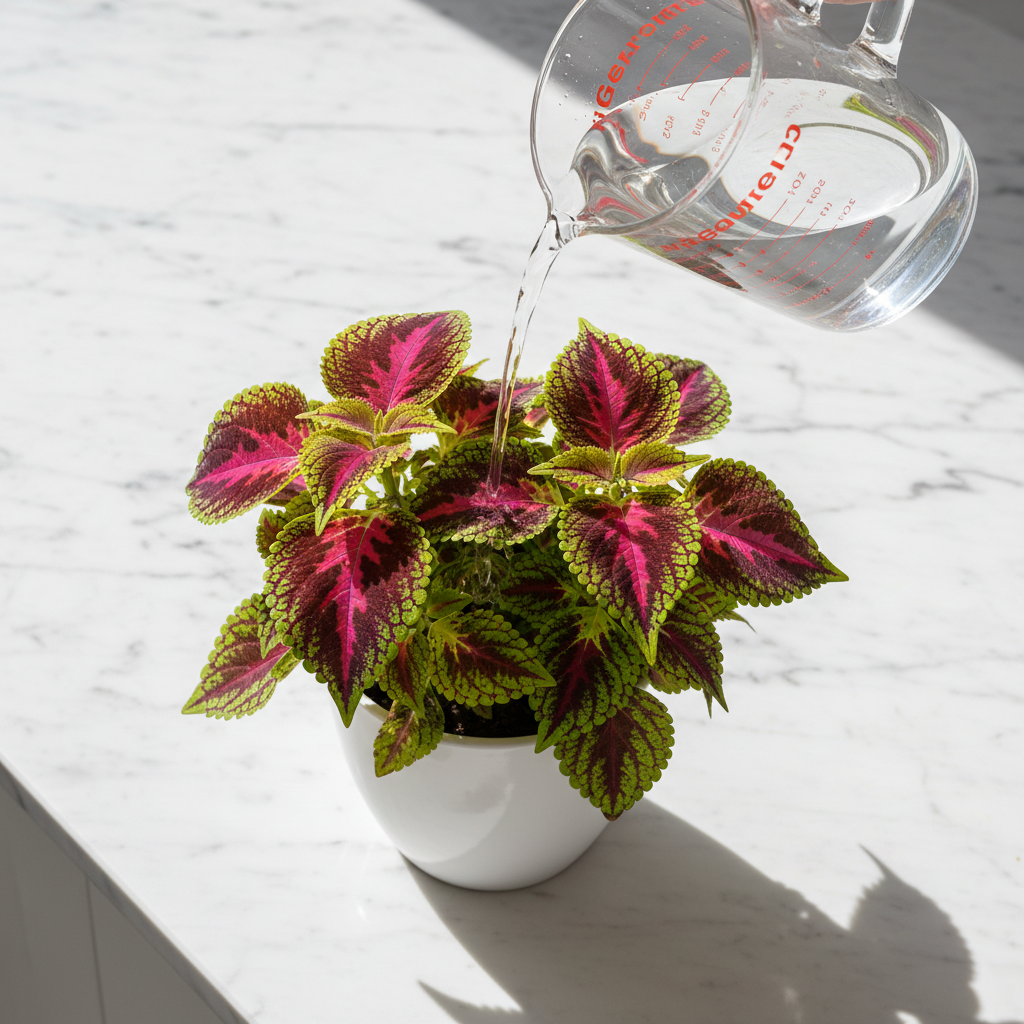
The most reliable method is the same as for any thirsty houseplant: water thoroughly when the top 1 to 2 centimetres (about half an inch) of substrate feels dry to the touch, then let any excess drain freely and discard whatever collects in the saucer. Indoors, in a bright spot in summer, this typically works out to two waterings a week for a plant in a 15-centimetre (6-inch) pot, dropping to once a week or less in winter. The schedule will vary so much with pot size, substrate, temperature and light that no fixed routine will serve you well; the finger test, or a wooden skewer pushed to the bottom of the pot and pulled out to check for moisture, is more reliable than the calendar.
Water Quality
Coleus is not as fussy as a calathea about water quality, but it is sensitive to chronic accumulation of dissolved salts. Hard tap water, softened water and water with high chloramine content can over time produce crispy brown leaf tips and a tide-line of white residue on the soil surface. If you live in a hard-water area, use filtered or rain water where convenient, or flush the pot thoroughly with several volumes of plain water once a month to wash accumulated salts out through the drainage holes. Room-temperature water is preferable; very cold water from the tap can shock the roots of an already-stressed plant.
Signs of Over- and Underwatering
| Symptom | Likely Cause | Action |
|---|---|---|
| Sudden whole-plant wilt, soil dry, leaves still firm to the touch | Underwatering | Water thoroughly; bottom-water in a basin for 20 minutes if the rootball has shrunk away from the pot wall |
| Slow droop, soil still wet, lower leaves yellowing | Overwatering, possibly early root rot | Stop watering, improve drainage, check roots, repot into fresh mix if rot is present |
| Crispy brown leaf tips and edges | Low humidity, salt buildup or chronic underwatering | Flush the pot, raise humidity, water more consistently |
| Soft, mushy stems near the base | Stem rot from sitting in waterlogged soil | Cut the plant down to the lowest healthy growth and root the cuttings; discard the rotted base |
| Pale, washed-out leaves with otherwise normal soil moisture | Light deficiency, not a water issue | Move closer to a brighter window |
Humidity
As a plant of the wet tropics, coleus prefers ambient humidity in the 50 to 70 per cent range. Most homes fall well below this, particularly in winter when central heating drops indoor humidity to 25 or 30 per cent. Coleus tolerates dry air better than calatheas or ferns, but the leaf margins will go crisp and the lower leaves will drop faster in arid conditions. A small ultrasonic humidifier near the plant during winter, grouping it with other plants, or placing the pot on a tray of damp pebbles will all push humidity up by ten to twenty points and visibly improve the plant. Misting is largely cosmetic and provides only fleeting humidity, but it can help dislodge dust and discourage spider mites if done in the morning so the leaves dry by evening.
Temperature
The ideal indoor temperature range for coleus is 18 to 27 degrees Celsius (65 to 80 Fahrenheit), with reasonable tolerance up to 30 degrees Celsius (86 Fahrenheit) provided humidity is adequate and the soil is moist. Below 15 degrees Celsius (60 Fahrenheit) growth stalls and lower leaves may drop; at 10 degrees Celsius (50 Fahrenheit) the plant suffers visible chilling injury, with limp dark-edged leaves; at freezing it dies outright. Keep coleus away from draughty windows in winter and from the direct blast of air-conditioning vents in summer, both of which can cause sudden leaf drop.
Soil, Potting & Repotting
Coleus is not particular about substrate as long as two requirements are met: the mix retains moisture between waterings, and it drains freely enough that the roots never sit in standing water. A standard peat- or coir-based houseplant compost amended with around twenty per cent perlite by volume hits this brief almost perfectly. The perlite opens up the structure so excess water moves through quickly, while the coir or peat holds enough moisture to keep the rootball evenly damp for several days between drinks. Avoid pure cactus mix at one extreme (drains too fast for this thirsty plant) and pure peat or compost at the other (compacts and stays sodden in a closed pot).
A Simple Coleus Mix Recipe
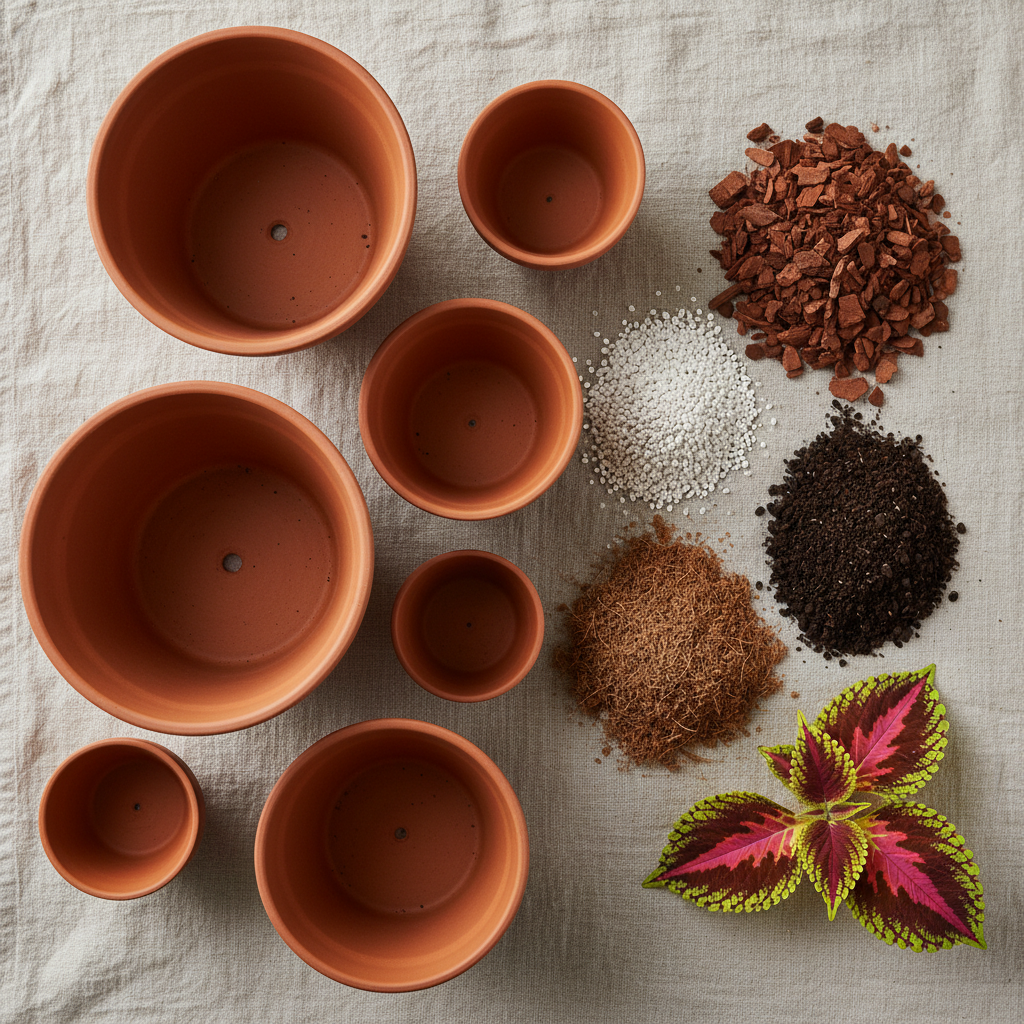
- Five parts standard peat- or coir-based houseplant compost (the base, providing moisture retention and gentle fertility).
- Two parts coarse perlite (the drainage and aeration component).
- One part fine orchid bark (improves long-term structure and resists compaction).
- One part sieved worm castings or well-rotted leaf mould (provides slow background nutrition for the first few months).
Mix the ingredients dry in a tub before potting, then moisten with warm water until the mix holds together when squeezed but releases easily when poked. This recipe drains well, holds moisture sensibly and feeds the plant gently for several months without supplementary fertiliser.
Pot Choice
Any pot with drainage holes will work, but the material affects how often you will need to water. Terracotta breathes and dries the rootball quickly, which suits coleus only if you are committed to regular watering during summer; glazed ceramic or plastic holds moisture longer and is more forgiving of an absent-minded plant parent. Pot size should be modest: coleus prefers a pot just slightly larger than its rootball, because oversized pots stay wet between waterings and invite root rot. A 15-centimetre (6-inch) pot suits a typical bushy specimen; only the very largest cultivars like the ‘Kong’ series eventually need a 20- to 25-centimetre (8- to 10-inch) container.
When and How to Repot
Coleus grows fast enough that a vigorously growing plant may fill its pot in a single season. Signs that repotting is due include water running straight through the pot, roots circling the bottom or emerging from the drainage holes, and a plant that wilts within a day or two of watering even in moderate conditions. The best time to repot is early spring, just as growth restarts, but any time during the active growing season is acceptable.
- Choose a pot one size larger than the current one, with drainage holes.
- Add a layer of fresh mix in the bottom so the rootball will sit at the same depth as before.
- Tip the plant out, support the rootball with one hand, and tease apart any tightly circling roots at the base.
- Set the rootball in the new pot, fill around the sides with fresh mix, and firm gently with the fingers (not the palms — coleus stems are brittle).
- Water thoroughly until water runs from the drainage holes, and place the freshly repotted plant out of direct sun for two or three days to recover.
Pro Tip — Repot After Pinching: Combine your annual repot with a hard pinch that removes the top third of the plant. The reduced canopy puts less demand on the freshly disturbed roots, the plant recovers in days, and the cuttings make a free stockpile of replacement plants.
Fertilising
A coleus growing in good light produces a remarkable volume of leaf tissue in a short season, and this comes at a real nutritional cost. Without supplementary feeding, even a plant in fresh enriched compost will start to look pale and slow-growing by midsummer, with the lower leaves yellowing as the plant cannibalises them for nitrogen to push new growth at the tips. A simple, regular feeding programme avoids this entirely and is the single biggest lever for producing the lush, dense, deeply coloured plants seen in commercial growers’ photographs.
What to Use
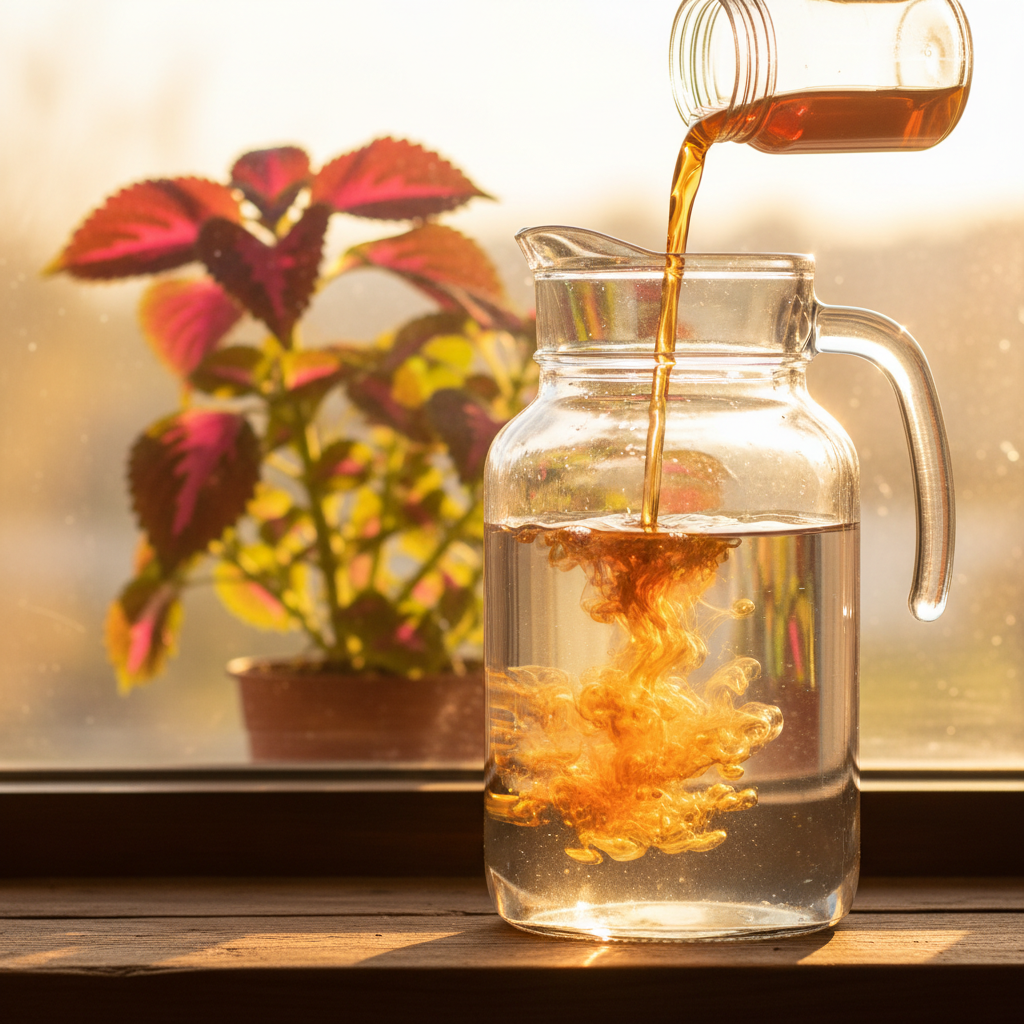
A balanced liquid fertiliser with an NPK ratio close to 10-10-10 or 20-20-20, diluted to half the manufacturer’s recommended strength, suits coleus well throughout the growing season. The temptation to reach for a high-nitrogen “foliage” formula is best resisted: too much nitrogen produces enormous, soft leaves that lose colour intensity and become magnets for sap-sucking pests. A balanced feed, in contrast, supports steady growth while letting the plant maintain the pigment concentrations that make coleus worth growing in the first place. Organic options such as worm-casting tea, dilute fish emulsion or seaweed concentrate work equally well, with the bonus of providing trace elements and supporting soil microbiology.
How Often
For indoor coleus, feed every two weeks at half strength from early spring through to early autumn, then stop feeding entirely from mid-autumn through to late winter. The plant cannot use the additional nutrients during the low-light months and unused fertiliser salts accumulate in the soil, eventually burning the roots. An alternative that suits people who prefer a less rigid schedule is a very dilute “weakly weekly” approach: a quarter-strength dose with every other watering, never below this dilution. Whichever you choose, always water the pot first with plain water if the substrate has become very dry, then apply the diluted feed; fertiliser applied to bone-dry roots can scorch the fine root hairs.
Slow-Release vs Liquid
Slow-release granular fertilisers work for outdoor coleus in large containers but are less suitable indoors, where the warmer, more constant pot temperature can release nutrients faster than the manufacturer’s chart predicts and lead to a slow buildup of salts. Liquid feed gives you finer control. If you do prefer a granular product, choose one with a stated indoor formulation and apply at three-quarters of the recommended rate to compensate for warmer indoor pot temperatures.
Warning — Salt Buildup: White crusts on the soil surface or on the pot rim are a sign that fertiliser salts have accumulated to a level that is starting to damage the roots. Flush the pot by watering thoroughly with plain water three times in succession, letting each drain completely, and resume feeding only when fresh growth resumes. A monthly flush during the feeding season prevents the problem.
Propagation
Few houseplants propagate as cheerfully as coleus. Cuttings root with such reliability that a determined grower can turn a single 90-centimetre plant into more than a hundred new specimens in the course of a year. There are three practical methods to choose between: water rooting in a glass jar, direct rooting in damp substrate under a humidity dome, and growing from seed. Cuttings reproduce a cultivar exactly; seed produces a genetic lottery that may or may not resemble the parent plant.
Stem Cuttings in Substrate
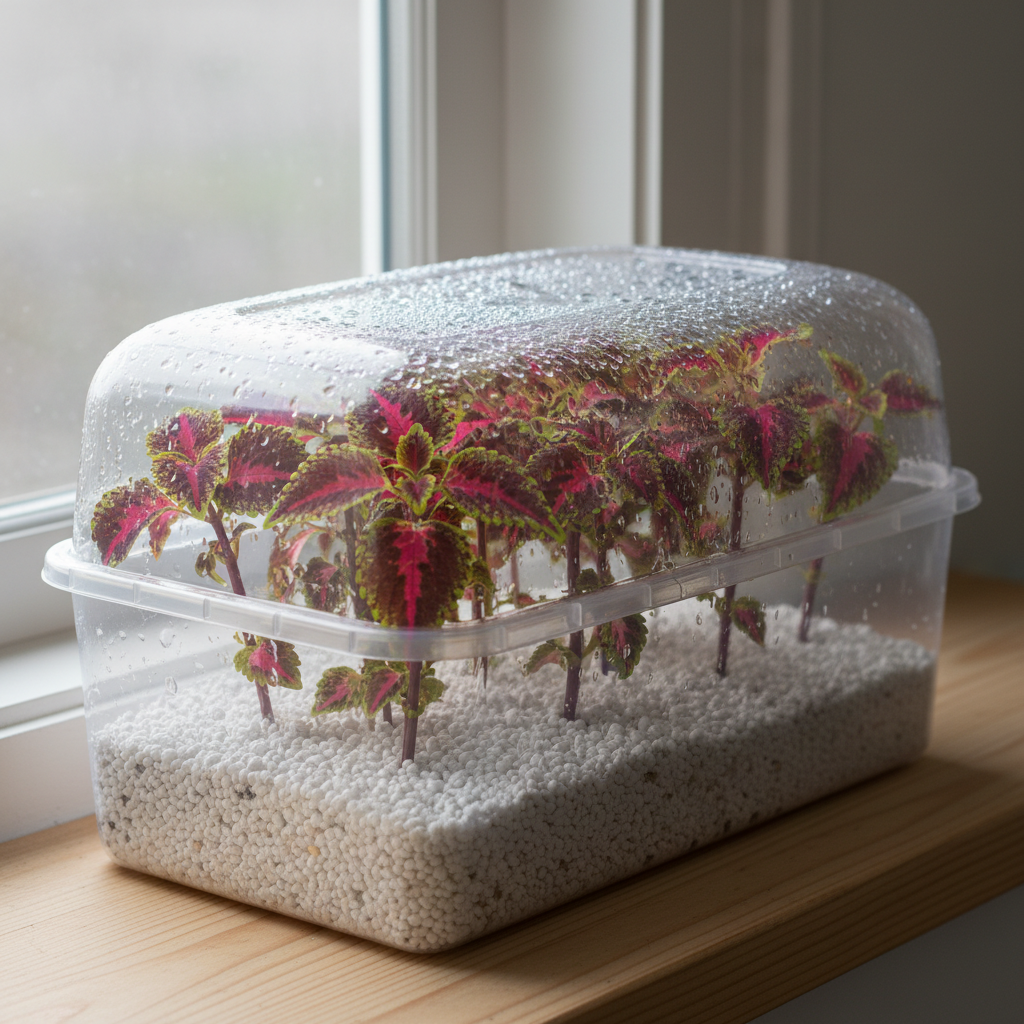
Substrate rooting under a humidity dome produces the most robust young plants, because the cuttings develop fibrous root systems adapted to soil rather than the brittle water roots that have to transition when potted up.
- Take 8- to 12-centimetre (3- to 5-inch) tip cuttings from healthy, non-flowering stems just below a leaf node, using sterilised scissors or a sharp blade.
- Strip the lower one or two pairs of leaves from each cutting, leaving at least two pairs of healthy leaves at the top. Pinch off any flower buds.
- Optionally dip the cut end in rooting hormone powder, though coleus roots so readily that this rarely makes a practical difference.
- Insert the cuttings into a shallow tray of moistened perlite or a fifty-fifty perlite and coir mix, deep enough that the lowest exposed node is buried.
- Cover with a clear plastic dome, a propagator lid or an inverted clear container to maintain high humidity, and place in bright indirect light at room temperature.
- Vent the dome for a few minutes every day or two to prevent fungal growth. Roots typically appear within seven to fourteen days.
- Once new top growth resumes, pot each rooted cutting into its own 9- to 12-centimetre (3.5- to 5-inch) pot of regular coleus mix.
Water Rooting
Water rooting is the easiest method to monitor and a perfect first project for new propagators or curious children. Take cuttings as above, strip the lower leaves, and stand the bare stems in a glass jar of room-temperature water on a bright windowsill, with the leaves clear of the waterline. Change the water every three or four days to keep it fresh and oxygenated. White roots should appear within a week, and within two to three weeks each cutting will have a small mass of roots a few centimetres long. Pot the rooted cuttings up at this stage; if left in water too long, the brittle water roots break easily during planting and the transition shocks the plant.
Growing from Seed
Coleus seed is widely available in mixed-colour packets and is the cheapest way to produce a large quantity of plants, but most named cultivars do not come true from seed. Sow on the surface of a moist seed-starting mix in late winter, press lightly without covering (the seed needs light to germinate), keep at 21 to 24 degrees Celsius (70 to 75 Fahrenheit) under a clear cover, and expect germination within seven to fourteen days. Prick out the seedlings into individual cells once they have two pairs of true leaves, and grow on under bright light. Expect a fascinating mix of leaf shapes and colour combinations, almost none of which will match the picture on the packet exactly.
Pinching and Shaping
Whatever your propagation method, the secret to a full, bushy coleus is regular pinching of the growing tips. Each time you remove the top pair of leaves above a node, the plant responds by sending out two new shoots from the leaf axils just below. Pinch a young plant for the first time when it has four to six pairs of leaves, then again every three or four weeks during the growing season. The discarded tips, of course, are perfect cuttings, so pinching simultaneously shapes the parent and provides next year’s stock.
Pro Tip — Always Pinch Flower Spikes: When coleus starts to produce its tall, pale-blue flower spikes, the plant treats this as the end of its productive cycle and slows leaf production accordingly. Pinch off the flower spikes as soon as you see them forming and the plant will keep pushing fresh foliage. Only allow flowering if you specifically want to collect seed and accept the decline that follows.
Pests & Diseases
The soft, sappy leaves and high nitrogen levels that make coleus so visually appealing also make it unusually attractive to sap-sucking insects. Most problems are easy to head off with regular inspection and quick action, but a coleus left unchecked in a warm room is one of the fastest plants to become overrun in an indoor collection. Inspect new growth, leaf undersides and the leaf axils weekly during the growing season, and isolate any new plant brought into the home for at least two weeks before placing it with the rest of your collection.
Common Pests
| Pest | What to Look For | Treatment |
|---|---|---|
| Mealybugs | White cottony masses in leaf axils and along stems, sticky honeydew on lower leaves | Dab each insect with a cotton bud dipped in 70 per cent isopropyl alcohol; follow with weekly insecticidal soap sprays until clear |
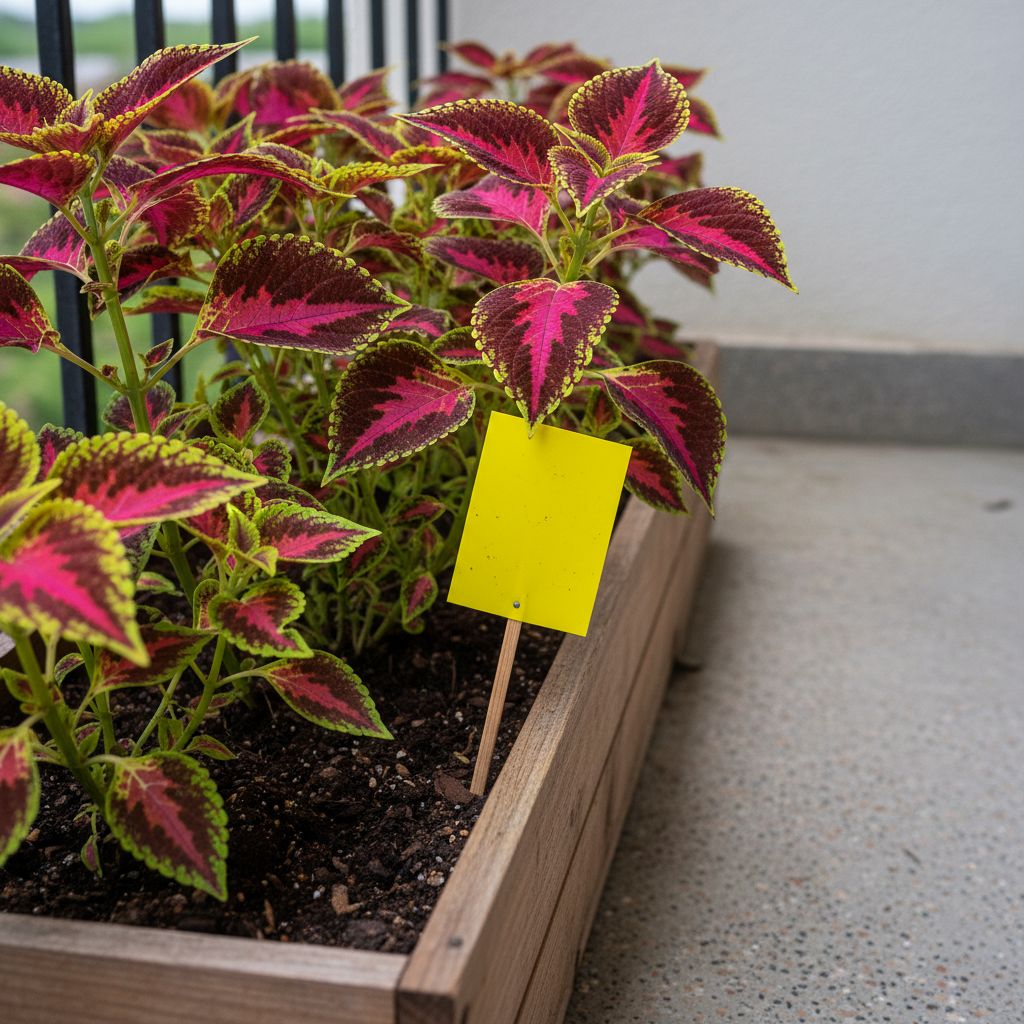
| Whitefly | Tiny white moth-like insects rising in clouds when leaves are disturbed; yellowing leaves and honeydew | Yellow sticky traps, repeated insecticidal soap or neem oil applications every five to seven days; quarantine the plant |
| Spider mites | Fine speckling on upper leaf surfaces, wispy webbing in leaf joints, leaves bronzing and dropping | Shower the plant thoroughly, raise humidity, and apply a miticidal soap or neem treatment three times at five-day intervals |
| Aphids | Soft green or black clusters on new growth and flower stems, distorted young leaves | Wipe off with a damp cloth, follow with a strong jet of water, then insecticidal soap if numbers persist |
| Fungus gnats | Small dark flies hovering around the soil surface; larvae in the top few centimetres of substrate | Let the soil surface dry between waterings, add a layer of horticultural sand or grit, use yellow sticky traps and biological control with Bacillus thuringiensis israelensis |
| Thrips | Silvery streaks and tiny black dots on the leaf surface; pale, distorted young leaves | Blue or yellow sticky traps, repeated insecticidal soap or spinosad treatments; remove the worst-affected leaves |
Common Diseases
Downy mildew: The single most serious disease of coleus, caused by the oomycete Peronospora belbahrii. Symptoms include yellow blotches on the upper leaf surface with greyish or purplish fuzzy growth on the underside, followed by leaf drop and eventual collapse. The pathogen thrives in cool, humid conditions and is difficult to treat once established. Improve air circulation, avoid wetting the foliage, remove infected leaves promptly and bag them for disposal. Severely affected plants should be discarded entirely, as the spores travel easily through an indoor collection.
Stem and root rot: Caused by overwatering, poor drainage or fungal pathogens including Pythium and Rhizoctonia. Symptoms are sudden wilting that does not respond to watering, blackened stem bases and a sour smell from the soil. Salvage what you can by taking healthy tip cuttings from the upper portion of the plant and discarding the rotted base and contaminated substrate.
Botrytis (grey mould): A fuzzy grey-brown growth on damaged leaves and stems, especially in cool, damp, still air. Improve ventilation, remove affected tissue with sterilised scissors and avoid watering late in the day.
Prevention
Most pest and disease problems on coleus can be prevented with three simple habits: inspect new plants in quarantine for two to three weeks before introducing them to your collection; maintain good air circulation around plants and avoid overcrowded benches; and water at the base of the plant rather than over the foliage. Wiping the leaves gently with a damp microfibre cloth once a month removes dust, disturbs early pest colonies and gives you a chance to spot trouble while it is still containable.
Popular Varieties
The cultivar list for coleus runs to thousands and grows every year, with breeders working in two broad directions: ever-larger leaves with deeper, more saturated colour for statement specimens, and ever-more-compact, sun-tolerant plants for bedding and containers. Below are two of the most distinctive cultivars worth seeking out, followed by a quick tour of the popular series most often available from garden centres.
‘Kong Red’
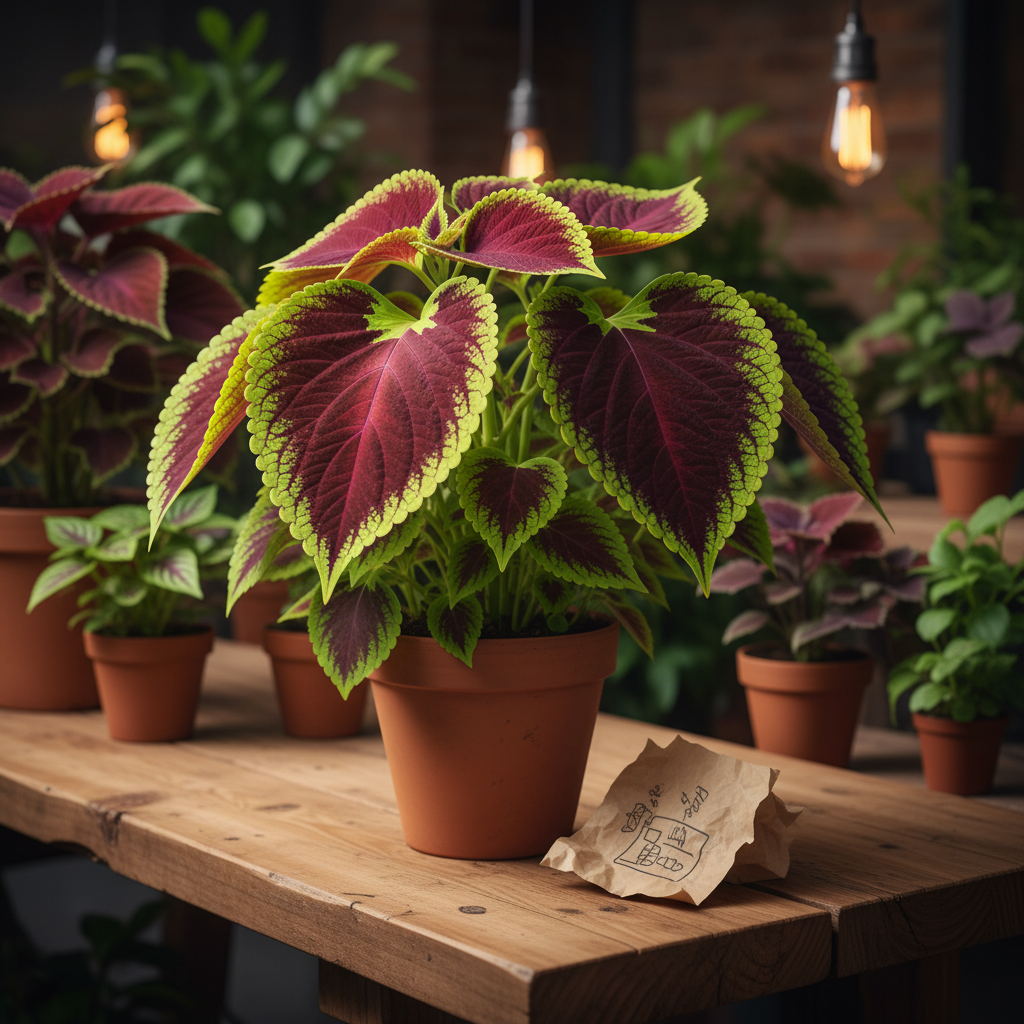
Part of the famous ‘Kong’ series, this cultivar is the closest coleus comes to a true houseplant statement piece. The leaves are enormous — easily 15 centimetres (6 inches) across on a mature specimen — with deep wine-red centres framed by a wide, bright chartreuse-green margin and a thin dark purple outermost edge. Unlike most coleus, the ‘Kong’ series was bred specifically for shade, which makes it one of the few cultivars that performs reliably in lower light indoors. Mature plants reach 50 to 60 centimetres tall and equally wide, so give it room.
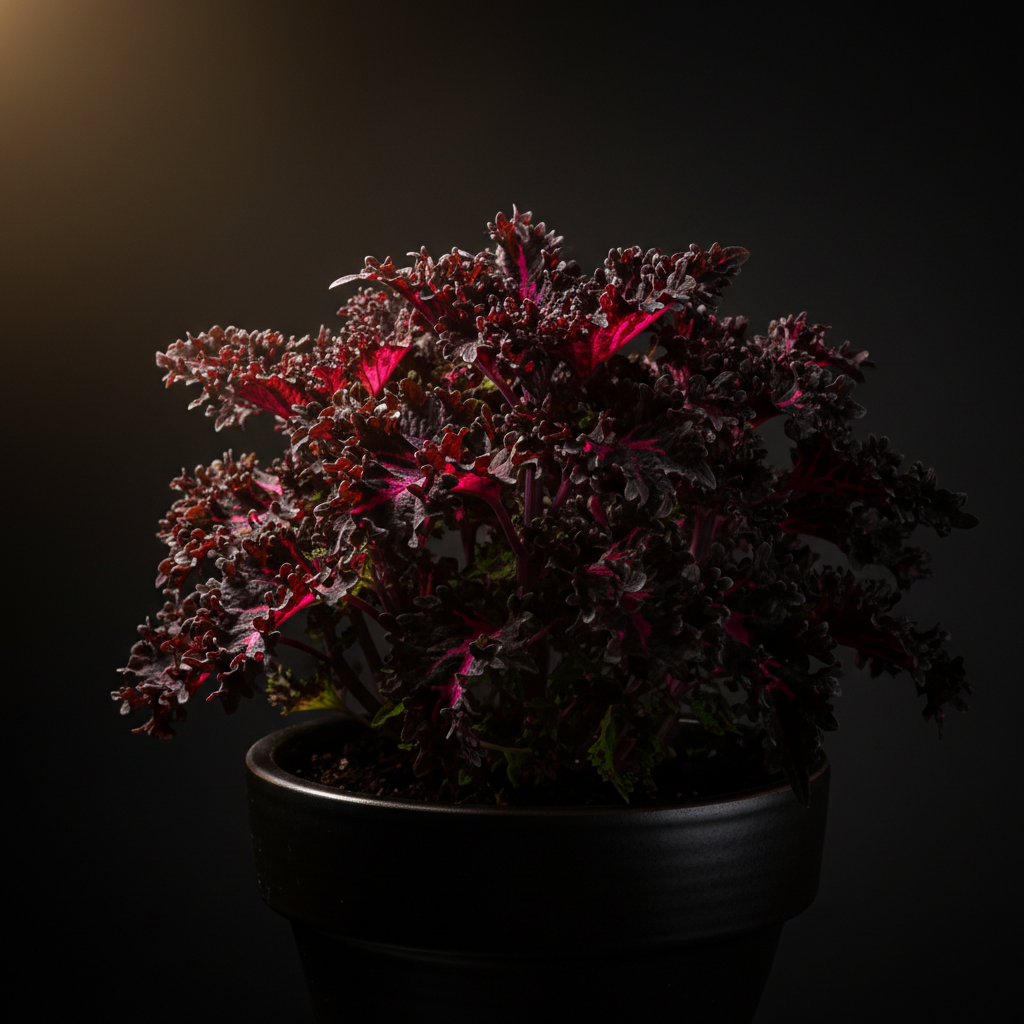
‘Black Dragon’
One of the oldest cultivars still in cultivation and still one of the most striking, ‘Black Dragon’ produces deeply ruffled, frilled and curled foliage in near-black aubergine purple, with the leaf undersides and venation flushed in vivid magenta-red. The plant has a compact, mounding habit reaching about 35 to 45 centimetres, with stems that branch densely without much pinching. Slightly less vigorous than the ‘Wizard’ or ‘Kong’ series, it makes up for it with theatrical drama and pairs beautifully with chartreuse-foliaged plants for contrast.
Other Popular Series
‘Wizard’ series: Compact, well-branched plants reaching 25 to 35 centimetres, available in a wide colour range including ‘Wizard Velvet Red’, ‘Wizard Coral Sunrise’, ‘Wizard Jade’ and ‘Wizard Mosaic’. Bred to be easy from seed and tolerant of a range of light levels, this is the series most likely to appear in supermarket plant displays.
‘ColorBlaze’ series: A modern Proven Winners line of vegetatively propagated cultivars including ‘ColorBlaze Royale Pineapple Brandy’, ‘ColorBlaze Velveteen’ and ‘ColorBlaze Wicked Witch’. These cultivars are exceptionally sun-tolerant and rarely flower, making them favourites for outdoor summer planters as well as bright indoor positions.
‘Main Street’ series: Each cultivar in the series is named after a famous street (‘Main Street Beale Street’, ‘Main Street Wall Street’, and so on). Upright, vigorous plants with good resistance to flowering, suited to taller container compositions or as solo specimens reaching 50 to 70 centimetres.
‘Inky Fingers’: A trailing, dwarf cultivar with small deeply lobed leaves in deep purple-black with bright chartreuse margins. Excellent for shelf edges, hanging baskets and the front of mixed container plantings.
‘Henna’: A distinctive cultivar with coppery-orange leaves edged in burgundy, the colour deepening to gold and red in stronger light. The leaf margins are scalloped and the plant has a softly upright habit, making it useful as a warm-tone accent.
‘Chocolate Mint’: Compact and very dark, with chocolate-purple leaves edged in a thin band of mint green. The contrast is subtle compared with the loud bicolour cultivars, which makes it a useful counterpoint in mixed plantings.
Frequently Asked Questions
Is coleus an annual or a perennial?
Botanically, coleus is a tender perennial native to frost-free tropical climates, where individual plants live for several years and develop woody bases over time. In temperate climates it is most often grown as an annual outdoors because it is killed by the first frost. Indoors, with adequate light and protection from cold, coleus will live for two to three years before naturally declining, at which point most growers simply propagate a fresh generation from cuttings rather than persisting with the parent plant.
Why is my coleus leggy and pale?
Leggy growth with long internodes and pale leaves is almost always a light problem. Coleus reaches actively for brighter light when it does not have enough, producing tall, weak stems and reduced pigmentation. Move the plant to a brighter window, pinch back the elongated growth to encourage compact branching, and consider supplementing with a grow-light during the dark half of the year.
Why are the lower leaves dropping?
Some lower-leaf drop is natural on an older coleus as the lower stem lignifies and becomes woody. Excessive lower-leaf drop, especially when accompanied by yellowing, usually points to one of three causes: chronic underwatering, chronic overwatering or insufficient light. Check the soil moisture, evaluate light levels honestly and adjust whichever is out of balance. If the lower stems have become bare and unattractive, propagate fresh cuttings from the top and start again rather than trying to revive a leggy plant.
Should I let my coleus flower?
For most growers, no. Coleus flowers are small, pale blue or lavender spikes that are pleasant but unremarkable, and once the plant begins flowering it diverts energy away from the foliage that you are presumably growing it for. The plant becomes leggier, the leaf colour dulls and the plant accelerates toward the end of its productive life. Pinch flower spikes off as soon as they appear unless you specifically want to collect seed.
Can I keep my outdoor summer coleus over winter indoors?
Yes, with care. Bring plants indoors before night-time temperatures drop below 12 degrees Celsius (54 Fahrenheit), inspect carefully for hitchhiking pests, give them a hard cutback to about a third of their size to reduce stress and place in the brightest possible window. Expect some adjustment leaf-drop in the first two weeks. An alternative many gardeners prefer is to take a batch of cuttings in late summer, root them in water or substrate, and overwinter the small young plants on a windowsill rather than trying to drag a large outdoor specimen inside.
Why are the leaf edges turning crispy and brown?
Crispy brown leaf edges generally indicate low humidity, accumulated fertiliser salts or chronic underwatering, often a combination of all three. In winter, the dry air of a heated room is the most common culprit; a humidifier or pebble tray will help. Flush the pot with plain water if you see white salt deposits on the soil or pot, and review whether you are watering deeply enough each time and not just dampening the top of the substrate.
Is coleus safe around pets and children?
Coleus is classified as toxic to cats, dogs and horses by the ASPCA. Ingestion can cause vomiting, diarrhoea, drooling and skin irritation. It is not considered seriously toxic to humans, but the sap can irritate sensitive skin and the leaves are not for eating. Keep the plant out of reach of curious pets and small children, and wash your hands after handling cuttings, especially if you have sensitive skin.
How big will my coleus get indoors?
Final size depends on cultivar and pinching regime. Compact bedding cultivars in the ‘Wizard’ or ‘Versa’ series typically settle at 25 to 35 centimetres indoors; mid-size cultivars in the ‘ColorBlaze’ and ‘Main Street’ series reach 50 to 70 centimetres; and the large-leaved ‘Kong’ series can grow to 90 centimetres tall and wide if left unpinched in a generous pot. Regular pinching keeps any of them at the size and density you prefer.






