
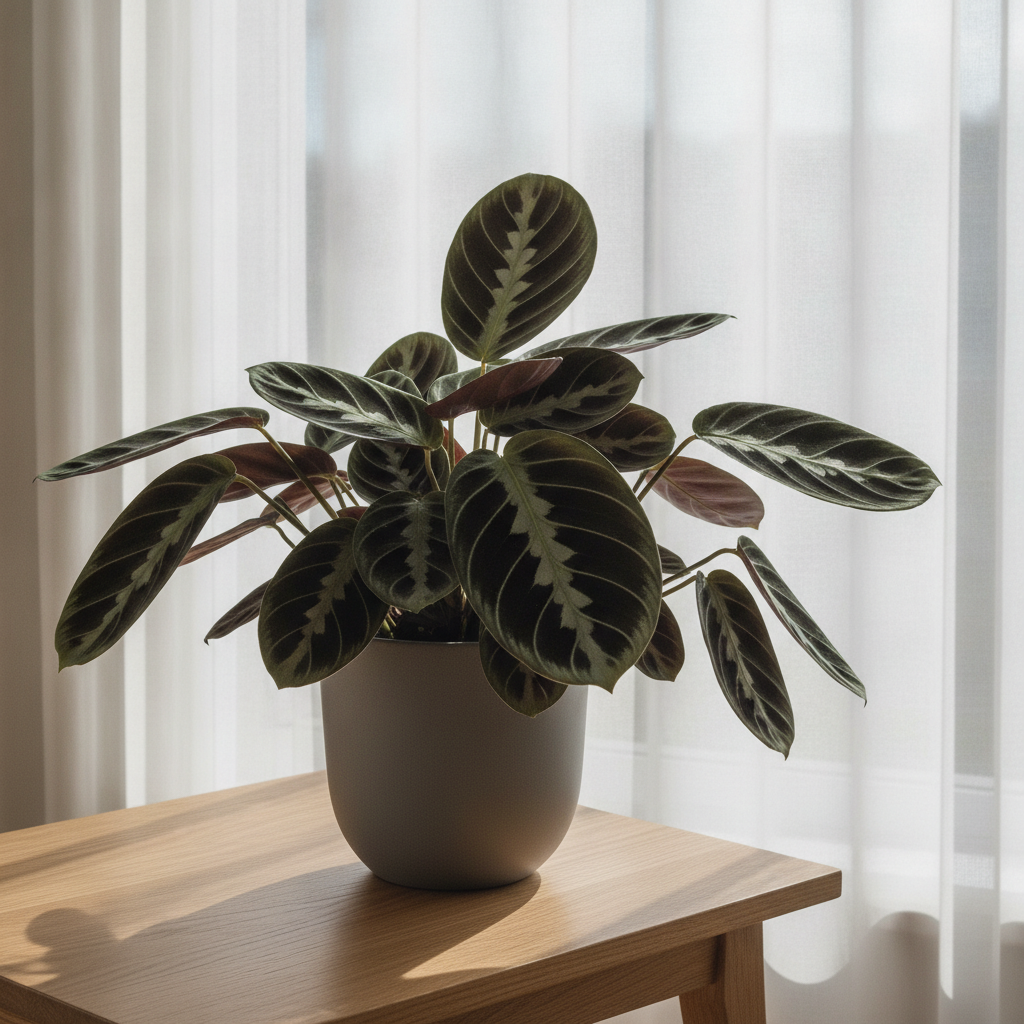
Few houseplants perform quite as literally as the Black Maranta, a moody, dark-leaved form of the prayer plant that raises and lowers its foliage with the rhythm of the day. Known botanically as Maranta leuconeura in its massangeana form, and often sold simply as the Black Prayer Plant, it carries oval leaves of deep, almost blackish green overlaid with a silvery feather running along the midrib and pale grey veins fanning out toward the margins. The undersides flush a quiet purple, so that every evening fold reveals a second colour entirely. Like all marantas it hails from the humid forest floors of Brazil, where it grows as a low, spreading groundcover beneath a dense canopy that filters the sun to a soft, dappled glow.
The prayer plant has a reputation for being temperamental, and the Black Maranta is no exception. It will survive a surprising range of neglect, limping along in dry rooms with crisping edges and dull colour, but it only truly thrives when its rainforest origins are respected: steady moisture, generous humidity, filtered light and water free of the minerals it resents. This guide walks through every part of its care in turn, from reading the light in your rooms to dividing a mature clump, so that you can move your plant from merely surviving to genuinely flourishing.
Contents
- Quick Reference
- Why Black Maranta Makes a Rewarding Houseplant
- Light Requirements
- Watering & Humidity
- Soil, Potting & Repotting
- Fertilising
- Propagation
- Pests & Diseases
- Popular Varieties
- Frequently Asked Questions
Quick Reference: Black Maranta at a Glance
| Light | Bright, indirect light; no direct midday sun |
| Watering | Keep evenly moist; water when the top 2 to 3 cm (1 inch) begins to dry |
| Temperature | 18 to 27 degrees Celsius (65 to 80 degrees Fahrenheit); never below 15 degrees Celsius (59 degrees Fahrenheit) |
| Humidity | High, ideally 60 percent or above |
| Fertiliser | Balanced feed at half strength every 2 to 4 weeks in spring and summer |
| Toxicity | Non-toxic to cats, dogs and humans |
Why Black Maranta Makes a Rewarding Houseplant
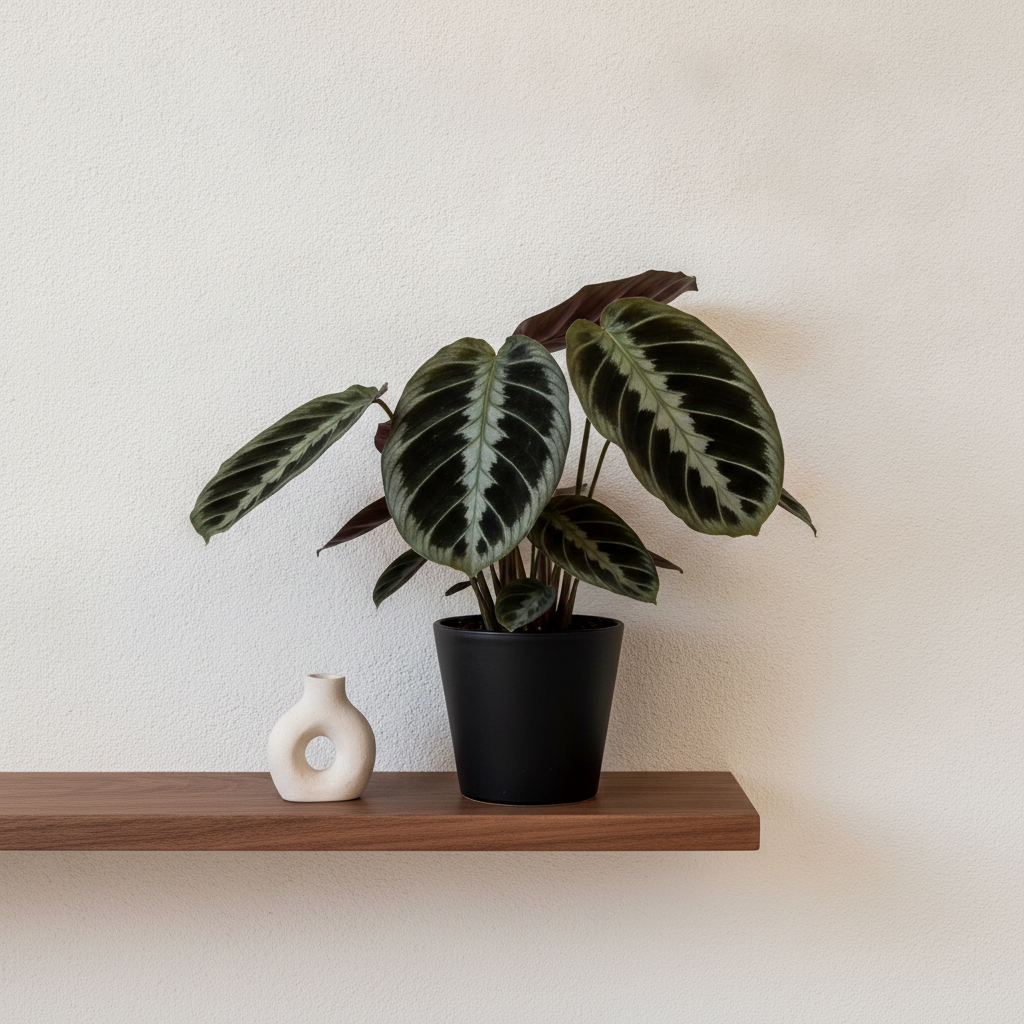
The immediate appeal of the Black Maranta is its colouring. Where most prayer plants read as bright and busy, this form is dark and restrained, the near-black leaf blades throwing the silvery central feather into sharp relief. Grouped with paler foliage it provides depth and contrast that few houseplants can offer, and a single well-grown specimen spilling over the rim of a pot has real presence on a shelf or low table. Because it stays compact, rarely exceeding 30 centimetres (12 inches) in height and spreading outward rather than upward, it suits homes where floor space is tight and a plant needs to earn its place on a surface.
Beyond looks, the plant is quietly theatrical. Every evening the leaves rise and fold together along the midrib, a movement called nyctinasty that is driven by changes in water pressure within a swollen joint at the leaf base known as the pulvinus. By morning they lower and spread flat again to catch the light. This nightly performance is what earned the whole genus the name prayer plant, and it makes the Black Maranta an unusually engaging companion, one that visibly responds to the passing of the day. It is also completely safe around pets and children, so it can be placed within reach without the worry that accompanies many trendy aroids.
Important — Toxicity: The Black Maranta is listed as non-toxic to cats, dogs and humans by the ASPCA and equivalent bodies, making it one of the safest statement foliage plants for a home with curious animals or small children. Even so, nibbled leaves can cause mild stomach upset in pets, so it is sensible to discourage grazing.
Light Requirements
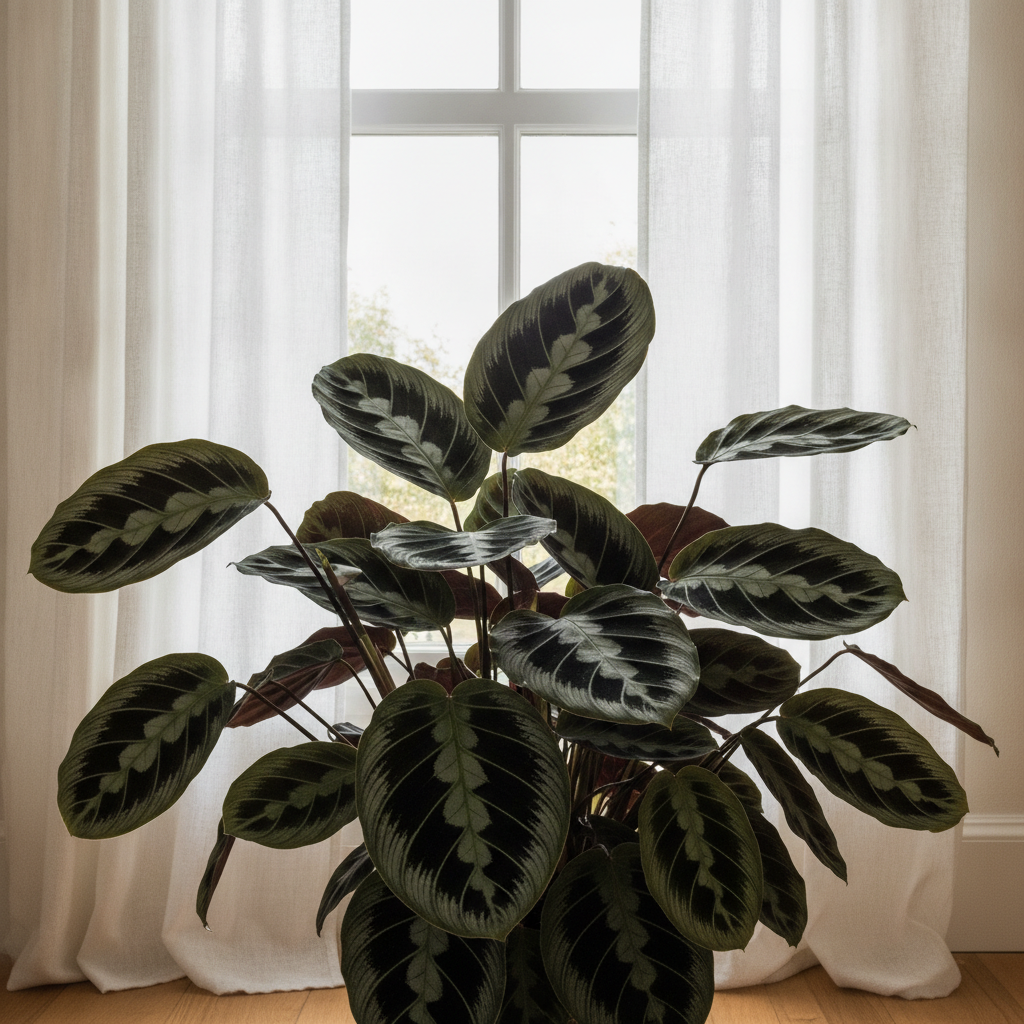
In the wild the Black Maranta grows on the shaded forest floor, sheltered beneath layers of taller vegetation that break the tropical sun into shifting patches. Recreating that filtered, generous-but-gentle light indoors is the single most important thing you can do for the colour and health of the leaves. The plant wants brightness without the harsh, direct beams that would scorch it in nature, which in practical terms means a well-lit room with the plant set back from the glass or screened by a sheer curtain.
Given the right light the leaves hold their deep base colour, the silvery feather stays crisp and the plant grows steadily, sending up new furled leaves from the centre of each crown. Too little light and growth slows to a crawl, the markings fade toward a flat green and the stems stretch and thin as they reach for a brighter spot. Too much direct sun and the picture reverses: the rich colour bleaches out, the surface takes on a washed, papery quality and brown scorch marks appear where the strongest rays land.
Light Levels Explained
Light indoors falls away far more quickly than most people expect, roughly with the square of the distance from the window, so a plant a couple of metres into a room receives only a fraction of the light of one on the sill. The table below sets out the broad categories and how the Black Maranta responds to each.
| Light Category | Approx. Level | Typical Location | Outcome |
|---|---|---|---|
| Direct sun | Over 50,000 lux | On an unscreened south sill | Fading and scorch; avoid |
| Bright indirect | 10,000 to 20,000 lux | Near an east window or behind a sheer on a bright window | Ideal; strong colour and steady growth |
| Medium | 5,000 to 10,000 lux | A metre or two back from a bright window | Acceptable; slower growth, still good colour |
| Low | 1,000 to 3,000 lux | A dim corner or interior wall | Survives but stretches; markings fade |
| Very low | Under 1,000 lux | Far from any window | Decline over time; not recommended |
Window Orientation and Placement
South-facing window: The brightest exposure in the northern hemisphere and generally too intense for a Black Maranta placed directly on the sill. It works well if you set the plant a metre or more back, or drape a sheer curtain to diffuse the midday sun.
East-facing window: Arguably the best position of all. The plant receives gentle, cool morning light that it can take head on, then softer, indirect light for the rest of the day. Colour and form tend to be at their finest here.
West-facing window: Suitable with care. Morning and midday light is soft, but the strong afternoon sun can scorch, so keep the plant back from the glass or use a light curtain during the hottest hours.
North-facing window: A safe, if dimmer, choice. The light is even and never harsh, which suits the plant, though in the depths of winter you may find growth stalls and colour dulls, in which case a supplementary lamp helps.
Pro Tip — Reading the Leaves: Let the plant tell you whether the light is right. Vivid, well-defined markings and compact growth mean it is happy. Long, leaning stems with widely spaced leaves mean it wants more light, while pale, bleached patches mean it is getting too much direct sun.
How Light Affects Leaf Colour
The dramatic contrast between the near-black blade and the silvery feather is a direct product of good light. In bright indirect conditions the plant produces plenty of the pigments that darken the leaf and sharpen the pattern, so the markings look painted on. In gloom the leaf simply cannot sustain that investment, and it drifts toward a uniform mid-green with vague, muddy veining. If your plant’s colour has faded, the remedy is almost always more light rather than more feed, and moving it closer to a bright window usually restores the contrast within a few new leaves.
Warning — Direct Sunlight: An hour or two of strong, direct sun through glass is enough to bleach and burn maranta leaves, and the damage does not heal. Scorched patches turn pale, then crisp and brown, and the affected leaf never recovers its colour. When in doubt, choose the softer, filtered position.
Artificial Lighting
The Black Maranta responds well to artificial light, which makes it a good candidate for rooms that lack a bright window or for the darker months of the year. A full-spectrum LED grow light positioned 30 to 45 centimetres (12 to 18 inches) above the foliage and run for 10 to 12 hours a day provides ample energy for steady growth. Because the plant needs the daily light-and-dark cycle to drive its leaf movements, put the lamp on a timer and give it a genuine night rather than leaving it lit around the clock.
Seasonal Adjustments
Light levels indoors swing dramatically between summer and winter, and the plant’s placement should move with them. A spot that is perfect in the low, weak light of December may become too bright by June, and vice versa. As the days shorten, shift the plant closer to the window to compensate, and as spring returns, ease it back or add a curtain. Watching the new growth and adjusting gradually beats leaving the plant fixed in one spot all year.
Watering & Humidity
Watering is where most Black Marantas are won or lost. The plant comes from consistently moist forest soil and dislikes both extremes, sulking when it dries out completely and rotting when it sits in cold, stagnant water. The aim is even, steady moisture: a growing medium that stays lightly damp all the way through, never bone dry and never waterlogged. Add to that the plant’s genuine sensitivity to the minerals and chemicals in ordinary tap water, and watering becomes the part of care that most rewards a little extra attention.
When to Water
Check the plant every few days by pushing a finger into the top of the mix. When the top 2 to 3 centimetres (about 1 inch) has begun to dry but the layer beneath is still cool and damp, it is time to water. You are aiming to top up the moisture before the root zone dries out, not to let the whole pot dry and then flood it. In the bright, warm months this may mean watering twice a week, while in the dim, cool depths of winter it may stretch to once every week or ten days.
Resist the urge to water on a fixed schedule regardless of conditions, because the plant’s thirst changes with light, temperature and season. A pot in bright summer warmth dries far faster than the same pot in a cool winter room, and following the calendar rather than the soil is a common route to both overwatering and underwatering. Let the feel of the mix, not the day of the week, make the decision.
Pro Tip — Skip the Tap: Marantas are among the plants most sensitive to fluoride, chlorine and dissolved salts, which show up as brown, crispy leaf edges over time. Water with rainwater, distilled water or tap water that has been left to stand uncovered overnight, always at room temperature, since cold water shocks the roots.
How to Water Correctly
- Bring your water to room temperature and, if using tap water, let it stand overnight so some of the chlorine dissipates.
- Water slowly and evenly across the surface of the mix until it runs freely from the drainage holes, which ensures the whole root ball is moistened.
- Let the pot drain completely for several minutes so no excess is left sitting at the base.
- Empty the saucer or cache pot; never leave the plant standing in collected water.
- Return the plant to its spot and check again in a few days, adjusting frequency to how quickly the top layer dries.
Signs of Overwatering vs. Underwatering
| Symptom | Overwatering | Underwatering |
|---|---|---|
| Leaf colour | Yellowing, often starting with lower leaves | Dull, with browning at the edges and tips |
| Leaf texture | Soft, limp and translucent | Crisp, curled and brittle |
| Soil | Stays wet for days, may smell sour | Dry through, pulling away from the pot sides |
| Roots | Brown, mushy and foul-smelling | Dry and wiry but generally alive |
| Recovery | Slow; may need repotting into fresh mix | Fast once watering resumes |
Warning — Root Rot: Persistent sogginess, especially in cold conditions, invites root rot, the most common killer of marantas. If you notice a sour smell, blackened stem bases or leaves collapsing despite wet soil, unpot the plant at once, trim away any brown mushy roots with sterile scissors and repot into fresh, airy mix.
Humidity Requirements
If light is the first pillar of maranta care, humidity is the second. As a rainforest-floor plant it expects the moist, close air of the tropics, ideally 60 percent relative humidity or more. The dry air of a centrally heated or air-conditioned room, which can fall below 30 percent, is the usual cause of the crisp brown edges that plague so many prayer plants and is often mistaken for a watering fault.
The clearest signs that the air is too dry are browning, papery leaf margins, tips that curl and crisp, and edges that fail to unfurl cleanly on new leaves. These symptoms usually appear first on the leaves nearest a radiator, heat vent or draughty window, which is a useful clue that humidity rather than water is the underlying problem.
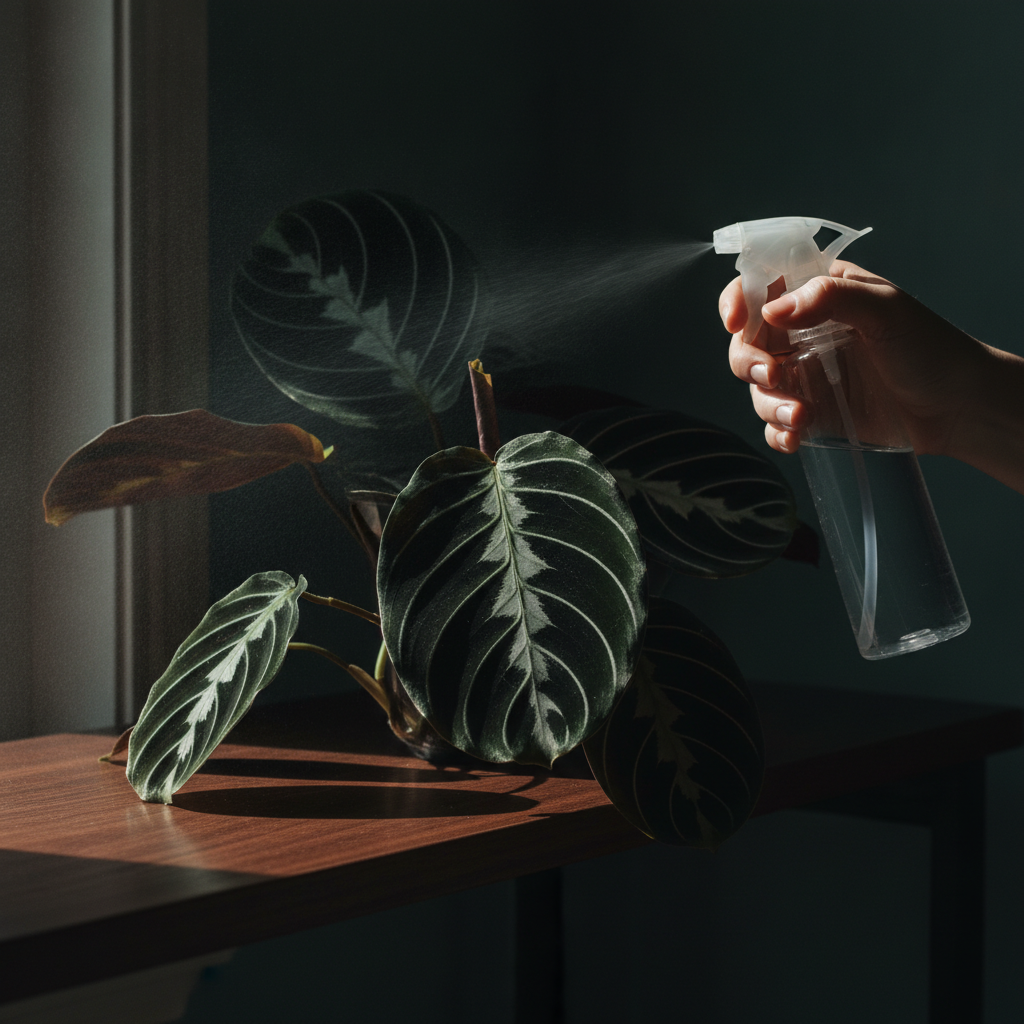
Raising humidity is straightforward. Grouping plants together creates a moister microclimate as they transpire, and standing the pot on a wide tray of pebbles topped up with water lifts the local humidity without wetting the roots. A small room humidifier is the most reliable solution of all and pays dividends for a whole collection of tropical plants, while a bright bathroom or kitchen, with their naturally damper air, often suits a maranta beautifully. Misting helps a little but is short-lived, so treat it as a supplement rather than a cure.
Water Quality
It is worth repeating that water quality matters more for marantas than for almost any other common houseplant. The brown crisping so often blamed on low humidity is frequently the result of mineral build-up from hard or fluoridated tap water accumulating in the leaf tissue. Rainwater is ideal and free; distilled or filtered water is a good substitute; and if you must use tap water, letting it stand overnight and flushing the pot thoroughly now and then to wash out accumulated salts will limit the damage.
Soil, Potting & Repotting
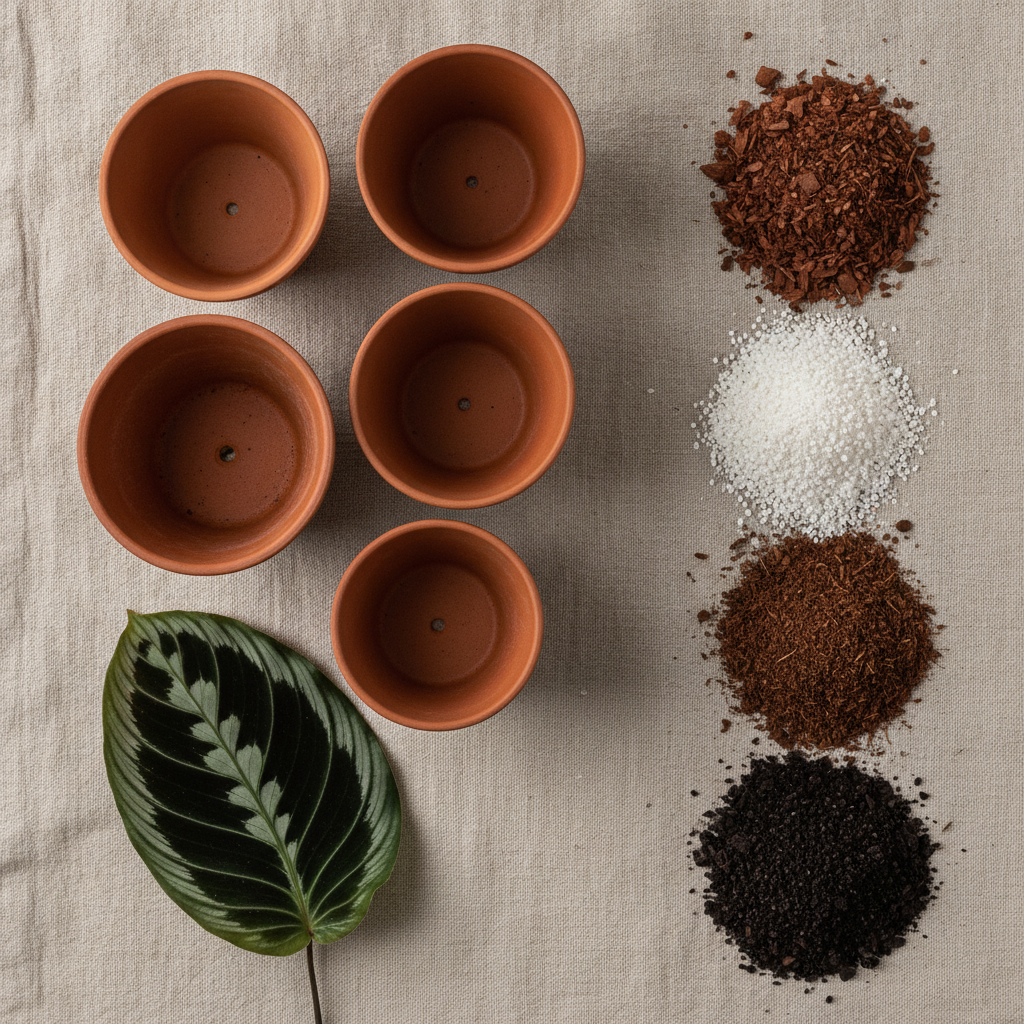
The Black Maranta asks for a potting mix that squares a circle: it must hold moisture, because the plant hates to dry out, yet it must also drain and breathe freely, because the roots rot in stagnant wet. The forest floor it comes from is rich in decaying leaf litter, light and open in texture, and constantly damp without ever being boggy. A good indoor mix imitates that balance, staying evenly moist between waterings while letting excess drain away and air reach the roots.
Ideal Soil Composition
A reliable recipe starts with a peat-free base such as coco coir or a quality houseplant compost, lightened generously with perlite for drainage and aeration and enriched with a little fine bark or worm castings to mimic the leaf litter of the forest floor. The result should feel spongy and open in the hand, springing back rather than compacting into a dense clod. The proportions below make a good starting point that you can adjust to your conditions.
| Component | Proportion | Function |
|---|---|---|
| Coco coir or peat-free compost | 50 percent | Holds moisture and provides the bulk of the mix |
| Perlite | 30 percent | Opens the structure for drainage and aeration |
| Fine orchid bark | 10 percent | Adds air pockets and mimics forest litter |
| Worm castings or compost | 10 percent | Supplies gentle, slow-release nutrition |
Marantas prefer a slightly acidic root zone, roughly pH 5.5 to 6.0, which most coir- and compost-based mixes fall within naturally. There is rarely any need to adjust pH deliberately; simply avoid heavy, alkaline garden soils and stick to peat-free potting ingredients, which keep the mix in the right range on their own.
Pro Tip — Quick Mix Recipe: If you would rather not blend from scratch, take a bag of ordinary peat-free houseplant compost and stir through roughly one part perlite to every two parts compost, plus a handful of fine bark. That single tweak transforms a dense shop-bought mix into something a maranta will root into happily.
Choosing the Right Pot
The Black Maranta has a shallow, spreading root system rather than a deep taproot, so it grows best in a wide, relatively shallow pot that gives those roots room to run sideways. A container that is too deep holds a reservoir of wet mix beneath the roots that never dries, inviting rot, so match the pot to the plant rather than reaching for the biggest one to hand.
Drainage holes are non-negotiable. Whatever the material or style, the pot must have holes at the base so that excess water can escape. A decorative cache pot without drainage can be used as an outer sleeve, but only if you lift the inner pot out to water and drain it, then return it once it has stopped dripping.
Pot material: Plastic and glazed ceramic hold moisture well and suit the maranta’s love of steady dampness, which makes them a sensible default. Unglazed terracotta breathes and dries faster, so it is workable but demands more frequent watering and a closer eye on the plant.
Pot size: When potting up, increase the diameter by only 2 to 4 centimetres (1 to 2 inches) at a time. An oversized pot surrounds the roots with damp, unused mix that stays wet far too long, whereas a modest step up keeps the balance of moisture and air the plant needs.
When to Repot
A Black Maranta generally needs repotting every one to two years, best done in spring as growth resumes. The signs that it is ready are roots creeping from the drainage holes or circling the surface, water that races straight through without wetting the mix, and a general slowing of growth despite good care. Repotting also gives you the chance to refresh tired mix and to divide an overcrowded clump into new plants.
How to Repot: Step-by-Step
- Water the plant a day beforehand so the root ball is hydrated and holds together as you work.
- Ease the plant from its pot by tipping it and supporting the base, rather than tugging on the stems.
- Gently tease apart the outer roots and shake off some of the old, spent mix from around them.
- Inspect the roots and trim away any that are brown, soft or dead using sterilised scissors.
- Set the plant in its new pot at the same depth as before, on a layer of fresh mix, and fill around it, firming lightly.
- Water thoroughly with room-temperature water and let the pot drain completely.
- Return it to a warm, humid, brightly lit spot out of direct sun while it settles.
Warning — Transplant Shock: Expect a maranta to sulk for a week or two after repotting, with a little drooping or edge browning as it re-establishes. Keep conditions stable, warm and humid, resist the temptation to overwater the disturbed roots, and hold off feeding for a month while new growth appears.
Fertilising
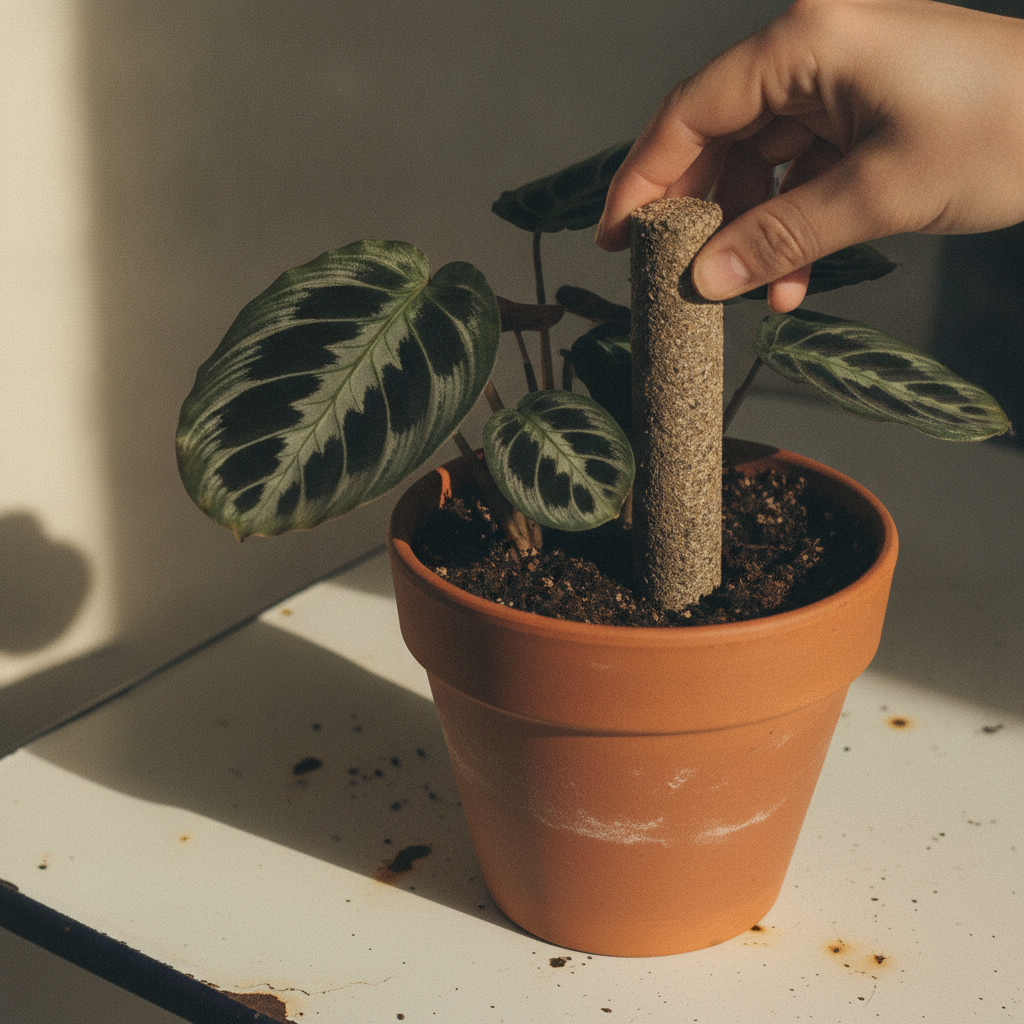
The Black Maranta is a light feeder rather than a hungry one. In its native habitat it draws a slow, steady trickle of nutrients from decomposing leaf litter, so it responds best to gentle, regular feeding during the growing season rather than occasional heavy doses. Given a little food through spring and summer it produces more leaves, richer colour and stronger growth, but it is easily overfed, and too much fertiliser does more harm than too little.
Because marantas are so sensitive to the mineral salts that make up fertiliser, the golden rule is to dilute well and feed only when the plant is actively growing. A feed applied to dry roots, or at full label strength, can scorch the fine root hairs and show up as browning leaf edges that look, confusingly, much like the symptoms of dry air or hard water.
Understanding Plant Nutrients
A balanced houseplant fertiliser supplies the three major nutrients, nitrogen, phosphorus and potassium, shown on the label as the N-P-K ratio, along with smaller amounts of secondary and trace elements. For a foliage plant like the Black Maranta, a balanced or slightly nitrogen-led formula keeps the leaves coming, while the trace elements support the deep colour and healthy new growth. The table below outlines what each key nutrient does and how a shortage tends to show.
| Nutrient | Symbol | Primary Function | Deficiency Symptoms |
|---|---|---|---|
| Nitrogen | N | Drives leaf and stem growth | Pale, yellowing older leaves; weak growth |
| Phosphorus | P | Supports roots and energy transfer | Stunted growth; dull, darkened leaves |
| Potassium | K | Regulates water and overall vigour | Browning leaf margins; weak stems |
| Magnesium | Mg | Central to chlorophyll and colour | Yellowing between the veins of older leaves |
| Iron | Fe | Needed for green pigment in new growth | Yellowing between the veins of young leaves |
Types of Fertiliser
Liquid fertilisers: The easiest to control and the best fit for marantas, since you can dilute them precisely and apply them with each watering. A balanced liquid houseplant feed at half the recommended strength is hard to beat.
Slow-release granular: Coated prills or sticks that release nutrients gradually over months. Convenient, but harder to dial back if the plant shows signs of overfeeding, so use them sparingly and at a reduced rate.
Organic fertilisers: Worm castings, diluted compost tea and similar gentle amendments feed slowly and are very forgiving, which suits a plant prone to fertiliser burn. They also improve the life and structure of the mix over time.
Feeding Schedule
Feed every two to four weeks through spring and summer, when the plant is putting out new leaves, using a balanced liquid feed at half strength. As growth slows in autumn, taper the feeding off, and through the short, dim days of winter stop altogether, since a resting plant cannot use the nutrients and the unused salts simply accumulate in the mix.
Pro Tip — Less Is More: With marantas it is always safer to underfeed than overfeed. Half the strength stated on the bottle, applied to already-moist soil, gives the plant what it needs while sparing the sensitive roots. If in doubt, dilute further.
How to Fertilise
- Water the plant lightly first, or feed as you water, so the fertiliser never meets dry roots.
- Dilute a balanced liquid feed to half the recommended strength using room-temperature soft water.
- Apply evenly across the mix until it just begins to drain, then discard any run-off.
- Every couple of months, flush the pot with plain water to wash out accumulated salts.
Warning — Salt Build-Up: A white, crusty deposit on the soil surface or around the pot rim signals a build-up of fertiliser salts, which scorch roots and brown the leaf edges. Flush the pot thoroughly with plenty of plain water, and cut back both feeding and, if relevant, hard-water use.
Propagation
Propagating a Black Maranta is one of the pleasures of growing it, both because the plant multiplies readily and because doing so keeps a spreading clump vigorous. Unlike the vining aroids that root from a single node in a jar of water, the maranta grows as a cluster of crowns joined by short underground stems, and the most dependable way to make new plants is simply to divide that cluster. Stem-tip cuttings are also possible for the more adventurous, giving a second route to fresh plants.
Whichever method you choose, spring and early summer are the best times, when the plant has the warmth, light and energy to recover quickly and push out new roots and leaves. Propagation attempted in the cold, dark months tends to stall and rot rather than take, so it pays to wait for the growing season.
Understanding the Growth Habit
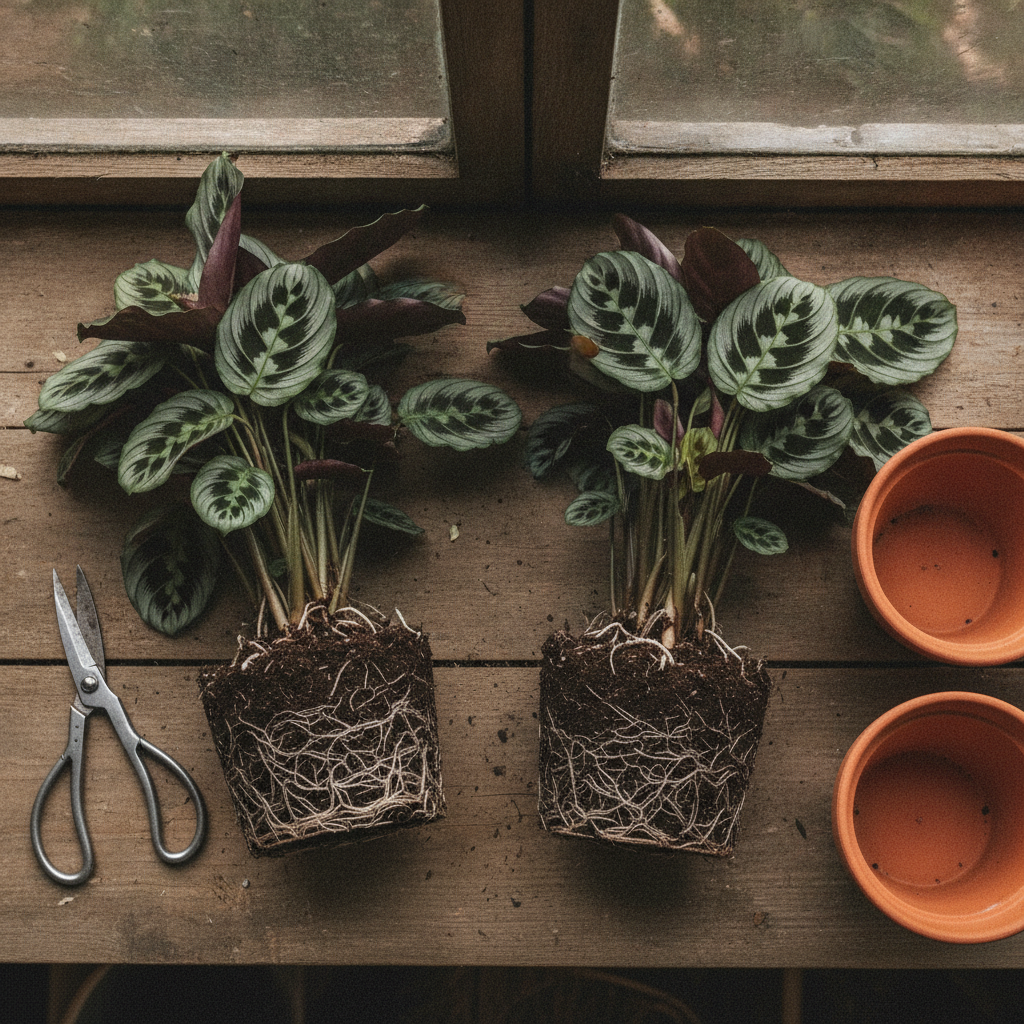
The Black Maranta grows from a network of short, fleshy underground stems that send up clusters of leaves at intervals, so a mature plant is really a colony of connected crowns rather than a single stem. This is what makes division so straightforward: each crown already has its own roots and simply needs separating from its neighbours. Understanding this structure also explains why the plant spreads sideways to fill a wide pot and why it responds so well to being split every year or two.
Division: Step-by-Step
Division is the go-to method and is best carried out at repotting time, when the plant is already out of its pot. Aim to give each new section at least two or three healthy leaves and a good portion of roots so it can support itself from the start.
- Water the plant the day before, then slide it out of its pot and gently shake the loose mix from the roots.
- Study the clump to find natural divisions where separate crowns of leaves rise from their own roots.
- Tease the sections apart with your fingers, using a sterile knife only where roots are too tangled to separate by hand.
- Make sure each division carries several leaves and a healthy share of roots.
- Pot each section into its own container of fresh, airy mix at the depth it grew before.
- Water in well and place the new plants somewhere warm, humid and brightly lit but out of direct sun.
Pro Tip — A Humid Recovery: Newly divided marantas recover fastest in high humidity. Slipping the pots inside a loose, clear plastic bag or a propagator for the first week or two, with a little airflow, keeps the air moist and takes the pressure off roots that are still re-establishing.
Stem Cuttings: Step-by-Step
Where division is not practical, stem-tip cuttings offer an alternative. Marantas root from the node, the swollen point where a leaf stalk meets the stem, so a cutting must include at least one node to succeed.
- Choose a healthy stem and cut just below a node using clean, sharp scissors, taking a section with one or two leaves.
- Set the cutting in a glass of room-temperature soft water with the node submerged and the leaves clear of the water, or insert it into moist mix.
- Place it somewhere warm, humid and brightly lit out of direct sun, and change the water every few days if rooting in water.
- Once roots reach a few centimetres, over several weeks, pot the cutting into a small container of fresh mix.
- Keep the young plant especially humid while it adjusts from water to soil.
Troubleshooting Propagation
| Problem | Likely Cause | Solution |
|---|---|---|
| Divisions wilt badly | Too much root disturbance or dry air | Raise humidity, keep warm and stable, avoid overwatering |
| Cuttings rot in water | Stagnant water or no node included | Change water often; ensure a node is submerged |
| No roots after weeks | Too cold or too dark | Move somewhere warmer and brighter; be patient |
| Leaves brown after potting | Shock moving from water to soil | Increase humidity; pot on before roots grow long |
Pests & Diseases
A well-grown Black Maranta in a humid, brightly lit spot is reasonably resistant to trouble, but stressed plants, particularly those kept too dry in the air, are a magnet for pests. Spider mites in particular thrive in exactly the dry conditions that weaken a maranta, so many pest problems trace back to a humidity shortfall. Regular, close inspection of the leaves, including their undersides, is the best defence, catching problems while they are small and easily dealt with.
Most diseases of the maranta, meanwhile, are the result of excess moisture sitting on the leaves or around the roots. Watering the mix rather than the foliage, giving the plant room for air to move around it and keeping conditions warm all go a long way toward preventing the fungal and bacterial problems described below.
Common Pests
Spider Mites (Tetranychus urticae)
The most persistent enemy of the maranta, these tiny sap-suckers flourish in dry air and are often noticed only once fine webbing appears in the leaf axils and the foliage takes on a dull, stippled, dusty look. Because they are barely visible, a magnifier helps confirm them.
Treatment: Rinse the plant thoroughly, including the leaf undersides, then treat with insecticidal soap or neem oil and repeat weekly until clear. Crucially, raise the humidity, since mites struggle to establish in moist air.
Fungus Gnats (Bradysia species)
Small black flies that hover around the pot and run across the soil surface, fungus gnats are drawn to the constantly moist mix marantas require. The adults are a nuisance rather than a serious threat, but their larvae feed on roots and can weaken a young or already-struggling plant.
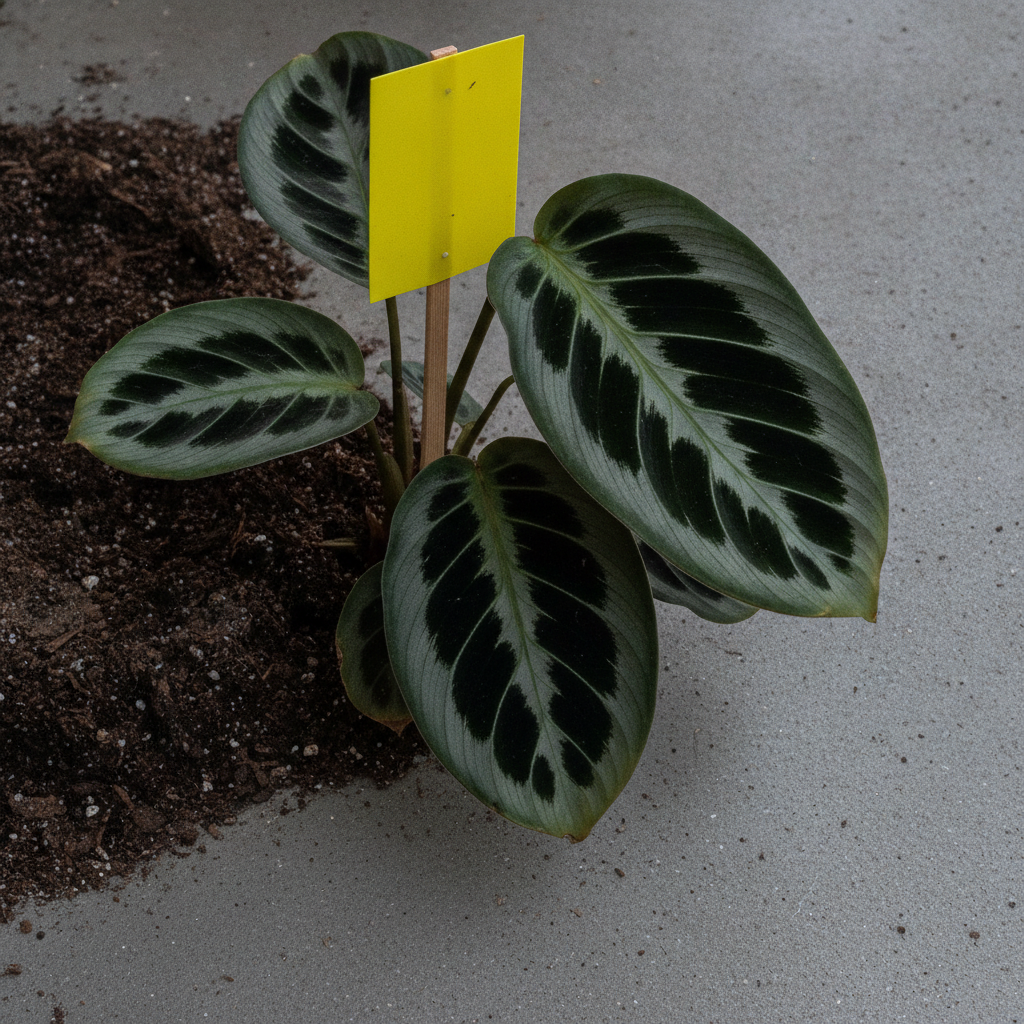
Treatment: Let the very top of the mix dry a little between waterings, set yellow sticky traps to catch the adults, and treat the soil with a Bacillus thuringiensis larvicide or a layer of horticultural sand if the larvae persist.
Mealybugs (Pseudococcus species)
Soft, white, cottony insects that cluster in the leaf joints and along the stems, sucking sap and leaving a sticky residue behind. They spread slowly but can be stubborn once established in the dense heart of a clump.
Treatment: Dab each insect with a cotton bud dipped in isopropyl alcohol, then follow up with insecticidal soap or neem oil, checking every few days for survivors hidden deep in the foliage.
Common Diseases
Root Rot (Pythium and Phytophthora)
The most serious threat to a maranta, root rot follows from soil kept too wet, especially in cold conditions or a pot without drainage. Affected plants yellow and wilt despite wet soil, and the roots turn brown, soft and foul-smelling.
Treatment: Unpot the plant, cut away all rotten roots with sterile scissors, and repot into fresh, airy mix in a clean pot with drainage. Water more sparingly thereafter and ensure warmth.
Leaf Spot (Helminthosporium and bacterial forms)
Brown or black spots, sometimes ringed with yellow, that appear on the leaves when water sits on the foliage in still, cool air. Left unchecked the spots enlarge and merge, killing whole leaves.
Treatment: Remove affected leaves, stop misting and wetting the foliage, improve air circulation, and apply a suitable fungicide if the problem spreads.
Pest and Disease Summary
| Pest / Disease | Identification | Treatment |
|---|---|---|
| Spider mites | Fine webbing, dull stippled leaves | Rinse, insecticidal soap or neem, raise humidity |
| Fungus gnats | Small flies around moist soil | Dry the top layer, sticky traps, larvicide |
| Mealybugs | White cottony clusters in joints | Alcohol swab, then soap or neem |
| Root rot | Wilting in wet soil, mushy roots | Trim roots, repot in fresh airy mix |
| Leaf spot | Brown or black spots on leaves | Remove leaves, keep foliage dry, fungicide |
Prevention Strategies
Prevention rests on the same conditions that keep the plant looking its best. Maintaining high humidity denies spider mites the dry air they need; watering the soil rather than the leaves and keeping air moving around the plant heads off fungal spots; and never letting the pot stand in water protects the roots from rot. A plant grown well is a plant that rarely falls ill.
It also pays to quarantine any new plant for a couple of weeks before it joins your collection, and to inspect your maranta each time you water. Wiping the leaves occasionally with a soft, damp cloth both removes dust that dulls the colour and gives you a regular, close look at the undersides where pests first take hold.
Pro Tip — Isolate and Inspect: At the first sign of any pest, move the affected plant well away from its neighbours. Marantas are often grown grouped together for humidity, which is exactly the arrangement that lets an infestation spread, so quick isolation can save a whole shelf of plants.
Popular Varieties
The Black Maranta is one form within the wider species Maranta leuconeura, a plant that has given rise to several strikingly different cultivars. They share the same nightly leaf movement and the same care needs, so once you can grow one you can grow them all, but each brings its own pattern and palette. Collectors often keep two or three side by side to enjoy the contrast between the dark, silvered form and its brighter, red-veined and blotched relatives.
The table below compares the most widely available marantas, and the featured cards and profiles that follow look more closely at two of the best-loved forms alongside the Black Maranta itself.
| Variety | Leaf Appearance | Light Needs | Growth Rate | Availability |
|---|---|---|---|---|
| Black Maranta (massangeana) | Blackish-green with silvery feather and grey veins | Bright indirect | Moderate | Uncommon |
| Kerchoveana | Apple-green with paired chocolate blotches | Bright indirect | Moderate to fast | Very common |
| Erythroneura (Herringbone) | Dark green with red veins and light herringbone | Bright indirect | Moderate | Common |
| Fascinator Tricolor | Deep green with pink veins and lime midrib | Bright indirect | Moderate | Common |
| Lemon Lime | Green with vivid lime-yellow herringbone | Bright indirect | Moderate | Increasingly common |
Featured Varieties
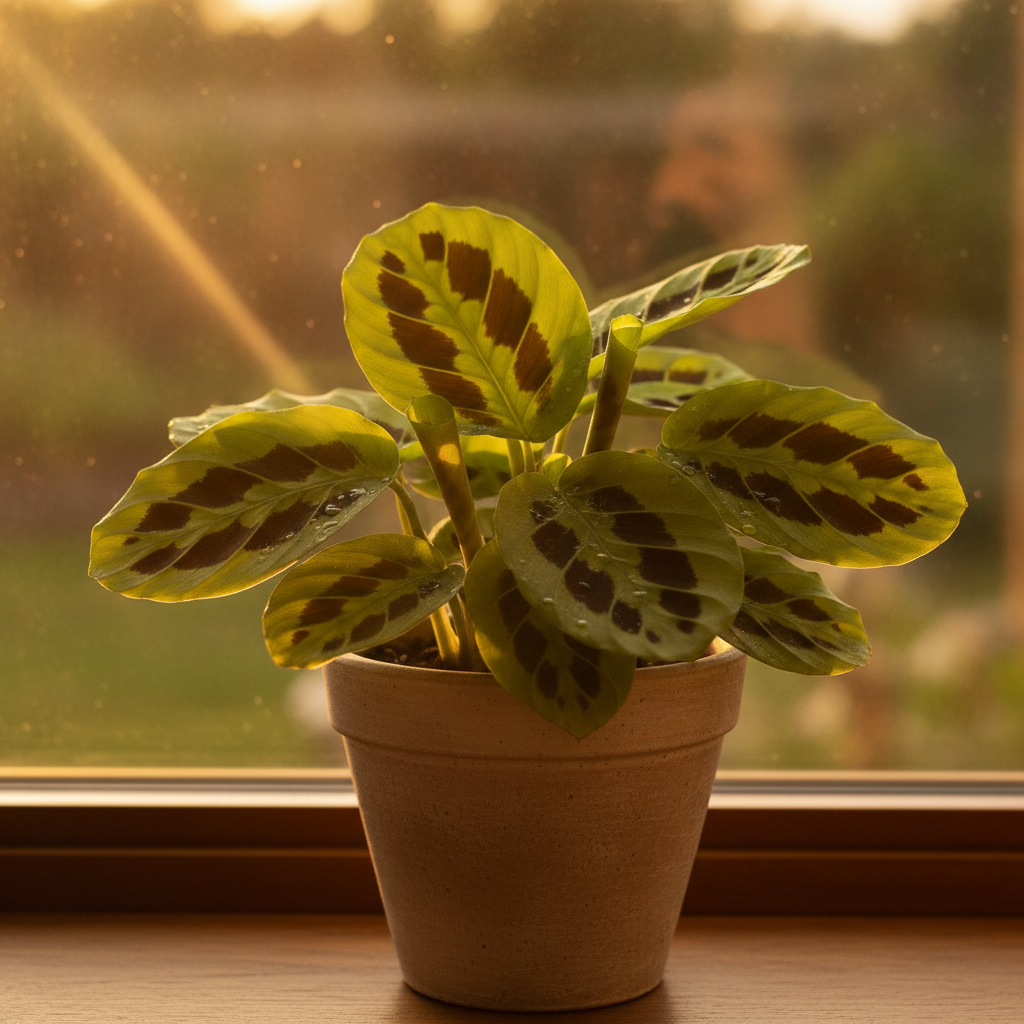
Kerchoveana
The classic green prayer plant, sometimes called Rabbit’s Foot, with apple-green oval leaves marked by paired dark chocolate blotches either side of the midrib that mellow toward green as they age. It is the most forgiving and widely sold maranta of all.
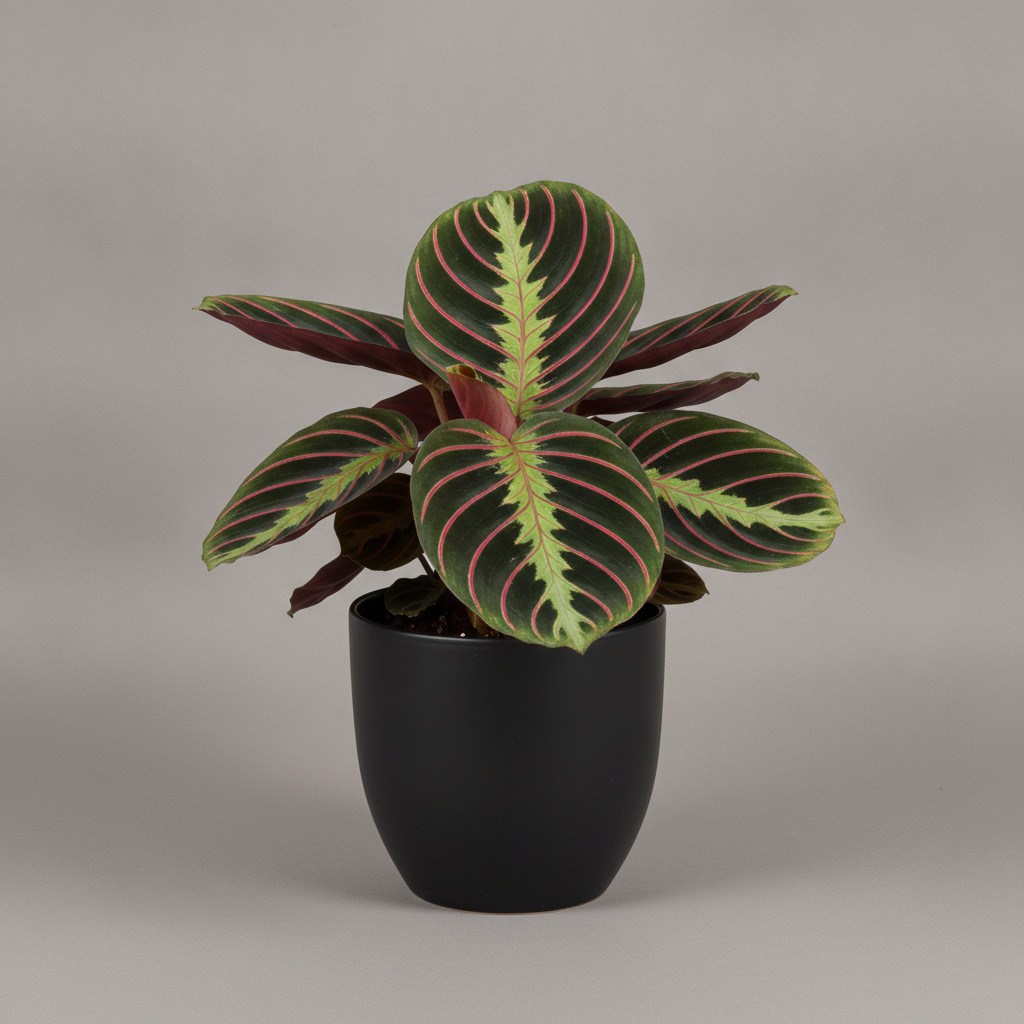
Erythroneura
The herringbone or red prayer plant, with velvety dark-green leaves crossed by vivid red lateral veins, a feathery light-green band down the midrib and deep maroon undersides. Its colouring is the boldest in the group and a natural companion to the darker Black Maranta.
Variety Profiles in Detail
Black Maranta (Maranta leuconeura massangeana)
The subject of this guide is the darkest and most understated of the marantas. Its blackish-green blades and crisp silver feather give it a moody, almost monochrome character that sets it apart from its brighter cousins, and the purple undersides add a final flourish each evening as the leaves fold. It is a little scarcer in the trade than the green forms and worth seeking out for anyone who loves dramatic, deep-toned foliage.
Kerchoveana (Maranta leuconeura kerchoveana)
Where the Black Maranta is dark and dramatic, Kerchoveana is fresh and cheerful, its light green leaves dotted with the paired brown markings that give it the nickname Rabbit’s Tracks. It is the toughest and most tolerant of the group, a good first maranta and a reliable partner to the darker forms in a mixed grouping.
Erythroneura (Maranta leuconeura erythroneura)
The showiest of all, Erythroneura draws the eye with electric red veins running across velvety dark leaves and a bright herringbone spine. It demands the same humid, filtered conditions as the rest of the species but rewards them with colour that few houseplants can match, making it a natural centrepiece.
Choosing the Right Variety for Your Space
Because every maranta wants the same care, the choice comes down to colour and to how confident you feel. A first-time grower is well served by the forgiving Kerchoveana, while those chasing drama will reach for the Black Maranta or the red-veined Erythroneura. Grouped together in a bright, humid spot the three make a collection that is far more than the sum of its parts, each throwing the others into sharper relief.
Frequently Asked Questions
Why are the edges of my Black Maranta turning brown and crispy?
Brown, crispy edges almost always point to low humidity, hard or fluoridated water, or a combination of the two. Raise the humidity around the plant, switch to rainwater or filtered water, and flush the pot occasionally to wash out accumulated salts, and new leaves should emerge clean.
Why does my prayer plant fold its leaves at night?
This nightly folding, called nyctinasty, is entirely normal and is what gives the prayer plant its name. It is driven by changes in water pressure in a joint at the base of each leaf, and the leaves lower and spread again by morning. Healthy movement is a good sign that the plant is content.
My maranta’s leaves are staying folded up during the day. What is wrong?
Leaves that stay tightly folded well into the day usually mean the plant is thirsty or stressed by dry air. Check whether the mix has dried out too far, water if needed and raise the humidity. If it recovers its daytime spread within a day or two, dryness was the cause.
Is the Black Maranta safe for cats and dogs?
Yes. The Black Maranta, like all Maranta leuconeura forms, is non-toxic to cats, dogs and humans, which makes it one of the safest choices for a home with pets. Nibbling may still cause mild stomach upset, so it is best to discourage it.
How often should I water a Black Maranta?
There is no fixed schedule; water when the top 2 to 3 centimetres (about 1 inch) of mix begins to dry. In practice that is often twice a week in warm, bright months and once every week or so in winter, but always let the feel of the soil rather than the calendar decide.
Why is my Black Maranta losing its dark colour?
Fading colour and vague markings are usually a sign of too little light. Move the plant to a brighter, indirect spot and the deep base colour and silvery feather should return over the next few leaves. Avoid direct sun, however, which bleaches the leaves in the opposite way.
Can I propagate a Black Maranta in water?
You can root stem-tip cuttings in water provided each cutting includes a node, though division of the clump at repotting time is more reliable and gives fuller plants faster. Whichever you choose, do it in spring or summer and keep the humidity high while the new plant establishes.
Should I mist my prayer plant?
Misting lifts humidity briefly and can help, but its effect is short-lived and wet leaves left in still air can encourage leaf spot. A pebble tray, grouping plants together or, best of all, a room humidifier provide the steady humidity the plant really wants far more effectively than misting alone.
What temperature does a Black Maranta need?
Aim for 18 to 27 degrees Celsius (65 to 80 degrees Fahrenheit) and keep the plant away from cold draughts, heaters and windows in winter. Temperatures below about 15 degrees Celsius (59 degrees Fahrenheit) cause stress and damage, so ordinary comfortable room warmth suits it well.
Why are the lower leaves of my maranta yellowing?
The occasional yellow lower leaf is natural ageing, but several yellowing leaves at once usually signal overwatering. Check that the mix is not staying soggy, that the pot drains freely and that the plant is not sitting in cold, wet conditions, and ease back on watering until it recovers.






