
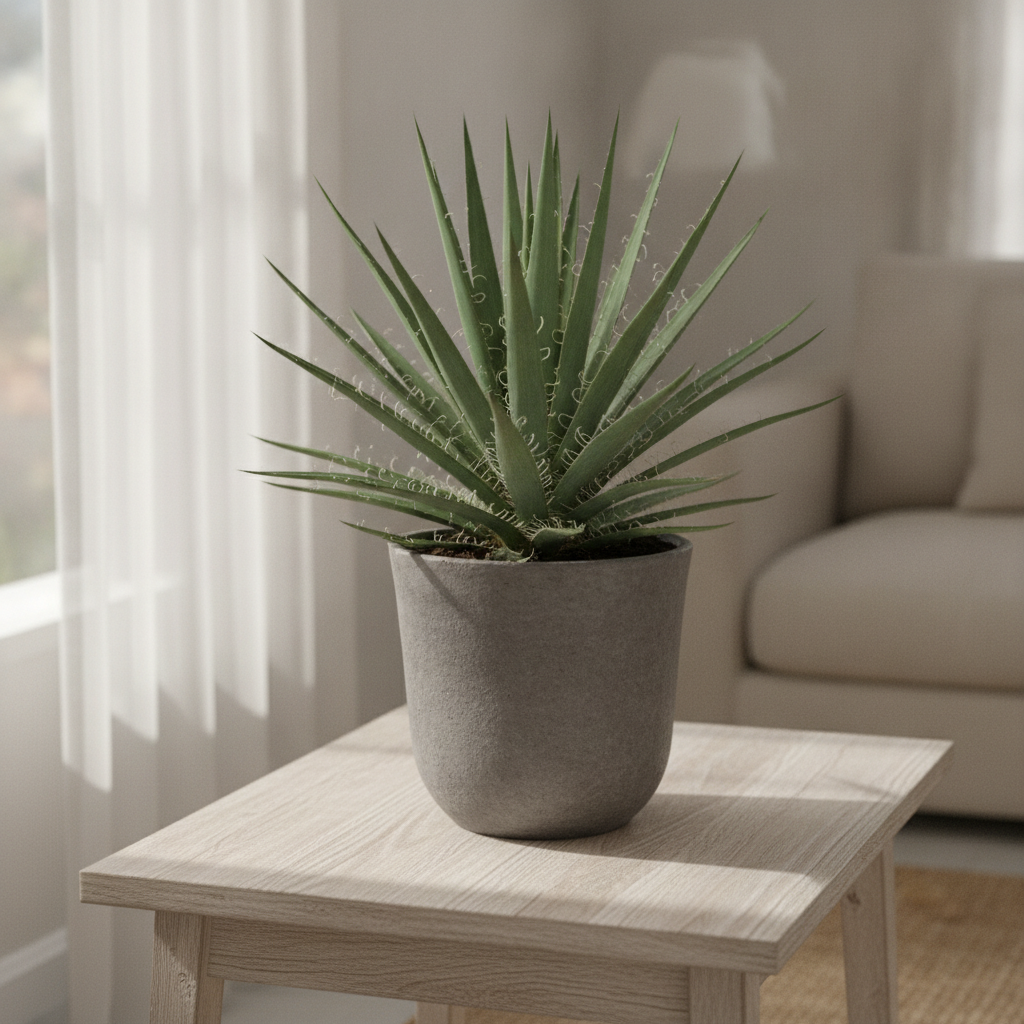
Few houseplants carry the open prairie in their DNA quite like the soapweed yucca. Known botanically as Yucca glauca and sold under names including small soapweed, Great Plains yucca and beargrass, this evergreen forms a low, near-stemless rosette of stiff, slender blue-green blades that radiate outward in a near-perfect starburst. Each leaf is tipped with a firm point and fringed along its edges with fine, curling white fibres, a detail that gives the plant much of its sculptural charm. It is native to the central grasslands of North America, ranging from the Canadian prairies of Alberta and Saskatchewan south through the Great Plains into Texas and New Mexico, where it endures blistering summers, bitter winters and long stretches without rain.
That prairie toughness is the key to understanding it indoors. Soapweed yucca is not a soft, forgiving foliage plant in the mould of a pothos or a peace lily; it is a sun worshipper that resents wet feet and dim corners. Grown in the wrong spot it will slowly etiolate and rot, yet given the brightest window in the house and a gritty, fast-draining mix, it becomes an almost indestructible architectural specimen that asks for very little. This guide walks through everything that separates merely keeping a soapweed yucca alive from helping it genuinely thrive, from light and watering through soil, feeding, propagation and the handful of pests that trouble it.
Contents
- Quick Reference
- Why Soapweed Yucca Makes a Rewarding Houseplant
- Light Requirements
- Watering & Humidity
- Soil, Potting & Repotting
- Fertilising
- Propagation
- Pests & Diseases
- Popular Varieties
- Frequently Asked Questions
Quick Reference: Soapweed Yucca at a Glance
| Light | As much direct sun as possible; a south-facing window or a spot under grow-lights is ideal. |
| Watering | Sparingly. Let the soil dry out completely, then water thoroughly; roughly every 2 to 3 weeks in summer and monthly or less in winter. |
| Temperature | 18 to 27 C (64 to 81 F) indoors; tolerates far colder outdoors, down to around -30 C (-22 F). |
| Humidity | Low. Average dry household air suits it perfectly; high humidity is a liability. |
| Fertiliser | Very light. A diluted, low-nitrogen feed once or twice across the growing season is plenty. |
| Toxicity | Mildly toxic to cats, dogs and horses if eaten (saponins). Leaf tips are sharp and can injure. |
Why Soapweed Yucca Makes a Rewarding Houseplant
The appeal of Yucca glauca lies in its clean, disciplined geometry. Where many popular houseplants trail, sprawl or fill a corner with soft foliage, the soapweed yucca holds a tight, symmetrical dome of narrow leaves that reads almost like a piece of living sculpture. The cool blue-green colouring sets it apart from the sea of glossy tropical greens, and the peeling white marginal fibres catch the light in a way that rewards a close look. For anyone drawn to a minimalist, desert-modern or Scandinavian interior, it offers structure and texture without fuss.
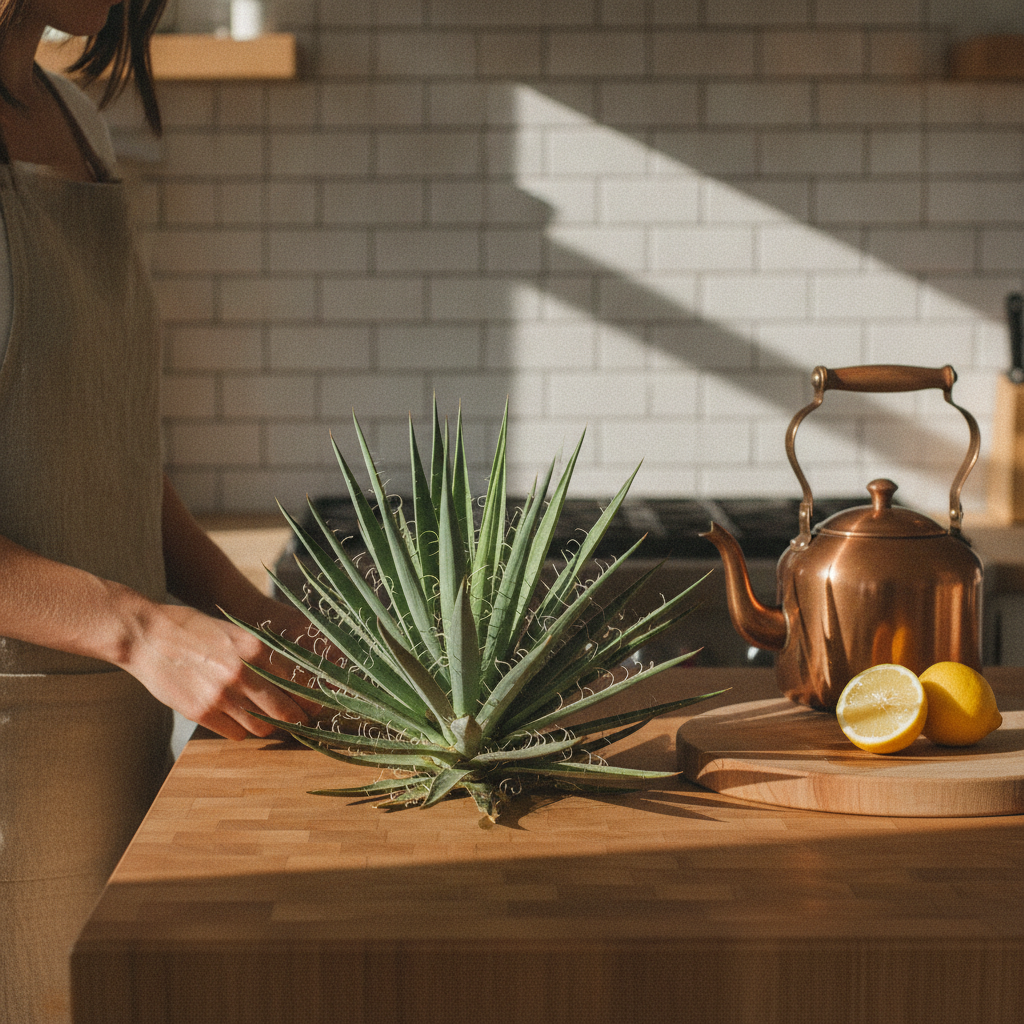
Just as importantly, it is forgiving of neglect in exactly the way busy owners appreciate. This is a plant adapted to survive prairie droughts, so forgetting to water it for a fortnight does no harm at all, and it stores enough reserves in its fleshy roots to shrug off periods of benign inattention. It is exceptionally long-lived, largely free of the pest problems that plague thin-leaved tropicals, and its slow, steady growth means it rarely outgrows its space in a hurry. The trade-off is that it demands genuine sunlight and sharp drainage, two conditions it will not compromise on, so the honest verdict is that it thrives for the right owner in the right spot rather than for everyone everywhere.
Important — Toxicity: Soapweed yucca contains saponins that are mildly toxic to cats, dogs and horses if the foliage or roots are chewed, and ingestion can cause drooling, vomiting and stomach upset. The rigid, needle-sharp leaf tips also pose a physical risk to eyes and skin, so place the plant where pets, children and passers-by will not brush against it.
Light Requirements
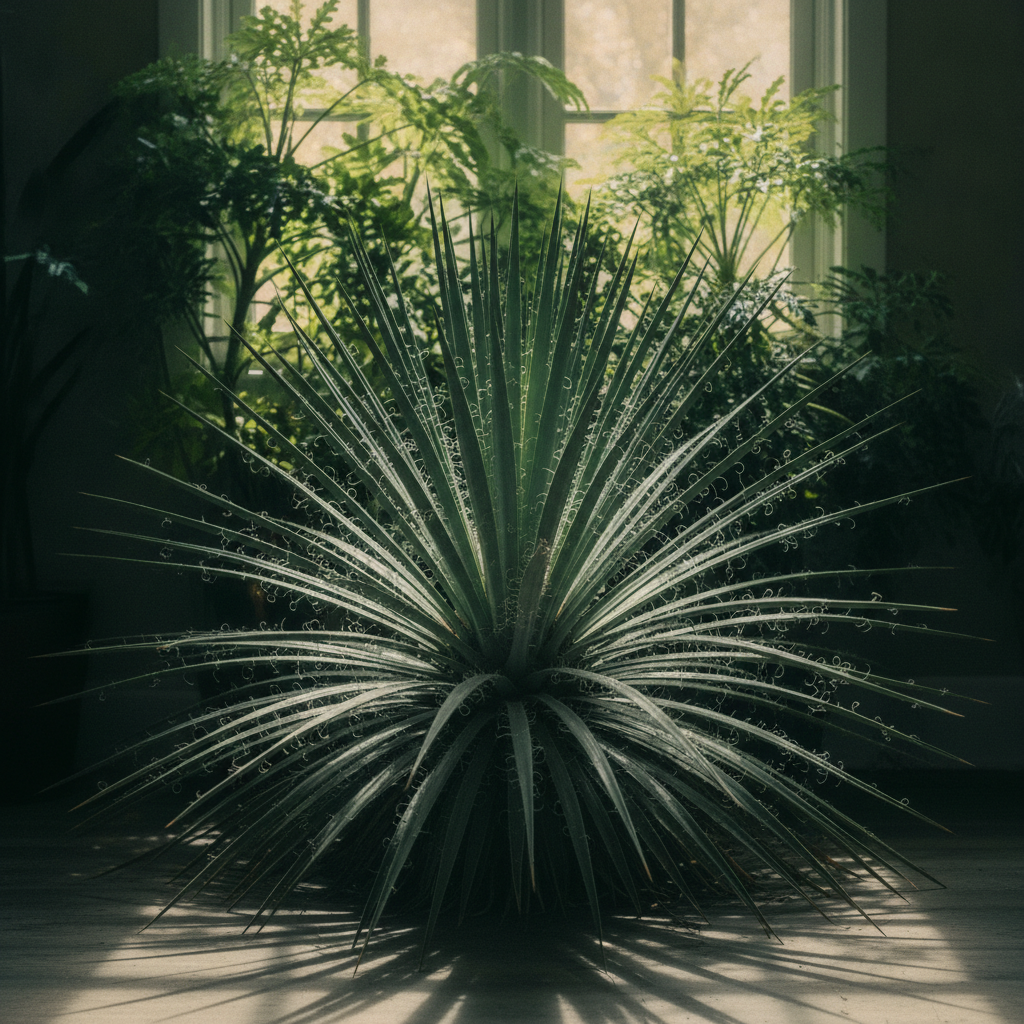
Light is the single most important factor in growing a healthy soapweed yucca, and there is no way to fake it. In its native range this plant grows in open, treeless grassland under full, unfiltered sun for the entire day, and it has evolved to run its metabolism at that intensity. The blue-grey waxy bloom on its leaves is itself a sunscreen, reflecting excess radiation and reducing water loss, which tells you everything about the conditions it expects.
Indoors, the goal is to give it the brightest position you have and then, if possible, make it brighter. A windowsill that receives several hours of direct sun each day is the minimum for keeping the rosette compact and firm. In anything less, the plant does not die quickly, but it stretches, the leaves lose their stiffness and lean toward the light, and the tidy starburst gradually collapses into a loose, floppy tuft.
Light Levels Explained
Understanding how indoor light tiers map to real outcomes helps set expectations. The categories below describe roughly what the plant experiences at each level and what result you can expect over a growing season.
| Light Category | Approx. Level | Typical Location | Outcome |
|---|---|---|---|
| Direct sun | Over 40,000 lux | Unobstructed south-facing sill | Ideal; tight, firm, well-coloured rosette |
| Bright indirect | 10,000 to 25,000 lux | Near an east or west window | Acceptable; slower, slightly looser growth |
| Medium | 5,000 to 10,000 lux | A metre or two back from a window | Marginal; noticeable stretching over time |
| Low | 1,000 to 5,000 lux | North window or interior wall | Poor; etiolation, weak growth, decline |
| Very low | Under 1,000 lux | Hallway or windowless room | Unsustainable; the plant will slowly fail |
Window Orientation and Placement
South-facing window: This is the best position in the home for a soapweed yucca in the northern hemisphere. Placed right on or beside the sill, it receives the strong midday and afternoon sun the plant craves, and no acclimatisation is usually needed for a plant that has been growing in good light already.
East-facing window: A workable second choice. The plant gets several hours of gentler morning sun, enough to stay reasonably compact, though growth is slower and you may see mild leaning toward the glass over the months.
West-facing window: Also suitable, offering strong afternoon light. Rooms with west light can run hot in summer, which the yucca tolerates well, so this is a solid option where a southern aspect is not available.
North-facing window: Not recommended. A north aspect never supplies the intensity this plant needs, and a soapweed yucca kept here will steadily deteriorate no matter how careful you are with everything else. If a north window is your only option, plan to supplement heavily with artificial light.
Pro Tip — Rotate for symmetry: Because the rosette grows toward the light, give the pot a quarter turn every week or two. This keeps the leaves radiating evenly in all directions and preserves the clean, symmetrical dome that makes the plant so striking.
How Light Affects Leaf Colour and Form
Strong light does more than keep the plant compact; it drives the very features that make the soapweed yucca beautiful. In full sun the leaves develop their deepest blue-grey tone, the waxy bloom is at its heaviest, and the blades stand stiff and straight. In weaker light the colour shifts toward a flatter, duller green, the wax coating thins, and the leaves become softer and more prone to bending. Good light also encourages the marginal fibres to curl tightly, adding to the plant’s character.
Warning — Direct Sunlight: While soapweed yucca loves sun, a plant that has been grown in low light indoors can scorch if moved abruptly into intense direct sun, especially behind glass that magnifies the heat. Introduce it gradually over one to two weeks, increasing exposure a little each day, to let the leaves build up their protective bloom before full exposure.
Artificial Lighting
Because natural light indoors is so often the limiting factor, a full-spectrum LED grow-light is a genuinely useful tool for this species. Positioned 20 to 30 cm (8 to 12 in) above the rosette and run for 12 to 14 hours a day, a good grow-light can supply the intensity a dim room cannot, keeping growth tight and the colour strong. For anyone in a flat with only north or heavily shaded windows, supplemental lighting is less a luxury than a requirement for long-term success.
Seasonal Adjustments
Light intensity indoors falls sharply from autumn into winter, and the yucca’s growth slows to a near halt in response. Move the plant to your sunniest window for the darker months, clean any dust from the leaves so they capture every available photon, and reduce watering accordingly since a plant receiving less light uses far less water. As days lengthen again in spring, growth resumes and you can shift back to a normal routine.
Watering & Humidity
If light is where most people underdo it with soapweed yucca, water is where most people overdo it. This is a drought-adapted plant with thick, water-storing roots, and the fastest way to kill one is to keep its soil consistently moist. The guiding principle is simple: when in doubt, do not water. A yucca will forgive weeks of dryness far more readily than a single week of soggy soil.
When to Water
Water only when the potting mix has dried out entirely, from the surface all the way to the bottom of the pot. Push a finger deep into the soil or lift the pot to judge its weight; a dry pot is noticeably light. In practice, a soapweed yucca in a bright spot during the growing season needs watering roughly every two to three weeks, though this varies with pot size, temperature and how much sun it receives.
In winter, when growth stalls and light is weak, cut back dramatically. Watering once a month or even less is usually right, and some growers keep the plant almost bone dry through the coldest, darkest weeks. The plant is effectively resting, and cold, wet soil at this time is the classic recipe for root rot.
Pro Tip — The soak and dry method: When you do water, do it properly. Drench the mix until water runs freely from the drainage holes, which flushes out accumulated salts and wets the entire root zone, then let the pot drain fully and do not water again until it is completely dry. This mimics the prairie pattern of an occasional heavy downpour followed by a long dry spell.
How to Water Correctly
- Confirm the soil is dry all the way through before you begin; if in any doubt, wait a few more days.
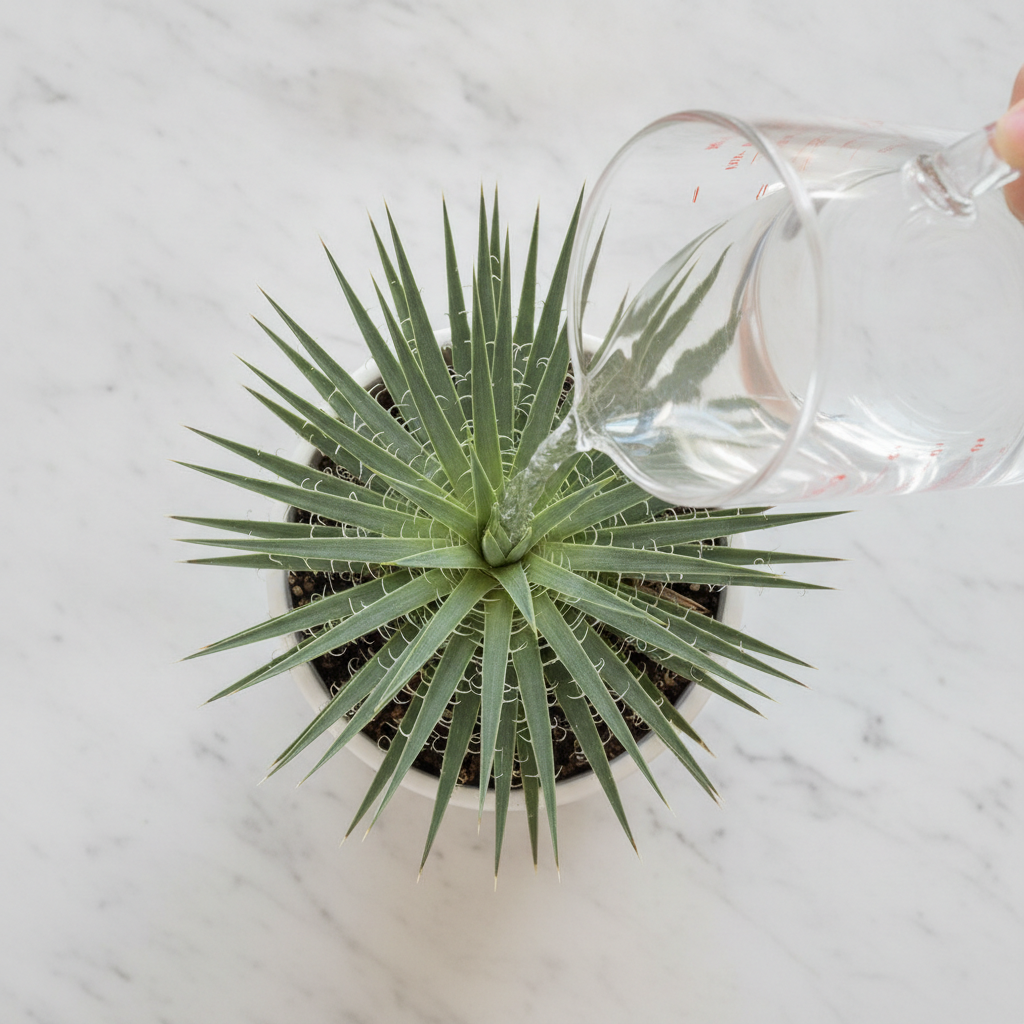
- Water at the base of the plant, aiming for the soil rather than pouring into the crown of the rosette where moisture can settle and rot the centre.
- Add water steadily until it drains freely from the bottom of the pot.
- Let the pot sit and drain completely, then empty any saucer so the roots never stand in water.
- Return the plant to its bright spot and leave it undisturbed until the mix is fully dry again.
Signs of Overwatering vs. Underwatering
| Symptom | Overwatering | Underwatering |
|---|---|---|
| Leaf colour | Yellowing, often starting at the base of the rosette | Dulling and slight greying, colour otherwise holds |
| Leaf texture | Soft, mushy, translucent at the base | Wrinkled, slightly curled or creased along the length |
| Soil | Stays wet for a long time, may smell sour | Bone dry, pulling away from the sides of the pot |
| Roots | Brown, soft and foul-smelling | Firm and pale but dry; recover quickly once watered |
| Stem base | Darkening, soft rot at soil level | Firm; no rot present |
Warning — Root Rot: Root rot is the number one killer of container-grown yuccas and is almost always caused by overwatering or poor drainage. If the base of the plant turns soft and dark, act at once: unpot it, cut away all mushy roots and rotted tissue with a sterile blade, let the wounds callus for a day or two, and repot into fresh, dry, gritty mix. Caught early, many plants recover; left unchecked, the rot spreads into the crown and the plant is lost.
Humidity Requirements
Here the soapweed yucca is refreshingly undemanding, because it actively prefers dry air. The average humidity of a centrally heated or air-conditioned home, often as low as 30 to 40 percent, suits it perfectly, and it never needs misting or a pebble tray. If anything, this is a plant to keep away from humid microclimates.
Problems linked to moisture in the air are almost always the result of too much rather than too little. Persistently high humidity, poor air circulation and crowded conditions encourage fungal spotting on the leaves and raise the risk of crown rot, so a steamy bathroom or a plant packed tightly among tropical foliage is the wrong home for this species.
Rather than raising humidity, focus on keeping air moving freely around the plant. Good ventilation, a little space between it and its neighbours, and a bright, airy position all help the foliage stay dry and healthy between waterings.
Water Quality
Soapweed yucca is not fussy about water quality and tolerates ordinary tap water in most areas without complaint. Because you water so infrequently, mineral build-up is slower to develop than with thirstier plants, though flushing the pot thoroughly at each watering keeps salts from accumulating. In regions with very hard water or heavily softened water, occasional use of rainwater or filtered water is a sensible precaution, but for most owners it is not necessary.
Soil, Potting & Repotting
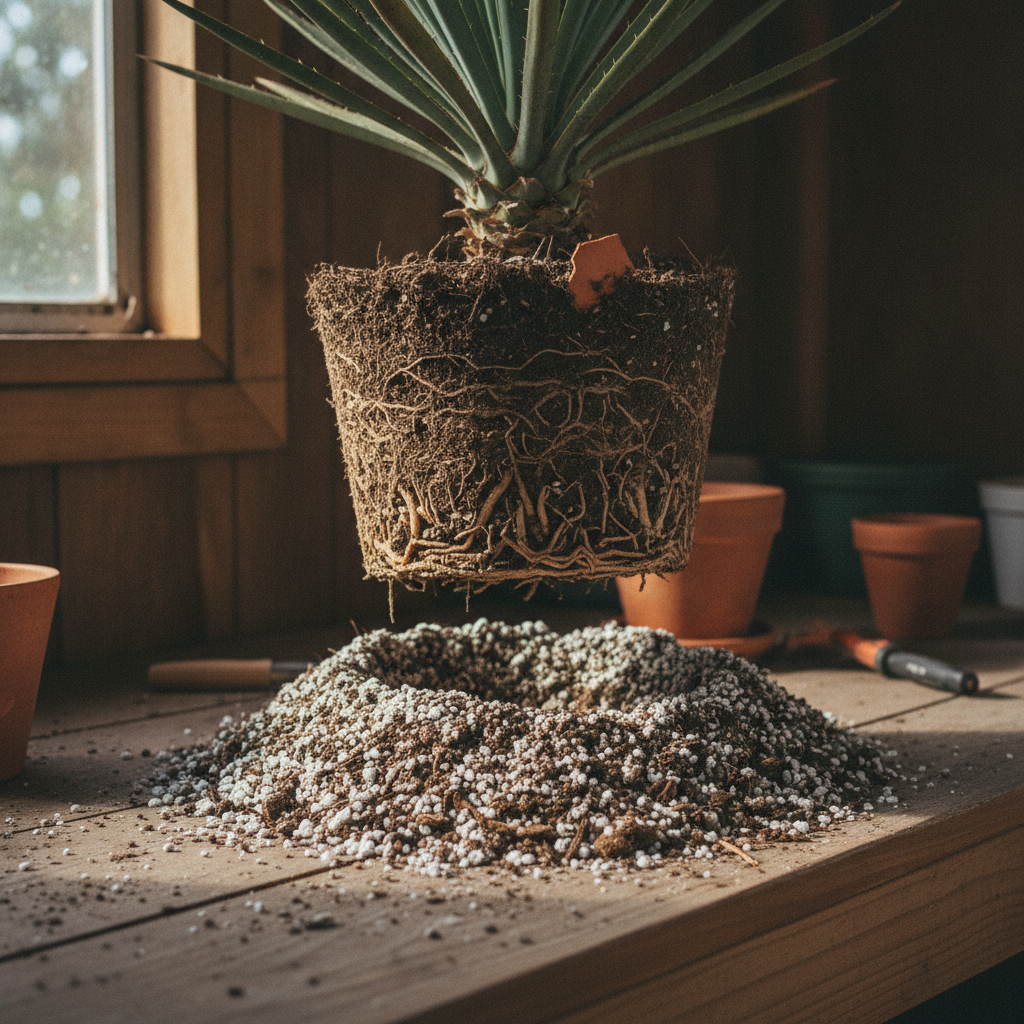
Drainage is everything for a soapweed yucca. In the wild it grows in sandy, gravelly, often nutrient-poor prairie soils that shed water almost instantly, and replicating that fast-draining character in a pot is the second half of the survival equation, alongside strong light. A rich, moisture-retentive potting compost of the kind that suits tropical foliage is exactly wrong for this plant.
Ideal Soil Composition
Aim for a mineral-heavy, gritty blend that holds just enough moisture to sustain the plant between deep soakings while draining freely and staying airy around the roots. A purpose-made cactus and succulent compost is a good starting point, but most benefit from extra grit added to open them up further. The table below shows a reliable blend.
| Component | Proportion | Function |
|---|---|---|
| Cactus or succulent compost | 50 percent | Base structure and modest moisture retention |
| Coarse horticultural grit or pumice | 30 percent | Rapid drainage and root aeration |
| Coarse sand or perlite | 20 percent | Extra porosity and weight for stability |
Soapweed yucca is comfortable across a wide range of soil pH, from slightly acidic to alkaline, roughly 6.0 to 8.0, which reflects the varied prairie soils of its native range. There is no need to chase a precise figure; a standard gritty mix will fall within its tolerance without any adjustment.
Pro Tip — Quick Mix Recipe: For a fast, dependable blend, combine two parts of a bagged cactus compost with one part pumice and one part coarse grit or perlite. If in doubt, err toward more grit rather than less: a mix that looks almost too sharp and stony is usually exactly right for this plant.
Choosing the Right Pot
The container matters almost as much as the mix inside it, because the wrong pot can undo even the best soil. With a top-heavy rosette and sharp leaves, the yucca also benefits from a stable, weighty base.
Drainage holes are non-negotiable. Never plant a soapweed yucca in a pot without generous drainage holes. Any container that traps water at the roots will lead to rot no matter how careful your watering, so if you love a decorative pot without holes, use it only as an outer cover and keep the plant in a well-drained inner pot.
Pot material: Unglazed terracotta is the ideal choice. Its porous walls wick moisture out of the mix and allow it to dry more evenly and quickly, which is exactly what this plant wants, and its weight helps counterbalance a tall rosette. Plastic and glazed ceramic can work but hold moisture longer, so lean even harder on a gritty mix and cautious watering if you use them.
Pot size: Choose a pot only slightly larger than the root ball. An oversized container holds a large volume of slow-drying soil around the roots, which greatly increases rot risk. Soapweed yucca is happy growing somewhat snug and rarely needs a dramatic upgrade in pot size.
When to Repot
This is a slow-growing plant that dislikes disturbance, so repot infrequently, roughly every three to four years or only when it is clearly pot-bound, with roots circling the base or emerging from the drainage holes. The best time is spring, at the start of the active growing season, when the plant can recover quickly. If the plant is healthy and not straining its pot, refreshing the top few centimetres of mix each year is often all it needs.
How to Repot: Step-by-Step
- Wait until the soil is dry, which makes the plant easier to remove and is gentler on the roots.
- Wear thick gloves and, ideally, wrap the leaves loosely with cloth or paper to protect yourself from the sharp tips.
- Ease the plant out of its pot and gently tease away the old, spent soil from around the roots.
- Inspect the roots, trimming any that are soft, blackened or rotten with a sterile blade.
- Position the plant in its new pot at the same depth it sat before, and fill around it with fresh gritty mix, firming lightly.
- Resist the urge to water straight away; wait about a week before the first watering to let any disturbed roots heal.
Warning — Transplant Shock: After repotting, a soapweed yucca may pause its growth for several weeks as it settles in, which is normal. Keep it in bright light but avoid fertilising until you see fresh growth, and be especially disciplined about not overwatering during this recovery window, when damaged roots are most vulnerable to rot.
Fertilising
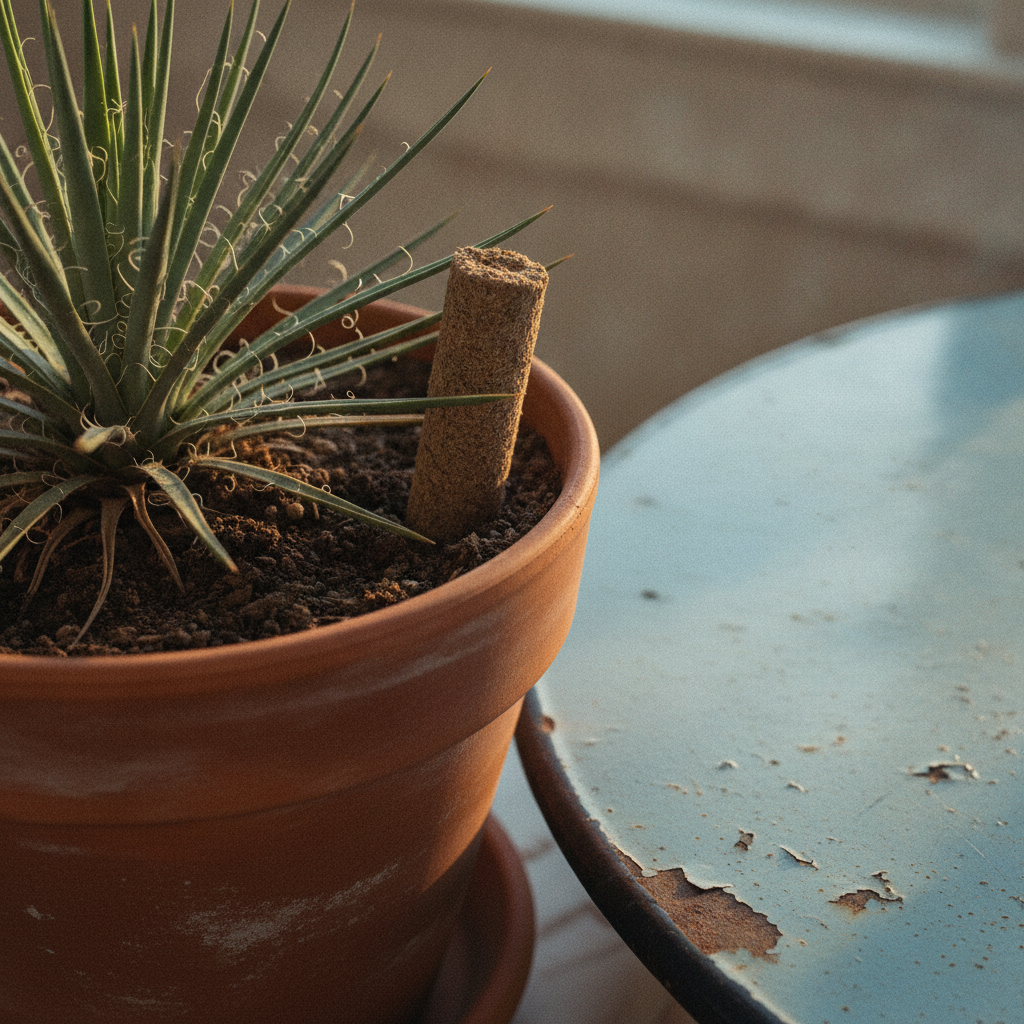
Soapweed yucca evolved on lean, low-fertility prairie soils and has correspondingly modest appetites. It is one of those plants where the most common mistake is feeding too much rather than too little, and a plant that is overfed produces soft, weak, rapid growth that is more prone to flopping and to pest and disease problems.
Treat fertiliser as an occasional, gentle boost rather than a routine. A light feed once or twice across the whole growing season, from late spring through summer, is ample for a container plant, and many well-established specimens grow happily for years on almost nothing beyond the nutrients in a periodic soil refresh.
Understanding Plant Nutrients
Fertilisers are labelled with an NPK ratio giving the percentages of nitrogen, phosphorus and potassium, the three nutrients plants need in the largest amounts. For a soapweed yucca, a balanced or slightly low-nitrogen formula is best, since too much nitrogen drives exactly the lush, soft growth this plant should avoid. The table below summarises the key nutrients and what their absence looks like.
| Nutrient | Symbol | Primary Function | Deficiency Symptoms |
|---|---|---|---|
| Nitrogen | N | Leaf and stem growth, green colour | Overall paling, weak and stunted growth |
| Phosphorus | P | Root development and flowering | Poor roots, dull colour, reddish tints |
| Potassium | K | Overall vigour and stress tolerance | Yellowing or browning at leaf edges |
| Calcium | Ca | Cell wall structure and firmness | Distorted, weak new growth |
| Magnesium | Mg | Core of the chlorophyll molecule | Yellowing between the veins of older leaves |
| Iron | Fe | Chlorophyll production in new growth | Yellowing of the youngest leaves, green veins |
Types of Fertiliser
Liquid fertilisers: These are the easiest to control for a light feeder, because you can dilute them heavily and apply only when you choose. A balanced houseplant feed or a dedicated cactus and succulent formula, diluted to half strength or less, is well suited to this plant.
Slow-release granular: A small amount of slow-release fertiliser worked into the soil in spring can supply steady, gentle nutrition through the season without any further effort. Use less than the packet suggests, since general rates assume hungrier plants.
Organic fertilisers: Mild organic options such as a dilute seaweed feed or a thin top-dressing of worm castings release nutrients slowly and are difficult to overdo, which makes them a safe, forgiving choice for a plant that resents excess.
Feeding Schedule
Feed only during the active growing season, from late spring through to the end of summer. One application at the start of the season and perhaps one more midway through is usually enough. Stop feeding entirely in autumn and winter, when the plant is resting and cannot use the nutrients, and any excess simply accumulates in the soil as harmful salts.
Pro Tip — Less is more: When it comes to feeding a soapweed yucca, always dilute more than you think you need to and feed less often than you would a leafy tropical. A hungry-looking yucca is far easier to fix than one damaged by a build-up of fertiliser salts, so treat under-feeding as the safer error.
How to Fertilise
- Water the plant lightly a day beforehand, or feed just after a normal watering, so nutrients never hit dry roots.
- Dilute a liquid feed to half strength or weaker, following the lower end of the label’s guidance.
- Apply the solution to the soil, not the foliage, and only during the growing season.
- Flush the pot thoroughly with plain water every few months to wash out any accumulated salts.
Warning — Salt Build-Up: A white or yellowish crust on the soil surface or around the pot rim, along with brown, scorched leaf tips, is a sign of fertiliser salt build-up. Correct it by flushing the pot with several times its volume of plain water, letting it drain completely, and cutting back on feeding thereafter.
Propagation
Soapweed yucca can be multiplied in several ways, but not by the leaf cuttings that work for many succulents; a detached yucca leaf will simply dry up rather than root. Instead, the reliable methods for the home grower are separating the offsets, or pups, that form around the base of a mature plant, and dividing the crown of a clumping specimen. Growing from seed is possible too, though it is slow and requires viable seed, which in nature depends on a very particular pollinator.
Both vegetative methods are best carried out in spring or early summer, when the plant is entering active growth and wounds heal fastest. Patience is the watchword: yuccas are unhurried, and new divisions can take a while to establish before they show fresh growth.
Understanding Offsets and the Root System
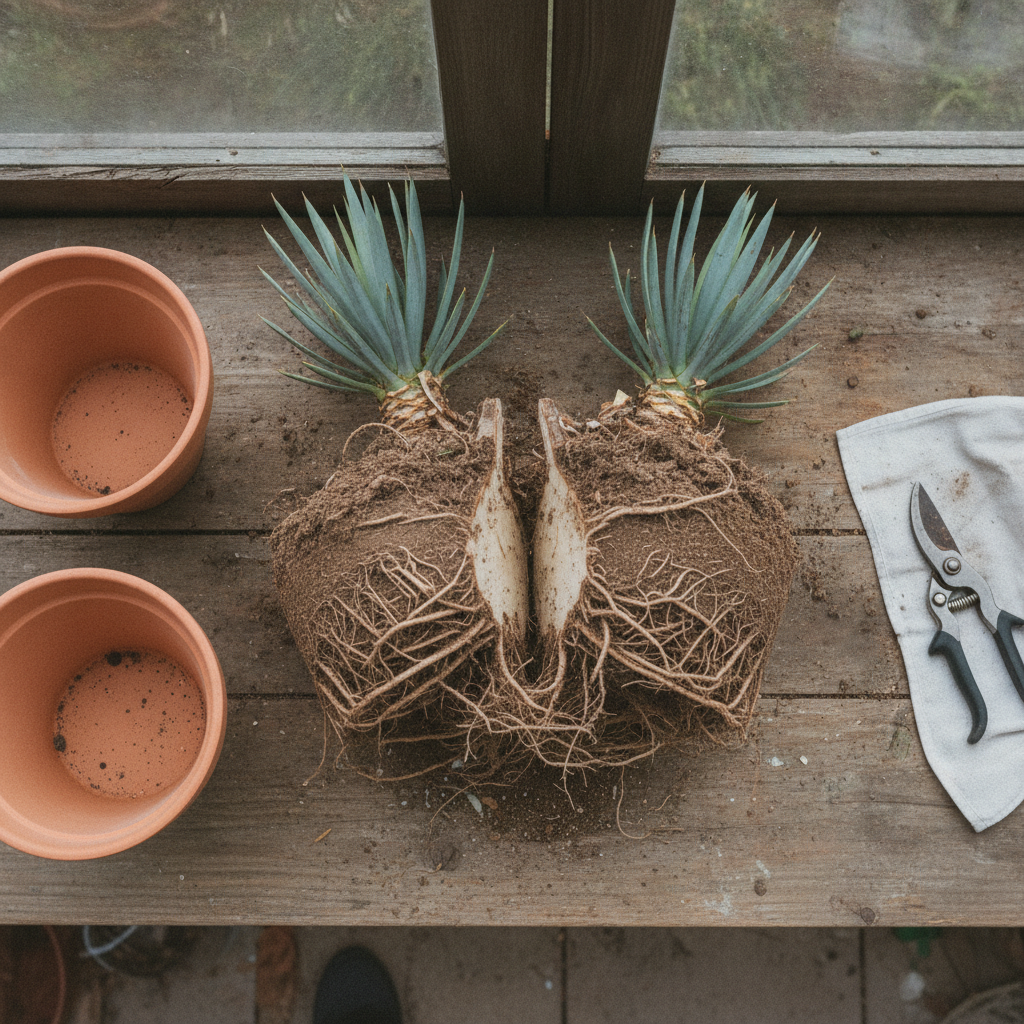
A healthy, established soapweed yucca spreads by producing offsets from its base and from underground rhizomes, gradually forming a clump of rosettes. Each offset is a young plant in its own right, connected to the parent and often already carrying a few roots of its own. This natural cloning is what makes vegetative propagation so dependable: you are simply separating growth the plant has already started, rather than coaxing roots from bare tissue. The fleshy, storage-rich roots also mean divisions arrive with a built-in reserve of energy to draw on while they settle.
Offset Separation: Step-by-Step
Separating pups is the simplest and most successful method for most owners, especially when repotting gives you access to the base of the plant.
- Wearing gloves, unpot the parent plant and gently brush away soil to expose where the offsets join the base.
- Identify a well-developed offset, ideally one that already has a few roots of its own.
- Use a clean, sharp knife to cut the offset away from the parent, keeping as many of its roots intact as possible.
- Let the cut surfaces dry and callus in a shaded, airy spot for two to three days to guard against rot.
- Pot the offset into a small container of gritty, free-draining mix, burying only the base.
- Keep it in bright, indirect light and wait about a week before the first light watering, then treat it as a normal, mature plant.
Pro Tip — Let the wound callus: The single most important step in yucca propagation is allowing the cut to dry and seal before it touches soil. Planting a fresh, moist wound straight into damp mix is the most common cause of failure, because open tissue invites rot. A few days of patience dramatically improves your success rate.
Division: Step-by-Step
Where a plant has grown into a multi-crowned clump, you can split it into separate plants by division, which also rejuvenates an old, congested specimen.
- Unpot the whole clump and shake or wash off enough soil to see the individual crowns and their roots.
- Decide where to divide, choosing natural break points where each section carries both a crown and a fair share of roots.
- Cut cleanly through the root mass with a sterile knife, or ease sections apart by hand where they separate easily.
- Allow the cut surfaces to callus for a couple of days in a dry, shaded place.
- Pot each division into its own container of gritty mix and withhold water for about a week before resuming careful watering.
Troubleshooting Propagation
| Problem | Likely Cause | Solution |
|---|---|---|
| Offset rots after planting | Planted before the wound callused, or soil too wet | Let cuts dry for several days; use dry, gritty mix and delay watering |
| No new growth for weeks | Normal slow establishment for a yucca | Be patient, keep bright and barely watered; roots form before top growth |
| Division wilts or softens | Too few roots taken, or over-watering during recovery | Ensure each piece has roots; keep almost dry until established |
| Seeds fail to germinate | Non-viable seed or unmet dormancy needs | Use fresh seed, provide warmth and light, and expect slow, uneven results |
Pests & Diseases
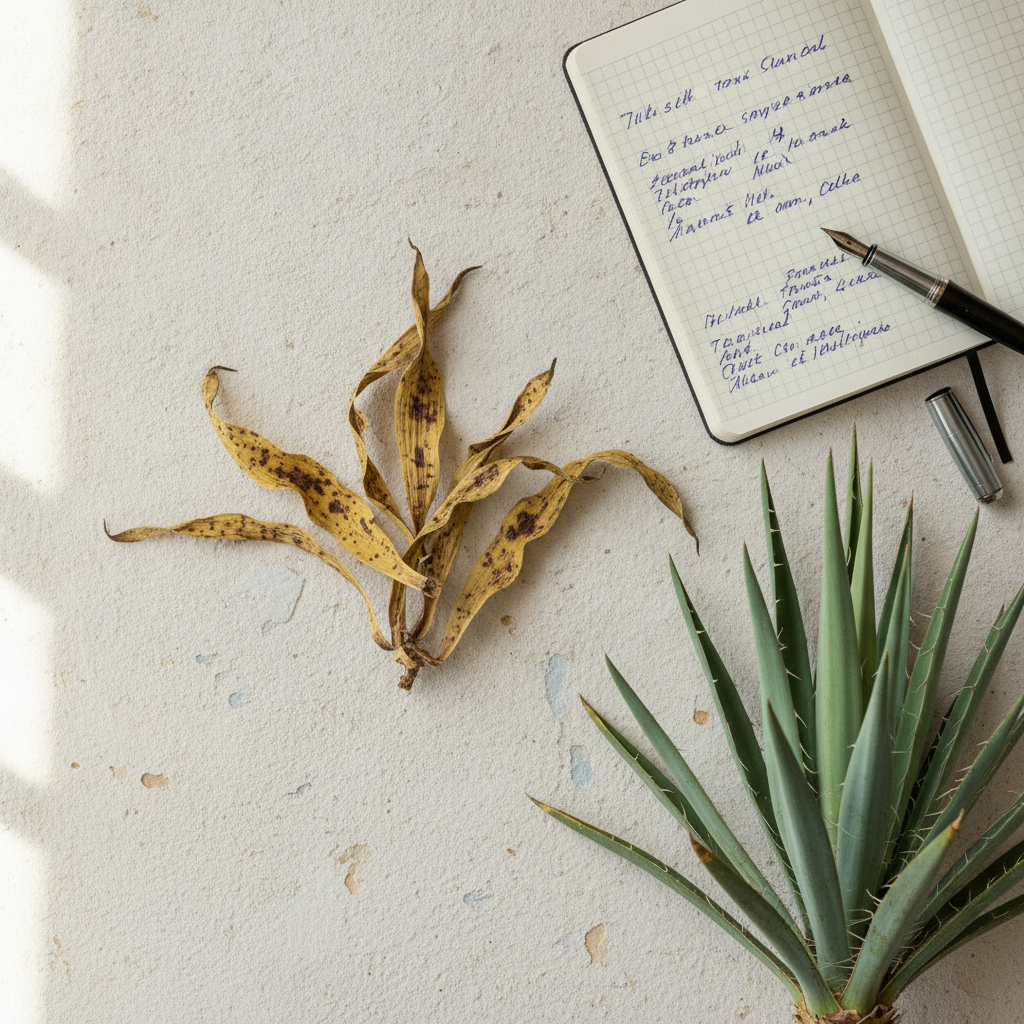
One of the great pleasures of the soapweed yucca is how rarely it falls prey to the pests and diseases that torment thinner-leaved houseplants. Its tough, waxy foliage and dry-growing habits make it a poor target, and a plant kept in good light with careful watering is largely trouble-free. The problems that do occur are almost always secondary to a cultural mistake, most often overwatering.
Even so, it pays to know what to watch for, since early detection makes any issue far easier to resolve. Inspect the plant, particularly the leaf axils and undersides, every few weeks, and treat the appearance of trouble as a prompt to review your care as much as to reach for a remedy.
Common Pests
Mealybugs (Pseudococcidae)
Mealybugs are small, soft-bodied insects that hide in the crevices of the rosette and leaf axils, protected by a white, cottony wax. They suck sap and, in numbers, weaken the plant and leave sticky honeydew that can turn sooty and black.
Treatment: Dab each insect directly with a cotton bud dipped in isopropyl alcohol, which dissolves their protective coating. For larger infestations, treat with an insecticidal soap or a horticultural oil, repeating every week or two until they are gone, and check hidden axils carefully.
Scale Insects (Diaspididae)
Scale appear as small, brown, limpet-like bumps clinging to the leaves, often along the midrib or edges. Immobile once settled, they are easy to overlook until their sap-feeding causes yellowing and general decline.
Treatment: Scrape off individual scales with a fingernail or an old toothbrush, then wipe the area with alcohol. Persistent infestations respond to horticultural oil, which smothers them; repeat applications are usually needed to catch newly hatched crawlers.
Spider Mites (Tetranychus urticae)
Spider mites are tiny arachnids that thrive in hot, dry conditions and can occasionally colonise a stressed yucca, causing fine stippling on the leaves and, in bad cases, delicate webbing between the blades. They are hard to see without a lens.
Treatment: Wipe the leaves down to physically remove mites and webbing, then treat with insecticidal soap or horticultural oil. Because they are less common on a healthy, well-grown plant, their appearance is often a sign the plant is under stress from another cause.
Common Diseases
Root and Crown Rot (Phytophthora and Pythium spp.)
By far the most serious threat to a container soapweed yucca, root and crown rot is a fungal and water-mould problem caused by soil that stays too wet. It shows as a soft, darkening base, yellowing lower leaves and, eventually, collapse of the whole plant as the roots turn to mush.
Treatment: Act immediately. Unpot the plant, cut away all soft and discoloured tissue with a sterile blade, let it dry, and repot into fresh, dry, gritty mix. Prevention through cautious watering and excellent drainage is far more effective than any cure.
Fungal Leaf Spot (various fungi)
Leaf spot appears as brown or grey lesions, sometimes with a yellow halo, and is encouraged by high humidity, poor air movement and water sitting on the foliage. It is largely cosmetic in mild cases but can spread if conditions stay damp.
Treatment: Remove affected leaves, improve air circulation, keep water off the foliage and reduce humidity around the plant. A copper-based fungicide can help in stubborn cases, but improving the growing conditions usually resolves it.
Pest and Disease Summary
| Pest / Disease | Identification | Treatment |
|---|---|---|
| Mealybugs | White cottony masses in axils and crevices | Alcohol swabs, insecticidal soap, horticultural oil |
| Scale insects | Brown limpet-like bumps on leaves | Scrape off, wipe with alcohol, apply horticultural oil |
| Spider mites | Fine stippling and faint webbing | Wipe down, insecticidal soap, address underlying stress |
| Root and crown rot | Soft dark base, yellowing, collapse | Cut away rot, repot in dry gritty mix, water less |
| Fungal leaf spot | Brown or grey lesions on leaves | Remove leaves, improve airflow, keep foliage dry |
Prevention Strategies
The best defence for a soapweed yucca is simply good culture. A plant grown in strong light, watered sparingly and potted in a fast-draining mix is naturally resilient, and the overwhelming majority of problems can be traced back to a departure from one of those three fundamentals. Get them right and pests and diseases rarely gain a foothold.
Beyond the basics, quarantine any new plant for a couple of weeks before placing it near your yucca, inspect regularly so issues are caught early, keep the foliage clean and dust-free, and ensure air moves freely around the plant. These small habits together make serious outbreaks very unlikely.
Pro Tip — Diagnose before you treat: Because so many yucca problems stem from overwatering rather than pests, always check the soil and roots before assuming an infestation. Yellowing, softening leaves usually mean wet feet, not insects, and reaching for a pesticide when the real issue is drainage only wastes time while the rot advances.
Popular Varieties
Yucca glauca is a wild species rather than a heavily bred ornamental, so it has few named cultivars in the way that, say, a hosta or a philodendron might. Instead, its variation comes largely from geography, with regional forms and recognised subspecies differing subtly in size, leaf width and hardiness across its vast native range.
For the grower, this means choosing between the typical Great Plains form and one of the hardier northern variants, along with a small number of related species often sold under the soapweed umbrella. The table and profiles below cover the forms you are most likely to encounter.
| Variety | Leaf Appearance | Light Needs | Growth Rate | Availability |
|---|---|---|---|---|
| var. glauca | Narrow blue-grey blades, white curling threads | Full sun | Slow | Common |
| subsp. albertana | Shorter, finer blue-green leaves, tight clump | Full sun | Slow | Uncommon |
| var. stricta | Stiffer, more upright blades | Full sun | Slow | Uncommon |
| Yucca harrimaniae (relative) | Broader, shorter leaves, denser rosette | Full sun | Slow | Specialist |
| Yucca baccata (relative) | Wider, thicker blue-green leaves | Full sun | Slow | Specialist |
Featured Varieties
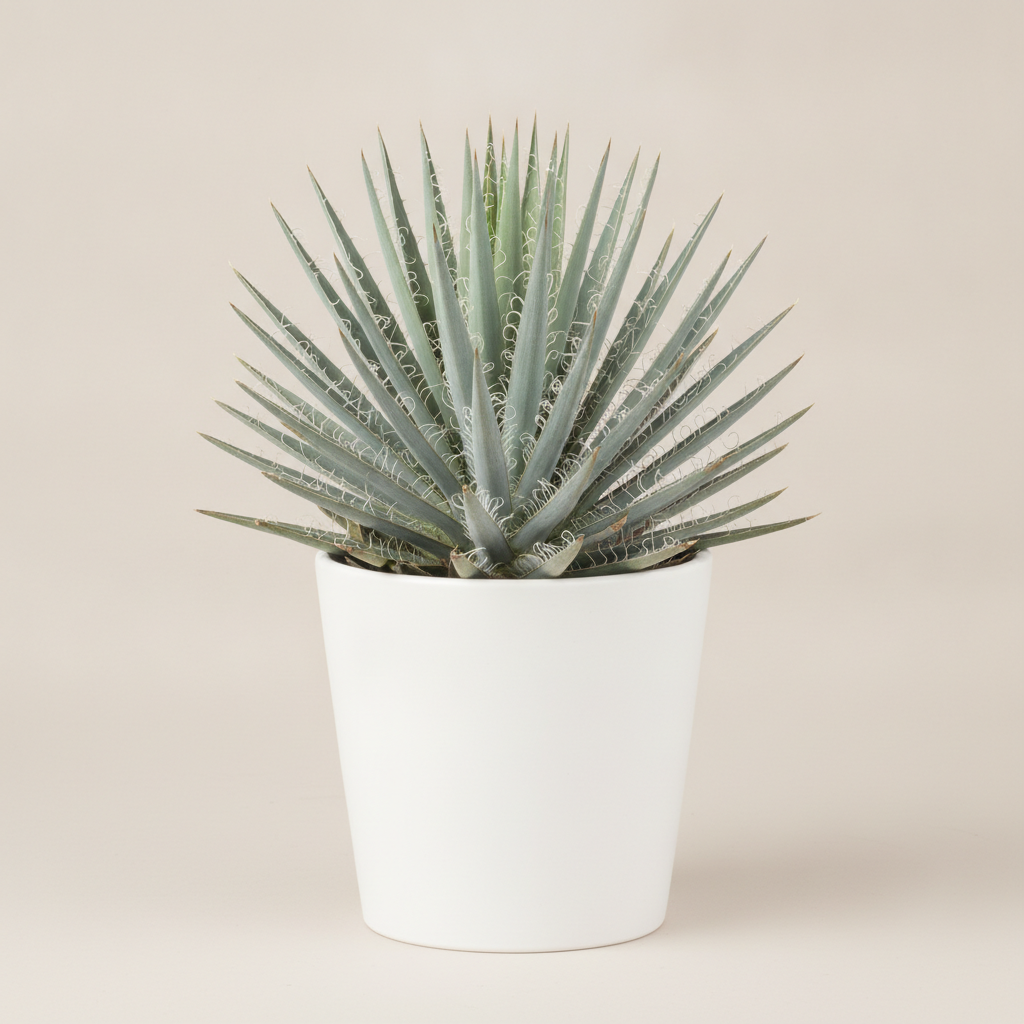
var. glauca (Great Plains Soapweed)
The typical form and the one most often sold, with a classic rounded rosette of narrow, rigid blue-grey blades edged in peeling white threads. It is the benchmark against which the other forms are judged and the easiest to source.
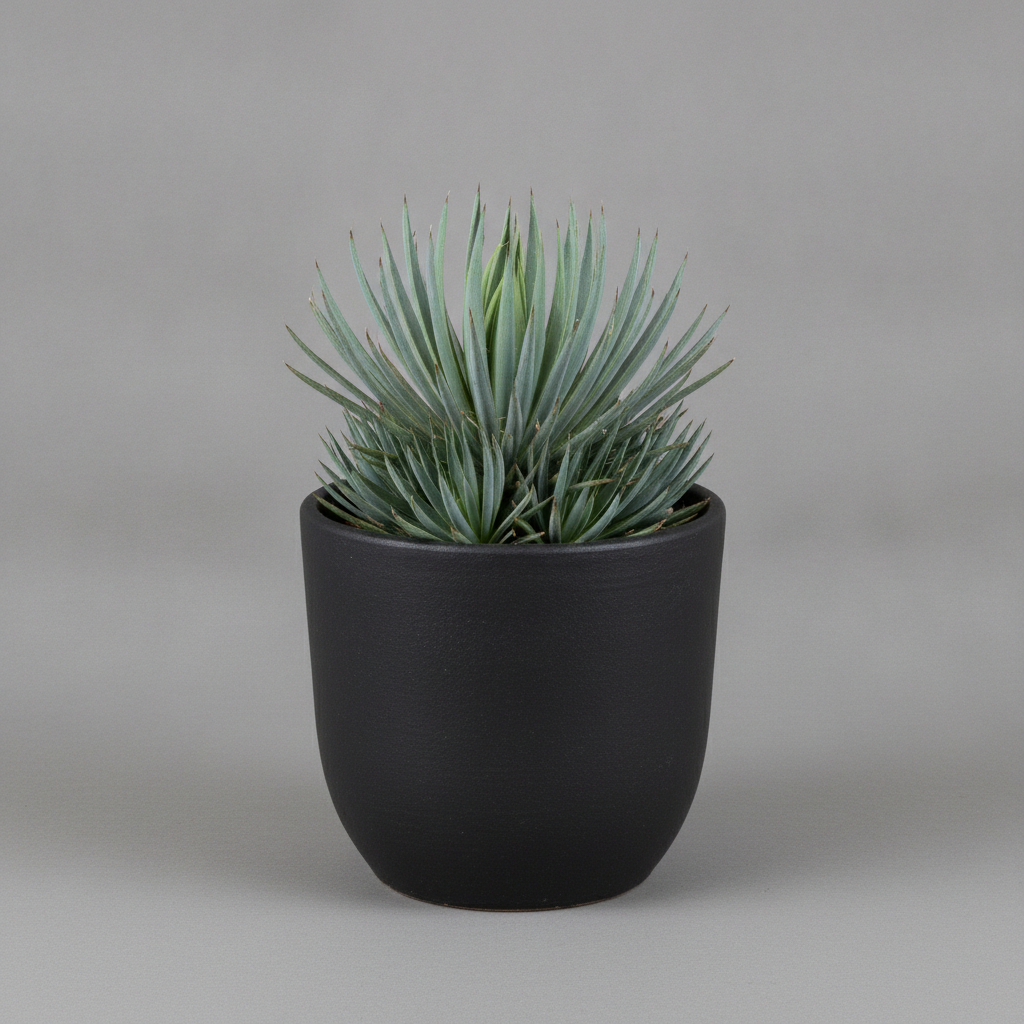
subsp. albertana (Alberta Soapweed)
A hardier northern subspecies from the Canadian prairies, more compact than the type with shorter, finer leaves and a tighter clumping habit. It is prized by collectors in the coldest climates for its exceptional cold tolerance.
Variety Profiles in Detail
var. glauca (Yucca glauca var. glauca)
The nominate variety is the widespread Great Plains soapweed, forming a low, near-stemless rosette up to about 1 metre (3 ft) across, with countless slender, sharp-tipped blue-grey leaves and abundant white marginal fibres. In summer a mature plant sends up a tall spike of pendulous, creamy-white bell flowers. This is the form to expect when you buy a soapweed yucca without a more specific name.
subsp. albertana (Yucca glauca subsp. albertana)
Native to the northern edge of the species’ range in Alberta and Saskatchewan, this subspecies is adapted to some of the harshest conditions any yucca endures. It is generally smaller and more compact, with finer leaves and a denser clump, and it survives extreme winter cold that would test even the type. For growers in very cold regions who want to keep a plant outdoors, it is the standout choice.
Related soapweeds (Yucca harrimaniae and Yucca baccata)
Several close relatives are sometimes sold alongside true soapweed and share much of its culture. Yucca harrimaniae, Spanish bayonet, is a smaller, denser species with shorter, broader leaves, while Yucca baccata, the banana yucca, is a larger, coarser plant with wide, thick blue-green blades and edible fruit. Both want the same full sun and sharp drainage as Yucca glauca.
Choosing the Right Variety for Your Space
For most indoor growers the choice is straightforward: the widely available var. glauca is ideal, offering the full soapweed character in a manageable form. If you live in a very cold climate and intend to grow your plant outdoors year round, seek out subsp. albertana for its hardiness. And if you simply love the look and have a specialist nursery within reach, exploring the related species can add welcome variety, provided you can give every one of them the same non-negotiable diet of strong sun and fast-draining soil.
Frequently Asked Questions
Why is my soapweed yucca turning yellow?
The most common cause of yellowing, especially at the base of the rosette with soft, mushy leaves, is overwatering. Check that the soil has dried out fully between waterings and that the pot drains freely. An occasional old leaf yellowing and dying at the very bottom is normal ageing and no cause for concern.
How often should I water my soapweed yucca?
Water only when the mix is completely dry, which in a bright spot usually means roughly every two to three weeks in summer and once a month or less in winter. These are guidelines, not a schedule; always check the soil first and, when unsure, wait longer rather than watering too soon.
Is soapweed yucca safe for cats and dogs?
No. Like other yuccas, it contains saponins that are mildly toxic to cats, dogs and horses if eaten, and can cause drooling, vomiting and stomach upset. The sharp leaf tips are also a physical hazard. Keep the plant out of reach of pets, and contact a vet if you suspect your animal has chewed it.
Can I grow soapweed yucca indoors long term?
Yes, provided you can give it enough light. This is really a full-sun outdoor plant, so indoors it needs the very brightest window you have, ideally south-facing, and often benefits from a grow-light. In good light with sharp drainage it can live happily in a container for many years; in a dim spot it will slowly decline.
Will my soapweed yucca flower indoors?
Flowering indoors is uncommon. In the wild, mature plants send up a tall spike of creamy bell-shaped flowers in summer, but this usually requires the intense light and seasonal cues of an outdoor life. A container plant kept in exceptional light may occasionally bloom, but most indoor specimens are grown for their striking foliage rather than their flowers.
Why are the tips of my yucca leaves turning brown?
Brown leaf tips can result from a build-up of fertiliser salts, inconsistent watering, or occasionally very dry air combined with heat. Flush the pot thoroughly with plain water to clear any salts, ease back on feeding, and settle into a steady soak-and-dry watering rhythm. Existing brown tips will not turn green again but new growth should be clean.
How fast does soapweed yucca grow?
Slowly. This is not a plant that will fill a room in a season; it adds modest growth each year and can take several years to reach full size in a container. That measured pace is part of its appeal, since it rarely outgrows its position and needs repotting only every few years.
Do I need to prune my soapweed yucca?
Very little pruning is needed. Simply remove old, dead or damaged leaves from the base as they naturally wither, pulling or cutting them away cleanly. Wear gloves and mind the sharp tips. There is no need to shape the plant, as its beauty lies in its natural symmetrical rosette.
Can soapweed yucca survive frost?
Remarkably well. Yucca glauca is one of the hardiest yuccas, native to the northern Great Plains and tolerant of temperatures down to around -30 C (-22 F), with the Alberta subspecies hardier still. If you grow it outdoors in a cold climate, the main winter risk is not cold itself but wet soil, so excellent drainage is essential for it to come through the season unscathed.






