
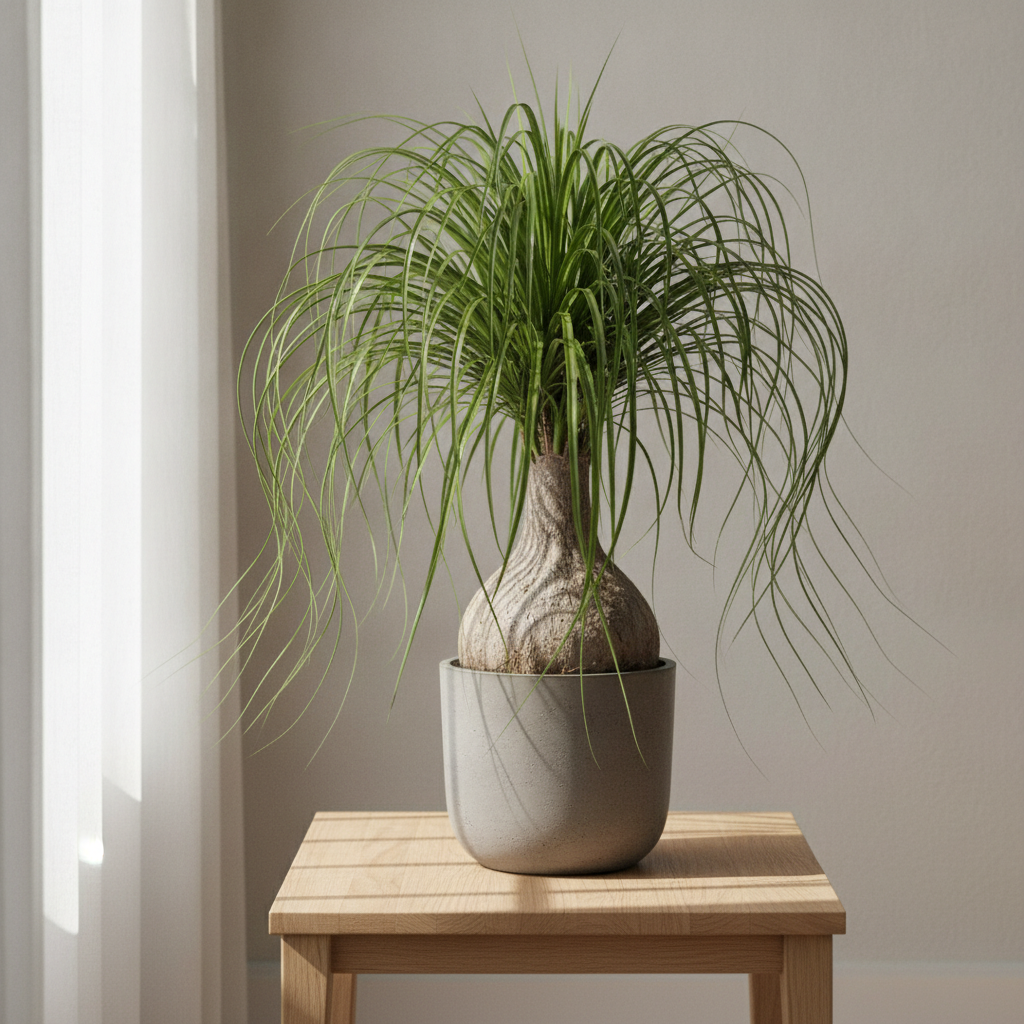
Few houseplants wear their survival strategy quite so openly as the bottle ponytail palm (Beaucarnea recurvata). That swollen, bulbous base, which earns the plant its other common names of elephant foot palm and bottle palm, is a living water tank, and it explains almost everything about how this plant likes to be treated. Despite the name, it is not a palm at all but a member of the Asparagaceae family, a relative of agaves and dracaenas, native to the semi-arid scrublands of eastern Mexico.
The bottle ponytail palm has a well-earned reputation as one of the most forgiving plants you can bring indoors, tolerating missed waterings, low humidity and long stretches of neglect that would finish off fussier species. Yet there is a meaningful gap between a plant that merely survives on a shelf and one that thrives, slowly thickening its caudex and pushing out a fuller fountain of leaves year after year. This guide covers everything that separates the two, from reading the light in your home to watering by the weight of the pot rather than the calendar.
Contents
- Quick Reference
- Why the Bottle Ponytail Palm Makes a Forgiving Houseplant
- Light Requirements
- Watering & Humidity
- Soil, Potting & Repotting
- Fertilising
- Propagation
- Pests & Diseases
- Popular Varieties
- Frequently Asked Questions
Quick Reference: Bottle Ponytail Palm at a Glance
| Light | Bright light, including several hours of direct sun; the more the better |
| Watering | Soak thoroughly, then let the soil dry out almost completely; roughly every 2 to 4 weeks |
| Temperature | 18 to 27 degrees C (64 to 81 degrees F); protect from anything below 10 degrees C (50 degrees F) |
| Humidity | Low to average; thrives in dry indoor air, no misting needed |
| Fertiliser | Light feeder; a diluted balanced feed once a month in spring and summer only |
| Toxicity | Non-toxic to cats, dogs and humans |
Why the Bottle Ponytail Palm Makes a Forgiving Houseplant
The appeal of the bottle ponytail palm rests on a rare combination of striking looks and near-indestructible temperament. The sculptural caudex, smooth and grey-brown with a texture that cracks into a pattern reminiscent of an elephant’s foot as it ages, sits beneath a cascade of long, ribbon-thin leaves that arch outward and tumble downward like a green fountain. It reads as architectural and slightly whimsical at once, which is why it turns up everywhere from minimalist Scandinavian interiors to plant-packed jungle corners.
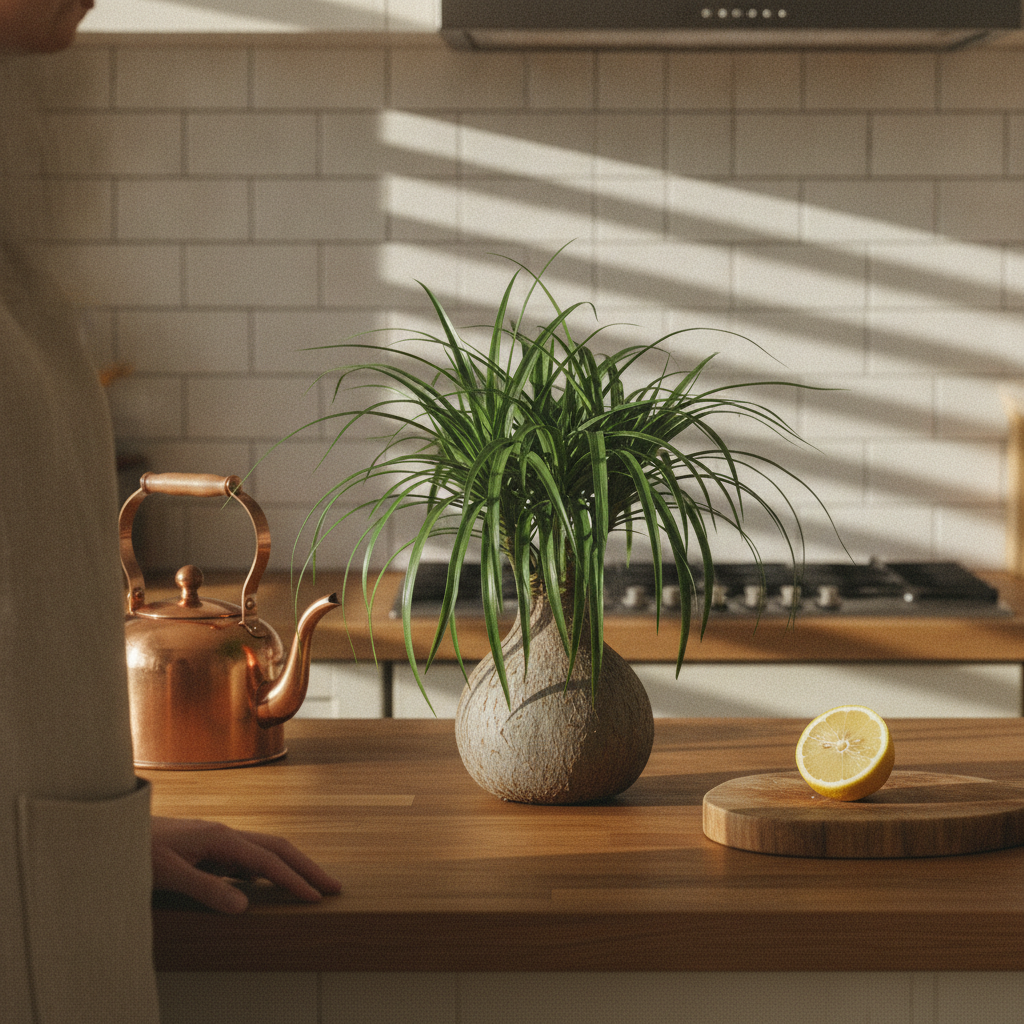
Underneath the good looks is a plant genuinely suited to the way most people live. It stores water in its base, so it copes with the forgotten watering can and the fortnight away far better than a fern ever could. It asks for the kind of bright, dry conditions that many homes supply by default, and it grows slowly enough that it rarely outgrows its spot in a hurry. For a beginner nervous about killing something, or an experienced grower who wants one plant that simply gets on with it, the bottle ponytail palm is close to ideal. Its main vulnerability is kindness in the form of too much water, which the rest of this guide is largely devoted to helping you avoid.
Important — Toxicity: The bottle ponytail palm is listed as non-toxic to cats and dogs by the ASPCA and poses no known risk to humans, making it one of the safer choices for homes with curious pets or small children. The narrow leaf tips can be nibbled without harm, though it is still worth discouraging pets from chewing any houseplant.
Light Requirements
If there is a single lever that separates a thriving bottle ponytail palm from a merely surviving one, it is light. This is a plant of open, sun-baked Mexican hillsides, and it wants as much brightness as your home can offer. In its native range it grows in full sun with nothing overhead to shade it, so the dim corner that suits a pothos will leave a ponytail palm sulking, stretched and slow.
Indoors, the ideal position is directly in front of, or very close to, your brightest window, where the plant receives several hours of direct sun each day alongside strong ambient light for the rest. Given that, it will grow steadily, keep its leaves firm and upright at the crown, and thicken its base over the years. In lower light it will not die quickly, but growth stalls, new leaves emerge narrower and weaker, and the plant slowly loses the dense, full look that makes it worth having.
Light Levels Explained
Houseplant light is often described in vague terms, so the table below translates the usual categories into approximate light levels and the outcome you can expect from a bottle ponytail palm in each. Unlike many foliage plants, this one sits happily at the brightest end of the scale.
| Light Category | Approx. Level | Typical Location | Outcome |
|---|---|---|---|
| Direct sun | 20,000 lux and above | On a south-facing windowsill | Ideal; strong, steady growth and a thickening base |
| Bright indirect | 10,000 to 20,000 lux | Beside a bright window | Very good; healthy but slightly slower growth |
| Medium | 5,000 to 10,000 lux | A metre or two back from a window | Tolerated; growth slows noticeably |
| Low | 1,000 to 5,000 lux | A dim corner or north room | Survives only; leaves weaken and stretch |
| Very low | Below 1,000 lux | An interior hallway | Long-term decline; not recommended |
Window Orientation and Placement
South-facing window: the best possible position in the northern hemisphere. A ponytail palm set on or right beside a south window will bask in the direct sun it evolved for and reward you with the fullest growth. There is very little risk of giving it too much.
East-facing window: an excellent choice, delivering several hours of gentle morning sun followed by bright light. The plant will grow well here and the cooler morning rays carry almost no risk of leaf scorch.
West-facing window: also very good, offering strong afternoon sun. The one caveat is that a plant moved suddenly from shade into hot west light can scorch, so acclimatise it gradually over a couple of weeks.
North-facing window: the weakest option. A north window rarely provides the intensity a ponytail palm wants, and while the plant will hang on, expect stalled growth and thin new leaves. If a north room is your only choice, supplement with a grow light.
Pro Tip — Rotate for an Even Crown: Because the leaves reach toward the light source, a plant left facing one way will lean and grow lopsided over time. Give the pot a quarter turn every week or two so every side gets its share of sun and the fountain of leaves stays balanced.
How Light Affects Growth and Form
Light does more than fuel a ponytail palm; it shapes it. In strong light the leaves stay short relative to their number, firm, and arch in a tidy cascade, while the caudex swells because the plant is photosynthesising enough to bank surplus energy and water. Starved of light, the same plant redirects its resources into longer, floppier leaves that reach desperately toward the window, and the base stops fattening. If you notice the crown looking sparse or the newest leaves flopping rather than arching with tension, weak light is almost always the reason.
Warning — Direct Sunlight: Although this plant loves sun, a specimen that has spent months in low light can still scorch if moved abruptly into blazing midday glass. Sudden brown, bleached patches on the upper leaves are sunscald. Always transition a plant to brighter conditions over one to two weeks rather than in a single move.
Artificial Lighting
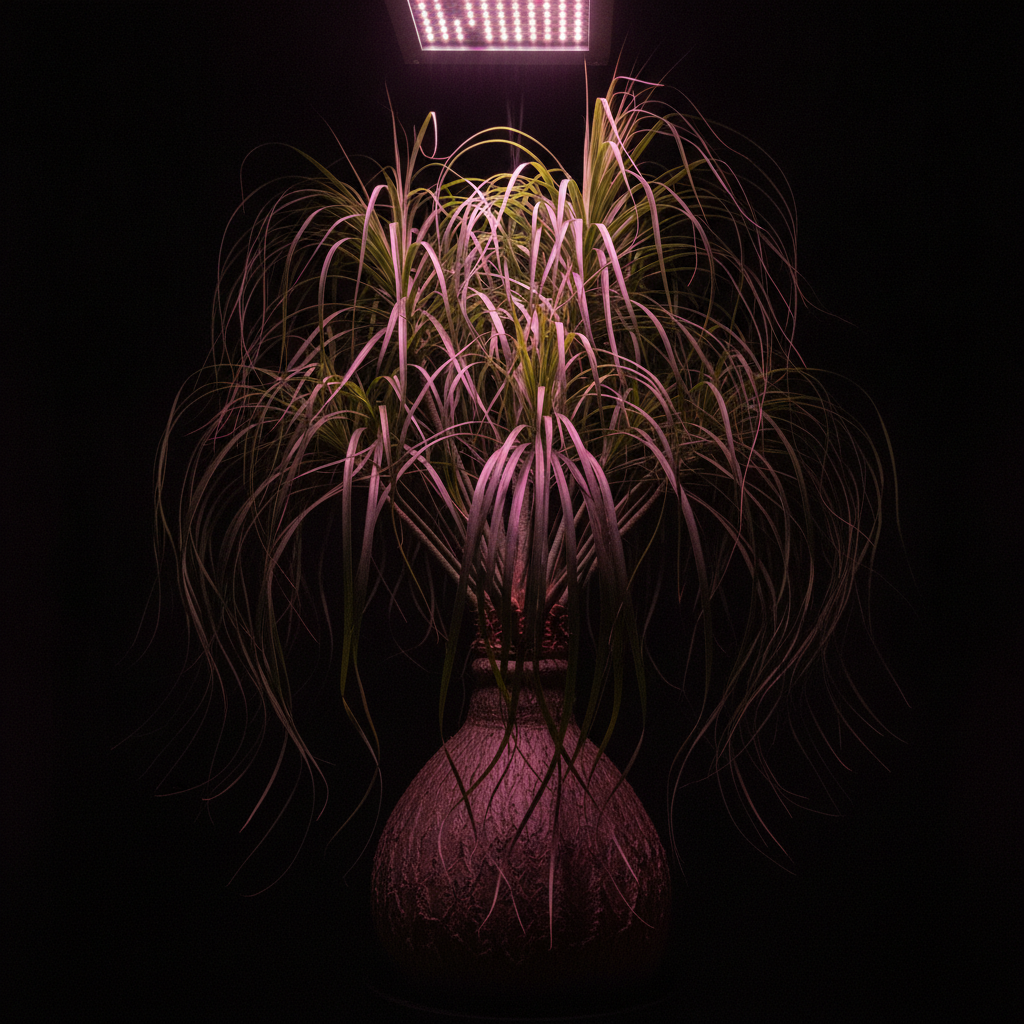
In homes without a genuinely bright window, a full-spectrum LED grow light is a reliable substitute and often a necessity for this species. Position the light 30 to 45 centimetres (12 to 18 inches) above the crown and run it for 10 to 12 hours a day to mimic the long, intense days of a Mexican summer. Because ponytail palms demand so much light, they respond to supplementary lighting more visibly than most foliage plants, often resuming growth within a few weeks.
Seasonal Adjustments
Light levels fall sharply through autumn and winter in temperate climates, and the ponytail palm responds by slowing almost to a standstill. This is normal and healthy. Move the plant to your brightest available window for the darker months, cut back watering to match the reduced growth, and resist the urge to feed. As the days lengthen again in spring, growth resumes and you can return to a more generous routine.
Watering & Humidity
Watering is where most bottle ponytail palms are lost, and almost always through generosity rather than neglect. The swollen caudex is a reservoir, holding weeks of water in reserve, which means the plant is built to endure drought and utterly unsuited to sitting in constantly damp soil. The golden rule is simple: when in doubt, do not water.
When to Water
Rather than watering on a fixed schedule, water according to how dry the pot is. Wait until the soil has dried out almost completely, from the surface right down to the base of the pot, before watering again. In practice this usually means roughly every two to three weeks in the bright, warm months and every four to six weeks, sometimes longer, through the cooler, darker part of the year.
The most reliable check is the weight of the pot. Lift it just after a thorough watering to feel how heavy a fully soaked pot is, then lift it again every few days. When it feels distinctly light, the soil has dried and it is time to water. A finger pushed into the soil is a useful backup: if you feel any moisture in the top several centimetres, wait.
Pro Tip — Read the Base: A healthy caudex is firm and hard to the touch. If the swollen base ever feels soft, spongy or wrinkled at the top where it meets the leaves, treat it as a warning that watering is out of balance, usually too much, and let the plant dry out fully before doing anything else.
How to Water Correctly
- Wait until the soil is almost entirely dry and the pot feels light for its size.
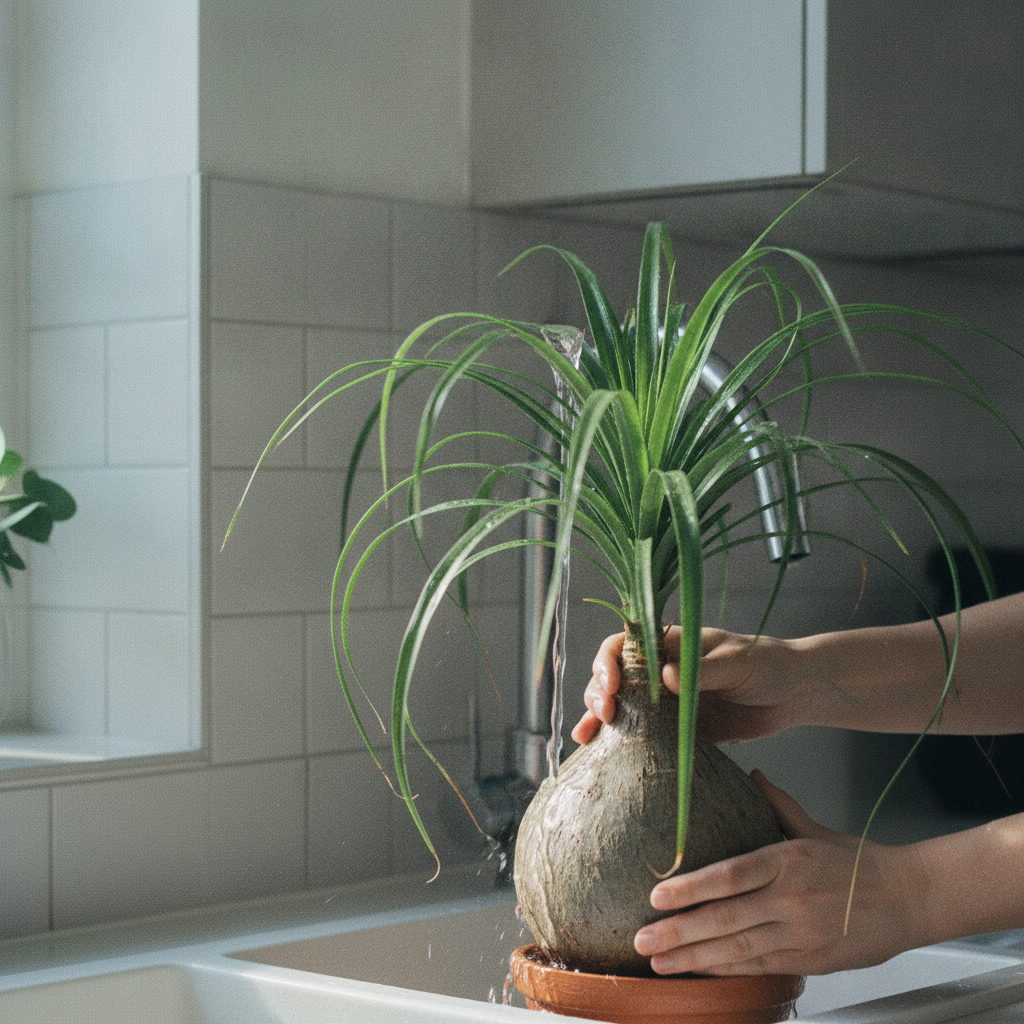
- Take the plant to a sink or bath and water slowly across the whole surface until water runs freely from the drainage holes.
- Let it soak for a minute, then water once more so the entire root ball is thoroughly wetted.
- Allow the pot to drain completely for 15 to 30 minutes; never let it sit in a saucer of standing water.
- Return the plant to its bright spot and do not water again until the soil has dried out once more.
Signs of Overwatering vs. Underwatering
| Symptom | Overwatering | Underwatering |
|---|---|---|
| Leaf colour | Yellowing, often starting low and spreading | Overall dulling with browning tips |
| Leaf texture | Soft, limp leaves that lose their arch | Crisp, dry, brittle tips and edges |
| Caudex | Soft, spongy or wrinkled at the top, a serious sign | Slight shrinking or wrinkling that firms up after watering |
| Soil | Stays wet for long periods, may smell sour | Bone dry and pulling away from the pot sides |
| Base and roots | Blackening, mushy tissue and a foul smell | Dry but firm, recovers quickly once watered |
Warning — Root Rot: Root and caudex rot is the leading cause of death in this species and it can be difficult to reverse once the base has gone soft. If you catch it early, unpot the plant, cut away all blackened, mushy tissue with a sterile blade, let the wounds callus over for a day or two, and repot into fresh, dry, gritty mix. Then withhold water until clear new growth confirms recovery.
Humidity Requirements
Here the bottle ponytail palm is refreshingly undemanding. As a plant of dry Mexican scrubland, it is perfectly comfortable in the low humidity of a centrally heated or air-conditioned home, typically 30 to 50 percent, and needs no special measures to keep it happy.
Because it tolerates dry air so well, humidity-related problems are rare. If leaf tips brown in a very dry, heated room in winter, it is far more often a symptom of underwatering or a build-up of minerals than of low humidity itself, so check your watering and water quality before assuming the air is at fault.
There is genuinely no need to mist a ponytail palm, and misting offers no real benefit while adding a small risk of trapping moisture in the crown. If you keep the plant alongside more humidity-hungry species, grouping them together is fine, but the ponytail palm asks for nothing extra on this front.
Water Quality
Ordinary tap water is fine for this tough plant in most areas. In regions with very hard water, mineral salts can accumulate in the soil over time and contribute to browning tips, so flushing the pot thoroughly at each watering, which you should be doing anyway, helps keep those salts moving through and out. If your water is especially hard or heavily softened, occasional use of rainwater or filtered water is a worthwhile refinement, though rarely essential.
Soil, Potting & Repotting
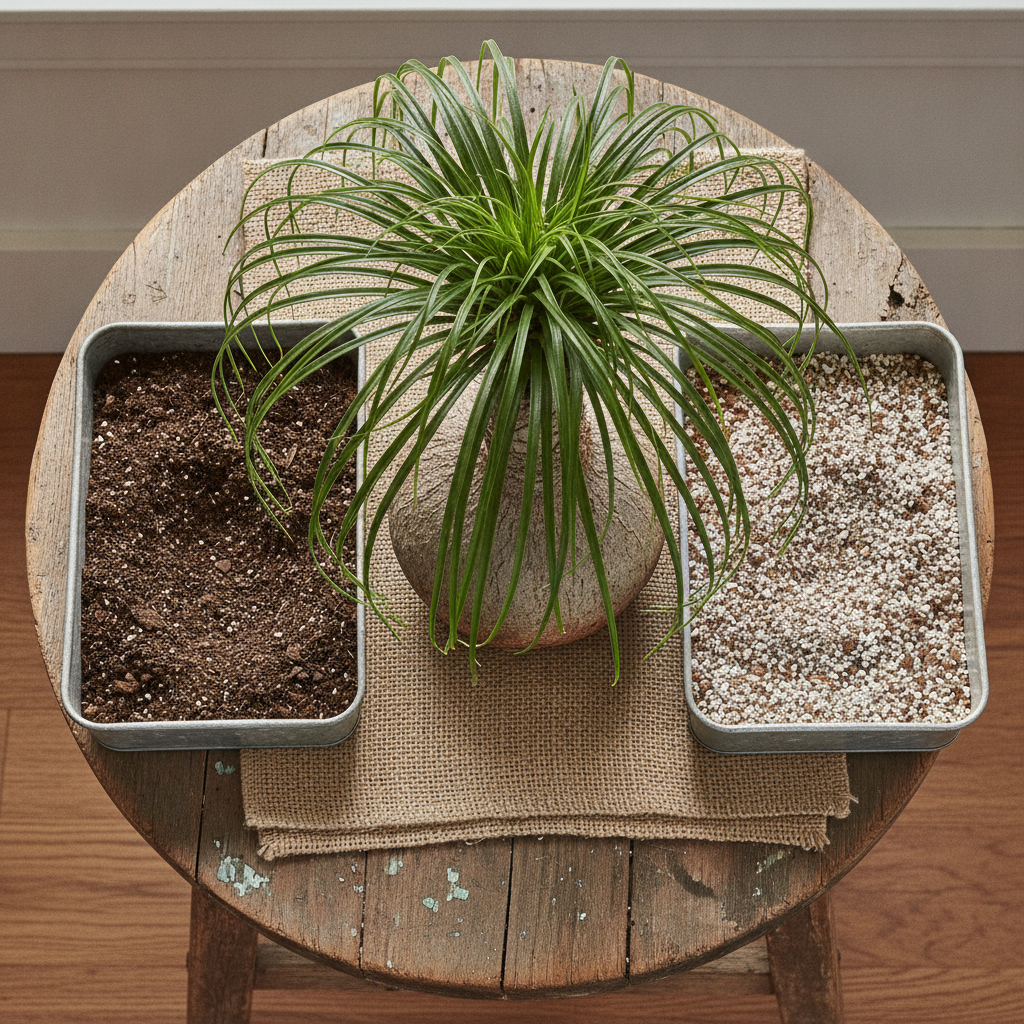
Given how fatal excess moisture is to this plant, the soil you choose is not a detail but a defence. The goal is a fast-draining, gritty medium that holds a little moisture and then releases the rest quickly, closely echoing the sharp-draining soils of the plant’s arid homeland.
Ideal Soil Composition
A good cactus and succulent compost is the obvious starting point, and for most growers it is enough on its own. If you want to improve an ordinary potting mix, cut it heavily with grit and perlite so that water races through rather than lingering. The exact recipe matters less than the principle that the mix should never stay soggy.
| Component | Proportion | Function |
|---|---|---|
| Cactus or standard potting compost | Half | Provides structure and a modest reserve of nutrients and moisture |
| Coarse grit or horticultural sand | One quarter | Adds weight and sharp drainage, mimicking rocky native soil |
| Perlite or pumice | One quarter | Creates air pockets and speeds the release of excess water |
The plant is not fussy about acidity and does well in soil that is slightly acidic to neutral, roughly a pH of 6.0 to 7.0, which most commercial mixes fall within by default. Do not lose sleep over pH; drainage is the far more important factor for this species.
Pro Tip — Quick Mix Recipe: For a reliable blend, combine two parts cactus compost, one part coarse grit and one part perlite. If in doubt, err toward more grit rather than less; it is almost impossible to make the mix too free-draining for a bottle ponytail palm.
Choosing the Right Pot
The pot is as much a part of the drainage system as the soil, and the right choice makes overwatering much harder to do by accident.
Drainage holes are non-negotiable. Never pot a ponytail palm into a container without holes, however handsome it looks. If you love a decorative cachepot, keep the plant in a plain plastic nursery pot with drainage and simply drop that inside, lifting it out to water and drain.
Pot material: unglazed terracotta is close to ideal because its porous walls wick moisture from the soil and let it evaporate, which suits a plant that hates staying wet. Plastic and glazed ceramic work too, but they hold moisture longer, so lean even harder on a gritty mix if you use them.
Pot size: choose a pot only slightly wider than the caudex. A container that is too large holds a mass of wet soil the roots cannot use, which invites rot. Ponytail palms are also content to be quite snug, and a tight pot can even encourage the base to swell more dramatically.
When to Repot
This is a slow grower that positively prefers to be pot-bound, so repotting is an occasional event rather than an annual chore. Expect to move it up a size only every three to four years, or when the caudex has grown to fill the pot, roots are pushing out of the drainage holes, or the plant becomes top-heavy and unstable. The best time is spring, at the start of the active growing season, so the plant can settle in while it is growing strongly.
How to Repot: Step-by-Step
- Water lightly a day or two beforehand so the root ball holds together, then let it drain.
- Ease the plant out by tipping the pot and supporting the caudex, rather than pulling on the leaves.
- Gently tease away loose old soil and inspect the roots, trimming any that are black or mushy with a sterile blade.
- Choose a pot just one size larger with good drainage, and add a layer of fresh gritty mix to the base.
- Set the plant at the same depth it grew before, keeping the caudex above the soil line, and never bury the swollen base.
- Fill around the roots with fresh mix, firming gently to remove air gaps without compacting it.
- Wait about a week before watering to let any disturbed roots heal, then resume normal care.
Warning — Transplant Shock: Keeping the caudex above the soil line matters enormously. Burying the swollen base traps moisture against it and is a fast route to rot. If the plant looks briefly sulky after repotting, hold your nerve and keep it dry and bright; it should recover within a couple of weeks.
Fertilising
The bottle ponytail palm is a light feeder by nature, adapted to poor, thin soils where nutrients are scarce. It needs far less feeding than a fast-growing tropical foliage plant, and over-feeding does more harm than a lean diet ever would.
Think of fertiliser as a gentle top-up during the growing season rather than a regular necessity. A plant in fresh, decent soil can go a long time on the nutrients already present, and pushing it with feed will not make a slow grower fast; it will only risk salt build-up and burnt roots.
Understanding Plant Nutrients
Most balanced houseplant feeds are built around three main nutrients, nitrogen, phosphorus and potassium, shown on the label as the N-P-K ratio, supported by a handful of secondary and trace elements. For a ponytail palm, a balanced formulation used sparingly covers everything the plant needs; there is no call for anything specialised.
| Nutrient | Symbol | Primary Function | Deficiency Symptoms |
|---|---|---|---|
| Nitrogen | N | Drives leaf and stem growth and green colour | Overall paling and slow, weak growth |
| Phosphorus | P | Supports root development and energy transfer | Stunted growth and dull, sometimes purplish leaves |
| Potassium | K | Regulates water use and overall vigour | Yellowing and browning along leaf edges |
| Calcium | Ca | Builds cell walls and strong new growth | Distorted or weak emerging leaves |
| Magnesium | Mg | Central to chlorophyll and photosynthesis | Yellowing between the veins of older leaves |
| Iron | Fe | Needed for chlorophyll production | Yellowing of the newest leaves while veins stay green |
Types of Fertiliser
Liquid fertilisers: the easiest option for this plant, giving you full control over strength and timing. Dilute a balanced houseplant or cactus feed to half the recommended strength and apply only during spring and summer.
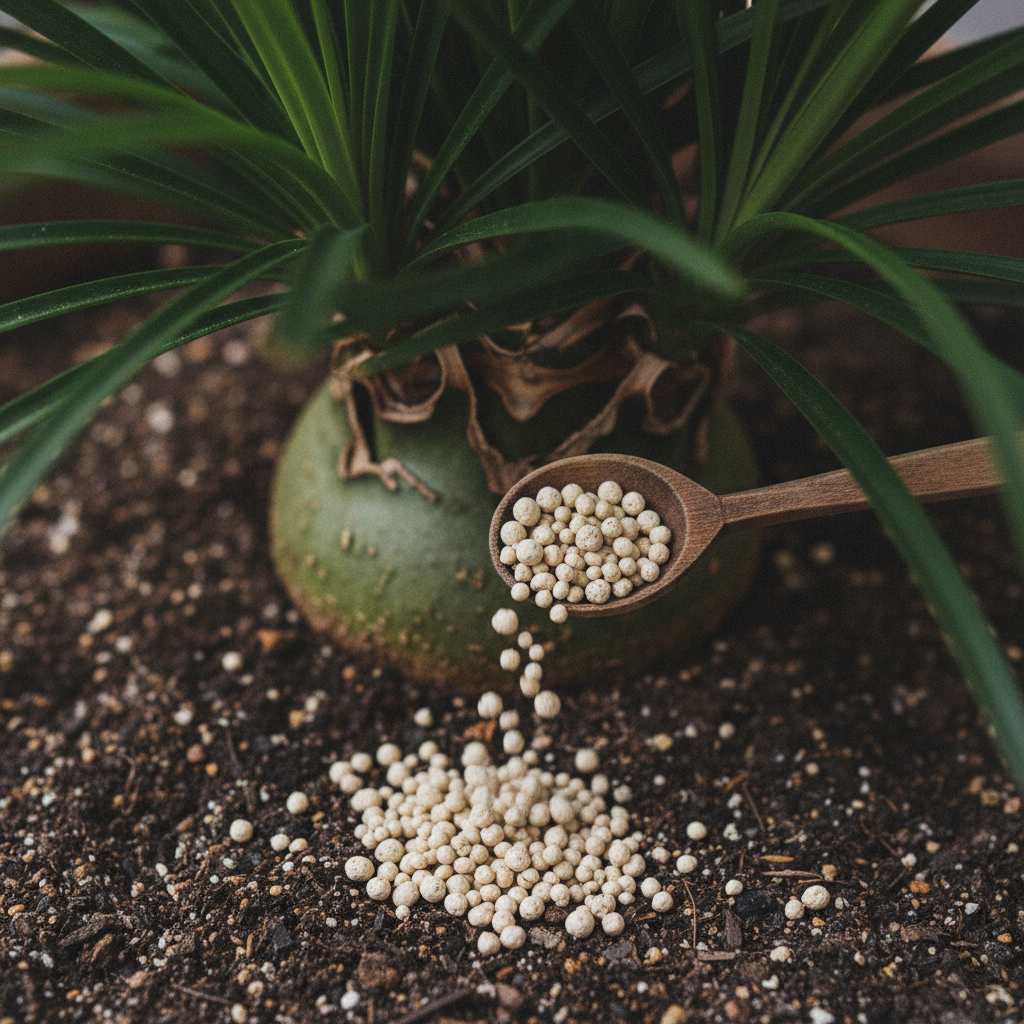
Slow-release granular: a convenient hands-off approach; a small dose of coated prills scattered on the soil in spring will feed the plant gently over several months. Use less than the label suggests, as those doses assume hungrier plants than this one.
Organic fertilisers: options such as diluted worm-casting tea or a light top-dressing of worm castings work well and are almost impossible to overdo. They release nutrients slowly and improve the soil, which suits the ponytail palm’s gentle appetite.
Feeding Schedule
Feed only while the plant is actively growing, from mid-spring to late summer, and stop entirely through autumn and winter when growth pauses. Once a month at half strength is ample, and skipping the odd feed will do no harm at all. Never fertilise a bone-dry plant or one that is stressed, sick or newly repotted.
Pro Tip — Less Is More: With a ponytail palm, under-feeding is almost always safer than over-feeding. If you are unsure whether to feed, do not. A lean plant simply grows a little slower, while an over-fed one risks scorched roots and a salt-crusted pot that is much harder to put right.
How to Fertilise
- Water the plant lightly first so the roots are moist, never applying feed to dry soil.
- Dilute a balanced liquid feed to half the strength stated on the label.
- Pour it evenly over the soil until it just begins to drain from the bottom.
- Every few months, flush the pot with plain water to wash out any accumulated salts.
Warning — Salt Build-Up: A white crust on the soil surface or around the pot rim signals a build-up of fertiliser salts, which can burn roots and brown leaf tips. If you see it, flush the pot thoroughly with plain water several times and ease off on feeding until the plant recovers.
Propagation
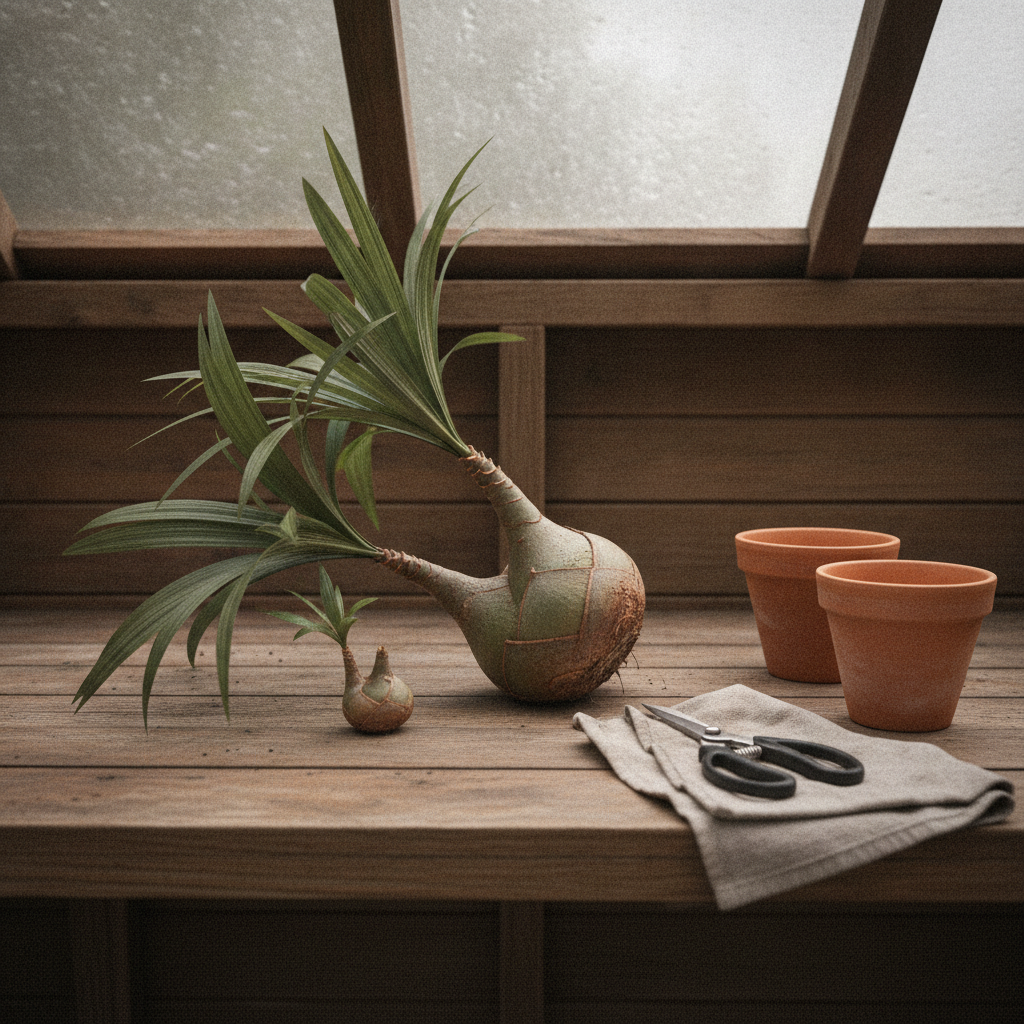
Propagating a bottle ponytail palm calls for patience more than skill. Unlike vining houseplants, it cannot be grown from a leaf or a stem cutting, because it has no nodes along a stem that will root. Instead, propagation relies on the offsets, or pups, that mature plants produce around the base, or on growing from seed.
Of the two, dividing off pups is far quicker and more reliable for the home grower, giving you a genetically identical young plant. Growing from seed is possible but slow and best suited to the patient enthusiast, since seedlings take years to develop the swollen base that makes the plant so appealing.
Understanding Offsets and Pups
As a ponytail palm matures, it often produces small offsets, miniature versions of the parent, from the base of the caudex. Each pup gradually forms its own roots while still attached, drawing on the parent for support. Once a pup has reached a reasonable size, ideally around 10 centimetres (4 inches) tall with a few roots of its own, it is ready to be separated and grown on independently. Spring and early summer, when the plant is growing strongly, is the best time to do this.
Division of Offsets: Step-by-Step
Separating a pup is the fastest route to a new plant. Work gently, keep everything clean, and resist the urge to water heavily afterwards.
- Ease the parent plant out of its pot so you can see where the pup joins the caudex.
- Brush away soil to expose the join and any roots the pup has already formed.
- Using a clean, sharp knife, cut the pup away cleanly, keeping as many of its own roots attached as possible.
- Let the cut surfaces dry and callus in a shaded, airy spot for one to three days.
- Pot the pup into a small container of dry, gritty cactus mix, keeping its base at the surface.
- Wait about a week, then water sparingly and place it in bright, indirect light until it establishes.
Pro Tip — Let It Callus: The single most important step is allowing the cut to dry and callus over before potting and before the first watering. Potting a fresh, wet wound straight into damp soil is the surest way to lose the pup to rot. A day or two of patience dramatically improves your success rate.
Growing from Seed: Step-by-Step
Seed is the only way to produce large numbers of plants and the route commercial growers usually take, but it is a long game measured in years rather than weeks.
- Soak fresh seed in warm water for 24 hours to soften the coat and encourage germination.
- Sow onto the surface of a moist, gritty seed mix, barely covering the seed.
- Keep the tray warm, ideally 21 to 27 degrees C (70 to 81 degrees F), and in bright light.
- Maintain light, even moisture until seedlings appear, which can take several weeks.
- Once seedlings are established, gradually reduce watering and treat them as small adult plants.
Troubleshooting Propagation
| Problem | Likely Cause | Solution |
|---|---|---|
| Pup rots after separation | Potted before the cut had callused, or watered too soon | Always let wounds dry for a day or two and keep the mix on the dry side |
| Pup fails to root | Too little warmth or light, or separated too small | Provide warmth and bright light, and take larger pups with existing roots |
| Seed does not germinate | Old or non-viable seed, or too cool | Use fresh seed and keep it consistently warm |
| Seedlings damp off | Excess moisture and poor air flow | Reduce watering, improve ventilation and use a sterile mix |
Pests & Diseases
A healthy bottle ponytail palm, grown bright and kept on the dry side, is remarkably resistant to trouble. Its tough leaves and lean, dry conditions are unappealing to many common pests, and the biggest threats it faces are almost all self-inflicted through overwatering rather than brought in by insects.
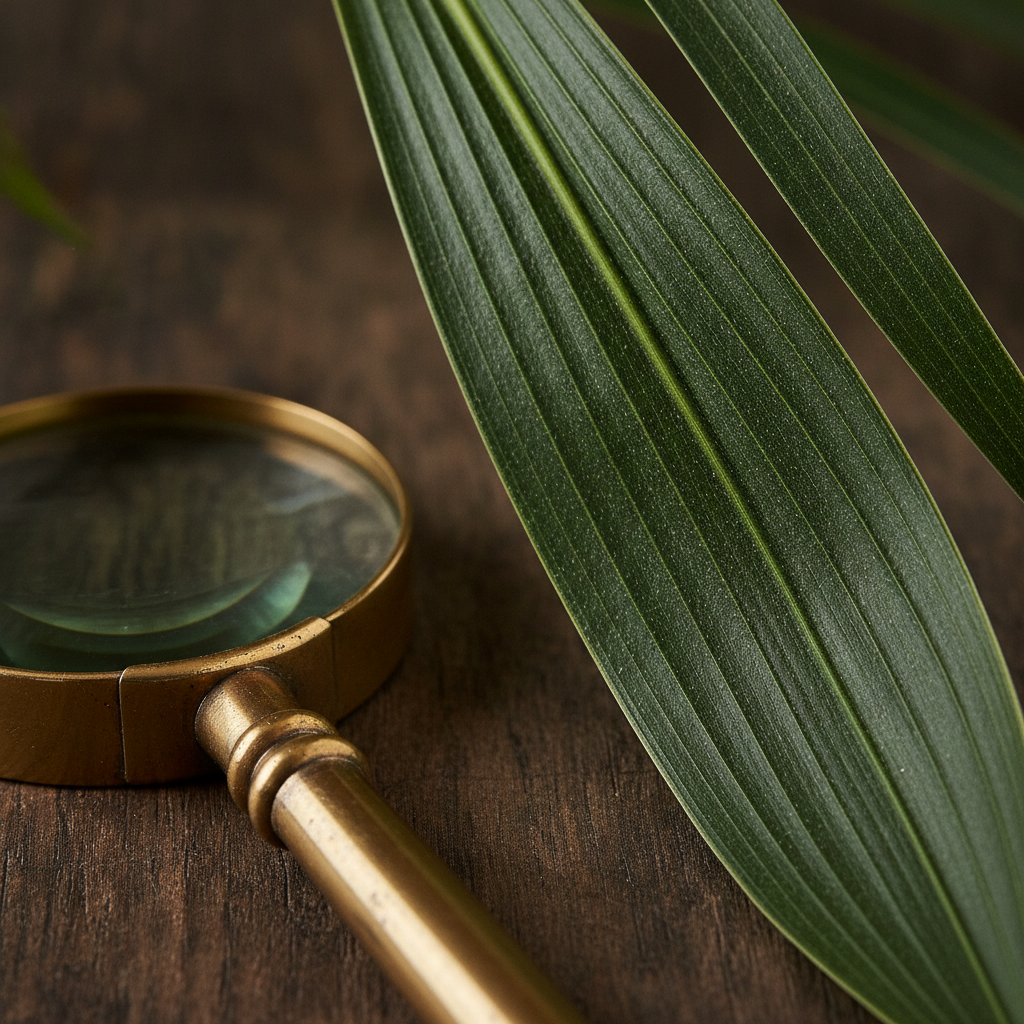
That said, no houseplant is entirely immune, and stressed or crowded plants can attract sap-sucking insects. Regular inspection, particularly of the crown and the undersides of leaves, lets you catch any problem while it is small and easily dealt with.
Common Pests
Spider Mites (Tetranychus urticae)
The most likely pest on a ponytail palm, favoured by the same warm, dry conditions the plant enjoys. They are tiny and hard to see, but fine webbing between the leaves and a stippled, dusty look to the foliage give them away.
Treatment: Rinse the leaves thoroughly, then treat with insecticidal soap or neem oil, repeating every week for three to four weeks. Raising humidity a little and improving air flow makes conditions less welcoming to them.
Mealybugs (Pseudococcus species)
Small, soft insects that hide in leaf axils and around the crown, coating themselves in a white, cottony wax. They suck sap and weaken the plant, and their sticky residue can lead to sooty mould.
Treatment: Dab each insect with a cotton bud dipped in isopropyl alcohol, then follow up with neem oil or insecticidal soap. Check the crown carefully, as they like to tuck in among the leaf bases.
Scale (Coccidae family)
Scale appear as small, brown, limpet-like bumps clinging to leaves and stems. Under their protective shells they feed on sap, causing yellowing and slow decline if left unchecked.
Treatment: Scrape or wipe them off with an alcohol-dipped cloth, then treat with neem oil or a systemic insecticide for heavier infestations. Persistence over several weeks is usually needed to clear them fully.
Common Diseases
Root and Caudex Rot (Pythium and Phytophthora species)
By far the most serious threat to the plant, and almost always caused by overwatering or poor drainage. The soft, blackening tissue starts at the roots and can spread up into the caudex, which turns spongy and foul-smelling.
Treatment: Act quickly. Unpot the plant, cut away all affected tissue with a sterile blade, let the wounds callus, and repot into fresh, dry, gritty mix. Then water only sparingly until firm new growth shows recovery. Prevention through careful watering is far easier than cure.
Leaf Tip Browning (physiological)
Not a true disease but a common complaint, showing as dry, brown leaf tips. It usually reflects underwatering, a build-up of mineral salts, or occasionally very dry air rather than any pathogen.
Treatment: Review your watering, flush the pot to clear salts, and trim the brown tips with clean scissors, following the natural point of the leaf, for a tidier look.
Pest and Disease Summary
| Pest / Disease | Identification | Treatment |
|---|---|---|
| Spider mites | Fine webbing and stippled, dusty leaves | Rinse, then neem oil or insecticidal soap weekly |
| Mealybugs | White cottony clusters in leaf axils | Alcohol on a cotton bud, then neem oil |
| Scale | Brown limpet-like bumps on leaves and stems | Scrape off, then neem oil or systemic insecticide |
| Root and caudex rot | Soft, black, foul-smelling base or roots | Cut away rot, dry, repot in gritty mix and keep dry |
| Leaf tip browning | Dry brown tips on otherwise healthy leaves | Correct watering, flush salts and trim tips |
Prevention Strategies
Prevention with this plant comes down mostly to getting the basics right, because a ponytail palm grown in the conditions it wants rarely runs into trouble. Keep it bright, water only when the soil has dried out, and use a sharply draining mix, and you remove the root cause of nearly every serious problem before it can start.
Beyond that, inspect new arrivals before placing them near your other plants, wipe the leaves occasionally to keep them clean and free of dust, and isolate any plant showing signs of pests until it is clear. Good air flow around the plant discourages both mites and fungal problems.
Pro Tip — Quarantine New Plants: Most pest outbreaks arrive on a newly bought plant. Keep any newcomer separate from your collection for two to three weeks and check it over carefully before letting it join the others, and you will head off the majority of infestations.
Popular Varieties
The bottle ponytail palm is a distinctive plant in its own right, and the trade offers relatively few named cultivars compared with the endless variegated forms of aroids. What variation exists tends to be in form, single-trunked versus multi-headed, and in the rarer variegated foliage, along with a few closely related Beaucarnea species sold under similar names.
For most buyers the choice is really between a classic single-caudex plant and a branched, multi-headed specimen, with the variegated form as an occasional and pricier treat. The table and profiles below cover the forms you are most likely to encounter.
| Variety | Leaf Appearance | Light Needs | Growth Rate | Availability |
|---|---|---|---|---|
| Single-Trunk Bottle Palm | One dense fountain of narrow green leaves | Bright, direct | Slow | Very common |
| Multi-Headed Ponytail Palm | Several crowns of leaves on a branched base | Bright, direct | Slow | Common |
| Variegated Ponytail Palm | Green leaves edged with creamy-yellow | Bright, direct | Very slow | Uncommon |
| Guatemalan Ponytail (Beaucarnea guatemalensis) | Similar fountain, often reddish young growth | Bright, direct | Slow | Uncommon |
| Blue Ponytail (Beaucarnea stricta) | Stiffer, bluer, more rigid leaves | Bright, direct | Slow | Occasional |
Featured Varieties
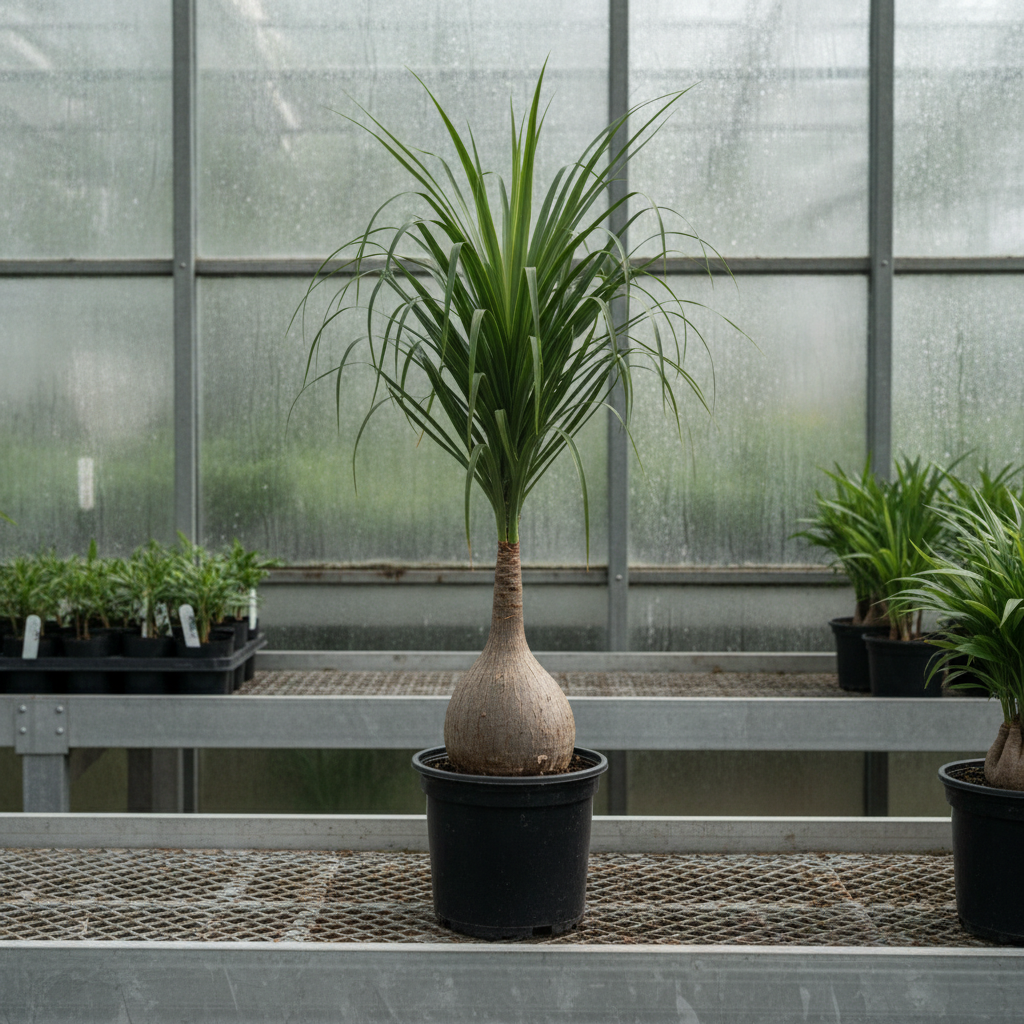
Single-Trunk Bottle Palm
The classic form, with a single dramatically swollen caudex topped by one full fountain of arching leaves. This is the plant most people picture, prized for the clean sculptural line of its bottle-shaped base.
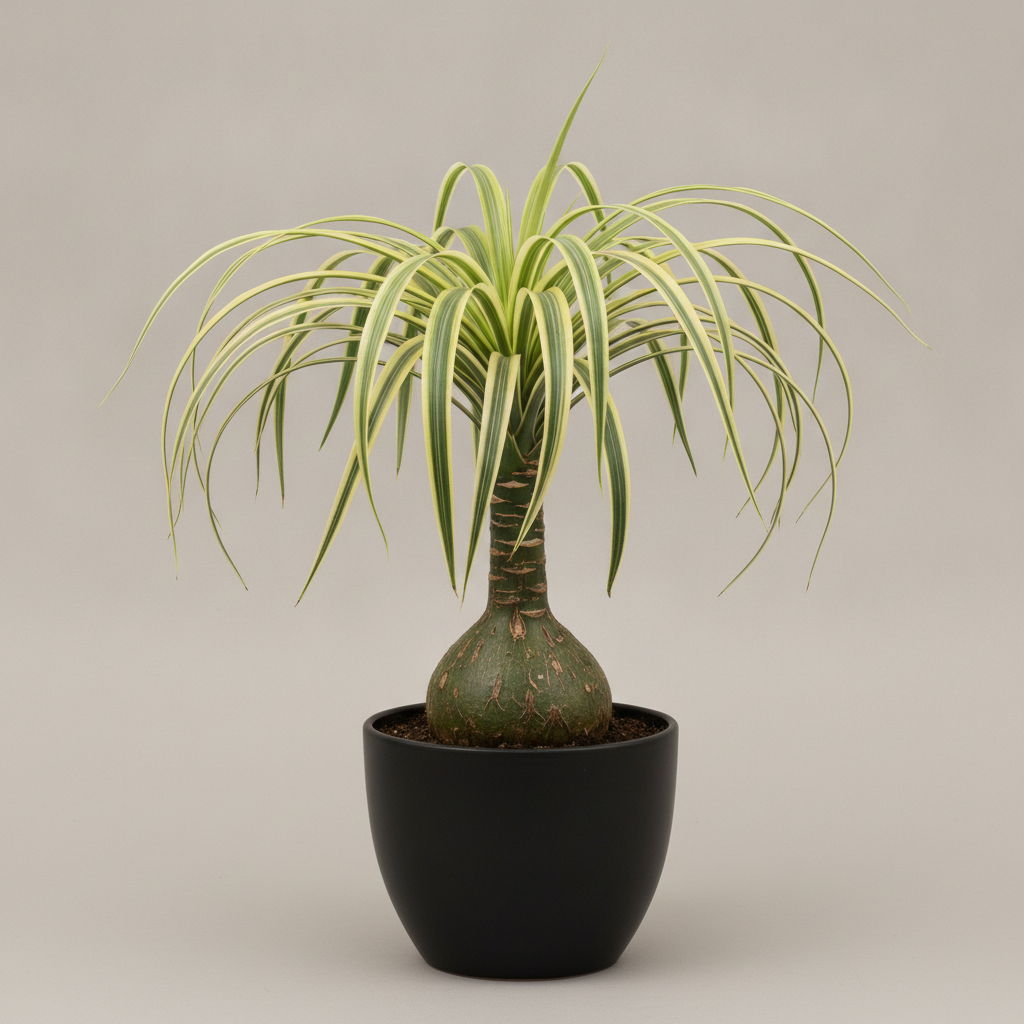
Variegated Ponytail Palm
A scarcer and slower-growing form whose leaves are edged with creamy-yellow variegation. The reduced chlorophyll makes it grow more slowly still and demand even brighter light to keep its colour crisp.
Variety Profiles in Detail
Single-Trunk Bottle Palm (Beaucarnea recurvata)
The standard and most widely sold form. A young plant is mostly base and a modest tuft of leaves, but over many years the caudex swells into the elephant-foot shape that gives the plant its character. It is the most forgiving of the lot and the best starting point for anyone new to the species.
Multi-Headed Ponytail Palm (Beaucarnea recurvata)
Older or deliberately pruned plants can branch, forming several separate crowns of foliage above a single broad base. The effect is fuller and more tree-like, and mature multi-headed specimens command a premium as statement plants. Care is identical to the single-trunk form.
Variegated Ponytail Palm (Beaucarnea recurvata variegated)
The collector’s choice, with cream-margined leaves that soften the plant’s usual solid green. It is slow, uncommon and correspondingly expensive, and needs the very brightest light you can give it to hold its variegation and avoid reverting to plain green.
Choosing the Right Variety for Your Space
For a first ponytail palm, or for any bright spot where you want a reliable, low-fuss plant, the classic single-trunk form is the obvious pick. If you have the room and the budget for a sculptural centrepiece, a mature multi-headed plant makes a striking floor specimen. Save the variegated form for when you can guarantee it a genuinely sunny position, since without strong light its colour fades and its already slow growth grinds to a crawl.
Frequently Asked Questions
Is the bottle ponytail palm actually a palm?
No. Despite the name and the fountain of strap-like leaves, it is not a true palm. It belongs to the Asparagaceae family and is more closely related to agaves and dracaenas. The palm-like look is purely superficial.
How often should I water my ponytail palm?
Water only when the soil has dried out almost completely, which usually works out at every two to three weeks in spring and summer and every four to six weeks or longer in winter. Always let the pot dictate the timing rather than the calendar, and when in doubt, wait.
Why is the base of my ponytail palm going soft?
A soft or spongy caudex is a serious warning sign of rot, almost always caused by overwatering. Stop watering at once, and if the softness is spreading, unpot the plant, cut away any black, mushy tissue, let it dry, and repot into fresh dry gritty mix. A firm base is a healthy base.
Why are the tips of the leaves turning brown?
Brown leaf tips most often point to underwatering or a build-up of mineral salts, and occasionally to very dry air. Check that you are watering thoroughly when the soil is dry, flush the pot occasionally to clear salts, and trim the tips with clean scissors if you want a neater look.
How big does a bottle ponytail palm get indoors?
Indoors it grows very slowly and typically reaches around 1 to 1.8 metres (3 to 6 feet) over many years, though in its native Mexico it can exceed 4 metres (13 feet) in the wild. Its slow pace is part of its appeal, as it rarely outgrows its spot in a hurry.
Is the ponytail palm safe for cats and dogs?
Yes. It is listed as non-toxic to both cats and dogs by the ASPCA, which makes it a reassuring choice for pet owners. It is still sensible to discourage pets from chewing the leaves, but nibbling poses no known danger.
Can I grow a ponytail palm from a leaf?
No. The plant cannot be propagated from leaves or stem cuttings because it lacks the nodes needed to form new roots and shoots. The only ways to make more are by separating the offsets, or pups, that form around the base, or by growing from seed.
Why has my ponytail palm stopped growing?
Some slowdown is normal, as this is a naturally slow grower that pauses almost entirely in winter. If it has stalled during the growing season, the usual culprit is insufficient light. Move it to your brightest window or add a grow light, and make sure you are not over-watering, which can also check its growth.
Does the ponytail palm need a lot of humidity?
Not at all. As a desert-adapted plant it thrives in the ordinary dry air of most homes and needs no misting or humidifier. This tolerance of low humidity is one of the reasons it is such an easy-going houseplant.
What kind of pot is best for a ponytail palm?
Choose a pot with drainage holes that is only slightly larger than the caudex, ideally in unglazed terracotta so excess moisture can escape through the walls. A snug pot filled with gritty, fast-draining mix is exactly what this rot-prone plant wants.






