
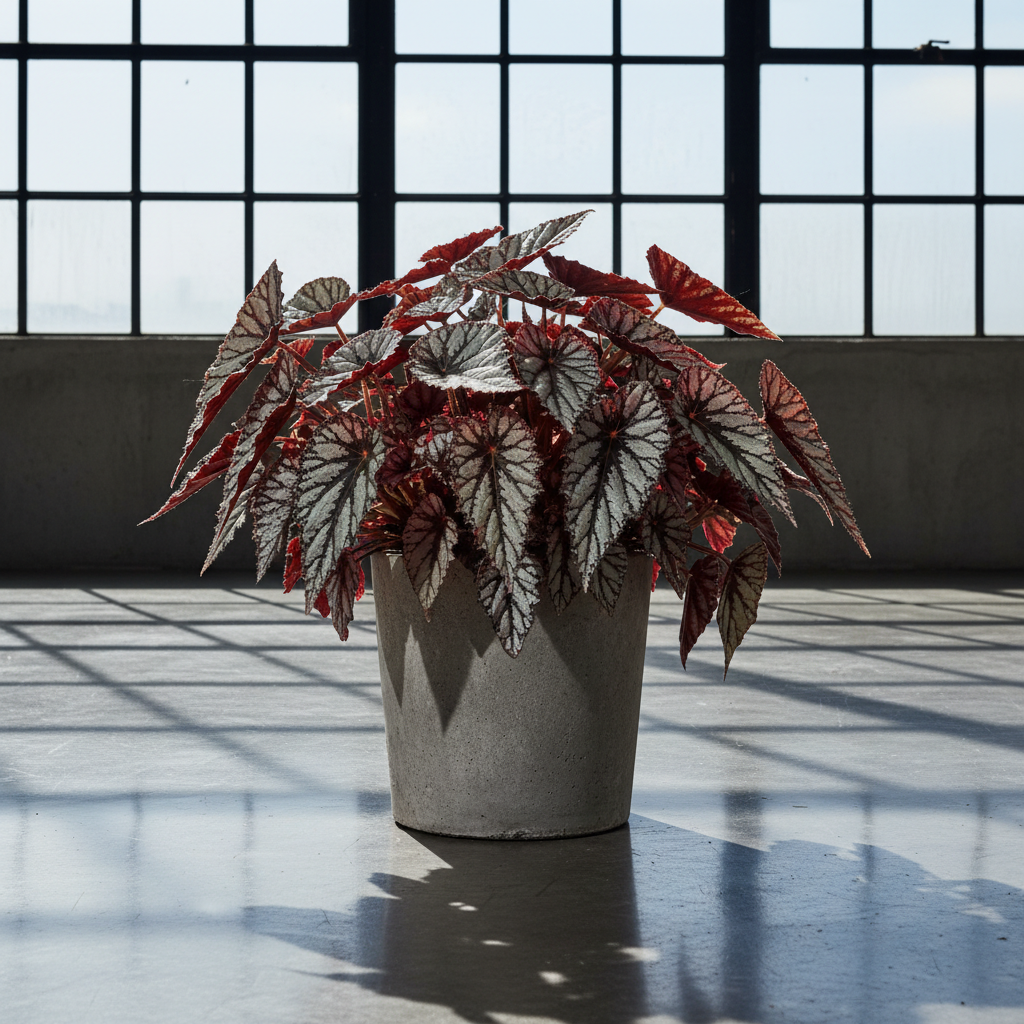
Few houseplants paint with as wild a palette as the Begonia Rex. The cultivated forms gathered under the umbrella name Begonia rex-cultorum are descended from a single wild parent, Begonia rex, discovered in the moist forests of Assam in north-eastern India in 1856 and quickly seized upon by Victorian breeders who crossed it with related species from southern China, Vietnam and the eastern Himalayas. The result is a sprawling group of hybrids grown almost entirely for their leaves, which carry metallic silver, deep burgundy, blood-red, rose-pink, emerald and near-black in patterns that look closer to brushwork than botany.
Rex Begonias have a reputation for being temperamental, and that reputation is half-earned. In the cool, dim and dry rooms of a typical home, a Rex will sulk, lose its lower leaves and eventually rot at the rhizome. In a warm humid spot with bright indirect light and a careful watering hand, the same plant will throw out leaf after enormous leaf and live for many years. This guide covers everything that separates surviving from thriving, from light and humidity to soil, fertilising, propagation, pests and the dozens of cultivars worth knowing.
Contents
- Quick Reference
- Why Begonia Rex Makes a Showstopping Houseplant
- Light Requirements
- Watering and Humidity
- Soil, Potting and Repotting
- Fertilising
- Propagation
- Pests and Diseases
- Popular Varieties
- Frequently Asked Questions
Quick Reference: Begonia Rex at a Glance
| Light | Bright indirect light; tolerates medium light at the cost of colour intensity. No direct midday sun. |
| Watering | Water when the top 2 to 3 cm (about 1 inch) of soil are dry. Keep evenly moist but never soggy. |
| Temperature | 18 to 24 degrees Celsius (65 to 75 Fahrenheit). Avoid drops below 15 degrees Celsius (59 Fahrenheit). |
| Humidity | 50 to 70 percent. Thrives in higher humidity; struggles below 40 percent. |
| Fertiliser | Balanced liquid feed at quarter to half strength every 2 to 4 weeks during active growth. |
| Toxicity | Mildly toxic to cats, dogs and small children if chewed. Keep out of reach. |
Why Begonia Rex Makes a Showstopping Houseplant
The first and most obvious reason to grow a Rex Begonia is the foliage. No two cultivars look quite alike, and within a single leaf you can find silver bands, dark veining, copper iridescence, rosy blushing and an almost holographic shimmer that shifts with the angle of the light. The leaves themselves are large for a houseplant of this size, often 15 to 25 centimetres (6 to 10 inches) across in a mature specimen, and the textured surface, with sunken veins and a slightly puckered blade, catches light very differently from the glossy flatness of most tropical foliage.
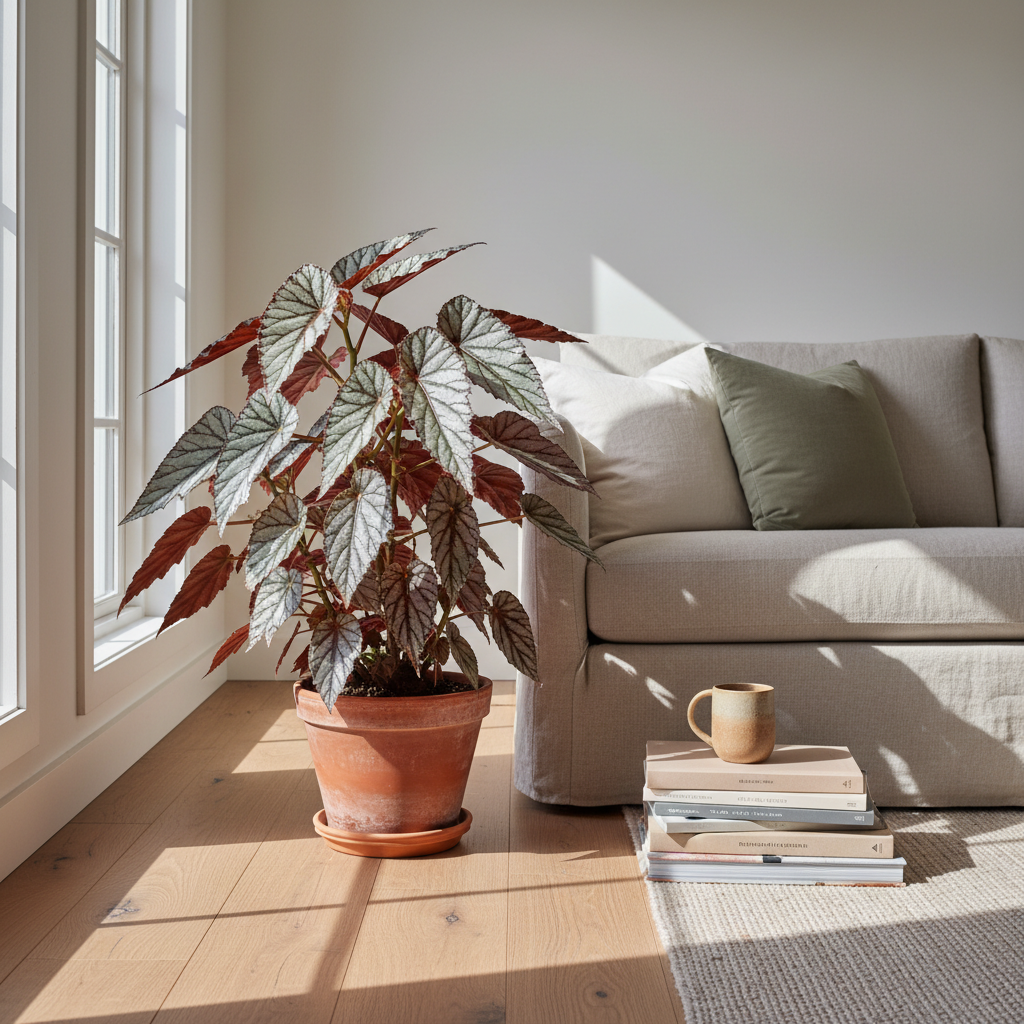
Beyond the looks, Rex Begonias are useful plants in a way that more ornamental species often are not. They stay relatively compact, rarely exceeding 30 to 40 centimetres (12 to 16 inches) in height, so they slot easily onto a shelf, a desk or a sideboard. They tolerate the slightly lower light levels of an interior shelf better than most highly variegated plants, and they grow from a thick horizontal rhizome that can be divided into multiple plants without trauma, making them generous to give away. Their natural ancestors live as understorey plants on mossy slopes and rocky ledges in cloud forest, so they are adapted to filtered light, cool nights, steady humidity and the kind of organic, fast-draining substrate that builds up over rotting leaf litter, all conditions a thoughtful houseplant grower can recreate indoors.
Important — Toxicity: All Begonia species contain insoluble calcium oxalate crystals, which can cause mouth irritation, drooling, vomiting and difficulty swallowing if chewed or eaten by pets or children. Rex Begonias are classified as mildly toxic to cats and dogs by the ASPCA. Keep plants well out of reach of curious mouths, and wash hands after repotting if you have sensitive skin.
Light Requirements
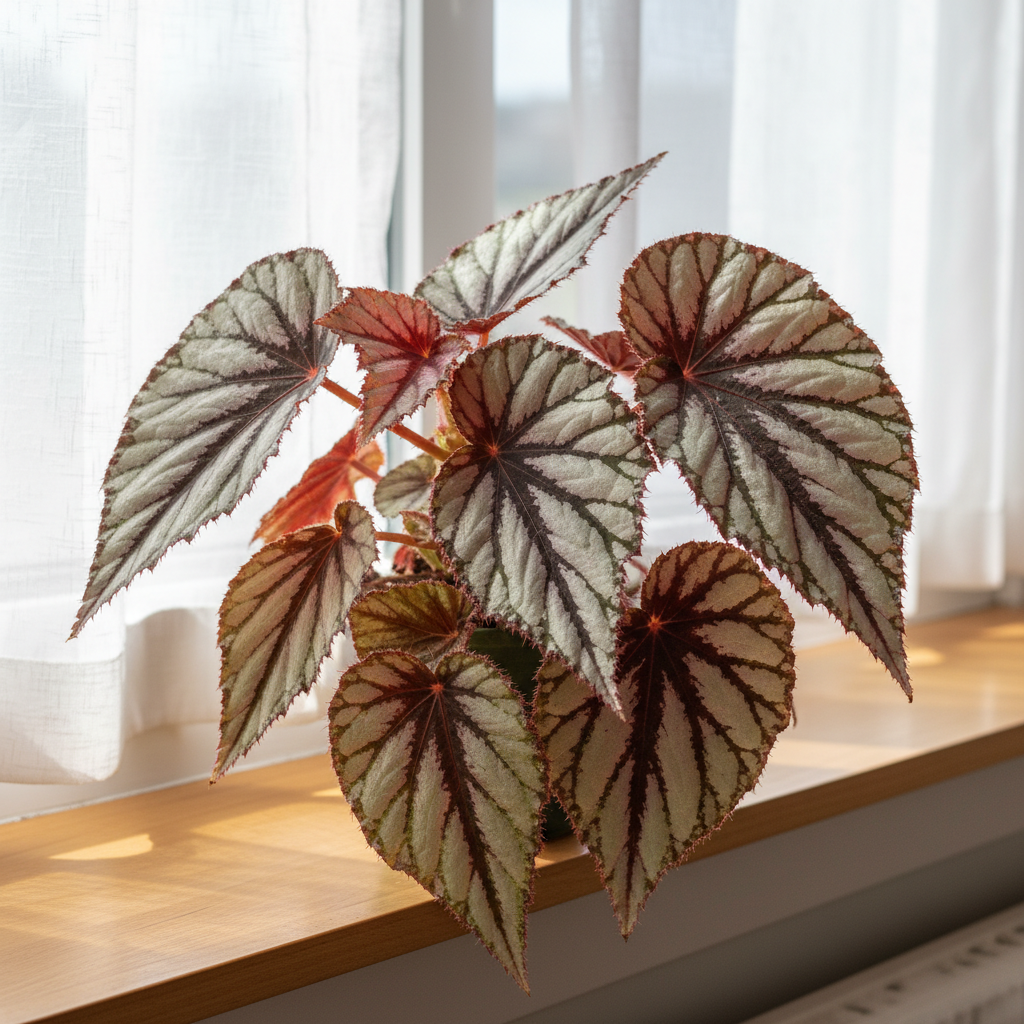
Light is where most Rex Begonia owners go wrong in one of two opposite directions. Push the plant up against a south-facing window and the dramatic leaf colour bleaches out within days, with crispy brown patches appearing wherever direct rays hit the blade. Push it into a dim corner away from any window and the plant slows almost to a halt, with new leaves coming through small, dull and stretched on long pale petioles. The sweet spot is bright indirect light, the kind of luminous shade that exists a metre or two back from a sunny window, or right up against a north-facing window without obstruction.
The reason Rex Begonias are so sensitive on this point comes back to the leaf pigments. The silver and metallic patches you can see are not just colour, they are tiny air pockets between the upper leaf cells that scatter and reflect light. Below the surface, the actual chloroplasts are concentrated in the dark green or burgundy areas, which means the plant is doing all of its photosynthesis with far less green leaf surface than a plain foliage plant would have. Too little light and it cannot make enough sugar; too much and the silver areas, with no protective chlorophyll above the air pockets, burn quickly.
Light Levels Explained
The table below gives a practical rule of thumb for matching light intensity to typical placements. Lux is a measure of light arriving at the leaf surface, easily checked with a free smartphone light-meter app held flat where the plant sits.
| Light Category | Approx. Level | Typical Location | Outcome |
|---|---|---|---|
| Direct sun | 30,000 to 100,000 lux | South window, no curtain, summer noon | Leaves bleach and scorch within hours. |
| Bright indirect | 10,000 to 20,000 lux | 1 to 2 m from a south or west window, or up against an east or north window | Ideal: rich colour, compact growth. |
| Medium | 2,500 to 10,000 lux | Middle of a well-lit room, 3 m from a window | Acceptable but slower growth, less vivid colour. |
| Low | 500 to 2,500 lux | Bathroom or corridor with a small window | Stretched petioles, smaller leaves, eventual decline. |
| Very low | Below 500 lux | Interior corner, no nearby window | Plant will not survive long without grow lights. |
Window Orientation and Placement
South-facing window: Too strong without filtering. Use a sheer curtain, or set the plant 1.5 to 2 metres (5 to 6 feet) back from the glass so it receives reflected light rather than direct rays. In a sun-rich climate, consider an east or north window instead.
East-facing window: Often the best position. A Rex placed on or close to an east-facing sill gets a few hours of gentle morning sun before the rays become harsh, which intensifies leaf colour without scorching.
West-facing window: Workable if filtered. Late-afternoon western sun is hot and tends to brown the leaf edges, so use a sheer or set the plant slightly back from the glass.
North-facing window: Generally too dim by itself in northern latitudes, especially in winter. South of about 45 degrees latitude a north window can be plenty; further north, supplement with a grow light from October to March.
Pro Tip — The Shadow Test: Hold your hand 30 cm (12 inches) above the plant on a sunny day. A crisp dark shadow with sharp edges means the light is too direct. A soft, blurred shadow means bright indirect, which is what you want. No shadow at all means too dim.
How Light Affects Leaf Colour and Pattern
Leaf colour in Rex Begonias is genetically programmed but expressed in dialogue with light. In stronger light, the pink and red pigments in the leaf, which are anthocyanins, accumulate more intensely as a kind of internal sunscreen, deepening the burgundy and rose patterning. In weaker light, the plant invests in chlorophyll instead, so the green areas expand and the silver and pink shrink. A Rex that has been kept too dim and is then moved gradually to brighter conditions will often show this shift visibly in its next two or three new leaves, which emerge with much richer colour than the older foliage.
Warning — Direct Sunlight: Even a single hour of unfiltered midday sun, especially through a south window in summer, can leave permanent bleached patches on a Rex leaf. The damage does not repair: affected leaves stay scorched until they are eventually shed and replaced. If you have to move the plant from a dim location to a bright one, do it over 7 to 10 days, increasing exposure gradually.
Artificial Lighting
Rex Begonias respond well to LED grow lights and are a popular choice for plant shelves under artificial lighting. A full-spectrum LED panel rated at 20 to 30 watts of true power positioned 30 to 45 centimetres (12 to 18 inches) above the plant, running for 12 to 14 hours a day, is more than enough to keep growth steady through winter. Grow lights also help the plant break dormancy earlier in spring if used to gently lengthen the photoperiod.
Seasonal Adjustments
Indoor light in winter at temperate latitudes can be a fifth of what it was in summer, so a position that worked perfectly in July will be borderline by January. Move the plant closer to the window from late autumn, rotate it a quarter turn every week so growth stays even, and consider supplemental LED light during the darkest months. In summer, the opposite applies: pull the plant back from the glass, or add a sheer curtain, as the angle and intensity of the sun rises.
Watering and Humidity
Watering is the single most decisive variable in keeping a Rex Begonia alive long-term. The thick horizontal rhizome from which the leaves emerge holds water well, but the fine feeder roots that branch off it are extremely vulnerable to rot if they sit wet in cool soil. Underwatering is also possible, especially in warm rooms with low humidity, and shows up as a sudden wilt followed by crisp papery edges on the lower leaves. The goal is steady, even moisture without saturation.
When to Water
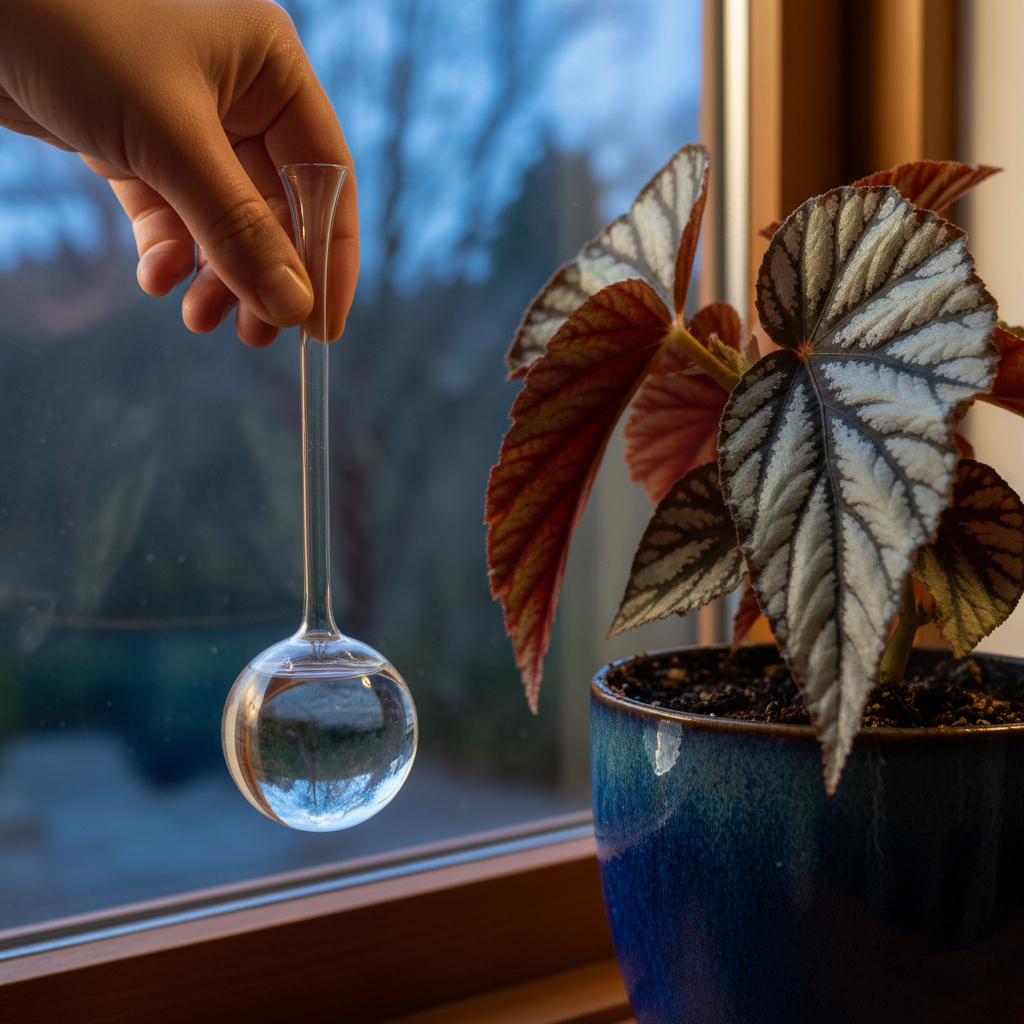
Water when the top 2 to 3 centimetres (about 1 inch) of soil have dried out, but the soil below that depth is still cool and slightly damp to the touch. In a warm, well-lit room in summer this typically means watering every 5 to 7 days; in a cooler room or in winter dormancy, every 10 to 14 days or even less. The exact interval matters far less than the actual state of the soil, which is why a finger check or a wooden chopstick pushed into the substrate is more reliable than a calendar.
The rhizome itself should never sit in standing water. If you bottom-water, remove the plant from the saucer after 20 to 30 minutes and tip out any excess. If the pot has been sitting in a cache pot, lift it out after watering and let it drain completely before returning it. Wet feet, especially when combined with cool nights, are the most common route to root rot.
Pro Tip — Water the Soil, Not the Leaves: Rex Begonia leaves do not handle prolonged moisture well; droplets that sit on the textured surface in low light can lead to leaf-spot diseases. Water at the soil level with a long-spouted can, or bottom-water by setting the pot in a shallow tray for half an hour, then drain.
How to Water Correctly
- Check the top 2 to 3 cm (1 inch) of soil with a finger or a clean wooden chopstick; only water when this layer feels dry.
- Use room-temperature water; cold water from the tap can shock the roots and cause leaf drop.
- Water around the rhizome at soil level, working your way around the pot so the entire root zone is moistened, not just one side.
- Continue until water runs freely from the drainage holes, which flushes accumulated salts from the substrate.
- Wait 10 to 20 minutes for the pot to finish draining, then empty the saucer or cache pot completely.
- Wipe up any water that splashed onto the leaves with a soft paper towel.
Signs of Overwatering vs. Underwatering
| Symptom | Overwatering | Underwatering |
|---|---|---|
| Leaf colour | Yellowing of lower leaves, often with darkening at the petiole | Bright leaves fade and look slightly washed-out |
| Leaf texture | Soft, limp, sometimes translucent patches | Crisp, papery edges; leaves curl inward at the margins |
| Soil | Stays damp for more than a week; smells sour or musty | Pulls away from the pot wall; dust-dry deep down |
| Roots | Black, mushy, slip out of their casing when touched | Pale, dry, brittle but still intact |
| Stem/rhizome base | Soft, brown, sometimes oozing when pressed | Firm but slightly shrivelled, leaves wilt from the top down |
Warning — Root Rot: A Rex Begonia with a rotting rhizome rarely recovers in place. If you smell sourness in the soil or see the base of the plant darkening and softening, unpot immediately, cut away every soft section back to firm white tissue with a sterilised blade, dust the cut surfaces with cinnamon or sulphur powder, and let the plant air-dry on a sheet of paper for 24 hours before replanting in fresh dry mix in a smaller pot.
Humidity Requirements
If watering decides whether your Rex survives, humidity decides whether it thrives. The ancestors of Begonia rex-cultorum live on shaded forest floors where the air sits at 70 to 90 percent humidity year-round, and modern hybrids still respond visibly to humidity in the room. Below 40 percent, leaf edges curl, brown crisp tips appear on the youngest leaves first, and new growth comes through smaller and less vivid. Above 50 percent, growth picks up; above 60 percent, the plant pushes new leaves freely and the rhizome thickens.
The symptoms of low humidity can be mistaken for underwatering, but the giveaway is that the soil is still moist when the leaves complain. Brown crisp edges with no other watering problem almost always point to dry air.
To raise humidity, the most reliable tool is a small electric humidifier set close enough to the plant that it lifts the reading on a digital hygrometer to 55 percent or higher. Pebble trays help marginally but rarely lift the local reading by more than 5 to 10 percent. Grouping the Rex with other plants is more effective than it sounds, because each plant transpires moisture into the air around it. A glass cabinet or terrarium, lit with a small grow bulb, will hold a Rex in near-greenhouse conditions and can transform a struggling plant within weeks.
Water Quality
Rex Begonias are not as fluoride-sensitive as some prayer plants, but very hard tap water with a lot of dissolved calcium and salts will gradually deposit a crust on the soil surface and on the rhizome itself. Where the local water is very hard, rainwater, filtered water or water left to stand uncovered for 24 hours before use will give visibly better results over a year. Avoid softened water, which has been treated with sodium and can be actively harmful to the plant.
Soil, Potting and Repotting
The right substrate for a Rex Begonia balances three things: moisture retention, air around the roots, and a slight acidity that mimics decomposing leaf litter. A heavy compost-based potting mix straight from the bag will hold too much water and suffocate the rhizome; a chunky orchid-style mix will dry out too fast and stress the plant constantly. The sweet spot is a fluffy peat- or coir-based mix lifted with perlite and fine bark.
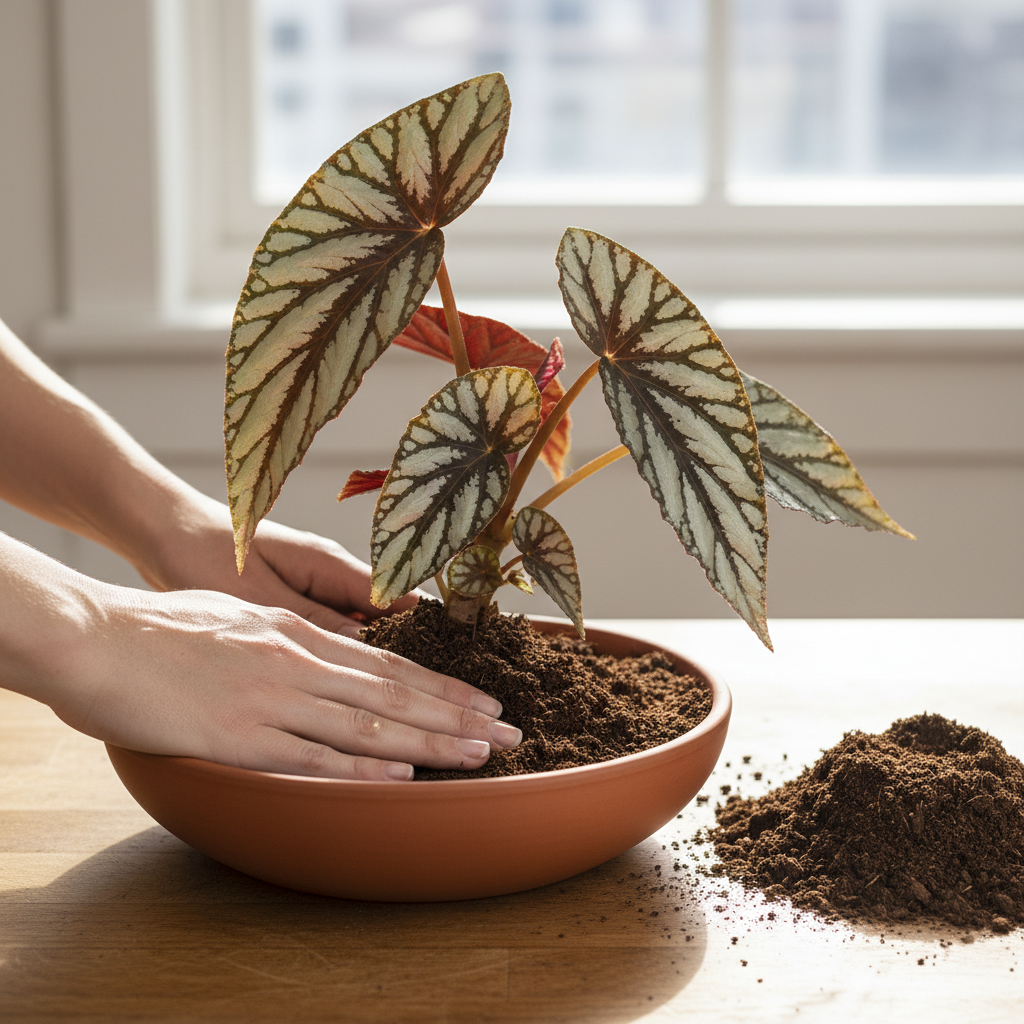
Ideal Soil Composition
A good Rex Begonia mix should feel light in the hand when dry and spring back when squeezed when damp. The substrate should drain freely within seconds of being watered, with no standing puddle on the surface, yet still hold enough moisture that the inside of the pot does not bone-dry between waterings. The pH should sit in the slightly acidic range, ideally between 5.5 and 6.5, which is where most peat-based African violet mixes naturally fall.
| Component | Proportion | Function |
|---|---|---|
| Peat moss or coco coir | 50 percent | Holds moisture evenly and provides slightly acidic structure |
| Perlite | 25 percent | Creates air pockets so roots can breathe |
| Fine orchid bark | 15 percent | Improves drainage and slowly breaks down into humus |
| Worm castings or leaf mould | 10 percent | Adds gentle, slow-release nutrition and beneficial microbes |
Many growers shortcut the recipe by using a bagged African violet mix straight, which is already close to the right balance, and then lifting it with an extra 20 to 25 percent perlite by volume. This combination consistently outperforms generic potting compost for Rex Begonias.
Pro Tip — Quick Mix Recipe: Two parts African violet mix, one part perlite, half a part fine orchid bark. Mix dry in a tub, moisten lightly with rainwater until it just clumps when squeezed, then pot up. This single mix works for both adults and rooted cuttings.
Choosing the Right Pot
The pot makes a much bigger difference for Rex Begonias than for most foliage plants, because the rhizome creeps horizontally rather than rooting straight down. Wide, shallow pots, sometimes sold as bonsai or bulb pans, mirror the natural growth habit and let the rhizome spread across the surface as it would in the wild. A deep narrow pot wastes most of its volume on soil that the plant never roots into, which then stays cold and wet and eventually sours.
Drainage holes are non-negotiable. Whatever pot you choose, it must have one or more generous drainage holes. Decorative cache pots with no drainage are fine for hiding a nursery pot inside, but never plant a Rex directly into a sealed container; the rhizome will rot within weeks.
Pot material: Terracotta wicks moisture away from the substrate and gives an extra margin of safety against overwatering, which is why it is often recommended for begonias. Glazed ceramic and plastic both work too, but require more careful watering since they retain moisture longer. Choose by the conditions of your home rather than by aesthetic alone.
Pot size: Rex Begonias prefer to be slightly snug rather than swimming in space. A pot 3 to 4 centimetres (about 1.5 inches) wider than the current rhizome spread is plenty. Oversized pots hold too much wet soil around the small root system and reliably lead to rot.
When to Repot
Most Rex Begonias only need repotting every 1 to 2 years, and many will happily stay in the same pot longer if top-dressed with fresh mix annually. Repot in early spring as the plant emerges from dormancy, never in winter when the rhizome is sleeping. Signs that it is time include roots circling visibly at the drainage holes, the rhizome itself crawling over the edge of the pot, the substrate breaking down into a fine sludge that no longer drains, or a noticeable slowdown in new leaf production even in good light.
How to Repot: Step-by-Step
- Water the plant the day before repotting; a slightly hydrated rhizome handles disturbance better than a dry one.
- Prepare the new pot by adding a thin layer of moistened mix to the bottom, just enough that the rhizome will sit at the same height as before.
- Gently squeeze the old pot to loosen the root ball, then tip the plant out into your hand or onto a sheet of newspaper.
- Tease away loose old substrate, working with your fingers rather than a tool, and inspect the rhizome for soft or rotten patches.
- Trim any rotten root or rhizome tissue with a sterilised blade, cutting back to firm white flesh, and dust cuts with cinnamon powder.
- Position the plant in the new pot with the rhizome lying flat across the surface, partially buried but not deeply submerged.
- Backfill around the edges with fresh mix, tamping gently with your fingertips, then water thoroughly and let drain.
Warning — Transplant Shock: After repotting, a Rex Begonia commonly drops one or two of its oldest leaves and looks slightly limp for a week or two. This is normal. Keep the plant in a warm humid spot, out of direct sun, water sparingly until new growth resumes, and resist the urge to fertilise for at least 4 to 6 weeks.
Fertilising
Rex Begonias are moderate feeders rather than heavy ones. Their root systems are small relative to their leaf area, and the fine roots burn easily when fertiliser concentration in the substrate climbs too high. The reliable approach is to feed lightly and often during active growth, then stop entirely once the plant slows down for winter.
Active growth runs roughly from late March through to early October at temperate latitudes, although it depends on light levels in your specific room. The cue is leaf production: while new leaves are emerging steadily, the plant is feeding; once they stop, fertiliser sits unused in the soil and slowly builds into salt.
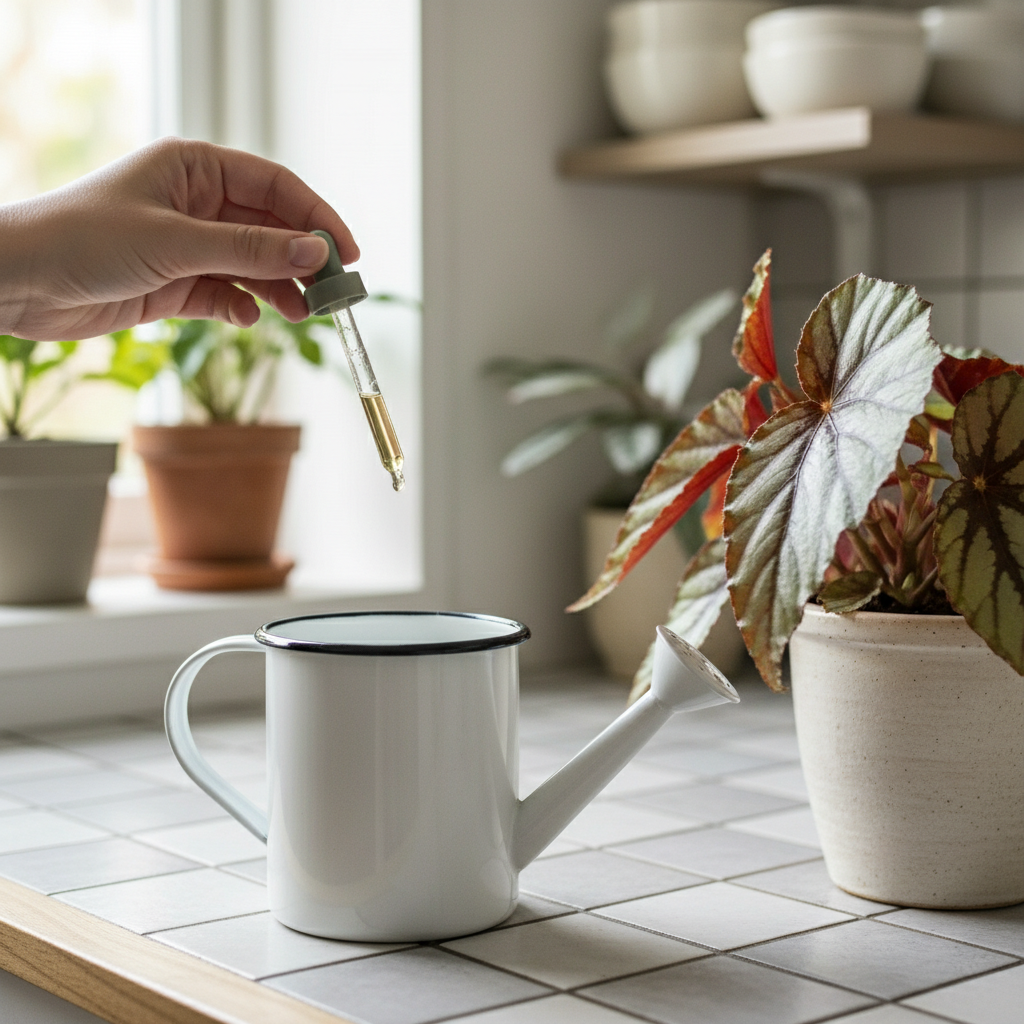
Understanding Plant Nutrients
Plant fertilisers report their content as three numbers on the label, known as the NPK ratio, which give the percentages of nitrogen, phosphorus and potassium by weight. A balanced fertiliser carries roughly equal numbers, for example 10-10-10 or 20-20-20, while a higher first number indicates a leaf-and-stem formula and a higher middle number signals a bloom booster. For a foliage plant like a Rex Begonia, a balanced or slightly nitrogen-leaning feed is ideal.
| Nutrient | Symbol | Primary Function | Deficiency Symptoms |
|---|---|---|---|
| Nitrogen | N | Builds leaves and chlorophyll | Whole-plant yellowing, oldest leaves first |
| Phosphorus | P | Root development and energy transfer | Stunted growth, dull leaves, purple undertones |
| Potassium | K | Cellular health and disease resistance | Brown edges and weak resistance to pests |
| Calcium | Ca | Cell wall strength, new leaf formation | Distorted new leaves, dying growth tips |
| Magnesium | Mg | Core component of chlorophyll | Yellowing between green veins on older leaves |
| Iron | Fe | Helps build chlorophyll | Yellowing between veins on newest leaves |
Types of Fertiliser
Liquid fertilisers: The easiest and most controllable option. Diluted into the watering can at quarter to half the label dose every 2 to 4 weeks during growth, they let you adjust the input quickly if the plant signals it has had enough. African violet feeds are a particularly good match for Rex Begonias because they are formulated for similar plants and similar substrates.
Slow-release granular: Coated prills that release nutrients gradually over 3 to 6 months. Convenient for forgetful growers but risky for Rex Begonias, since they keep feeding even when the plant slows in winter. If you use them, top-dress in spring only and remove the prills in autumn before dormancy.
Organic fertilisers: Worm castings, seaweed extracts and well-diluted fish emulsions are gentle, build soil biology over time and rarely cause salt burn. They are an excellent choice for growers who want a more forgiving routine, although the smellier varieties are not always welcome indoors.
Feeding Schedule
A simple, reliable rhythm: dilute a balanced liquid feed to quarter strength and add it to the watering can every second watering during spring and summer, scaling back to once a month in autumn, and stopping entirely from late November through to February or until the plant resumes producing new leaves. Adjust if the plant shows signs of either deficiency or salt buildup.
Pro Tip — Half-Strength is Plenty: The labels on most houseplant fertilisers are written for hungry plants in larger pots than most homes use. For a Rex Begonia, half the recommended dose, or even a quarter, gives steadier growth without the risk of leaf-tip burn from accumulated salts.
How to Fertilise
- Water the plant with plain water first, then add fertiliser to the next watering; never feed dry soil, which concentrates the solution around dry roots and can scorch them.
- Mix the diluted fertiliser thoroughly in the watering can; concentrated drops at the bottom can damage the rhizome.
- Apply at the soil level, avoiding contact with the leaves or rhizome.
- Let any excess drain freely from the pot and discard it; never let the plant sit in fertilised runoff.
- Flush the pot with clear water every 6 to 8 weeks to wash out any accumulated salts from the substrate.
Warning — Salt Build-Up: A white crust on the soil surface, or a faint brown ring at the base of new leaves, signals salt accumulation from over-fertilising or hard tap water. Flush the pot with at least three pot-volumes of clear distilled or rainwater, let it drain fully, and pause feeding for at least a month.
Propagation
Few houseplants are as generous with cuttings as the Rex Begonia. Both leaf cuttings and rhizome divisions strike easily under the right conditions, which is one of the reasons the cultivar list has grown so large; hobby breeders and nurseries can multiply a single new mutation into hundreds of plants within a season. A grower with a healthy mature Rex can produce dozens of new plants from a single repotting.
The two main approaches are rhizome division, which gives the fastest mature-looking plant, and leaf cuttings, which give the largest number of new plants from the smallest amount of starting material. Both are reliable; the choice depends on whether you want a few full-sized plants quickly or many small ones over several months.
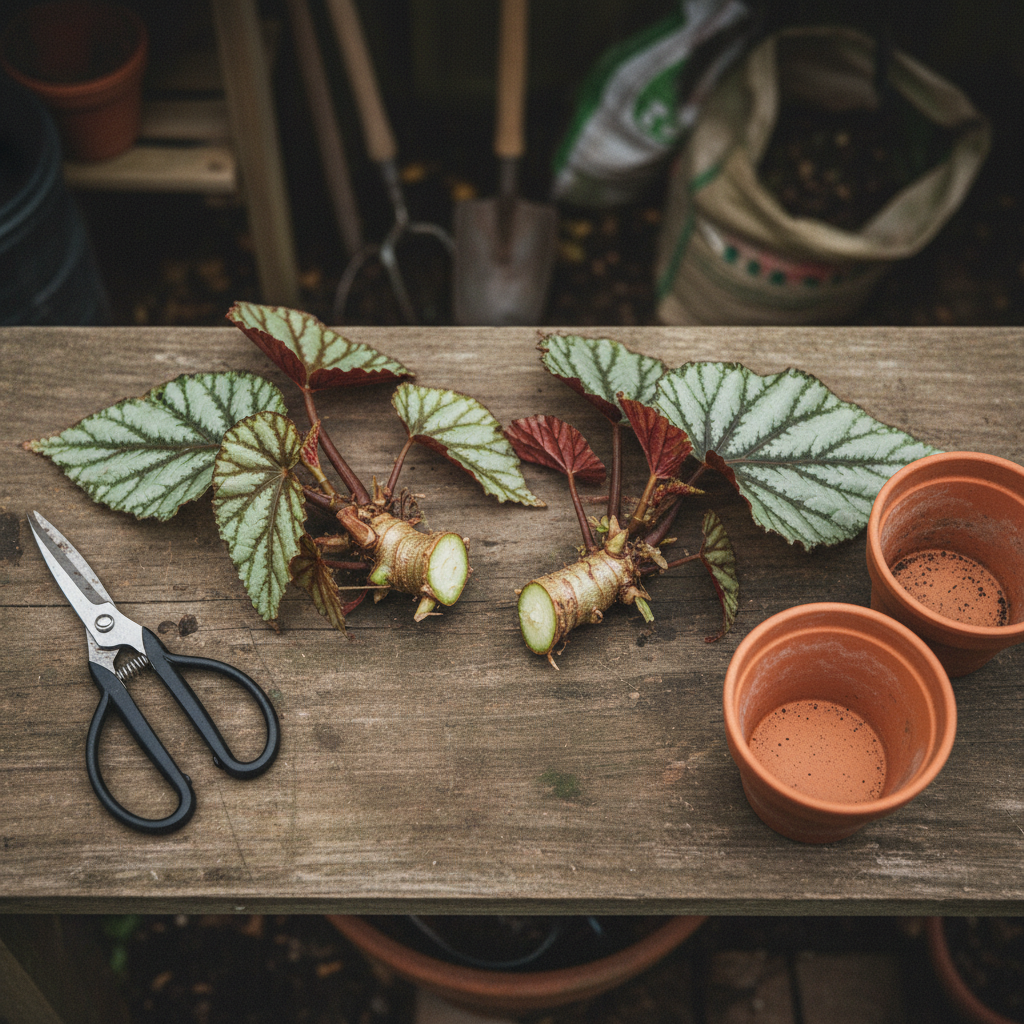
Understanding the Rhizome
Unlike many houseplants which root from a central crown, Rex Begonias grow from a thick horizontal stem called a rhizome that creeps along the soil surface. Each leaf and its petiole emerge from a node along this rhizome, and tiny feeder roots descend directly from the underside. The rhizome itself stores water and nutrients, which is what allows the plant to bounce back from a missed watering or a brief dormancy. For propagation, the key insight is that any section of rhizome with at least one node and a small amount of root will grow into a new plant.
Rhizome Division: Step-by-Step
Division is the fastest and most reliable way to multiply a Rex Begonia. The best time is early spring during repotting, when the rhizome is plump and the plant is just beginning to produce new leaves. Choose a mature specimen with at least two visible growth points along the rhizome.
- Unpot the plant and gently brush away most of the loose substrate, exposing the full rhizome and root system.
- Identify natural break points where the rhizome forks or where two growth crowns emerge separately.
- Sterilise a sharp knife or blade with isopropyl alcohol, and cut cleanly through the rhizome between crowns, ensuring each section has at least one growth point and a small cluster of roots.
- Dust the cut surfaces with cinnamon or sulphur powder to prevent infection.
- Pot each division into a snug pot filled with fresh, slightly moistened Rex Begonia mix, with the rhizome lying horizontally on the surface and just lightly covered.
- Place the new plants in a warm, humid, brightly lit spot away from direct sun, and water sparingly for the first 2 to 3 weeks until established.
Pro Tip — Air-Dry the Cuts: Before potting up freshly divided sections, let the cut surfaces air-dry on a sheet of paper for 6 to 12 hours. The cinnamon dust seals quicker on a dried wound, and the divisions are dramatically less likely to rot in their new pots.
Leaf Cuttings: Step-by-Step
Leaf cuttings are slower than division but spectacularly productive: a single mature leaf can give rise to half a dozen or more new plantlets. There are two main methods, the whole-leaf approach and the leaf-wedge approach, both relying on the begonia’s ability to produce new growth directly from the major leaf veins.
- Select a healthy, mature leaf with thick veining and no signs of damage; cut it from the parent with a sterile blade, leaving 1 to 2 centimetres of petiole attached.
- For the whole-leaf method, lay the leaf flat on damp peat-perlite mix in a shallow tray and make small cuts across the major veins with a sterile blade, then pin the leaf flat to the substrate with hairpins or paper clips so the cut veins stay in firm contact with the soil.
- For the wedge method, cut the leaf into pie-slice wedges, each with a section of main vein at the inner tip, and insert the tip into damp mix at a shallow angle.
- Mist lightly, cover with a clear plastic lid or place inside a transparent bag to maintain near-100 percent humidity, and set somewhere warm at 21 to 24 degrees Celsius (70 to 75 Fahrenheit) with bright indirect light.
- Check every few days; condensation is fine but the substrate should not be waterlogged. Tiny plantlets typically emerge from the cut veins in 4 to 8 weeks.
- Once each plantlet has produced two or three of its own small leaves, transplant carefully into individual small pots and gradually reduce humidity over 2 to 3 weeks.
Troubleshooting Propagation
| Problem | Likely Cause | Solution |
|---|---|---|
| Cuttings rot before rooting | Substrate too wet or no air circulation | Use a fresh sterile mix, lighter on the water, and vent the humidity cover daily for a few minutes |
| Leaf turns mushy at the cut | Bacterial infection from unsterile tools | Sterilise blades with isopropyl alcohol between cuts; dust new cuts with cinnamon |
| No new plantlets after 8 weeks | Temperature too low or light too dim | Move to a warmer spot at 22 to 25 degrees Celsius (72 to 77 Fahrenheit) with brighter indirect light |
| Plantlets emerge but stay tiny | Substrate exhausted or humidity dropped too quickly | Pot up gently, mist regularly, and feed at one-eighth strength after first true leaves |
Pests and Diseases
Rex Begonias are not unusually pest-prone, but the warm, humid conditions they prefer also happen to be the conditions that favour a few familiar houseplant nuisances. Most issues catch on quickly if leaves are inspected weekly, and most are entirely treatable with measures milder than chemical pesticides.
Disease pressure on Rex Begonias is higher than on average for an indoor plant, largely because the leaves hold moisture in their textured surfaces and the rhizome is sensitive to fungal and bacterial pathogens in wet soil. Air movement, careful watering, and rapid removal of any damaged leaves go a long way to preventing problems before they spread.
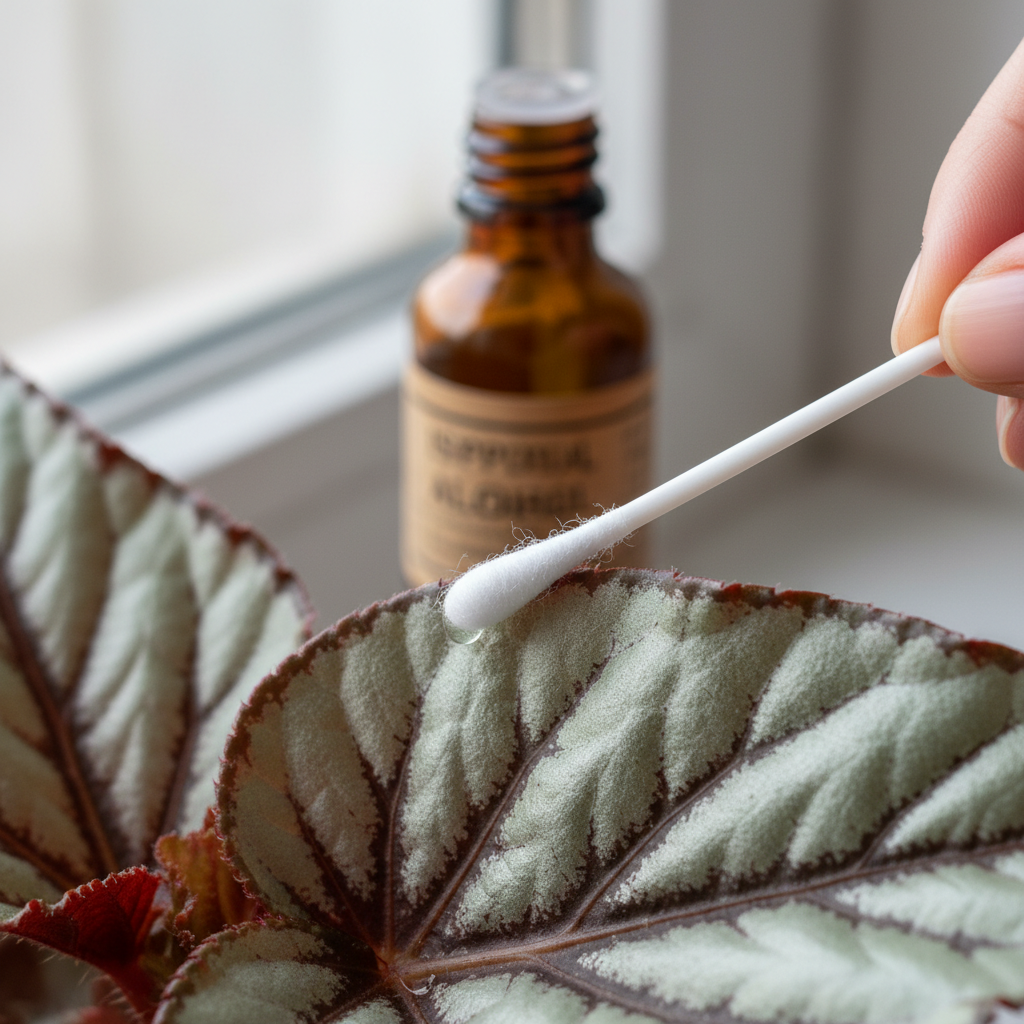
Common Pests
Mealybugs (Pseudococcus longispinus and others)
Small white fluffy insects that gather in the leaf axils and along the rhizome, sucking sap and weakening the plant. The puckered leaf texture of a Rex Begonia gives them many hiding places, so infestations can build before they are noticed. Look for sticky honeydew, distorted new growth, and the characteristic cotton-wool clusters.
Treatment: Dab each visible mealybug with a cotton bud dipped in 70 percent isopropyl alcohol, which kills on contact. For broader infestations, follow up with an insecticidal soap spray every 7 to 10 days for three applications, paying attention to the undersides of leaves and the rhizome surface.
Thrips (Frankliniella occidentalis)
Slender, fast-moving insects barely a millimetre long, often black or pale brown, that rasp at leaf surfaces and leave silvery streaks and tiny dark fecal specks behind. Thrips can spread viral diseases between plants and are one of the harder pests to clear from a Rex once established.
Treatment: Combine yellow or blue sticky traps to monitor and catch adults with weekly applications of a spinosad or pyrethrin-based spray for at least three weeks, since the life cycle includes a soil-dwelling pupal stage that needs repeated treatment to break.
Spider Mites (Tetranychus urticae)
Tiny, almost-invisible arachnids that show up most often when the air is dry. They feed on the undersides of leaves, leaving fine yellow stippling and, in heavier infestations, delicate webbing in the leaf axils. Rex Begonias kept at low humidity are particularly vulnerable.
Treatment: Raise humidity above 50 percent, rinse the foliage thoroughly with room-temperature water if practical, and apply a neem oil or insecticidal soap spray every 5 to 7 days for three applications. Persistent infestations often signal that the underlying humidity problem has not been solved.
Fungus Gnats (Bradysia species)
Small grey-black flies that hover around the soil surface and reproduce in damp organic substrate. The adults are mostly a nuisance, but the larvae feed on tender roots and can weaken cuttings and seedlings.
Treatment: Let the top of the soil dry out between waterings, top-dress with a thin layer of horticultural sand or fine grit to disrupt egg-laying, and water with a Bacillus thuringiensis israelensis (Bti) solution to kill larvae in the substrate. Yellow sticky traps catch the adults.
Common Diseases
Powdery Mildew (Oidium begoniae)
A white-grey powdery coating that appears on the upper leaf surface, often starting in patches and expanding into a continuous bloom. Begonias are notably mildew-prone, particularly in poorly ventilated rooms with cool nights and high humidity.
Treatment: Remove the worst-affected leaves and spray remaining foliage with a milk-and-water solution at 1 part milk to 9 parts water, or a sulphur-based fungicide, every week for three weeks. Increase air circulation with a small fan running on low nearby.
Botrytis Grey Mould (Botrytis cinerea)
A fuzzy grey-brown mould that appears on damaged or dying leaf tissue and spreads rapidly in still humid air. Often the first signs are soft brown patches on lower leaves that quickly grow fuzz.
Treatment: Remove all affected leaves with sterile scissors, cutting back into healthy tissue, and dispose of the material outside the home. Improve airflow, reduce humidity slightly to around 50 percent until the outbreak is gone, and avoid wetting the leaves when watering.
Bacterial Leaf Spot (Xanthomonas axonopodis pv. begoniae)
Small, water-soaked translucent spots on the leaves that gradually turn brown with yellow halos. Without intervention, spots merge and large sections of leaf collapse. The bacterium spreads through splashing water and on contaminated tools.
Treatment: No reliable home-grower cure exists. Remove every affected leaf, sterilise scissors between cuts, isolate the plant, water only at the soil surface, and keep humidity around the plant moderate rather than very high. In severe cases, propagate a healthy leaf from the unaffected portion and discard the parent.
Pest and Disease Summary
| Pest / Disease | Identification | Treatment |
|---|---|---|
| Mealybugs | White cottony clusters in leaf axils | Cotton bud with isopropyl alcohol, then insecticidal soap |
| Thrips | Silvery streaks, dark fecal specks | Spinosad or pyrethrin spray plus sticky traps |
| Spider mites | Stippled leaves, fine webbing | Raise humidity, neem oil or insecticidal soap |
| Fungus gnats | Small flies hovering around soil | Drier topsoil, Bti drench, yellow sticky traps |
| Powdery mildew | White powdery coating on leaves | Milk solution or sulphur fungicide, more airflow |
| Botrytis | Fuzzy grey mould on dying tissue | Remove affected leaves, improve airflow, reduce humidity slightly |
| Bacterial leaf spot | Translucent spots with yellow halos | Remove leaves, isolate plant, propagate from healthy section |
Prevention Strategies
Prevention is much easier than treatment with Rex Begonias. Inspect the plant once a week, gently lifting a few leaves to peek at undersides and at the rhizome surface where pests tend to congregate first. New plants brought home should be isolated from the rest of the collection for at least two weeks to make sure nothing hitchhiked in. A gentle wipe of the upper leaf surface with a damp microfibre cloth every month keeps dust off and gives you a chance to notice problems early.
Cultural conditions matter as much as physical treatments. A Rex Begonia kept in good light, watered correctly, in a well-ventilated room with steady humidity, simply does not attract problems the way a stressed plant does. Crowded shelves with no airflow, on the other hand, are mildew incubators, and a single neglected Rex can seed an outbreak across an entire collection within weeks.
Pro Tip — Quarantine and Inspect: Always quarantine new Rex Begonias for at least 14 days in a separate room before introducing them to your main collection. Use this window to inspect the underside of every leaf and the rhizome surface, and to confirm that no eggs or larvae are present in the substrate.
Popular Varieties
The Rex Begonia world is vast. Hundreds of named cultivars exist, many produced by hobby breeders working in small greenhouses, and new selections appear every year. Most fall into a few recognisable groups based on leaf shape, colour pattern, or breeding line, but within each group the variation can be striking.
The cultivars below are among the most widely grown and most consistently available in plant shops and online specialist nurseries. Some, like Escargot, have been popular since the 1970s; others, like the Jurassic series, are recent introductions that have travelled quickly thanks to social media.
| Variety | Leaf Appearance | Light Needs | Growth Rate | Availability |
|---|---|---|---|---|
| Escargot | Silver and green spiralling like a snail shell | Bright indirect | Moderate | Widely available |
| Fireworks | Silver and pink bands radiating from a dark centre | Bright indirect | Moderate | Common |
| Harmony’s Red Robin | Deep blood-red with darker veining | Bright indirect | Moderate | Specialist nurseries |
| Silver Limelight | Pale silver with faint green veining | Bright indirect | Moderate | Common |
| Boston Cherries ‘n Chocolate | Deep chocolate brown with cherry-pink spots | Bright indirect | Moderate | Specialist nurseries |
| Black Mamba | Near-black foliage with pewter sheen | Bright indirect; tolerates medium | Slow | Specialist nurseries |
| Jurassic series | Various: enormous bold leaves, vigorous | Bright indirect | Fast | Common |
| Iron Cross (B. masoniana) | Pale green with bold dark cross at centre | Bright indirect | Moderate | Widely available |
Featured Varieties

Escargot
The most recognisable Rex Begonia of all. Leaves spiral inward like a snail shell, with broad silver-green outer bands curling tightly around a darker olive centre. Bred in the 1970s and still one of the most photographed begonias on the market. Slightly slower than other cultivars but holds its colour reliably indoors.
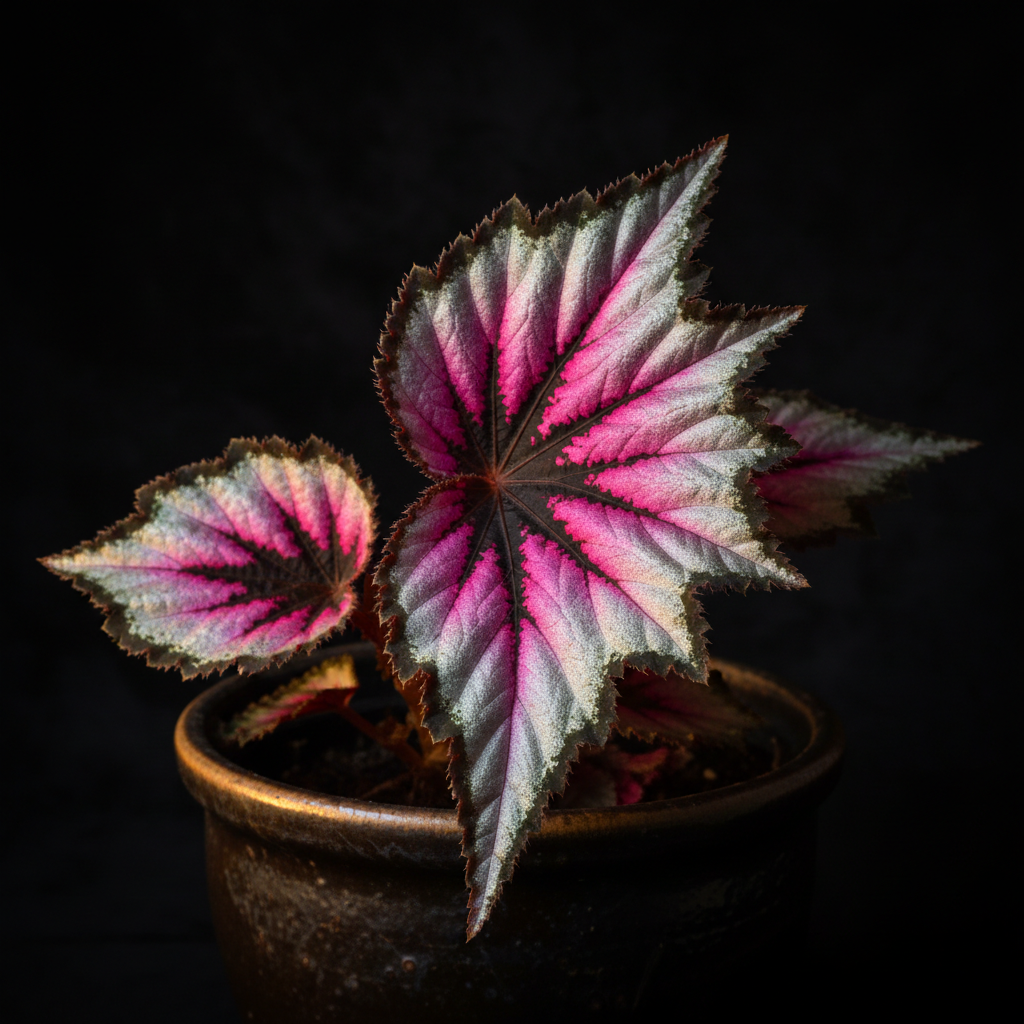
Fireworks
One of the most visually electric Rex Begonias. Vivid bands of metallic silver and hot pink radiate from a near-black purple centre, trimmed at the edges in deep emerald. Looks artificial at first glance, and is consistently among the bestselling cultivars in plant-shop chains. Slightly more humidity-hungry than average.
Variety Profiles in Detail
Harmony’s Red Robin (Begonia rex-cultorum ‘Harmony’s Red Robin’)
A modern cultivar with deep blood-red leaves marked by even darker burgundy veining, sometimes with a thin silvery edge. The colour deepens with stronger light, and in winter the plant tends to hold its leaves longer than older cultivars. Compact and well-suited to shelf cultivation.
Silver Limelight (Begonia rex-cultorum ‘Silver Limelight’)
An almost monochromatic variety with pale silver, near-white leaves and only the faintest tracery of green veins. Photographs beautifully in low-key light. More sensitive to direct sun than coloured cultivars because the silver areas have very little protective pigment.
Boston Cherries ‘n Chocolate (Begonia rex-cultorum ‘Boston Cherries ‘n Chocolate’)
Deep chocolate-brown leaves dappled with small cherry-pink spots, giving an almost printed-fabric effect. Slower-growing and slightly fussier about humidity, but rewards careful care with one of the richest colour palettes in the genus.
Black Mamba (Begonia rex-cultorum ‘Black Mamba’)
Near-black foliage with a faint pewter sheen and only a hint of green underneath. Tolerates lower light than most Rex cultivars but grows slowly even in good conditions. A favourite of dark-academia interiors.
Iron Cross Begonia (Begonia masoniana)
Strictly speaking a separate species and not a Rex cultivar, but commonly grouped with them in the trade. Pale apple-green leaves carry a bold dark-brown cross at the centre, like a stamped emblem. The leaf surface is heavily puckered and slightly rough to the touch. Care is essentially identical to other Rex Begonias.
Choosing the Right Variety for Your Space
For first-time Rex Begonia growers, Escargot, any of the Jurassic series, or Iron Cross are the most forgiving choices and accept a slightly wider range of conditions. Highly silver or near-white cultivars like Silver Limelight need brighter, more carefully controlled conditions to keep their colour without scorching. Very dark cultivars like Black Mamba or Boston Cherries ‘n Chocolate handle lower light better than the silvery ones but tend to grow slowly. Where humidity is hard to maintain, choose a vigorous cultivar from the Jurassic line and pair it with a humidifier rather than relying on a slow-growing collector’s variety.
Frequently Asked Questions
Why is my Rex Begonia losing its lower leaves?
Some lower-leaf loss is normal: older leaves yellow and drop as the rhizome creeps forward and pushes out new growth. Rapid loss of multiple leaves at once usually points to overwatering, transplant shock, or a sudden drop in humidity. Check the rhizome for softness, lift the plant out of its pot to inspect the roots, and review the watering routine of the past few weeks before deciding on a cause.
Do Rex Begonias go dormant?
Yes. Most Rex Begonias slow down or stop producing new leaves from late autumn into early spring, and some shed several leaves entirely. The rhizome remains alive and will resume growth as light and warmth return. During this period, water less, stop fertilising, and keep the plant in a warm, draught-free spot. Do not panic if half the foliage falls; this is normal for many cultivars.
Should I cut off the flowers?
Rex Begonias do flower occasionally, sending up sprays of small pink or white blossoms on slender stems. The flowers are unremarkable next to the foliage and divert energy away from leaf production. Most growers cut the flower stems off at the base as soon as they appear, which is harmless to the plant and keeps the leaves coming.
Can I grow a Rex Begonia under a glass cloche or in a terrarium?
Yes, and many growers find this the easiest way to keep them happy. The high steady humidity inside a cloche or terrarium suits Rex Begonias perfectly, and the slightly cooler microclimate compared to a sunny windowsill protects the foliage. Make sure there is some ventilation, as standing humid air with no movement encourages mildew, and use a small grow light if the spot is too dim.
Why are my new leaves smaller than the old ones?
This is almost always a sign that something has reduced the plant’s resources: insufficient light, exhausted soil, or interrupted feeding. Move the plant to a brighter spot for a week or two and observe whether the next two or three leaves come through larger. If they do not, repot into fresh substrate and resume a gentle feeding schedule.
Are Rex Begonias safe to keep around cats and dogs?
No. All Begonia species, including Rex cultivars, contain insoluble calcium oxalate crystals that can cause mouth irritation, drooling and vomiting if chewed. The roots and rhizome are reportedly the most toxic part. The ASPCA lists Begonias as toxic to cats, dogs and horses. Keep the plant well out of reach, especially of young animals that taste-test new objects.
My Rex Begonia has brown, crispy edges on its leaves. What is happening?
The most common cause is low humidity, especially in winter when central heating dries the air. Other causes include underwatering, salt buildup from hard water or over-fertilising, and exposure to cold draughts. Move the plant away from radiators and draughty windows, raise humidity to at least 50 percent, flush the substrate with rainwater, and check that watering is happening before the soil goes bone-dry.
How long does a Rex Begonia live?
Individual rhizomes can live for many years, often a decade or more, but the original leaves do not. As the rhizome creeps forward, the oldest sections behind the active growth point eventually wither and the plant migrates across the pot. Most growers refresh their plants by dividing the rhizome and replanting the youngest sections every 2 to 3 years, which effectively resets the plant indefinitely.
Can I put a Rex Begonia outside in summer?
It is possible, but it requires careful placement. A sheltered shaded spot on a balcony or patio, where the plant gets bright indirect light and is protected from wind, can give good growth. Avoid any spot that catches direct midday sun. Bring the plant back indoors well before night temperatures drop below 15 degrees Celsius (59 Fahrenheit), and inspect the foliage and rhizome carefully for pests before reintroducing it to your indoor collection.
Why does my Rex Begonia look great in summer and miserable in winter?
This is the normal pattern for the genus, particularly in temperate climates. Short winter days, dry indoor air from heating systems, and the plant’s natural dormancy all conspire to slow growth and shed some leaves. The key is to ease back on watering and fertiliser, raise humidity around the plant, and resist the urge to repot or intervene heavily. Once daylight lengthens in late February or March, new leaves resume, and the plant typically returns to full vigour by April.






