
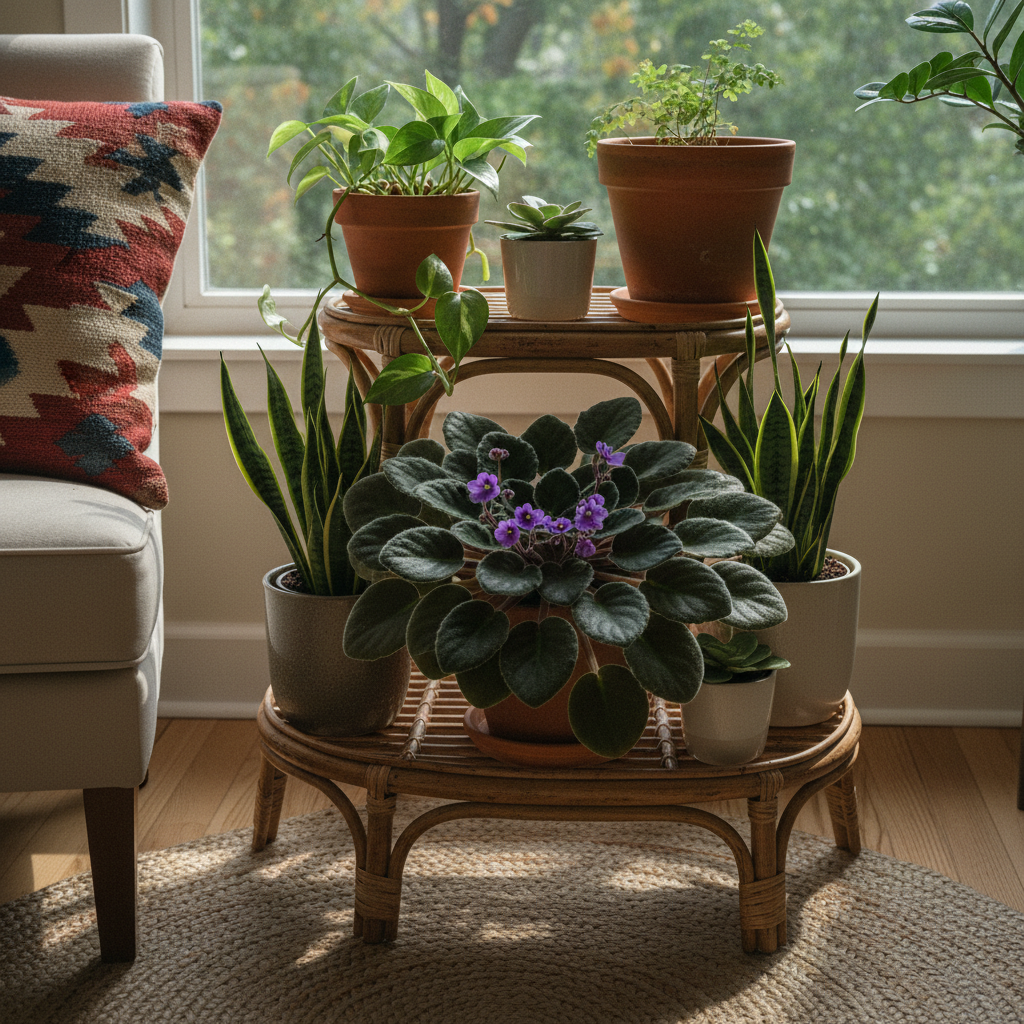
The African violet, known to botanists as Saintpaulia ionantha and now formally placed within the genus Streptocarpus, is one of the most beloved flowering houseplants in the world. Native to a tight cluster of cloud-shaded forests in the Eastern Arc Mountains of Tanzania and southern Kenya, the species was first collected for European horticulture in 1892 by Baron Walter von Saint Paul-Illaire, after whom the plant is named. Within a generation it had become a staple of glasshouses and parlour windowsills across Germany, England and the United States, and today there are thousands of registered cultivars in cultivation, with new ones added every season by an enthusiastic global community of breeders and hobbyists.
Few plants reward attentive growing as generously as the African violet. With the right light, the right water and a sensible feeding schedule, a healthy specimen can stay in bloom for nine or ten months of the year, producing fresh flushes of five-petalled blossoms in pinks, purples, blues, magentas and whites above a tight, symmetrical rosette of fuzzy leaves. The reputation for fussiness is largely undeserved, but it does come from a genuine quirk: African violets dislike almost everything a thirsty plant lover instinctively does to them, from chilled tap water poured over the crown to a sunny south window in midsummer. This guide walks through the difference between an African violet that survives on a forgotten shelf and one that thrives as the centrepiece of a windowsill, covering light, watering, soil, feeding, propagation, pests and the staggering range of cultivars available to today’s grower.
Contents
- Quick Reference
- Why African Violet Makes a Rewarding Houseplant
- Light Requirements
- Watering and Humidity
- Soil, Potting and Repotting
- Fertilising
- Propagation
- Pests and Diseases
- Popular Varieties
- Frequently Asked Questions
Quick Reference: African Violet at a Glance
| Light | Bright indirect light, roughly 10,000 to 15,000 lux for 10 to 14 hours per day. East-facing windows are ideal; supplement with fluorescent or LED grow lights in winter. |
| Watering | Keep the soil consistently moist but never soggy. Water from below or carefully at the soil line with tepid water. Allow the top 1 cm (½ in) to dry slightly between waterings. |
| Temperature | Steady 18 to 24 °C (65 to 75 °F) day and night. Avoid drops below 15 °C (60 °F) and any cold draught from windows or doors. |
| Humidity | Prefers 50 to 70 percent relative humidity. Tolerates 40 percent but blooms less freely and may show brittle leaves in very dry air. |
| Fertiliser | Balanced or slightly phosphorus-leaning African violet feed (such as 14-12-14) at quarter strength with every watering, or half strength every second watering during active growth. |
| Toxicity | Non-toxic to cats, dogs and humans according to the ASPCA. Safe for households with pets and young children. |
Why African Violet Makes a Rewarding Houseplant
Most flowering houseplants are sold in bud, brought home for a week of colour and then either tossed or relegated to a shelf where they never bloom again. The African violet is different. In the conditions of an ordinary heated living room, with no greenhouse and no specialist equipment, a well-treated plant will produce successive flushes of flowers almost continuously, often with only a brief midsummer pause. That, more than anything else, is what has made the species the most-grown flowering houseplant in the world: it is a true year-round bloomer, scaled to fit on a saucer.
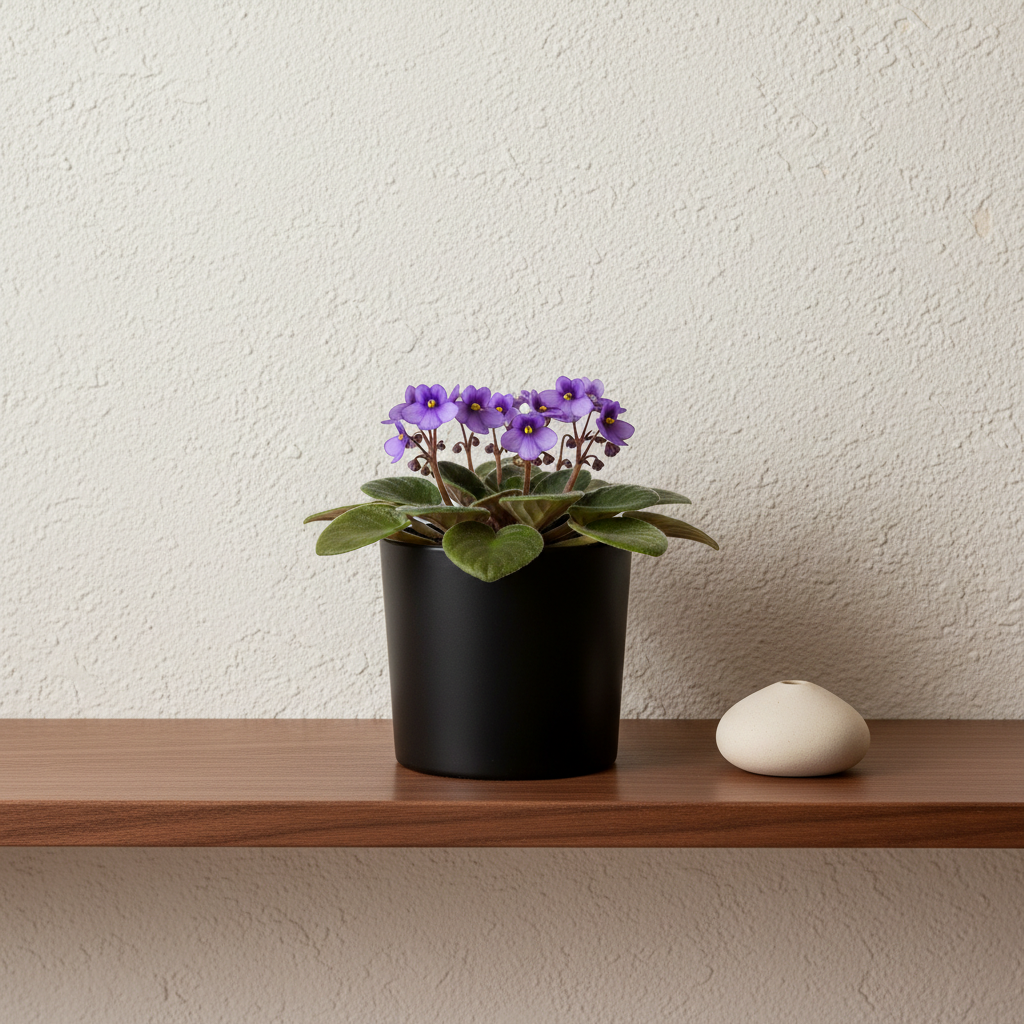
Beyond the flowers, the plant itself is well suited to indoor life in ways that many tropicals are not. A standard rosette tops out at about 20 to 30 cm (8 to 12 in) across, with semi-miniature and miniature classes staying well under that, so even a small flat can hold a meaningful collection. The fuzzy, slightly succulent leaves store water and tolerate the occasional missed watering. The roots are shallow and modest, so a typical specimen lives happily for years in a 9 cm (3½ in) pot without ever demanding the kind of constant up-potting that fast-growing aroids require. And because the plant evolved on the floor of cloud forests where light is filtered and never harsh, it actively prefers the relatively dim, indirect light that most rooms supply, rather than tolerating it under protest.
Important — Toxicity: The African violet is non-toxic to cats, dogs and humans, and is one of the few showy flowering houseplants you can keep without concern in a home with curious pets or small children. The fuzzy leaves are unappealing to chew on, which further reduces the chance of incidents.
Light Requirements
Light is the single most important variable in African violet care. Almost every common complaint, from a refusal to bloom to elongated leggy growth to pale washed-out foliage, traces back to either too little or too much of it. The species evolved in the dappled understorey of montane forests, where soft sidelight filters through tree canopies for most of the day but direct sun rarely reaches the forest floor. Replicating that even, gentle, prolonged illumination is the single change that turns most struggling plants into reliable bloomers.
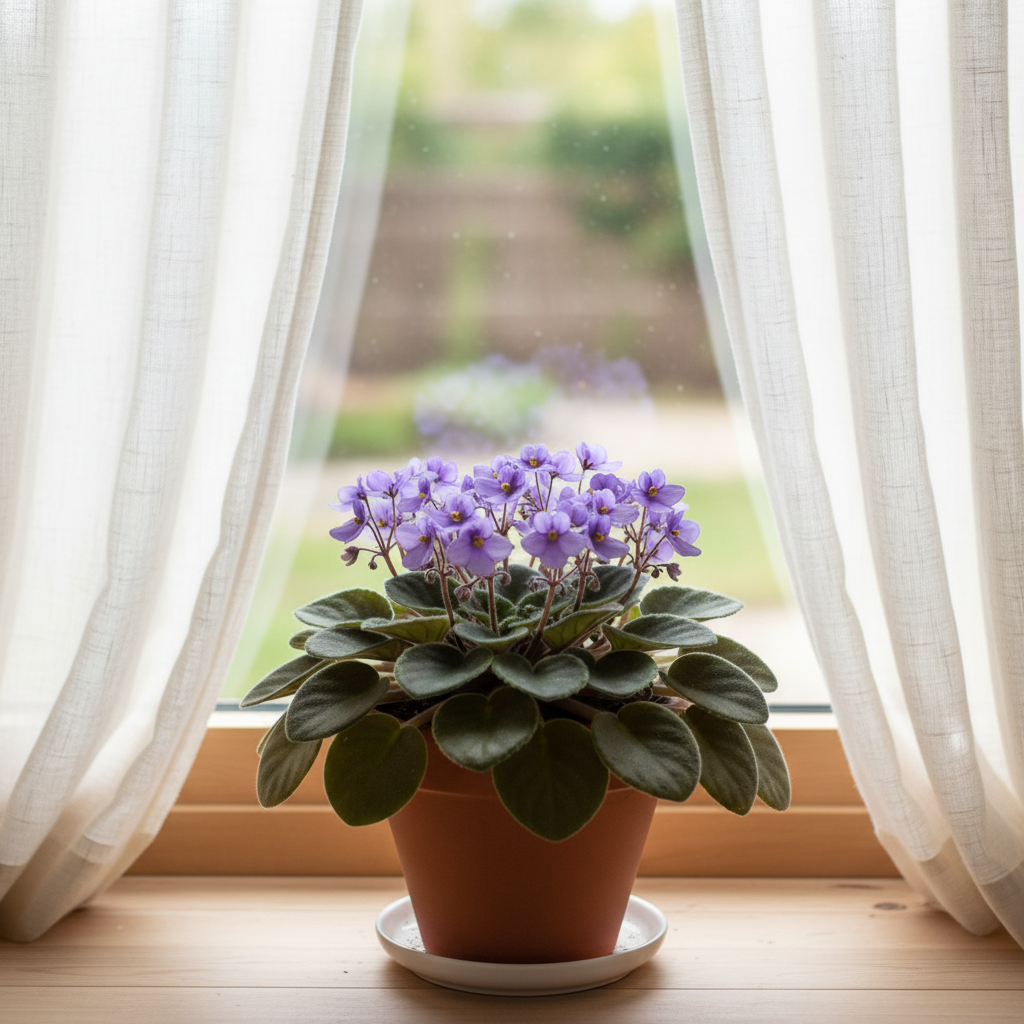
In practical terms, an African violet wants roughly 10,000 to 15,000 lux for 10 to 14 hours a day. That is much less than a sun-loving succulent demands but considerably more than people typically realise. A sheer-curtained east window in summer, or an unobstructed east window in winter, comes close. A north window in a high-latitude country in midwinter does not, and is the most common reason an otherwise healthy plant simply stops flowering between November and February.
Light Levels Explained
Lux is a measure of how much visible light reaches a surface. To translate the numbers below into something useful, hold a smartphone lux meter at the level of the rosette: roughly 1,000 lux is “you can read comfortably”, 10,000 lux is “very bright open shade outdoors”, and 100,000 lux is “midsummer noon sun on a clear day”.
| Light Category | Approx. Level | Typical Location | Outcome |
|---|---|---|---|
| Direct sun | 50,000 lux and above | Unshaded south or west window in summer | Sunscald, bleached foliage, crisped leaf edges; flowers fade quickly. |
| Bright indirect | 10,000 to 20,000 lux | East window, or south with sheer curtain | Compact growth, dark green leaves, near-continuous bloom. Ideal. |
| Medium | 2,500 to 10,000 lux | A metre back from a bright window, or under a fluorescent shop light | Healthy foliage, sporadic bloom; growth slows. |
| Low | 500 to 2,500 lux | North window in winter, interior of a well-lit room | Survives but rarely flowers; leaf petioles stretch upwards seeking light. |
| Very low | Below 500 lux | Corner of a dim room, hallway with no nearby window | Decline within months; leaves yellow, plant becomes leggy and stops growing. |
Window Orientation and Placement
South-facing window: In a north-temperate climate this is too bright in summer and just right in winter. The simple solution is a sheer curtain, which knocks midday intensity down by 30 to 50 percent while still letting through more than enough light for heavy flowering. Without a curtain, leaves develop pale tan or yellow patches within days, and flower stems wilt by lunchtime.
East-facing window: The classic best position. The plant catches several hours of gentle morning light, which is bright but not yet hot, and then sits in evenly diffused light for the rest of the day. Most show-quality plants in collectors’ homes spend their lives on an east sill.
West-facing window: Workable but trickier than east. Western light arrives in the afternoon when air and glass temperatures are already high, so direct rays can scorch leaves and dry the soil unevenly. Pull the plant back about 30 cm (12 in) from the glass, or use a sheer panel, to take the edge off.
North-facing window: Adequate in spring and summer at southern European latitudes and below, but generally too dim in winter for reliable bloom anywhere north of about 50 degrees. African violets on a north sill in Edinburgh or Copenhagen in January almost always need supplemental artificial light to keep flowering.
Pro Tip — The Quarter-Turn Rule: African violets grow symmetrically only if light arrives symmetrically. Give the pot a quarter turn each time you water; over a month the rosette completes a full rotation and stays flat and even instead of leaning towards the window.
How Light Affects Bloom and Leaf Colour
A plant in correct light produces leaves that lie almost flat above the soil, dark green with a slight purplish flush on the undersides, and pushes flower stalks (peduncles) up from the leaf axils in regular flushes. Reduce the light and the petioles elongate upwards in search of brightness, the rosette opens like a star reaching for the sky, and flowering ceases. Increase the light beyond what the plant can use and leaves bleach to a pale, yellowish green, edges curl downwards, and any blooms that do appear are short-lived. Variegated cultivars are particularly informative: their white or cream markings intensify in good light and fade towards green when light is insufficient, so the foliage itself acts as a built-in light meter.
Warning — Direct Sunlight: Even a single hour of direct midsummer sun on the leaves of an African violet can produce permanent bleached patches and ring-shaped scars on the foliage. These do not recover. If your plant must sit on a bright sill, install a sheer curtain or move the pot 30 cm (12 in) back from the glass before the sun arrives.
Artificial Lighting
African violets respond extremely well to artificial light, and many of the most spectacular show plants in the world spend their entire lives under fluorescent or LED fixtures. A standard set-up uses two T5 or T8 fluorescent tubes (one cool white, one warm white) or a single full-spectrum LED panel, mounted 25 to 30 cm (10 to 12 in) above the top of the rosette and run for 12 to 14 hours a day on a timer. Under this regime, a plant on an interior shelf with no window access at all can outperform a south-window specimen, blooming continuously regardless of season. Reduce the photoperiod to 10 hours in summer if the plant shows signs of heat stress, and remember to keep at least eight hours of darkness, which the plant uses for flower-bud initiation.
Seasonal Adjustments
In high-latitude homes, light intensity in December and January can fall to a tenth of what the same window delivers in June. Move plants closer to the glass in winter, swap a sheer curtain for clear glass, and consider adding a simple LED grow light for the worst eight weeks. In summer, reverse the changes: pull plants back from south and west windows, add diffusing fabric, and watch leaf colour for early signs of bleaching. Many growers keep one set of plants on the west sill in winter and rotate them onto the east sill in summer to balance the seasonal swing in available light.
Watering and Humidity
If light is the most important variable for an African violet, water is the easiest to get spectacularly wrong. The species is famously sensitive to cold water on its leaves, which produces pale yellow rings and spots within hours, and even more sensitive to standing water at the crown, which rots through the central growing point with little warning. The good news is that with two small adjustments to a standard houseplant watering routine, the plant becomes one of the most forgiving on the windowsill.
When to Water
African violets prefer evenly moist soil, never bone dry and never waterlogged. The reliable rule is to lift the pot: if it feels noticeably light and the top centimetre of soil is just starting to dry, it is time to water. In a 9 cm (3½ in) plastic pot in average indoor conditions, that interval works out to roughly every five to seven days in summer and every seven to ten days in winter, but always trust the pot weight rather than the calendar.
The classic finger test, pressing a knuckle into the soil to a depth of one centimetre, also works well and is more reliable than visual inspection because the soil surface dries faster than the root zone. If the soil feels cool and moist, wait. If it feels barely damp or fully dry, water thoroughly. Plants flowering heavily transpire more and dry out faster than plants resting between flushes, so adjust through the year rather than running a fixed schedule.
Pro Tip — Tepid Water Only: Cold water shocks the roots and chills the leaves, leaving the pale rings and spots that are the visual signature of an African violet that has been watered carelessly. Always use water at room temperature, ideally drawn the day before and left to stand so any chlorine in tap water has dissipated and the temperature has equilibrated with the room.
How to Water Correctly
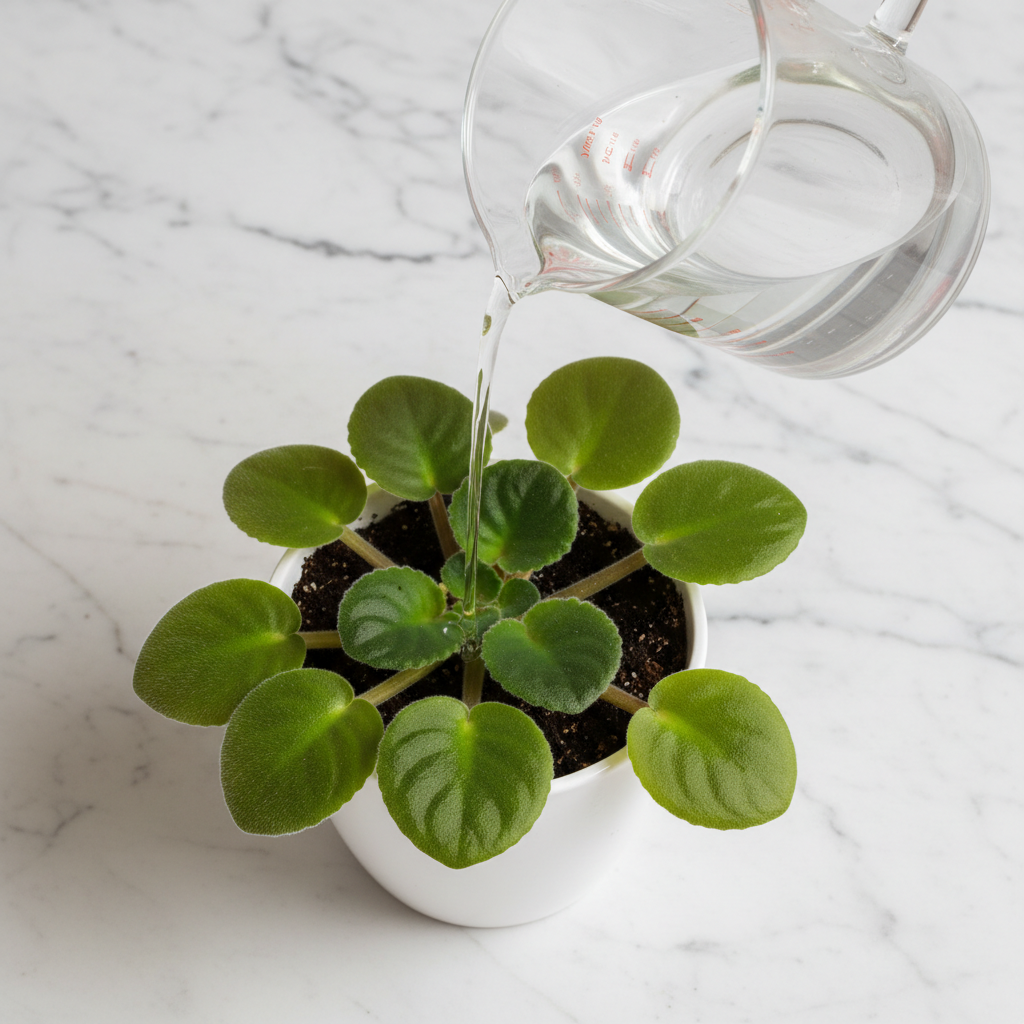
- Choose a method. Either bottom-water by setting the pot in a shallow saucer of tepid water for 20 to 30 minutes, or top-water carefully with a narrow-spouted vessel that lets you direct the stream at the soil and not the leaves.
- For bottom watering, fill the saucer to about 2 cm (¾ in) and let the pot draw moisture up through the drainage holes until the soil surface darkens. Pour off any water that remains in the saucer after half an hour; the roots should never sit in standing water indefinitely.
- For top watering, tilt the pot slightly and trickle water in along the inside edge of the rim, working around the pot so all sides are moistened. Stop when water begins to run from the drainage holes.
- Empty the saucer or outer cachepot of any residual water within an hour. Trapped water at the base of the pot is the single most common cause of crown rot in African violets.
- If a few drops splash onto the leaves, gently blot them with a soft, dry cloth, taking care not to crease the fuzzy surface. Water sitting in direct light on the leaves is what produces the characteristic ring-spotting.
- Refill your watering jug for next time so the water has 24 hours to come to room temperature and off-gas any chlorine before its next use.
Signs of Overwatering vs Underwatering
| Symptom | Overwatering | Underwatering |
|---|---|---|
| Leaf colour | Older leaves yellow uniformly and drop; central crown may darken. | Outer leaves dull, edges turn brown and crisp. |
| Leaf texture | Limp and soft even with wet soil; petioles feel mushy at the base. | Leaves go thin and papery; whole rosette appears slightly deflated. |
| Soil | Constantly dark and heavy, sour smell, possible fungus gnats hovering above. | Pulls away from the sides of the pot, lifts very light, dust-dry to the touch. |
| Roots | Brown or black, slimy, easily fall off when touched; healthy roots are white. | Dry, thin and brittle but still pale; recover quickly once watering resumes. |
| Crown | Soft, brownish, may collapse into the pot; the worst-case outcome. | Generally unaffected unless drought is severe and prolonged. |
Warning — Root Rot: African violets sitting in saturated soil for more than a day or two are at high risk of crown and root rot, which spreads up through the petioles and can take down a mature plant in under a week. If you suspect overwatering, unpot immediately, cut away any black or mushy tissue with a sterile blade, dust the cuts with cinnamon or powdered sulphur, and repot into fresh dry mix. Withhold water for several days while the plant recovers.
Humidity Requirements
In their cloud-forest home, African violets sit in a near-constant 70 to 80 percent relative humidity. Most modern centrally-heated homes run at 20 to 35 percent in winter, which is closer to a desert than a forest. The plant tolerates this remarkably well, but bloom counts rise and leaf quality improves noticeably when humidity climbs above 50 percent. The aim is comfortable bathroom humidity rather than tropical-greenhouse swelter.
Signs that ambient humidity is too low include brittle, slightly cupped leaves, buds that brown and abort before opening, and a gradual decline in the size of each successive flower flush. None of these are urgent but together they tell you the plant is working harder than it should to keep its tissues hydrated.
Practical ways to raise humidity around an African violet collection include grouping plants together so they share their own transpiration, placing pots on a pebble tray filled with water (the pot sits on the pebbles, not in the water), running a small cool-mist humidifier in the room during heating season, and growing the most demanding cultivars under a clear plastic dome or in a glass cabinet. Misting the leaves directly is counterproductive: it spots the foliage and does nothing for ambient humidity that does not evaporate again within minutes.
Water Quality
African violets are mildly sensitive to dissolved minerals. In hard-water regions, a white crust accumulates around the rim of the pot and on the surface of the soil after several months, and the leaves of sensitive cultivars can develop pale margins as fluoride and chloride build up in the tissue. Where possible, use rainwater, distilled water or water from a reverse-osmosis filter. Failing that, let tap water stand uncovered for 24 hours so chlorine dissipates, and flush each pot thoroughly with extra water once a quarter to leach accumulated salts out through the drainage holes.
Soil, Potting and Repotting
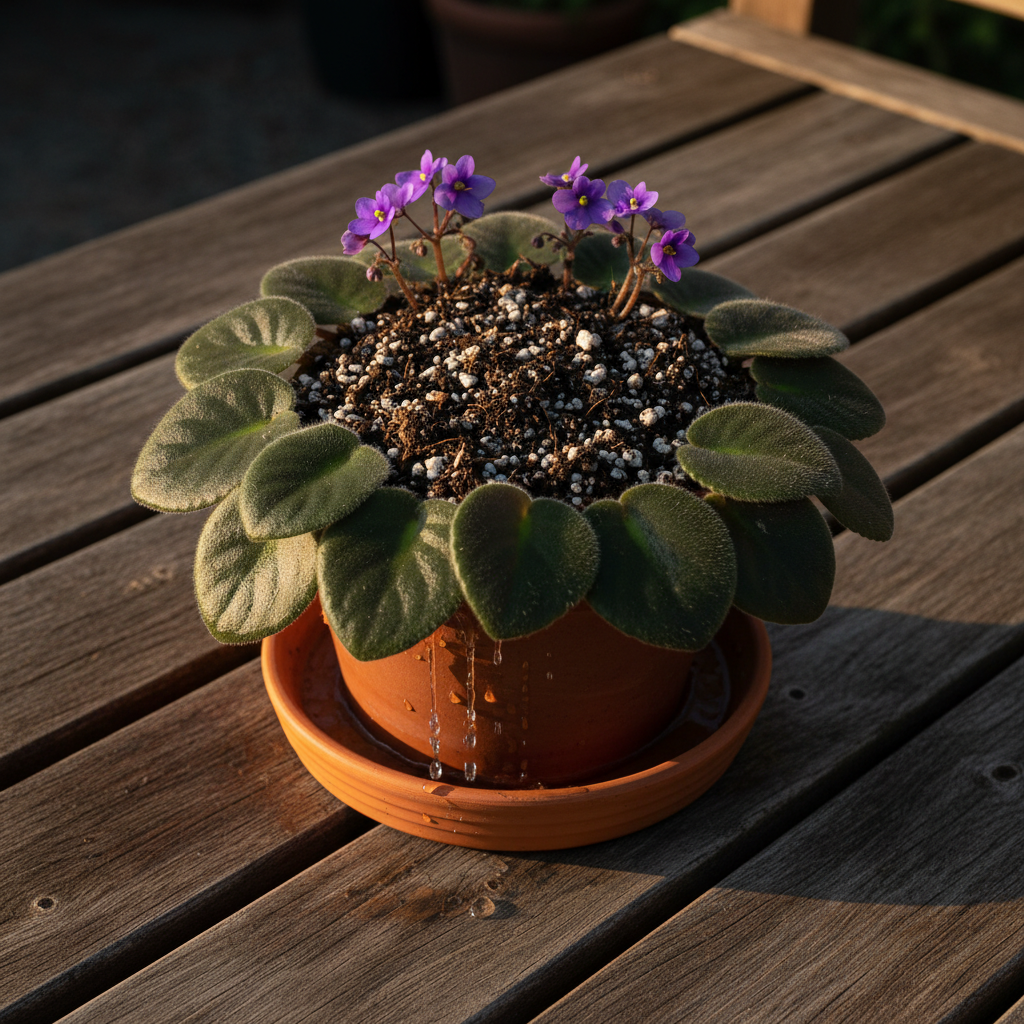
The substrate an African violet grows in determines how quickly water moves through the root zone, how much oxygen reaches the roots between waterings, and how prone the plant is to the salt build-up and crown rot that cut short so many otherwise healthy specimens. Ordinary all-purpose houseplant compost is too dense and too water-retentive; what the plant wants is a light, airy, mostly soilless mix that drains within seconds of watering but still holds enough moisture to feel evenly damp a day or two later.
Ideal Soil Composition
A classic African violet mix is roughly half organic and half mineral, with no actual garden soil at all. The organic fraction provides moisture-holding and a slow source of nutrients; the mineral fraction creates the air pockets that fine African violet roots need in order to breathe and to push outwards into fresh substrate. Commercial African violet mixes work well as a starting point, but most experienced growers prefer to amend them further with perlite for extra drainage.
| Component | Proportion | Function |
|---|---|---|
| Sphagnum peat moss or coco coir | 50% | Holds moisture evenly; maintains slightly acidic pH; provides bulk. |
| Coarse perlite | 30% | Creates air pockets, prevents compaction, ensures rapid drainage. |
| Vermiculite | 15% | Holds water and dissolved nutrients without becoming heavy; buffers feeding. |
| Horticultural charcoal | 5% | Absorbs salts and odours; suppresses fungal activity in the root zone. |
Aim for a pH between 6.0 and 6.5, which is the range in which African violet roots can most efficiently take up nitrogen, phosphorus and the micronutrients responsible for vivid leaf colour. Peat-based mixes tend to start near 5.5 and drift higher over time as feeding adds calcium and magnesium; coir-based mixes start nearer neutral. If a plant shows pale new growth despite regular feeding, suspect pH first and consider repotting into fresh mix before adjusting the fertiliser.
Pro Tip — Quick Mix Recipe: If you do not want to blend a custom substrate, buy a bag of standard African violet potting mix and amend it one to one with extra coarse perlite. The result is light, airy and drains fast enough to forgive almost any watering schedule.
Choosing the Right Pot
African violets have small, fibrous root systems that resent excess unoccupied soil, so the pot must be sized to the plant, not the other way around. A useful rule of thumb is the one-third rule: the pot diameter should be roughly one third of the leaf-span of the rosette. A 20 cm (8 in) rosette is therefore happiest in a 7 cm (2¾ in) pot. Oversized pots hold too much water between feedings, encourage crown rot, and paradoxically suppress flowering because the plant prioritises root growth over bloom.
Drainage holes are non-negotiable. An African violet in a pot without drainage holes is a plant on borrowed time, no matter how careful the watering. Even if you intend to display the plant in a decorative cachepot without holes, grow it in a plain plastic nursery pot that lifts out at watering time and goes back in only once it has finished draining.
Pot material: Plastic pots retain moisture longer and are kinder to the small root system in dry, centrally-heated rooms. They also weigh less, which makes the lift-the-pot method of judging water need easier to calibrate. Terracotta breathes more and dries faster, which can be useful for collectors who tend to overwater, but in most homes it pushes the watering interval to every three or four days, which is impractical. Specialist self-watering African violet pots, in which a porous inner pot sits inside a glazed reservoir, work superbly for absent-minded growers, provided the reservoir is allowed to run dry for several days each month.
Pot size: Standard rosettes settle into 9 to 11 cm (3½ to 4¼ in) pots and live there for years. Miniatures top out in 5 cm (2 in) pots. Trailing African violets need shallow pans, typically 12 to 15 cm (5 to 6 in) across by 5 cm (2 in) deep, to accommodate their spreading habit.
When to Repot
African violets benefit from a fresh substrate roughly once a year, even if the pot size does not change. Peat compacts, salts accumulate, and the lower leaves on a mature plant gradually drop off and leave a bare, awkward “neck” of stem rising above the soil. Repotting is the chance to refresh the mix, trim the rootball back to fit the same-sized pot, and bury the bare neck so the rosette sits flush with the new soil surface again.
How to Repot: Step-by-Step
- Water the plant a day or two before repotting so the soil holds together and the roots are turgid. Never repot a wilting or freshly-watered plant.
- Slide the rosette out of its pot by tipping it sideways and supporting the crown between your fingers. The rootball should come away cleanly with the soil.
- Gently tease off the outer third of the rootball and shake away any loose old substrate. Inspect the roots: they should be white to pale tan, firm and fine. Cut away anything brown, mushy or hollow.
- Trim the bottom of the rootball with a sterile blade so that, when the plant is set into the new pot, the base of the lowest leaves sits exactly at the rim. This brings the bare neck down into the soil where it will grow new feeder roots.
- Place a small mound of fresh mix in the centre of the same or one-size-larger pot. Set the trimmed rootball on top, then trickle fresh mix around the sides, tapping the pot gently to settle the substrate without compacting it.
- Stop when the surface is just below the lowest petioles and the leaves are nearly resting on the soil. Do not bury the crown itself.
- Water lightly and place the plant out of direct light for three or four days while the root system re-establishes. Resume normal care once new growth resumes.
Warning — Transplant Shock: Many growers panic when their African violet stops flowering for several weeks after repotting. This is normal. The plant is rebuilding its root system and will not push fresh bloom stalks until the work is done. Avoid feeding heavily during the recovery period; resume your regular schedule once new leaf growth appears at the centre of the rosette.
Fertilising
African violets are heavy feeders by houseplant standards because they bloom almost continuously, and each flush of flowers represents a substantial draw on the plant’s mineral reserves. At the same time, their root systems are small and easily damaged by salt accumulation, so the trick is to feed lightly but often rather than fertilising heavily on a fixed schedule. The most successful collectors apply a very dilute solution with every watering, year-round, and almost never give the plant a “real” feeding.
Commercial African violet fertilisers exist for a reason: their nutrient ratios are tuned for a plant that needs steady phosphorus and potassium for flowers without excess nitrogen that would push foliage at the expense of bloom. A typical formula is something like 14-12-14 or 12-36-14, both of which keep the plant flowering without producing oversized, soft, dark leaves that look out of proportion to the rosette.
Understanding Plant Nutrients
The three numbers on a fertiliser label refer to the percentages by weight of nitrogen, phosphorus and potassium, in that order, but African violets also rely on a suite of secondary and micro-nutrients for healthy bloom and foliage colour. Deficiencies of these often masquerade as light or watering problems, so it is worth recognising them on sight.
| Nutrient | Symbol | Primary Function | Deficiency Symptoms |
|---|---|---|---|
| Nitrogen | N | Builds chlorophyll and leaf tissue; drives overall growth. | Older leaves uniformly pale and yellow; whole rosette looks lacklustre. |
| Phosphorus | P | Supports flower initiation, root development and energy transfer. | Sparse flowering; reddish or purplish tinge on leaf undersides. |
| Potassium | K | Regulates water balance, disease resistance and bloom quality. | Yellow or brown leaf edges; weak, short-lived flower stems. |
| Calcium | Ca | Structural component of cell walls; critical for crown integrity. | Distorted new growth at the centre of the rosette; stunted leaves. |
| Magnesium | Mg | Central atom in the chlorophyll molecule. | Interveinal yellowing on older leaves while veins remain green. |
| Iron | Fe | Required for chlorophyll synthesis and enzyme function. | Pale young leaves with darker veins; symptoms appear on new growth first. |
Types of Fertiliser
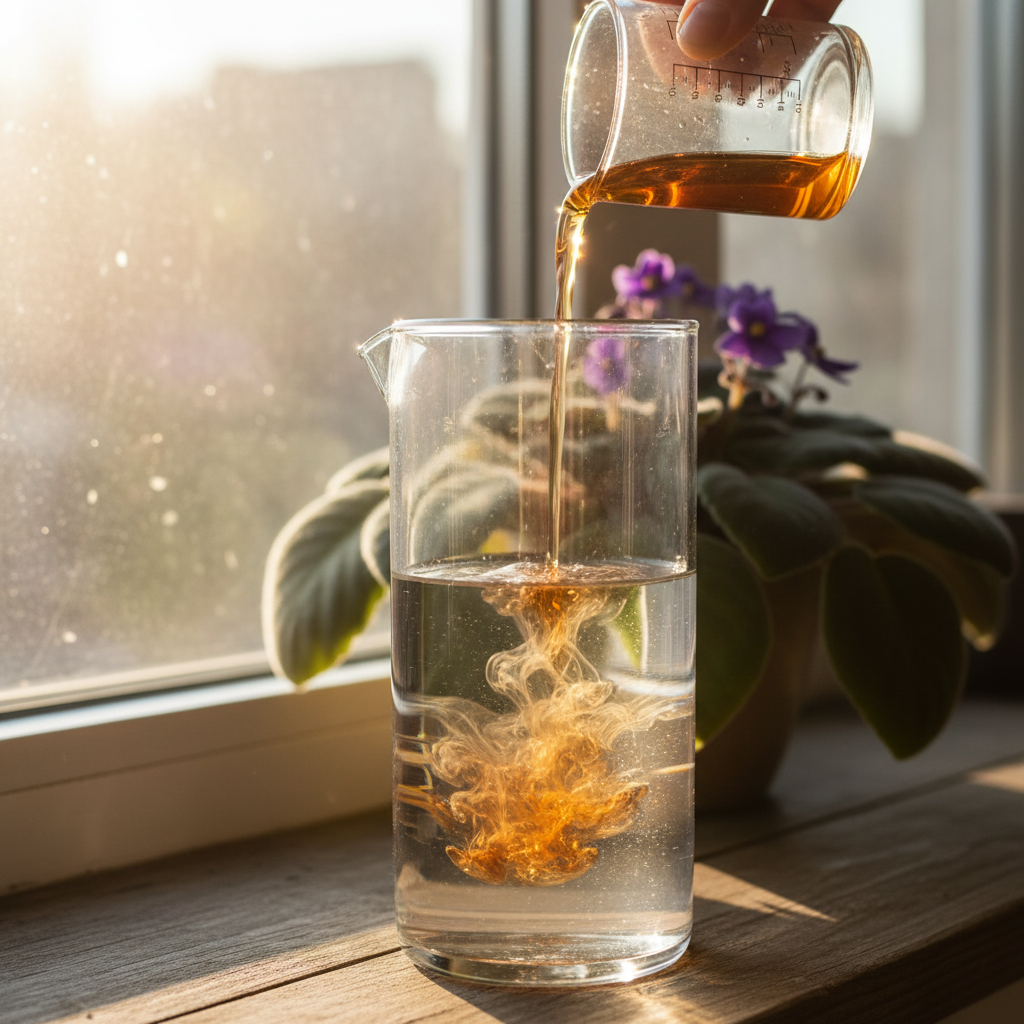
Liquid fertilisers: The standard for African violet care. Dilute to quarter strength and apply with every watering, or to half strength and apply every second watering. Look for formulations explicitly marketed for African violets or for blooming houseplants; avoid leafy-foliage feeds high in nitrogen, which push lush leaves and suppress bloom.
Slow-release granular: Coated prills sprinkled on the soil release nutrients gradually over three to six months. Convenient for collectors who travel often, but the release rate is temperature-dependent, which makes overfeeding easy in a warm room. Use them at the lower end of the label rate.
Organic fertilisers: Fish emulsion, seaweed extract and worm-casting tea all work well at half the dilution rate of synthetic feeds, but the lingering odour of fish-based products inside a house is a strong argument for sticking to seaweed extract or compost teas indoors. Organic feeds are gentler on the root system and forgive overfeeding more readily.
Feeding Schedule
For a plant in active bloom in well-lit conditions, feed at quarter strength with every watering, year-round. For a plant resting after a heavy flush, or during the dim months of midwinter at high latitude, reduce to every second or third watering. Stop feeding entirely for six to eight weeks after any major repotting, as fresh substrate already contains enough residual nutrients to sustain the plant while the root system re-establishes. Resume gentle feeding only once new leaf growth appears in the centre of the rosette.
Pro Tip — Less Is More: If you can only remember one rule about feeding African violets, make it this: dilute your fertiliser more than the label suggests, and feed more often. Quarter strength every watering produces better plants than full strength every fourth watering, because it keeps nutrient levels in the root zone steady instead of spiking and then crashing.
How to Fertilise
- Measure the diluted fertiliser into your watering jug rather than mixing in the pot. Even distribution matters; concentrated feed splashing the leaves can cause chemical burns.
- Let the solution come to room temperature, the same as plain water, before applying.
- Water as usual, either from below or carefully at the soil line, until liquid runs from the drainage holes.
- Tip out any feed that collects in the saucer within an hour; standing fertiliser solution is just as harmful as standing plain water for the root system.
- Once every three months, water with plain tepid water only, using twice the usual volume, to flush accumulated salts out through the drainage holes.
Warning — Salt Build-Up: A white or yellow crust on the soil surface, around the pot rim or on the stem at soil level is a sign of accumulated fertiliser salts. Left unchecked, this damages the fine roots and produces brown leaf edges and reduced bloom. Flush thoroughly with plain water, and if the crust is severe, repot into fresh mix and resume feeding at a lower dilution.
Propagation
Few houseplants are as enjoyable to propagate as the African violet. A single mature leaf, cleanly removed from a plant in good health, can produce three to six new rosettes that are genetically identical to the parent. The process is slow but reliable, requires almost no equipment, and is the basis for the worldwide hobbyist trade in named cultivars, many of which are exchanged from grower to grower as leaves in padded envelopes rather than as whole plants.
The two methods most commonly used are leaf cuttings in water and leaf cuttings in a damp substrate. Both produce essentially the same result, but water rooting lets you watch the process and is more forgiving of imperfect conditions; substrate rooting skips a transplant step and tends to produce sturdier plantlets sooner. Chimera cultivars, those with striped or pinwheel petals, are an exception: their leaves do not reliably reproduce the striped flower pattern, so chimeras are propagated by suckers or flower stalks rather than leaves.

Understanding the Leaf Cutting
Each African violet leaf carries the genetic information for an entire plant. When the cut end of a petiole is held in moist conditions, the wound tissue at its base activates and begins differentiating into either roots or a tiny meristem (a growing tip) capable of producing a new rosette. The leaf itself sustains the plantlets that emerge from the petiole, gradually losing colour and firmness over the eight to sixteen weeks it takes for the babies to grow large enough to separate. Once the plantlets are independent, the parent leaf can usually be discarded; occasionally it will continue feeding the new plants for a second round of growth.
Water Rooting: Step-by-Step
This is the method most growers learn first. It is slow but visual, and the success rate with a healthy parent leaf is close to 100 percent.
- Choose a healthy, mature, second-row leaf from the middle of the rosette, avoiding the youngest centre leaves and the oldest outer ones. The leaf should be firm and unblemished.
- With a clean blade, cut the petiole at a 45-degree angle, leaving 2 to 3 cm (¾ to 1¼ in) of stem below the blade. The angled cut increases the surface area for root development.
- Fill a small jar with tepid water at room temperature. Cover the opening with a piece of foil or plastic film, and pierce a small hole through which the petiole can hang into the water while the leaf blade itself rests above the foil and stays dry.
- Place the jar in a bright but indirect location at 20 to 24 °C (68 to 75 °F). Top up the water as needed to keep the cut end submerged; change the water entirely every two weeks to keep it fresh.
- Roots appear within three to six weeks. Wait until they are at least 2 cm (¾ in) long before potting up.
- Transfer the rooted leaf into a small pot filled with damp African violet mix, planting the petiole so the base of the leaf blade just touches the soil surface. Tent loosely with a clear plastic bag for two weeks to maintain high humidity while the roots settle.
- Tiny plantlets emerge from the soil around the base of the leaf in another four to eight weeks. When each plantlet has three or four leaves of its own, separate it gently with a small blade and pot it on individually.
Pro Tip — Keep the Leaf Dry: The biggest reason water-rooted African violet leaves fail is that the leaf blade itself drops below the water line and starts to rot. The foil-over-jar method holds the blade reliably above the surface; without it, replace the jar with one whose neck is just narrow enough that the petiole alone reaches the water.
Substrate Rooting: Step-by-Step
Faster than water rooting and arguably more reliable for producing stocky young plants. The cutting is inserted directly into the medium it will live in long-term, skipping the transplant shock that sometimes interrupts water-rooted starts.
- Prepare a small pot or deli cup filled with damp African violet mix combined one to one with extra perlite, or with pure damp vermiculite.
- Cut a leaf as above, with a 2 to 3 cm (¾ to 1¼ in) petiole and an angled cut at the base.
- Make a shallow hole in the medium with a pencil or chopstick and insert the petiole at a 45-degree angle, with the leaf blade resting against the rim of the container. Firm the medium gently around the petiole.
- Cover the container with a clear plastic bag or transparent lid to maintain near-saturated humidity. Place in bright indirect light at 20 to 24 °C (68 to 75 °F).
- Check weekly that the medium stays moist but not waterlogged. Vent the cover briefly each week to refresh the air and prevent fungal growth.
- Plantlets emerge from the medium around the base of the parent leaf in six to twelve weeks. Gradually remove the cover over a week to acclimatise them to ambient humidity.
- When plantlets have three or four leaves each, unpot the whole cluster carefully, separate the babies by teasing apart their roots, and pot each one into its own 5 to 7 cm (2 to 2¾ in) pot.
Troubleshooting Propagation
| Problem | Likely Cause | Solution |
|---|---|---|
| Leaf rotted at the petiole before rooting | Leaf blade submerged in water, or substrate kept saturated rather than damp. | Use the foil-over-jar method or a coarser, faster-draining mix. Restart with a fresh leaf. |
| Roots formed but no plantlets after months | Cool temperatures or insufficient light slowing meristem activation. | Move to a warmer spot (22 to 24 °C / 72 to 75 °F) with brighter indirect light or under a grow lamp. |
| Plantlets emerged with all-green foliage from a variegated parent | Variegation in African violets is partly temperature-sensitive. Cool conditions favour variegation, warm conditions suppress it. | Grow young plantlets cooler (18 to 20 °C / 65 to 68 °F) for the first few months; variegation often emerges as they mature. |
| Chimera-flowered parent producing solid-coloured offspring | Chimera tissue does not transmit through ordinary leaf propagation. | Propagate chimeras only from suckers or flower-stalk cuttings, never from leaves. |
Pests and Diseases
African violets are not particularly susceptible to insect pests by houseplant standards, but the dense crown of fuzzy leaves does provide good cover for several small invaders, and the chronically moist conditions the plant prefers favour a handful of fungal and bacterial problems. Early detection is the difference between an isolated incident and a collection-wide outbreak: get into the habit of lifting and inspecting each plant every time you water, paying close attention to the leaf axils and the underside of the foliage.
Most problems can be resolved without specialist chemicals. Cleanliness, good airflow, careful watering and prompt removal of damaged tissue together prevent the great majority of African violet ailments, and a quarantine routine for any new plant entering the collection stops nearly all of the rest.
Common Pests
Cyclamen Mite (Phytonemus pallidus)
The most feared African violet pest. Cyclamen mites are microscopic, invisible to the naked eye, and concentrate in the soft new growth at the centre of the rosette. Infested plants develop dramatically distorted, stunted, hairier-than-normal central leaves, flower buds that brown and fail to open, and an overall hunched appearance as the crown collapses inwards. Damage is often mistaken for nutrient deficiency or virus infection.
Treatment: Isolate the affected plant immediately, as mites spread by contact and on tools. Mild infestations can sometimes be eliminated by repeated treatment with a miticide labelled for ornamentals; serious cases are most easily handled by discarding the plant, sterilising the pot and surrounding shelf with diluted bleach, and quarantining any neighbouring plants for at least eight weeks while watching for symptoms.
Mealybugs (Pseudococcus spp.)
White, cottony insects that cluster in leaf axils and along the petioles, sucking sap and leaving sticky honeydew behind. On African violets they prefer the protected spaces deep in the rosette and underneath the lower leaves, which makes them easy to overlook in the early stages.
Treatment: Dab each visible mealybug with a cotton bud dipped in 70 percent isopropyl alcohol; the alcohol breaks down their waxy coating and kills them on contact. For wider infestations, apply a systemic insecticide labelled for indoor ornamentals according to the product directions. Re-inspect weekly for at least a month, as new bugs hatch from eggs invisible to the eye.
Thrips (Frankliniella occidentalis)
Tiny slender insects that feed on pollen and petals, leaving silvery streaks on flowers and shed pollen smeared across the petals. Often arrive on cut flowers or freshly bought blooming houseplants. Less damaging than mites or mealybugs but disfigure flowers in days.
Treatment: Pinch off and bin all open flowers and buds to remove the breeding sites. Hang blue sticky traps near the plants to catch adults. Treat with insecticidal soap or a spinosad-based product as needed; repeat at five-day intervals for three cycles to break the life cycle.
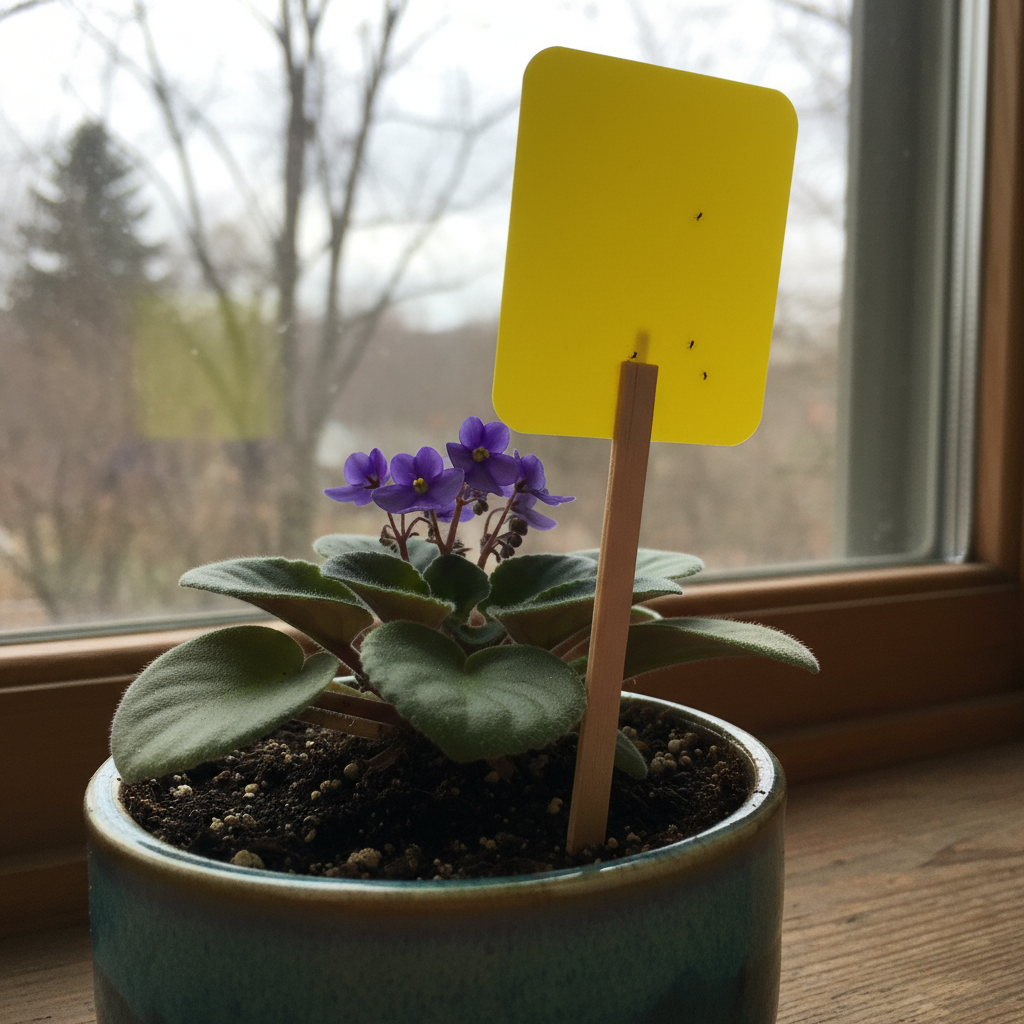
Fungus Gnats (Bradysia spp.)
Small dark flies that hover around the soil surface. The adults are a nuisance but harmless; the larvae feed on root hairs and decaying organic matter and can damage seedlings or the fine root systems of African violets in chronically wet soil.
Treatment: Let the soil surface dry between waterings to interrupt the larval life cycle. Place yellow sticky traps at soil level to catch adults. For persistent infestations, drench the soil with a Bacillus thuringiensis subspecies israelensis (Bti) product, which kills larvae without affecting the plant.
Common Diseases
Crown and Root Rot (Pythium and Phytophthora spp.)
The most serious African violet disease, caused by water-mould pathogens that thrive in saturated soil. The crown softens, lower leaves go limp and yellow, and eventually the whole rosette collapses into the pot as the central stem rots through. Often arrives via overwatering, a pot that does not drain freely, or contaminated water.
Treatment: Unpot immediately, cut away all soft or discoloured tissue with a sterile blade, and dust the cuts with cinnamon or sulphur powder. Repot into fresh dry mix in a sterilised pot. Withhold water for several days. Mild cases recover; advanced cases rarely do, and it is often easier to take leaf cuttings from any clean foliage and start again.
Botrytis Blight (Botrytis cinerea)
Grey, fuzzy mould that develops on faded flowers and damaged tissue in damp, still air. Spreads rapidly from spent blossoms onto fresh foliage and can ruin a plant within days in a poorly ventilated room.
Treatment: Remove all affected tissue with a clean blade and improve airflow around the plant with a small fan running on low for several hours a day. Reduce humidity slightly and avoid splashing water on the leaves. A fungicide labelled for botrytis can be applied if the infection is widespread.
Powdery Mildew (Oidium spp.)
A white, powdery coating that appears first on flowers and young leaves, then spreads across the foliage. Encouraged by warm days, cool nights and stagnant air. Distorts flowers and slows growth but rarely fatal.
Treatment: Improve airflow, reduce humidity slightly, and spray with a potassium-bicarbonate-based fungicide or a 1:9 milk-and-water solution as a gentle home remedy. Remove the most heavily affected leaves to reduce spore load.
Pest and Disease Summary
| Pest / Disease | Identification | Treatment |
|---|---|---|
| Cyclamen mite | Distorted, hairy, hunched centre growth; failed buds | Isolate; miticide or discard |
| Mealybugs | White cottony clusters in leaf axils, sticky residue | Cotton bud with 70% isopropyl alcohol; systemic if widespread |
| Thrips | Silvery streaks on flowers, pollen smeared on petals | Remove flowers; sticky traps; spinosad or insecticidal soap |
| Fungus gnats | Small flies hovering above soil surface | Let surface dry; yellow sticky traps; Bti soil drench |
| Crown and root rot | Soft, collapsing crown; yellow lower leaves; sour soil smell | Cut out rot; repot in fresh dry mix; reduce watering |
| Botrytis blight | Grey fuzz on faded flowers and damaged tissue | Remove affected tissue; improve airflow; reduce humidity |
| Powdery mildew | White powdery coating on flowers and leaves | Airflow; potassium-bicarbonate spray; remove worst leaves |
Prevention Strategies
Prevention costs nothing and avoids almost every African violet pest and disease covered above. Quarantine new plants for at least four weeks in a separate room before introducing them to the rest of your collection. Sterilise tools with isopropyl alcohol between plants, especially when taking leaf cuttings. Remove spent flowers as soon as they fade, before botrytis has a chance to colonise the dying petals. Keep the leaves clean by very gently dusting them with a soft natural-bristle brush; do not wipe with a damp cloth, which can spot the fuzzy surface.
Above all, water in a way that keeps the soil consistently moist but never saturated, empties the saucer reliably within an hour of each watering, and never wets the crown. The vast majority of African violets that decline mysteriously over a few months have suffered slow, invisible root damage from chronic overwatering, not pests. Get the watering right and a healthy plant has very little else to worry about.
Pro Tip — Quarantine New Arrivals: Every African violet collector who has lost a plant to cyclamen mites learned the hard way to quarantine new acquisitions. Keep a freshly purchased plant in a separate room for a full month, inspect it weekly, and only move it in with the others once you are certain it is clean.
Popular Varieties
The world of African violet cultivars is enormous. The African Violet Society of America’s master list of registered varieties runs to more than 16,000 names, and new ones are added every year by breeders ranging from large commercial operations to home hybridisers working with a few dozen pots on a single shelf. The result is a staggering range of flower forms, colours and leaf types, organised by collectors into a handful of broad classes.
For everyday growers, the most useful distinctions are by size class (standard, semi-miniature, miniature, trailing) and by flower type (single, semi-double, double, frilled, fringed, star, chimera). Leaf type is a secondary axis: most plants have plain green oval leaves, but variegated, quilted, ruffled and “girl-type” (with a pale patch at the base of each leaf) forms are widely available.
| Variety | Leaf Appearance | Light Needs | Growth Rate | Availability |
|---|---|---|---|---|
| Optimara Rose Quartz | Dark green, oval, slightly quilted | Bright indirect | Moderate | Common |
| Lonestar Snowstorm | Mint-green, cream-edged variegated | Bright indirect (variegation needs strong light) | Slow | Specialist |
| Rob’s Sticky Wicket | Plain green, semi-miniature size | Bright indirect | Moderate | Specialist |
| Optimara EverFlorin | Dark green, smooth oval | Bright indirect | Vigorous | Common |
| Granger’s Garnet Glow | Plain green, standard size | Bright indirect | Moderate | Specialist |
| Ness’ Crinkle Blue | Heavily ruffled, dark green | Bright indirect | Moderate | Specialist |
| Pixie Blue | Small oval, trailing habit | Bright indirect | Vigorous spread | Specialist |
| Rhapsodie Series | Standard green, robust | Bright indirect | Vigorous | Common |
Featured Varieties
Optimara Rose Quartz
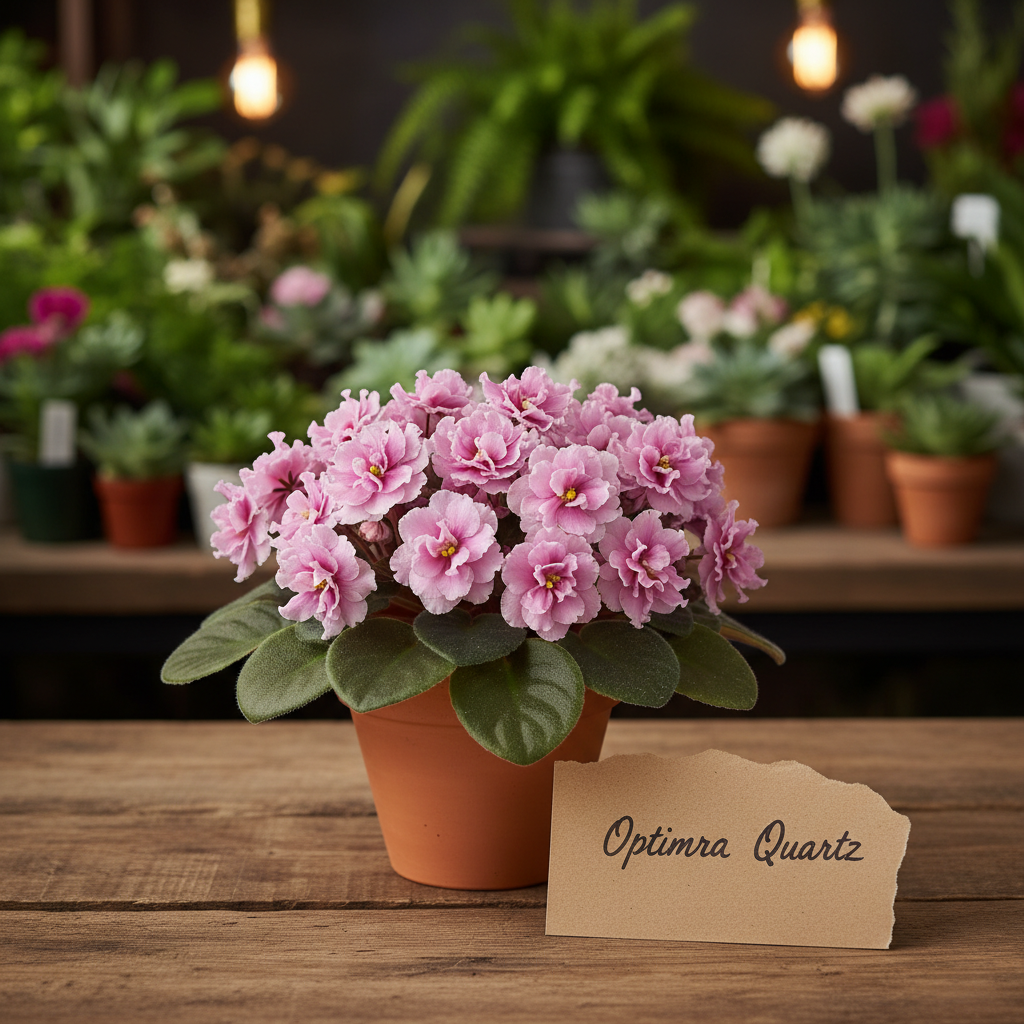
A widely sold standard-size cultivar from the prolific Optimara breeding programme, with fully double ruffled pink blooms held in generous clusters above a tidy rosette of dark-green oval leaves. Vigorous, prolific and forgiving of average windowsill conditions, which is why supermarkets and garden centres stock it in such quantities.
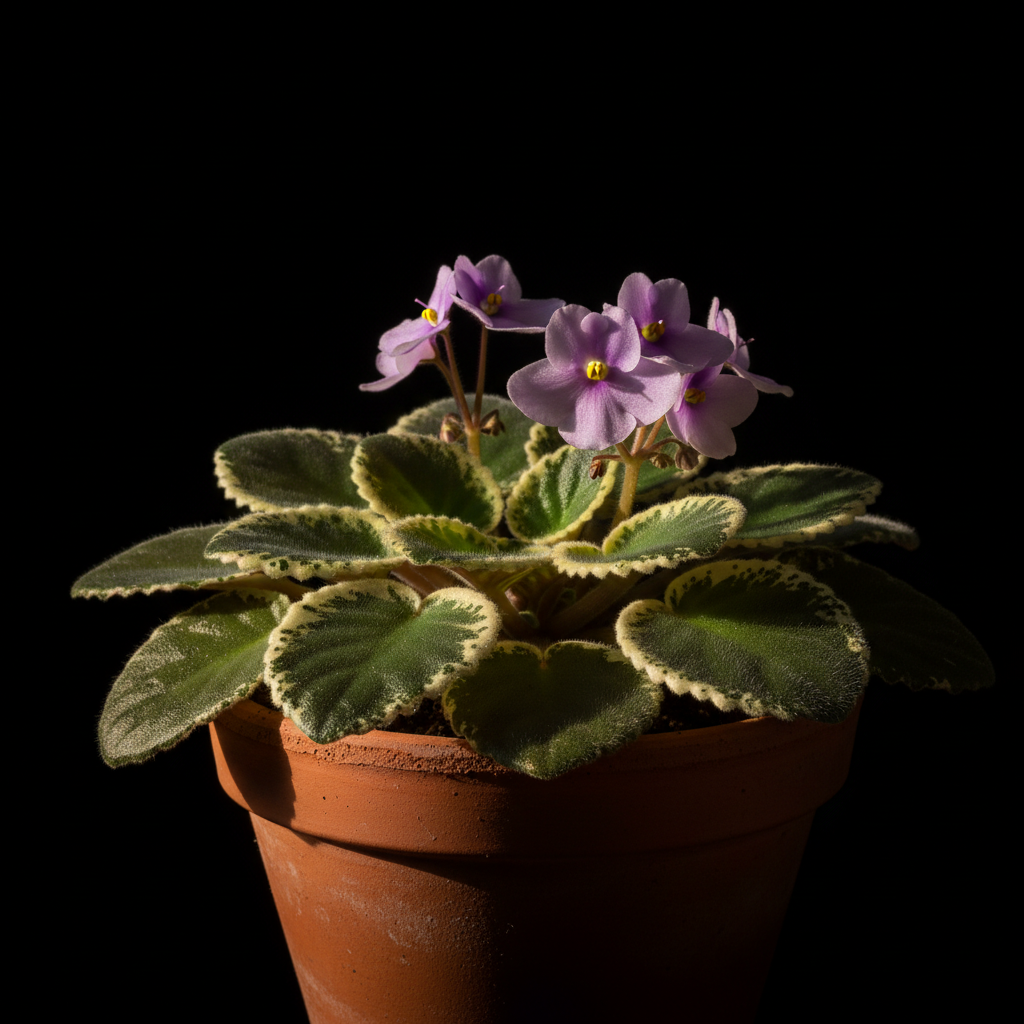
Lonestar Snowstorm
A striking variegated cultivar from the Lonestar Violets line, with mint-green oval leaves boldly edged in cream-white and bearing single lavender flowers above the foliage. The variegation is temperature-sensitive: cooler growing conditions intensify the pale edges, while warmer rooms push the leaves towards solid green. Slower-growing than the Optimara hybrids but visually arresting even out of bloom.
Variety Profiles in Detail
Rhapsodie Series (Saintpaulia ionantha ‘Rhapsodie’)
Developed in West Germany in the 1960s by Hermann Holtkamp, the Rhapsodie series was the first generation of African violets bred specifically for long shelf life and consistent flowering in retail conditions. The series remains in commercial production decades later and is among the most reliable choices for new growers: robust foliage, abundant flowering, and a strong tendency to keep blooming through the indignities of supermarket lighting and a long ride home.
Optimara Series (Saintpaulia ionantha ‘Optimara’)
The successor lineage to the Rhapsodies, again from the Holtkamp nursery in Tennessee, the Optimara series introduced compact growth, more uniform rosettes and broader colour ranges, including the soft pastels and bicolour patterns that dominate today’s casual-buyer market. Optimaras include both standard and miniature classes and are by far the most likely African violets to be found in mainstream florists.
Rob’s and Ma’s Series (Saintpaulia ionantha ‘Rob’s’ and ‘Ma’s’)
The flagship lines of two of the most respected American hybridisers, Ralph (Rob) Robinson and his late mother (Ma) Olive Ma. Their introductions tend to be semi-miniature in size, with showy, often chimera-flowered blooms and inventive leaf forms. Almost all are circulated through the specialist trade rather than supermarkets and are sought out by serious collectors for their flower complexity and growth habit.
Trailing African Violets (Saintpaulia ‘Pixie’ and others)
Unlike standard rosette cultivars, trailing African violets produce multiple crowns along spreading stems, creating cascading mounds rather than tight single rosettes. They suit shallow pans, hanging baskets and wide bonsai-style dishes, and bloom freely once established. Pixie Blue and several Rob’s introductions are particularly popular among trailing-form enthusiasts.
Choosing the Right Variety for Your Space
For a single plant on a kitchen windowsill, a robust Optimara or Rhapsodie hybrid is hard to beat: they tolerate variable conditions, bloom reliably and are cheap to replace if something goes wrong. For a small dedicated collection, mixing one or two variegated cultivars with a chimera and a trailing form gives a satisfying visual range without requiring a whole greenhouse. For serious collectors, the specialist trade in named varieties is endless, and joining a national African Violet Society or trading leaves with other hobbyists is the standard route into the rarer forms. Whatever the scale, choose your varieties partly for the conditions you can actually offer; a temperamental chimera in a north-facing bedsit will frustrate, while a sturdy Rhapsodie in the same spot will bloom on undaunted.
Frequently Asked Questions
Why is my African violet not flowering?
By a wide margin, the most common cause is insufficient light. African violets need 10 to 14 hours per day of bright indirect light to bloom reliably. If your plant has healthy foliage but no flowers, move it closer to a brighter window or add a small grow lamp on a timer. Other contributing factors include a pot that is too large (which redirects energy from flowers to root growth), excess nitrogen in the fertiliser (use a bloom-leaning African violet formula instead), or chronic underfeeding. Most plants begin pushing flower stalks within four to six weeks of correcting these issues.
Why do my African violet leaves have pale spots and rings?
Cold water on the foliage. The leaves of Saintpaulia are extremely sensitive to chilled water, which damages the cells immediately beneath the contact area and produces the pale yellow rings and spots that are the visual signature of careless watering. Always use water at room temperature, and either bottom-water or pour carefully at the soil line. The existing spots will not heal, but new growth will be unblemished if the watering technique improves.
How often should I water my African violet?
In a 9 cm (3½ in) pot in average indoor conditions, roughly every five to seven days in summer and every seven to ten days in winter, but trust the weight of the pot and the feel of the soil rather than a calendar. When the pot feels noticeably lighter and the top centimetre of soil is just starting to dry, water thoroughly with tepid water, then empty the saucer within an hour.
Are African violets toxic to cats and dogs?
No. The ASPCA lists Saintpaulia ionantha as non-toxic to cats, dogs and horses, and they are also safe around small children. The fuzzy texture of the leaves makes them unappealing to most pets, which further reduces the likelihood of incidents. African violets are one of the few showy flowering houseplants that can be displayed without concern in a multi-species household.
What is the lifespan of an African violet?
With good care, individual plants commonly live 25 to 50 years, and exceptional specimens in collectors’ homes have been documented at over half a century. Most household plants, however, are replaced or restarted from leaf cuttings every five to ten years, when the original rosette has developed a long bare neck and the easier option is to start fresh from a leaf taken from the same plant. Because African violets propagate so readily, the genetic line of a much-loved cultivar can be maintained almost indefinitely.
Can I keep an African violet in a bathroom?
Yes, provided the bathroom has enough natural light. The high humidity of a regularly used bathroom suits the plant well, and the warm stable temperatures favour continuous bloom. The limiting factor is usually light: a bathroom with a small frosted window will not provide enough illumination, while one with a clear east or south window is among the best possible homes for the species.
Why are the leaves of my plant turning yellow?
Several causes are possible, and the pattern of yellowing helps narrow it down. Older outer leaves yellowing uniformly is normal as the plant ages and usually requires no action beyond removing the spent foliage. Younger central leaves yellowing or pale points to a feeding problem, often iron or magnesium deficiency, addressed by a flush with plain water followed by a balanced African violet feed. Sudden yellowing across many leaves at once, especially with limp petioles, suggests overwatering or the onset of crown rot; check the roots immediately.
Should I remove dead flowers and leaves?
Yes, promptly. Spent flowers and damaged leaves left on the plant invite botrytis blight and other fungal infections, and they also draw resources that could go into new growth and the next flush of blooms. Pinch off faded flower stems at the base with thumb and forefinger, and snap off limp or yellow outer leaves by twisting them sideways at the petiole; both come away cleanly without tools and without leaving a wound that could rot.
Why does my African violet have a long bare stem?
Over time, as older outer leaves are shed, the stem at the base of the rosette becomes progressively more exposed, eventually forming a “neck” of bare petiole stubs sticking out of the soil. This is normal and easily corrected at the next repotting: trim the bottom of the rootball, set the plant deeper into a same-sized pot of fresh mix so that the lowest leaves rest at the new soil surface, and the neck is buried. The plant produces fresh roots from the buried stem within a few weeks.
Can I grow African violets entirely under grow lights?
Yes, and many of the most spectacular show plants in the world are grown this way. A pair of T5 or T8 fluorescent tubes (one cool, one warm) or a single full-spectrum LED panel mounted 25 to 30 cm (10 to 12 in) above the rosette, run for 12 to 14 hours per day on a timer, produces continuous bloom regardless of season or window orientation. This makes African violets one of the few flowering houseplants that thrive in interior rooms with no natural light at all.






