
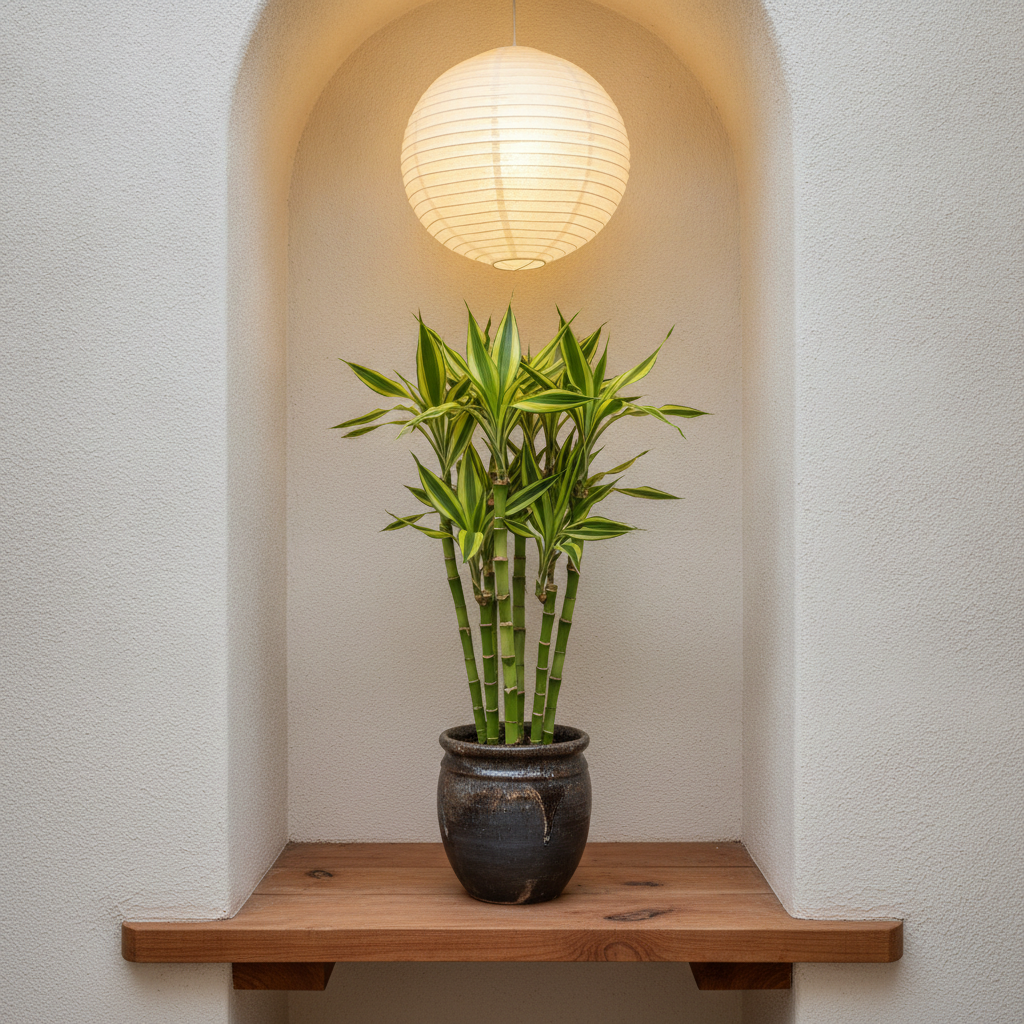
Few houseplants carry as much cultural weight for as little effort as lucky gold bamboo. Despite the name, Dracaena sanderiana is not a bamboo at all but a member of the dragon-tree family, and the golden form prized in homes and offices is grown less for botanical drama than for the calm, upright green canes that seem to thrive on neglect. It will sit for years in a jar of water on a windowsill, ask for almost nothing, and reward you with steady growth and a reputation for inviting good fortune. This guide covers everything that separates a plant that merely survives from one that genuinely thrives, from the water you pour on it to the way you coax its canes into spirals.
In this guide
- Quick reference
- Why lucky gold bamboo makes a rewarding houseplant
- Light
- Watering
- Soil and growing medium
- Fertilising
- Propagation
- Common pests and problems
- Varieties
- Frequently asked questions
Quick reference
| Botanical name | Dracaena sanderiana (golden and variegated forms) |
| Common names | Lucky gold bamboo, golden lucky bamboo, ribbon plant, friendship bamboo |
| Family | Asparagaceae (the asparagus and dragon-tree family) |
| Native range | Tropical Central Africa, particularly Cameroon |
| Light | Bright, indirect light; tolerates moderate to low light |
| Water | Keep roots submerged if grown in water, or soil lightly moist; use non-fluoridated water |
| Humidity | Average household humidity is fine; happier above 40 per cent |
| Temperature | 18 to 32 degrees Celsius (65 to 90 degrees Fahrenheit) |
| Feeding | Very light; a diluted feed every month or two in growth |
| Mature size | Typically 0.3 to 1 metre (1 to 3 feet) indoors |
| Toxicity | Toxic to cats and dogs; keep away from pets |
| Difficulty | Very easy, forgiving of neglect |
Why lucky gold bamboo makes a rewarding houseplant
The appeal of lucky gold bamboo begins with a small deception. The jointed green canes, the segmented stems and the airy leaves all read as bamboo to the eye, yet the plant belongs to the genus Dracaena, closely related to the corn plant and the dragon tree. What it borrows from true bamboo is only the look, and what it keeps for itself is a temperament that could not be more different. Real bamboo is thirsty, fast and prone to running riot. Dracaena sanderiana is slow, tidy and content to live for years in the same modest vessel.
The golden form is a variegated selection in which the canes and the strappy leaves carry warm yellow tones alongside the usual green, giving the plant a brighter, more luminous presence than the plain species. In its native Central Africa it grows as an understorey plant in humid, shaded forest, and that heritage explains almost everything about its behaviour indoors. It expects filtered light rather than blazing sun, it tolerates the low humidity of a centrally heated room better than most tropicals, and it can root and grow in nothing more than water because its ancestors evolved on damp, low-lying forest floors.
Culturally the plant is inseparable from feng shui, where it is thought to balance the five elements and draw prosperity and calm into a space. The number of canes carries meaning, and the plant is a common housewarming and business-opening gift across much of Asia and, increasingly, the wider world. None of this affects how you care for it, but it does explain why lucky gold bamboo turns up trained into hearts, spirals, trellises and woven towers far more often than it is simply left to grow straight. For a new plant owner it offers a rare combination: something decorative, meaningful and almost impossible to kill through inattention.
Pro Tip — Choosing your stalks: In feng shui tradition, two canes are given for love, three for happiness, five for wealth, seven for health and eight for growth. Arrangements of four are traditionally avoided, because the word for four sounds like the word for death in several Chinese dialects. It is folklore rather than horticulture, but it is worth knowing if you are giving the plant as a gift.
Light
Lucky gold bamboo is one of the few houseplants where the difference between surviving and thriving in terms of light is genuinely wide, and understanding it is the single most useful thing you can do for the plant. Because it evolved beneath a forest canopy, it copes with far less light than most variegated plants, which is why it flourishes in offices and windowless bathrooms where almost nothing else will. Copes, however, is not the same as thrives. In deep shade the plant stays alive but grows barely at all, the golden variegation fades toward a flat green, and the canes may stretch and lean as they reach for whatever light they can find.
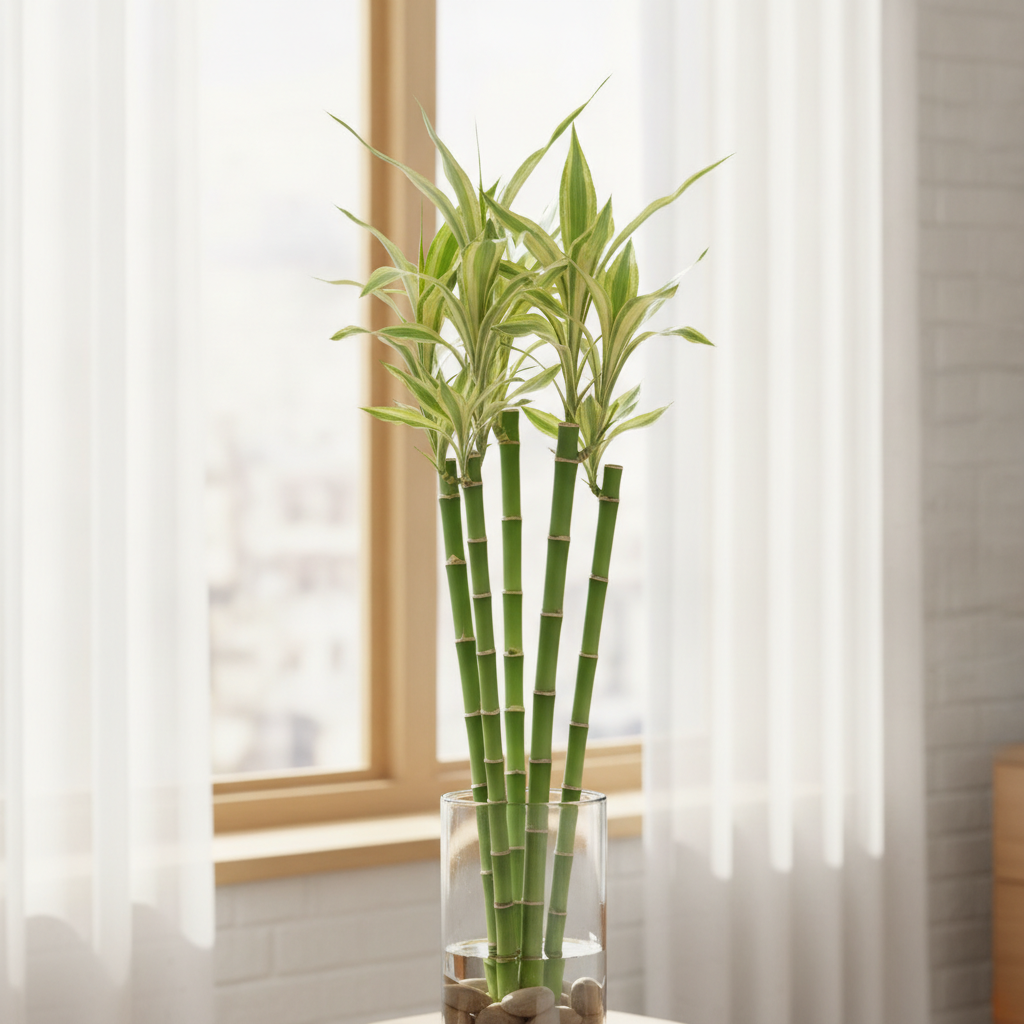
The sweet spot is bright, indirect light: a position a metre or two back from an east or north window, or beside a south or west window screened by a sheer curtain. Here the golden tones stay saturated, the leaves hold a healthy sheen and the plant puts on steady new growth. What it will not tolerate is direct, unfiltered sun through glass, especially in the middle of the day. The thin leaves scorch quickly, developing bleached patches and crisp brown edges that never recover. If you have inherited a plant that has been sitting in gloom, move it toward brighter light gradually over a couple of weeks rather than all at once, so the foliage can adjust without shocking.
Light also drives one of the plant’s most charming tricks. Lucky gold bamboo bends toward its light source, and the elaborate spirals sold in shops are produced by growers who rotate the canes slowly beside a single-sided light over many months. At home you can encourage a gentle curve by turning the plant a quarter turn every week or two, or keep the canes ramrod straight by turning it more often so growth stays even. Either way, a plant that leans dramatically to one side is simply telling you it wants more light coming from the front rather than the side.
Watering
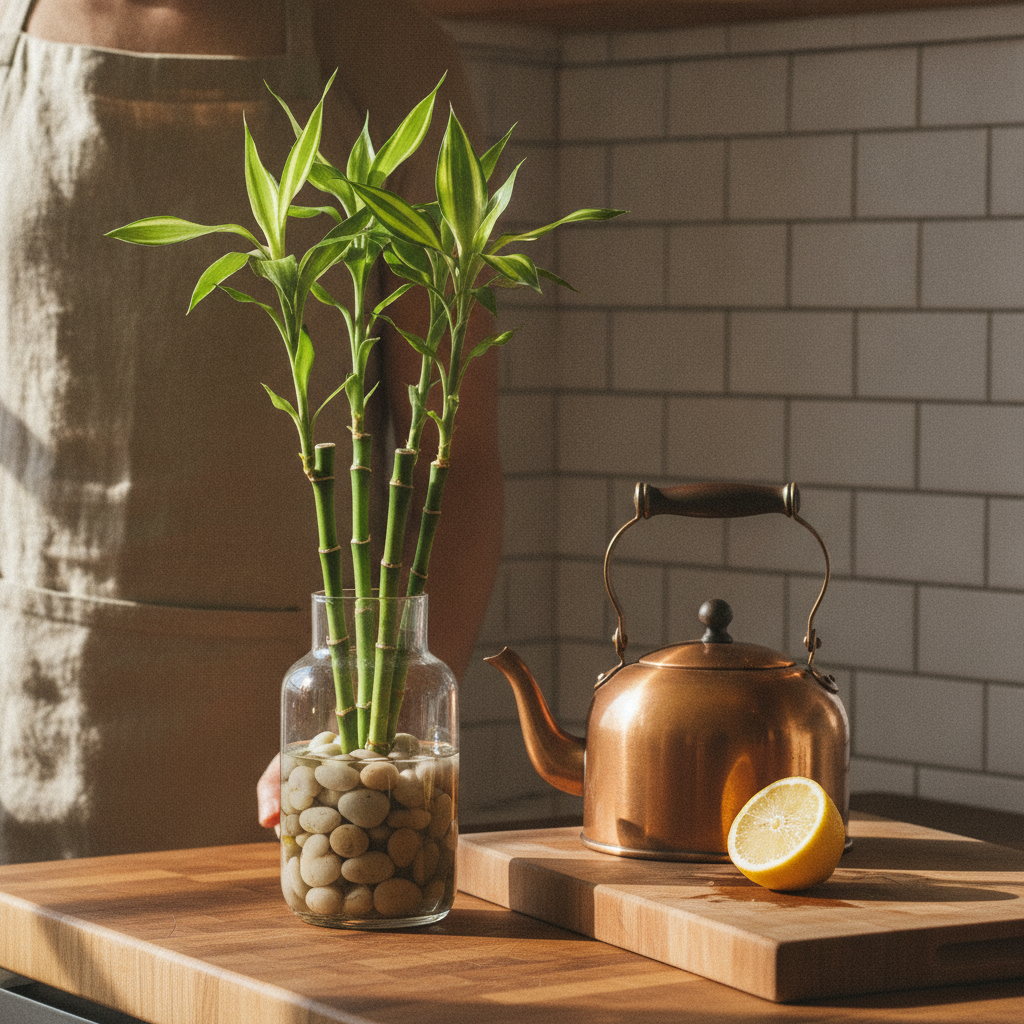
Watering is where lucky gold bamboo diverges most sharply from other houseplants, because it can be grown two entirely different ways and the routine depends on which you choose. Grown in water, which is the traditional and most common method, the roots simply sit submerged in a vessel of pebbles and water. The single rule is to keep the water level topped up so the roots never dry out, generally adding water every few days and changing it completely every one to two weeks to keep it fresh and free of algae. When you change the water, give the pebbles a quick rinse and check that no cane bases have started to soften or rot.
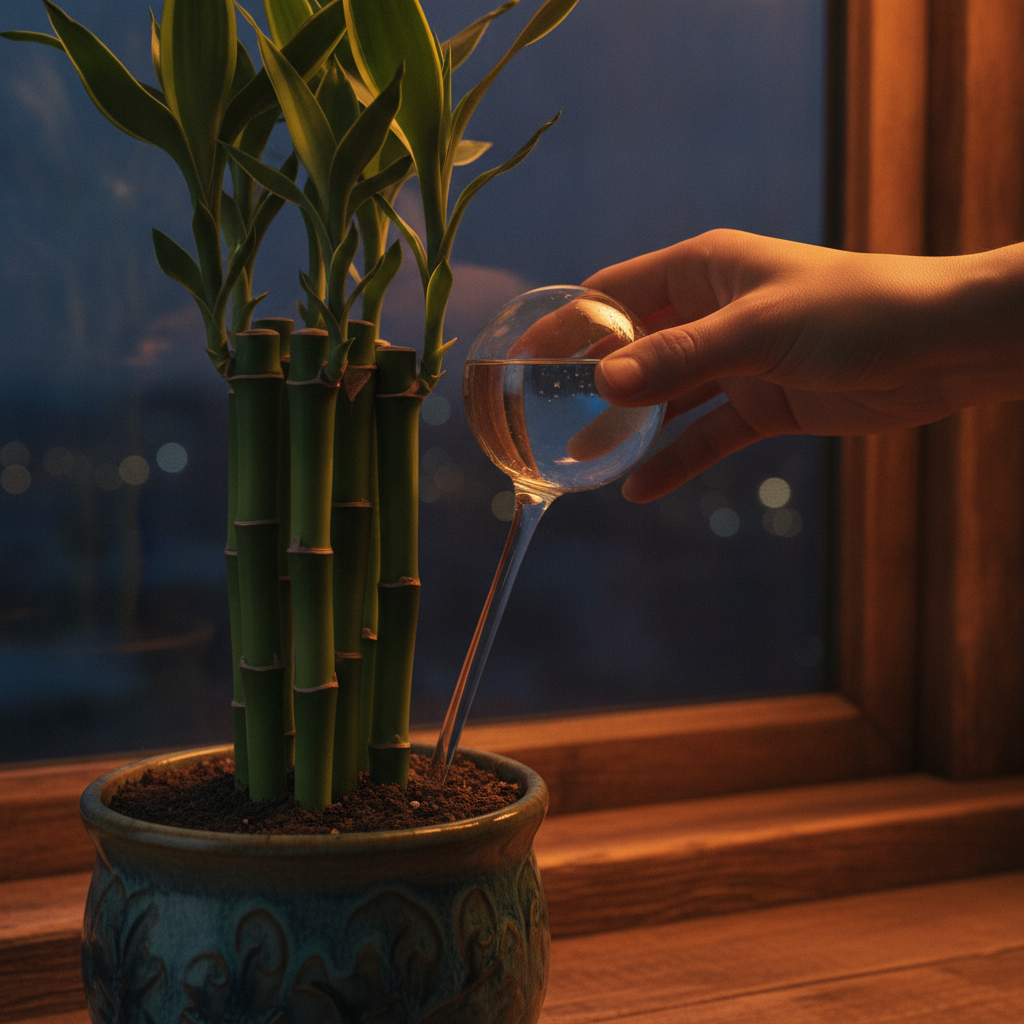
Grown in soil, the plant wants the medium kept lightly and evenly moist, never bone dry and never waterlogged. Water thoroughly when the top two to three centimetres (about an inch) of soil begin to feel dry, let the excess drain away completely, and never leave the pot standing in a saucer of water. Soil culture is slightly more forgiving of neglect than water culture in the short term, because the medium buffers the roots, but it is less forgiving of overwatering, which is the one reliable way to kill an otherwise indestructible plant. Soft, yellowing lower canes and a sour smell from the medium are the classic signs that the roots are sitting too wet.
Warning — Watch your tap water: Lucky gold bamboo is unusually sensitive to the chlorine and, especially, the fluoride found in many municipal water supplies. These chemicals accumulate in the leaf tissue and show up as brown, scorched leaf tips even when everything else is perfect. Use rainwater, distilled water or filtered water where you can. If you only have tap water, let it stand uncovered overnight so some of the chlorine can dissipate before you use it.
Whichever method you use, room-temperature water is kindest to the roots, and consistency matters more than volume. This is a plant that responds well to a steady, unremarkable routine and badly to dramatic swings between drought and flood. If you travel often, water culture is the more resilient choice, since a topped-up vessel will comfortably see the plant through a week or two of absence.
Soil and growing medium
If you keep your lucky gold bamboo in water, the growing medium is nothing more than a layer of clean pebbles, glass beads or decorative stones whose only jobs are to anchor the canes upright and hold them in position. Choose a vessel tall enough to support the canes and wide enough to spread them attractively, fill it with a few centimetres of rinsed pebbles, and settle the roots among them. There is no soil, no drainage question and no repotting schedule to worry about, which is a large part of the plant’s appeal.
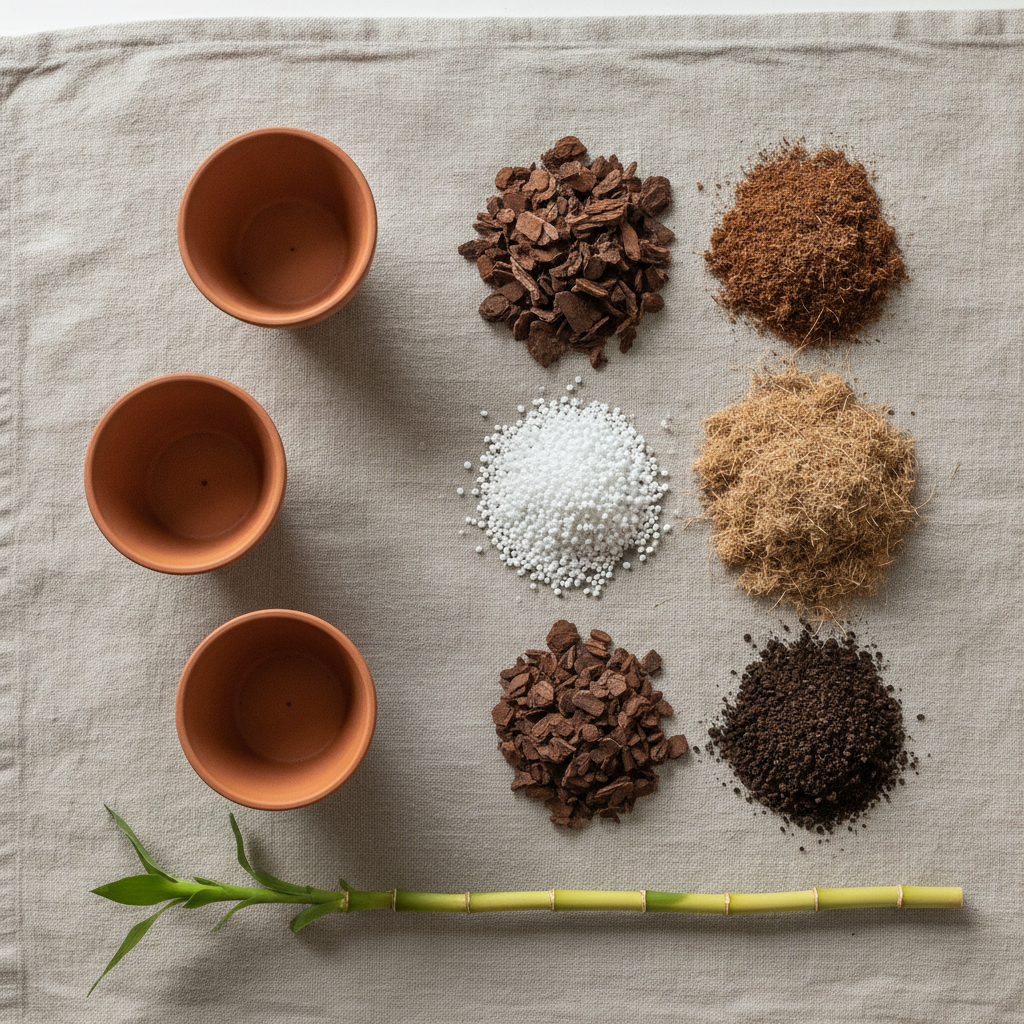
If you prefer to grow it in soil, the priority is drainage. Lucky gold bamboo roots resent sitting in dense, waterlogged medium, so a standard peat-based houseplant compost lightened with a generous handful of perlite and a little orchid bark makes an excellent base. The aim is a medium that holds enough moisture to stay lightly damp between waterings but drains freely enough that water runs straight through rather than pooling. Always plant into a pot with drainage holes, because a decorative cover pot with no escape route for water is the most common cause of root rot in an otherwise healthy specimen.
Transferring a plant from water to soil is entirely possible but worth doing thoughtfully. Roots grown in water are more brittle and less efficient at extracting moisture from soil, so a plant moved across will often sulk for a few weeks while it grows a new set of soil-adapted roots. Keep the medium a little moister than usual during this transition, and be patient. Moving in the opposite direction, from soil to water, is generally harder and less successful, so it is best to decide early which method suits you and stick with it. Repotting soil-grown plants is rarely urgent; every two to three years, or whenever the roots have clearly filled the pot, is plenty.
Fertilising
Lucky gold bamboo is a light feeder, and the most common feeding mistake by far is giving it too much. In its native forest it draws modest nutrition from decaying leaf litter and mineral-poor water, so it is adapted to make do with very little. A plant grown in water in particular needs almost nothing, because there is no reservoir of soil nutrients and the roots are exposed directly to whatever you add. Overfeeding shows up quickly as yellowing leaves, brown tips and, in water culture, a bloom of algae in the vessel.
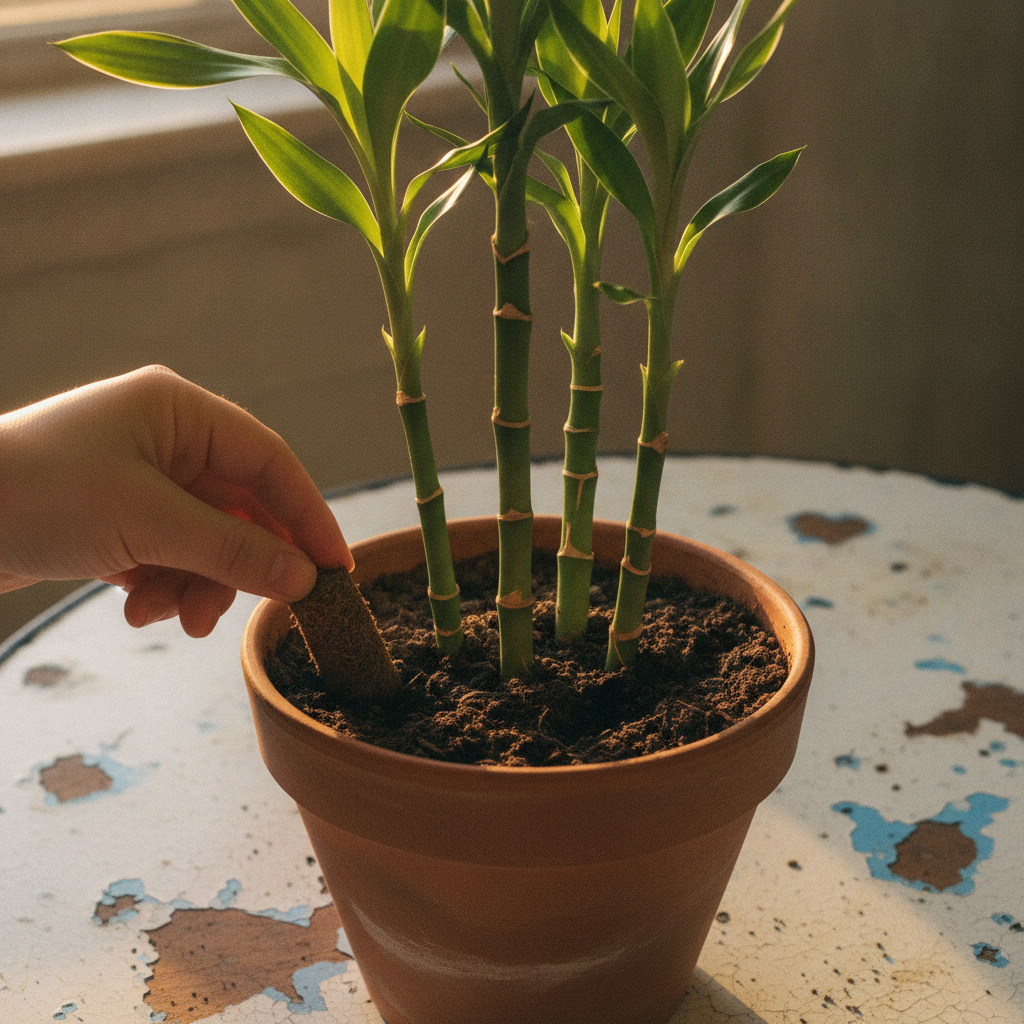
For a water-grown plant, a single drop of dilute liquid houseplant fertiliser added when you change the water, no more than once every month or two during the warmer growing months, is ample. Many growers use a specialist lucky bamboo feed formulated at very low strength, which takes the guesswork out of dilution. For a soil-grown plant, a balanced liquid fertiliser diluted to a quarter or half the recommended strength, applied every four to six weeks in spring and summer, keeps the canes green and the variegation bright without pushing soft, weak growth.
Stop feeding altogether in autumn and winter, when growth naturally slows and the plant has little use for extra nutrients. If in doubt, feed less rather than more; a slightly hungry lucky gold bamboo simply grows a little slower, while an overfed one develops the scorched, yellowing foliage that sends anxious owners searching for a disease that is not there. When you see that pattern, the first thing to do is flush the medium or change the water and give the plant a rest from feeding entirely.
Propagation
Propagating lucky gold bamboo is refreshingly straightforward, and because the plant roots so readily in water it is one of the best houseplants for a beginner to practise on. Propagation is done from stem cuttings, ideally taken from offshoots, the smaller side stems that emerge from the main canes, though a section of a healthy cane will work just as well. Spring and early summer, when the plant is in active growth, give the fastest and most reliable results.
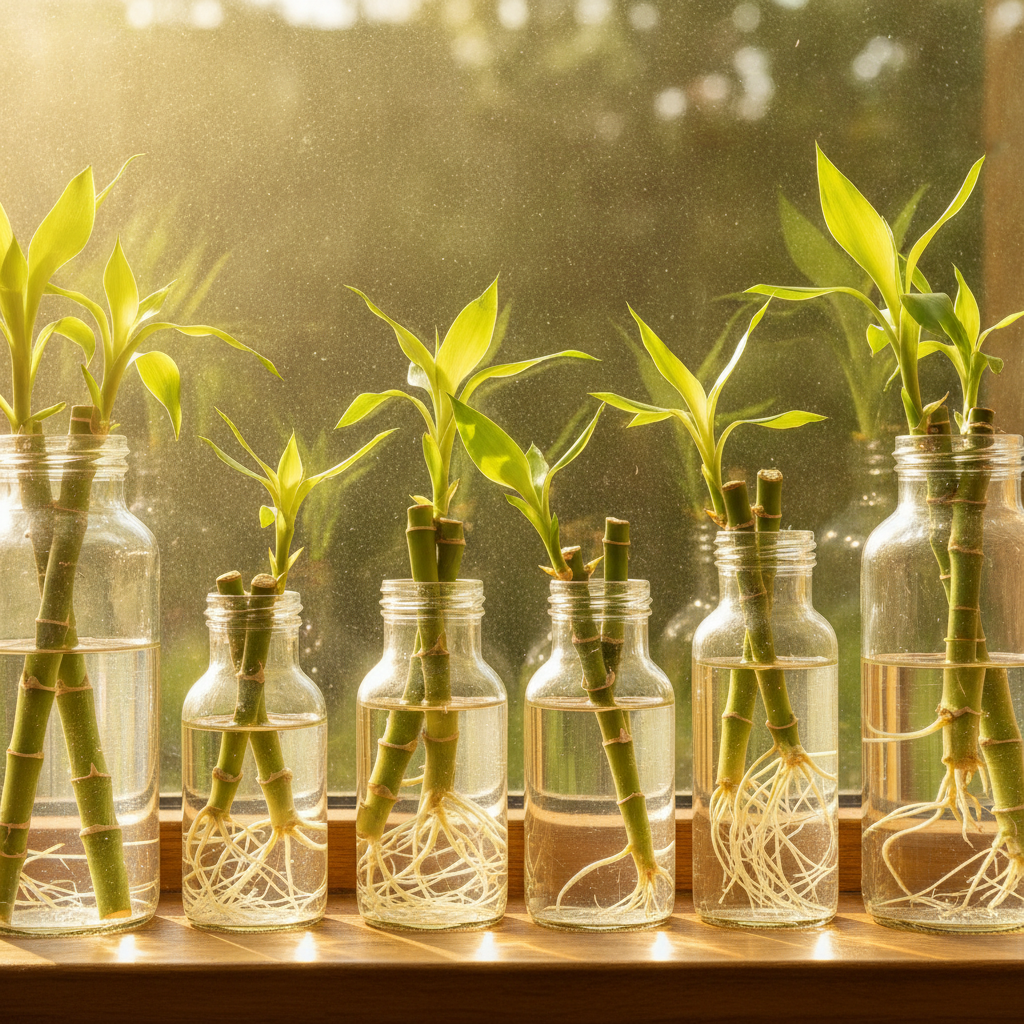
To take a cutting, follow these steps:
- Choose a healthy offshoot or cane section with at least one node, the slightly raised band where leaves and roots emerge. A cutting of roughly 10 to 15 centimetres (4 to 6 inches) with one or two nodes is ideal.
- Using clean, sharp scissors or secateurs, cut just below a node. Trim away any leaves from the lower portion so no foliage will sit underwater.
- Stand the cutting in a jar of clean, non-fluoridated water, keeping the node submerged. Place it in bright, indirect light.
- Change the water every few days to keep it fresh. White roots should begin to emerge from the node within two to four weeks.
- Once the new roots are several centimetres long, either leave the cutting to grow on in water or pot it into a free-draining soil mix.
A small refinement worth knowing concerns the top cut of the parent cane. Many growers seal the cut end of the mother plant with a dab of soft wax or even a smear of candle wax to prevent rot and moisture loss, a traditional practice you will see on shop-bought plants where the tops are dipped in coloured wax. It is not essential, but it does tidy the parent and reduce the chance of the exposed cut going soft. Beyond that, propagation asks very little: clean water, gentle light and a few weeks of patience are all it takes to turn one plant into several.
Common pests and problems
Lucky gold bamboo is not a magnet for pests, and most of the troubles owners run into are cultural rather than biological, meaning they trace back to water quality, light or feeding rather than any insect. Even so, it pays to know both what can go wrong and how to read the warning signs, because the plant is expressive and will tell you clearly when something is off.
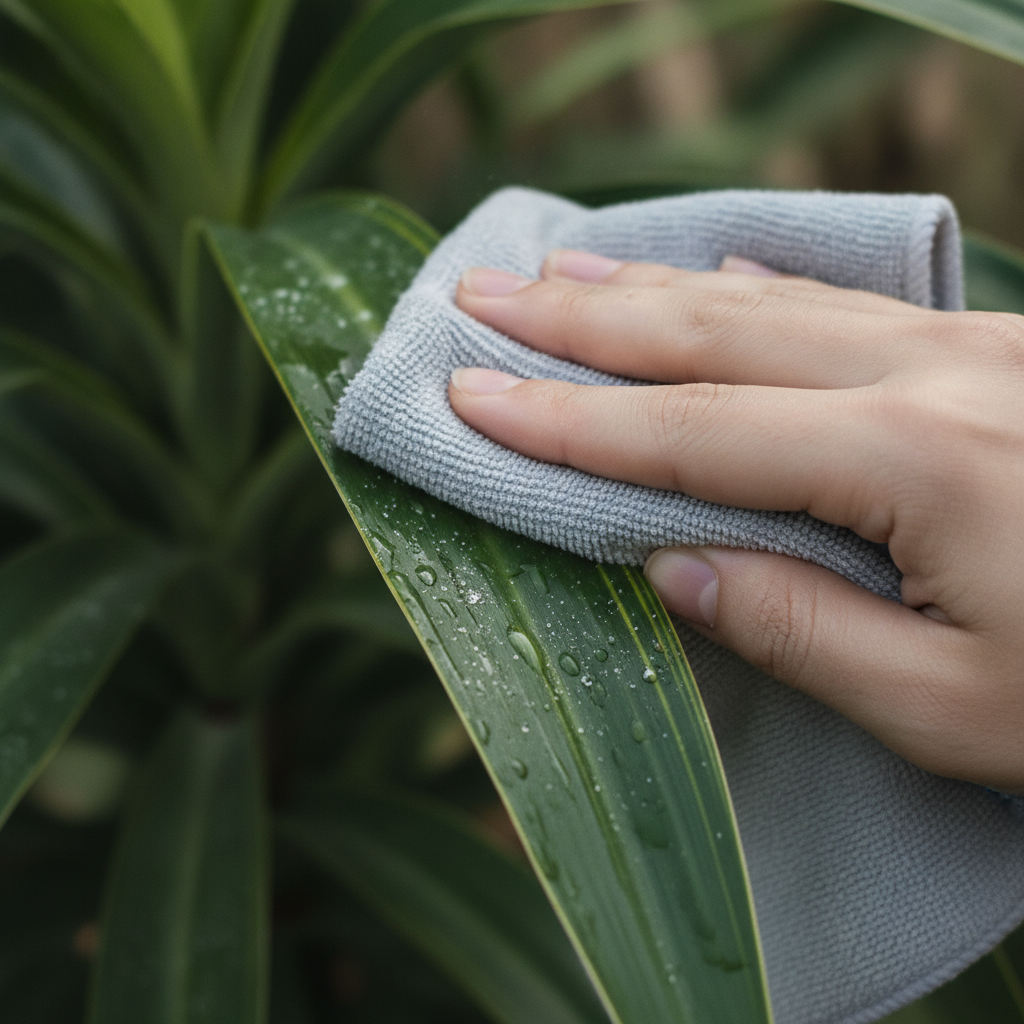
The insects most likely to appear are mealybugs, which look like small tufts of white cotton wool tucked into the leaf axils and cane joints, and spider mites, which favour warm, dry air and leave fine webbing and a stippled, dusty look on the leaves. Both are dealt with the same way: wipe the affected areas with a cotton bud dipped in diluted isopropyl alcohol, rinse the whole plant, and raise the humidity a little to discourage mites from returning. Because lucky gold bamboo is often grown in water, always check the cane bases and roots too, where the occasional fungus gnat larva or patch of algae can take hold in a neglected vessel.
Far more common than pests are the appearance problems that flow from care. Brown, crispy leaf tips almost always point to fluoride or chlorine in the water, and switching to filtered or stood water usually stops the spread. Uniform yellowing of the leaves or canes suggests too much direct sun, overfeeding or, in soil, waterlogged roots; work through those three causes in turn and one will usually fit. A cane that turns soft, yellow and mushy at the base is rotting and should be removed promptly before the rot spreads to its neighbours, and any cloudy, foul-smelling water should be changed at once. Yellowing that begins at the very tips and creeps down a whole cane, by contrast, may simply be that cane reaching the end of its life, in which case it can be cut away cleanly and a healthy offshoot grown on in its place.
Pro Tip — Read the colour: Yellow and green tell you different stories. Yellow canes or leaves usually mean too much of something, whether light, fertiliser or water, and rarely recover their colour once turned. Green foliage that is merely pale or stretched usually means too little light, and will green up and firm again once the plant is moved somewhere brighter. Diagnosing by colour before you reach for any treatment saves a great deal of unnecessary worry.
Varieties
Although it is all one species, Dracaena sanderiana reaches homes in a surprising range of forms, split between named leaf variegations and the trained shapes that growers create by manipulating the canes. Two are worth singling out, one for its foliage and one for its striking silhouette.
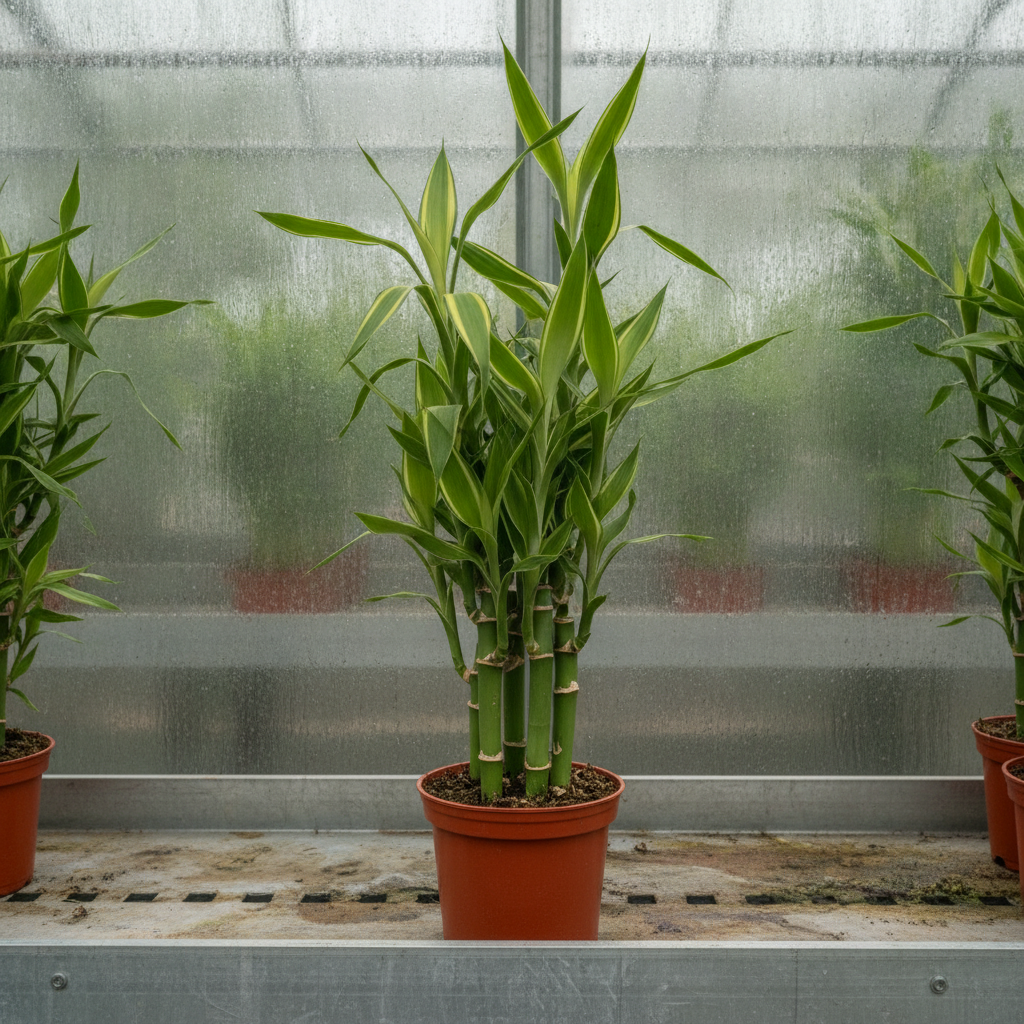
Victory
The Victory selection is grown for its foliage, with broad, strappy leaves carrying a creamy gold central stripe that runs the length of each blade. It is the form most people picture when they hear golden lucky bamboo, and it holds its variegation best in bright, indirect light, fading toward plain green if kept too dark.
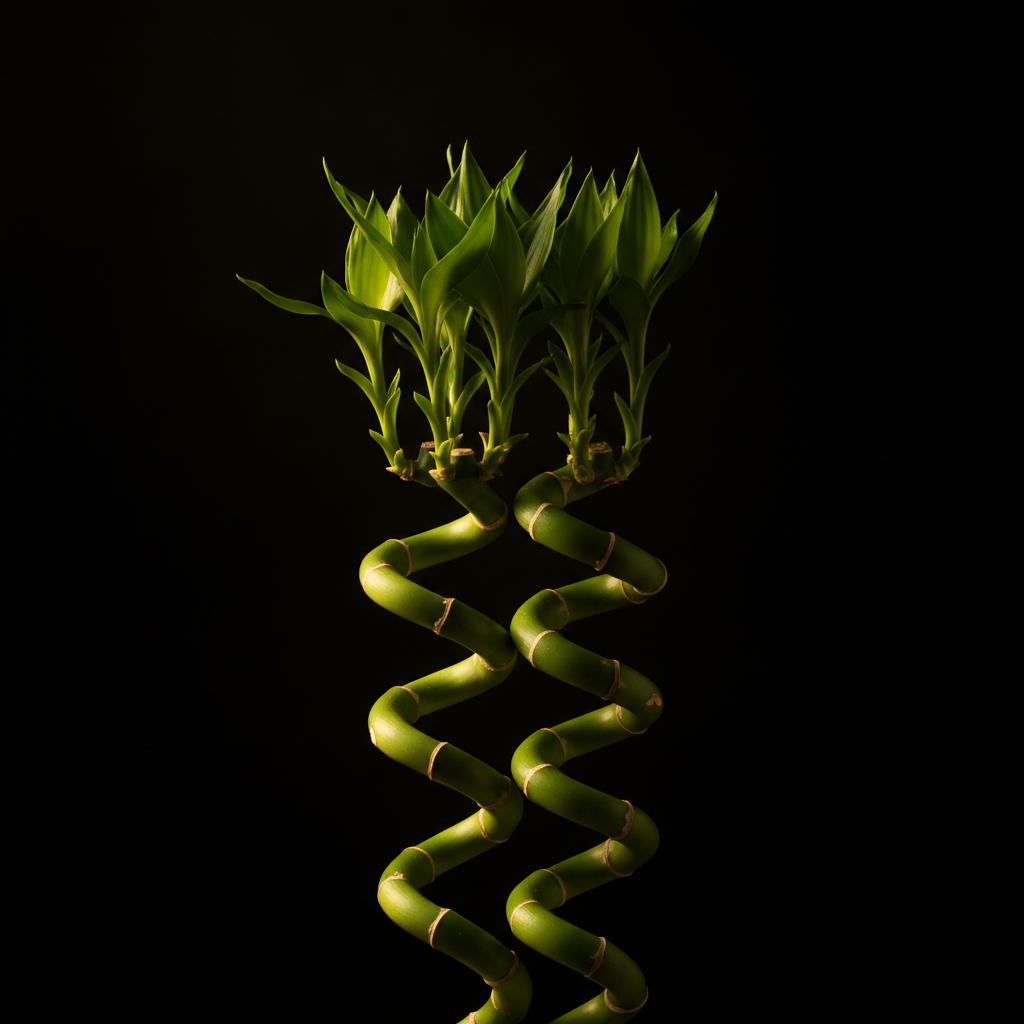
Spiral
The spiral, or curly, form is not a genetic variety at all but a feat of patient training, in which growers rotate single canes beside a one-sided light for months until they curl into tight corkscrews. Each spiral is unique, and because the shape is coaxed rather than inherited, new growth from the top emerges straight and must be trained afresh.
Beyond these two you will find plain-green forms, white-margined selections often sold as White Stripe, and elaborate woven arrangements in which many canes are trained into towers, hearts, trellises and lattices. All share the same easy care, so your choice is purely a matter of the look you want and the shape that suits your space.
Frequently asked questions
Is lucky gold bamboo really a bamboo?
No. Despite the jointed, bamboo-like canes, it is Dracaena sanderiana, a member of the dragon-tree family and a close relative of the corn plant. It shares none of true bamboo’s fast, thirsty, spreading habit, which is exactly why it makes such an easy houseplant.
Why are the leaf tips turning brown?
Brown, crispy tips are almost always caused by fluoride or chlorine in tap water building up in the leaves. Switch to filtered, distilled or rainwater, or leave tap water standing uncovered overnight before using it, and the problem usually stops spreading. Very dry air can contribute too.
Can I grow it in water forever?
Yes. Many plants live for years in nothing but pebbles and water. Keep the water topped up and clean, change it every one to two weeks, and feed only a tiny amount occasionally. Water culture is the traditional method and the more travel-friendly of the two.
How do I make the canes spiral?
Spirals are made by slowly rotating a cane beside a single light source over many months so it bends steadily toward the light. It takes patience and only works on soft new growth. Most spiralled plants are shaped by commercial growers; at home you can encourage a gentle curve but rarely reproduce the tight shop-bought coils.
Is lucky gold bamboo safe for pets?
No. Dracaena sanderiana is toxic to cats and dogs, and chewing on the canes or leaves can cause drooling, vomiting, weakness and loss of appetite. Keep the plant well out of reach of curious pets, and contact a vet if you suspect your animal has eaten any.
My cane has turned yellow. Can I save it?
A cane that has yellowed is unlikely to turn green again, as the colour rarely returns once lost. If only part of a cane is affected you can cut away the yellow section above a healthy node; if a whole cane has gone soft and yellow, remove it entirely to protect the others and grow on a healthy offshoot in its place.






