
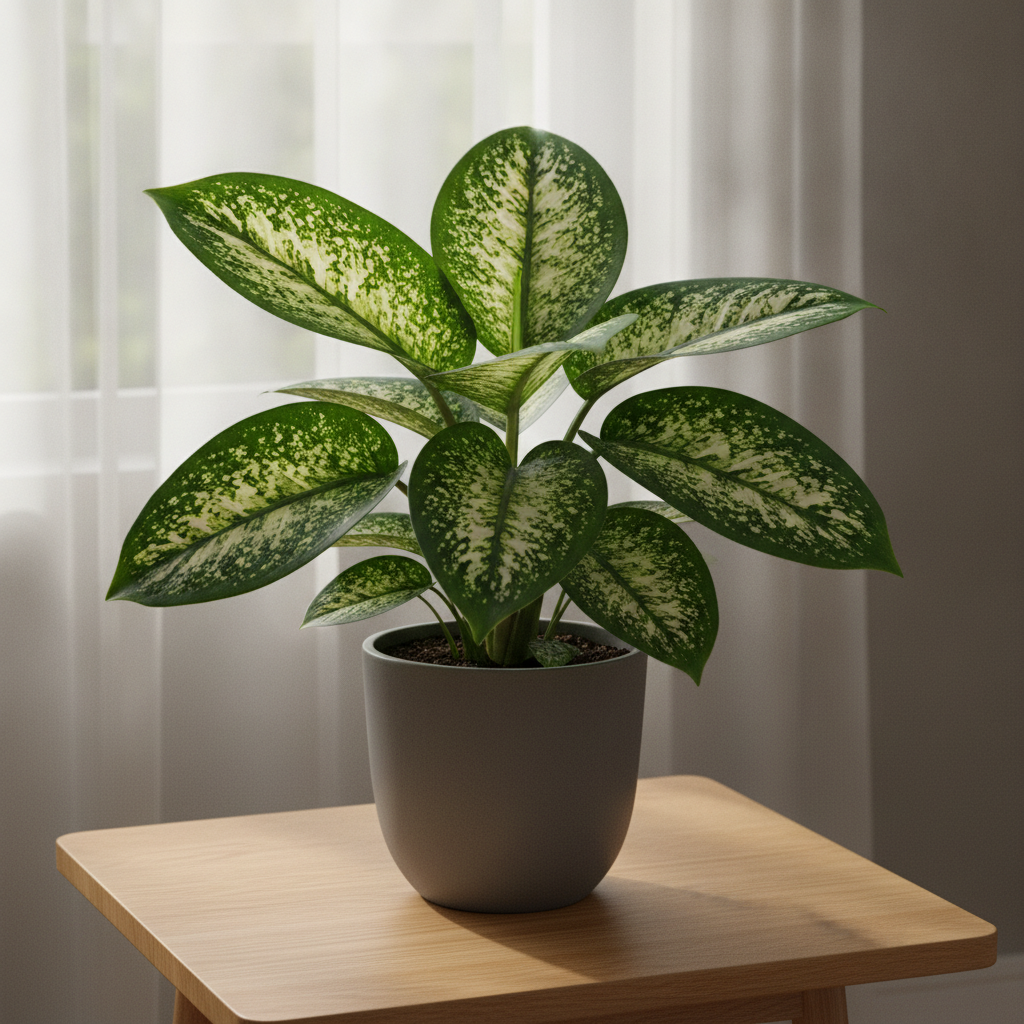
The exotica plant, better known to most growers as the exotica dumb cane, is a compact selection of Dieffenbachia, the boldly variegated aroid whose broad leaves have decorated living rooms for well over a century. Sold under the botanical label Dieffenbachia exotica, it belongs to the arum family (Araceae) and traces its ancestry to the humid understorey of tropical Central and South America, from the Caribbean islands down through Colombia and Brazil. Where the parent species can grow tall and rangy, the exotica form stays denser and more manageable, its oval, pointed leaves splashed with creamy-white and pale-yellow marbling that seems to glow against the deep green margins.
Its reputation is that of a forgiving, fast-growing houseplant that rewards a little attention with generous foliage, and the “dumb cane” nickname is a reminder to handle it with respect, as every part of the plant carries irritating sap. Keeping an exotica dumb cane alive is not difficult, but the gap between a plant that merely survives and one that truly thrives comes down to reading its light, water and warmth correctly. This guide walks through every aspect of its care, from choosing the right window to propagating new plants, so you can grow a lush, well-coloured specimen rather than a leggy, faded one.
Contents
- Quick Reference
- Why Exotica Dumb Cane Makes a Rewarding Houseplant
- Light Requirements
- Watering & Humidity
- Soil, Potting & Repotting
- Fertilising
- Propagation
- Pests & Diseases
- Popular Varieties
- Frequently Asked Questions
Quick Reference: Exotica Dumb Cane at a Glance
| Light | Bright, indirect light; tolerates medium light with reduced variegation. No direct midday sun. |
| Watering | Keep evenly moist; water when the top 2 to 3 cm (1 in) of soil dries. Reduce in winter. |
| Temperature | 18 to 27 degrees C (64 to 81 degrees F). Never below 13 degrees C (55 degrees F). |
| Humidity | Moderate to high, 50 to 60 per cent or more preferred. |
| Fertiliser | Balanced feed at half strength, monthly through spring and summer. |
| Toxicity | Toxic to people and pets. Sap contains calcium oxalate crystals that irritate mouth and throat. |
Why Exotica Dumb Cane Makes a Rewarding Houseplant
Few foliage plants deliver as much visual impact for as little effort as the exotica dumb cane. A single well-grown plant produces a dense rosette of large, paddle-shaped leaves, each one a small painting of cream, chartreuse and forest green. Because the exotica selection was bred for compactness, it fills a corner or a tabletop without the awkward, bare stem that older Dieffenbachia cultivars develop with age, making it one of the tidiest members of the group for indoor display.
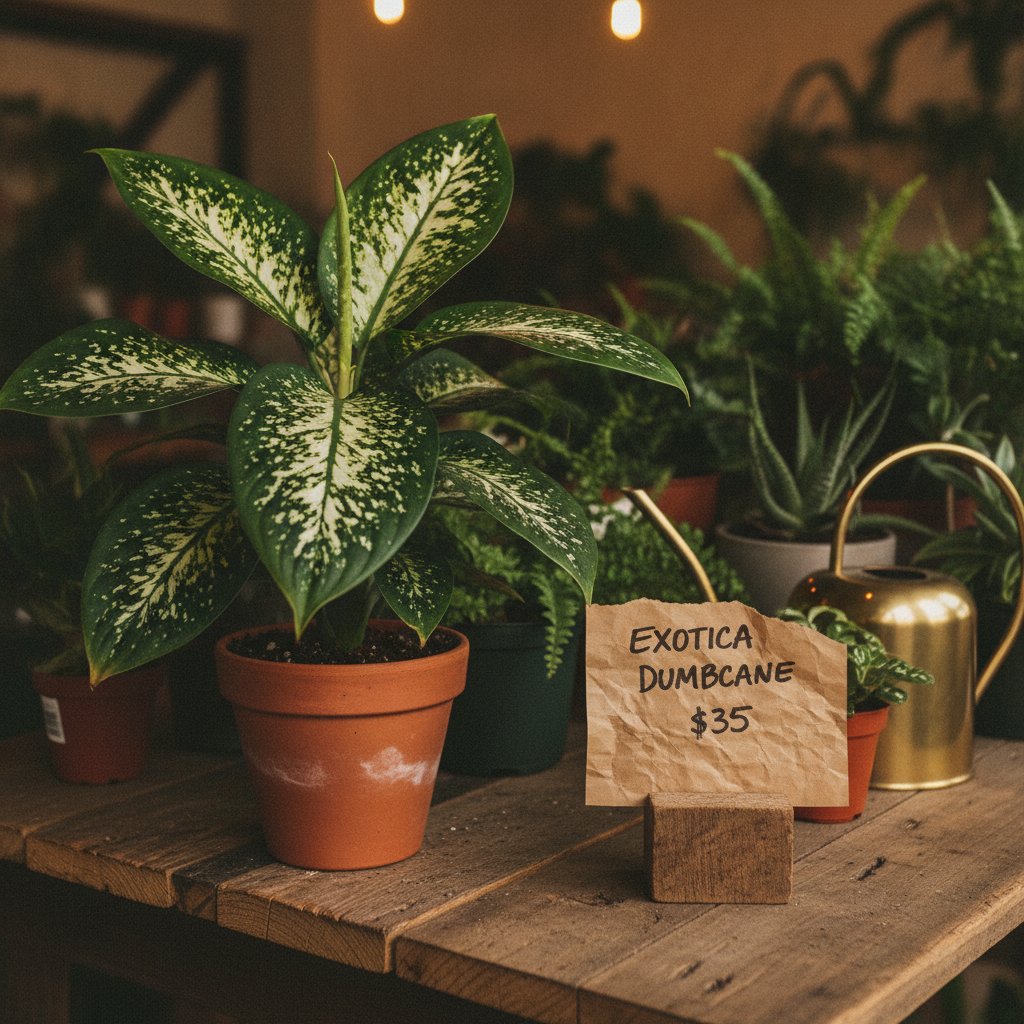
Beyond looks, the plant earns its place through sheer adaptability. It grows quickly in warmth, tolerates the medium light of an average living room, and forgives the occasional missed watering far better than a fern or a calathea would. It is also an efficient grower in typical household temperatures, so a small starter plant can double in size within a single season given decent conditions. For anyone building confidence with tropical foliage, the exotica dumb cane offers the thrill of visible, rapid progress without demanding specialist equipment.
Important — Toxicity: Every part of the exotica dumb cane contains needle-like calcium oxalate crystals called raphides. If chewed, the sap causes intense burning, swelling of the lips, tongue and throat, and temporary difficulty speaking, which is the origin of the name “dumb cane”. Keep the plant well away from children, cats and dogs, and wear gloves when cutting stems, as the sap can also irritate skin and eyes.
Light Requirements
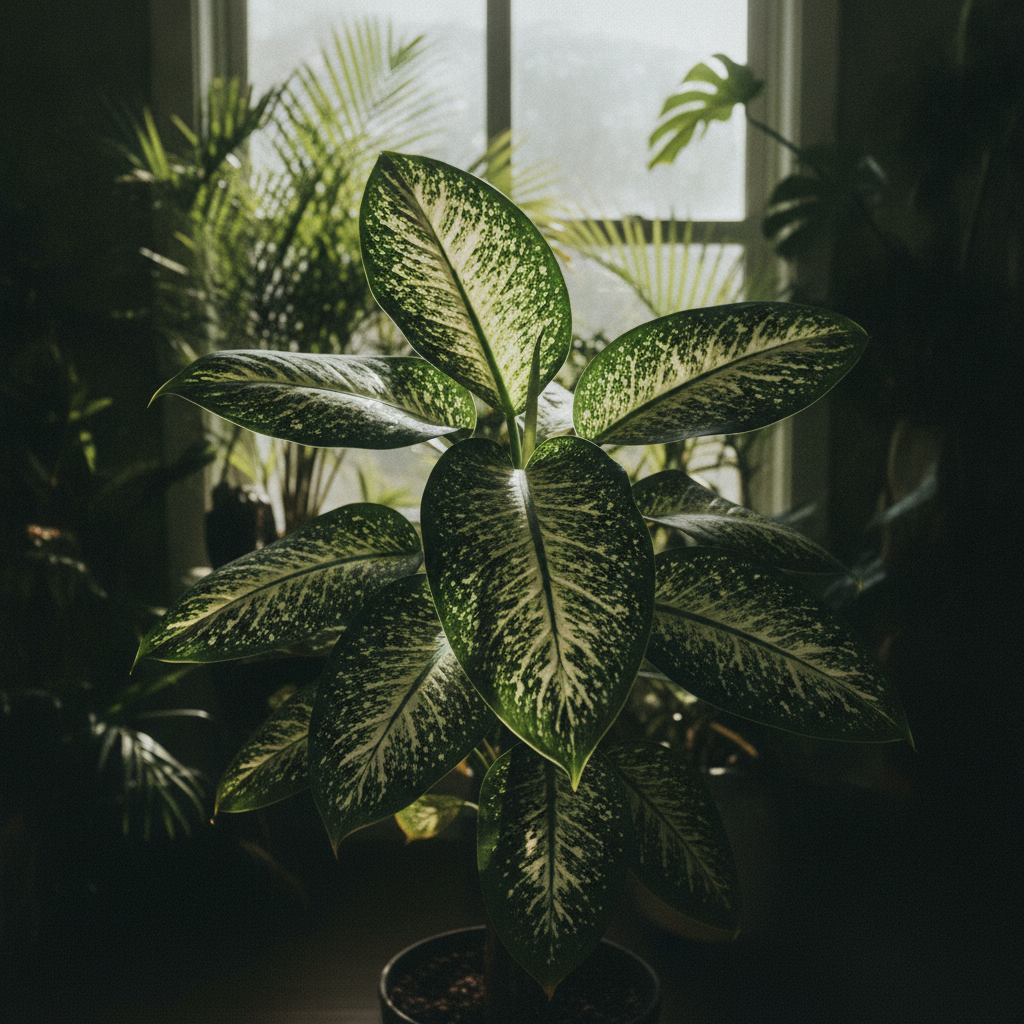
Light is the single biggest factor in how well an exotica dumb cane holds its variegation. In its native habitat the plant grows on the forest floor beneath a broken canopy, receiving bright but filtered light rather than direct exposure. Recreating that indoors means giving it a spot that feels bright to the eye but never places the leaves in the path of harsh, unfiltered sun for more than an hour or two.
The ideal position is a metre or so back from a window that receives plenty of daylight, or directly in front of a window screened by a sheer curtain. In these conditions the cream and yellow markings stay vivid, the leaves grow to full size, and the plant keeps a compact, upright shape. Too little light and the plant stretches toward the nearest source, producing smaller, greener leaves with weaker contrast; too much and the delicate pale areas scorch.
Light Levels Explained
Understanding how houseplant light categories translate into real placements helps you match the exotica dumb cane to your home. The table below outlines the main tiers and what each one means for this plant.
| Light Category | Approx. Level | Typical Location | Outcome |
|---|---|---|---|
| Direct sun | Over 50,000 lux | On an unshaded south-facing sill | Bleaching and brown scorch on pale areas |
| Bright indirect | 10,000 to 20,000 lux | Near an east or curtained south window | Ideal; full colour and compact growth |
| Medium | 5,000 to 10,000 lux | A metre or two into a bright room | Good growth, slightly muted variegation |
| Low | 1,000 to 2,500 lux | North room corner, interior wall | Leggy, greener leaves, slow growth |
| Very low | Under 1,000 lux | Windowless hallway | Decline; not suitable long term |
Window Orientation and Placement
South-facing window: The brightest option in the northern hemisphere and usable only with a sheer curtain or by setting the plant back a metre or more. Unshaded south light in summer will bleach and burn the variegated areas within days.
East-facing window: Often the sweet spot. Gentle morning sun followed by bright indirect light for the rest of the day suits the exotica dumb cane beautifully and rarely causes scorch.
West-facing window: Workable, but the strong afternoon sun can be intense in summer, so filter it or position the plant slightly to one side of the direct beam.
North-facing window: Provides soft, even light that the plant tolerates, though growth slows and variegation may fade a little. Rotate the plant regularly here to keep it from leaning.
Pro Tip — Rotate for Symmetry: Because the exotica dumb cane grows toward light, give the pot a quarter turn every time you water. This keeps the leafy crown even and upright rather than lopsided toward the window.
How Light Affects Variegation
The pale cream and yellow zones on each leaf contain little or no chlorophyll, which means they contribute less to feeding the plant and depend on the green areas to do the work of photosynthesis. In strong, filtered light the plant can afford to keep those showy pale patches large and bright. In dim conditions it compensates by producing more chlorophyll, and new leaves emerge greener and less marked. If you notice fresh growth losing its cream marbling, the most likely cause is insufficient light rather than any deficiency, and moving the plant closer to a bright window usually restores the pattern over a few leaves.
Warning — Direct Sunlight: The creamy sections of the leaf have little protection against ultraviolet light. A few hours of unfiltered summer sun can leave permanent bleached-white or crispy brown patches that never recover, so always diffuse strong light with a curtain or distance.
Artificial Lighting
In a room short on natural daylight, the exotica dumb cane responds well to a full-spectrum LED grow light positioned 30 to 45 cm (12 to 18 in) above the foliage and run for 10 to 12 hours a day. Because the plant is compact, a single modest fixture is usually enough to keep colour and form strong through the darker months, and supplementary light is a practical way to overwinter a plant that would otherwise stretch.
Seasonal Adjustments
Daylight weakens considerably in winter, so a spot that was perfect in summer may become too dim by December. Move the plant closer to the window through the cold months, then step it back again in spring as the sun climbs higher and grows more intense. Cleaning the glass and the leaves themselves also matters, since a film of dust on either surface can cut usable light by a surprising margin.
Watering & Humidity
Watering is where most exotica dumb canes are won or lost. The plant likes soil that stays lightly moist but never waterlogged, a balance that is easy to strike once you learn to read the top layer of the mix rather than watering on a fixed schedule.
When to Water
Water when the top 2 to 3 cm (1 in) of the potting mix has dried out. Push a finger into the soil, and if it feels dry at the first knuckle it is time; if it is still damp, wait a day or two and check again. Through the warm growing season this often means watering once or twice a week, while in winter the interval stretches to once every week or two as growth slows and the mix dries more slowly.
The plant is sensitive to both extremes. Letting the mix dry out completely causes the lower leaves to yellow and droop, while keeping it constantly saturated starves the roots of oxygen and invites rot. Aim for the middle ground of consistently, lightly moist soil, and always tip away any water that collects in the saucer within half an hour of watering.
Pro Tip — Use Tepid Water: Dieffenbachia dislikes cold water on its roots, which can shock the plant and mark the leaves. Let tap water reach room temperature before use, and it will be absorbed far more readily.
How to Water Correctly
- Check the top few centimetres of soil and only proceed if they feel dry.
- Water slowly and evenly across the whole surface, not just one side of the pot.
- Continue until water runs freely from the drainage holes, which ensures the entire rootball is moistened.
- Let the pot drain fully for several minutes over a sink or tray.
- Empty the saucer so the pot never stands in leftover water.
- Wait until the top layer dries again before the next watering.
Signs of Overwatering vs. Underwatering
| Symptom | Overwatering | Underwatering |
|---|---|---|
| Leaf colour | Yellowing, often starting with lower leaves | Yellowing at leaf edges with browning tips |
| Leaf texture | Soft, limp, sometimes translucent | Dry, curling and papery |
| Soil | Wet and slow to dry, may smell sour | Bone dry and pulling away from the pot sides |
| Roots | Brown, mushy and foul smelling | Dry, brittle and pale |
| Stem base | Soft, darkened, sometimes collapsing | Firm but the whole plant droops |
Warning — Root Rot: A soft, darkening stem base and a sour smell from the soil are signs of advanced root rot, the most common killer of Dieffenbachia. If you catch it early, unpot the plant, cut away all mushy roots and stem tissue with a sterilised blade, and repot the healthy remainder into fresh, dry mix.
Humidity Requirements
As a tropical understorey plant, the exotica dumb cane appreciates humidity above the level of most centrally heated homes. It grows best when relative humidity sits between 50 and 60 per cent, though it will cope with ordinary room air far better than more demanding cousins such as calatheas.
When the air is too dry, the plant tells you through crisp brown leaf edges and tips, and new leaves may struggle to unfurl cleanly. These symptoms are most common in winter, when radiators strip moisture from the air, and they are cosmetic rather than fatal, but they do spoil the plant’s appearance.
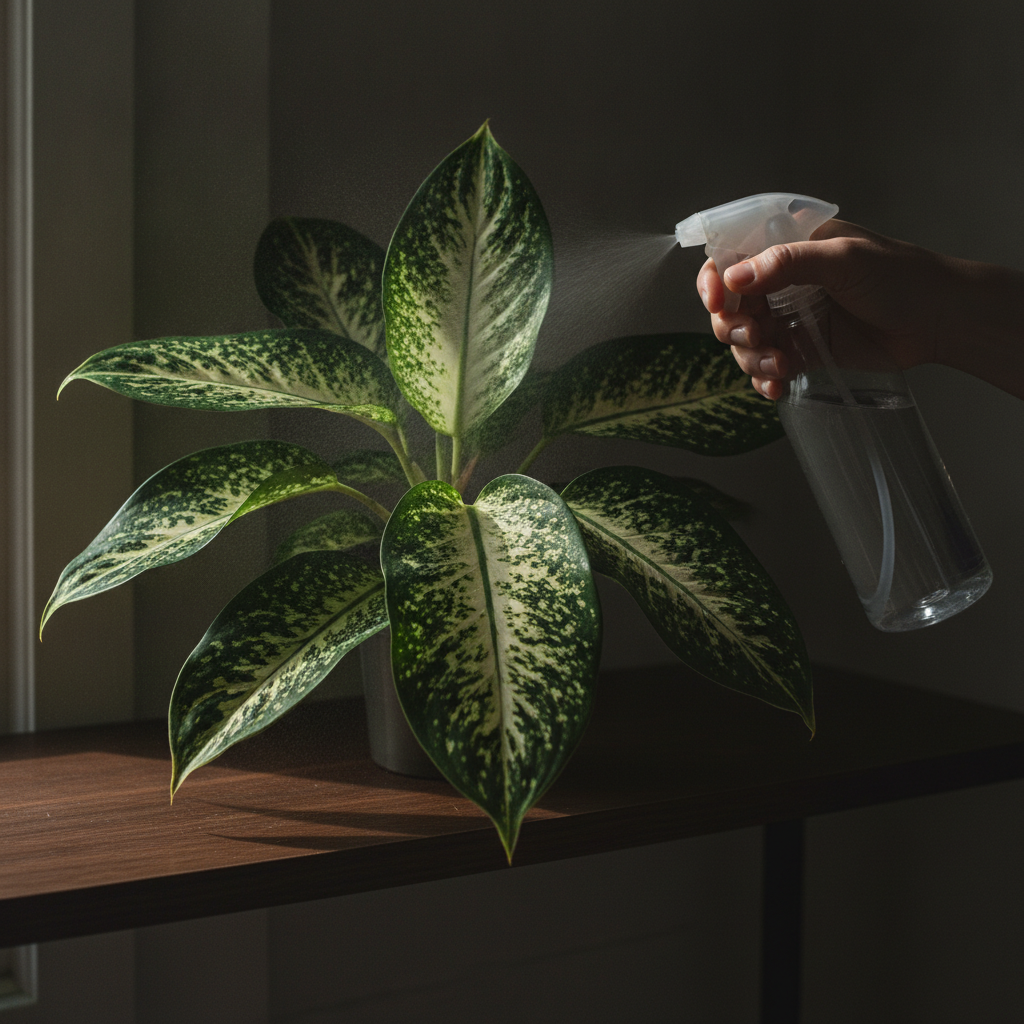
Raising humidity is straightforward. Grouping plants together creates a moister microclimate, standing the pot on a tray of damp pebbles lifts local humidity without wetting the roots, and a small room humidifier is the most reliable option of all. Occasional misting helps a little but evaporates quickly, so it is a supplement rather than a solution.
Water Quality
Dieffenbachia can be sensitive to the fluoride and chlorine found in some tap water, which may show as brown leaf tips over time. If your water is heavily treated, letting it stand overnight before use allows some chlorine to dissipate, and rainwater or filtered water is gentler still. That said, many growers use ordinary tap water without trouble, so treat this as a refinement to try if tip-browning persists despite good humidity.
Soil, Potting & Repotting
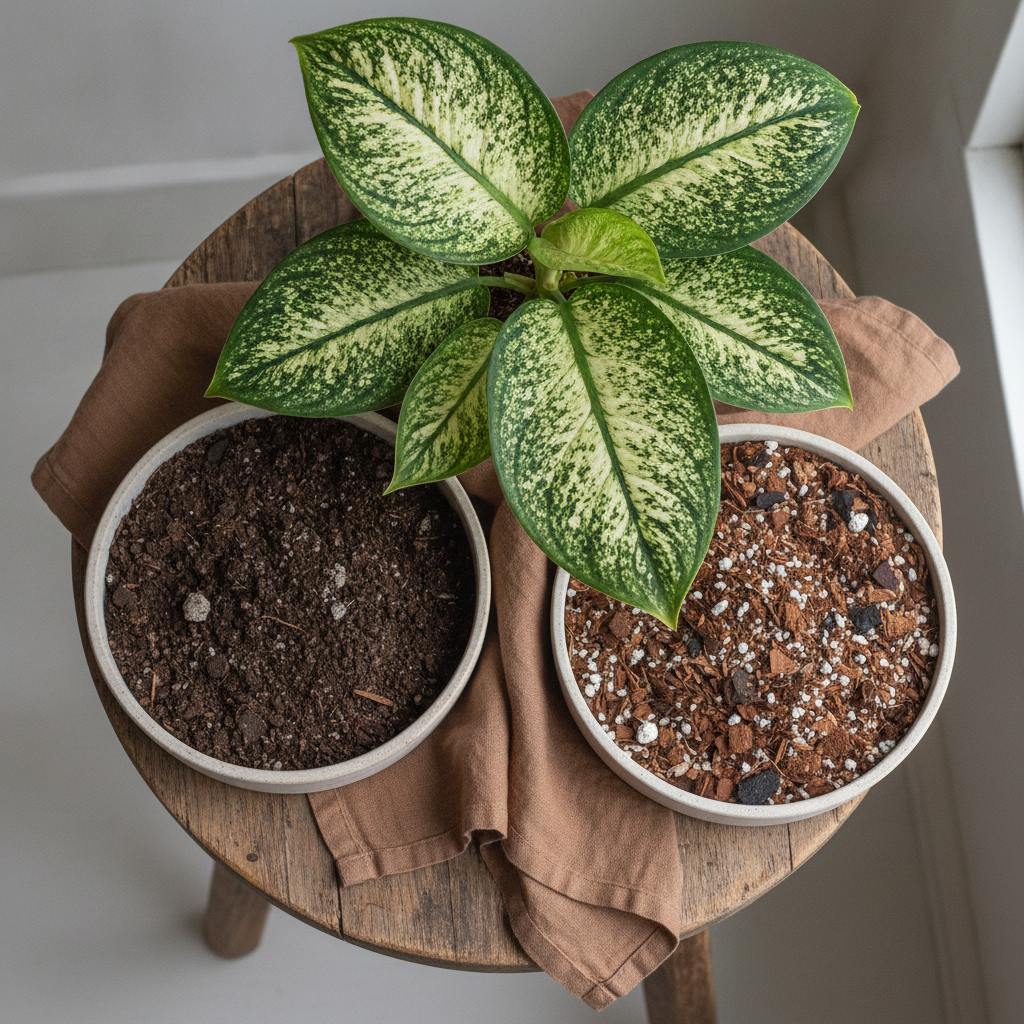
The right growing medium underpins everything else. Because the exotica dumb cane wants moisture but hates sitting wet, it needs a mix that holds water yet drains freely, with plenty of air pockets around the roots.
Ideal Soil Composition
A quality peat-free or peat-based houseplant compost forms a good base, but on its own it tends to compact and stay soggy. Lightening it with chunky amendments gives the roots the aeration they crave. The blend below balances moisture retention against drainage and suits the plant well.
| Component | Proportion | Function |
|---|---|---|
| Houseplant compost | 50 per cent | Holds moisture and nutrients |
| Orchid bark or coco chips | 20 per cent | Creates air pockets and structure |
| Perlite or pumice | 20 per cent | Improves drainage, prevents compaction |
| Worm castings or compost | 10 per cent | Adds slow, gentle nutrition |
The exotica dumb cane prefers a slightly acidic to neutral soil, with a pH of roughly 6.0 to 6.5. Most bagged composts fall comfortably within this range, so pH is rarely something you need to measure or adjust for this plant under normal conditions.
Pro Tip — Quick Mix Recipe: For a fast, reliable blend, stir together five handfuls of houseplant compost, two of orchid bark, two of perlite and one of worm castings. It drains freely, holds just enough moisture, and feeds the plant gently for months.
Choosing the Right Pot
The container matters as much as what goes inside it. A pot that is too large holds excess wet soil the roots cannot use, while one that is too small dries out and cramps growth.
Drainage holes are non-negotiable. The exotica dumb cane must never sit in standing water, so choose a pot with at least one generous drainage hole. If you love a decorative cover pot without holes, use it as an outer sleeve and lift the inner nursery pot out to water and drain.
Pot material: Terracotta breathes and wicks away moisture, which suits growers who tend to overwater, while plastic and glazed ceramic retain moisture longer and suit drier homes or forgetful waterers. Either works well as long as it drains.
Pot size: Move up by only one size, roughly 2 to 4 cm (1 to 2 in) more in diameter, when repotting. This gives the roots room to grow without surrounding them with sour, unused soil.
When to Repot
A healthy, fast-growing exotica dumb cane usually needs repotting every one to two years. Tell-tale signs include roots creeping out of the drainage holes or circling the surface, water running straight through without wetting the mix, and growth that has slowed despite good care. The best time to repot is spring or early summer, when the plant is actively growing and recovers quickly from disturbance.
How to Repot: Step-by-Step
- Water the plant a day beforehand so the rootball holds together and slides out cleanly.
- Wearing gloves, ease the plant out by tipping the pot and supporting the base of the stems, never pulling by the leaves.
- Gently tease apart circling roots and brush away a little of the old, spent soil.
- Add a layer of fresh mix to the new pot, then set the plant at the same depth it grew before.
- Fill around the rootball with fresh mix, firming lightly to remove large air gaps.
- Water thoroughly to settle the soil, then let the pot drain completely.
- Return the plant to bright indirect light and hold off feeding for a few weeks.
Warning — Transplant Shock: Some drooping or a paused growth spurt is normal for a week or two after repotting. Resist the urge to overwater a sulking plant, as soggy soil around freshly disturbed roots is far more likely to cause rot than to revive it.
Fertilising
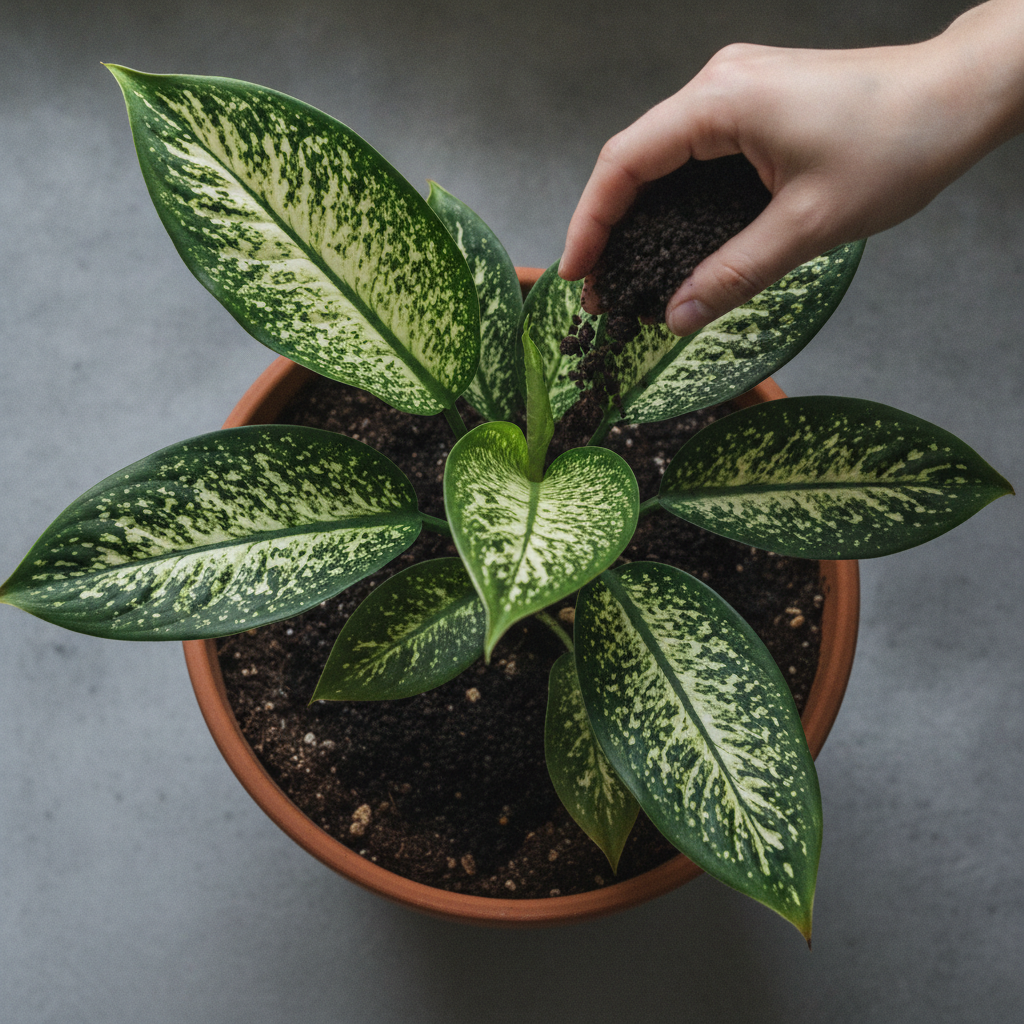
Fast growth comes at a nutritional cost, and the exotica dumb cane draws steadily on the nutrients in its soil to fuel its large leaves. Regular but gentle feeding through the growing season keeps foliage full-sized and richly coloured.
The key word is gentle. Dieffenbachia is more easily harmed by too much fertiliser than by too little, so a light, consistent approach beats occasional heavy feeding every time.
Understanding Plant Nutrients
Most balanced houseplant fertilisers list three headline numbers for nitrogen, phosphorus and potassium, the primary nutrients plants use in the largest quantities. Understanding what each one does helps you read a deficiency in the leaves and choose the right feed.
| Nutrient | Symbol | Primary Function | Deficiency Symptoms |
|---|---|---|---|
| Nitrogen | N | Leaf and stem growth, green colour | Pale, yellowing older leaves; slow growth |
| Phosphorus | P | Root development and energy transfer | Stunted growth, dull or purplish leaves |
| Potassium | K | Overall vigour and water regulation | Yellow or brown leaf margins |
| Calcium | Ca | Cell wall structure | Distorted, weak new growth |
| Magnesium | Mg | Core of the chlorophyll molecule | Yellowing between the veins of older leaves |
| Iron | Fe | Chlorophyll production | Yellowing between veins on new leaves |
Types of Fertiliser
Liquid fertilisers: The most popular choice for this plant, offering quick uptake and easy control. Dilute a balanced formula to half the recommended strength and apply it with your normal watering during the growing season.
Slow-release granular: Coated prills release nutrients gradually over several months, which suits growers who prefer a hands-off routine. Scatter them on the soil surface in spring and let watering do the rest.
Organic fertilisers: Worm castings, seaweed extract and gentle organic feeds nourish the plant slowly while supporting soil life. They are very forgiving and almost impossible to overapply, making them a safe choice for the fertiliser-shy.
Feeding Schedule
Feed roughly once a month from spring through late summer, when the plant is in active growth. As light levels fall in autumn, taper off and stop feeding entirely through winter, when the plant rests and cannot use the extra nutrients. Resume in spring as new growth appears.
Pro Tip — Feed at Half Strength: Dieffenbachia responds best to dilute, frequent feeding rather than occasional full-strength doses. Mixing your liquid feed to half the label rate reduces the risk of fertiliser burn while still supplying steady nutrition.
How to Fertilise
- Water the plant lightly first if the soil is very dry, to protect the roots.
- Mix a balanced liquid fertiliser to half the recommended strength.
- Apply it evenly across the soil surface until it begins to drain.
- Let the pot drain fully and empty any excess from the saucer.
- Flush the pot with plain water every couple of months to clear built-up salts.
Warning — Salt Build-Up: Mineral salts from fertiliser accumulate in the soil over time and can burn the roots, showing as crusty white deposits and brown leaf tips. Flushing the pot thoroughly with plain water every month or two washes these salts away and keeps the roots healthy.
Propagation
Propagating an exotica dumb cane is both practical and satisfying. As the plant ages it can shed its lowest leaves and reveal a length of bare cane, and propagation is the ideal way to rejuvenate a leggy specimen while multiplying your collection at the same time.
The plant grows from a fleshy, jointed stem, and almost any section of that stem bearing a node can be coaxed into forming a new plant. This makes stem cuttings and air layering the two most reliable methods, with division a bonus when a mature plant produces offsets at its base.
Understanding Nodes and Canes
A node is the slightly swollen band on the stem where a leaf once joined, and it holds the dormant buds and root initials from which new growth emerges. The bare, leafless portions of stem are known as canes, and even a plain length of cane will sprout roots and shoots as long as it contains at least one node. Recognising nodes is the single most useful skill in Dieffenbachia propagation, because every cutting you take must include one to succeed.
Stem Cuttings: Step-by-Step
Stem cuttings are the classic way to propagate a dumb cane and to turn one leggy plant into several. Take them in spring or summer for the fastest rooting, and always wear gloves because of the irritating sap.
- Using a clean, sharp knife, cut the bare cane into sections 5 to 8 cm (2 to 3 in) long, each containing at least one node.
- Lay the sections out for a few hours so the cut ends callus over and seal.
- Press each section horizontally, node facing up, half buried into moist propagation mix or damp sphagnum moss.
- Keep the container warm, around 21 to 24 degrees C (70 to 75 degrees F), and in bright indirect light.
- Maintain even moisture and cover loosely to hold humidity while allowing some airflow.
- Watch for shoots and roots over four to eight weeks, then pot up each rooted section once new leaves appear.
Pro Tip — Do Not Bury Too Deep: Cane sections rot easily if fully submerged in wet mix. Half-burying them horizontally with the node exposed to air gives the best balance of moisture and oxygen for rooting.
Air Layering: Step-by-Step
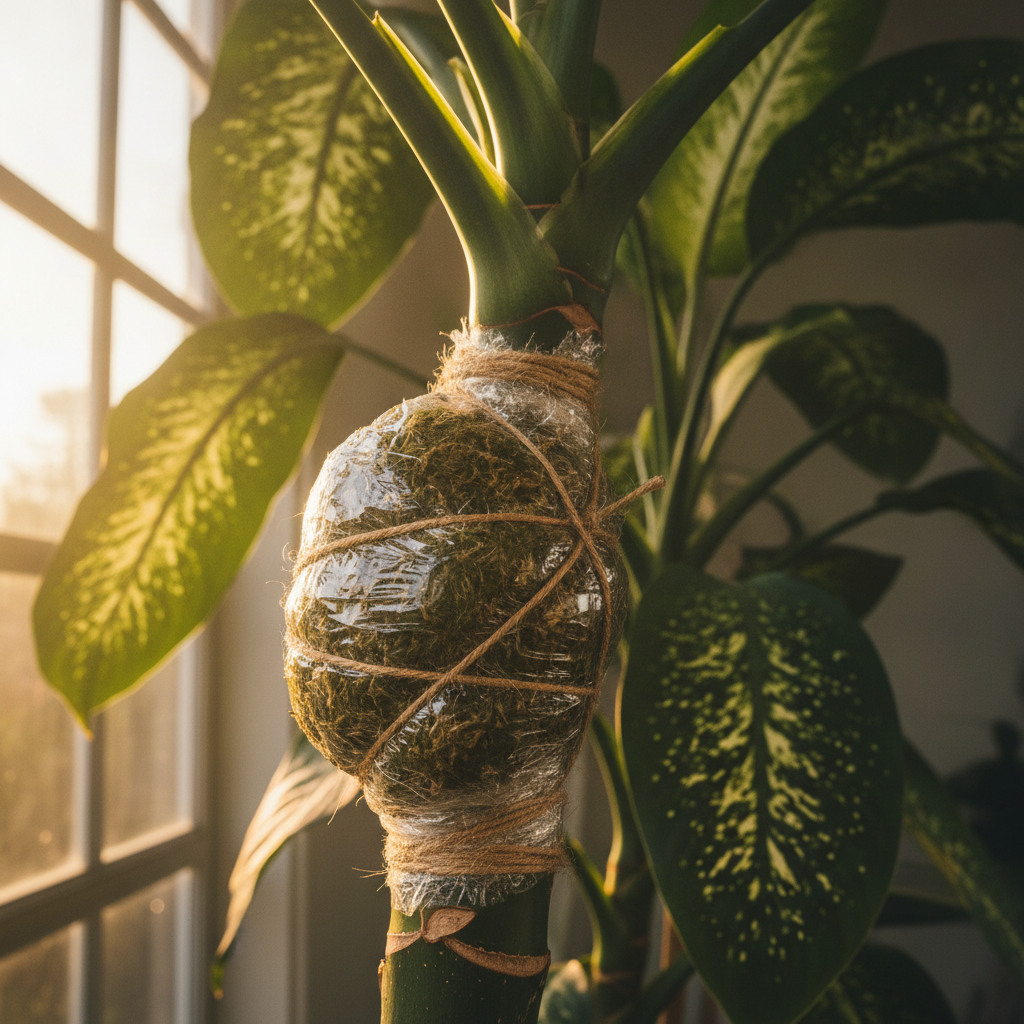
Air layering roots a section of stem while it is still attached to the parent plant, producing a large, established new plant with almost no risk. It is the best method for a tall, bare-stemmed exotica dumb cane you want to shorten and refresh.
- Choose a healthy point on the stem below the leafy crown and just above a node.
- Make a shallow upward cut or remove a thin ring of the outer stem to expose the tissue.
- Wrap the wounded area in a generous handful of damp sphagnum moss.
- Enclose the moss in clear plastic film and tie it securely above and below to hold in moisture.
- Keep the moss damp by opening the top and moistening it every week or so.
- Once roots fill the moss after several weeks, cut the stem just below the root ball and pot up the new plant.
Troubleshooting Propagation
| Problem | Likely Cause | Solution |
|---|---|---|
| Cutting turns soft and rots | Mix too wet or cut end not callused | Use fresh mix, callus cuts first, reduce moisture |
| No roots after many weeks | Too cold or no node included | Warm the container and ensure each piece has a node |
| Shoots appear but no roots | Normal early stage | Be patient and keep conditions stable |
| Moss dries out in air layering | Wrapping not sealed or not remoistened | Re-tie the film and dampen the moss weekly |
Pests & Diseases
A healthy, well-cared-for exotica dumb cane is reasonably resistant to trouble, but no houseplant is immune. Most problems arrive either on a newly bought plant or during the dry, low-light conditions of winter, so vigilance at those moments pays off.
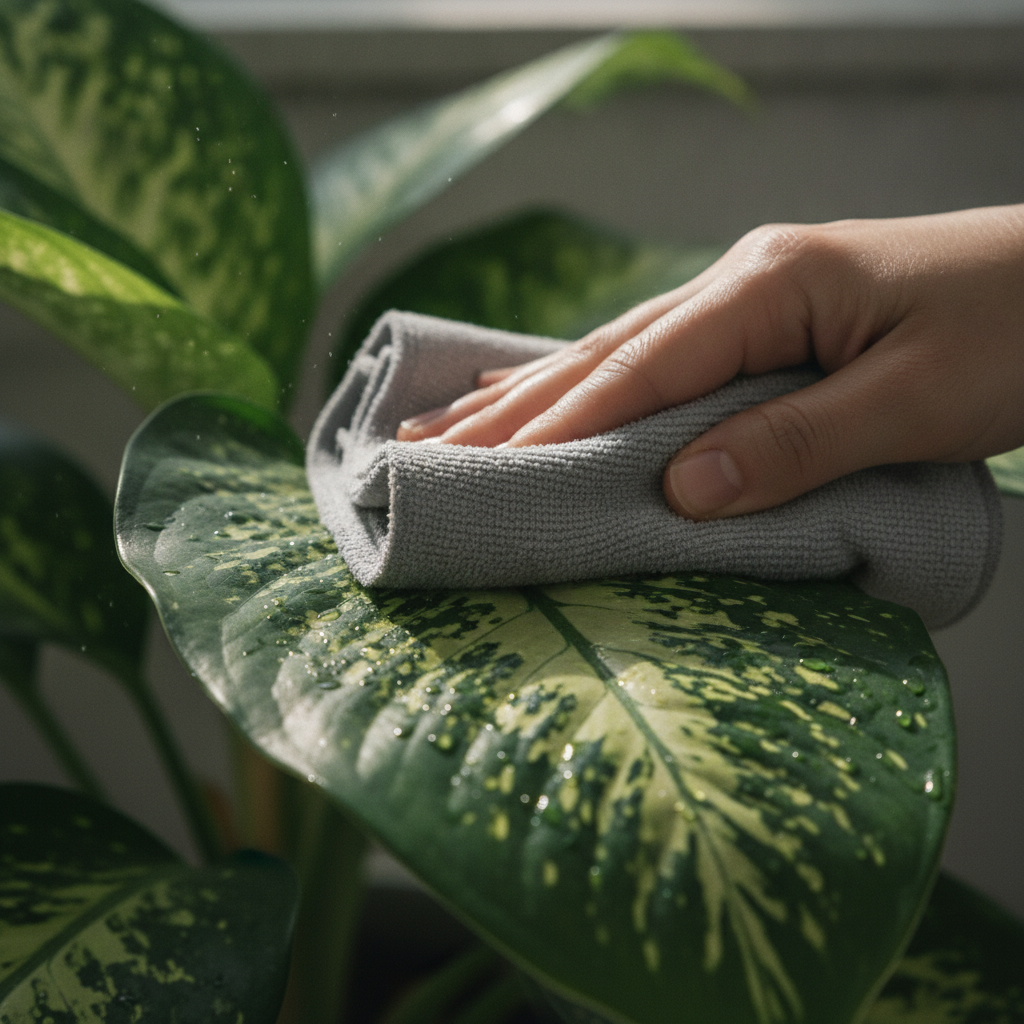
The best defence is a weekly glance at the leaves, especially their undersides and the joints where leaf meets stem. Catching an infestation while it is small makes treatment quick and the outcome certain.
Common Pests
Spider Mites (Tetranychus urticae)
These tiny sap-suckers thrive in warm, dry air and show as fine speckling on the leaves, with delicate webbing in the leaf axils in bad cases. They multiply fast, so act quickly.
Treatment: Rinse the plant thoroughly, then treat the foliage with insecticidal soap or diluted neem oil every few days, and raise humidity to make conditions less favourable to the mites.
Mealybugs (Pseudococcus longispinus)
Mealybugs look like small blobs of white cotton wool tucked into leaf joints and along the stem, where they weaken the plant by feeding on its sap and excrete sticky honeydew.
Treatment: Dab each bug directly with a cotton bud dipped in rubbing alcohol, then follow up with neem oil sprays and isolate the plant until no new insects appear.
Aphids (Aphis gossypii)
Aphids are small green, black or brown insects that cluster on soft new growth, distorting emerging leaves and leaving sticky residue behind. They are most common on stressed or overfed plants.
Treatment: Wash them off with a strong jet of water, then apply insecticidal soap to any survivors and check the fresh growth over the following week.
Common Diseases
Root Rot (Pythium and Phytophthora)
By far the most serious threat to Dieffenbachia, root rot follows chronic overwatering and poor drainage. It turns roots brown and mushy, softens the stem base, and causes the lower leaves to yellow and collapse.
Treatment: Unpot the plant, cut away all soft, discoloured roots and stem tissue with a sterilised blade, and repot the healthy remainder into fresh, well-draining mix. Then correct the watering routine that caused it.
Bacterial Leaf Spot (Erwinia and Xanthomonas)
This shows as dark, water-soaked spots with yellow halos that spread in warm, wet, poorly ventilated conditions, sometimes with an unpleasant smell in severe cases.
Treatment: Remove affected leaves promptly, avoid wetting the foliage when watering, improve airflow around the plant, and keep the leaves dry to halt the spread.
Pest and Disease Summary
| Pest / Disease | Identification | Treatment |
|---|---|---|
| Spider mites | Fine speckling and webbing | Rinse, insecticidal soap or neem, raise humidity |
| Mealybugs | White cottony blobs in leaf joints | Alcohol swabs and neem oil |
| Aphids | Clusters on new growth, sticky residue | Water jet and insecticidal soap |
| Root rot | Mushy roots, soft stem, yellow leaves | Cut away rot, repot dry, fix watering |
| Bacterial leaf spot | Dark spots with yellow halos | Remove leaves, keep foliage dry, improve airflow |
Prevention Strategies
Prevention is far easier than cure. Quarantine every new plant for a couple of weeks before it joins your collection, inspect the leaves regularly, and keep the foliage clean and dust-free so pests have nowhere to hide. Good cultural care, meaning correct watering, adequate light and sensible feeding, produces a vigorous plant that shrugs off most problems on its own.
Airflow and moisture management do most of the heavy lifting against disease. Avoid leaving water sitting on the leaves overnight, give the plant a little space rather than crowding it, and never let the pot stand in a saucer of water, and you will sidestep the great majority of fungal and bacterial troubles.
Pro Tip — Neem as Routine Defence: A light monthly spray of diluted neem oil on the leaves, especially the undersides, deters most sap-sucking pests before they establish. Apply it in the evening or out of direct light to avoid marking the foliage.
Popular Varieties
The name “exotica” covers a group of compact, heavily variegated Dieffenbachia selections rather than a single fixed clone, and it sits within a wider family of cultivars that share the same easy care but differ in leaf pattern, size and colour balance. Getting to know the most common of these helps you choose a plant to match your space and your taste.
All of the varieties below want the same conditions, namely bright indirect light, evenly moist but well-drained soil and steady warmth, so you can mix several in a collection without juggling different routines. What changes from one to the next is mostly the proportion of cream to green and the ultimate size of the plant.
| Variety | Leaf Appearance | Light Needs | Growth Rate | Availability |
|---|---|---|---|---|
| Exotica Compacta | Dense, rounded leaves, large cream centres | Bright indirect | Moderate | Common |
| Camille | Butter-cream centres, thin green edge | Bright indirect | Fast | Very common |
| Tropic Snow | Large leaves, bold cream banding along veins | Bright indirect | Fast | Common |
| Star Bright | Speckled green and cream, upright habit | Bright indirect | Moderate | Occasional |
| Compacta | Small, bushy, green with pale flecking | Medium to bright | Moderate | Common |
| Tropic Marianne | Broad cream centres, pale margins | Bright indirect | Fast | Occasional |
Featured Varieties
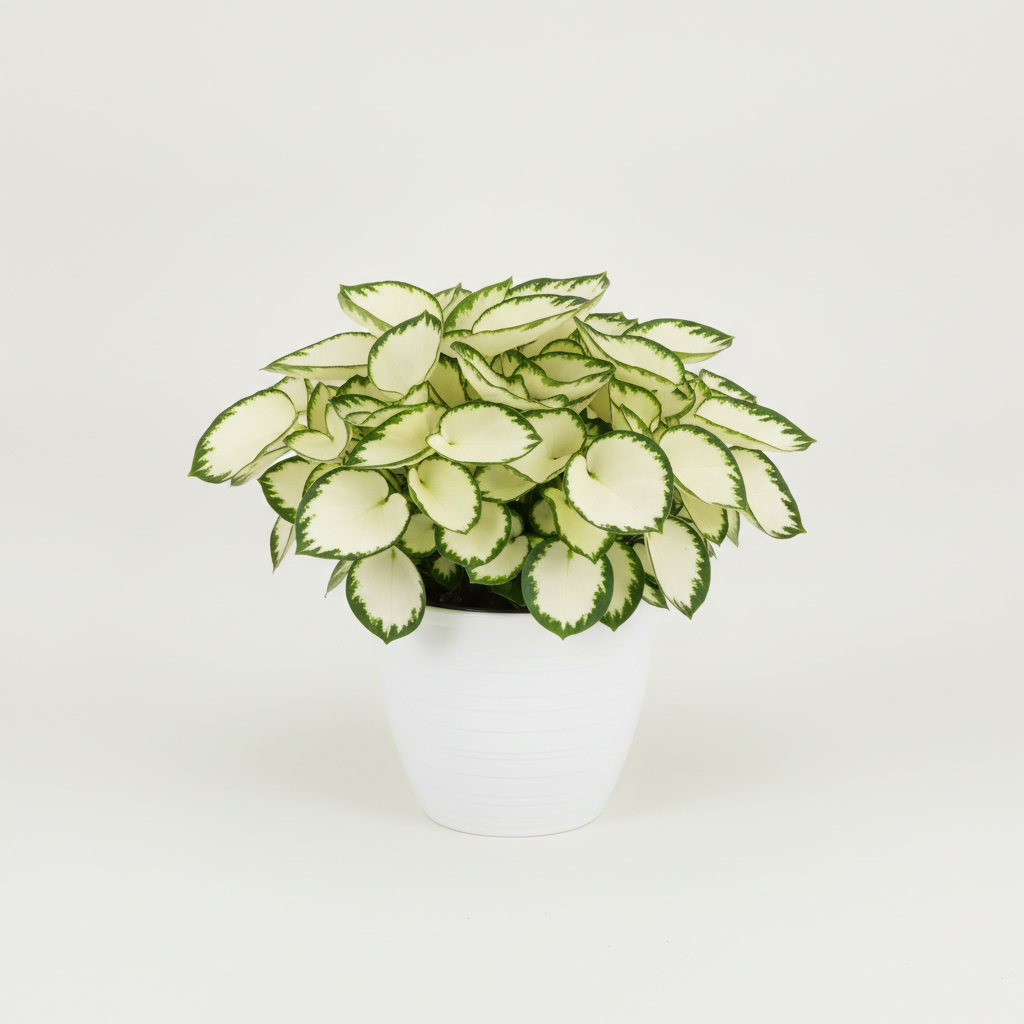
Exotica Compacta
The signature exotica form, a dwarf, densely leaved plant whose rounded leaves carry large creamy-white centres framed by narrow deep-green margins. Its tidy, bushy shape makes it a natural choice for tabletops and shelves.
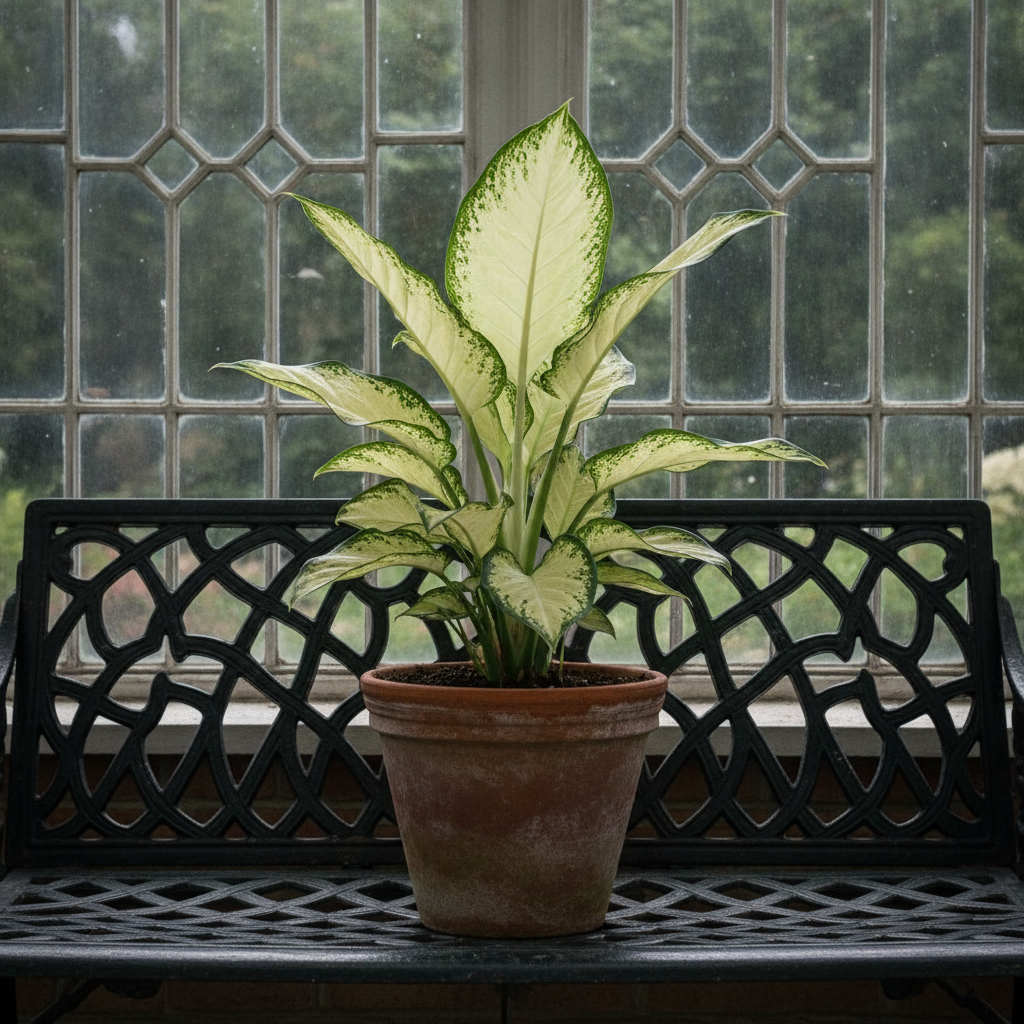
Camille
One of the most widely sold dumb canes, with upright leaves showing pale butter-cream centres and a thin, crisp green edge. It grows quickly and keeps its bright colour readily, making it an easy companion to the exotica form.
Variety Profiles in Detail
Tropic Snow (Dieffenbachia seguine ‘Tropic Snow’)
A larger, more statuesque variety whose broad leaves carry bold bands of cream feathering out from the midrib along the veins. It grows fast and tall, making it a fine floor plant where the compact exotica would be lost, though it needs a little more room to show off its size.
Star Bright (Dieffenbachia ‘Star Bright’)
An upright, more sculptural selection with leaves finely speckled in green and cream rather than boldly blocked, giving a softer, more textured look. It stays reasonably compact and rewards a bright spot with dense, well-marked foliage.
Choosing the Right Variety for Your Space
For a tabletop, shelf or desk, the compact exotica and Camille forms are the obvious picks, staying full and neat without outgrowing their spot. If you have a bright corner to fill at floor level, a fast, upright variety like Tropic Snow makes a bolder statement. Whichever you choose, prioritise a plant with strong, even variegation and firm, blemish-free leaves, as a healthy, well-coloured start makes every aspect of care easier from there.
Frequently Asked Questions
Is the exotica dumb cane poisonous to cats and dogs?
Yes. Like all Dieffenbachia, it contains calcium oxalate crystals that cause painful burning and swelling of the mouth and throat if chewed, along with drooling and vomiting. Keep it well out of reach of pets and children, and contact a vet or doctor if ingestion is suspected.
Why are the lower leaves on my plant turning yellow?
Occasional yellowing of the oldest, lowest leaves is natural as the plant ages. If several leaves yellow at once, the usual culprit is watering, either too much, which is more common, or too little. Check the soil moisture and the roots before adjusting your routine.
Why does my exotica dumb cane have brown leaf tips?
Brown, crispy tips usually point to low humidity, inconsistent watering, or a build-up of salts and minerals from tap water or fertiliser. Raise the humidity, water more evenly, and flush the pot with plain water periodically to clear accumulated salts.
How big does an exotica dumb cane get?
The compact exotica selection typically reaches 60 cm to 1 metre (2 to 3 ft) tall indoors, staying bushier and lower than the taller species and cultivars, which can climb well beyond that. Good light keeps it dense rather than stretched.
Why is my plant becoming leggy with a bare stem?
Legginess and a bare lower cane come from too little light, from natural leaf shedding with age, or from both together. Move the plant to a brighter spot, and consider air layering or taking cane cuttings to produce a fresh, full plant from the leggy one.
How often should I water my exotica dumb cane?
Rather than following a fixed calendar, water whenever the top 2 to 3 cm (1 in) of soil has dried. In practice this often means once or twice a week in summer and every week or two in winter, but always let the soil be your guide.
Can I grow an exotica dumb cane in a low-light room?
It will tolerate medium light, but true low light causes weak, greener growth and gradual decline. If your room is dim, either place the plant as close to the window as possible or add a full-spectrum grow light to keep it healthy and well coloured.
Why is my plant losing its cream variegation?
Fading variegation almost always signals insufficient light. The plant produces greener leaves to boost photosynthesis when it is short of light, so moving it somewhere brighter, but still out of direct sun, usually brings the cream markings back over the next few leaves.






