
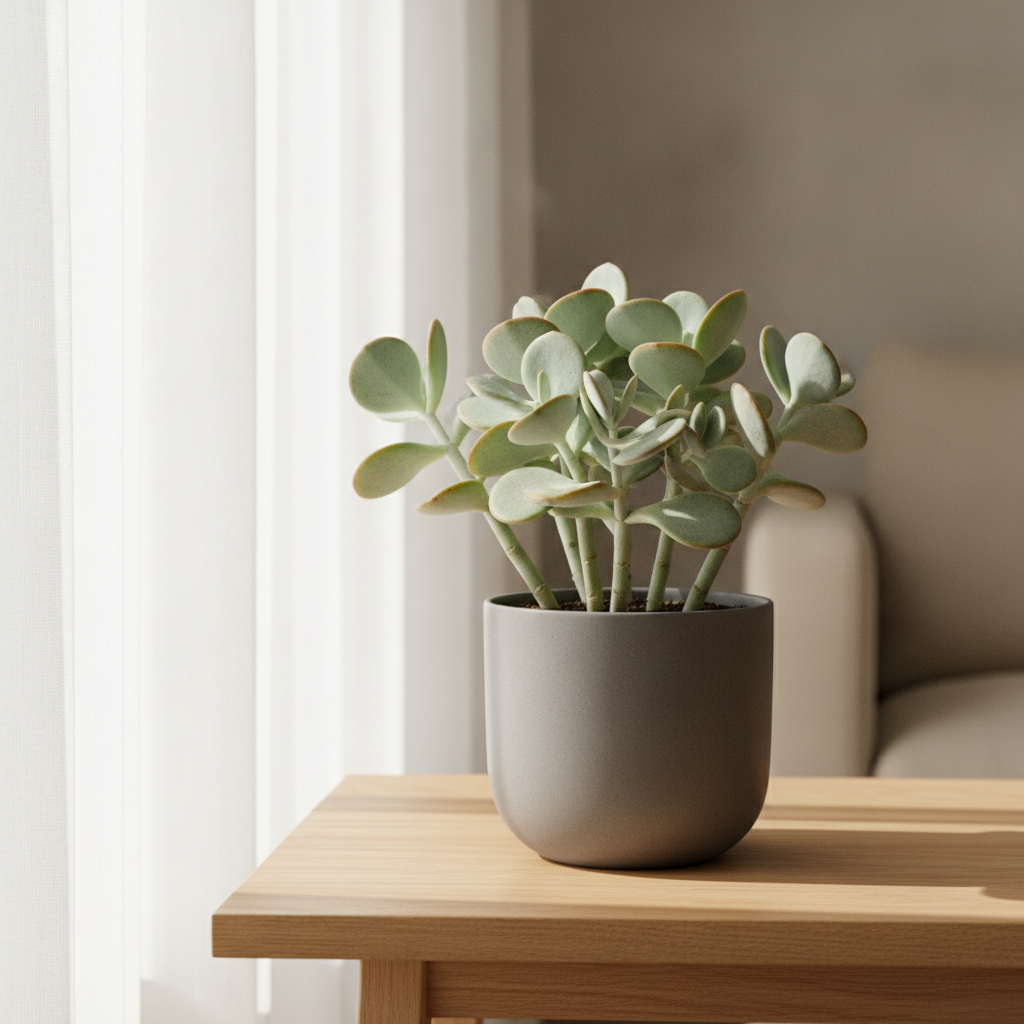
Few succulents carry themselves with the quiet, sculptural poise of the silver crown plant, Cotyledon orbiculata, a shrubby evergreen from the arid corners of southern Africa. Its rounded, paddle-shaped leaves are coated in a chalky white bloom called farina, giving the whole plant a frosted, almost ceramic appearance, and many forms finish each leaf with a thin line of red or maroon along the margin. Known variously as pig’s ear or round-leafed navel-wort, it belongs to the stonecrop family, Crassulaceae, and shares that family’s talent for storing water and shrugging off neglect.
As a houseplant, Cotyledon orbiculata has a reputation for being almost impossible to kill through forgetfulness, and almost easy to kill through kindness. The single most common cause of failure is too much water, not too little. Keeping one alive is straightforward once you accept how little it asks; getting one to truly thrive, colour up, stay compact and eventually send up its nodding orange bells, takes a little more understanding of light, drainage and dormancy. This guide walks through everything from the ideal windowsill to the plant’s genuinely serious toxicity, so you can grow a specimen that looks its silvered best year after year.
Contents
- Quick Reference
- Why the Silver Crown Plant Makes a Rewarding Houseplant
- Light Requirements
- Watering & Humidity
- Soil, Potting & Repotting
- Fertilising
- Propagation
- Pests & Diseases
- Popular Varieties
- Frequently Asked Questions
Quick Reference: Silver Crown Plant at a Glance
| Light | Bright light with several hours of direct sun; a south or west window indoors |
| Watering | Soak thoroughly, then let the soil dry out completely; roughly every 2 to 3 weeks in growth, far less in winter |
| Temperature | 18 to 24°C (64 to 75°F); protect from frost and keep above 5°C (41°F) |
| Humidity | Low; thrives in dry indoor air and dislikes damp, stagnant conditions |
| Fertiliser | A dilute low-nitrogen feed once or twice during spring and summer only |
| Toxicity | Toxic to pets, livestock and humans if eaten; contains cardiac glycosides |
Why the Silver Crown Plant Makes a Rewarding Houseplant
The appeal of Cotyledon orbiculata begins with its foliage. Each leaf is a plump, rounded oval, arranged in neat opposite pairs that stack up the fleshy stems into a shrubby little crown, and the whole surface is dusted with farina, a natural powdery wax the plant produces to reflect fierce sunlight and slow water loss. The result is a colour that ranges from soft sage to a striking chalky silver-blue, often outlined by a fine crimson edge that intensifies in strong light. Set against a terracotta pot or a plain wall, it reads as much as a piece of living sculpture as a plant.

Beyond looks, this is a forgiving plant for anyone who travels, forgets, or simply prefers a low-maintenance windowsill. Its swollen leaves and stems act as a built-in reservoir, so a fortnight without water is nothing to a healthy specimen. In its native South Africa and Namibia it grows on rocky slopes and in dry scrub, weathering drought, heat and grazing pressure, and that toughness translates directly to the home. Given a bright spot and a gritty mix, a silver crown plant will slowly build into a characterful shrub of 30 to 60cm (12 to 24in) indoors, and in summer a mature plant may throw up a tall stalk hung with pendulous orange to coral bell-shaped flowers that nod in the slightest draught. It is that combination of near-indestructibility and understated beauty that keeps it on collectors’ shelves and beginners’ windowsills alike.
Important — Toxicity: Every part of Cotyledon orbiculata contains cardiac glycosides, chiefly bufadienolides, which can cause vomiting, weakness, an irregular heartbeat and, in severe cases, more serious poisoning if the plant is eaten. It is well documented as toxic to sheep, goats and cattle, where it causes a condition known as krimpsiekte, and it should be treated as toxic to cats, dogs and children too. Site it well out of reach of pets and small children, and wash your hands after handling cut stems.
Light Requirements
Light is the single factor that separates a lush, silvered, compact silver crown plant from a pale, stretched and floppy one. This is a full-sun succulent by nature, adapted to open, exposed habitats where it bakes for much of the day, and indoors it wants the brightest position you can offer. The powdery farina that gives the leaves their colour is essentially the plant’s own sunscreen, so the more light it receives, the more of that protective bloom it produces and the more intense the silver and red tones become.
Aim for at least four to six hours of direct sun a day, ideally more. A windowsill that receives bright, unfiltered light for most of the day will keep the rosettes tight and the internodes short. In too little light the plant stretches, a process called etiolation, producing long weak stems with widely spaced leaves that lose much of their compact charm and never fully recover their form.

Light Levels Explained
Understanding where your home sits on the light spectrum makes placement far easier. The table below sets out the broad categories, with rough light readings in lux, and what to expect from a silver crown plant in each.
| Light Category | Approx. Level | Typical Location | Outcome |
|---|---|---|---|
| Direct sun | 50,000 lux and above | On a south or west windowsill | Ideal; compact growth, strong colour and best flowering |
| Bright indirect | 10,000 to 25,000 lux | Just back from a sunny window | Acceptable; growth a little softer, colour slightly muted |
| Medium | 5,000 to 10,000 lux | An east window or a bright room interior | Survives but stretches over time; farina thins |
| Low | 1,000 to 5,000 lux | A north room or well inside | Poor; etiolation, leaf drop and eventual decline |
| Very low | Below 1,000 lux | A dim corner or hallway | Unsuitable; the plant will slowly fail |
Window Orientation and Placement
South-facing window: In the northern hemisphere this is the prime spot, delivering long hours of strong light that suit the plant perfectly. Push the pot right up to the glass and the plant will reward you with tight growth and vivid colour.
West-facing window: An excellent second choice, offering intense afternoon sun. The warmth of a west window in summer is well tolerated by this heat-loving species, though watch for scorch on plants moved there suddenly.
East-facing window: Workable but on the low side. Morning sun is gentler and shorter, so an east window tends to produce softer, slightly stretched growth. Consider supplementing with a grow light if this is your only option.
North-facing window: Generally too dim for a silver crown plant to prosper. Without direct sun the plant etiolates and the farina fails to develop, so a north aspect is best avoided unless paired with strong artificial light.
Pro Tip — Acclimatise to Prevent Scorch: A plant grown in modest light, whether newly bought or wintered indoors, can burn if suddenly moved into blazing sun. Introduce it to brighter conditions over 10 to 14 days, adding an hour or so of direct light each day, to let it thicken its protective farina before full exposure.
How Light Affects Leaf Colour and Farina
The silvery bloom and red leaf edges that make this plant so desirable are both light-driven. In strong sun the plant lays down a thick, reflective coat of farina and pushes anthocyanin pigments into the leaf margins, producing that clean chalky blue-white finish rimmed in crimson. In weaker light the leaves revert towards plain green, the powder thins, and the red edging fades. If your specimen has lost its colour, the cause is almost always insufficient light rather than any nutritional problem.
Warning — Direct Sunlight: Although this is a sun-lover, glass can amplify heat and an unacclimatised plant may scorch, leaving permanent tan or brown patches on the leaves. Take particular care behind south and west windows during summer heatwaves, and never mist the leaves in direct sun, as water droplets can act like tiny lenses and leave burnt spots.
Artificial Lighting
Where natural light falls short, a full-spectrum LED grow light fills the gap well. Position it 20 to 30cm (8 to 12in) above the plant and run it for 12 to 14 hours a day to mimic a bright growing season. Succulents like this one need genuinely strong output to stay compact, so a decent horticultural fixture rather than a token bulb is worth the investment, especially through the short days of winter in temperate climates.
Seasonal Adjustments
Light intensity swings enormously between summer and winter indoors. In the brighter months you may need to shade a plant from the very hottest midday glare behind south glass, while in winter you should move it to the sunniest available position and accept slower growth. Many growers find their silver crown plant does most of its growing in the cooler, brighter parts of the year and rests over the hottest, driest weeks, so let the plant’s own rhythm guide how much light and water you give.
Watering & Humidity
If there is one skill that makes or breaks success with the silver crown plant, it is watering. As a leaf and stem succulent from a dry climate, Cotyledon orbiculata stores its own water and expects long gaps between drinks. The golden rule is to water thoroughly but infrequently, always allowing the soil to dry out completely before the next watering. More silver crown plants are lost to root rot from a well-meaning watering can than to any drought.
When to Water
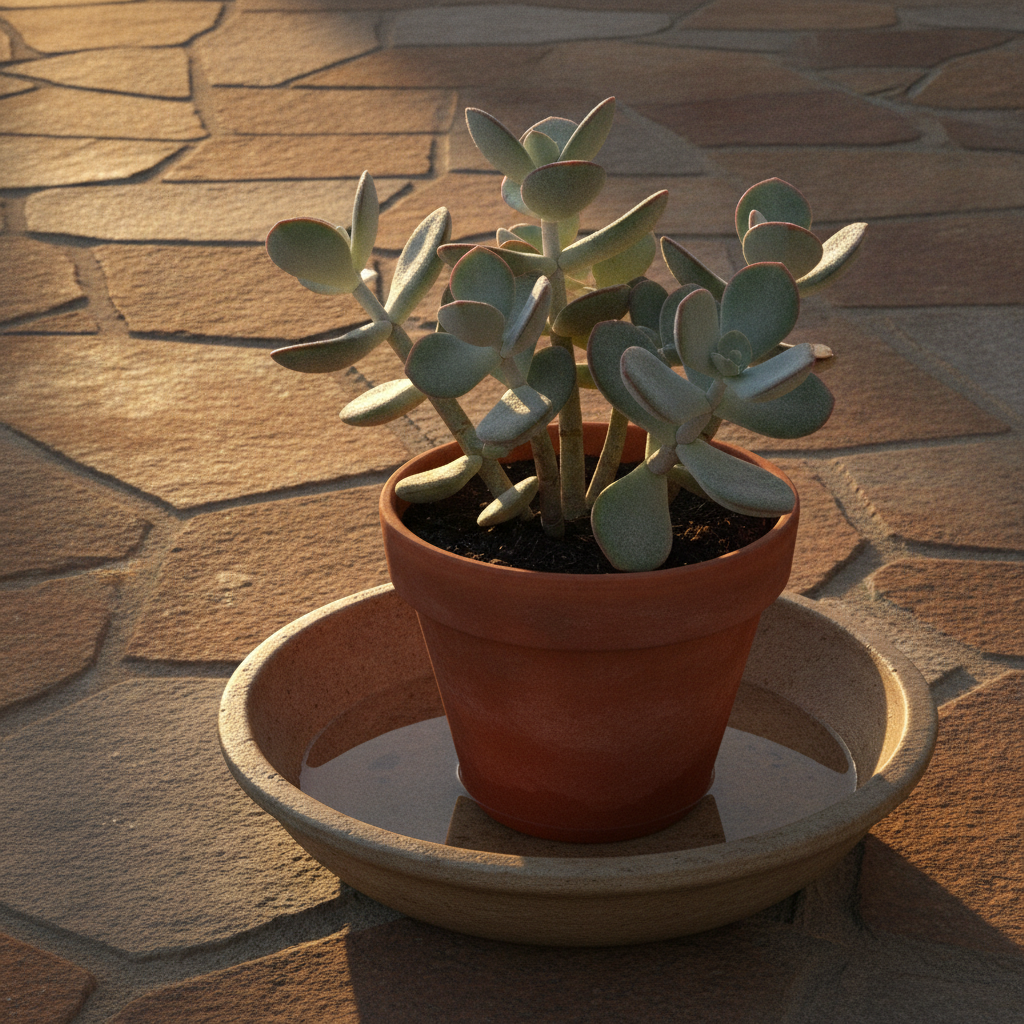
Forget any fixed schedule and read the plant and the pot instead. The soak-and-dry method is the reliable approach: water deeply, then wait until the potting mix is bone dry all the way through before watering again. In practice, during active growth in spring and summer, that often works out at roughly once every two to three weeks, but the interval depends entirely on your light, warmth, pot size and mix.
The most trustworthy signals come from the plant and soil themselves. Push a finger or a wooden skewer several centimetres into the mix; if any moisture clings, wait. The leaves offer a second gauge, since a slightly soft, less turgid leaf tells you the reservoir is running low and a drink is due, whereas firm, plump leaves mean the plant is fully charged and needs nothing. Lifting the pot to feel its weight is another good habit, as a dry pot is noticeably lighter than a freshly watered one.
Pro Tip — Water Less in Winter: As light and temperatures fall, the plant’s water use drops sharply. Through the coldest, darkest weeks reduce watering to a bare minimum, perhaps a small drink once a month or even less, just enough to stop the leaves shrivelling. A cold, wet rootball in winter is the classic recipe for rot.
How to Water Correctly
- Check that the top few centimetres of soil, and ideally the whole pot, are completely dry before you begin.
- Water at the base of the plant, directing the flow onto the soil and keeping it off the powdery leaves, which mark easily where the farina is disturbed.
- Apply enough water that it runs freely from the drainage holes, wetting the entire rootball rather than just the surface.
- Let the pot drain fully and tip away any water collected in the saucer or cachepot so the roots never sit in it.
- Return the plant to its bright spot and do not water again until the mix has dried out entirely.
Because the leaves are so easily blemished, many growers prefer to water from below. Standing the pot in a shallow tray of water for 10 to 20 minutes lets the mix draw moisture up through the drainage holes, soaking the roots without ever wetting the foliage. Remove the pot once the surface feels just damp and let it drain.
Signs of Overwatering vs. Underwatering
| Symptom | Overwatering | Underwatering |
|---|---|---|
| Leaf colour | Yellowing, translucent or blackening leaves | Dull, slightly faded colour |
| Leaf texture | Soft, mushy, water-soaked and squashy | Wrinkled, thin, soft but not slimy |
| Leaf behaviour | Lower leaves drop off at the slightest touch | Leaves shrivel and may dry from the tips |
| Soil | Stays wet for a long time, may smell sour | Bone dry and pulling away from the pot |
| Stem base | Black, soft or collapsing at soil level | Firm but the whole plant looks deflated |
The two problems are easy to tell apart with a little practice. An underwatered plant recovers quickly and fully once watered, plumping its leaves back up within a day or two. An overwatered plant that has begun to rot rarely recovers unless you act fast, so when in doubt, err firmly on the side of dryness.
Warning — Root Rot: Soft, translucent lower leaves and a blackening stem base signal root rot, the leading killer of this species. If you catch it, unpot the plant at once, cut away all mushy black roots and tissue with a clean blade, let the healthy remainder callus for a few days, and replant into fresh dry gritty mix. Often the surest rescue is to take firm stem cuttings from the top and start again.
Humidity Requirements
Unlike the tropical foliage plants that crave a moist atmosphere, the silver crown plant is thoroughly at home in dry air. It evolved in an arid climate and copes happily with the low humidity of a centrally heated room, typically anywhere from 30 to 50 percent. There is no need to mist, group for humidity, or run a humidifier for this plant.
In fact, excess humidity works against it. Damp, still air encourages fungal problems and can cause the leaves to rot, particularly in cool conditions. If your plant sits in a humid bathroom or a crowded, poorly ventilated corner and shows soft spots or mildew, the remedy is more airflow and drier surroundings, not less.
Good air circulation is the useful companion to low humidity here. A gently moving current of air helps the soil surface dry, keeps fungal spores from settling, and toughens the plant, so an open, airy position suits it far better than a sheltered, stagnant one.
Water Quality
The silver crown plant is not fussy about water quality and tolerates ordinary tap water in most areas. In regions with very hard water you may see faint mineral spotting on the pot or soil surface over time, though this rarely troubles the plant. If you would rather avoid any residue, rainwater or filtered water works well. Whatever you use, let cold water reach room temperature before applying it, since an icy drink can shock the roots of a warmth-loving succulent.
Soil, Potting & Repotting
Drainage is everything for this plant. In the wild it roots into gritty, fast-draining ground where water rushes away within minutes of rain, and it expects the same in a pot. A dense, moisture-retentive potting compost holds water around the roots far too long and is the fastest route to rot, so the aim is an open, mineral-rich mix that dries quickly and admits plenty of air.
Ideal Soil Composition
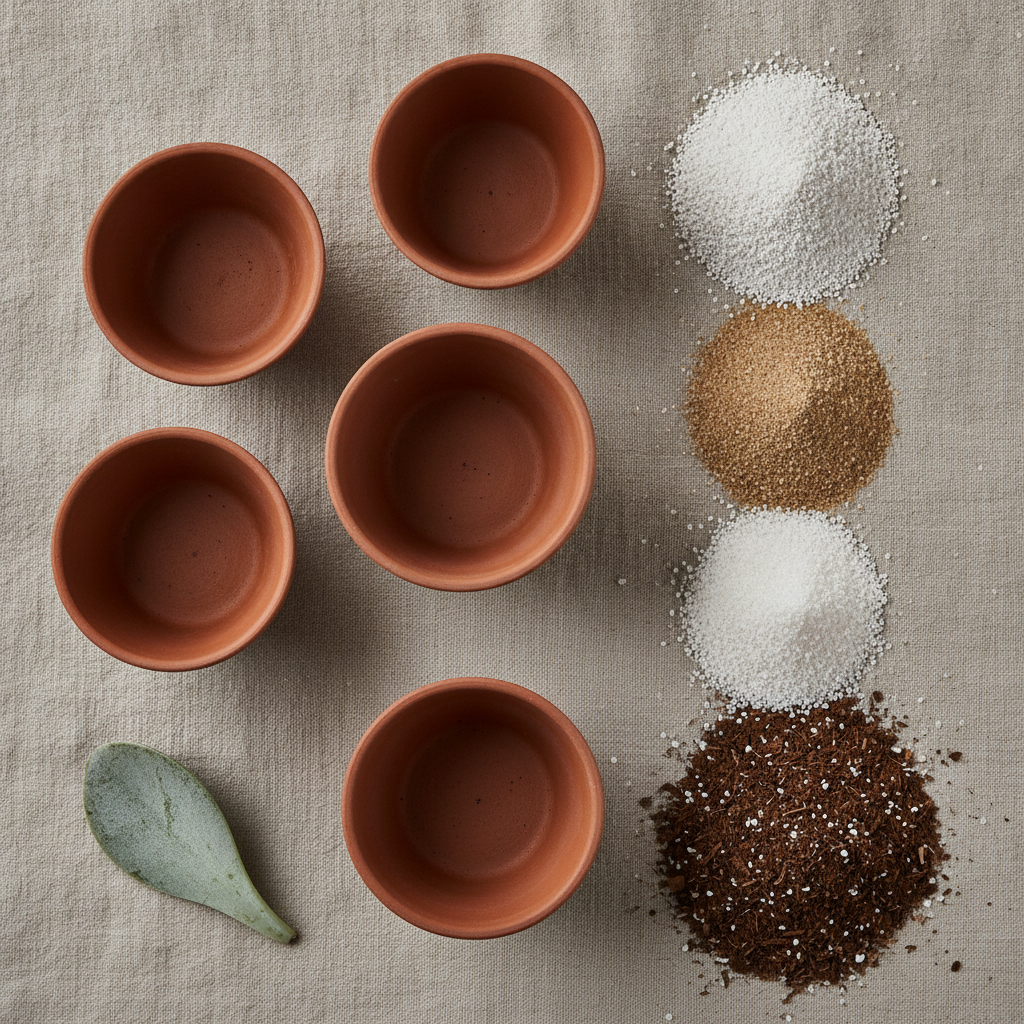
A good silver crown plant mix leans heavily towards grit. A ready-made cactus and succulent compost is a fine starting point, but most benefit from extra mineral material to open them up further. The idea is a substrate that is at least half coarse, inorganic grit by volume, holding just enough organic matter to retain a little moisture and nutrition.
| Component | Proportion | Function |
|---|---|---|
| Cactus or succulent compost | Around one third | Provides some moisture retention and light nutrition |
| Pumice or coarse perlite | Around one third | Creates air pockets and speeds drainage |
| Coarse horticultural sand or fine gravel | Around one third | Adds weight, grit and rapid water passage |
The plant is relaxed about soil pH, growing well anywhere from slightly acidic to slightly alkaline, roughly pH 6.0 to 7.5. There is no need to test or adjust it; a standard succulent mix falls comfortably within this range. Far more important than pH is the physical structure of the mix and its ability to drain freely.
Pro Tip — Quick Mix Recipe: For a reliable blend, combine two parts cactus compost, two parts pumice or perlite, and one part coarse sand, then add a handful of fine gravel for extra weight and drainage. If you can pour water through a handful and watch it run straight out, you have the texture right.
Choosing the Right Pot
The container matters almost as much as the mix. A pot that helps the soil dry, and that suits the plant’s slow, top-heavy growth, makes watering far more forgiving and keeps the roots healthy.
Drainage holes are non-negotiable. Never pot a silver crown plant into a container without drainage. Standing water at the base of a closed pot will rot the roots within days, whatever mix you use. If you love a decorative cachepot with no hole, keep the plant in a plain nursery pot inside it and lift it out to water.
Pot material: Unglazed terracotta is the ideal choice, as its porous walls wick moisture out of the mix and let it breathe, working with the plant’s need for dryness. Glazed ceramic and plastic hold moisture longer, so if you use them, water even more sparingly to compensate.
Pot size: Choose a snug pot only a little larger than the rootball. An oversized container holds a large volume of damp soil that the modest roots cannot use, keeping the mix wet for too long. As the plant grows tall it can become top-heavy, so a slightly heavier or wider-based pot helps keep it stable.
When to Repot
The silver crown plant is slow-growing and positively enjoys being a little pot-bound, so it needs repotting only every two to three years, or when roots begin to escape the drainage holes and the plant looks obviously crowded. The best time is early in the growing season, in spring, when the plant can quickly settle into fresh mix. Repotting is also your chance to inspect the roots for any early signs of rot and to refresh a mix that has broken down and become too water-retentive.
How to Repot: Step-by-Step
- Let the soil dry out fully first, as a dry rootball slides from the pot more cleanly and the roots handle better.
- Ease the plant out by gently squeezing a flexible pot or running a knife around the inside of a rigid one, supporting the base of the stems as you lift.
- Crumble away most of the old mix and inspect the roots, trimming off any that are black, soft or dead with a clean, sharp blade.
- Choose a pot just one size up with good drainage, and part-fill it with your gritty succulent mix.
- Set the plant at the same depth it grew before, never burying the stems deeper, and fill around the roots with mix, firming gently.
- Top the surface with a thin layer of grit if you like, both for looks and to keep the stem base dry.
- Wait a week before watering, giving any disturbed or trimmed roots time to callus and heal.
Warning — Transplant Shock: Resist the urge to water immediately after repotting. Freshly cut or bruised roots are prone to infection, and watering into that damage invites rot. Give the plant several dry days in bright, indirect light to recover before its first drink in the new pot.
Fertilising
The silver crown plant is a light feeder that grows lean and healthy in poor, gritty ground, so its fertiliser needs are modest. In its natural habitat it survives on thin mineral soils, and overfeeding indoors does far more harm than good, producing soft, sappy growth that stretches and loses colour. A little feed at the right time supports steady growth, but restraint is the guiding principle.
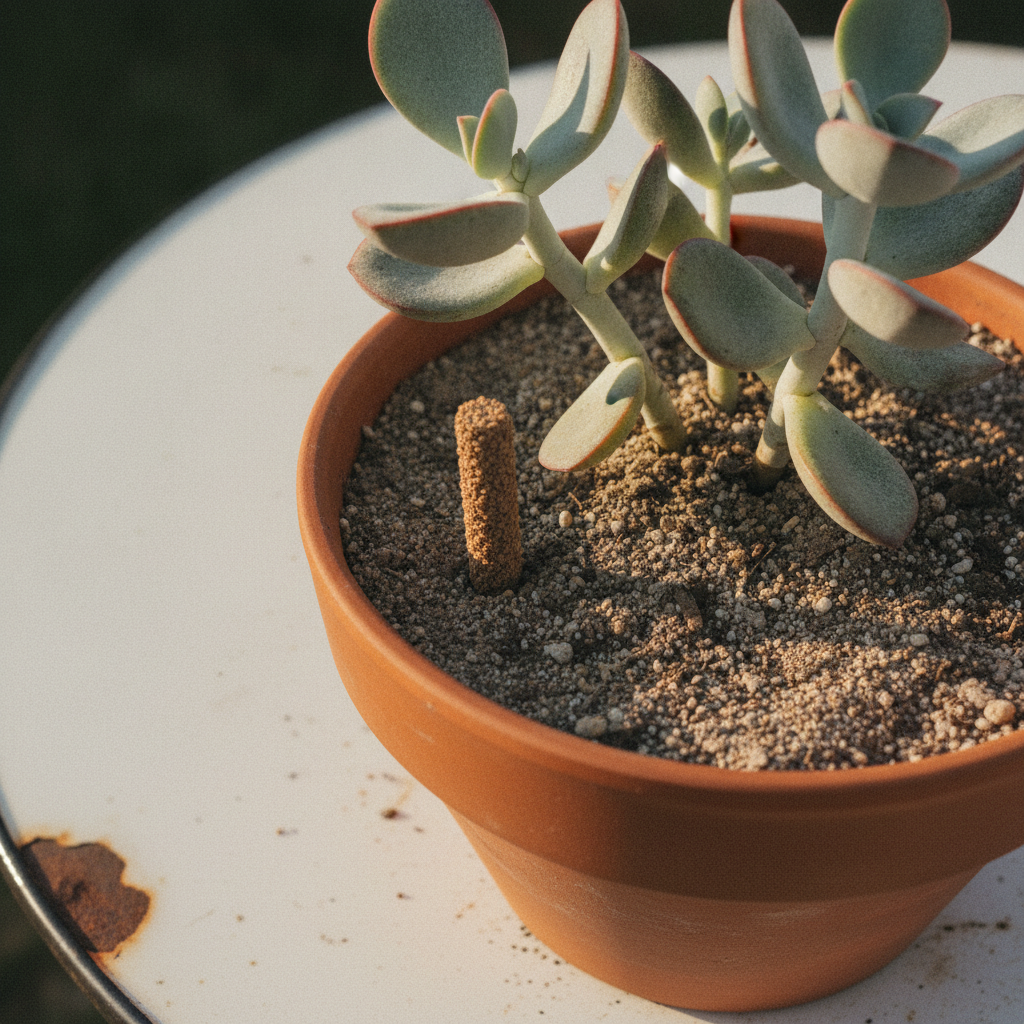
Feed only during the active growing season, and always at reduced strength. A single feed in spring and perhaps one more in summer is plenty for most plants. Never fertilise a dormant or resting plant, and never feed one that is stressed, newly repotted or sitting in dry soil.
Understanding Plant Nutrients
Fertilisers are labelled with an N-P-K ratio, standing for nitrogen, phosphorus and potassium, the three major nutrients. For a succulent like this one a balanced or low-nitrogen formula is best, as too much nitrogen drives the leggy, water-soft growth you want to avoid. The table below outlines the key nutrients and the signs of deficiency, though genuine deficiency is rare in a plant fed even occasionally.
| Nutrient | Symbol | Primary Function | Deficiency Symptoms |
|---|---|---|---|
| Nitrogen | N | Drives leaf and stem growth | Pale, slow, stunted new growth |
| Phosphorus | P | Supports roots and flowering | Weak roots and poor flowering |
| Potassium | K | Overall vigour and stress tolerance | Yellowing leaf edges, soft growth |
| Calcium | Ca | Builds strong cell walls | Distorted, weak new leaves |
| Magnesium | Mg | Central to chlorophyll | Yellowing between leaf veins |
| Iron | Fe | Aids chlorophyll production | Pale young leaves with green veins |
Types of Fertiliser
Liquid fertilisers: A liquid succulent or cactus feed diluted to half or quarter strength is the easiest option, giving you full control over timing and dose. Apply it to already-moist soil during a normal watering in the growing season.
Slow-release granular: A small amount of slow-release succulent fertiliser worked into the mix at repotting time feeds gently over several months. Use it sparingly, as these products keep releasing nutrients and it is easy to overdo.
Organic fertilisers: A light top-dressing of worm castings or a very dilute organic feed suits those who prefer a natural approach. Organic options release slowly and gently, which fits this plant’s modest appetite, though they should still be used with a light hand.
Feeding Schedule
Keep it simple. Feed once as growth begins in spring and, if the plant is growing strongly, once more in early summer, using a diluted low-nitrogen feed each time. Stop entirely from late summer onwards so the plant is not pushed into soft growth heading into the darker, cooler months. Through autumn and winter give no fertiliser at all.
Pro Tip — Less Is More: When it comes to feeding succulents, underfeeding is always safer than overfeeding. If you are unsure whether to fertilise, skip it. A silver crown plant will grow perfectly well on a single dilute feed a year, whereas a heavily fed one loses its compact shape and silvery colour.
How to Fertilise
- Dilute a succulent or balanced houseplant fertiliser to half strength or weaker, following the label as your maximum rather than your target.
- Water the plant lightly first, or feed during a normal watering, so the roots are never fed into dry soil.
- Apply the diluted feed to the soil at the base of the plant, keeping it off the powdery leaves.
- Flush the pot with plain water every few months during the growing season to wash out any accumulated mineral salts.
Warning — Salt Build-Up: Fertiliser salts can accumulate in the mix and scorch the roots, showing as brown, crisp leaf tips or a white crust on the soil. Prevent this by feeding sparingly and by periodically drenching the pot with plain water until it runs freely from the base, carrying the excess salts away.
Propagation
One of the joys of the silver crown plant is how readily it multiplies. Like most members of the Crassulaceae, it roots easily from pieces of itself, so a single plant can become many with almost no equipment. Propagation is also the perfect way to rescue a rotting plant, refresh a leggy old specimen, or simply share a favourite with friends.
The most reliable method by far is stem cuttings, which root quickly and grow away true to the parent. Leaf cuttings are possible but far less dependable in this species than in some other succulents, so stem cuttings are the technique to master first. Whichever you try, the season matters: take cuttings in spring or summer when the plant is in active growth and healing is fastest.
Understanding Callusing
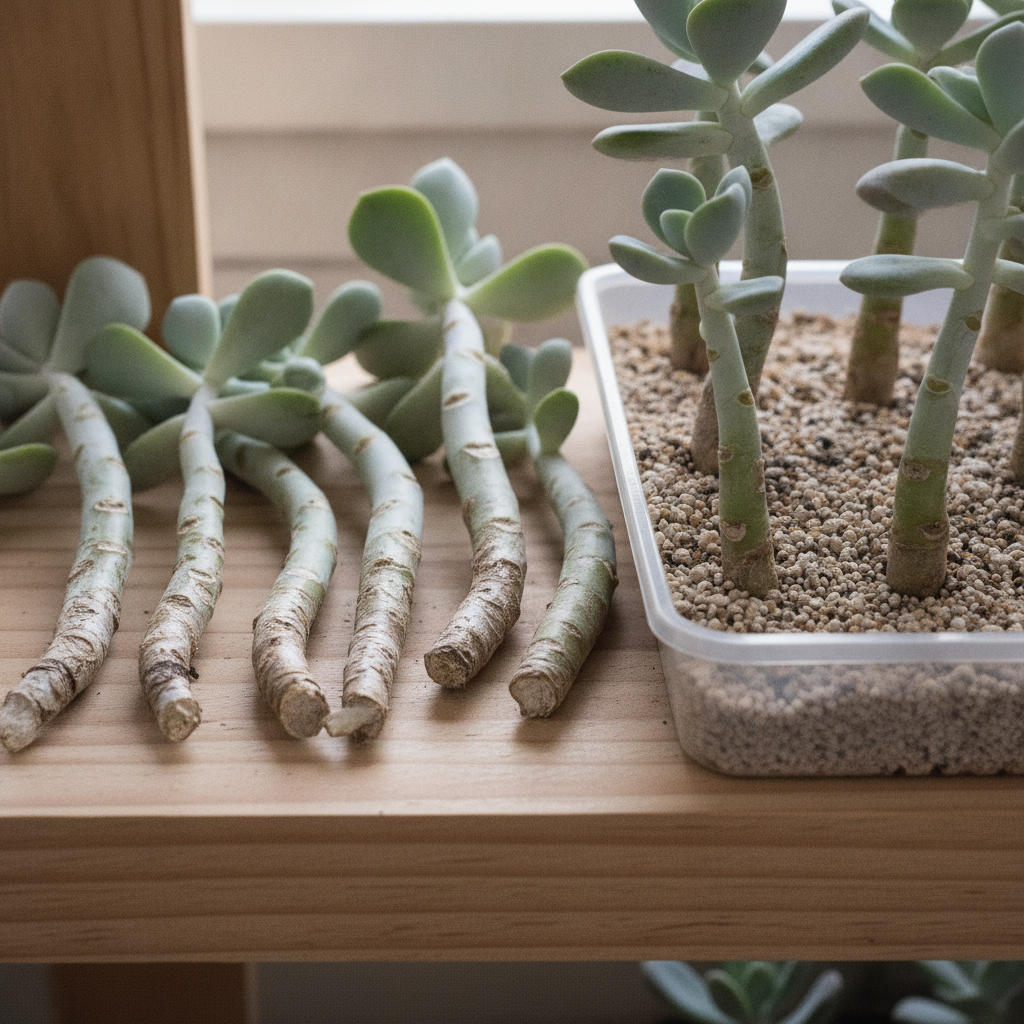
The single most important step in succulent propagation is callusing. When you cut a stem or remove a leaf, the wound is an open door to rot if it meets damp soil straight away. Left in the open air for a few days, the cut surface dries and forms a protective callus, a hardened seal over which new roots can safely emerge. Skipping this step is the commonest reason cuttings fail, so patience at the start pays off in far higher success rates.
Stem Cuttings: Step-by-Step
Stem cuttings are the go-to method, quick, forgiving and ideal for reshaping a plant that has grown tall and bare at the base. A leggy, etiolated plant can be beheaded and its top rooted as a fresh, compact specimen while the stump often resprouts.
- Using a clean, sharp knife, cut a healthy stem tip 8 to 12cm (3 to 5in) long, just above a pair of leaves on the parent.
- Remove the lowest pair or two of leaves to expose a short length of bare stem for planting.
- Set the cutting aside in a dry, airy, shaded spot for three to seven days until the cut end forms a firm callus.
- Insert the callused end a few centimetres into barely moist, gritty succulent mix, firming it just enough to stand upright.
- Keep the pot in bright, indirect light and leave it dry for the first week, then water very lightly and let it dry again between waterings.
- After three to four weeks, a gentle tug should meet resistance, showing roots have formed, after which you can treat it as an established plant.
Pro Tip — Keep Cuttings on the Dry Side: Succulent cuttings rot in wet compost far more often than they dry out. Water only lightly and infrequently until roots are clearly established, and keep the mix on the dry side of just-moist. A cutting can wait patiently for weeks, but it cannot recover from rot.
Leaf Cuttings: Step-by-Step
Leaf cuttings are worth trying as a bonus method, though results are hit and miss with Cotyledon orbiculata. The key is to take a whole, undamaged leaf cleanly, since a leaf torn without its base will not sprout.
- Gently twist a plump, healthy leaf sideways off the stem so it comes away whole, with its base intact.
- Lay the leaf on a dry surface out of direct sun for a few days until the broken end calluses over.
- Rest the callused leaf on top of, or just barely into, gritty succulent mix, base end down.
- Place it in bright, indirect light and mist the soil surface only very lightly every few days, never soaking it.
- Watch over the following weeks for tiny roots and a small rosette forming at the base, then pot the young plantlet on once it is established.
Troubleshooting Propagation
| Problem | Likely Cause | Solution |
|---|---|---|
| Cutting turns soft and black | Rot from planting too soon or watering too much | Allow a longer callus period and keep the mix drier |
| Cutting shrivels and dries up | Left too long unplanted or kept too dry after rooting | Plant sooner after callusing and give occasional light water |
| No roots after many weeks | Cool temperatures or a dormant season | Wait for warmer, brighter conditions in spring or summer |
| Leaf cutting withers without rooting | Leaf taken without an intact base, or the species’ low success rate | Take whole leaves cleanly, or switch to more reliable stem cuttings |
Pests & Diseases
A healthy silver crown plant grown in bright light and dry, gritty soil is remarkably trouble-free. Its tough, waxy leaves deter many pests, and its dislike of damp keeps most diseases at bay. Nearly all the problems it does encounter trace back to overwatering or poor air movement rather than to any inherent weakness.
Prevention is far easier than cure. Inspect new plants before bringing them home, quarantine recent purchases for a couple of weeks, and check your plant now and then, paying attention to the leaf axils and the undersides where pests like to hide. Catching an infestation early, when it is a handful of insects rather than a colony, makes treatment quick and simple.
Common Pests
Mealybugs (Pseudococcus species)
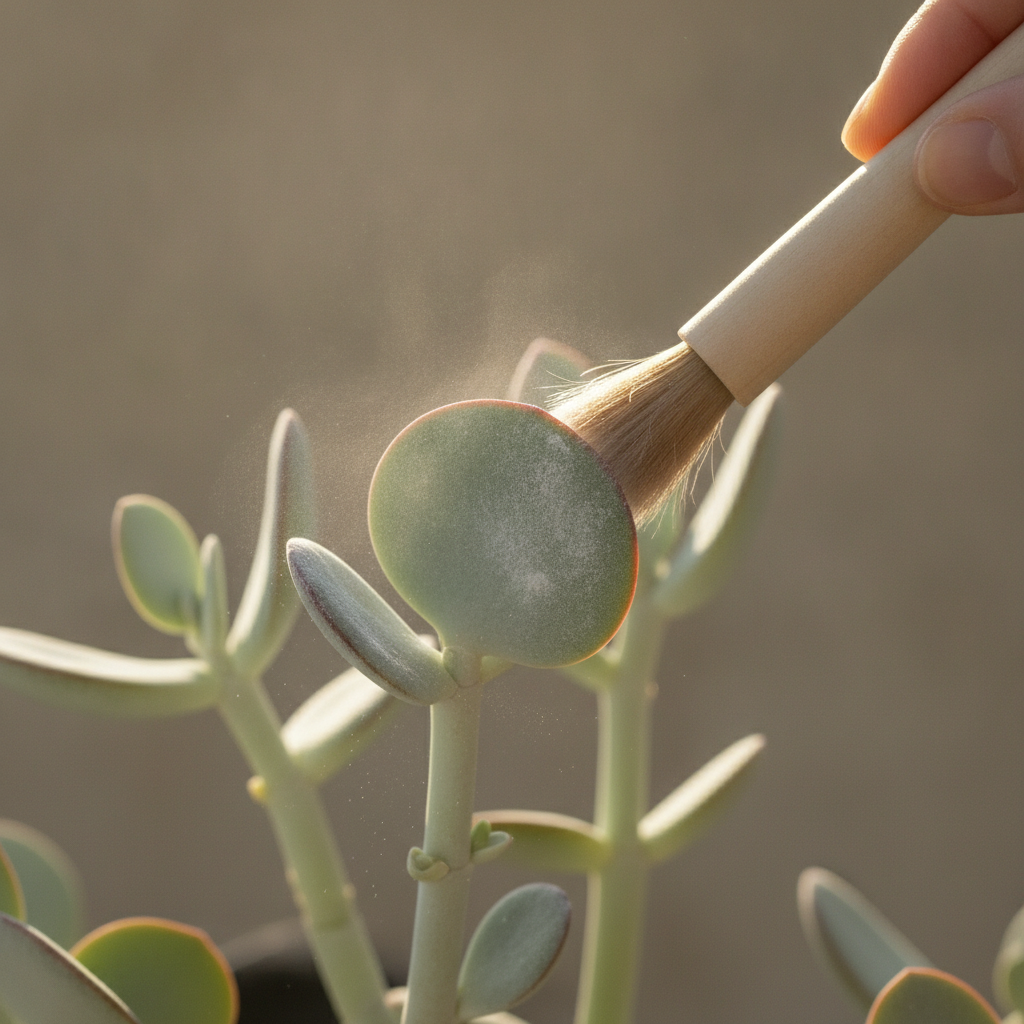
Mealybugs are the number one pest of this plant, appearing as small, soft, white cottony blobs tucked into the leaf axils and between the stems. They suck sap, weaken the plant and secrete sticky honeydew that can lead to sooty mould. Because they hide among the powdery leaves, they are easily overlooked until numerous.
Treatment: Dab each insect directly with a cotton bud dipped in isopropyl alcohol, which kills them on contact. For heavier infestations, treat the whole plant with a systemic houseplant insecticide or repeated sprays of a suitable insecticidal soap, and isolate it until you are sure the pests are gone.
Aphids (Aphidoidea)
Aphids are drawn especially to the tender flower stalks when the plant blooms, clustering on the buds and soft new growth. These small green, black or grey insects distort the flowers and, like mealybugs, leave sticky honeydew behind.
Treatment: Knock them off with a firm jet of water or wipe them away by hand, then follow up with insecticidal soap or a neem oil spray if they persist. Keeping an eye on flower stalks as they emerge lets you deal with aphids before they build up.
Scale Insects (Coccoidea)
Scale insects appear as small, hard, brown or tan bumps clinging to the stems and the undersides of leaves. They are easy to mistake for part of the plant, but they too feed on sap and weaken growth over time, and their waxy shells make them stubborn to shift.
Treatment: Scrape or rub the scales off with a fingernail or an alcohol-dipped cotton bud, then treat with a systemic insecticide for any young crawlers you cannot see. Repeat inspections over several weeks catch survivors before they re-establish.
Common Diseases
Root and Stem Rot (Pythium and Fusarium species)
By far the most serious disease of the silver crown plant, root and stem rot is caused by fungal and water-mould organisms that thrive in cold, saturated soil. It shows as soft, blackening tissue at the stem base, yellowing lower leaves and a plant that collapses despite looking watered. Once advanced, it is usually fatal.
Treatment: Act at the first sign by unpotting the plant, cutting away every trace of soft, discoloured tissue with a sterile blade, and letting the healthy remainder callus before replanting into fresh dry mix. In many cases the best insurance is to take clean cuttings from the top and start afresh. Prevent it entirely by watering sparingly and using a fast-draining mix.
Powdery Mildew and Leaf Fungus
In humid, stagnant conditions the leaves can develop fungal blemishes or a dusty grey coating that is easy to confuse with the plant’s natural farina. Unlike the even, silvery bloom of healthy leaves, fungal growth is patchy and often accompanied by soft or discoloured spots.
Treatment: Improve air circulation, reduce humidity and remove badly affected leaves. A fungicide labelled for ornamentals can help in stubborn cases, but correcting the growing conditions is the real fix, since this plant should never be kept damp and close.
Pest and Disease Summary
| Pest / Disease | Identification | Treatment |
|---|---|---|
| Mealybugs | White cottony clumps in leaf axils | Alcohol on a cotton bud; systemic insecticide |
| Aphids | Small insects clustered on flower stalks | Water jet, insecticidal soap or neem oil |
| Scale | Hard brown bumps on stems and leaves | Scrape off; systemic insecticide for crawlers |
| Root and stem rot | Black, soft stem base and collapsing plant | Cut out rot, dry, replant or take cuttings |
| Powdery mildew | Patchy grey fungal coating on leaves | More airflow, less humidity, remove affected leaves |
Prevention Strategies
The best defence is simply good culture. A silver crown plant kept in strong light, watered only when dry, potted in gritty mix and given room to breathe rarely troubles its owner. Most pests and all serious disease take hold in stressed, overwatered, poorly ventilated plants, so getting the basics right removes the conditions they need.
Build a few simple habits into your routine. Quarantine new arrivals, inspect your plant when you water, wipe away dust and debris from the crown, and never let the pot stand in water. Good airflow around the plant, whether from an open window or the general movement of a lived-in room, does more to keep it healthy than any spray.
Pro Tip — Treat at the First Sign: Pests multiply fast, so the moment you spot one mealybug or aphid, act. A quick dab of alcohol or a single wipe-down when the problem is tiny saves the drawn-out battle of treating a full infestation, and spares the plant weeks of stress.
Popular Varieties
The name Cotyledon orbiculata covers a wonderfully variable species, and growers have selected many forms that differ in leaf shape, size, colour and the boldness of their red margins. Some are barely distinguishable in a shop, while others are so distinct they were once treated as separate species. This variability is part of the plant’s charm, since two specimens labelled the same can look quite different.
The forms below are among the most widely grown. All share the same easy care, so choosing between them is a matter of the leaf look you prefer, from broad silvery paddles to narrow, wavy or finger-like foliage.
| Variety | Leaf Appearance | Light Needs | Growth Rate | Availability |
|---|---|---|---|---|
| Var. oblonga ‘Macrantha’ | Large, elongated grey-green with vivid red edges | Full sun | Moderate | Common |
| ‘Silver Ruffles’ (‘Undulata’) | Chalky silver-white with wavy, ruffled margins | Full sun | Slow | Common |
| Var. flanaganii | Narrow, near-cylindrical finger-like leaves | Full sun | Moderate | Occasional |
| ‘Elk Horns’ | Deeply lobed, antler-shaped grey leaves | Full sun | Slow | Uncommon |
| ‘White Sprite’ | Compact, densely white-powdered small leaves | Bright light to full sun | Slow | Occasional |
| Var. spuria | Rounded grey leaves, often smaller and neater | Full sun | Moderate | Uncommon |
Featured Varieties
Var. oblonga ‘Macrantha’
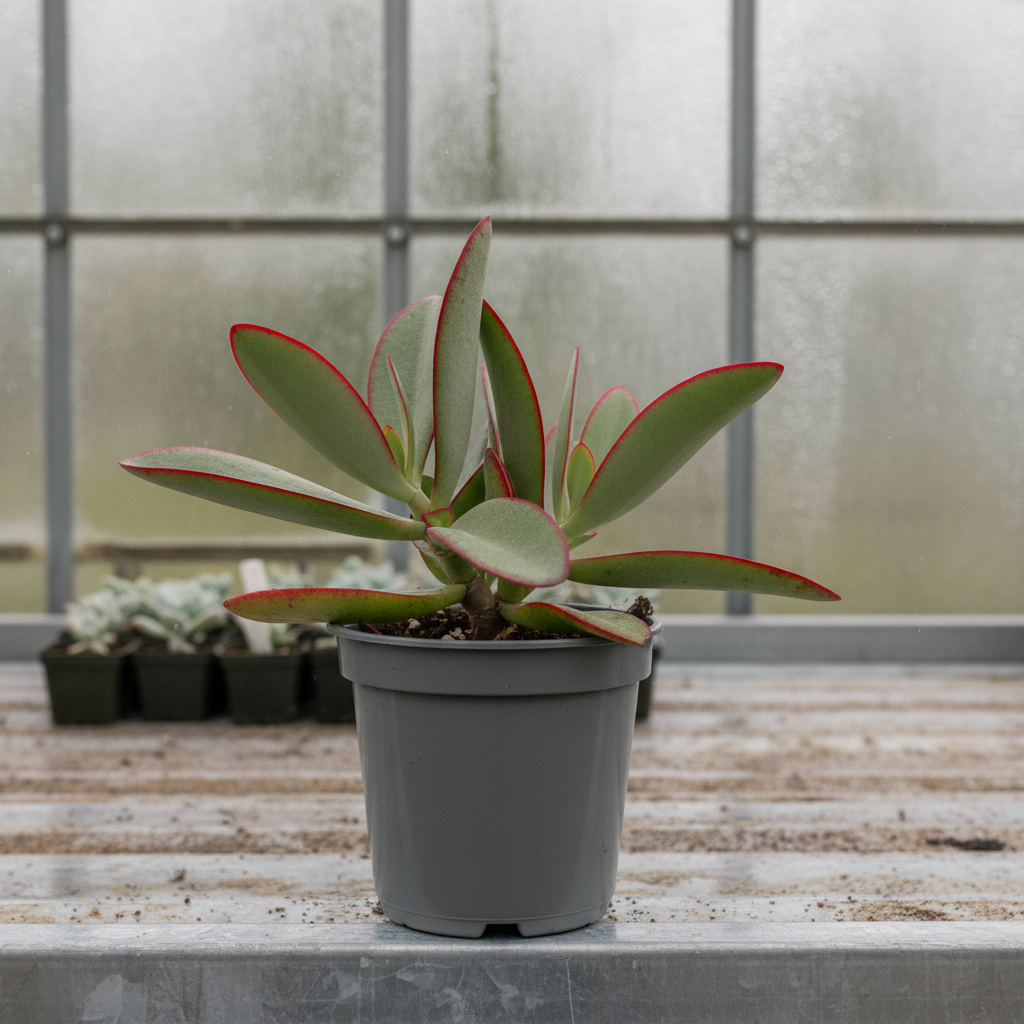
Perhaps the showiest form, ‘Macrantha’ bears larger, more elongated paddle leaves in soft grey-green, each finished with a bold band of crimson along the edge. The red intensifies in strong light, making it a favourite for those who want maximum colour contrast.

‘Silver Ruffles’ (‘Undulata’)
Prized for its texture, ‘Silver Ruffles’ carries chalky silver-white leaves with strongly wavy, crimped upper margins that catch the light beautifully. It is a slower, more compact grower whose sculptural, frosted foliage makes it one of the most sought-after selections.
Variety Profiles in Detail
Var. flanaganii (Cotyledon orbiculata var. flanaganii)
This distinctive form breaks from the usual rounded paddles with slender, almost cylindrical, finger-like leaves that give the plant a spiky, coral-like silhouette. Still coated in the family farina, it looks quite unlike a typical silver crown plant and adds welcome variety to a succulent collection, while asking for exactly the same bright, dry conditions.
‘Elk Horns’ (Cotyledon orbiculata ‘Elk Horns’)
A curiosity among the forms, ‘Elk Horns’ produces grey, deeply lobed leaves that fork into shapes reminiscent of antlers or elk horns, hence the name. It is slow-growing and a little harder to find, but its unusual foliage makes it a talking point and a rewarding challenge for the keen collector.
Choosing the Right Variety for Your Space
Because every form shares the same undemanding care, your choice comes down to looks and available light. If you want bold colour, reach for a red-edged form like ‘Macrantha’; for texture and a frosted, ceramic finish, ‘Silver Ruffles’ is hard to beat; and for something out of the ordinary, the finger-leaved var. flanaganii or antler-shaped ‘Elk Horns’ bring real character. Whatever you choose, give it the sunniest spot you can and the same gritty, dry-side treatment, and it will settle in happily.
Frequently Asked Questions
Why are the leaves on my silver crown plant falling off?
Sudden leaf drop, especially of soft lower leaves that fall at a touch, almost always points to overwatering and the early stages of rot. Let the soil dry out completely, cut back sharply on watering, and check the stem base for softness. Occasional loss of the oldest leaves is normal, but widespread dropping is a warning to keep the plant much drier.
Why has my plant grown tall and leggy?
Stretched, spindly growth with widely spaced leaves is etiolation, caused by too little light. The plant is reaching for a brighter source. Move it to your sunniest window or add a grow light, and prune the leggy top to root as a fresh, compact cutting. Improving the light will keep all future growth tight.
Is the silver crown plant safe around pets and children?
No. All parts of Cotyledon orbiculata contain cardiac glycosides and are toxic if eaten, causing digestive upset and, in larger amounts, heart and nervous-system effects in pets, livestock and people. Keep it well out of reach of cats, dogs and small children, and seek veterinary or medical advice if any part is swallowed.
How often should I water my silver crown plant?
Only when the soil has dried out completely, rather than on a fixed schedule. In spring and summer that often falls around once every two to three weeks, but in winter it may be once a month or less. Always let the mix dry fully between waterings, and when in doubt, wait, since this plant tolerates drought far better than wet feet.
Why are the leaves wrinkled and soft?
Wrinkled, deflated leaves usually mean the plant is thirsty and has drawn down its water reserves, so a good soak should plump them up within a day or two. If the leaves are soft and also yellowing or translucent, however, the cause is more likely overwatering and rot, in which case you should keep the plant dry and inspect the roots.
Will my silver crown plant flower indoors?
It can, given enough light. A mature, well-grown plant in a very bright spot may send up a tall stalk in summer, hung with pendulous orange to coral bell-shaped flowers. Flowering is far more likely with strong sun and a proper cool, dry winter rest, so the brighter the position, the better your chances of seeing those nodding blooms.
Can I grow my silver crown plant outdoors?
Yes, in a warm, frost-free climate it makes an excellent outdoor succulent for a sunny, sharply drained spot, roughly suited to USDA zones 9 to 11. In colder regions grow it in a pot that can spend summer outside and come indoors before the first frost, since it will not survive a hard freeze. Keep it above about 5°C (41°F) to be safe.
Why is my plant losing its silvery colour?
The chalky farina and red leaf edges are produced in response to strong light, so a plant kept too dark reverts towards plain green and loses its bloom. Move it into more direct sun and the new growth will return to its silvered, red-rimmed best. Avoid handling the leaves more than necessary, too, as touching rubs off the delicate powder.






