
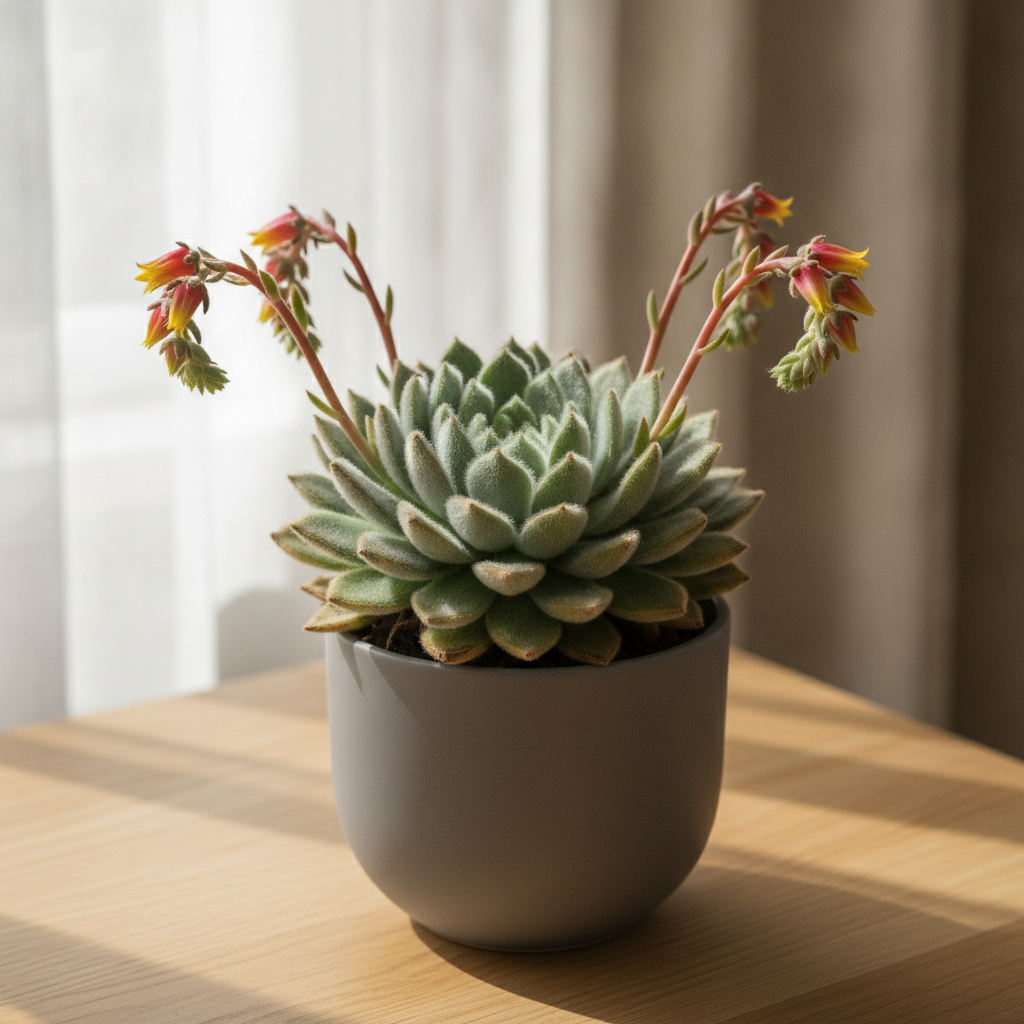
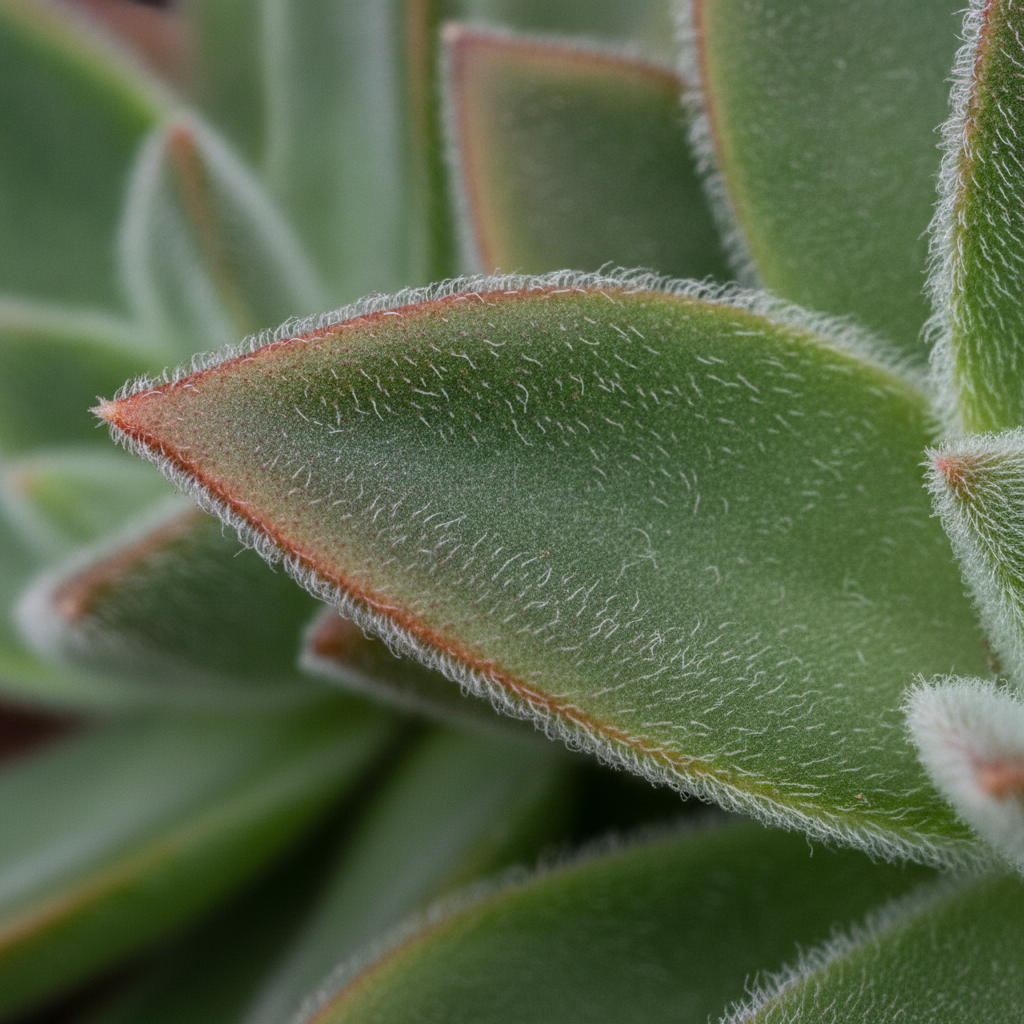
Few succulents wear their name as literally as the Mexican firecracker. Come late spring, this small fuzzy rosette sends up slender arching stems tipped with rows of urn-shaped blooms that are scarlet at the base and blaze yellow at the mouth, looking for all the world like a string of tiny firecrackers about to go off. Known botanically as Echeveria setosa, and sometimes sold as the firecracker plant or Mexican firecracker hen and chicks, it is a compact evergreen succulent native to the rocky slopes of Puebla and Oaxaca in central Mexico. What sets it apart from the hundreds of other echeverias in cultivation is its coat: every plump blue-green leaf is densely covered in fine white bristly hairs, giving the whole rosette a frosted, almost animal-soft appearance that begs to be touched.
As a houseplant, Echeveria setosa has a reputation for being straightforward but not quite bulletproof. It asks for very little in the way of feeding or fuss, yet its hairy leaves make it fussier about water than a smooth-leaved succulent, because moisture trapped among the trichomes can invite rot. The gap between merely keeping this plant alive and growing a tight, richly coloured, free-flowering specimen comes down to a handful of details: enough light to keep the rosette compact, a gritty mix that drains in seconds, and a watering hand that errs on the side of neglect. This guide walks through every one of those details so you can move your Mexican firecracker from surviving to genuinely thriving.
Contents
- Quick Reference
- Why Mexican Firecracker Makes a Rewarding Houseplant
- Light Requirements
- Watering & Humidity
- Soil, Potting & Repotting
- Fertilising
- Propagation
- Pests & Diseases
- Popular Varieties
- Frequently Asked Questions
Quick Reference: Mexican Firecracker at a Glance
| Light | Very bright light; several hours of direct sun with some protection from harsh summer midday glare |
| Watering | Soak thoroughly, then let the soil dry out completely; roughly every 10 to 14 days in summer, monthly or less in winter |
| Temperature | 18 to 27 degrees C (64 to 81 degrees F); keep above 5 degrees C (41 degrees F), not frost hardy |
| Humidity | Low; average dry room air is ideal, high humidity is a risk |
| Fertiliser | Dilute succulent feed once a month through spring and summer only |
| Toxicity | Non-toxic to cats, dogs and humans |
Why Mexican Firecracker Makes a Rewarding Houseplant
The first thing that draws most people to Echeveria setosa is texture. Where most succulents present smooth, waxy or powdery surfaces, this species is unmistakably furry, its silvery-white hairs catching the light and softening the outline of every leaf. That fuzz is not decoration for our benefit; in its native high-altitude Mexican habitat, the dense trichomes reflect fierce sunlight, reduce water loss and trap a thin insulating layer of air against the leaf surface. Indoors, the effect is a plant that looks alive and tactile on a windowsill in a way few others manage, holding interest even when it is not in bloom.
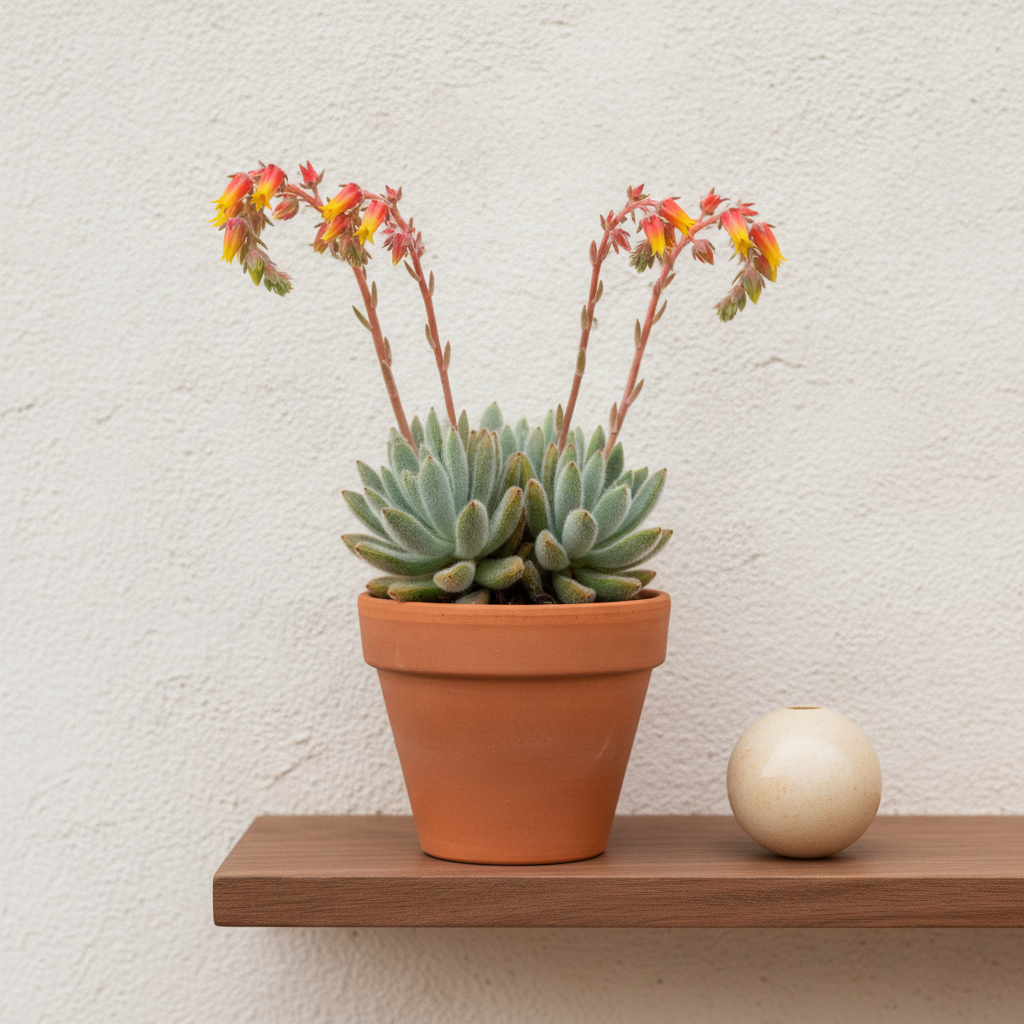
Beyond looks, the Mexican firecracker earns its place through a combination of small size, low demands and a genuinely spectacular flowering display. A mature rosette rarely exceeds 10 to 15 centimetres (4 to 6 inches) across and sits low to the pot, so it fits happily on a crowded sill, a shallow dish garden or a sunny desk. It clusters slowly into a colony of offsets over time, which makes it easy to share, and in spring it throws up flowering stalks two to three times the height of the plant, lined with the red and yellow blooms that give it its common name and that pollinators, especially hummingbirds in its native range, adore. For a plant that asks so little, the payoff is disproportionately generous.
Important — Toxicity: Echeveria setosa is considered non-toxic to cats, dogs and people, and does not appear on the ASPCA list of plants harmful to pets. It is a safe choice for homes with curious animals or children, although as with any plant it is sensible to discourage nibbling, since fibrous plant matter can still cause mild stomach upset if eaten in quantity.
Light Requirements
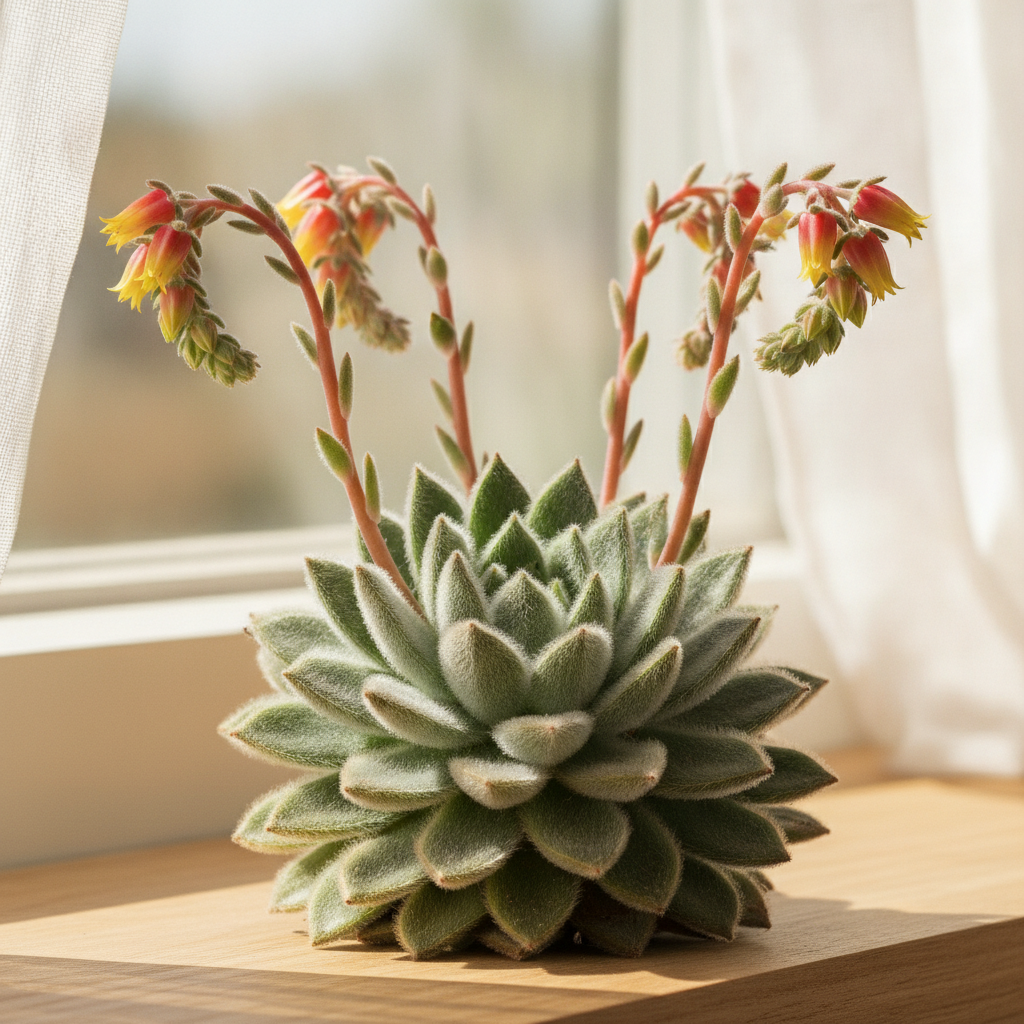
Light is the single most important factor in growing a good-looking Mexican firecracker, and it is where most indoor specimens fall short. In the wild this species grows fully exposed on sun-baked rocky slopes, so it is adapted to intensity levels far higher than a typical room provides. Given enough light it keeps its leaves short, plump and tightly packed, holds a strong blue-green colour flushed with pink at the tips, and flowers reliably. Deprived of it, the rosette loosens, the leaves stretch and pale, and blooming becomes sporadic or stops altogether.
The ideal indoor position is directly in or immediately beside a bright window where the plant receives at least four to six hours of sunlight each day. A little direct morning or late-afternoon sun is excellent; the main thing to moderate is the most brutal summer midday sun through glass, which can scorch even a sun-loving succulent when it is magnified and the plant has no air movement to cool it.
Light Levels Explained
Understanding how different light intensities translate into locations in your home makes it easier to place this plant well. The values below are approximate and measured in lux, the unit most plant light meters and phone apps report.
| Light Category | Approx. Level | Typical Location | Outcome |
|---|---|---|---|
| Direct sun | Over 50,000 lux | On a south or west sill, unobstructed | Ideal; compact growth, best colour and flowering |
| Bright indirect | 20,000 to 50,000 lux | Just back from a bright window or behind a sheer curtain | Good; healthy but slightly looser rosette |
| Medium | 10,000 to 20,000 lux | A metre or two from a bright window | Marginal; noticeable stretching over time |
| Low | 2,000 to 10,000 lux | North window or interior wall | Poor; etiolation, pale leaves, no flowers |
| Very low | Under 2,000 lux | Away from any window | Unsuitable; gradual decline |
Window Orientation and Placement
South-facing window: In the northern hemisphere this is usually the best spot, offering the long hours of bright light the plant craves. During the peak of summer a very thin curtain or a slight setback from the glass prevents the harshest midday rays from scorching the leaves.
East-facing window: A strong second choice. Gentle direct morning sun followed by bright light for the rest of the day suits Echeveria setosa well and carries almost no scorch risk.
West-facing window: Also very good, delivering intense afternoon sun. Watch for heat build-up on hot days, as west light tends to be the warmest of the day when combined with rising room temperatures.
North-facing window: Generally too dim to keep this plant in good condition. A north sill will sustain it for a while, but the rosette will steadily stretch and lose its charm. A grow light is the practical remedy here.
Pro Tip — Rotate for Symmetry: Echeveria rosettes lean toward their light source. Give the pot a quarter turn every week or so to keep the rosette growing evenly and symmetrically rather than tilting toward the glass.
How Light Affects Colour and Form
Light does more than fuel growth in this species; it shapes its entire appearance. In strong light the leaves stay short and swollen, the rosette stays tight, and stress pigments deepen the blue-green base colour and bring out rosy or coral flushing along the leaf edges and tips. In weaker light the plant redirects energy into reaching for brightness, producing longer, thinner, greener leaves spaced further apart on an elongating stem. This stretching, known as etiolation, is not reversible: the drawn-out growth stays that way, though a move to brighter light will make all new growth compact again.
Warning — Direct Sunlight: A plant that has spent months in low light cannot be moved straight into full sun without burning. Sudden exposure scorches the leaves, leaving permanent brown or bleached patches. Acclimatise gradually over two to three weeks, increasing direct exposure a little at a time, especially when moving plants outdoors for summer.
Artificial Lighting
Where natural light is limited, Echeveria setosa responds very well to a full-spectrum LED grow light. Because it wants high intensity, position the light fairly close, around 15 to 30 centimetres (6 to 12 inches) above the rosette, and run it for 10 to 12 hours a day. A grow light is often the difference between a stretched, floppy plant and a tight, colourful one for growers in dim flats or during the short days of a northern winter.
Seasonal Adjustments
Light intensity indoors swings dramatically through the year. A summer south window can be almost too bright, while the same spot in December may be barely adequate. Move the plant to your brightest available position for autumn and winter, clean the window glass to maximise transmission, and be ready to supplement with a grow light if the rosette begins to loosen. In spring, reintroduce any increase in direct sun gradually to avoid shocking growth that softened over winter.
Watering & Humidity
Watering is where the Mexican firecracker demands slightly more thought than a smooth succulent, because its fuzzy leaves complicate the picture. The plant itself is drought-adapted and stores water in its plump leaves, so it wants the classic succulent rhythm of a thorough soak followed by a complete dry-out. The wrinkle is that water sitting among the leaf hairs dries slowly and can trigger spotting or rot, so how you apply the water matters almost as much as how often.
When to Water
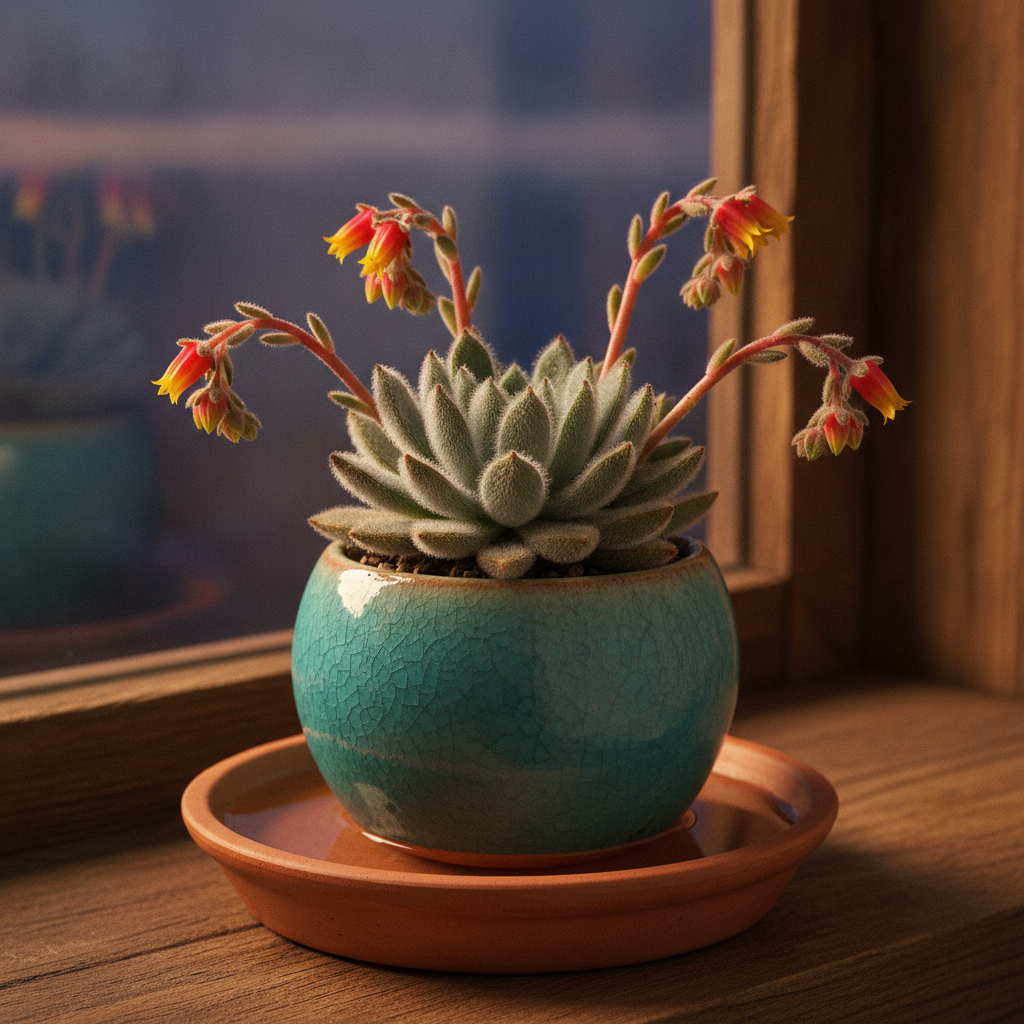
The only reliable schedule for this plant is one based on the soil, not the calendar. Wait until the potting mix is completely dry all the way through, then water. In practice, during the warm growing months this tends to mean watering roughly every 10 to 14 days, but the exact interval depends on your light, pot size, temperature and mix. Push a finger or a wooden skewer to the bottom of the pot to check; if there is any dampness or cool feel, wait.
In autumn and winter, growth slows to a near halt and water use drops sharply. Reduce watering to once a month or even less, giving only enough to stop the leaves shrivelling. A cool, dry winter rest actually benefits the plant and encourages spring flowering, so resist the urge to keep watering on the summer schedule when the days shorten.
Pro Tip — Watch the Bottom Leaves: The oldest leaves at the base of the rosette are your moisture gauge. When they feel slightly soft or look a touch wrinkled, the plant is genuinely thirsty. Firm, plump leaves mean there is still stored water and no watering is needed.
How to Water Correctly
- Confirm the soil is bone dry throughout before you begin.
- Water at the soil surface, directing the stream at the potting mix and keeping it off the fuzzy leaves and out of the centre of the rosette.
- Alternatively, stand the pot in a shallow dish of water for 10 to 15 minutes and let the mix wick moisture up from below, then remove it.
- If watering from above, apply enough that water runs freely from the drainage holes, ensuring the entire root ball is wetted.
- Let the pot drain completely and never leave it standing in a saucer of water.
- If any water does settle on the leaves or in the crown, dab it away gently or blow it off so it does not linger among the hairs.
Signs of Overwatering vs. Underwatering
| Symptom | Overwatering | Underwatering |
|---|---|---|
| Leaf colour | Yellowing, translucent or blackening leaves | Duller, faded colour |
| Leaf texture | Soft, mushy, squishy to the touch | Wrinkled, thin, slightly flexible |
| Soil | Stays damp for days, may smell sour | Bone dry for an extended period |
| Roots | Brown, black and slimy when checked | Dry and intact but growth stalls |
| Stem base | Blackened, soft, collapsing rosette | Firm but lower leaves shrivelling |
Warning — Root Rot: Overwatering is the leading killer of this plant. A soft, translucent or blackening rosette base usually means rot has set in. Act fast: unpot the plant, cut away all mushy tissue with a clean blade, let the healthy remainder callus for a few days, and replant into fresh dry gritty mix. An unaffected rosette top can often be saved and rerooted even if the roots are lost.
Humidity Requirements
Unlike the tropical foliage plants that dominate many houseplant collections, Echeveria setosa prefers dry air. Ordinary room humidity of 30 to 50 per cent is perfect, and the plant is entirely comfortable in the arid conditions created by central heating that other houseplants dislike.
High humidity is not just unnecessary but actively risky for a hairy succulent. Damp, still air keeps moisture lingering among the leaf trichomes and in the crown, creating ideal conditions for fungal spotting and rot. If you grow this plant in a humid room, kitchen or bathroom, compensate with excellent air circulation and even more restraint with the watering can.
There is never any need to mist this plant, and doing so is counterproductive. If you want to raise humidity for a neighbouring tropical, keep that grouping well away from your Echeveria and ensure a fan or open window keeps air moving around the succulents.
Water Quality
Mexican firecracker is not especially fussy about water quality, and normal tap water is generally fine. Where water is very hard, mineral salts can leave white deposits on the soil surface and gradually build up in the mix, so if you notice crusting or the leaves developing spots, switch to rainwater or filtered water. Letting tap water stand overnight before use also allows some chlorine to dissipate, which does no harm.
Soil, Potting & Repotting
Get the soil right and you eliminate the most common cause of failure with this plant. Everything about the Mexican firecracker’s needs points to one requirement above all: drainage that is fast and free. Its roots must never sit in moisture, so the mix has to hold just enough water to wet the roots on watering day and then dry out quickly and completely.
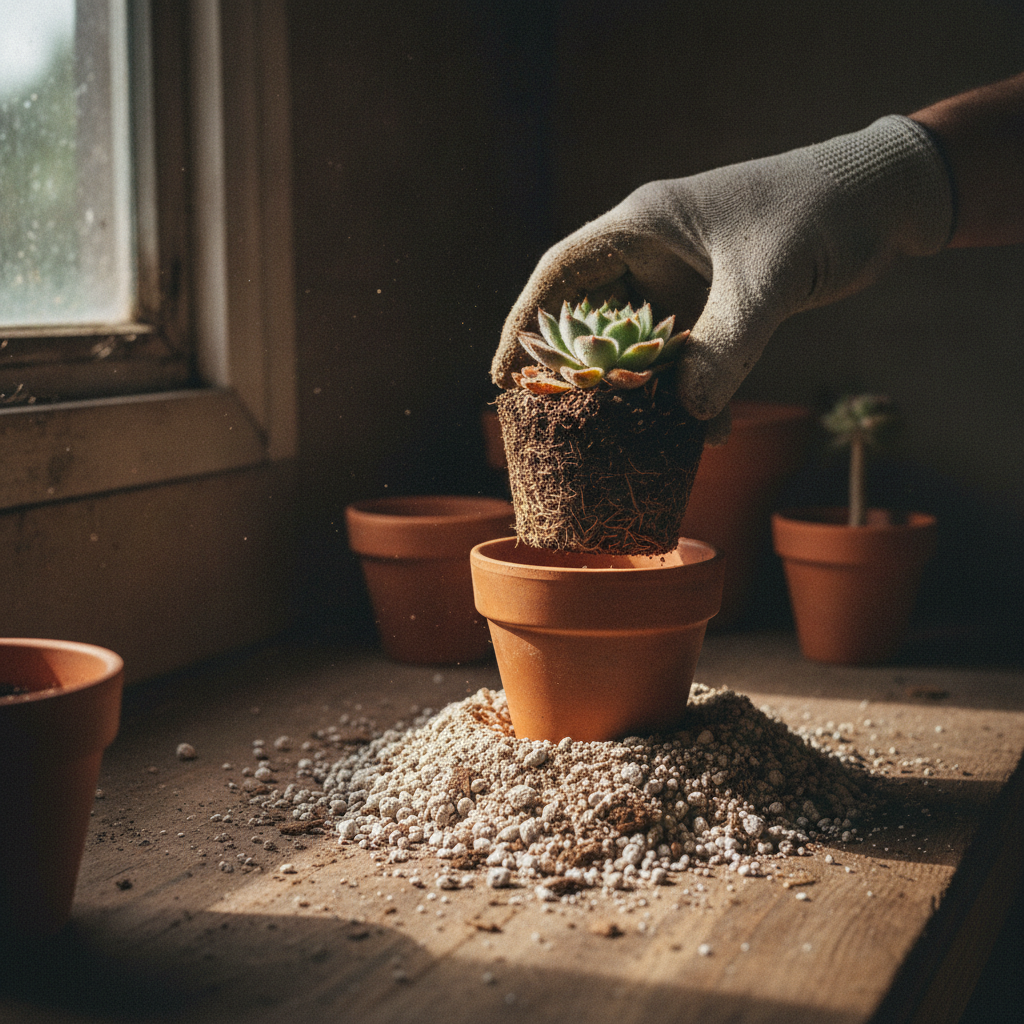
Ideal Soil Composition
Standard houseplant compost holds far too much water for an echeveria and will rot the roots in short order. Instead, aim for a gritty, open blend that is roughly half mineral matter. A dedicated cactus and succulent compost bulked up with extra perlite, pumice or coarse horticultural grit makes an excellent base, and the added grit is well worth the effort even if a bagged succulent mix seems convenient on its own.
| Component | Proportion | Function |
|---|---|---|
| Cactus and succulent compost | 50 per cent | Base structure and modest moisture and nutrient retention |
| Perlite or pumice | 30 per cent | Aeration and rapid drainage |
| Coarse horticultural grit or sand | 20 per cent | Weight, structure and extra drainage around the roots |
The plant tolerates a slightly acidic to neutral soil pH in the range of about 6.0 to 7.0, which most commercial mixes fall within, so pH is rarely something you need to adjust deliberately for this species.
Pro Tip — Quick Mix Recipe: For a reliable blend, combine two handfuls of bagged cactus compost with one handful of pumice and one handful of coarse grit. If the mix still clumps together when moist rather than crumbling apart, add more mineral grit until it feels loose and gritty.
Choosing the Right Pot
Pot choice has a direct effect on how quickly the soil dries and therefore on how forgiving the plant is to grow. For a small, shallow-rooted succulent like this, the goal is a container that dries evenly and does not hold a large reservoir of damp soil the roots cannot reach.
Drainage holes are non-negotiable. Never plant a Mexican firecracker in a pot without a drainage hole. Decorative cachepots are fine as outer covers, but the plant itself must sit in a container that lets excess water escape freely, or root rot becomes almost inevitable.
Pot material: Terracotta is the ideal choice. Its porous walls wick moisture out of the soil and let it evaporate, speeding the dry-out this plant depends on. Glazed ceramic and plastic both work but retain moisture longer, so if you use them, lean even harder toward a gritty mix and cautious watering.
Pot size: Choose a pot only slightly larger than the rosette and its roots. A shallow, snug container suits the compact root system and dries out at a healthy pace, whereas an oversized pot stays wet in the middle long after the surface has dried, inviting rot.
When to Repot
This is a slow grower, so it needs repotting only infrequently, typically every two to three years or when the rosette and its offsets have filled the pot. The best time is early spring as the growing season begins, which gives the plant the whole summer to settle. Repotting is also the moment to divide crowded offsets, refresh spent soil and inspect the roots for any early signs of rot.
How to Repot: Step-by-Step
- Water lightly a day or two beforehand so the root ball holds together, or repot dry to reduce the chance of breaking roots.
- Gently ease the plant out of its pot, supporting the rosette from below rather than pulling on the leaves, which detach easily.
- Crumble away most of the old soil from the roots and check them, trimming off anything brown, black or mushy with a clean blade.
- Part-fill the new pot with dry gritty mix and set the plant so the base of the rosette sits just above the soil line.
- Fill in around the roots with more mix, firming gently, and top-dress with a layer of grit to keep the leaves off damp soil.
- Wait about a week before watering, giving any disturbed or trimmed roots time to callus and heal.
Warning — Transplant Shock: Do not water immediately after repotting. Freshly disturbed roots have tiny wounds, and moist soil against those wounds is an open invitation to rot. Repotting into dry mix and waiting several days before the first watering is the safest approach with any echeveria.
Fertilising
Mexican firecracker is a light feeder that evolved on nutrient-poor rocky ground, so it needs far less fertiliser than the average leafy houseplant. A little feeding through the growing season supports steady growth and good flowering, but overfeeding does real harm, producing soft, weak, over-large growth that is more vulnerable to pests and rot.
The guiding principle is restraint. When in doubt, feed less rather than more; a slightly hungry echeveria is a far healthier plant than an over-fed one, and many growers keep these succulents in good condition with almost no supplementary feeding at all.
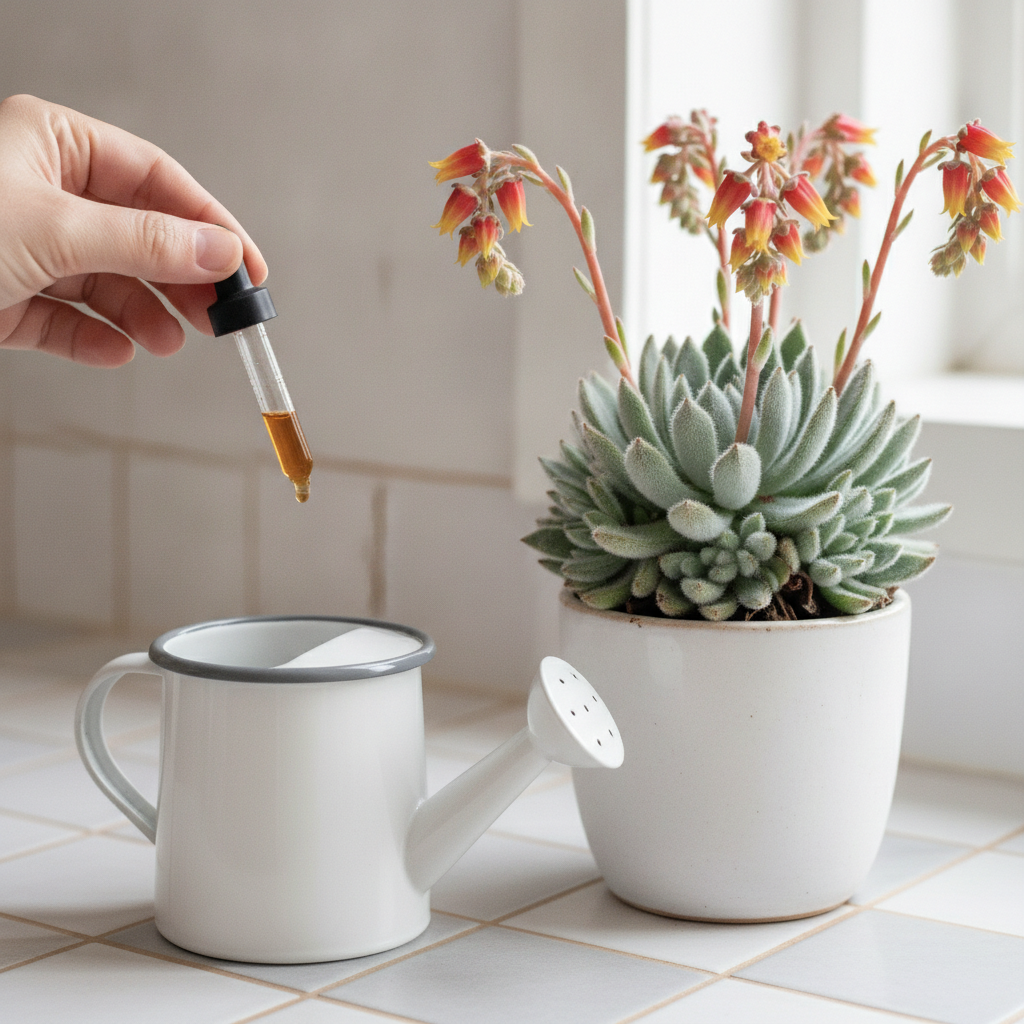
Understanding Plant Nutrients
Fertilisers are labelled with an NPK ratio showing the percentages of nitrogen, phosphorus and potassium, the three nutrients plants use in the largest amounts. For succulents, a balanced or slightly low-nitrogen formula is best, since too much nitrogen drives lush, soft growth at the expense of the compact form and colour that make this plant attractive.
| Nutrient | Symbol | Primary Function | Deficiency Symptoms |
|---|---|---|---|
| Nitrogen | N | Leaf and stem growth | Pale, slow, stunted growth |
| Phosphorus | P | Root development and flowering | Poor rooting, few flowers |
| Potassium | K | Overall vigour and stress resistance | Weak growth, browning leaf edges |
| Calcium | Ca | Cell wall strength | Distorted or weak new growth |
| Magnesium | Mg | Chlorophyll production | Yellowing between leaf veins |
| Iron | Fe | Chlorophyll and enzyme function | Yellow new leaves with green veins |
Types of Fertiliser
Liquid fertilisers: The easiest and most controllable option for succulents. A liquid succulent or cactus feed diluted to half the recommended strength, added to the watering can during the growing season, gives you precise control over how much the plant receives.
Slow-release granular: A few controlled-release granules mixed into the soil in spring will feed gently over several months. Use a light hand, since it is easy to over-apply granular feed to a small pot and difficult to remove it again.
Organic fertilisers: Gentle organic options such as a very dilute worm-casting tea suit the plant’s modest needs and carry little risk of burning. They release nutrients slowly and improve soil life, though they act more slowly than synthetic feeds.
Feeding Schedule
Feed only during active growth in spring and summer, offering a dilute succulent fertiliser roughly once a month, or about every third or fourth watering. Stop feeding entirely in autumn and winter when the plant is resting, as fertiliser applied to a dormant plant simply accumulates as unused salts in the soil.
Pro Tip — Feed at Half Strength: Always dilute succulent fertiliser to half the dose on the label, or weaker. These plants are adapted to lean soils, and a gentle, dilute feed avoids the soft growth and salt build-up that a full-strength dose can cause.
How to Fertilise
- Mix the fertiliser to half its recommended strength in your watering can.
- Water the plant with plain water first if the soil is completely dry, to avoid feeding onto parched roots.
- Apply the diluted feed to the soil, keeping it off the leaves and out of the crown.
- Let the pot drain fully as you would after any watering.
- Flush the pot with plain water every few months to wash out any accumulated fertiliser salts.
Warning — Salt Build-Up: White crusting on the soil surface or pot rim signals a build-up of fertiliser salts, which can scorch roots and mark the leaves. If you see it, stop feeding and flush the soil thoroughly with plain water several times to leach the excess away.
Propagation
One of the quiet pleasures of growing Echeveria setosa is how readily it multiplies. A single rosette will, over time, produce a cluster of offsets around its base, and each of those pups can become a new plant. This makes propagation both easy and rewarding, and it is the reliable way to build up a colony or share the plant with friends.
There are two main routes: separating the offsets that form naturally at the base, and rooting individual leaves. Offset division is the faster and more dependable of the two for this species, while leaf propagation works but is a little more temperamental thanks to the hairy leaf surface. Both are worth trying, and spring or early summer is the ideal time to start either.
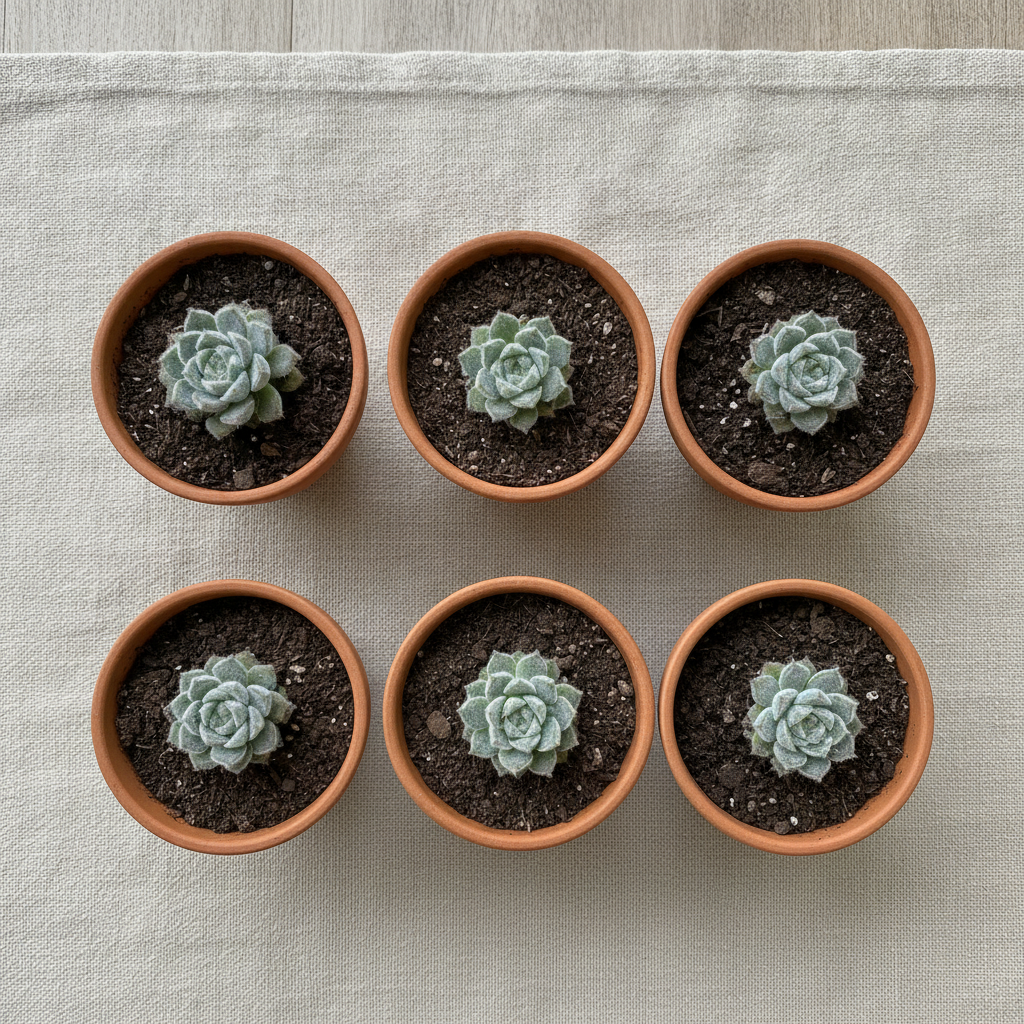
Understanding Offsets and Leaves
Offsets, or pups, are miniature clones that grow from the base of the mother rosette, often already forming their own tiny roots while still attached. Because they are genetically identical to the parent and frequently part-rooted, they establish quickly once separated. A single detached leaf, by contrast, can also regenerate an entire new plant from its base, drawing on the water and nutrients stored inside it while a fresh rosette and roots emerge, though this takes longer and has a lower success rate on a fuzzy-leaved species.
Offset Division: Step-by-Step
This is the most reliable method and the one to reach for first. Mature plants offer up offsets freely once they have settled in.
- Choose an offset that is a reasonable size, ideally with a few of its own roots already visible.
- Gently work it away from the mother plant with your fingers, or cut it free with a clean, sharp blade as close to the base as possible.
- Set the offset aside in a dry, shaded spot for two to three days so any cut surface calluses over.
- Pot it into a small container of dry gritty succulent mix, just deep enough to hold it upright.
- Wait about a week, then begin watering lightly, keeping the young plant in bright but not scorching light.
- Increase light and water gradually as the offset roots in and starts to grow.
Pro Tip — Callus Before Potting: Never plant a fresh cutting or offset straight into soil. Letting the wound dry and callus for a few days first dramatically reduces the risk of rot and is the single most important step in succulent propagation.
Leaf Propagation: Step-by-Step
Leaf propagation is a rewarding experiment, though be prepared for a proportion of leaves to fail on this hairy species. Take several leaves at once to improve your odds.
- Select a plump, healthy leaf and remove it with a gentle sideways wiggle, taking care to keep the whole leaf base intact, since a torn leaf will not root.
- Lay the leaves on a tray in a dry, bright, shaded place for a few days to callus.
- Set the callused leaves on top of, not buried in, a tray of dry gritty mix.
- Mist the surface very lightly every few days to encourage rooting, keeping the leaves themselves dry.
- Watch for tiny roots and a miniature rosette to appear at the leaf base over the following weeks.
- Once the new rosette has its own roots and the parent leaf shrivels, pot the youngster up into its own small container.
Troubleshooting Propagation
| Problem | Likely Cause | Solution |
|---|---|---|
| Offset or leaf rots | Potted too wet or before callusing | Use dry mix, callus first, water only lightly |
| Leaf shrivels with no roots | Torn leaf base or air too dry | Take clean whole leaves, mist the tray occasionally |
| No growth for weeks | Too cool or too dark | Provide warmth and bright indirect light, be patient |
| Roots form but dry out | New roots never reached moist soil | Lightly moisten the surface so roots can anchor down |
Pests & Diseases
A healthy, well-grown Mexican firecracker is reasonably resistant to trouble, but its dense, hairy rosette offers plenty of sheltered crevices where pests can hide, which makes early detection important. Most problems that afflict this plant trace back to excess moisture or to pests that slip in from other plants, so vigilance and good culture prevent the great majority of issues.
Make a habit of looking closely at the plant every time you water, paying particular attention to the leaf axils and the centre of the rosette where pests congregate. Catching an infestation early, when it is a handful of insects rather than a colony, makes treatment far simpler and protects the rest of your collection.

Common Pests
Mealybugs (Pseudococcidae)
Mealybugs are the number one pest of this plant and are especially problematic because their white, cottony bodies camouflage perfectly among the leaf hairs. They cluster in the leaf axils and crown, sucking sap and weakening the plant while excreting sticky honeydew.
Treatment: Dab each insect directly with a cotton bud dipped in isopropyl alcohol, which kills them on contact. For heavier infestations, treat with a systemic insecticide or repeated sprays of a suitable succulent-safe insecticide, and isolate the plant until it is clear.
Aphids (Aphidoidea)
Aphids are drawn to the tender flower stalks in particular, massing on the developing buds and stems to feed on sap. They can distort the blooms and, like mealybugs, leave sticky honeydew that encourages sooty mould.
Treatment: Rinse them off the flower stalk with a gentle stream of water, or wipe them away by hand. Insecticidal soap or a diluted neem oil spray applied to the stalks controls persistent populations.
Spider Mites (Tetranychidae)
Spider mites are tiny and thrive in hot, dry conditions. They are hard to spot on a fuzzy leaf but reveal themselves through fine webbing and a stippled, dusty look to the foliage as they pierce cells to feed.
Treatment: Improve air circulation and wipe the plant down, then treat with insecticidal soap or a miticide. Repeat every few days over a couple of weeks to break the breeding cycle.
Common Diseases
Root and Crown Rot (Pythium and Phytophthora)
By far the most serious threat to this plant, rot is caused by soil-borne organisms that flourish in wet, poorly drained conditions. It shows as blackening, softening tissue at the base of the rosette or roots and can collapse a healthy plant within days once established.
Treatment: Cut away all affected tissue with a sterile blade, let the healthy portion callus, and replant into fresh dry gritty mix. Prevention through careful watering and fast-draining soil is far more effective than any cure.
Fungal Leaf Spot (various fungi)
Damp, still conditions and water lingering on the hairy leaves can lead to brown or black spots on the foliage, particularly in a humid room with poor air movement. The spots are unsightly and can spread if conditions do not improve.
Treatment: Remove badly affected leaves, improve ventilation, and keep water off the foliage. A copper-based or general fungicide can help in stubborn cases, but cultural changes usually resolve the problem.
Pest and Disease Summary
| Pest / Disease | Identification | Treatment |
|---|---|---|
| Mealybugs | White cottony clusters in axils and crown | Alcohol on a cotton bud, systemic insecticide |
| Aphids | Small insects massed on flower stalks | Rinse off, insecticidal soap or neem |
| Spider mites | Fine webbing, stippled dusty leaves | Insecticidal soap or miticide, improve airflow |
| Root and crown rot | Blackening, soft, collapsing base | Cut out rot, callus, replant dry; prevent by watering less |
| Fungal leaf spot | Brown or black spots on leaves | Remove leaves, improve ventilation, keep leaves dry |
Prevention Strategies
Prevention with this plant is mostly a matter of good basic culture. Bright light, a gritty free-draining mix, careful watering that keeps the leaves dry, and steady air movement together head off the overwhelming majority of pest and disease problems before they start. A plant grown in the right conditions is far more resilient than one that is stressed by low light or wet feet.
Quarantine any new plant for a couple of weeks before it joins your collection, since new arrivals are the most common way pests enter a home. Inspect regularly, remove dead leaves that could harbour fungus or insects, and act at the first sign of trouble rather than waiting to see whether it spreads.
Pro Tip — Inspect the Hidden Crevices: Because pests love to hide among the leaf hairs and deep in the rosette, shine a torch into the crown and part the leaves gently when you inspect. Problems are almost always easier to catch there than on the exposed leaf surfaces.
Popular Varieties
Although Echeveria setosa is a distinctive species in its own right, botanists and growers recognise several natural varieties and closely related selections that differ in leaf shape, degree of fuzziness and overall size. Collectors enjoy assembling a range of these forms, since they share the same easy care yet each brings a slightly different character to a windowsill.
There are also popular hybrids bred from Echeveria setosa, most famously the woolly-leaved cultivars that inherit its trademark hairs. The table and profiles below cover the forms you are most likely to encounter and how to tell them apart.
| Variety | Leaf Appearance | Light Needs | Growth Rate | Availability |
|---|---|---|---|---|
| Echeveria setosa (species) | Plump blue-green leaves, dense white hairs | Very bright | Slow | Common |
| var. deminuta | Smaller, tightly clustering fuzzy rosettes | Very bright | Slow | Fairly common |
| var. ciliata | Broader leaves fringed with fine cilia hairs | Very bright | Slow | Occasional |
| var. minor | Dwarf form with very compact rosettes | Very bright | Very slow | Occasional |
| var. oteroi | Rounder, plumper, less densely hairy leaves | Very bright | Slow | Uncommon |
| ‘Doris Taylor’ (Woolly Rose) | Green leaves heavily coated in white wool, hybrid | Very bright | Moderate | Common |
Featured Varieties
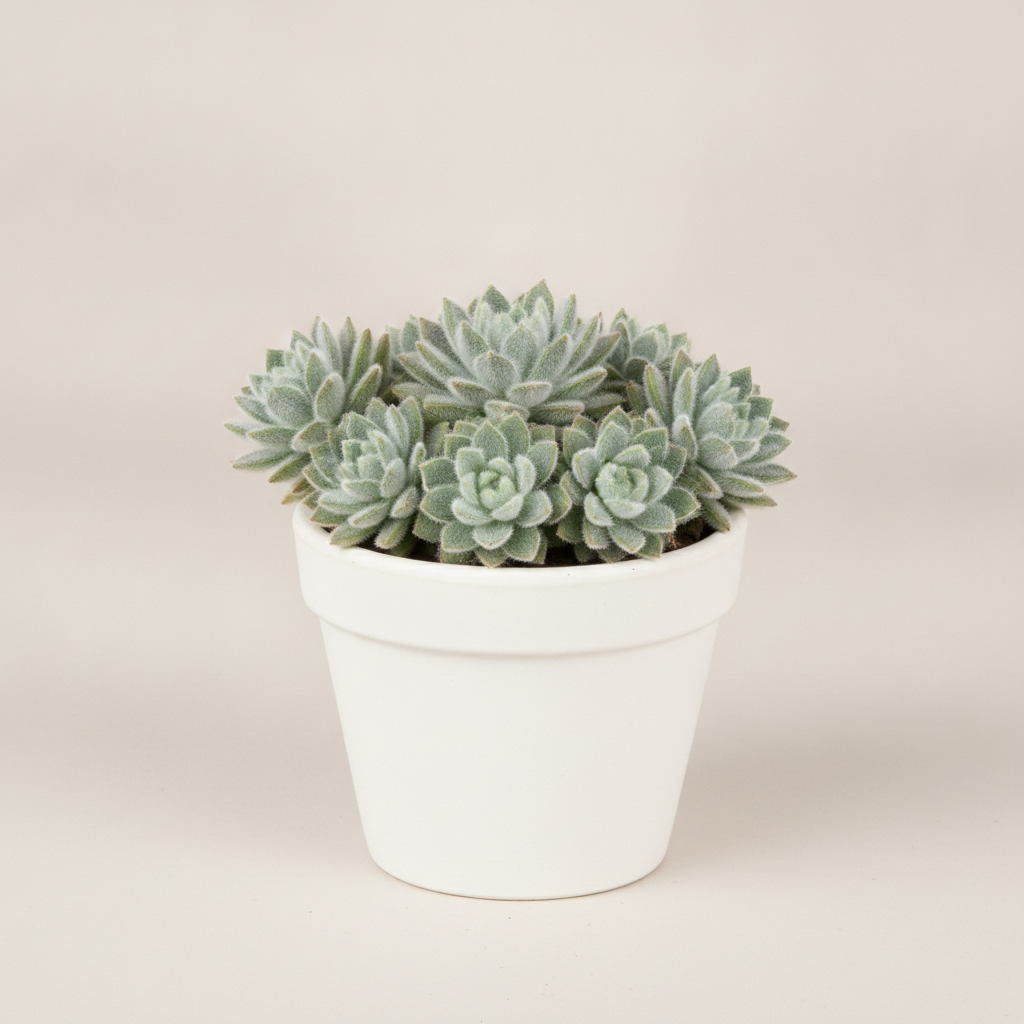
Echeveria setosa var. deminuta
A smaller, more freely clustering form that quickly builds into a dense cushion of short fuzzy rosettes. Its compact habit and enthusiastic offsetting make it a favourite for small pots and shared cuttings.
Echeveria setosa var. ciliata
Distinguished by broader, flatter leaves edged with a delicate fringe of fine white cilia hairs and often flushed reddish toward the tips. The leaf margins catch the light beautifully, giving this form a softer, more feathered outline.
Variety Profiles in Detail
Echeveria setosa var. deminuta (Echeveria setosa var. deminuta)
The most widely grown of the named varieties, deminuta stays noticeably smaller than the species and produces offsets prolifically, forming tight low mounds of fuzzy rosettes. It is an excellent choice for anyone who wants the classic firecracker look in a compact, colony-forming package, and its readiness to pup makes it easy to propagate.
Echeveria setosa var. ciliata (Echeveria setosa var. ciliata)
This form trades some of the species’ overall fuzz for a striking fringe of cilia along the leaf edges, giving each leaf a defined, hair-lined margin. Combined with reddish tips in strong light, it is one of the more ornamental variations and a rewarding one to grow close to the eye where the detail can be appreciated.
Doris Taylor, Woolly Rose (Echeveria setosa × Echeveria pulvinata)
Not a variety of the species but a famous hybrid between Echeveria setosa and Echeveria pulvinata, Doris Taylor inherits a heavy coat of white wool over green, red-tipped leaves. It grows a little larger and faster than pure setosa and is extremely popular, often sold simply as woolly rose, making it a natural companion plant for anyone drawn to the fuzzy-leaved echeverias.
Choosing the Right Variety for Your Space
All of these forms share the same easy, sun-loving care, so the choice comes down to look and scale. For a small windowsill or a mixed succulent bowl, the compact deminuta is hard to beat; for detail and ornament up close, ciliata rewards a good look; and for a slightly larger, faster-growing woolly specimen, the Doris Taylor hybrid is the obvious pick. Whichever you choose, give it the brightest spot you have and the same gritty mix and cautious watering, and it will reward you with that unmistakable fuzzy charm.
Frequently Asked Questions
Why is my Mexican firecracker stretching and looking leggy?
Stretching, or etiolation, is almost always a sign of insufficient light. The plant is elongating in search of brightness, producing longer, paler, more widely spaced leaves. Move it to your brightest window or add a grow light. The existing stretched growth will not tighten up again, but all new growth will be compact once the light improves, and you can behead and reroot a badly stretched rosette to start fresh.
Can I get water on the fuzzy leaves?
It is best to avoid it. The fine hairs trap moisture against the leaf surface, where it dries slowly and can cause spotting or rot, especially in humid or still air. Water at the soil level or from below, and if droplets do land on the leaves or in the crown, gently blot or blow them off so they do not linger.
How often should I water my Echeveria setosa?
Water only when the soil has dried out completely, which typically works out to every 10 to 14 days in summer and as little as once a month or less in winter. Rather than following a fixed schedule, check the soil each time, since light, temperature and pot size all change how quickly it dries. When in doubt, wait a few more days.
Will my Mexican firecracker flower indoors?
Yes, given enough light. In spring or early summer a well-grown plant sends up slender arching stalks lined with red and yellow urn-shaped flowers, the display that earns it its common name. A bright position and a cool, dry winter rest both help trigger flowering. In dim conditions the plant may skip blooming altogether.
Is Echeveria setosa safe for cats and dogs?
Yes. This plant is considered non-toxic to cats, dogs and humans, and does not appear on lists of pet-hazardous plants. It is a safe choice for households with animals, though it is still wise to discourage pets from chewing on it, as any plant material can cause mild digestive upset if eaten in quantity.
Why are the lower leaves shrivelling?
A few shrivelling leaves at the very bottom of the rosette are usually normal, as the plant reabsorbs old leaves to fuel new growth. If many leaves are wrinkling and the plant feels light, it is thirsty and needs a good soak. If the base is soft, dark and mushy rather than dry, the cause is overwatering and rot, which is a much more serious problem to address.
Can I grow my Mexican firecracker outdoors?
In a warm, frost-free climate it grows happily outdoors in bright light with shelter from the harshest midday sun and from prolonged rain. It is not frost hardy, tolerating temperatures down to around 5 degrees C (41 degrees F) at best, so in cooler regions grow it in a pot that can be brought inside before the first frost and kept as a houseplant over winter.
Why does my plant have white cottony bits in the crown?
Those are almost certainly mealybugs, the most common pest of this species, which hide among the leaf hairs and in the rosette centre. Treat them promptly by dabbing each one with a cotton bud dipped in isopropyl alcohol, and isolate the plant from your other succulents until the infestation is fully cleared to stop it spreading.






