
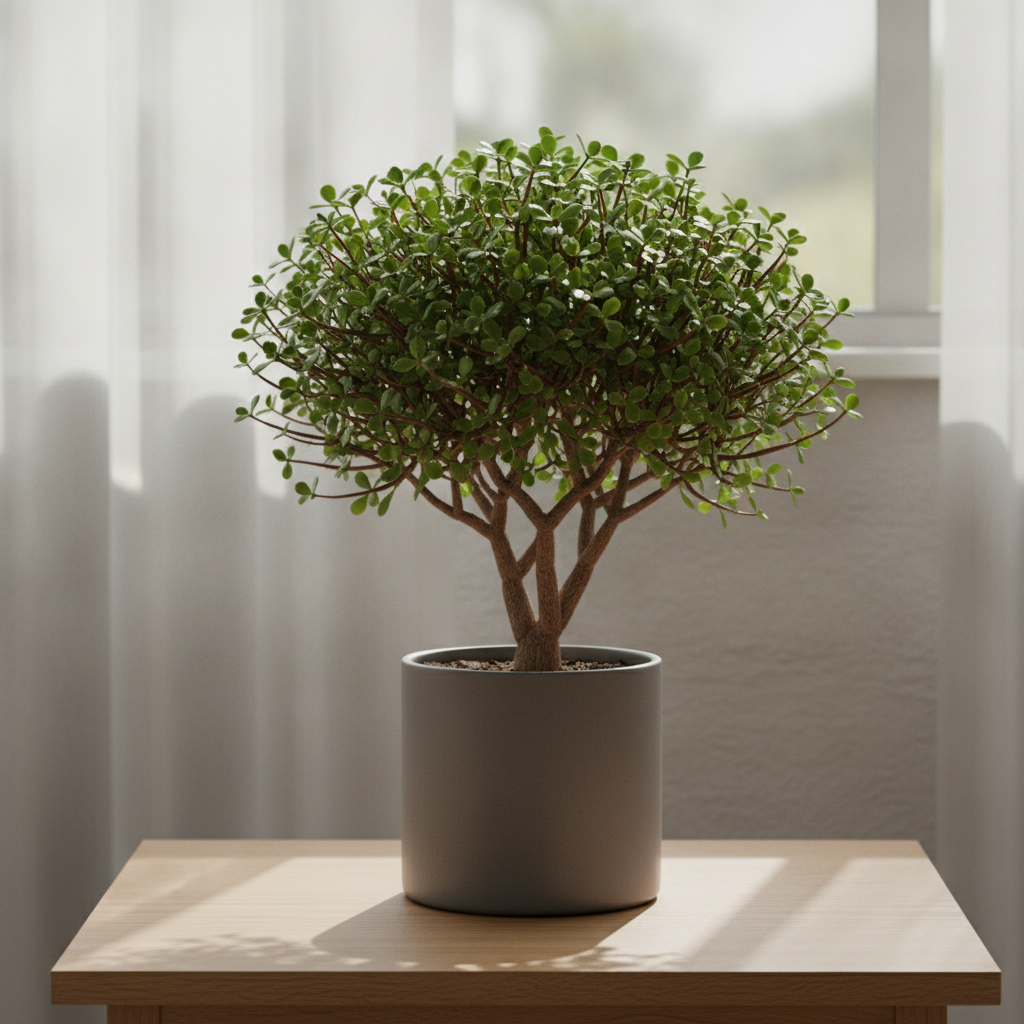
The Mini Jade Tree is the compact, small-leaved form of Portulacaria afra minima, a fleshy South African succulent shrub better known in its full size as elephant bush or spekboom. Despite the common name it is not a true jade at all: the genuine jade plant is Crassula ovata, and the two are only distant relatives. What the Mini Jade Tree borrows from that plant is the look, a woody, branching, tree-like frame hung with rounded coin-sized leaves, shrunk down to a scale that makes it one of the most popular subjects for beginner bonsai and sunny windowsills alike. It also answers to mini elephant bush, dwarf jade and, in its homeland, to spekboom.
Its reputation is one of near-indestructibility, and for once the reputation is deserved. This is a plant that stores water in both its leaves and its thickened stems, tolerates being forgotten for weeks, and asks for very little beyond strong light and a pot that drains freely. That forgiving nature is exactly why it turns up on so many “best plants for people who kill plants” lists. Yet there is a meaningful gap between a Mini Jade Tree that merely survives, holding on with sparse, floppy growth, and one that truly thrives, building a dense, sculptural crown of glossy leaves on reddish stems. This guide covers everything that separates the two, from light and watering through soil, feeding, propagation, pests and the most rewarding varieties to grow.
Contents
- Quick Reference
- Why the Mini Jade Tree Makes a Rewarding Houseplant
- Light Requirements
- Watering & Humidity
- Soil, Potting & Repotting
- Fertilising
- Propagation
- Pests & Diseases
- Popular Varieties
- Frequently Asked Questions
Quick Reference: Mini Jade Tree at a Glance
| Light | Very bright light with at least three to four hours of direct sun; happiest in a south or west window. |
| Watering | Soak thoroughly, then let the soil dry out completely. Roughly every 10 to 14 days in summer, monthly or less in winter. |
| Temperature | 18 to 24 degrees Celsius (64 to 75 Fahrenheit). Protect from anything below 10 degrees Celsius (50 Fahrenheit). |
| Humidity | Low. Ordinary dry household air is ideal; high humidity is a liability. |
| Fertiliser | Dilute, balanced feed every four to six weeks in spring and summer only. |
| Toxicity | Non-toxic and pet-safe. The leaves are even edible for people and are grazed by tortoises and elephants. |
Why the Mini Jade Tree Makes a Rewarding Houseplant
Few succulents pack as much character into as little space as the Mini Jade Tree. In the wild the full-sized Portulacaria afra grows into a sprawling shrub two to four metres (six to thirteen feet) tall across the semi-arid thickets of South Africa’s Eastern Cape, where it is a keystone species that feeds browsing elephants and, remarkably, sequesters carbon at rates rivalling tropical rainforest. The dwarf form keeps every ornamental quality of its parent, the mahogany stems, the neat rounded leaves, the naturally branching habit, but compresses it into a plant that lives comfortably in a 10 to 15 centimetre (4 to 6 inch) pot for years. That combination of miniature scale and genuinely tree-like structure is what makes it the classic gateway bonsai.
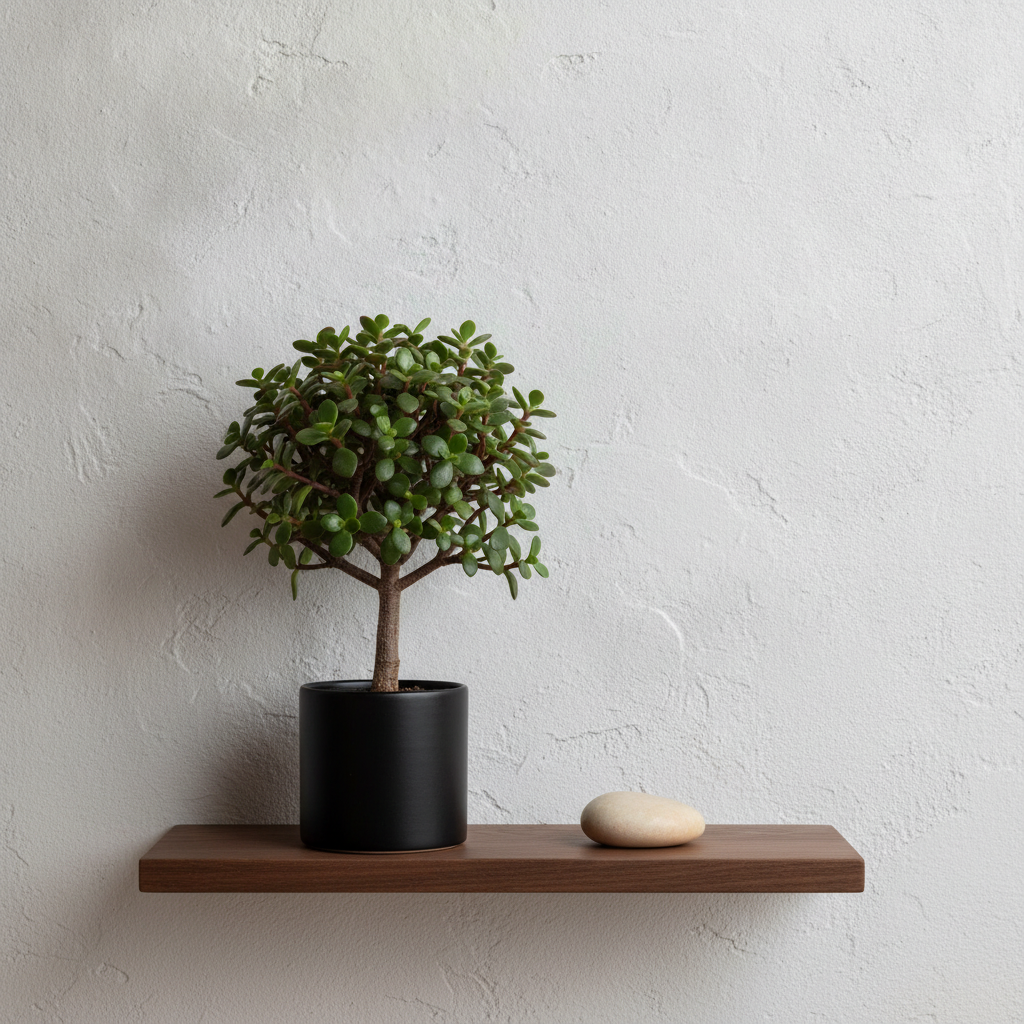
Beyond looks, the practical case for this plant is strong. It is one of the most drought-tolerant succulents you can keep indoors, forgiving of the erratic watering that defeats fussier species, and it grows fast enough by succulent standards to reward pruning and shaping within a single season. It thrives in the dry, centrally heated air that stresses tropical foliage plants, and it propagates so readily that a single trimming session yields a tray of new plants. Perhaps best of all for households with animals or small children, it carries none of the usual houseplant risk.
Important — Toxicity: The Mini Jade Tree is non-toxic to cats, dogs, horses and humans. This is a real point of difference from the true jade plant (Crassula ovata), which is toxic to pets. The mildly tart, spinach-like leaves are actually eaten in salads and stews across parts of southern Africa, so a curious nibble from a pet or toddler is no cause for alarm.
Light Requirements
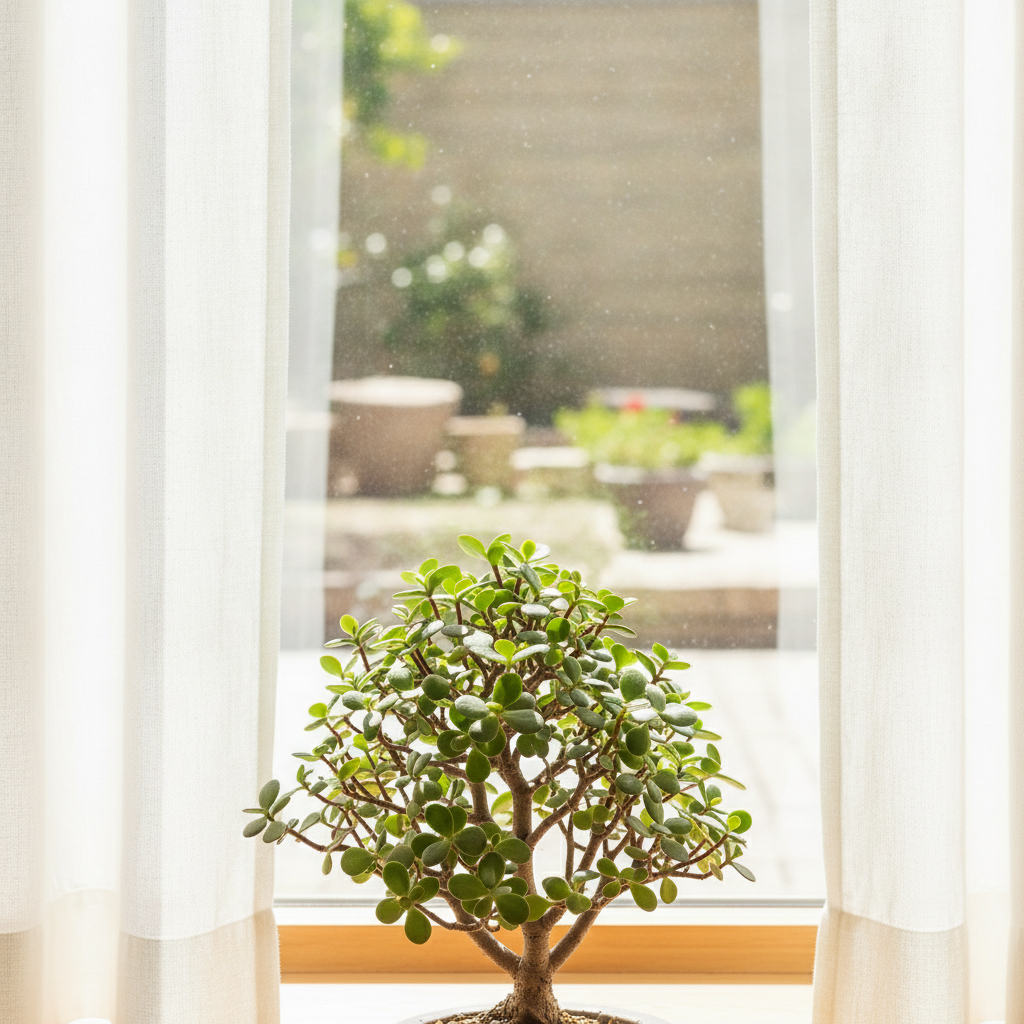
Light is the single most important factor in growing a good Mini Jade Tree, and the most common reason indoor specimens disappoint. This is a full-sun plant from a bright, open landscape, and it carries that appetite indoors. Given generous light it stays compact, with short internodes, thick stems and densely packed leaves. Starved of it, the plant stretches desperately towards the nearest window, producing long bare stems, widely spaced leaves and a weak, floppy silhouette that no amount of pruning can fully correct.
Aim to give your plant at least three to four hours of direct sunlight each day, supplemented by bright indirect light for the rest. An unobstructed windowsill is far better than a spot a metre back from the glass, where light intensity falls off dramatically. If you can grow it outdoors in summer, on a sunny balcony or patio, it will reward you with the tightest, most colourful growth of the year, though it needs a week or two of gradual acclimatisation first to avoid scorching.
Light Levels Explained
Houseplant light is often described in vague terms, so the table below translates the usual categories into approximate brightness and typical positions in a home, along with what each means for this particular succulent.
| Light Category | Approx. Level | Typical Location | Outcome |
|---|---|---|---|
| Direct sun | 20,000 to 100,000 lux | On a south or west windowsill | Ideal; compact growth and reddish stem colour |
| Bright indirect | 10,000 to 20,000 lux | Just beside a sunny window | Good; healthy but slightly looser growth |
| Medium | 2,000 to 10,000 lux | A metre back from a bright window | Marginal; slow, gradually stretching |
| Low | 500 to 2,000 lux | North window or interior wall | Poor; etiolation and leaf drop |
| Very low | Below 500 lux | Hallways, far corners | Unsuitable; steady decline |
Window Orientation and Placement
South-facing window: The best position in most homes in the northern hemisphere, delivering the long hours of direct sun this plant craves. Place it right against the glass and rotate it every week or two for even growth.
East-facing window: A workable second choice. The gentler morning sun is enough to keep a mature plant healthy, though growth will be a little looser than in a south window and you may see less stem colour.
West-facing window: Very good. Strong afternoon sun suits the plant well, and the extra warmth of a west window in summer is welcome rather than harmful, provided the soil is allowed to dry between waterings.
North-facing window: Generally too dim to grow this plant well. A specimen here will hang on for months but will steadily etiolate. If a north window is your only option, plan to add a grow light.
Pro Tip — Read the Stems: The gaps between leaves tell you everything about your light. Short spacing and fat stems mean the plant is happy; long, bare sections of stem with leaves only at the tips mean it is reaching for more light and should be moved brighter before it becomes permanently leggy.
How Light Affects Colour and Form
In strong light the leaves stay small, thick and deep green, and the young stems and leaf margins take on a warm reddish or bronze flush that is one of the plant’s quiet charms. Variegated forms such as the Rainbow Bush deepen their pink edges in bright conditions and fade to plain cream when light is short. In dim conditions all forms respond the same way: leaves enlarge and thin out, spacing stretches, and the plant loses the tight, sculptural quality that makes it worth growing.
Warning — Direct Sunlight: Although this is a sun-loving plant, a specimen grown in low light or bought fresh from a shaded shop cannot be moved into full sun overnight. Soft, shade-grown leaves will scorch, showing bleached white or brown patches. Reintroduce strong sun gradually over 10 to 14 days.
Artificial Lighting
The Mini Jade Tree responds very well to supplementary lighting, which makes it a viable plant even in dim flats. A full-spectrum LED grow light positioned 20 to 30 centimetres (8 to 12 inches) above the plant and run for 12 to 14 hours a day will keep growth compact through the darkest months. Because the plant is small, even a modest desk-style grow lamp is usually sufficient.
Seasonal Adjustments
Light intensity indoors can fall by half or more between summer and midwinter. Move the plant to your brightest available window as the days shorten, clean the glass and the leaves so nothing is lost to grime, and accept that growth will slow or stop over winter. This rest is natural and healthy. Resist the urge to compensate with extra water, which does far more harm in low light than a little stretching ever will.
Watering & Humidity
If light is where most people underserve this plant, watering is where they overdo it. The Mini Jade Tree is built for drought. Its leaves and swollen stems are living water tanks, and it uses a water-thrifty form of photosynthesis that lets it endure long dry spells. The golden rule is simple: soak thoroughly, then wait until the soil is bone dry before watering again. More Mini Jade Trees are killed by kindness, by frequent small waterings that keep the roots perpetually damp, than by any other cause.
When to Water
Forget any fixed schedule and judge by the soil and the plant. Push a finger into the mix or lift the pot to feel its weight; water only when the soil is completely dry all the way through and the pot feels light. In a warm, bright summer position this might mean watering every 10 to 14 days, while in winter it can stretch to once a month or even less. A slightly underwatered Mini Jade Tree recovers in hours once watered; a chronically overwatered one rarely recovers at all.
The plant itself gives clear signals. Firm, plump leaves mean it is well hydrated and needs nothing. Leaves that feel slightly soft and look faintly wrinkled are the ideal moment to water. Deeply shrivelled, papery leaves mean you have waited too long, though even then a good soak usually brings the plant back over a day or two.
Pro Tip — The Wrinkle Test: When in doubt, wait for the leaves to just begin to lose their firmness before watering. A Mini Jade Tree tells you it is thirsty long before it comes to any harm, so letting it ask is far safer than watering on a calendar.
How to Water Correctly
- Confirm the soil is completely dry throughout before you begin.
- Water at the soil surface, avoiding the leaves and the crown of the plant.
- Add water slowly until it runs freely from the drainage holes, wetting the entire root ball.
- Let the pot drain fully for several minutes, then tip away any water left standing in the saucer.
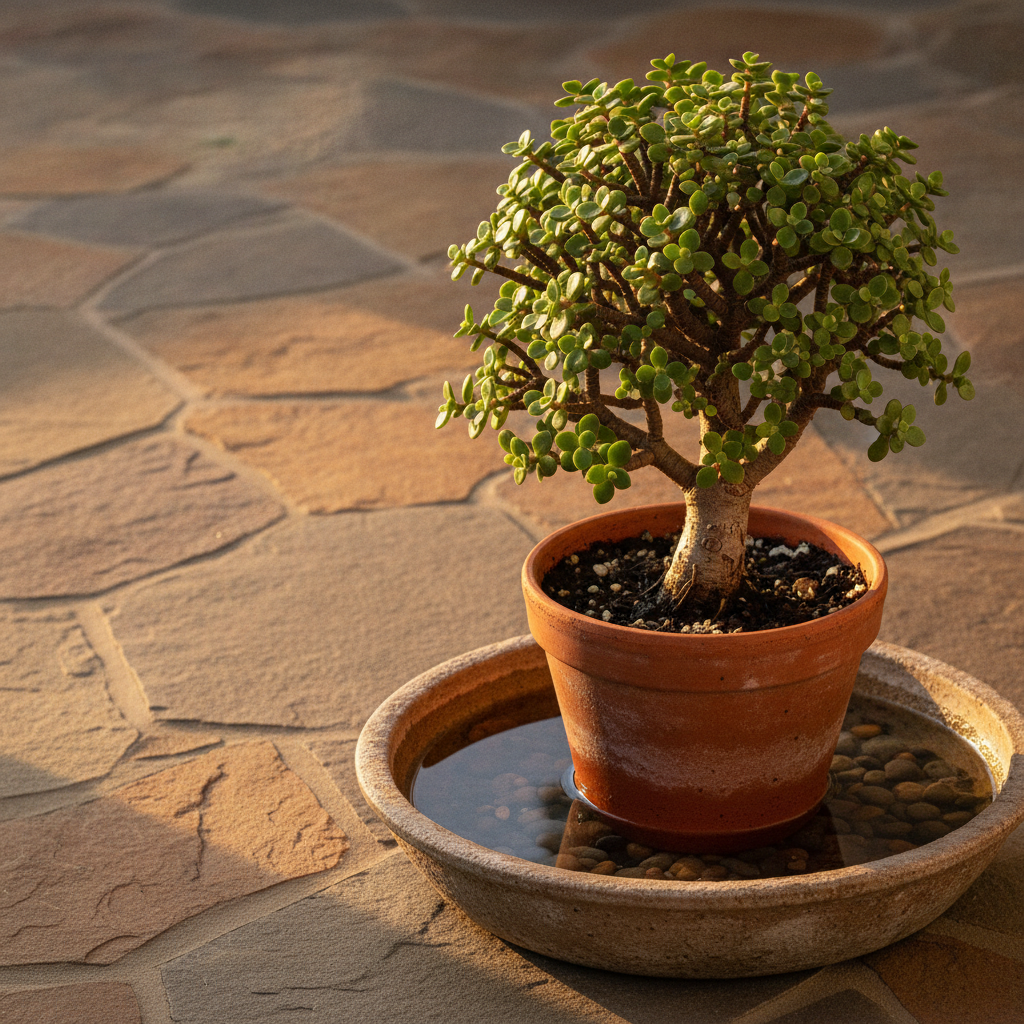
- Never let the pot sit in a tray of water; the roots must not stay wet.
- Put the plant back in its bright spot and do not water again until the soil has dried out completely.
Signs of Overwatering vs. Underwatering
| Symptom | Overwatering | Underwatering |
|---|---|---|
| Leaf colour | Yellowing, then translucent | Fading to a dull, pale green |
| Leaf texture | Soft, mushy, squishy to the touch | Wrinkled, thin and papery |
| Leaf drop | Sudden, with leaves falling plump and soft | Gradual, with leaves shrivelling first |
| Stems | Blackening or soft at the base | Thin and slightly shrunken but firm |
| Soil | Stays wet for many days | Bone dry, pulling away from the pot |
Warning — Root Rot: A soft, darkening stem base or leaves that drop while still plump is a sign of rot, not thirst. Stop watering at once, unpot the plant, cut away any black or mushy tissue with a clean blade, and let the healthy portion dry and callus before replanting in fresh, dry, gritty mix. Rot caught early can often be salvaged as a cutting.
Humidity Requirements
Here the Mini Jade Tree is refreshingly undemanding. It is adapted to dry air and actively prefers it, thriving in the 30 to 50 percent relative humidity typical of a heated home. Unlike tropical foliage plants, it needs no misting, no pebble trays and no humidifier.
In fact, high humidity works against this plant. Damp, stagnant air raises the risk of fungal problems and rot, especially when combined with cool temperatures or overwatering. If you grow one in a bathroom or another humid room, make sure it has excellent airflow and bright light to offset the moisture.
Good air circulation is the one atmospheric factor worth attending to. A gently moving airflow helps the soil surface and foliage dry quickly after watering, which is exactly what a succulent wants. An open window in mild weather or a nearby fan on hot, still days does the plant a real favour.
Water Quality
The Mini Jade Tree is unfussy about water quality and tolerates ordinary tap water in most areas. If your water is very hard you may see faint mineral crusting on the soil over time, which is harmless but can be avoided by using filtered or collected rainwater. Room-temperature water is gentler on the roots than very cold water straight from the tap.
Soil, Potting & Repotting
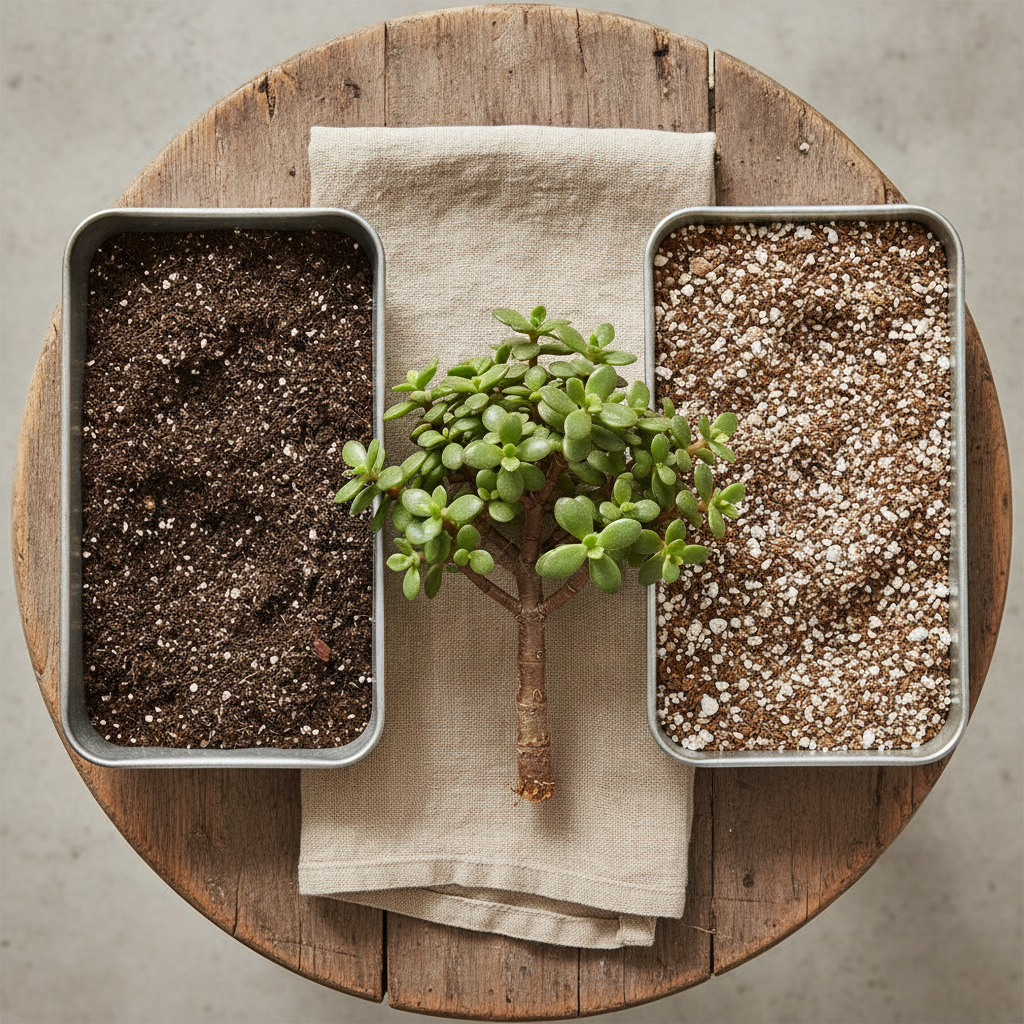
Because overwatering is the chief danger, the growing medium matters enormously. The right soil forgives the occasional heavy hand with the watering can, while the wrong soil, a dense, moisture-holding mix, turns every watering into a gamble. The aim is a gritty, fast-draining medium that holds just enough moisture to sustain the plant between soakings and then dries quickly.
Ideal Soil Composition
A quality cactus and succulent compost is a fine starting point, but most bagged mixes still hold too much moisture on their own. Improving drainage by cutting the compost with mineral grit produces a far better medium. The table below sets out a reliable recipe.
| Component | Proportion | Function |
|---|---|---|
| Cactus and succulent compost | 50 percent | Base structure and modest moisture retention |
| Pumice or perlite | 30 percent | Sharp drainage and aeration around the roots |
| Coarse horticultural sand or fine grit | 20 percent | Weight, structure and fast free drainage |
The Mini Jade Tree is not particular about pH and grows well in anything from mildly acidic to mildly alkaline soil, roughly 6.0 to 7.5. Far more important than pH is physical structure: the mix should feel gritty and loose in the hand, and water should run straight through it rather than pooling on the surface.
Pro Tip — Quick Mix Recipe: For a no-fuss blend, combine two parts bagged cactus compost with one part pumice and one part coarse grit. If you can pour water through a handful and see it drain almost instantly, you have it right.
Choosing the Right Pot
Pot choice has a direct effect on how easy the plant is to keep alive, because the container governs how quickly the soil dries out.
Drainage holes are non-negotiable. Never grow a Mini Jade Tree in a pot without drainage. Any decorative cover pot should be used only as a sleeve, with the plant lifted out to water and returned once fully drained.
Pot material: Unglazed terracotta is the ideal choice. Its porous walls wick moisture out of the soil and let it evaporate, dramatically lowering the risk of rot. Glazed ceramic and plastic hold moisture longer, so if you use them, be even more conservative with watering.
Pot size: Choose a snug pot only a little larger than the root ball. A pot that is too large holds a reservoir of damp soil the small root system cannot use, which invites rot. This plant is perfectly content slightly pot-bound, and tight roots also help keep top growth compact, which is why bonsai growers favour shallow trays.
When to Repot
The Mini Jade Tree is slow to need repotting and dislikes being disturbed, so there is no need to hurry. Every two to three years is usually enough, or whenever roots grow thickly from the drainage holes, the plant becomes top-heavy, or the soil has broken down and no longer drains freely. Spring, at the start of the growing season, is the best time. Always repot into dry soil and wait several days before the first watering, giving any roots damaged in the process time to heal.
How to Repot: Step-by-Step
- Water lightly a few days ahead so the root ball holds together, then let the surface dry before repotting.
- Gently slide the plant from its pot, supporting the base of the stems rather than pulling on the crown.
- Tease away old, spent soil from the roots and inspect them, trimming any that are black, mushy or dead.
- Add a layer of fresh gritty mix to a clean pot only slightly larger than the last.
- Position the plant at its previous depth and fill around the roots with more dry mix, firming gently.
- Leave the top of the root ball just below the rim and do not bury the stems any deeper than before.
- Wait five to seven days before watering to let the roots settle and any wounds callus over.
Warning — Transplant Shock: Watering immediately after repotting is the classic mistake. Damaged roots sitting in wet soil rot quickly, so the enforced dry spell after repotting is a protection, not neglect. Some leaf drop in the weeks after repotting is normal and passes as the plant re-establishes.
Fertilising
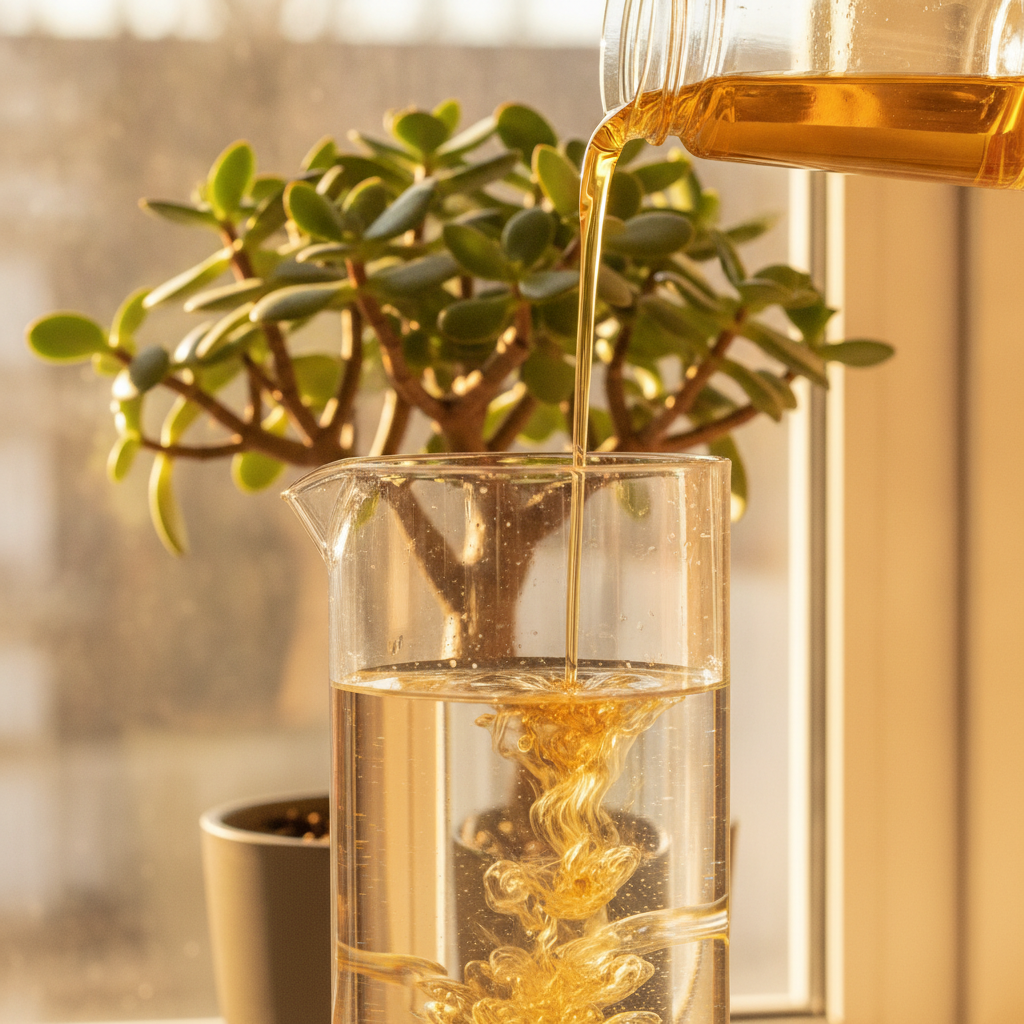
The Mini Jade Tree is a light feeder that grows in nutrient-poor ground in the wild, so it needs far less fertiliser than a leafy tropical plant. A little feeding during the growing season does encourage fuller, faster growth and better colour, but too much causes soft, weak, overstretched shoots that are prone to pests and rot.
Restraint is the guiding principle. Feed only in the active growing months of spring and summer, always at reduced strength, and never feed a dry, stressed or dormant plant. If you are unsure whether to fertilise at all, err on the side of not doing so; this is a plant that suffers far more from overfeeding than from going hungry.
Understanding Plant Nutrients
Fertilisers are labelled with an N-P-K ratio, the percentages of nitrogen, phosphorus and potassium. For a succulent like this, a balanced or slightly low-nitrogen formula is best, since excess nitrogen drives the soft, leggy growth you most want to avoid. The table below outlines the key nutrients and the signs of deficiency.
| Nutrient | Symbol | Primary Function | Deficiency Symptoms |
|---|---|---|---|
| Nitrogen | N | Leaf and stem growth | Pale, uniformly yellowing older leaves |
| Phosphorus | P | Root development and energy | Weak roots, stunted, sluggish growth |
| Potassium | K | Overall vigour and stress tolerance | Yellow or browning leaf edges |
| Calcium | Ca | Cell wall strength | Distorted, weak new growth |
| Magnesium | Mg | Core of the chlorophyll molecule | Yellowing between the leaf veins |
| Iron | Fe | Chlorophyll production | Pale new leaves with green veins |
Types of Fertiliser
Liquid fertilisers: The easiest option to control. A balanced houseplant or dedicated cactus feed, diluted to half or even quarter strength, lets you match feeding to the plant’s modest needs and stop instantly at the end of summer.
Slow-release granular: A few slow-release prills worked into the soil in spring can feed the plant gently across the whole season. Use less than the label suggests, as the recommended rates are calibrated for hungrier plants.
Organic fertilisers: A light top-dressing of worm castings in spring is a gentle, forgiving way to feed, releasing nutrients slowly with little risk of the salt build-up that synthetic feeds can cause.
Feeding Schedule
Feed once every four to six weeks through spring and summer with a diluted balanced fertiliser, and stop altogether in autumn and winter when growth naturally slows. Four or five feeds across the growing season are plenty for a healthy Mini Jade Tree.
Pro Tip — Feed Onto Moist Soil: Always apply liquid feed to soil that is already slightly damp, ideally the day after a normal watering. Fertiliser poured onto bone-dry roots can scorch them, so watering first protects the plant and helps the nutrients spread evenly.
How to Fertilise
- Dilute a balanced liquid fertiliser to half strength or less in a watering can.
- Make sure the plant is healthy and the soil is lightly moist, not bone dry.
- Apply the solution to the soil, keeping it off the leaves and stems.
- Let any excess drain away completely and empty the saucer.
- Flush the pot with plain water every few months to wash out accumulated salts.
Warning — Salt Build-Up: A white crust on the soil or around the pot rim signals mineral salts from over-fertilising. These can burn the roots and brown the leaf tips. Flush the soil thoroughly with plain water until it runs clear, and cut back on future feeding.
Propagation
Propagating a Mini Jade Tree is almost comically easy, which is part of the plant’s appeal. Stem cuttings root with a very high success rate, and every time you prune to shape the plant you generate ready-made material for new ones. It is one of the best succulents on which to learn propagation, because the margin for error is so wide.
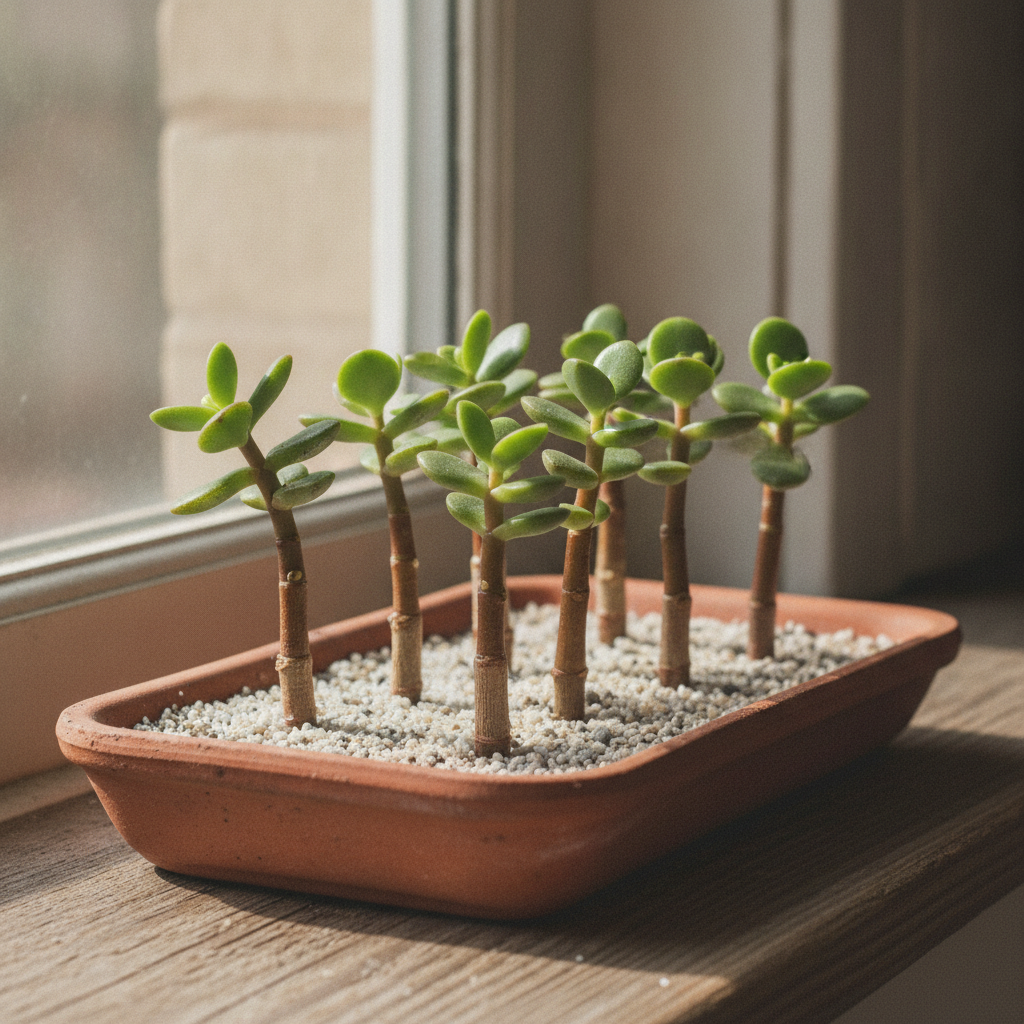
The most reliable method by far is stem cuttings, and the key to success is patience at one specific stage: allowing the cut end to dry and form a callus before it ever touches soil. Skip that step and cuttings tend to rot; honour it and they root almost without fail.
Understanding Stems and Callusing
The thickened, semi-woody stems of this plant are packed with stored energy and water, which is exactly what a cutting needs to power root formation. A callus, the dry, sealed layer that forms over a fresh cut after a few days in the open air, protects the wound from rot-causing microbes while the cutting waits to root. This is why dry propagation, not water rooting, suits the plant so well.
Stem Cuttings: Step-by-Step
This is the go-to method and works reliably at any point in the growing season. Choose healthy, firm stems for the best results.
- Using clean, sharp scissors or a blade, cut a healthy stem section 5 to 10 centimetres (2 to 4 inches) long.
- Strip the leaves from the lowest third of the cutting to expose a clean length of stem.
- Set the cutting aside in a dry, shaded spot for three to seven days until the cut end calluses over.
- Insert the callused end a couple of centimetres into dry, gritty succulent mix.
- Place the pot in bright, indirect light and leave it dry for the first week.
- Begin watering sparingly, letting the mix dry fully between waterings; roots usually form within two to three weeks.
- Once a gentle tug meets resistance, the cutting has rooted and can be treated as a mature plant.
Pro Tip — Bushier Plants From Pruning: Every cut you make prompts the plant to branch below it, so propagation and shaping go hand in hand. Prune to encourage a fuller crown and pot up the trimmings, and one plant quickly becomes many.
Leaf Propagation: Step-by-Step
Individual leaves can also be rooted, though the method is slower and less dependable than stem cuttings. It is a fun experiment and a good use of leaves knocked off during handling.
- Gently remove a plump, healthy leaf, keeping its base intact.
- Let the leaf dry for a day or two until the base has callused.
- Lay the leaf on top of dry, gritty mix rather than burying it.
- Place it in bright, indirect light and mist the soil lightly every few days.
- Be patient; tiny roots and a new rosette may take several weeks to appear, and not every leaf will take.
Troubleshooting Propagation
| Problem | Likely Cause | Solution |
|---|---|---|
| Cutting turns black and mushy | Inserted before callusing, or kept too wet | Allow a full callus and use dry, gritty mix |
| Cutting shrivels away | Left too long before potting, or too dry after rooting | Pot up sooner and water lightly once roots form |
| No roots after many weeks | Too little light or too cold | Move somewhere brighter and warmer |
| Leaves drop from the cutting | Normal early stress, or overwatering | Keep it dry and bright; new growth will follow |
Pests & Diseases
The Mini Jade Tree is relatively resistant to pests, and a healthy plant grown in good light with careful watering rarely suffers serious trouble. Most problems it does encounter are traceable to excess moisture, which weakens the plant and creates the damp conditions that pests and pathogens exploit.
Prevention is far easier than cure. Inspect your plant regularly, particularly the leaf axils and the undersides of leaves, and isolate any new arrival for a couple of weeks before letting it join your other plants. Catching an infestation early makes it trivial to deal with, whereas an established one can take weeks of persistence to clear.
Common Pests
Mealybugs (Pseudococcus species)
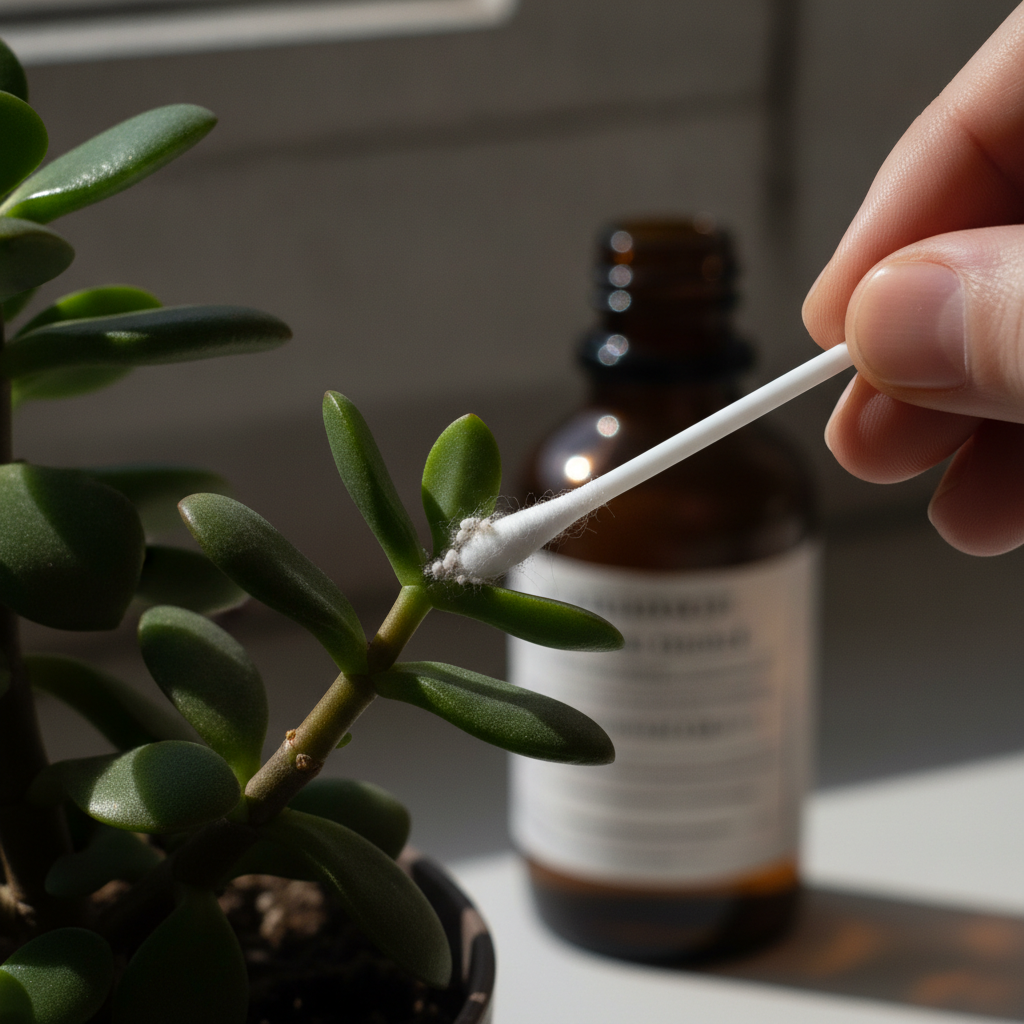
By far the most common pest of this plant, mealybugs appear as small, cottony white tufts tucked into leaf axils and along the stems. They suck sap, weaken the plant and leave behind sticky honeydew that can turn into sooty mould.
Treatment: Dab each insect directly with a cotton bud dipped in isopropyl alcohol, then treat the whole plant with insecticidal soap or diluted neem oil. Repeat weekly until no new bugs appear, checking the roots too in stubborn cases.
Spider Mites (Tetranychus urticae)
These tiny mites thrive in hot, dry conditions and are hard to see, though the fine webbing they spin between leaves and stems gives them away. They cause faint stippling and a dull, dusty look to the foliage.
Treatment: Rinse the plant to knock the mites back, then apply neem oil or a suitable miticide, treating every few days to break the fast breeding cycle. Improving air circulation helps prevent their return.
Scale (Coccoidea species)
Scale insects show up as small, hard brown bumps clinging to stems and leaves. Immobile once settled, they are easy to overlook until their sticky honeydew and the resulting sooty mould draw attention.
Treatment: Scrape or wipe them off with an alcohol-dipped cloth or cotton bud, then follow up with neem oil or horticultural oil to catch the mobile juveniles. Persistent checking over several weeks is usually needed.
Common Diseases
Root and Stem Rot (Pythium and Fusarium species)
The most serious threat to this plant, rot sets in when the roots or stem base sit in wet soil. It shows as blackening, softening tissue at the base and leaves that drop while still plump, and it can kill a plant quickly if ignored.
Treatment: Unpot the plant immediately, cut away all soft, discoloured tissue with a sterile blade, and let the healthy remainder callus before replanting in dry, gritty mix. Often the surest rescue is to take a clean cutting from the top and start again.
Sooty Mould (Capnodium species)
This black, powdery coating grows on the honeydew excreted by sap-sucking pests. It does not attack the plant directly but blocks light from the leaves and signals an underlying infestation that needs dealing with.
Treatment: Wipe the mould away with a damp cloth and, crucially, eliminate the pests producing the honeydew, without which the mould cannot return.
Pest and Disease Summary
| Pest / Disease | Identification | Treatment |
|---|---|---|
| Mealybugs | Cottony white tufts in leaf axils | Alcohol swab, then insecticidal soap or neem |
| Spider mites | Fine webbing and stippled leaves | Rinse, then neem oil or miticide |
| Scale | Hard brown bumps on stems | Scrape off, then horticultural oil |
| Root and stem rot | Black, soft base; plump leaf drop | Cut away rot, dry, replant or re-root |
| Sooty mould | Black powder on leaves | Wipe off and remove the pests behind it |
Prevention Strategies
The single most effective preventive measure is correct watering. A plant kept on the dry side, in gritty soil and bright light, is naturally robust and far less appealing to pests, while a chronically damp one is a magnet for both insects and rot. Good airflow reinforces this by keeping foliage and soil dry.
Routine inspection completes the picture. A quick look over the plant each time you water, paying attention to the hidden leaf axils where mealybugs hide, means you catch trouble while it is still a single insect rather than a colony. Quarantining new plants for two weeks stops most infestations before they ever start.
Pro Tip — Neem as Routine Defence: A monthly wipe or light spray of diluted neem oil during the growing season deters mealybugs and mites before they establish. Apply it in the evening or out of direct sun so the treated leaves do not scorch.
Popular Varieties
Although the plain green Mini Jade Tree is the most widely grown, Portulacaria afra has produced a handful of distinctive cultivars that share its easy nature while offering different colours and growth habits. All are grown in exactly the same way, so you can mix them freely in a collection.
The two most sought-after are the variegated Rainbow Bush and the golden Yellow Elephant Bush, but trailing and upright forms broaden the range further, from cascading hanging displays to tall, columnar accents.
| Variety | Leaf Appearance | Light Needs | Growth Rate | Availability |
|---|---|---|---|---|
| Green Mini Jade (minima) | Small, rounded, deep green | High | Moderate | Common |
| Rainbow Bush (Variegata) | Cream and green, pink-edged | High | Slow | Common |
| Yellow Elephant Bush (Aurea) | Chartreuse to golden yellow | Very high | Slow to moderate | Occasional |
| Low Rider (Prostrata) | Green, on trailing stems | High | Moderate | Occasional |
| Cork Bark | Green, on corky woody stems | High | Slow | Rare |
| Skyscraper | Green, on tall upright stems | High | Fast | Rare |
Featured Varieties
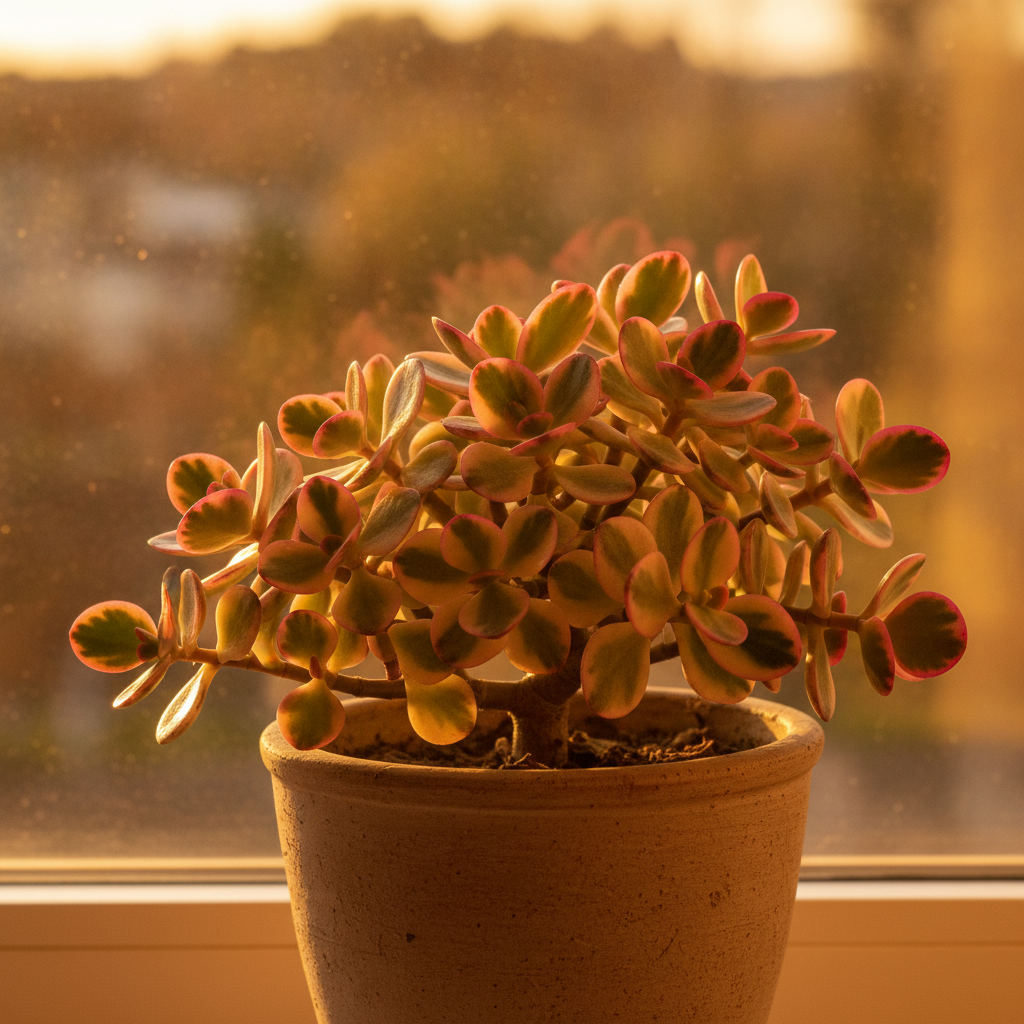
Rainbow Bush
The variegated cultivar, with rounded leaves splashed cream and green and blushed pink at the margins in strong light. Slower and slightly more delicate than the green form, it makes a spectacular trailing or bonsai subject.
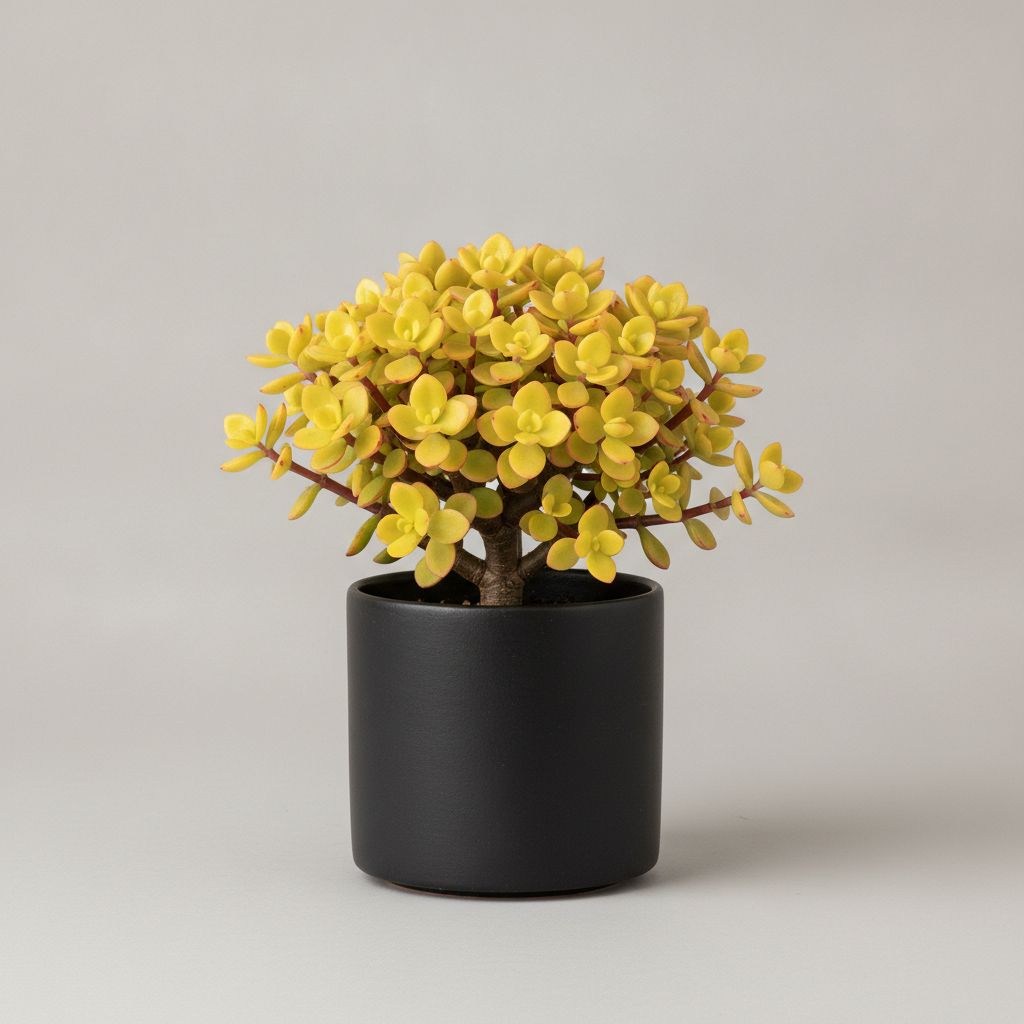
Yellow Elephant Bush
A striking golden form whose small leaves glow bright chartreuse to yellow in full sun, deepening in colour the more light it receives. Compact and dense, it provides a vivid contrast to the green and variegated types.
Variety Profiles in Detail
Rainbow Bush (Portulacaria afra ‘Variegata’)
The most popular of the coloured forms, prized for foliage that combines soft cream variegation with pink-flushed edges. It grows more slowly than the species and its variegated tissue is a little more prone to scorch, so it appreciates bright light filtered at its harshest. Grown well, it is among the most beautiful small succulents available.
Low Rider (Portulacaria afra ‘Prostrata’)
A naturally trailing cultivar whose stems spill downward rather than reaching up, making it ideal for hanging pots and the edges of arrangements. It shares the toughness of the upright forms and roots just as readily from cuttings.
Choosing the Right Variety for Your Space
For a first plant or a future bonsai, the plain green Mini Jade is the fastest and most forgiving choice. If you want a splash of colour and can offer a very bright window, the Rainbow Bush or Yellow Elephant Bush reward the extra light with striking foliage. And for a hanging display or to soften the edge of a shelf, the trailing Low Rider is the natural pick. Whichever you choose, the care is identical, so a collection of several makes an easy and visually varied display.
Frequently Asked Questions
Is the Mini Jade Tree the same as a real jade plant?
No. The true jade plant is Crassula ovata, while the Mini Jade Tree is Portulacaria afra minima, a different species from a different family. They look similar and are cared for in much the same way, but the Mini Jade has smaller leaves, more flexible reddish stems and, importantly, is non-toxic, whereas the true jade is toxic to pets.
Why is my Mini Jade Tree dropping leaves?
The usual culprit is watering. Leaves that fall while still plump and soft point to overwatering and possible rot, while leaves that shrivel before dropping indicate the plant has been too dry for too long. Sudden environmental changes, such as moving the plant or a cold draught, can also trigger a brief bout of leaf drop that soon settles.
How fast does a Mini Jade Tree grow?
By succulent standards it is a moderately fast grower, especially in strong light and warmth. It will not shoot up like a tropical vine, but a well-kept plant puts on noticeable growth each season and responds quickly to pruning by branching, which is why it lends itself so well to shaping and bonsai.
Can I grow a Mini Jade Tree as a bonsai?
Yes, and it is one of the finest beginner bonsai subjects there is. Its naturally tree-like branching, small leaves, thickening trunk and tolerance of root pruning all suit the art, and it recovers from mistakes far more readily than traditional woody bonsai. Regular pruning and a shallow, well-draining pot are all you need to start.
Is the Mini Jade Tree safe for cats and dogs?
Yes. Portulacaria afra is non-toxic to cats, dogs and horses, and the leaves are even edible for people. This makes it a genuinely pet-safe choice and a reassuring alternative to the toxic true jade plant, though it is still sensible to discourage pets from treating any houseplant as a snack.
Why has my Mini Jade Tree become tall and leggy?
Legginess, long bare stems with widely spaced leaves, is a classic sign of insufficient light. The plant is stretching towards the nearest source of brightness. Move it to your sunniest window or add a grow light, and prune back the stretched growth to encourage a bushier, more compact shape; the trimmings can be rooted as new plants.
Do I need to mist my Mini Jade Tree?
No. This is a dry-air succulent that positively dislikes humidity, so misting is unnecessary and can even encourage rot and fungal problems. Ordinary household air suits it perfectly, and the only atmospheric factor worth improving is airflow, not moisture.
How do I make my Mini Jade Tree bushier?
Give it plenty of direct light and prune it regularly. Pinching or cutting back the growing tips prompts the plant to branch from below each cut, gradually building a denser crown. Combined with strong light to keep new growth compact, routine pruning is the key to a full, well-shaped plant, and every trimming can become a new cutting.






