
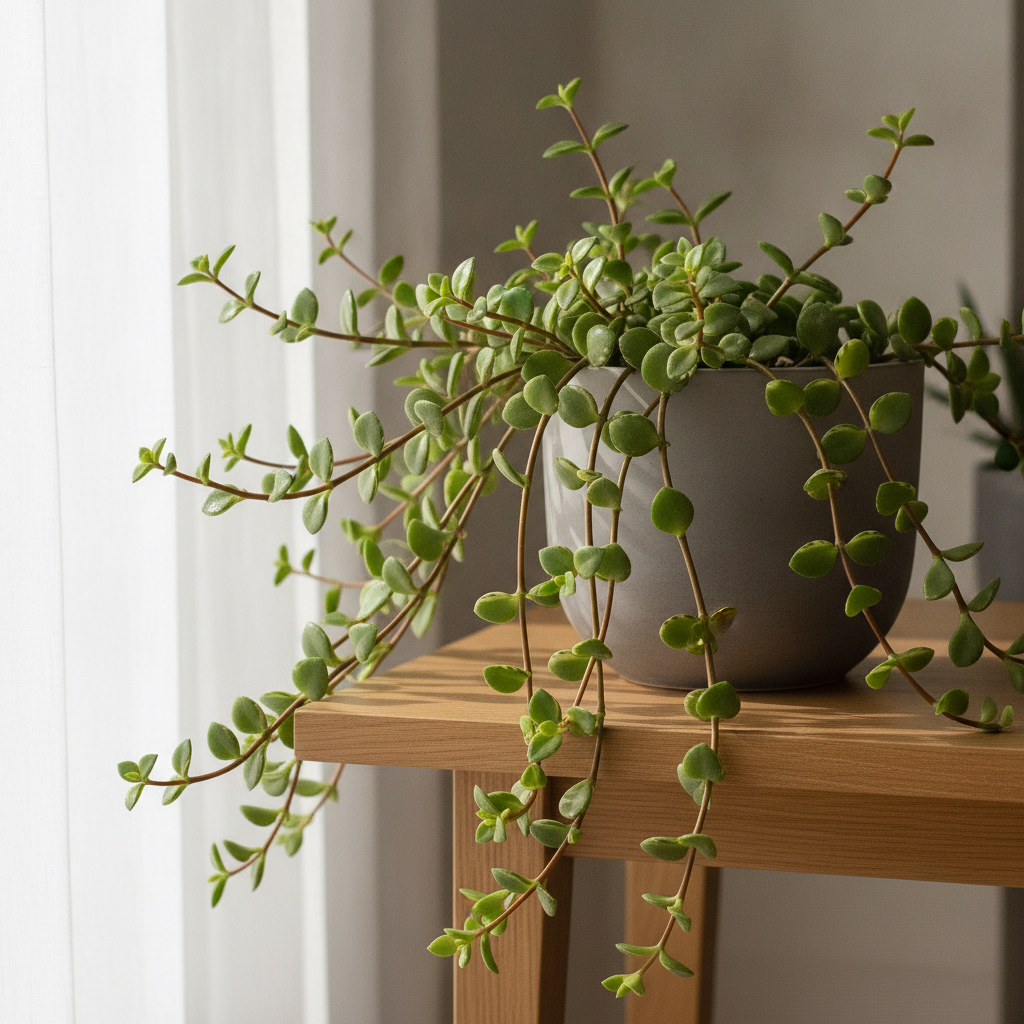
Few trailing succulents combine easy temperament with such a generous, tumbling habit as the trailing string jade. Known botanically as Crassula sarmentosa and sold under nicknames such as the comet plant, this South African shrublet sends out long, red-flushed stems lined with pairs of glossy oval leaves edged in fine cream and gold. Left to its own devices on a shelf or in a hanging pot, it spills downward in loose cascades that can reach 60 to 90 centimetres (24 to 36 inches), softening a hard edge the way few other succulents manage.
Its reputation as a beginner plant is well earned, but there is a meaningful gap between a trailing string jade that merely survives and one that truly thrives. A neglected specimen will cling to life in poor light and irregular watering, growing pale, leggy and sparse. A well-tended one flushes deep red at the leaf margins, stays densely clothed in foliage from crown to tip, and in autumn may reward you with sprays of small, honey-scented star-shaped flowers. This guide covers everything that separates the two outcomes, from reading light correctly to watering with a succulent’s rhythm, choosing the right gritty soil, feeding sparingly, propagating almost effortlessly, and heading off the handful of pests that trouble the genus.
Contents
- Quick Reference
- Why Trailing String Jade Makes a Rewarding Houseplant
- Light Requirements
- Watering & Humidity
- Soil, Potting & Repotting
- Fertilising
- Propagation
- Pests & Diseases
- Popular Varieties
- Frequently Asked Questions
Quick Reference: Trailing String Jade at a Glance
| Light | Bright indirect light with a few hours of gentle direct sun; an east or lightly shaded south window is ideal |
| Watering | Soak thoroughly, then let the soil dry almost completely; roughly every 10 to 14 days in growth, far less in winter |
| Temperature | 18 to 24 degrees Celsius (64 to 75 degrees Fahrenheit); protect from anything below 7 degrees Celsius (45 degrees Fahrenheit) |
| Humidity | Low to average household humidity, 30 to 50 percent, is perfectly suitable |
| Fertiliser | Dilute succulent feed once a month in spring and summer only |
| Toxicity | Mildly toxic to cats and dogs if eaten; keep out of reach of pets and small children |
Why Trailing String Jade Makes a Rewarding Houseplant
The trailing string jade belongs to the vast Crassula genus, the same group that gives us the familiar upright jade plant, Crassula ovata. Where its cousin grows into a stiff little tree, Crassula sarmentosa scrambles and trails, a growth habit it evolved to sprawl over rocks and through scrub in its native Eastern Cape and KwaZulu-Natal. That heritage is the key to understanding it as a houseplant. It is a tough, drought-adapted succulent that stores water in its leaves and stems, yet it is also faster and more forgiving than many succulents, putting on visible new growth across a single season rather than creeping along at a glacial pace.
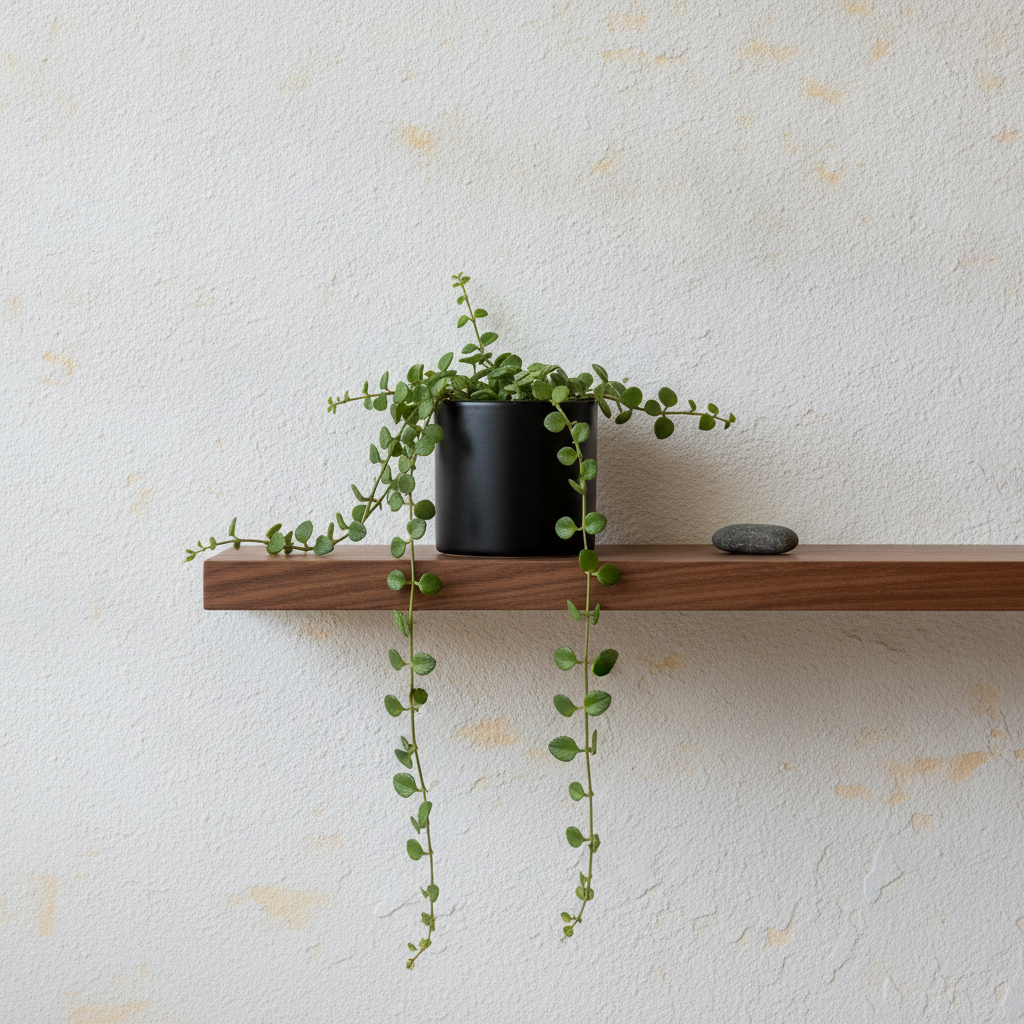
For the home grower, several qualities make it especially appealing. It thrives on a degree of benign neglect, tolerating missed waterings that would finish off a thirstier plant. It propagates so readily from stem cuttings that a single plant can furnish an entire windowsill within a year. Its trailing form suits shelves, mantelpieces and hanging planters where an upright plant would look wrong. And unlike many succulents that stay stubbornly green, it repays good light with warm red and coral tones along the leaf edges and stems, giving it real seasonal character. The difference between a merely surviving plant and a thriving one shows plainly in colour and density: a thriving specimen is compact, richly tinted and fully clothed, while a struggling one stretches, fades to a flat green and drops its lower leaves.
Important — Toxicity: Like other members of the jade family, Crassula sarmentosa is considered mildly toxic to cats and dogs. Ingestion can cause vomiting, lethargy and loss of coordination in pets. It is not a plant to grow within reach of animals that chew foliage, and its sap may irritate sensitive skin, so wash your hands after taking cuttings.
Light Requirements
Light is the single factor that most clearly separates a lush trailing string jade from a disappointing one. As a succulent from open, sunny habitats, it wants considerably more light than the average foliage houseplant. Give it too little and it stretches, the gaps between leaf pairs lengthening into bare stem, the colour draining to a weak uniform green. Give it the right amount and it stays tight, dense and flushed with red at every margin.
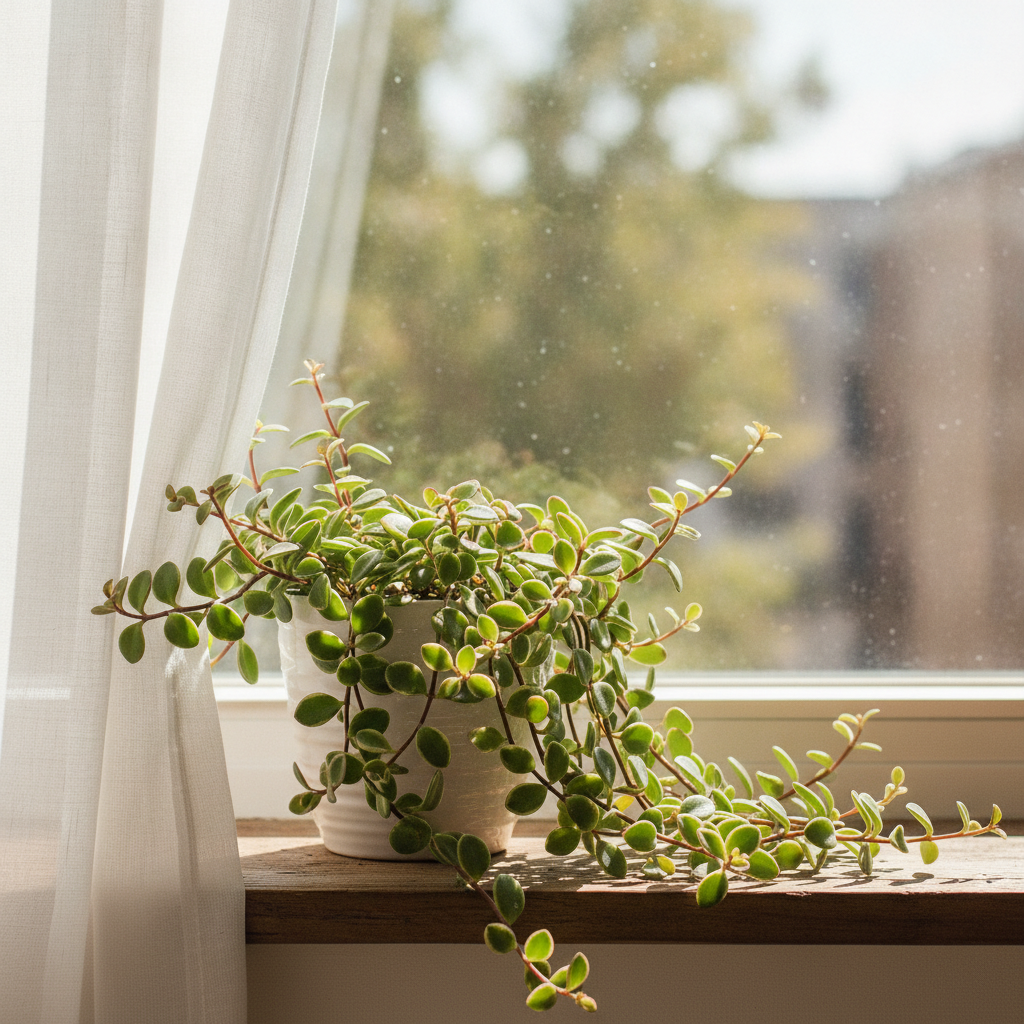
The ideal is bright, mostly indirect light supplemented with two to four hours of gentle direct sun each day. Morning sun from an east-facing window is close to perfect, strong enough to bring out colour but rarely harsh enough to scorch. A south window works well too, provided the midday sun is filtered by a sheer curtain during the hottest months. The plant will accept a west window and even survive in medium light, but survival and good looks are different things.
Light Levels Explained
Understanding the practical light tiers helps you place the plant with confidence. The values below are approximate illuminance readings that describe the conditions a trailing string jade will meet in a typical home.
| Light Category | Approx. Level | Typical Location | Outcome |
|---|---|---|---|
| Direct sun | 50,000 lux and above | On an unshaded south sill | Best colour, but risk of scorch in peak summer |
| Bright indirect | 15,000 to 40,000 lux | Beside an east or curtained south window | Ideal: compact, dense, well coloured |
| Medium | 5,000 to 15,000 lux | A metre or two back from a bright window | Survives, slower growth, some stretching |
| Low | 1,000 to 5,000 lux | North window or dim interior | Leggy, pale, leaf drop over time |
| Very low | Below 1,000 lux | Hallways, interior corners | Decline; not suitable long term |
Window Orientation and Placement
South-facing window: The brightest option in the northern hemisphere and generally excellent, though in high summer the direct midday sun can be strong enough to scorch. A sheer curtain or a position just to the side of the direct beam gives the best of both worlds.
East-facing window: Arguably the sweet spot. Cool, bright morning sun encourages red margins and compact growth without the scorch risk of harsh afternoon light. Most trailing string jades look their best here.
West-facing window: A good choice, offering strong afternoon light. Watch for heat build-up behind glass on hot days, and pull the plant back slightly if leaves show signs of stress.
North-facing window: The weakest orientation and the hardest for this plant. It may hold on, but expect etiolation, muted colour and gradual loss of the lower leaves. If a north window is your only option, plan to supplement with a grow light.
Pro Tip — Rotate for Even Growth: Because the plant leans toward its light source, give the pot a quarter turn every week or two. This keeps the trailing stems radiating evenly around the pot instead of all crowding toward the window, and prevents a lopsided, one-sided cascade.
How Light Affects Leaf Colour
The red and coral tones that make this plant so appealing are a direct response to light intensity. Under strong light the plant produces protective pigments called anthocyanins, which blush the leaf margins and stems in shades of rose, red and burgundy. In lower light those pigments fade and the plant reverts to plain green, so if your specimen has lost its colour, the cause is almost always insufficient light rather than any nutritional shortfall. In the variegated comet form, good light also intensifies the contrast between the cream margins and the green centres. Moving a pale plant gradually into brighter conditions will, over several weeks, restore the colour.
Warning — Direct Sunlight: A plant that has been living in low or medium light cannot be moved straight into full sun without burning. Sudden exposure causes pale, papery scorch patches that never recover. Acclimatise over two to three weeks, adding an hour of direct sun at a time, to let the leaves toughen and build up their protective pigments.
Artificial Lighting
Where natural light falls short, a full-spectrum LED grow light fills the gap admirably. Position it 20 to 30 centimetres (8 to 12 inches) above the plant and run it for 10 to 12 hours a day. Because succulents want high intensity, choose a light rated for that use rather than a low-output decorative bulb. A grow light is particularly valuable through the dim months of winter in temperate climates, where it can be the difference between a plant that holds its form and one that stretches badly.
Seasonal Adjustments
Light changes markedly through the year, and so should the plant’s placement. In summer, ease it back from an unshaded south window or add a sheer curtain to prevent scorch. In winter, move it as close to the brightest glass as possible to capture every hour of weak, low-angled sun. A plant that was thriving beside a bright window in July may be starved by December in the same spot, so treat placement as something to revisit each season rather than set once and forget.
Watering & Humidity
Watering is where most trailing string jades are lost, and almost always to kindness rather than neglect. As a leaf-and-stem succulent, the plant carries its own water reserve and is built to endure dry spells. What it cannot endure is sitting in constantly moist soil, which suffocates the roots and invites rot. The guiding principle is simple: water thoroughly, then wait until the soil is almost completely dry before watering again.
When to Water
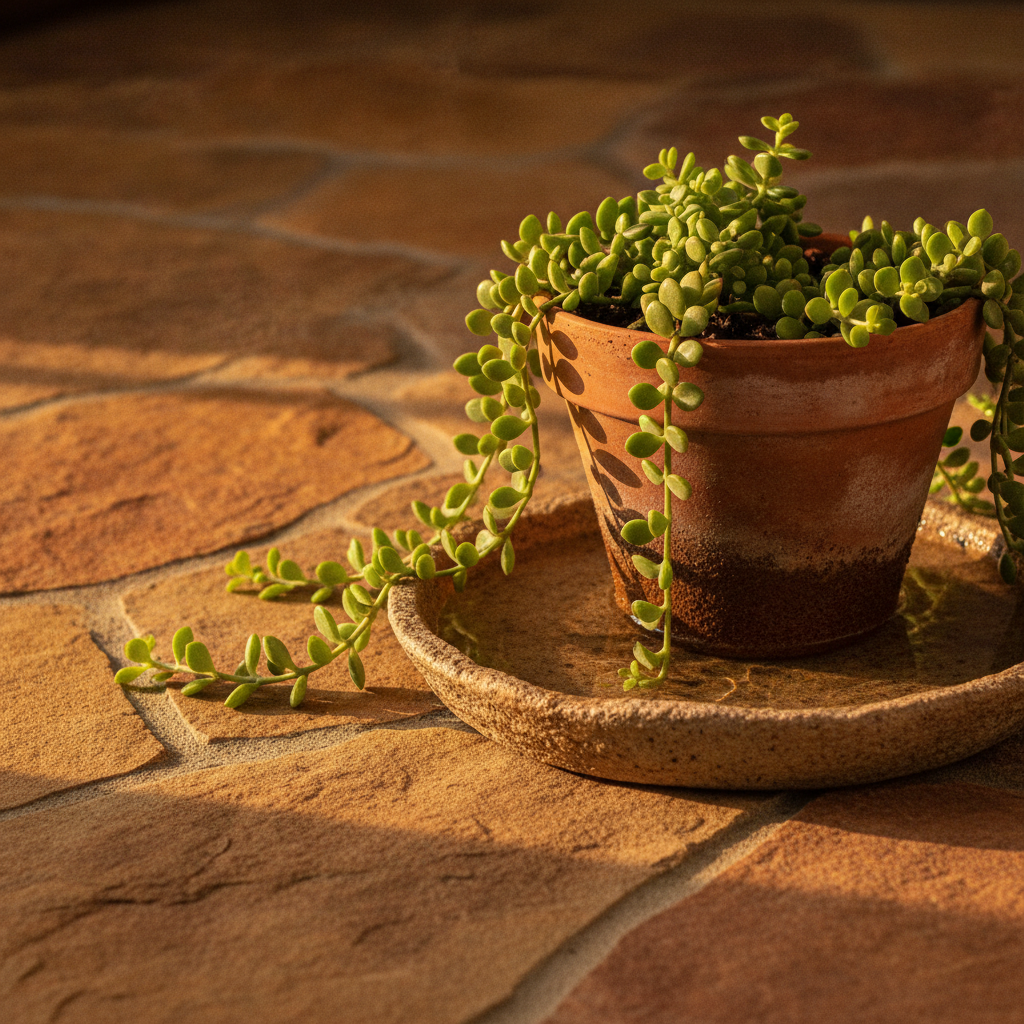
Rather than watering on a fixed calendar, water in response to the soil. Push a finger a few centimetres into the mix, or lift the pot to judge its weight. When the soil is dry well below the surface and the pot feels light, it is time. In the active growth of spring and summer, a plant in bright light and a fast-draining mix typically needs water every 10 to 14 days, though warmth, pot size and light all shift that figure.
Winter is a different regime entirely. As growth slows and light weakens, the plant’s water use drops sharply. Watering may fall to once every three or four weeks, sometimes less. Overwatering in winter, when the soil dries slowly and the roots are barely working, is the classic route to root rot, so err firmly on the side of dryness during the cold months.
Pro Tip — Read the Leaves: The leaves themselves are a reliable moisture gauge. Plump, firm leaves mean the plant is well hydrated and needs nothing. Slightly soft, wrinkled or flattening leaves signal genuine thirst. Learning to read this cue is more dependable than any schedule, because it reflects what the plant is actually experiencing.
How to Water Correctly
- Check first that the soil is dry well below the surface and the pot feels light for its size.
- Water generously, either from the top until it runs freely from the drainage holes, or by standing the pot in a shallow dish of water for 10 to 15 minutes to soak from below.
- Let all excess water drain away completely; never leave the pot standing in a full saucer.
- Tip away any water that collects in the outer cover pot or tray after draining.
- Return the plant to its bright spot and do not water again until the soil has dried out once more.
Signs of Overwatering vs. Underwatering
| Symptom | Overwatering | Underwatering |
|---|---|---|
| Leaf colour | Yellowing, translucent or blackening leaves | Dull, faded, sometimes reddening under stress |
| Leaf texture | Soft, mushy, squishy to the touch | Wrinkled, shrivelled, thin and flattened |
| Leaf drop | Leaves fall easily, often still plump | Lower leaves dry and drop after prolonged drought |
| Stems | Blackening or soft rot at the base | Firm but shrunken, corky in severe cases |
| Soil | Stays wet for many days, may smell sour | Bone dry, pulling away from the pot sides |
Warning — Root Rot: Blackening, mushy stems at the soil line are the hallmark of root rot, and by the time they appear the roots are usually already lost. Act immediately: unpot the plant, cut away every soft or discoloured section back to firm, healthy tissue, let the cuttings callus for a day or two, and restart in fresh dry mix. Undamaged trailing stems can almost always be salvaged as cuttings even when the parent crown is beyond saving.
Humidity Requirements
Humidity is refreshingly uncomplicated with this plant. Adapted to dry, airy habitats, the trailing string jade is entirely content in ordinary household humidity of 30 to 50 percent, and it has no need for misting, pebble trays or humidifiers. In fact, high humidity combined with poor airflow does more harm than good, encouraging fungal problems on the fleshy leaves and stems.
Because the plant is so undemanding here, humidity-related symptoms are rare. If anything, the risk lies in overly damp, stagnant conditions such as a closed bathroom, where the combination of moisture and still air can lead to soft, rotting patches. Good air circulation is far more valuable to this succulent than any effort to raise humidity.
There is no need to raise humidity for a trailing string jade under normal circumstances. Should you keep it in an unusually dry environment, such as beside a hard-working radiator in winter, the plant will still cope, though you may find it needs watering marginally more often as the leaves lose moisture a little faster to the dry air.
Water Quality
Trailing string jade is not fussy about water quality and tolerates ordinary tap water in most areas. In regions with very hard water, mineral salts may accumulate in the soil over time and show as a whitish crust on the surface or pot rim; flushing the soil thoroughly every few months clears this. If your tap water is heavily softened, which adds sodium, rainwater or filtered water is a better long-term choice. Letting tap water stand overnight before use allows some chlorine to dissipate, a small refinement that does no harm.
Soil, Potting & Repotting
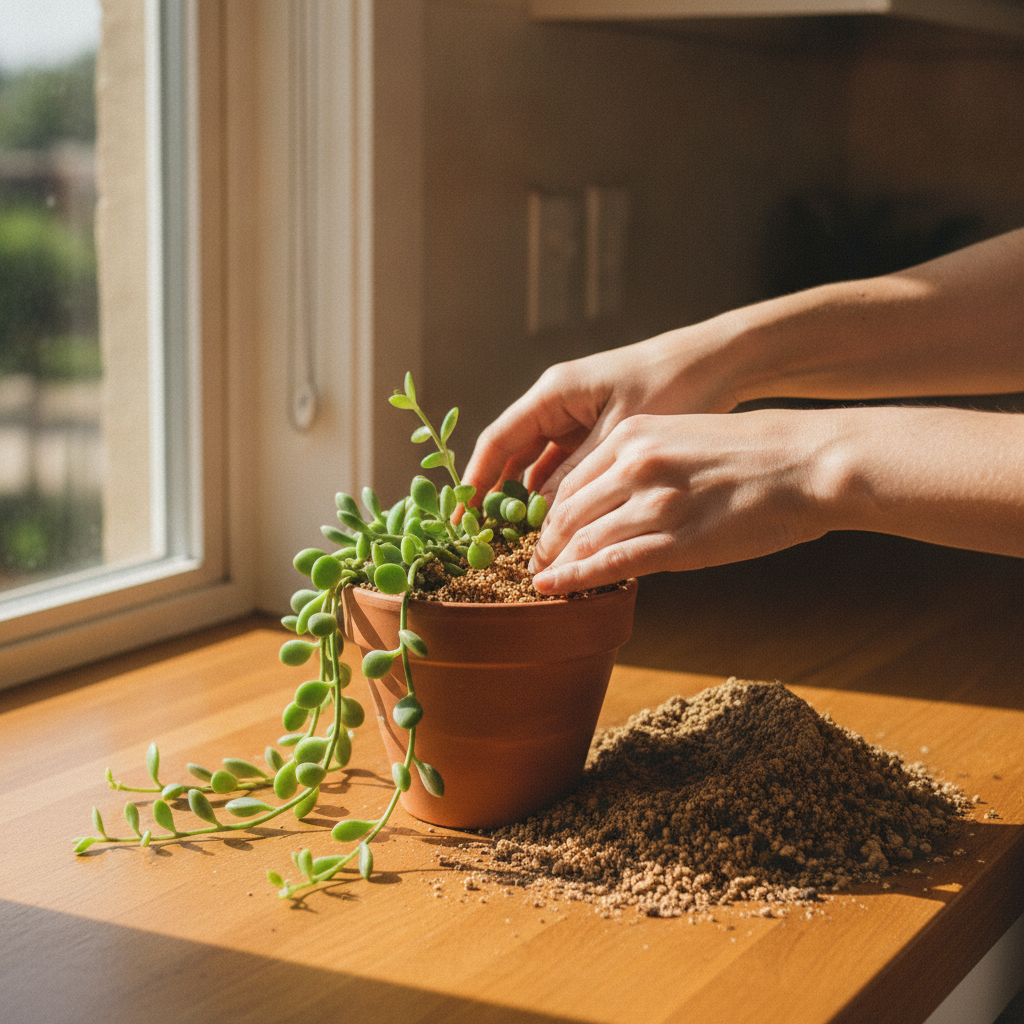
The right soil is the quiet foundation of a healthy trailing string jade, and it works hand in hand with your watering. Because the plant demands fast drainage and dislikes wet feet, an ordinary peat-heavy houseplant compost is a liability: it holds too much water and stays soggy far too long. What this succulent wants is a gritty, open mix that drains within seconds and admits plenty of air to the roots.
Ideal Soil Composition
A good starting point is a commercial cactus and succulent compost amended with extra grit. The aim is a blend that is roughly half organic matter to hold a little moisture and nutrients, and half mineral grit to guarantee sharp drainage and aeration. The table below breaks down a reliable mix.
| Component | Proportion | Function |
|---|---|---|
| Cactus or standard potting compost | 50 percent | Holds modest moisture and nutrients, provides body |
| Perlite or pumice | 30 percent | Opens the mix for drainage and aeration |
| Coarse horticultural grit or sand | 20 percent | Adds weight and ensures rapid drainage |
In terms of acidity, the plant is easy-going and prefers a slightly acidic to neutral soil in the region of pH 6.0 to 7.0. This range occurs naturally in most peat-free and cactus composts, so it rarely needs adjusting. What matters far more than fine-tuning the pH is getting the physical structure right, because drainage is what keeps the roots alive.
Pro Tip — Quick Mix Recipe: For a simple, dependable blend, combine two handfuls of cactus compost with one handful of perlite and one handful of coarse grit. If you can squeeze a fistful of the moist mix and it crumbles apart rather than holding a tight ball, the drainage is right for a trailing string jade.
Choosing the Right Pot
The container matters as much as the mix. Because this is a trailing plant, shallow pots, hanging planters and shelf-edge positions all show it off well, and its relatively modest root system does not demand great depth. What every pot must have, without exception, is a way for water to escape.
Drainage holes are non-negotiable. A pot without drainage will trap water at the base and rot the roots no matter how careful your watering. If you love a decorative cover pot that has no holes, use it as an outer sleeve only, keeping the plant in a plain nursery pot inside that you can lift out to water and drain.
Pot material: Terracotta is an excellent match for this succulent because its porous walls wick moisture from the soil and help it dry evenly, reducing the risk of rot. Glazed ceramic and plastic hold moisture longer, which is not disqualifying but does mean you must be more disciplined about letting the soil dry between waterings.
Pot size: Choose a pot only slightly larger than the root ball. An oversized pot holds a large volume of slow-drying soil around roots that cannot use it, which again invites rot. Trailing string jade is quite happy a little snug, so step up gradually rather than over-potting.
When to Repot
This is not a plant that needs frequent repotting. Every two to three years is usually sufficient, or whenever you see roots emerging from the drainage holes, the soil drying out unusually fast, or growth slowing despite good care. The best time to repot is spring, at the start of the active growing season, when the plant can recover quickly. Refreshing the mix at the same time replaces spent soil and restores good drainage.
How to Repot: Step-by-Step
- Water lightly a day or two beforehand so the root ball holds together, then let it drain; do not repot into or out of sodden soil.
- Ease the plant out by tipping the pot and supporting the crown, handling the brittle trailing stems gently to avoid snapping them.
- Tease away loose old soil from the roots and inspect them, trimming off any that are black, soft or clearly dead.
- Add a layer of fresh gritty mix to the base of the new pot, then set the plant so the crown sits at its previous depth.
- Fill around the root ball with more mix, firming gently to remove air pockets without compacting it hard.
- Wait about a week before watering, giving any damaged roots time to seal and reducing the risk of rot.
Warning — Transplant Shock: Waterlogging a freshly repotted succulent is the fastest way to undo your work. Disturbed roots are vulnerable, and moist soil around them readily turns to rot. Keep a newly repotted plant in bright but not scorching light and hold off watering for around a week so cut and bruised roots can callus first.
Fertilising
Trailing string jade is a light feeder, and restraint serves it far better than generosity. In the wild it grows in lean, rocky soils, so it is adapted to make do with little. Indoors, a modest feeding routine through the growing season keeps it vigorous and well coloured, while overfeeding produces soft, weak, overly leafy growth that is more prone to pests and rot.
The goal is to supplement, not force. A small amount of balanced nutrition during spring and summer supports steady new growth and helps the plant flower, whereas a heavy hand pushes it to grow faster than its structure can support. Think of feeding as a gentle top-up rather than a growth accelerant.
Understanding Plant Nutrients
Fertilisers are labelled with an N-P-K ratio describing their nitrogen, phosphorus and potassium content, the three nutrients plants use in the greatest quantity. For a succulent like this, a balanced or slightly low-nitrogen formula is preferable, since too much nitrogen encourages sappy growth at the expense of form and colour. A handful of secondary and trace nutrients round out what the plant needs, and their deficiency symptoms are worth recognising.
| Nutrient | Symbol | Primary Function | Deficiency Symptoms |
|---|---|---|---|
| Nitrogen | N | Leaf and stem growth | Pale, uniformly yellowing older leaves, stunted growth |
| Phosphorus | P | Root development and flowering | Poor rooting, weak flowering, dull tints |
| Potassium | K | Overall vigour and water regulation | Yellow or brown leaf edges, weak stems |
| Calcium | Ca | Cell wall strength | Distorted new growth, soft tissue |
| Magnesium | Mg | Chlorophyll production | Yellowing between the veins of older leaves |
| Iron | Fe | Chlorophyll and enzyme function | Yellowing of new leaves while veins stay green |
Types of Fertiliser
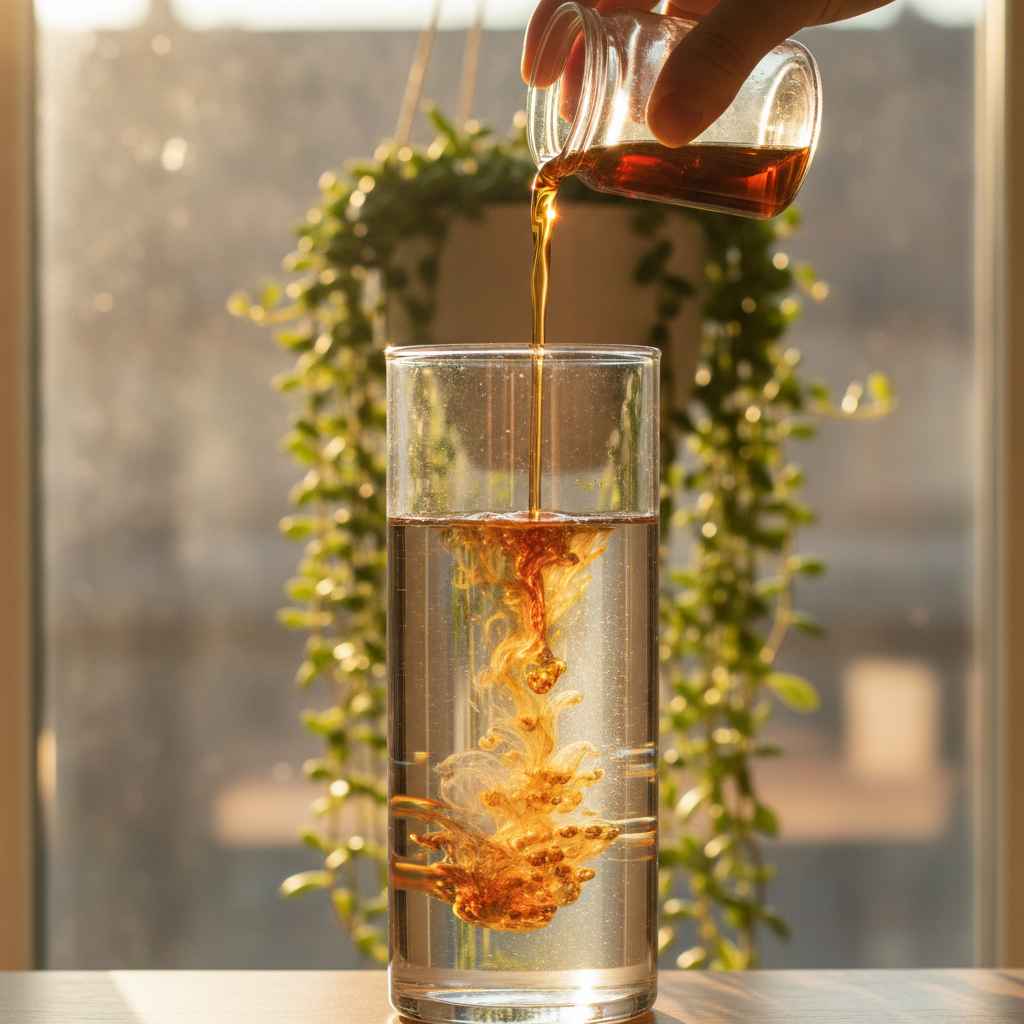
Liquid fertilisers: The easiest option for a plant like this. A liquid succulent or cactus feed, diluted well below the recommended strength, is simply added to the watering can during the growing season. It acts quickly and gives you full control over how much the plant receives.
Slow-release granular: Coated granules mixed into the soil release nutrients gradually over several months. They are convenient, but with a light feeder there is a risk of over-supply, so use them sparingly and at a lower rate than the packet suggests if you choose this route.
Organic fertilisers: Gentle options such as diluted worm-casting tea provide mild, slow nutrition and support soil life. They are very forgiving and unlikely to burn, though they act more slowly and less predictably than mineral feeds.
Feeding Schedule
Feed only during the active growing months of spring and summer, roughly once a month, and stop entirely in autumn and winter when the plant is resting. A dormant plant cannot use the nutrients, and feeding it simply lets unused salts build up in the soil. Four or five feeds across the warm half of the year are ample for a trailing string jade.
Pro Tip — Feed at Half Strength or Less: Succulents are easily overfed, so dilute any fertiliser to half the label rate or even a quarter. It is far safer to under-feed this plant than to over-feed it, and a lean diet actually improves the compactness and colour you are growing it for.
How to Fertilise
- Always feed a plant that is already growing actively, never one that is stressed or dormant.
- Water lightly first, or feed onto already-moist soil, so the fertiliser never hits dry roots directly.
- Dilute a liquid succulent feed to half strength or less in the watering can.
- Apply to the soil, avoiding splashing the fleshy leaves, and let any excess drain away.
- Flush the soil with plain water every couple of months to clear accumulated salts.
Warning — Salt Build-Up: Over time, fertiliser salts accumulate and can scorch the roots, showing as brown, crisp leaf tips and a white crust on the soil. Prevent this by feeding sparingly and by flushing the pot thoroughly with plain water two or three times a year, letting it drain fully each time.
Propagation
If any part of trailing string jade care is genuinely effortless, it is propagation. The plant roots so willingly from stem cuttings that trimming it for shape and starting new plants become the same task. A single healthy specimen can populate an entire windowsill within a year, and cuttings make the ideal insurance policy against losing a parent plant to rot.
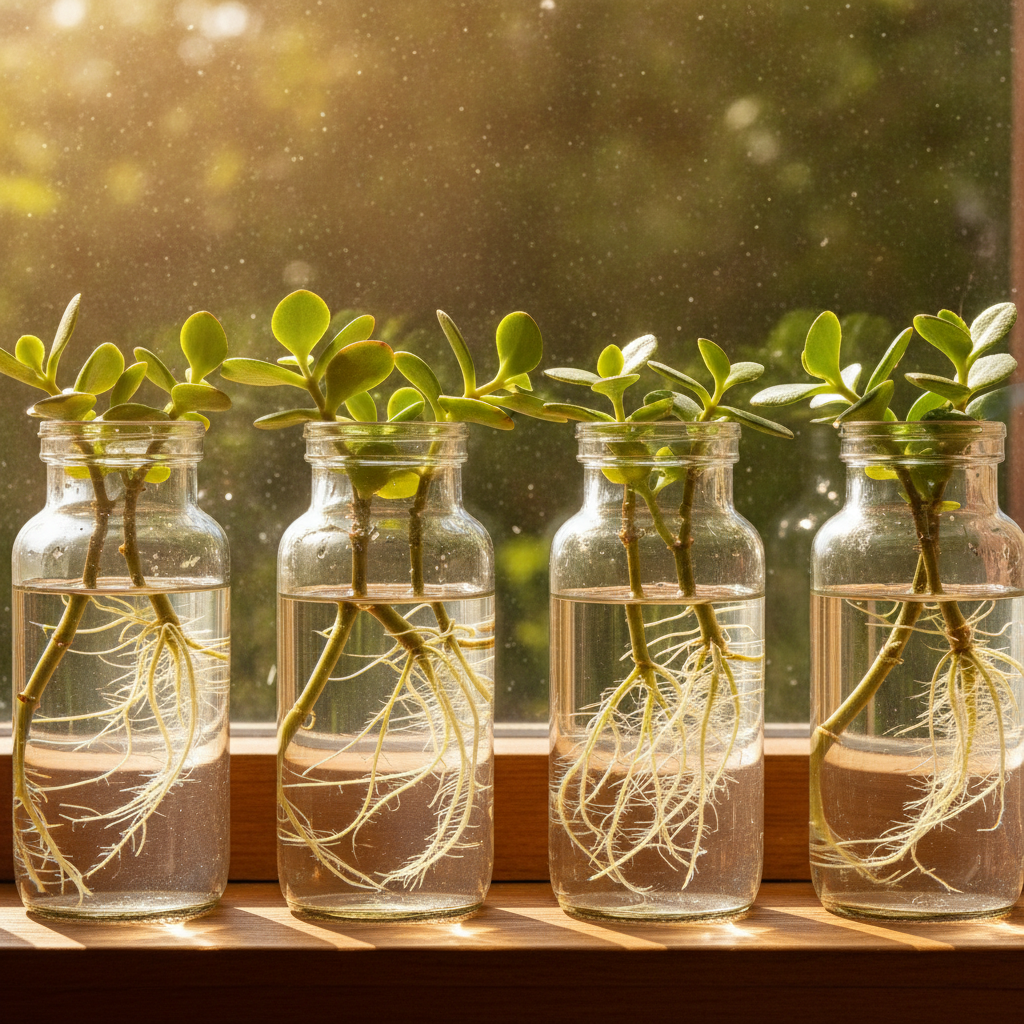
The two most reliable methods are rooting stem cuttings in water and rooting them directly in soil. Both work extremely well, and the choice is largely a matter of preference. Water rooting lets you watch the roots develop and is deeply satisfying, while soil rooting skips the transplanting step and produces sturdier roots from the outset.
Understanding Nodes and Callusing
Success comes from understanding two things: the node and the callus. A node is the point on the stem where a pair of leaves attaches, and it is from here that new roots emerge, so every cutting must include at least one or two nodes. Callusing is the natural sealing over of a fresh cut. Because this is a succulent, allowing the cut end to dry and callus for a day or two before it meets water or soil dramatically reduces the chance of the cutting rotting rather than rooting.
Water Propagation: Step-by-Step
Rooting in water is clean, visual and reliable, and works best in the warmth and light of spring and summer.
- Using clean scissors, cut a healthy trailing stem 8 to 12 centimetres (3 to 5 inches) long, just below a node.
- Strip the leaves from the lowest one or two nodes so no foliage will sit under water.
- Let the cut end dry and callus in a shaded spot for one to two days.
- Stand the cutting in a jar of water with the bare nodes submerged and the leaves clear of the surface.
- Place it in bright, indirect light and refresh the water every few days to keep it clear.
- When roots reach two to three centimetres (about an inch), pot the cutting into gritty succulent mix and water it in.
Pro Tip — Pot Several Together: Root and pot three or four cuttings into the same container rather than one. Trailing string jade looks fullest as a cluster, and a group planting gives you a lush, cascading plant far sooner than a single lonely stem ever would.
Soil Propagation: Step-by-Step
Rooting directly in soil skips transplanting and tends to produce robust, well-anchored roots. It asks only a little patience, as you cannot see progress until new growth appears.
- Take a stem cutting 8 to 12 centimetres (3 to 5 inches) long, cutting just below a node, and remove the lowest leaves.
- Allow the cut end to callus for one to two days in a dry, shaded place.
- Insert the bare nodes into lightly moistened gritty succulent mix, firming gently so the cutting stands upright.
- Set the pot in bright, indirect light and mist the surface lightly every few days, keeping the mix barely moist but never wet.
- After two to three weeks, give the cutting a very gentle tug; resistance means roots have formed.
- Once rooted, shift to the normal soak-and-dry watering routine and move into brighter light.
Troubleshooting Propagation
| Problem | Likely Cause | Solution |
|---|---|---|
| Cutting rots at the base | No callusing, or soil kept too wet | Let cuts dry longer before planting; keep the medium barely moist |
| No roots after a month | Too cold, too dark, or no node buried | Move somewhere warmer and brighter; ensure a node is in the medium |
| Leaves shrivel on the cutting | Normal early moisture loss before rooting | Be patient; plumpness returns once roots establish |
| Cutting stays limp and pale | Stem was too soft or damaged when taken | Start again with a firm, healthy section of stem |
Pests & Diseases
A healthy trailing string jade growing in bright light and well-drained soil is a resilient plant that shrugs off most trouble. The problems it does encounter are almost always tied to conditions rather than bad luck: overwatering behind fungal rots, and stressed or dusty plants behind pest outbreaks. Prevention, in other words, is mostly a matter of good routine care.
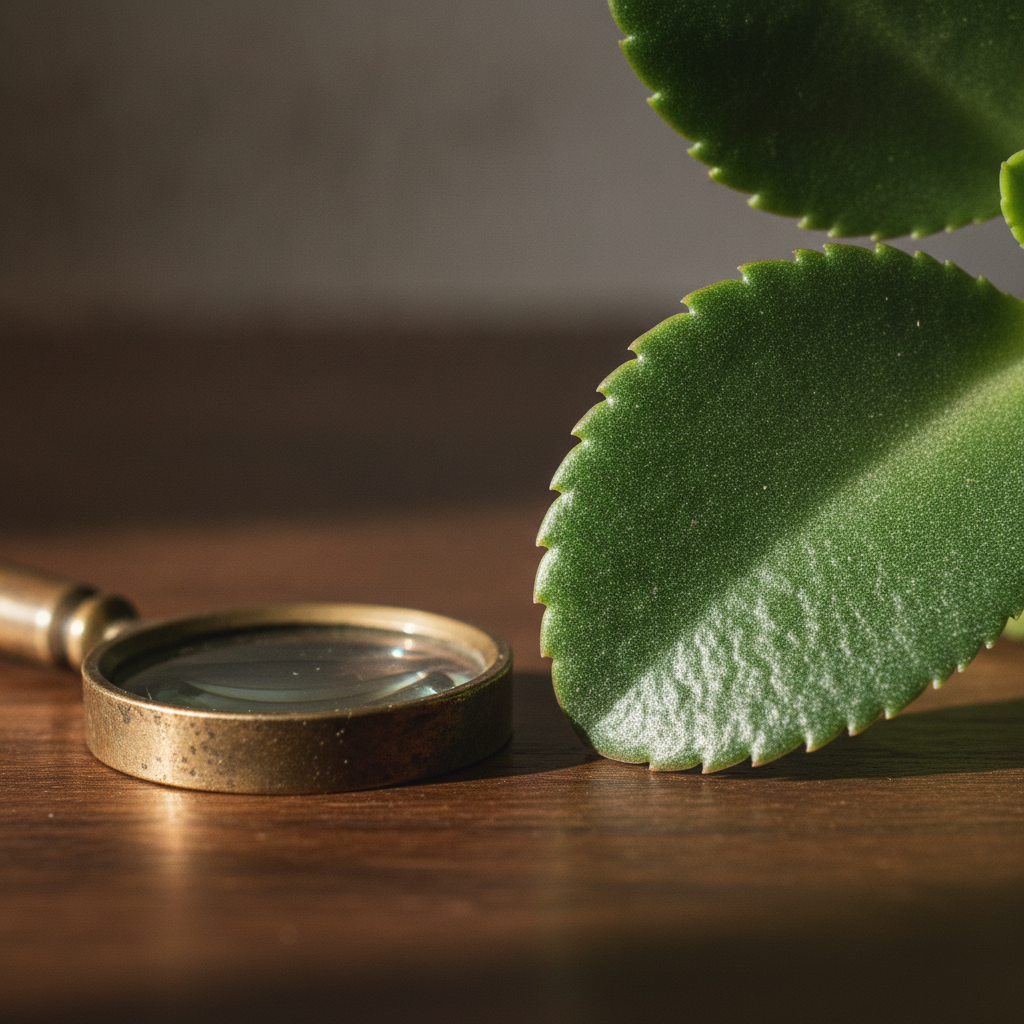
Even so, it pays to inspect the plant regularly, paying attention to the leaf axils and the undersides of leaves where pests like to hide. Catching an infestation early, when it is a few insects rather than a colony, makes treatment quick and keeps the plant looking its best. The most common culprits are described below.
Common Pests
Mealybugs (Pseudococcus species)
The most frequent pest of jade relatives, mealybugs appear as small, cottony white tufts tucked into leaf axils and along stems. They suck sap, weakening the plant and leaving sticky honeydew that can turn sooty.
Treatment: Dab each insect with a cotton bud dipped in isopropyl alcohol, then treat the whole plant with insecticidal soap or diluted neem oil. Repeat every week until no new bugs appear, and isolate the plant while you do.
Spider Mites (Tetranychus urticae)
Tiny and hard to see, spider mites thrive in warm, dry conditions and reveal themselves through fine webbing and pale stippling on the leaves. A badly affected plant looks dull and dusty.
Treatment: Rinse the foliage, then apply neem oil or a miticide to the leaves and their undersides, repeating at intervals to break the breeding cycle. Improving airflow discourages their return.
Aphids (Aphidoidea)
Aphids cluster on soft new growth and flower stalks, especially in spring, sucking sap and distorting fresh shoots. Like mealybugs, they excrete sticky honeydew.
Treatment: Dislodge them with a firm spray of water, then follow up with insecticidal soap or neem oil. A few repeat applications usually clear them entirely.
Fungus Gnats (Sciaridae)
Small black flies drifting around the pot are fungus gnats, whose larvae live in constantly damp soil. They are more a symptom of overwatering than a threat in themselves, but they signal that the mix is staying too wet.
Treatment: Let the soil dry out more thoroughly between waterings, top-dress with a layer of grit, and use yellow sticky traps to catch the adults until the cycle is broken.
Common Diseases
Root and Stem Rot (Phytophthora and Pythium species)
By far the most serious threat to this plant, rot follows chronic overwatering and poor drainage. It shows as blackening, softening tissue at the stem base and roots, and it can spread quickly through a waterlogged plant.
Treatment: Remove the plant from its soil, cut away all soft and discoloured tissue back to firm growth, and restart the healthy portions as cuttings in fresh dry mix. Correct the watering and drainage that caused it, or the problem will simply recur.
Powdery Mildew (Erysiphe species)
A white, powdery coating on leaves and stems, powdery mildew takes hold where humidity is high and air is stagnant. It is uncommon on this succulent but can appear in damp, still corners.
Treatment: Improve air circulation, remove badly affected leaves, and treat with a fungicide or a dilute potassium bicarbonate spray. Avoid wetting the foliage when you water.
Pest and Disease Summary
| Pest / Disease | Identification | Treatment |
|---|---|---|
| Mealybugs | Cottony white tufts in axils and on stems | Alcohol swabs, then insecticidal soap or neem oil |
| Spider mites | Fine webbing, pale stippled leaves | Rinse, then neem oil or miticide; improve airflow |
| Aphids | Clusters on new growth and flowers | Water spray, then insecticidal soap or neem oil |
| Fungus gnats | Small black flies around the soil | Dry out soil, grit top-dressing, sticky traps |
| Root and stem rot | Blackening, mushy base and roots | Cut back to healthy tissue, restart as cuttings |
| Powdery mildew | White powdery coating on foliage | Improve airflow, remove leaves, apply fungicide |
Prevention Strategies
The best defence is a plant kept in the conditions it wants. Bright light, a gritty free-draining mix and disciplined watering address the root causes of nearly every problem on this list, since most pests and all rots exploit stressed or waterlogged plants. Good airflow around the foliage is equally valuable, discouraging both fungal disease and sap-sucking insects.
Beyond the basics, quarantine any new plant for a couple of weeks before it joins your collection, wipe dust from the leaves occasionally so pests have nowhere to hide, and inspect the plant whenever you water. These small habits catch trouble early and are far easier than rescuing a plant that has been quietly infested for weeks.
Pro Tip — Neem Oil as Routine Defence: A monthly wipe or light spray of diluted neem oil during the growing season keeps most common pests at bay before they establish. Apply it in the evening or out of direct sun so the treated leaves do not scorch, and cover the undersides where pests gather.
Popular Varieties
Trailing string jade is grown in a small but attractive range of forms, with the choice coming down mostly to leaf colouring. All share the same easy temperament and cascading habit, so any of them makes an equally rewarding houseplant. The main distinction is between the plain green species and the variegated selections that carry cream and gold in their leaves.
The variegated comet form is the one most often seen in shops and the reason many people seek the plant out, prized for the contrast of its cream-margined leaves against red-flushed stems. The green species form is understated by comparison but arguably more vigorous, and it flushes just as warmly in strong light. The table and profiles below cover the forms you are most likely to encounter.
| Variety | Leaf Appearance | Light Needs | Growth Rate | Availability |
|---|---|---|---|---|
| Green species form | Glossy deep green, finely toothed cream edge | Bright, some direct sun | Fast | Common |
| Comet (Variegata) | Green centres, broad creamy-yellow margins | Bright, some direct sun | Moderate | Common |
| Comet in high light | Cream margins flushed pink to red | Strong light | Moderate | Seasonal |
| Crassula sarmentosa cultivars | Variable variegation and leaf size | Bright, some direct sun | Moderate to fast | Specialist |
Featured Varieties
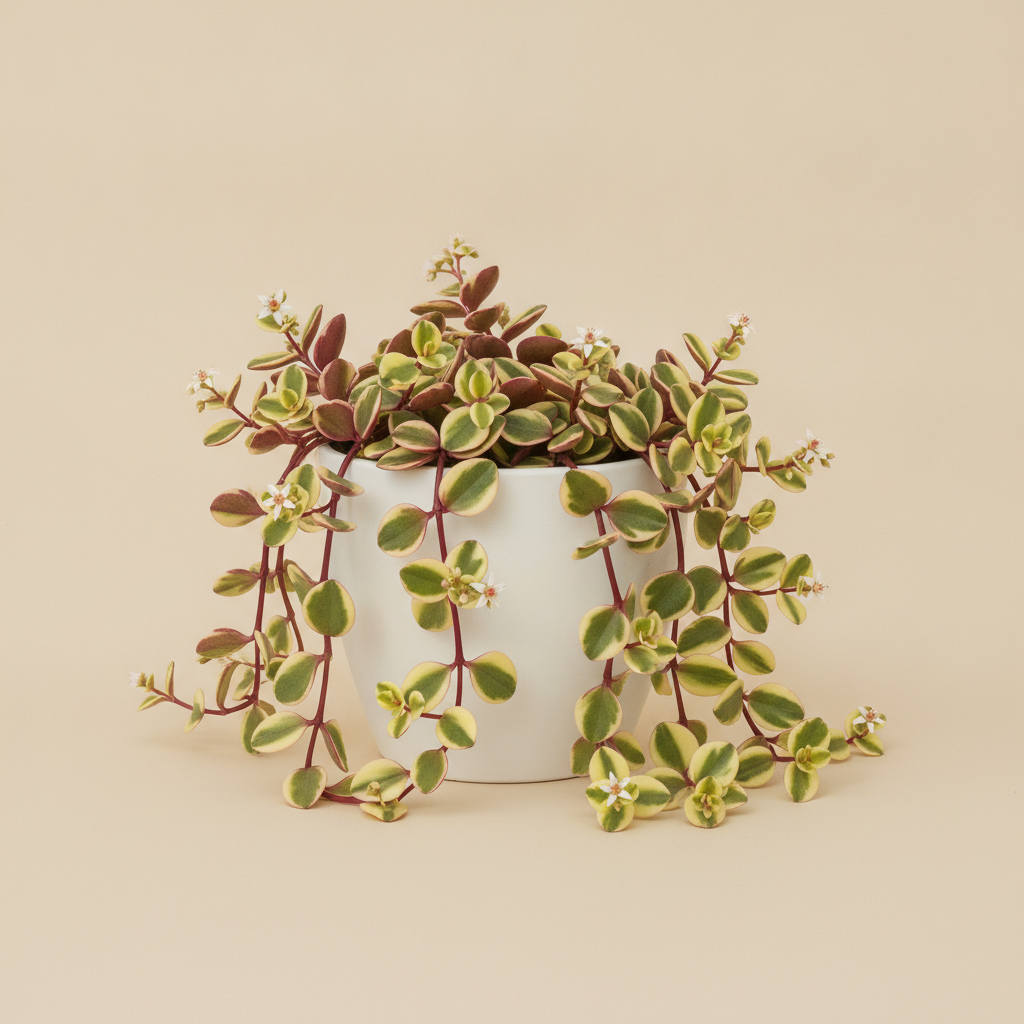
Comet (Variegata)
The showpiece form, with broad creamy-yellow margins around green leaf centres and stems that flush red in good light. It is the variety most gardeners picture when they think of the trailing string jade.
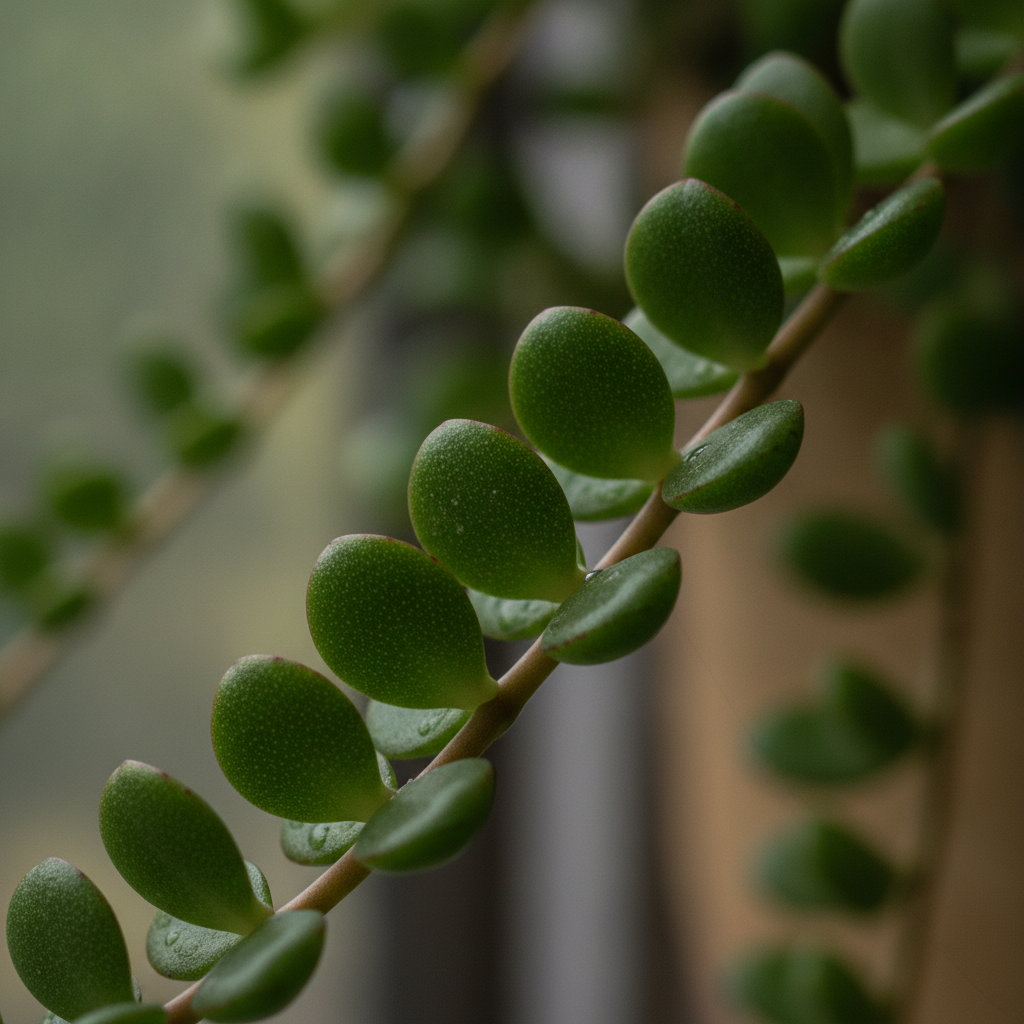
Green Species Form
The original wild form, with uniformly deep green, glossy leaves edged in fine pale teeth. Vigorous and quick to trail, it takes on rich red tones at the margins under strong light.
Variety Profiles in Detail
Comet (Crassula sarmentosa ‘Variegata’)
The variegated comet is the most widely sold form and the one that first drew many growers to the species. Its oval leaves carry generous creamy-yellow margins framing a green centre, and in bright conditions the whole plant takes on warm pink and red overtones along the edges and stems. It grows a touch more slowly than the plain green form, a common trade-off with variegation since the pale tissue holds less chlorophyll, but it remains an easy and fast plant by succulent standards. Give it your brightest position to keep the variegation crisp and the colour strong.
Green Species Form (Crassula sarmentosa)
The unvariegated species is sometimes overlooked in favour of its flashier sibling, but it is a superb plant in its own right. Its glossy, uniformly green leaves, each rimmed with fine pale teeth, clothe the trailing stems densely, and it is the most vigorous of the forms, quick to fill a pot and spill over the edge. In strong light the leaf margins and stems blush a deep red, giving it plenty of seasonal interest despite the lack of variegation. For a grower who wants maximum cascade in minimum time, this is the form to choose.
Choosing the Right Variety for Your Space
The decision is easy and mostly aesthetic. If you have a very bright spot and want the most striking foliage, the variegated comet rewards that light with cream-and-red leaves that few other succulents can match. If your light is merely good rather than exceptional, or you simply want the fullest, fastest cascade, the robust green species form is the more reliable performer. Either way you are getting the same forgiving, easily propagated plant, so there is no wrong choice, only the look you prefer.
Frequently Asked Questions
Why is my trailing string jade growing leggy and stretched?
Legginess, where the gaps between leaf pairs lengthen into bare stem, is the classic sign of insufficient light. The plant is stretching toward the nearest bright source. Move it to a brighter position, ideally an east or lightly shaded south window, and trim the stretched stems back; the cuttings will root easily, and the parent will regrow more compactly in the better light.
How do I get the red colour on the leaf edges?
The red and coral tints are a response to bright light, not to fertiliser or any special treatment. Give the plant more light, including a few hours of gentle direct sun, and the protective pigments that create the colour will develop over several weeks. A plant kept in low light will stay a flat green no matter what else you do.
How often should I water it?
Water only when the soil has dried out almost completely, which in bright conditions during spring and summer usually means every 10 to 14 days. In winter this can drop to once every three or four weeks or even less. Always judge by the dryness of the soil and the firmness of the leaves rather than by a fixed schedule.
Is trailing string jade safe for cats and dogs?
No. Like other members of the jade family, it is considered mildly toxic to cats and dogs, and ingestion can cause vomiting, lethargy and incoordination. Keep it out of reach of pets that chew plants, ideally on a high shelf or in a hanging planter where its trailing habit is an advantage.
Why are the leaves going soft and mushy?
Soft, mushy, translucent leaves are a sign of overwatering, and often the first visible stage of root rot. Stop watering at once, let the soil dry out fully, and check the roots and stem base for blackening. If rot has set in, salvage healthy trailing stems as cuttings and restart in fresh dry mix, then adjust your watering to be far more sparing.
Does it flower indoors?
Yes, a well-grown plant in good light can produce clusters of small, star-shaped white to cream flowers, usually in autumn and winter, and they carry a light honey scent. Flowering is most likely on a mature plant that has enjoyed strong light and a cooler, drier rest period, so bright conditions and a lean regime encourage bloom.
Can I grow it in a hanging basket?
A hanging basket is one of the best ways to display this plant, since its cascading stems can trail freely without being interrupted by a surface. Make sure the basket drains well, use the same gritty succulent mix, and hang it where it still receives bright light, as height in a room often means dimmer conditions further from the window.
How do I make my plant look fuller and bushier?
Pinch or trim the growing tips to encourage the stems to branch, and pot several rooted cuttings together in one container for instant density. Combined with bright light to keep the growth compact, regular light pruning and group planting turn a sparse plant into a full, tumbling one within a season, and every trimming you take becomes another future plant.






