
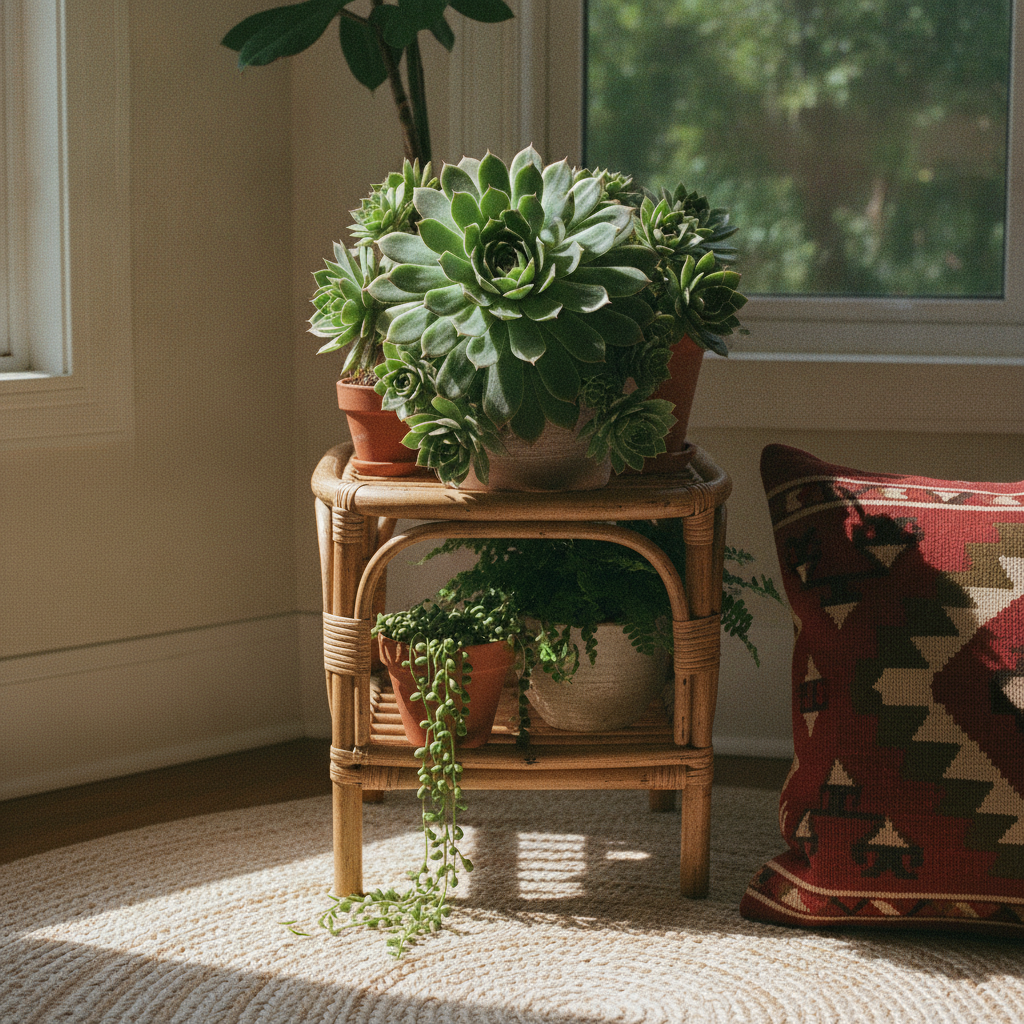
Few houseplants carry as much folklore as the humble houseleek. For centuries, Sempervivum tectorum was planted deliberately on the turf and tiled roofs of European farmhouses, where people believed its fleshy rosettes warded off lightning, fire and witchcraft. The species name tectorum means “of roofs”, and the emperor Charlemagne is said to have ordered it grown on every dwelling in his realm. Strip away the superstition and what remains is one of the toughest, most forgiving plants you can own: an alpine survivor that thrives on neglect, multiplies itself endlessly, and shrugs off conditions that would kill almost anything else on a windowsill.
The common name captures the plant’s charm perfectly. A central “hen” rosette surrounds herself with a brood of smaller “chicks”, offsets that radiate outward on short stems until a single plant becomes a dense colony. This guide covers everything you need to move a houseleek from merely surviving to genuinely thriving indoors, from the light it craves to the sharp, gritty soil that keeps its roots alive.
Quick Reference
| Botanical name | Sempervivum tectorum |
| Common names | Hens and chicks, common houseleek, liveforever |
| Light | Full sun to very bright indirect light, at least 4 to 6 hours direct |
| Watering | Sparingly; only when the soil is completely dry, roughly every 10 to 14 days in summer and far less in winter |
| Soil | Gritty, free-draining cactus or alpine mix with added grit or perlite |
| Temperature | Tolerates 5 to 30 degrees Celsius (41 to 86 Fahrenheit); survives frost to minus 30 degrees Celsius (minus 22 Fahrenheit) outdoors |
| Humidity | Low; dry household air is ideal |
| Feeding | Rarely; a weak feed once or twice per growing season at most |
| Growth habit | Low ground-hugging rosettes, 5 to 12 centimetres (2 to 5 inches) across, spreading by offsets |
| Propagation | Separating offsets (chicks); very easy |
| Toxicity | Non-toxic to cats, dogs and humans |
| Difficulty | Very easy, beginner friendly |
Why Hens and Chicks Make a Rewarding Houseplant
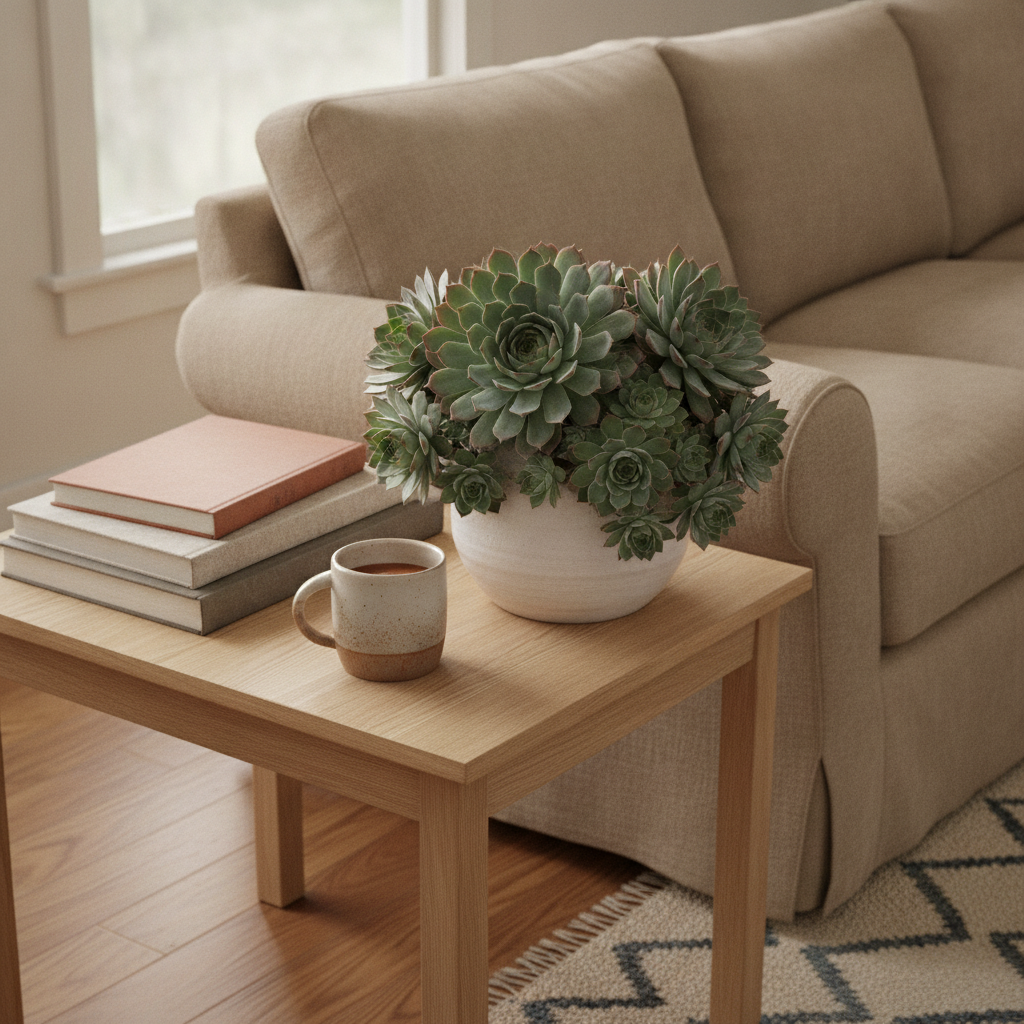
Hens and chicks belong to the Crassulaceae family, the same group that gives us jade plants and echeverias, and they share that family’s talent for storing water in thick, waxy leaves. What sets Sempervivum apart is its origin. This is a genuine alpine plant, native to the high, exposed slopes of the Alps, Pyrenees, Apennines, Carpathians and Balkans, where it clings to rock crevices and thin, stony soil. That heritage explains almost every quirk of its care: it wants bright light, gritty ground, cool nights and very little fuss, because those are the conditions it evolved to master.
For an indoor grower, the appeal is threefold. First, the plant is close to indestructible. It handles missed waterings, cold draughts, poor feeding and cramped pots with equanimity, which makes it an ideal choice for beginners or for anyone who travels. Second, it is a generous multiplier. A single rosette planted in spring can produce a ring of offsets by autumn, and those offsets root readily, so one plant quickly becomes a windowsill full of gifts to give away. Third, the rosettes are quietly beautiful, geometric spirals of pointed leaves that blush red, bronze or purple in strong light, tightening and colouring as the seasons turn.
There is one biological detail worth understanding from the start, because it surprises new owners. Each individual rosette is monocarpic, meaning it flowers only once and then dies. When a mature hen sends up a tall stalk topped with star-shaped pink or red flowers, that particular rosette is at the end of its life. This is not a sign that you have done something wrong. The colony survives because the surrounding chicks carry on, and the small gap left by the spent flowering rosette soon fills in. Understanding this rhythm turns what looks like a loss into a normal, even welcome, part of the plant’s life cycle.
Pro Tip – Read the colour: The leaf colour of a houseleek is a live readout of how much light it is getting. Rosettes that stay flat, open and pale green are stretching for more sun, while tight rosettes flushed with red or bronze are getting the intense light they want. Use this as your daily gauge before reaching for the watering can.
Light
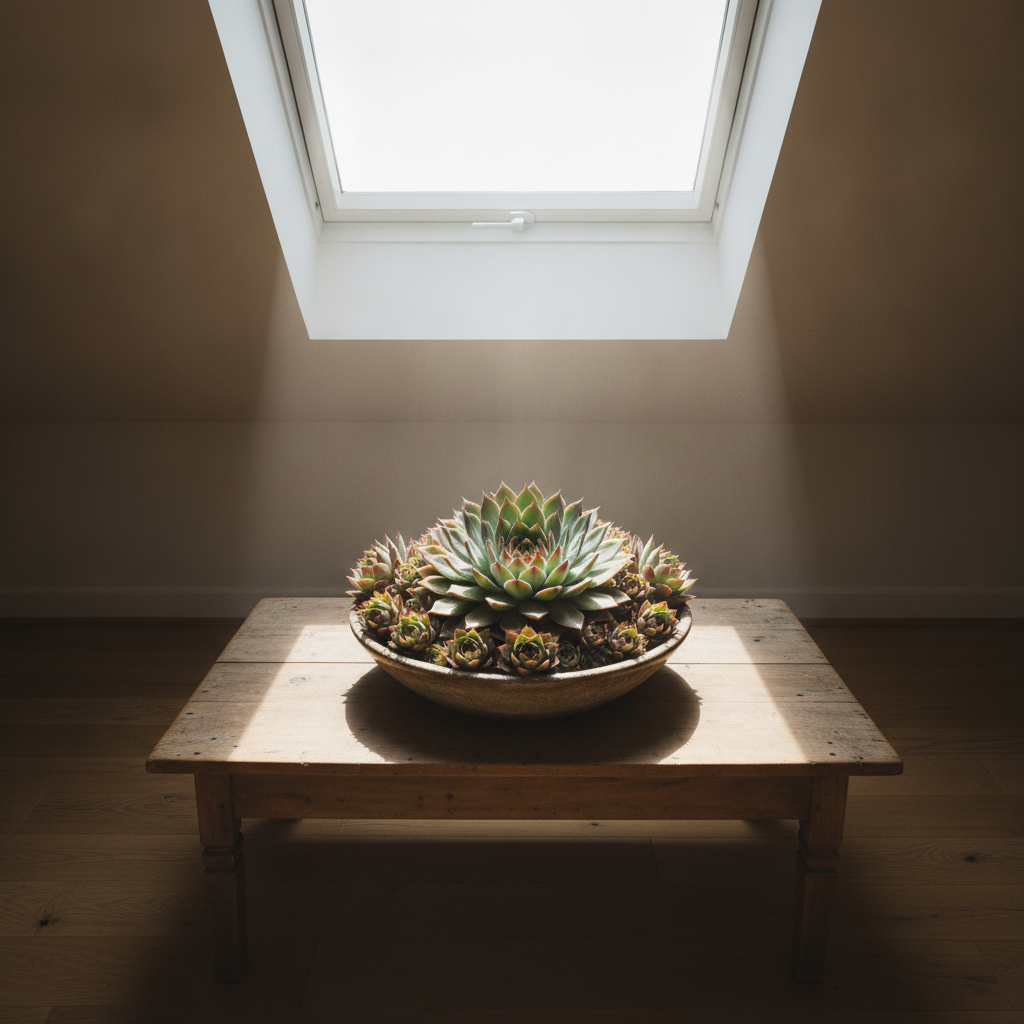
Light is the single most important factor in growing a healthy houseleek indoors, and it is where most failures begin. This is a full-sun plant. In the wild it grows completely exposed on alpine rock, taking the full force of mountain sunlight, and it carries that appetite indoors. To thrive rather than merely survive, a hens and chicks needs at least four to six hours of direct sun each day, and it will happily take more.
The best position in most homes is a south-facing or south-west-facing windowsill where the plant sits right against the glass. An east-facing window with strong morning sun can work, and a west-facing window gives good afternoon light, but a north-facing window almost never provides enough intensity to keep a houseleek compact. In a north aspect the rosette will “etiolate”, stretching upward and outward with pale, widely spaced leaves as it hunts for light. Etiolation is not fatal, but it permanently spoils the tight geometry that makes the plant attractive, and it cannot be reversed. The only remedy is to move the plant somewhere brighter and let new, compact growth form.
If your home simply lacks a bright enough window, a full-spectrum LED grow light is a reliable substitute. Position it 20 to 30 centimetres (8 to 12 inches) above the rosettes and run it for 10 to 12 hours a day. One word of caution applies to plants that have spent months in low light: move them into strong sun gradually over a week or two rather than all at once, because a houseleek that has softened in dim conditions can scorch when suddenly exposed to intense midday sun. Acclimatise it by increasing exposure a little each day, and the leaves will toughen and colour up beautifully.
Watering
If light is where growers lose houseleeks slowly, watering is where they lose them quickly. Overwatering is by a wide margin the most common cause of death. These plants store abundant moisture in their leaves and are adapted to long dry spells punctuated by occasional mountain rain, so they need far less water than most people instinctively give them.
The correct approach is the “soak and dry” method. When you water, water thoroughly, letting moisture run all the way through the pot and out of the drainage holes, then do not water again until the soil is completely dry from top to bottom. During the active growing season of spring and summer this usually means watering roughly every 10 to 14 days, but treat that only as a rough guide. The soil, not the calendar, tells you when to act. Push a finger or a wooden skewer to the bottom of the pot; if it comes out with any damp soil clinging to it, wait longer. In the cooler, darker months of autumn and winter the plant slows almost to a standstill and needs very little water, perhaps once every three to four weeks, just enough to stop the roots shrivelling entirely.
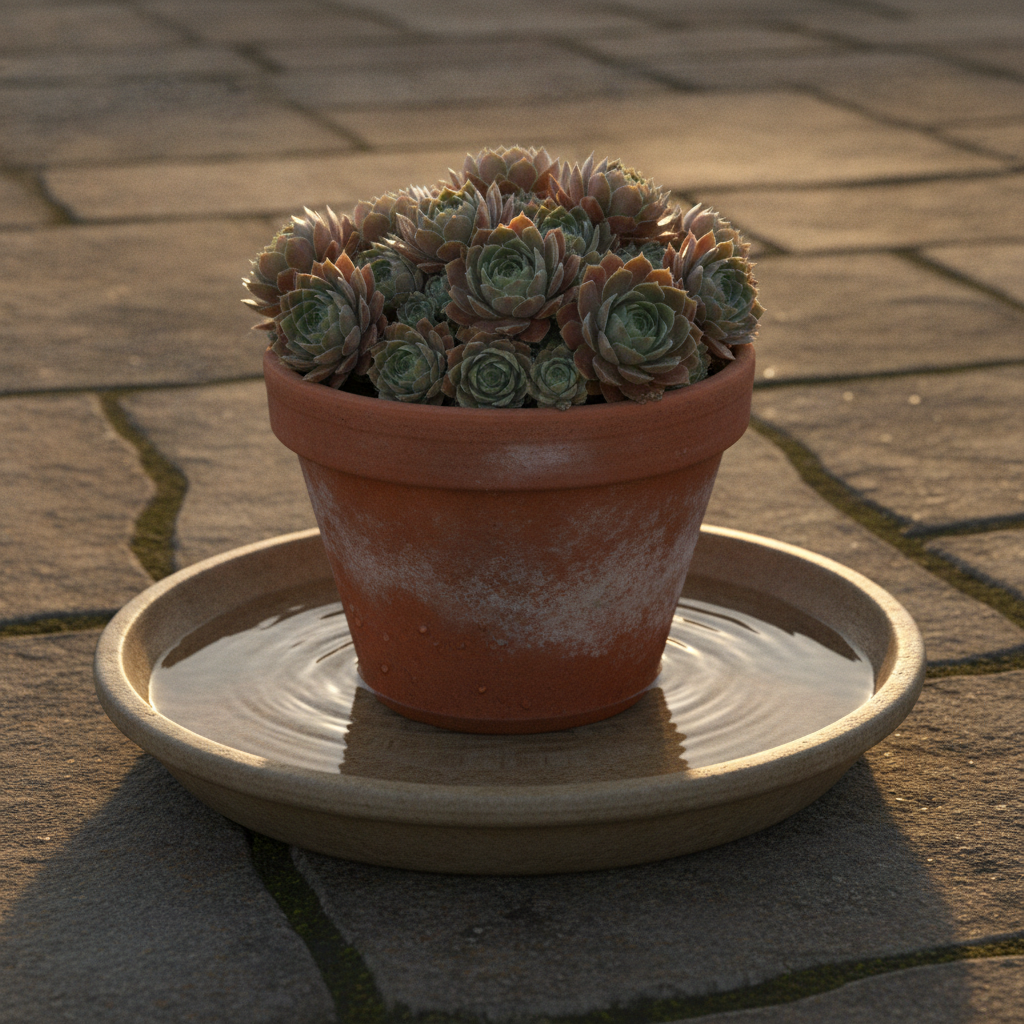
Technique matters as much as frequency. Always water the soil, not the plant. Water that collects in the centre of a tightly packed rosette can sit there and trigger crown rot, especially in low light or cool conditions. Bottom watering, where you stand the pot in a shallow dish of water for 15 to 20 minutes and let it wick moisture up through the drainage holes, sidesteps this problem entirely and is an excellent habit for houseleeks. Whichever method you choose, never leave the pot standing in a saucer of water afterwards, and empty any excess promptly.
Warning – When in doubt, wait: A thirsty houseleek recovers within hours of a good drink, its leaves plumping straight back up. A waterlogged one rots from the roots and is often beyond saving before you notice. If you are ever unsure whether to water, the safe answer is almost always to wait another few days.
Soil
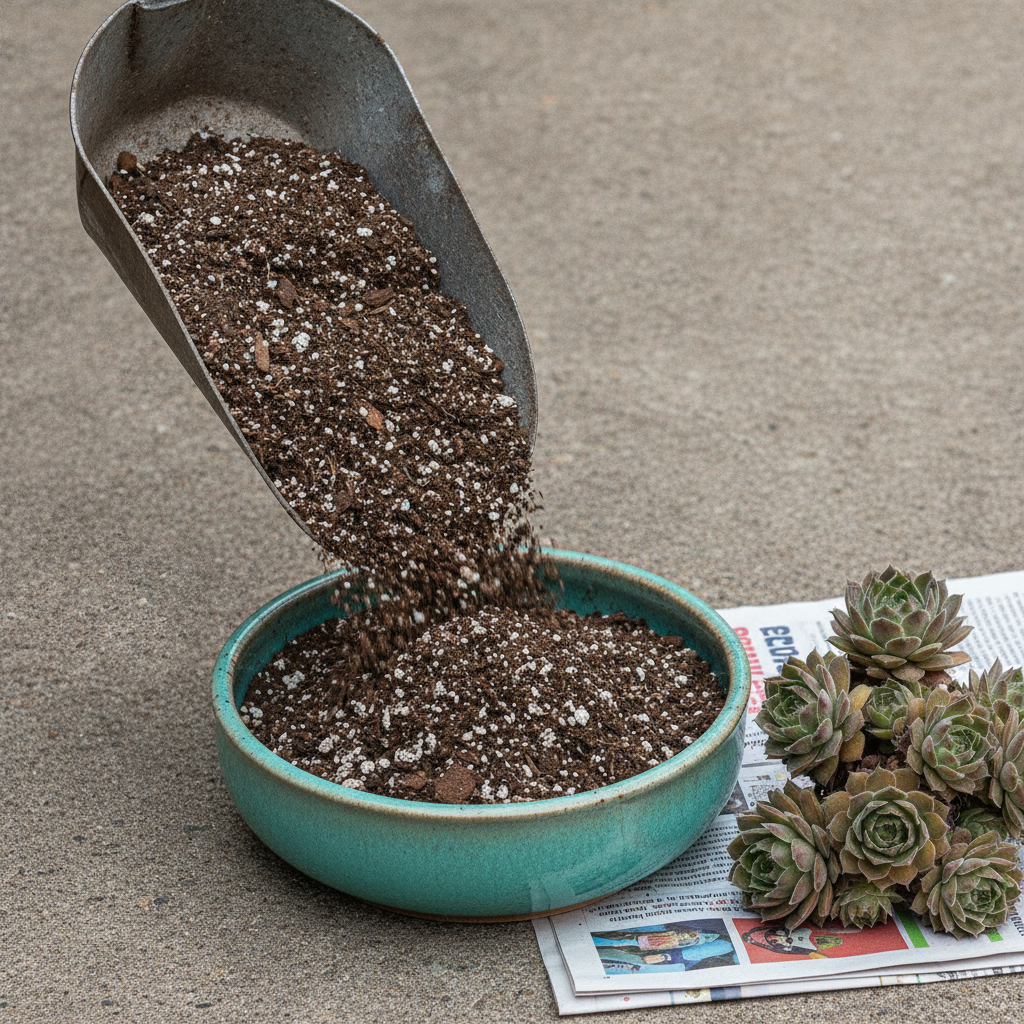
Soil for a houseleek has one overriding job: to drain fast and hold almost no standing water. In its native rock crevices the plant roots into a thin, gritty substrate of broken stone and mineral debris, so a rich, moisture-retentive potting compost is exactly wrong for it. Ordinary houseplant compost holds water around the roots for days, and in that time the fine roots suffocate and rot.
The simplest good option is a commercial cactus and succulent mix, but even these are often too water-retentive on their own, so it pays to sharpen the drainage further. A reliable homemade blend is roughly two parts cactus compost or a peat-free multipurpose compost to one part coarse grit, horticultural sand or perlite. The aim is a mix that feels gritty in the hand and lets water run straight through rather than clumping into a wet mass. Adding a top-dressing of fine gravel or grit around the base of the rosette is more than decorative: it keeps the leaves off the damp soil surface, reduces rot at the crown, and reflects light back up onto the plant.
The container matters as much as the mix. Choose a pot with generous drainage holes, and favour a shallow, wide shape over a deep one, because houseleeks are shallow-rooted spreaders that grow outward rather than down. Terracotta is the ideal material. Its porous walls breathe and let the soil dry evenly, which suits a plant this sensitive to lingering moisture, whereas glazed ceramic and plastic hold water longer. Houseleeks are slow growers and do not mind being snug, so you will only need to repot every two to three years, or sooner if the pot has filled entirely with offsets. Spring is the best time to repot, and letting the plant dry out for a few days before and after reduces the risk of root damage triggering rot.
Fertilising
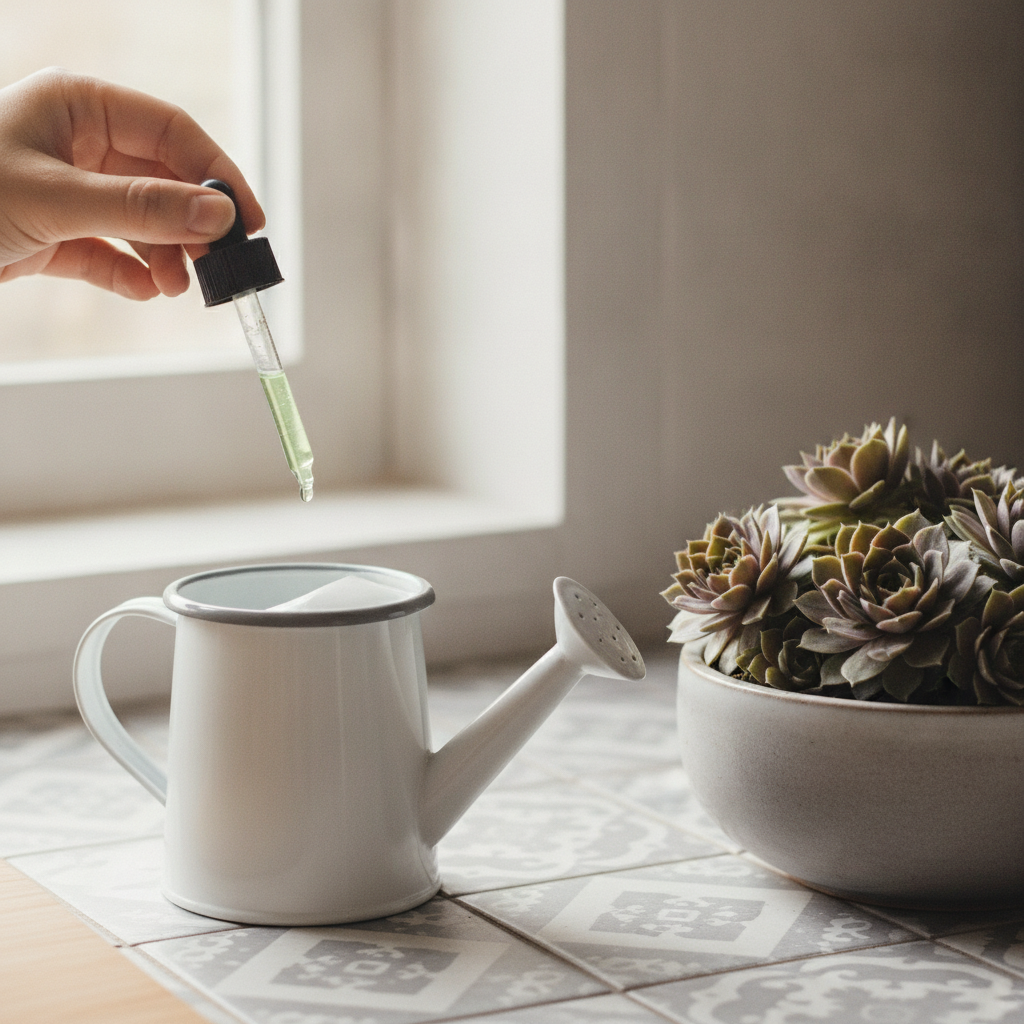
Hens and chicks are adapted to poor, mineral soils and expect very little in the way of nutrients. This is a plant you can quite easily kill with kindness, and overfeeding is a real risk. Too much fertiliser pushes soft, fast, pale growth that undoes the tight, colourful form you are trying to encourage, and it can burn the roots outright.
In practice, most houseleeks need no feeding at all if you refresh the soil every couple of years. If you do want to give a modest boost, use a fertiliser formulated for cacti and succulents, which is low in nitrogen, and dilute it to half or even a quarter of the strength stated on the label. Apply it once at the start of the growing season in spring and, at most, once more in early summer. Never feed a houseleek in autumn or winter, when the plant is dormant and cannot use the nutrients, and never feed a plant that is dry at the roots, as this concentrates the salts and risks scorching. Water lightly first, then apply the diluted feed. When it comes to feeding this plant, less is genuinely more.
Propagation
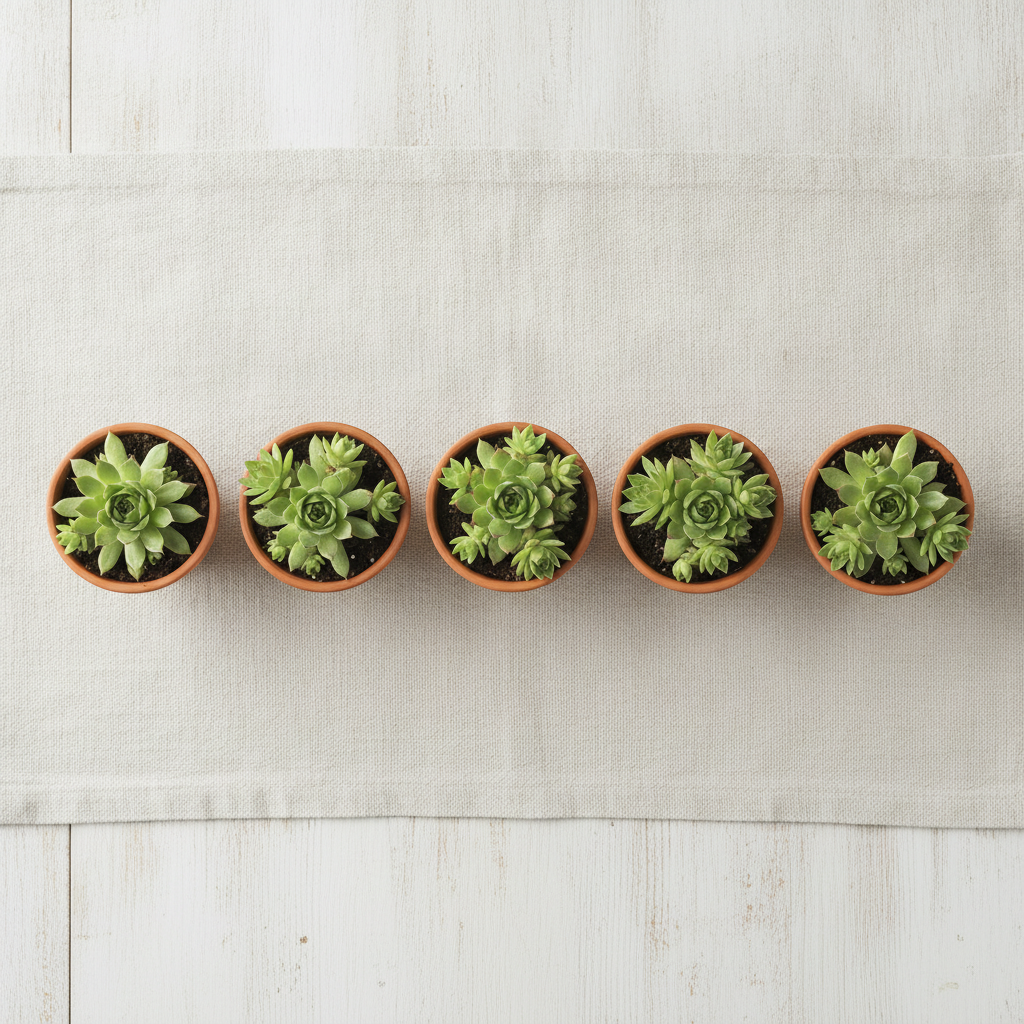
Propagation is where houseleeks are at their most rewarding, because the plant does almost all the work for you. Unlike many succulents that are grown from leaf or stem cuttings, Sempervivum multiplies through offsets, the very “chicks” that give the plant its name. Each mature rosette sends out short horizontal stems, called stolons, that end in a miniature rosette. These offsets often root themselves into the surrounding soil while still attached to the mother, so separating them is simple.
The best time to divide offsets is spring or early summer, when the plant is in active growth and will re-establish quickly, though it can be done at almost any time of year. To propagate a houseleek, follow these steps:
- Choose a chick that has grown to a reasonable size, ideally one that already has small roots of its own where it touches the soil.
- Gently pull or twist it away from the mother rosette, or cut the connecting stolon with a clean, sharp blade. Keep any roots that come away with it.
- If the offset has no roots yet, set it aside in a dry, shaded spot for one to two days so the cut end can callus over. This step prevents rot when it is planted.
- Fill a small pot with the same gritty, free-draining mix you use for mature plants and settle the offset onto the surface, pressing it in just enough to hold it steady.
- Wait about a week before watering lightly for the first time, then care for it exactly as you would an adult plant.
Rooting is usually quick and reliable, often taking just two to three weeks. Houseleeks can also be grown from seed, but seed-raised plants are slow and the results of named cultivars will not come true, so offsets are almost always the better route. Because a single healthy colony produces dozens of chicks a year, propagation quickly gives you a steady supply of plants to spread around the house or pass on to friends.
Pro Tip – Rescue the hen’s legacy: When a mother rosette flowers and begins to die back, do not panic and do not discard the whole pot. Simply lift and replant the healthiest surrounding chicks, and the colony carries on seamlessly. The flowering rosette has already secured the next generation before it fades.
Common Pests and Problems
Houseleeks are among the most pest-resistant plants you can grow, and the overwhelming majority of problems are cultural rather than biological, which is to say they come from care mistakes rather than insects. Even so, a few pests and diseases are worth knowing.
The most serious threat is root and crown rot, caused by overwatering or poorly draining soil. The first signs are rosettes that turn soft, translucent, yellow or brown at the base, and leaves that pull away with almost no resistance. By the time rot is visible at the crown it has usually spread through the roots, so prevention through sharp drainage and restrained watering is far more effective than any cure. If you catch it early, unpot the plant, cut away all soft and blackened tissue with a clean blade, let the healthy remainder callus for a day or two, and replant it into fresh dry mix.
Among insect pests, mealybugs are the most likely visitors, appearing as small white cottony tufts tucked between the leaves and in the tight centre of the rosette. Aphids sometimes cluster on the soft flower stalks in summer, and vine weevil grubs can attack the roots of plants grown in the open. Watch too for a rust fungus, Endophyllum sempervivi, which is specific to houseleeks and shows as swollen, distorted rosettes with orange spore pustules; affected rosettes should be removed and destroyed, as there is no simple cure. The table below summarises the main problems and their remedies.
| Problem | Signs | Remedy |
| Root or crown rot | Soft, mushy, discoloured rosettes; leaves detach easily | Cut away rot, dry out, replant in fresh gritty mix; water far less |
| Mealybugs | White cottony tufts between leaves | Dab with a cotton bud dipped in isopropyl alcohol; treat with neem oil |
| Aphids | Small green or black insects on flower stalks | Rinse off or spray with diluted neem oil or insecticidal soap |
| Vine weevil | Rosettes collapse; grubs found in the roots | Remove grubs; repot in fresh mix; use biological nematode control |
| Houseleek rust | Swollen, distorted rosettes with orange pustules | Remove and destroy affected rosettes; improve airflow |
| Etiolation | Pale, stretched, flattened rosettes | Move to much brighter light; propagate compact offsets |
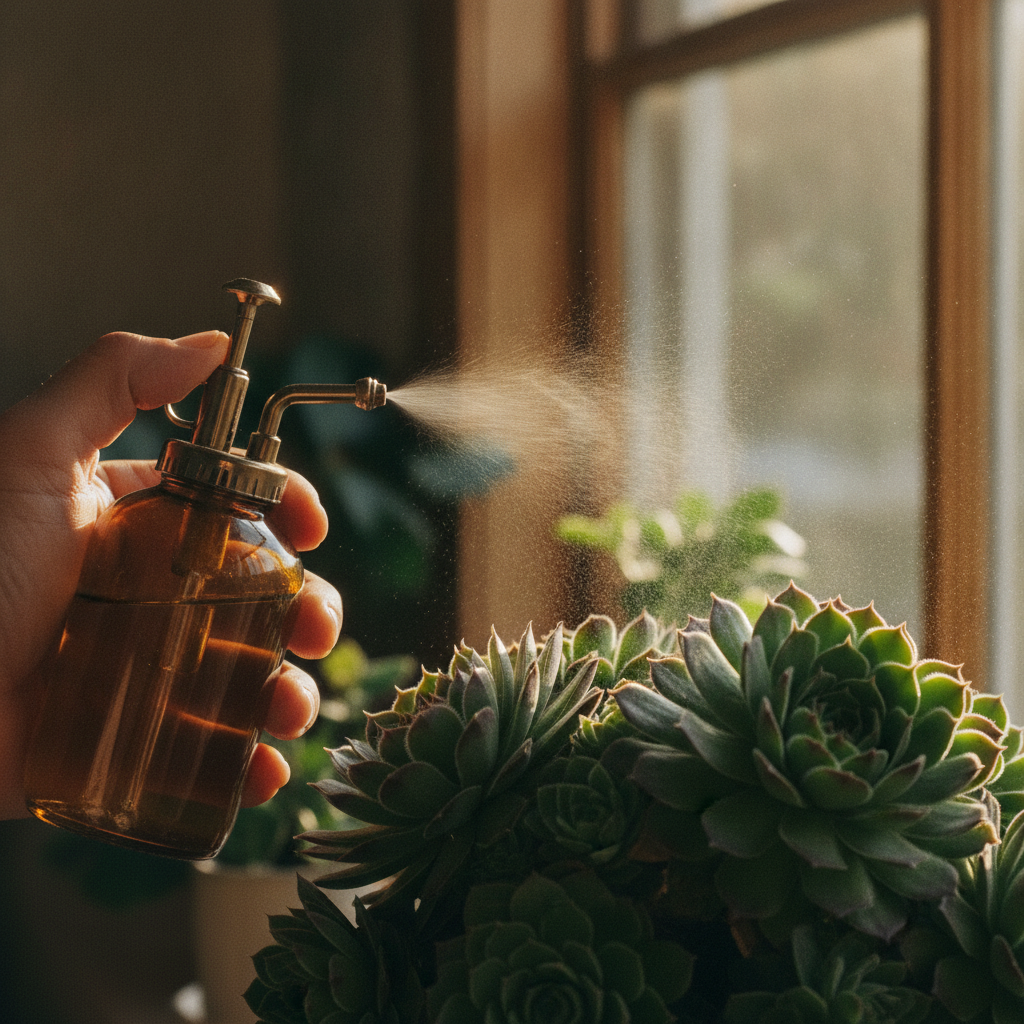
For the occasional insect outbreak, a light spray of diluted neem oil applied in the evening, out of direct sun, is a gentle and effective control. Keeping the plant in bright light with good airflow and letting the soil dry fully between waterings prevents nearly every problem before it starts.
Varieties
The genus Sempervivum contains dozens of species and thousands of named cultivars, bred for an extraordinary range of colours, sizes and textures. Rosettes may be apple green, silver, bronze, ruby red or deep purple, some smooth and glossy, others tipped with fine hairs or veiled in cobweb-like threads. Colour shifts with the seasons and with light intensity, so the same plant can look quite different in summer sun and winter shade. Two of the most popular and widely grown forms are shown below.
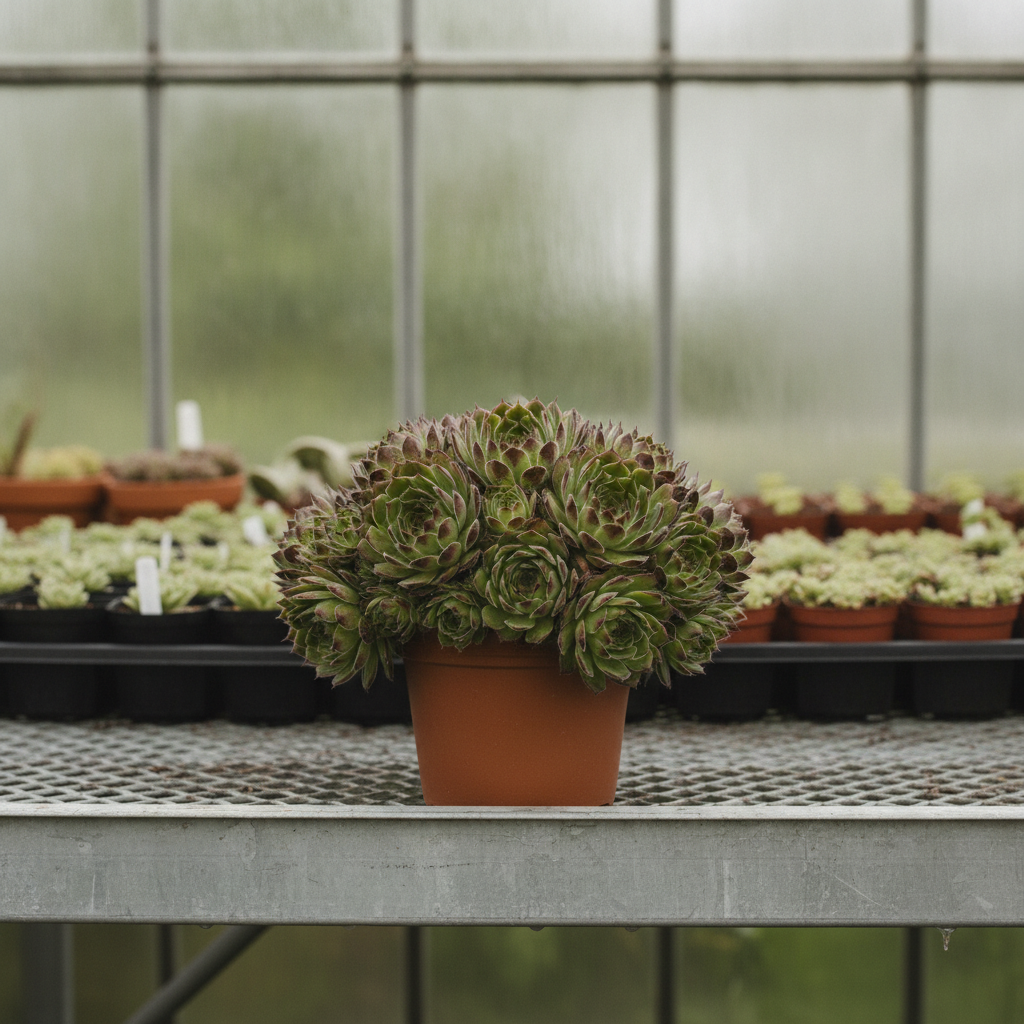
‘Royanum’ is a classic and easy-going cultivar prized for its clear contrast. It forms broad, open rosettes of bright apple-green leaves, each tipped with a distinct patch of deep chocolate-maroon that sharpens in strong sun. It is vigorous, offsets freely, and is one of the best choices for a first named houseleek.
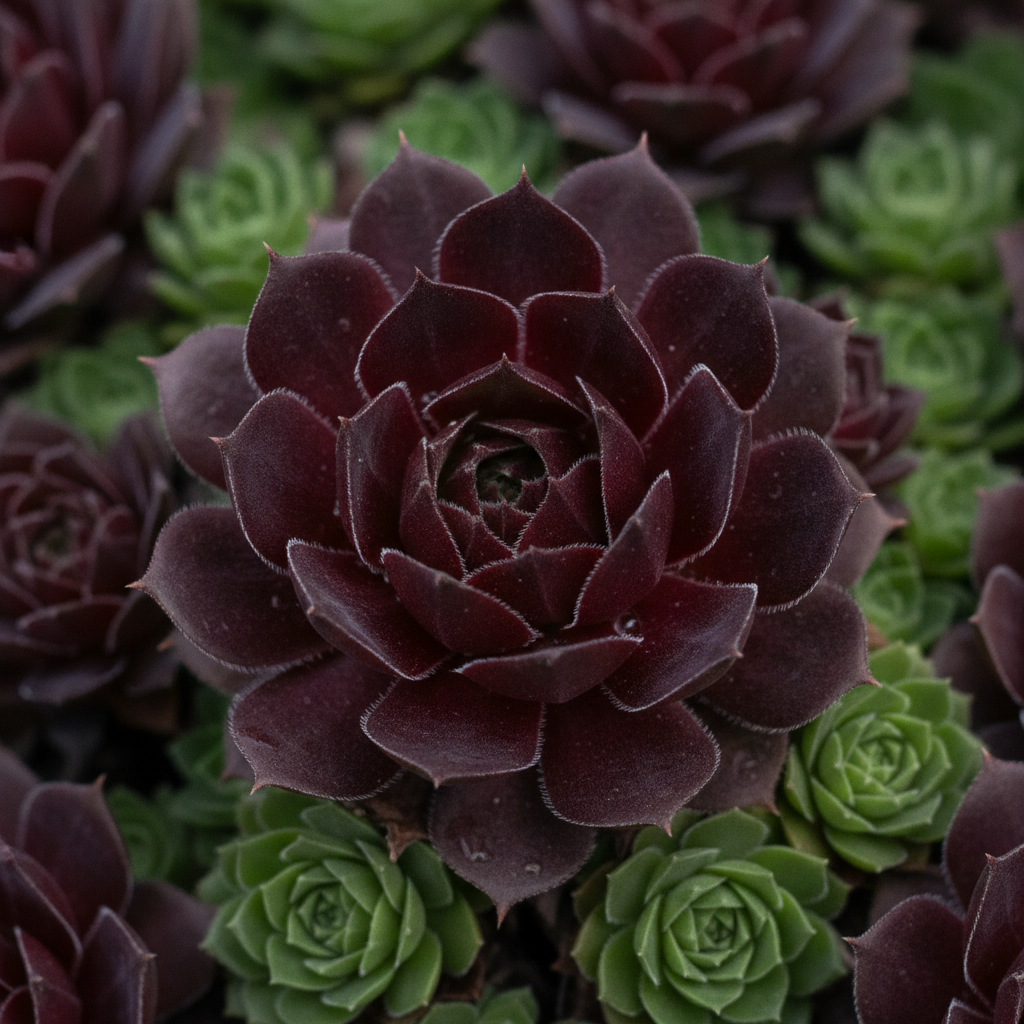
‘Atropurpureum’ is grown for its drama. Its rosettes deepen to a rich wine-red or purple, a colour that intensifies dramatically in bright light and cooler weather and softens toward green in shade. Planted alongside a green form such as ‘Royanum’, it makes a striking contrast and demonstrates just how much light drives the colour of these plants.
Beyond these two, look out for the cobweb houseleek (Sempervivum arachnoideum), whose rosettes are laced with white webbing, and countless hybrids with names like ‘Red Beauty’, ‘Pacific Devil’s Food’ and ‘Cobweb Buttons’. All share the same easy care, so once you have mastered one houseleek you can collect the rest with confidence.
Frequently Asked Questions
Why is my hens and chicks flowering, and is that bad?
Flowering is natural and, in a mature plant, expected. A rosette that sends up a tall stalk of star-shaped pink or red flowers is reaching the end of its individual life, because each rosette is monocarpic and dies after blooming. This is not a mistake on your part. The surrounding offsets carry the colony forward, so simply enjoy the flowers and replant the healthiest chicks once the parent fades.
Can hens and chicks live permanently indoors?
Yes, provided you can give them enough light. The single biggest challenge indoors is intensity of sun, so a bright south-facing windowsill or a grow light is essential. Many growers keep houseleeks outdoors for part of the year, where they colour up best in strong light and cool nights, and bring them in or simply leave them out, since the plant is extremely cold hardy.
Why are my rosettes stretched out and pale?
This is etiolation, and it means the plant is not receiving enough light. The rosette elongates and opens up as it searches for the sun. The stretched growth will not tighten back up, so move the plant to a much brighter spot to prevent further stretching, and propagate the compact new offsets to reset the plant’s form.
How often should I water a houseleek in winter?
Very rarely. In the cool, low-light months the plant is dormant and uses almost no water. Watering roughly once every three to four weeks, or just often enough to stop the roots drying out completely, is usually plenty. Overwatering in winter, when the soil dries slowly, is one of the most common ways houseleeks are lost.
Are hens and chicks safe around pets?
Yes. Sempervivum tectorum is considered non-toxic to cats, dogs and humans, which makes it a reassuring choice for households with curious animals or children. As with any plant, it is still best to discourage nibbling, but it poses no known poisoning risk.
My houseleek’s lower leaves are drying up. Should I worry?
Usually not. It is completely normal for the oldest, outermost leaves of a rosette to dry, brown and shrivel as the plant grows and replaces them from the centre. Simply peel or brush these away to keep the plant tidy. Only worry if the drying is accompanied by softness, translucency or discolouration spreading from the base, which would point to rot rather than natural ageing.






