
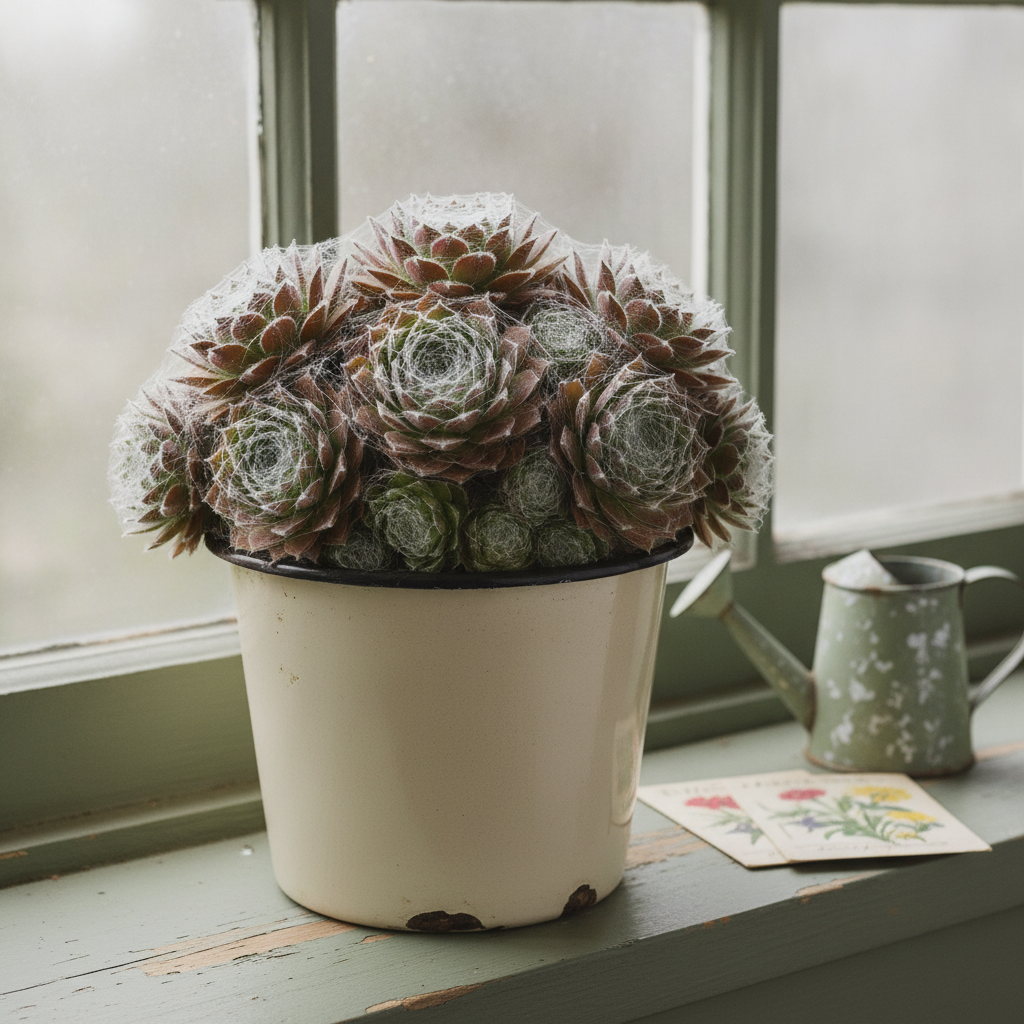
Few succulents wear their origins as plainly as the cobweb houseleek. Each tight rosette of Sempervivum arachnoideum is strung across with fine white threads, as though a spider had worked through the night to lace the leaf tips together. That webbing is not decoration but survival equipment, spun by a plant that clings to bare rock high in the mountains of Europe where sun, wind and cold would flay anything less prepared. Bring it indoors or onto a windowsill and you inherit a plant that asks for almost nothing, punishes kindness far more readily than neglect, and quietly multiplies itself into a colony while you look the other way.
This guide covers everything needed to keep a cobweb houseleek not merely alive but genuinely thriving, from the counterintuitive light and water it wants to the gritty soil it insists on and the effortless way it propagates itself from offsets. It is an easy plant, but easy on its own terms, and understanding those terms is the difference between a plump, densely webbed rosette and a stretched, rotting one.
Quick Reference
- Why grow a cobweb houseleek
- Light
- Watering
- Soil and potting
- Fertilising
- Propagation
- Pests and problems
- Varieties
- Frequently asked questions
| Botanical name | Sempervivum arachnoideum |
| Common names | Cobweb houseleek, spiderweb hens and chicks, cobweb sempervivum |
| Family | Crassulaceae |
| Origin | Mountains of central and southern Europe (Alps, Pyrenees, Apennines, Carpathians) |
| Mature size | Rosettes 1 to 3 cm (0.4 to 1.2 in) across, mats spreading 30 cm (12 in) or more |
| Light | Full sun to very bright light, at least 4 to 6 hours direct |
| Water | Sparing; only when soil is fully dry, far less in winter |
| Soil | Very gritty, fast-draining mineral mix |
| Temperature | Tolerates -20 C (-4 F) to around 30 C (86 F); genuinely cold-hardy |
| Humidity | Low; dislikes still, humid air |
| Toxicity | Non-toxic to cats, dogs and humans |
| Difficulty | Easy, provided drainage and sun are right |
Why Grow a Cobweb Houseleek as a Houseplant
The appeal of Sempervivum arachnoideum begins with the webbing. Where most succulents defend themselves with waxy coatings or plump reservoirs of water, this species evolved a veil of fine white hairs, technically trichomes, that stretch from the tip of one leaf to the next until the whole rosette appears wrapped in gossamer. High in the alpine zone where the plant grows wild, that webbing scatters fierce ultraviolet light, traps a thin insulating layer of still air against the leaves, and slows evaporation in a place where liquid water is scarce for much of the year. What functions as sunscreen and windbreak on a mountainside reads, on a windowsill, as one of the most distinctive textures in the whole world of succulents.
Beyond looks, the cobweb houseleek earns its place through sheer resilience. The genus name Sempervivum translates from Latin as “always living”, and the plant lives up to it. It survives temperatures that would turn a jade plant to mush, shrugs off drought, and asks for no feeding, no misting and no fussing. For anyone who has killed a succulent by loving it too hard, the houseleek offers a gentler learning curve, because its main requirements are things you withhold rather than things you provide. The species epithet arachnoideum, from the Greek for spider, simply records the webbing that sets it apart from its plainer relatives.
It is worth being honest about what this plant is and is not. A cobweb houseleek is fundamentally an outdoor alpine, happiest on a sunny balcony, in a rock garden, or in a trough where it can feel the seasons turn. It can be grown on a bright windowsill indoors, and many people do, but it will never be as content in a warm, dim living room as a pothos or a snake plant. Understanding it as a cold-loving sun worshipper rather than a tropical houseplant is the single most useful mental shift you can make, and it explains almost every care instruction that follows.
Pro Tip — Read the webbing: The density of the white webbing tells you how happy your plant is. In strong light the cobwebbing grows thick and bright; in weak light the rosette stretches, the webbing thins, and the leaves lose their compact geometry. Treat the webbing as a built-in light meter.
There is also a long folk tradition attached to houseleeks that adds to their charm. For centuries they were planted on the roofs and walls of European homes, where they were believed to ward off lightning and fire, a superstition tied to the Roman god Jupiter and preserved in old common names. Whether or not you credit the myth, a plant that has been cultivated on rooftops for a thousand years has clearly proven it can look after itself.
Light
Light is where the cobweb houseleek is least forgiving, and where most indoor failures begin. This is a full-sun plant in the truest sense. In the wild it grows exposed on sunlit slopes and rock crevices, and it expects the same generosity indoors. Aim for a minimum of four to six hours of direct sun each day, and more if you can manage it. A south-facing or west-facing windowsill is ideal in the northern hemisphere; a north window, however bright it may seem to the eye, will almost never be enough.
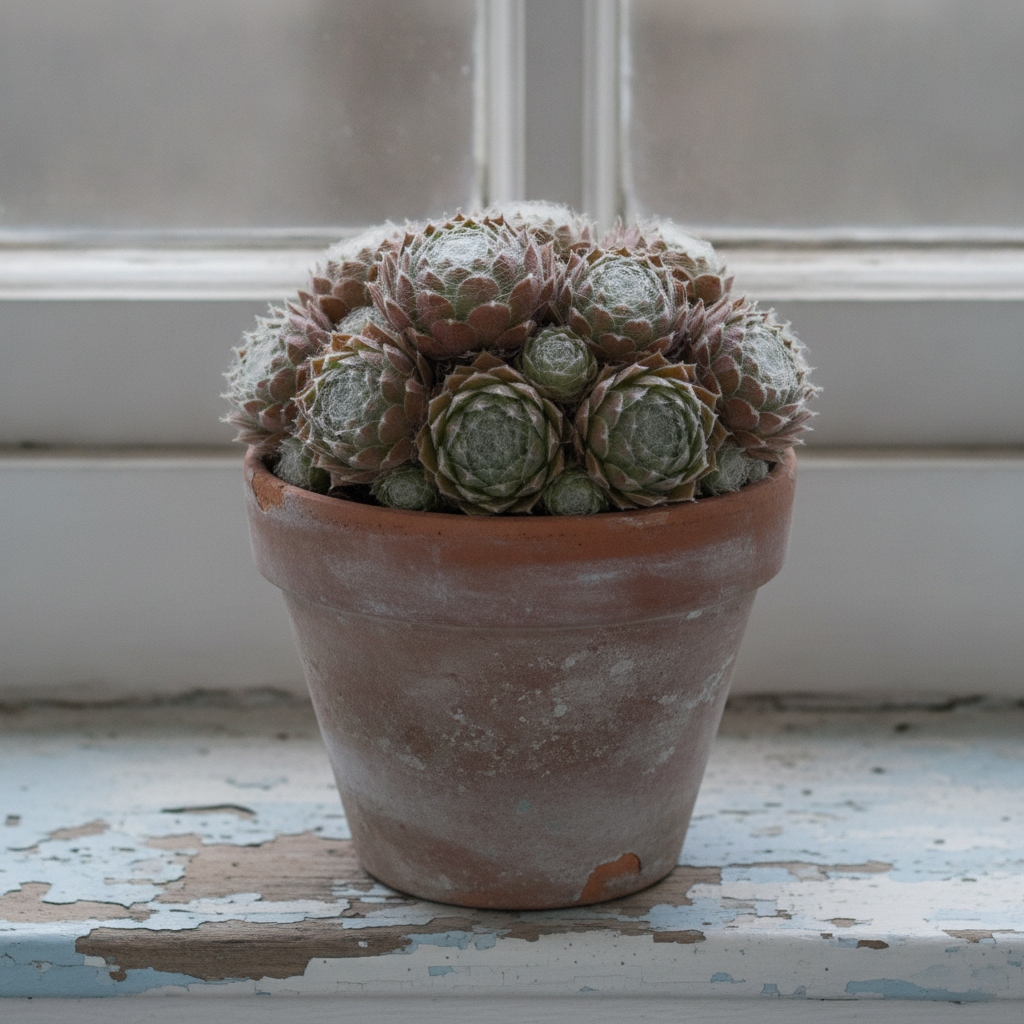
The clearest way to read whether your plant is getting enough light is to watch the shape of the rosette. A well-lit houseleek stays low, tight and symmetrical, with leaves packed into a dense dome and webbing spun thickly across the top. A plant starved of light does the opposite: it etiolates, stretching upward and outward as the leaves reach for a stronger source, the gaps between them widening and the whole rosette loosening into something pale and floppy. Once a rosette has stretched it will not tighten back up, so the etiolated growth is permanent, though offsets grown in better light will form properly.
Colour is the other tell. Many forms of Sempervivum arachnoideum flush red or bronze at the leaf bases and tips when grown hard in bright light and cool temperatures, a stress response that most growers actively encourage because it is so attractive. Kept too warm and too shaded, those same plants stay a flat, uniform green. If your houseleek has lost its colour, more light rather than less is almost always the answer.
If you cannot offer a genuinely sunny window, this plant is an excellent candidate for a balcony, terrace or windowsill outdoors for most of the year. It relishes the extra light and the cool nights, and it is hardy enough to stay outside through frost in most temperate climates. Growers without any bright natural light can succeed with a full-spectrum LED grow light positioned close overhead and run for ten to twelve hours a day, though even the best artificial setup is a substitute rather than an equal for real alpine sun. When moving a plant from shade into strong sun, do it over a week or two to avoid scorching the leaves, which can happen even to a sun-lover that has grown soft indoors.
Watering
If light is where indoor growers fall short, watering is where they overdo it. The cobweb houseleek stores water in its fleshy leaves and is built to endure long dry spells, so the guiding principle is simple: water thoroughly, then wait until the soil is completely dry before watering again. In practice that usually means a good soak every week or two during the warm growing months, and dramatically less in winter, when the plant is semi-dormant and may go a month or more between drinks.
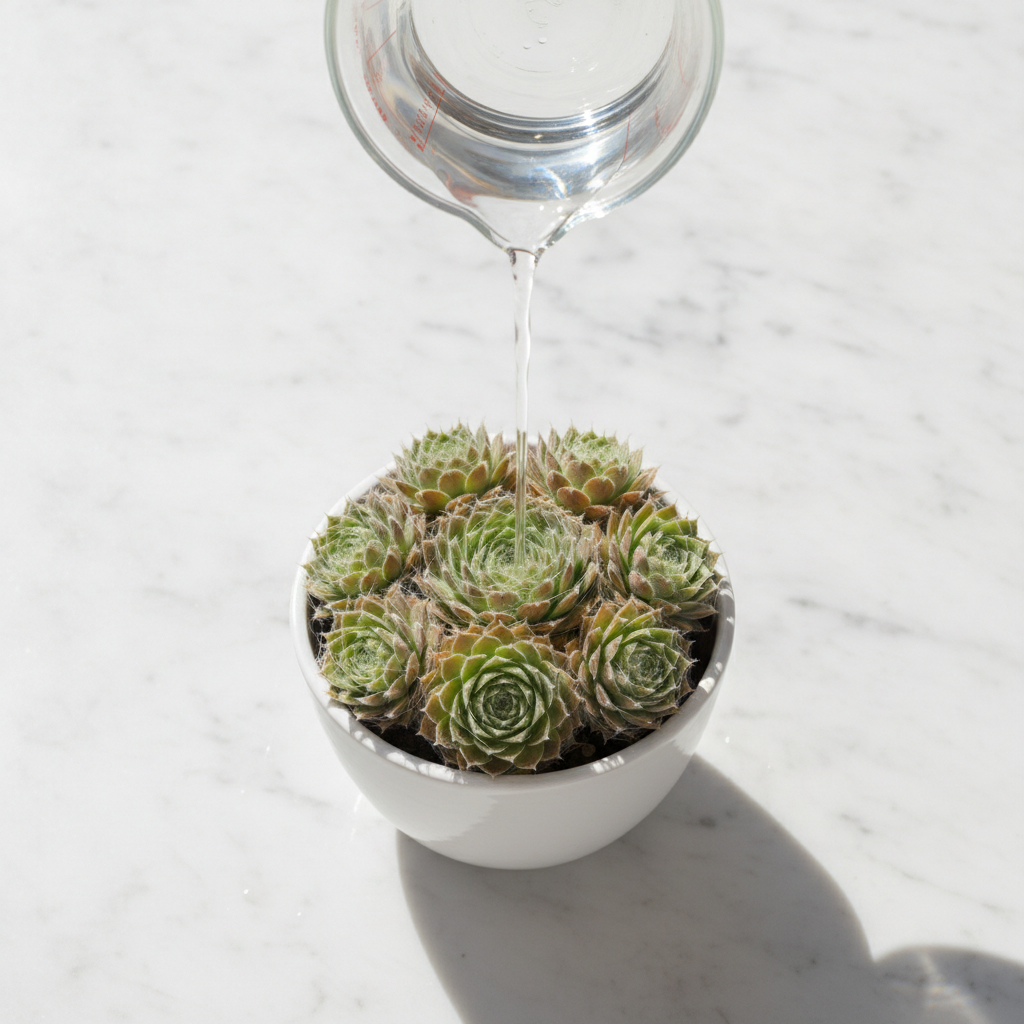
Technique matters as much as frequency. Direct the water at the soil rather than over the rosette, because water that pools in the crown and sits trapped beneath the webbing can trigger rot, especially in cool or still conditions. Where possible, water in the morning so that any stray moisture dries off during the day. Bottom watering, sitting the pot in a shallow tray of water for ten or fifteen minutes until the surface darkens, is an excellent method for houseleeks because it keeps the rosette dry entirely and encourages roots to grow downward toward the moisture.
The signs of trouble run in both directions, though overwatering is by far the more common and more dangerous. A plant given too much water shows soft, translucent, yellowing leaves, often starting at the base of the rosette, and in advanced cases a blackening, mushy crown that signals rot has set in. An underwatered plant, by contrast, simply shows slightly wrinkled or shrivelled outer leaves that plump up again within a day of a proper soak. Given the choice, always err toward too dry, because a thirsty houseleek recovers in hours while a rotting one rarely recovers at all.
Warning — Never let it sit in water: A saucer left full of water is the fastest way to kill a cobweb houseleek. Always tip out excess water from the tray after watering, and never leave the pot standing in a puddle. Roots left in saturated soil suffocate and rot within days.
Water quality is rarely a concern for this tough plant, which tolerates ordinary tap water without complaint. Far more important is that whatever water you give drains away freely and quickly, which brings us to the soil the plant sits in.
Soil and Potting
Soil is the foundation of houseleek care, and it is non-negotiable: the mix must drain fast and hold very little water. In the wild these plants root into little more than grit, scree and the crumbling mineral debris that collects in rock crevices, so a rich, moisture-retentive potting compost is actively harmful. The goal is a gritty, open, largely mineral mix that lets water rush through and air reach the roots within moments of watering.
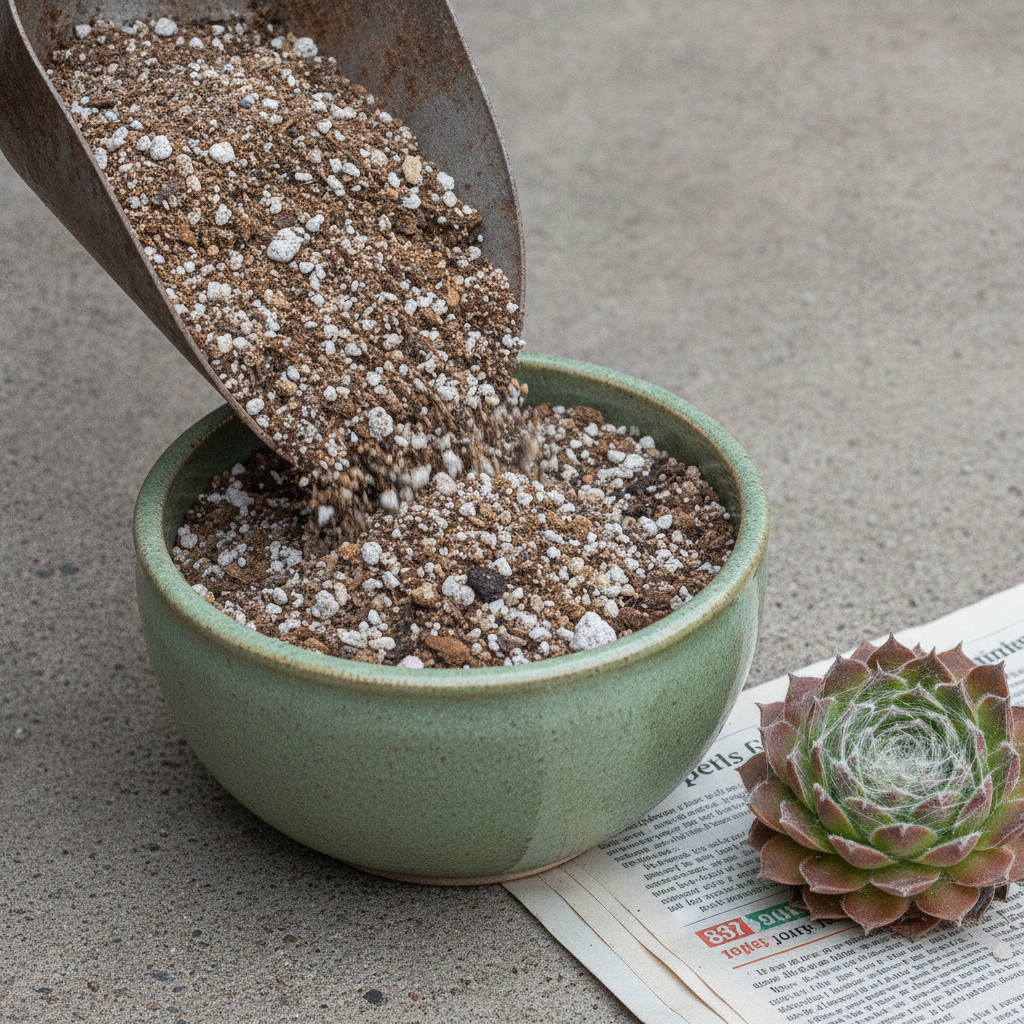
A reliable recipe is roughly half mineral grit and half a lean, low-nutrient compost. You can build this from a commercial cactus and succulent compost cut with an equal volume of horticultural grit, coarse sand, pumice or perlite. Some growers go even more mineral, using two parts grit to one part compost, and houseleeks are perfectly happy in such spartan mixes. What you want to avoid is any peat-heavy, water-retentive medium that stays wet for days, because that is precisely the condition alpine plants never encounter and cannot cope with.
The container matters almost as much as the contents. Choose a pot with generous drainage holes, and favour shallow, wide vessels over deep ones, because houseleeks are shallow-rooted spreaders that produce offsets sideways rather than growing tall. A shallow bowl or alpine pan lets a single rosette fill out into an attractive colony over a couple of seasons. Terracotta is the traditional and ideal choice, since the porous clay wicks moisture out of the soil and helps it dry between waterings; glazed ceramic and plastic both hold water longer and demand more restraint from you in return.
Repotting is an occasional task rather than a routine one. A houseleek is content to be somewhat crowded, and a pot packed with offsets is a fine thing to look at, so you generally only need to repot every two or three years, or when the colony has completely outgrown its container. Spring is the best time, at the start of the active growing season. When you do repot, take the chance to remove any dead outer leaves and to check the roots, which should be fine and pale; trim away anything blackened or mushy, let the plant sit dry for a day so any wounds callus over, and only then settle it into fresh gritty mix and wait several days before the first watering.
Pro Tip — Top-dress with grit: Finishing the soil surface with a layer of coarse grit or fine gravel keeps the base of the rosette dry, stops soil splashing up into the webbing, sets off the plant beautifully, and discourages fungus gnats. It is a small touch that pays off in both health and appearance.
Fertilising
The cobweb houseleek is adapted to poverty. It grows wild in mineral grit that offers almost no nutrients, and it neither expects nor benefits from heavy feeding. In most cases you can skip fertiliser entirely and the plant will be perfectly healthy, drawing what little it needs from the small amount of compost in its mix and from the slow breakdown of organic matter around its roots. This is genuinely a plant where doing nothing is a valid strategy.
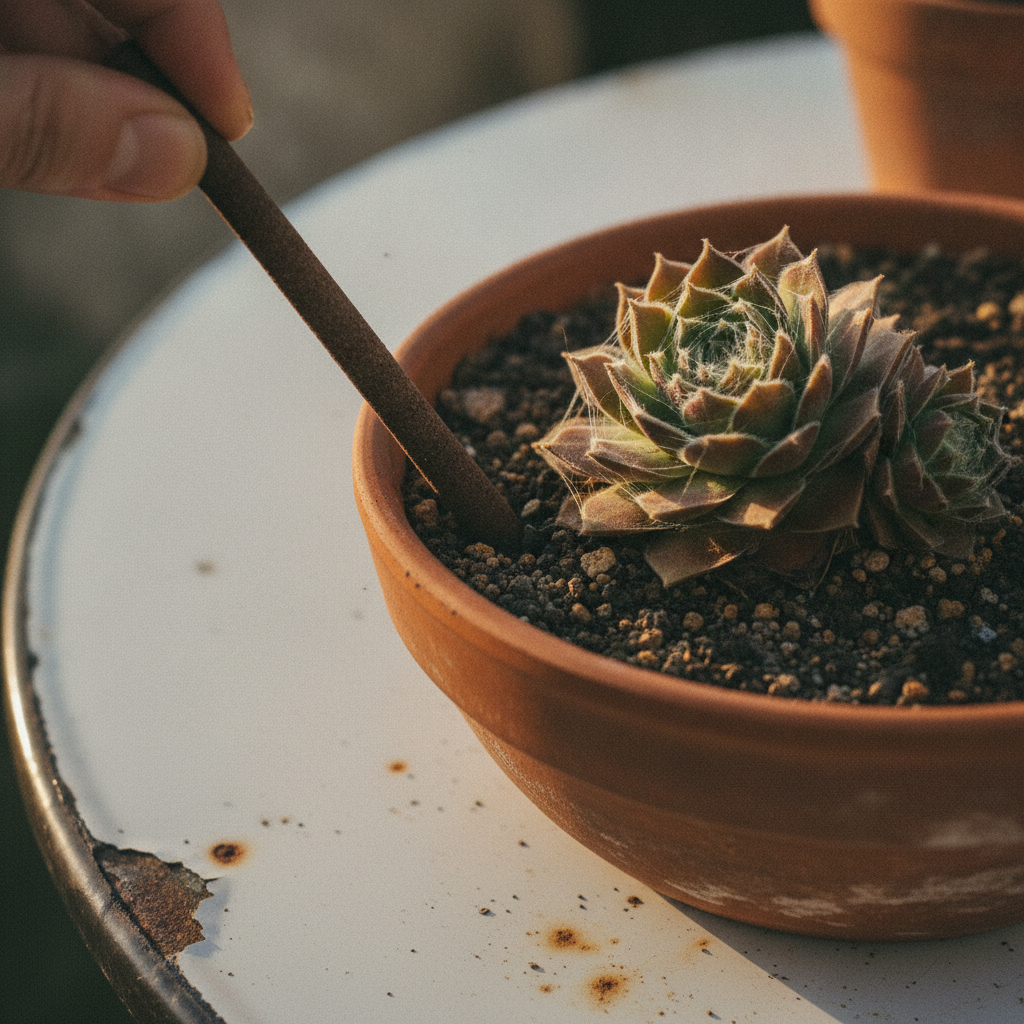
If you do choose to feed, treat it as a light touch given rarely. A single application of a balanced or low-nitrogen liquid fertiliser diluted to a quarter or half the recommended strength, offered once in late spring and perhaps again in mid summer, is more than enough. Fertilisers formulated for cacti and succulents are ideal because they are low in nitrogen, which is exactly what you want. Never feed a houseleek in autumn or winter, when the plant is winding down and cannot use the extra nutrients.
The risk of overfeeding is real and worth understanding. Too much nitrogen pushes a houseleek into soft, fast, lush growth that runs against everything the plant is built for. The rosettes loosen, the leaves become plump and weak, the attractive red and bronze stress colours fade to a bland green, the webbing thins, and the pampered tissue becomes far more susceptible to rot and to pests. A hungry houseleek is a compact, colourful, tightly webbed houseleek; a well-fed one is often a disappointment. When in doubt, feed less or not at all.
Propagation
Propagating the cobweb houseleek is one of the great pleasures of growing it, because the plant does nearly all the work itself. Like all sempervivums it multiplies by offsets, the small clone rosettes affectionately known as “chicks” that appear around the base of the mother, or “hen”, often on short creeping stems called stolons. A single rosette will, over a season, surround itself with a ring of miniature copies, and these are all you need to build a colony or share the plant with friends.
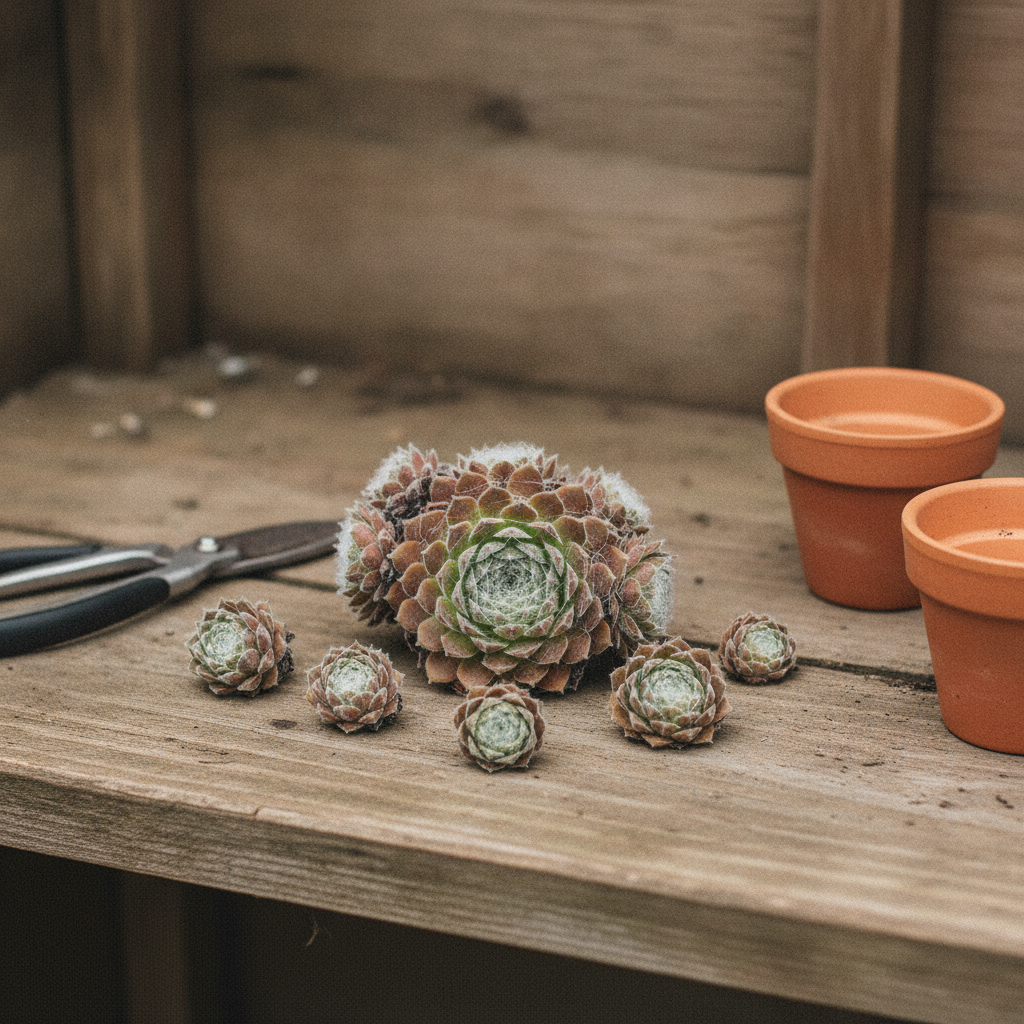
Dividing offsets is simple and can be done any time in the growing season, though late spring and early summer give the fastest results. The steps are straightforward:
- Choose an offset that has begun to develop its own tiny roots, or one large enough to establish quickly. Larger chicks root faster than the smallest ones.
- Gently detach it from the mother, following the connecting stolon back and pinching or snipping it off with clean fingers or sterilised scissors. Many chicks come away with a light twist and little resistance.
- If the offset has no roots yet, set it aside in a dry, shaded spot for a day or two so the cut end calluses over. Rooted offsets can be planted straight away.
- Nestle each offset into a small pot or tray of the same gritty, free-draining mix, pressing it just firmly enough to hold it upright without burying the leaves.
- Place it in bright light, keep the mix barely moist rather than wet, and within two to three weeks the offset will anchor itself with new roots and begin to grow.
Houseleeks can also be grown from seed, but it is a slow and unpredictable route best left to collectors, since seed-raised plants take years to reach a good size and, in a species as variable as this one, may not resemble the parent. For anyone who simply wants more plants, offsets are quicker, easier and true to type.
One quirk of the genus deserves a mention here because it worries new growers unnecessarily. Sempervivums are monocarpic, meaning each individual rosette flowers only once and then dies. After several years a mature rosette may push up a curious, elongated flower stalk bearing a cluster of star-shaped pink or reddish blooms; this is a natural and beautiful event, not a sign of illness. Once that rosette has flowered and set seed it will slowly wither, but by then it will have thrown off a generation of offsets to take its place, so the colony as a whole simply carries on. If you prefer to keep a rosette going a little longer, you can cut off the emerging flower stalk, though most growers let nature run its course and enjoy the bloom.
Pests and Problems
A healthy cobweb houseleek grown in the right conditions is remarkably trouble-free, and the great majority of problems it does suffer trace back not to pests but to care, above all to excess water. Still, a few genuine pests find their way to the plant, and it pays to recognise them early. When inspecting a houseleek, look closely into the rosette and beneath the webbing, since this is exactly the sheltered spot where trouble likes to hide.

The most important pest to know is the mealybug, precisely because its white, cottony masses can be mistaken for the plant’s own webbing. The difference is that natural cobwebbing is fine, even and stretched neatly between leaf tips, while a mealybug infestation appears as fluffy white clumps tucked into the leaf axils and crown, often accompanied by a sticky residue. Dab any confirmed mealybugs with a cotton bud dipped in isopropyl alcohol, and for a wider infestation treat the plant with a suitable insecticide or a diluted horticultural soap, repeating every week or so until they are gone. Aphids may also appear, particularly on flower stalks, and root mealybugs occasionally infest the soil, which is one more reason to check the roots whenever you repot.
Vine weevils are worth a special mention for outdoor and alpine growers, as their pale, curved larvae feed unseen on houseleek roots and can hollow out a plant before you notice anything wrong above the soil. A rosette that suddenly loosens and lifts away from its roots is the classic symptom. Fungus gnats, by contrast, are less a pest of the plant than a sign that the soil is being kept too wet; letting the mix dry out properly and top-dressing with grit usually ends them.
By far the most serious problem, however, is rot, and it is almost always self-inflicted. Overwatering, poor drainage, water trapped in the crown, or cold and wet combined will cause the base of the rosette to turn brown, soft and mushy, and once rot takes hold in the centre a rosette is usually beyond saving. The response is prevention rather than cure: gritty soil, restrained watering, good air movement and bright light together head off nearly every case. If rot appears, remove the affected rosette promptly to protect its neighbours, and salvage any healthy offsets by rooting them afresh in dry, gritty mix.
| Symptom | Likely cause | What to do |
| Soft, brown, mushy crown | Overwatering or rot | Remove affected rosette, dry out, save offsets in gritty mix |
| Stretched, loose, pale rosette | Too little light | Move to full sun or add a grow light |
| Wrinkled, shrivelled outer leaves | Underwatering | Give a thorough soak; recovers within a day |
| Fluffy white clumps in the crown | Mealybugs | Dab with alcohol, treat with soap or insecticide |
| Rosette lifts away from roots | Vine weevil larvae | Check and replace soil, treat with biological control |
| Faded green, no red colour | Too much shade, warmth or feeding | More light, cooler nights, stop fertilising |
Varieties
Cobweb houseleeks are wonderfully variable, and generations of collectors have selected forms that differ in rosette size, webbing density and colour. All share the same easy care, so choosing between them is purely a matter of the look you prefer. Two of the most widely grown selections show off the range of the species nicely.
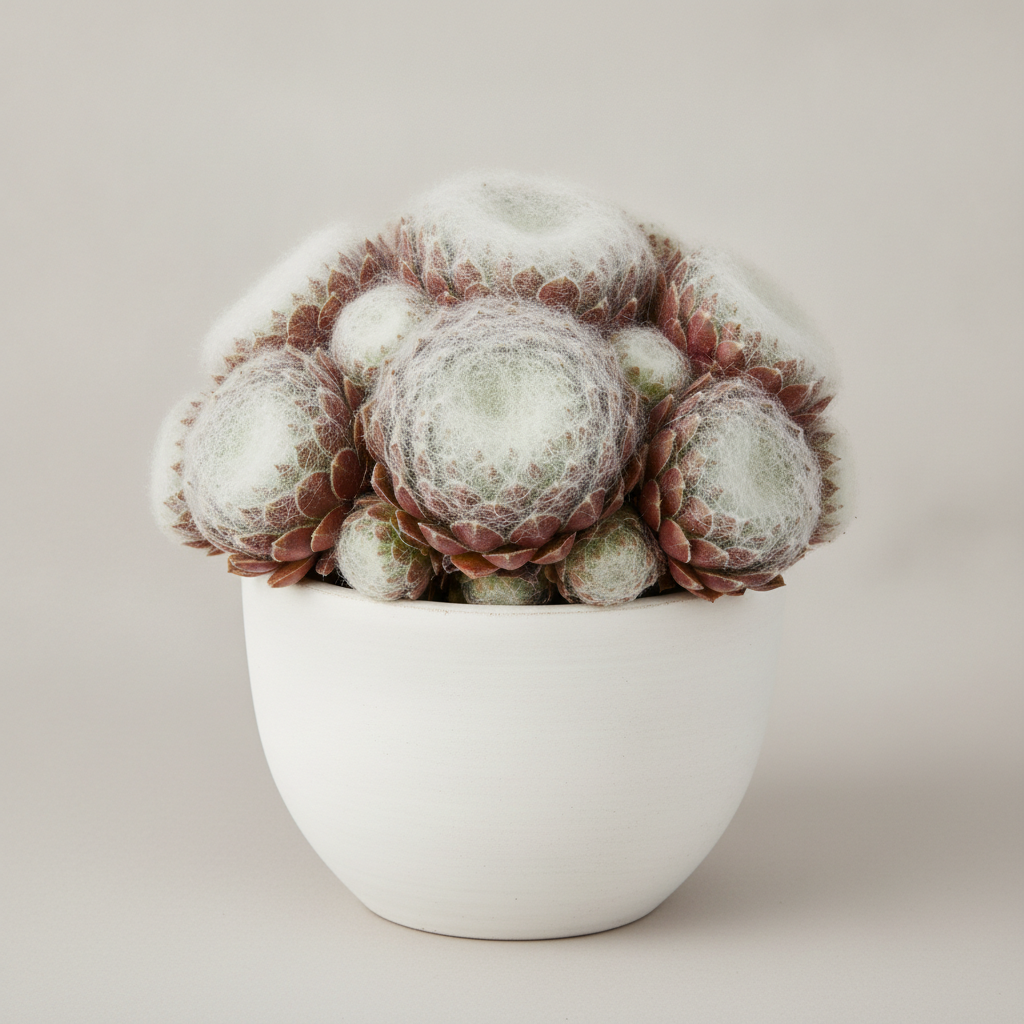
Sempervivum arachnoideum ‘Cebenense’ is prized for its especially heavy, bright white webbing, which can nearly obscure the leaves beneath. Its larger rosettes flush a warm bronze-red toward the base in strong light, giving a striking contrast between the ruddy foliage and the pale threads. It is one of the showiest forms and a favourite for trough and container displays.

Sempervivum arachnoideum subsp. tomentosum, often sold as ‘Minor’, is the dwarf, extra-woolly form. Its rosettes are tiny, often only a centimetre or two across, and so densely webbed that a mature clump reads as a soft white mat. It multiplies freely into cushions and is ideal for miniature alpine pans, hypertufa troughs and tight crevice plantings where its scale can be appreciated up close.
Beyond these two, the cobweb houseleek hybridises readily with other Sempervivum species, and countless named crosses combine its trademark webbing with the size, colour and form of their other parent. Forms such as ‘Rubrum’ with reddish leaves and ‘Stansfieldii’ with a distinct bronze tone are worth seeking out, and any well-stocked alpine nursery will offer a shifting selection worth browsing.
Frequently Asked Questions
Is the white webbing a sign of pests?
No. The fine white threads stretched neatly between the leaf tips are the plant’s own natural trichomes and are entirely healthy; indeed, thick webbing is a sign of a happy plant grown in good light. The webbing to worry about is different in character: mealybug fluff appears as irregular cottony clumps tucked into the leaf axils and crown, often with a sticky residue, rather than as even threads across the surface.
Can I grow a cobweb houseleek indoors permanently?
You can, but only on your brightest windowsill, and it will never be quite as robust as one grown outdoors. This is fundamentally an alpine plant that wants full sun and cool nights. If your sunniest window gives less than four to six hours of direct light, the plant will slowly stretch and lose its compact form, and you will need to supplement with a grow light or move it outdoors for part of the year.
Why is my houseleek sending up a tall stalk?
That is a flower stalk, and it is a natural part of the plant’s life cycle rather than a problem. Each sempervivum rosette flowers once, produces a cluster of star-shaped blooms, and then dies after setting seed. By that point it will have surrounded itself with offsets that carry the colony on, so nothing is truly lost. If you would rather keep a particular rosette going, you can cut off the emerging stalk before it develops.
Is the cobweb houseleek toxic to pets?
No. Sempervivum species, including the cobweb houseleek, are considered non-toxic to cats, dogs and humans, which makes them a safe choice for households with curious animals or children. As with any plant, it is still sensible to discourage pets from chewing on it, since large amounts of any foliage can cause mild stomach upset.
How cold can it survive?
Remarkably cold. Cobweb houseleeks are genuinely frost-hardy and tolerate temperatures down to around -20 C (-4 F), and often lower, provided the soil stays well drained. Cold is not a threat to this plant; wet is. A houseleek left in soggy soil through a cold winter will rot, but the same plant in gritty, free-draining mix will sail through hard frost unharmed and often colour up beautifully in the cold.
How often should I repot?
Rarely. Houseleeks are happy crowded and only need repotting every two to three years, or when a colony has completely filled and outgrown its container. Spring is the best time. Use the opportunity to refresh the gritty mix, remove dead outer leaves, and divide off some of the offsets if you would like more plants.






