
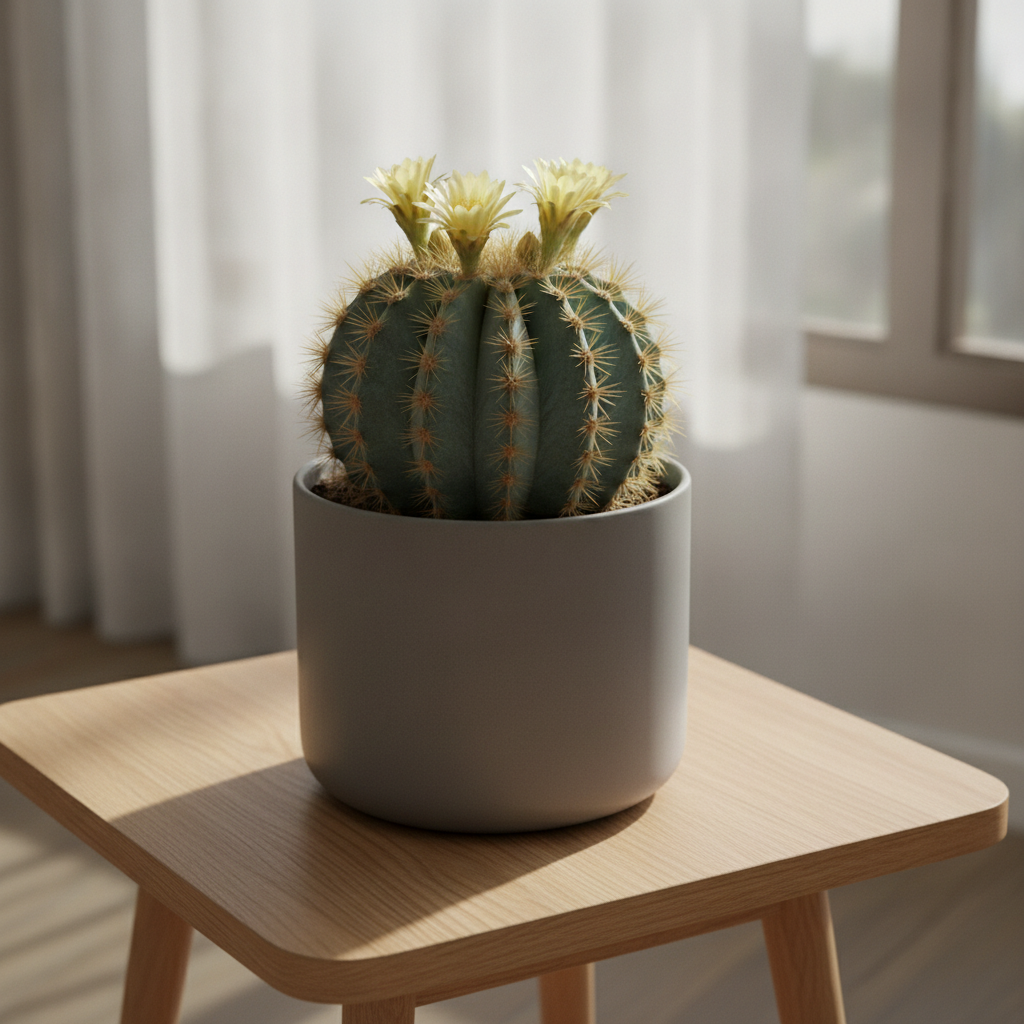
Few small cacti announce themselves as quietly and as beautifully as the balloon cactus. Known botanically as Parodia magnifica, and still sold under its older name Notocactus magnificus, it is a globular to short-columnar cactus prized for its glaucous blue-green skin, its crisp geometry of sharp ribs, and the fine golden-yellow bristles that line every ridge like stitching on a seam. The common names it collects along the way, ball cactus, blue ball cactus and green ball cactus, all point to the same thing: a plant whose plump, symmetrical body looks almost inflated, as though it might drift off the windowsill.
This is a cactus that rewards restraint. It asks for very little water, a gritty pot of soil and a bright spot, and in return it holds its sculptural shape for years before crowning itself with silky, sulphur-yellow flowers in summer. The gap between merely surviving and genuinely thriving comes down to a handful of decisions: how much light you give it, how firmly you resist the urge to water, and whether you allow it a cool, dry winter rest. This guide walks through each of those decisions in detail so that your balloon cactus does not just persist on a shelf but grows into a robust, free-flowering specimen.
Contents
- Quick Reference
- Why the Balloon Cactus Makes an Excellent Houseplant
- Light Requirements
- Watering & Humidity
- Soil, Potting & Repotting
- Fertilising
- Propagation
- Pests & Diseases
- Popular Varieties
- Frequently Asked Questions
Quick Reference: Balloon Cactus at a Glance
| Light | Bright light with two to four hours of gentle direct sun; protect from harsh summer midday sun |
| Watering | Soak thoroughly then let the soil dry out completely; keep nearly dry through winter |
| Temperature | 18 to 27 degrees C (64 to 81 degrees F) in growth; a cool winter rest of 8 to 12 degrees C (46 to 54 degrees F) |
| Humidity | Low; average dry room air of 30 to 50 per cent is ideal |
| Fertiliser | Dilute low-nitrogen cactus feed once a month in spring and summer only |
| Toxicity | Non-toxic to cats, dogs and humans, but the spines can injure |
Why the Balloon Cactus Makes an Excellent Houseplant
The balloon cactus earns its place on the windowsill through a rare combination of good looks and genuine toughness. It hails from the rocky, high-altitude grasslands of southern Brazil and Uruguay, where it grows wedged among stones in thin, fast-draining soil, exposed to strong light and long dry spells. That heritage translates directly into an easygoing houseplant that tolerates neglect far better than it tolerates fuss. A gardener who forgets to water for three weeks will find their balloon cactus entirely unbothered; a gardener who waters attentively every few days will, sadly, rot it.

Aesthetically, the plant offers something many houseplants cannot: a strong architectural form that stays compact and tidy without pruning. A young balloon cactus is almost perfectly spherical, flattened slightly at the top, with eleven to fifteen sharply defined ribs running from crown to base. Each rib is edged with woolly areoles that carry clusters of bristly golden spines, so the whole body seems gilded when caught in low light. With age the plant grows taller and begins to offset at the base, forming a small cluster of heads. Then, on plants of four years or more, come the flowers: glossy, funnel-shaped and pale yellow, opening in a ring around the crown through summer. It is a plant that looks composed all year and spectacular for a few weeks, which is exactly the rhythm many collectors want.
Important — Toxicity: The balloon cactus is not toxic to cats, dogs or people, so an accidental nibble will not poison a curious pet. The real hazard is mechanical. The fine golden spines are sharp and can lodge in skin, paws or mouths, so place the plant out of reach of pets and small children and handle it with folded newspaper or thick gloves.
Light Requirements
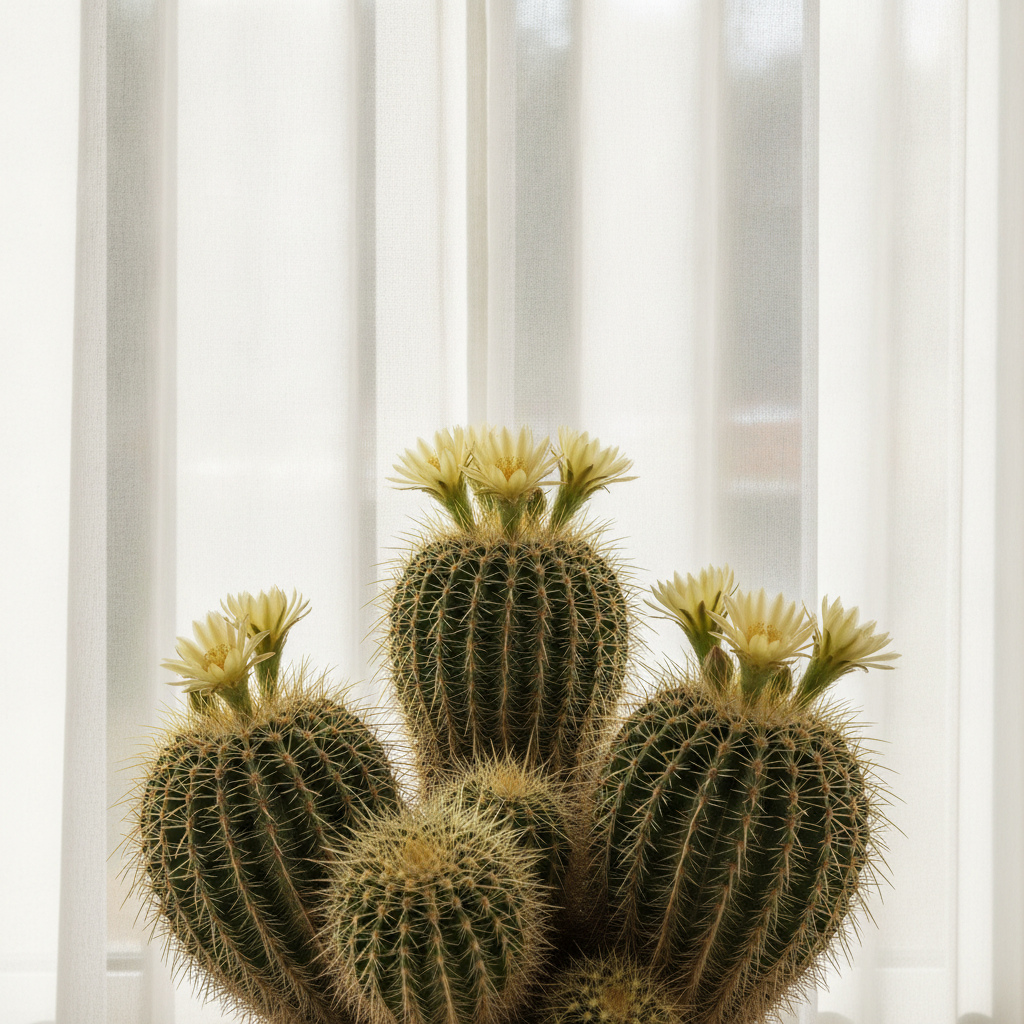
Light is the single most important factor in growing a healthy, well-shaped balloon cactus, and it is where most indoor specimens go wrong. In its native grasslands the plant grows in the open under bright, largely unfiltered sun, so it is built for high light levels. Indoors it wants the brightest position you can offer, with several hours of gentle direct sun each day to keep its body firm, its ribs tight and its colour a healthy blue-green.
The ideal is a spot that receives bright light for most of the day plus two to four hours of morning or late-afternoon sun. That combination supplies the energy the plant needs to flower without exposing it to the fierce midday summer sun that can scorch an unacclimatised cactus. A balloon cactus grown in strong, consistent light stays low and rounded; one grown in shade stretches, pales and loses the very geometry that makes it worth keeping.
Light Levels Explained
Understanding how indoor light is categorised makes it far easier to judge whether a given spot will actually suit a sun-loving cactus. The table below sets out the common tiers, roughly what light intensity each represents, where you tend to find it in the home and what it means for a balloon cactus.
| Light Category | Approx. Level | Typical Location | Outcome |
|---|---|---|---|
| Direct sun | Over 50,000 lux | On a south-facing sill | Excellent, though acclimatise slowly to avoid scorch |
| Bright indirect | 10,000 to 25,000 lux | Near a bright window, just out of the sunbeam | Good; healthy growth but fewer flowers |
| Medium | 5,000 to 10,000 lux | A metre or two back from a window | Marginal; plant survives but etiolates over time |
| Low | 1,000 to 5,000 lux | North room, interior wall | Poor; stretching, softening and eventual decline |
| Very low | Under 1,000 lux | Hallway, far from any window | Unsuitable; the plant will slowly starve |
Window Orientation and Placement
South-facing window: This is the best position in most homes in the northern hemisphere. It delivers the long hours of strong light the balloon cactus craves. In high summer, a thin voile curtain or a short remove from the glass helps take the edge off the most intense midday sun.
East-facing window: An excellent choice. Gentle morning sun is easy on the plant and rarely scorches, while bright light for the rest of the day keeps growth compact. Many growers find east windows the safest way to give strong light without risk.
West-facing window: Also very good. Afternoon sun is stronger and warmer than morning sun, so watch for scorch during heatwaves, but a west sill generally produces firm, well-coloured plants.
North-facing window: The weakest option and generally not enough on its own. A balloon cactus here will gradually etiolate, growing narrow and pale. If a north window is all you have, plan to supplement with a grow light.
Pro Tip — Rotate for Symmetry: A balloon cactus grows towards its light source, so a plant left facing one way will slowly lean and lose its prized symmetry. Give the pot a quarter turn every week or two and the body stays even and round on all sides.
How Light Affects Colour and Flowering
Light does more than keep the plant alive; it shapes how it looks and whether it blooms. Under strong light the body takes on its characteristic blue-green, glaucous cast, the spines flush a deeper gold, and the ribs stay tightly drawn. Under insufficient light the skin turns a flat, sappy green, the plant elongates into an unnatural column, and flowering stops altogether. Because balloon cactus flowers form only on well-fed, well-lit, mature plants, bright light through spring and summer is effectively a prerequisite for those sulphur-yellow blooms.
Warning — Direct Sunlight: A cactus that has spent winter in dim light will scorch if suddenly moved into blazing summer sun. The tissue can develop permanent yellow or brown corky patches that never recover. Reintroduce strong sun gradually over two to three weeks, extending exposure a little each day.
Artificial Lighting
Where natural light falls short, a full-spectrum LED grow light is a reliable substitute. Position it 20 to 30 cm (8 to 12 in) above the plant and run it for 10 to 12 hours a day to mimic a bright growing season. Grow lights are especially useful through the dark months in northern climates, though if you intend to give the plant a cool winter rest to encourage flowering, you may prefer to let it experience the natural shortening of the days instead.
Seasonal Adjustments
The plant’s light needs shift with the seasons. From spring through early autumn, give it the maximum bright light it can take, acclimatising it to summer sun as the days lengthen. In late autumn and winter, as the plant enters dormancy, lower light is perfectly acceptable and even helpful, since a cooler, quieter rest sets the stage for the following summer’s flowers. Move it to the brightest available winter position simply to keep it from etiolating, not to push growth.
Watering & Humidity
If light is where balloon cactus growers most often fall short, watering is where they most often go too far. This is a desert-adapted plant that stores moisture in its swollen body and expects long dry intervals. The guiding principle could not be simpler: water thoroughly, then wait until the soil is bone dry before watering again. Almost every serious problem a balloon cactus develops traces back to soil that stayed wet for too long.
When to Water
Through the active growing season of spring and summer, water when the potting mix has dried out completely from top to bottom. In a warm, bright spot with a gritty mix, that usually means roughly once every 10 to 14 days, though the interval depends entirely on your conditions rather than the calendar. The most reliable test is to lift the pot: a fully dry pot feels surprisingly light, while a pot with moisture still in it feels heavy. When in doubt, wait another few days.
In autumn, begin tapering off. Through winter, when the plant is resting and temperatures are low, water only very occasionally, perhaps once every four to six weeks and only enough to stop the body shrivelling severely. A cool, dry winter is not neglect; it is the deliberate rest period that triggers flowering the following summer. Keeping a balloon cactus warm and watered all winter tends to produce a soft, bloom-shy plant.
Pro Tip — The Weight Test: Get to know the weight of the pot when freshly watered and again when fully dry by lifting it at both extremes. Within a week or two you will be able to judge exactly when to water by feel alone, which is far more accurate than any fixed schedule.
How to Water Correctly
- Check that the soil is completely dry before you begin, using the weight test or a wooden skewer pushed to the base of the pot.
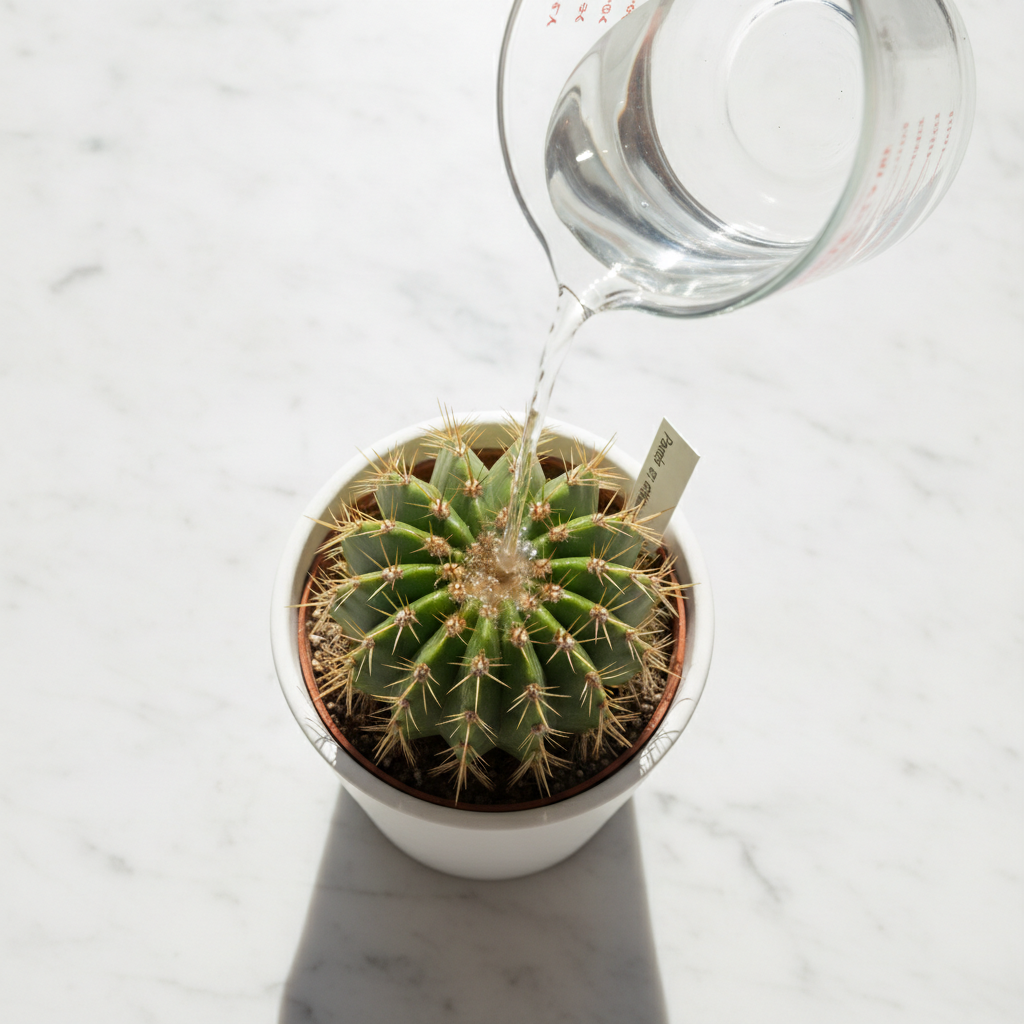
- Water the soil directly, aiming the flow at the surface of the mix rather than over the body of the plant, to keep water out of the crown.
- Continue until water runs freely from the drainage holes, ensuring the entire root ball is moistened.
- Let the pot drain fully, then tip away any water that collects in the saucer so the roots never sit in it.
- Do not water again until the mix has dried out completely, which may be one to two weeks in summer and much longer in winter.
Signs of Overwatering vs. Underwatering
| Symptom | Overwatering | Underwatering |
|---|---|---|
| Body colour | Yellowing, translucent or blackened patches | Dull, faded, greyish green |
| Body texture | Soft, mushy, collapsing at the base | Wrinkled, shrunken, ribs drawn in tightly |
| Soil | Stays damp for days, may smell sour | Bone dry and pulling away from the pot |
| Roots | Brown, slimy and rotten | Dry and papery but generally intact |
| Stem base | Brown, soft rot creeping upward | Firm, simply thinner than usual |
The important thing to notice is that an underwatered balloon cactus is easily rescued, since a good soak will plump it back up within days, whereas an overwatered one is often past saving by the time the damage shows. When you cannot decide, always err on the side of dryness.
Warning — Root Rot: Soft, brown, mushy tissue at the base is the sign of root rot, and it spreads fast. If you catch it early, unpot the plant, cut away all rotten roots and tissue with a sterile blade, let the wound callus in dry air for several days, and replant in fresh dry mix. Prevention through careful watering is far easier than a cure.
Humidity Requirements
Humidity is refreshingly simple with this plant. The balloon cactus is thoroughly at home in the dry air of a typical centrally heated or air-conditioned room, and it needs no misting, pebble trays or humidifiers. Average indoor humidity of 30 to 50 per cent is ideal.
In fact, high humidity works against it. Damp, stagnant air raises the risk of fungal problems and encourages the tissue to stay soft, so a bathroom or a crowded, poorly ventilated corner is the wrong home for a cactus. Good airflow matters more than moisture in the air.
Because the plant is so tolerant of dry conditions, you can place it near a radiator or a sunny sealed window without worry. If anything, err towards drier, brighter, better-ventilated spots rather than humid ones.
Water Quality
Balloon cactus is not fussy about water quality and ordinary tap water is fine in most areas. In regions with very hard water, minerals can slowly build up as a whitish crust on the soil surface and pot rim over the years. If you notice this, an occasional flush with rainwater or filtered water helps, but for most growers plain tap water at room temperature is perfectly adequate.
Soil, Potting & Repotting
The right soil is the foundation of good balloon cactus care, because it is the soil that determines how quickly water drains away from the roots. A cactus in the wrong mix is fighting its grower at every watering. The aim is a gritty, mineral-heavy medium that holds just enough moisture to sustain the plant but drains so freely that it can never stay saturated.
Ideal Soil Composition
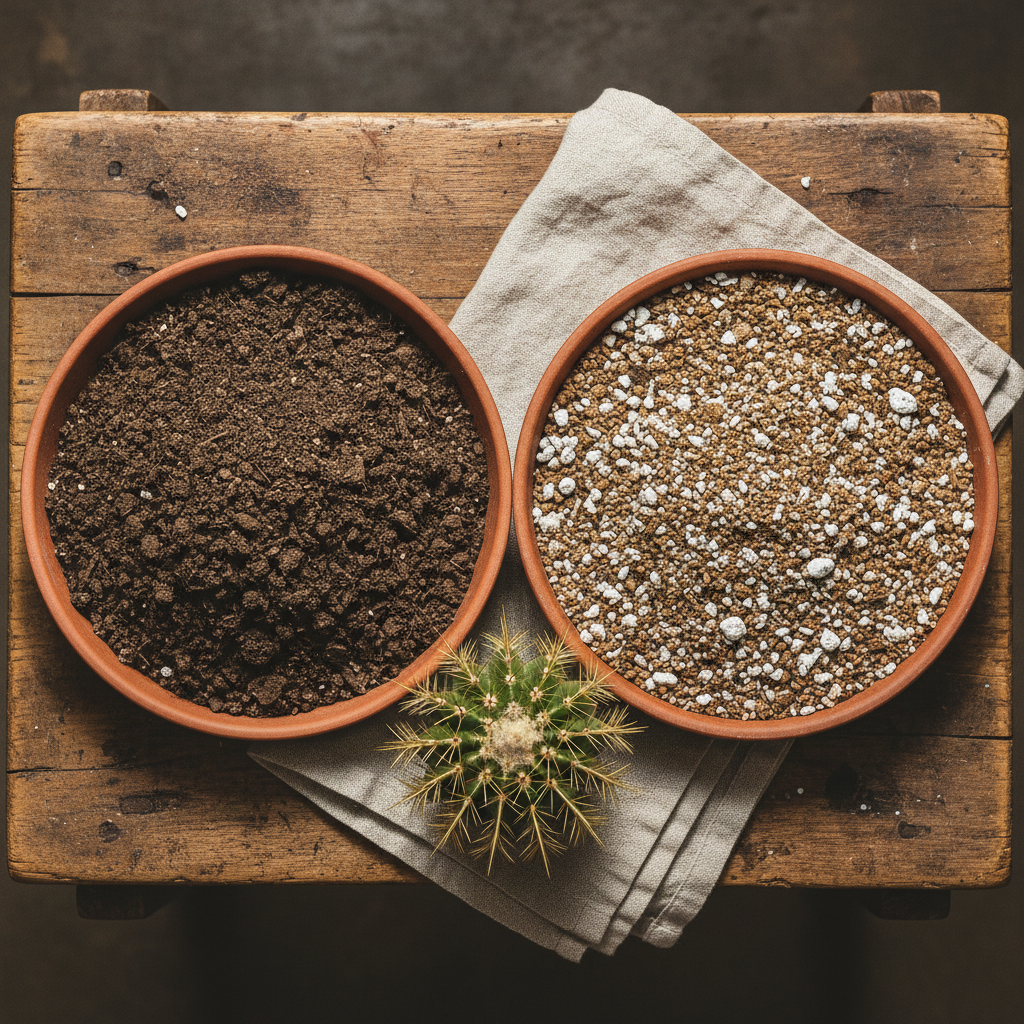
A good balloon cactus mix is roughly half mineral grit and half organic matter, leaning towards the mineral side. The organic component holds a little moisture and nutrition, while the grit creates the air pockets and drainage channels that keep the roots healthy. You can buy a proprietary cactus and succulent compost and improve it by cutting in extra grit, or build your own from the components below.
| Component | Proportion | Function |
|---|---|---|
| Cactus or general potting compost | 50 per cent | Holds modest moisture and nutrients |
| Pumice or perlite | 25 per cent | Creates air space and prevents compaction |
| Coarse grit or sharp sand | 25 per cent | Ensures rapid drainage around the roots |
The balloon cactus prefers a slightly acidic to neutral soil, in the region of pH 6.0 to 7.0. Most commercial cactus mixes already sit comfortably in this range, so there is rarely any need to adjust it. Far more important than fine-tuning the pH is getting the drainage right.
Pro Tip — Quick Mix Recipe: For a fast, reliable blend, combine two parts standard cactus compost with one part pumice and one part coarse horticultural grit. If water does not run straight through when you wet it, add more grit until it does.
Choosing the Right Pot
The pot you choose has a direct effect on how safely you can water. A well-chosen container makes overwatering much harder, while a poorly chosen one can undo even careful watering habits.
Drainage holes are non-negotiable. Never plant a balloon cactus in a pot without drainage. A decorative cover pot with no holes will trap water at the base and rot the roots no matter how carefully you water, so if you use one, keep the cactus in a plain plastic or terracotta grower pot inside it and lift it out to water.
Pot material: Terracotta is the classic and arguably the best choice for this plant. Its porous walls let the soil breathe and dry out more quickly, which suits a cactus that hates staying wet. Glazed ceramic and plastic both hold moisture longer, so if you use them, be even more conservative with watering.
Pot size: Choose a pot only slightly larger than the plant, leaving a centimetre or two of space around the body. An oversized pot holds a large volume of slow-drying soil that stays wet around the roots, which is exactly what you want to avoid. Balloon cacti are quite happy growing snug in a modest container.
When to Repot
Balloon cactus is slow-growing and dislikes disturbance, so it needs repotting only every two to three years, or when the plant has clearly outgrown its pot or the mix has broken down and stopped draining. The best time is early spring, at the start of the growing season, when the plant can recover quickly. Always repot into dry soil and wait a week or so before the first watering, so that any roots damaged in the move can callus rather than rot.
How to Repot: Step-by-Step
- Make sure the soil is dry, which loosens the root ball and reduces the chance of tearing roots.
- Protect your hands with folded newspaper wrapped into a collar, a strip of thick fabric or leather gloves, then ease the plant gently from its pot.
- Crumble away the old spent soil from around the roots and inspect them, trimming off any that are dead, brown or mushy with a sterile blade.
- Set the plant in a clean pot only slightly larger than the last, at the same depth it grew before, never burying the base of the body.
- Fill around the roots with fresh dry gritty mix, tapping the pot to settle it, and firm it lightly so the plant stands upright.
- Wait seven to ten days before watering, keeping the plant in bright, indirect light while it settles.
Warning — Transplant Shock: Watering immediately after repotting is the most common way to kill a freshly moved cactus. Damaged roots in wet soil rot almost at once. Always let the plant rest in dry mix for a week or more before the first drink.
Fertilising
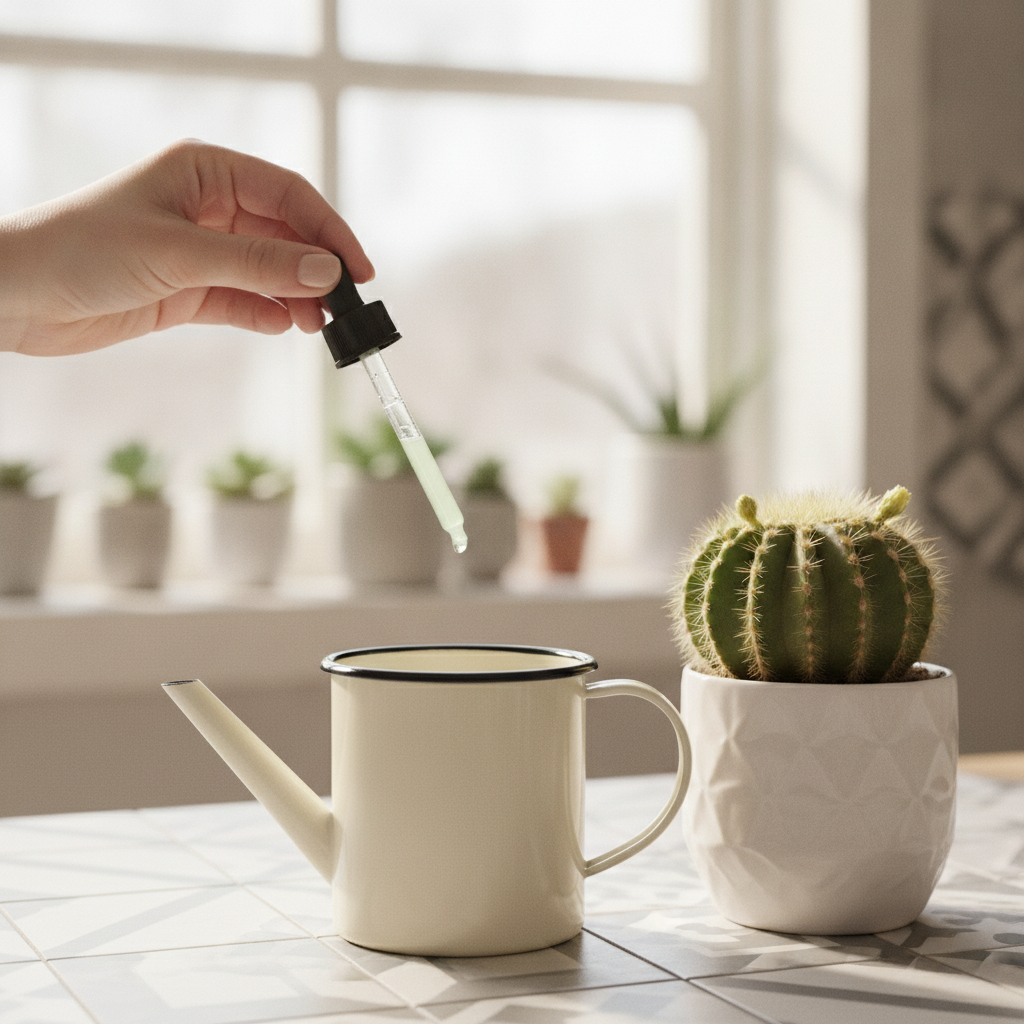
In the wild the balloon cactus grows in lean, stony ground, so it is adapted to low fertility and needs only modest feeding. That said, a plant confined to a small pot of fast-draining mix will exhaust the little nutrition that mix holds, and a light feeding programme through the growing season noticeably improves vigour and flowering.
The key is to feed sparingly and only when the plant is actively growing. Overfeeding produces soft, swollen, weak growth that is prone to splitting and disease, and it can scorch the roots. With cacti, less is genuinely more.
Understanding Plant Nutrients
Fertilisers are labelled with an NPK ratio showing the proportions of nitrogen, phosphorus and potassium, the three nutrients plants use in the greatest quantity. For a flowering cactus, a feed relatively low in nitrogen and higher in potassium suits best, since too much nitrogen drives soft green growth at the expense of blooms. The table below summarises the main nutrients and what a shortage of each looks like.
| Nutrient | Symbol | Primary Function | Deficiency Symptoms |
|---|---|---|---|
| Nitrogen | N | Green tissue and overall growth | Pale body, weak, stunted growth |
| Phosphorus | P | Roots, flowers and energy transfer | Poor rooting, few or no flowers |
| Potassium | K | Flowering, firmness and stress resistance | Soft growth, poor blooming |
| Calcium | Ca | Cell walls and structural strength | Weak, distorted new growth |
| Magnesium | Mg | Core of the chlorophyll molecule | Yellowing between tissues |
| Iron | Fe | Chlorophyll production | Pale yellowing of newest growth |
Types of Fertiliser
Liquid fertilisers: The most practical choice for a cactus, since you can dilute them precisely and deliver them with a normal watering. A specialist cactus feed or a tomato feed, both low in nitrogen, works well at half the recommended strength.
Slow-release granular: A small amount of controlled-release fertiliser worked into the soil at repotting feeds gently over months. Use a light hand, as it is easy to overdose a small pot.
Organic fertilisers: Gentle options such as diluted worm-casting tea release nutrients slowly and are hard to overdo, though they supply lower concentrations and act more slowly than mineral feeds.
Feeding Schedule
Feed only during the active growing season, from mid-spring to late summer, at roughly monthly intervals. That amounts to just three or four feeds a year, which is plenty for this frugal plant. Stop feeding entirely from early autumn through winter, when the plant is dormant and cannot use the nutrients; feeding a resting cactus simply lets fertiliser salts accumulate in the soil.
Pro Tip — Feed at Half Strength: Always dilute cactus fertiliser to half, or even a quarter, of the dose on the label. Cacti are far more easily harmed by too much feed than by too little, and a weak solution given a few times a year keeps the plant firm and free-flowering.
How to Fertilise
- Wait until the plant is in active growth in spring or summer, never in winter.
- Water the plant lightly first if the soil is very dry, so that concentrated feed never touches dry roots directly.
- Dilute a low-nitrogen fertiliser to half the recommended strength in your watering can.
- Apply it to the soil in place of a normal watering, letting the excess drain freely away.
- Flush the pot with plain water every couple of months to wash out any build-up of fertiliser salts.
Warning — Salt Build-Up: A white or yellowish crust on the soil surface or pot rim signals that mineral salts from fertiliser and hard water are accumulating. These can burn the roots over time. Flush the pot thoroughly with plain water two or three times to leach them out, and cut back on feeding.
Propagation
Propagating a balloon cactus is a patient pursuit rather than a quick one, but it is straightforward and genuinely rewarding. There are two practical routes: separating the offsets, or pups, that form around the base of a mature plant, and raising new plants from seed. Because the balloon cactus is a solitary grower in youth and offsets only with age, seed is often the faster route to a large number of plants, while offsets give you a ready-made specimen.
Whichever method you choose, the golden rule of cactus propagation applies throughout: keep things on the dry side and give every cut surface time to callus before it meets moist soil. Rushing this step is the surest way to lose a young plant to rot.
Understanding Offsets and Areoles
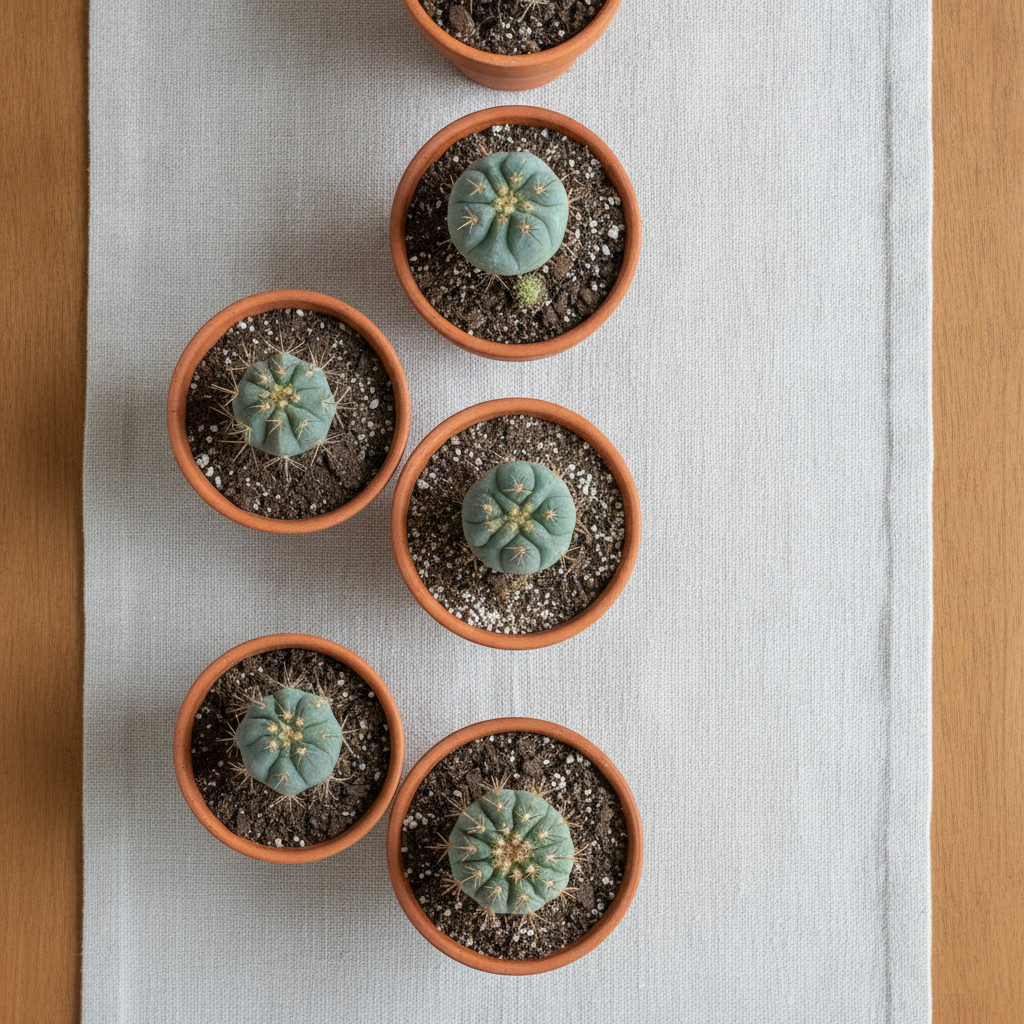
As a balloon cactus matures it begins to produce small offsets low on the body or around the base, each a miniature version of the parent complete with its own ribs and spines. These pups can be detached and grown on as independent plants. New growth and flowers both emerge from areoles, the small woolly cushions spaced along the ribs, which are the cactus equivalent of buds. Understanding that offsets carry their own areoles helps explain why a cleanly separated pup can root and grow into a full plant on its own.
Separating Offsets: Step-by-Step
This is the simplest method and the one most growers use. It works only once a plant is old enough to have produced offsets around its base.
- Choose a firm, healthy offset, ideally one that has already started to form its own small roots at the base.
- Wrap your fingers to protect them from the spines, then gently twist or cut the offset away from the parent with a sterile, sharp blade, keeping the cut as clean as possible.
- Set the offset aside in a dry, shaded, airy spot for five to seven days so the wound calluses over into a dry, firm scar.
- Once calloused, settle the offset onto the surface of a small pot of barely moist gritty cactus mix, supporting it upright with a few pebbles if needed.
- Keep it warm and bright but out of direct sun, and water only sparingly until new roots take hold and fresh growth appears.
Pro Tip — Let It Callus: The single most important step in cactus propagation is allowing every cut surface to dry and callus fully before it touches soil. A firm, dry scar keeps rot-causing organisms out; a fresh, wet wound invites them in.
Growing from Seed: Step-by-Step
Balloon cactus grows readily from seed, and while it is slow, it is the way to raise many plants at once and the only option for a solitary specimen that has not yet offset.
- Sow fresh seed thinly on the surface of a moist, sterile, gritty seed mix in a shallow, clean container.
- Do not bury the seed, as these cactus seeds need light to germinate; simply press them lightly onto the surface.
- Cover the container with a clear lid or bag to hold humidity, and keep it warm at around 20 to 25 degrees C (68 to 77 degrees F) in bright, indirect light.
- Keep the surface lightly moist, never waterlogged, until tiny green globes appear over the following weeks.
- Gradually increase ventilation as the seedlings grow, and pot them on individually once they are large enough to handle safely, after several months.
Troubleshooting Propagation
| Problem | Likely Cause | Solution |
|---|---|---|
| Offset rots at the base | Potted before the wound calloused, or soil too wet | Let cuts dry for a week first and keep the mix barely moist |
| Offset never roots | Too cold, too dark, or soil kept bone dry | Provide warmth, bright indirect light and occasional light moisture |
| Seeds fail to germinate | Old seed, buried too deep, or too cool | Use fresh seed on the surface and keep warm and humid |
| Seedlings damp off | Fungal infection in stagnant, overly wet conditions | Improve airflow, ease off watering and use a sterile mix |
Pests & Diseases
The balloon cactus is a robust plant with few natural enemies indoors, and a specimen grown in bright light and a dry, well-drained pot rarely runs into trouble. Most problems that do arise are traceable either to sap-sucking insects that sneak in among the spines or to fungal rots brought on by excess moisture.
The best defence is vigilance combined with good culture. Inspect the plant regularly, paying attention to the crown and the shaded folds between the ribs where pests like to hide, and keep conditions on the dry and airy side. Caught early, every common issue is easily dealt with.
Common Pests
Mealybugs (Pseudococcus species)
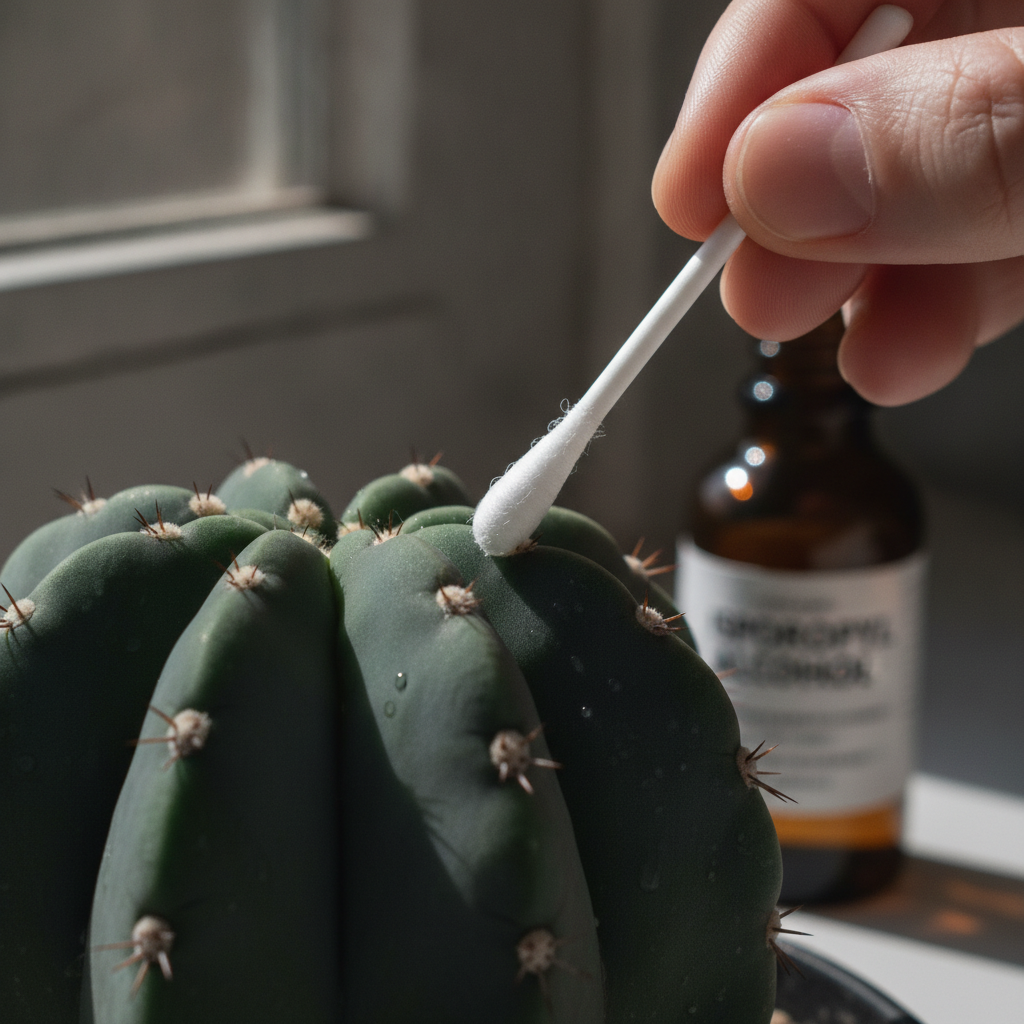
Mealybugs are the balloon cactus’s most frequent pest, appearing as small, white, cottony tufts nestled in the woolly areoles and between the ribs. They suck sap and slowly weaken the plant, and their waxy coating hides them from casual glances. A related nuisance is the root mealybug, which attacks the roots unseen and shows up as white residue in the soil at repotting.
Treatment: Dab each insect directly with a cotton bud dipped in isopropyl alcohol, which dissolves their protective coating on contact. For heavier infestations, follow up with a systemic insecticide or repeated sprays of a suitable cactus-safe treatment, and for root mealybugs, unpot, wash the roots and replant in fresh mix.
Spider Mites (Tetranychus urticae)
Spider mites are tiny arachnids that thrive in hot, dry conditions and feed on the plant’s surface, leaving fine pale speckling and, in bad cases, delicate webbing among the spines. They are hard to see without a magnifier, so the stippling on the skin is usually the first clue.
Treatment: Rinse the plant with a firm jet of water to knock the mites off, then treat with a miticide or insecticidal soap. Improving airflow and avoiding a hot, stagnant position discourages their return.
Scale Insects (Coccoidea)
Scale insects appear as small, brown, limpet-like bumps stuck fast to the body of the plant. Beneath their hard shells they feed on sap, causing yellowing and slow decline, and their flat, immobile form makes them easy to mistake for part of the plant.
Treatment: Scrape or lift them off gently with a fingernail or a cotton bud soaked in alcohol, and treat persistent infestations with a systemic insecticide that the plant takes up into its sap.
Common Diseases
Root and Stem Rot (Fusarium and Phytophthora species)
Rot is by far the most serious threat to a balloon cactus, and it is almost always self-inflicted through overwatering or poor drainage. It shows first as soft, discoloured, brown or black tissue at the base, which spreads upward as the internal tissue turns to mush. By the time the surface looks bad, the roots are often already destroyed.
Treatment: Act at the first sign. Unpot the plant, cut away every trace of soft, discoloured tissue with a sterile blade until only firm green flesh remains, let the wound callus in dry air for several days, and replant in fresh dry mix. Then correct the watering habits that caused it.
Fungal Leaf and Body Spots (various fungi)
In damp, poorly ventilated conditions, fungal spots can appear as small brown or corky blemishes on the body. They are usually cosmetic rather than fatal, but they signal that the air around the plant is too still and humid for a cactus.
Treatment: Improve ventilation, reduce watering and avoid wetting the body of the plant. Remove any badly affected tissue and, if the problem persists, apply a suitable fungicide.
Pest and Disease Summary
| Pest / Disease | Identification | Treatment |
|---|---|---|
| Mealybugs | White cottony tufts in areoles and rib folds | Alcohol on a cotton bud, then systemic insecticide |
| Spider mites | Fine pale speckling and faint webbing | Rinse off, then miticide or insecticidal soap |
| Scale insects | Small brown limpet-like bumps on the body | Scrape off and apply a systemic insecticide |
| Root and stem rot | Soft brown mushy tissue at the base | Cut out rot, callus, replant, correct watering |
| Fungal spots | Brown or corky blemishes in humid conditions | Improve airflow, reduce moisture, fungicide if needed |
Prevention Strategies
Prevention with a balloon cactus comes down almost entirely to getting the basics right. Bright light, a gritty free-draining mix, a pot with drainage, careful watering and good airflow together head off the vast majority of pest and disease problems before they start. A plant grown hard and dry, in the way its wild ancestors grew, is remarkably resistant to trouble.
Beyond good culture, quarantine any new plant for a couple of weeks before it joins your collection, since mealybugs and scale often arrive as stowaways. Inspect your cactus whenever you water, and deal with the first stray insect at once rather than waiting for an infestation to build.
Pro Tip — Alcohol Is Your Friend: Keep a small bottle of isopropyl alcohol and a bag of cotton buds near your plants. A quick dab at the first white tuft of a mealybug, spotted during routine watering, stops an infestation before it ever gets going.
Popular Varieties
The balloon cactus belongs to the genus Parodia, a group that swallowed up the former genus Notocactus and now contains a wonderful range of small, ribbed, free-flowering ball cacti from South America. Gardeners shopping for a balloon cactus will find the true species itself alongside a handful of closely related cousins and the occasional prized crested form, all sharing the same easygoing culture.
The table and profiles below cover the plant you are most likely to buy and its most popular relatives, so you can recognise them and choose the one that suits your space and taste. All share the same needs for bright light, gritty soil and sparing water.
| Variety | Appearance | Light Needs | Growth Rate | Availability |
|---|---|---|---|---|
| Classic Balloon Cactus | Blue-green flattened globe, golden spines | Bright, some direct sun | Slow | Common |
| Crested form (f. cristata) | Fan-shaped, brain-like folds | Bright, some direct sun | Very slow | Uncommon |
| Golden Ball Cactus (Parodia leninghausii) | Columnar, soft golden bristles | Bright, some direct sun | Slow to moderate | Common |
| Scarlet Ball Cactus (Parodia haselbergii) | Green globe, white spines, red flowers | Bright, some direct sun | Slow | Fairly common |
| Silver Ball Cactus (Parodia scopa) | Dense white spines, yellow flowers | Bright, some direct sun | Slow | Common |
| Tom Thumb (Parodia mammulosa) | Small ribbed globe, varied flowers | Bright, some direct sun | Slow | Occasional |
Featured Varieties
Classic Blue-Green Balloon Cactus
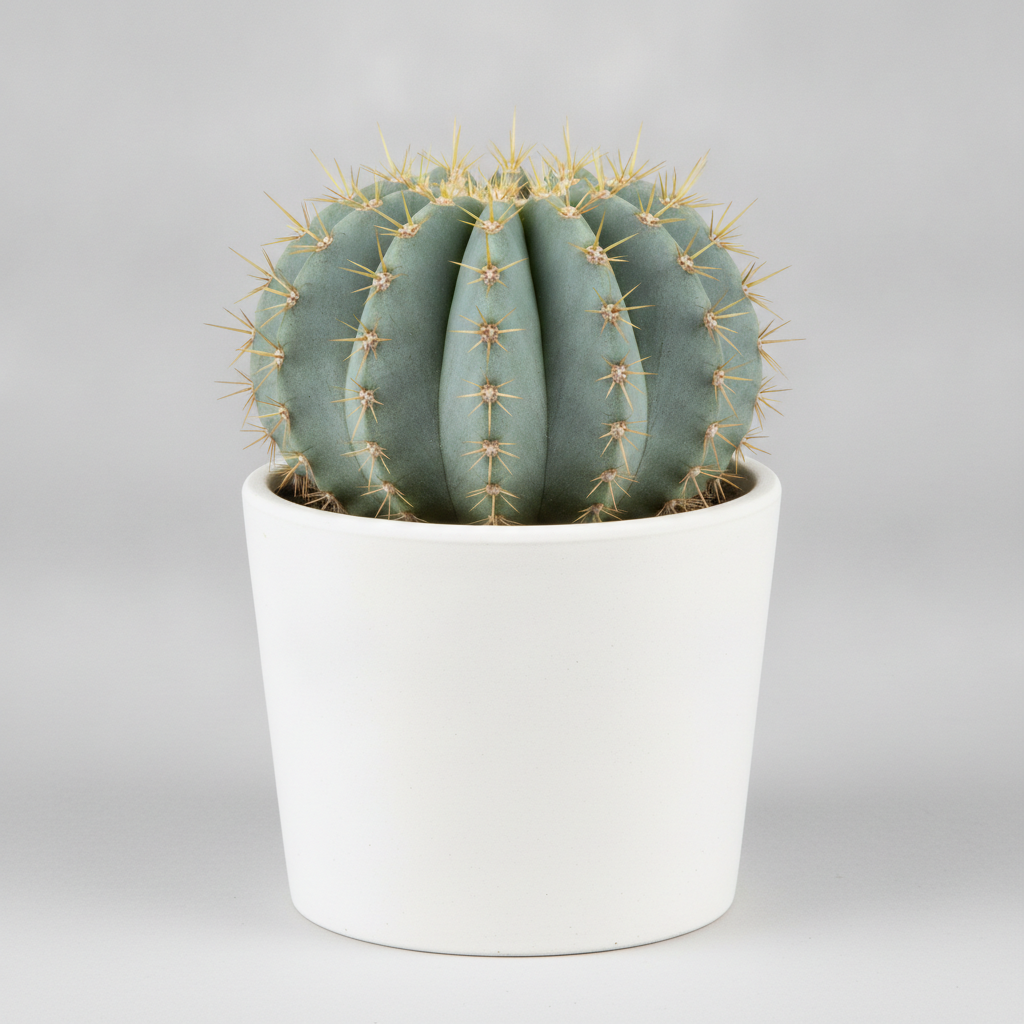
The species in its purest form: a glaucous, blue-green globe flattened at the top, with eleven to fifteen crisp ribs edged in fine golden spines. This is the plant most people picture when they hear the name, and it is the classic choice for a first balloon cactus.
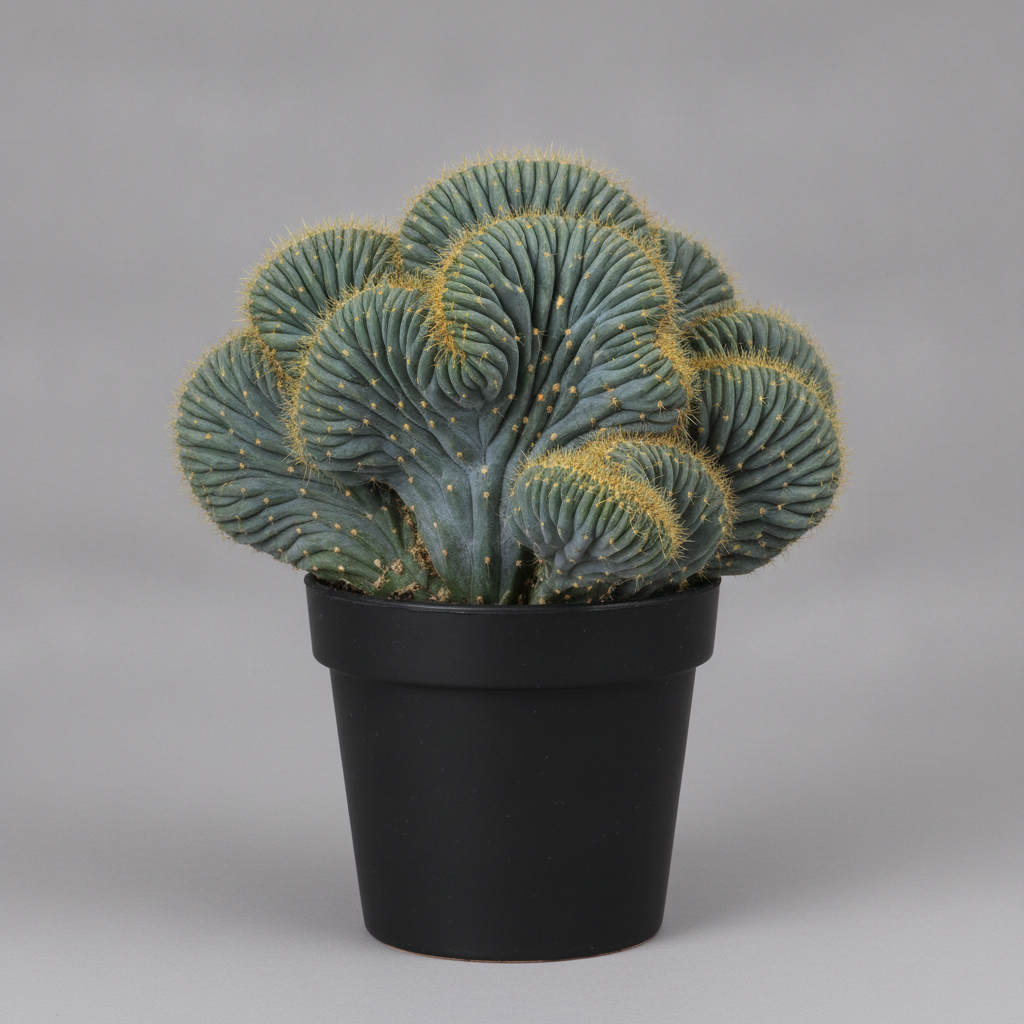
Crested Balloon Cactus (f. cristata)
A rare and collectable mutation in which the growing point fans out into an undulating, brain-like crest of contorted blue-green tissue. Slow-growing and sculptural, the crested form is a prized curiosity that commands higher prices and turns heads on any shelf.
Variety Profiles in Detail
Golden Ball Cactus (Parodia leninghausii)
One of the most popular relatives, the golden ball cactus grows into a soft-looking column clothed in fine, hair-like golden bristles that are far gentler to the touch than most cactus spines. It clusters freely with age and carries large lemon-yellow flowers at the crown, making it a warm-toned companion to the blue-green species.
Scarlet Ball Cactus (Parodia haselbergii)
Unusual among its yellow-flowered kin, this species produces striking orange-red blooms above a flattened green body clad in fine white spines. It flowers early in the year, sometimes in late winter, and offers a splash of hot colour that sets it apart from the rest of the genus.
Silver Ball Cactus (Parodia scopa)
Densely covered in soft white radial spines that give it a silvery, woolly appearance, this globular species contrasts beautifully with the golden and blue-green forms. It bears bright yellow flowers and shares exactly the same undemanding care, making it an easy addition to a collection.
Choosing the Right Variety for Your Space
For a first cactus, the classic blue-green balloon cactus is hard to beat: widely available, forgiving and handsome all year. If you want warmth and softness, the golden ball cactus with its gentle bristles is the friendliest to handle, while the scarlet ball cactus rewards you with unusual red flowers. Collectors chasing something special will gravitate towards the crested form. Whichever you choose, the care is essentially identical, so you can build a varied and beautiful group of ball cacti on a single sunny sill without complicating your routine.
Frequently Asked Questions
How often should I water my balloon cactus?
Water only when the soil has dried out completely, which in a bright, warm spot usually means roughly every 10 to 14 days in spring and summer. In winter, cut back drastically to once every four to six weeks or less. Always let the mix dry fully between waterings and never leave the pot standing in water.
Why won’t my balloon cactus flower?
The two usual reasons are insufficient light and the lack of a cool, dry winter rest. Balloon cacti flower only on mature plants of about four years or more, and they need bright light through the growing season followed by a cold, nearly dry dormancy at around 8 to 12 degrees C (46 to 54 degrees F) to set buds. Give it both and the yellow blooms usually follow in summer.
Is the balloon cactus safe for cats and dogs?
Yes, it is non-toxic to cats, dogs and humans, so it will not poison a pet that chews it. The genuine risk is physical: the sharp golden spines can hurt paws, mouths and hands, so keep the plant somewhere pets and children cannot reach it.
Why is my balloon cactus turning yellow or soft?
Yellowing accompanied by softness, especially at the base, almost always means overwatering and the onset of rot. Stop watering at once, check the roots, and if you find soft brown tissue, cut it away, let the plant callus and replant in fresh dry gritty mix. A uniformly pale, stretched plant, by contrast, usually just needs more light.
Why has my balloon cactus become tall and thin?
Stretching into a narrow, pale column is called etiolation and it is caused by too little light. The plant is straining towards a weak light source. Move it to your brightest window and acclimatise it gradually to stronger sun. The etiolated growth will not return to its rounded shape, but new growth in good light will be compact once more.
What kind of pot and soil does it need?
Use a terracotta pot with drainage holes, only slightly larger than the plant, filled with a gritty, fast-draining cactus mix. A blend of cactus compost with added pumice and coarse grit is ideal. Avoid large pots and dense, moisture-retentive soils, both of which keep the roots too wet.
How big does a balloon cactus get?
It is a small, slow-growing cactus. A single body reaches around 15 cm (6 in) across, and with age the plant grows somewhat taller and clusters into a group of heads that may spread to 30 cm (12 in) or so over many years. Its compact size makes it a perfect windowsill plant.
How do I handle a balloon cactus without getting spined?
Wrap a strip of folded newspaper or a length of thick fabric into a collar around the body and use it as a handle, or wear sturdy leather gloves. This lets you lift and repot the plant securely without pressing the spines into your skin, and without damaging the delicate golden bristles.
Does the balloon cactus need a winter rest?
Yes, and it is the secret to flowering. Through winter, keep the plant cool, at roughly 8 to 12 degrees C (46 to 54 degrees F), in bright light and almost completely dry. This dormancy mimics its natural winter and prompts it to set flower buds for the following summer. A plant kept warm and watered all year rarely blooms.
Is Parodia magnifica the same as Notocactus magnificus?
Yes. The plant was long known as Notocactus magnificus, but botanists have since merged the genus Notocactus into Parodia, so its current accepted name is Parodia magnifica. You will still see both names on plant labels and in older books, and they refer to exactly the same balloon cactus.






