
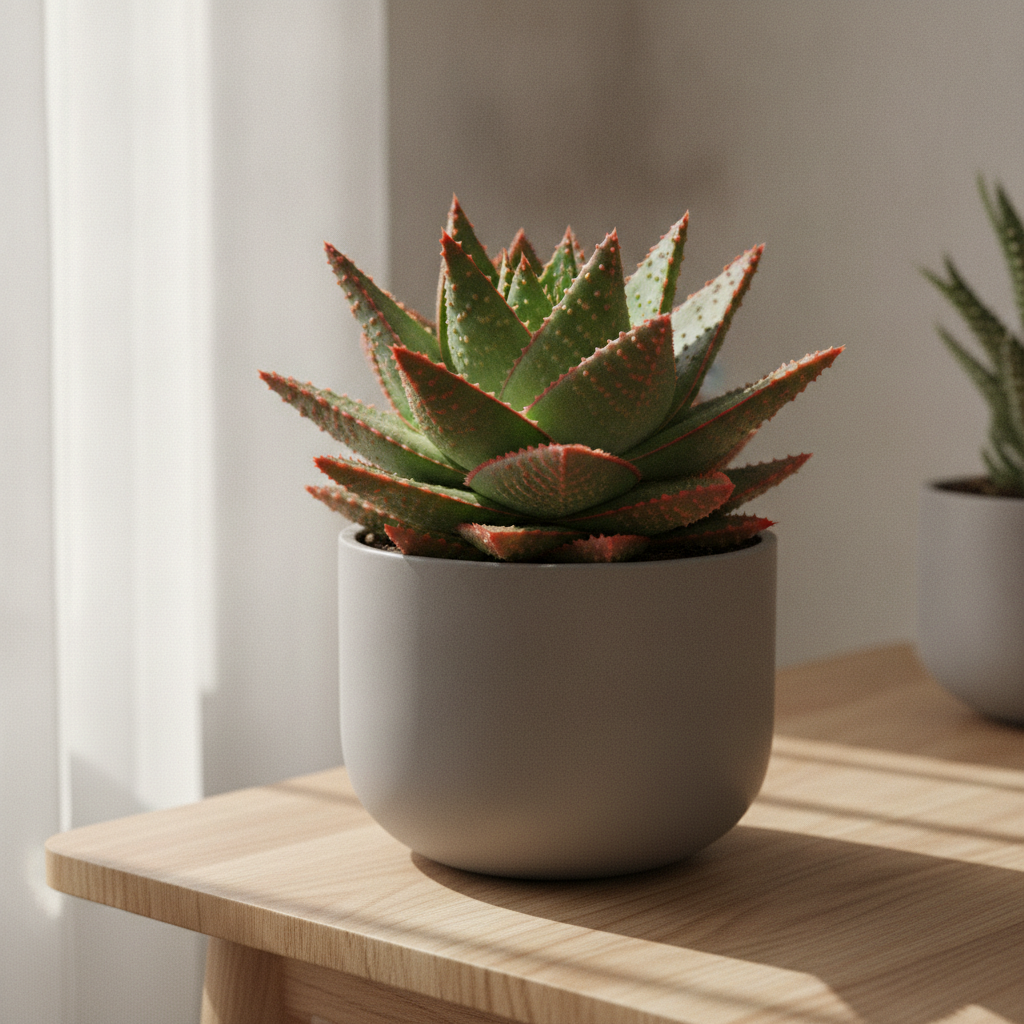
Few small succulents earn their name as neatly as the Christmas Carol aloe (Aloe ‘Christmas Carol’), a compact hybrid whose deep green rosette is studded with raised, blister-like bumps and edged with rows of ruby-red teeth that blush a festive scarlet whenever the light turns bright or the air turns cold. It is a modern cultivar rather than a wild species, one of a celebrated family of ornamental aloes bred for jewel-toned colour and heavy leaf texture, and it has become a favourite windowsill plant precisely because it packs so much visual drama into a rosette that rarely grows wider than a dinner plate.
Christmas Carol has a reputation as an easy, forgiving plant, and that reputation is largely deserved. It asks for very little water, tolerates neglect far better than overattention, and rewards a bright spot with intensifying colour. Yet there is a meaningful gap between a plant that merely survives on a dim shelf and one that thrives into a tight, richly coloured, offset-producing clump. This guide covers everything that separates the two: how much light it truly wants, how to water a succulent without rotting it, the gritty soil it needs, when and how little to feed, how to multiply it from offsets, and how to spot the handful of pests and diseases that trouble aloes indoors.
Contents
- Quick Reference
- Why Christmas Carol Aloe Makes a Great Houseplant
- Light Requirements
- Watering & Humidity
- Soil, Potting & Repotting
- Fertilising
- Propagation
- Pests & Diseases
- Popular Varieties
- Frequently Asked Questions
Quick Reference: Christmas Carol Aloe at a Glance
| Light | Very bright light, including two to four hours of direct sun; the more light, the redder the leaves |
| Watering | Soak thoroughly, then let the soil dry out completely; roughly every 10 to 21 days in summer, monthly or less in winter |
| Temperature | 18 to 27 C (64 to 81 F) ideal; protect from anything below about 5 C (41 F) |
| Humidity | Low to average household humidity, around 30 to 50 per cent; dislikes damp, stagnant air |
| Fertiliser | A dilute cactus feed once or twice across spring and summer only |
| Toxicity | Mildly toxic to cats, dogs and humans if the leaves are eaten; the sap can irritate skin |
Why Christmas Carol Aloe Makes a Great Houseplant
The strongest argument for the Christmas Carol aloe is that it delivers colour and texture usually associated with far fussier plants, while demanding almost none of the attention those plants require. It is a hybrid developed within the ornamental aloe breeding movement that produced dozens of small, heavily tuberculate cultivars, and its parentage shows in the dense, warty leaf surface and the vivid red marginal teeth. Given good light it forms a symmetrical rosette of triangular, upward-curving leaves that shift from cool green in shade to burnished orange-red in sun, so the same plant can look entirely different depending on where you keep it.
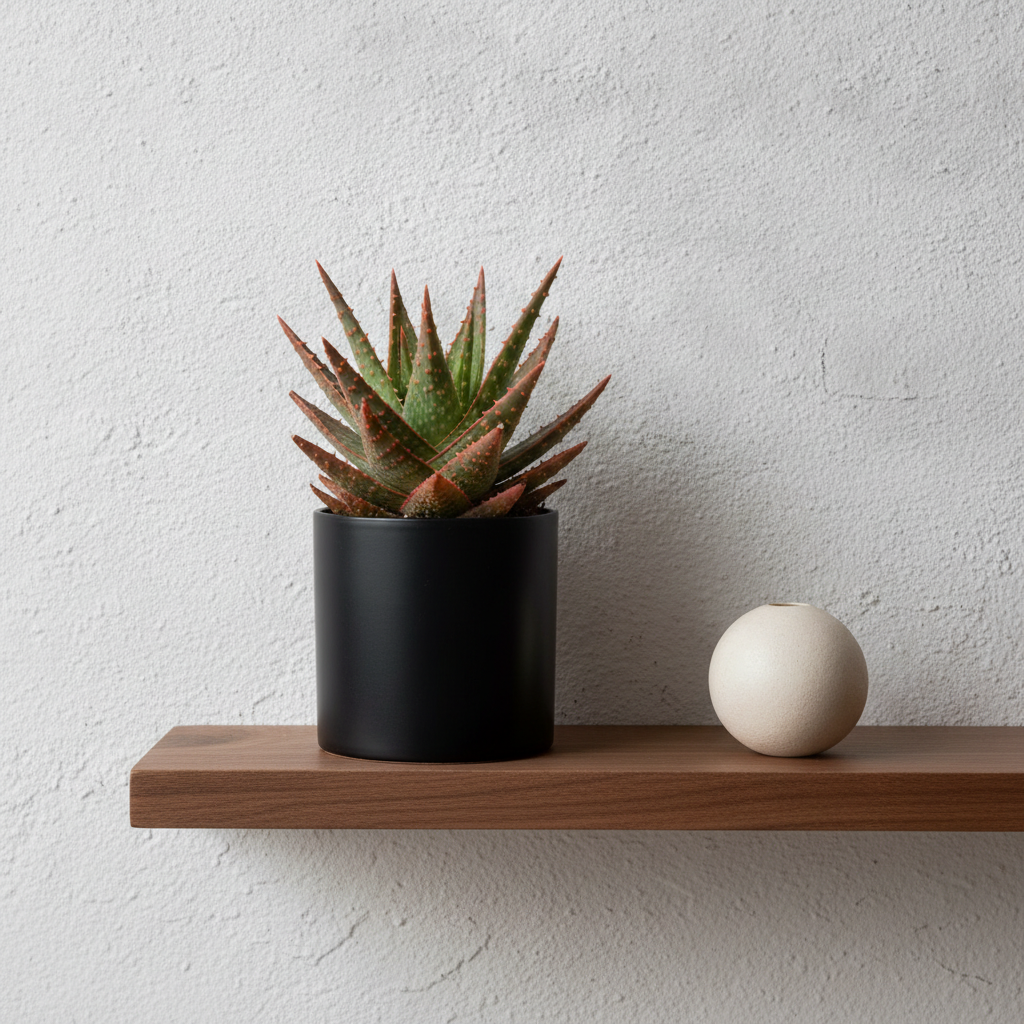
Beyond looks, it is genuinely low-maintenance in a way that suits busy or forgetful owners. As a succulent it stores water in its thick leaves, so it copes with being forgotten for weeks and actively prefers to be left alone between waterings. It stays small and slow-growing, meaning it will not outgrow its spot or need frequent repotting, and it obligingly produces offsets around its base that can be separated to make new plants or left to build a generous clustered colony. For anyone who has struggled to keep thirstier houseplants alive, an aloe that punishes fuss and rewards restraint can be a welcome change of pace.
Important — Toxicity: Like other aloes, Christmas Carol contains aloin and related compounds in its leaf sap that are mildly toxic if eaten. Cats and dogs that chew the leaves may vomit or become lethargic, and the sap can irritate sensitive skin. Keep the plant out of reach of curious pets and children, and wash your hands after handling cut leaves.
Light Requirements
Light is the single most important factor in growing a good-looking Christmas Carol aloe, because light does two things at once: it fuels compact growth and it drives the red pigmentation that gives the plant its name. In dim conditions the rosette stays green, the leaves stretch and space out, and the whole plant loses the tight, jewelled quality that makes it worth owning. In strong light the leaves stay short and stacked, and anthocyanin pigments flood the tissue so the margins and tips blush deep coral to scarlet.
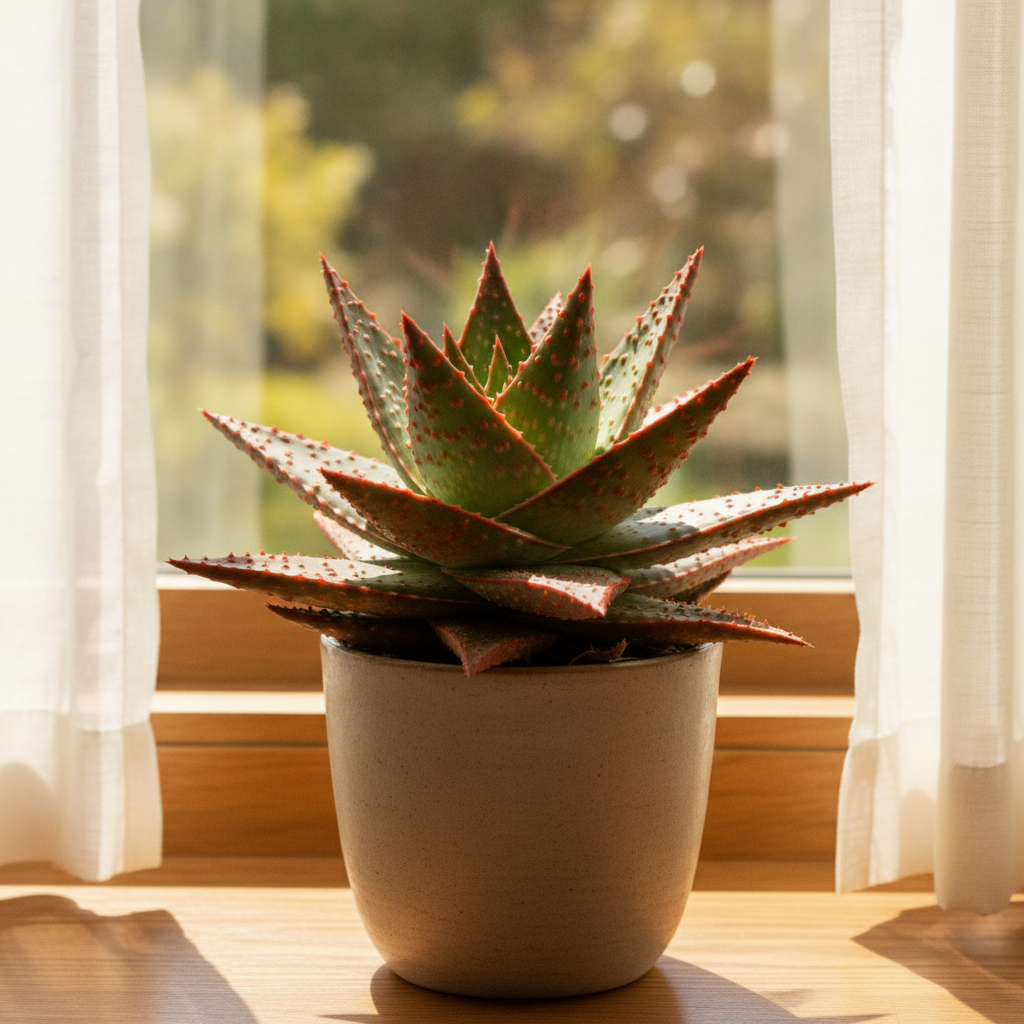
The ideal position is the brightest windowsill you can offer, with several hours of direct sun each day. A few hours of gentle morning or late-afternoon sun brings out the best colour without much risk, while unbroken, intense midday summer sun through glass can occasionally scorch a plant that has not been acclimatised. The goal is maximum light with a gradual transition, so the plant colours up rather than burns.
Light Levels Explained
Houseplant light is often described in vague terms, so it helps to translate those categories into what they mean for a sun-loving succulent. The table below shows how each broad light level tends to play out for Christmas Carol, remembering that this is a plant that leans firmly towards the bright end of the scale.
| Light Category | Approx. Level | Typical Location | Outcome |
|---|---|---|---|
| Direct sun | 20,000 to 50,000+ lux | On a south or west windowsill | Best colour and tightest form once acclimatised |
| Bright indirect | 10,000 to 20,000 lux | Just back from a sunny window | Healthy green growth, less intense red |
| Medium | 5,000 to 10,000 lux | Near an east window or a shaded south one | Survives, stays green, slower growth |
| Low | 1,000 to 5,000 lux | Middle of a bright room | Stretches, loses colour, weak leaves |
| Very low | Under 1,000 lux | North corner or interior wall | Decline over time, will not thrive |
Window Orientation and Placement
South-facing window: In the northern hemisphere this is the prime location, offering the long hours of bright light and direct sun that bring out the deepest colour. In high summer, thin curtains at the peak of the day can prevent scorch on a newly moved plant.
East-facing window: A very good choice, delivering direct morning sun that is gentle enough to colour the leaves with little risk of burning. Growth stays compact and healthy here.
West-facing window: Also excellent, providing strong afternoon light and warmth. Because west sun is hot, acclimatise a plant gradually and watch for any bleaching in the first couple of weeks.
North-facing window: The weakest option and generally not enough on its own. A Christmas Carol here will hold on but slowly etiolate, spacing out its leaves and fading to plain green. Supplement with a grow light or choose a brighter aspect.
Pro Tip — Read the Colour: The plant tells you whether it is getting enough light. Rich red margins and a squat, tight rosette mean the light is right. Flat green leaves that reach and space apart mean it wants more, so move it closer to the glass a little at a time.
How Light Affects Leaf Colour
The red that makes this aloe special is not a fixed trait but a stress response. Anthocyanin pigments build up in the leaves as a form of natural sunscreen when the plant receives strong light, and they intensify further in cool conditions, which is why plants grown on a bright, cool windowsill through autumn and winter often reach their most spectacular festive colour. Move the same plant into shade and warmth and it will slowly revert to green as those pigments fade. This is entirely reversible and is a useful lever: if you want maximum colour, give more light and cooler nights; if you prefer a greener look, ease off the intensity.
Warning — Direct Sunlight: A plant grown in low light and then moved abruptly into fierce summer sun can suffer sunscald, appearing as pale, bleached or brown dry patches that never recover. Always increase exposure over a week or two so the leaves can adapt their pigment defences.
Artificial Lighting
Where natural light falls short, a full-spectrum LED grow light is an effective substitute and can even coax out red colour if it is strong enough. Position the light around 20 to 30 cm (8 to 12 inches) above the rosette and run it for 10 to 12 hours a day. Because this is a high-light plant, a weak desk lamp will not do; look for a dedicated horticultural light with a meaningful output, and raise or lower it based on how the plant responds.
Seasonal Adjustments
As the sun weakens through autumn and winter, move the plant to your brightest window and clean the glass so it loses none of the available light. Shorter days naturally slow growth, which is normal and no cause for concern. When spring returns and the sun strengthens, reintroduce any increased exposure gradually rather than leaving a winter-softened plant in sudden strong sun, which invites scorch.
Watering & Humidity
If light is what makes a Christmas Carol aloe beautiful, watering is what keeps it alive, and the most common way to kill one is kindness in the form of too much water. As a succulent it evolved in arid, fast-draining conditions and stores its own reserves in fleshy leaves, so it is built to endure drought and to resent constant moisture. The guiding principle is simple: water thoroughly, then wait until the soil is bone dry before watering again.
When to Water
Rather than watering on a fixed calendar, water according to the soil. Push a finger or a wooden skewer into the mix; if there is any dampness at all, wait. Only when the pot is completely dry from top to bottom, and ideally feels light when lifted, is it time to water again. In the warmth and long days of spring and summer this might mean watering every 10 to 21 days, while in the cooler, darker months it can stretch to once a month or even less.
The plant itself gives clear cues. Firm, plump leaves mean it is well hydrated and needs nothing. Leaves that begin to look slightly thinner, softer or faintly wrinkled are telling you the reserves are running down and a drink is due. Learning to read this fullness is far more reliable than any schedule, because the right frequency depends on your light, warmth, pot and mix.
Pro Tip — When in Doubt, Wait: A thirsty aloe recovers within hours of a good soak, but a waterlogged one may already be rotting by the time it shows symptoms. If you are ever unsure whether to water, the safer answer is almost always to leave it another few days.
How to Water Correctly
- Confirm the soil is completely dry before you begin.
- Water at the soil level, directing the flow onto the mix and avoiding the crown and the crevices between leaves, where trapped water encourages rot.
- Add water slowly until it runs freely from the drainage holes, wetting the entire root zone.
- Alternatively, stand the pot in a shallow dish of water for 10 to 15 minutes to soak up moisture from below, then remove it.
- Let the pot drain fully and never leave it sitting in a saucer of standing water.
- Return the plant to its bright spot and do not water again until the mix has dried out entirely.
Signs of Overwatering vs. Underwatering
| Symptom | Overwatering | Underwatering |
|---|---|---|
| Leaf colour | Yellowing, translucent or blackened patches | Dulling green, faded and lacklustre |
| Leaf texture | Soft, mushy, water-soaked and squishy | Thin, wrinkled, flat and pliable |
| Soil | Stays wet for many days, may smell sour | Bone dry, pulling away from the pot sides |
| Roots | Brown, slimy and falling apart | Dry and intact but sparse |
| Stem base | Blackening and collapsing at soil line | Firm but shrivelling lower leaves |
Warning — Root Rot: A blackening, softening base is the hallmark of root rot, the leading killer of aloes. If you catch it early, unpot the plant, cut away every soft, discoloured root and leaf with a sterile blade, let the wounds callus for a day or two, and replant into fresh dry gritty mix. Badly rotted plants are often better salvaged by rooting a healthy offset.
Humidity Requirements
Unlike the tropical foliage plants that crave moist air, Christmas Carol is entirely happy in ordinary, even dry household humidity of around 30 to 50 per cent. It has no need for misting, pebble trays or humidifiers, and in fact prefers airy conditions that let its leaves dry quickly.
Problems come not from dryness but from the opposite. Persistently damp, stagnant air combined with wet soil is what invites fungal rot and pests, so a bathroom or a closed, humid corner is a poorer home than a bright, freely ventilated windowsill.
If anything, aim to improve air movement rather than humidity. Good airflow around the rosette helps moisture evaporate from the leaf crevices after watering and keeps the plant firm and healthy. There is no need to raise humidity for this species under any normal indoor conditions.
Water Quality
Christmas Carol is not fussy about water quality and tolerates ordinary tap water well. Because it is watered infrequently, mineral build-up is rarely an issue, though if your water is very hard you may occasionally see a pale crust on the soil surface. Room-temperature water is kindest, and rain water or filtered water is a fine choice if you happen to have it, but it is by no means required.
Soil, Potting & Repotting
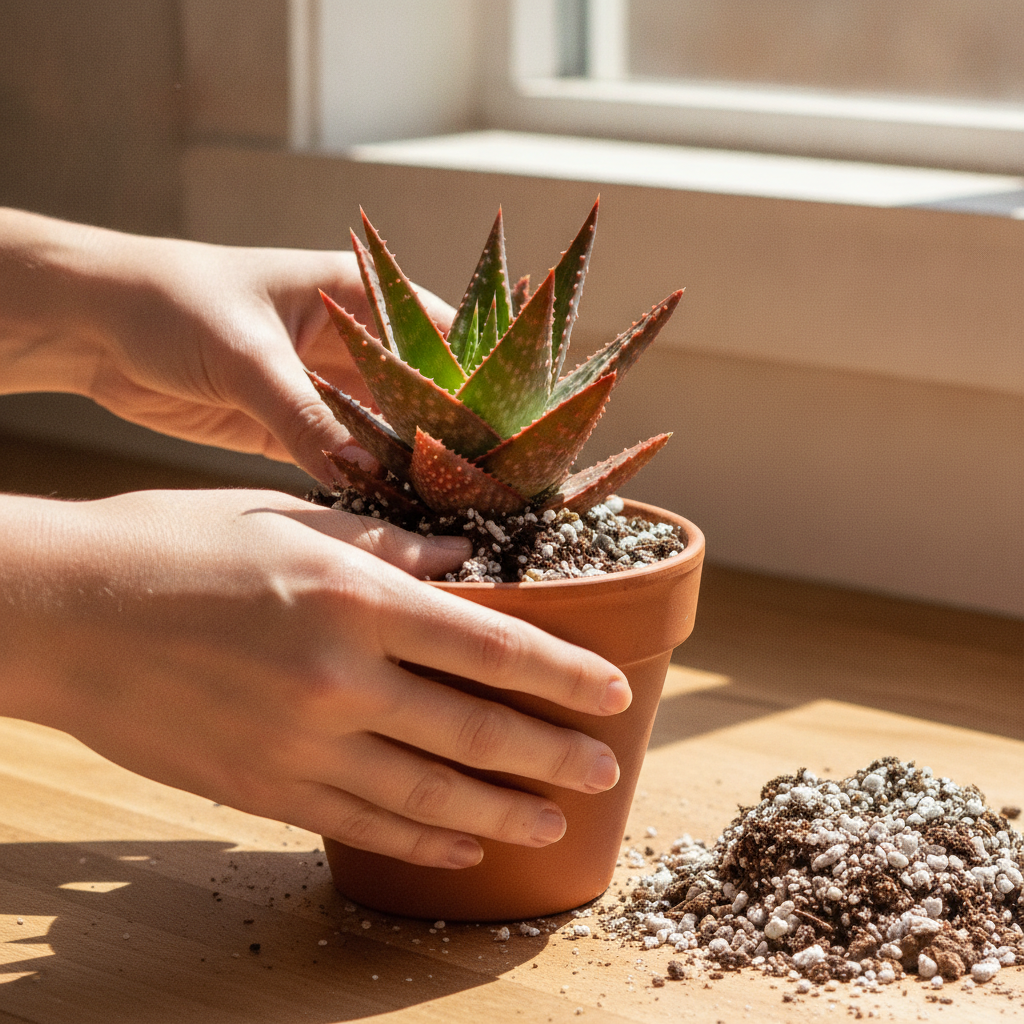
The right soil is the foundation of a healthy aloe, and it is the single easiest thing to get wrong. Standard houseplant compost holds far too much water for a succulent and will keep the roots damp long enough to rot them. What Christmas Carol wants instead is a lean, gritty, sharply draining mix that mimics the rocky ground of its aloe ancestry, holding just enough moisture to keep the roots alive between soakings and then drying out fast.
Ideal Soil Composition
A good aloe mix is roughly half mineral grit and half organic matter, so that water drains through in seconds and air reaches the roots. You can buy a ready-made cactus and succulent compost and improve it further by cutting in extra perlite, pumice or coarse grit, aiming for a mix that feels open and crumbly rather than dense and spongy.
| Component | Proportion | Function |
|---|---|---|
| Cactus or standard compost | About one third to one half | Holds a little moisture and nutrients |
| Pumice or coarse perlite | About one third | Creates air pockets and speeds drainage |
| Coarse grit or sharp sand | About one quarter | Adds weight and further improves drainage |
| Fine bark or coir (optional) | A small handful | Improves structure without waterlogging |
The plant is relaxed about pH, thriving anywhere from slightly acidic to slightly alkaline, roughly 6.0 to 7.5, so there is no need to test or adjust it. Far more important than pH is the physical structure of the mix and its ability to dry quickly.
Pro Tip — Quick Mix Recipe: For a reliable blend, combine two parts cactus compost, two parts pumice or perlite and one part coarse grit. If you can roll the moist mix into a ball that holds its shape, add more grit until it crumbles apart in your hand.
Choosing the Right Pot
Pot choice works hand in hand with soil to control moisture, and for a rot-prone succulent it deserves real thought rather than being an afterthought.
Drainage holes are non-negotiable. Never plant a Christmas Carol in a pot without drainage. Without an escape route, water collects at the bottom and the roots sit in a reservoir that guarantees rot no matter how careful your watering.
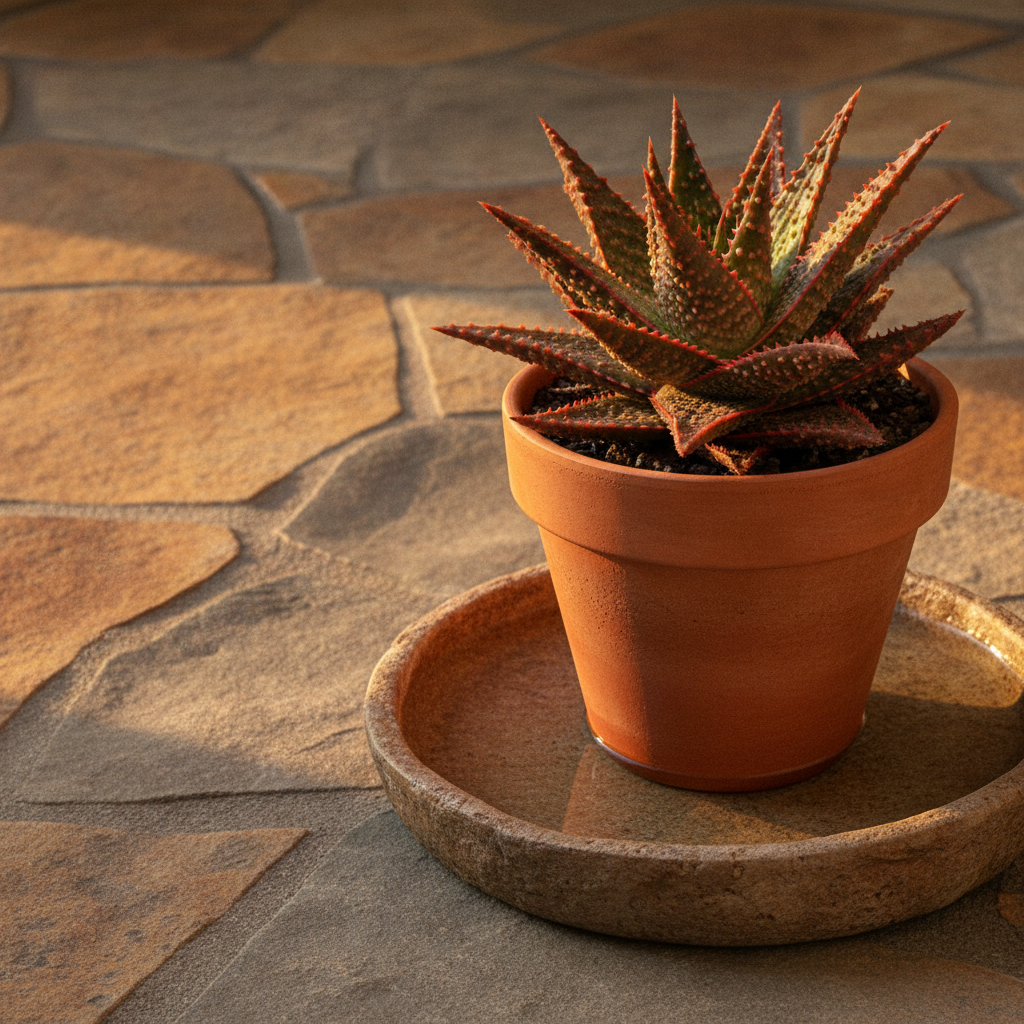
Pot material: Unglazed terracotta is ideal because its porous walls wick moisture out of the soil and let it evaporate, drying the root zone faster. Plastic and glazed ceramic hold water longer, so if you use them, lean even harder on a gritty mix and cautious watering.
Pot size: Choose a pot only slightly larger than the root ball. A large pot holds a large volume of slow-drying soil around a small plant, which keeps moisture near the roots for too long. Snug quarters suit this aloe far better than a spacious one.
When to Repot
Being slow-growing, Christmas Carol needs repotting only every two to three years, or when it has clearly outgrown its home. Tell-tale signs include roots creeping from the drainage holes, a rosette that has clustered with offsets and filled the entire surface, or a mix that has broken down into fine, water-retentive dust. The best time to repot is spring or early summer, when the plant is in active growth and recovers quickly. Always let the soil dry first and repot into dry mix, waiting several days before the first watering.
How to Repot: Step-by-Step
- Wait until the soil is completely dry, which loosens the root ball and reduces breakage.
- Gently ease the plant out, supporting the base of the rosette and protecting your hands from the marginal teeth.
- Crumble away the old spent mix and inspect the roots, trimming any that are brown, soft or dead with a sterile blade.
- Separate any offsets now if you wish to propagate them, or leave them attached for a clustered look.
- Settle the plant into a barely larger pot part-filled with fresh dry gritty mix, keeping it at the same depth as before.
- Fill around the roots and firm lightly, keeping the crown at the surface and never buried.
- Wait around a week before watering to let any damaged roots heal and prevent rot.
Warning — Transplant Shock: Watering immediately after repotting is a classic mistake. Freshly disturbed and trimmed roots need time to callus, and wet soil against open wounds is an invitation to rot. Keep the newly potted plant dry and out of harsh sun for several days before its first drink.
Fertilising
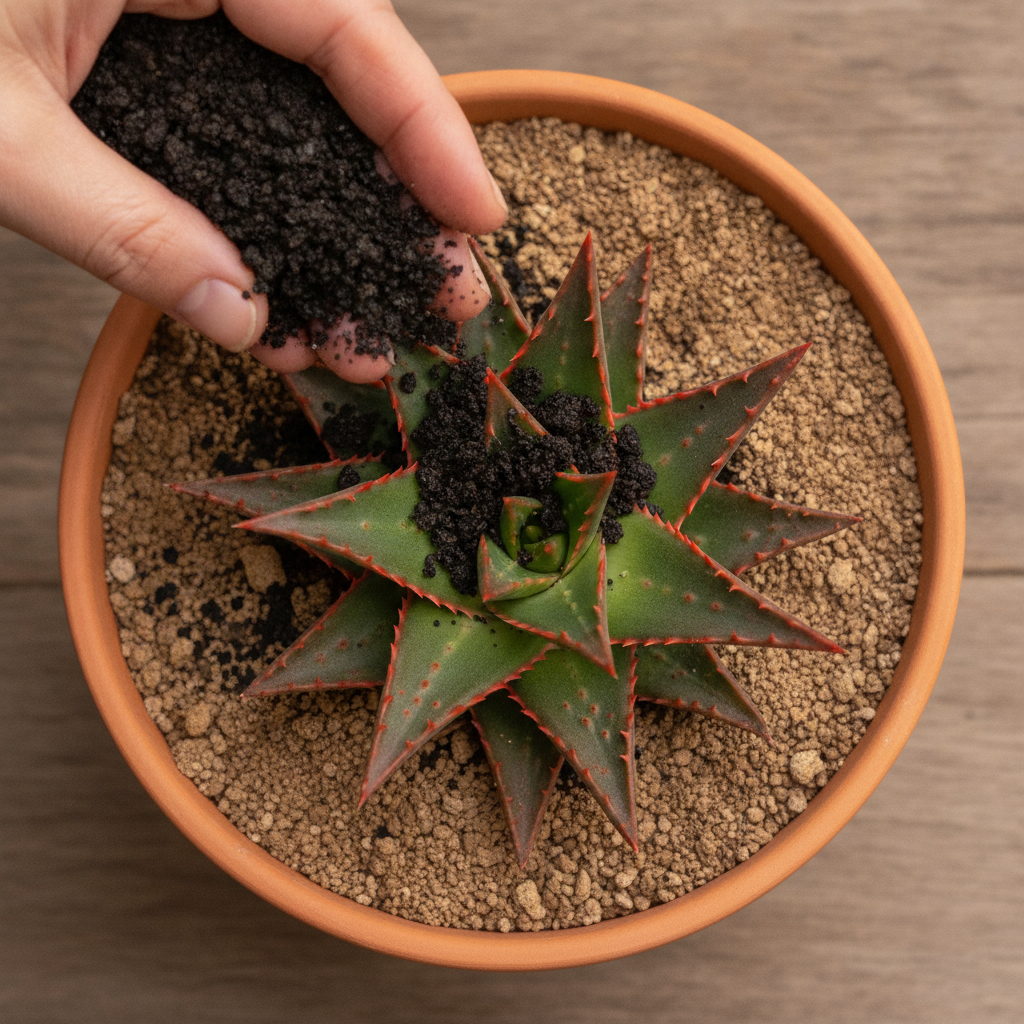
Christmas Carol is a light feeder that grows perfectly well with little or no supplementary fertiliser. In the wild its relatives cope with poor, mineral soils, and indoors the plant needs only an occasional gentle boost during its growing season to keep its colour and vigour. Overfeeding does far more harm than underfeeding, pushing soft, pale, stretched growth that undermines the compact form you are trying to encourage.
Feed only in spring and summer, when the plant is actively growing, and never in autumn or winter, when it is resting and cannot use the nutrients. One or two feeds across the whole growing season is plenty for this modest little succulent.
Understanding Plant Nutrients
Fertilisers are labelled with an N-P-K ratio describing their nitrogen, phosphorus and potassium content, alongside smaller amounts of secondary and trace nutrients. For a succulent you want a balanced or low-nitrogen feed, because high nitrogen forces the lush, soft growth that succulents are not built to support. The table below summarises the roles of the main nutrients and how a shortage shows itself.
| Nutrient | Symbol | Primary Function | Deficiency Symptoms |
|---|---|---|---|
| Nitrogen | N | Leaf and stem growth | Overall paling, weak slow growth |
| Phosphorus | P | Root development and flowering | Poor roots, dull leaves, few blooms |
| Potassium | K | Overall vigour and stress tolerance | Yellow or brown leaf edges |
| Calcium | Ca | Cell walls and new growth | Distorted, weak emerging leaves |
| Magnesium | Mg | Core of the chlorophyll molecule | Yellowing between leaf veins |
| Iron | Fe | Chlorophyll production | Pale new growth with green veins |
Types of Fertiliser
Liquid fertilisers: A liquid cactus and succulent feed diluted to half the recommended strength is the easiest option, giving you full control over dose and timing. Apply it to already-moist soil during a normal watering in the growing season.
Slow-release granular: A few granules of a low-strength slow-release feed worked into the soil in spring will drip-feed nutrients gently over months. Use sparingly, as it is easy to overdo with such a small, slow plant.
Organic fertilisers: A thin top-dressing of worm castings is a forgiving, low-risk way to feed, releasing mild nutrition slowly with almost no danger of burning the roots. It suits gardeners who prefer to avoid synthetic products.
Feeding Schedule
A realistic schedule is a single dilute feed in mid-spring as growth begins, followed by one more in mid-summer if the plant is growing strongly. Stop entirely by early autumn so the plant can wind down for its winter rest. If in doubt, feed less; a Christmas Carol will always do better slightly hungry than overfed.
Pro Tip — Half Strength, Never on Dry Roots: Always dilute succulent feed to half the label rate, and only ever apply it to soil that is already damp. Fertiliser salts applied to bone-dry roots can scorch them, so water first or feed as part of a watering.
How to Fertilise
- Confirm the plant is in active spring or summer growth.
- Dilute a cactus fertiliser to half its recommended strength.
- Water lightly first, or fold the feed into a normal watering, so the roots are never dry when fed.
- Apply at the soil level, keeping fertiliser off the leaves and crown.
- Resume plain watering thereafter and do not feed again until the next scheduled time.
Warning — Salt Build-Up: Repeated feeding can leave a build-up of mineral salts in the mix, seen as a white crust and often causing brown leaf tips. If this appears, flush the pot with plenty of plain water until it runs clear from the drainage holes, then let it dry fully before resuming normal care.
Propagation
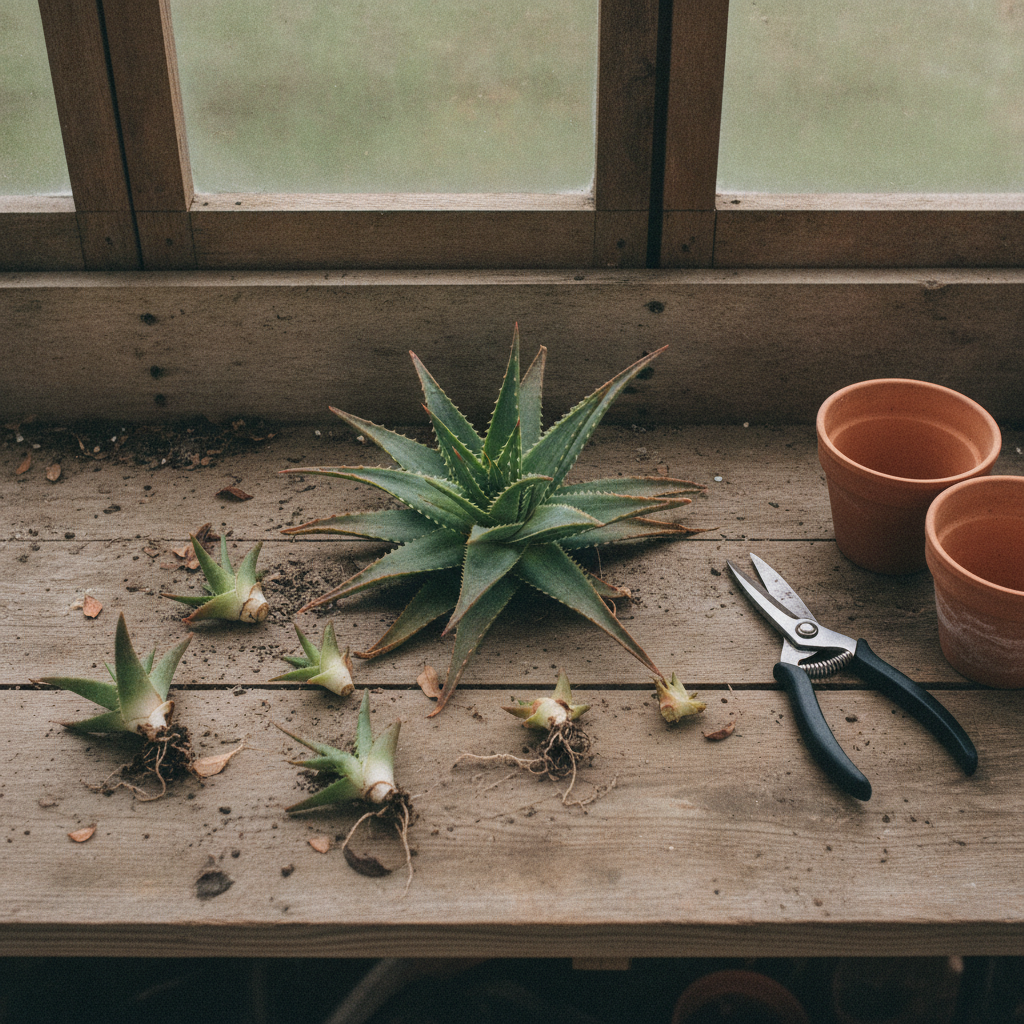
Propagating Christmas Carol is one of the quiet pleasures of growing it, because the plant does most of the work itself by producing offsets, or pups, around its base. These are small, genetically identical clones of the parent, and separating them is the simplest and most reliable way to make new plants that will share the parent’s colour and texture.
It is worth knowing what does not work, too. Unlike some fleshy-leaved succulents such as echeverias, aloes do not reliably grow new plants from a single detached leaf, so a leaf cutting will usually just shrivel. And because Christmas Carol is a hybrid, any seed it might set will not come true, producing seedlings that differ from the parent. Offsets and division are therefore the methods to rely on.
Understanding Offsets
An offset is a miniature rosette that emerges from the base of the mother plant, connected by a short section of stem or root. As it grows it develops its own roots while still drawing support from the parent. Once a pup has reached a reasonable size, ideally a third or more of the parent’s diameter, and has begun forming roots of its own, it is ready to be separated and grown on independently. Removing well-developed pups also keeps the parent tidy and lets both plants grow more vigorously.
Separating Offsets: Step-by-Step
The most dependable method is to lift the whole plant and detach rooted pups, ideally in spring or summer so they establish quickly.
- Let the soil dry, then ease the whole plant out of its pot to expose the base and the offsets.
- Brush away the mix so you can see where each pup connects to the parent and whether it has its own roots.
- Gently work the offset free by hand, or cut it away with a clean, sharp blade, keeping as many of its roots as you can.
- Set the separated pups aside in a dry, shaded spot for one to three days so the cut surfaces callus over.
- Pot each pup into a small container of dry gritty mix, just deep enough to hold it upright.
- Wait about a week, then begin watering lightly, and keep the young plants in bright but not scorching light.
Pro Tip — Let Cuts Callus: The single most important step is the drying period. Potting a freshly cut pup straight into soil and watering it invites rot, whereas letting the wound callus for a couple of days first dramatically improves success. Patience here pays off.
Dividing a Clustered Clump: Step-by-Step
An older plant that has built up into a dense cluster of several rosettes can be divided into separate plants at repotting time, which both multiplies your stock and rejuvenates a congested pot.
- Unpot the whole clump when the soil is dry and shake off the loose mix.
- Study the mass of rosettes and roots to find natural points where the clump wants to break apart.
- Tease the clump into individual rooted sections by hand, cutting only where roots are too entwined to separate cleanly.
- Allow any cut surfaces to callus for a day or two in a dry, airy place.
- Pot each division into its own small pot of fresh dry gritty mix at its original depth.
- Hold off watering for several days, then resume normal care as the divisions settle in.
Troubleshooting Propagation
| Problem | Likely Cause | Solution |
|---|---|---|
| Pup rots after potting | Watered too soon or potted while wounded | Let cuts callus, use dry mix, delay watering |
| Offset fails to root | Removed too small or with no roots | Wait until pups are larger and rooted before separating |
| Leaf cutting shrivels | Aloes rarely grow from single leaves | Propagate from offsets or division instead |
| Slow establishment | Low light or cold, dormant season | Propagate in spring or summer in bright warmth |
Pests & Diseases
A healthy Christmas Carol kept in bright light and gritty soil is a robust plant with few troubles, and most of the problems it does encounter trace back to excess moisture rather than to pests. Still, a handful of sap-sucking insects find their way to indoor aloes, and it pays to know them and to check your plant regularly so any infestation is caught while it is small.
The best defence is routine observation. Every time you water, take a moment to look into the leaf crevices and along the undersides, where pests like to hide, so you can act at the first sign of trouble rather than after an outbreak has taken hold.
Common Pests
Mealybugs (Pseudococcus species)
Mealybugs are the most frequent aloe pest, appearing as small white, cottony blobs tucked into the leaf axils and crevices where the leaves meet the stem. They pierce the tissue to feed on sap, weakening the plant and leaving a sticky residue behind.
Treatment: Dab each insect directly with a cotton bud dipped in isopropyl alcohol, which dissolves their protective coating on contact. For a wider infestation, treat the whole plant with an insecticidal soap or diluted neem oil and repeat every week or so until no new bugs appear.
Scale Insects (Coccoidea)
Scale appears as small, hard brown bumps clinging to the leaves, often mistaken for part of the plant’s natural texture. Like mealybugs they suck sap, and heavy infestations sap the plant’s vigour and cause yellowing.
Treatment: Scrape or rub the bumps off gently with a fingernail or an alcohol-dipped cloth, then follow up with neem oil or insecticidal soap to catch the mobile young. Persistence over several weeks is usually needed to clear them fully.
Fungus Gnats (Sciaridae)
Small black flies drifting around the pot are fungus gnats, whose larvae live in persistently damp soil and feed on organic matter and fine roots. Their presence is usually a sign that the mix is being kept too wet for a succulent.
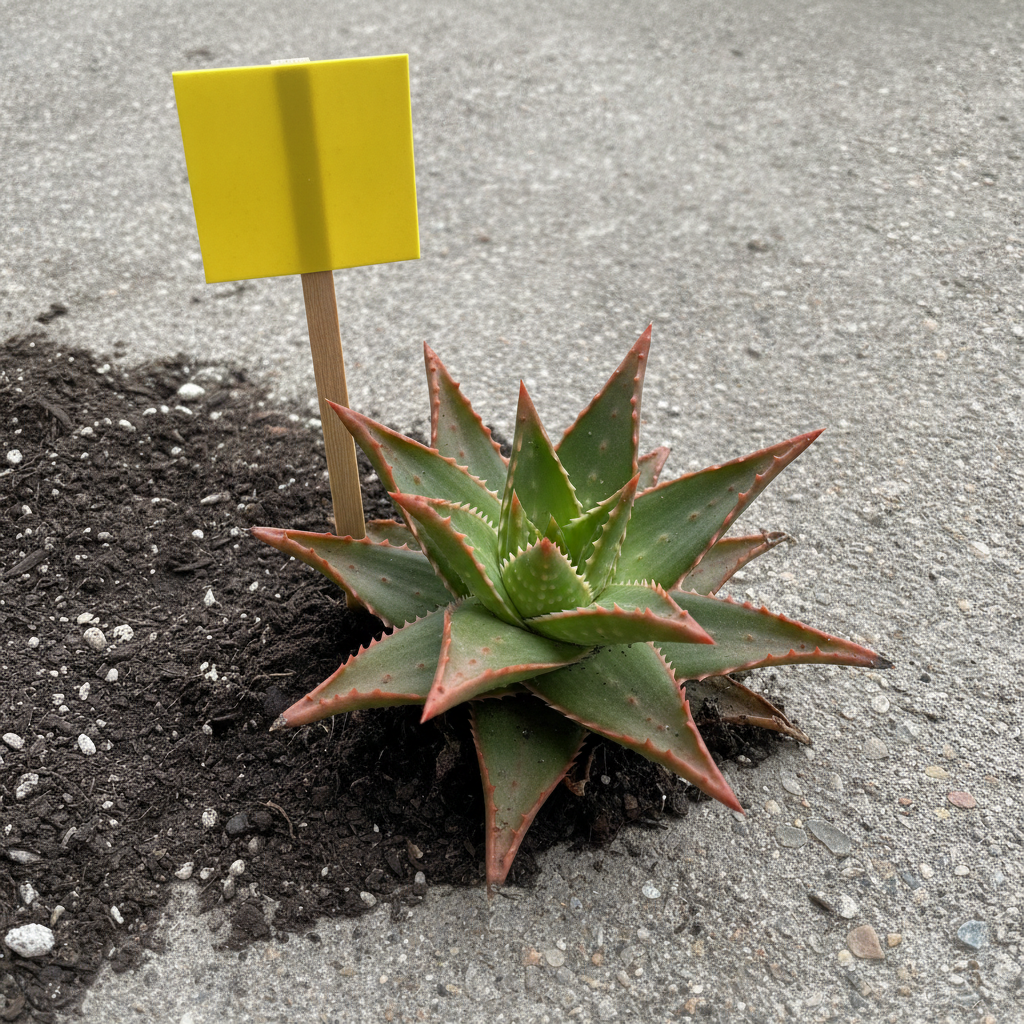
Treatment: Let the soil dry out fully, which alone breaks their life cycle, and use yellow sticky traps to catch the adults. Topping the mix with a layer of grit denies them the damp surface they need to breed.
Common Diseases
Root and Crown Rot (Pythium and Fusarium species)
By far the most serious threat to a Christmas Carol, rot is caused by fungi that thrive in soggy soil and attack the roots and the base of the rosette. It shows as blackening, softening tissue at the soil line and leaves that yellow, collapse and pull away easily.
Treatment: Act fast. Unpot the plant, cut away all soft, discoloured roots and tissue with a sterile blade, let the healthy remainder dry for a day or two, and replant into fresh dry gritty mix. If the crown is lost, salvage a clean offset instead. Prevention through careful watering is far easier than any cure.
Leaf Spot (various fungi)
Fungal leaf spot appears as small dark or sunken marks on the leaves, usually where water has been left sitting on the surface in humid, poorly ventilated conditions. It is largely cosmetic but signals that the growing environment is too damp.
Treatment: Improve airflow, keep water off the leaves when watering, and remove any badly affected leaves with a clean blade. Better ventilation and drier foliage usually stop it spreading.
Pest and Disease Summary
| Pest / Disease | Identification | Treatment |
|---|---|---|
| Mealybugs | White cottony blobs in leaf axils | Alcohol swab, then neem or insecticidal soap |
| Scale insects | Hard brown bumps on leaves | Scrape off, then neem or insecticidal soap |
| Fungus gnats | Small black flies around the pot | Dry the soil, sticky traps, grit top-dressing |
| Root and crown rot | Blackening, mushy base and roots | Cut out rot, dry, repot in fresh gritty mix |
| Leaf spot | Dark sunken marks on leaves | Improve airflow, keep leaves dry, remove leaves |
Prevention Strategies
Nearly every problem an aloe faces is prevented by the same core conditions: bright light, a gritty fast-draining mix, careful and infrequent watering, and good airflow. A plant grown this way is naturally resilient, and its firm, well-coloured leaves are far less attractive to pests and far less prone to rot than the soft, overwatered growth that trouble seeks out.
It also helps to quarantine any new plant for a couple of weeks before it joins your collection, since new arrivals are the most common way pests are introduced. Inspect regularly, keep the growing area clean and uncluttered, and deal with any small outbreak promptly before it can spread.
Pro Tip — Isolate and Inspect: Whenever you spot a pest, move the affected plant away from its neighbours straight away. A few minutes of isolation and a close inspection can save you from an infestation that spreads across an entire windowsill.
Popular Varieties
Christmas Carol belongs to a whole movement of small ornamental aloe hybrids, many developed by specialist breeders to combine heavy leaf texture, vivid colour and compact, collectible form. If you fall for its charms, there is a rich family of close relatives to explore, each offering its own twist on the same appealing formula of bumps, teeth and seasonal red.
These hybrid aloes share almost identical care, so once you can grow one well you can grow them all. The table and profiles below introduce some of the most sought-after cousins, any of which sits happily alongside Christmas Carol on a bright windowsill.
| Variety | Leaf Appearance | Light Needs | Growth Rate | Availability |
|---|---|---|---|---|
| Christmas Carol | Green with red bumps and red teeth | Very bright to direct | Slow | Common |
| Christmas Sleigh | Dense creamy-white tubercles, red teeth | Very bright to direct | Slow | Common |
| Pink Blush | Slender pink leaves with pale banding | Very bright to direct | Slow to moderate | Common |
| Doran Black | Dark green, heavily white-spotted | Very bright to direct | Slow | Occasional |
| Delta Lights | Broad leaves with cream marbling | Very bright to direct | Slow | Occasional |
| Firebird | Small, spotted, flushing orange-red | Very bright to direct | Moderate | Common |
| Bright Star | Grey-green with bold white teeth | Very bright to direct | Slow | Occasional |
Featured Varieties
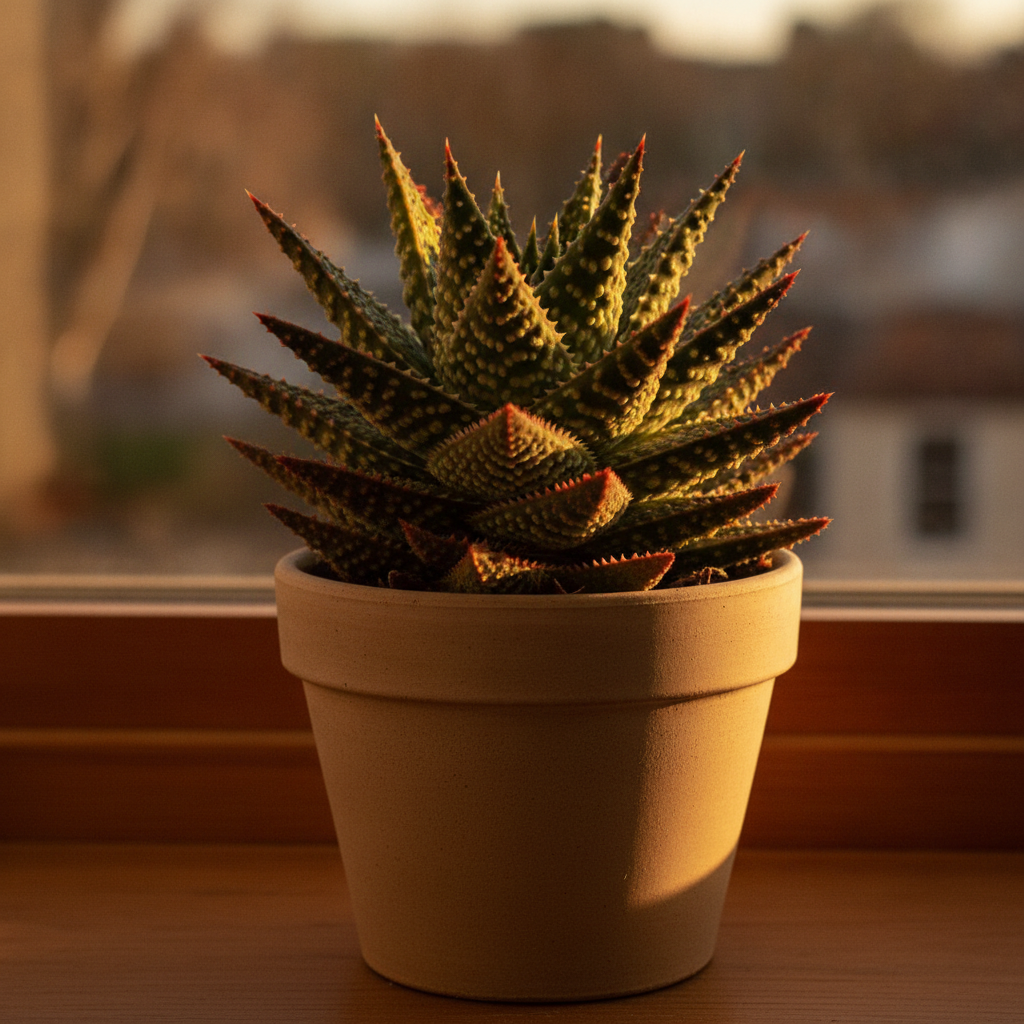
Christmas Sleigh
A close sibling with even more pronounced, densely packed creamy-white tubercles standing proud of the leaf surface, framed by bold red marginal teeth. Its knobbly, heavily textured rosette gives it a sculptural quality, and it colours up warmly in strong light just like Christmas Carol.
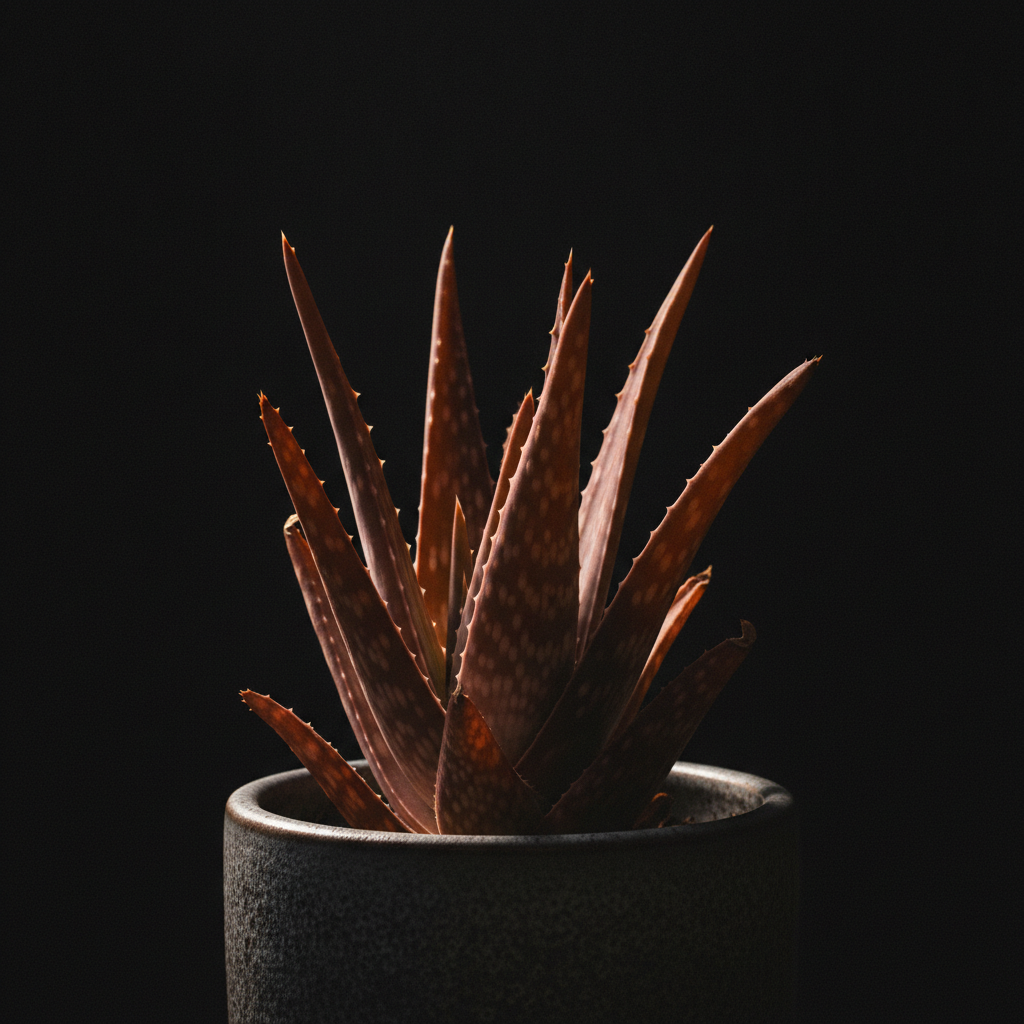
Pink Blush
A more upright, elegant hybrid whose slender leaves take on a dusky pink flush marked with soft horizontal banding and pale spotting. It offers a gentler, cooler colour palette than the fiery reds of Christmas Carol, and makes a lovely contrast when the two are grown side by side.
Variety Profiles in Detail
Christmas Carol (Aloe ‘Christmas Carol’)
The plant this guide is devoted to, prized for the balance it strikes between texture and colour. Its deep green leaves carry rows of red-tipped tubercles and toothed red margins that flush scarlet in bright, cool conditions, and its compact, symmetrical rosette stays small and neat. Slow-growing and offset-forming, it is both an easy beginner succulent and a genuine collector’s plant.
Firebird (Aloe ‘Firebird’)
A dwarf hybrid that stays even smaller than Christmas Carol, with slim spotted leaves that blush warm orange-red in sun and a habit of flowering freely on short spikes of coral tubular blooms. It offsets readily into dense little colonies, making it one of the most rewarding of the miniature hybrids for a sunny sill.
Doran Black (Aloe ‘Doran Black’)
Named for its very dark green, almost black-toned leaves that are liberally speckled with pale raised spots, Doran Black offers drama through contrast rather than red flush. It shares the same compact, slow-growing, tuberculate character and thrives in identical bright, dry conditions.
Choosing the Right Variety for Your Space
Because every plant in this group wants the same bright light and lean, dry treatment, the choice comes down purely to looks. If you want maximum festive colour, Christmas Carol and Firebird deliver the reds; for pale, textural drama, Christmas Sleigh and Doran Black lead with their tubercles and spots; and for a softer, cooler palette, Pink Blush stands apart. The one non-negotiable across all of them is a very bright spot, so let the light your home can offer, rather than the plant, be your deciding factor.
Frequently Asked Questions
Why is my Christmas Carol aloe turning green instead of red?
Green colour almost always means not enough light. The red pigments develop as a response to strong light and cool temperatures, so a plant on a dim shelf will revert to plain green and may also stretch. Move it to your brightest window, and the colour will gradually return over a few weeks as it acclimatises to the increased light.
How often should I water it?
Water only when the soil is completely dry, which in practice tends to be every 10 to 21 days in summer and monthly or less in winter. Rather than counting days, check the soil and the firmness of the leaves; plump leaves and any dampness in the mix both mean you should wait longer.
Is Christmas Carol aloe safe for cats and dogs?
No, it is best treated as mildly toxic. Like other aloes it contains compounds that can cause vomiting, lethargy and digestive upset if a pet eats the leaves, and the sap may irritate skin. It is not among the most dangerous houseplants, but it should still be kept out of reach of pets and children.
Why are the lower leaves shrivelling?
A few oldest leaves at the very base drying up and shrivelling is completely normal as the plant sheds them with age. If many leaves are thinning and wrinkling at once, however, the plant is thirsty and due a thorough soak. Distinguish this from soft, mushy, yellowing leaves, which point to overwatering instead.
Will it flower indoors?
It can. A mature, well-grown plant given plenty of light may send up a short spike of small tubular orange to coral flowers, most often in the warmer months. Flowering is a sign of a happy plant, but a Christmas Carol is grown chiefly for its foliage, so do not be concerned if it never blooms.
How big does it get?
It stays small, with a single rosette typically reaching around 15 to 20 cm (6 to 8 inches) across and only a few centimetres tall. Over time it clusters with offsets to form a wider colony, but it never becomes a large plant, which is part of its appeal for windowsills and small spaces.
Can I grow it outdoors?
In a warm, frost-free climate it can live outdoors year-round in a bright, sheltered spot with sharp drainage. In cooler regions it is best grown as a container plant that spends summer outside and comes indoors before temperatures fall, as it will not tolerate frost and suffers below about 5 C (41 F).
Why won’t my aloe grow from a leaf?
Aloes, unlike some other succulents, do not reliably root from a single detached leaf, which simply shrivels rather than forming a new plant. To propagate Christmas Carol, separate the rooted offsets it produces around its base or divide an established clump, both of which are quick and dependable.






