
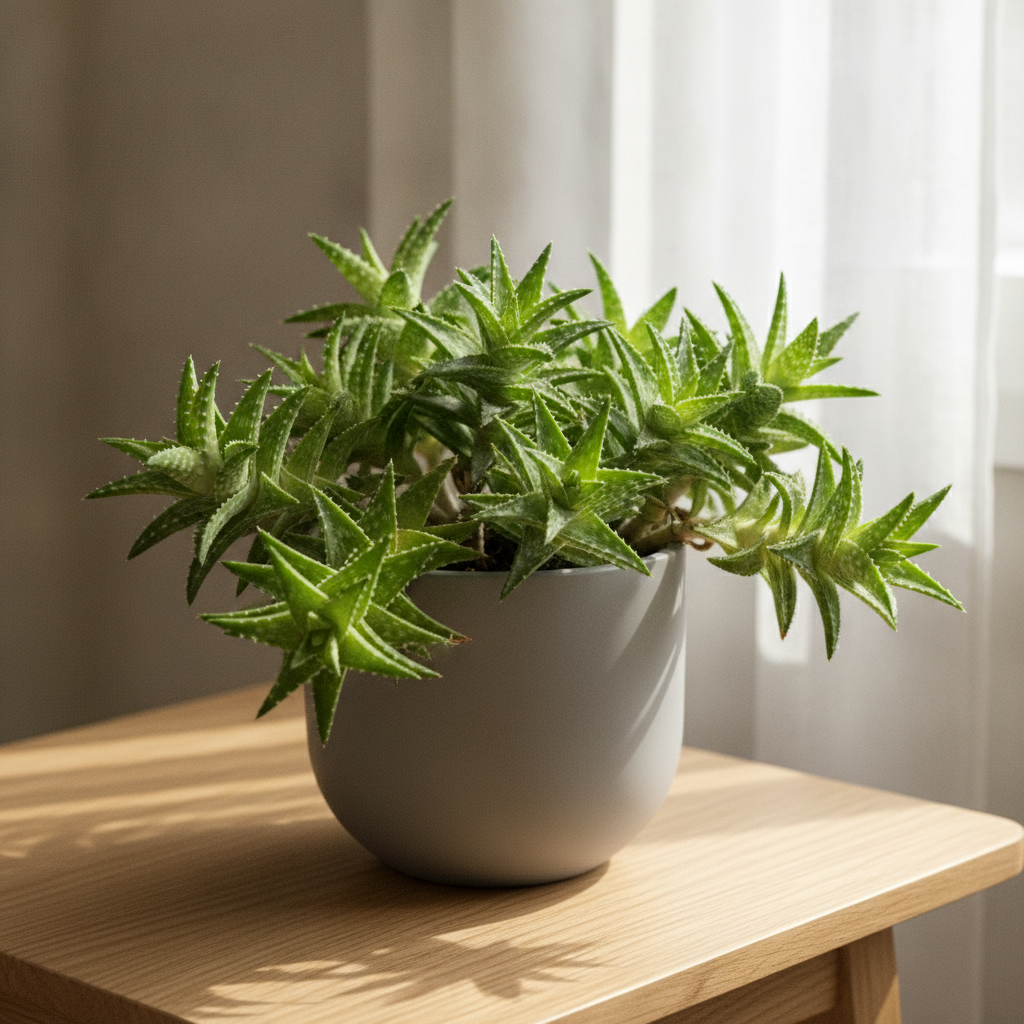
Few small succulents look as fierce and forgive as much as the tiger tooth aloe. Its stacked, triangular leaves are lined with soft white teeth and freckled with pale spots, giving it the look of a miniature agave crossed with a dragon, yet it asks for almost nothing in return. Botanically it is Aloe juvenna, a dwarf clustering aloe native to the highlands of Kenya, where it grows in rocky crevices and thin, gritty soils under strong equatorial light. In cultivation it rarely exceeds 30 centimetres (12 inches) in height, its stems elongating and sprawling into dense colonies of overlapping rosettes.
The tiger tooth aloe has earned a reputation as one of the most beginner-proof succulents you can own, and that reputation is largely deserved. It stores water in its fleshy leaves, tolerates missed waterings for weeks, and multiplies willingly into new plants. But there is a real difference between a tiger tooth aloe that merely survives on a shadowed shelf and one that thrives into a tightly packed, sun-blushed cluster with coppery leaf tips. This guide covers everything from light and watering to soil, feeding, propagation and pests, so you can push your plant from surviving to genuinely thriving.
Contents
- Quick Reference
- Why Tiger Tooth Aloe Makes a Resilient Houseplant
- Light Requirements
- Watering & Humidity
- Soil, Potting & Repotting
- Fertilising
- Propagation
- Pests & Diseases
- Popular Varieties
- Frequently Asked Questions
Quick Reference: Tiger Tooth Aloe at a Glance
| Light | Bright indirect to several hours of direct sun; a sunny windowsill is ideal |
| Watering | Soak-and-dry; water only when the soil is bone dry, roughly every 2 to 3 weeks in growth |
| Temperature | 10 to 27 degrees Celsius (50 to 81 Fahrenheit); protect from frost below 5 degrees Celsius (41 Fahrenheit) |
| Humidity | Low; average household air is perfect, high humidity is a risk |
| Fertiliser | Sparingly; diluted succulent feed once or twice across spring and summer |
| Toxicity | Mildly toxic to cats and dogs if eaten; keep out of reach of pets |
Why Tiger Tooth Aloe Makes a Resilient Houseplant
The appeal of the tiger tooth aloe begins with its forgiving constitution. As a succulent from a hot, seasonally dry climate, it is built to store water and ride out drought, which makes it an unusually tolerant companion for people who travel, forget, or simply prefer a plant that does not demand daily attention. Underwatering, the most common way houseplants die, is precisely the condition this aloe is engineered to withstand. It is far more likely to be killed by kindness, in the form of too much water, than by neglect.

Beyond its toughness, the plant offers real ornamental value. The leaves are arranged in tight, stacked spirals that overlap like the scales of a pine cone, each one a deep, glossy green stippled with raised creamy-white spots and edged with soft, harmless teeth. Grown in strong light and kept slightly stressed, the leaf margins and tips flush with warm bronze and coppery-red tones, a colour shift that many growers deliberately encourage. Because it offsets so freely, a single rosette will, within a year or two, become a generous clump that spills over the pot rim, offering an ever-expanding supply of pups to share or pot on.
Important — Toxicity: Like most true aloes, the tiger tooth aloe contains saponins and anthraquinones that make it mildly toxic to cats and dogs. Ingestion can cause vomiting, diarrhoea, lethargy and loss of appetite. It is not usually life-threatening, but the plant is best kept well out of reach of curious pets and small children, and any suspected ingestion should be discussed with a veterinarian.
Light Requirements
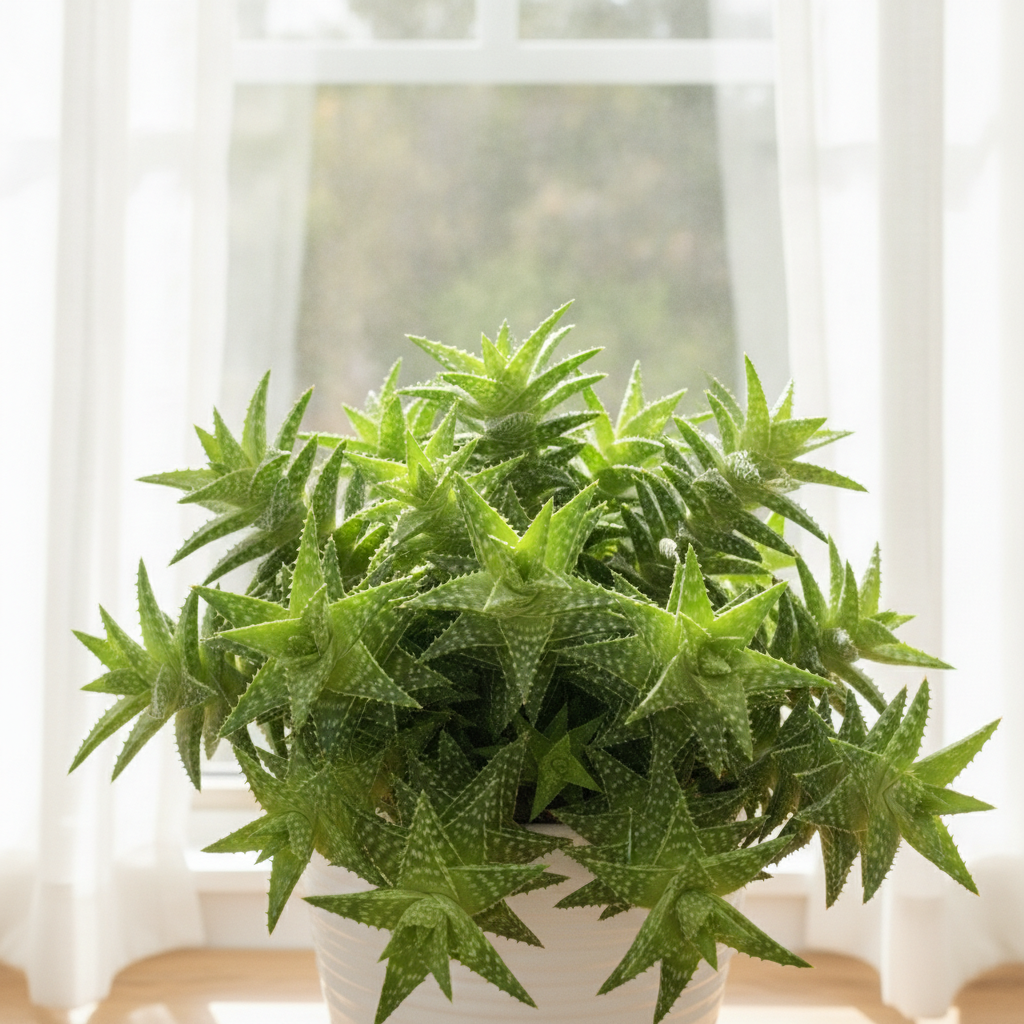
Light is the single most important factor in growing a handsome tiger tooth aloe. Coming from open, high-altitude habitats near the equator, the plant is adapted to intense sunshine and will only develop its best form and colour when given generous light. In a dim corner it does not die quickly, but it stretches, the stacked leaves loosening and the stems reaching desperately toward the nearest window in a condition known as etiolation.
The ideal is bright, direct light for at least four to six hours a day, supplemented by bright indirect light for the rest. A south or west-facing windowsill is close to perfect indoors. Given this, the rosettes stay tight and compact, the spots stay crisp and pronounced, and the leaf tips take on their characteristic sunset blush. The plant can even be moved outdoors for the warmer months, where it will colour up beautifully, provided you acclimate it gradually to avoid scorching.
Light Levels Explained
Understanding how different light intensities translate to real locations in your home makes it much easier to place this aloe well. The table below summarises the practical outcomes you can expect across a range of light levels.
| Light Category | Approx. Level | Typical Location | Outcome |
|---|---|---|---|
| Direct sun | Over 50,000 lux | Unobstructed south or west window, outdoors | Best colour and form, compact rosettes; acclimate to avoid scorch |
| Bright indirect | 10,000 to 25,000 lux | Near a sunny window, just out of the beam | Healthy green growth, less intense colouring |
| Medium | 5,000 to 10,000 lux | A metre or two back from a bright window | Survives but slow, mild stretching over time |
| Low | 1,000 to 5,000 lux | North window, interior room | Etiolation, weak floppy stems, loss of markings |
| Very low | Under 1,000 lux | Windowless spaces, deep corners | Slow decline, not sustainable long term |
Window Orientation and Placement
South-facing window: In the northern hemisphere this is the brightest exposure and the top choice for a tiger tooth aloe. Placed directly on the sill it will receive the sustained direct sun it craves, colouring up and staying compact. In the height of summer, a very thin curtain can take the edge off the harshest midday rays if you notice bleaching.
East-facing window: Gentle morning sun followed by bright light for the rest of the day suits the plant well. Growth will be healthy and the risk of scorch is minimal, though colouring may be a touch less dramatic than in a south window.
West-facing window: Strong afternoon sun makes a west window an excellent second choice to a south one. The plant will thrive here, though as with any hot afternoon exposure, watch for signs of stress during heatwaves.
North-facing window: This is the weakest exposure and generally too dim for a tiger tooth aloe to flourish. The plant will slowly stretch and lose its markings. If a north window is your only option, plan to supplement with a grow light.
Pro Tip — Even Growth: Aloes lean toward the light, so a plant on a windowsill will gradually tilt toward the glass. Give the pot a quarter turn every week or two to keep the cluster growing symmetrically rather than one-sided.
How Light Affects Leaf Colour
The tiger tooth aloe is one of those succulents whose appearance is a direct readout of the light it receives. In moderate light the leaves stay a uniform fresh green. As light intensity increases and the plant experiences a degree of benign stress, it produces protective pigments that turn the leaf edges and tips a warm orange, bronze or reddish-copper. This colouring is a sign of a happy, well-lit plant, not a problem, and it is entirely reversible when the plant is moved back into softer light.
Warning — Direct Sunlight: Although this aloe loves sun, a plant that has been growing in low light cannot be moved straight into blazing direct sun without burning. Sudden exposure causes white or brown scorched patches that do not heal. Always acclimate over one to two weeks by increasing sun exposure gradually.
Artificial Lighting
Where natural light is limited, a full-spectrum LED grow light is an effective substitute. Position it 20 to 30 centimetres (8 to 12 inches) above the plant and run it for 10 to 12 hours a day to mimic the long, bright days of the plant’s native range. Grow lights are particularly useful through short, dark winters, when even a south window may not deliver enough intensity to keep the rosettes tight.
Seasonal Adjustments
As the sun’s angle lowers and daylight shortens in autumn and winter, move your tiger tooth aloe to the brightest available position and do not be shy about placing it in full winter sun, which is far gentler than summer sun. In spring, as light strengthens, reintroduce any plants that summered indoors to brighter conditions gradually to prevent scorch. Matching your care to the seasons in this way keeps the plant compact year-round.
Watering & Humidity
If light is what makes a tiger tooth aloe beautiful, watering is what most often kills it. The golden rule with this and nearly every succulent is that it is far safer to err on the side of too dry than too wet. The plant’s fleshy leaves are reservoirs, and its roots are adapted to periods of complete drought punctuated by occasional heavy rain, not to sitting in constantly moist compost.
When to Water
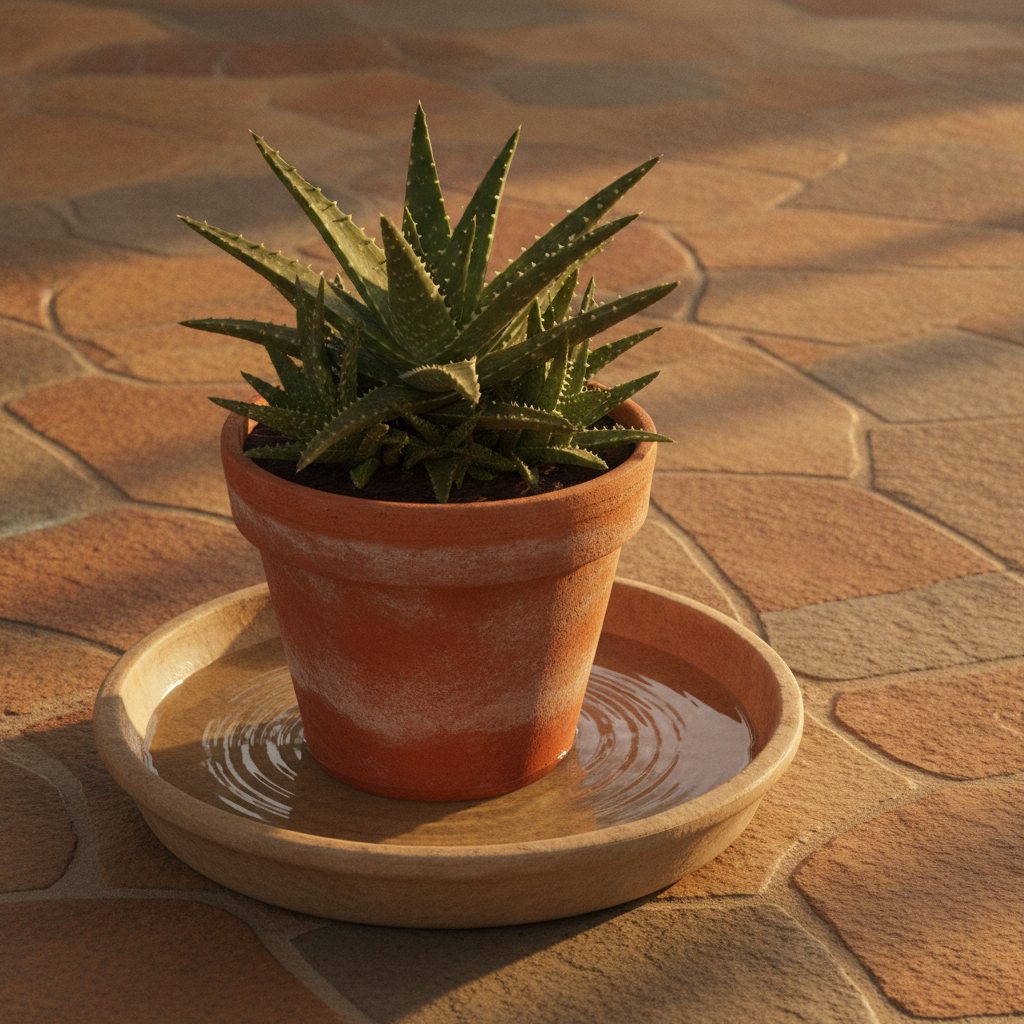
The best method is the soak-and-dry approach. Wait until the soil has dried out completely, then water thoroughly until it runs from the drainage holes, and wait again. In practice this means watering roughly every two to three weeks during the active growing season of spring and summer, though the exact interval depends on your light, temperature, pot size and the weather. Rather than following a fixed calendar, check the soil: push a finger or a wooden skewer deep into the pot and only water if it comes out dry.
In autumn and winter, when growth slows and light is weak, the plant needs far less water. Stretch the interval to once every four to six weeks, or even less, giving just enough to stop the leaves from shrivelling. A tiger tooth aloe kept cool and dry through winter is a healthy one; a cool, wet plant is a candidate for root rot.
Pro Tip — Read the Leaves: The plant tells you when it is thirsty. Plump, firm leaves mean it is well hydrated. When the lower leaves begin to look slightly soft, thin or wrinkled, that is your cue to water. This living gauge is more reliable than any schedule.
How to Water Correctly
- Check that the soil is completely dry throughout the pot before watering.
- Water at the soil level rather than over the rosette, keeping the crown and leaf axils dry to prevent rot.
- Apply water slowly and thoroughly until it drains freely from the bottom of the pot.
- Alternatively, set the pot in a shallow dish of water for 10 to 15 minutes to soak up moisture from below, then remove it.
- Let the pot drain completely and never leave it standing in a saucer of water.
- Wait until the soil is bone dry again before repeating.
Signs of Overwatering vs. Underwatering
| Symptom | Overwatering | Underwatering |
|---|---|---|
| Leaf colour | Yellowing, translucent or blackening leaves | Leaves fade to a dull, pale green |
| Leaf texture | Soft, mushy, water-soaked and swollen | Thin, wrinkled, shrivelled and puckered |
| Soil | Stays wet for many days, may smell sour | Bone dry, pulls away from the pot sides |
| Roots | Brown, black, soft and foul-smelling | Dry but firm and pale |
| Stem base | Soft, brown or black rot at soil line | Firm, perhaps slightly shrunken |
Warning — Root Rot: Root rot is the leading cause of death in tiger tooth aloes. If the base of the plant turns soft, brown or black and leaves collapse, act immediately: unpot the plant, cut away all mushy roots and rotted tissue with a sterile blade, let the healthy remainder callus for a few days, and replant in fresh, dry, gritty mix. Caught early, many plants recover.
Humidity Requirements
Humidity is refreshingly simple with this plant: it wants very little. Ordinary household humidity, in the region of 30 to 50 percent, suits it perfectly. Unlike tropical foliage plants, the tiger tooth aloe has no need for misting, pebble trays or humidifiers, and in fact prefers drier air.
Problems tend to arise at the humid end of the scale rather than the dry. In consistently damp, stagnant air the plant becomes more vulnerable to fungal issues and rot, particularly if water lodges between the stacked leaves. A bathroom without good airflow, or a crowded terrarium, is the wrong home for this aloe.
Good air circulation is the best insurance. A gently moving current of air helps the soil surface and the leaf crevices dry quickly after watering, which is exactly what keeps rot at bay. If your growing area is still and humid, a small fan running nearby makes a genuine difference.
Water Quality
The tiger tooth aloe is not fussy about water quality and tolerates ordinary tap water in most areas. In regions with very hard water, mineral salts can accumulate on the soil surface and pot rim over time, appearing as a white crust. If you notice this, flushing the pot thoroughly every few months, or switching to filtered or rainwater, will keep the build-up in check. Room-temperature water is always kinder to the roots than cold.
Soil, Potting & Repotting
Getting the soil right is the other half of the watering equation. Because the tiger tooth aloe is so intolerant of prolonged moisture, the growing medium must drain fast and dry out quickly. Ordinary potting compost, which holds water for days, is a common cause of failure. The aim is a gritty, open mix that lets water rush through and air reach the roots.
Ideal Soil Composition
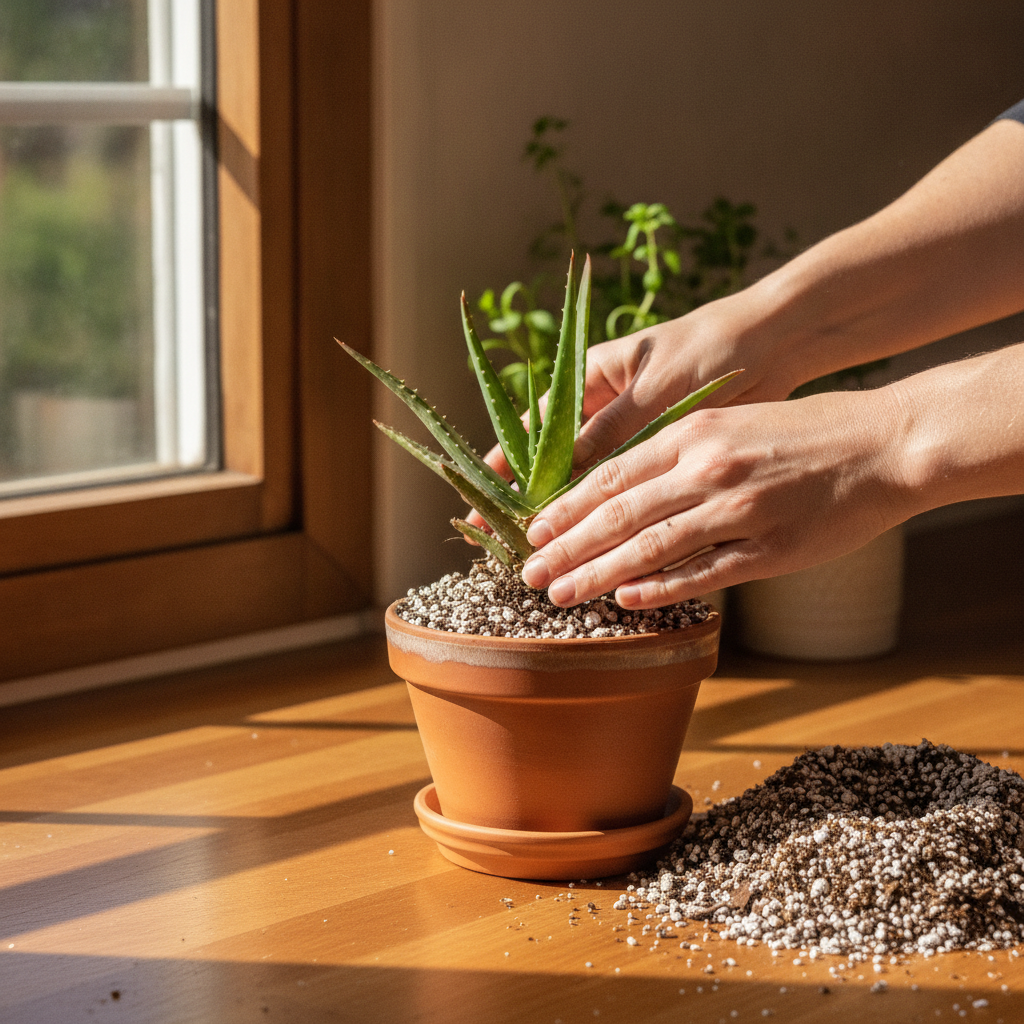
A good succulent or cactus mix forms the base, but most commercial cactus composts still hold a little too much moisture on their own and benefit from extra grit. The goal is a medium that is roughly half mineral material by volume, which provides the sharp drainage and airflow that aloe roots depend on.
| Component | Proportion | Function |
|---|---|---|
| Cactus or succulent compost | 50 percent | Base structure, some moisture and nutrients |
| Pumice or coarse perlite | 30 percent | Aeration and rapid drainage |
| Coarse sand or fine grit | 20 percent | Weight, sharp drainage, prevents compaction |
The tiger tooth aloe prefers a slightly acidic to neutral soil, in the pH range of about 6.0 to 7.0, which most cactus mixes fall comfortably within. There is no need to fuss over pH beyond avoiding strongly alkaline conditions, which can lock up nutrients over time.
Pro Tip — Quick Mix Recipe: For a simple, reliable blend, combine two parts ready-made cactus compost with one part pumice and one part coarse horticultural grit or perlite. If you can squeeze the moist mix into a ball that immediately crumbles apart, the drainage is about right.
Choosing the Right Pot
The pot you choose has a direct bearing on how well the soil dries and, by extension, on the health of the plant. With succulents, a slightly undersized pot in a breathable material is almost always better than a large, moisture-retaining one.
Drainage holes are non-negotiable. Never plant a tiger tooth aloe in a container without drainage. Excess water must be able to escape freely, and a decorative pot with no hole is effectively a reservoir that will drown the roots. If you love a particular cachepot, plant the aloe in a plastic nursery pot with holes and drop that inside the decorative one, removing it to water.
Pot material: Terracotta is the classic choice for this plant, and for good reason. Its porous walls wick moisture out of the soil and allow it to evaporate, helping the mix dry more evenly and quickly than it would in plastic or glazed ceramic. In humid homes or for chronic overwaterers, terracotta is a genuine safeguard.
Pot size: Choose a pot only slightly larger than the current root cluster. An oversized pot holds a large volume of soil that stays wet long after the roots have drunk their fill, inviting rot. As a sprawling, offsetting plant, the tiger tooth aloe is also happy to fill a shallow, wide bowl, which showcases its clumping habit beautifully.
When to Repot
This is a slow-growing plant that is content to be a little crowded, so repotting is infrequent, typically once every two to three years. The signs that it is time include roots emerging from the drainage holes, a dense mat of offsets that has filled the surface and is pushing at the pot walls, soil that dries out almost the moment you water it, or a plant that has become top-heavy and unstable. The best time to repot is spring, at the start of the growing season, when the plant can recover quickly.
How to Repot: Step-by-Step
- Water lightly a day or two ahead only if the plant is very dry, but ideally repot into and out of dry soil to reduce the risk of root damage and rot.
- Ease the plant out of its pot, supporting the base of the cluster and teasing the root ball free rather than pulling on the leaves.
- Gently crumble away the old soil and inspect the roots, trimming any that are black, mushy or dead with a sterile blade.
- Wear gloves or handle carefully, as the soft teeth are harmless but the plant is easier to manage without crushing leaves.
- Set the plant in a pot only slightly larger, at the same depth it grew before, and fill around it with fresh gritty mix.
- Firm the soil lightly to remove air pockets, but do not compact it.
- Wait about a week before watering to let any disturbed roots heal and callus.
Warning — Transplant Shock: Do not water a freshly repotted aloe straight away. Newly cut or disturbed roots are wounds, and moisture around them invites rot. Give the plant several dry days to recover before the first watering, and keep it out of harsh direct sun during this settling-in period.
Fertilising
The tiger tooth aloe is a light feeder that evolved in lean, mineral soils, so it needs very little supplementary nutrition. Many growers keep their plants for years with barely any feeding at all, relying on the small reserves in fresh potting mix. That said, a modest amount of fertiliser during the growing season supports steady growth and healthy colour, as long as you resist the temptation to overdo it.
Over-fertilising is more harmful than under-fertilising here. Too much feed pushes soft, weak, etiolated growth that undermines the plant’s naturally compact form and can burn the roots. When in doubt, feed less.

Understanding Plant Nutrients
Fertilisers are labelled with an N-P-K ratio representing the three primary nutrients, along with various secondary nutrients and trace elements. Understanding what each does helps you read a label and choose a balanced or low-nitrogen succulent feed rather than a rich, leafy-plant formula.
| Nutrient | Symbol | Primary Function | Deficiency Symptoms |
|---|---|---|---|
| Nitrogen | N | Leaf and stem growth, green colour | Pale, yellowing older leaves, stalled growth |
| Phosphorus | P | Root development and flowering | Poor roots, weak growth, dull tone |
| Potassium | K | Overall vigour and stress resistance | Brown leaf edges, general weakness |
| Calcium | Ca | Cell wall strength | Distorted or stunted new growth |
| Magnesium | Mg | Core of the chlorophyll molecule | Yellowing between leaf veins |
| Iron | Fe | Chlorophyll production | Pale new growth with green veins |
Types of Fertiliser
Liquid fertilisers: A liquid succulent or cactus feed diluted to half the recommended strength is the easiest and most controllable option. Applied to already-moist soil during watering, it delivers a gentle dose of nutrients that is well suited to this undemanding plant.
Slow-release granular: A small amount of slow-release granular fertiliser mixed into the soil at repotting provides a steady, low background level of nutrition across the season. This suits growers who prefer a hands-off routine, though the dose is harder to fine-tune.
Organic fertilisers: Gentle organic options such as heavily diluted worm-casting tea release nutrients slowly and are unlikely to burn. They are a mild, forgiving choice, well matched to a plant that wants only a whisper of feeding.
Feeding Schedule
Feed only during the active growing season, from spring through summer. For most tiger tooth aloes, applying a half-strength succulent feed just once or twice across that whole period is plenty. Never fertilise in autumn or winter, when the plant is resting, and never feed a plant that is bone dry, as concentrated nutrients on dry roots can scorch them.
Pro Tip — Less Is More: With succulents, dilute your fertiliser further than the label suggests and feed less often than you think you should. A quarter to half strength, a couple of times a year, produces a tougher, better-coloured, more compact plant than monthly full-strength feeding ever will.
How to Fertilise
- Choose a balanced or low-nitrogen liquid feed formulated for succulents or cacti.
- Dilute it to a quarter or half of the strength stated on the label.
- Water the plant normally first, or feed as you water, so nutrients reach moist rather than dry roots.
- Apply at the soil level, avoiding the leaves and the crown of the rosette.
- Flush the pot with plain water occasionally through the year to prevent any salt build-up.
Warning — Salt Build-Up: Repeated feeding without flushing can leave a crust of fertiliser salts in the soil that damages roots and shows as brown, crispy leaf tips. If you see a white deposit on the soil or pot, run plenty of plain water through the pot to leach the salts away.
Propagation
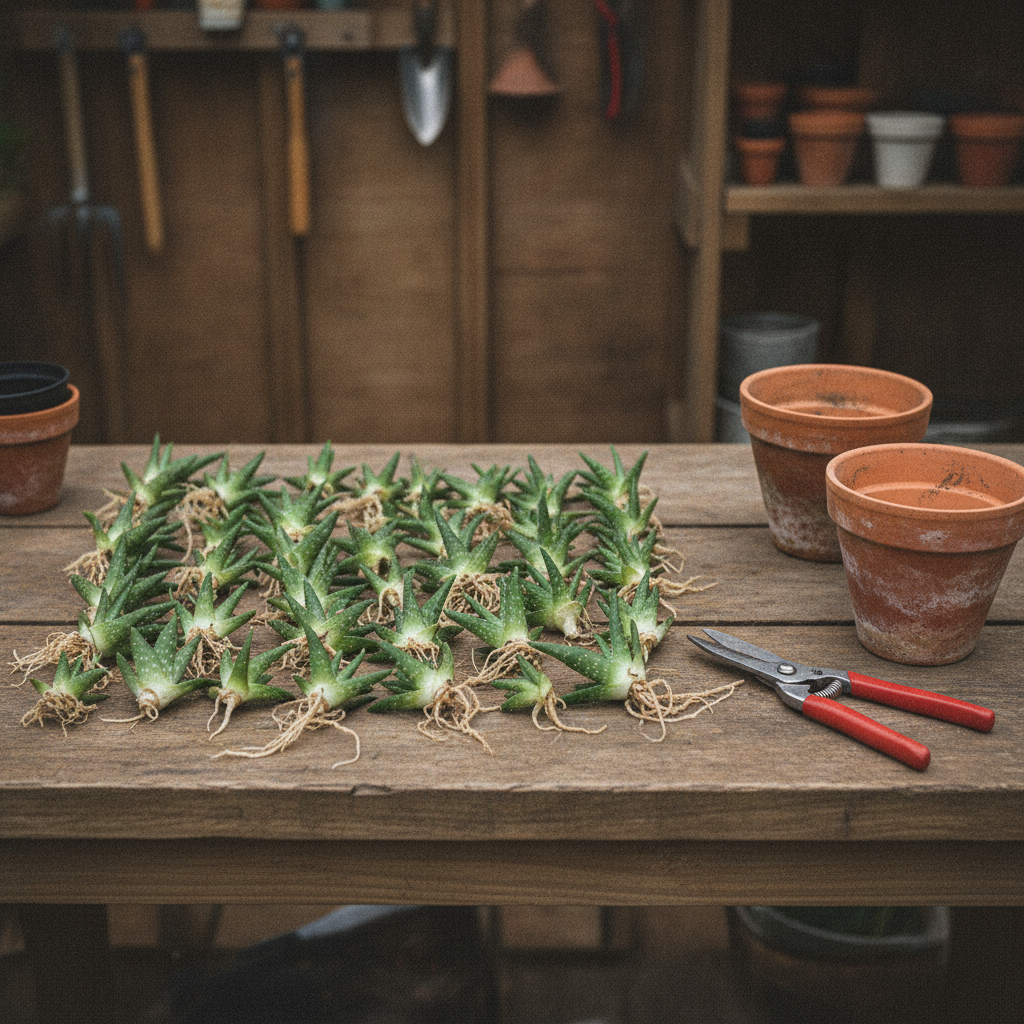
Propagation is where the tiger tooth aloe truly shines, because it does most of the work for you. The plant offsets prolifically, ringing itself with small clones known as pups, and its sprawling stems root readily wherever they touch soil. A single plant can quickly become a whole windowsill’s worth, and pups make generous, easy gifts.
The two most reliable methods are separating offsets and taking stem cuttings. Both are simple, high-success techniques that suit beginners, and both are best carried out in spring or early summer when the plant is growing actively and wounds heal fastest.
Understanding Offsets and Stems
An offset, or pup, is a genetically identical baby plant that emerges from the base of the parent, often already carrying its own small roots. Because these pups are effectively pre-formed plants, detaching one and potting it up has an extremely high success rate. The plant’s elongating, sprawling stems behave similarly: cut a length of stem and it will readily produce roots from its nodes, giving you a second, equally dependable route to new plants.
Separating Offsets: Step-by-Step
This is the easiest and most reliable method, ideally done when you are repotting the parent anyway.
- Remove the whole plant from its pot and gently brush away soil to expose where the pups join the parent.
- Locate an offset that has a few roots of its own, which gives it the best head start.
- Separate it by gently pulling it away, or by cutting the connecting tissue cleanly with a sterile knife.
- Set the pup aside in a dry, shaded spot for two to three days so the cut surface can callus over.
- Pot the callused pup into a small container of dry, gritty succulent mix.
- Wait about a week, then begin watering sparingly and place it in bright, indirect light until established.
Pro Tip — Let It Callus: The single most important step in succulent propagation is letting the cut or torn surface dry and callus before it touches soil or water. A callused wound resists the rot that kills so many fresh cuttings. Never plant a moist, open cut straight into damp compost.
Stem Cuttings: Step-by-Step
As the stems lengthen and sprawl, taking a cutting is both a way to make new plants and a handy method of tidying a leggy, stretched specimen.
- Using a clean, sharp blade, cut a healthy section of stem several centimetres long, ideally with a rosette of leaves at the tip.
- Strip away the lowest one or two leaves to expose a short length of bare stem for rooting.
- Lay the cutting in a dry, shaded place for three to five days until the cut end has thoroughly callused.
- Insert the callused end into dry, gritty succulent mix, deep enough to stand upright.
- Wait a week before giving the first light watering, then water sparingly as roots form.
- Keep in bright, indirect light and resist the urge to tug the cutting; roots usually take hold within a few weeks.
Troubleshooting Propagation
| Problem | Likely Cause | Solution |
|---|---|---|
| Cutting or pup rots | Planted before callusing, or kept too wet | Always callus first and use dry, gritty mix; water only sparingly |
| No roots forming | Too cold, too dark, or too soon to expect them | Provide warmth and bright indirect light, and be patient |
| Pup shrivels | Detached with no roots and left too dry | Give a light watering; pups with some roots establish faster |
| Cutting falls over | Not inserted deeply enough or top-heavy | Replant deeper or prop upright until rooted |
Pests & Diseases
A healthy, well-lit and correctly watered tiger tooth aloe is remarkably resistant to trouble. Most of the problems that afflict it stem not from pests arriving out of nowhere but from cultural mistakes, chiefly overwatering, that weaken the plant and open the door to disease. Still, a few sap-sucking insects can find their way onto even a robust specimen, so regular inspection is worthwhile.
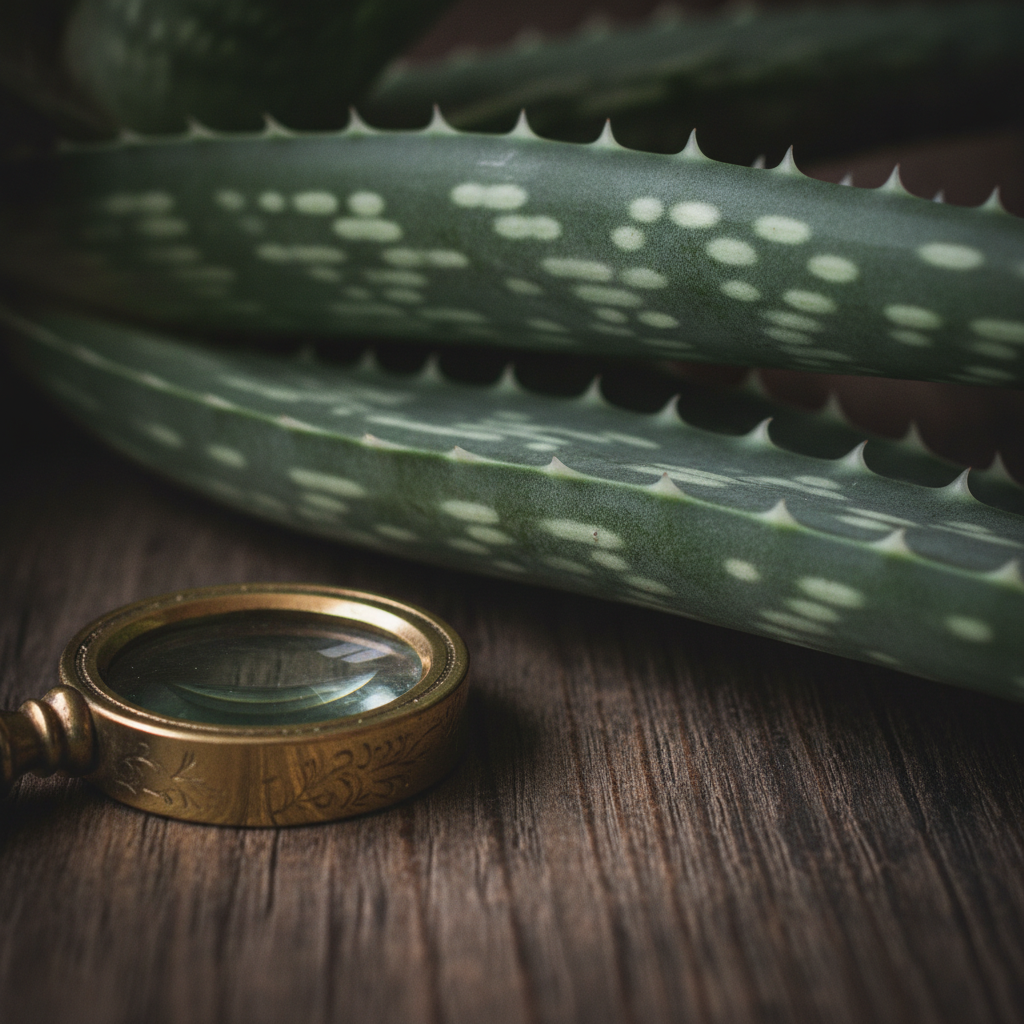
Check your plant over every week or two, paying particular attention to the crevices between the stacked leaves and the leaf axils, where pests love to hide. Catching an infestation early, when it is just a few insects, makes it far easier to deal with than a colony that has spread across the whole cluster.
Common Pests
Mealybugs (Pseudococcidae)
Mealybugs are the most common pest of tiger tooth aloe, appearing as small, white, cottony blobs tucked into the leaf axils and crevices. They suck sap, weakening the plant and leaving sticky honeydew that can turn into sooty mould.
Treatment: Dab each insect directly with a cotton bud dipped in 70 percent isopropyl alcohol, which kills them on contact. For larger infestations, spray the whole plant with diluted insecticidal soap or a neem oil solution, and repeat every week until clear.
Scale Insects (Diaspididae)
Scale appear as small, hard, brown or tan bumps stuck fast to the leaves and stems. They too feed on sap and, because their waxy shells protect them, they can be stubborn to remove.
Treatment: Scrape or rub them off gently with a fingernail or an alcohol-soaked cotton bud, then treat the plant with neem oil or insecticidal soap to catch any crawlers. Persistence over several weeks is usually needed.
Spider Mites (Tetranychus urticae)
Spider mites are tiny and hard to see, but they betray themselves with fine webbing and a stippled, dull, faintly speckled look to the leaves. They thrive in hot, dry, dusty conditions and can multiply quickly.
Treatment: Rinse the plant, then apply neem oil or a miticide, repeating at intervals to break the breeding cycle. Improving air circulation and wiping away dust helps prevent their return.
Fungus Gnats (Sciaridae)
Small black flies drifting around the pot are fungus gnats, whose larvae live in constantly moist soil and can nibble young roots. Their presence is almost always a sign that the soil is being kept too wet.
Treatment: Let the soil dry out fully, which alone breaks their life cycle, and use yellow sticky traps to catch the adults. Correcting your watering habits is the real cure.
Common Diseases
Root Rot (Pythium and Phytophthora)
By far the most serious disease of this plant, root rot is caused by fungal and water-mould pathogens that flourish in soggy soil. It shows as a soft, brown or black, mushy base and collapsing, yellowing leaves.
Treatment: Unpot the plant, cut away every trace of rotted root and stem with a sterile blade, let the healthy tissue callus for a few days, and replant in fresh, dry, gritty mix. Prevention through careful watering and good drainage is far easier than cure.
Leaf Spot and Fungal Blight (various fungi)
Brown or black sunken spots on the leaves, often in humid, stagnant conditions or where water has lodged in the rosette, indicate fungal leaf spot. It is unsightly and can spread if left unchecked.
Treatment: Remove affected leaves, improve air circulation, and keep water off the foliage. A fungicide can help in stubborn cases, but better airflow and dry leaves usually resolve it.
Pest and Disease Summary
| Pest / Disease | Identification | Treatment |
|---|---|---|
| Mealybugs | White cottony masses in leaf axils | Alcohol swab, insecticidal soap or neem oil |
| Scale | Hard brown bumps on leaves and stems | Scrape off, treat with neem oil |
| Spider mites | Fine webbing, stippled dull leaves | Rinse, neem oil or miticide, improve airflow |
| Fungus gnats | Small black flies around the soil | Let soil dry, yellow sticky traps |
| Root rot | Soft black mushy base, collapsing leaves | Cut away rot, callus, replant in dry mix |
| Leaf spot | Sunken brown or black spots on leaves | Remove leaves, improve airflow, keep dry |
Prevention Strategies
Prevention with this plant comes down to good basic culture. A tiger tooth aloe grown in bright light, gritty fast-draining soil and a pot with drainage, and watered only when dry, is rarely troubled by anything. The vast majority of its problems trace back to excess moisture, so mastering the soak-and-dry approach is the best pest and disease insurance you can have.
Beyond that, quarantine any new plants for a couple of weeks before adding them to your collection, inspect your aloe regularly so you catch issues early, and keep the growing area clean, airy and free of fallen debris. These simple habits stop most infestations before they ever begin.
Pro Tip — Neem as Routine: A light preventive spray of diluted neem oil every few weeks, applied in the evening or out of direct sun to avoid leaf burn, deters mealybugs, mites and scale before they establish. Wipe the leaves clean afterwards so the plant can breathe.
Popular Varieties
As a distinctive species in its own right, Aloe juvenna is not the subject of the sprawling cultivar breeding seen in some houseplants, but there are a few forms and close relatives worth knowing. The differences are mostly in colour and variegation rather than the underlying stacked, toothed habit that defines the plant.
It is also worth noting that the tiger tooth aloe is frequently confused with its lookalike, Aloe squarrosa, in the trade, so plants sold under one name are sometimes the other. The care, happily, is essentially identical, so a mislabelled plant is no cause for concern.
| Variety | Leaf Appearance | Light Needs | Growth Rate | Availability |
|---|---|---|---|---|
| Species form | Bright green, white-spotted, soft-toothed | High | Slow | Common |
| Variegated form | Cream and green striped, paler overall | High | Very slow | Uncommon |
| Sun-stressed form | Coppery-bronze tips and margins | Very high | Slow | Common (light-dependent) |
| Aloe squarrosa (lookalike) | Recurved, spotted, toothed leaves | High | Slow | Common, often mislabelled |
Featured Varieties
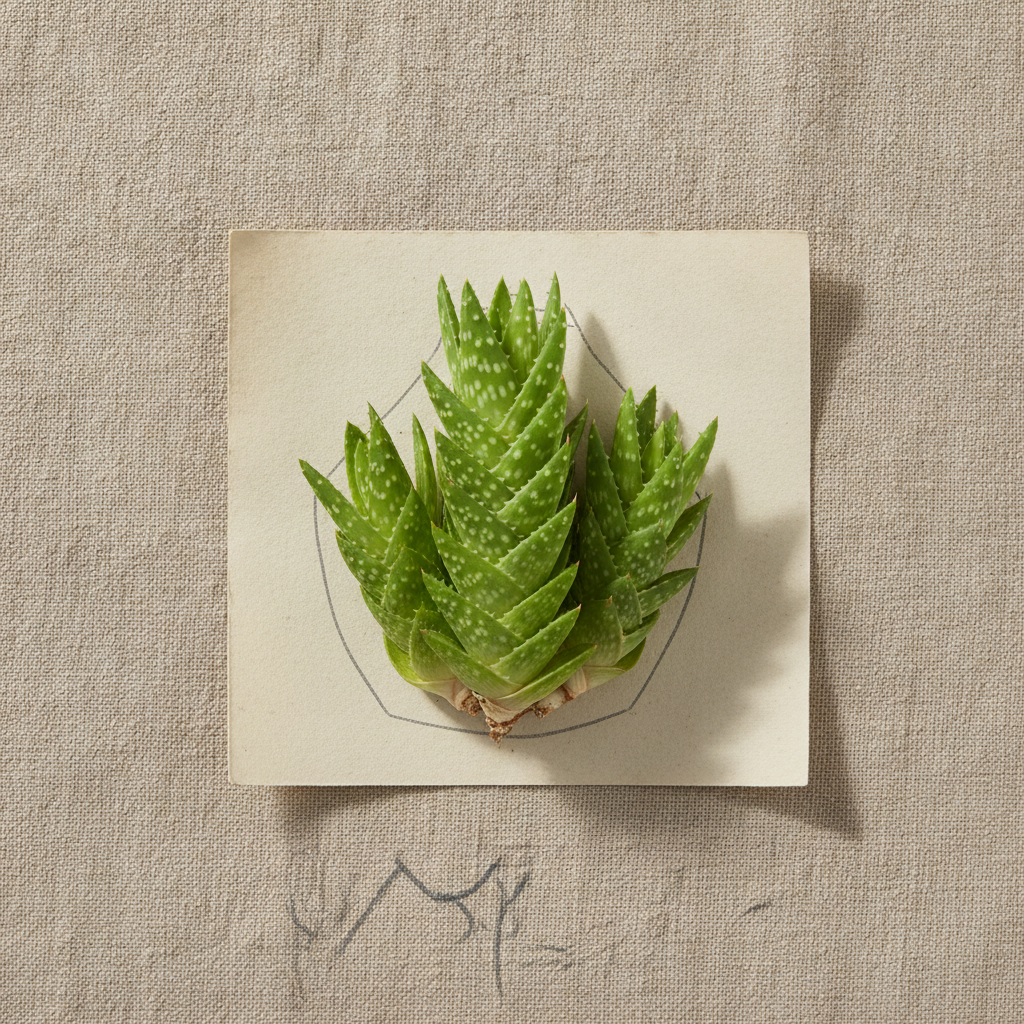
Species Form
The classic tiger tooth aloe: compact stacked columns of bright green triangular leaves flecked with raised white spots and lined with soft white marginal teeth. It is the most widely available and the most rewarding to grow well.
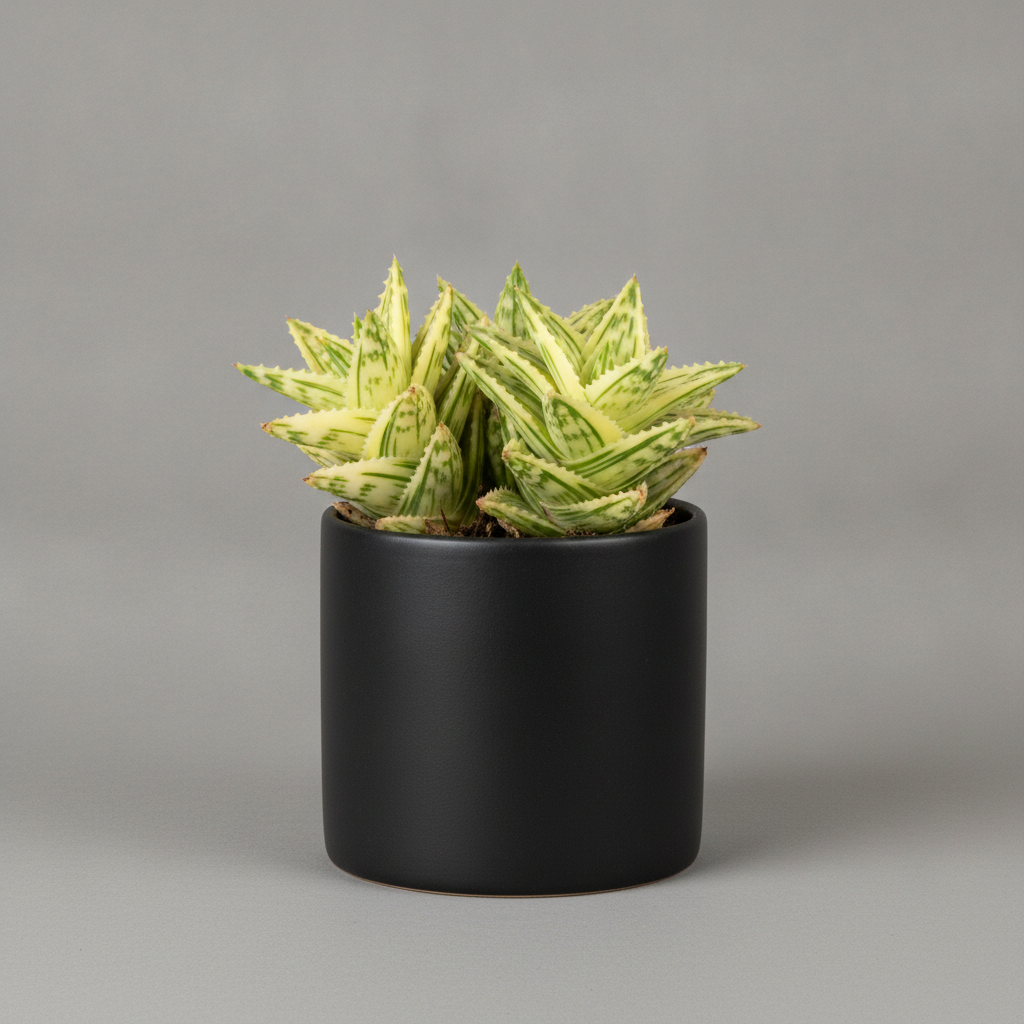
Variegated Form
A rarer, collector-favoured form in which the same stacked, toothed leaves are striped in cream-yellow and green. With less chlorophyll it grows more slowly and needs strong light to hold its markings, but it is a striking specimen.
Variety Profiles in Detail
Species Form (Aloe juvenna)
The standard species is everything most growers want: tough, compact, freely offsetting and quick to colour up in strong light. Its stacked rosettes are the definitive tiger tooth look, and it is the form you are most likely to find in garden centres and succulent shops. Given a sunny sill and lean watering, it develops beautiful bronzed tips and forms dense, sculptural clusters.
Variegated Form (Aloe juvenna variegata)
Variegated tiger tooth aloes carry irregular cream and yellow striping across their leaves. Because the pale tissue lacks chlorophyll, these plants photosynthesise less efficiently, grow noticeably slower, and demand consistently bright light to keep their variegation from reverting to plain green. They are prized by collectors and command a premium accordingly.
Aloe squarrosa (The Lookalike)
Often sold interchangeably with the tiger tooth aloe, Aloe squarrosa is a genuinely distinct species with more strongly recurved, downward-curling leaves, though at a glance the two are easily muddled. If your plant’s care matches everything in this guide, the exact label matters little, as both are dwarf, spotted, toothed aloes with the same requirements.
Choosing the Right Variety for Your Space
For most people, and especially for beginners, the plain species form is the best choice: it is affordable, widely available, fast to establish and endlessly generous with pups. If you have a very bright spot and enjoy something more unusual, the variegated form rewards the extra light and patience with standout looks. Whichever you pick, the compact size of every tiger tooth aloe makes it ideal for windowsills, desks and small collections rather than large floor displays.
Frequently Asked Questions
Why is my tiger tooth aloe stretching out and looking leggy?
Stretching, or etiolation, is almost always a sign of insufficient light. The stems elongate and the stacked leaves loosen as the plant reaches toward a brighter source. Move it to a sunnier window or add a grow light, and use the opportunity to take stem cuttings from the leggy growth to start fresh, compact plants.
Are the teeth on the leaves sharp?
No. Despite the fierce name, the white teeth along the leaf margins of a tiger tooth aloe are soft and harmless, more like little rubbery bristles than the rigid spines of a true agave. They are safe to handle and pose no real risk to hands.
Why are the leaf tips turning red or orange?
Warm red, orange and coppery tones on the tips and edges are a stress response to strong light, and they are a good sign rather than a bad one. It means the plant is receiving plenty of sun and is often considered the most attractive state for this aloe. Move it to softer light and the green returns.
How often should I water my tiger tooth aloe?
Water only when the soil has dried out completely, which typically means every two to three weeks in spring and summer and much less in winter. Rather than following a rigid schedule, check the soil and the firmness of the leaves. When in doubt, wait, as this plant tolerates drought far better than excess water.
Is the tiger tooth aloe safe for cats and dogs?
No, it is considered mildly toxic to pets. Like other true aloes it contains compounds that can cause vomiting, diarrhoea and lethargy if eaten. It is not usually dangerous in small amounts, but the plant should be kept out of reach of pets and children, and a vet consulted if a pet ingests a significant quantity.
Does the tiger tooth aloe flower indoors?
It can, though flowering indoors is uncommon and depends on the plant being mature and receiving excellent light. When it does bloom, it sends up a slender stalk bearing tubular orange to red flowers. Most people grow it for its foliage and clustering habit rather than its flowers, so blooms are a welcome bonus rather than the point.
Why is the base of my plant turning brown and mushy?
A soft, brown or black, mushy base is the classic sign of root or stem rot from overwatering. Act quickly: unpot the plant, cut away all the affected tissue with a sterile blade, let the healthy part callus for a few days, and replant in dry, gritty mix. Then reform your watering habits so it does not recur.
How big does a tiger tooth aloe get?
It is a dwarf, compact aloe that rarely exceeds about 30 centimetres (12 inches) in height, though its sprawling stems and prolific offsets mean it spreads outward into a wider clump over time. This modest size is a large part of its appeal, making it perfectly suited to windowsills, shelves and small pots.
How do I get more plants from my tiger tooth aloe?
The easiest way is to separate the pups that form around the base, ideally ones that already have a few roots, letting them callus before potting them up. You can also take stem cuttings from longer stems. Both methods have very high success rates as long as you allow the cut surfaces to callus and keep the young plants on the dry side until rooted.






