
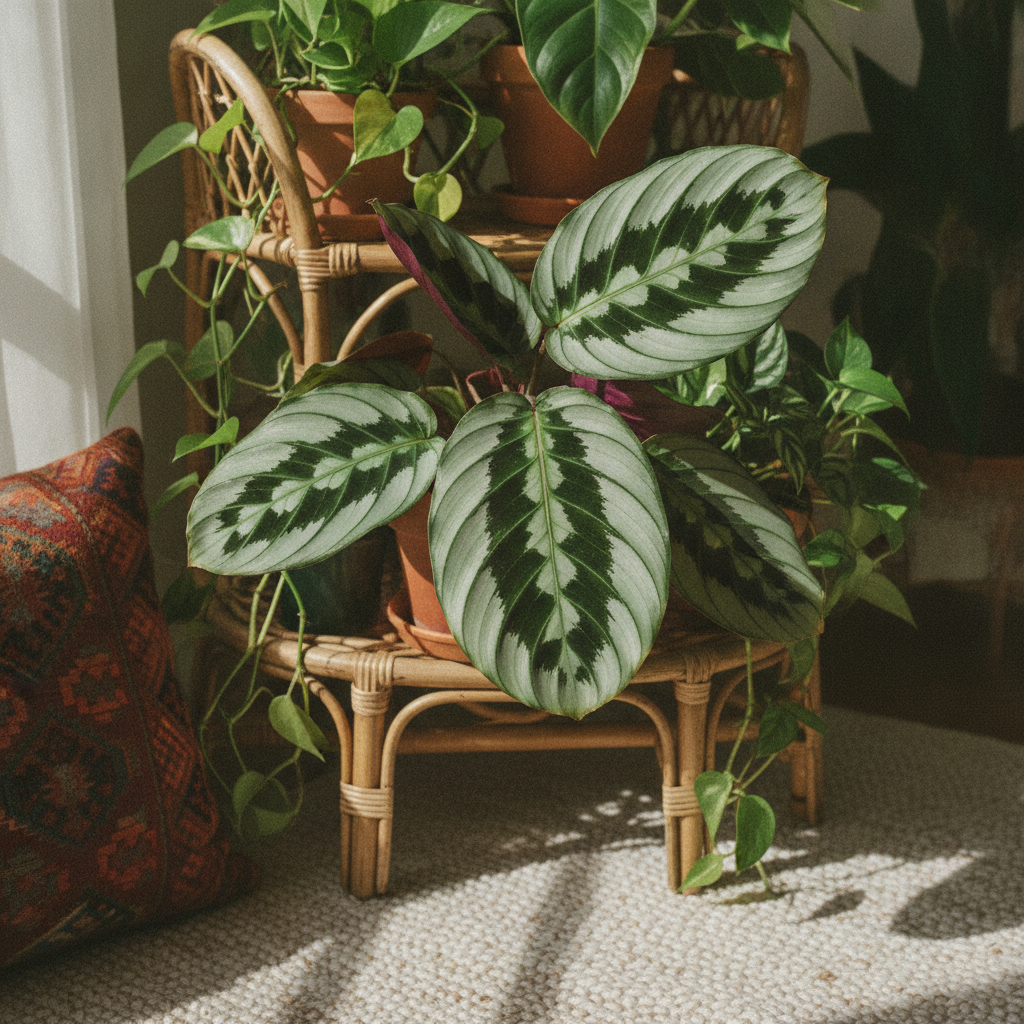
Few houseplants perform a nightly ritual quite as charming as the Silver Band Maranta, a striking form of the prayer plant Maranta leuconeura named for the luminous silvery-green stripe that feathers down the centre of every oval leaf. As dusk falls, the leaves rise and fold together like a pair of praying hands, a movement called nyctinasty that gives the whole prayer plant family its common name. Native to the humid, shaded understorey of Brazil’s tropical forests, this low-growing perennial has become a favourite of collectors who want colour and movement rather than a static green silhouette.
The Silver Band Maranta carries a reputation for being a little temperamental, and that reputation is only half deserved. It will forgive a surprising amount once its three core needs are met: steady moisture, warm humid air, and bright light that never turns harsh. This guide walks through every aspect of its care in detail, from reading the soil before you water to dividing a crowded pot, so you can move past merely keeping the plant alive and into the far more satisfying territory of watching it thrive, spread, and put out fresh banded leaves through the growing season.
Contents
- Quick Reference
- Why Silver Band Maranta Makes a Rewarding Houseplant
- Light Requirements
- Watering & Humidity
- Soil, Potting & Repotting
- Fertilising
- Propagation
- Pests & Diseases
- Popular Varieties
- Frequently Asked Questions
Quick Reference: Silver Band Maranta at a Glance
| Light | Bright indirect light; tolerates medium light, dislikes direct sun |
| Watering | Keep evenly moist; water when the top 2 to 3 cm (1 in) of soil begin to dry |
| Temperature | 18 to 27 degrees C (65 to 80 degrees F); avoid below 15 degrees C (59 degrees F) |
| Humidity | High, ideally 60 percent or above; struggles below 40 percent |
| Fertiliser | Balanced feed at half strength, every 4 weeks in spring and summer |
| Toxicity | Non-toxic to cats, dogs and humans |
Why Silver Band Maranta Makes a Rewarding Houseplant
The immediate appeal of the Silver Band Maranta is its foliage. Each leaf is a soft oval, roughly 10 to 13 cm (4 to 5 in) long, painted with a broad feathered band of pale silver-green running down the midrib, flanked by deeper green and finished with a wine-red flush on the underside. Grown well, a mature plant forms a dense, spreading mound around 20 to 30 cm (8 to 12 in) tall that trails gently over the pot rim, making it equally at home on a shelf, in a hanging planter, or as ground-level cover beneath taller plants.

Beyond looks, the plant earns its place through behaviour. The nightly folding and morning unfurling of the leaves make it feel almost like a companion rather than a decoration, and children in particular are fascinated by the change. It stays compact, so it never outgrows a modest home the way a monstera or fiddle leaf fig eventually will, and because it naturally lives on a shaded forest floor it copes with the moderate light of a real living room better than many trendier plants. It is also one of the safest choices for a household with curious pets, which removes a great deal of the anxiety that comes with collecting tropical foliage.
Important — Toxicity: The Silver Band Maranta is listed as non-toxic to both cats and dogs by the ASPCA, and it poses no poisoning risk to humans. While no plant material should be eaten, you can grow this one without fear that a nibbling pet or toddler will come to harm.
Light Requirements
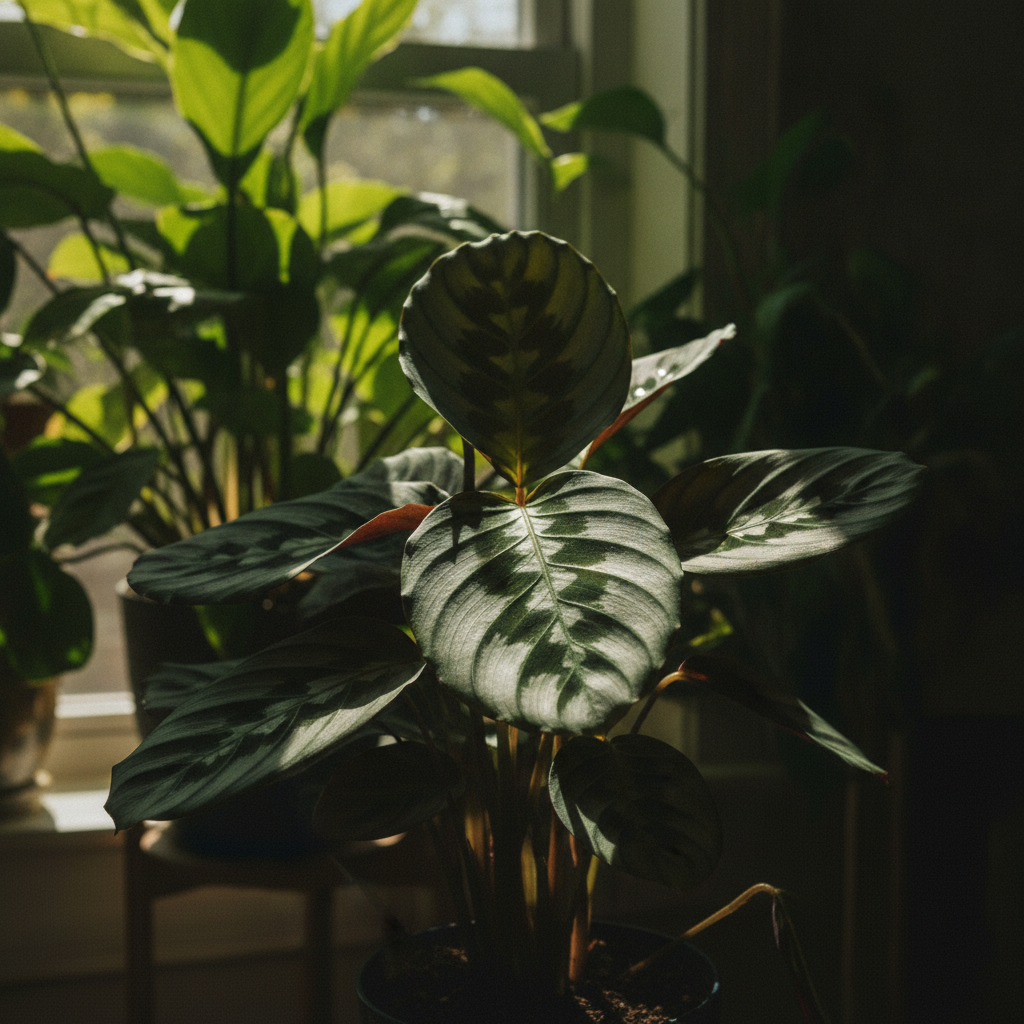
Light is the single factor that people most often get wrong with prayer plants, usually by giving too much rather than too little. In its native habitat the Silver Band Maranta grows beneath a dense canopy, receiving only the dappled, filtered light that reaches the forest floor. Replicating that indoors means bright but indirect light, the kind you find a short distance back from a window or beside one screened by a sheer curtain.
In the right light the leaves keep their contrast crisp, the silver band stays vivid, and the plant holds a compact, full shape. Too little light and growth slows to a crawl while the markings fade and the stems stretch and thin as they reach for the window. Too much direct sun, and the delicate leaves scorch within days, bleaching to a papery beige that never recovers.
Light Levels Explained
Because indoor light is far dimmer than most people assume, it helps to think in rough categories. The table below sets out how the Silver Band Maranta responds across the range you are likely to encounter in a home.
| Light Category | Approx. Level | Typical Location | Outcome |
|---|---|---|---|
| Direct sun | Over 50,000 lux | On a south windowsill | Leaves scorch and bleach; avoid |
| Bright indirect | 10,000 to 20,000 lux | 1 to 2 m from a bright window | Ideal; strong colour, compact growth |
| Medium | 5,000 to 10,000 lux | Interior of a well-lit room | Good; slightly slower growth |
| Low | 1,000 to 2,500 lux | Away from windows, north rooms | Survives; leggy, faded markings |
| Very low | Under 1,000 lux | Hallways, windowless corners | Decline over time; not advised |
Window Orientation and Placement
South-facing window: The brightest exposure in the northern hemisphere and generally too intense right at the glass. Place the plant at least 1.5 to 2 m (5 to 6 ft) back, or diffuse the light with a sheer curtain so the leaves never feel direct rays.
East-facing window: Often the best choice. The gentle morning sun is weak enough not to scorch, and the bright indirect light through the rest of the day suits the plant perfectly. It can sit close to an east window with no trouble.
West-facing window: Workable, but the afternoon sun here is strong. Keep the plant a little back from the glass or filter the harshest hours so late-day light does not burn the foliage.
North-facing window: Provides soft, even light with no risk of scorch, which the plant appreciates, though in a dim north room growth will be slower and you may need to supplement with a grow light through winter.
Pro Tip — Read the Leaves: The plant tells you when the light is wrong. Faded, washed-out bands and long bare stretches of stem mean it wants more light, while crisp pale patches or curling edges signal too much. Adjust position gradually, moving the pot 30 cm (1 ft) at a time and waiting a week to judge the result.
How Light Affects Leaf Colour and Movement
The vivid silver banding depends on balanced light. In good bright indirect conditions the pigments develop fully and the contrast between the silvery centre and the dark margins is at its sharpest. In dim light the plant redirects energy into simply reaching for brightness, and the markings dull as leaves space themselves further apart. Light also drives the nightly prayer movement; a plant kept in near darkness loses the rhythm, and one shocked by sudden bright light may hold its leaves half-folded during the day as a stress response.
Warning — Direct Sunlight: Even an hour of direct midday sun can permanently scorch prayer plant leaves, leaving dry beige patches that will not green up again. If you move the plant to a brighter spot, watch it closely for the first few days and pull it back at the first sign of bleaching.
Artificial Lighting
The Silver Band Maranta responds very well to artificial light, which makes it a strong candidate for offices and darker rooms. A full-spectrum LED grow light positioned 30 to 45 cm (12 to 18 in) above the plant and run for 10 to 12 hours a day will keep it healthy through the darkest months. Because the plant is naturally low-light adapted, you do not need a powerful horticultural fixture; a modest LED is plenty, and it will happily grow under a mix of grow light and ambient room light.
Seasonal Adjustments
As daylight shortens through autumn and winter, light levels at any given spot can drop by more than half. Move the plant closer to its window for the cooler months, then step it back again in spring as the sun strengthens. This seasonal shuffle keeps the light roughly constant year round and prevents the leggy winter growth that so often spoils a maranta’s shape.
Watering & Humidity
Watering is where the Silver Band Maranta demands the most attention. Unlike a succulent that wants to dry out fully, this plant likes its soil to stay lightly and consistently moist, never soggy and never bone dry. The roots are fine and thirsty, and both extremes cause visible damage quickly, so the goal is a steady rhythm rather than a fixed schedule.
When to Water
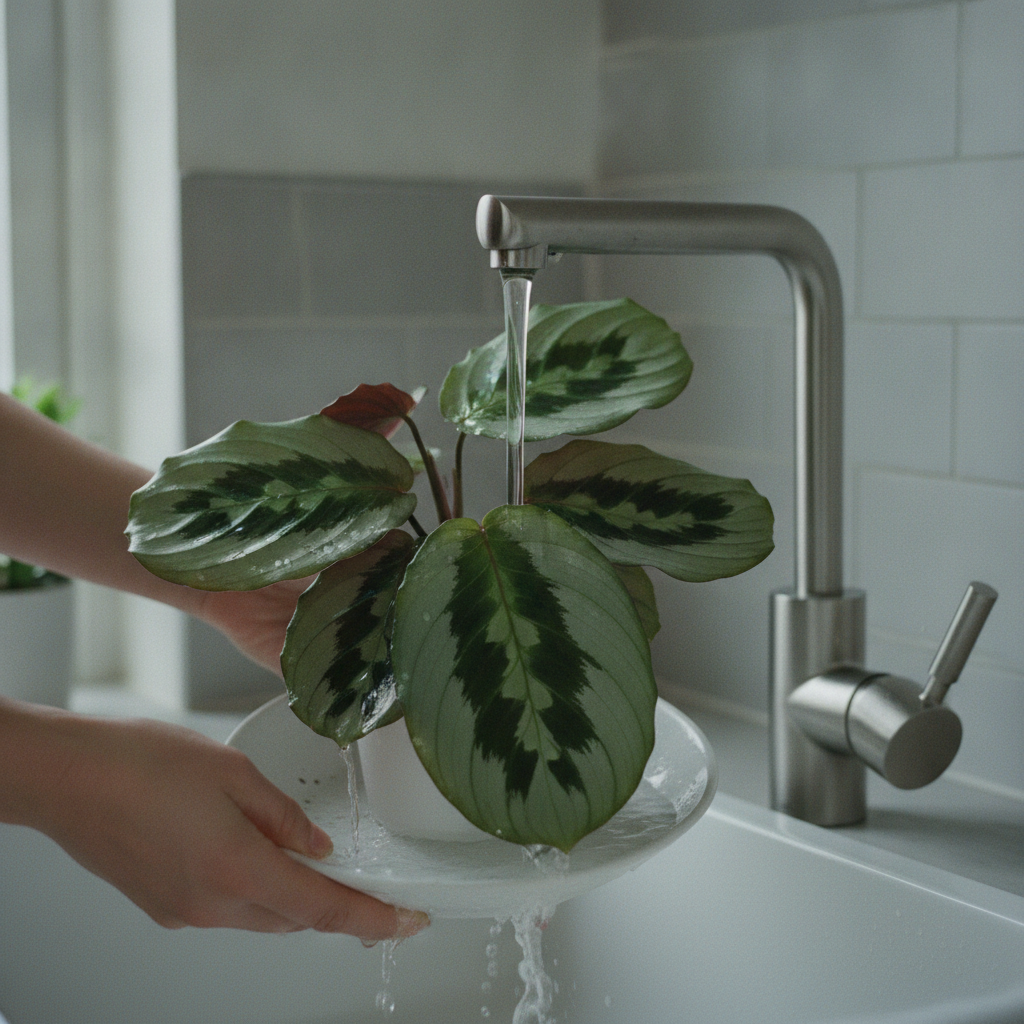
Check the plant every few days by pushing a finger into the top of the pot. When the top 2 to 3 cm (about 1 in) of soil begins to feel dry, it is time to water. In the warmth and light of spring and summer this may mean watering twice a week, while in the cooler, dimmer winter months it can stretch to once a week or less. Let the plant and its conditions set the pace rather than watering on a rigid calendar.
The soil should never dry out entirely between waterings. If the whole pot goes dry the leaf edges crisp and curl, and the plant may drop lower leaves. Equally, water sitting in the base of the pot for days on end will suffocate and rot the roots. The narrow target between those two failures is exactly why consistency matters so much for this species.
Pro Tip — Lift the Pot: Weight is a more reliable guide than the surface alone. Learn how heavy the pot feels right after watering and again when it is ready for more. A quick lift soon tells you the moisture level through the whole root ball without any guesswork.
How to Water Correctly
- Use room-temperature water, as cold water can shock the sensitive roots and cause the leaves to curl.
- Pour slowly and evenly across the whole soil surface, not just in one spot, until it runs freely from the drainage holes.
- Let the pot drain fully for several minutes so no water remains trapped at the bottom.
- Tip away anything that collects in the saucer or cachepot; the plant should never sit in standing water.
- Return the plant to its spot and check again in a few days, adjusting frequency to the season.
Signs of Overwatering vs. Underwatering
| Symptom | Overwatering | Underwatering |
|---|---|---|
| Leaf colour | Yellowing, often across whole leaves | Browning, crisp tips and edges |
| Leaf texture | Soft, limp, sometimes translucent | Dry, curled and papery |
| Soil | Wet, heavy, may smell sour | Dry, shrunken, pulling from the pot |
| Roots | Brown, mushy, foul-smelling | Dry and brittle but pale |
| Stem base | Soft and darkened near the soil | Firm but growth stalls |
Warning — Root Rot: Persistent overwatering leads to root rot, the most common killer of prayer plants. If the soil smells sour and the stem base feels soft, unpot the plant at once, cut away any brown mushy roots with clean scissors, and repot into fresh, barely moist mix. Caught early, most plants recover.
Humidity Requirements
Humidity is nearly as important as watering for this rainforest native. The Silver Band Maranta wants relative humidity of 60 percent or higher and starts to suffer once the air drops below about 40 percent, which is common in centrally heated homes through winter. High humidity keeps the leaf edges soft and whole and supports steady new growth.
The clearest sign that the air is too dry is browning, crisping leaf tips and edges, sometimes with a thin yellow halo where the healthy tissue meets the dead. Slowed growth and leaves that fail to unfurl neatly are secondary clues. These symptoms often appear at the same time of year the heating comes on, which points squarely at humidity rather than watering.
To raise humidity, group the plant with other foliage so they share moisture, stand it on a wide tray of pebbles topped up with water that sits just below the pot base, or run a small room humidifier nearby, which is by far the most effective option. A steamy bathroom with enough light also suits it well. Misting offers only a brief lift and can encourage fungal spots if the leaves stay wet, so it is not a reliable substitute for genuinely humid air.
Water Quality
Prayer plants are unusually sensitive to the minerals and additives in tap water. Fluoride and chlorine in particular tend to accumulate and show up as browning leaf tips even when watering and humidity are correct. If your tap water is heavily treated, switch to filtered or distilled water, or leave tap water to stand uncovered overnight so some of the chlorine can dissipate. Rainwater, where clean, is an excellent free alternative.
Soil, Potting & Repotting
The right soil resolves the central tension in maranta care: it must hold enough moisture to keep the roots evenly damp, yet drain freely enough that they never sit in water. A dense, water-logging compost is a fast route to root rot, while a gritty cactus mix dries out far too quickly for this thirsty plant.
Ideal Soil Composition
Aim for a light, organic-rich mix that stays moist but breathes. A good blend combines a peat-free base for water retention with perlite for aeration and drainage, plus a portion of fine bark or coir to keep the structure open. The result should feel spongy and airy rather than heavy and compacted.
| Component | Proportion | Function |
|---|---|---|
| Peat-free potting compost or coco coir | 50 percent | Holds moisture and nutrients |
| Perlite | 25 percent | Improves aeration and drainage |
| Fine orchid bark | 15 percent | Keeps the mix open and airy |
| Worm castings or leaf mould | 10 percent | Adds gentle, slow nutrition |
The Silver Band Maranta prefers a slightly acidic soil, roughly pH 5.5 to 6.5, which most peat-free houseplant composts fall within naturally. There is no need to test or adjust pH for a healthy plant, but if you use very hard tap water over a long period the soil can drift alkaline, which is another reason to favour filtered or rainwater.
Pro Tip — Quick Mix Recipe: For a reliable no-fuss blend, stir together two handfuls of peat-free houseplant compost, one handful of perlite, and half a handful of fine bark. It hits the moisture-holding, free-draining balance a prayer plant wants without any specialist ingredients.
Choosing the Right Pot
Because the Silver Band Maranta has a shallow, spreading root system, it does better in a wide, relatively shallow pot than in a tall deep one. A container only slightly larger than the root ball keeps the soil from staying wet in unused corners.
Drainage holes are non-negotiable. Whatever the material or style, the pot must have holes in the base so excess water can escape. A decorative cachepot without holes is fine as an outer cover, provided you lift the inner pot out to water and drain it, then tip away anything that pools below.
Pot material: Plastic and glazed ceramic hold moisture well and suit this moisture-loving plant. Unglazed terracotta wicks water away through its walls and dries out faster, so if you love the look of terracotta be prepared to water more often to compensate.
Pot size: Move up only one size, around 2 to 4 cm (1 to 2 in) more in diameter, when repotting. An oversized pot holds a reservoir of wet soil the small roots cannot use, which invites rot rather than encouraging growth.
When to Repot
The Silver Band Maranta is a slow, modest grower and only needs repotting every one to two years, usually in spring as growth resumes. Signs it is ready include roots creeping through the drainage holes, water running straight through without wetting the soil, or the plant becoming visibly crowded and top-heavy. Repotting is also the ideal moment to divide a large clump, described in the propagation section below.
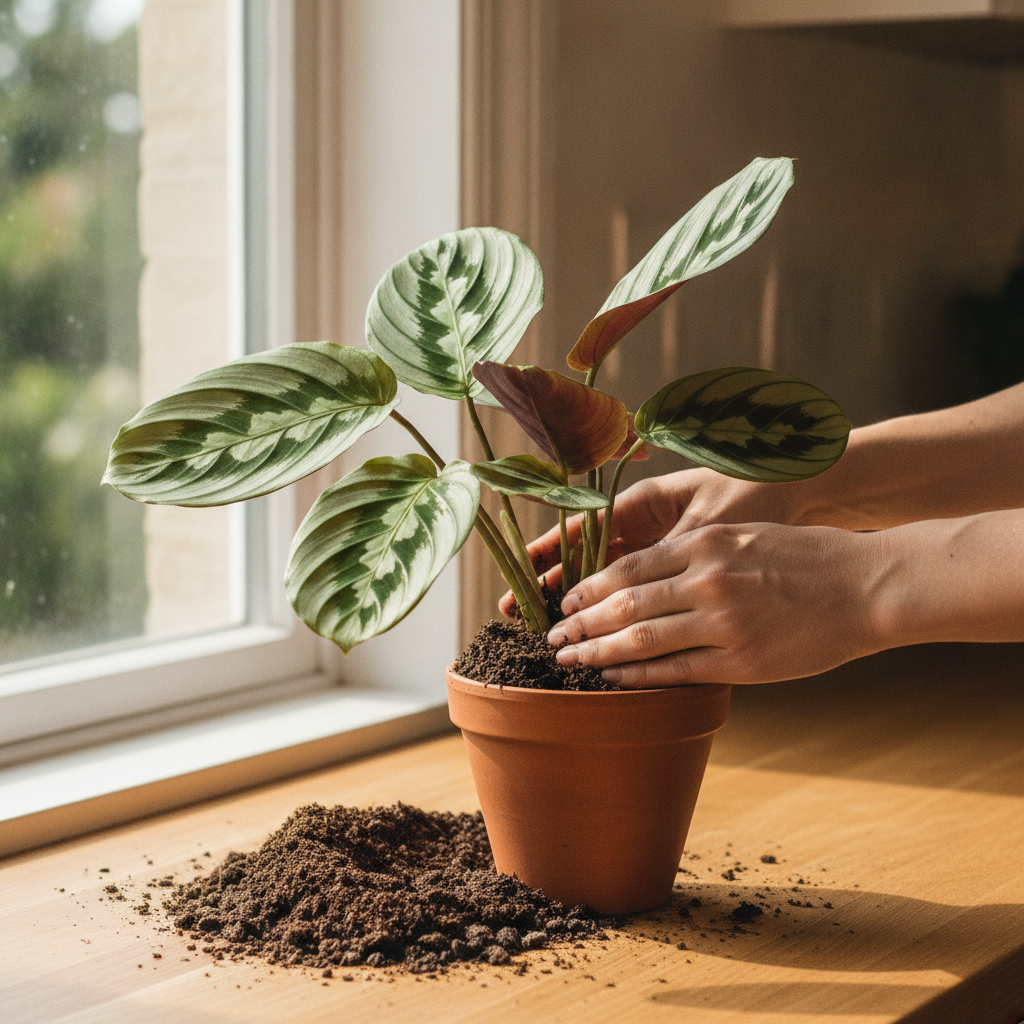
How to Repot: Step-by-Step
- Water the plant a day before repotting so the root ball is moist and holds together.
- Ease the plant out by tipping the pot and supporting the base of the stems, rather than pulling on the foliage.
- Gently tease apart the outer roots and remove any that are brown, mushy or dead.
- Add a layer of fresh mix to the new pot, then set the plant so its soil line sits at the same depth as before.
- Fill around the root ball with fresh mix, pressing lightly to remove air pockets without compacting it hard.
- Water thoroughly to settle the soil, let it drain, and top up any mix that sinks.
- Return the plant to its usual spot and keep humidity high while it re-establishes.
Warning — Transplant Shock: Expect a little sulking after repotting, with some leaf curling or drooping for a week or two. Resist the urge to fix it with extra water or feed. Keep conditions stable and humid, and the plant will settle on its own once new roots take hold.
Fertilising
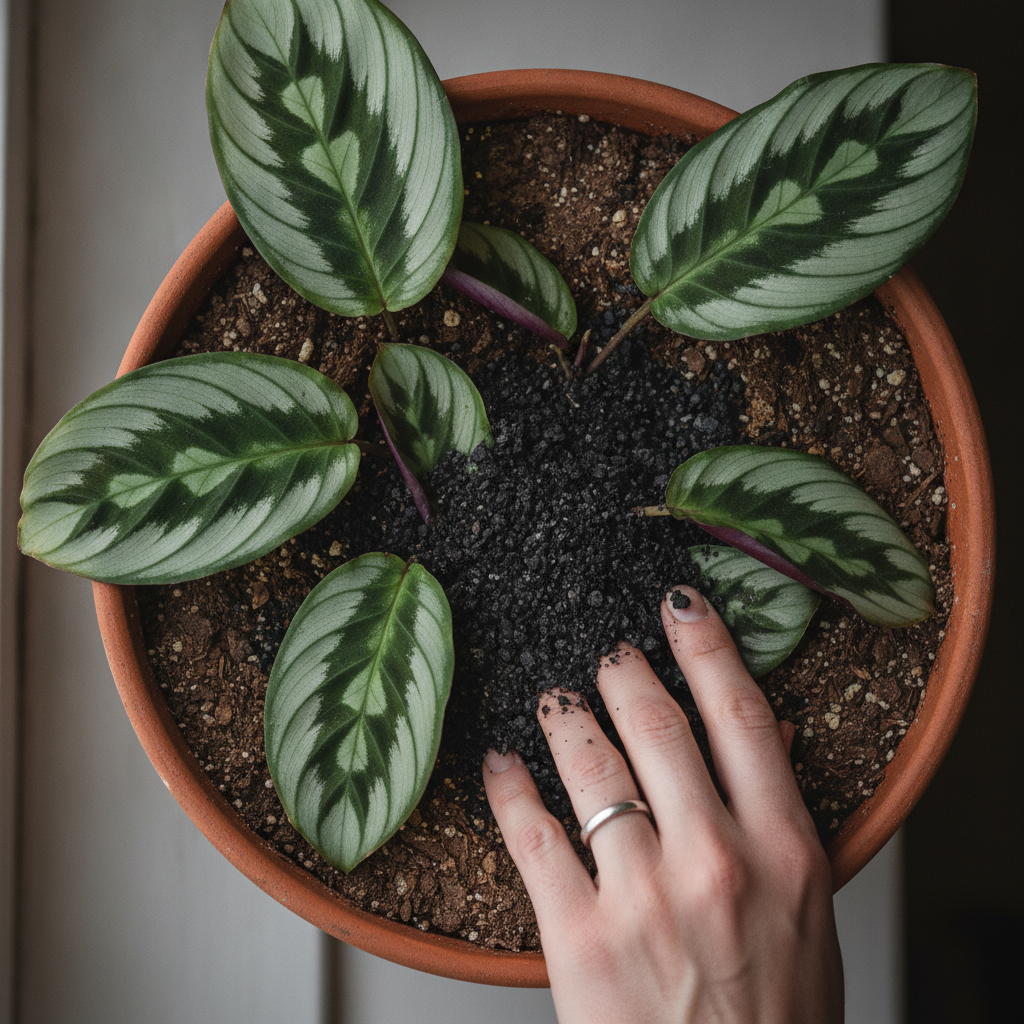
The Silver Band Maranta is a light feeder that draws steady, modest nutrition from its soil rather than needing heavy doses. In the wild it lives on the slow trickle of nutrients released by decaying leaf litter, and the closest indoor equivalent is a gentle, regular feed through the growing season at well below full strength.
Feeding matters most in spring and summer when the plant is actively producing new leaves. During autumn and winter growth naturally slows, and continuing to feed at that point simply loads the soil with unused salts that damage the sensitive roots.
Understanding Plant Nutrients
Most houseplant fertilisers list three numbers, the N-P-K ratio, showing the proportion of nitrogen, phosphorus and potassium. For a foliage plant like this one a balanced ratio works well, supporting leaf growth without pushing it too hard. The secondary nutrients below round out what the plant needs and explain the deficiency symptoms you might see.
| Nutrient | Symbol | Primary Function | Deficiency Symptoms |
|---|---|---|---|
| Nitrogen | N | Leaf and stem growth, green colour | Pale, yellowing older leaves |
| Phosphorus | P | Root development and energy | Weak roots, stunted growth |
| Potassium | K | Overall vigour and water regulation | Yellow or brown leaf margins |
| Calcium | Ca | Cell wall strength | Distorted, weak new growth |
| Magnesium | Mg | Core of the chlorophyll molecule | Yellowing between leaf veins |
| Iron | Fe | Chlorophyll production | Pale new leaves with green veins |
Types of Fertiliser
Liquid fertilisers: The easiest option to control, mixed into water and applied while feeding. Diluting to half the recommended strength suits this salt-sensitive plant and lets you feed little and often through the growing season.
Slow-release granular: Coated prills that release nutrients gradually over months. Convenient, but they give you less control over dosage, so use them sparingly and at the lower end of the label rate for a light feeder like this.
Organic fertilisers: Worm castings, diluted seaweed and compost teas feed gently and improve soil life, making them well matched to a prayer plant’s preference for a slow, natural supply. A thin top-dressing of castings once or twice a season is often all it needs.
Feeding Schedule
Feed roughly every four weeks from spring through late summer with a balanced liquid fertiliser at half strength. Stop feeding entirely from autumn into winter while growth is dormant. Always apply feed to already-moist soil, never to a dry root ball, so the nutrients spread evenly and the roots are protected.
Pro Tip — Less Is More: With prayer plants, under-feeding is far safer than over-feeding. If in doubt, dilute further and feed less often. A slightly hungry maranta stays healthy, while an over-fed one develops scorched leaf edges from salt build-up that mimic the symptoms of dry air.
How to Fertilise
- Water the plant lightly first, or feed straight after a normal watering, so the soil is already moist.
- Mix a balanced liquid fertiliser to half the label strength in room-temperature water.
- Pour the solution evenly over the soil until it just begins to drain, avoiding the leaves.
- Let the pot drain fully and empty any run-off from the saucer.
- Flush the soil with plain water every couple of months to wash out accumulated salts.
Warning — Salt Build-Up: A white crust on the soil surface or around the pot rim signals fertiliser salts accumulating in the mix. Flush the soil by running plenty of plain water through it until it drains clear, which resets the balance and spares the roots from chemical burn.
Propagation
Propagating the Silver Band Maranta is one of the most satisfying parts of growing it, and it is genuinely easy once you understand where new roots and shoots come from. A single healthy plant can become several within a season, whether to fill out a fuller pot, to share, or simply to insure against losing the parent.
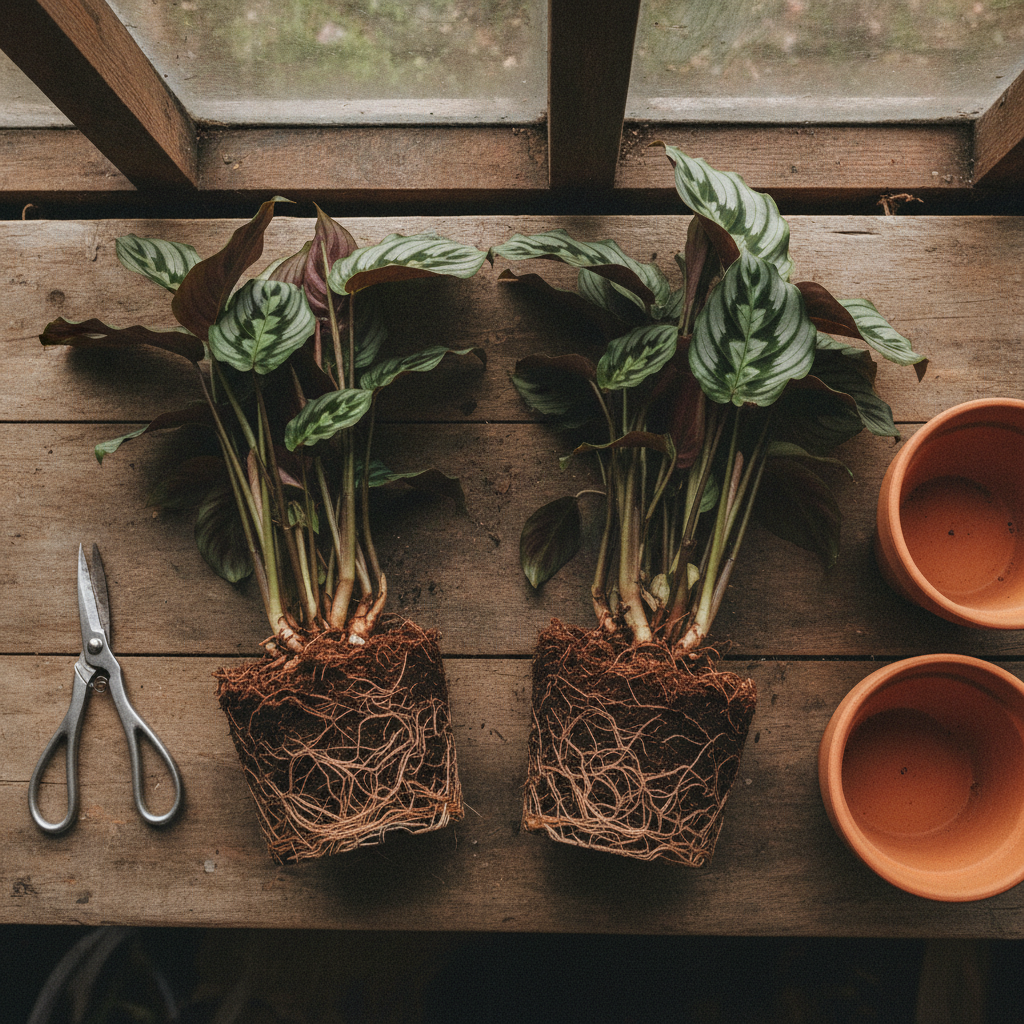
Two methods work reliably: dividing a mature clump at the roots, and taking stem cuttings that root at the leaf nodes. Division gives you instant, established plants, while cuttings let you multiply from a single crown. Both are best done in spring or early summer when the plant is growing actively and recovers fastest.
Understanding Nodes and Crowns
The Silver Band Maranta grows from a spreading crown, a cluster of stems that emerge together at soil level, and each stem carries nodes, the slightly swollen points where a leaf meets the stem. Nodes are where new roots form on a cutting, so any cutting must include at least one. The crown is where natural divisions occur, as an established plant produces several separate clumps that can be gently pulled apart with their own roots intact.
Division: Step-by-Step
Division is the quickest, most reliable method and pairs naturally with spring repotting. It suits a plant that has grown into a full, crowded clump.
- Water the plant the day before so the roots are hydrated and the soil loosens easily.
- Slide the whole plant out of its pot and brush away enough soil to see the natural clumps of stems.
- Gently work the root ball apart into two or three sections, each with a healthy share of both roots and stems.
- Tease stubborn roots free with your fingers, or cut cleanly with sterilised scissors where they will not separate.
- Pot each division into its own container of fresh, barely moist mix at the same depth it grew before.
- Water in, then keep the new plants warm, humid and out of direct sun while they settle.
Pro Tip — Divide at Repotting: There is no better moment to divide than when you are already repotting. The plant is out of its pot, the roots are exposed, and it is bracing for a settling-in period anyway, so you combine two disturbances into one and lose no extra growing time.
Stem Cuttings: Step-by-Step
Stem cuttings let you multiply from a single plant without unpotting it, and they root readily in either water or moist mix. Choose healthy stems with at least one node and a leaf or two.
- Using clean, sharp scissors, cut a stem just below a node, keeping 8 to 10 cm (3 to 4 in) of stem and one or two leaves.
- Remove any lower leaves so the node itself sits bare and will be below the water or soil line.
- Place the cutting in a glass of room-temperature water, or insert it into a small pot of moist propagation mix.
- Keep it warm and bright but out of direct sun, changing the water every few days if rooting in water.
- Roots usually appear within two to four weeks; once they reach 3 to 5 cm (1 to 2 in), pot water-rooted cuttings into soil.
- Grow the young plant on with high humidity until it is established and putting out new leaves.
Troubleshooting Propagation
| Problem | Likely Cause | Solution |
|---|---|---|
| Cutting rots in water | Stale water or no node submerged | Change water often; ensure a node sits below the surface |
| No roots after a month | Too cold or too dark | Move somewhere warmer and brighter; be patient |
| Division wilts badly | Too few roots per section or dry air | Keep humidity very high; do not divide too small |
| Leaves crisp on cuttings | Low humidity during rooting | Enclose in a clear bag or propagator to hold moisture |
Pests & Diseases
A healthy, well-cared-for Silver Band Maranta is reasonably resistant to trouble, but the same warm, humid conditions it loves also suit several common houseplant pests. The thin, tender leaves are especially attractive to sap-suckers, and dry indoor air makes spider mites a recurring threat.
The best defence is regular inspection. Turn a few leaves over each time you water and look along the stems and leaf axils, because catching an infestation in its first days makes it far easier to clear than a colony that has spread across the whole plant.
Common Pests
Spider Mites (Tetranychus urticae)
The most frequent pest of prayer plants, thriving in dry air. They are tiny and hard to see, but the fine webbing they spin between leaves and stems, along with a faint pale stippling on the upper leaf surface, gives them away. Left unchecked they weaken and yellow the foliage.
Treatment: Rinse the plant thoroughly, raise humidity to make conditions hostile to the mites, and treat with insecticidal soap or neem oil every five to seven days until the webbing is gone.
Mealybugs (Pseudococcus longispinus)
Small, soft-bodied insects that look like specks of white cotton wool tucked into leaf axils and along the stems. They suck sap and excrete sticky honeydew, which can lead to sooty mould, and populations build quietly if not addressed.
Treatment: Dab each insect directly with a cotton bud dipped in isopropyl alcohol, then follow up with neem oil or insecticidal soap and re-check weekly for stragglers.
Aphids (Aphis gossypii)
Small green, black or pink insects that cluster on soft new growth and the undersides of young leaves. They distort emerging foliage and, like mealybugs, leave a sticky honeydew residue behind.
Treatment: Knock them off with a firm spray of water, then treat with insecticidal soap or neem oil, repeating until no new colonies appear.
Common Diseases
Root Rot (Pythium and Phytophthora)
By far the most serious disease, caused by soil that stays waterlogged. The roots turn brown and mushy, the lower stems soften, leaves yellow and wilt, and the soil may smell sour. Untreated it kills the plant from the roots up.
Treatment: Unpot the plant, cut away all rotten roots with sterilised scissors, and repot into fresh, free-draining mix. Water more cautiously afterwards and improve drainage to prevent a recurrence.
Leaf Spot (Helminthosporium)
A fungal disease showing as small water-soaked spots that enlarge into brown or tan lesions, sometimes ringed with yellow. It spreads when leaves stay wet for long periods, particularly in still, overly humid air.
Treatment: Remove affected leaves, improve air circulation, and avoid wetting the foliage when watering. A copper-based fungicide can help in stubborn cases.
Pest and Disease Summary
| Pest / Disease | Identification | Treatment |
|---|---|---|
| Spider mites | Fine webbing, pale stippling | Rinse, raise humidity, neem oil |
| Mealybugs | White cottony clusters in axils | Alcohol swab, then insecticidal soap |
| Aphids | Insect clusters on new growth | Rinse off, treat with neem oil |
| Root rot | Mushy brown roots, sour soil | Trim roots, repot, water less |
| Leaf spot | Brown lesions with yellow halos | Remove leaves, improve airflow |
Prevention Strategies
Prevention comes down to good routine care. A plant grown in the right light, watered correctly and kept humid is far less likely to attract pests or fall to disease than a stressed one. Quarantine any new plant for a couple of weeks before it joins your collection, and inspect it closely, since most infestations arrive on a newcomer.
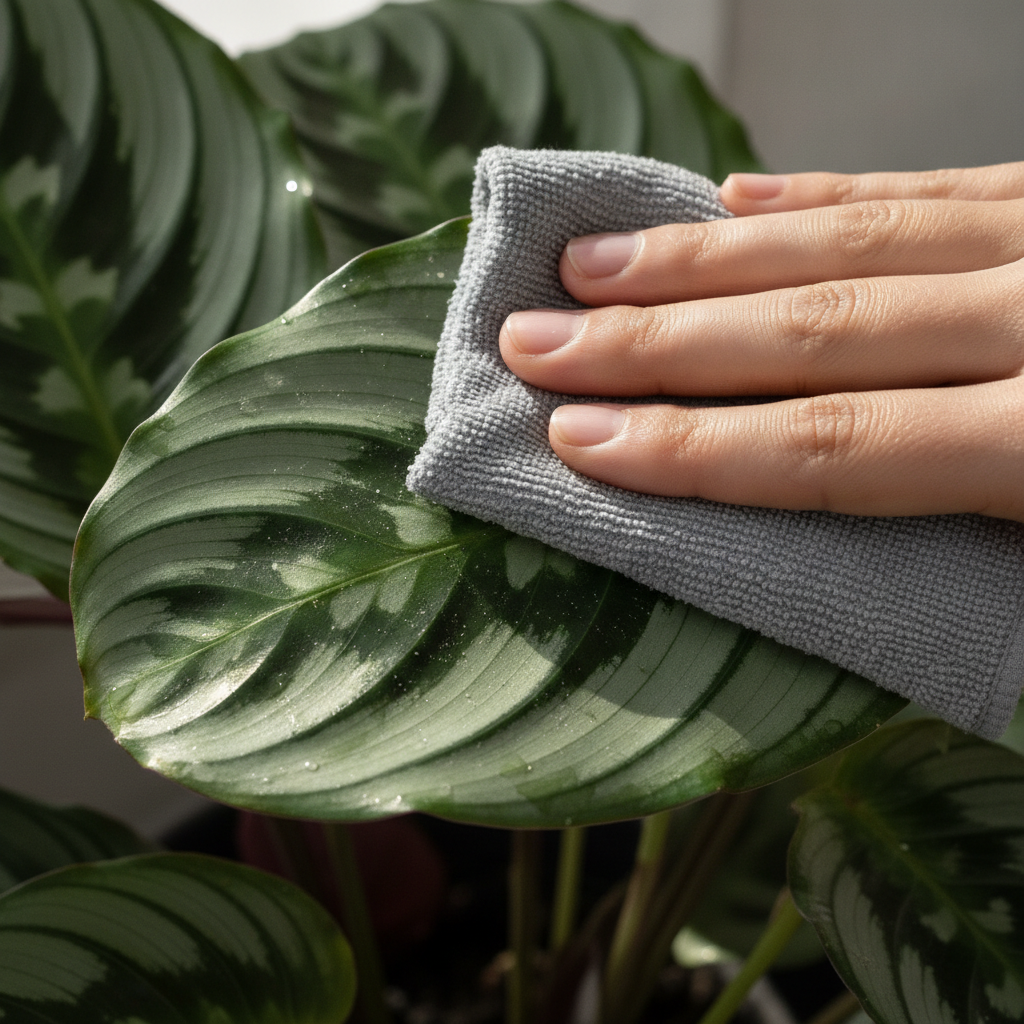
Keep the leaves clean by wiping them gently now and then, which removes dust, improves the plant’s breathing, and doubles as a regular pest check. Good air movement, sensible spacing between plants and prompt removal of any damaged leaves all reduce the conditions that fungal problems need to take hold.
Pro Tip — Neem as Routine: A light monthly spray of diluted neem oil, applied in the evening so the leaves are not in sun, works as a gentle preventative that deters most sap-sucking pests before they ever establish. Always test on one leaf first and keep the plant out of direct light until it dries.
Popular Varieties
The Silver Band Maranta belongs to the species Maranta leuconeura, which has given rise to several distinct and much-loved cultivars. They share the same easy-going care but differ strikingly in leaf pattern and colour, so once you have mastered one the others open up as natural companions.
The two most famous relatives are the Rabbit’s Foot Prayer Plant and the Red Herringbone Prayer Plant, both of which are widely sold and instantly recognisable. The table and profiles below set the Silver Band alongside its best-known cousins to help you tell them apart and choose the right one.
| Variety | Leaf Appearance | Light Needs | Growth Rate | Availability |
|---|---|---|---|---|
| Silver Band | Silvery-green central band, dark margins | Bright indirect | Moderate | Common |
| Kerchoveana (Rabbit’s Foot) | Pale green with dark chocolate blotches | Bright indirect | Moderate | Very common |
| Erythroneura (Red Herringbone) | Dark green, lime centre, red veins | Bright indirect | Moderate | Very common |
| Massangeana | Blackish green with silver feathering | Bright indirect | Slow | Occasional |
| Fascinator | Bold red veins over green and cream | Bright indirect | Moderate | Common |
Featured Varieties
Kerchoveana (Rabbit’s Foot)
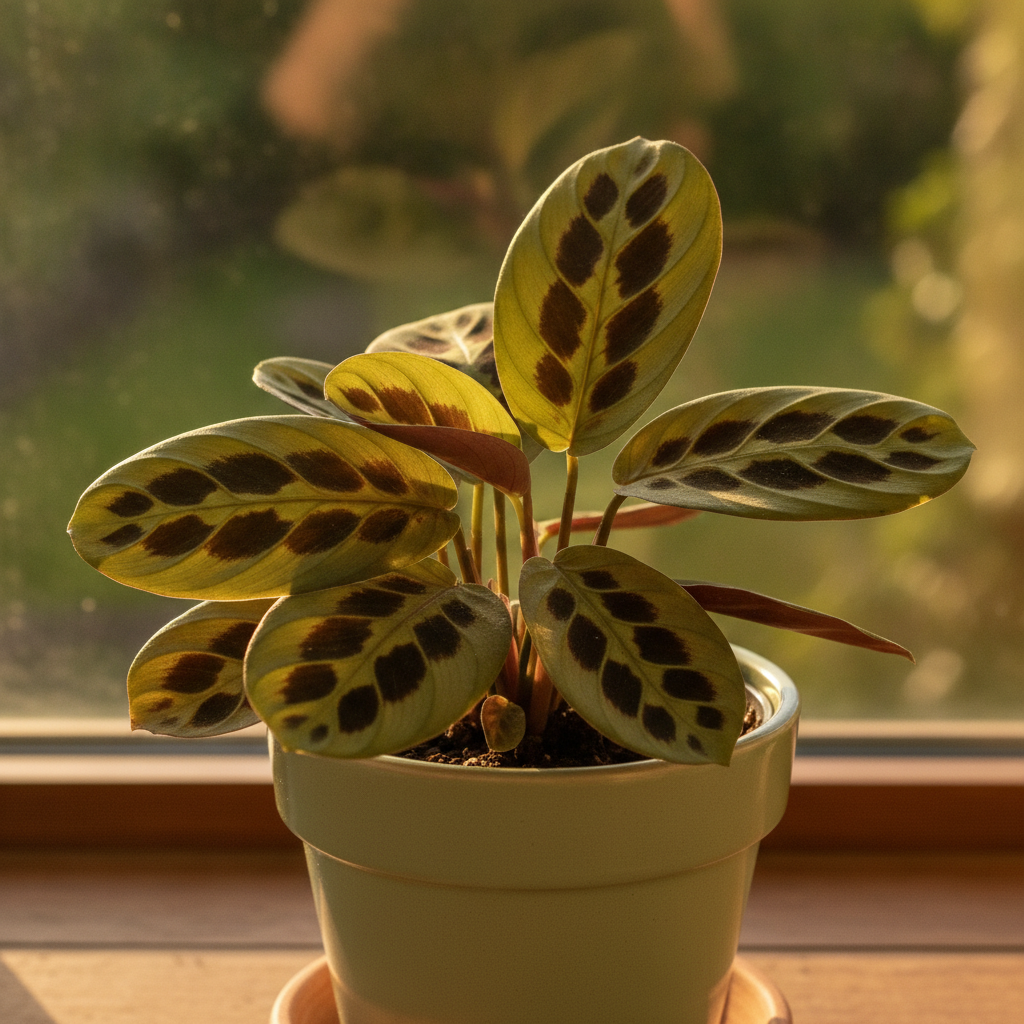
Pale sage-green leaves marked with two neat rows of dark chocolate-brown blotches either side of the midrib, which soften towards green as the leaves mature. The most forgiving and widely grown of all the prayer plants.
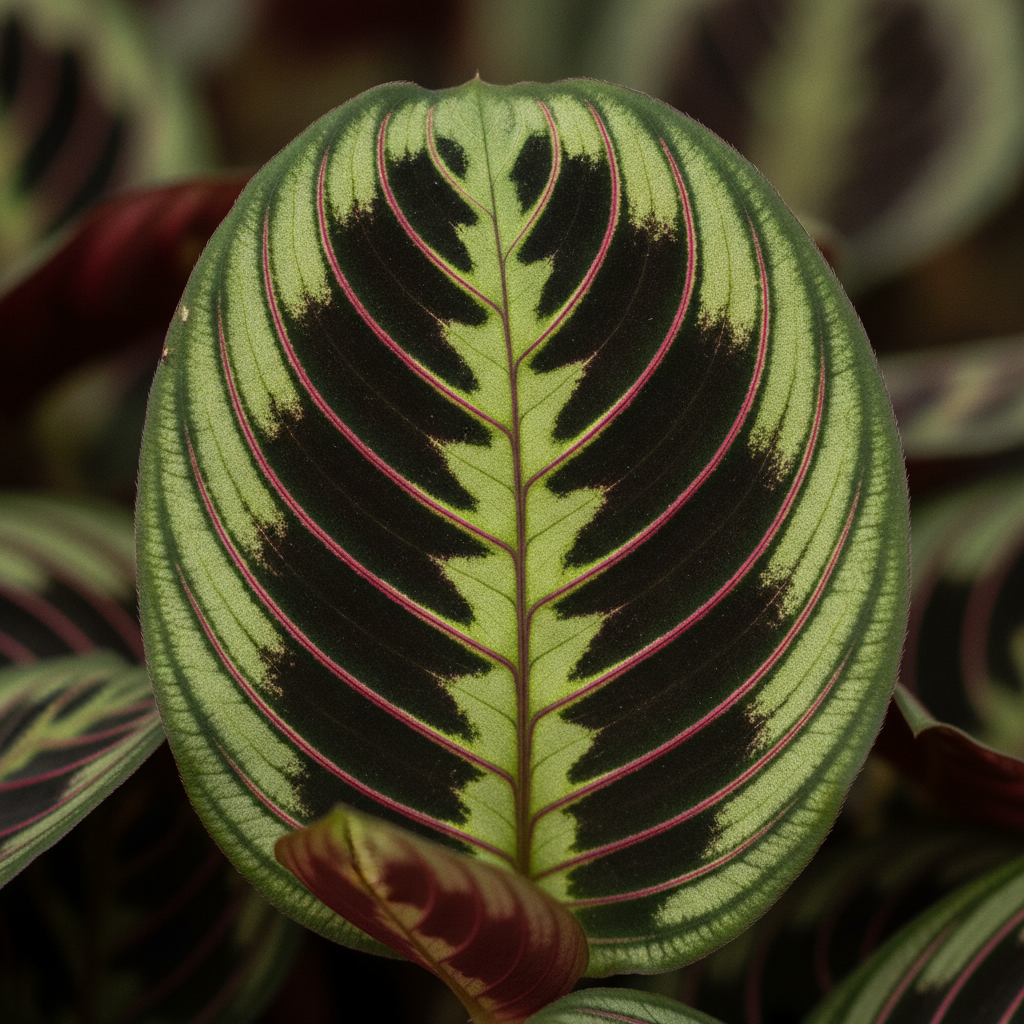
Erythroneura (Red Herringbone)
The showiest cousin, with velvety dark green leaves, a lime-green herringbone flash down the centre and vivid pink-red lateral veins, all set against deep maroon undersides. A dramatic contrast to the softer Silver Band.
Variety Profiles in Detail
Silver Band Maranta (Maranta leuconeura)
The subject of this guide, prized for the luminous silver-green band that feathers down each leaf between darker green margins. It combines the classic prayer-plant movement with a cooler, more restrained colour scheme that blends easily into any interior.
Rabbit’s Foot Prayer Plant (Maranta leuconeura var. kerchoveana)
Named for the paired dark markings that resemble a rabbit’s footprints, this is the easiest prayer plant to grow and the one most often recommended to beginners. Its pale green leaves lack the red veining of other forms but fold just as dramatically at night.
Red Herringbone Prayer Plant (Maranta leuconeura var. erythroneura)
The most ornamental variety, defined by bright red veins tracing a herringbone pattern across dark, velvety leaves. It demands the same care as the Silver Band but rewards it with some of the most vivid foliage of any common houseplant.
Choosing the Right Variety for Your Space
All the prayer plants share the same needs, so the choice comes down to look. The Silver Band suits calmer, minimalist interiors where its cool silver tones sit quietly, the Rabbit’s Foot is the safest bet for a first prayer plant, and the Red Herringbone brings a jolt of colour to a bright shelf. Because their care is identical, you can grow a mixed group side by side and enjoy the whole spectrum of patterns from a single humid corner.
Frequently Asked Questions
Why are the leaf tips on my Silver Band Maranta turning brown?
Brown, crispy tips almost always point to dry air or mineral build-up from tap water, and sometimes to inconsistent watering. Raise the humidity around the plant, switch to filtered or distilled water, and keep the soil evenly moist. Existing brown tips will not recover, but new growth should come in clean once the cause is fixed.
Why does my prayer plant not fold its leaves at night?
The nightly folding is driven by light, so a plant in too dim a spot, or one exposed to artificial light through the evening, may lose the rhythm. Give it good bright indirect light during the day and genuine darkness at night, and the movement usually returns within a week or two.
Is the Silver Band Maranta safe for cats and dogs?
Yes. Maranta leuconeura is listed as non-toxic to both cats and dogs, making it one of the safest tropical foliage plants for a pet household. While it is still best to discourage pets from chewing any houseplant, an accidental nibble will not poison them.
How often should I water a Silver Band Maranta?
Water whenever the top 2 to 3 cm (1 in) of soil begins to dry, which in practice is often around twice a week in summer and once a week or less in winter. Rather than fixing a schedule, check the soil regularly and let its moisture guide you, keeping it consistently damp but never waterlogged.
Why are my maranta’s leaves curling?
Curling leaves usually mean the plant is thirsty or the air is too dry, though very cold water and cold draughts can trigger it too. Check that the soil has not dried out, raise the humidity, and water with room-temperature water. If the curling is mild it should ease within a day of correcting the cause.
Should I mist my Silver Band Maranta?
Misting gives only a brief lift in humidity and, because the leaves stay damp afterwards, it can encourage fungal leaf spots. A room humidifier, a pebble tray or grouping plants together are all far more effective and safer ways to keep the air around the plant humid.
Why is my prayer plant growing leggy with faded colour?
Long, bare stems and washed-out markings are the classic signs of too little light. Move the plant to a brighter position with strong indirect light, or add a grow light through winter. You can also pinch back the leggy stems to encourage bushier, more compact regrowth.
How big does a Silver Band Maranta get?
It stays compact, typically reaching around 20 to 30 cm (8 to 12 in) tall with a similar or wider spread as it mounds and trails over the pot. This modest size makes it ideal for shelves, tabletops and hanging planters, and it will never outgrow a normal room.
Can I grow a Silver Band Maranta in a bathroom?
A bathroom can be an excellent home for one, provided there is enough light. The naturally higher humidity from showers suits the plant perfectly, so as long as it sits near a window or under supplementary lighting, a bright bathroom often keeps a prayer plant happier than a dry living room.






