
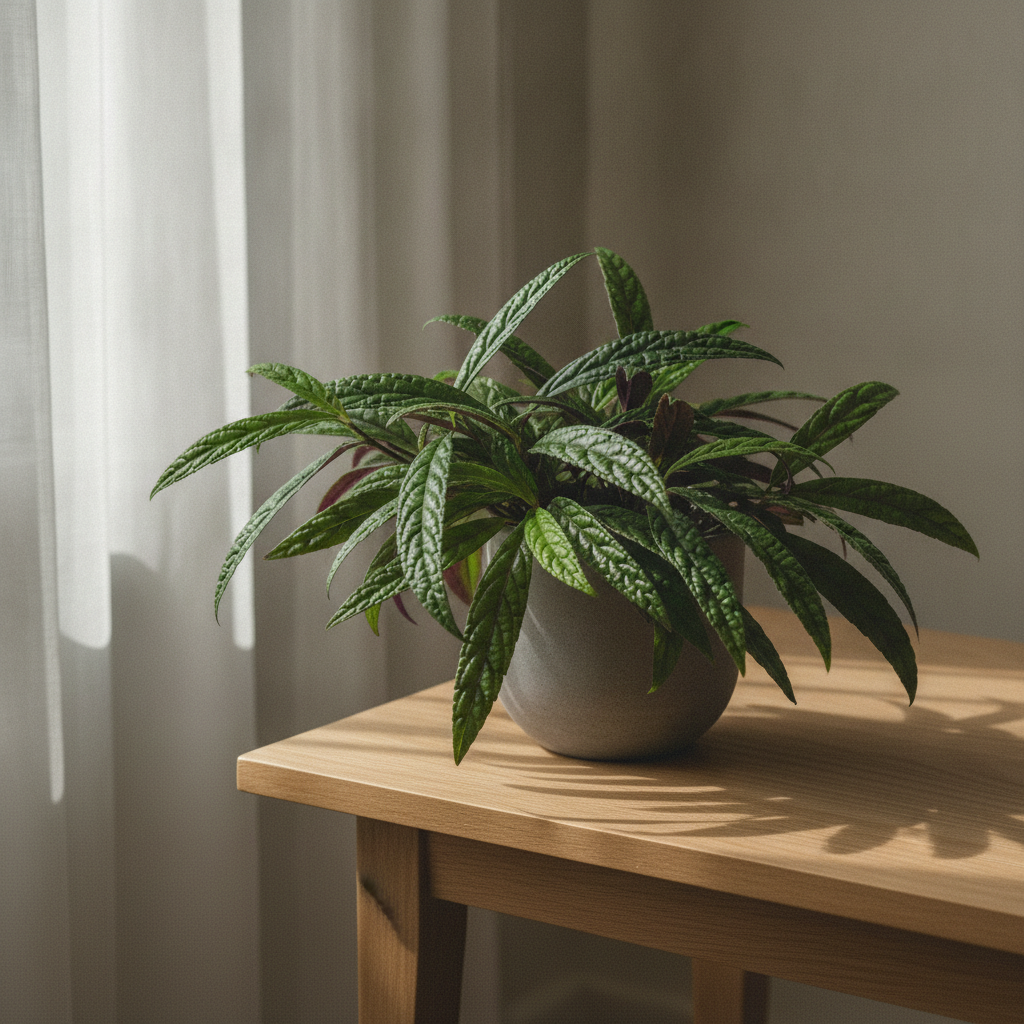
Few houseplants wear their texture as boldly as the green waffle plant. Its narrow leaves are so deeply puckered and quilted that they look pressed in a waffle iron, each ridge catching light to reveal a metallic sheen over dark green, with wine-purple undersides that flash as the foliage trails. Known botanically as Hemigraphis repanda and sold under the common name Dragon’s Tongue, this member of the acanthus family (Acanthaceae) hails from the warm, humid understorey of tropical Southeast Asia, where it creeps across the forest floor as a low groundcover.
It has earned a devoted following among terrarium keepers and windowsill gardeners alike, prized for its compact spreading habit, fast growth and the way its colour deepens in good light. The green waffle plant is not difficult, but it is honest: it tells you immediately when it is unhappy, wilting dramatically the moment its soil dries out and fading in dim corners. This guide covers everything from light and watering to propagation and pests, and draws the important distinction between merely keeping the plant alive and coaxing it to genuinely thrive.
Contents
- Quick Reference
- Why the Green Waffle Plant Makes a Rewarding Houseplant
- Light Requirements
- Watering & Humidity
- Soil, Potting & Repotting
- Fertilising
- Propagation
- Pests & Diseases
- Popular Varieties
- Frequently Asked Questions
Quick Reference: Green Waffle Plant at a Glance
| Light | Bright, indirect light; tolerates a little gentle morning sun, which intensifies leaf colour |
| Watering | Keep the mix evenly moist; water as soon as the top centimetre begins to dry. Never let it dry out fully |
| Temperature | 18 to 27 degrees Celsius (65 to 80 Fahrenheit); avoid anything below 15 degrees Celsius (59 Fahrenheit) |
| Humidity | High, ideally 50 to 60 per cent or more; excellent in terrariums |
| Fertiliser | Balanced liquid feed at half strength, roughly monthly through spring and summer |
| Toxicity | Generally regarded as non-toxic to cats, dogs and humans, though not intended for eating |
Why the Green Waffle Plant Makes a Rewarding Houseplant
The appeal of Hemigraphis repanda starts with its foliage and never really moves on from it. Each leaf is long and narrow, gently scalloped along the edges, and pressed into a network of deep ridges and hollows that give the plant its waffle nickname. In good light the upper surface takes on a pewter-to-violet metallic cast, while the reverse glows a rich burgundy that becomes visible wherever the trailing stems flip or cascade. Grown in a shallow bowl it forms a dense, textured mat; allowed to spill from a shelf or hanging pot, it becomes a curtain of crinkled colour.
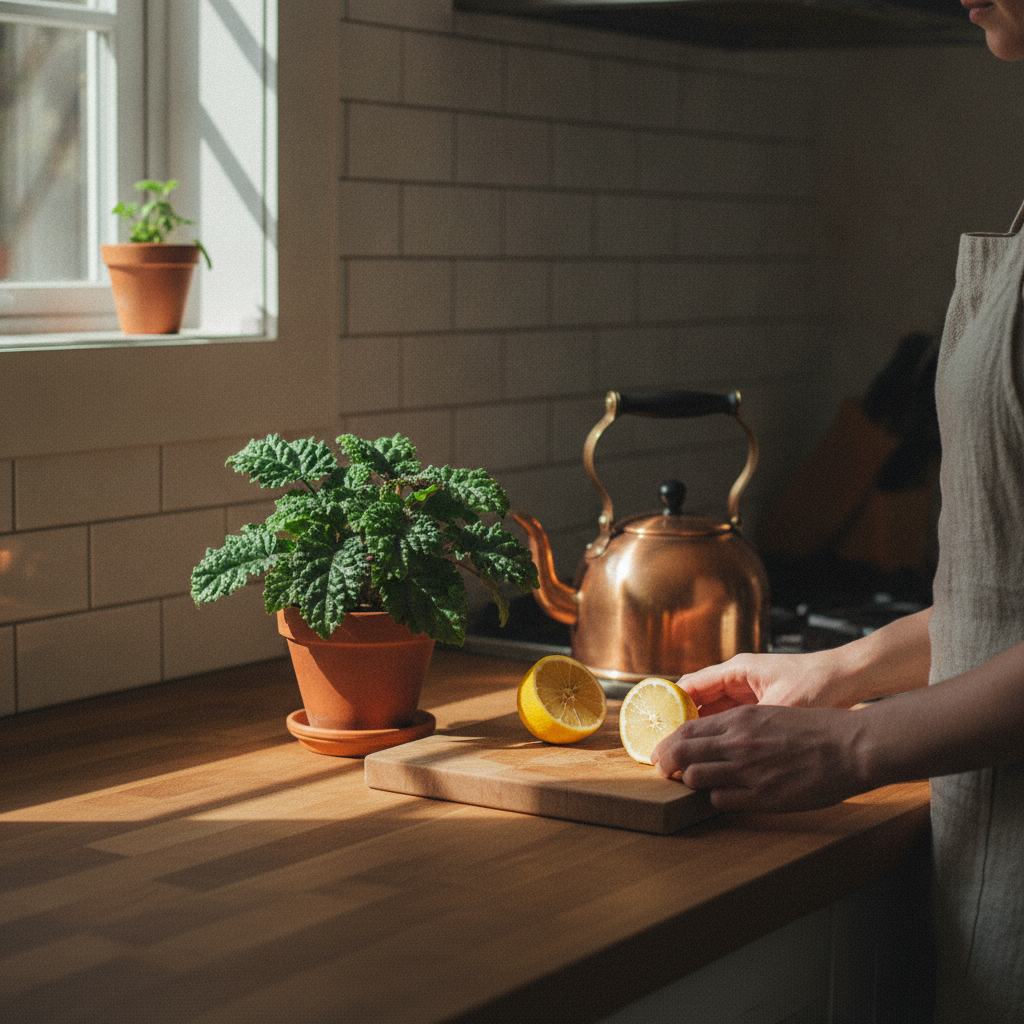
Beyond looks, this is a genuinely practical plant. It grows quickly, so a single small pot fills out within a season, and it roots so readily from cuttings that one plant soon becomes a shelf full. Its low, mounding stature suits terrariums, dish gardens and the front edge of a grouped display, where taller plants would tower over it. It flowers occasionally too, sending up small white to pale lilac tubular blooms, though most growers keep it purely for the leaves. For anyone who finds all-green foliage plants a little flat, the green waffle plant offers texture and colour without demanding the fussiness of a calathea.
Important — Toxicity: Hemigraphis repanda is not listed among the plants known to poison cats and dogs, and it is widely considered pet-safe and child-safe. Even so, it is an ornamental rather than an edible, so it is sensible to discourage nibbling and to keep it out of reach of determined pets to protect the plant as much as the animal.
Light Requirements
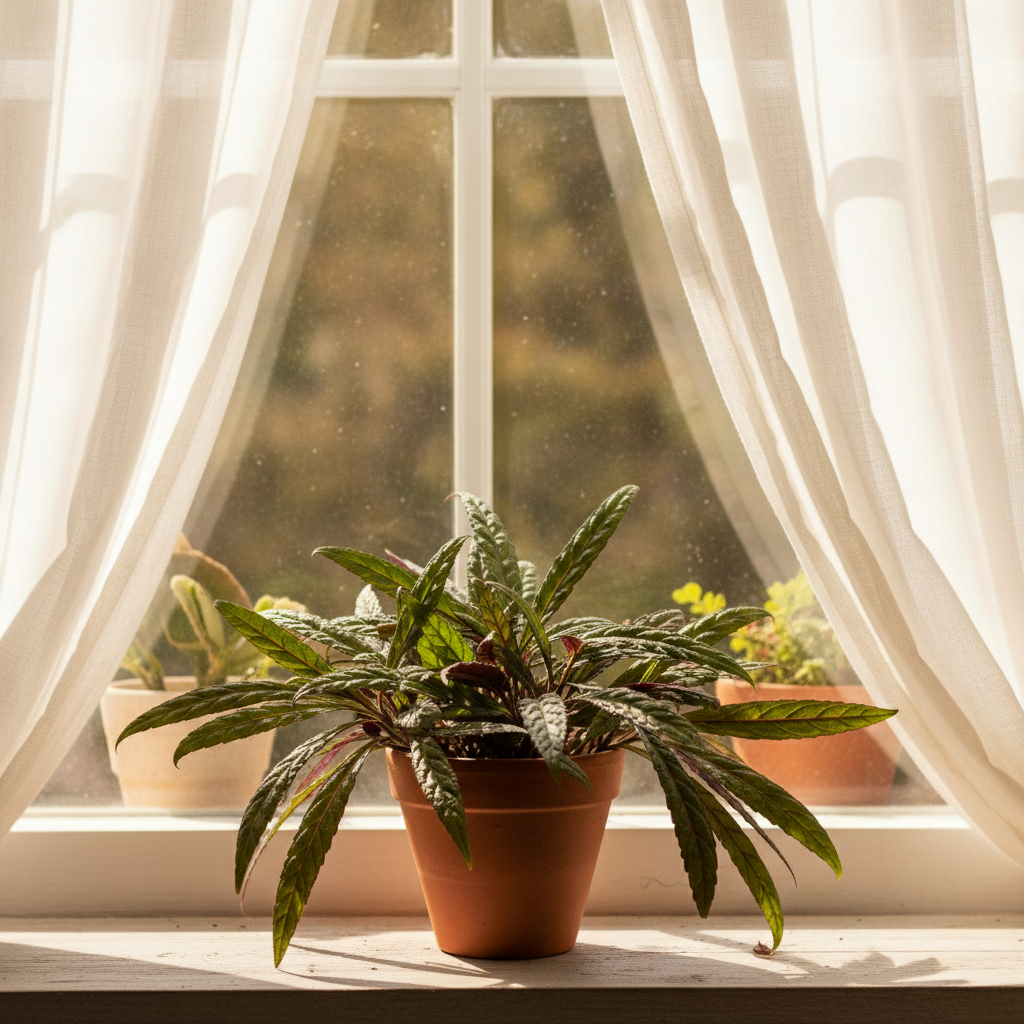
Light is the single biggest lever you have over how good a green waffle plant looks. In its native understorey it grows in bright, dappled shade beneath a broken canopy, so it is adapted to strong ambient light without the full force of overhead tropical sun. Indoors, that translates to a spot with plenty of bright, indirect light for most of the day, with perhaps an hour or two of soft, low-angle sun to draw out the deepest purples.
Get the light right and the leaves stay small, densely packed and richly coloured, with tight internodes that keep the plant looking full. Get it wrong in the direction of too little light and the plant stretches, the spaces between leaves lengthen, and the metallic purple washes out to a plain, tired green. Too much harsh sun swings the other way, bleaching and scorching the delicate foliage.
Light Levels Explained
Understanding where your plant sits on the spectrum of indoor light makes placement far less guesswork. The table below sets out the common categories and what each means for a green waffle plant.
| Light Category | Approx. Level | Typical Location | Outcome |
|---|---|---|---|
| Direct sun | Over 50,000 lux | On a south-facing sill with no shading | Risk of bleaching and leaf scorch; avoid |
| Bright indirect | 10,000 to 25,000 lux | Near an east window, or set back from a bright south one | Ideal; rich colour and compact growth |
| Medium | 5,000 to 10,000 lux | A metre or two into a bright room | Acceptable; growth slower, colour softer |
| Low | 1,000 to 5,000 lux | North corner or interior wall | Leggy, stretched stems and faded colour |
| Very low | Under 1,000 lux | Away from any window | Decline over time; not suitable |
Window Orientation and Placement
South-facing window: The brightest option in the northern hemisphere and often too intense at midday. Place the plant a metre back, or diffuse the light with a sheer curtain, so it receives the brightness without the scorching direct rays.
East-facing window: Close to perfect. Gentle morning sun deepens the purple tones, and the light softens for the rest of the day. This is where most green waffle plants look their best.
West-facing window: Workable, but the afternoon sun here is hotter and more direct than the morning equivalent, so pull the plant back slightly or filter the light to prevent bleaching.
North-facing window: The dimmest aspect. A green waffle plant will survive right on a north sill but tends to stretch and lose colour; consider supplementing with a grow light through the darker months.
Pro Tip — Read the Colour: The plant’s own foliage is the best light meter you own. Deep, saturated purple undersides and tight, compact growth mean the light is right. Long bare stems and washed-out green leaves mean move it brighter. Adjust placement gradually rather than in one big jump to avoid shocking it.
How Light Affects Leaf Colour
The metallic silver-purple sheen and burgundy reverse that make this plant special are partly light-driven. The purple pigments intensify in response to brighter conditions as a form of natural sun protection, so a plant grown in strong indirect light develops noticeably richer tones than one kept in shade. If your green waffle plant has faded to ordinary green, more light is almost always the fix, provided you increase it gradually to avoid scorch.
Warning — Direct Sunlight: The thin, textured leaves of Hemigraphis repanda scorch easily. Hours of unfiltered midday or afternoon sun will bleach the upper surface to a pale, papery beige and crisp the leaf edges. If you want stronger colour, add brightness through indirect light or gentle morning sun, not through harsh direct exposure.
Artificial Lighting
This plant responds well to supplemental lighting, which makes it a strong candidate for closed terrariums and shelves far from windows. A standard full-spectrum LED grow light positioned 30 to 45 centimetres above the foliage, run for 12 to 14 hours a day, comfortably replaces or tops up natural light. Because the plant is low-growing, a single bar or panel covers a surprising spread of foliage, and the even overhead light encourages the compact, mat-forming habit that looks best.
Seasonal Adjustments
Light indoors drops sharply between autumn and late winter, and a green waffle plant that thrived on an east sill through summer may stretch and dull by January. Move it closer to the glass as the days shorten, clean any dust off the window, and consider a grow light through the darkest weeks. Come spring, ease it back to its summer position gradually so the increasing intensity does not catch the tender new growth off guard.
Watering & Humidity
If light sets the colour, water sets the mood. The green waffle plant is a thirsty, moisture-loving tropical that likes its soil kept consistently damp, and it is famously undramatic about hiding its needs: let the pot dry out and the whole plant collapses into a limp, wilted heap within hours. The good news is that it usually recovers just as fast once watered, but repeated cycles of severe wilting weaken it, so the aim is steady, even moisture rather than a boom-and-bust rhythm.
When to Water
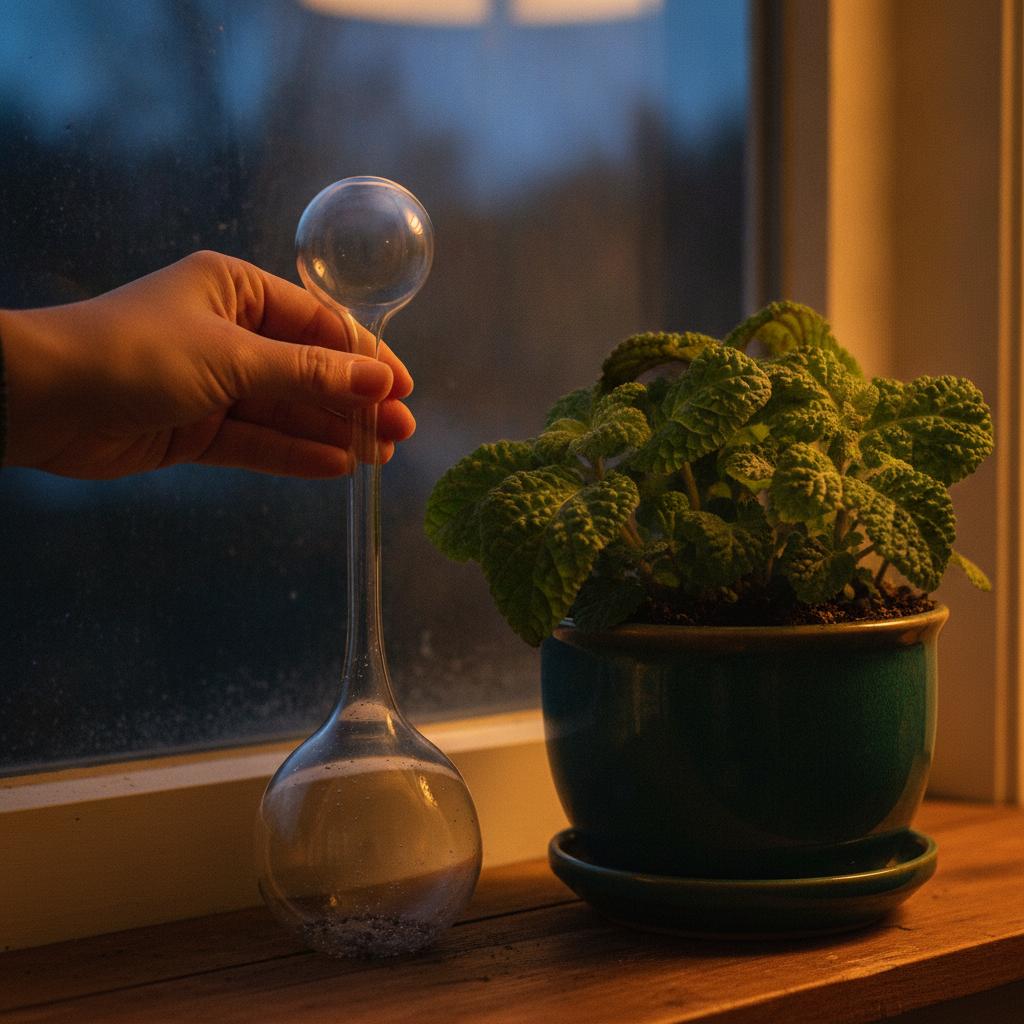
Check the plant every couple of days by pressing a finger into the top of the mix. Water as soon as the top centimetre or so feels barely dry to the touch, rather than waiting for the deeper soil to dry as you would with a succulent or pothos. In practice this often means watering two or three times a week in warm, bright conditions, and less in cooler or dimmer spells.
The exact frequency depends on your pot, light and warmth, so trust the soil over the calendar. A small plant in a bright, heated room dries far faster than the same plant in a cool, shaded corner. What stays constant is the target: damp but never waterlogged, so the roots always have access to moisture without sitting in a swamp.
Pro Tip — Wilt Is a Late Warning: Do not use dramatic wilting as your cue to water. By the time the leaves flop, the plant is already stressed. Water on the basis of the soil surface drying slightly, and the plant will stay turgid and happy without the roller-coaster of collapse and revival.
How to Water Correctly
- Take the plant to a sink and water at the soil surface, avoiding a heavy splash that packs the mix down.
- Pour steadily until water runs freely from the drainage holes, wetting the entire root zone rather than just the top.
- Let the pot drain fully for several minutes so no excess remains trapped at the base.
- Tip away any water that collects in the saucer or cover pot; the roots should never stand in it.
- Return the plant to its spot and feel the surface again in two or three days to gauge the next watering.
Signs of Overwatering vs. Underwatering
| Symptom | Overwatering | Underwatering |
|---|---|---|
| Leaf colour | Yellowing, especially lower leaves | Dull, greyish, then browning at the tips |
| Leaf texture | Soft, mushy, translucent patches | Thin, crisp and papery, curling inward |
| Overall posture | Limp even though soil is wet | Sudden dramatic wilt with dry soil |
| Soil | Stays soggy for days, sour smell | Pulls away from the pot edge, bone dry |
| Stem base | Blackened, soft, rotting at the crown | Firm but shrivelling as it dehydrates |
Warning — Root Rot: Loving moisture is not the same as loving to sit in water. A green waffle plant in a pot without drainage, or one left standing in a full saucer, quickly develops root rot: the roots turn brown and mushy, the crown blackens, and the plant collapses in a way that watering will not fix. Always use a pot with drainage holes and empty the saucer after every watering.
Humidity Requirements
Humidity is where this plant reveals its rainforest origins most clearly. It wants a moist atmosphere, ideally 50 to 60 per cent relative humidity or higher, and it rewards that with lush, unblemished foliage. This is precisely why it is such a star performer in closed terrariums and glass cabinets, where the enclosed air stays consistently damp and the plant can spread across the substrate in perfect condition.
In dry room air, particularly in winter when central heating is running, the leaf edges may brown and crisp, and the plant becomes far more prone to spider mites. Low humidity rarely kills a green waffle plant outright, but it holds it back from thriving and opens the door to pests.
To raise humidity, group it with other plants so their combined transpiration lifts the local moisture, stand the pot on a tray of pebbles topped up with water, or run a small humidifier nearby. A bathroom or kitchen with a bright window often supplies the damp warmth it craves. Misting gives only a brief lift and, done heavily in still air, can encourage fungal spotting, so lean on the steadier methods instead.
Water Quality
The green waffle plant is not especially fussy about water, but like many thin-leaved tropicals it appreciates being spared a heavy mineral load. If your tap water is very hard or strongly chlorinated, leaving it to stand overnight lets some chlorine dissipate, or you can use filtered or collected rainwater. Room-temperature water is kinder to the roots than cold straight from the tap, which can briefly shock a warmth-loving plant.
Soil, Potting & Repotting
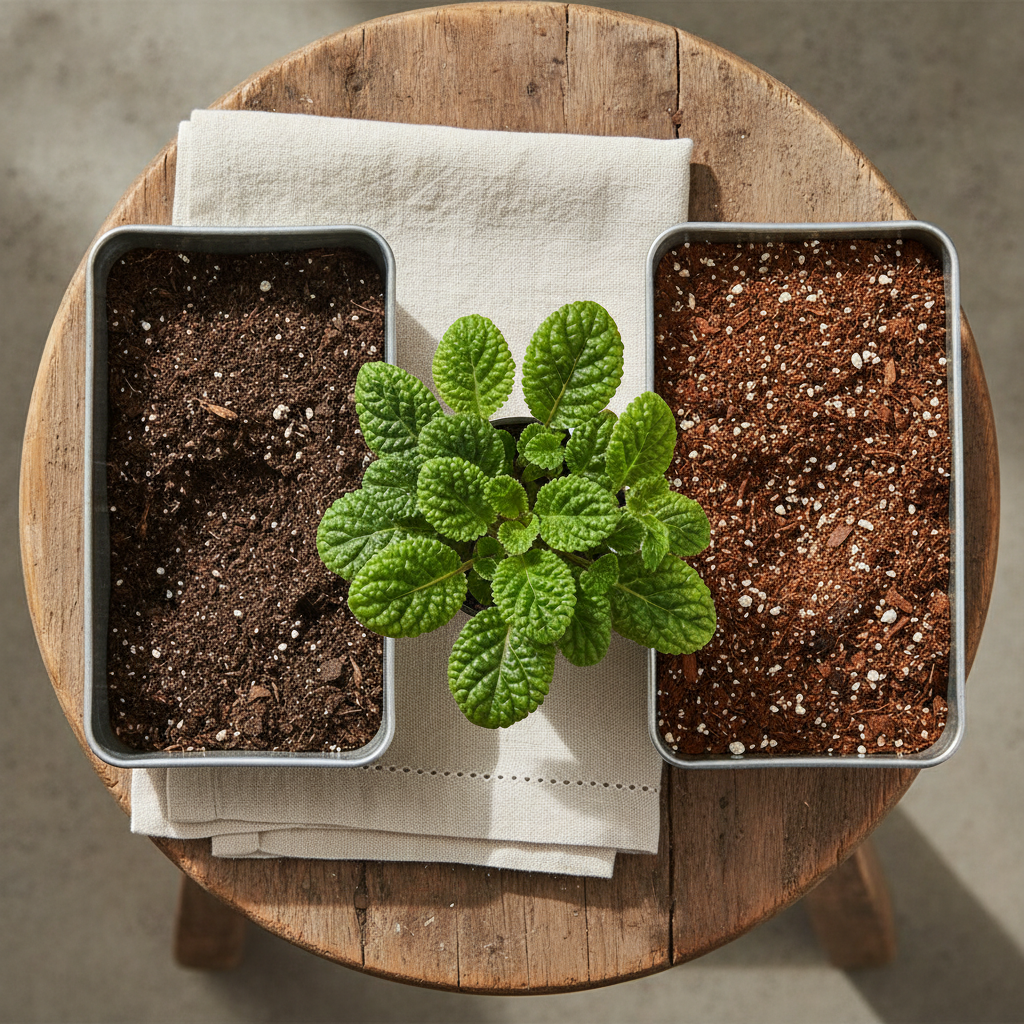
The ideal growing medium for a green waffle plant threads a careful needle: it must hold enough moisture to keep the plant evenly damp, yet drain freely enough that the roots never suffocate. A dense, water-logging soil invites rot, while a fast-draining cactus mix dries out far too quickly for this thirsty tropical. The sweet spot is a rich, moisture-retentive but airy blend.
Ideal Soil Composition
Start with a good peat-free or coir-based houseplant compost, which supplies moisture retention and organic richness, then open it up with perlite for aeration and drainage. A little fine bark or worm castings adds structure and slow nutrition. The finished mix should feel spongy and hold together when squeezed damp, yet crumble apart rather than compacting into a solid clod.
| Component | Proportion | Function |
|---|---|---|
| Coir or peat-free compost | Two parts | Retains moisture and holds organic nutrients |
| Perlite | One part | Opens the mix for drainage and root aeration |
| Fine orchid bark | Half a part | Adds structure and prevents compaction |
| Worm castings | A small handful | Supplies gentle, slow-release nutrition |
The green waffle plant prefers a slightly acidic to neutral soil, roughly pH 5.5 to 6.5, which most coir and peat-free composts sit comfortably within. There is no need to test or adjust pH in normal circumstances; a quality houseplant mix will be in range by default.
Pro Tip — Quick Mix Recipe: For an easy blend that works every time, combine two large scoops of coir-based compost with one scoop of perlite and a generous handful of fine bark. It holds moisture like the plant wants while staying open enough that water always drains away from the roots.
Choosing the Right Pot
Because it is a low, spreading plant rather than a deep-rooted one, the green waffle plant is happiest in a wide, shallow pot or a half-pan that gives its creeping stems room to run. This shape also suits its use as a groundcover in dish gardens and terrariums.
Drainage holes are non-negotiable. Given how readily this plant rots in standing water, every container it lives in must have drainage. If you love a decorative pot without holes, use it as a cover pot and keep the plant in a plain nursery pot inside, lifting it out to water and drain.
Pot material: Plastic and glazed ceramic hold moisture well and suit this plant’s love of dampness. Unglazed terracotta wicks water away and dries out fast, which means far more frequent watering; use it only if you know you tend to overwater and want the extra safety margin.
Pot size: Move up only one size at a time, choosing a pot two to three centimetres wider than the current one. An oversized pot holds a large volume of wet soil that the small root system cannot use, and that lingering moisture is a fast track to rot.
When to Repot
Fast growth means this plant fills a pot quickly, so expect to repot roughly once a year, ideally in spring as active growth resumes. Signs it is ready include roots emerging from the drainage holes, water running straight through without wetting the mix, and the plant drying out noticeably faster than it used to. Even if it is not pot-bound, refreshing the mix every year or two keeps the soil open and the plant vigorous.
How to Repot: Step-by-Step
- Water the plant a day beforehand so the roots are hydrated and the mix holds together during the move.
- Ease the plant out by tipping the pot and supporting the base of the stems, rather than pulling on the foliage.
- Gently tease apart any circling roots and shake off a little of the old, spent soil from the outer edges.
- Add a layer of fresh mix to the new pot, position the plant at the same depth it grew before, and fill around it.
- Firm the mix lightly to remove air pockets without compacting it, keeping the crown at the surface.
- Water thoroughly to settle everything in, then let the pot drain fully before returning it to its spot.
Warning — Transplant Shock: A newly repotted green waffle plant may wilt for a day or two while its roots re-establish. Resist the urge to drown it in an effort to help; keep the mix evenly moist, hold it out of direct sun, and give it a few days in stable warmth. It will perk back up as the roots take hold.
Fertilising
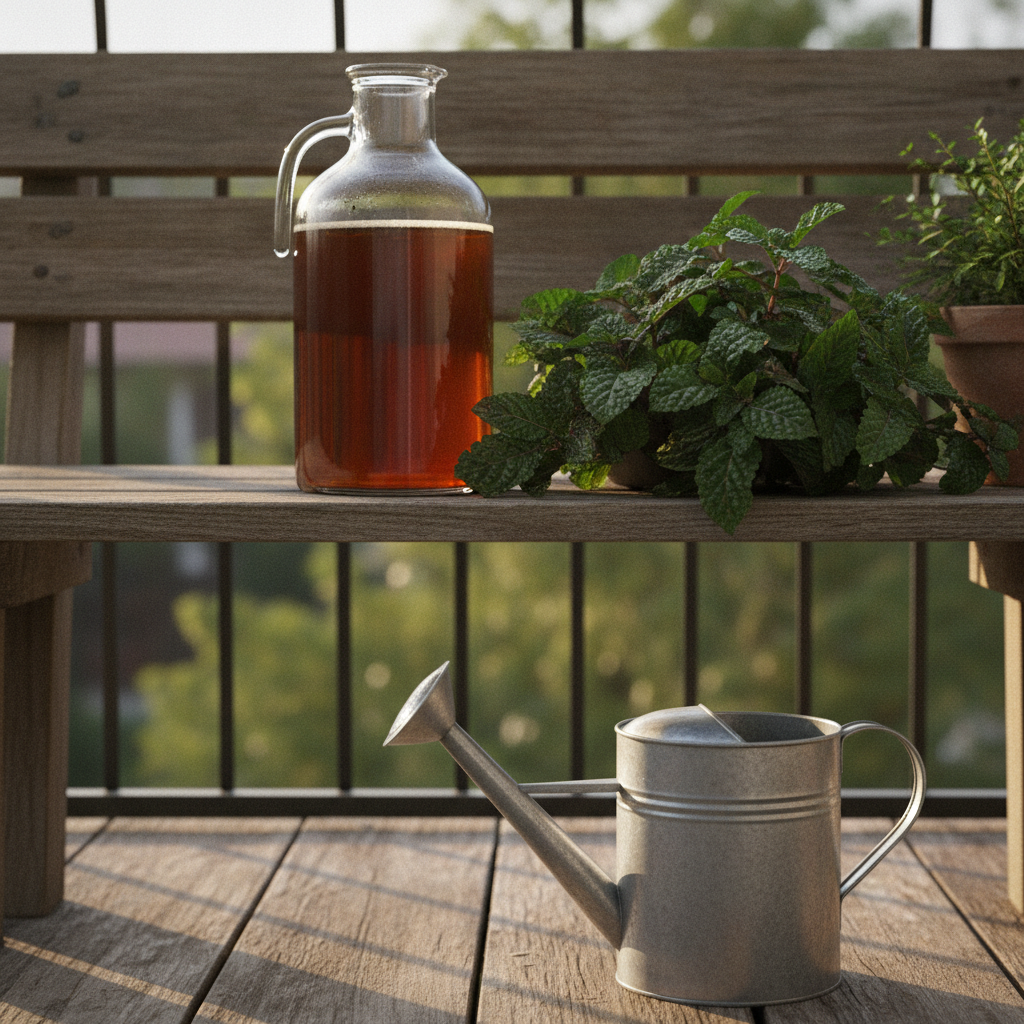
A fast grower with a modest root system, the green waffle plant benefits from regular but gentle feeding through its active season. Nutrients fuel the steady production of new leaves that keeps the plant dense and colourful, but this is a plant that prefers a light, frequent hand to an occasional heavy dose.
The rhythm to aim for is little and often across spring and summer, tapering right off in autumn and winter when growth naturally slows and the plant needs far less. Overfeeding does more harm than underfeeding here, so err on the side of dilute.
Understanding Plant Nutrients
Most houseplant fertilisers list three headline numbers, the ratio of nitrogen, phosphorus and potassium. For a foliage plant like this one, nitrogen matters most because it drives leaf growth, but a balanced feed that also supplies phosphorus, potassium and a few trace elements keeps everything running smoothly.
| Nutrient | Symbol | Primary Function | Deficiency Symptoms |
|---|---|---|---|
| Nitrogen | N | Drives leafy growth and green pigment | Pale, yellowing older leaves; slow growth |
| Phosphorus | P | Supports roots and energy transfer | Stunted growth, dull purpling of leaves |
| Potassium | K | Regulates water and overall vigour | Browning leaf margins, weak stems |
| Magnesium | Mg | Central atom of the chlorophyll molecule | Yellowing between the veins of older leaves |
| Iron | Fe | Chlorophyll formation in new growth | Yellowing between veins on young leaves |
Types of Fertiliser
Liquid fertilisers: The easiest match for this plant. A balanced liquid houseplant feed diluted to half the recommended strength and applied with watering gives you precise control over how much the plant receives and is simple to stop in winter.
Slow-release granular: Convenient if you would rather not think about it. A pinch of controlled-release pellets worked into the top of the mix in spring feeds gradually over several months, though you sacrifice the fine control of liquid feeding.
Organic fertilisers: Worm castings, dilute compost tea and gentle organic liquid feeds suit the plant’s preference for a light touch, improving soil life as they feed. They release nutrients slowly and are hard to overdo, making them a forgiving choice.
Feeding Schedule
Through spring and summer, feed with a half-strength balanced liquid fertiliser roughly every three to four weeks, or with each second or third watering if you prefer a very dilute continuous approach. As light and growth fade in autumn, taper the feeding off, and stop altogether in winter while the plant is resting. Resume in spring once you see fresh leaves appearing.
Pro Tip — Half Strength, Full Benefit: Always mix feed weaker than the label suggests. A green waffle plant’s fine roots are easily burned by concentrated fertiliser, and half strength delivers all the nutrition it needs with none of the risk of scorched root tips and crisping leaf edges.
How to Fertilise
- Water the plant lightly first if the soil is quite dry, so the feed never hits parched, sensitive roots.
- Dilute a balanced liquid fertiliser to half the recommended strength in a watering can.
- Apply evenly across the soil surface until the mix is moistened, avoiding splashing the foliage.
- Let any excess drain away, and tip out whatever collects in the saucer so salts do not concentrate there.
Warning — Salt Build-Up: Over months of feeding, mineral salts can accumulate in the soil and show up as a white crust on the surface or pot rim, along with browning leaf tips. Every couple of months, flush the pot by running plenty of plain water through it until it drains freely, which washes the excess salts away.
Propagation
Propagating a green waffle plant is almost comically easy, which is a large part of its charm. As a creeping plant that naturally roots wherever its stems touch damp ground, it is primed to grow new plants from cuttings, and success rates are high even for complete beginners. A single healthy plant provides all the material you need to fill pots, refresh a leggy specimen, or share with friends.
The best time to take cuttings is spring or summer, when the plant is growing actively and roots form fastest. Because the plant grows so quickly, propagation also doubles as pruning: taking cuttings from the tips keeps the parent bushy and encourages it to branch.
Understanding Nodes
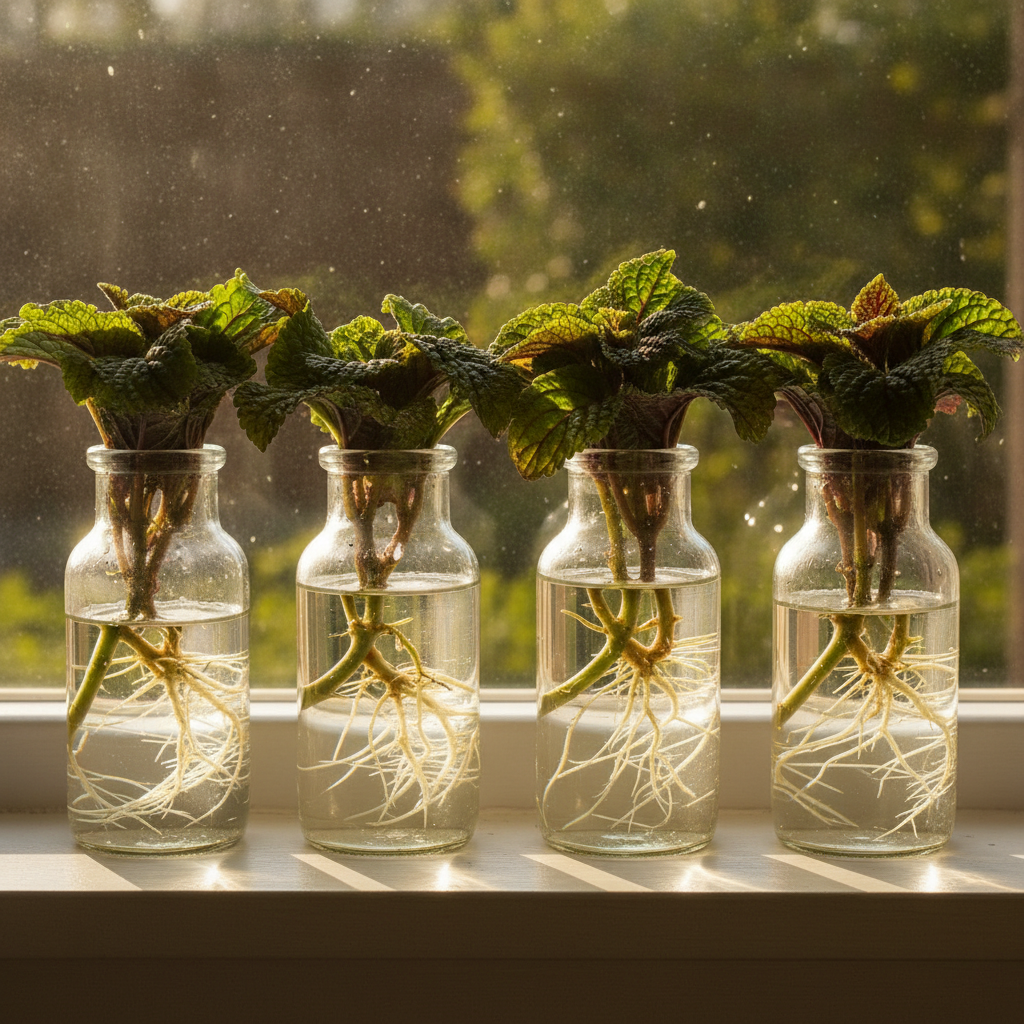
The key structure in propagation is the node, the slightly thickened point on a stem where leaves attach. Nodes contain the dormant cells that produce new roots, so every cutting must include at least one, and ideally two. On a creeping green waffle plant, you will often find that stems in contact with the soil have already begun rooting at their nodes, which tells you exactly how willing this plant is to multiply.
Water Propagation: Step-by-Step
Rooting cuttings in water is the most satisfying method because you can watch the roots develop, and it works reliably for this plant.
- Using clean scissors, snip a healthy stem tip about 8 to 10 centimetres long, cutting just below a node.
- Strip the leaves from the lowest one or two nodes so no foliage will sit underwater and rot.
- Place the cutting in a small jar of room-temperature water with the bare nodes submerged and the leaves above the rim.
- Set the jar in bright, indirect light and refresh the water every few days to keep it clear and oxygenated.
- Watch for white roots emerging from the nodes within one to two weeks, and pot up once they reach 3 to 5 centimetres.
Pro Tip — Pot Up in a Cluster: For a full-looking plant fast, root several cuttings at once and pot three or four together in a single small container. They knit into a lush, dense mound far quicker than a single cutting would, giving you a show-worthy plant in a matter of weeks.
Soil Propagation: Step-by-Step
Rooting directly in soil skips the transition from water to mix and often produces sturdier roots, at the cost of not being able to see progress.
- Take a stem tip cutting of 8 to 10 centimetres with two or more nodes, as for water propagation.
- Remove the lower leaves and, if you like, dip the cut end in rooting hormone to speed things along.
- Insert the bare nodes into a small pot of moist, airy propagation mix and firm it gently around the stem.
- Cover loosely with a clear bag or dome to hold humidity, and keep the mix consistently damp in warm, bright shade.
- Tug very gently after two to three weeks; resistance means roots have formed, at which point remove the cover.
Troubleshooting Propagation
| Problem | Likely Cause | Solution |
|---|---|---|
| Cutting rots in water | Leaves submerged, or water left stale | Keep only bare nodes underwater; change water often |
| No roots after weeks | Too cold, too dark, or no node included | Warm, bright spot; ensure each cutting has a node |
| Cutting wilts badly | Too much leaf area losing water before roots form | Trim some leaves and raise humidity with a cover |
| Roots form but plant stalls after potting | Shock moving from water to dry soil | Pot into moist mix and keep humid for the first week |
Pests & Diseases
A well-grown green waffle plant kept warm, humid and evenly watered is fairly resilient, but its soft, thin leaves and love of moisture make it a target for a handful of common troubles. Most problems trace back to conditions rather than bad luck: dry air invites mites, while soggy soil invites rot.
The best defence is regular observation. Turn a few leaves over when you water, check the crown and stem bases, and act at the first sign of trouble, while an infestation or infection is still small and easily beaten.
Common Pests
Spider Mites (Tetranychus urticae)
The most likely pest on this humidity-loving plant, especially in dry, heated rooms. They are tiny, thrive in dry air, and reveal themselves through fine stippling on the leaves, a faint webbing in the leaf axils, and a general dullness to the foliage.
Treatment: Rinse the plant thoroughly, raise the humidity around it, and treat with insecticidal soap or neem oil, repeating every few days until they are gone. Mites hate moist air, so improving humidity is both cure and prevention.
Aphids (Aphidoidea)
Small green, black or pinkish insects that cluster on soft new growth and flower buds, sucking sap and leaving behind sticky honeydew. Fast-growing tender tips are their favourite target on a green waffle plant.
Treatment: Blast them off with a firm spray of water, then follow up with insecticidal soap or neem oil on the undersides and growing tips. Repeat weekly until no new colonies appear.
Mealybugs (Pseudococcidae)
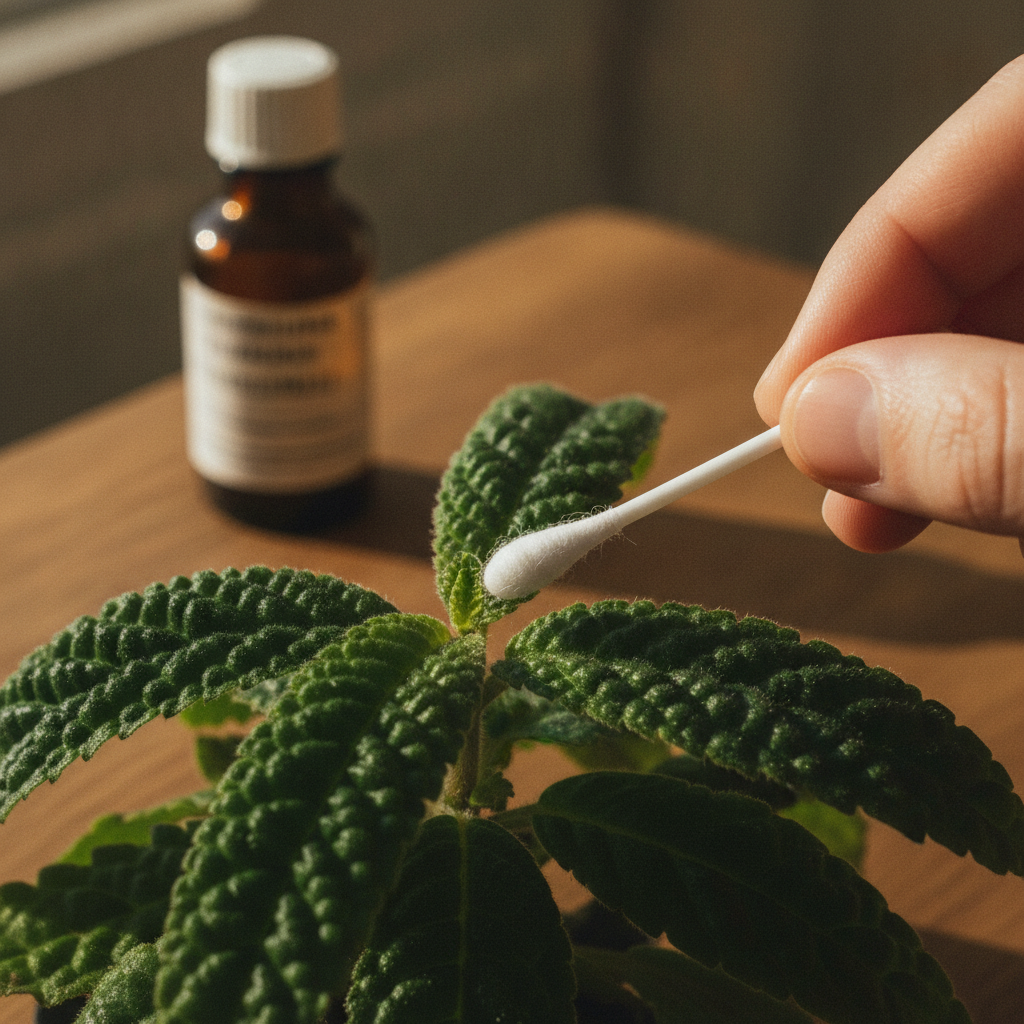
White, cottony blobs that lodge in leaf axils and along stems, draining sap and weakening the plant. Their waxy coat makes them stubborn but they are easy to spot against the dark foliage.
Treatment: Dab each one directly with a cotton bud dipped in isopropyl alcohol, then treat the whole plant with neem oil. Check weekly, as survivors and eggs can reignite an infestation.
Whitefly (Trialeurodes vaporariorum)
Tiny white flying insects that lift off in a cloud when the plant is disturbed. They gather on leaf undersides and, like aphids, excrete honeydew that can lead to sooty mould.
Treatment: Hang yellow sticky traps to catch the adults and treat the foliage with insecticidal soap or neem oil, repeating to break the breeding cycle.
Common Diseases
Root Rot (Pythium and Phytophthora)
The most serious threat to a green waffle plant, caused by waterlogged soil starving the roots of oxygen and letting rot organisms take hold. The roots turn brown and mushy, the base blackens, and the plant collapses despite the wet soil.
Treatment: Unpot the plant, cut away all soft, blackened roots with clean scissors, and repot into fresh, airy mix in a pot with good drainage. If the crown is gone, salvage healthy stem tips as cuttings and start again.
Leaf Spot (various fungi)
Brown or blackish spots, sometimes with a yellow halo, that appear when foliage stays wet in still, humid air. It spreads through splashing water and poor air circulation.
Treatment: Remove affected leaves, water at the soil rather than over the foliage, and improve airflow around the plant. Avoid heavy misting in stagnant conditions.
Pest and Disease Summary
| Pest / Disease | Identification | Treatment |
|---|---|---|
| Spider mites | Fine stippling, faint webbing, dull leaves | Rinse, raise humidity, neem oil or soap |
| Aphids | Clusters on new tips, sticky honeydew | Water blast, then insecticidal soap |
| Mealybugs | White cottony tufts in axils | Alcohol swab, then neem oil |
| Whitefly | Tiny white flies rising when disturbed | Sticky traps and neem oil |
| Root rot | Mushy brown roots, blackened crown | Trim rot, repot in fresh airy mix |
| Leaf spot | Brown spots, sometimes haloed | Remove leaves, improve airflow |
Prevention Strategies
Prevention rests on getting the growing conditions right. Steady humidity keeps spider mites at bay, careful watering with good drainage keeps root rot away, and watering at the soil rather than over the leaves prevents most fungal spotting. A plant grown in its preferred warmth and light is simply more able to shrug off attacks than a stressed one.
Quarantine any new plant for a couple of weeks before it joins your collection, inspect your green waffle plant whenever you water, and keep the foliage clean and free of dust. Good airflow around the plant, without cold draughts, discourages both pests and disease.
Pro Tip — Neem as Routine: A light monthly spray of diluted neem oil on the leaf undersides, done in the evening or out of direct sun, acts as an effective preventative. It deters the sap-suckers that most often trouble this plant before they ever gain a foothold.
Popular Varieties
The green waffle plant belongs to the genus Hemigraphis, a small group of low, creeping tropicals from Asia that share the same puckered, colourful foliage. While Hemigraphis repanda is the classic narrow-leaved green waffle plant, several close relatives and selected forms circulate under overlapping common names, and it helps to know them apart when shopping.
All of them want the same broad care: warmth, humidity, steady moisture and bright indirect light. They differ mainly in leaf shape, size and the balance of green, silver and purple, so choosing between them is largely a matter of the look you are after.
| Variety | Leaf Appearance | Light Needs | Growth Rate | Availability |
|---|---|---|---|---|
| Dragon’s Tongue | Narrow, elongated, deeply crinkled, silvery purple | Bright indirect | Fast | Common |
| Belgian Waffle | Puckered leaves marbled cream, pink and green | Bright indirect | Moderate | Uncommon |
| Purple Waffle Plant | Broad, oval, glossy with deep purple undersides | Bright indirect | Fast | Common |
| Red Ivy | Rounded metallic leaves, strong purple flush | Bright indirect | Fast | Common |
| Snow White | Green leaves splashed with silvery white | Bright indirect | Moderate | Rare |
Featured Varieties
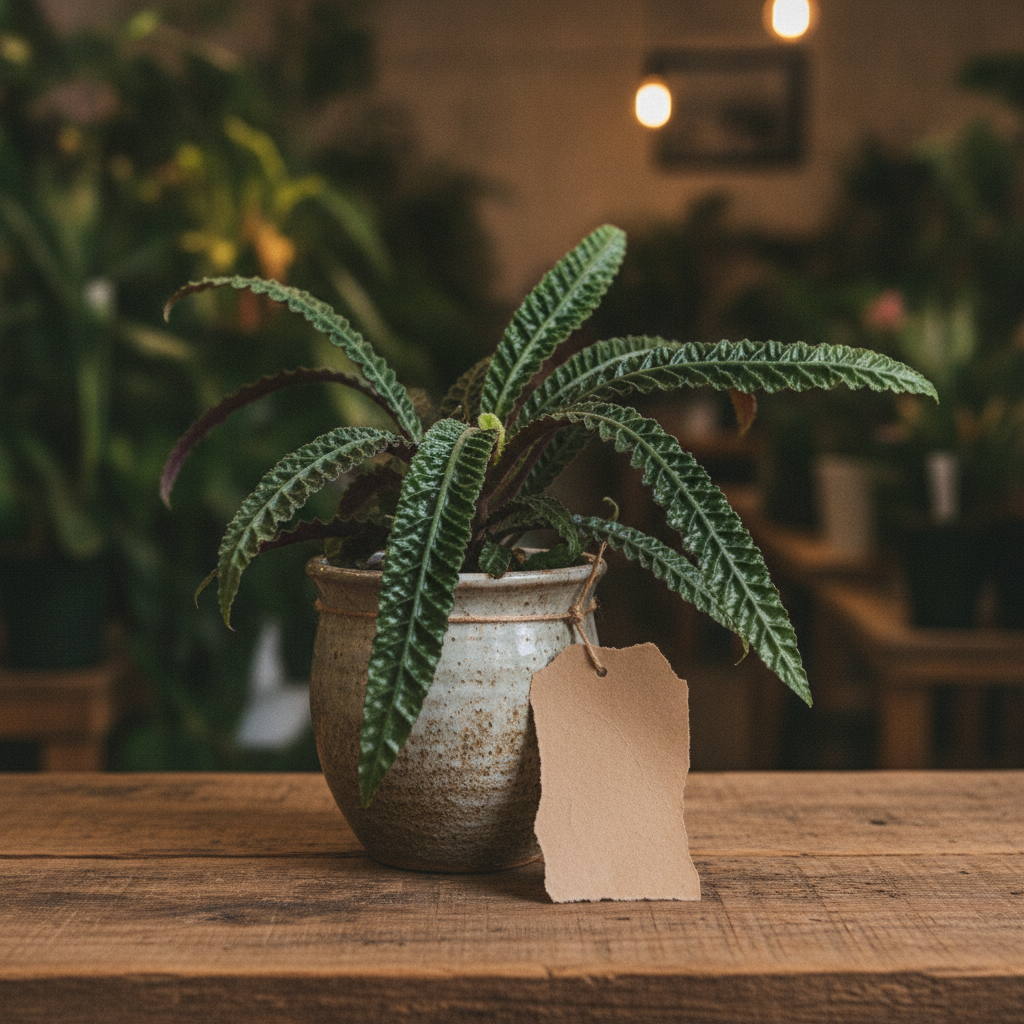
Dragon’s Tongue
The archetypal green waffle plant, with very narrow, strongly elongated leaves and an intensely crinkled surface. In good light the dark green upper side takes on a silvery-purple metallic cast, and the whole plant forms a dense, textured mat.
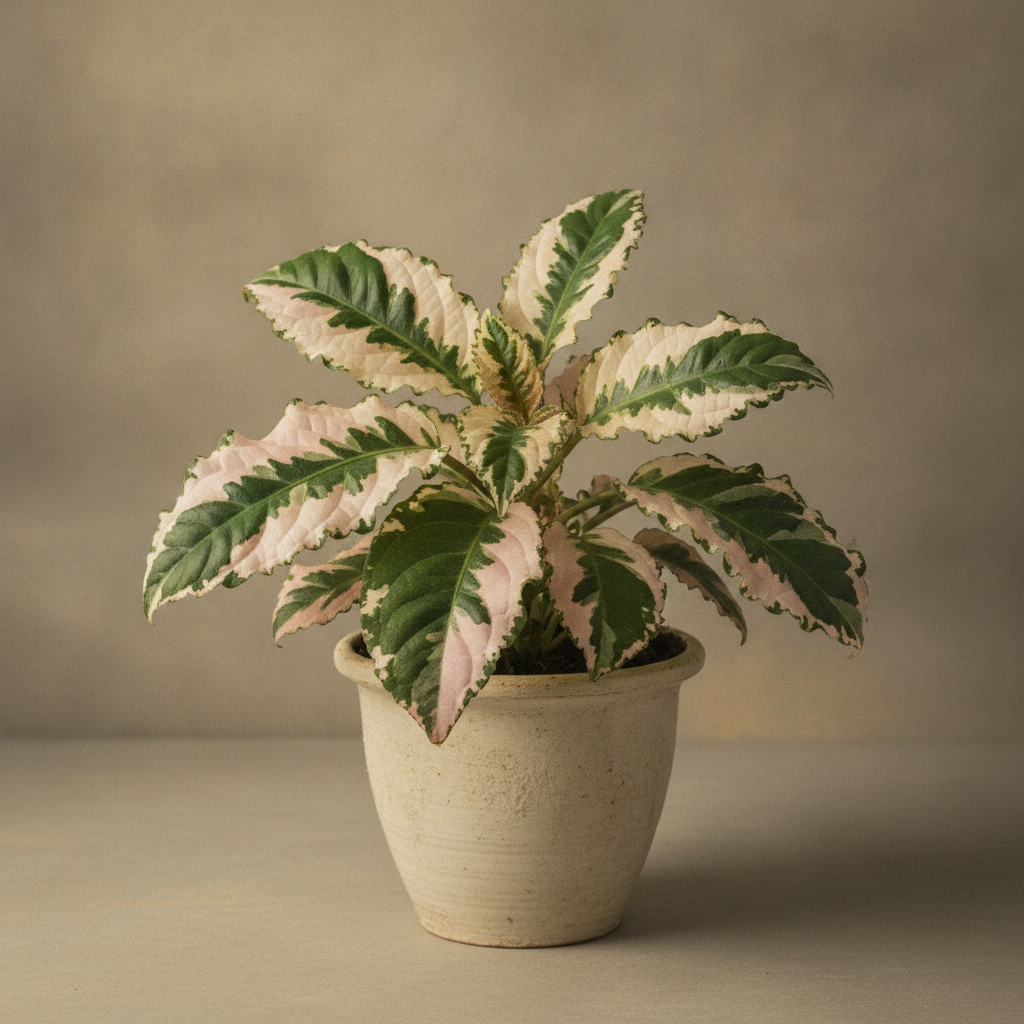
Belgian Waffle
A variegated selection whose puckered leaves are marbled with cream, soft rose-pink and green. It is a little slower and needs consistently bright indirect light to hold its variegation, but it rewards with a far more colourful display.
Variety Profiles in Detail
Purple Waffle Plant (Hemigraphis alternata)
Often sold alongside the green waffle plant and easy to confuse with it, this close cousin has broader, more oval leaves that are glossy grey-green above and a dramatic deep burgundy-purple beneath. It shares the same appetite for warmth, humidity and moisture, and is if anything even more vigorous, making it a superb trailing plant for a bright bathroom.
Red Ivy (Hemigraphis alternata)
Another name applied to the purple-flushed forms of Hemigraphis, with rounded, metallic leaves that colour up strongly in bright light. It cascades attractively from a hanging pot and roots at the nodes as it goes, so it is quick to fill a container and simple to keep in check with the occasional trim.
Choosing the Right Variety for Your Space
For a compact, textural groundcover in a terrarium or dish garden, the narrow-leaved Dragon’s Tongue form of the true green waffle plant is the natural choice. If you want more colour, the variegated Belgian Waffle or the purple-backed relatives bring pink, cream and burgundy into play, though the variegated types need reliably bright indirect light to stay vivid. Whichever you pick, the care is essentially identical, so you can mix several in one grouping and treat them all the same.
Frequently Asked Questions
Why does my green waffle plant keep wilting?
Almost always because the soil has dried out. This plant wilts dramatically and quickly when thirsty, then recovers within hours of watering. Keep the mix evenly moist and water as soon as the surface begins to dry, rather than waiting for the collapse. If the soil is wet and the plant still wilts, suspect root rot instead.
Is the green waffle plant safe for cats and dogs?
It is generally regarded as non-toxic and does not appear on the common lists of plants dangerous to cats and dogs. It is still an ornamental rather than a snack, so it is wise to discourage pets from chewing it, which protects both the animal and the plant.
Why has my plant lost its purple colour?
Fading to plain green is a classic sign of too little light. The purple pigments intensify in brighter conditions, so move the plant somewhere with more bright, indirect light, increasing the exposure gradually to avoid scorching the leaves.
Can I grow a green waffle plant in a terrarium?
Yes, and it is one of the best plants for the job. Its love of high humidity and steady moisture is perfectly met by a closed terrarium, and its low, spreading habit makes an ideal living groundcover. Just be ready to trim it, as it grows quickly and will happily overrun a small enclosure.
Why are the tips of the leaves turning brown and crispy?
Crispy brown tips usually point to air that is too dry, or occasionally to a build-up of fertiliser salts. Raise the humidity around the plant with a pebble tray, grouping or humidifier, and flush the pot with plain water every couple of months to wash away accumulated salts.
How fast does a green waffle plant grow?
Quickly, given warmth, humidity and good light. A small cutting can fill a pot within a single growing season, and established plants spread steadily across their container. This vigour is why regular pruning, which doubles as free propagation material, keeps the plant looking its best.
How do I make my plant bushier?
Pinch or trim the growing tips regularly. Each cut encourages the stem to branch from the nodes below, producing a fuller, denser plant. Combine this with bright light to keep the internodes short, and pot several rooted cuttings together for an instantly lush effect.
Does the green waffle plant flower?
It can, producing small white to pale lilac tubular flowers, usually in the warmer months. The blooms are modest and short-lived, and most growers value the plant purely for its striking, textured foliage rather than its flowers.






