
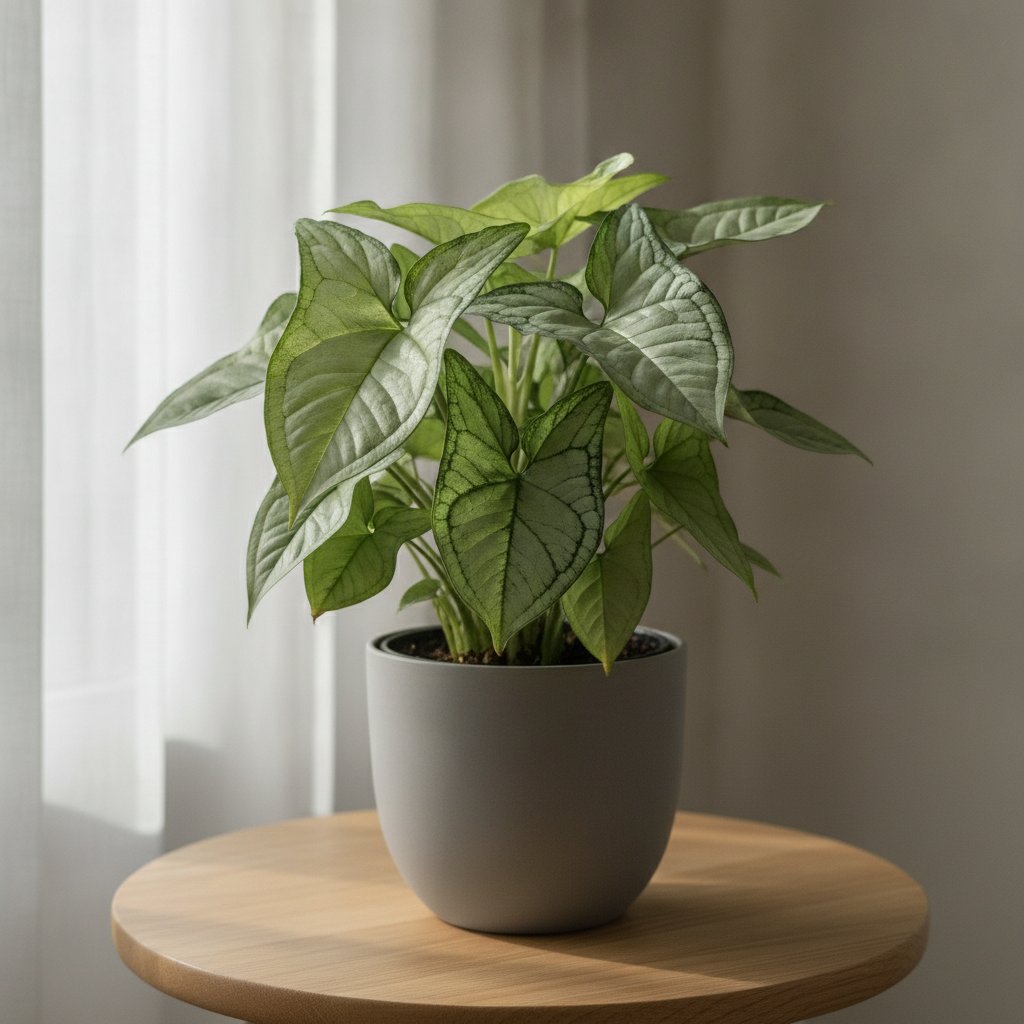
Few arrowhead plants announce themselves quite like the Batik Syngonium. Where most forms of Syngonium podophyllum lean on soft washes of cream, pink or plain green, the Batik cultivar carries a graphic network of dark veins pressed into pale, silvery foliage, as though each leaf had been dipped in wax and hand-dyed in the Indonesian batik tradition it is named for. It is a plant that reads as botanical artwork on a shelf, yet asks for almost nothing beyond the routine any beginner can master. This guide covers everything that separates a Batik Syngonium that merely survives from one that genuinely thrives.
Quick Reference
The table below distils the growing conditions a Batik Syngonium needs. Treat it as a summary; the detail behind each figure follows in the sections beneath.
| Care Factor | Requirement |
| Botanical name | Syngonium podophyllum ‘Batik’ |
| Common names | Batik Syngonium, Batik arrowhead plant, painted arrowhead |
| Plant family | Araceae (the aroids) |
| Light | Bright, indirect light; no direct midday sun |
| Water | When the top 2 to 3 cm (1 in) of mix has dried |
| Soil | Light, chunky, well-draining aroid mix |
| Temperature | 18 to 27 degrees C (64 to 81 degrees F) |
| Humidity | Happy at average room levels, better above 50 percent |
| Fertiliser | Balanced feed, monthly through spring and summer |
| Growth habit | Compact and bushy when young, climbing or trailing with age |
| Mature size | Around 30 to 90 cm (1 to 3 ft) indoors, longer if allowed to climb |
| Toxicity | Toxic to cats, dogs and humans if chewed |
| Difficulty | Easy, forgiving of beginner mistakes |
Why the Batik Syngonium Makes Such a Rewarding Houseplant

The appeal of the Batik Syngonium begins with the leaves and rarely stops there. Each blade emerges in the classic arrowhead shape of its species, but the surface is a pale, cool green, almost dusted with silver, crossed by veins so dark and precisely defined that they look printed rather than grown. The contrast is what gives the plant its name, and it is unusually stable for a Syngonium, holding its markings well as long as light levels stay generous.
Beyond looks, this is one of the most obliging aroids you can bring home. It grows quickly, recovers gracefully from the occasional missed watering, and tells you clearly when something is wrong rather than declining in silence. A thirsty Batik Syngonium droops its stems and lifts them again within hours of a drink, which makes it an excellent teacher for anyone still learning to read a plant. It also multiplies with almost comical ease, so a single healthy specimen can become a shelf full of plants or a run of gifts within a season.
The species behind the cultivar, Syngonium podophyllum, is native to the humid forests of Central and South America, where it begins life scrambling across the forest floor before climbing tree trunks toward brighter light. That background explains much of its behaviour indoors. Young plants stay compact and bushy with the neat, spade-shaped juvenile leaves most people recognise, while older plants left to climb a moss pole will start to stretch, vine and produce larger, more deeply lobed adult foliage. Neither phase is wrong; understanding that the plant can shift between them helps you shape it to the look you want.
Pro Tip — Shape it your way: Keep pinching the growing tips to hold a Batik Syngonium as a dense, mounding houseplant, or give it a moss pole and let it climb to encourage larger, more mature leaves. The plant is genuinely flexible, so decide the form you want early and prune toward it.
Light
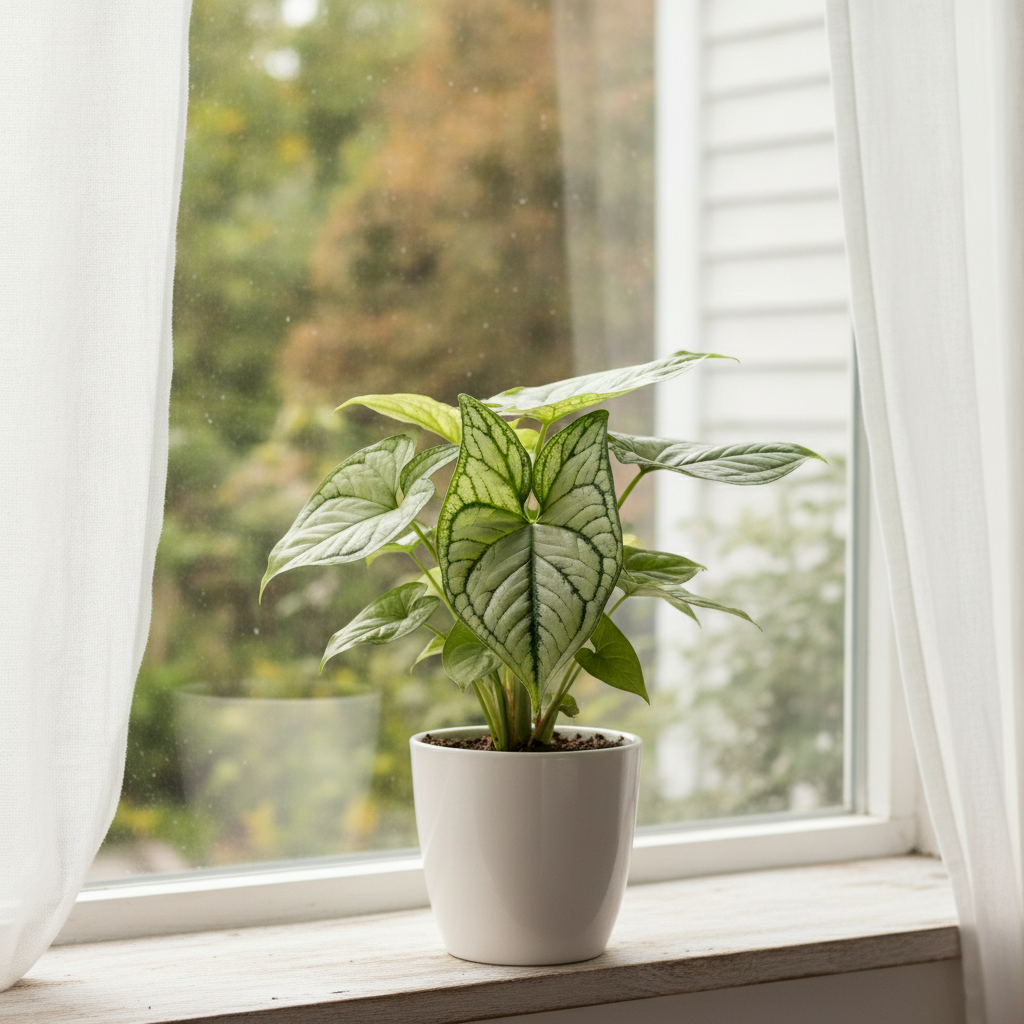
Light is the single factor that most affects how good a Batik Syngonium looks, because the very markings that make it desirable depend on it. In bright, indirect light the pale sections of the leaf stay luminous and the dark veins hold their sharp definition. In a dim corner the plant does not die, but new leaves emerge greener, flatter and less contrasted, and the graphic patterning that drew you to it slowly fades. If your plant is losing its character, light is almost always the reason.
Aim for a position a metre or two back from a bright window, or directly in front of one screened by a sheer curtain. An east-facing sill with gentle morning sun suits it well, as does a bright north-facing room. What you want to avoid is prolonged direct midday and afternoon sun striking the leaves, which scorches the delicate pale tissue and leaves bleached, papery patches that will not recover. The pale areas of a Batik leaf hold less chlorophyll and less protective pigment than a solid green leaf, so they burn more readily.
If your home is genuinely short of natural light, a Batik Syngonium responds very well to a full-spectrum LED grow light running for ten to twelve hours a day. This is often the simplest fix for winter dullness in northern climates, where short days can otherwise leave new growth weak and washed out. Rotate the pot a quarter turn each time you water so every side receives its share and the plant grows evenly rather than leaning toward the glass.
Watering
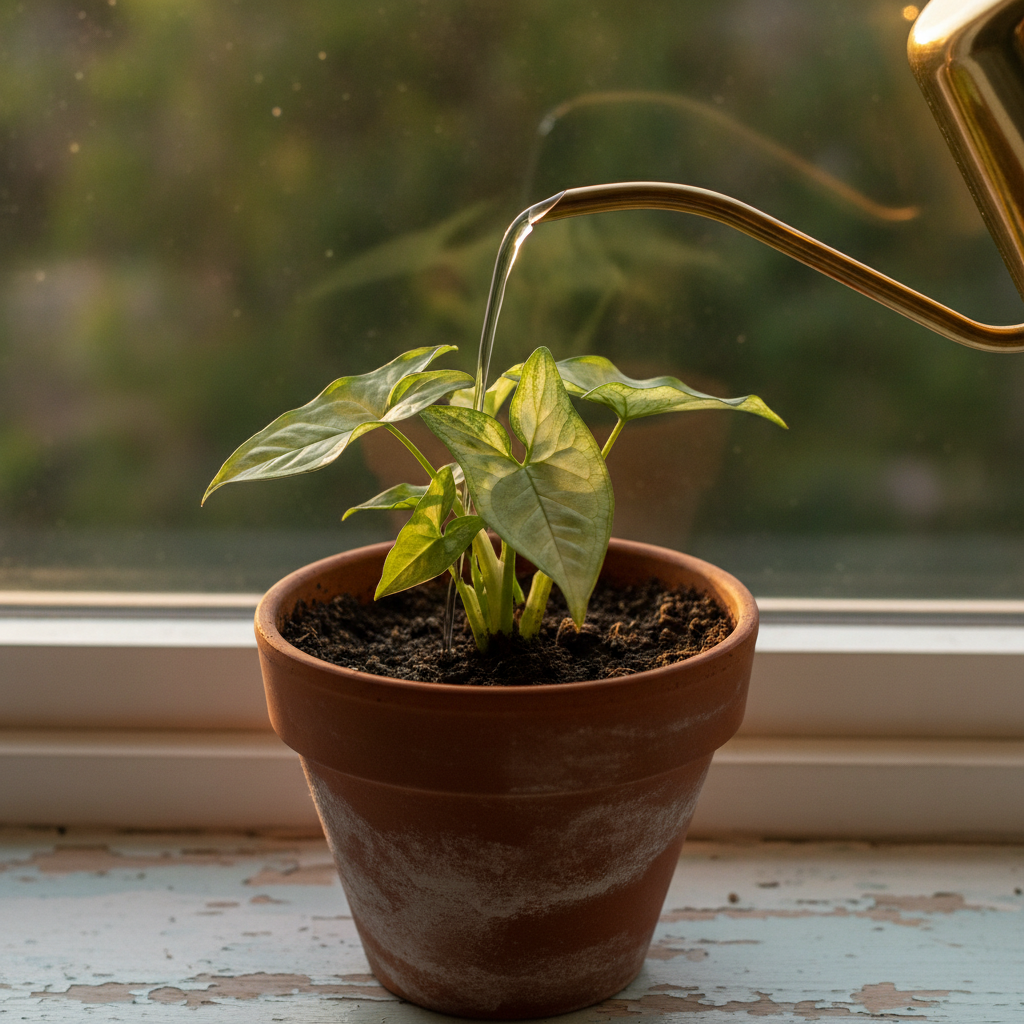
Watering a Batik Syngonium well is mostly a matter of restraint and observation. The plant likes its mix to stay lightly moist through the growing season but never wet, and the reliable way to judge this is to feel the surface. When the top 2 to 3 cm (about an inch) has dried, it is time to water. Push a finger into the mix rather than trusting the look of the surface, which dries faster than the root zone beneath.
When you do water, do it thoroughly. Take the pot to a sink, pour slowly until water runs freely from the drainage holes, and let it drain completely before returning the plant to its spot. This flushes stale salts from the mix and ensures the whole root ball is moistened rather than just the top. Never leave the pot standing in a saucer of collected water, because roots left sitting in it will suffocate and rot. Emptying the saucer a few minutes after watering is one of the most useful habits you can build.
The plant makes reading its thirst unusually easy. A Batik Syngonium that has gone too long between drinks wilts dramatically, its stems softening and folding down, and then springs back within a few hours of watering with no lasting harm. Use this as a guide while you learn its rhythm, but do not rely on it as a routine, since repeated severe wilting eventually stresses the plant and crisps the leaf edges. In winter, when growth slows and light is weaker, let the mix dry a little further between waterings and expect to water noticeably less often.
Warning — Overwatering is the real risk: The most common way to lose a Batik Syngonium is not neglect but kindness. Soft, yellowing lower leaves paired with a persistently wet, sour-smelling mix point to root rot from overwatering. When in doubt, wait a day and check again rather than watering on a fixed schedule.
Soil
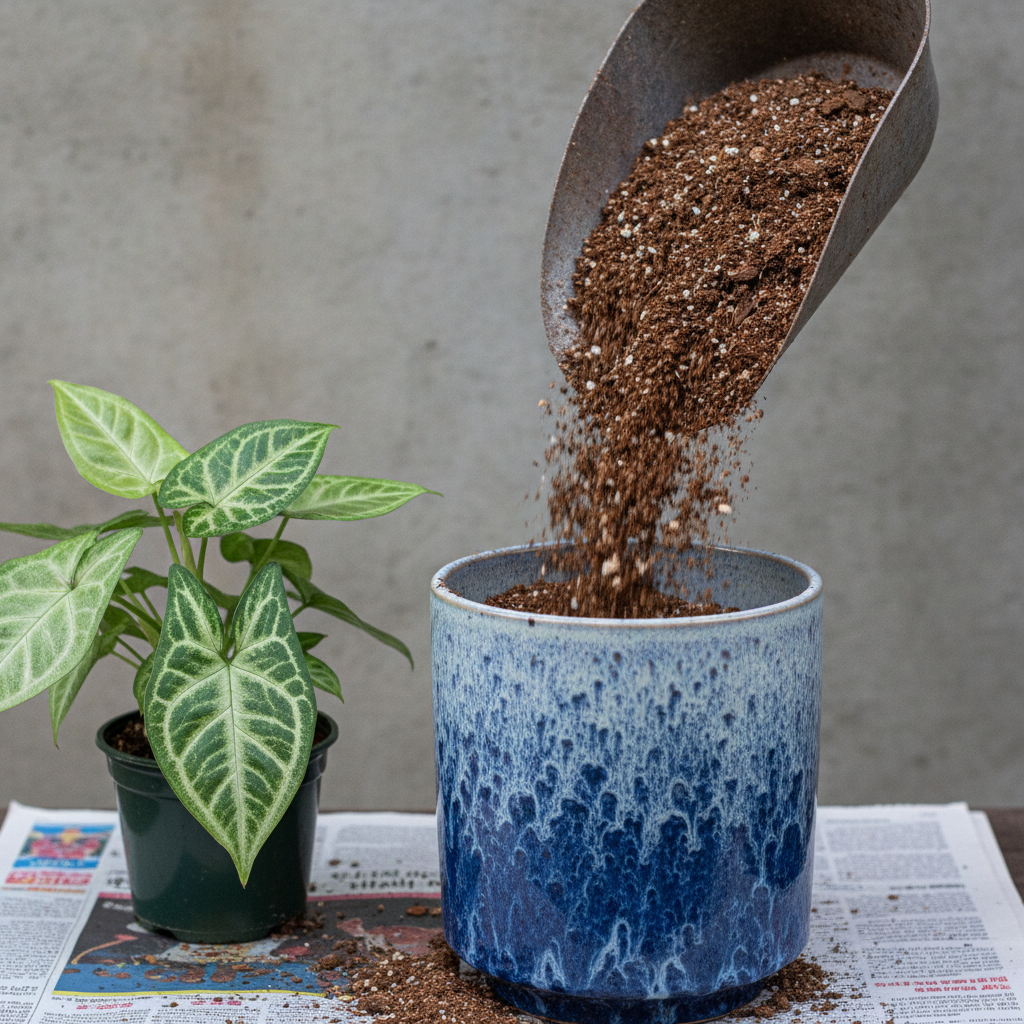
As an aroid, the Batik Syngonium wants a growing medium that holds a little moisture while draining fast and staying full of air. A dense, water-retentive potting compost used straight from the bag will hold too much water around the roots and invite rot. The goal is a mix that feels light and open in the hand, so that water passes through quickly and the roots are never starved of oxygen.
A dependable recipe combines roughly two parts standard houseplant compost, one part orchid bark, and one part perlite, with an optional handful of coco coir or worm castings for a little extra moisture retention and nutrition. The bark creates structure and air pockets, the perlite keeps the mix from compacting over time, and the compost supplies the body and nutrients. If you would rather not mix your own, a bagged aroid or monstera mix is formulated along exactly these lines and works well without adjustment.
Repot a Batik Syngonium every one to two years, or whenever roots begin circling the pot and creeping from the drainage holes. Choose a new pot only 2 to 5 cm (1 to 2 in) wider than the last, since an oversized pot holds a large volume of wet mix the small root system cannot use, which again raises the risk of rot. Any pot is fine as long as it has drainage holes; that single feature matters far more than the material it is made from. Spring and early summer, when the plant is growing actively, are the best times to repot so it recovers quickly.
Fertilising
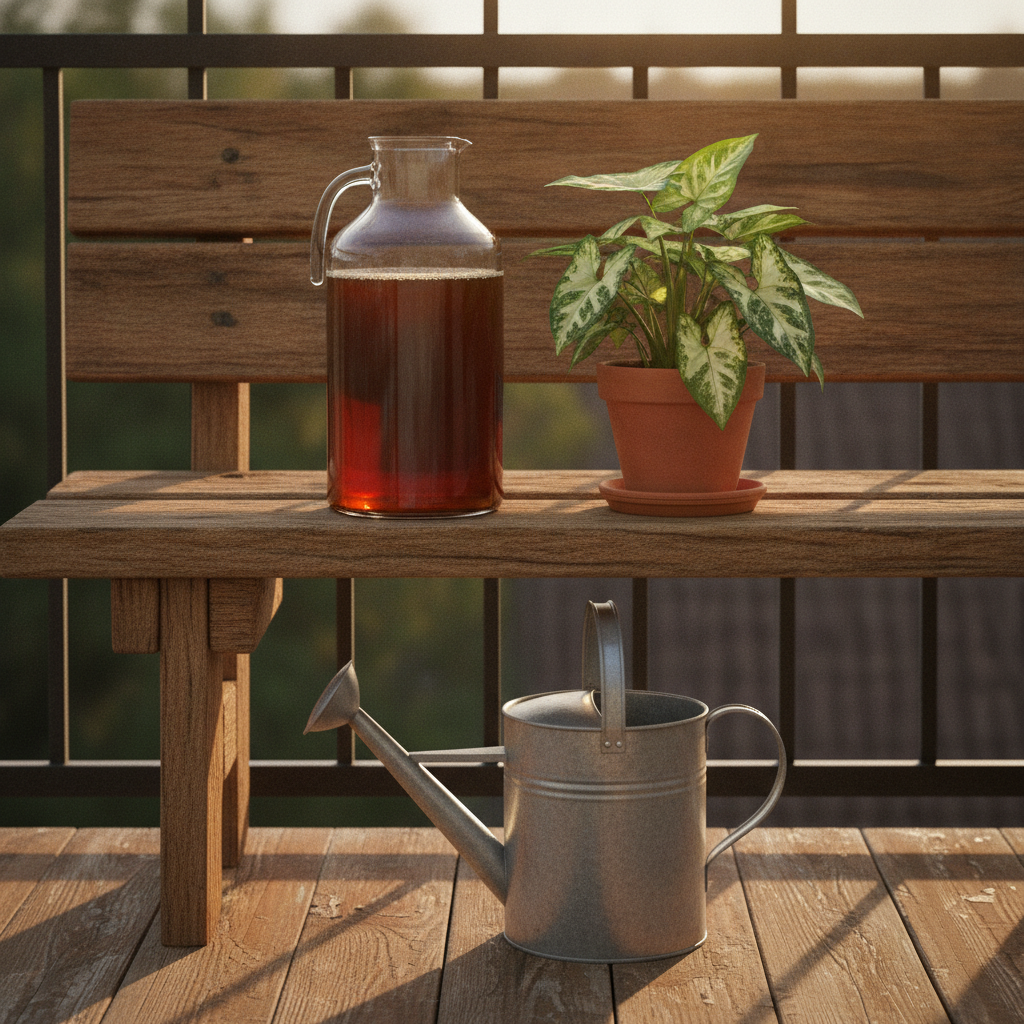
The Batik Syngonium is a fast grower when it is happy, and that pace draws on nutrients the potting mix alone cannot supply indefinitely. A modest feeding routine keeps new leaves emerging steadily and holds the foliage a healthy colour. Through the active growing months of spring and summer, apply a balanced liquid houseplant fertiliser diluted to half the strength listed on the label, roughly once a month. Half strength is deliberate, because Syngonium roots are sensitive to over-feeding and a lighter hand produces better results than a heavy one.
Always feed onto a mix that is already damp rather than bone dry, since applying fertiliser to parched roots can scorch them. Watering first and then feeding, or feeding with your normal watering, both work well. In autumn and winter, when growth naturally slows and light is limited, stop fertilising altogether and let the plant rest. Pushing feed at a plant that is not actively growing simply builds up unused salts in the mix.
Those mineral salts are worth watching. If you see a whitish crust forming on the surface of the mix or around the pot rim, or if leaf tips begin to brown and crisp, the plant may be carrying a build-up of fertiliser salts. Flushing the pot thoroughly with plain water two or three times, letting it drain fully between each pass, clears the excess and usually settles the problem. A gentle, consistent approach to feeding avoids the issue in the first place.
Propagation

Propagating a Batik Syngonium is one of the easiest jobs in indoor gardening, and it is the reason a single plant so often becomes a small collection. The plant grows from nodes along its stems, the slightly swollen points where a leaf meets the main stem, and each node carries the potential to root and become a new plant. The most reliable method is a simple stem cutting rooted in water, where you can watch the whole process unfold.
- Choose a healthy stem with at least one or two leaves and identify a node just below them. On a vining stem you may see small nub-like aerial roots already forming at the node, which is a good sign.
- Using clean, sharp scissors or secateurs, cut about 1 cm (half an inch) below the node so that the node itself is included on the cutting.
- Remove any leaf that would sit below the waterline, then place the cutting in a glass of clean, room-temperature water with the node fully submerged and the remaining leaves above the surface.
- Set the glass in bright, indirect light and refresh the water every few days to keep it clear and oxygenated.
- Within one to three weeks white roots should emerge from the node. Once they reach 3 to 5 cm (1 to 2 in) long, pot the cutting into a small container of moist aroid mix.
- Keep the newly potted cutting a little more consistently moist than usual for the first two weeks while the water-formed roots adapt to soil, then return it to your normal watering routine.
You can skip the water stage and root cuttings directly in damp potting mix if you prefer, which produces sturdier roots better suited to soil from the start, though you lose the pleasure of watching them grow. Either way, spring and summer give the fastest results, as the warmth and longer days drive quick rooting. Because ‘Batik’ is a stable cultivar, cuttings come true to the parent and carry the same striking veined foliage.
Pests and Common Problems
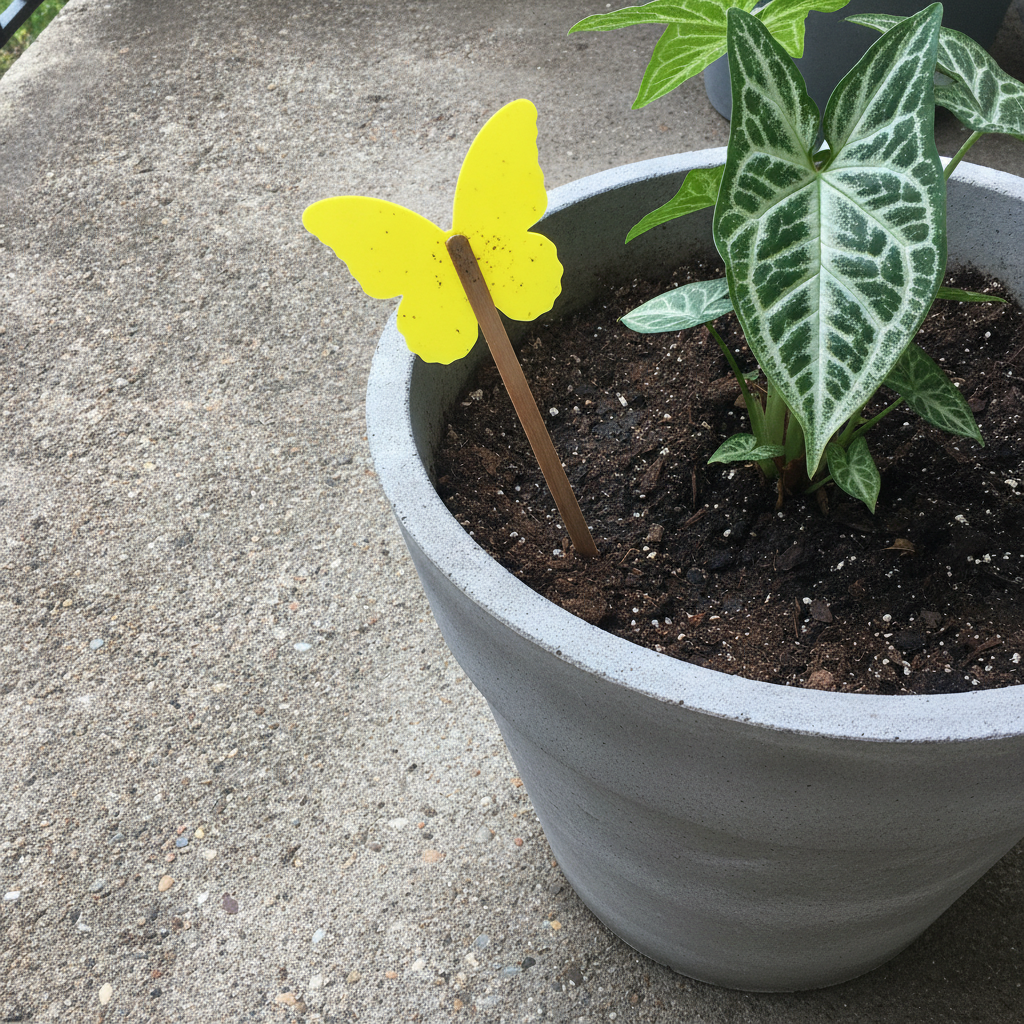
A healthy, well-lit Batik Syngonium is not especially prone to pests, but like any leafy houseplant it can attract the usual indoor troublemakers, particularly in dry air or when it is already stressed. The pests worth knowing are spider mites, mealybugs, aphids, scale and fungus gnats. Spider mites are the most common on Syngonium and reveal themselves through fine stippling on the leaves, faint webbing in the leaf axils, and a dull, tired look to the foliage; they multiply fastest in warm, dry conditions. Mealybugs appear as small white cottony tufts tucked where leaves meet stems, aphids cluster on soft new growth, and scale shows up as flat brown discs clinging stubbornly to stems and leaf undersides.
Catching any of these early makes them far easier to deal with, so inspect your plant, including the undersides of leaves, whenever you water. For a light infestation, wipe the leaves with a cloth dipped in soapy water or dab visible mealybugs with a cotton bud moistened in diluted rubbing alcohol. For anything more established, treat the whole plant with insecticidal soap or a neem oil solution, repeating every seven to ten days until the problem clears, and isolate the plant from your others while you do. Raising humidity and keeping the foliage clean both make spider mites far less likely to take hold in the first place.
Not every complaint is a pest. Yellowing lower leaves usually signal overwatering, while brown, crispy leaf tips point to dry air, inconsistent watering or a build-up of fertiliser salts. Pale, washed-out new growth that has lost its veining is a request for more light, and leggy stems with long gaps between leaves say the same. Fungus gnats, those small flies drifting up from the mix, are a sign the surface is being kept too wet; letting the top layer dry out between waterings and setting a yellow sticky trap nearby brings their numbers down quickly.
Warning — Keep it away from pets and children: Like all members of the arum family, the Batik Syngonium contains insoluble calcium oxalate crystals, which cause intense burning and irritation of the mouth and throat if chewed or swallowed. Keep it out of reach of cats, dogs and small children, and wash your hands after taking cuttings.
Varieties and Related Cultivars
The Batik Syngonium belongs to a large and endlessly collectable family of Syngonium podophyllum cultivars, each bred or selected for a different take on the arrowhead leaf. Once the batik veining has drawn you in, these close relatives are a natural next step, and they share almost identical care so you can grow a whole shelf of them on one routine. Two of the most popular are shown below.
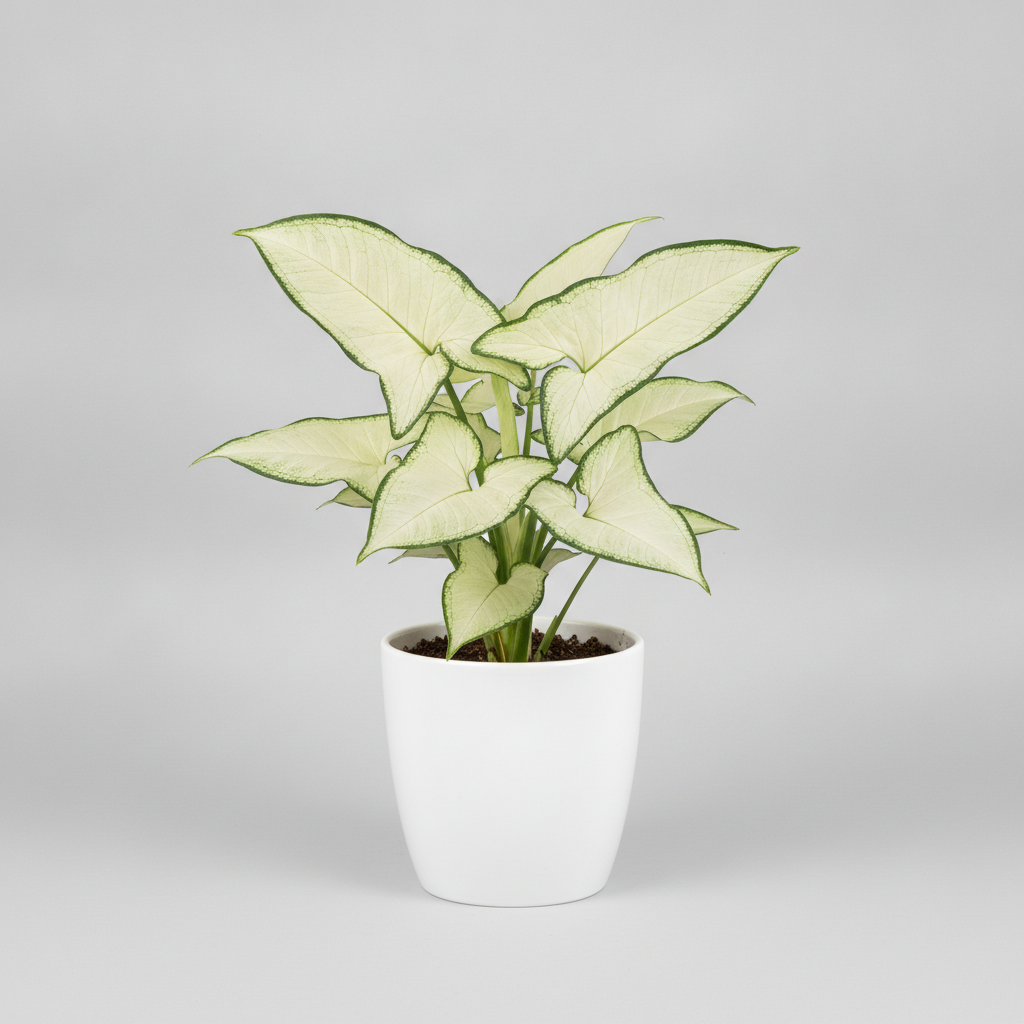
White Butterfly. The default arrowhead plant on most shop benches, ‘White Butterfly’ carries broad creamy-white leaf centres framed by slim green margins. It is vigorous, forgiving and holds its pale colouring well in bright indirect light, making it the natural companion to the more graphic Batik.
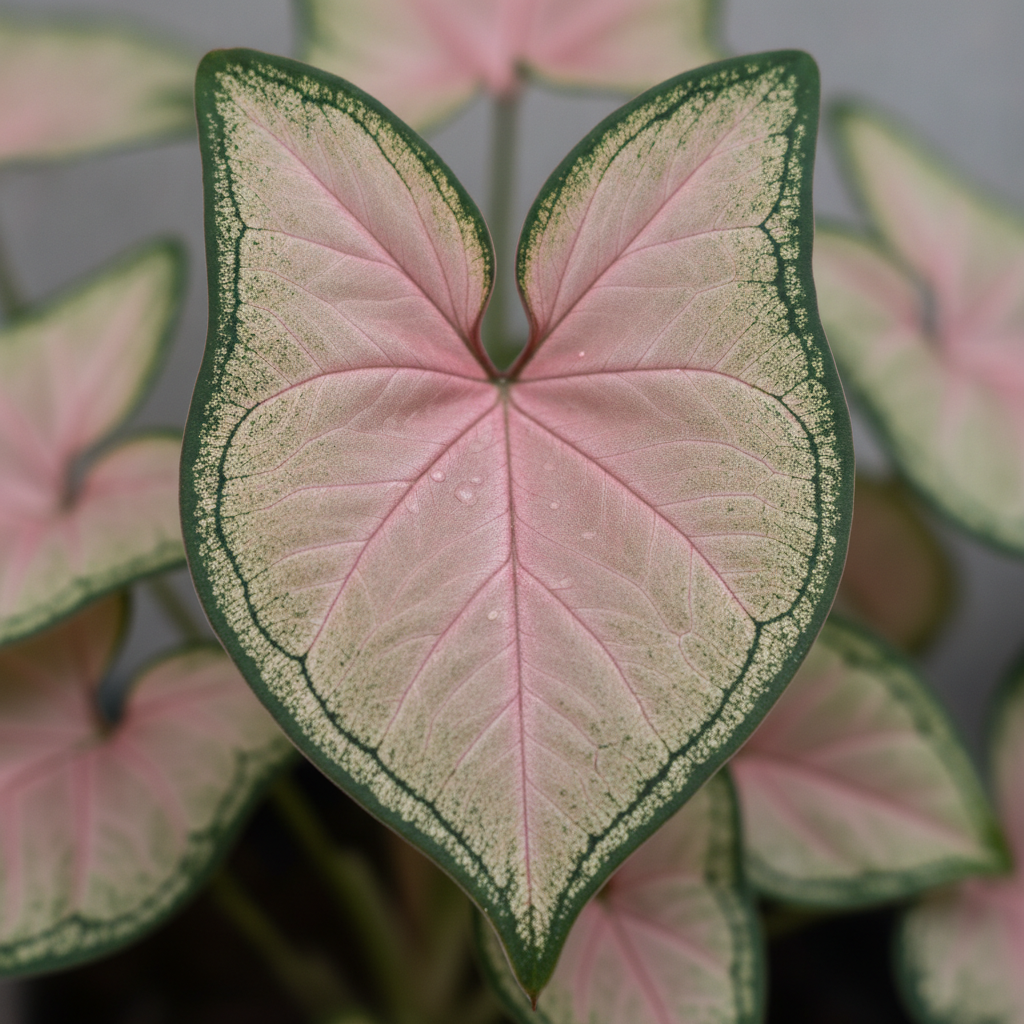
Pink Allusion. A softer, more romantic cultivar, ‘Pink Allusion’ washes its arrowhead leaves with pale pink through the centre, set off by dark green margins and fine pink veining. The pink deepens in good light and fades in shade, so it rewards a bright position just as the Batik does.
Other names worth seeking out include the near-neon ‘Neon Robusta’, the deep, moody ‘Maria’ and ‘Black Velvet’, and the boldly splashed ‘Confetti’ and ‘Mango Allusion’. All belong to the same species and respond to the same light, water and soil, so building a collection is largely a matter of shelf space and patience.
Frequently Asked Questions
Why is my Batik Syngonium losing its markings?
Fading veins and greener, flatter new leaves are almost always a light problem. The batik patterning depends on bright, indirect light, and in a dim spot the plant produces plainer foliage. Move it closer to a bright window, screened from direct sun, or add a grow light, and the contrast should return on new growth.
Is the Batik Syngonium toxic to cats and dogs?
Yes. It contains insoluble calcium oxalate crystals that cause painful burning and swelling of the mouth and throat, along with drooling and vomiting, if a pet chews the leaves. Keep it out of reach of cats, dogs and children, and place it where curious animals cannot easily nibble it.
Why are the leaves on my Batik Syngonium turning yellow?
Occasional yellowing of the oldest, lowest leaves is normal ageing. Widespread yellowing, especially with a soggy mix, usually means overwatering. Let the top few centimetres of mix dry before watering again, make sure the pot drains freely, and never leave it standing in water.
Should I let my Batik Syngonium climb or stay bushy?
That is entirely up to you. Left alone and pinched regularly, it stays a compact, mounding plant with the familiar arrowhead leaves. Given a moss pole to climb, it vines upward and produces larger, more lobed mature foliage. Both are healthy, so choose the look you prefer and prune toward it.
How fast does a Batik Syngonium grow?
In good light with regular feeding through spring and summer, it is a fast grower and can put out new leaves every couple of weeks. Growth slows markedly in autumn and winter as light fades, which is normal and nothing to worry about; it picks up again as the days lengthen.
Can I grow a Batik Syngonium in water permanently?
Cuttings root and can be kept in water for a long time, and many growers display them this way. For a fuller, longer-lived plant, though, potting rooted cuttings into an airy aroid mix gives better results, since soil supplies the nutrients and structure that plain water cannot sustain over the long term.






