
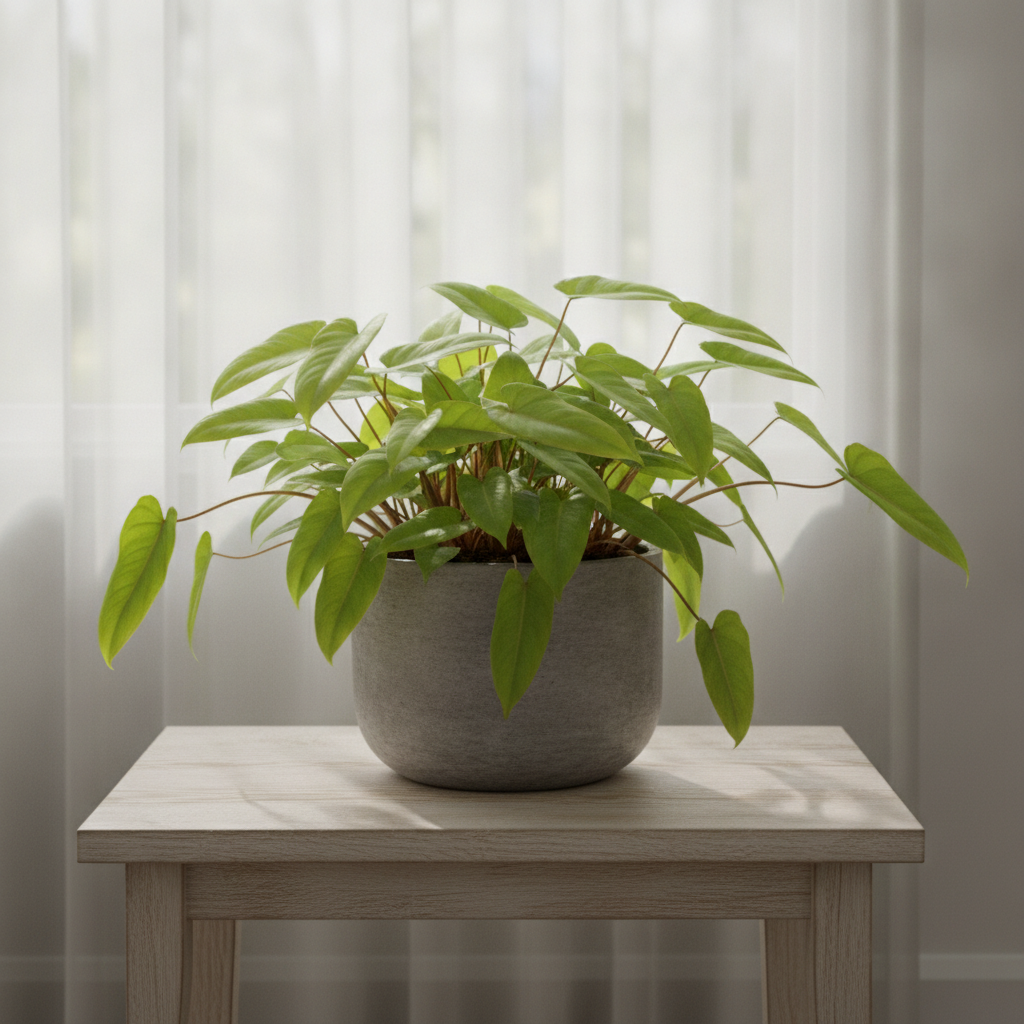
Few houseplants reward a little attention as generously as the Burle Marx philodendron. Named after the celebrated Brazilian landscape architect Roberto Burle Marx, Philodendron burle-marxii is a sprawling, fast-growing aroid from the humid forests of eastern Brazil, where it scrambles across the ground and over rocks and tree bases in a loose, shrubby mound. Its glossy, elongated heart-shaped leaves sit on slender reddish petioles and catch the light in a way that makes even a young plant look lush, and the species takes its place easily in a hanging basket, on a shelf where it can trail, or in a floor pot where it can spread into a generous clump.
This is a plant with a forgiving reputation, and deservedly so. It tolerates a wide range of indoor conditions and bounces back quickly from the occasional missed watering or awkward spot. Yet there is a real difference between a Burle Marx philodendron that merely survives, holding on with a few small leaves and leggy stems, and one that thrives, pushing out broad, deeply coloured foliage on a plant that doubles in size across a single growing season. This guide covers everything that separates the two, from light and water to soil, feeding, propagation, pests and the handful of cultivars worth seeking out.
Contents
- Quick Reference
- Why Burle Marx Philodendron Makes a Rewarding Houseplant
- Light Requirements
- Watering & Humidity
- Soil, Potting & Repotting
- Fertilising
- Propagation
- Pests & Diseases
- Popular Varieties
- Frequently Asked Questions
Quick Reference: Burle Marx Philodendron at a Glance
| Light | Bright, indirect light; tolerates medium light but grows slower |
| Watering | When the top 2 to 3 cm (about 1 inch) of mix has dried; roughly weekly in summer |
| Temperature | 18 to 27 degrees C (64 to 81 degrees F); avoid below 13 degrees C (55 degrees F) |
| Humidity | Happy at average room humidity; thrives above 60 percent |
| Fertiliser | Balanced liquid feed at half strength every 3 to 4 weeks in the growing season |
| Toxicity | Toxic to cats, dogs and humans if chewed (calcium oxalate crystals) |
Why Burle Marx Philodendron Makes a Rewarding Houseplant
The appeal of this philodendron starts with its sheer ease. It belongs to a group of tropical aroids that evolved on the shaded forest floor, which means it is naturally adapted to the lower, more diffuse light that most homes provide. Unlike fussier collector plants that sulk the moment conditions shift, the Burle Marx philodendron settles in quickly, tolerates the dry air of a centrally heated room, and forgives the kind of irregular watering that comes with a busy life. For anyone moving beyond their first pothos or snake plant, it is a confidence-building step up that still looks like a far more demanding species.
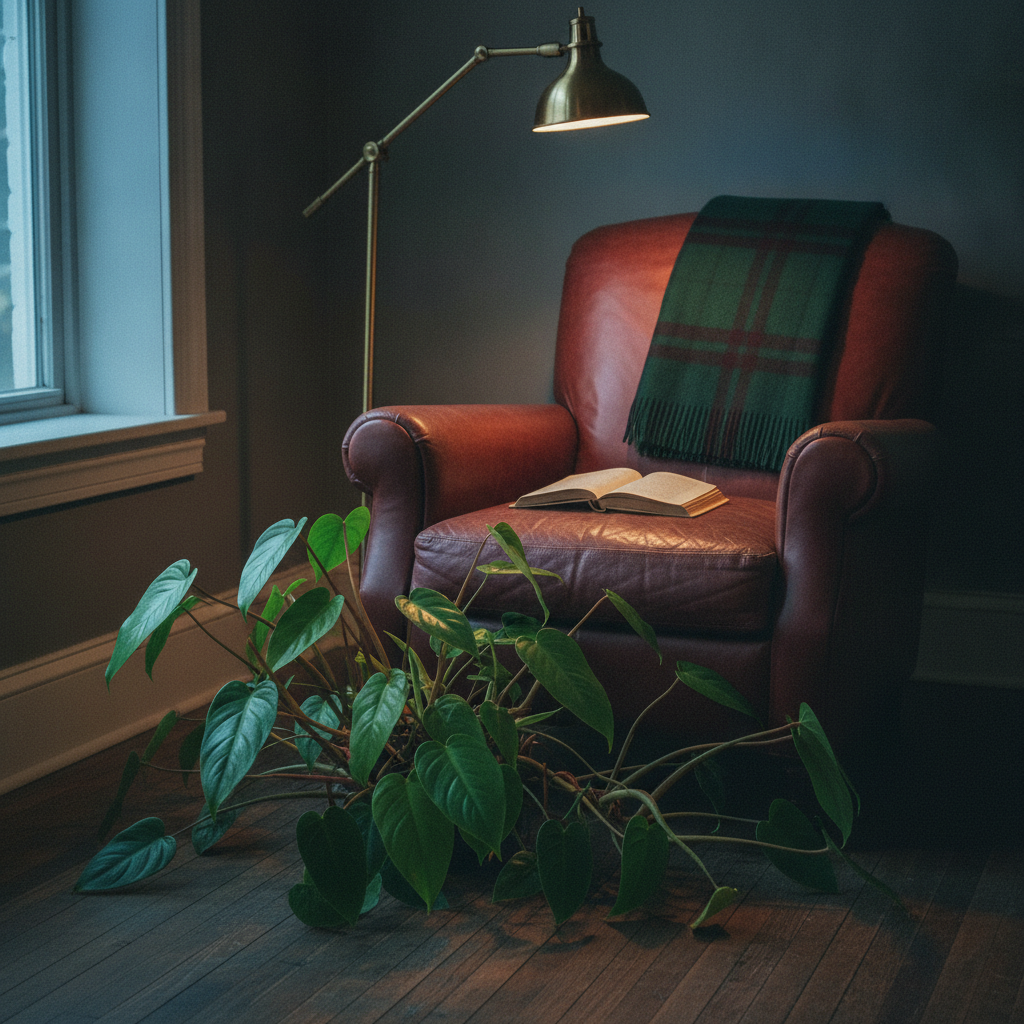
Beyond temperament, the plant earns its place on looks and pace. Healthy specimens grow fast, filling out a pot and spilling over the rim within a season, and the foliage holds a deep, even green that reads as both jungly and refined. The species works as ground cover at the base of taller plants, as a trailing accent on a shelf, or trained up a small moss pole into a more upright form. It is also widely available and inexpensive, so experimenting with placement, propagation and styling carries little risk. The one genuine caveat is toxicity, which matters in homes with curious pets or small children.
Important — Toxicity: Like all philodendrons, Philodendron burle-marxii contains insoluble calcium oxalate crystals. Chewing the leaves or stems can cause intense oral irritation, drooling, and swelling in cats, dogs and people. Keep it out of reach of pets and children, and wash your hands after pruning or taking cuttings.
Light Requirements
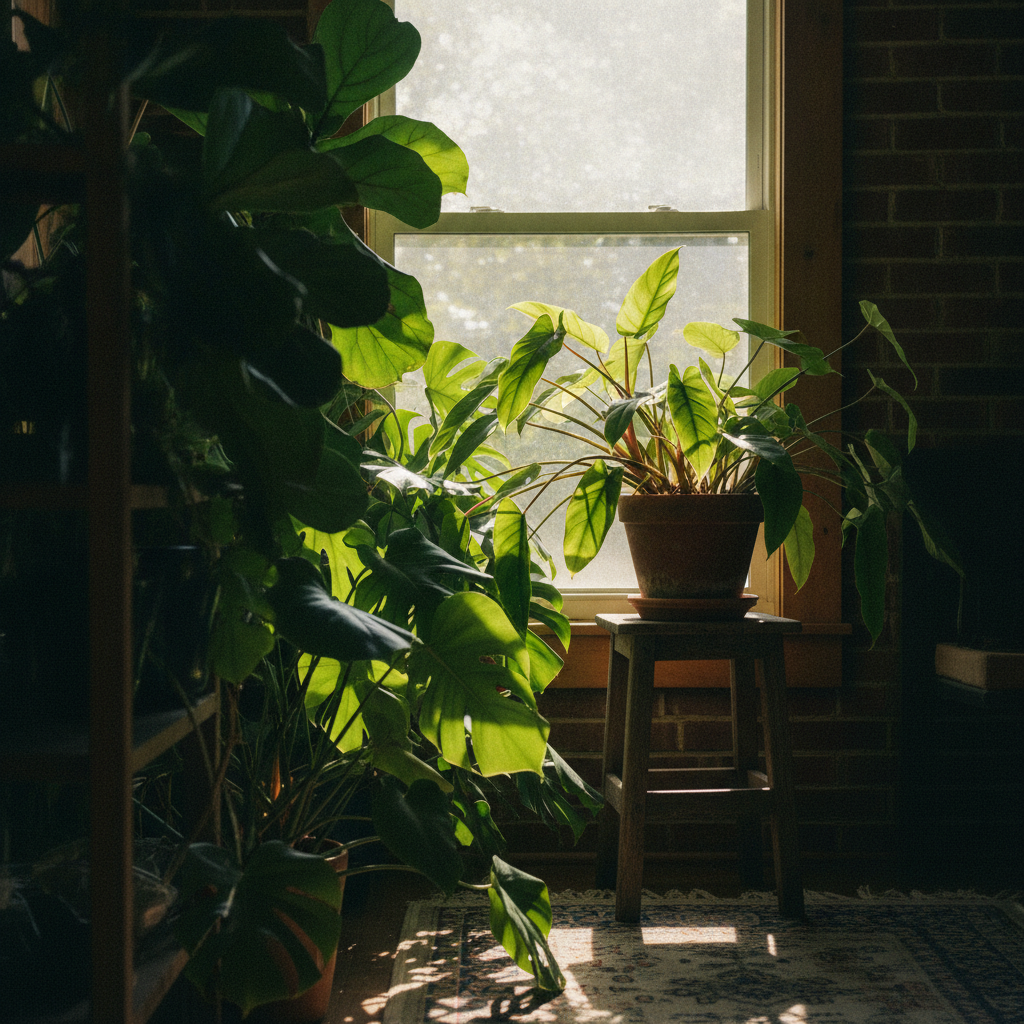
Light is the single biggest factor separating a thriving Burle Marx philodendron from a leggy, struggling one. In its native habitat the plant grows beneath a forest canopy, receiving plenty of bright but filtered light rather than direct sun. Recreating that indoors means giving it a position with strong ambient brightness and no more than a little gentle early or late direct sun on the leaves.
The ideal is bright, indirect light for most of the day: a spot a metre or two back from a sunny window, or directly beside a window that faces away from the harshest midday sun. In these conditions the plant produces compact growth, short internodes, and large, well-coloured leaves. It will survive in medium light, but expect slower growth, smaller foliage and longer gaps between leaves as the stems stretch toward the light.
Light Levels Explained
Indoor light is often misjudged because human eyes adjust so readily to dimness. The table below gives a rough guide to how different light levels translate into placement and likely outcome for this species.
| Light Category | Approx. Level | Typical Location | Outcome |
|---|---|---|---|
| Direct sun | Over 50,000 lux | On an unshaded south-facing sill | Risk of scorch and bleaching |
| Bright indirect | 10,000 to 25,000 lux | Near an east or filtered south window | Ideal; lush, compact growth |
| Medium | 5,000 to 10,000 lux | A metre or two from a bright window | Acceptable; slower, looser growth |
| Low | 1,000 to 5,000 lux | An interior wall or north corner | Survives but becomes leggy |
| Very low | Under 1,000 lux | A dim hallway or windowless room | Decline over time; not recommended |
Window Orientation and Placement
South-facing window: The brightest exposure in the northern hemisphere. Excellent if the plant is set back from the glass or behind a sheer curtain, but place it too close and the midday sun can scorch the leaves.
East-facing window: Often the sweet spot. Gentle morning sun followed by bright ambient light for the rest of the day suits this philodendron perfectly, with little risk of burning.
West-facing window: Works well, though the stronger afternoon sun means the plant is best positioned just to the side of the direct beam rather than squarely in it.
North-facing window: Provides soft, even light that the plant tolerates, but growth will be slower and looser. Place it as close to the glass as possible to make the most of the available light.
Pro Tip — Rotate for Even Growth: Because the plant leans toward its light source, give the pot a quarter turn each time you water. This keeps the clump balanced and stops all the new growth from crowding to one side.
How Light Affects Leaf Size and Habit
In good light, the Burle Marx philodendron keeps its internodes short, meaning the leaves emerge close together for a full, bushy look. Drop the light and the stems elongate, stretching the gaps between leaves and giving the plant a sparse, vine-like appearance. Variegated forms are even more light-dependent: their cream and lime markings need bright conditions to develop, and in dim light they tend to revert toward plain green as the plant prioritises chlorophyll.
Warning — Direct Sunlight: Several hours of unfiltered midday sun will bleach the glossy green leaves to a dull yellow and leave crisp brown scorch patches that never recover. Acclimatise the plant gradually if you move it to a brighter spot, increasing exposure over a week or two.
Artificial Lighting
This philodendron responds well to supplemental lighting, which makes it a good candidate for rooms that lack a bright window. A full-spectrum LED grow light positioned 30 to 45 cm (12 to 18 inches) above the plant and run for 10 to 12 hours a day will sustain healthy growth through dark winters or in interior spaces. Ordinary household bulbs do little for plants, so choose a fixture marketed specifically for horticulture.
Seasonal Adjustments
As the sun sits lower and weaker through autumn and winter, move the plant closer to its window to compensate for the drop in intensity, then ease it back in spring as light strengthens again. Growth naturally slows in the darker months, so do not be alarmed by the lull; it will resume once daylight lengthens.
Watering & Humidity
Watering is where most Burle Marx philodendrons are won or lost, and the principle is simple: this plant likes to be kept lightly moist but never waterlogged. Its roots need both moisture and air, so the goal is to water thoroughly and then allow the top of the mix to dry before the next round, rather than keeping the soil constantly soggy or bone dry.
When to Water
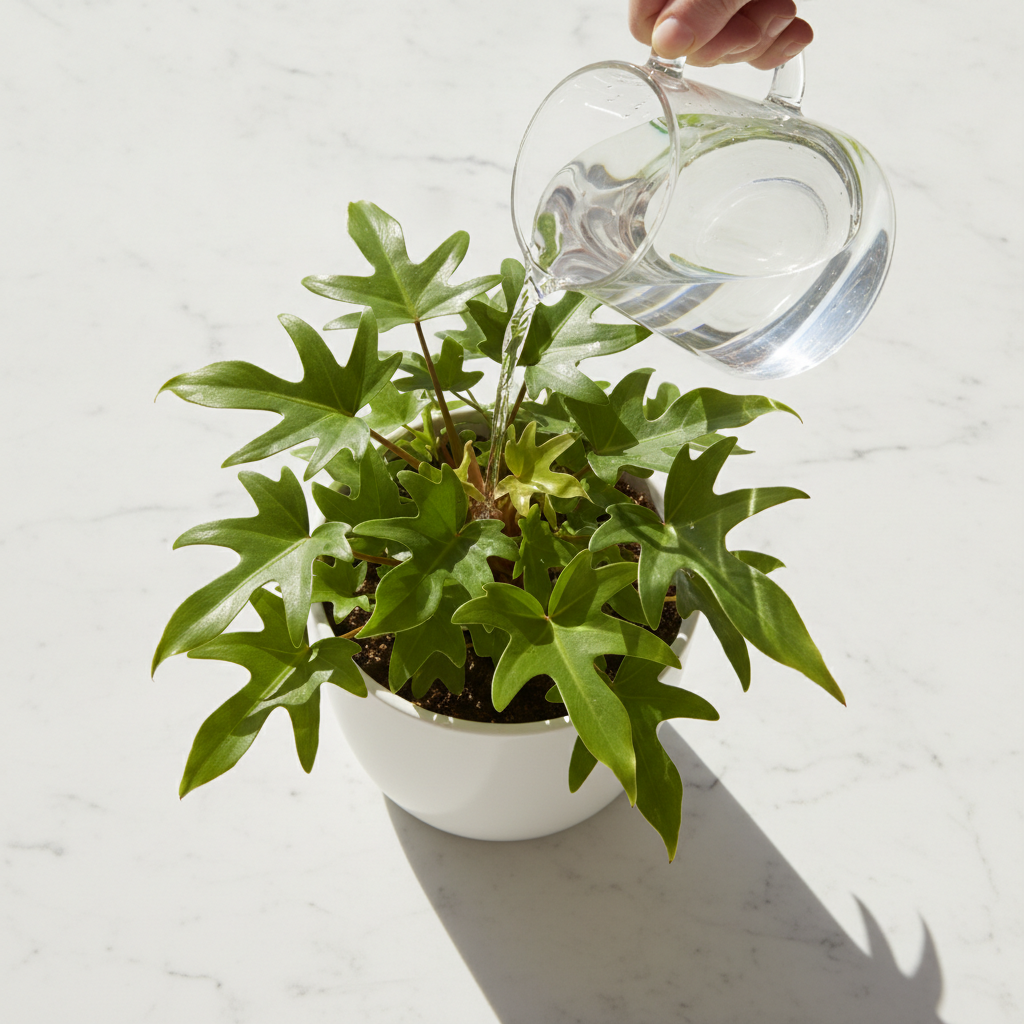
Check the mix with a finger rather than watering on a fixed schedule. When the top 2 to 3 cm (about 1 inch) feels dry, it is time to water. In a bright, warm spot during the growing season this often works out to roughly once a week, but the interval changes with the seasons, the pot size and your home conditions, so the feel of the soil always trumps the calendar.
In autumn and winter, when growth slows and evaporation drops, the mix stays wet for longer and watering should become noticeably less frequent. Letting the plant dry a little more deeply between drinks in the cooler months is far safer than maintaining a summer rhythm into a dim, cold January.
Pro Tip — The Weight Test: Lift the pot just after watering and again a few days later to learn how heavy “wet” and “dry” feel. With a little practice you can judge when to water by weight alone, which is more reliable than any schedule.
How to Water Correctly
- Check that the top few centimetres of mix have dried before you begin.
- Water slowly and evenly across the surface using room-temperature water.
- Continue until water runs freely from the drainage holes, which ensures the whole root ball is moistened.
- Let the pot drain completely for several minutes.
- Empty the saucer or cachepot so the plant never sits in standing water.
Signs of Overwatering vs. Underwatering
| Symptom | Overwatering | Underwatering |
|---|---|---|
| Leaf colour | Yellowing, often several leaves at once | Dull green fading to brown at the edges |
| Leaf texture | Soft, limp, sometimes translucent | Crisp, dry and curling |
| Soil | Stays wet for many days, may smell sour | Pulls away from the pot edge, very dry |
| Roots | Brown, mushy and foul-smelling | Dry and brittle but still pale |
| Stem base | Soft and darkened | Firm but shrivelled |
Warning — Root Rot: Persistent overwatering is the most common killer of this plant. If you find soft, dark, smelly roots, unpot immediately, trim away all affected tissue with sterilised scissors, and repot into fresh, airy mix. Reduce watering and improve drainage to prevent a recurrence.
Humidity Requirements
As a tropical species, the Burle Marx philodendron appreciates humidity, but it is far more adaptable than its rainforest origins suggest. It grows perfectly well at the average household humidity of 40 to 50 percent, and only really shows its gratitude with faster growth and glossier leaves when levels climb above 60 percent.
When the air is very dry, typically in winter when heating is running, you may notice crisp brown leaf tips or slightly smaller new growth. These are cosmetic rather than serious, but they are a useful signal that the plant would welcome a more humid microclimate.
To raise humidity, group it with other plants so they share transpired moisture, set the pot on a tray of damp pebbles, or run a small room humidifier nearby during the driest months. A naturally humid kitchen or bathroom with enough light also makes an excellent home. Misting offers only a brief lift and is not a reliable long-term solution.
Water Quality
This philodendron is not especially sensitive to tap water, but in hard-water areas mineral build-up can gradually brown the leaf tips. If you notice this, switch to filtered or rainwater, or leave tap water to stand overnight before using it so some of the chlorine dissipates. Room-temperature water is always kinder to the roots than cold water straight from the tap.
Soil, Potting & Repotting
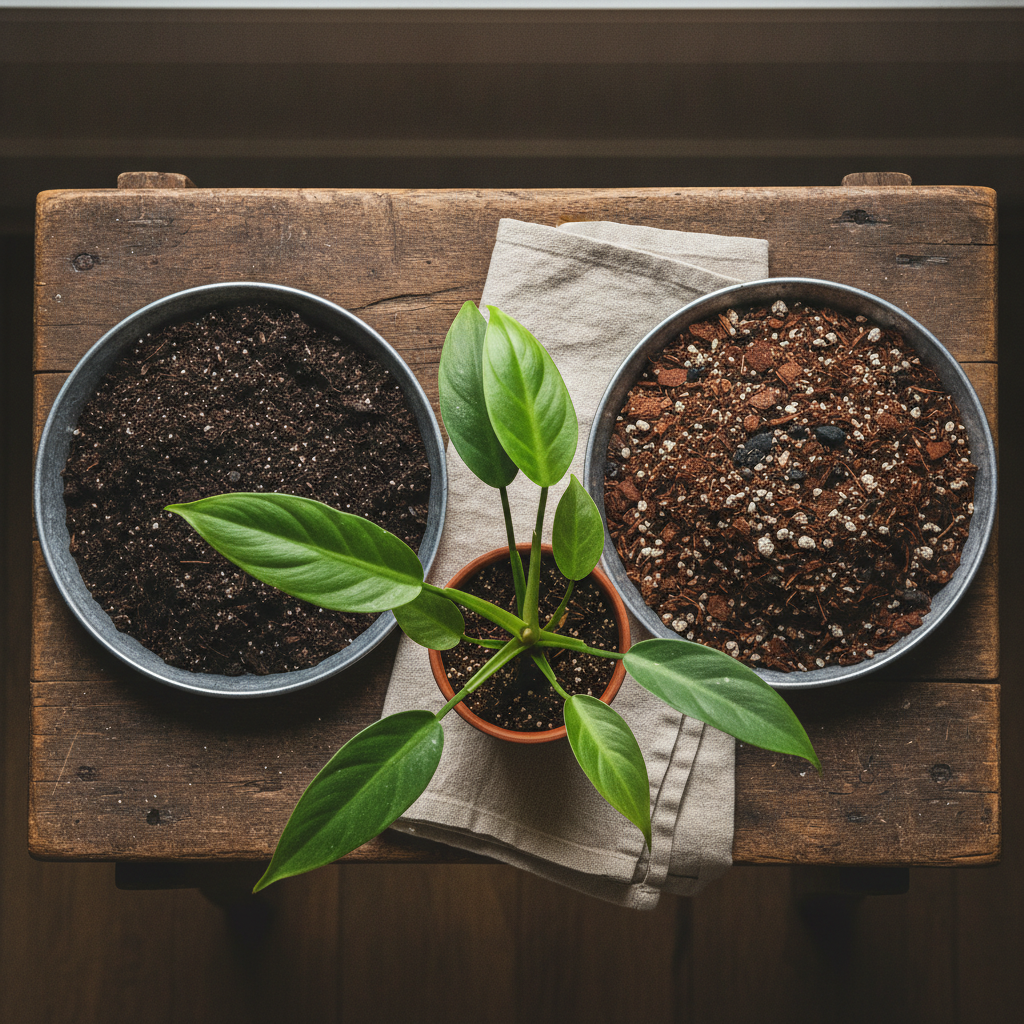
The right growing medium does more to keep this plant healthy than almost any other factor. As an aroid with thick, air-hungry roots, it needs a mix that holds some moisture while draining freely and staying loose enough for oxygen to reach the roots. A dense, water-retentive compost packed straight from the bag is the fast track to root rot.
Ideal Soil Composition
Aim for a chunky, open mix built around quality potting soil and loosened with coarse materials. The combination below holds enough moisture to keep the plant happy between waterings while leaving generous air pockets around the roots.
| Component | Proportion | Function |
|---|---|---|
| Quality potting mix | 40 percent | Base structure and moisture retention |
| Orchid bark | 25 percent | Air pockets and chunky structure |
| Perlite or pumice | 20 percent | Drainage and aeration |
| Coco coir | 10 percent | Even moisture without sogginess |
| Worm castings | 5 percent | Gentle, slow-release nutrition |
The plant prefers a slightly acidic to neutral root zone, in the range of pH 5.5 to 6.5, which a good aroid mix naturally provides. There is no need to test or adjust this for a typical houseplant; simply refresh the mix every couple of years to keep it open and lightly fertile.
Pro Tip — Quick Mix Recipe: No time to measure? Combine two handfuls of standard houseplant compost with one handful of orchid bark and one handful of perlite. That rough ratio drains well enough for this philodendron and takes under a minute to mix.
Choosing the Right Pot
Pot choice influences both how the plant grows and how forgiving its watering becomes. Because this is a sprawling, clumping species, a slightly wider pot gives it room to spread, and a hanging or raised pot lets the foliage trail attractively.
Drainage holes are non-negotiable. Whatever the material or style, the pot must have holes so excess water can escape. Decorative pots without drainage trap water against the roots; if you love the look of one, use it as a cachepot with a plain nursery pot tucked inside.
Pot material: Terracotta breathes and dries quickly, which suits heavy-handed waterers, while glazed ceramic and plastic hold moisture longer and suit those who tend to forget. Either works, provided you adjust your watering to match.
Pot size: Choose a pot only 2 to 4 cm (1 to 2 inches) wider than the current root ball. An oversized pot holds a large volume of wet soil that the roots cannot use, which raises the risk of rot.
When to Repot
This is a vigorous grower, so expect to repot every one to two years. Tell-tale signs include roots circling the bottom or pushing through the drainage holes, water that runs straight through without wetting the mix, and a plant that dries out far faster than it used to. Early spring, as growth resumes, is the best time to repot, giving the plant a full season to settle into its new home.
How to Repot: Step-by-Step
- Water the plant a day or two beforehand so the root ball slides out cleanly and the roots are less stressed.
- Ease the plant from its pot by tipping it and supporting the base, rather than pulling on the stems.
- Gently tease apart the outer roots and brush off some of the old, spent mix.
- Inspect the roots, trimming any that are soft, brown or rotten with sterilised scissors.
- Add fresh mix to the new pot, position the plant at its previous depth, and fill around the sides.
- Firm the mix lightly to remove large air gaps, then water thoroughly to settle everything in.
Warning — Transplant Shock: A little drooping in the days after repotting is normal. Resist the urge to compensate with extra water or feed, which only adds stress. Keep the plant in stable, bright indirect light and let it recover at its own pace.
Fertilising
Given its fast growth, the Burle Marx philodendron is a hungrier plant than many of its low-maintenance cousins, and regular feeding through the growing season pays off in larger leaves and quicker filling out. That said, it is easy to overdo, and too much fertiliser does more harm than too little.
The aim is steady, gentle nutrition rather than occasional heavy doses. A diluted balanced feed applied regularly while the plant is actively growing keeps it well supplied without the risk of burning the roots or building up salts in the mix.
Understanding Plant Nutrients
Most houseplant fertilisers list three numbers, the N-P-K ratio, representing nitrogen, phosphorus and potassium. For a foliage plant like this one, a balanced or slightly nitrogen-led formula supports the leafy growth you want. The table below outlines the key nutrients and what their shortage looks like.
| Nutrient | Symbol | Primary Function | Deficiency Symptoms |
|---|---|---|---|
| Nitrogen | N | Leafy growth and rich green colour | Pale, yellowing older leaves |
| Phosphorus | P | Root and stem development | Stunted growth, dull foliage |
| Potassium | K | Overall vigour and water regulation | Brown leaf edges and weak stems |
| Calcium | Ca | Cell wall strength | Distorted, weak new growth |
| Magnesium | Mg | Core of the chlorophyll molecule | Yellowing between leaf veins |
| Iron | Fe | Chlorophyll production | Pale new leaves with green veins |
Types of Fertiliser
Liquid fertilisers: The easiest choice for this plant, diluted into water and applied during normal watering. They give you precise control over strength and timing, which suits a fast grower that benefits from little and often.
Slow-release granular: Pellets mixed into the surface of the soil that release nutrients gradually over several months. Convenient and low-effort, though you lose some control over exactly how much the plant receives at any moment.
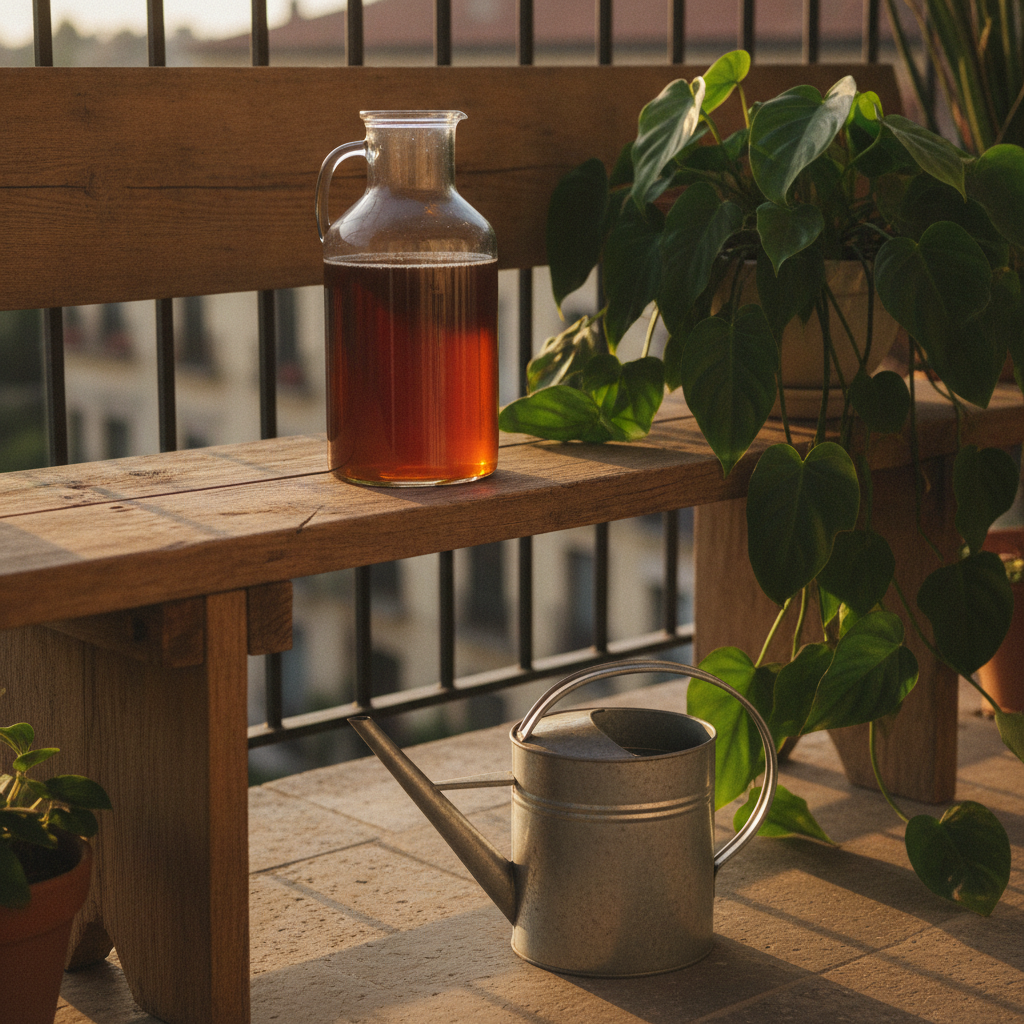
Organic fertilisers: Worm castings, compost tea and similar gentle feeds build soil health over time and are almost impossible to overdo. They release nutrients slowly and improve the structure of the mix as a bonus.
Feeding Schedule
Feed every three to four weeks through spring and summer using a balanced liquid fertiliser at half the strength listed on the label. As growth slows in autumn, taper off, and stop feeding entirely through the depths of winter when the plant is barely growing and cannot use the nutrients.
Pro Tip — Half Strength, Double Frequency: Diluting your feed to half the recommended concentration and applying it a touch more often gives steadier nutrition and far less risk of fertiliser burn than occasional full-strength doses.
How to Fertilise
- Water the plant lightly first if the mix is very dry, to protect the roots from a concentrated dose.
- Dilute the fertiliser to half strength in a watering can.
- Apply evenly across the soil surface until it begins to drain from the bottom.
- Avoid splashing the diluted feed onto the leaves, and wipe off any that lands.
Warning — Salt Build-Up: Over time, fertiliser salts accumulate in the mix and can show up as a white crust on the soil or pot and as brown leaf tips. Flush the pot thoroughly with plain water every couple of months, letting it run freely from the drainage holes to wash the salts away.
Propagation
One of the great pleasures of the Burle Marx philodendron is how willingly it propagates. A single healthy plant quickly yields material for new plants, whether you want to fill out a sparse pot, share cuttings with friends, or simply rejuvenate an older, leggy specimen.
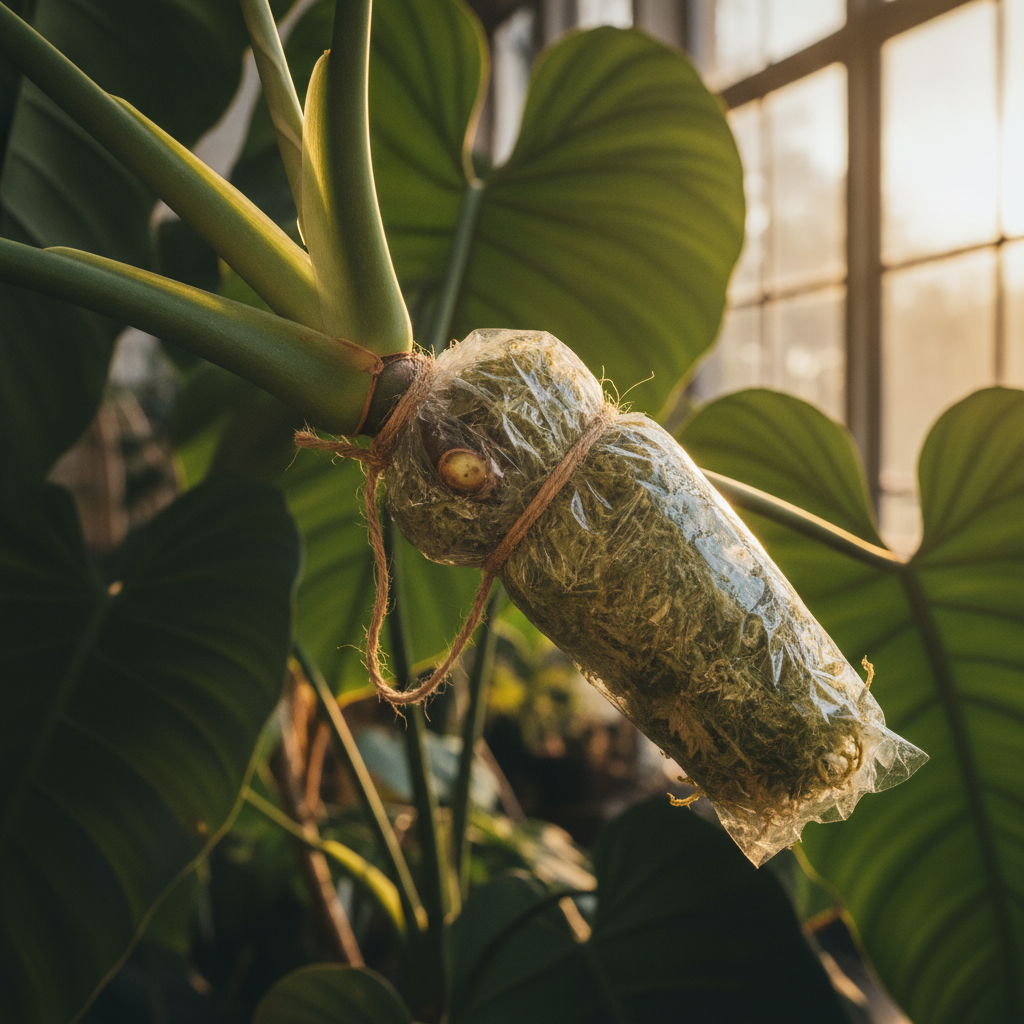
The two most reliable methods are stem cuttings and division, with air layering as a useful option for thicker or more established stems. All three rely on the same key structure, the node, and all are best attempted in spring or summer when the plant is growing strongly.
Understanding Nodes and Aerial Roots
A node is the slightly swollen point on a stem where a leaf emerges, and it is from here that new roots and growth develop. On this philodendron you can often see small aerial roots or root nubs forming at the nodes along the stem. Any cutting you take must include at least one node, because a leaf alone, with no node, will never grow into a new plant no matter how long it sits in water.
Stem Cuttings: Step-by-Step
This is the simplest and most popular method, ideal for sharing plants and for taming a stem that has grown too long. Cuttings root readily in either water or a moist propagation mix.
- Choose a healthy stem and locate a node, ideally one with a small aerial root already showing.
- Cut about 1 cm below the node using clean, sharp scissors or a knife.
- Remove the lowest leaf so a bare node sits below the waterline or under the mix.
- Place the cutting in a jar of room-temperature water or insert it into moist propagation mix.
- Keep it in bright, indirect light and refresh the water every few days if rooting in water.
- Once roots reach 3 to 5 cm (1 to 2 inches), pot the cutting up into your usual aroid mix.
Pro Tip — Plant Several Together: Because each cutting becomes a single stem, potting three or four rooted cuttings into one pot gives a fuller, bushier plant far faster than relying on a single cutting to branch out.
Division: Step-by-Step
As a clumping plant, mature specimens naturally form separate crowns that can be split into independent plants. Division is best done at repotting time and gives you instantly sized new plants rather than waiting for cuttings to grow.
- Remove the whole plant from its pot and gently shake off loose mix to expose the root system.
- Identify natural clumps, each with its own stems and healthy roots.
- Tease the sections apart by hand, or cut through dense roots with a sterilised knife.
- Pot each division into its own appropriately sized container of fresh aroid mix.
- Water in well and keep the new plants in bright, indirect light while they settle.
Troubleshooting Propagation
| Problem | Likely Cause | Solution |
|---|---|---|
| Cutting rots in water | Dirty water or no node submerged | Refresh water often, ensure a clean node is below the surface |
| No roots after weeks | Low light or cool temperatures | Move somewhere brighter and warmer, above 20 degrees C (68 degrees F) |
| Leaves yellow on cutting | Normal energy use, or stress | Be patient if a node is healthy; remove badly affected leaves |
| Roots but no new growth | Cutting still establishing | Pot up and wait; top growth follows root establishment |
Pests & Diseases
A healthy, well-grown Burle Marx philodendron is fairly resistant to trouble, and most problems trace back to stress from incorrect watering or very dry air rather than to inherent fragility. Still, the usual indoor pests will take advantage of a weakened plant, so regular inspection is the best defence.
Make a habit of checking the undersides of leaves and the leaf axils whenever you water. Catching an infestation early, when only a few insects are present, makes treatment quick and easy, whereas an established colony can take weeks to clear.

Common Pests
Spider Mites (Tetranychus urticae)
Tiny sap-sucking arachnids that thrive in warm, dry air. They leave fine pale stippling on the leaves and, in bad cases, delicate webbing in the leaf joints. The plant looks dull and dusty before the damage becomes obvious.
Treatment: Rinse the plant in the shower to dislodge as many as possible, then treat with insecticidal soap or neem oil every few days. Raising humidity makes the environment far less hospitable to them.
Mealybugs (Pseudococcus species)
Small, soft insects coated in a white, cottony wax, usually clustered in leaf axils and along stems. They suck sap and excrete sticky honeydew that can lead to sooty mould.
Treatment: Dab each insect with a cotton bud dipped in isopropyl alcohol, then follow up with neem oil. Repeat weekly until no new bugs appear, checking hidden crevices carefully.
Fungus Gnats (Bradysia species)
Small black flies that hover around the soil surface, their larvae living in consistently moist mix where they feed on organic matter and fine roots. They are more a nuisance and a sign of overwatering than a serious threat.
Treatment: Let the top of the mix dry out more between waterings, use yellow sticky traps to catch the adults, and top-dress with a thin layer of grit to break the breeding cycle.
Common Diseases
Root Rot (Pythium and Phytophthora)
The most serious disease this plant faces, caused by waterlogged conditions that suffocate the roots and let fungal pathogens take hold. Symptoms include yellowing, wilting despite wet soil, and soft, blackened roots with a foul smell.
Treatment: Unpot the plant, cut away all rotten roots with sterilised scissors, and repot into fresh, airy mix in a clean pot. Reduce watering sharply and improve drainage to stop the problem returning.
Bacterial Leaf Spot (Erwinia and Xanthomonas)
Appears as dark, water-soaked spots on the leaves, often ringed with a yellow halo, that can spread quickly in warm, wet, poorly ventilated conditions. It is encouraged by water sitting on the foliage.
Treatment: Remove affected leaves promptly, avoid wetting the foliage when watering, and improve air circulation around the plant. Isolate it from other plants until the spread has stopped.
Pest and Disease Summary
| Pest / Disease | Identification | Treatment |
|---|---|---|
| Spider mites | Fine stippling and webbing | Rinse, neem oil, raise humidity |
| Mealybugs | White cottony clusters | Alcohol swab then neem oil |
| Fungus gnats | Small flies over the soil | Dry out mix, sticky traps, grit top-dressing |
| Root rot | Soft black roots, wilting | Trim roots, repot, reduce watering |
| Bacterial leaf spot | Dark haloed leaf spots | Remove leaves, keep foliage dry |
Prevention Strategies
Prevention is far easier than cure. Inspect new arrivals before introducing them to your collection, and quarantine them for a couple of weeks to be sure they are pest-free. Keep the plant well cared for, since a vigorous specimen shrugs off the occasional pest far better than a stressed one.
Wipe the leaves with a damp cloth every few weeks to keep them clean and let you spot trouble early, and maintain good airflow around the plant to discourage both fungal disease and the humid, stagnant conditions some pests prefer. Sensible watering, avoiding constant sogginess, removes the single biggest underlying cause of disease.
Pro Tip — Neem as Routine: A light monthly spray of diluted neem oil, applied in the evening so the leaves are not in direct sun, works as a gentle preventative that keeps most common pests from ever establishing.
Popular Varieties
While the standard green Burle Marx philodendron is handsome in its own right, a few cultivated forms have become sought after for their colour and markings. These keep the same easygoing nature as the species while offering something a little different to look at.
It is worth noting that some plants sold under the Burle Marx name, such as the finely cut Burle Marx Fantasy, are actually distinct hybrids rather than true forms of Philodendron burle-marxii. The genuine cultivars below share the species’ classic elongated heart-shaped leaf and clumping habit.
| Variety | Leaf Appearance | Light Needs | Growth Rate | Availability |
|---|---|---|---|---|
| Standard green | Glossy deep green, heart-shaped | Bright indirect | Fast | Very common |
| Burle Marx Variegata | Cream and lime marbling over green | Bright indirect | Moderate | Uncommon |
| Gold Burle Marx | Bright chartreuse to golden green | Bright indirect | Fast | Uncommon |
| Inconstant variegata | Unstable green and yellow splashes | Bright indirect | Moderate | Rare |
Featured Varieties
Burle Marx Variegata
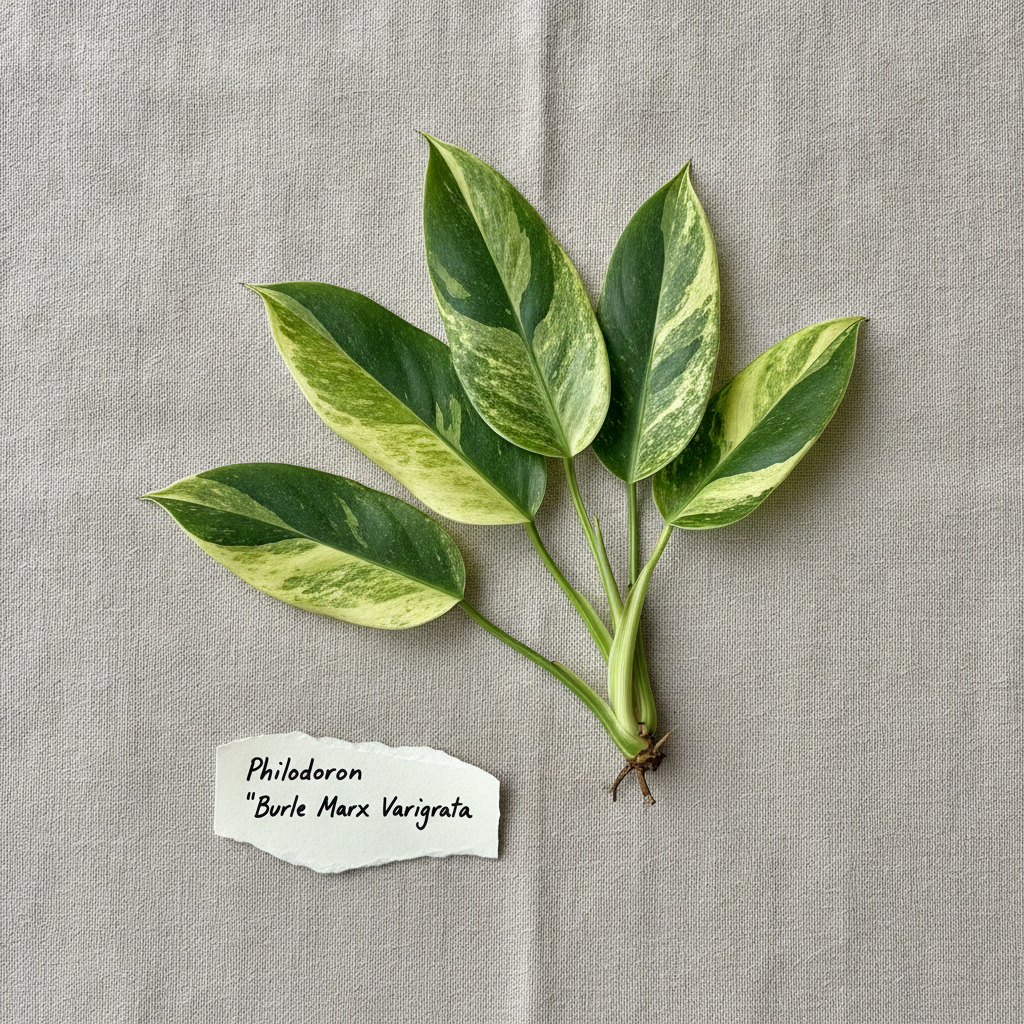
The most prized form, with glossy leaves splashed and marbled in creamy yellow and lime over deep green. No two leaves are alike, and bright light is essential to keep the variegation vivid.
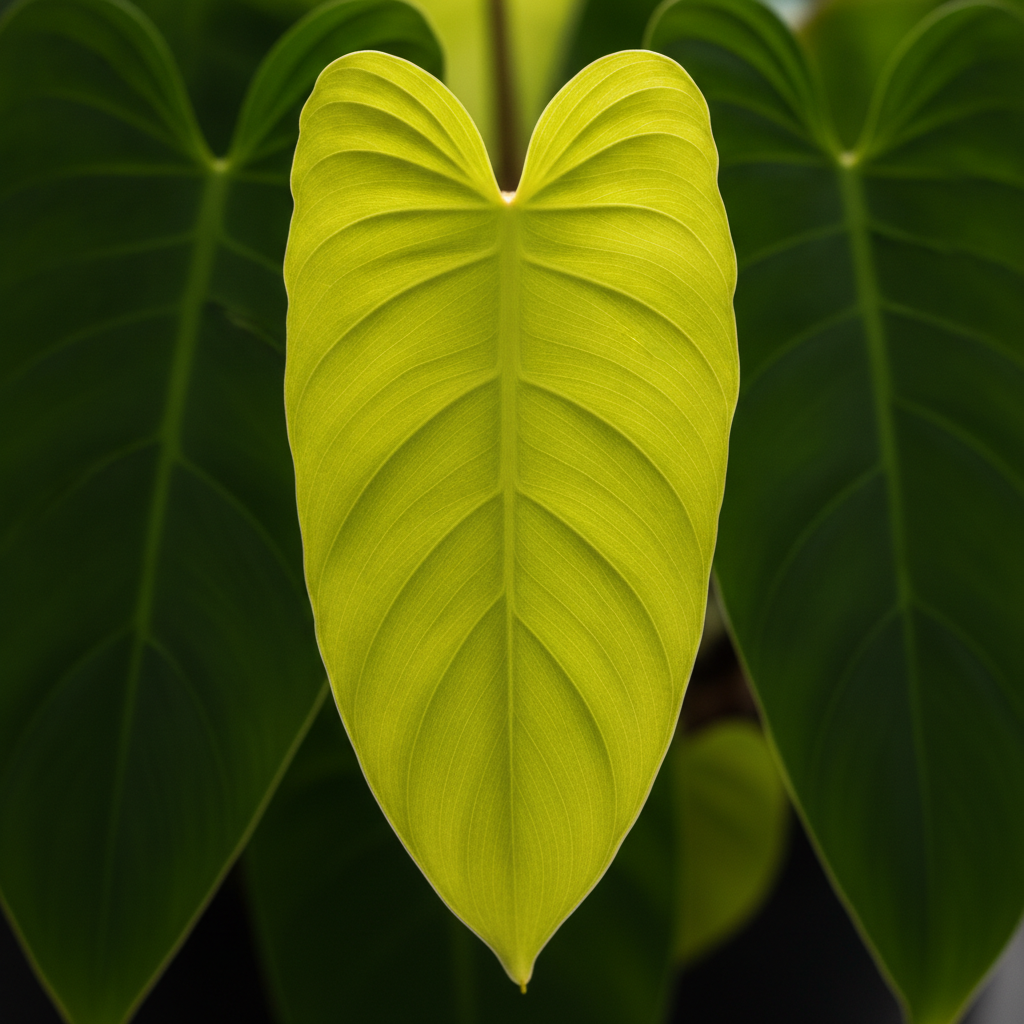
Gold Burle Marx
A uniformly bright form whose chartreuse to golden green leaves glow almost lime in good light. It keeps the fast growth of the species while bringing a vivid splash of colour to a shelf or hanging pot.
Variety Profiles in Detail
Burle Marx Variegata (Philodendron burle-marxii ‘Variegata’)
This cultivar takes the species’ elongated heart-shaped leaf and overlays it with irregular sectors of cream, butter yellow and lime. Because the variegation is somewhat unstable, individual stems can range from heavily marked to nearly all green, and pruning back to a well-variegated node helps steer the plant toward more colourful growth. It grows a little more slowly than the plain green form and rewards bright, indirect light with its best contrast.
Gold Burle Marx (Philodendron burle-marxii ‘Gold’)
Rather than variegation, this form carries an even golden-green wash across the whole leaf, brightest on new growth and deepening slightly with age. It is more stable than the variegated form and retains the vigorous, sprawling habit of the species, making it an easy way to add a lift of colour without the unpredictability of marbled foliage.
Choosing the Right Variety for Your Space
For a fast, fuss-free green plant to fill a corner or trail from a shelf, the standard form is hard to beat and very affordable. If you have a genuinely bright spot and want a statement piece, the variegata is worth the search, provided you can give it the light its markings demand. The gold form is a happy middle ground, offering colour with the easy reliability of the plain species.
Frequently Asked Questions
Is the Burle Marx philodendron easy to care for?
Yes, it is one of the more beginner-friendly philodendrons. It tolerates a range of light levels, forgives the occasional missed watering, and grows quickly enough to feel rewarding. The main thing to get right is avoiding overwatering, which is the most common cause of problems.
Why are the leaves on my plant turning yellow?
The usual culprit is overwatering, especially if several leaves yellow at once and the soil stays wet. Check that the mix drains freely and let the top few centimetres dry before watering again. An occasional yellow older leaf, however, is simply the plant shedding its oldest growth and nothing to worry about.
Does it need a moss pole?
It does not require one, since it grows naturally as a sprawling, clumping plant rather than a tall climber. That said, providing a small moss pole or trellis encourages a more upright habit and can produce slightly larger leaves as the plant climbs, so it comes down to the look you prefer.
How fast does it grow?
In good conditions it is a fast grower, capable of putting out new leaves every couple of weeks through spring and summer and noticeably filling out its pot across a single season. Growth slows or pauses in winter, which is entirely normal.
Is it safe around pets and children?
No. Like all philodendrons, it contains calcium oxalate crystals that cause painful oral irritation and swelling if chewed by cats, dogs or people. Position it out of reach, and seek veterinary or medical advice if ingestion is suspected.
Can I grow it in water permanently?
You can keep it in water for a long time, and it roots readily there, but it will grow more strongly and live longer in a proper aroid mix. If you do grow it in water, change the water regularly and add a few drops of dilute hydroponic fertiliser to supply the nutrients it would otherwise draw from soil.
Why is my plant leggy with small leaves?
This is almost always a sign of insufficient light. The stems stretch and the leaves shrink as the plant reaches for a brighter source. Move it closer to a window or add a grow light, and prune the leggy stems back to encourage fuller, more compact growth.
How do I make my plant bushier?
Prune leggy stems just above a node to encourage branching, and pot several rooted cuttings together rather than relying on one stem. Combined with bright light and regular feeding through the growing season, this quickly produces a full, lush plant.






